Category: RESEARCH

  • Kantar debuts sustainability study in India

    By Our Staff

    Kantar, the data-driven analytics and brand consulting company, has released preliminary findings from a new study exploring what sustainability means to Indian consumers. Kantar’s Asia Sustainability Foundational Study interviewed nearly 10,000 consumers across nine countries in the region, including India, to understand their concerns and priorities.

    Key findings from the India Sustainability Foundational study include:

    • In India, a country faced with numerous socio-economic issues, resource scarcity and environmental challenges, the issues closest to home take precedence for consumers.

    • And despite these challenges as a developing nation, the concerns of Indian consumers go beyond their basic rights, as sustainability issues are interlinked with their daily lives.

    • The top 5 sustainability concerns of Indian consumers are:

    1. Water pollution

    2. Poverty and hunger

    3. Deforestation

    4. Lack of access to healthcare and vaccinations

    5. Air pollution

    • Consumers’ concerns vary depending on the category in question, so brands developing their sustainability strategy need to understand this in order to focus their efforts. For example, consumers expect food brands to avoid over packaging and to discourage wastage. To gain competitive advantage in this category, brands need a credible back story around the “farm to fork” journey of their products – and to demonstrate that they are taking steps to minimise the impacts of intensive farming such as over-use of pesticides.

    Around 48% of consumers in India are active and engaged on sustainability issues. This group is more conscious of the impact of their own choices. 77% say they are prepared to invest time and money in companies that try to do good. But intent is not always translating into action; 84% of consumers still prioritise saving money over saving the planet when it comes to their real-world actions.

    Though most Indians express willingness to spend time and money to support companies that do good, the Value-Action Gap is still significant, with consumers often failing to act on these good intentions. For example, 65% of consumers report that they throw recyclable waste in the trash or dustbin.

    Further, the study measures the three factors persistently undermining sustainable consumer behaviour:

    • Cost – at the time of purchase, 84% say they prioritise saving money over saving the planet.

    • Comfort – 76% say they do not have enough information to choose sustainable options.

    • Convenience – 72% say they tend to forget about sustainability in their busy day-to-day lives.

    The research additionally introduces Kantar’s Sustainability Framework which businesses can use to build a consumer-centric strategy for success. This leverages a ‘Sword and Shield’ approach to better understand how brands in different categories can responsibly navigate sustainability issues by identifying where to focus their attention, how to localise their brand purpose to address local consumer tensions, and how to innovate to overcome the Value-Action-Gap.

    Commenting on the findings, Paru Minocha, Head of Sustainable Transformation Practice, at Kantar’s India office  said: “India’s stage of growth and increasing consumer consciousness regarding sustainability gives it huge potential to create commercial value and address environmental and social issues. Consumers are looking for brands that have social and environmental purpose, so from a marketing standpoint, purpose is imperative, and sustainability will potentially drive consumer choice. Our research illustrates the importance of taking a local approach to sustainability issues. While a company purpose could be a global constant, translating that into action needs to take into consideration the tensions that exist in each market. For the first time, through this foundational study we are able to identify which sustainability issues consumers care about most and how that should translate to action depending on the consumer category. The immediate task ahead is to find levers to unlock this behaviour change.”

    Added Jonathan Hall, Managing Partner, Kantar Sustainable Transformation Practice: “Kantar’s Sustainability Foundational Study uniquely identifies the social and environmental issues that are relevant for consumers on a sector-by-sector basis in India and across the world. Brands have the opportunity to apply the lens of their purpose to understand where to play in the space and to create interventions that are meaningful for different consumer segments. In this way, brand can help people align their actions with their sustainable beliefs and close the Value-Action Gap.”

  • TikTok tops Ad Equity charts again, globally


    By Our Staff


    Kantar, the data, insights and consulting company, has released Media Reactions 2021, the second edition of its global ad equity ranking of media channels and media brands.


    Ad equity refers to the attitude’s consumers have towards the advertising experience within specific platforms and ad formats.  Despite the prominence of digital platforms in daily life, consumers continue to be more positive about offline ad platforms such as cinema, sponsored events, magazine ads and point of sale (POS). The popularity of podcast adverts has risen. Positioned at #11 in the overall Ad Equity ranking, they have overtaken influencer content as the preferred digital ad medium. Podcast ads are perceived as both better quality and more relevant compared to 2020, but also more repetitive, unsurprising given the increase in ad spend on the platform.


    Consumer Global ad equity ranking – all media channels Consumer Global ad equity ranking – online media channels
    1) Cinema ads (-) 1) Podcast ads (+1)
    2) Sponsored events (-) 2) Influencer content (-1)
    3) Magazine ads (-) 3) Ecommerce ads (new!)
    4) POS ads (new!) 4) Ads on TV streaming services (-1)
    5) Newspaper ads (-) 5) Social media story ads (-)


    Across branded digital platforms, TikTok remains top of the global Ad Equity rankings. Although only ranked as the #1 overall platform in one market – Taiwan, TikTok is the leading global digital platform in the important US market and is first or second ranked of the global digital platforms in 9 of the 22 markets where it was measured. The inclusion of commerce platforms in this year’s ranking illustrates their increasing importance across the digital advertising landscape. Amazon ranks second globally among consumers, topping the list in 4 markets. Together with regional ecommerce giant Mercado Libre, which leads in Argentina, Amazon’s success showcases why ecommerce has entered the online media channel ad equity rankings in third place.


    Global ad equity for media brands: 2021 Top 5 ranking among consumers

    1) TikTok (-)
    2) Amazon (new!)
    3) Instagram (-1)
    4) Google (-)
    5) Twitter (-)


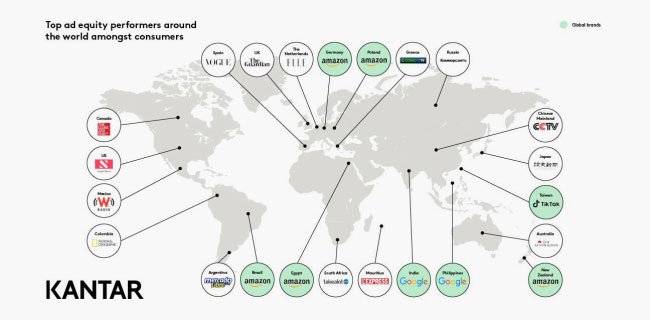
    Global vs Local: Media Reactions highlights the importance, and challenge, of market-specific media strategies. In 16 of the 23 markets surveyed the #1 ranked media brand was a local media brand or a localised version of global media brands. Ten of these 16 are news and magazine brands. This local success, together with differing attitudes to the ads on global digital media brands, makes balancing the benefits of scale of global media platforms with the promise of greater relevance from local media gems ever more important. (see image above)


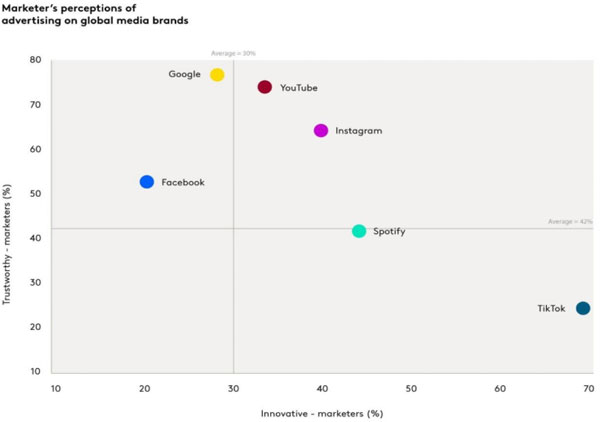
    The Innovator’s Dilemma: Media Reactions also highlights the challenge for brands in keeping their media mix reflective of the latest consumer media preferences as well as reflective of their own values and brand positioning. Marketers favour channels and platforms they believe provide both trustworthy and innovative advertising environments. Among the global brands, Instagram best manages this balancing act. YouTube, Google and Facebook are trusted platforms but are considered slightly less innovative.


    TikTok is not yet trusted by marketers as much as the more established platforms, but it has made enormous improvements in the past year. It remains comfortably the most innovative place for ads, and trust has doubled, so many more marketers are now positive about placing ads on the platform.


    Ad Spend Outlook: Media Reactions marketers’ survey provides insights into probable media growth areas for 2022. The vast majority of global marketers plan to increase spend on their favoured ad formats: online video, influencer content and social media ads. Many will reduce spend on print ads.  YouTube, Instagram and TikTok are the platforms set to benefit most.


    Discussing the findings Duncan Southgate, Global Brand Director, Media, Insights Division at Kantar, said: “The ad industry has been encouraged by the rapid recovery in 2021, as advertising has been used as one of the levers to fuel recovery in the wider economy. As we emerge into a new media landscape, brands need to understand which consumer and marketer attitudes have changed, and which have stayed the same. Which media brands have retained their appeal, and which have grown stronger? While the pandemic accelerated the growth of digital in every aspect of life, we have seen a robustness in consumers’ preference for offline advertising, and some strong local news brands in particular. Marketers need to ensure their strategies respect those preferences alongside the benefits of scale delivered by global digital platforms. TikTok has done an impressive job retaining its differentiated advertising proposition with consumers – even as its user base has almost doubled over the past year. We have also seen the re-emergence of retail as a critical ad platform, both online and physically. Advertising strategies that seamlessly align with omnichannel retail strategies provide a great opportunity for marketers to deliver more popular campaigns.”


    Added Sandeep Ranade, Head of Media- South Asia, Insights Division at Kantar: “Moving into 2022, we will see consumers adopting more and more digital channels and it will impact advertiser’s appetite for digital connection opportunities. Consumers do not differentiate between the way media is bought and hence it will no longer be offline vs online but a balance of reach vs receptivity and global vs local media partners to bridge the gap between what consumers prefer vs what advertisers perceive consumers prefer. We have also seen that Indian consumers generally have more pronounced views on advertising compared to the global audience”


    The full report can be found at www.kantar.com/campaigns/media-reactions.


  • 75% marketers expect increase in mobile budgets…


    MMA in collaboration with WARC has unveiled a new report titled ‘The Use of Mobile in Digital Marketing Mix’. The study analyses mobile marketing capabilities, growth in m-commerce and social marketing, and impact of technologies such as AI, IoT, ML & voice on improving marketing efficiency.


    Key highlights include:

    • Two third (69%) marketers have adopted mobile-first approach – a 10% increase since 2020 demonstrating mobile marketing’s growing position in the greater modern marketing picture


    • 55% marketers use engagement metrics followed by business metrics (51%) to measure mobile effectiveness in 2021


    • 75% marketers are expecting an increase in mobile budgets in 2021 – a 20% increase since 2020 led by social media and m-commerce technologies


    • Social media leads in marketers’ (86%) strategy, followed by mobile web display (50%) and in-app display (47%). 56% Indian consumers engage with social media ads – highest amongst any country.


    • 89% respondents agree that mobile plays a significant role in purchase journey. With e-commerce boom, 82% marketers have accelerated their m-commerce capabilities and 81% are embarking on shoppable media which is becoming a business avenue


    • 62% marketers believe that ‘death of cookie’ will significantly impact marketing strategies. Furthermore, ad fraud continues to hinder mobile growth for 33% marketers followed by consumer privacy concerns and metrics (25%)


    • Nearly 37% marketers are spending more than a quarter of their budget in martech, while 35% are spending less than 10%


    • With 37% marketers using AI & ML capabilities in 2021 – 42% expect these to be the top technologies over the next two years, followed by IoT (25%) and voice (24%)


    Key Takeaways from the report:

    1. Brand awareness is the most common key objective when running mobile marketing campaigns in India. As for marketing channels, TV and display are considered the most effective channels when run alongside mobile.

    2. Social is the most used and most prioritised channel for mobile marketing. Nearly nine-tenths (86%) of respondents are using social in their mobile marketing strategy. YouTube, LinkedIn and Facebook are the biggest platforms for display marketing, while Twitter and Instagram are dominating partnership and sponsorship marketing.

    3. Marketing professionals in India are expecting mobile budget growth this year. Three in four (75%) are expecting their mobile budget to increase this year. Last year, just over half said the same (55%).

    4. Mobile commerce has been accelerated due to the pandemic. Four in five (82%) marketers have experienced improved m-commerce capabilities and just under half (46%) of Indian marketers have named commerce via mobile devices as the most significant consumer behaviour in 2021.

    5. The cookie-death will have a significant effect on the marketing industry. Even though the end of the thirdparty cookie has been delayed, three in five marketers are predicting an impact to their business from its ‘death’.

    6. The future of mobile technology seeks to connect the online and offline, particularly through AI and machine learning, IoT and voice. Respondents are investing significant budget into mobile martech to ensure they keep up with the latest innovations in the industry, especially as interest in AI grows.

    Click here for the full report

  • TV still accounts nearly half of large marketer budgets…


    By Our Staff


    Earlier this week, GroupM unveiled its global end-of-year forecast of adspends. The WPP advertising clongomerate also publishes its India-specific numbers, so we are not doing a detailed look right now, but here are highlights of the This Year Next Year study, and a special focus on television thereafter.


    Excerpted from the GroupM report:

    The overall industry forecast:

    • 2021 growth: 22.5% (excluding U.S. political advertising), an upward revision from June’s prediction of 19.2%.

    • 2022 growth: 9.7% (excluding U.S. political advertising), an upward revision from June’s prediction of 8.8%.

    • Many underlying trends appear to be disproportionately concentrated in the U.S., the U.K. and China, which together account for approximately 70% of all the industry’s growth, despite making up about 60% of the total market.

    • Looking at the top 10 advertising markets over the next five years, growth should get back to the mid- to high-single digits:

    ° France, Germany, Australia and the U.S. all poised to grow in a range of 4-5% annually, on average, over the next five years.

    ° India, the U.K., Brazil, Canada, Japan and China are forecast to grow between 6-8% annually, on average.


    Here are the major areas considered in detail as we reach the end of 2021:

    Digital advertising: likely end 2021 growing by 30.5%, up from June’s forecast of 26% growth.

    ° Digital advertising accounted for 64.4% of all advertising in 2021, up from 60.5% in 2020.

    ° Alphabet, Meta and Amazon account for 80-90% of the global total.

    • Television advertising:forecasted to grow by 11.7% in 2021, up from June’s estimate of 9.3%. Given 2020’s decline of 13.7%, the industry is not expected to return to 2019 levels until 2023.

    ° Subsequent years will be roughly flat—up 1-2% per year through 2026—for television advertising in most major markets around the world, as the largest advertisers continue to incrementally shift spending.

    ° Overall, Connected TV+ will account for about 10% of total TV advertising in 2022 ($17 billion of a total of $171 billion) and is expected to double by 2026.

    • Audio advertising: Expectations for audio are that it will grow 15.6% in 2021 and 6.4% in 2022. In subsequent years, we assume a reversion to historical trends: largely flat.

    OOH advertising: Outdoor advertising is expected to grow 17.1% in 2021 and 14.9% in 2022. In subsequent years, we assume a reversion to historical trends: mid-single digit growth.


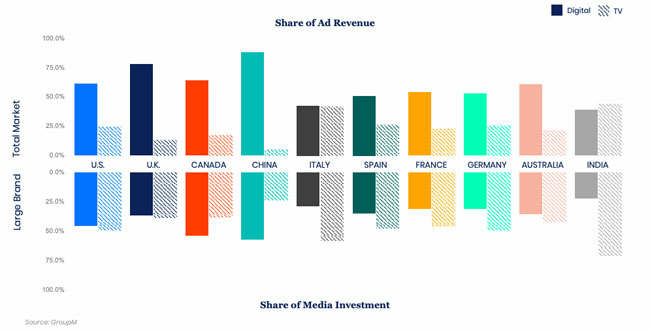
    Now, a superficial read of the data included in This Year, Next Year might leave one with the impression that because 64% of the world’s advertising revenue is generated by digital media and 21% goes to TV, that marketers are allocating 64% of their budgets to digital media and 21% to TV, on average. This would be a mistaken interpretation, because many advertisers—especially small ones and those whose businesses operate entirely online—often allocate all or nearly all of their budgets to digital media while large businesses typically allocate higher shares of their budgets to television.


    For smaller businesses, a high digital skew could occur because digital media’s precision targeting capabilities and automated sales platforms are uniquely capable of absorbing advertising budgets that are measured in hundreds or thousands of dollars. Larger advertisers that spend 100% of their budgets online might typically be doing so because their operations are entirely transactional or direct-to-consumer. For them, too, digital media platforms offer unique advantages connecting a budget for advertising with a tangible near-term outcome and the potential for active “growth hacking” strategies, which can work well, at least up to a certain scale.


    However, the world of media also includes businesses whose marketing goals are set around brand-building. They often do this by associating their products with top-tier video-based content or otherwise focusing on goals that are not most efficiently achieved through digital media. Further, for many, the combined use of different types of media can be synergistic in ways that are difficult to quantify. For example, we can reasonably assume that a strong brand should drive better performance of an e-commerce-focused advertising campaign versus the alternative of having a weak brand, although the factors that can drive a brand to accomplish this outcome can involve uncountable numbers of variables over many years or even decades


    Given our own focus as the world’s largest agency group, servicing larger brands primarily, we wanted to better assess the typical large advertiser media mix. To do this, we looked to GroupM’s own data to find useful illustrations of the ways in which different marketers allocate their budgets around the world. In studying these trends, we primarily focused on two dominant groupings of media, television and digital platforms, and then limited our analysis where possible to a subjectively defined group of large marketers on a like-for-like basis (meaning that we included only the same marketers in each period) within each of our Top 10 markets.


    The most accurate benchmark for large brands to consider is that in a typical large country during 2021, a large brand is allocating 47% of its advertising budget to television, including digital video extensions, and 35% to internet-based media, excluding those digital video extensions. For reference, in 2019, television typically accounted for 48%, while digital media typically accounted for 28%. These figures reflect wide gaps between the shares of revenue that media generates, with the difference driven by the wide range of brands that spend money in a given territory.


    For individual marketers, we recognize that this data may provide useful information about what other marketers are doing. However, the goal should not be to mimic them. Instead, we present this information to help spur questions about the right allocations for your brand. Well-developed media plans account for a marketer’s unique goals, apply some creativity to achieving those goals and consider what worked well for others who faced similar circumstances. It is our hope that the data presented here leads to the creation of more media plans that meet these criteria.


  • New age of growth for the advertising industry: DCMN report

    By Our Staff


    DCMN, the growth marketing partner for digital brands, has released its global Growth Guide: A new report looking at marketers’ goals, strategies and challenges going into 2022. The results point to a new period of growth for the industry: 66% of marketers surveyed expect their budgets to increase next year, with this figure rising to 71% for Indian marketers alone. This compares to 75% in France and 68% in the US.


    The research, conducted by Censuswide on behalf of DCMN, surveyed 600 inhouse marketers in the US, the UK, France, the Netherlands, Germany and India. The results offer an understanding of how the marketing landscape has changed after a tumultuous few years and how optimistic brands are heading into 2022.


    Key findings show that:

    It’s good news for marketing and advertising agencies, with the vast majority of Indian respondents – 93% – planning to increase their spending on agencies in the next 12 months.


    Aside from spending on agencies, budgets will go towards experimenting with new formats and advertising channels. Outside of digital advertising, the three channels Indian marketers plan to focus on and invest in the most are mobile advertising, podcasts and linear TV.


    The research also shows that 62% of Indian marketers are more focused on long-term branding efforts, versus 33% for performance-oriented goals. This is remarkably in-line with global figures, at 65% versus 31%.


    But the new year also comes with its own challenges. As advertising campaigns grow ever more complex, marketers in India are most concerned about managing and reconciling large amounts of data across channels. Keeping up with privacy regulations comes in second place, as policies targeting iOS and the future of cookies are set to dramatically reshape the marketing world – perhaps for good.


    Bindu Balakrishnan
    Bindu Balakrishna

    Said Bindu Balakrishnan, Country Head India at DCMN: “At DCMN, we wanted to take a closer look at where the marketing industry stands right now, and the impact of a disrupted 2020 and 2021. The results are impressive, and point to a marketing rebound in the coming year – both in India and in other countries around the world. Overall, we’re seeing that branding efforts remain top of mind for marketers. It’s also clear that brands still have huge faith in linear TV, with mobile advertising and TV set to be some of the most popular channels for marketers to invest in next year.”


  • Drive double-digit growth by measuring marketing right: BCG-Meta Industry Report

    By Our Staff


    Boston Consulting Group (BCG), in collaboration with Meta, has launched a report titled, “Measure To Grow: Drive double-digit growth by measuring marketing right” that brings together an industry consensus on optimal marketing measurement for marketing spends. The study provides a comprehensive view on the best-in-class marketing measurement practices that can unlock exponential business growth for businesses, small and large.


    For the purpose of this study, BCG and Meta collaborated with leading marketing measurement specialists including Adobe, Analytic Edge, AppsFlyer, Cartesian Consulting, Nielsen, and RainMan Consulting as well as 18 digital-first organizations from India across five key industries (Financial Services, EdTech, E-commerce, Travel, Media/OTT) to present this view.


    The report findings highlight that there has been a 3x increase in the share of digital marketing spends over the last five years by India Inc. However, despite its significant growth, the measurement practices have not kept pace. As a result, organizations are leaving significant value on the table.


    Said Shaveen Garg, Managing Director and Partner, BCG: “While the spends on digital marketing have sky rocketed, the true efficiency of the spend is not measured in most Indian companies. Thus, potentially leaving a lot of money on the table. As the customer journeys have become complex and intertwined between online-offline and across channels, the ability to measure business impact of digital marketing has taken a hit.Our study showed that while there were some companies have taken a lead and are getting exceptional returns, vast majority are in early stages. There is no silver-bullet single answer to what to measure and how, but the core principle to follow is to capture incremental impact on true business metrics.”


    Added Pratham Hegde, Director and Head of Measurement at Facebook India: “Digital is the new mainstream, and in order to unlock growth, there is a growing need for businesses to measure the true impact of marketing on business outcomes. The industry consensus is that there is no single measurement method or metric that will address all measurement requirements. The core recommendation for advertisers is to have an incrementality based approach at the centre of their measurement philosophy.”


  • Podcasts hit a high note


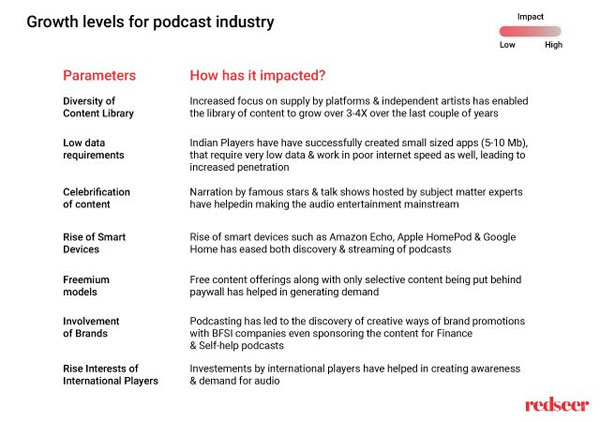
    India is witnessing a steady uptick in the usage of podcast entertainment over the last few years. The rise of DIY platforms has facilitated the emergence of independent content providers, resulting in an increase in the availability of new content. The popularity of smart gadgets like Amazon Echo, Apple HomePod and Google Home has made it easier to find and listen to podcasts. Here are some key insights into the industry.


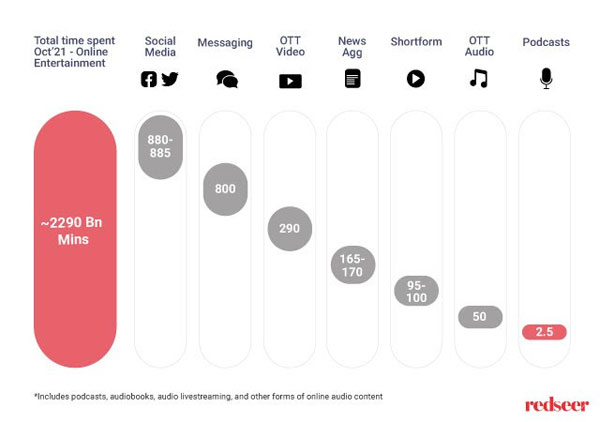
    1. Podcast has picked up well in India and already constitute 1% of the total time spent

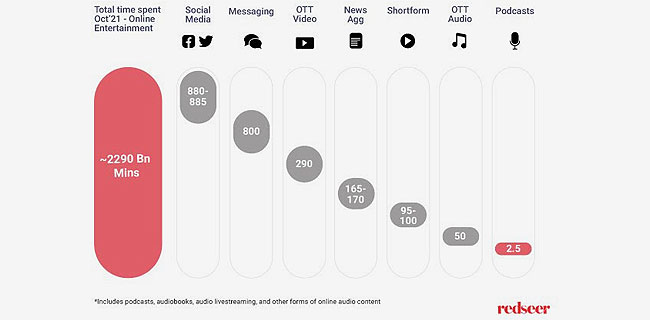
    According to our RedSeer analysis, the total time spent in Oct’21 – Online Entertainment was around 2290 billion minutes. Social media takes up the most time (885 billion minutes), followed by Messaging, OTT Video, News Aggregation, and Shortform App. In the month of October, podcasts accounted for 2.5 billion minutes.


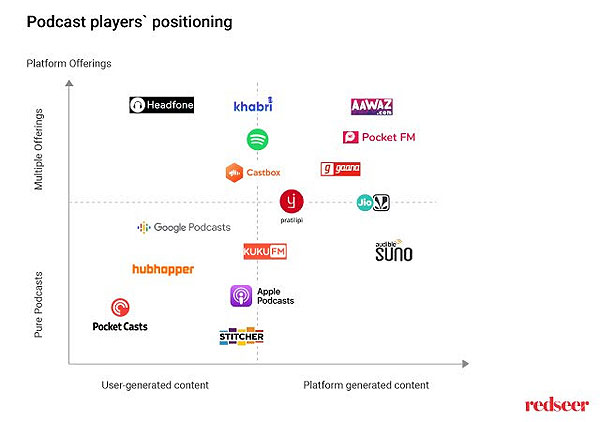
    2. In order to keep the audience engaged platforms are focusing on and generating their own content, high-quality UGC would take longer

    To acquire popularity and keep content development costs low, Indian platforms started with both UGC and PGC models. However, the platform’s ability to preserve brand value and quality is hampered by UGC material. Platforms are increasingly devoting more resources to producing high-quality content and bringing on celebrities to narrate and host shows. Few platforms, such as Headphone and Khabri, are investing in stronger UGC filtering and recommendation engines.


    3. This growth is happening on the back of diversified content, smart devices and low data tariffs

    Indian players have successfully created low data usage apps to deliver podcast content, with diversification around vernacular, and celebrity-driven content. The mix of free and premium models to subscription also allows new users to experiment and consume this new form of entertainment.


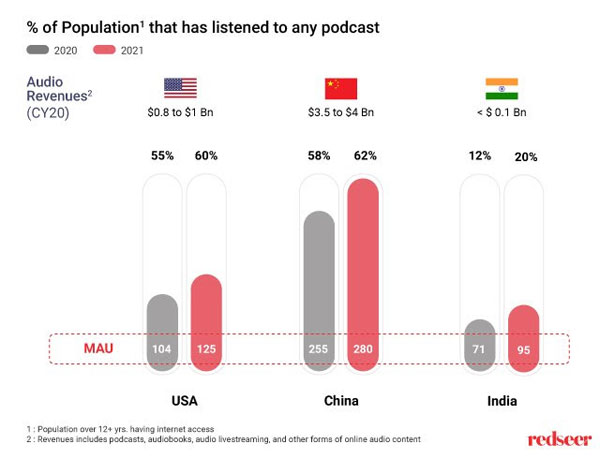
    4. We have seen a 34% jump in the MAU during 2021, capturing 20% of the potential market

    By the end of 2021, India will have 95 million monthly active users, a 34% increase from 71 million active users in 2020. The report also suggests that only 12% of the Indian population has ever listened to the podcast, indicating immense room for growth.


    The newfound popularity of podcasts is attracting advertisers and brands. Platforms with multiple offerings generate the highest traffic. Although players are diversifying into other audio entertainment avenues to increase user engagement & traffic, still podcasts are the major focus for all the players. As India’s internet user base grows with a larger audience warming up to this new entertainment format, the podcast market will unravel in exciting ways.


  • Indian Research and Insights industry to double by 2026


    By Our Staff


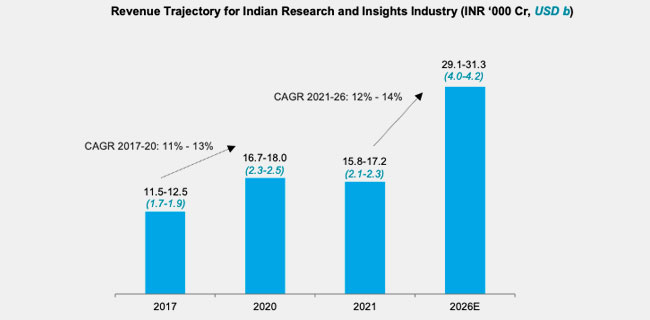
    The Market Research Society of India has launched the inaugural edition of its Indian Research & Insights (R&I) Industry Report. As per the report, the Indian R&I industry is expected to grow at a 12-14% CAGR to INR 31,300 crore by 2025-26, compared to INR 17,200 crore in 2020-21. Moreover, India is fast becoming the global analytics hub, with international markets accounting for 3/4th of its revenues. As per the report, the Indian R&I sector employs more than 125,000 people.


    During 2020-21, Marketing Analytics services accounted for 52% of the total Indian R&I industry revenues, while traditional Market Research and Syndicated/ Publishing services stood at 32% and 16%, respectively. By 2025 26, Analytics services will account for 59%, while Custom Market Research and Syndicated/ Publishing services will account for 27% and 14%, respectively, as per the report. The FMCG and Retail sectors are the largest consumer for Research and Insights with a share of 27%, followed by Information, Communications & Telecom (16%) and Banking, Financial Services & Insurance (15%).


    Commenting on the report, Sandeep Arora, President, MRSI, said, “The Indian Research & Insights industry has staged a robust recovery and is emerging as the most sought-after destination for analytics, globally. The availability of talent coupled with proven expertise in data handling, technology, infrastructure and cost competitiveness will lead to an orbital shift in the industry by 2030. We not only expect the R&I industry to grow 2X in the next five years but can safely estimate the industry size to reach $10 bn by 2030, especially with the strategic direction that most providers are adopting to move towards MR 3.0. We are excited and proud to launch the inaugural edition of the Indian Research & Insights industry report.”


    MRSI partnered with Value Notes as the research partner for the report. The report curates the findings from exhaustive desk research, secondary data of 198 companies, and more than 140 interviews conducted with the industry professionals. The 150+ paged report is available on a subscription basis on the MRSI website (www.mrsi.co.in).


    According to the study, the “global landscape for “research and insights” has evolved dramatically over the last decade. The explosion of data volumes, types of data and sources, and falling technology costs have driven client budgets towards tech-enabled solutions for both data collection and analysis. As a result, the scope of “research and insights” has substantially expanded and enabled many non-traditional methods as well as service providers.”


    Adds the report: “India emerged as a global player in IT services a little over two decades ago, and the global impact of Indian service providers continues to resonate. The Insights Industry in India has a diversity of research providers, along a continuum ranging from “traditional MR” players servicing domestic demand, to companies focused on the global opportunity. From the early days of outsourced MR operations and secondary research, the Indian Insight industry has moved up the value chain, and now supports sophisticated tech-enabled and analytics services. As a result, Indian providers earn around 3/4ths of their revenue from international markets. India is ranked fourth in position by industry size, according to the ESOMAR report on Global Market Research 2021. The country witnessed an increase in revenues with a growing share of tech-enabled research that comprises of a thriving analytics segment.”


    And what’s the future for the business?


    Today, notes the report, “growth is fuelled by the quality of talent (across skills and management levels) and technological sophistication. This is a giant leap forward from the early days when offshoring to India was primarily driven by labour rate arbitrage.”


    Consolidation is changing the contours of the industry, the executive summary of the report adds. “With the role of technology growing dramatically and declining share of wallet for traditional services, the definition of a “full-service” research agency is changing and lines between player types are blurring. Large full-service agencies are adding analytics capabilities inorganically and also selling DIY tools. Market research outsourcing companies are also adding analytics services, and some even getting into syndicated research. IT and BPO companies are muscling into market research as well as analytics. Report publishers are increasingly offering consulting or custom research services. Large cash-rich companies in traditional consumer MR and IT/BPOs are aggressively acquiring niche analytics firms and this consolidation is further likely to intensify to capture the share of customer wallet.”


    Enthusiasm for Indian start-ups coupled with the robust global demand outlook – mean that private and public funding is likely to scale new peaks in India, notes the report,” adding: “With the role of technology growing dramatically, clients are pushing their agencies to extend their services to include digital and analytics initiatives. While this means a larger pie for providers, the need to build capabilities and acquire talent is becoming critical. This is leading to increased demand for experienced data management and analytics professionals, as well as domain experts. As analytics becomes more core to decision-making, we expect further traction in acquisitions over the next few years. India boasts a large number of start-ups in analytics and these will prove attractive targets for a variety of players.”


  • Starcom India tops in RECMA New Business Balance Report 2021

    By Our Staff


    Starcom India has ranked #1 in new business in RECMA’s New Business Balance Report for 2021. Starcom, as per a communique from the agency, has gained the top position in competitive pitch wins across Consumer Products (CPG),  New-Age and App Economy which includes clients in Auto,  D2C, FinTech, Ecommerce, Gaming etc.


    Said Rathi Gangappa, Chief Executive Officer, Starcom India, said, “It is an honour to be recognised as the number 1 media agency in new business wins, in the prestigious RECMA Report 2021. Starcom’s strong consumer understanding, data-led insights, integrated talent, focus on efficiency using competitive pricing and flawless activation has led to us emerging in the top position. We will continue our strong growth trajectory, through very human , personalised brand experiences at scale and market-leading work.”


  • Consumer Attitudes toward Technology


    By Our Staff

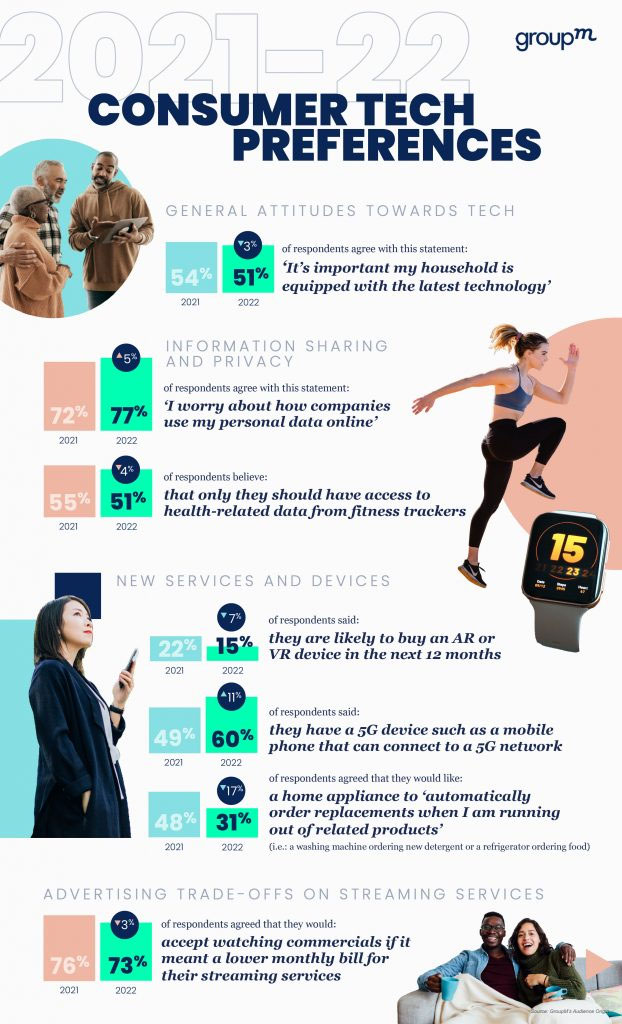
    GroupM, WPP’s media investment group, released its second annual survey on consumer attitudes toward technology in the U.S last week. The results reveal increased concern about sharing personal data, declining interest in buying the latest tech products sooner rather than later, and greater numbers of people confused by technology and its promises overall. Conducted by GroupM’s Audience Origin (formerly LivePanel) in December 2021, this proprietary research surveyed one thousand U.S. consumers on their attitudes toward technology across six general categories: attitudes toward technology, information sharing and privacy, virtual reality-based devices and services, smart appliances, mobile devices and digital services, such as visual search, streaming audio and streaming video.


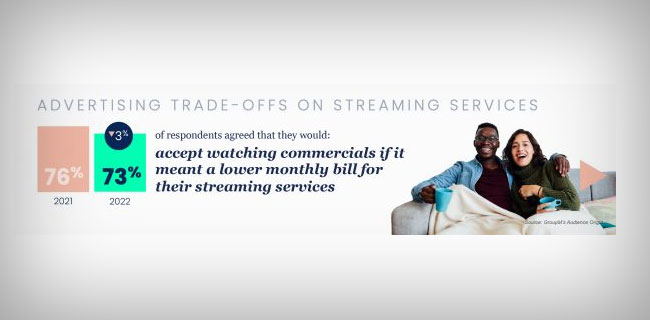
    Survey respondents indicated some material shifts in sentiments around privacy, with greater numbers of people concerned about the use of their data online, fewer willing to share data associated with health trackers or allow smart appliances to automatically refill consumables. Fewer households now believe it is important that they are equipped with the latest technology and greater numbers profess to being confused by new technologies – which we can see in responses to questions regarding VR and AR device access or 5G access – with more saying they will wait until technology becomes cheaper before purchasing devices. Of more direct importance for the advertising industry, a shrinking majority of respondents (73%) said that they would accept having to watch commercials in order to maintain a lower monthly bill for streaming video services versus 76% in last year’s survey.


    These trends reinforce the importance of data privacy to consumers and its implications for marketers—including the need to go above and beyond in securing consent from consumers when collecting or otherwise working with their data-to ensure that consumers experience real benefits from the use of that data and to always be mindful of how third-party data used in campaigns has been aggregated. The results also suggest that marketers could benefit from creating more clarity around how their technology products work and their practical benefits for consumers.


    Finally, the increasing willingness of consumers to pay to avoid advertising in streaming video services reflected in this survey strengthens GroupM’s instinct that, over time, advertising will become a diminishing feature in this channel. This highlights the challenges that marketers will increasingly face in using TV for reach and frequency-based goals in the future: it will be increasingly important for marketers to either more directly manage TV budgets alongside their spending on UGC-based platforms such as YouTube or to look at the use of TV differently, managing budgets for related campaigns more directly alongside those intended for sports, culture, music or other event sponsorships.


    Highlights of the research:

    1. General attitudes toward technology. 51% of respondents agree with this statement: “It’s important my household is equipped with the latest technology” versus 54% in our survey last year. 32% of the population somewhat or completely agreed that new technology “confuses me” in the new survey versus 28% last year. 73% agreed that they “wait until technology becomes cheaper before considering a purchase” versus 69% last year.

    2. Information sharing and privacy.77% of respondents strongly or somewhat agree with the statement “I worry about how companies use my personal data online” in our most recent survey, up from 72% in last year’s survey. 51% of respondents believe that only they should have access to health-related data from fitness trackers. The comparable figure was 55% in last year’s survey. As with last year, only a small share of the population believes that the company that made the device or software should have access (5.4% this year versus 6.9% last year).

    3. New services and devices: VR/AR, 5G and Smart Device-Based Consumables. Virtual or Augmented Reality: 32% of respondents claimed to own a VR or AR device in our most recent survey, with 15% claiming they are likely to buy such a device in the next 12 months. Consumer perceptions of what, exactly, such a device is may not be commonly shared, as last year 39% claimed to own one, with 22% planning to buy one. Looking at 5G devices, 60% of respondents said they have a 5G device such as a mobile phone that can connect to a 5G network, up from 49% last year. Among the 40% of the population without a 5G connected device, more than a third expect to acquire such a device this year. As with VR/AR, consumer understanding of 5G may not fully match the reality of the product, as third-party estimates of shipments of rates of 5G devices in the United States major U.S. carriers imply substantially lower figures. In the world of smart devices, 31% agreed that they would like a home appliance to “automatically order replacements when I am running out of related products” (i.e.: a washing machine ordering new detergent or a refrigerator ordering food). By contrast, the comparable figure was 48% last year. While it is possible the driver of this sentiment change is related to a lack of satisfaction with related products, we also note that this trend is coinciding with greater concerns around privacy illustrated above.

    4. Advertising trade-offs on streaming services. Asked, “If it meant a lower monthly bill for your streaming services, how likely would you accept having to watch commercials?” 73% agreed with this statement in our newest survey versus 76% last year. Access to ad-free or ad-lite subscription services remains high, consistent with data observed through public filings made by the operators of streaming services.


  • Reset. Redefine. Redux


    The last year has shown our immense capacity for adjustments and unhesitant flexibility in learning to coexist with the virus. From holding back spends to the returning to shopping malls and airports with gusto, Indian consumers have adapted to the ebbs and tides of the pandemic. Preparing for exigencies went hand in hand with recalibrating needs and striving to build a fuller life. We are living in strange times and are yet to get completely accustomed to the new way of living. Nevertheless, there is a continuous effort to do more and be more with the spirit of ‘Carpe Diem’ whenever possible. Along with the conscious focus on care and safety, there is a constant lookout for pockets of enjoyment and social joy.


    Locked in their homes and under restrictions, Indian consumers have also had a year of epiphany. They have realised the value of self-care, mindful living and are now seeking a more sustainable lifestyle. Some old habits have been replaced entirely, others adjusted, and the changes are here to stay.


    The 2022 Annual Trends by Kantar are borne out of conversations the teams there have had with consumers across the country


    Here are 10 themes that define how consumers are preparing themselves for 2022 (text source: Kantar).


    1. Going small to live big

    In earlier times, the big city fuelled dreams and aspirations of the youth and beckoned with the promise to ‘make it big’. The same city now seems stifling with matchbox homes, chaotic traffic, hectic schedules and cluttered living. The urban trapped millennials have been looking for breathers in their busy corporate lifestyles, often finding respite in trips along unchartered tracks.

    The lockdown and the opportunity of working from home has allowed them to consider an alternate to the city humdrum. As companies chose remote working as ‘business as usual’, the service sector employees chose to move ‘back home’ to smaller towns.

    What might have started as a prudent decision to save high rent expenses eventually seems to have translated into a more longer-term lifestyle adjustment. There is a conscious effort to recalibrate needs and wants as *59% believe that the pandemic helped them be more appreciative of what they already have. Many are stepping away from the tiring race to success and charting their own path for professional fulfilment, often trading off a heavier pay cheque for a fuller life.

    Much of the infrastructural development in India has been metro centric. The current trend offers a unique opportunity to reimagine our cities, our infrastructure, and mobility. Brands, on the other hand need to reinforce supply chains to avoid losing customers due to last mile connectivity gaps.

    (*Source: NICS 2021)


    2. Seeking assurance in ‘ghar jaisa’ khana

    The pandemic has made consumers painfully sensitive about the importance of health and immunity. A more focused approach to individual health requirements, an increasing appreciation of the traditional diets and a growing interest in the functional benefits of our familiar kitchen ingredients are triggering conscious food choices.

    Consumers are seeking comfort in familiarity, especially in the times of turbulence. They are more mindful of what they eat and are willing to make an effort to table fresher meals, *72% prefer fresh home cooked food than the packaged with the fear of preservatives. If the meals are not from their own kitchen, they would prefer it from someone else’s to be assured of the hygiene and quality of ingredients, thus making home chefs a rage. ‘Bahar ka khana’ is not yet worry-free as *44% do not feel safe ordering food online these days. At the same time there is a growing awareness about mindful eating rituals such as slow eating, appreciation of what’s on the plate and a deeper consciousness of the emotional connect with food.

    With increasing importance to freshly cooked meals, consumers would be open to kitchen solutions in terms of ingredients or appliances that make ‘home-made’ easier. Additionally, the affinity towards ‘home like food’ will also guide what the food industry will offer in terms of offerings on restaurant menus.

    (*Source: NICS 2021)


    3. Proactive upskilling

    According to the World Economic Forum, while the rapid evolution of machines in the workplace will displace 75 million jobs by 2022, it will also create 133 million new roles. As companies have been on their accelerated journey of digital transformation, the moot question has been whether the Indian workforce is ready for this change.

    Constant learning has become an imperative for workers to adapt to changing times and stay relevant. Through this volatility, upskilling has become the new insurance cover in the job market, ensuring stability in an unpredictable workplace disrupted by technology. Proactive self-learning through online courses has become the new norm for working professionals trying to stay employable as well as students gearing up to join the work force. *65% of learners upskilled to strengthen career prospects and *33% of learners were senior-level professionals. As both freshers and experienced employees become more conscious of the skill gap and lean in to bridge it, enrolments into online courses continue to exponentially grow.

    Proactive and consistent training and development led by employers will be increasingly critical, not only to keep the workforce equipped for the changing workplace, but also to ensure that employees are engaged and invested in the evolving business imperatives of the organisation.

    (*Source: Simplilearn’s State of Upskilling in 2021)


    4. Exercising autonomy through gig work

    The Indian freelance job market gained rapid acceleration with the pandemic induced job instability. However, what started as a necessity, is now a carefully considered choice for many. The comfort of flexible work schedules, coupled with an apathy for the corporate workstyle has been holding freelancers from going back to full-time employment.

    On the other hand, the Great Resignation of the west is showing signs in India too. ***62% of India’s workforce has the intention of switching jobs this year, compared to an average of ***41% globally.

    Most gig workers value the potential for higher earnings and flexible timings in their choice of work and are happy to trade off a steady income and job stability in the bargain. Women looking for employment after a sabbatical have found freelancing to be the much-needed bridge to join back the workforce.  The nature of freelance work has also evolved and gig working is not limited to factory or support function jobs. **70% of the Indian freelancers on their platform were working in core management functions.

    With 15 million freelancers, India is already the second largest gig market in the world. In the long term, the Indian gig economy has the potential to service up to *90 million jobs in India’s non-farm economy. India Inc. should make the most of this opportunity to absorb diverse work force and let them contribute professionally while taking care of their personal comfort.

    (*Source: BSG Report; Unlocking the Potential of the Gig Economy in India 2021

    **Source: Flexingit Survey, 2021

    ***Source: Microsoft’s 2021 Work Trend Index)


    5. Shrinking personal space with remote work

    Working from home had started with the promise of more comfort with workdays without travel and meetings without formals. Very soon this advantage was turned on its head as lines between work and personal life started blurring. Work expected you to be always on call and home assumed you were never away. Though remote work was expected to improve employee productivity, there is mounting evidence of increased burnout.

    **1 in 3 professionals in India feel burnt out due to increased workload and unmanageable stress. Professionals are seeking their personal space that has been squeezed between the responsibilities of home and work and they are looking forward to coming back to their workplace. *57% feel that commuting to their place of work would be a welcome relief after months of working from home.

    Corporate India has already taken cognizance of this situation and there have been measures to ease life in these times for employees. While focus has been on making work from home more convenient through virtual workplaces, organisations will also need to start rethinking their entire work models, culture, and values to ensure better mental health amongst the workforce. Employees are also learning to draw a line between personal and professional while operating from the same physical space.

    *Source: NICS 2021

    **Source: Future of Work Perception Study by LinkedIn, 2021)


    6. Yearning to get away from home

    Tired of being cooped up in their homes with social distancing norms, travel restrictions, people have been aching to step out of their homes. With the easing of mobility restrictions, restaurants are witnessing rising footfalls as Indian consumers making frequent visits to their favourite restaurants. Not only are consumers keen to experience a refreshing restaurant ambience rather than ordering in, the average order values have increased by *20%.  Work from home restrictive lifestyles have also allowed some more disposable income which consumers are glad to spend outdoors as evident in luxury dining increasing by as much as *120%.

    Lockdown fatigue had resulted in strong pent-up demand which is fuelling unique trends of ‘getting away from home’. Travellers have started to rekindle their travel plans through weekend getaways and similar convenient means to escape from the challenging life of work-from-home stifling schedules. Considering the renewed emphasis on personal control over cleanliness and hygiene, travelers are looking for nearby locations for road trips. Staycations are also an emerging trend where people are checking into at luxurious hotels to rejuvenate themselves with a pampered weekend.

    With varying rules of social distancing as we witness new waves of the pandemic, consumers will learn to switch on and switch off their social lives but would always yearn to step out. As consumers continue to seek respite from house arrest yet again, by planning for getaways, dropping into restaurants for a meal or even choosing to work from coffee shops, the reassurance of sanitation and hygiene-related measures such us fully vaccinated staff would ensure that they keep coming back.

    (*Source: Report by Dineout) 


    7. Instagram is the new store

    Fuelled by India’s fast growing smartphone penetration and inexpensive data, social media access and engagement has been steadily growing. As the pandemic further accelerated the growth of the e-commerce, social commerce has emerged as a favoured means of online shopping.

    Making a purchase on social media has brought back the element of the shopping experience that shoppers miss in the online store environment. Discussions, direct messaging and video sharing features make social commerce closer to shopping in person. Consequently, social chatter is fast becoming an active driver of brand choice; while advertising manages to influence *38% towards a brand, *41% tend to be swayed by comments or reviews posted on social media.  Riding on social word-of-mouth, today there are social commerce shoppers, account for **53% of total online shoppers in India.

    Stepping ahead of dynamic customer engagement, social commerce has proved to be an effective and affordable channel for smaller businesses.  This channel has also presented a cost-effective alternative for larger businesses and brands reeling under the pressure of mounting customer acquisition costs and struggling to protect these precious customers from competitors wooing them endlessly with deep discounts.

    *Source: NICS 2021

    **Source: Report by WATConsult, Isobar)


    8. Beauty goes beyond skin deep

    The pandemic brought hand hygiene to the forefront where consumers reacted out of fear without having the time or opportunity to make well thought through choices. The scenario however is vastly different today with consumers making well researched choices in personal care and are realising its significance of self-care more than ever.

    With virtual workplaces and limited social engagement, there is no mad rush to show up looking one’s best and people are moving towards a more sustainable self-care practice grounded in nature, health and wellness. There is an increasing positive disposition towards slowing down through daily self-care rituals. A stark contrast to the fast-paced world of the beauty industry that sells us quick fixes, cover ups and immediate results.

    Consumers have become extremely conscious about taking care of their bodies, and not just for the purpose of looking good. Fewer people are insisting on stepping out of home with make up (*30% vs. *49% last year) and declining interest towards cosmetic surgeries (*17% vs. *48% last year). The millennials especially have become acutely conscious of the long-term benefits of personal care regimes. What started as an obsession for sanitisers and hand-washes, has now gradually moved towards conscious choices of personal care, personal hygiene and wellness products.

    Brands need to be cognizant of shift in consumer choices towards personal care and grooming and cater to this growing affinity towards sustained self-care through their product solutions as well as communication of benefits.’

    (*Source: NICS 2021)


    9. True inclusion finding a voice among the youth

    Consumers are being drawn towards brands that embrace diversity and advocate causes that support social equity. The generation Z, being at the forefront of this movement, are evaluating brands with a conscientious looking glass. These globally connected consumers are constantly absorbing information and influences to make brand choices. They deeply value freedom of expression and the openness to accept different kinds of people and bluntly call out brands for stereotyping or alluding to any kind of discrimination.

    This generation is also taking active steps to make a change around them *36% of Indian Gen Z educated themselves on diversity and inclusion matters and *37% tried to educate and change the views of those around them. *22% of Gen Zs have boycotted a company because they didn’t agree to its views or actions.

    There have been examples of inclusive marketing countering stereotypes to create a vision that consumers can resonate with and embrace. There has been a shift in advertising campaigns featuring stories of real people told with a sensitivity that has found favour with consumers.

    Brands looking to engage this generation will need to extend their efforts beyond mere lip service. Just dressing brand communication with diverse imagery will not be enough. To stay relevant, brands need to embed diversity in their organisational culture as well as in their product development endeavours.

    (*Source: Deloitte 2021 Millennial and Gen Z study)


    10. Collective consciousness towards sustainability

    The pandemic has been a wake-up call; consumers are now acutely aware of the cumulative damage caused to the environment by human carelessness and are eager to ‘make good.’ *76% pay lot of attention to environmental and societal issue in the news.

    Increasing awareness and heightened consciousness have paved the way for more mindful living where consumers are seeking to coexist with nature and the environment. *77% are prepared to invest time and money to support companies that do good and while shopping *64% consumers factor in sustainability atleast once in a while.

    Sustainable actions that people are most willing to take today like reducing food waste, saving energy are those that have been part of the Indian ethos for generations. Yet, there are gaps between intentions and actions as most shoppers buying on autopilot are focused on saving money rather than the planet. Further, they don’t often have enough information about how sustainable products are different and the impact they make on our environment.

    Brands can fuel these actions by increasing awareness about the use of green energy in their production process, making it easier to recycle, incentivizing consumers and making it convenient for them to buy sustainable products.

    (*Source: Kantar Sustainability Foundational Report 21)

    ________________________________


    2021 has been a year of discovery for consumers where there have learnt to find their way in a fast-changing environment. No wonder the ‘how to’ search on Google has been on an all-time high. As we learn to adjust in a world that changes often and unpredictably, consumers would continue to seek more information from myriad sources and will be armed with higher awareness. Brands would need to listen more intently to consumers than ever before, be transparent in their promises and provide solutions for their evolving needs.  


    Contact your local Kantar partner or write to chhavi.bhargava@kantar.com  to know more.
     

  • Q4 2021 records highest ad volumes with a bumper festive spike: BARC

    By Our Staff


    According to the BARC Think Report of December 2021, Q4 2021 recorded highest ad bolumes for a quarter since 2019 with a bumper festive spike.  2021 also recorded 22% growth in Ad Volumes over 2020 and 18% over 2019. 4000+ brands advertised on television in December 2021. Ad Volumes in December 2021 recorded 155 mn seconds on Television.


    Said Aaditya Pathak, Head – Client Partnership & Revenue Function, BARC India, reflecting on the last quarter: “Post a rollercoaster ride in 2020 on account of the pandemic and lockdown, 2021 was a strong positive year for the broadcast industry. We witnessed increased attention from marketers towards television, across languages, while welcoming new brands to the medium throughout the year. Ad Volumes for digital native and e-commerce brands indicate that marketers continued to bet on television to establish stronger relationships and effective communication with their consumers. With a total of 155 million seconds of advertising volumes in December 2021, we can say with optimism that the broadcast industry ended 2021 on an encouraging note.”


    December 2021 Highlights

    > December 2021 recorded a total of 155 mn seconds of Ad Volumes, 25% higher than December 2019

    > Of 2524 advertisers and 4104 brands, there were 19% new advertisers and brands on TV in December 2021

    > Ecommerce, BFSI, Retail and Textiles sectors independently registered over 40% growth each when compared to December 2019

    > Ad Volumes for Corporate/Brand Image category surged by 42% over December 2020

    > Ad Volumes on Hindi language channels continued to grow consistently with 15% and 22% growth over December 2020 and 2019 respectively

    > Ad Volumes for English language channels recovered with a 15% growth over December 2020

    > Ad Volumes for Bhojpuri language channels witnessed highest growth with 120% over December 2019 while Punjabi increased by 83% over December 2019

    > Oriya and Assamese Ad Volumes also recorded an impressive 50% growth over December 2019, while Marathi channels Ad Volumes grew by 47% as compared to December 2019

    > Advertisers beyond the Top 50 enhanced their presence on TV with 30% and 26% growth over December 2020 and 2019 respectively


    Q4 2021 Highlights

    > Q4 2021 showcased stronger growth than Q4 2020 and Q4 2019

    > Q4 2021 recorded 489 mn seconds of Ad Volumes, registering 27% growth over Q4 2019 and 6% over Q4 2020

    > Brands across BFSI, Ecommerce, Corporate/Brand Image and Personal Accessories categories led this growth in Q4 2021 over Q4 2019

    > Ad Volumes on South language channels i.e. Tamil, Telugu, Malayalam and Kannada – registered 25% growth in Q4 2021 over Q4 2019