Category: RESEARCH

  • Innovation & Data will drive Marketing Agendas in Uncertain Times


    By A Correspondent


    CRM leader Salesforce has released the sixth edition of its State of Marketing report which revealed that as technology drives customer expectations to new heights, Indian marketers have emerged as not just messengers, but engagers who foster meaningful customer relationships well beyond the first purchase. The research also found that standards of customer engagement are shifting again, and Indian marketers are prioritising innovation in a radically altered landscape.


    For the 6th edition of the State of Marketing report, Salesforce collected data from nearly 7,000 marketing leaders across the globe, spanning six continents, just as the Covid-19 crisis emerged. After carefully dissecting the survey results, Salesforce Research deemed that the insights in this report provided significant relevance, value and a helpful guide to marketers as they navigate through these uncertain times.


    Said Sunil Jose, SVP, Salesforce India: “The COVID-19 crisis is forcing marketers in India to rethink every aspect of their business – from strategic priorities and challenges, to the technological and team skills they will need — as they navigate getting back to work during a global crisis, and then continuing to transform the customer experience to be best positioned for success in the years ahead. The insights in this year’s State of Marketing report are a helpful guide for marketers as they journey to recover and transform their business.”


    The trends revealed in the State of Marketing report were collected from marketing leaders from B2B, B2C and B2B2C companies across 30 countries, including 300 respondents from India, which showed the following:


    :: Marketing Transformation Takes On New Urgency: The expectations and behaviors of consumers, businesses, and society at large are shifting with unprecedented speed and magnitude. Marketers are at the forefront having been increasingly tasked to take a leadership role, with 87% in India leading customer experience initiatives across their companies. This involves a combination of both technological and organizational innovation. In India, innovating is the top priority for marketing leaders, while insufficient organizational structure and processes is their top challenge.


    :: Customer Data Sets the Stage for Empathetic Marketing: As customers navigate a series of “new normals,” personalized, empathetic engagement has never been more important. Delivering messages and offers that resonate with an individual’s unique needs and expectations requires deep insights. Marketers are shifting how they source and manage customer data and ramping up use of technologies like artificial intelligence (AI) that help them make the most of it. In India, marketers are expected to go from 20 data sources in 2019 to 25 projected data sources in 2021 and report a 118% increase in AI adoption since 2018.


    :: Marketers Double Down on Business Value: As businesses shift from crisis triage to recovery and adaptation, marketers have a unique opportunity to turn trusted customer relationships into business value. Marketers increasingly track metrics like customer satisfaction, digital engagement, and lifetime customer value to gain a holistic picture of what’s working and what isn’t across the customer journey. B2B marketers have a particularly strong role in business growth through account-based marketing (ABM). In India, 65% ofmarketers track customer lifetime value (LTV) to measure success.


    For full report, visit: https://www-stg.salesforce.com/form/pdf/6th-state-of-marketing/

     

  • How India’s Gen Z is addicted to Streaming


    By Indrani Sen


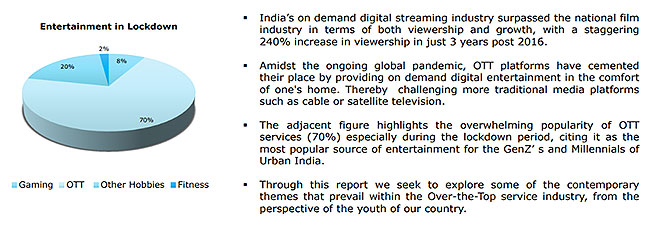
    Covid-19 has transformed the media consumption trends in India. Globally, streaming platforms gained in a big way since the pandemic struck and India is no exception. The report published by Dentsu Agies Network – “Now Streaming: The Indian Youth OTT Story” – is a study conducted among urban India’s Gen Z & Millennial reconfirms this trend. These trends could be reflecting behavioural changes of the two younger generations which are likely to last even after the cloud of pandemic shifts from the Indian sky. The highlights of the findings from the report are shown below:

    Source: https://dentsumarketing.cloud/dmcinsights.php


    As many as 74% of the respondents came from the Top 8 metros with 26% coming from rest of urban India. 47% of the respondents were male and 52.2% were female. 78.5% came from Gen Z (5 to 25 years) and 21.5% came from Millennials (25 to 39 years).  The report therefore cannot be taken as uniform trends across urban youths across India but trends which are visible among youths residing in the top 8 metros and mostly below 25 years of age. They are, however, the future targets of marketing and advertising in India.


    Average daily time spent in hours

    Gen Z Millennials
    On line Gaming 1.97 1.11
    Binge Watching 4.45 3.66


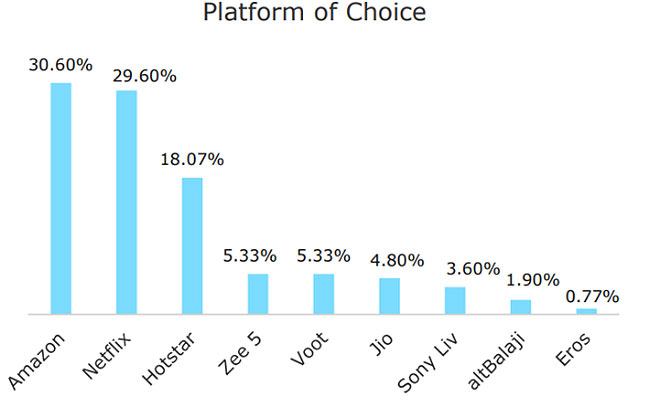
    Among the various OTT platforms, Amazon Prime and Netflix lead the pack, followed by Hotstar. The other OTT platforms are yet to build up significant presence among the Indian youths. Gen Z spends more time than Millennials both on gaming and binge watching on OTT platforms.


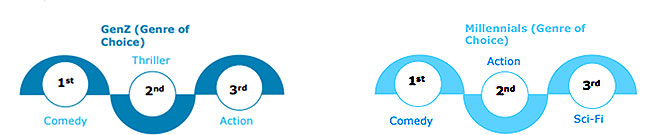
    The choice of genres by the two sections of youth explains the popularity of the top three platforms which offer more content as per their preference. Zee 5, Voot, Jio, Sony Liv, etc have less content to offer in the Comedy, Action, Thriller and Science Fiction genres. Amazon Prime, Netflix and Hotstar have also invested more in production of original content. However, the report has also shown that both in North and South India across different demographics the primary usage of OTT platforms were for viewing TV shows and movies.


    During the lockdown north Indian youths invested on an average in three OTT subscriptions than their counterparts in south India who invested on an average in two OTT subscriptions. The Gen Z invested on an average in 3 OTT subscriptions while Millennials invested in 2 OTT subscriptions during the same period. The report does not give details of the demographic profile of the sample, but we can safely assume that the sample was skewed towards higher SECs as indicated by higher spends on OTT subscription by Gen Z, most of whom would not have been financially independent and had to ask their parents for the subscription money. Obviously their parents were not financially affected due to the economic slowdown during the lockdown and could afford to indulge their children. The report therefore captures mainly the trends of OTT consumption of urban youths from 5 to 25 years age belonging mostly to NCCS A and the top 8 metros.


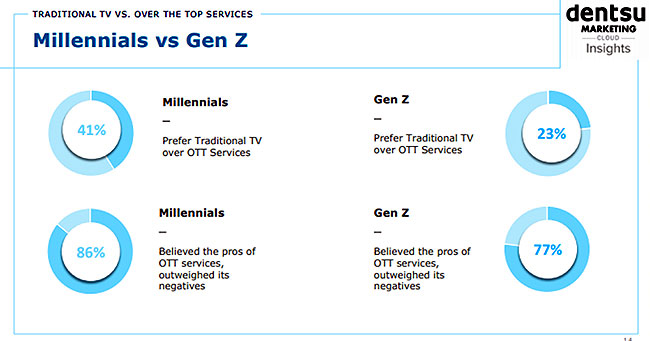
    The report has also captured that 73% have no concern about the content of the OTT platforms. The other 27% have stated obscene content, anti-national content, strong and bold language of the content as well as content hurting sentiments of religion/ caste as causes of concern related to OTT platforms. On the other hand all respondents had concerns about internet connections, pop-up ads and buffering related to steaming of the contents. Both Millennials and Gen Z have shown a clear preference for OTT services and believes that the positives factors outweigh the negatives.


    The report concludes that content distribution, attractive marketing, transitioning the gaming industry and personalisation are the key factors which is helping consumption of OTT platforms to dominate over consumption of traditional TV viewing. The analysis does not mention about the tie ups between OTT platforms and Telecom giants like Airtel, VI and Jio, a practice which began in 2017/ 2018 and has been continuing since then.


    As per the range of packages offered by the three telecom companies, it appears the leading OTT platforms do not believe in exclusive tie ups with any single telecom company and have created a level playing field for all the service providers by having tie ups with all of them. It seems this survey did not probe into this aspect of free subscription with mobile connection among the Gen Z and Millennials, most of whom would have been enjoying some such free benefits through a single sign in. The findings of the reports outweigh the apparent skewing of the sample and a few gaps and have provided all of us a crystal globe for gazing into the future of media consumption.


  • So who is India’s Most Progressive Celeb?


    By A Correspondent


    The Indian Institute of Human Brands (IIHB) has released its Tiara Research Report on Celebrities as Human Brands. The Report was released by the Coach of the Indian Cricket team, Ravi Shastri and Dr Sandeep Goyal, Chief Mentor of the IIHB on Dussehra day in Mumbai.


    Sandeep Goyal

    Said Dr Goyal: “The sample size of the TIARA Report is 25% bigger than the universe of TRP data collection currently being done by BARC. Our respondent base is 60,000; while BARC only covers 44,000 respondent homes. So, the study is comprehensive and representative of the entire India market. We have covered 23 cities. No study on celebrities hitherto has been so detailed and exhaustive. We have used 64 active attributes in the analysis of every single celebrity. Totally, there are over 100 data points that have been used in the analysis. This report, for the first time provides a DNA analysis of almost every prominent celebrity in the country. More importantly, our proprietary tools allow cross comparisons across celebrities, across attributes, across demographics, across cities, and more.”


    INDIA’S MOST BEAUTIFUL

    Deepika Padukone is India’s Most Beautiful. She scores 59.9 on the TIARA ratings. Padukone is way ahead of Aishwarya Rai Bachchan who leads the list of beautiful ladies in Bollywood, with a score of 45.0. In Television, Divyanka Tripathi Dahiya top scores with 39.1 TIARA ratings. Cricketer Mithali Raj has been voted Most Beautiful.


    INDIA’S MOST GLAMOROUS

    Deepika Padukone is also India’s Most Glamorous with a top score 60.3. In Bollywood, Priyanka Chopra and Ranbir Kapoor are seen to have the highest glamour quotient. In Television, Rannvijay Singh and Shilpa Shetty are top rated on glamour. In Sports, Virat Kohli and Sania Mirza occupy the top ranks. As a couple, Virushka are most glamorous.


    INDIA’S MOST INNOVATIVE

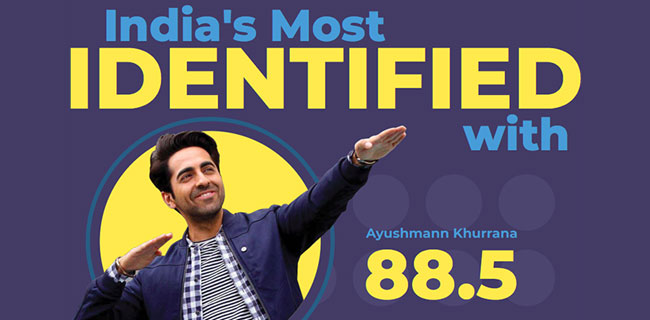
    Retired Indian Captain MS Dhoni is seen to be India’s Most Innovative. He top scores with a TIARA rating of 59.7. In Bollywood, Ayushmann Khurrana is easily No.1 in males, while Deepika Padukone leads on innovation amongst females. AR Rehman top scores in Television, Bharti Singh excels at top spot amongst women. Virat Kohli and Smriti Mandhana top score amongst sportspersons. DeepVeer – Deepika + Ranveer are the Most Innovative power couple.


    INDIA’S MOST  RELIABLE

    Shuttler Saina Nehwal is rated as India’s Most Reliable with a high 69.0 TIARA rating. In Bollywood, old warhorse Anil Kapoor ranks at No.1 while Nushrat Bharucha is top amongst the females. Zakir Khan and Surbhi Chandna are in top places in Television. Sachin Tendulkar and Harmanpreet Kaur are rated best in Sports while Virushka are rated the Most Reliable amongst couples.


    INDIA’S MOST PROGRESSIVE

    Vikrant Massey who was recently in the lead role in Ginny weds Sunny, is rated as India’s Most Progressive, surprisingly ahead of Ayushmann Khurrana who sits on top in the Bollywood list, alongside Deepika Padukone. In Television, Dharmesh Yelande and Mouni Roy top on Progressive. Jasprit Bumrah and Sania Mirza score best on Progressive amongst those in Sports. Virat Kohli and Anushka Sharma top score as a couple on Progressive.


    Other category toppers include:


    INDIA’S MOST RESPECTED : Amitabh Bachchan


    INDIA’S MOST APPEALING : Akshay Kumar


    INDIA’S MOST TRENDY : Virat Kohli


    INDIA’S MOST DISTINCTIVE : Nawazuddin Siddiqui


    INDIA’S MOST VERSATILE : Nawazuddin Siddiqui


    INDIA’S NO.1 HEART-THROB : Ranbir Kapoor


    INDIA’S MOST SEDUCTIVE : Radhika Apte


    INDIA’S MOST SEXY : Priyanka Chopra


    INDIA’S MOST DOWN TO EARTH : MS Dhoni


    INDIA’S MOST FEARLESS: Virat Kohli


    About the Tiara Report:

    The TIARA Report, notes a communique, is the largest and most comprehensive study of celebrities in India.

    • A sample size of 60,000 respondents pa- India.

    • 23 cities (Delhi including NCR), Mumbai (including Thane), Chennai, Kolkata, Bangalore, Hyderabad, Ahmedabad, Surat, Pune (including Pimpri and Chinchwad), Jaipur, Lucknow, Kanpur, Nagpur, Vishakhapatnam, Indore, Bhopal, Patna, Vadodara, Ghaziabad, Ludhiana and Agra.

    • 180 celebrities : 69 from Bollywood (37 male, 32 female); 67 from Television (46 male, 21 female), 37 from Sports (30 male, 7 female), and 7 celebrity  ‘power couples’.

    • The field study was conducted by Japanese research agency Rakuten.


    Tiara is an acronym for Trust, Identify, Attractive, Respect and Appeal. The study uses the research data across 64 active attributes covering image, personality and human factors; and a battery of confirmatory statements to quantify key celebrity dimensions.

    TIARA Research Final-Online


  • IPL 13 Rules. And how!


    By Indrani Sen


    Ever since IPL 13 began on September 19, 2020 with a massive 20 crore viewers on Star India Network and Disney + Hotstar, the tournament has been delivering high ratings on TV and OTT platforms.

     

    On the digital media front, IPL 13 is generating huge tractions over and above its coverage through Star India’s OTT platform Disney  + Hotstar. On October 30, 2020 Wavemaker published a press release on their mid-season report of “IPL Mesh 2020” covering matches from September 19 to October 24. Mesh is Wavemaker’s Realtime Data Intelligence tool which has integrated data from “multiple consumer touchpoints across Digital ecosystem ranging from Social Listening, Google Searches, Website visits, BARC, Video analytics in partnership with VIDOOLY, Interaction data points collected from Facebook, Twitter, Instagram and YouTube” to arrive at the observations and predictions shared in the report.


    The press release by Wavemaker contains a few charts and whets the appetite for the total report. The report predicts that the IPL buzz volume of the digital track will grow from 37 Mn in 2019 to 60 Mn + in 2020. During the first 36 days of the tournament, CSK was the driving force behind the interactions on social media. Now that CSK has failed to secure a place in the playoff matches, it will be interesting to watch if the buzz volume of the track gets affected. Similarly, it would be interesting to see who takes the place of M S Dhoni as wicketkeeper in the Leading Player Index Leader Board.


    In the Leaderboard ranking of most loved ads, Dream 11, Oppo and Tata Motors took the first three positions in desending order. IPL 13 has also seen a never before engagement in gamification of Cricket Fantasy League with the top five Fantasy League in September 2020 generating 30 million google searches and 90 Million web traffic. Based on historical data, the report claims that there will be huge surge both in TVP and social buzz during the next two weeks which will counter the drop in the social media buzz over during the last few weeks as shown in the chart above.


    While the Wavemaker’s report reconfirms the accelerated growth of the digital media intractions in India, in traditional TV media also IPL 13 continues to deliver high ratings to the satisfaction of the advertisers who have invested their advertising rupee in cricket. A fortnight back on October 15, TAM released “IPL 13 Advertising Report 1” based on their ADEX data covering the period from September 19 to October 10 (25 natches).  The report has shown an 8% growth registered in average ad volumes from IPL 12 to IPL 13 during the same time span/ number of matches. 5 out of the top 10 categories have been from E-commerce with 35% share of IPL 13 advertising volume and Oppo India’s commercial made it to the top position quite fast during IPL 13 compared to 2nd position in IPL 12.


    The most interesting fact which has emerged from this Advertising Report is the participation of new categories and brands in IPL 13. According to the TAM Adex report 30+ new categories and 150+ new brands advertised during IPL 13 compared to IPL 12. It remains to be seen how the advertising frenzy builds up further during the last two weeks of IPL 13, strategically scheduled during the pre-Diwali season in this pandemic hit year.


  • TAM Sports: Tally of Advertisers & Brands grew by 7% and 3% in IPL13 Live matches. Avg ad vol stays same

    By A Correspondent


    Before we give you the headlines, the Advertising Volumes we refer to are for advertising across 24 Star Network channels for both IPL 13 and IPL 12. The study is on All Live matches only during IPL Season 13 and 12. It excludes pre-, mid- and post-match shows. The analysis is based on Pure Advertising [i.e. Excluding Franchisees, Promos, Filler, Film Trailer and Official Broadcaster (Star Network)]


    So here are the headlines:

    > Average Ad Volumes during all matches of IPL 13 remained almost same compared to IPL 12.

    > Tally of Advertisers & Brands grew by 7% and 3% respectively in IPL 13 compared to IPL 12

    > Oppo India made it to the top during IPL 13 compared to 4th place in IPL 12

    > During IPL 13 (53 days), Ad Volumes of Sports genre spiked by more than 3 Times compared to 53 days prior to IPL 13


    Here’s what you can get by clicking on the PDFed presentation here:

    > Overview of IPL 13

    > Toppers – Categories, Advertisers and Brand

    > New Advertisers and Brands in IPL 13 vs. IPL 12.

    > Advertisers under Top 5 Genres – IPL 13

    > Ad Length Usage (10, 20, 30 Seconds) – IPL 13

    > Advertising Trend in Channel Genres

    And more…


    IPL 13 Commercial Advertising Report

  • Ad volumes register marginal y-o-y rise in 2020: TAM AdEx report


    By  A Correspondent


    TAM AdEx has released the first of its report on 2020 for television advertising.

    Highlights of the report are Advertising Trend during Lockdown versus Unlockdown, Covid Prevention categories, Celebrity Endorsement, Social Ads by Govt. etc.

    According to the report, advertising volumes in 2020 saw a marginal rise versus what it was the previous year (2019). Average ad volumes in the all-important fourth quarter of the year rose 39% over the average ad volumes in the first three quarters of the year. There was 90% growth in Average Ad Volumes/Day witnessed during Post Lockdown period.

    FMCG players ruled the list of Top 10 advertisers with HUL leading the list. Four of the Top 10 brands advertised were from Hindustan Unilever and three were from RB. Personal Care/Personal Hygiene sector had 20% share of Ad Volumes followed by F&B with 18% share.


    Please click on this link for the report: TAM AdEx-Mirroring Y 2020 for Television Advertising


  • Ad volumes drop 3% in 2020: BARC

    By A Correspondent


    Advertising volumes dipped by 3 per cent in Calendar Year 2020, with the volumes dipping as 18% in the H1 period January-June over the corresponding period the previous year. In H2 – that’s July to December – the growth over the previous H2 was 12%, and over H1 of 2020 the growth was in fact 34%.


    Hindustan Unilever was the biggest advertiser in 2020 with a 30% growth in ad volumes over 2019, followed by the RB Group, with their ad volumes growing by 37% in 2020 over 2019.


    Said Aaditya Pathak, Head – Client Partnership & Revenue Function, BARC India: “Television continues to be the screen of the household and the most important medium for all the major advertisers to reach their audience pre-pandemic and post lockdown too. Return of originals along with the festive season and live sporting events boosted the ad volumes, taking the overall growth in ad volumes to 34% as compared to H1, 2020 and eventually minimising the reduction in volumes to a marginal -3% for the overall year, as compared to 2019”.


    The movies genre saw significant growth in ad volumes in 2020 as compared to 2019. Hindi GEC witnessed the highest growth in ad volumes with 10% as compared to 2019. Other Regional GECs saw a growth of 8% as over 2019. News genre in 2020 too had the highest volume, while ad volumes dropped by 1%


    A heightened consciousness of safeguarding our health, understandably gave a boost to the antiseptics and personal care categories. Ad volumes for Dettol Toilet Soaps and Dettol Antiseptic Liquid, went up by 118% and 136% respectively. Horlicks ad volumes also surged by 60% in 2020 as compared to 2019.


    During the peak lockdown in April and May, the ad volumes for digital brands was the highest with 16% and 13% respectively as compared to the month of January 2020. The highest ad volumes share for digital brands in 2019 was at 9% in the months of March, September and December.


    For PDF of the Advertising-Related Data, please click here: BARC India Ad Volumes Report – An Insight

  • Achche Din… GroupM forecasts 23.2% in CY2021

    GroupM share of adspend


    By Our Staff


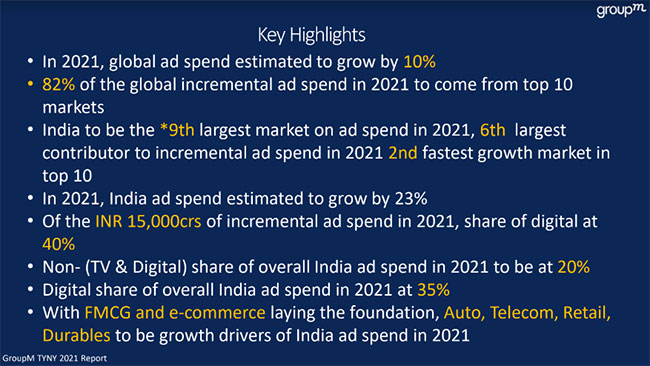
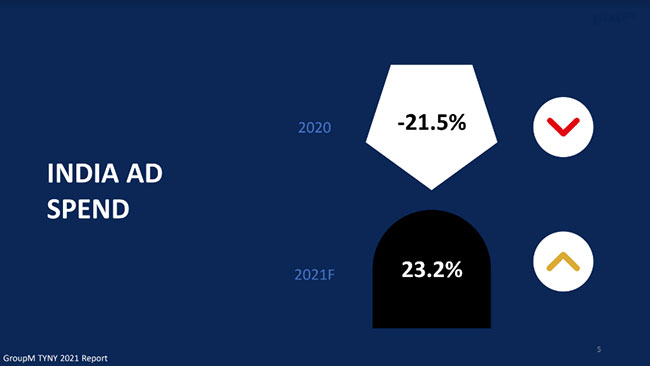
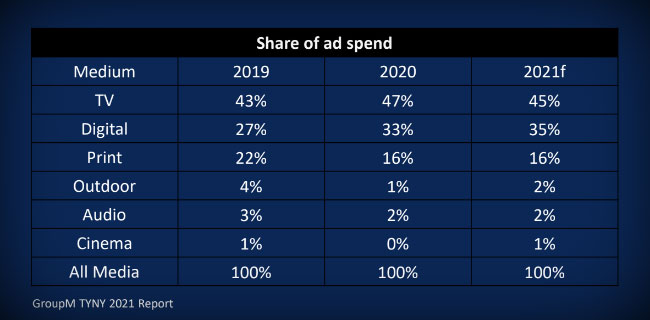
    GroupM India has announced its advertising expenditure (AdEx) forecasts for 2021. As per the GroupM futures report ‘This Year, Next Year’ (TYNY) 2021, India will see a major ad recovery in 2021 given the downfall of ad spends in 2020 due to the pandemic.


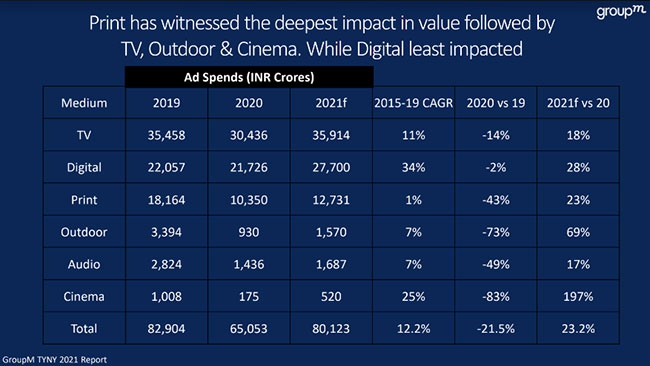
    TYNY forecasts India’s advertising investment to reach an estimated Rs. 80,123 crores this year. This represents an estimated growth of 23.2%, for the calendar year 2021. India is the 2nd fastest growing market in the top 10 countries and will be the 6th largest contributor to incremental ad spends in 2021 globally. While India was ranked 9th in the global ad spend rank in 2019, it dropped to 10 in 2020 and is likely to regain its 9th rank this year.


    Prasanth Kumar, CEO - GroupM South Asia
    Prasanth Kumar

    Commenting on the TYNY 2021 report, Prasanth Kumar, CEO – GroupM South Asia said, “2020 was an unprecedented year. The pandemic impacted across sectors and it, therefore, affected the media investments too. As we are aware, the year that went by had a mixture of lockdowns, many restricted market momentum and overall threw a challenge and impacted multi-industry economies. The ad industry too had its challenges and 2020 witnessed a steep drop in the overall media investments. However, we have witnessed a month-on-month upturn in the industry starting Q3 last year and we are quite optimistic about the revival that 2021 will see. With the gradual easement of the lockdown backed by seasonal spends and big-ticket events like IPL, we expect 2021 to continue to build on that momentum. While the global ad spends are estimated to see a rise of 10% in 2021, digital is expected to take 67% of ad spends. With the help of technology, marketers have adapted to pandemic-proof ways by constantly innovating, staying relevant and offering digitally charged solutions to brands.”


    Digital was the only medium to witness a gain of USD 27bn globally in 2020. Digital as a media vehicle will continue to skyrocket due to the increase in digital dependency and changing consumer patterns.


    Tushar Vyas, GroupM
    Tushar Vyas

    Added Tushar Vyas, President – Growth and Transformation, GroupM South Asia: “2021 will see 90% incremental ad spends on digital globally. The massive switch to digital reliance over the past 1 year has been a major driver for this shift. Brands have been forced to think big and different to transform their businesses, match the newer expectations and overcome the challenges faced. The post-pandemic era will continue to see this upsurge in digital demands. The crisis has brought about a sea change in mindset, adoption, and role of technology in doing business. Brands are seen renewing their business models and are constantly ideating to find better ways to connect with the consumer on a digital tangent.”


    Ashwin Padmanabhan
    Ashwin Padmanabhan

    While Covid-19 resulted in an overall slowdown in the global economy, Indian adspends will continue to see a month-on-month recovery considering the overall media landscape. Said Ashwin Padmanabhan, President – Partnerships and Trading of GroupM India: “Based on a strong foundation built on the back of FMCG and e-commerce, 2021 is expected to see growth across sectors like auto, telecom, consumer durable, retail and education. Manufacturing, which was severely impacted by the pandemic, is now stabilising and moving toward a positive outlook enabled by automation, technology and supply chain optimisation. 2020 has accelerated the adoption of agile, cost-effective business models, which will help brands and marketers offer better products, services and experiences to consumers.”


    Sidharth Parashar, President - Investments and Pricing, GroupM India
    Sidharth Parashar

    Added Sidharth Parashar, President-Investments and Pricing of GroupM India: “Along with digital, television saw a spike in consumption during the lockdown. With acceptance on the subscription bandwagon increasing, OTT will continue to witness a constructive growth and is likely to develop with more players attracting users by investing in content. Print & Radio expected to be backed by local advertisers and certain categories with marketeers leveraging the brand solutions that these media offer. We expect OOH and cinema to see double-digit growth after a difficult year. Given the uncertainty and cautiously spending consumer, brands are realising the importance of being present wherever consumers are. Hence along with continued relevance of television & other mass media, we will witness advertisers leveraging relevant platforms to reach out to its audience.”


    GroupM TYNY Key Highlights

  • Back to 2019 levels, as AdEx to grow 26%: Pitch Madison report


    By Our Staff


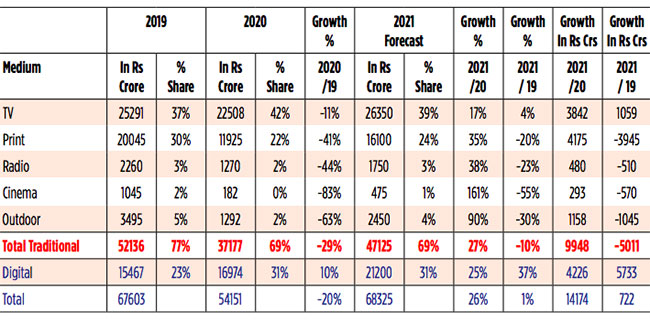
    It is the most respected of the forecasts of advertising expenditure in the country. We are referring to the Pitch Madison Advertising Outlook report that was unveiled virtually on Wednesday by Sam Balsara, Chairman, Madison World. According to the report, AdEx degrew 20% in 2020 and is expected to grow 26% in Calendar Year 2021.


    Sam Balsara
    Sam Balsara

    Said Balsara, Chairman, Madison World: “A number of macro-economic factors, study of AdEx historical behaviour and stupendous growth in Q4 leads us to make a high projection of 26%. Our full report gives you more details of the basis of our projection and some Advice to Advertisers.”


    Key findings of the report:

    A. Overall:

    1) In 2020 total Adex has degrown by 20% and Traditional Adex by as much as 29%.

    2) In absolute terms ADEX has degrown from Rs. 67,603 crore to Rs. 54,151 crore, a drop of a whopping Rs. 13,452 crore, the highest drop in one year ever, in Indian ADEX’s history. Adex is now at 2017 levels, but is expected to reach 2019 level by end of 2021.

    3) Although Traditional Media declined by 29% in 2020, its share in total Adex is as high as 69%, whereas the global average is 41%.

    4) Covid’s negative impact on Indian ADEX has been more severe compared to Global Adex  and many other countries of the world including US where the drop was only 4%.

    5) Q4 2020 has registered a whopping 61% increase over Q3 2020 and a 16% increase over Q4 2019. And this gives us a lot of confidence and hope that both Market and ADEX is going to bounce back sharply in 2021.

    6) Many Advertisers deserted TV, Print and Radio in Q2 2020, but by Q4 almost all Advertisers have returned to the Advertising fold.

    7) FMCG continues to be the main category spender and its share moved up to 38% compared to 33% in full year 2019.

    8) E-commerce and Education are the only two categories that increased spends, by 30% and 9% respectively.

    9) 10 new advertisers entered the Top 50 list of advertisers, key ones being Phone Pe, Pepsico, facebook and Disney Hotstar.


    B. Television

    1) Television media degrew by a mere 11% to reach Rs.22,508 crore, its 2018 level, but has further consolidated its position as the No. 1 medium with 42% market share.

    2) FMCG, continues to be the largest contributor for TV ADEX and further increased its share from 49% to 51%, though in value terms, the category de-grew by 9% almost in line with the TV degrowth of 11%.

    3) The only 2 categories to show a growth in absolute terms are E-commerce, which registered a 95% growth over 2019 and Education, a 193% growth over 2019.  Within e-commerce, in addition to online shopping, mobile wallets and media / entertainment / social media / OTT were the leading categories.

    4) The impact on regional channels has been the least, implying that national brands prioritised campaigns in their strong markets and regional brands came back to ADEX faster than national brands.

    5) TV Adex is expected to grow by 17% in 2021 to reach Rs. 26,350 crore, 4% higher than 2019.


    C. Print

    1) Covid damage to Print has been massive and Print ADEX lost as much as Rs. 8,120 crore or 41% and has gone back to a level it had reached in 2012.

    2) With a drop in share from 30% to 22%, Print lost its No. 2 rank in ADEX.

    3) However, a spike in ADEX during the festive season (Q4 20) has resulted in highest Volume and Ad  revenue.

    4) Print Adex grew by 59% in Q4 2020 vs Q3 2020, however, this is still 15% less than Q4 2019.

    5) All categories in Print seem to have got affected including E-commerce (-57%), Education (-14%), Auto       (-29%) and FMCG (-30%). Education increased its share of Print ADEX by 5 percentage  points, from 10% to 15% and Auto and FMCG by 3 percentage points each, from 13% to 16% and from 14% to 17% respectively. These 3 categories accounted for 47% of Print ADEX.

    6) Newspaper circulation in metros got affected a little more deeply and recovery seems to have taken longer. Because of which contribution of Hindi, in terms of volume has increased from 35% to 38% with English trailing at 24%. Kannada and Malayalam newspapers showed highest resilience and least degrowth in terms of volume, whilst Tamil, Telugu and Marathi publications de-grew the most.

    7) Print Adex is expected to grow by 35% in 2021 to reach Rs. 16,100 crore, but it will still be at the level it reached in 2015.


    D. Digital

    1) Digital is the only medium that grew in 2020 by 10% to reach Rs. 16,974 Digital is now the No. 2 medium, having displaced Print with a share of 31%, up from 23% in 2019.

    2) Digital has grown in 3 quarters and de-grew only in Q2 2019 by 35% when there was a strict lockdown. This drop of 35% must be seen in comparison to the drop of 79% in Print and 61% in Television in the same quarter.

    3) Share of Search has come down significantly by as much as 5 percentage points and now stands at just 18%. This is not because Search has degrown, but other verticals have grown much faster. Video, not only is the largest contributor but has further increased its share from 30% to 32% during the year. Both Social and Display have marginally improved their Share and all three have grown shares at the expense of Search.

    4) Programmatic has taken firm root in Indian Digital Adex and now almost 40% of all Digital spends are through Programmatic.

    5) Digital is set to grow by 25% in 2021 to reach Rs. 21,200 crore.


    E. Other Media

    1) Radio ADEX is the third worst affected medium which de-grew by almost 44% and came down in value from Rs. 2,260 crore to just Rs. 1,270 crore. This sharp drop has taken Radio back to its 2014 level. With this drop, Radio has also lost 1% market share and now has a share of 2%. We expect Radio Adex to grow by 38% and reach Rs. 1,750 crore.

    2) OOH ADEX also de-grew by as much as 63% to a low of Rs. 1,292 crore and its market share dropped by as many as 3% points from 5% in 2019 to 2% in 2020. OOH Adex in 2020 has gone back to its 2007 level. We expect OOH Adex to grow by 90%, to reach Rs. 2,450 crore.

    3) Cinema is by far the worst affected medium because of Covid and in our estimate, suffered an 83% drop, capsizing its low base of around just a little over Rs. 1,000 crore to under Rs 200 crore. We expect Cinema to grow by 161% to reach Rs. 475 crore.


  • M&E revenue to rebound 27% next fiscal


    By Our Staff

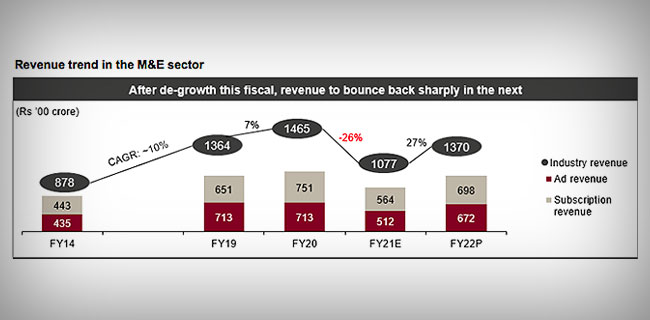
    Revenue of India’s media and entertainment (M&E) sector should script a strong 27% rebound to ~Rs 1.37 lakh crore in fiscal 2022, after contracting ~26% this fiscal. Optically, the de-growth this fiscal and growth expectation next fiscal may sum up to a full rebound. But that won’t be true because the 27% growth will be on a much lower base. Industry revenue next fiscal will still be lower than that in fiscal 2020 (refer to Chart above).

    The time to bounce-back to pre-pandemic levels will be relatively shorter for segments such as digital and television (TV), while print, films, outdoor, and radio would take longer

    Credit profiles of large media companies would be unaffected due to strong balance sheets, liquidity and the revenue rebound, while mid-sized and small ones could see stress, an analysis of over 80 of them rated by Crisil Ratings shows.

    Said Nitesh Jain, Director, Crisil qually to the overall M&E sector’s topline, but since the former correlates strongly with economic growth, the pandemic has had a bigger impact on it. Next fiscal, with strong economic rebound on the cards, ad revenue should grow 31% on-year and subscription revenue ~24%.”

    The TV segment – contributing around half of the sector’s topline – has recovered fully and will report healthy growth next fiscal. Ad revenue saw a sharp contraction initially, but recovered swiftly thereafter, aided by airing of new content, sports events such as the Indian Premier League and a buoyant festive season.

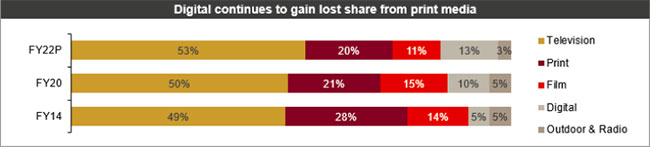
    As for subscriptions, TV was resilient even during the peak of pandemic as people remained indoors. The print segment – contributing a fifth of the M&E sector topline – is recovering, though at a much slower pace, and should be able to rebound fully only by the end of next fiscal. Print is losing share in ad revenue mainly to the digital segment (refer to chart 2. Circulation too, especially for English language, could see a loss of 8-10%, because of increased preference for e-papers in metros.

    However, print companies are rebooting their cost structure and accelerating digital adoption to stay relevant. Films – contributing a sixth to the sector topline – is one of the most impacted segment. But occupancies in theatres should improve with the vaccination rollout and a strong pipeline of content. However, this segment is likely to remain impacted even next fiscal due to social distancing norms and fear of closed spaces.

    Other traditional media – radio and outdoor – are seeing persisting pain, and will likely take much longer to recover (Radio and outdoor segments don’t have any subscription revenue). This is because commuting as well as ad budgets for micro, small and medium enterprises – the key drivers for these segments – will remain restricted even in fiscal 2022.

    Added Rakshit Kachhal, Associate Director, Crisil Ratings Ltd: “Digital has emerged as the medium of choice. The pandemic accelerated adoption of over-the-top (OTT) platforms, online gaming, e-commerce, e-learning, e-papers and online news platforms. This has meant the focus of advertisers has shifted from traditional to digital media. We expect the digital segment revenue to grow 14-16% annually over the medium term. Its share of M&E sector revenue is expected to double to ~20% by fiscal 2024 compared with last fiscal.”

    Given the sharp impact on revenue, cash accruals this fiscal will weaken for all M&E companies except TV distributors. Credit profiles of the large companies are cushioned by strong balance sheets (with most of them net debt-free), while those of small and mid-sized media companies have weakened. More downgrades among the latter led to the Crisil Ratings’ credit ratio (upgrades to downgrades) for the sector sliding to 0.33 in the first nine months of the current fiscal from 0.75 in fiscal 2020.

    Liquidity pressure may intensify for them if recovery in ad revenue is delayed. That said, there is a silver lining to this cloud, too. M&E companies have adopted aggressive cost rationalisation initiatives. Besides, the pandemic-led change in consumer behaviour has accelerated monetisation opportunities for these players through integration of digital media into their traditional businesses. Some of these aspects can lead to structural changes in business models of the M&E sector over the longer term.

  • 45% of mobile users in India introduced to gaming in pandemic


    From an InMobi communique with minor tweaks


    India, a mobile-first economy, is also the land of committed mobile gamers who belonging to different age groups, gender, and geography, said InMobi’s 2021 Gaming Report, India. The report title “Everyone’s Gaming Among Us – Mobile Gaming through the Pandemic and Beyond” reveals insights derived from the app usage patterns and trends that were analysed basis 1.7 trillion ad requests between January 2020 and January 2021 on the InMobi Marketing Cloud and Audience Intelligence Platform, and a survey conducted among over 1000 smartphone users from across India using InMobi Pulse.

    InMobi Pulse is a leading mobile consumer intelligence platform powered by artificial intelligence (AI). Overall, the report indicates that in India, which is home to 1 out of 10 gamers across the globe, mobile gaming is a source of entertainment as well as relaxation, and it has become a mainstay in the life of the average citizen.

    Commenting on the changing gaming pattern in India, Vasuta Agarwal, Managing Director, Asia Pacific, InMobi, said: “Mobile gaming accelerated due to the lockdown in India as people continued to shelter at place and work from home. What was seemingly an emerging trend is now a lasting behaviour with a 1.5x growth in gaming users. With over 80% of mobile gamers playing every day, it has evolved to become an integral part of the connected consumer’s life!”


    India: The Land of the Committed Mobile Gamer

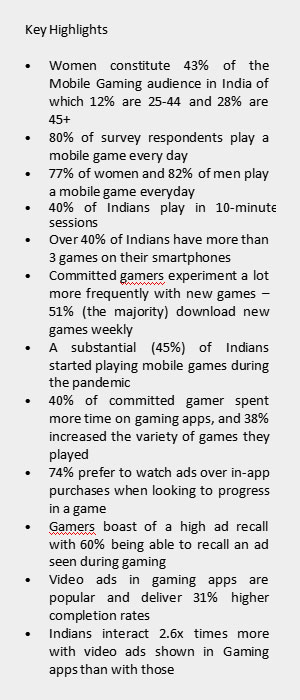
    Gaming in India is no longer restricted to young men. Majority of Indians are committed gamers who play at least once or more every day. Accessibility and affordability of smartphones and high-speed internet are some of the factors which have made mobile gaming a popular source of entertainment for people regardless of age and location. The report highlights that women constitute 43 per cent of the Mobile Gaming audience in India of which 12 per cent are in the age group of 25-44 and 28 per cent are over 45 years.

    Typically, Indians play mobile games in multiple short spurts during the day. 40 per cent of the respondents who participated in the InMobi Pulse survey indicated that they usually play in 10-minute sessions – in between meetings, chores, meals, etc. However, committed gamers, on the contrary, spend substantially more time per session than other gamers, with over 84 per cent of the players spending up to an hour on mobile gaming in a single sitting.


    According to the report, committed Indian gamers love experimenting with new games. More than half of the survey respondents said they download a new game every week while over 40 per cent have more than three games on their smartphones at any given time. Given the vast app universe and increasing size of the apps, Indian gamers say they have to constantly choose between apps that they want to keep on their smartphones. While casual and card/puzzle/board games are a popular choice among all gamers, the committed players and Gen Z gamers have a greater inclination towards MOBA (Multiplayer Online Battle Arena), simulation, and action games.

    Advertisements on gaming apps and other apps and word-of-mouth are the most preferred ways of finding new games. While committed gamers prefer app store recommendations and ads on gaming apps to find new games, occasional gamers mainly rely on word-of-mouth, in-app ads and social media to discover new games.


    Emerging Trends and Lasting Behaviour

    The onset of the pandemic and the subsequent lockdown resulted in a significant shift in mobile usage and consequently has been a catalyst in boosting mobile gaming in India. During this period, the survey shows that 45 per cent of Indians started playing games on their smartphones. This also resulted in a spike in the amount of time spend on mobile gaming as well as the number of apps they experimented with. Among the committed gamers, 40 per cent spent more time on gaming apps while 38 per cent of them increased the variety of games they played. During COVID-19, on an average day, time spent on gaming apps surged through the day as people played a lot more often starting as early as 7:30 AM till 11:30 PM. The sharpest surge in the use of gaming apps occurred at 11:30 AM, with a 6.6x increase in gameplay.

    The lasting impact of COVID-19 shows that Indians are continuing to play a lot more on their smartphones throughout the day. Mobile Gaming has grown from being just a hobby to becoming synonymous with a medium of relaxation. The Gen X (45+ age group) users were seen indulging in multiplayer games to connect with family, friends, and other like-minded people on the platform.


    Importance of Mobile Gaming for brands

    Despite the huge opportunity right in front of them, most marketers seem to be hesitant when it comes to investing in the gaming space. They carry misplaced notions on the lack of personas, placements, engagement, and of course brand safety – but this couldn’t be further from the truth! Contrary to the popular notion, women today are highly committed gamers, with 77 per cent of them playing at least once a day if not more, to relax and stay connected with family and friends. Data finds that around 32 per cent of women games play in 10-minute sessions while 23 per cent tend to play for over an hour every day.

    Even the most committed gamers don’t limit themselves just to games but keep a variety of other interests both online and offline. These people can be found all across the internet, be it on social media platforms, video and music streaming apps, or at a retail outlet. Today, the probability of mobile gamers being the target audience of any business is extremely high which means one can effectively engage with these user groups to market their brands. Data also shows that 74 per cent of the gamers prefer to watch gaming advertisements over in-app purchases in order to move to the next stage in the game. They also boast of a high ad recall with 60 per cent being able to recall an ad seen in or during a game.

    Indians interact 2.6x times more with video ads shown in Gaming apps than with those shown in other apps. Video advertisements in gaming apps are among the most popular and deliver 31 per cent higher completion rates for publishers (over the MOAT benchmark) on the InMobi Advertising Platform.

    “Gaming is one of the most scalable channels for brands to reach diverse target audiences. Be it women, millennials, sports enthusiasts, or OTT viewers, everybody is gaming among us. Moreover, mobile gamers are receptive to advertising with 3 in 4 consumers preferring to see an ad and 60% of them being able to recall the ads they see. Gaming is the biggest opportunity for brands to maximize impact with video and other engaging formats in 2021,” added Agarwal.

    According to the report, the Indian gaming ecosystem has matured by leaps and bounds over the past year. India is the 5th largest mobile gaming market across the world and the gaming culture has now achieved escape velocity in the country, competing with other popular entertainment categories such as short-form videos, streaming services and social networks. As brands continue to traverse different stages of digital marketing maturity, leveraging this platform would be extremely critical for brands to meet the consumers where they are, and continue to stay relevant.

  • Total TV Owning Households grow 6.9% to reach 210mn


    By Our Staff

    Television measurement body Broadcast Audience Research Council India (BARC India), has released its TV Universe Estimates 2021 (TV UE).

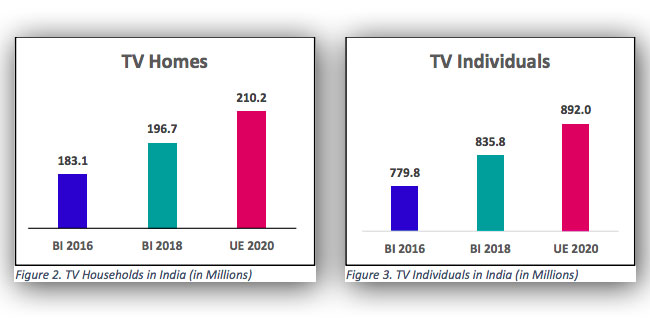
    According to BARC India’s TV UEs 2020, 210 mn Indian households now own a TV set, an increase of 6.9% from 197 Mn in 2018. Simultaneously, TV viewing individuals also witnessed an increase of 6.7%, reaching 892 Mn from 836 Mn in 2018, an increase of 57 million individuals in 2020. TV Owning female population grew by 7%, while male population grew by 6%. In terms of age-groups, the highest growth was witnessed in the “kids” category (age 2 to 14) at 9%.

    Meanwhile, TV households in Urban markets grew by 4% from 87.8 Mn in 2018 to 91 Mn while Rural markets have grown by 9%, up from 108.9 Mn to 119.2 Mn in 2020. While TV households across India grew by 6.9%, HSM grew by 8% outpacing All India as well as the South states which grew by 5%.


    NCCS

    As the Indian population continues to move up the socio-economic pyramid, changes are also observed in the NCCS profile of TV households. As per the TV UE-2020, the proportion of NCCS A and B has increased to 27% and 31% respectively while NCCS DE has further contracted to 9% of TV households in the country.


    Sunil Lulla

    On presenting the updated TV Universe Estimates for broadcasters, advertisers, agencies and other industry stakeholders, Sunil Lulla, Chief Executive Officer, BARC India, said, “As a body that is deeply rooted in data science, BARC India is committed to providing its stakeholders with a true representation of the television universe. We are happy we have been able to ascertain that television continues to be the screen of choice for Indians. With an additional 13 Mn TV households and an opportunity for another 90 Mn households that are yet to own a TV set, India’s broadcast ecosystem continues to have a significant potential for growth in the years to come.”


    Dr Derrick Gray

    Added Dr Derrick Gray, Chief of Measurement Science & Business Analytics, BARC India: “At BARC India, we are deeply invested in providing data that is statistically accurate by factoring in changes in the various “control and weighting variables” that are shown to be highly associated with television viewing. The updated Universe Estimates, UE 2020 aptly sums up India’s linear TV ecosystem and highlights that TV owning households continue to grow. Given the global pandemic scenario, the updated estimate is robust and is developed with the help of data and findings based from various previously validated field studies. We are certain that these estimates will help the industry to a great extent. We will continue to provide the industry with a currency that is reliable and of global standards. I would like to thank the TechComm on behalf of all of us for all their support and contributions in formalising the UE 2020.”


    TV UE 2020 has been developed by computingthe Linear growth of TV Households and TV Individuals from Broadcast India (BI) Studies conducted in 2016 and 2018at geographic and demographic levels. The distribution of the TV population by NCCS was taken from the most recent Indian Readership Survey (IRS). BARC India will implement the findings from the TV Universe Estimates 2020 for its data starting Week 14, 2021, which will release on April 16, 2021 (that’s tomorrow). While an establishment survey as a part of Broadcast India (BI) 2021 is also currently underway, the updated estimates will reflect for BARC India subscribers in the YUMI Analytics platform with immediate effect.


    For more: BARC India TV Universe Estimates 2020