Category: RESEARCH

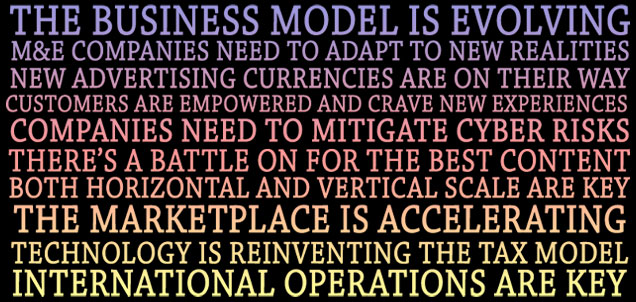
  • 10 Opportunities & Threats for M&E companies


    Media and entertainment companies can gain competitive advantage by finding opportunities in disruption, notes an EY report By John Harrison,

    EY Global Media & Entertainment Sector Leader


    What are the most significant growth opportunities for media and entertainment companies today? What are the most significant risks or threats that they face? The EY Global Media & Entertainment sector team has identified and assessed ten areas of upside and risk for the industry.

    Read on to find ways companies in this industry can respond to the shifting environment.

    1. The business model is evolving

    Disruption is sweeping through the media and entertainment (M&E) industry, powering the invention and rapid expansion of new business models and leading to uncertainty about the durability of well-established ecosystems. Consumers are expecting media and entertainment providers of all types to deliver choice, convenience and value, all wrapped inside personalized, customized experiences that are available on demand and on a cross-platform basis — and with limited advertising and strong data protection.

    2. M&E companies need to adapt to new realities  

    Intensifying competition for viewers and advertisers, combined with ongoing declines in subscribers, is putting pressure on topline performance at many M&E companies. At the other end of a margin squeeze, costs are escalating — especially in the critical areas of content and talent.

    Unsurprisingly, the mantra of cost cutting has reared its head again as a key priority for management teams; however, the solution today is more holistic and nuanced than simple brute-force reductions. What the M&E industry requires is a new level of operational excellence — the kind of strategic expense reduction that delivers short-term results and long-term efficiencies.

    3. New advertising currencies are on their way

    As the lines blur between linear and digital media, advertisers are developing new currencies to better understand and target consumers. Audiences are fragmenting across video platforms — from live TV to time-shifted and connected TV (over-the-top video, streaming media players, connected digital video recorders), and from desktop to mobile and immersive videos (augmented reality, virtual reality and wearables).

    With this fragmentation, advertising models are also evolving new forms, including programmatic, native, vertical, 360 degree and addressable ads. Audience measurement — the key piece in the puzzle and critical to understanding consumers — has become more complex and continues to lag.

    4. Customers are empowered and crave new experiences

    In the traditional M&E model, creativity, distribution and monetization were linear. For the most part, consumers were passive, waiting for content that was made available at a time dictated by others. Digital has created a new world order that is more atomized, disintermediated, complex and, above all, dynamic. As a consequence, M&E consumers are more empowered. They have steadily rising expectations around how products and services should be delivered.

    Just a few years ago, consumers were delighted to be able to stream a movie or TV show on multiple devices. Now, a consumer expects personalized experiences across their daily life, from mobility and financial services to communications and entertainment.

    5. Companies need to mitigate cyber risks

    Every click, view and download results in massive amount of data being created every day. This data offers M&E companies a real competitive advantage, however, this same data is a magnet for cyber criminals.

    M&E companies need to take a four-step, risk-based approach to cybersecurity:

    :: Prioritize: Identify and prioritize the assets that matter most to the organization.

    :: Plan: Improve processes to plan, protect, detect and respond to cyber threats.

    :: Protect: Consider the impact of security breaches that third parties present and develop a supplemental plan addressing these potential gaps.

    :: Preserve: Develop a continuous improvement plan that enables management of constant change efficiently and effectively.

    6. There’s a battle on for the best content

    The rapid proliferation of video distribution platforms and a corresponding uplift in engagement metrics, subscription fees, advertising revenue — or a combination — has created an intense competitive landscape for developing and acquiring the best content.

    With so much content available across many distribution alternatives, M&E companies need to think of innovative strategies to enable consumers to find compelling programs to watch. We expect AI and machine learning technologies to be leveraged by M&E companies to dissect viewing patterns from multiple perspectives to build personalized recommendations into consumers’ digital interaction. Also, the importance of network collaboration with distribution “frenemies” will increase, curating content relevant to specific platforms.

    7. Both horizontal and vertical scale are key

    The rise of global social, video, advertising and e-commerce giants — with their user bases measuring in billions, tremendous financial resources, market-leading growth rates and appetite for risk — is creating a new competitive reality. This “winner takes all” backdrop is powering a strong sense of urgency across the M&E sector to respond strategically.

    M&E leaders view inorganic action as the fastest way to gain heft, increase share, rationalize the marketplace, quickly add new capabilities, reshape existing asset portfolios and futureproof their business models. According to EY research, the top rationales for M&A in the sector are “enhancing product and service portfolios” and “gaining market share,” indicating strategic imperatives of scale and scope.

    8. The marketplace is accelerating

    As new technologies accelerate how supply and demand intersect in all industries, the dynamics of M&E marketplaces — for both consumers and advertisers — are becoming “superfluid,” placing new pressures on all parts of the ecosystem to move more quickly.

    The dynamics of programmatic transactions are now expanding to other aspects of the business, which increasingly embrace data and automation. As digital dynamics are increasingly infused into all media (even traditional), the opportunities to accelerate superfluidity will continue to grow.

    9. Technology is reinventing the tax model

    US tax reform represents the biggest change in taxation in more than 30 years. Multinational M&E companies must respond to its wide-ranging implications. Yet tax reform is really an inflection point in what has become a much wider conversation about the future of the tax function. In the year ahead, companies and tax executives will need to explore how they engage with regulators and how they manage reporting to take advantage of new technologies.

    10. International operations are key

    Globalization is critical to M&E companies looking to build scale, open new markets and remain competitive. Although we see the rise of economic nationalism and the prospect of higher trade barriers, at the same time, a suite of enabling digital technologies is rendering borders less relevant. Today’s M&E companies must be more open than ever to the opportunities of growing their international operations.
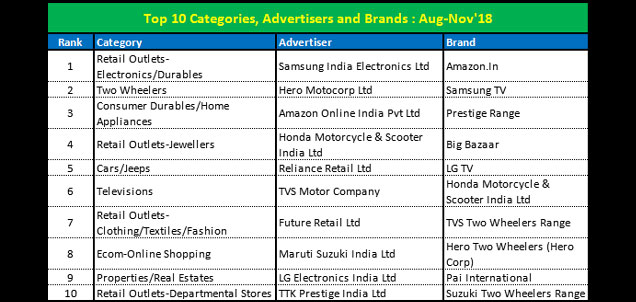
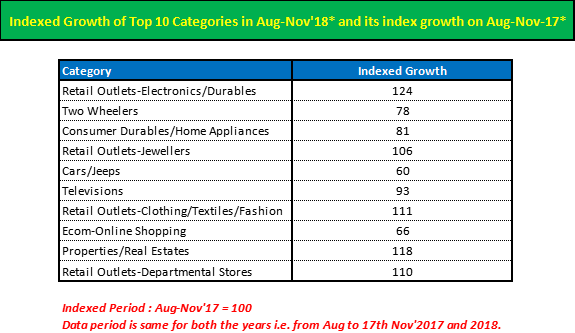
     

  • AdEx for Festive Advertising in 2018


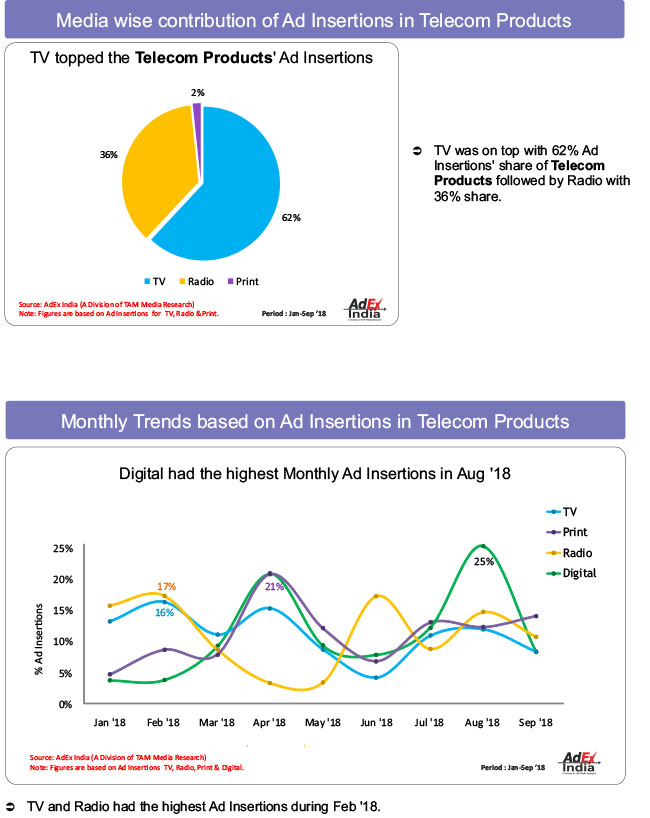
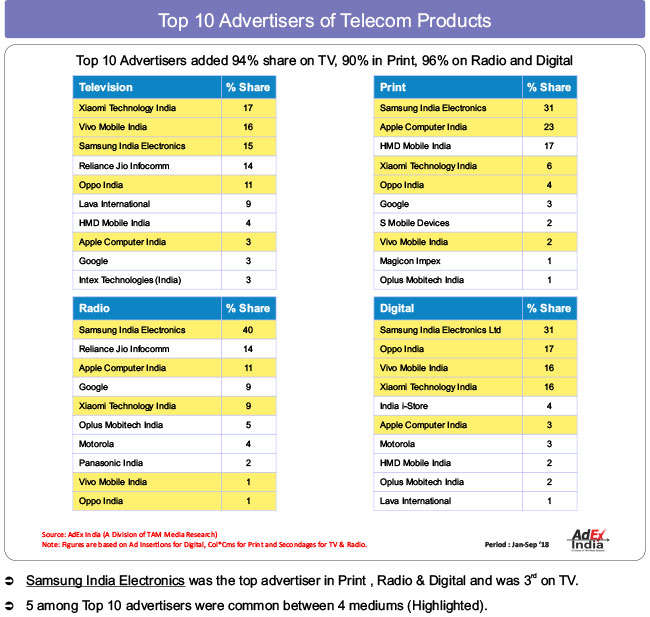
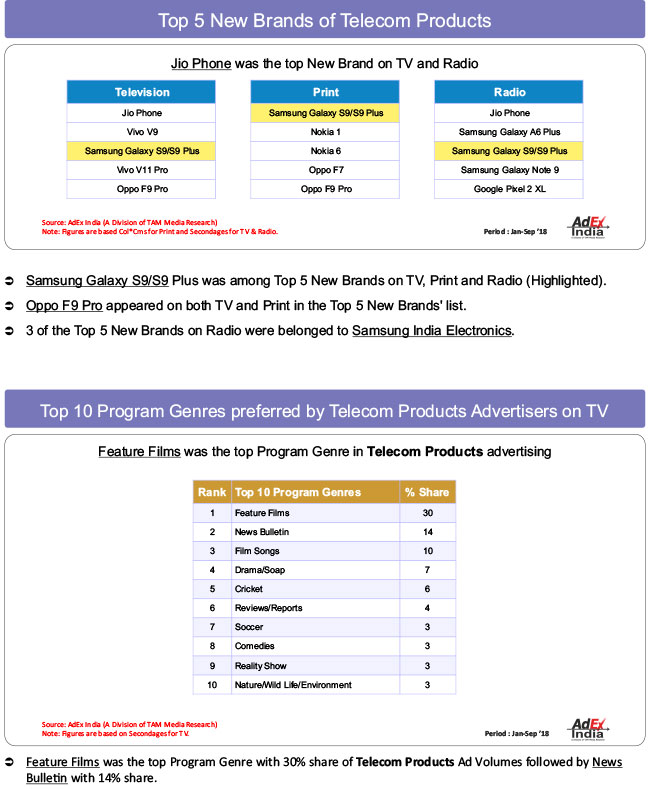
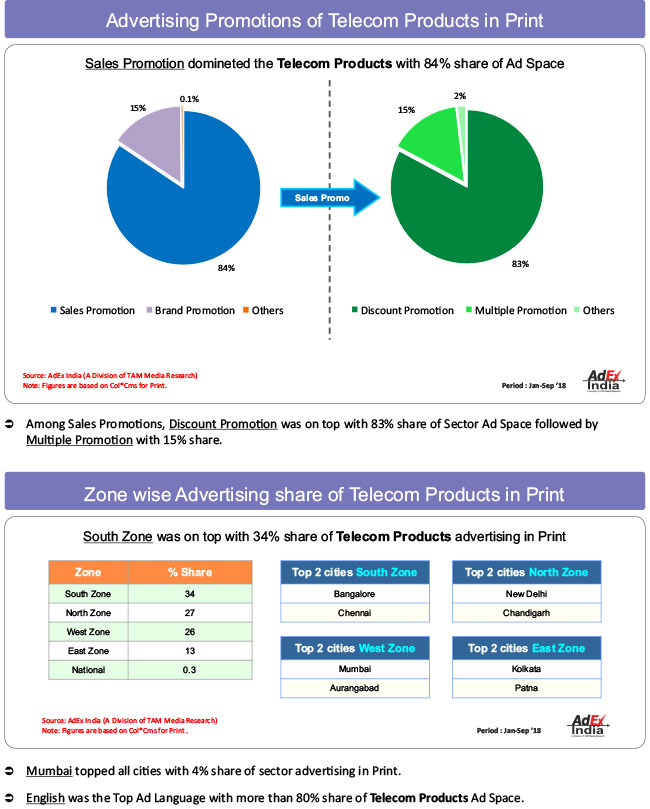
    TAM AdEx, a division of TAM Media Research, has shared with MxMIndia numbers for festive advertising for 2018. The data tells the story:


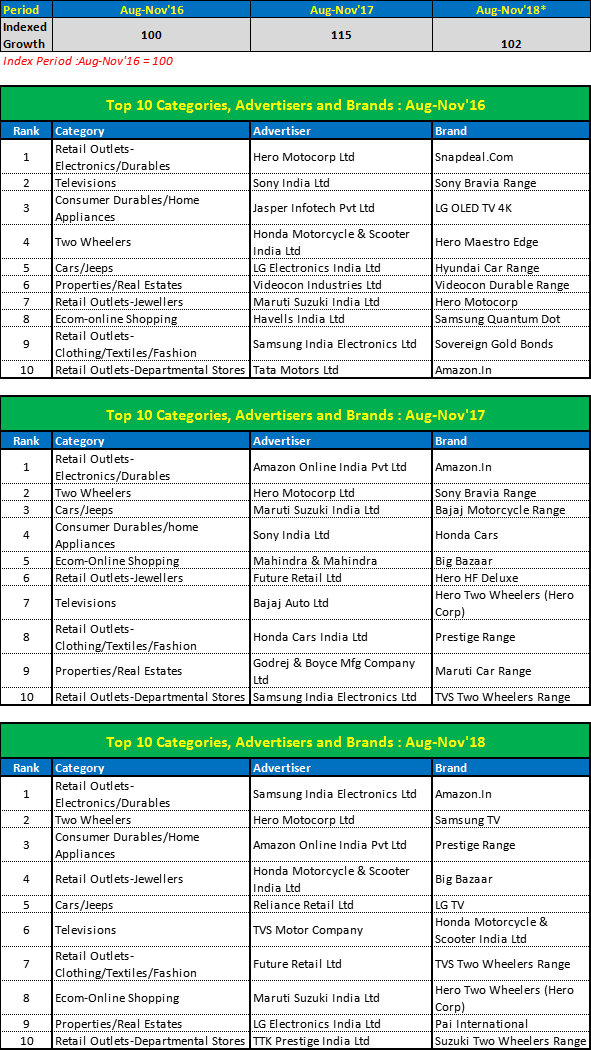
    This is a very important chart. Index grew to 115 in 2017 but only 102 in 2018. Below the first chart are the Top categories, advertisers and brands for 2016, 2017 and 2018 (also above as the main story image)


  • RAM Ratings for Week 51 – Jan 16-22, 2018

    We are back with carrying of RAM numbers every week, starting with Week 51. Here are the Radio Audience Measurement (RAM) Ratings for Week 51 of 2018… that’s December 16 to 22, 2018. Sourced directly from RAM. It may be noted that this is topline data which may be insufficient for taking business decisions on booking (or not booking) ads on radio stations. We urge advertisers to buy the research findings or ask radio stations and/or media agencies for detailed numbers.

    Market: MUMBAI
    Demographic: All People 12+ Filter Demographic: None
    Week: Week 51-2018 [16DEC to 22DEC]
    Daypart: Whole Week Daypart
    Place of Listening: All
    Rank Stations Share % T.S.L.
    1 Fever FM 104 Mumbai 18.2 6.17
    2 Radio City 91.1 Mumbai 13.7 5.42
    3 Big FM 92.7 Mumbai 12.1 5.06
    4 Radio Mirchi 98.3 Mumbai 11.8 3.35
    5 Radio Nasha 91.9 Mumbai 11.6 5.43
    6 Red FM 93.5 Mumbai 9.7 3.43
    7 AIR FM2-Gold 100.7 Mumbai 6.7 4.23
    8 REDTRO 106.4 Mumbai 4.3 5.5
    9 Radio One 94.3 Mumbai 2.8 2.06
    10 AIR FM1-Rainbow 107.1 Mumbai 2.5 3.31


    Market: KOLKATA
    Demographic: All People 12+ Filter Demographic: None
    Week: Week 51-2018 [16DEC to 22DEC]
    Daypart: Whole Week Daypart
    Place of Listening: All
    Rank Stations Share % T.S.L.
    1 Radio Mirchi 98.3 Kolkata 20.1 4.38
    2 Fever FM 104 Kolkata 18.7 6.5
    3 Big FM 92.7 Kolkata 16.6 5.02
    4 Aamar FM 106.2 Kolkata 10.4 4.37
    5 Red FM 93.5 Kolkata 9.2 3.1
    6 Friends FM 91.9 Kolkata 5.4 3.19
    7 Radio One 94.3 Kolkata 5.4 4.42
    8 Ishq FM 104.8 Kolkata 5.2 3.1
    9 AIR FM2-Gold 100.2 Kolkata 3.9 3.19
    10 AIR FM1-Rainbow 107 Kolkata 2.7 4.01


    Market: DELHI
    Demographic: All People 12+ Filter Demographic: None
    Week: Week 51-2018 [16DEC to 22DEC]
    Daypart: Whole Week Daypart
    Place of Listening: All
    Rank Stations Share % T.S.L.
    1 Fever FM 104 Delhi 18.9 5.22
    2 Radio City 91.1 Delhi 13.7 4.24
    3 Radio Nasha 107.2 Delhi 13.1 4.34
    4 Radio Mirchi 98.3 Delhi 11.6 3.27
    5 AIR FM2-Gold 106.4 Delhi 10.8 4.47
    6 Red FM 93.5 Delhi 9.6 3.36
    7 Big FM 92.7 Delhi 7.6 3.08
    8 Ishq FM 104.8 Delhi 4.3 2.35
    9 Hit 95 FM Delhi 3.4 2.43
    10 AIR FM1-Rainbow 102.6 Delhi 3.2 2.06


    Market: BANGALORE
    Demographic: All People 12+ Filter Demographic: None
    Week: Week 51-2018 [16DEC to 22DEC]
    Daypart: Whole Week Daypart
    Place of Listening: All
    Rank Stations Share % T.S.L.
    1 Radio City 91.1 Bangalore 25.6 9.31
    2 Big FM 92.7 Bangalore 19.2 7.37
    3 Radio Mirchi 98.3 Bangalore 17.4 6.48
    4 Fever FM 104 Bangalore 14.3 8.19
    5 AIR FM1-Rainbow 101.3 Bangalore 6.4 5.3
    6 Red FM 93.5 Bangalore 5.3 3.53
    7 AIR FM1-Vividh Bharati Bangalore 3.9 4.1
    8 Radio One 94.3 Bangalore 3.7 3.44
    9 Radio Indigo 91.9 Bangalore 1.4 2.18
    10 Radio Mirchi 95 Bangalore 1.3 3.17
  • SRK brand value erodes as Virat continues at #1


    By A Correspondent


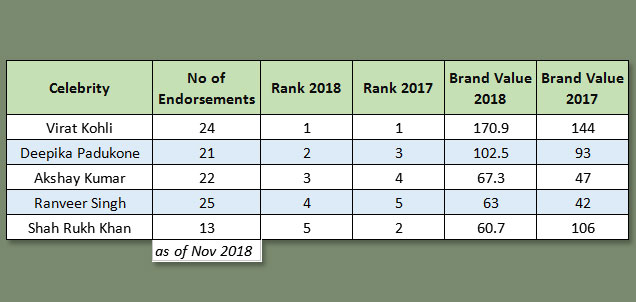
    Global advisory firm Duff & Phelps announced findings from the fourth edition of its Celebrity Brand Valuation Report 2018: ‘The Bold, the Beautiful and the Brilliant.’ The report, released on Thursday, provides a ranking of India’s most powerful celebrity brands based on brand values derived from their endorsement contracts.


    Key findings from the report include:

    :: Virat Kohli retains the top position for the second consecutive year. His brand value rose by 18% to US$170.9 million in 2018.

    :: Deepika Padukone rises to the second position, whereas Shah Rukh Khan falls to the fifth position.

    :: Total value of the top 20 celebrity brands stands at US$877 million, with the top 10 contributing more than 75% of the total value.


    Celebrity – Top 10

    2018

    2017

    Brand Rank Brand Value Brand Rank
    Virat Kohli 1 170.9 1
    Deepika Padukone

    2

    102.5

    3

    Akshay Kumar

    3

    67.3

    4

    Ranveer Singh

    4

    63.0

    5

    Shah Rukh Khan

    5

    60.7

    2

    Salman Khan

    6

    55.8

    6

    Amitabh Bachchan

    7

    41.2

    8

    Alia Bhatt

    8

    36.5

    9

    Varun Dhawan

    9

    31.6

    10

    Hrithik Roshan

    10

    31.0

    7


    Commenting on the rise of the endorsement market in India, Varun Gupta, Managing Director and Asia Pacific Leader for Valuation Services, Duff & Phelps said: “The celebrity endorsement market in India has matured from vanilla endorsement deals to full-fledged partnerships through innovative routes such as equity deals and strategic partnerships. On the other hand, rising internet penetration, varied formats of content consumption and a burgeoning middle class with increasing disposable incomes is boosting media spends for traditional and digital advertisements through celebrities. Millennial celebrities continue to be the first choice for brand endorsements as companies want to have a greater focus on the youth segment fuelled by demand in sectors such as e-commerce, retail, FMCG and smartphones, among others.”


    As per data from GroupM ESP Properties, over the past decade celebrity-led endorsements increased in number from 650 in 2007 to 1,660 in 2017, representing a steady CAGR of 10%. Further, TV ad spends with celebrity endorsers rose from INR15.5 billion in 2007 to INR66.6 billion in 2017 at a CAGR of 16.1%. TV ads with celebrity endorsers represented close to 24% of the total TV ad spends in 2017, which represents a 5% uptick from 2007.


    Added Aviral Jain, Managing Director, Duff & Phelps: “While Bollywood celebrities dominate the rankings of the top 20 celebrities, sportspersons provide tough competition. Virat Kohli, Sachin Tendulkar, M. S. Dhoni and P.V. Sindhu collectively contributed almost US$241 million, which is over 27% of the cumulative brand value of the top 20 celebrities pegged at US$877 million.”


    “Brands are also increasingly going regional in their endorsement strategy to cater to the heterogenous peculiarities of Indian states. They are leveraging the equity that local celebrities enjoy. Product brands are also looking for better returns on their investment through a step up on regional markets and have started coming up with region-specific commercials featuring regional celebrities like Mahesh Babu and Tamannaah,” Jain added.


    Further, the report focuses on the rising trend of power couples. By tapping into a power couple’s reach and impact, brands can target each partner’s unique following and voice. The coming together of a power couple creates a larger platform that brands want to leverage to target the youth. This year, power couple Virat Kohli and Anushka Sharma have endorsed around 40 brands together such as Head and Shoulders, Manyavar, Pepsi, Celkon, Boost, Audi, Fastrack, Goinee, Wrogn and Polaroid.


    Celebrities are also increasingly being leveraged to create social media buzz. A celebrity’s hold on social media is now a major determinant of the influence that he or she can have over a brand campaign. Duff & Phelps sourced data from Meltwater, the vertical leader in online media intelligence solutions, on the top celebrities and their social media presence, engagement and influence index.


    Commenting on the power of a celebrity’s social media influence, Christo van Wyk, Area Director – India and Middle East, Meltwater said: “ Like marketers, celebrities are continuously building their brand, and those that are aware of current trends and of the difficulties in breaking through the clutter, recognize that social media is a unique opportunity to stand out above the crowd. Celebrities with well-crafted social media strategies are able to maintain relevance, build more intimate relationships with fans and garner real-time feedback on their work. Much like a corporate brand’s, a thriving social media presence can serve as a reflection of a celebrity’s public desirability.”


  • Digital to contribute 29% of ad market by 2021


    On Wednesday, the Dentsu Aegis Network’s DAN Digital Report was released in the presence of a cross-section of the media and marketing professionals. Here are key highlights from the report and an executive summary:


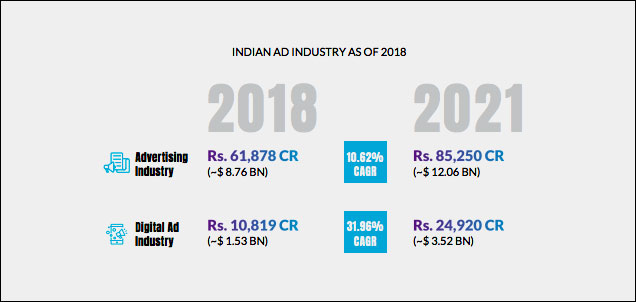
    :: As of 2018, the Indian advertising market stands at Rs 61,878 crore ($8.76 billion) and is estimated to grow with a CAGR of 10.62% till 2021 to reach a market size of Rs 85,250 crore ($12.06 billion).


    :: “The digital advertising market size is around Rs 10,819 crore ($1.3 billion) and the estimated CAGR growth will be 31.96% and the market will expand to Rs 24,920 crore ($3.52 billion).


    :: Television and print take the largest share of media spends at 70% aggregated followed by digital media at 17%. Digital will contribute 29% of the ad market size by 2021.


    :: Currently, BFSI is the biggest spender on digital media with a contribution of 38% of all their marketing budgets. This is followed by consumer durables (36%), e-commerce (34%) and telecom (31%). FMCG spends heavily on the television (63%) and the retail sector spends largely on print (54%) medium of advertising.


    :: The advertising expenditure on the digital advertising formats is led by social media (29%) followed by search (25%), display (21%) and video (20%).


    :: The main drivers of the growth of digital media will be voice, vernacular and video. Apart from this, some of the other drivers of digital media growth will be engaging mobile experiences based on augmented reality (AR) and virtual reality (VR).


    Executive Summary:

    :: Internet penetration and adoption of digital media in India is growing at an unprecedented rate, which is creating huge opportunities to tap into the unchartered arena of digital space in newer ways. The ever-evolving digital industry and the advancement of technology opens various opportunities to interact with the audiences. Marketers can now choose innovative ways to reach out to their target audience and cater to the demand to create unforgettable experiences for them.


    :: As of 2018, the Indian advertising market stands at Rs 61,878 crore ($8.76 billion) and is estimated to grow with a CAGR of 10.62% till 2021 to reach a market size of Rs 85,250 crore ($12.06 billion). The digital advertising market size is around Rs 10,819 crore ($1.3 billion) and the estimated CAGR growth will be 31.96% and the market will expand to Rs 24,920 crore ($3.52 billion).


    :: Television and print take the largest share of media spends at 70% aggregated followed by digital media at 17%. Digital transformation is being adopted at a substantial scale, which in turn, is increasing the adoption of digital media at a rapid pace.


    :: Currently, BFSI is the biggest spender on digital media with a contribution of 38% of all their marketing budgets. This is followed by consumer durables (36%), e-commerce (34%) and telecom (31%). FMCG spends heavily on the television (63%) and the retail sector spends largely on print (54%) medium of advertising.


    :: The advertising expenditure on the digital advertising formats is led by social media (29%) followed by search (25%), display (21%) and video (20%). The BFSI vertical spends the largest share of its digital media budget on search (38%), while FMCG spends the largest share of its digital media budget on video (33%).


    :: Currently, 18% of all digital media is bought programmatically and has grown from 15% last year. The major reason for the growth are technological advancements,  improvements in data science & analytics, implementation of algorithm to automate various procedures, better ad fraud detection and improved data policies & regulations. The rapid increase in the penetration of mobile devices and internet has led to 47% of digital media spends on mobile devices and is expected to grow at CAGR of 49% to reach spends share of 67% by 2021.


    :: Machine Learning (ML) and artificial intelligence (AI) will see heavy adoption and implementation in various media in the near future. The main drivers of the growth of digital media will be voice, vernacular and video. Apart from this, some of the other drivers of digital media growth will be engaging mobile experiences based on augmented reality (AR) and virtual reality (VR). In the near future, data-driven decision-making and business strategies will be more transformative and will entail building and merging of different types of business models and its implementation.


    Commenting on the report, Ashish Bhasin, Chairman & CEO- South Asia, Dentsu Aegis Network said, “Today, you no longer have to sell ‘digital’ to a client. This is the only medium which gives you a very measurable ROI, and almost an immediate impact. We have about 500 million people on the internet today and in the next three to four years, another 300-400 million people will join in. Concurrently, the next phase of internet users will speak regional languages and as a result, you will probably see a lot more advertising in regional languages on digital in the years to come. Dentsu Aegis Network understands this scope. Consequently, we are over-weight on digital. Of our 3500 people, more than 1600 are in our digital agencies. Nearly 48% of our revenues comes from digital at a time when the market average in India is still 15-17%. As leaders in digital, we recognise the need for an industry level research report which not only covers the market size but also gives a direction towards which this industry is moving. The lack of detailed and accurate Digital Advertising Spends is surprising for a medium that lends itself to measurement. It is to fulfil this gap that all the 8 agencies of the Dentsu Aegis Network i.e. Isobar, iProspect, Merkle Sokrati, WatConsult, Dentsu Webchutney, SVG Media/Columbus, Fractal and Amnet collaborated again for the 3rd edition of our Digital Report that extensively covers digital trends, spends and insights across all sectoRs The report has now become the industry standard for digital marketing and this year the report summary will also be available on Alexa.”


  • Predictions for Businesses & Brands


    By A Correspondent


    Kantar IMRB has presents a report on predictions for 2019 using data and reference from across business units within Kantar and syndicated studies such as- Target Group Index –Kantar IMRB, Global Monitor 2018- Kantar Consulting, Kantar Worldpanel, eMarketPulse- Kantar IMRB. The report offers insights to brands on what to expect from the market and solutions to reach out to the consumers in the most effective manner.

    Notes the report summary: “The outlook for India has never been so uncertain. With national elections looming a few months from now, the voter / consumer has much to consider. The resultant instability, compounded by a fast-changing technology, financial and business landscape has created a deep sense of insecurity in Indian consumers. Their overriding response would be to seek stability.”

    Said Preeti Reddy, CEO, South Asia, Kantar Insights Division: “At Kantar, we recognise that it is imperative to achieve a balance of human insight and data-enabled decisions in both the business world and our personal worlds. While data might give us the confidence to believe, our personal experience and foresight give us the guidance to act differently and courageously. In identifying the key trends and how they may manifest over the coming year, we have attempted to exhibit that spirit of digging deep and finding stability “


    So here are the key predictions:

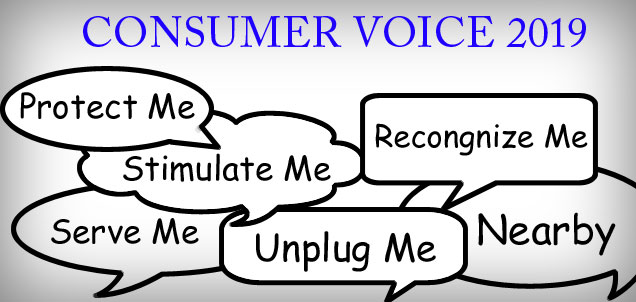
    RECOGNIZE ME

    Consumer Truth

    68 % of Indians agree that they are free to shape their identities and transform themselves in whatever way they want. The percentage has increased sharply from 57% in 2017. As every micro-segment of India’s population demonstrates a hunger for recognition, they are no longer inspired by a few role models, but by achievers they see around themselves. They reject collective labelling as the emergent middle class, small town resident, aspirational homemaker, and would like brands to meet their unique needs and help fulfil their dreams. The defining characteristic about this duality is an expectation to be recognized for both selves:

    Market View

    Brands and categories which recognize the consumer for who they are and where they are will flourish. Expect identity and location data to be more precious than ever. For online retailers, a small-town push would be a no-brainer. Overall e-commerce spends by non-metro shoppers have quadrupled in 2018, while e-tail spends by metro shoppers have grown by 3X. The recognition of diversity and inclusion is inexorably making its mark in the consumer’s consciousness. A focus on regional language support – driven by technology use in local languages, has seen Google announce the addition of Marathi for its popular Google Assistant, with plans afoot for seven more Indian languages, including Tamil, Bengali, Gujarati, Telugu, Urdu, Kannada and Malayalam.

    User-generated content will grow by leaps and bounds as people of all shades and intent seek to be recognized. How marketers can understand human motivations and their diverse origins will pave the path for the fulfilment of their needs. There will be an explosion of agents of change. This will cause an evolution from coaching centres and middlemen, to enablers who are able to spot the potential and facilitate transformation, with technology playing the dual role of connector and showcase.

    PROTECT ME

    Consumer Truth

    47% of Indians say that they feel stressed these days. The percentage has increased from 39% in 2017; and more women than men feel this way. In 2018, Kantar brought to fore that consumers are in a state of perpetual anxiety. That feeling has magnified, with young Indians feeling even more anxious than ever – according to Kantar IMRB’s TGI study, 64% of 15-19-year old worry about crime and violence around them,

    Market View

    Protector products are expected to see a sharp uptick as we go forward into 2019. Hand sanitizers, for example, have grown by a massive 59% in the previous year, Chyawanprash – the traditional Ayurvedic immunity booster, by 26%.

    #Metoo has spurred women to find ways of defending themselves. Smart jewelry brand Leaf Wearables embeds a device called Safer Pro – priced at only Rs 1899, which sends out an alarm signal and the user’s location to predetermined contacts. The smart device recently picked up the $1 million Xprize for Women’s Safety. Expect more such devices, especially for young children, to hit the market soon.

    Implications

    With technology and social media giving birth to new forms of threat such as online trolling. Brands will have to create a stable, positive environment and enable support groups to change the discourse of negativity. At the same time, the entertainment industry – where portrayal of women as victims hitherto pandered to the male gaze and fantasy – will be compelled to change their storytelling and bring in more powerful women’s voices.

    STIMULATE ME

    Consumer Truth

    76% of Indians say that they’re looking for new experiences and sensations that will liven up their everyday activities. The percentage has increased from 64% in 2017. Indians are most likely to look for experiences that allow them to help and connect with others, are memorable and make them feel recharged. Mobile gaming has taken off and with 250 million gamers, India is one of the top 5 gaming countries in the world. The desire for new experiences and stimulation is not limited to young people. For many seniors, laughing clubs are passé – they are running marathons, and pushing the boundaries of their physical capability and flexibility, like taking up dance after 60. The penchant for celebration, which has been magnified by the Great Indian Wedding, is now a regular occurrence.

    Market View

    The momentum driving India’s Experience Economy will only increase in 2019. Over the last three years, the demand for adventure activities and local experiences grew by 178%, with the percentage of people above 50 years rising from 8% to 11%. According to beauty doyenne Shahnaz Hussain, over 700 spas are expected to open doors in the next two years. It’s an industry that is growing at 40% annually. Some travel agents are also reporting young inbound tourists paying anywhere between $150-250 to attend and experience the sensory overload of an Indian wedding. The multi-player game Player Unknown’s Battleground (PUBG) really took off after the launch of a mobile version in March. The ability to chat with other players adds significantly to its attraction.

    Implications

    Going forward into the next year, we expect that many more brands will leverage the power of senses to attract consumers. This will provide a more engaging user experience, even as new technologies such as AR/VR offer immersion and superimposition of imagined worlds for the consumer.  With gaming no more a niche experience, it presents a fantastic opportunity for brands to both be involved in the game ecosystem and to gamify their user experience.

    SERVE ME NEARBY

    Consumer Truth

    149% more traffic congestion than comparable cities around Asia – that’s what Indian metro dwellers have to deal with. Traffic congestion in Mumbai leads to commuters spending 135 per cent more time in road travel than any other Asian city; commuters in Kolkata take 171 per cent more time than the average to travel during peak hours, the figure for Delhi is 162 per cent. With the changing contours of Indian cities, neighborhoods will become more significant than the city itself. The consumer’s expectation is that all the services will be delivered at the doorstep.

    While the benefit of proximity in terms of convenience is obvious, the opportunity for service providers is enormous. We are witnessing a reskilling of this workforce, particularly in the form of leveraging technology and improvement in customer service. The familiar warm relationship between the neighborhood grocer, chemist or barber will be increasingly enabled by technology.

    Market View

    91% of the people surveyed by Cashkaro.com said that they will spend more money on e-commerce sites in 2019. A massive part of that growth is expected to come from services, with specialized platforms gaining popularity over marketplaces. At-home service platforms like HouseJoy and UrbanClap have witnessed exponential growth in customers and service providers alike. The latter reported 2.5 million registered users, with 75% repeat users and average transaction value between Rs 1200-1500. The home chef business is pegged at Rs 408,040 crore in 2018; It is estimated that there are as many as 2 lakh beauty professionals across India, with nearly one-fourth of them being freelancers. Online curated beauty services platform Vanity Cube, which services between 150-200 bookings a day, expects that demand to grow 15X within a year.


    Implications

    There’s a massive B2B opportunity for food, beverage and grooming brands to fulfil the unique needs of the service providers – in the form of new products and new ideas. Brands need to work out how to engage with them and convert them into advocates. Content marketing will become the norm – and it will be vital to help them create interesting content using the entire gamut of options from Instagram to TikTok. Simplifying the transaction through payment gateways will become as important soon, as rewarding customers and users for their loyalty.

    UNPLUG ME

    Consumer Truth

    53% of Indians (amongst those who use the internet) say that they wish social media had less of an influence in their lives. Even as technology engagement grows by leaps and bounds – the 18% growth in the number of smartphone users in 2018 is the highest in the world – a growing section of the population is reducing their screen time and seeking ways to reconnect physically with the world. Astronomy buffs in Mumbai head out to far-flung villages over the weekend; travel experience platform Unhotel offers walks in the Himalayas along with book readings and guided bird-watching. Mainstream newspapers like The Times of India propagate the joys of a Slow Life unhindered by technology. Even the Maharashtra government steps in to declare one day in a week as a ‘No Mobile’ day.

    Market View

    Digital detox is emerging as a big business, starting at the very top of the heap. Tech platforms such as Android and the iPhone track and report all our screen time; Android labels it under the ‘digital wellbeing’ banner. The SHUT (Service for Healthy Usage of Technology) clinic in Bangalore has seen as steady rise in the number of patients seeking help for tech deaddiction ever since it opened four years ago; As more people embrace physical activity ranging from the new-age Zumba to traditional yoga to long-distance running and cycling, the athleisure market has exploded, growing by nearly 14%. Some 35000 people of all ages were at the starting line of the Delhi Marathon, each having paid Rs 1900 to participate. It is no small wonder that there are now over 1000 marathons organized in cities big and small across India. On a more sedentary note, even book reading clubs. Litfests have mushroomed across cities, from Pondicherry and Chandigarh to Pune, Jaipur and Allahabad, some reporting a threefold increase in visitors over the last 2 years.

    Implications

    The travel and leisure industry has much to feel optimistic about as more Indians seek physical and social in-person experiences. In the face of uncertainty and pessimism, this kind of reconnection and exploration provides platforms for stability. In 2019, we expect even more brands and industries to find opportunity in addressing the growing realization of the perils of technology engagement, particularly at a young age. Others will rekindle the nostalgia of relationships, memories and places that allow us to rediscover ourselves.

  • India’s financial services high on Trust


    By A Correspondent


    Even a  decade after the global financial crisis and last year’s cloud over the working of some banks, the Indian financial services sector is a riding a high according to a study by Pitchfork Partners, a Mumbai-based communication strategy consultancy, and MHP, a global communication consultancy. An overwhelming majority in India felt that the sector’s reputation was strong. The Financial Services Reputation Index (FSRI) India Report – the study was conducted across Asia and similar reports were drawn up for various countries – showed that payment systems were rapidly gaining acceptance with more 91% saying they were positive about them.


    Banks, despite the turbulence they have faced over the past few years, made a strong showing – 89% of the respondents were positive about them while 75% said bankers were the most trustworthy among six professions that also included lawyers, property agents, journalists, politicians and policemen.


    Said Jaideep Shergill, co-founder, Pitchfork Partners: “Increased regulation and competition across Asia have raised consumer trust in financial services, but most consumers would like to see even more transparency.” Indeed, when asked what Indian financial services companies can do to enhance their reputations, improved customer service (23%) and transparency (20%) ranked the highest.


    Data security emerged as a major fear with 25% of the respondents saying they were concerned about their data being stolen.


    Added Shergill: “In this day and age, data security is a natural concern – even more so than promised performance and results. This comes as no surprise given the number of high-profile data breaches across the region in the past year.”


    Business intelligence firm ORC International conducted the research for the FSRI report. It included one-on-one interviews with prominent CEOs/CMOs/CCOs and a survey of 1,000 consumers in each market.


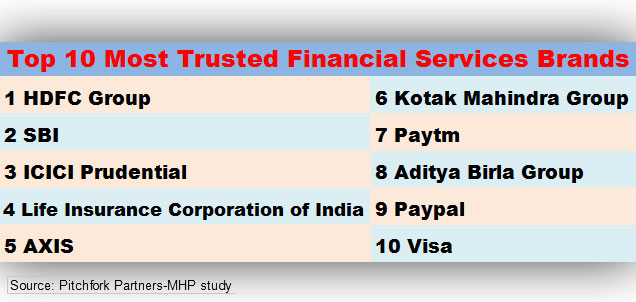
    The study showed that HDFC Group and public sector behemoth State Bank of India were the most trusted Indian financial services brands. New-age, technology-led brands like Paytm and Paypal also featured in the top 10.


    Respondents were interested also in the social responsibility aspects of financial services firms – 78% said that while selecting a company it mattered that it was a responsible one; 75% said they wanted the companies to give back to the community in some way.


    PostScript: Bankers are the most trustworthy of professionals, followed by lawyers. Interestingly, journalists are #4 amongst six, a notch lower than even real estate agents. Ouch!


    Access the full study here: http://pitchforkpartners.com/wp-content/uploads/2019/01/FSRI-India-Report-by-PItchfork-Partners.pdf


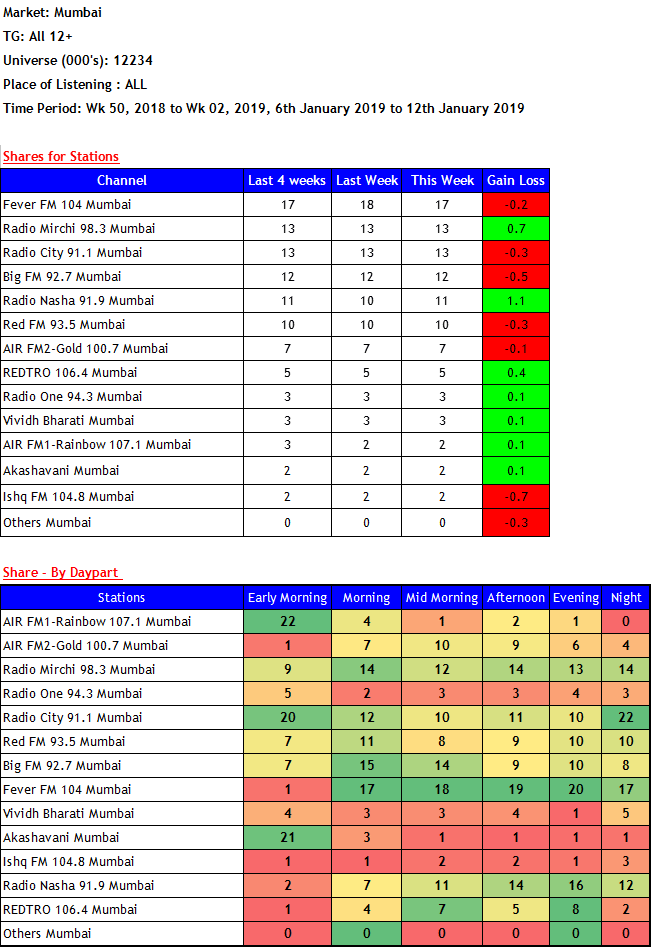
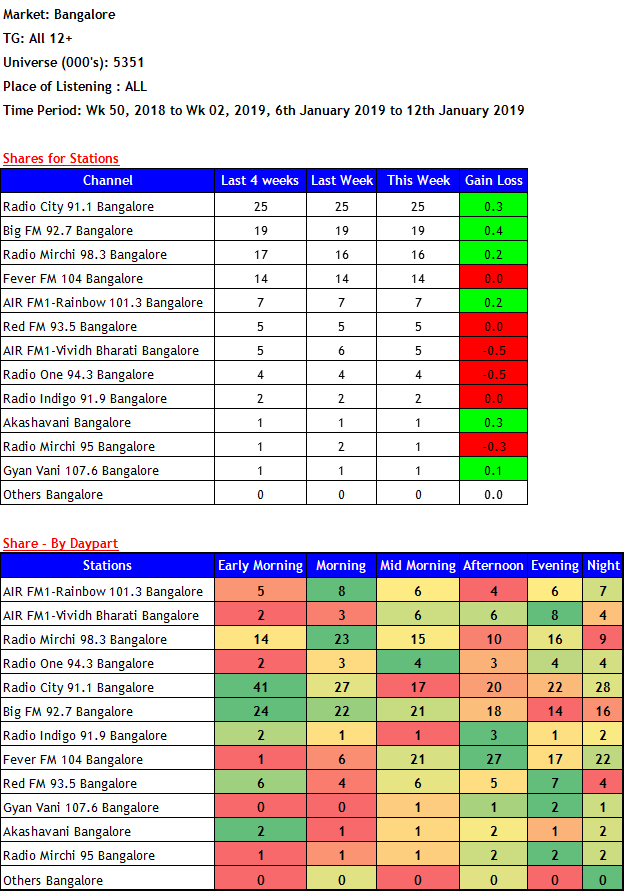
  • RAM Ratings for Week 2 – Jan 6-12, 2019

    We are back with carrying of RAM numbers every week, starting from last. Here are the Radio Audience Measurement (RAM) Ratings for Week 2 of 2019… that’s January 6 to 12, 2019. Sourced directly from RAM. It may be noted that this is topline data which may be insufficient for taking business decisions on booking (or not booking) ads on radio stations. We urge advertisers to buy the research findings or ask radio stations and/or media agencies for detailed numbers.


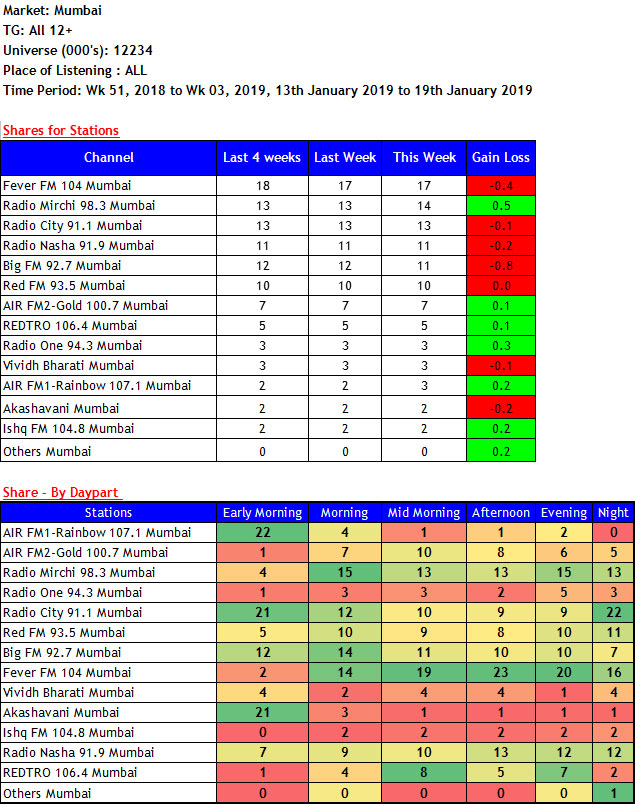
  • RAM Ratings for Week 3 – Jan 13-19, 2019

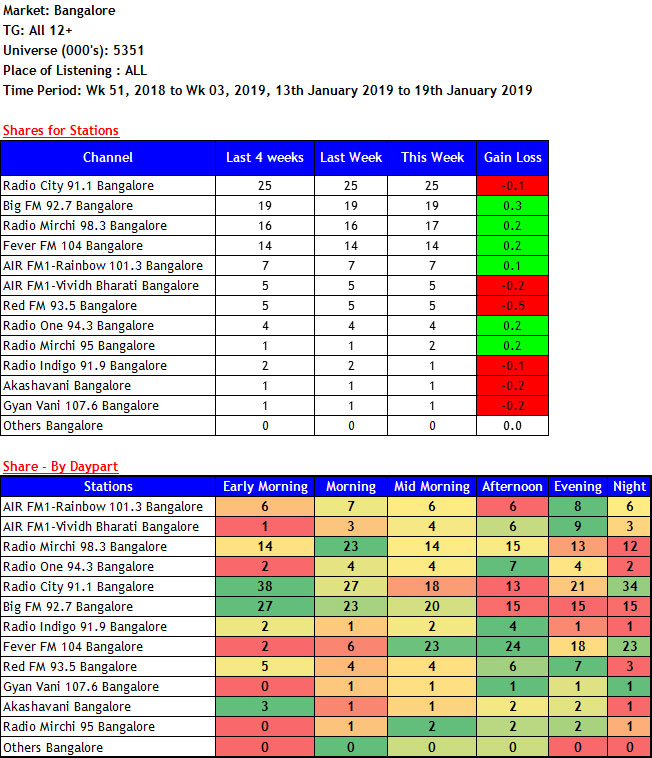
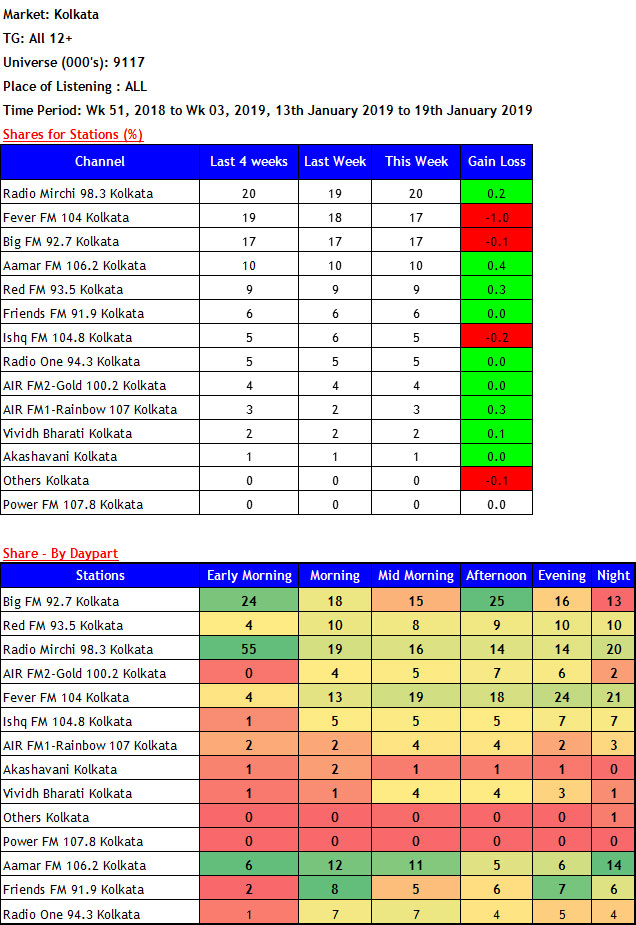
    We are back to carrying of RAM numbers every week. Here are the Radio Audience Measurement (RAM) Ratings for Week 3 of 2019… that’s January 13 to 19, 2019. Sourced directly from RAM. It may be noted that this is topline data which may be insufficient for taking business decisions on booking (or not booking) ads on radio stations. We urge advertisers to buy the research findings or ask radio stations and/or media agencies for detailed numbers


  • AdEx to grow 16.4% in 2019: Madison


    By A Correspondent


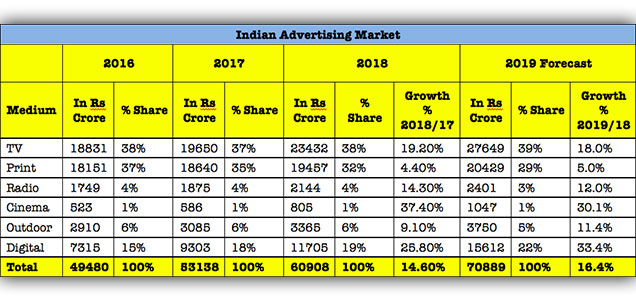
    Media agency network Madison is bullish about 2019 and expects a growth of 16.4% taking the total AdEx to Rs 70,888 crores. “The reasons for our high forecast are upcoming Parliamentary elections, increase in government spending to showcase its achievements, the upcoming ICC Cricket World Cup 2019, growth of OTT, increased spending in rural and India moving to a consumption society,” notes a communique, adding: “In 2019, we believe highest growth will come from Digital at 33%, followed by Cinema at 30% (although on a very small base), followed by TV (18%), Radio (12%), Outdoor (11%) and Print (5%).”

    Adspends have grown from Rs 53,138 crore to Rs 60,908 crore, an addition of  7,769 crores, the highest addition in one year in the last decade. The growth rate of 14.6% achieved in 2018 is almost double the growth rate achieved in 2017, notes the Pitch Madison Advertising Report 2019 release on Wednesday.

    Television still continues to be the largest contributor to Adex with 38% share, followed by Print at 32%, Digital at 19%. Outdoor, Radio and Cinema share has remained steady at 6%, 4% and 1% over the last 3 years.


    Figures at a glance:

    Indian Advertising Market
    2016 2017 2018 2019 Forecast
    Medium In Rs Crore % Share In Rs Crore % Share In Rs Crore % Share Growth % 2018/17 In Rs Crore % Share Growth % 2019/18
    TV 18831 38% 19650 37% 23432 38% 19.20% 27649 39% 18.0%
    Print 18151 37% 18640 35% 19457 32% 4.40% 20429 29% 5.0%
    Radio 1749 4% 1875 4% 2144 4% 14.30% 2401 3% 12.0%
    Cinema 523 1% 586 1% 805 1% 37.40% 1047 1% 30.1%
    Outdoor 2910 6% 3085 6% 3365 6% 9.10% 3750 5% 11.4%
    Digital 7315 15% 9303 18% 11705 19% 25.80% 15612 22% 33.4%
    Total 49480 100% 53138 100% 60908 100% 14.60% 70889 100% 16.4%


    Other findings of the report, as per the communique:


    1. TV:
      • TV grew by an unbelievable 19% to reach close to the   Rs. 23,500 crore mark, reinforcing regular Advertisers’ unshakable faith in this medium, no doubt aided by the robust measurement mechanism set up by our Industry.
      • This is the highest growth TV has witnessed in last 3 years. In terms of absolute numbers, TV advertising has grown by Rs. 3,782 crore in 2018.
      • And its share in the Adex pie stands at 38%. Whilst its share has declined over the decade from 43% in 2009, it is significant that since 2015 it has increased its lead over Print and now the gap in share is as much as 6 percentage points.
      • The main categories that have fueled the overall growth of Rs. 3,782 crores in 2018 are the evergreen FMCG (Rs. 1,660 crores) and Auto (Rs. 360 crores). E-commerce category too grew dramatically by 29% to reach Rs. 1,100 crores from Rs. 850 crores in 2017.
      • FMCG continues to rule the roost contributing as much as 50% to the total Television Adex, followed by Telecom at 12% and Auto at 8%.
      • Increase in FCT has also been a big contributing factor to the overall increase of 19% in the TV Advertising Market. The overall FCT demand in 2018 has increased by 12% led by growth in frequency channels and new channel launches.


    1. Print
    • India probably is the only major market where Print Adex is actually growing year on year.
    • Print grew by 4.4% during the year, marginally lower than our projection of 5%.
    • However, Print continues to be 2ndhighest contributor after Television with a share of 32%. And this share of Adex is also the highest in the world.
    • The resilience of Print is brought out in the fact that it has 200,000 Advertisers and the number is growing, compared to TV which has only 12,000 Advertisers.
    • Nearly 75%, of Print’s growth of Rs 820 crores is accounted by just 5 categories – FMCG, Education, Auto, Retail & E-commerce.
    • In terms of Volume, Hindi publications continue to be ahead of English publications contributing 35% of the total volume, while share of English publications dropped by 2% and now contributes 25%.


    1. Digital
    • The digital advertising market had an impressive growth of 26% in 2018. It has been growing at a compounded annual growth of 30%+ for last 10 years and 24% for last 5 years.
    • The continued growth of digital is fueled by mobile, online video and social media, which are increasingly attracting more advertising investment.
    • One of the key reasons for this growth has been the proliferation of OTT platforms. The OTT playing field has seen a 3.5x increase in number of players from just 9 players in 2016 to 30 players now.
    • Digital Adex at Rs. 11,705 crores is now 19% of Adex in 2018. It was only 9% in 2013.
    • Google and Facebook continue to dominate digital spends cornering 80% of the total digital pie.


    Says Mr. Sam Balsara, Chairman, Madison World, “After two dull years, 2018 has seen significant growth in Television and Digital and we expect the momentum to continue in 2019. With this growth, India has regained its pole position of being the fastest growing advertising market in the world and is expected to retain this position even in 2019.


    There is no doubt that for Advertisers, Media has become a complex subject and they need competent and experienced, creative media planners, working in enabling environments, provided by good media agencies to build their Brands.”


    If you would like a full copy of the Report, please email rj@madisonindia.com 


  • Indian Ad Industry: Are Happy Times Really Here Again?


    By Indrani Sen


    Indrani Sen

    Last week, the advertising and media industry probably had an overdose of data and information to chew, both GroupM and Madison released their annual reports on industry AdEx “This Year Next Year” (TYNY) 2019 and “Pitch Madison Advertising Report” (PMAR) 2019; Dentsu Aegis Network’s arm Posterscopre released a forecast for only OOH industry followed by the TAM AdEx Report and the results of the DD Free Dish e-auction held from February 11 to 14, 2019. It will not make any sense to discuss the implications of all the reports together. Let me today take a look at TYNY 2019 and PMAR 2019 released by GroupM and Madison.

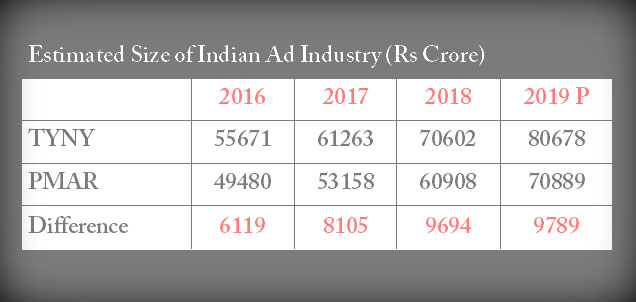
    By now, industry professionals are reconciled to the reality that there is a big gap in the estimation of the size of the Indian Ad Industry by the two agencies. However, as an academic I find it difficult to explain the reasons of the same to my students. I was alarmed to find earlier that since 2016, the gap in real terms increased year on year till 2018 as shown in the chart below. It is reliving to find from the recent reports that the same is not increasing further in the estimates made for 2019 by GroupM and Madison. We can probably hope that in another few years the difference between the two estimates will be reduced to 4% to 8%, the acceptable statistical margin of error at the 95% confidence level.

    Estimated Size of Indian Ad Industry (Rs Crore)
    2016 2017 2018 2019 P
    TYNY 55671 61263 70602 80678
    PMAR 49480 53158 60908 70889
    Difference 6119 8105 9694 9789


    A comparative analysis of the 2018 adspends by media made in the two reports show that the main bone of contention between the two is in the estimated size and share of TV media. Apart from TV, the differences in the estimated size in rupee value of Print, Digital and Radio fall within the acceptable margin of error ranging from 4% to 8%.The estimated size in rupee value are very close for OOH and same for Cinema. The detailed analysis is given below:

    Indian Ad Industry 2018: Estimated Size (Rs Crore) & Share (%)

     Rs. Crore 2018 f   2018  
    Media TYNY %share PMAR %share
    TV 33577 48 23432 38
    Print 17970 25 19467 32
    Digital 12337 17 11706 19
    OOH 3202 5 3365 6
    Radio 2709 4 2144 4
    Cinema 806 1 805 1
    Total 70602 100 60908 100
    Growth over last year 11%   12%  


    In terms of forecasts for 2019, the growth rates predicted by TYNY for different media are lower than the growth rates predicted by PMAR, apart from Radio where TYNY has predicted a higher growth rate than PMAR. Both the reports agree that the highest growth rate will be in Digital media fuelled by mobile, online video and social media, followed by Cinema though on a very small base. In terms of overall growth, TYNY has pegged it at 14%, 2.4% lower than the prediction of PMAR at 16.4%.

    Indian Ad Industry Forecast
    2019p 2019p
    Rs Crore TYNY %  Share Growth % PMAR % Share Growth %
    TV 38612 48 15 27649 39 18
    Print 18368 23 2 20442 29 5
    Digital 16038 20 30 15612 22 33
    OOH 3536 4 10 3750 5 11
    Radio 3116 4 15 2401 3 12
    Cinema 1008 1 25 1047 1 30
    Total 80678 100 14 70889 100 16.4


    Both the agencies have cited upcoming Parliamentary elections and ICC Cricket World Cup 2019 as major contributor to the growth in ad spends in 2019. While Madison have cited increase in government spending to showcase its achievements, the growth of OTT, increased spending in rural sector and India moving to a consumption society as the other reasons for predicting a high growth for the ad industry, GroupM has highlighted major trends like emerging technology, availability of data, content creation and distribution, etc. as factors contributing to the growth in advertising expenditure. There is no doubt that after two bad years in 2016 and 2017, Indian advertising industry has turned around in 2018 and is poised for further growth in 2019.

    Let me turn around and play the role of Devil’s advocate musing over what can disrupt the rosy dreams of advertising industry during next year. Over the last four days all of us are reeling under the effect of the terrorist attack in Pulwama killing 40 CRPF jawans. The entire nation wants revenge and our expectations have increased since the last surgical attack. Such attacks and counter attacks may lead to unforeseen developments affecting our economy and business.

    After the results of the last round of state elections, many political analysts think that BJP may have to depend on coalition with other political parties to run the Government in Centre after the next General Election which may affect smooth functioning of the Government. The gross overspending (Rs. 99610 crores over approved expenditure) by the Union Government as reported recently by CAG may have a diverse effect on various government approved projects in future as well as rural development.

    If RBI falls in line with the directives of the Finance Ministry, then India’s financial ratings may suffer globally and rupee may face further devaluation in its foreign exchange rate. There could be changes in the domestic as well as foreign policies of US which will have far reaching effect on the entire world and India will not be an exception. To sum up, we are living in very uncertain times when any significant change in internal or external political situations or foreign/ economic policies can adversely affect the growth of our advertising industry. Let us keep our fingers crossed and hope that the predictions for the growth in advertising in 2019 made by TYNY and PMAR will be realised without any major disruption.


    List of my articles related to this topic over last three years:


    Feb 20, 2018 Mind the TV AdEx Gap

    Feb 20, 2017 What is the real size of the Indian Ad Industry

    Nov 21, 2016 Post Demonetisation, it’s boom to doom for ad spends

    Feb 15, 2016 Boomtime for Media: A Review of Pitch Madison Advertising Report 2016