Category: RESEARCH

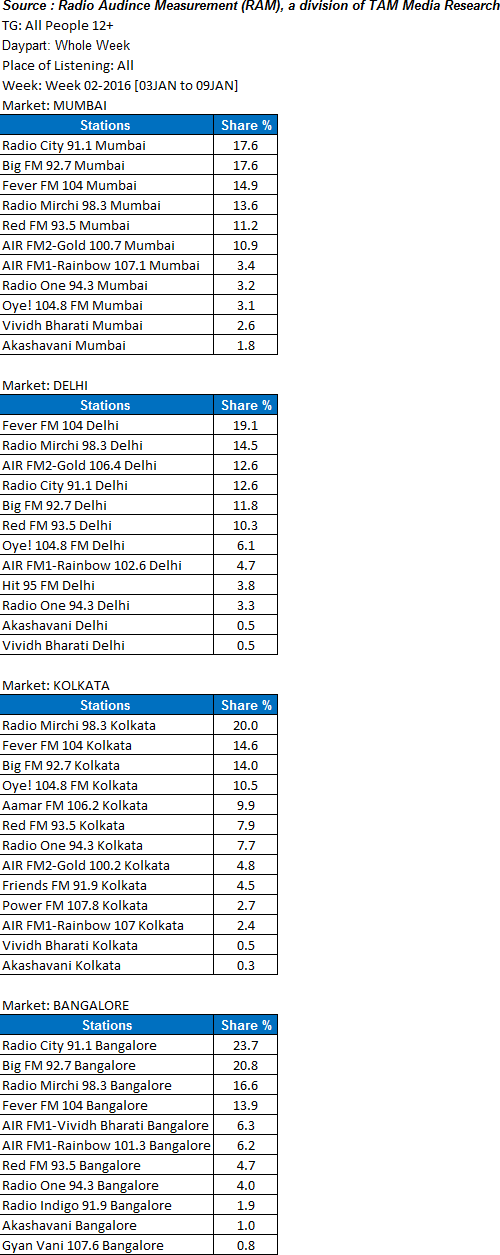
  • RAM Ratings for Week 2 – Jan 3-9, 2016

    Here are the Radio Audience Measurement (RAM) Ratings for Week 2 of 2016… that’s January 3 to 9, 2016. Sourced directly from RAM. It may be noted that this is topline data which may be insufficient for taking business decisions on booking (or not booking) ads on radio stations. We urge advertisers to buy the research findings or ask radio stations and/or media agencies for detailed numbers​.


    ​​​​​​​​​​​​​

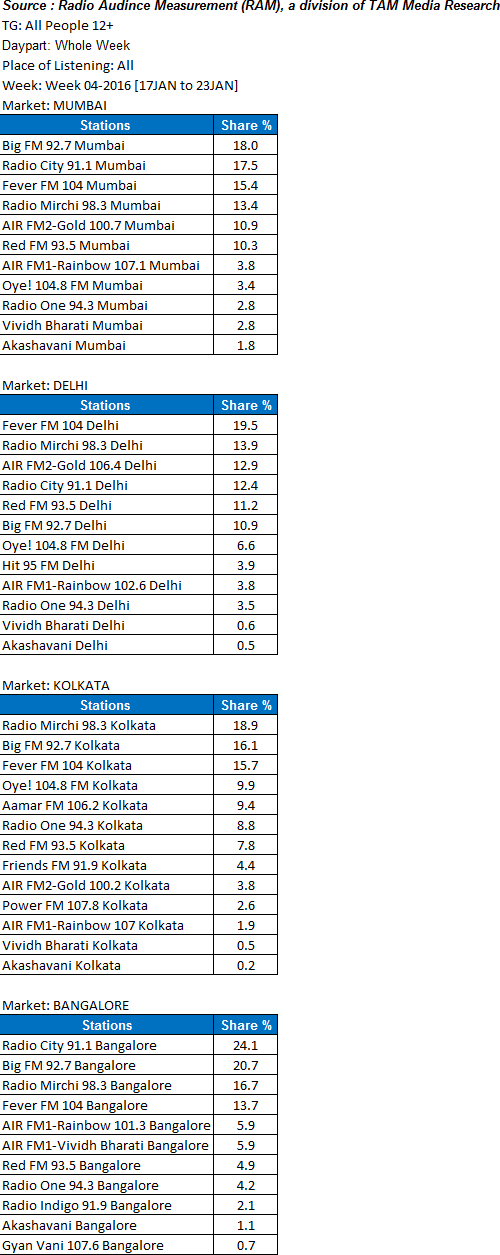
  • RAM Ratings for Week 4 – Jan 17-23, 2016

    Here are the Radio Audience Measurement (RAM) Ratings for Week 4 of 2016… that’s January 17 to 23, 2016. Sourced directly from RAM. It may be noted that this is topline data which may be insufficient for taking business decisions on booking (or not booking) ads on radio stations. We urge advertisers to buy the research findings or ask radio stations and/or media agencies for detailed numbers​.​​​​​​​​​​​​​​


  • It’s final: TAM India to exit TV viewership from Feb 29. BARC India & TAM complete jv


    By A Correspondent


    The much-awaited joint venture between BARC and TAM India has been announced with with the formation of the meter management company. This new entity which will be called Meterology Data Pvt Ltd. (MDL) will commence its operations in the next couple of weeks as TAM India exits TV viewership measurement business effective February 29, 2016. As a part of the new system, all TAM India meters will be re-deployed in panel homes selected by BARC India’s sample design. This JV will help BARC India in growing its sample size. It may be recalled that MxMIndia was the first media entity to report on the BARC TAM deal.


    In MDL, BARC India will have full management control with a 51% stake, while TAM India – which includes Nielsen and Kantar – will have a 49% stake.


    Up to this point, BARC and TAM India, both have been generating and reporting TV viewership data individually to the Industry. Now, with the completion of this JV, BARC India will be the single provider of TV Viewership data.


    MDL’s role will be to run and manage the meter operations and supplying raw data to BARC India. TV Viewership data will be computed and disseminated through BMW (BARC India Media Workstation). MDL will manage the panel households and will also be responsible for future TV panel expansions.


    The Spot Monitoring and Channel Monitoring data will be exclusively sold by BARC India to Broadcasters, Agencies, Advertisers and others.


    Meanwhile, TAM India will continue providing to the market the following services: AdEx services of TV, Print & Radio AdEx, Daily & Weekly Sales Index Reports, Bollywood & Music Monitoring Dashboards; Audience Measurement in Radio (RAM); Sports Sponsorship ROI Measurement (TAM Sports) and PR Measurement data & Audit services (Eikona) to its valuable clients.


    “The Industry was eagerly waiting for this merger to be completed from the time we announced it in August last year. We are happy to state that the Joint Venture Company is complete and all set to kick-off operations,” said BARC India CEO Partho Dasgupta.


    “We will work closely with BARC to ensure a good outcome for the industry and our joint clients. We have worked productively with BARC to get here and under the circumstances, have agreed a good way forward for everyone concerned” added Kantar CEO Eric Salama.


    “We are happy to collaborate with BARC India. The coming together of BARC India and TAM India has only strengthened the Indian broadcast industry, as they will now be getting viewership trends from a larger panel size,” informed Nielsen MD Prashant Singh.


    TAM Media Research CEO LV Krishnan said “I am very happy to see that the JV has finally taken shape. What is even more heartening is that TAM India’s current 12,000 meters, which was built and constructed tirelessly over the last fifteen years will get combined to give BARC India a larger and robust TV panel sample base for the Industry. We will do our best in providing our expertise to MDL. Meanwhile, TAM India will continue focusing its efforts towards value adding the Industry through constant enhancements of its existing businesses.”


  • So what should one make of BARC’s TAM meter jv?


    By A Correspondent


    So you have already read about the BARC India-TAM jv being solemnised. Now let’s try and understand what it means for all stakeholders, and more importantly for BARC and TAM.


    Tears for TAM?

    Of course, it’s been in existence for over 15 years. Has done yeoman service to the industry. The adspends on television would’ve grown any which way, but the presence of a robust measuring system ensured the more discerning and price-sensitive advertisings looked at television (over print).


    What happens to LV Krishnan?

    Don’t know yet, But one has to acknowledge the great work put in. Take a bow, LV!


    So, effective March 1, BARC will be a monopoly?

    Ah, well, yes. TAM will cease to be in existence for television measurement.


    Monopolies are bad news. How does this new one help television?

    Yes, a monopolistic situation isn’t good news, but don’t underestimate Nielsen and Sir Martin Sorrell’s WPP. They could well enter the scene again – directly or indirectly. In the short run, it will help stabilise BARC.


    But TAM meters were bad na? Will the 12,000 meters really add up?

    Hmmm, in all probability a fair number of them won’t be mainstreamed into the BARC system eventually. They may be deployed on rural or not-so-significant areas.


    So are we thinking of what you are thinking?

    We are all thinking, but we don’t have an evil, cynical mind!

    No, that basically the gobbling up happened because they wanted to kill competition!

    The weather in Mumbai is so horrible these days. I really wish I was in Delhi


    Okay, okay, we got the answer. But, pssst, just between you and me only, and not for the entire world, how did it help doing that?

    Because ever since BARC started releasing data from April 29 last year (2015), some broadcasters – large networks and minor ones – have been fussing about the data. And always comparing the BARC data with that of TAM. So, that was a pain in the you-know-where


    So you have a created an unfair monopoly?

    Why do you such words. Keynes ka distant cousin, kya?


    What happens to TAM’s digital-television measurement system which it announced with IMRB last year?

    Most probably it will be killed too. BARC is coming up with something similar. Plus TAM can’t be doing TV, so finito for the TV measurement part of the service possibly!


    And what the other stuff… RAM?

    Other businesses continue. The press release clearly says that it will continue to serve AdEx services of TV, Print & Radio AdEx, Daily & Weekly Sales Index Reports, Bollywood & Music Monitoring Dashboards; Audience Measurement in Radio (RAM); Sports Sponsorship ROI Measurement (TAM Sports) and PR Measurement data & Audit services (Eikona) to its valuable clients.


    But?

    No buts. But, yes, the main horsepower would come from TV


    So why did Kantar and Nielsen do it?

    Because they had lost substantial business any way. While broadcasters have the propensity to pay for two currencies, their associations would frown upon them continuing to back a company it had opted against.


    What about GroupM? Isn’t it owned by WPP, the people who half-own TAM via Kantar?

    Sir Martin Sorrell is a smart businessman. And his people here are wise. They know what’s good for the industry


    And where the wind is blowing?

    Why don’t you change from kurtas to shirts?


    Any more questions we should be asking?

    Yes, so when will it start getting warmer in Delhi


  • BARC Week 15 Data (April 9-15)

    By A Correspondent


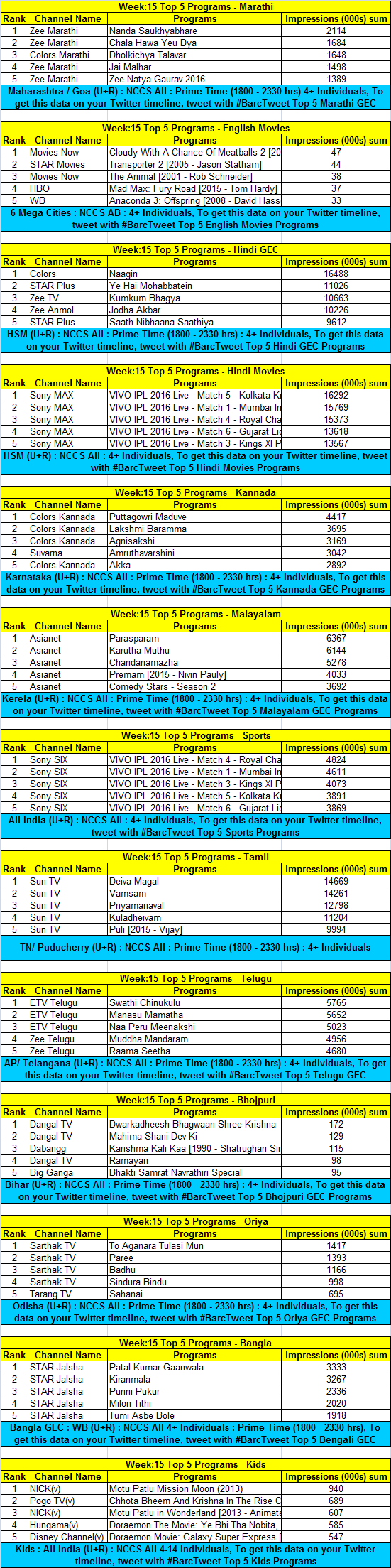
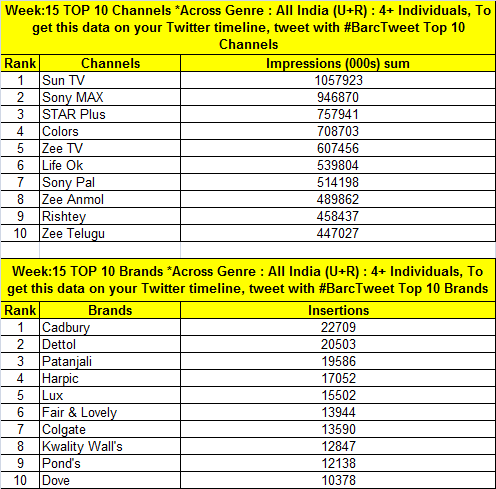
    Here are viewership numbers from BARC for Week 15 of 2016 – that’s April 9 to 15.


    Note these numbers are combined for urban and rural audiences, and subscribers to the data will know how the rankings are dramatically different for urban audiences.​ And ditto for rural or free-to-air audiences.


    Enjoy!​​​​​


  • Lifestyle, Punjabi, Assamese & Gujarati channels wef BARC Week 16 data (April 16-22)

    By A Correspondent


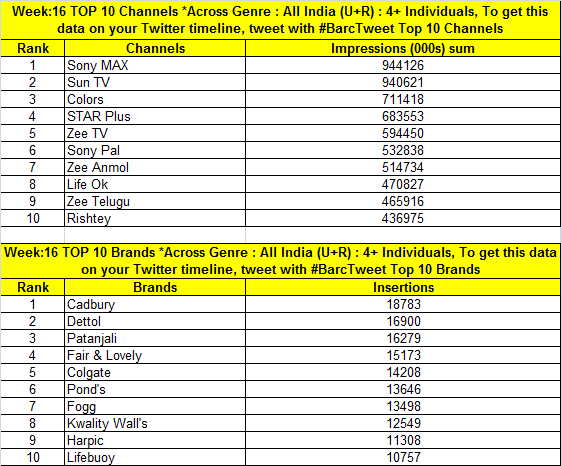
    As BARC completes a year of release of data, here are viewership numbers from BARC for Week 16 of 2016 – that’s April 16 to 22. Starting this week, BARC has added lifestyle, Punjabi, Assamese and Gujarati language channels to the weekly ratings.


    Note these numbers are combined for urban and rural audiences, and subscribers to the data will know how the rankings are dramatically different for urban audiences.​ And ditto for rural or free-to-air audiences.


    Enjoy!​​​​​


  • BARC Week 18 Data (April 30-May 6)

    By A Correspondent


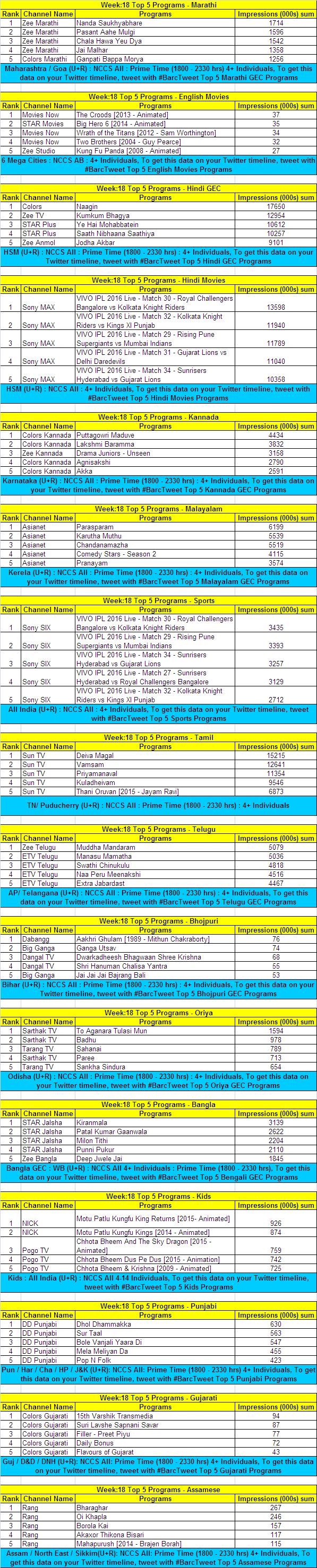
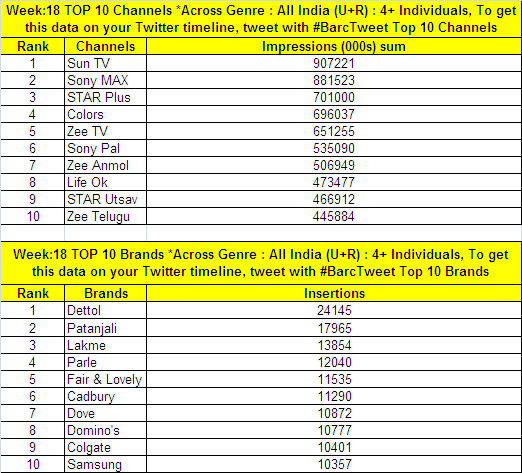
    Here are viewership numbers from BARC for Week 18 of 2016 – that’s April 30-May 6, 2016)


    Note these numbers are combined for urban and rural audiences, and subscribers to the data will know how the rankings are dramatically different for urban audiences.​ And ditto for rural or free-to-air audiences.


    Enjoy!​​​​​


  • E-commerce to touch Rs 2.1 trillion by Dec 2016: IAMAI-IMRB


    By A Correspondent


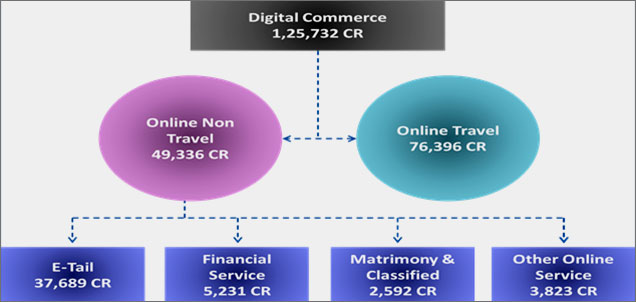
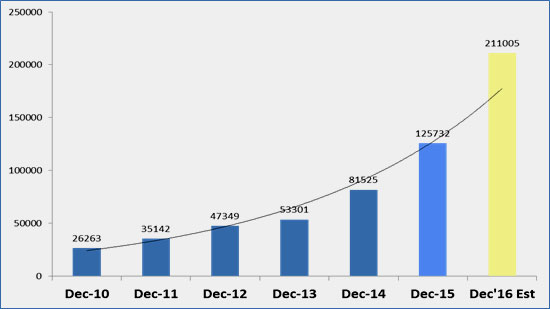
    The Digital Commerce Market has grown at a CAGR of 30%, between December 2011 and December 2015 and was valued at Rs 125,732 crores by the end of December 2015. It is estimated to reach Rs 211,005 crores by December 2016, according to the Digital Commerce Report 2015, published by the Internet and Mobile Association of India (IAMAI) and IMRB today.


    The report finds that Online travel industry continues to grow strongly with 61% share while share of online non-travel has improved over the previous year to reach 39%. In December 2015 share of e-Tail was 29%. Mobile Phone and Accessories, PCs and Apparel and Footwear continue to be the dominant categories that are selling within the e-tail segment. According to Nilotpal Chakravarti, AVP -IAMAI, “The growth trajectory of digital commerce signifies the coming of age of online transactions in India. No longer Indians are wary of transacting online. Another notable facet of the report is the substantial growth in non travel online transactions.”


    Domestic air ticket and railways booking continue to be among top contributors to the Online Travel spends.  These were the segments that were the top contributors in previous year also. Hotel Booking has seen a substantial movement in Y-o-Y growth at 165%, from Rs 1965 crores in December 2014 to Rs 5200 crores in December 2015. Spend on online railway ticket booking has also grown at around 34%, from Rs 16200 crores in 2014 to Rs 21708 crores in 2015. Online travel is expected to grow at a CAGR of around 40% to reach Rs 122815 crores by end of 2016.


    The report also finds that E-Tailing maintained a strong performance with a 57% Y-o-Y growth. Among E-Tail categories, Mobile Phone and Mobile Accessories continue to be the top contributor to the overall pie. Given that there is an increased demand for Smartphones in India, this could be a contributing factor. Computer and consumer electronics, as well as apparel and accessories, account for the bulk of India retail ecommerce spends contributing close to 49% collectively to overall spend in E-Tail segment. Apparel and Footwear sale has almost doubled as compared to the previous year, recording a 52% Y-o-Y growth from Rs 4699 crores in December 2014 to Rs 7142 crores in December 2015. This segment is expected to gain further momentum and reach Rs 72639 crores by end of 2016.


    Component share of E Tail (Rs 37,689 CR)

    Mobile Phones + Mobile Accessories

    14,109

    37%

    Apparels + Footwear + Personal / Healthcare Accessories

    7,142

    19%

    Consumer Durables + Kitchen Appliances

    6,452

    17%

    Laptops / Net books / Tablets / Desktops

    4,726

    13%

    Home Furnishings

    1,468

    4%

    Jewellery 

    1,120

    3%

    Other Products (Vouchers / Coupons, Toys, Gifts, Flowers, Handicrafts, Stationary etc.)

    994

    3%

    Books

    875

    2%

    Cameras + Camera Accessories

    803

    2%


    According to the report, Financial services market grew at a CAGR of around 17% between 2012 and 2015. The market reached close to Rs 5231 crores in terms of transactions as of Dec’15.  The demand for online utility payment is expected to reach Rs 6068 crores by Dec’2016.


    Other online service market that includes booking movie tickets and tickets for other events, online commuting or cab hire, online grocery and food deliver, was Rs 3823 crores in Dec’2015. In December 2014 the market was around Rs 2025 crores. In future online grocery and online food delivery are expected to emerge as big ticket items. Demand for other online service is expected to grow at a CAGR of 36% to reach Rs 5207 crores by December 2016.


  • Decoding Rural India


    It’s being billed as the World’s Largest Rural Establishment Report. Chrome Data Analytics, has unveiled a report covering 200,000 villages representing over 300 million people.  The Rural Establishment Survey covers consumer behaviour and habits in over 200,000 Indian villages.


    The survey, which was done over a period of 15 months, involved the entire Chrome DM infrastructure of over 650 field executive, 450 telecalling staff and the 150 strong analytics team, together speaking over 22 languages to map the length and breadth of the country. Respondents were made to fill out a detailed questionnaire which included consumer habits, family income and lifestyle patterns among other things.  The survey holds direct actionables for brands and agencies to help target growth regions Broadcasters, for example can know the exact subscriber base of cable networks in the villages covered.


    Here are some of the key findings of the report:

    1.90% of Rural Bihar prefers branded tea over local players.

    2. Rural:  Kerala, Punjab and Haryana have the max disposable incomes to spend on FMCG products.

    3. Data for Patanjali:

    :: Patanjali has been spotted most across all channels, no of insertions – 24828 (Wk-33).
    :: As a result, 93% of rural HSM India are aware about Patanjali/Ramdev baba’s product.
    :: 56% of rural HSM are not even aware about 30% of Patanjali’s products, most accessible products are Shampoo, Hair Oil, Chyawanprash & Honey, of which Honey & Chyawanprash’s market contribution is over 40% within the category.
    :: Within the Sugar category, 90% of rural HSM India buy open local sugar & only 5% have been buying sugar from Patanjali store.
    :: Within the Atta Category, 91.5% of rural HSM buy local atta/or chakki atta rest prefer Aashirvaad in this category.


    Important Categories – Most popular/consumption brands:


    Soap Lux, Lifebuoy (70% of North market share)/ Medimix (South)
    Shampoo Clinic Plus (Sachets especially)
    Hair Oil Parachute/Dabur Amla (Known as Amla)
    Hair Color Godrej  
    Detergent Surf/Nirma
    Beauty Cream Fair & Lovely (Sachets)
    Telcum Powder Ponds  
    Toothpaste/Toothbrush Colgate
    Butter Amul
    Chywanprash Dabur
    Honey Dabur
    Soft Drinks Coca Cola & Pepsi (almost 40% of market share each)  
    Chips Lays  
    Tea Tata Tea  
    Coffee Nestle  
    Ketup Kissan  
    Ointments Iodex, Vicks  


    As per Chrome’s latest survey (Monthly per capita expenditure):

    Across all major states in India, in Rural, Kerala followed by Punjab & Haryana have got maximum disposable income (an average of 2500 per month) whereas Odisha, Chhattisgarh, Jharkhand & Bihar spends very less (an average of 1150 per month).


  • Study notes celebs influence young minds


    In  the light of the ongoing controversy of celebrities endorsing brands, a survey conducted by Dr Samir Parikh, Director, Department of Mental Health and Behavioural Sciences, Fortis Healthcare assumes importance. Although the study is conducted only in Mumbai and Navi Mumbai, the findings can be considered to be representative of what India believes. Here then are the findings of the study:

    Aim: To study role models among the youth and the influence of their behaviour on youngsters.

    Methodology: A representative sample of school students undertook a survey, on role models and their influence on the youth.

    Sample: 765 students aged 14-17 years from schools across Mumbai and Navi Mumbai comprised the sample for the study.


    ‘A sense of responsibility and careful selection of endorsements would help’

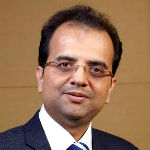
    Given the findings of the study, we asked Dr Samir Parikh, Director, Department of Mental Health and Behavioral Sciences, Fortis Healthcare, on how real is the impact of celebrities on young minds
     

    In the light of the currently controversy around film stars and celebrities endorsing products like pan masala, do you think young adults (and school going children) do get impacted by the endorsers?


    The fact is that the key reasons why celebrities are asked to endorse product as a marketing strategy by consumer products is because their endorsement does have an impact on the consumption/sale – the whole purpose of advertisements is that. So yes, when celebrities endorse a product, it has an impact, more so on the young impressionable minds who tend to follow their role models.


    Will it be fair to say, on the basis of what you would’ve gleaned from the study, that pan masala (or mouth freshners) will be consumed more because of the endorsements? Or are these just considered cool and forgotten?


    Advertisements, promotions, endorsement by role models surely has some impact, this is not debatable, yes by making sure that there is right information reaching kids, by creating an environment of media literacy for students some of the impact can be reduced.


    Your study talks about the influence of sportspersons on young minds. So do you think that an MS Dhoni featuring in the ad of an alcohol brand is potentially harmful?


    Sports role models should be careful in endorsing any product that is harmful in any which way, as young children and teens tend to follow the sports personalities. Add on to this, in my opinion. sports personalities should be utilised for more campaigns for students that would help the right message reach them.


    Given the influence of celebrities on the youth, would you say the government is doing the right thing by penalising film stars if the products they are endorsing are found to be of dubious nature?


    No society can have banning as the only solution, self-censorship, self-responsibility, ownership of self behaviour is what is important, and society needs to support this for all role models, celebrities, parents, teachers, media everyone. But as the same time once a celebrity endorses a product, the fact is that there is an ownership to the message and this message is heard and followed by younger people – I do feel a sense of responsibility and careful selection of endorsements would help.


    Does the influencing of young adults a trait across all strata of the population or is it more pronounced in certain specific demographics?


    It’s across all.


    Introduction:

    Young minds are quite impressionable and often emulate the behaviour of others. A role model is a person whose behavior is imitated by others. Social learning is based on modelling. It is imperative for the youth to learn responses and behaviours from ideal role models.

    Family members are often the source of initial learned behaviours for the youth. With the world becoming a global village due to media, the social influences on the youth are also evolving.


    Results:

    Family: 34% students reported having a family member as their role model, with most students reporting parents (father more than mothers) to be their role model. A few also stated that their elder siblings (brothers more than sisters) were their role models.

    Interpretation: Contrary to the popular adult belief, children feel that their parents are their biggest role model. Family is the first point of impact & influences before going out in the society. Even though peer become integral at the time of adolescence; parental influence is paramount.

    Sibling rivalry, considered as a common part of growing up, did not deter a few children from mentioning their elder sisters and brothers as role models. Parents can therefore model healthy and adaptive behaviour and strengthen their communication with children to inculcate positive attitudes and behaviours. Parents and families can impact the children of today for a better tomorrow.


    [] Sportspersons:

    Sports is emphasised upon both in school and media. 25% students reported having a sportsperson as their role model. This is fairly understandable as young people tend to follow sports players, almost in a form of hero-worshipping. MS Dhoni, Virat Kohli and Sania Mirza were mentioned amongst the Indian sportpersons as role model. While Lionel Messi was a clear favorite amongst the international sportspersons.

    [] Media Personalities: Role models in the media industry (14%) were spread out rather evenly, with Deepika Padukone, Ranbir Kapoor as most followed.

    Interpretation: Sports and media influence us in many different ways. With the media glorifying both these domains as potentially lucrative and glamourous fields, more youngsters are drawn towards it. This may be used in a constructive manner to emphasize on positive learning for adolescents.

    These findings have significant implications in that sports players and media celebrities must become involved in important social campaigns in order to create awareness and bring about necessary attitudinal shifts in society.

    Sportspersons and Media personalities should be mindful of their public appearance and activitites, as children often ape them without a thought.


    [] Political Figures:

    4%-When compared to other categories, political figures were perceived as role models by fewer students, at 4%.

    Students had followership mainly for historical figures, Mahatma Gandhi and Chandrashekhar Azad being most frequent.

    In recent figures, PM Narendra Modi and APJ Abdul Kalam were reported highest.

    Interpretation: Reading about historical figures such as Mahatma Gandhi gives children a better understanding of the past. This helps inculcate good habits, importance of struggle and history of our country. Relatively speaking, the political figure of the recite era who most adored was Late APJ Abdul Kalam.


    [] Business Leaders:

    6% students reported having business leaders like Dirubhai Ambani, Steve Jobs and Bill Gates as role models.

    Interpretation: This finding implies that the youth looks up to people who have been accomplished in their entrepreneurial activities, and that children today are aware of the importance of financial success. Success is often associated with these names.


    [] Teachers:

    Teachers closely followed suit with 17%.

    Interpretation: Teachers follow students through each pivotal stage of development. Students and teachers spend nearly six to eight hours a day, five days a week. Therefore, teachers can become influential people in students’ life. Teachers can help young minds grow into responsible minds by imparting some of life’s most important lessons.

    Implications:

    It’s been proven unequivocally; children learn by watching those around them. Bandura, reputed social psychologist, in his experiments in the 1960s established the importance of observation and modelling when it comes to social learning.

    Children still look up to adults to learn how to conduct themselves, a reality that has not yet changed. Such a tendency to learn by observations comes with it’s merits and disadvantages, based on how such learning is cultivated.

    Both altruism and truancy are social behaviours that are learned by observing others. It is thus, the collective responsibility of adults – whether it be parents, educators, or the media, to provide children with positive, prosocial role models to foster a youth that is compassionate, empathetic and responsible.
     

  • LG ranked India’s most attractive brand; Sony and Samsung Mobiles follow


    India’s Most Attractive Brands 2016, a study comparing the ‘attractiveness’ held in brands, has been released. TRA Research, a Comniscient Group company, has listed the brands that have successfully elicited the desire-based yearning in their audience. LG has taken the crown of India’s Most Attractive Brand in the just launched 2016 study. The South Korea-based Consumer Electronics giant has taken the 1st rank, moving up from 2nd place last year. Sony ranks 2nd, followed by the two-time reigning attractiveness champion from the previous reports, Samsung Mobiles which ranks 3rd this year. Honda makes an entrance at the 4th position also leading the Automobiles category. Samsung, in the Durables category leaped from rank 87 in 2015 to rank 5 this time round. The highest placed wholly-Indian conglomerate in this year’s listings, Bajaj, is India’s 6th Most Attractive brand.


    The second Indian brand in the list, Mumbai-based Tata is ranked 7th, which has slipped three places since last year. Maruti Suzuki comes in at rank 8 and Airtel towers up nine ranks from ranking 18th last year, followed by Nokia at 10th position. Another Mumbai-based brand Godrej (All India rank 13), Dell (All India rank 15) and Hewlett Packard (All India rank 17) made an exit from the top 10 Most Attractive Brands listings this year. A total of four out of the top 20 Most Attractive Brands were based out of Mumbai. Other city-based brands that were listed include Angel Broking (All India rank 491) and Big FM (All India rank 715).


    “LG’s progress in the report is admirable, having dethroned the two-time reigning personal-gadgetry brand Samsung Mobiles to be India’s Most Attractive Brand for 2016. The consumer electronics segment has always been high on Attractiveness—the magnetic pull that brands exert—evidenced by the fact that three out of the top 5 Most Attractive Brands for 2016 are from this segment. Tata’s ranked 7th this year has a dip of more than 20 per cent in Attractiveness Quotient as compared to the previous report.


    Brand Attractiveness is an invisible, overwhelming pull that subtly but irresistibly draws audiences towards itself. In order to influence and inspire their consumers, brands have to mold their outgoing communications to constantly and proactively accentuate their brand appeal,” commented N. Chandramouli, CEO, TRA Research.


    Among the 1000 brands 276 categories were listed. Some of the by Advertise” href=”#60137872″> important category leaders in Attractiveness are Colgate (FMCG), Amul (F&B), Bata (Personal Accessories), Raymond (Apparel) and Airtel (Telecom).
     

  • Mobile gaming to garner $1bn revenue by 2020

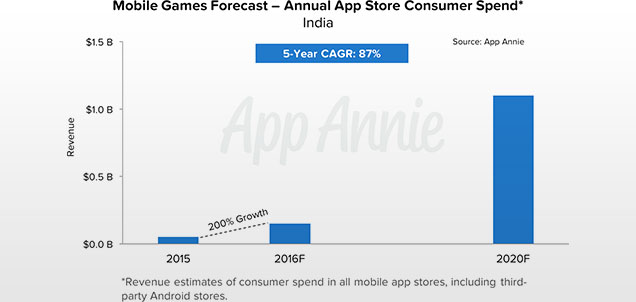
    Image courtesy AppAnnie


    The mobile gaming market in India is gaining traction, and predicted to garner revenue as high as USD1.1bn by 2020.


    The National Association of Software and Services Companies, in association with App Annie and Deloitte, released two whitepaper reports outlining substantial growth in the mobile and applied games sectors in India and the opportunities for both local and foreign mobile game publishers and investors, as well as best practices for applied game developers.


    “Both the Mobile Gaming on the Rise in India and the Applied Games in India white paper reports, demonstrate the growth of both mobile and applied games in India, for both local and international developers and publishers”, said Rajesh Rao, Chairman of the Nasscom Gaming Forum. “At Nasscom Gaming Forum we are excited by these findings and the opportunities these give to both local developers and publishers and look forward to continuing to build a thriving and innovative games economy in India”.


    The Nasscom Gaming Forum and App Annie report ‘Mobile Gaming on the Rise in India’ discusses how Indian consumers are taking to games, with game downloads doubling in the last two years, and the overall amount of time Indian users spent in mobile games growing sharply over the past year. Mobile game downloads are expected to grow at a CAGR of 58 per cent over the next five years going from 1.6 billion downloads in 2016 to an estimated 5.3 billion downloads in 2020, as a result of growing adoption of games, the rapid proliferation of smartphones, affordable data and universal implementation of direct carrier billing, India presents an ideal opportunity for local and foreign mobile game publishers and investors.


    Across the region, Indian gamers continue to embrace globally popular titles, including Candy Crush Saga, Clash of Clans and Subway Surfers. Local Indian publishers are enjoying increasing success in simulation, sports and social card games, with Teen Patti social card games succeeding and proving popular amongst younger consumers in the marketplace. The report continues to discuss how multiplayer and social features have become key engagement drivers critical to the success of games in India and how publishers should draw upon these proven mechanics and incorporate localised and culturally relevant content to grow their user base.


    The Nasscom Gaming Forum and Deloitte report ‘Applied Games in India’ discusses the growth of applied games with a focus on traditional learning, business, marketing or social experiences, that are predominantly used for simulation based training (in the fields of aviation and military). The reports discusses how the Indian market for applied games is expected to grow at a compound annual growth rate of 14-16 per cent, from USD 40 million in 2016, to USD 80 million in 2021. Currently across India there are 40 developers of Applied Games (Independent studios, IT firms venturing into Applied Games and e-learning companies), that operate out of Bangalore, Hyderabad, Mumbai and NCR.


    Report can be downloaded from: http://go.appannie.com/report-mobile-gaming-india-november-2016