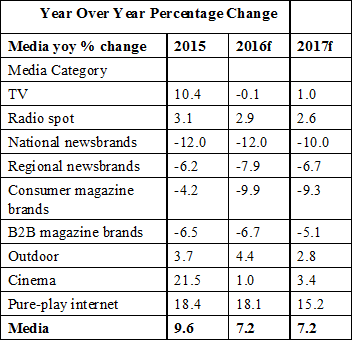
– UK advertising is set to see the eighth successive year of growth, despite the short-term effect of the EU referendum (aka Brexit), with predicted growth up from 6.3% to 7.2% for 2016, and from 5.8% to 7.2% for 2017. This increase in spending takes the industry to an investment of £18.8 billion in 2017, according to the latest media and marketing forecast figures from leading media services conglomerate GroupM.
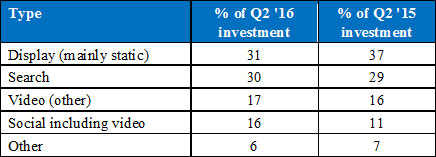
GroupM has found that digital display demand continues to rise strongly with a +15% rise predicted for 2017, particularly into social media, and, within digital, from static to video. The largest driver is paid search which is accelerating again. It benefits from rising automation, geo-targeting capabilities and the point of sale immediacy of mobile for performance-minded advertising. GroupM’s forecast for the year ahead is continued strong growth in search, which maximises automation and technology. ‘Search’ embraces YouTube’s substantial AdWords trade.
For the first time, GroupM offers an analysis of the aggregate digital advertising investment it manages for its UK clients. This includes paid search which differs to the IAB’s analysis which only includes details on display. GroupM now invests approximately the same amount in digital advertising as in TV (linear and VOD), and half of GroupM’s digital investment is automated, up from 40% in a year.
GroupM UK’s digital investment by venue in Q2 2016 vs Q2 2015:
Today, five advertising categories stand out as being important for TV but relatively light on digital. These are: Cosmetics & Personal Care; Food; Retail; Household Equipment & DIY; and Leisure Equipment. These five together comprise a third of UK TV ad investment, or £1.5 billion. Pure-play online advertising is by contrast approaching £10 billion. GroupM predicts that pure play digital vendors will target these categories more aggressively in future.
“The effect of the future EU exit on the UK economy is unknown, but the short-term impact was negligible. To our own surprise, we are revising UK advertising growth up from 6.3% to 7.2% for 2016, and from 5.8% to 7.2% for 2017,†said Adam Smith, Futures Director, GroupM.
“The main driver that we have seen is paid search accelerating again. It benefits from rising automation and the immediacy needed for mobile and performance-minded advertising. We expect digital display advertising to continue growing by 18% in 2016 and 15% in 2017. The ambition of pure play digital vendors to conquer TV territory and categories will be hard-won, but today’s undisputed winner is pure-play digital”
“We continue to support advertiser investments in digital campaigns by investing in the data and technology resources needed to inform and efficiently execute these campaigns. Of course, this is crucial as more media become digital, addressable and available in real time,†said Nick Theakstone, CEO, GroupM United Kingdom.  “However, it is also important that advertisers not abandon top of the marketing funnel activities for creating brand awareness, like TV, with over-investment in digital. We are advising careful consideration in balancing investments to ensure support of long-term brand growth.â€
It’s a list based only on income of public companies, so it may not necessarily be the last word, but the Business Insider’s list of top advertising agency executives, by way of compensation packages makes for interesting reading. The cut-off for the list is USD 2 million of annual compensation, so we would’ve seen more familiar names had we seen a list of the Top 50
This list, as per an introductory note on the BInsider website has “most of the same familiar faces from last yearâ€. And one more thing: the list only looks at ad agencies. Folks at some tech companies or even marketers who are integral part of the ecosystem don’t figure in this list.
Meanwhile, here’s the Business Insider link to the story: http://www.businessinsider.in/The-16-richest-people-in-advertising-ranked-by-income/articleshow/55601627.cms?format=slideshow
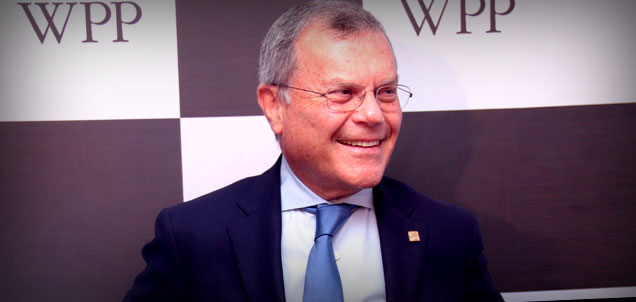
1. Sir Martin Sorrell, WPP CEO,  Compensation: $87.5 million (£70,416,000)
2. John Wren, Omnicom Group CEO, Compensation: $23,576,047
3. Michael Roth, CEO of IPG, Compensation: $14,458,102
4. Paul Richardson, WPP group finance director, Compensation: $14.3 million (£11,523,000)
5. Philip Angelastro, chief financial officer at Omnicom, Compensation: $6,255,150
6. Frank Mergenthaler, chief financial officer at IPG, Compensation: $5,603,572
7. Philippe Krakowsky, IPG chief strategy and talent officer, Compensation: $4,769,162
8. Timothy Andree, president and CEO of Dentsu Holdings USA and executive chairman of the Dentsu Aegis Network, Compensation: $4.4 million (Â¥497 million)
9. Kevin Roberts, former head coach at Publicis Groupe and executive chairman of Saatchi & Saatchi worldwide, Compensation: $4.4 million (€4,137,786)
10. Jonathan Nelson, chief executive officer of Omnicom Digital, Compensation: $3,937,950
11. Scott Kauffman, chief executive of MDC Partners, Compensation: $3,260,776
12. Michael O’Brien, general counsel and secretary at Omnicom Group, Compensation: $3,161,007
The demonetisation of the Rs 500 and Rs 2000 currency notes at 8pm on the eve of the US election 2016 results by Prime Minister Narendra Modi was a surprise announcement that triggered a significant upward kink in social media chatter.
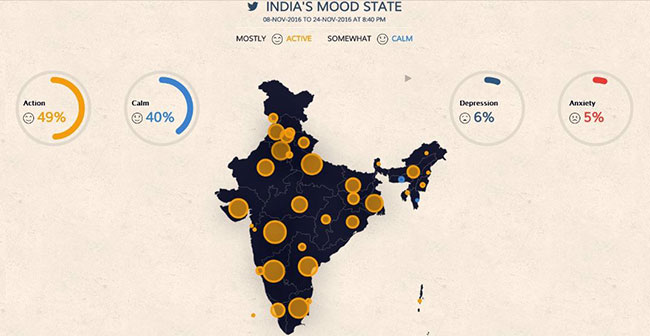
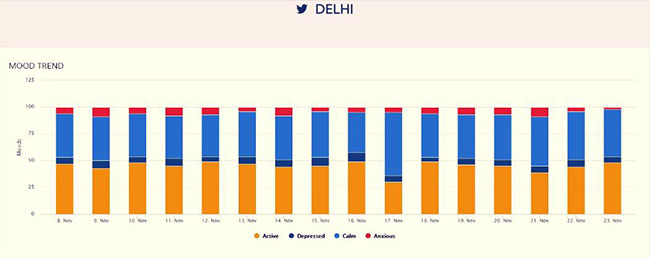
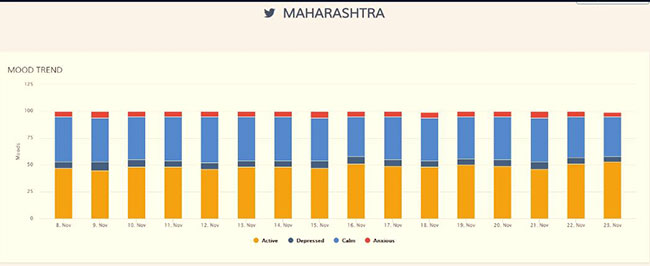
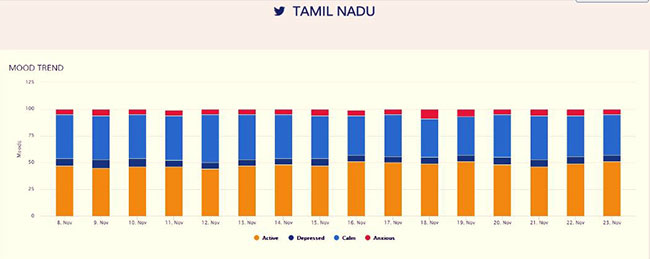
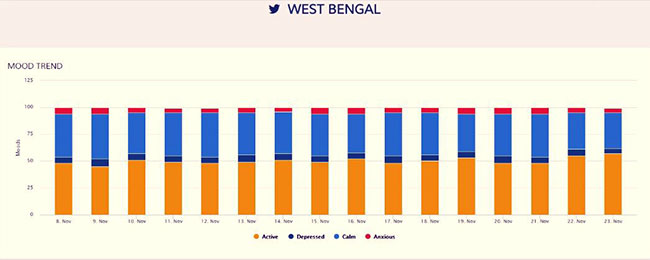
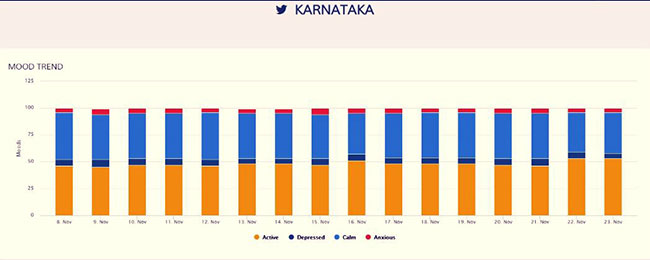
Maxus Kaleidoscope mapped the mood basis the location based Twitter and Instagram conversations in India between November 8 and 24 by when one had a clearer picture of the how the initial euphoria of the demonetisation panned out over time.
Location0based Tweets and Instagram Posts oscillated largely between Action oriented and Calm Moods in the fortnight since the demonetisation from an All India basis. Calm moods were dominant in the North Eastern states of Mizoram and Meghalaya as depicted in the map below.
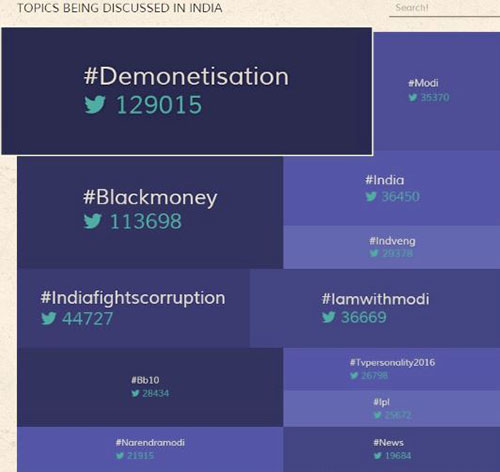
Nearly 5 lakh conversations on Twitter and Instagram made up the Top 10 trending topics. Demonetisation accounted for six of the Top 10 trending topics since the announcement of which the Prime Minister garnered half of the trending topics. #IamwithModi and #Modi were the topics that made up for 19% of the conversations within the top 10 trends. Cricket shared a bit of the spotlight from demonetization thanks to the ongoing England-India test series.
A total of 23 brands of were linked to the top 10 trending topics during the past fortnight. These brands factored in slightly over 30% of the total conversations of which PayTM (avg. 53% association) and SBI (avg. 16% association) carved out the larger part of the Brand Share of Conversation.
Samsung and Amazon also managed to gain a significant share of overall conversations however Samsung conversations were largely based on humorous conversations around the Samsung Galaxy Note and demonetisation of currency notes.
The Top 5 metros reflected similar patterns of Moods where Action dominated the moods however there were some days especially like November 17 in Delhi when the expression of Calm gave way to Action. Additionally Tamil Nadu showed a blip towards Anxiety on the November 18, 19 and 21 when subsequent announcements of the demonetisation easing by the government and news of the CM Ms. Jayalalithaa seemed to have driven up the specific mood.
Overall, across the top cities in India there is a sense of patient restraint as the demonetisation moves on into the 3rd week and nears the critical end of the month period when cash flows really come into play.
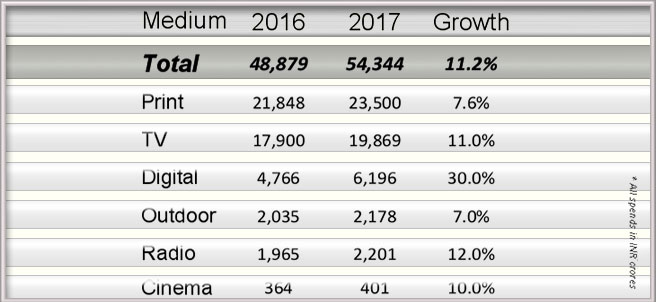
Publicis Media agency Zenith predicts that ad expenditure growth for India in 2017 will grow 11.2 per cent over 2016 and will stand at Rs 54,344 crore. Digital remains one of the fastest growing mediums in India registering a 30% growth rate. Television will register an 11% growth rate in 2017, print (newspapers) will grow at 7.6% and all other media between 7 and 12%.
These are part of the annual Advertising Expenditure Forecasts in which Zenith predicts that global ad expenditure will grow 4.4% in both 2016 and 2017, reaching US$566 billion by the end of 2017. The 2017 forecast is down by 0.1 percentage point from the forecasts published in September after small downgrades in Asia Pacific, which nevertheless remains one of the fastest growing regions for ad expenditure.
It may be noted that India is among the Top 10 contributors to adspend growth, along with others such as USA, China, Indonesia, UK, Philippines, Japan, Germany.
Said Tanmay Mohanty, Group CEO, Zenith India: “India remains one of the few bright spot economies in the world.adspending in India is on a steady growth curve and likely to stay that way in 2017, buoyed by the State Elections in Uttar Pradesh and Punjab, the upcoming Champions Trophy and continued expansion and growth of regional newspapers and television. In November, the central government introduced reform in the form of Demonetisation which is leading to some contraction in ad spends. We expect the demand for goods and services to pick up and this shortfall to be temporary. Demonetisation is expected to augur well for the economy long-term. In fact, we expect 2017 to see increased ad spending by categories such as Mobile Wallets, Telecom 4G, BFSI, Mobile Handsets, Fast Moving Consumer Goods and Consumer Durables.â€
Fast-track Asia economies (China, India, Indonesia, Malaysia, Pakistan, Philippines, Taiwan, Thailand and Vietnam) are growing extremely rapidly as they adopt Western technology and practices, while benefiting from the rapid inflow of funds from investors hoping to tap into this growth. Fast-track Asia barely noticed the 2009 downturn (ad expenditure grew by 7.9% that year) and since then has grown very strongly, ending 2015 up an estimated 9.6%.
After 2017 continued steady growth in global adspend is expected, of another 4.4% growth in 2018 and 4.1% in 2019. Global adspend growth has been remarkably stable since 2010, growing at between 4% and 5% a year, generally at or below the growth rate of global GDP. Before the financial crisis, advertising would typically exaggerate the wider economy, growing faster in times of expansion and shrinking faster during recessions, with frequent changes in year-on-year growth rates. More recently the global ad market appears to have entered a phase of more stable growth.
Television is currently the dominant advertising medium, attracting 36% of total global spends in 2016. However, the internet is expected to overtake television to become the largest medium in 2017.
The Mobile Marketing Association (MMA) in association with Kantar IMRB has released a report on Smartphones and Feature Phones Usage and Behaviour 2016-17 in India. The report studies the evolving nature of the Indian mobile consumers, and provides insights and behaviors individually on smartphones and feature phones.
KEY FINDINGS ON SMARTPHONES
I. Time spent on mobile surpasses any other media
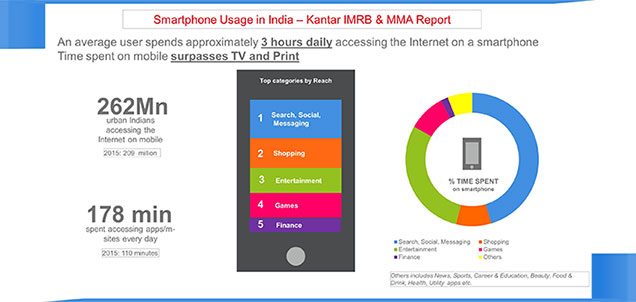
An average consumer spends 3 hours per day on their smartphones (an increase of 55% from 2015), which surpasses time spent on TV or any other media. Social media and messaging apps were the clear leaders accounting for almost 50% of all time spent on smartphones.
II. Women more engaged than Men
The study shows that Women spend 2x more time on their smartphones compared to Men – on YouTube and games. They also spent 80% more time on Facebook than their male counterparts.
III. Online shopping gains in leaps and bounds
Another finding revealed the rise of online shopping category, which now has 15% higher reach than the entertainment – making it the second most popular category in terms of reach.
KEY FINDINGS ON FEATURE PHONES
I. Prime users are from upper SECs
The study shows a whopping 75% of feature phone users were from the upper SECs, while only 25% of respondents were from SEC C, D and E (NCCS).
II. Feature phone users don’t intend to switch
A big revelation has been that almost 85% feature phone users do not intend to switch to smartphones on their next purchase indicating that the functional benefits of feature phones combined with their durability, battery life and ease of repair were highly coveted by these users.
III. Feature phones users spend more on mobile plans
Feature phone users spend more money on their mobile plans. The ARPUs was almost 20% higher compared to the national average.
Said D Shivakumar, Chairman and CEO, PepsiCo India Holdings and Chairman of the Mobile Marketing Association: “With over 85% mobile penetration, we are today one of the largest mobile markets globally and insights on mobile usage in India are of critical importance to the modern day marketer. We are in an age now where we need to seriously think about marketing measurement and attribution, giving marketers better measurements, tools and confidence in connecting marketing to business outcomes. A thorough understanding of the differential usage and consumer segments that are using smartphones and feature phones will only help marketers use their monies more efficiently. While most designing and applications are being targeted at smartphones, this report is a wake-up call. Today, the mobile is undeniably the closest we can get to our consumers, and it is this that will help marketers seek to understand – and leverage – a consumer’s path to purchaseâ€.
Added  Preeti Desai, Country Manager, Mobile Marketing Association India: “Mobile is clearly the third largest mass medium in terms of Ad spends in India today, with estimated spends in 2016 amounting to ₹.4,200 Cr. Hence it becomes very important for the industry to have credible research and measurement guidelines and reports, to help fully understand and leverage mobile’s ability to drive the future growth of business. With this in mind, MMA India has collaborated with Kantar IMRB to deep-dive into the dynamics implications and impact of smart phones and feature phones India focusing on each category separately and giving each their due focus. The insights of this study will be published in a series of industry reports that will go a long way in helping marketers use the medium effectively and efficiently. It is a great data set for marketers to reassess and optimize their spending with the most impactful allocations in their marketing mix, while leveraging mobile with double digit spend.â€
Hemant Mehta, Senior Vice President, media and retail, Kantar IMRB, said, “Mobile has had an outsized influence on the way consumers interact with each other, make decisions, transact and shop. This has significantly impacted the way companies and brands connect with their consumers and do business. But we’ve only seen the tip of the iceberg. With the advent of 4G, reduced data costs and free voice and SMS, we expect to see even more rapid changes in the mobile landscape. It is, therefore, important to keep a continuous pulse on the way consumers interact with and use their mobile phones. Along with MMA, we at Kantar IMRB have embarked on a journey to help marketers understand the impact of these changes and to identify emerging trends. The Smartphone and Feature phone reports are a step in this direction – providing an unbiased and insightful view on the evolution of mobile usage in India.â€
The report enables all members of the ecosystem to stay updated with consumer mobile trends and media consumption habits. Also at the same time, it elaborates the role of mobile as an influencer in the consumer path-to-purchase.
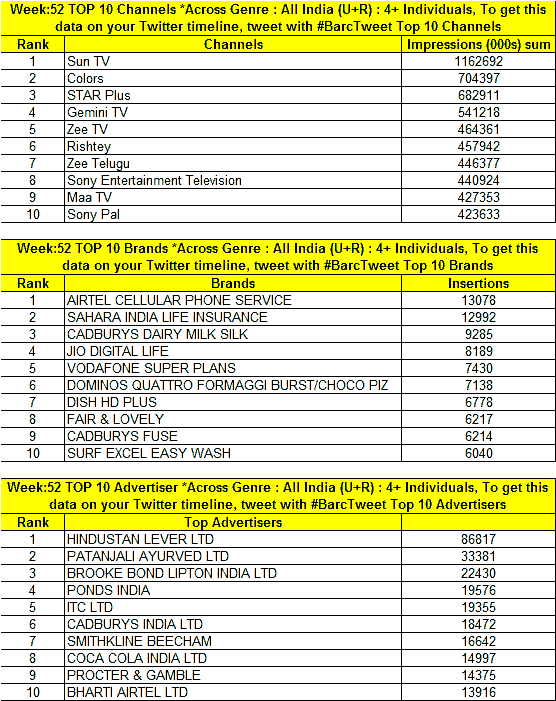
Media honcho Raj Nayak has reason to smile. The stars of his Hindi entertainment bouquet of Viacom18 shone really very well in the last week of 2016. That’s Week #52 – Dec 24 to 30, 2016 – the data for which was revealed on Thursday (Jan 5) where Colors and Rishtey topped the Urban and Rural tables respectively. In the combined Urban+Rural roster, Colors was #1 and Rishtey #3.
Call it the News Channel Dangal or whatever, here’s an analysis by Stratagem Media on how the English news channels fared post-demonetisation and Arnab Goswami’s exit
Background :
The economic and political scenario in the country over the last two months has been fodder for the news business – mainly with the announcement and unfolding of the demonetization drama, followed by the demise of Tamil Nadu Chief Minister, J Jayalalithaa. But for all of us in the marketing and media fraternity, something equally dramatic happened about the same time.
On November 2, the media fraternity witnessed a piece of truly “breaking news†–Arnab Goswami, the editor-in-chief and star NewsHour anchor of Times Now channel had resigned. Well of course, he was still on air, for the next few days, when on November 8, even as everyone was trying to predict the after-effect of his departure from the TV screen, the shock-n-awe of demonetisation happened.
Speculation about Goswami’s departure from the TV screen, and his plan thereafter,has been rife, ever since.
Objective of the study:
At Stratagem Media Pvt. Ltd, we were equally eager to understand the effect of these developments on the viewership of news channels. Our friends (mitrons) and fellow professionals in the media and marketing fields (by and large, our ‘nation’), would be keen to understand
– whether news viewership has risen post-demonetisation
– whether there is a difference between the after-math of demonetization on English and Hindi news channels?
– Or has Mr Goswami’s absence from the TV screen, had any effect on channel viewership and if so, how much?
But we felt it would be prudent to resist the temptation of jumping to conclusions and not rush through the analysis. So, we waited for the scenario to stabilise, till viewership data for at least a few weeks had trickled in.
Here’s a study of viewership,both pre- and post-demonetisation, which happened to also coincide with ArnabGoswami’s last week on the screen. Naturally, the questions that have been addressed are whether the viewership of English and Hindi News channels was affected in any way, post that week, and what was the effect on the viewership of specific channels.
Methodology:
A simple viewership comparison was undertaken for a period of 10 weeks i.e. five weeks pre- and five weeks post demonetisation/ Mr Goswami’s departure from the screen.
This study was focused on the ‘9 pm to 11 pm’ time slot on the weekdays, (which historically contributes to a major proportion of viewership). This analysis was done for three relevant geographical units (the 1mn+ cities across the country, Mumbai+Delhiand Mumbai+Delhi+Bengaluru), as well as for a relevant and sufficiently wide target group comprising of Males,above the age of 22 years belonging to the top two segments of affluence (i.e.NCCS AB)Although not all of it is published here, the analysis was also undertaken simultaneously, but separately, for the entire genre of Hindi News channels and English News channels (including English business channels).
Two viewership parameters were examined – gross impressions and relative channel share (for the English and Hindi channel genres).
The source of all data was the BARC viewership ratings.
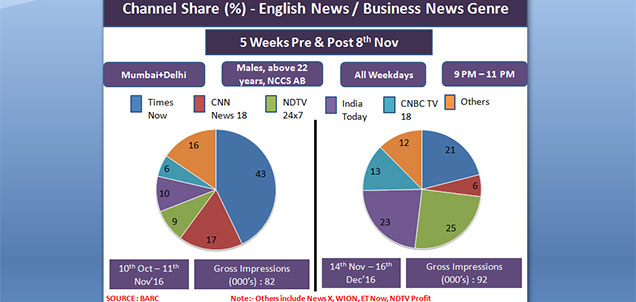
From the above analyses,in the five weeks post-demonetisation,it is evident that (within the specific TG of Men, above the age of 22, from the top 2 affluence classes – NCCS A&B), in the prime time slot of 9 pm to 11 pm,
– The viewership of English News channels in all main cities in India, in fact declined by 1 %, in the 5 weeks post demonetization. But it increased by about 11 % to 12 % in the 2–3 main metros. In other words, as expected, the viewership pie of English news genre as a whole has only managed to increase in the main cities (Mumbai, Bengaluru, Delhi) where the English news channels get most of their eyeballs.
– While Times Now continues to lead the pack in the English News genre, the decline in its viewership, ranged from – 29 % to  -45 % in these 3 market units. In fact, even CNN News18 declined by about 27 %, to 61 %,whereas the gain in viewership of other channels such as NDTV 24×7 and India Today TV, was considerable, ranging between 99 % to 230 % for either of them, over the same period. However these channels grew from a relatively much smaller base.
– Consequently, in the main cities of the country as a unit, the decline in the relative share of viewership for Times Now was from 55 % to 40 %, whereas NDTV 24×7’s relative share grew from 8 % to 17 %, and India Today TV’s relative share grew from 12 % to 19 %.
– The corresponding changes in viewership shares, in the main metros for these channels were even more pronounced, as evident from the graphs.
– And yet, without doubt, Times Now still stands head-n-shoulders above the other English News channels.
Conclusions (Hindi News channels)
From the analyses, it was also evident that in the 5 weeks post demonetisation, (and within the specific TG of Men, above the age of 22, from the top 2 affluence classes – NCCS A&B), in the prime time slot of 9 pm to 11 pm
– The viewership of Hindi News channels increased by as much as 29 % in the 1 mn + cities, with some channels registering gains of more than 50 %
 – In terms of relative channel shares, the biggest gainers were News18 India, Zee News and AajTak.
So, on an apple-to-apple comparison, Hindi channels seem to have grown in the post-demonetisation phase, in the cities, whereas English channels have in fact, marginally declined. So, could this perhaps be a case of missed opportunity.
This does however give rise to another pertinent question. What constitutes brand identity for a media house – be it a newspaper title, a TV channel, an FM station or a website? They say ‘Content is King’, but is it just content, or the values that the brand is perceived to stand for, or production quality, or just the sheer the persona of the anchors/ RJs.
To validate some of the quantitative findings of this analysis, we asked senior media professionals about their individual opinions and experiences. This is what they had to say :
Sandip Tarkas
Sandeep Tarkas, CEO (Sports, Media & Special Projects), Future Group, states that “I think Arnab was the person I missed the most during the entire demonetisation debate. After initially watching a lot more of news for about a week, I have almost stopped watching news TV, and that’s where I missed Arnab. He would have brought the right issues to the fore even if one didn’t agree with his take on the issueâ€.
Karthik Mani
Kartik Mani, Founder, Chief Insurgent – Merry Men, says that although he has never been a fan of Arnab Goswami, but Arnab’s absence has made watching Times Now, a lot less compelling.
Munnish Puri
Munnish Puri, media expert & Founder, Indian Financial Advisors, has this to say:”Beyond doubt, Arnab and Times Now were a highly impactful combination. Viewers tuned-in to get real ‘inside information’ of the news that mattered. Even global audiences took a strong liking to Arnab. Looking at the recent viewership data, it is not surprising that the Times Now viewership has been impacted. The Newshour is certainly not as engaging without Arnab!’
Bharat Kapadia
Bharat Kapadia, veteran media expert, confesses that he gets put off when news channels become noise channels, and that leads to reduced exposure. But he adds that Arnab always had the last & loudest word which at times made it interesting. And that he has hardly watched Times Now after Arnab quit. Bharatbhai also adds that his time spent watching news channels post demonetisation had increased, but he was disappointed about the way the topic was covered by all channels in general. There was no depth in the content, just opinionated angles and gimmicky presentation. He feels that it is entirely possible for face value to outweigh brand value of a media house, just as it happens in the film industry.
Sumit Roy
For Sumit Roy, Founder Director Univbrands, Times Now was not the preferred channel. He sums it up by saying: “Times Now isn’t any better now, without Arnab. As a policy I switch channels when any Anchor speaks over the Panelist and cannot control panelists speaking over each other. Some other anchors seem to have gone that route as well.As a result my preferred news channels are India Today, NDTV and BBC World. In that order. I stay with whichever (of these) has the more interesting story at the time of watching.â€
Nevertheless, as evident from the above analyses, it’s not just content, or the values of a news channel, or production quality, that builds a TV brand. Viewership also seems to be obviously sensitive to changes in brand persona.All in all, with state elections around the corner, we can be sure that the News Channel ‘Dangal’ is far from over.
Sundeep Nagpal
This report has been conceived and produced by Stratagem Media Pvt Ltd., an independent media specialist company, headed by its Founder–Director, Sundeep Nagpal
India is one of the fastest growing advertising markets globally with mobiles to continue delivering big gains with almost 220 million users accessing digital services through their smart phones. These were the highlights of the report unveiled by the Confederation of Indian Industry (CII) and KPMG in India titled ‘Digital – The New Normal of Marketing’at the CII National Marketing Summit.
The report estimates that, India is one of the fastest growing advertising markets globally with an estimated growth of 15.5 per cent in 2016, driven by a large consumer base and a burgeoning e-commerce industry. Although the share of digital advertising spend remains low at 12.7 percent in 2016, it is one of the fastest growing mediums at an expected CAGR of 33.5 percent (2015-2020) to cross INR 255 billion in 2020.
Of the total digital advertisement spends, ‘search and display’ commands the largest share even though it is a relatively maturing segment.
“The post-demonetisation days have clearly showed how the country is set to leapfrog a few stages to embrace the power of digital. Mobile is being rapidly adopted and marketers have an incredible opportunity to enhance the game of digital communication and deliver great customer experiences at each point of the journey,†said Thomas Varghese, Chairman, CII National Committee on Marketing and CEO-Textile Business, Aditya Birla Group.
As per the report, connected devices, smarter devices and ‘hyper relevant rich content’ will drive consumption for the consumer. Marketers will be well served if they are able to ride the data wave and use technology to build in analytical models. The Digital marketer will be responsible to deliver a distinctive consumer experience using various channels – thus making the role a key contributor to the overall omni channel experience. The report also gives insights into nascent technologies like emotions analytics and predictive marketing.
There have been silent and not so silent changes around us that are changing the way marketing will be done. With the internet becoming all pervasive, it has become so integral to our lives that it has literally disappeared. Singularity, connected systems, Cognitive and AI will create a world where the marketer will be marketing not only to humans but the ‘self-thinking’ machines,’ says Rachna Nath, Partner and Head, Digital Consulting, KPMG in India.
“Digital marketing is more about big data and technology innovation rather than conventional marketing. Digital marketer today will have to look at the consumer as a living sensor which creates data. Insights on consumer behavior will drive the next big innovation on the campaign. Success will depend upon how the digital marketer is able to drive differentiated strategies for each digital channel and eventually converging on consumer experience†says Aditya Rath, Partner and Lead for Digital Customer
Other key findings and suggestions presented in the report are:
Video is the new data format
The digital consumer’s attention span has now come down to 8 seconds, down from 12 seconds in 2007. Marketers are expected to direct their content strategists to curate short videos that create a greater impact on the consumer’s mind while holding their attention till the end. Live streaming videos are interactive, immersive and cost-effective.
Omni-channel experiences and touch points are essential in the digitally charged marketplace Healthcare, automotive, insurance, retail and manufacturing companies are experimenting on various IoT use cases to enhance the consumer experience.
Wearables provide a new dimension from a data perspective Through the galvanic skin sensors and gyroscopes that are in-built in these devices, marketers can continuously monitor the customer’s physiological and behavioural data.
Authenticity, relevance, and value are increasingly important parameters for content creation and distribution Customers trust user-generated content and give more weightage to peer recommendations and reviews than to professionally curated content.
Native ads are being used increasingly to combat mobile and desktop ad blocking They blend in and appear as content that would normally and deliver value and relevance to the consumer and do not hinder user experience of the website even while monetizing.
KPMG and CII Joint Marketing Report – Digital – The new normal of Marketing
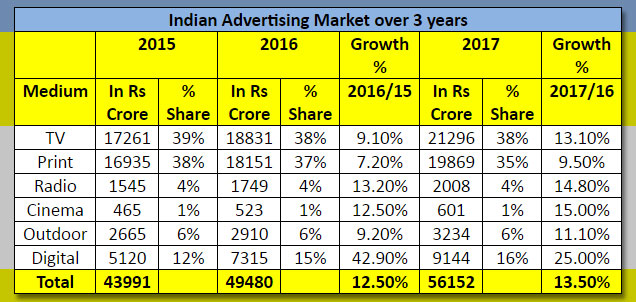
In February 2016, when Madison predicted that the Indian advertising industry would grow by 16%, it seemed overly-optimistic. Now it seems that Madison’s annual forecast report for that year would’ve been on the mark but for a small detail: a ‘tsunami’ called demonetisation. This derailed the entire industry, which eventually grew by only 12.5% last year as against the projected 16.8 %. Demonetisation also knocked off Rs 1,650 crore to settle at an industry size of Rs 49,480 crore, in the wake of a cash crunch and a drop in consumer off-take, which led to a lot of advertisers pulling out of campaigns in the last two months of 2016.
Sadly, we haven’t heard the last of it. In 2017, the industry is expected to grow 13.5% mainly because the months of January to April will be the ‘recovery phase’ from the currency crisis. “My advice to advertisers would be to intensify campaigns during this period, and also have new product launches,†says Sam Balsara, Chairman of Madison World (who released the Pitch Madison Annual Report on Wednesday), mainly to make good the damage wreaked by demonetisation.
Still, 2017, says the report, promises to be an exciting year for advertising. At a projected growth of 13.5%, the size of the industry may be a likely Rs 56, 152 crore. And this optimism for robust ad expenditures, comes on the back of high government investment in infrastructure, lower corporate and personal taxes for small and medium companies, good government support for the disadvantaged, and the general expectation of yet another year of high GDP growth. While the projected growth in the first four months is likely to be only 8%, ad expenditure will pick up between the months of May and October, to stand at a projected 14% growth. And since adex touched a low in the months of November and December of 2016, growth in the corresponding period in 2017 might – by comparison –appear as high as 24%.
Television: Sector-wise, TV was still the biggest contributor to adex, registering a 9% and Rs 1,570-crore growth to reach the industry-size of Rs 18,831crore. This was largely propelled by FMCG (Rs 692 crore) and Telecom (Rs 475 crore), even though it lost an estimated Rs 850 crore to demonetisation. In 2017, TV will remain brands’ favourite medium and is projected to grow by another Rs 2,460 crore (13%) to close on Rs 21,300 crore. The forecasted reasons for this are organic growth coming from established FMCG advertisers as well as aggressive new players like Patanjali, and new channel launches by the existing networks.
Print: Print grew by 7% in 2016 (three percentage points lower than the forecast for 2016), to stand at Rs 18,151 crore. In 2017, it is expected to grow by 9.5% to touch Rs 19,869 crore. Most of this growth will be because of dailies, and regional publications and new editions introduced by current publishers. As well as advertising from ‘print loyalists’ like auto, education, durables and mobile phones
Digital: This was the (not-so-big) surprise. Digital was hardly affected by demonetisation, and grew by a whopping 43% to register an industry size of Rs 7,315 crore. Consumption of digital video content, which sparked huge spends on online video advertising in 2016, coupled with mobile displays, fuelled the growth of digital advertising, and will continue to do so. In 2017, digital is expected to grow to 25% to touch Rs 9,144 crore.
Radio: Grew by 13% to register an industry size of Rs 1,749 crore in 2016. BFSI, media and auto advertisers were the main contributors to this growth. In 2017, radio is predicted to grow by 15% to become Rs 2,008 crore, and the likely reasons are greater aggression by e-commerce and mobile-wallet companies; the emergence of new radio stations who have won bids in Phase III auctions, and organic growth among retail and local advertisers
OOH: The out-of-home market grew by 9% to register an industry size of Rs 2,910 crore, on the backs of retail, hospitals, education, real estate and restaurants, who are the biggest advertisers. As per the forecast, in 2017 OOH will grow by 11% to reach a size of Rs 3,234 crore, as e-commerce, M-wallet apps and telecom and mobile handsets will start advertising more aggressively using this medium.
Cinema: Big-screen advertising grew by 12.5% in 2016 to settle at Rs 523 crore – which makes it a marginal player of all advertising media. In 2017, it is expected to grow by 15% to reach Rs 601 crore.
BSE-SME listed Majestic Research Services and Solutions Ltd (MRSS India) has retained the highest possible credit rating (MSE1) for the second consecutive year indicating uppermost credit worthiness based on financial strength and operating performance by SMERA Ratings Ltd.
In a highly fragmented and competitive market research segment, MRSS India a digital insight firm reported an annual revenue growth of over 102 per cent and net profit growth of 256per cent for 2015-16. It has shown significant improvement in its financial ratios and an increase in its reputed client base that includes Volkswagen, Zee Entertainment, Godrej and Boyce among others, said the SMERA note.
Responding to the credit rating, Majestic Research Services and Solutions Ltd, chairman Raj Sharma said, “With our innovative approach to introduce new tools, techniques and technology in the market research space, MRSS India has been at the forefront to redefine the market research space in India. This in turn has reflected in our financial performance that is set to keep our momentum going forward in the years to come.â€
The company has lined up forthcoming projects with Knight frank, UC webs, Faering Capital, Google,Airtel, Apeejay, Tata Chemical, Tata Motors, PWC, Unido, Madhya Pradesh tourism, Indraprastha and plans to grow its operations through Mergers and Acquisition, said the SMERA note.
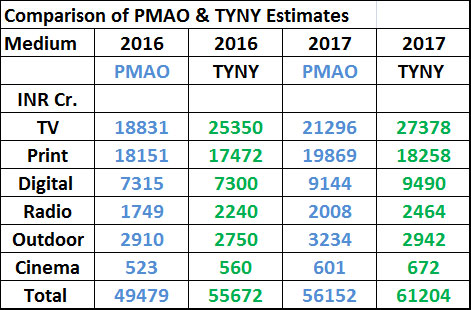
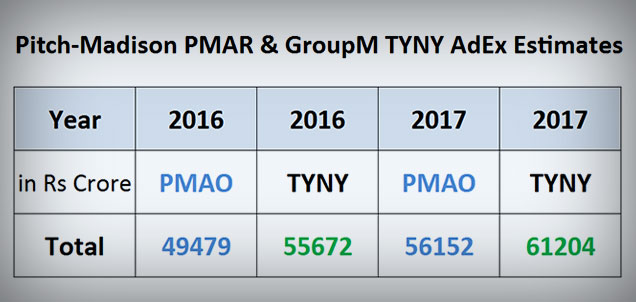
Last week was exciting for the advertising and media industry as the two major reports on industry Adex were released on two consecutive days. GroupM released its ‘This Year Next Year’(TYNY) 2017 report on February 14 followed by the release of ‘Pitch Madison Advertising Report’(PMAR) 2017 by Madison on February 15. In the last few days, both the reports have been published and analysed in the business newspapers and websites, leaving hardly any scope for adding any comment on the same.
As usual there is a difference between the two projections, this time it is of around Rs 5000 crore. The biannual report on advertising expenditure TYNY 2017 has forecast India’s advertising investment to reach an estimated Rs 61,204 crore in 2017 based on a growth rate of 10% over 2016. On the other hand, PMAR 2017 has projected a growth of 13.5% in 2017 over 2016 and has estimated the size of the industry to reach Rs 56,152 crore.
According to Sam Balsara, AdEx dropped by Rs 1650 crore in the last two months of 2016 after demonetisation and as a result, the industry adspends narrowly missed the mark of crossing Rs 50,000 crore. On the other hand, the GroupM report, Indian advertising industry clocked Rs 49,758 crore in 2015 and crossed the Rs 50,000 crore mark comfortably in 2016 by scoring Rs 55,671 crores. Madison estimated Indian adspends as Rs 43,991 crores in 2015, Rs 49,480 in 2016 and has projected Rs 56,152 crore in 2017. The difference, between the two sets of estimates, has been hovering between Rs 5000 to Rs 6000 crore, which is not a small amount.
If we compare the two sets of estimates by medium, we find that the major difference lies in the estimates of TV advertising expenditure, which is bit surprising as TV AdEx is very well-documented. Is there a difference in the way the two estimates are drawn up which leads to a gap of almost Rs 6000 crores between the estimated TV advertising expenditures?
PMAR has shown more favourable estimates for Print and Outdoor than TYNY, while TYNY estimates for Radio and Cinema are higher than the estimates of PMAO. It is interesting to note that for Digital medium, the two estimates ran neck-and-neck for 2016 and are quite close for 2017.
GroupM Report mentions that Media Adex reported do not include:
TV – special inventory like astons, L-bands, tickers, etc
The above leads us to conclude that the numbers shown in the TYNY for the above five media would be actually higher than their estimations, particularly for Radio, where activation/ events tied up with digital has become a major source of earning for the FM radio stations.
The Pitch Madison Advertising Report does not mention about the ad expenditures which are not covered in the report, but we can assume that Madison also has not covered the above expenditures which are not included in Media AdEx in their report.
So, what is the real size of the Indian Ad Industry? Are we yet to cross the Rs 50,000 crore mark or did we cross it last year?
Indrani Sen is a media services veteran, having worked with JWT, later Mindshare and then with Emami. In recent years, she is an independent consultant and academic. She is Adjunct Professor incharge of the Media Management programme at the Symbiosis Institute of Media & Communication, Pune. The views expressed here are her own.
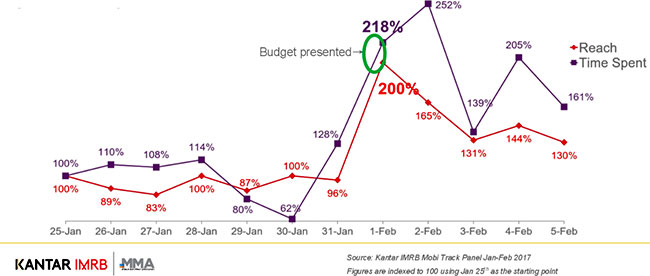
Coming in the wake of demonetisation, news platforms saw a surge in traction driven in large part by the Budget 2017-related narratives, as per a study conducted jointly by market insights major Kantar IMRB and the Mobile Marketing Association (MMA India). the A steady diet of budget forecasts contributed to an increase in overall time-spent in the days leading up to the Budget presentation. This was followed by a massive spike in engagement on February 1, the day of the Budget speech.
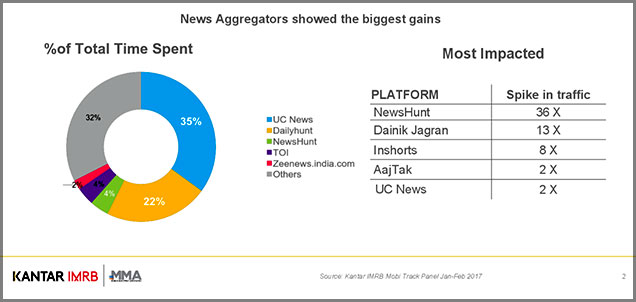
A second spike in traction was witnessed over the weekend following the Budget as readers caught up on in-depth analyses and the long-term implications of the Budget announcements. News aggregators drew the lion’s share of engagement among smartphone users—the top two aggregators accounted for almost 60% of total time-spent on news related content. The Times of India was the most popular of the standalone platforms with twice the traction of its nearest competitor Zee News. Platforms like Dainik Jagran, Inshorts, and AajTak saw the highest gains in traffic during this time, notes the study.
Kantar IMRB’s Mobi Track smartphone usage panel was used to analyse consumption of budget related content in the weeks leading upto and during the Budget 2017 presentation.
“Looking at the data from Kantar IMRB’s MobiTrak smartphone usage panel—the surge in budget-related news consumption confirms people’s attention and interest in the event. Engagement levels were expectedly highest among the digital generation i.e. 20-24 year olds —they accounted for the highest Reach and Time Spent  across all demographics. The desire for multiple points-of view was evident in the strong preference for news aggregators, a stark contrast to the behaviour of offline-readers who tend to limit their reading to a handful of print publicationsâ€, said Hemant Mehta, Managing Director, Media – Digital and Chief Strategy Officer, Kantar IMRB.
Added Preeti Desai, Country Manager India, MMA: “News consumption is undergoing two fundamental shifts across the globe including India. One is the rise in news audiences accessing news via their mobile devices, the other is the increase in people who read or watch news through social platforms. Mobile will continue to grow leaps and bounds as one of the primary mediums that Indians will access ‘News’ and the multiple spikes during 2017 budget showcases how fast Indians have adopted reading news not just in English but also in multiple languages (15+). It is important to note the second spike – post-Budget Day – the time spend is actually higher during the weekend and indicates that apart from short news Indians also reached out to various mobile news sources for longer in-depth analysis post the budget day. With rapid changes in the mobile landscape, it is important to keep a continuous pulse on the way consumers interact and these passive probes and insights on mobile usage in India by MMA and Kantar IMRB are of critical importance to the modern day marketers as they acknowledge mobile as the third largest advertising medium in India, after TV and Print. Mobile Ad spends are expected to grow to Rs10,000 crore in 2018 [Source: Mobile Ecosystem and Ad-Sizing Report India 2016].â€


 But we felt it would be prudent to resist the temptation of jumping to conclusions and not rush through the analysis. So, we waited for the scenario to stabilise, till viewership data for at least a few weeks had trickled in.






 By Indrani Sen