Category: Big Story

  • Technology, Oh my GAAD!

    Technology, Oh my GAAD!

    Shruti PushkarnaToday marks the 13th edition of Global Accessibility Awareness Day, commonly known as GAAD. A movement initiated in 2012 by Joe Devon and Jennison Asuncion with the intention of taking accessibility knowhow to mainstream developers. And much has transformed thanks to this global drive.


    Technology, more specifically AI and Generative AI are the hot topics at every forum. Whether it’s the fear of losing our jobs to chatbots or driving business efficiencies with machine learning and artificial intelligence, tech innovations are rapidly altering the work culture.


    Accessibility is no longer an alien concept to average social media users, who stumble upon several tips to omit barriers in physical and digital spaces, using simple tech solutions. As an inclusion advocate, I believe technology enables and empowers everyone, including the most vulnerable.


    But do product developers, service providers, and industry experts understand how technology can mainstream marginalized communities like Persons with Disabilities?


    I’m not so sure.


    Last week, I was in the city of Nizams, or should I say the emerging IT capital of India, Hyderabad. I was attending an annual industry event focused on driving conversations in the space of HR Tech. A swanky summit showcasing workplace innovations empowering organisations to drive outcomes and human engagements. Sounds fancy and intriguing, right?


    Honestly, I was quite enthusiastic looking at the speaker line-up, exhibits and masterclass agenda. Every panelist propagated the new mantra, AI + HI = ROI (Artificial Intelligence plus Human Intelligence equals Return on Investment), laying special emphasis on empathy in this growing robotic era.


    Innovation. Technology. Empathy. Human Centric Approach. Almost music to my ears. Except it wasn’t. The scope of discussions was limited to present day work roles and current employee base. The futuristic innovations didn’t explore the possibilities of an accessible and conducive work environment for all.


    The two-day extravaganza could have been a perfect setting to introduce a new equation to CXOs, CHROs and CEOs,

    Innovation Quotient (IQ)+ Empathy Quotient (EQ) = Inclusion Equity Quotient (IEQ).


    Let’s rewind to the beginning of this month, where I had an altogether crippling experience with technology. Contrary to efficient and easy access, the processes at Max Hospital, a leading brand in healthcare hit rock bottom when it came to IP (In-Patient) Care. The computerised functioning and omission of paperwork had me thinking of myriad job roles that could be executed by persons with different disabilities in this setup.


    But my bubble was busted immediately as the colossal cracks in the system unravelled within hours of checking in to the ritzy facility. Health workers and care providers failed to administer timely treatment as the tech-powered processes held them hostage. It was a long chain of communication passing through layers of systemic approvals from doctors to assistants, to administration, to nursing, to pharmacy, back to nursing, and finally to the patient. And unlike AI, this was hardly intuitive or quick, it took hours to execute.


    By the way, speaking of AI, Chat GPT 4o was launched recently. Hardly a geek myself, I was browsing videos to understand what’s unique about the latest offering. That’s when I encountered a post by Open AI on X without captions or subtitles. Ironic, eh? Something that could easily be generated using that very AI!


    Say hello to GPT-4o, our new flagship model which can reason across audio, vision, and text in real time: https://t.co/MYHZB79UqN

    Text and image input rolling out today in API and ChatGPT with voice and video in the coming weeks. pic.twitter.com/uuthKZyzYx

    — OpenAI (@OpenAI) May 13, 2024


    But it’s May 16 and GAAD, so I won’t end on a depressing note. Technology is a gamechanger for 1 billion people with disabilities across the world. People who would otherwise lose out on opportunities of engaging with the mainstream society, for work, education, entertainment and more.


    Sarah Moin, a girl from Lucknow, scored 95 percent in her ICSE Class X exams. She is blind, deaf and speech-impaired. How did she managed to study and score well? The answer is technology paired with grit and determination. Sarah uses an Orbit reader which is a 3-in-1 device that works as a book-reader, note-taker and a refreshable braille display. It connects to computer or mobile using USB or Bluetooth. This tech marvel enabled her to write her exams digitally.


    Ruhin Bhattasali is a 100 percent visually impaired girl from Hyderabad. She scored 491/500 in her CBSE Class XII exams. Belying the common stereotypes that blind students can’t pursue STEM subjects, Ruhin studied Maths, Physics and Chemistry. She wanted to pursue astrophysics but due to accessibility challenges, she has opted for Computer Science and is preparing for IIT JEE.


    Here’s more good news.


    Following a complaint against a leading app-based taxi service by a visually impaired consumer, the Chief Commissioner of Persons with Disabilities (CCPD) issued a directive that will enforce disability-inclusive behaviour by cab aggregators. Corporate lawyer and Accessibility professional Amar Jain faced difficulty using the Ola app which didn’t adhere to the Web Content Accessibility Guidelines (WCAG). The order from CCPD seeks appointment of an Accessibility Auditor and a Grievance Redressal Officer to ensure all existing and new features comply with accessibility standards as per law.


    Is it time for industries to drop inherent biases, explore out-of-the-box ideas, and widen their consumer base to include underrepresented groups?


    Wondering why MxMIndia publishes a disability advocacy column? Well, we strongly feel that the media can dramatically transform the world for persons with disabilities. This series attempts to help bring forth issues that the media must champion to create a truly inclusive and accessible India. Writing  this column is Shruti Pushkarna, a former journalist and now a disability inclusion advocate based in New Delhi. Her views here are personal. To access the archives of her 90-plus columns, please visit: https://www.mxmindia.com/category/ columns/shruti-pushkarna/


    If you have a view on the issues raise or would like to align with MxMIndia on this cause, write to us at editor [at] mxmindia.com.

  • If the Medium is the Message where does the Advertiser’s Responsibility End?

    If the Medium is the Message where does the Advertiser’s Responsibility End?

    Prabhakar MundkurThe Ghatkopar billboard incident that killed many and injured many more has raised many ethical questions about the advertising and media business.

     

    For many unknown reasons, the outdoor media business has always been known to be of a low moral standard and has once again brought up important questions of ethics in the advertising and media business.


    It is well known that the outdoor business is often part of the intricate web of questionable transactions. Which means if you are an owner of a hoarding in Mumbai, by definition you need to be turn a blind eye to the law.


    If one goes to the Ego Media website what is shocking is to see all the best brands in the country – from Godrej, Tata, Audi, Honda, Britannia, Big Bazaar, Titan and many more.


    Are we saying that some of the best brand names in the country don’t care where their advertising goes and would like to in any way be associated with a company who has shown to have a complete lack of morals and ethics in the business?  I know many advertisers and equally their advertising agencies think that a hoarding is something remote in their outdoor plan.  Beside the top-ranking client wanting his favourite airport hoarding or a hoarding in the centre of the city because s/he lives there, not much importance is perhaps being given to where the advertising finally goes.


    But shouldn’t advertisers care about where their advertising is being placed? Let me give you an example. If your cinema ad was to be tomorrow viewed in a theatre that screens porn films would you want your ad there?  Or if your ad was screened in a theatre known to conduct other illegal activities, would you still want your ad placed in that theare?  If yes, why don’t you care about where your outdoor creative is being placed?


    If so far you have thought that “Oh that is the job of the outdoor owner” you better think again. You are not really distanced from the tragedy that has struck us on the Ghatkopar hoarding.  Now that the real operation of Ego Media has been exposed in the media, I wonder how many advertisers have pulled out all their advertising from Ego Media.


    Or are they waiting thinking that they are actually at arm’s length from the outdoor business?


    There are many parties that are complicit in this act where many people lost their lives.


    The owner of the property, which is the Government Railway Police, Ego Media who actually constructed the hoarding, the BMC for having allowed it (or for giving a stability certificate ) and, yes, the advertiser and his advertising agency are equally complicit. After all, lives have been lost.


    It is time that the advertisers and their media and creative agencies feel equally guilty about the Ghatkopar billboard accident?


    As a nation that is constantly boasting about now crossing Japan’s GDP, we better stop condoning our collective conscience that this is the India we know and nothing can be done about it. Make a trip to Japan to see how strict their laws on construction of any kind are in their cities.


    We proudly say the medium is the message, but do we really care about what the medium is, and how the message is being placed on it.


    I don’t think so!


    Prabhakar Mundkur is a veteran advertising person having led advertising agencies in India and internationally. He is also a prolific writer and commentator. His views here are personal

  • Virtual Influencers: Hit or Miss?

    Virtual Influencers: Hit or Miss?

    Kunal SinhaIf you looked at recent CMO surveys and panel discussions lately, artificial intelligence (AI) and influencer marketing are on top of the agenda. 81% of US marketers say that influencer marketers is an essential part of their social media strategy; 77% of Indian marketers are confident in their agency’s capability to effectively manage influencer campaigns[1]. At the same time, 81% marketers say that AI has had a positive impact on their work[2]; and over three quarters of Indian marketers (78%) say they are ready to embrace AI[3].

    What happens when you combine the two? We get virtual influencers. Even though human influencers still vastly outnumber virtual influencers, the latter have caught the fancy of marketers and agencies and are becoming increasingly common.

    52% of U.S. social media users already follow a virtual influencer, and that percentage is higher in India at 58%[4].

    Global brands including Prada, Cartier, Disney, Puma, Nike, and Tiffany use virtual influencers to promote their products.

    Lil Miquela is a pioneer in the virtual influencer space. Describing herself as a 19-year-old robot living in LA, she has 2.6 million followers on Instagram https://www.instagram.com/lilmiquela/?hl=en

    and 3.5 million followers on TikTok https://www.tiktok.com/@lilmiquela?lang=en

    Managed by creative agency Brud, she has featured in brand partnerships with Prada, Calvin Klein and BMW, earning a spot on TIME magazine list of 25 Most Influential People on the Internet.

    Fashion brand Myntra created the virtual influencer Maya, incorporated her into the studio section of the Myntra app, where she doles out fashion advice apart from advocating mental health, inclusivity and body positivity. ‘Based out of Bangalore, and a student’, she has a follower base of 178K already, and endorses brands like L’Oreal.


    https://www.instagram.com/maya_unlimited/?hl=en

    Kyra or Kyraonig was created by Himanshu Goel, launched in Jan 2022, and enjoys a following of 243000 on Instagram https://www.instagram.com/kyraonig/?hl=en.

    She has has been prominent in the music and entertainment industries, endorsing various brands such as Amazon Prime Video, boat, MG, Titan EyeX and John Jacobs.

    Within two years, it is expected that  marketers will dedicate 30% of their celebrity and influencer marketing spends to virtual influencers[5].

    What should they keep in mind, as they embrace this opportunity?


    Virtual influencers give you control over content

    Brands that want to get across a certain message or have a specific point to make through their influencer partnership have a higher level of control over content with virtual influencers. Being able to control what an influencer posts can be appealing to some brands with a very specific message to share.

    Youth entertainment channel MTV collaborated with DDB Mudra to develop India’s first virtual rapper ‘BotHard’ to draw attention to its property, MTV Hustle 2.0. The bot was brought to life with the GPT3 platform and was specially trained to find rhyme structures of popular rappers. This collaboration inspired the creation of over 350,000 rap videos, with the show racking up 2 billion views across social platforms. This represented a nine-fold growth over the previous season. By creating a virtual influencer in-house provided the brand with greater control, agility, intellectual property ownership, and brand differentiation.


    Adaptability

    Virtual influencers don’t age, can speak multiple languages and can be made to travel to any place. This level of adaptability and flexibility allows brands to potentially use one virtual influencer for campaigns in different regions instead of identifying and engaging different influencers in various markets.

    British fashion house Ralph & Russo, successfully used a virtual influencer to launch its 2020–2021 couture collection. The company designed Hauli, a tall Black virtual model. Her name was derived from the Swahili words for strength and power.


    The campaign featured her posing at the Taj Mahal, the Great Wall of China, and other wonders of the world, location where conducting a photo shoot with a human influencer would be difficult (and expensive). The combination of an African influencer and a global context contributed massively to the campaign’s success. The promotion achieved 19.4 million views worldwide, with the brand estimating the value of the media exposure at $65.1 million.


    Brand safety and reputation

    While virtual influencers may seem to be a safer bet than real-life influencers, they’re not completely immune to controversy.

    Humans don’t fully understand how these systems work or make decisions, which poses a huge challenge for marketers and agencies. In the absence of clarity, is difficult for brands to predict how these virtual influencers might be accepted. Granted AI’s cool factor, marketers should be careful about diving in headfirst to avoid unfavourable PR.

    Earlier this year, automaker Mahindra launched an AI-generated influencer named Ava, which was designed to showcase the team’s journey in the ABB FIA Formula E World Championship, and towards a more sustainable future for the planet. Mahindra’s team used GenAI tools like Midjourney and Leonardo AI to create its new ambassador, saying ‘Having Ava, an influencer that is strongly associated with us and documents our journey, but with a broader appeal to help promote our core values as an organisation, is a project we’re hugely excited about.’

    Eva’s Instagram account @avabeyondreality described itself as a “Sustainable Tech Queen & Racing Rebel Robot”, with the goal of fueling inclusion through AI innovation. It documented the virtual influencer’s life through 11 posts, the first of which dated back to 8 December 2023.

    The launch of Eva was met with backlash from fans and media alike on social media. Many argued that the team should have hired a human ambassador rather than a virtual influencer.  Devin Altieri, a PR consultant in motorsport, wrote on X:  “Mahindra creating an AI team ambassador that is a woman instead of simply hiring one real, actual woman to fill that role is so incredibly messed up”. Alanis King, an auto journalist added: “I’m not an AI expert, but everything I see is about enormous energy use. Isn’t it weird to call this a ‘Sustainable Tech Champ’?”

    Faced with such strongly negative response, particularly from experts, Mahindra abandoned the project and deleted Eva’s Instagram account.


    Fuel fans and consumers’ desire for novelty.

    With some brand ambassadors and influencers, some brands find value in stability and longevity. We know how Tiger Woods’s association with Nike lasted 27 years.

    On social media era, on the other hand, many consumers crave something new and different, and find brands that rely on familiar celebrities as stale or uninteresting.

    As they scroll social media quickly, it requires something unusual to make them pause.

    Research shows that one reason consumers follow virtual influencers is that they are unexpected and previously unknown. Although betting on a virtual influencer may require a leap of faith, marketers should realize that human influencers may be perceived as overexposed or past their prime.

    Traditional influencer marketing can be expensive, particularly when collaborating with celebrities or industry experts. On the other hand, virtual influencers are a cost-efficient and scalable option, requiring less time and resources. While the initial investment in creating a virtual influencer can be significant, the long-term benefits far surpass the costs.


    Kunal Sinha is a senior strategy and foresights executive based in Jakarta, Indonesia. He is the author of several books including The Future of India’s Rural Markets and Raw – Pervasive Creativity in Asia. He writes for MxMIndia every other Monday. His views here are personal.

    ________

    [1] https://www.ey.com/en_in/media-entertainment/how-influencer-marketing-is-impacting-brands-in-india

    [2] https://sproutsocial.com/insights/index/

    [3] https://www.campaignasia.com/article/47-marketers-in-india-believe-ai-will-make-them-more-productive-linkedin-report/491903

    [4] Influencer Marketing Factory Report

    [5] Gartner global forecast, 2024

  • Have smartphones killed the art of conversation?

    Have smartphones killed the art of conversation?

    Mikoto (Pexels free images), CC BY-NC-SA


    By David Le Breton

    Once upon a time, human relationships unfolded without smartphones. The reality may be hard to recall, so profoundly have these devices transformed the way we relate to the world and others in fifteen years or so.

    As an anthropologist interested in modernity, I am particularly preoccupied by the impact of these devices on our conversations. In my book, The End of the Conversation? Words in a Spectral Wociety (French original: La fin de la conversation? La parole dans une société spectrale), I investigate the pernicious effects of this technology on our social fabric, and make a point of distinguishing conversation from communication.


    Communication is not conversation

    When I’m communicating, my relationship with another is usually mediated via a screen. Communication calls to mind notions of distance, physical absence, and by extension, frazzled attention. The age of communication induces feelings that everything is going too fast and we have no more time to ourselves. The next notification, message or call is always only a moment away, keeping us in a state of restless alertness.

    Conversations, on the other hand, are often free. One chats while enjoying a stroll or meeting a new person, sharing words like one breaks bread. While communication does away with the body, conversation calls for mutual presence, attention to the other person’s face, their facial expressions and their gaze. Conversation is happy to accommodate silence, pauses and each person’s rhythm.

    This is in contrast to communication, where any cut-off warrants a knee-jerk reaction: “We’ve been cut off”, “Are you there?” “I can’t hear you”, “I’ll call you back”. This isn’t an issue when conversing, because the other person’s face has never disappeared and it’s possible to be silent together in friendship, in complicity, to express a doubt or a thought. Silence in the course of a conversation allows us to breathe, while in the field of communication we would label it with words such as cut-off or breakdown.

    A few months ago in Taipei, Taiwan, I was at a popular restaurant when a dozen people from the same family sat down at a table nearby. The youngest were 2 or 3 years old, while the oldest were in their 60s. Having barely glanced at the menu before ordering, their eyes rapidly proceeded to attach to their mobile phones. Barely uttering a word, they ate with their smartphones in hand. The only exception was the occasional tension between two of the children, who must have been 4 or 5 years old. They stayed for a good hour, exchanging little more than a few sentences, without really looking at each other.

    The scene could have taken place in Strasbourg, Rome or New York, in any city in the world. Today it is commonplace. You only have to walk into a café or restaurant at random to see the same situation. The old family or friendly encounters are gradually disappearing, replaced by these new manners where we are together but separated from each other by screens, with the occasional smattering of words exchanged before returning to the tranquillity of our laptop. What’s the point of bothering with others, since a world of entertainment is immediately accessible, where we no longer have to make the effort to nurture relationships? Conversation becomes obsolete, useless and tedious, whereas the screen is a beautiful escape that doesn’t disappoint and that occupies time pleasantly.


    Cities populated by zombies

    The massive disappearance of conversation, even with oneself, is reflected in the fact that cities are now deserted, where you meet no one, and the pavements are full of zombies walking around hypnotised by their smartphones. Eyes downcast, they see nothing of what’s happening around them. If you’re trying to find your way, don’t ask for help, there’s no one around. Some are wearing earphones, talking to themselves, and displaying an ostentatious indifference.

    “Are You Lost in the World Like Me?”, Moby and the Void Pacific Choir, These Systems Are Failing (animation, Steve Cutts).

    Sometimes, communication is imposed in the public space. Those who dare not protest or go elsewhere find themselves invaded by the words of someone who has come to sit on their bench or near their table to start a conversation aloud. Another increasingly common practice is to watch a video without earphones or to put the loudspeaker on to hear the other person’s voice better.

    Another common form of incivility that has become commonplace is talking to someone who can’t stop pulling their smartphone out of their pocket every thirty seconds, in fear of missing out on a notification. Teenagers are particularly susceptible to the fear of missing out (FOMO) fever, but not only, and this frantic quest for the smartphone in your pocket, unless it’s always in your hand. Even when placed on a table next to you, experience shows that the smartphone exerts a magnetism that is difficult to counter, with people regularly looking at it with a kind of longing.

    For these users, relationships at a distance, without a body, are less unpredictable and frustrating as they demand only the surface of the self. They give rise to relationships that are in line with desire and based on personal decision alone, with no fear of spillover, because then all you have to do is interrupt the discussion on the pretext of a network problem and cut off communication. Face-to-face interactions are more uncertain, more likely to hurt or disappoint. But the more we communicate, the less we meet, and the more conversation disappears from everyday life.


    A growing sense of isolation

    Accelerated by Covid lockdowns, the digital society does not have the same dimension as concrete sociability, with people in mutual presence who talk and listen to each other. It fragments the social bond, destroying old links in favour of the abstract and often anonymous ones of social networks.

    Paradoxically, some people see it as a source of connection at a time when individual isolation has never been so acute. Never has the mal de vivre of teenagers and the elderly reached such a level. Frequent use of multiple social networks or the ostentation of one’s private life on a social network creates neither intimacy nor links in real life. The hundred “friends” on social networks are no match for one or two friends in everyday life.

    The digital society occupies time and provides a way of getting away from everything that annoys us in our daily lives, but it doesn’t give us a reason to live. Of course, some people find a connection through their isolation, but isn’t isolation also a consequence of the fact that we no longer meet in real life?

    New forms of expression are emerging that are now a matter of course for many of our contemporaries, and not just for the digital natives. Globally, connection is taking over from conversation, which has become an anachronism, but not without a major impact on the quality of the social bond, and potentially on the functioning of our democracies.The Conversation


    David Le Breton is Professeur de sociologie et d’anthropologie at Université de Strasbourg.  This article is republished from The Conversation under a Creative Commons license. Read the original article.

  • Copyright in AI-Generated Content: Originality, Creativity, and Human Origin

    Copyright in AI-Generated Content: Originality, Creativity, and Human Origin

    Sanjeev KotnalaThe excitement around AI-generated content is palpable. AI promises to fulfil a wide range of creative and functional needs quickly and efficiently. It can write books, blogs, and articles, design advertisements, create social media posts, develop visuals, and more. However, the surge in AI-generated content raises questions about originality and copyright protection for commercialising the content.


     

    Sourcing v/s Plagiarism

    Based on human prompts, AI generates content by accessing a vast repository of digital material and synthesising it into new works. This process often involves repurposing existing material, raising concerns about plagiarism. The AI doesn’t create original content; instead, it reconfigures what already exists, often from sources with copyright protections — something human creators are not allowed or expected to do. Genuinely speaking, it is a new form of an old problem- plagiarism.

    Before you point out, let me say that many human creators do the same! For example, I accessed many articles for this column, assimilated my thoughts, and then presented my point of view. So, what’s wrong if AI does the same? The AI does not superimpose its thoughts and thinking while recreating- recrafting what it proposes.


    Shaky on Copyright

    Copyright protection hinges on three main criteria: originality, a tangible medium, and human authorship. While AI-generated content might meet the requirement of being in a tangible medium, it falters on the other two fronts. AI content lacks originality since it is derived from existing works. Remember, the test of originality looks at substantial similarities and not differences. And it definitely fails the test of human authorship as algorithms, not humans, generate it.

    Unless the rules are changed- the AI-generated material cannot be commercially protected, which may be why most Generative AI programs promise the user the freedom to use or say they own the content!  However, if you were to try copyrighting it- you would be disappointed.


    The Debate on AI vs Copyright Continues

    The debate around AI and copyright is ongoing and complex. Some argue that traditional notions of copyright are becoming obsolete in a rapidly evolving digital landscape. Others believe in democratising content and universal ownership, valuing productivity and accessibility over strict copyright enforcement. You can ignore this debate if you feel the same way.

    It’s important to note that the debate on AI Content Copyright and the rules to harness AI capabilities within a safety net of universally accepted guidelines are ongoing and of significant relevance. This is a topic that we will be actively discussing and trying to resolve for some time.


    Case for a Disclaimer

    To maintain transparency, content creators should disclose the use of AI in their work. This would help differentiate between predominantly AI-generated content and content primarily created by humans with some AI assistance.

    Some digital content creators do mention if AI was used in content development. It may not be a case like the News and Advertorial, but the audience has the right to know. What do you think?


    Humanising AI Content

    Many creators use AI for initial content generation but rely on human creativity to edit and refine the final product. This practice, while common, does not solve the issue of originality since the AI’s role in content creation remains significant. Do not consider it a possible escape route to claim the originality of content. It would not pass the test.


    Individual Point of View

    Opinions on AI-generated content vary widely. The lack of consensus on copyright and commercial protection for such content leaves many questions unanswered. The debate will continue until the lawmakers and stakeholders work towards a shared understanding and framework- which is not expected soon.

    Possible solutions include stricter regulations on using copyrighted material in AI training, more explicit guidelines on the attribution of authorship in AI-generated content, and the development of AI-specific copyright laws.

    Many question the futility of such a debate. They question if it matters when the content is relevant, impactful, and to the brief. Is there a problem if no one objects and claims copyright?


    Net-net: AI Is trained on Pre-Existing Content

    AI training involves using pre-existing, often copyrighted content without explicit permissions or commercial transactions. This practice can lead to a homogenisation of creative works, potentially stifling originality and creativity in the long run.

    Many global and national content creators refuse AI permission to access their content for training. Is that a step in the right direction?

    Or would you want to access AI and check the politically correct stance and response?


    DISCLAIMER. This article first had 1063  words, then AI condensed it to 383. What you read is the Humanised version (741 words) of that condensed article- as the condensed version lacked and blanked out many human thoughts- still with the use of AI- I do not claim to be the sole creator of this particular piece of work.

  • Less than a week to go Goafest 2024

    Less than a week to go Goafest 2024

    It almost didn’t happen, but the bravehearts in the Indian advertising, media and marketing ecosystem decided that it’s got to happen. The Advertising Agencies Association of India and The Advertising Club, which jointly organises Goafest, announced the 17th edition of the annual Goafest and 55th edition of Abby for May 29 to 31. In Mumbai, instead of Goa. Overlooking Powai Lake instead of the Arabian Sea. The venue: Westin Powai, what was called Renaissance earlier and host to Ficci Frames for eons.

    Prasanth Kumar
    Prasanth Kumar
    Jaideep Gandhi
    Jaideep Gandhi
    Mohit Joshi
    Mohit Joshi

    From the organising leadership of Goafest, Prasanth Kumar, President of the Advertising Agencies Association of India and CEO of GroupM South Asia, Jaideep Gandhi, Chairperson of the Goafest Organising Committee and Mohit Joshi, CEO Havas Media Network India and Goafest 2024’s Co-chair spoke with MxMIndia early on Thursday.

    It may be noted that the detailed agenda hasn’t been unveiled yet, but that’s understandable. All the Goafest folks have busy day jobs, and everyone is trying their damnedest to make it a runaway success. And this we know from reasonably close quarters. Even the naysayers are helping. In fact, Prasanth Kumar or PK, as he’s known to the world, is delighted that Goafest 2024 will see each and every association in the M&E ecosystem chipping in. This includes the newspaperwallahs, the broadcasters, the digital folks… everyone.

    Gandhi joined him in adding: “Visionaries like Sundar Swamy, Arvind Sharma, Colvyn Harris, Ambi Parameswaran, Nagesh Alai, Nakul Chopra, Ashish Bhasin, Sam Balsara and Shashi Sinha have been key pillars of shaping and scaling Goafest to this magnitude over the last 16 years. Each one of them made unique contributions that made the festival larger, and relevant each year.”

    Hmmm. So here’s what our conversation generated.

    On Goafest in Mumbai:

    The organising leadership had a logistical issue of doing Goafest in Goa. PK: “We didn’t want to take a break, especially in the context of the way the industry is evolving. We felt it’s important for the industry to get together.

    Hence, Age of Adaptability is the theme, and, said PK, “in the true spirit of adaptability, we are doing the event in Mumbai”.

    On delegates not staying over like in Goa affecting the spirit:

    The fact is that if you want to be in the fest, you’ll be there. This is regardless of it being in Mumbai or Goa. We have taken a lot of time and effort to make the three days very interesting. We are going to offer a lot of opportunities for people to network. This Goafiest is not only about Goa or Mumbai… it is the largest event for the entire industry

    On registrations:

    PK: Good registrations, excellent response.”

    Gandhi: Last year’s registration count was upwards of 1600

    PK: This year, given the conversations we are having, we could get close to 2000. We are going to see a lot of clients, media publishers, owners, media agencies… We had an early bird entry fee which had a cut of 20% instead of the usual 10%

    On Absence of clients/marketers at Goafests in the past, and this year:

    Lot of speakers are from client organisations, So we hope to see them at least for a day

    On the Agenda:

    Joshi: We have over 20 sessions with panel discussions and keynotes. There are close to 50 speakers, and each of them sticking to the theme of adaptability. Industry experts and leaders. We are really excited about the agenda and are sure that people will learn from it.

    PK: We are also going to have a large number of masterclasses – From D&AD, some of our own sessions

    Meanwhile, the Goafest committee has been able to attract a string of sponsors, and some of them are still being signed up, according to the information received. There is at least one more international tie-up that is being inked, but details of that have still not been unveiled.

  • All Eyes on June 4

    All Eyes on June 4

    Shailesh KapoorTill a couple of months ago, the fate of the now-ongoing elections was signed and sealed. From them till now, there has been more excitement, even though the outcome is unlikely to be different from the one originally predicted, going by various accounts. June 4, the designated day for counting and results, is set to be a huge day from a media perspective, even though being a working day would curtail daytime viewership.

    Our news channels have not surprised us one bit during their coverage of these elections, predictably toeing the lines they have for almost a decade now. Yet, it is difficult to not appreciate the relentless hard work that a political journalist, however biased, must put in during elections as long-drawn as these have been.

    What has been different about the media playout of these elections is the increasing role social media, especially viral WhatsApp and Reels, have played in information dissemination. While the impact of such platforms was evident even in the previous two elections, it continues to get more mainstream, given the growing audience base with each passing year.

    We have also seen some young politicians provide entertain in good measure, infusing fresh energy amidst election fatigue, and providing fodder for viral videos too. Akhilesh Yadav is an old hand, but he has been in good form this year in his rallies. Priyanka Gandhi has impressed with her deft oration in Hindi. Kanhaiya Kumar has been expectedly feisty in his speeches. But the one who has really stood out is Tejashwi Yadav. I’m sure we will hear more of him soon.

    June 4 punctuates two big cricket matches: the IPL final about a week before it, and an India-Pakistan World T20 clash a week after. Between these three days, we can expect huge sums of advertising moneys to be spent on media, both traditional and digital.

    The day I’m looking forward to even more is June 1. It’s the last day of polling, and in the evening, the Election Commission embargo on sharing exit poll findings will be lifted. More than what the exit polls have to say, I’m looking for some humor in the mad rush one can expect our news channels to indulge in, that evening. Over the last two months, several pollsters have been on news channels, giving cryptic, qualitative hints, when they should be faithfully abstaining from media presence, in true spirit of the very logical embargo. But it’s hard to resist media coverage, I guess.

    By all accounts, second week of June should see return to media normalcy, unless we witness the unlikely scenario of a hung Parliament. But that’s still two exciting weeks away.

  • Yes, Machine Learning can Violate your Privacy!

    Yes, Machine Learning can Violate your Privacy!

    By Jordan Awan

    Machine learning has pushed the boundaries in several fields, including personalised medicine, self-driving cars and customised advertisements. Research has shown, however, that these systems memorise aspects of the data they were trained with in order to learn patterns, which raises concerns for privacy.

    In statistics and machine learning, the goal is to learn from past data to make new predictions or inferences about future data. In order to achieve this goal, the statistician or machine learning expert selects a model to capture the suspected patterns in the data. A model applies a simplifying structure to the data, which makes it possible to learn patterns and make predictions.

    Complex machine learning models have some inherent pros and cons. On the positive side, they can learn much more complex patterns and work with richer datasets for tasks such as image recognition and predicting how a specific person will respond to a treatment.

    However, they also have the risk of overfitting to the data. This means that they make accurate predictions about the data they were trained with but start to learn additional aspects of the data that are not directly related to the task at hand. This leads to models that aren’t generalised, meaning they perform poorly on new data that is the same type but not exactly the same as the training data.

    While there are techniques to address the predictive error associated with overfitting, there are also privacy concerns from being able to learn so much from the data.


    How machine learning algorithms make inferences

    Each model has a certain number of parameters. A parameter is an element of a model that can be changed. Each parameter has a value, or setting, that the model derives from the training data. Parameters can be thought of as the different knobs that can be turned to affect the performance of the algorithm. While a straight-line pattern has only two knobs, the slope and intercept, machine learning models have a great many parameters. For example, the language model GPT-3, has 175 billion.

    In order to choose the parameters, machine learning methods use training data with the goal of minimizing the predictive error on the training data. For example, if the goal is to predict whether a person would respond well to a certain medical treatment based on their medical history, the machine learning model would make predictions about the data where the model’s developers know whether someone responded well or poorly. The model is rewarded for predictions that are correct and penalized for incorrect predictions, which leads the algorithm to adjust its parameters – that is, turn some of the “knobs” – and try again.

    The basics of machine learning explained.


    To avoid overfitting the training data, machine learning models are checked against a validation dataset as well. The validation dataset is a separate dataset that is not used in the training process. By checking the machine learning model’s performance on this validation dataset, developers can ensure that the model is able to generalise its learning beyond the training data, avoiding overfitting.

    While this process succeeds at ensuring good performance of the machine learning model, it does not directly prevent the machine learning model from memorising information in the training data.


    Privacy concerns

    Because of the large number of parameters in machine learning models, there is a potential that the machine learning method memorises some data it was trained on. In fact, this is a widespread phenomenon, and users can extract the memorised data from the machine learning model by using queries tailored to get the data.

    If the training data contains sensitive information, such as medical or genomic data, then the privacy of the people whose data was used to train the model could be compromised. Recent research showed that it is actually necessary for machine learning models to memorise aspects of the training data in order to get optimal performance solving certain problems. This indicates that there may be a fundamental trade-off between the performance of a machine learning method and privacy.

    Machine learning models also make it possible to predict sensitive information using seemingly nonsensitive data. For example, Target was able to predict which customers were likely pregnant by analysing purchasing habits of customers who registered with the Target baby registry. Once the model was trained on this dataset, it was able to send pregnancy-related advertisements to customers it suspected were pregnant because they purchased items such as supplements or unscented lotions.


    Is privacy protection even possible?

    While there have been many proposed methods to reduce memorisation in machine learning methods, most have been largely ineffective. Currently, the most promising solution to this problem is to ensure a mathematical limit on the privacy risk.

    The state-of-the-art method for formal privacy protection is differential privacy. Differential privacy requires that a machine learning model does not change much if one individual’s data is changed in the training dataset. Differential privacy methods achieve this guarantee by introducing additional randomness into the algorithm learning that “covers up” the contribution of any particular individual. Once a method is protected with differential privacy, no possible attack can violate that privacy guarantee.

    Even if a machine learning model is trained using differential privacy, however, that does not prevent it from making sensitive inferences such as in the Target example. To prevent these privacy violations, all data transmitted to the organisation needs to be protected. This approach is called local differential privacy, and Apple and Google have implemented it.

    Differential privacy is a method for protecting people’s privacy when their data is included in large datasets.


    Because differential privacy limits how much the machine learning model can depend on one individual’s data, this prevents memorization. Unfortunately, it also limits the performance of the machine learning methods. Because of this trade-off, there are critiques on the usefulness of differential privacy, since it often results in a significant drop in performance.


    Going forward

    Due to the tension between inferential learning and privacy concerns, there is ultimately a societal question of which is more important in which contexts. When data does not contain sensitive information, it is easy to recommend using the most powerful machine learning methods available.

    When working with sensitive data, however, it is important to weigh the consequences of privacy leaks, and it may be necessary to sacrifice some machine learning performance in order to protect the privacy of the people whose data trained the model.


    Jordan Awan is Assistant Professor of Statistics, Purdue University. This article is republished from The Conversation under a Creative Commons license. Read the original article.

  • All roads lead to Goafest 2024

    All roads lead to Goafest 2024

    Sanjeev KotnalaThis year, my second-favourite festival of advertising and marketing – GoaFest, relocates to the picturesque hillock by Powai Lake in Mumbai. Despite the change of scenery, the essence of Goafest remains intact. Scheduled at the height of summer during the sweltering ‘Nau tapa,’ it promises the same exclusivity as the Grand Hyatt Goa. Fear not; the accomplished management team ensures continuity in excellence and execution.


    Goafest has significantly evolved over the years, shedding its initial entertainment-heavy façade for a more serious, business-focused atmosphere. The transformation reflects the industry’s current realities, with a noticeable reduction in entertainment elements. Pre-session entertainment is now limited and doesn’t set the mood for the serious awards or the informative afternoon sessions. However, the night-after parties still provide ample opportunity for networking and letting loose, albeit within friendly organisational circles. I miss the more relaxed vibe of earlier editions.


    Kudos to the organisers for enhancing the knowledge sessions. The event now features keynotes, interviews, and interesting discussions. However, clearly catering to audience preferences, a marked enhanced emphasis on celebrity guest speakers. This raises a pertinent question: Should association-led, fee-based events prioritise audience desires over their foundational goals? Striking a balanced approach seems to be an elusive target for Goafest.


    The relocation of GoaFest from Goa’s beaches prompts a re-evaluation of its geographical anchorage. Opinions are divided: some advocate for Mumbai due to its status as an industry hub, while others suggest rotating the location annually. This year’s participation will offer crucial insights into this ongoing debate.


    Timing is another crucial aspect under scrutiny. Given the industry’s low activity in April and May, these months appear ideal for higher attendance. Yet, climate conditions, the IPL season, and elections every fifth year suggest a shift to a post-monsoon, pre-festival window or a February prelude, positioning it as the first significant advertising festival of the year.


    Goafest is still to address three persistent challenges, even though there is no lack of effort. But, somehow, the results are missing.


    First, client-side participation remains low. Second, the ever-expanding list of awards diminishes their value. Third, international participation in both awards and attendance is lacking. While there are no easy solutions, enhancing client involvement could significantly elevate the festival’s prestige and indirectly also address the lethargic response.


    A final, somewhat controversial point: Are we burdened with too many awards functions? The coexistence of Kyoorius and Goafest within a tight timeframe begs the question. Despite their distinct identities—one is association-led, and the other a privately promoted—both events draw industry attention. However, financial constraints and the rise of digital participation threaten their sustainability. This duality fosters polarisation and factionalism within the industry, necessitating a thoughtful resolution.


    While Goafest continues to adapt and thrive, it must address these critical issues to retain its relevance and prestige in the dynamic advertising landscape.

  • The skill to judge creative product. Have you developed it?

    The skill to judge creative product. Have you developed it?

    With apologies to none at all


    Vikas MehtaI had been in advertising for two years when I went to present a finished TV commercial to a client. All alone. Due to some internal reasons, nobody could accompany me. I was nervous but confident as the film was exactly as discussed and had come out well. But being alone and that too presenting at the client’s house late at night, unsure about the TV quality and the VCR playback, I tried to remember all prayers I had learnt in my life. On the plus side, though the client was the chairman of a conglomerate, we had developed a good rapport.

    I was ushered into the massive dining room where the whole joint family was just finishing a meal. After exchanging small pleasantries and being introduced to the various children and grandchildren and the aunts and grandmothers, I put on the film. And waited with baited breath.

    The matriarch of the house took the lead. In rubbishing the film. And soon the whole family followed. I felt like a man standing on his death row and facing a barrage of gunfire and life slowly ebbing out of me. After what seemed an eternity, it was actually not even 2-3 minutes, everyone walked out of the room. Except for my client. He looked at me. Grinned. And asked, what now?

    I still don’t know how my tongue sprang back to life or how my brain instructed my tongue to speak. All I remember is telling my client with a straight face, confidently. “The film has to be seen through the eyes of the TG and it is bang on brief. So, it will work.”

    Later on, my client told me, that my simple logic and my confidence persuaded him in an instant. Because his reply was “Isko chalao”. No change, no cuts, no further discussions.

    And that remained my guru mantra whenever I went into creative assessment mode. As an advertising person, as a marketer or even as a critic.

    I think one of the most underrated but the most important skill which any marketing person must acquire is to asses and judge creative product. It’s a skill which is never taught. It is a skill which one acquires with experience but it is also a skill, the lack of which, can result in ineffective, insipid and wasted communication. I am not talking about just ads but about any communication. Assessing and judging an ad or a post or a blog or even a documentary is an art supported by some simple science.

    For me, there are three simple principles to be followed:

    Does the piece of communication meet the brief?

    The person who approves the brief must also be the final approval authority.

    Will the communication grab attention?

    Let’s delve into each. Let’s begin with the last one first.

    The way I started this column, I caught your attention. Didn’t I?  The story, the impending disaster and ultimately the great escape. Or happy ending. The very fact that you are reading this, tells me that I grabbed your attention. We are so busy trying to pack in brand message and brand rationale that we forget that we are one of the hundreds of messages that our target is being exposed to. So, we must develop the art of standing out in a crowd.

    Today, creating an impact means creating a controversy. Because we measure impact by the term viral. Did my ad go viral? Was my post viral? Are people talking about my brand? We forget that it’s not just about going viral. It must be connected to the brand story, brand personality, TG thinking and finally the emotion it creates. Because we humans remember emotions easily. Even facts presented as emotion are better understood.

    And to achieve all this we start with the brief. It should be super tight and focused. Personally, I think a good brief must be about four things. Single-minded benefit or service, TG, brand personality and desired response. An insight is a bonus.

    And two out of these four are anyways a constant. TG and brand personality. So, a marketing person must chisel the other two. First, be clear about the single-minded benefit. Rational or emotional. Do not pack in too many things. Remember, if someone throws more than one ball at you simultaneously, chances are that you will drop all. Exactly the same thing happens with a communication message. Do not clutter. Simplify to one benefit.

    Desired response is actually, what does one want the TG to recall. So, if the benefit is that Parle comes out with innovative products, then that is what the TG must recall single-mindedly. Now the challenge therefore is what stimulus or message will be communicated so that the TG remembers that Parle has innovative products. Stimulus is something that will make the TG recall that Parle comes with innovative products. Stimulus is the creative breakthrough.

    TG and brand personality are mostly non-negotiable. You may want to include a new TG, or enhance the TG base. But explain the new TG well. Actually, TG is not just about demographics but also about behaviour, emotion and attitudes. Are you as a marketer clear on your TG details? Will it help if all and sundry watch or read your communication but your TG doesn’t? Not understanding your TG and wanting the communication to go viral could be a waste.

    Personality does not change. How many of us humans are Dr Jekyll and Mr. Hyde? We all have a constant personality that defines us. The same is true for brands. No changing of personality with different pieces of communication.

    With the brief in place, we now move to the second of the three points in assessment. The final authority who is going to give green signal to the creative, has he or she signed off on the brief? You cannot expect a brand manager to sign off a brief and then the creative is rejected by the CEO who had not been privy to the brief. He may not agree with the single-minded benefit or the desired response. Is s/he clear about the TG and their emotions? The moral is simple. If your CEO will be the final approving authority, s/he better sign off on the brief too. I have worked with many MNC clients where this rule was followed and even if the CEO did not agree with the piece of communication, s/he would not interfere at the final stage. Mostly in such cases, the clarity, simplicity and impact in the creative was evident.

    While judging or assessing creative, leave aside your personal likes or dislikes, unless you are part of the TG. In fact, you need to understand the TG inside out. So that you can step into the shoes of the TG and then look at the TG from that lens. Judge a piece of creative through the lens of the TG. The I here has to take a backstage.

    I was lucky because the adversity I faced in that meeting, more than three decades ago, helped me learn the importance of creative judgement. But as an industry, I think we have failed in giving importance to this skill. Our creative judgment gets clouded because we are not trained to judge and asses it.

    It’s never too late to start.

  • Leo Burnett, FCB, Zee shine on Day 2

    Leo Burnett, FCB, Zee shine on Day 2

    Photograph: Bossman Dheeraj Sinha with Team FCB bagging the Grand Prix in the Technology category


    On the second day of the Abby Awards held at Goafest 2024, Leo Burnett India was awarded the Specialist Agency of the Year title in four categories namely Technology, Direct, Mobile and Digital. FCB was declared the Public Relations and Design Specialist Agency of the Year and Zee Entertainment Enterprises Limited (ZEEL) bagged the Broadcaster of the Year.


    FCB Group India won the two Grand Prix. One for the #Lulumelon campaign for HDFC Bank in the Technology category for use of AI, and the other in Direct for for social awareness or charity causes for Stir Design Magazine’s Untangling The Politics Of Hair campaign.


    In the Technology category, Leo Burnett India topped with won two silver and five bronze metals. While LBI got 36 points, FCB was second with 26 which included a Grand Prix. Hardcastle was third with 10 points.


    In Direct , Leo Burnett bagged 26 points with two silver and three bronze metals. Although FCB was awarded the Grand Prix in Direct, it was second with 20 points. Star India was in the third place with 8 points.

    .

    In Mobile category, Leo Burnett topped with 18 points – a gold, silver and a bronze, followed by Redbus. This was followed by Flipkart and Hardcastle – both at third place with 8 points each.


    In Digital category, Leo Burnett India topped the tally with 54 points – two golds, four silvers and two bronze metals. FCB Group India was second in this category at 32 points, and Redbus was third with 21 points.


    FCB topped in Design with two bronzes that earned them 10 points. Brave was second with 9 points and Creative Land Asia and Ebbxflo were a joint third with 6 points each.


    In Public Relations , as it happens internationally, more than PR agencies, it was creative agencies topping the tally. FCB Group India topped the category with one gold and three silvers at 27 points. Leo Burnett was second with 21, followed by Tribes Communication at third with 10 points.


    Zee Entertainment was Broadcaster of the Year with two golds, 10 silvers and six bronze metals at 100 points. Interestingly, Zee Kannada had entered separately and it grabbed the second place with 66 points. Would’ve been a tad tricky if it was on top, and ZEEL was second. TV18 secured the third place with 8.

  • Wavemaker is Media Agency oof the Year, ABP Publisher of the Year

    Wavemaker is Media Agency oof the Year, ABP Publisher of the Year

    It’s now become a winning habit for GroupM agency Wavemaker. On the first day of the Goafest 2024, Wavemaker India was crowned Media Agency of the Year at Abby Awards Powered by One Show. They bagged 16 metals. Earlier, ABP Ltd bagged the Publisher of the Year titled with five metals.

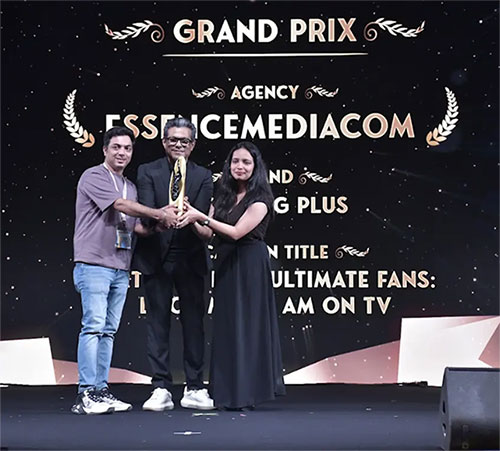
    The EssenceMediacom team winning the sole Grand Prix Media Abby for Airtel 5G Plus Ultimate Fans: Look Maa! I am on TV

    The Wavemaker tally include four golds, nine silvers and three bronzes. The sole Grand Prix presented was won by GroupM agency EssenceMediacom for Airtel 5G Plus campaign #LookMaImOnTV for innovative use of branded content – integration.

    While Wavemaker scored 98 points, the next best was less than half that at 48. That was Initiative Media. EssenceMedia secured 42 points.

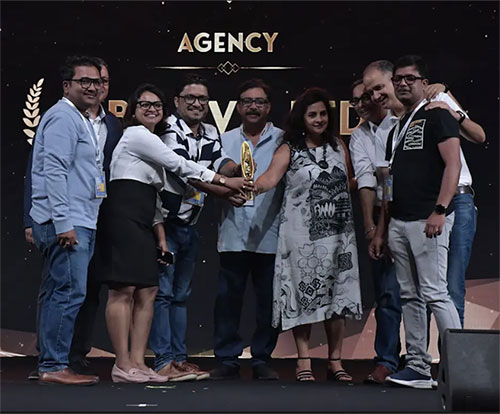
    The ABP Pvt Ltd team winning the Publisher of the Year Abby

    Like last year’s edition, the Abby Awards are powered by One Show and have received a total of 3506 entries as against 3301 last year. As many as 73 entrants for the Media Abby as against 63 last year. In Creative, there are 198 entrants as against 181 last year. The total number of entries for Media Abby were 1258 this year (up from 1019 last year) and in the various categories under Creative, it’s been 2248 this year, as against 2282 last year. Digital, Mobile, and Technology, have collectively garnered 626 entries from 75 companies.

    The gates for receiving entries had to be shut as per deadline, we were told, else, the entries for Creative Abby would’ve crossed last year’s tally.

    There were 23 jury chairs and 204 jurors across 23 categories. Of these there were 53 new, young, award-winning judges. There were 68 women amongst the judges (nine jury chairs are women).

    Publisher Abby

    Media Abby