Category: Big Story

  • In the Age of AI will Media & Advertising Divorce?

    In the Age of AI will Media & Advertising Divorce?

    Image rendered by ChatGPT given the column theme


    Ashoke AgarrwalA few decades ago, I was helping an advertising honcho craft an acceptance speech for a Lifetime Achievement Award. High on the list of reasons why advertising is a social good is that it enables citizens to access information and entertainment by providing media at a reasonable or no cost. Fast forward a few years, and the media veteran Pradeep Guha shocked the world by overtly positioning the primary role of the Times of India (TOI), once India’s newspaper of record, as an amasser of audiences for advertising to address. Pradeep’s honest assertion presaged the fall from grace of TOI and most other newspapers from a necessary read to a toilet accessory, if that.

    In the realm of broadcast and cable television, the relentless pursuit of audiences for advertisers has led to a steady diet of mind-numbing soap operas and shallow news coverage. The once vibrant and diverse landscape of television has been reduced to a monotonous cycle of content, all in the name of catering to advertisers’ demands.

    In the early years, social media was hailed as a tool of enlightenment and revolution, and the Arab Spring and Ukraine’s Maidan Revolution were credited to it. Today, it is seen not just as banal but as an insidious cause of rising depression among the young and tribalism at large. What gave? Once again, it was social media’s marriage with advertising. As Google (Alphabet) and Facebook (Meta) anchored their business model to advertising, they invented and nurtured algorithms that invented hordes of individuals hooked on content that amplified their worst impulses.

    The rise of OTT (Over The Top) television based on a Netflix-like subscription model led to a creative renaissance that restored television content as an art form similar to the movies (the fact that film and music had survived, in the main, as art forms have to do with the fact that advertising played little or no role in their business model). To my mind, OTT’s recent experiment with advertising as a source of revenue is dangerous and could lead to an inevitable creative slide into inaneness.

    The world is now seeing two revolutions.

    There is now a backlash to the increasing irrelevance of traditional mass media and an increasing wariness with social media as a news and information source. As a result, social media like Instagram and, where available, TikTok (or its imitators) have become platforms for content creators across various genres. While traditional social media platforms are becoming forums for content creators aiming at the mass market, niche platforms like Substack, Medium, Reddit and YouTube are becoming platforms for niche content creators in journalism, opinion, reviews and think pieces.

    In the coming years, if traditional media continues its decline, individuals or small, independent teams may take over a more significant share of the content market. While niche content on platforms like Substack and Medium is subscription or micro-payment-supported, content creators of mass platforms like Instagram and TikTok depend upon an insidious form of advertising called Influencer Marketing.

    While the dispersed content-creation model gathers momentum, another revolution is afoot as AI matures and uniquely empowers individuals and businesses. In a decade or two, communication between brands and individuals will be AI mediated with an AI avatar of the brand in communication with an AI avatar of the individual. I have posited this in my MxMIndia column of Jan 2022 titled ‘The Coming Post-Digital Age’.

    This will then result in a divorce between the media and advertising, leading to:

    • A re-emergence of mass media, albeit with a different business model
    • a repositioning of social media as a valued platform for content creators
    • And more effective and efficient brand-building by marketers through direct communication and social diffusion

    What do I mean by social diffusion? Globally, brands like Tesla and Apple have been built chiefly on social diffusion, which involves shared social narratives and the prosaic term unpaid media. Brands like Mercedes and BMW may have had advertising support in developed countries but have been mainly built on social diffusion in India. The guru brands – Sri Sri and Satguru – have been built through social diffusion. If Patanjali had continued to rely on social diffusion instead of relying on advertising to meet vaulting ambition, it would not be in the trouble it is today.

    In conclusion, the marketing communication discipline will shift paradigm over the next decade. One dimension of the change will be technology, with the emergence of AI as the vital medium of consumer interaction. The other dimension will be social, with the slow and steady accretion of social diffusion through narratives and word-of-mouth.

    Ashoke Agarrwal is a veteran advertising professional with around four decades in advertising and marketing services. Agarrwal, a chemical engineer from IIT Mumbai and a postgraduate from IIM Bangalore, is a pro-entrepreneur with past and current ventures in market research, advertising, CGI, e-learning and brand consultancy. He writes on MxMIndia every Thursday. His views here are personal.

  • Gig Workers: Charity begins at home

    Gig Workers: Charity begins at home

    With apologies to none at all

    Vikas MehtaBy Vikas Mehta

    Yes, I had ended my last post with a link to the new Pepsi rehash of the old ‘yeh dil maange more’ ad. And had promised to review it. But, hey, promises are meant to be broken. Am actually so disappointed at the ads dished out during the IPL that I refuse to talk about them. Instead, I will narrate two contrasting tales that I picked up over Eid.

    A friend was just settling down to enjoy the Eid holiday when he got a call from a friend who was coming over with some Eid sweets. My friend panicked as he had nothing to offer. But then being a millennial and having acquired the habits of Gen Z, he immediately remembered Blinkit. Sure enough, Blinkit was offering Eid sweets, not the typical Eid sweets like Sewaiyan but Feni Lachha, Agra Petha, Panjeri Laddoo…you get the drift.

    As luck would have it, my friend’s guest and the Blinkit delivery guy reached almost together. The guest was dressed in Eid livery and as my friend opened the door to his apartment, the Blinkit delivery guy too turned up. He delivered the order and then wished the guest Eid Mubarak in a choking voice. While the guest reciprocated heartily, my friend checked on the app and discovered that it was Eid for the delivery guy too. Instinctively, he called the delivery guy who had by then almost reached the lift, and handed over the Blinkit packet to him wishing him Eid Mubarak.

    Taken totally by surprise, the delivery guy burst into tears. It seems he had reported for his job against his family wishes, because he knew that being Eid there would be a shortage of riders, an excess of orders and he could earn better. So, while he ached to be with his family and celebrate the festival, economic compulsions and family responsibility steered him away from it. But, my friend’s gesture bowled him over. Watching all this, the guest too slipped in a note into his palms and urged him to go home to enjoy Eid with the family.

    Now, before we all go mushy and applaud the generosity of the two gents, listen to another incident that I picked up the same evening. My wife’s friend had called her over for a small Eid party. While they laid out a sumptuous dinner, the lady of the house seemed a bit off-colour. On enquiring, she found out that the friend was upset with Myntra. She had ordered an Eid dress for her daughter, a bit late but the delivery date as promised was on Eid. So, she was relieved that she had not failed her daughter.

    But, on the morning of Eid, she got a message from Myntra that due to some operational issues, the delivery will be delayed. Now, this lady was tracking the package and she knew that it had reached Dehradun. So, she deducted, rightly, that due to Eid, there was a shortage of delivery guys. And that upset her. She was angry and upset that her Eid had been spoilt.

    What contrasting tales. Here were two people who had instinctively succumbed to the spirit of the festival. Caring and sharing had come naturally to them.

    On the other hand, was this person who had a narrow selfish view of the festival. Who did not get the spirit of the festival and treated it very transactionally.

    That’s of course, my view. But the diversity of human behaviour never stops to amaze me. And also, the unpredictability of it.

    More crucially it also tells us the indifference we have towards the gig worker. As consumers we have lapped up the culture of home delivery. We marvel at the technology. We are awestruck by the whole process. We are delighted by the speed of delivery. And we are also happy that employment is being generated in the form of delivery guys. But, have we ever thought about humanising the last mile delivery.

    The word gig comes from an early twentieth century jazz slang. When two or more musicians would combine together to perform informally. No contract, no formal agreement, no payment promised. In today’s economy, it stands for any informal job. And that is what I cannot understand. Why is this last mile delivery an informal job? Isn’t it one of the most important parts of the delivery process? When every day, nay, every minute counts in making the delivery happen, why is the role of the delivery boy downgraded to a foot note?

    These people have no formal timings. No structured holidays. No minimum payment guarantee or even a basic pay. Their remuneration is linked to just delivery. Come rain, come extreme heat, come festivals, come illness, these gig workers have to soldier on.

    And please, do not compare them to a train driver or to a medical worker or to a public transport official. All these people have jobs. Not gigs. Fixed pay, not just a variable component. Sick leaves, designated holidays. Either gratuity or pension or both. Even insurance. Nothing of that sort exists for a gig worker.

    Before you accuse me of turning socialist or maybe even communist, all I am actually doing is to draw the attention of us, the consumers, who meet and interact with these people daily, to the fact that delivery people are not robots. They are as humans like you and me. But is our behaviour towards them human?

    I have a theory called the Indian housewife theory. It is expected that the housewife will make tasty meals every day. In fact, three times a day. And rarely do we have a word of appreciation towards the food cooked. Because we take it for granted. But once in a blue moon if the food goes wrong for whatever reason, the whole family rains down on the housewife. No appreciation for the 99% good food. But protest and howlers for that 1% of mistakes.

    And that’s how we treat the delivery or gig workers. We rarely acknowledge them. We hardly notice them. But they become our target if they are late or there is a problem in delivery.

    All I am asking therefore is that we as consumers must change our attitude towards the gig workers. Have empathy. Treat them with respect. It’s getting hotter. We do not venture out but expect them to deliver. On time. The least one can do is ask them if they need a glass of water. Maybe a small snack. An orange a day will not burn a hole in your pocket but it will not only refresh them but also make them feel appreciated and human.

    And some apps like Blinkit now give you the option to tip them. Do that. If you have saved Rs 20 in that delivery, tip it. And if you are really transactional, satisfy yourself by thinking that you save much more than the twenty rupees. You saved the effort of venturing outdoors. Didn’t you? So, nothing wrong in tipping them a small amount.

    We, the customers have to start this movement. One may call this socialist thinking but frankly I don’t care what it’s called as long as it helps us be humane. Can we at least make a beginning?

  • Present Imperfect. Future Shock. Journalism students see an industry in crisis

    Present Imperfect. Future Shock. Journalism students see an industry in crisis

    By Trish Audette-Longo & Christianna Alexiou

    It’s hard not to see the journalism industry as one in crisis.

    In February, Bell Media announced it was ending multiple CTV newscasts, making other programming cuts and selling 45 radio stations. Its parent company, BCE Inc., also announced it is cutting 4,800 jobs “at all levels of the company,” saying fewer than 10 per cent are at Bell Media.

    Weeks later, Vice Media said it would stop publishing on Vice.com and lay off hundreds.

    These decisions followed CBC’s December 2023 announcement that it would cut 600 positions, and news last fall that some Canadian journalism schools had shut down or paused their programs.

    Across the country, the outlook for the future of news is — at best — uncertain. Not talking about the state of the industry is not an option for journalism educators.

    In journalism school, students learn their craft while engaging with critical questions about their roles and responsibilities. They are often taught by previous or current journalists, whose work experiences prepare them to help students tackle reporting challenges.

    Crises ask journalism educators, students and practitioners to grapple with sharing stories about what the future could hold. What will journalists’ jobs look like in five years? Or 25 years?

    No one in any industry would be able to answer such questions with certainty. But critical events in journalism demand we talk through uncertain futures. And this presents follow-up questions. What are the risks and rewards of talking openly about precarity? How do you start a conversation when the future is so uncertain?


    Understanding journalism education

    In 2015, with the shock of the 2008 economic crisis still working through newsrooms, journalism educators offered a wide-ranging map for reevaluating the goals of journalism schools, and whether they are solely meant to train future journalists.

    Crises run into each other, overlapping and informing responses to change. COVID-19 and a reckoning with racism in journalism and other institutions have demanded new reflections on journalism education.


    Pathways to the future

    It’s time journalism educators shift conversations with students, to address their experiences, their worries and their understanding of what journalism is and what they want it to be.

    In 2022, we asked journalism students at Carleton University — where we, respectively, teach and studied — how they felt about their training through COVID-19. We were curious about how students viewed online learning and transitioning into journalism jobs.

    What we heard were concerns about burnout, precarity, work-life balance and the long-term outlook for a life in journalism.

    “I just feel like almost every week or every few weeks, I go on Twitter and there’s a journalist who’s like in their 30s or 40s, like halfway through their career, who just quit,” one student said.

    Students knew the risks of going into the industry, thanks to news of other cutbacks, guest speaker testimonies and their own experiences losing internship opportunities when the pandemic forced newsrooms online.


    Anticipating challenges

    We asked journalism students what they thought a day in the life of a journalist looked like. They talked about days that demanded endurance, dedication and working through different kinds of uncertainty.

    “They’re just always on,” one student said. “I don’t think journalists have a normal day. As in, you know, get up, get to work, get home.”

    Another student described “general burnout” as “a huge part” of the job.

    It isn’t surprising that students anticipated challenges finding work and worried about long-term financial stability. In some ways, their responses align with a broader Gen-Z refusal to put their jobs at the centre of their lives or accept low pay.

    “I don’t want to say, you know, the more money you make the more successful you are, but being able to just have that security is, I think, a huge thing,” one student said.

    “Maybe it doesn’t quite align with ‘success’ in a ‘making a difference’ kind of way. But I think (financial security) gives you an ability to make a difference.”

    Students also flagged the importance of mental health and well-being.

    “There is an expectation that your entire life should revolve around chasing a story until you physically cannot anymore,” one student said, explaining that this kind of thinking turned them away from journalism.


    Learning together

    Today’s journalism students have likely been told their entire lives — by friends, family, pop culture and so many reports — that it’s a dying industry. Nonetheless, they’re driven to find out more.

    Journalism in crisis, as others have argued, presents an opportunity to unpack traditions and reimagine practices.

    It’s also an opportunity to reconsider how journalism schools and newsrooms respond to the concerns of emerging journalists. How can precarity and burnout be addressed collectively inside and outside journalism, not as individual matters?

    One place this can begin is with classroom conversations, collectively taking on uncomfortable truths and fears alongside building new skills.


    Navigating not having reassuring answers

    One risk, for educators, is not having ready-made, reassuring answers to questions of insecurity.

    Introducing worst-case scenarios also risks scaring away students. In our interviews, one student cautioned against presenting guest speakers’ negative portrayals of the industry too early, for example.

    But recent news makes industry crises impossible not to talk about.

    Talking through crises can allow for discussion of alternatives and solutions. However, care should be taken to not romanticize what has worked in the past, including precarious conditions like long hours, low pay or competing for fewer and fewer jobs.

    Instead, it’s helpful to think of imagining different journalism futures as an in-progress collaboration for students, educators, journalists and news organization leaders. Such collaboration is a project of articulating not only crisis conditions, but drawing on shared experiences to figure out what it would take to make things better.

    Looking back, we wonder what responses and creative solutions we would have heard if we asked students what they wanted their days to look like as journalists — not just what they thought the job looked like already.The Conversation


    Trish Audette-Longo is Assistant Professor of Journalism Studies, Carleton University and Christianna Alexiou is an MSc in Regulation Student at the London School of Economics and Political Science. This article is republished from The Conversation under a Creative Commons license. Read the original article.

  • Molley’s MasterClass in Customer Relations

    Molley’s MasterClass in Customer Relations

    Representative photograph

    Sanjeev KotnalaSometimes, roadside vendors can teach you a lot more than any business school or training session can. And if you keep your eyes wide open to observe and question everything you observe, trust me, the class is on every time you take to the streets. This morning was one of the best demonstrations of trust and customer relations. It was not an AI-based digital service provider with fancy algorithms working for it but a vegetable vendor with an open mind.

    Introducing Molley, a lady who sells primarily green and fresh vegetables just across the gate of a public school.

    If you ever doubted the rule of location, location, and location for such a business, this demonstrated it.

    Molley sits cross-legged on the mat, and her vegetables are spread on a bori– the woven sack placed on the road. She uses fresh banana leaves to line the road outside the area covered by the sacks.

    She is at the corner diagonally opposite the school gate. You would think there is nothing special about the location. However, if you stop there, you will soon realise that primarily, women from nearby societies and her core catchment area come to drop their children at school every morning. Some women walk to the school; many come in their cars and two-wheelers to drop off their children. Most of them buy vegetables for the day on the way back home.

    With time, Molley, a plump-looking, sweet-natured vegetable vendor, crafted and nurtured her customer base. A large section of these ladies buy vegetables from her, even though there are a few vegetable carts just a few meters away and one big, well-stacked shop that even promises home delivery.

    So, I stood there, taking a ringside view, as my wife bought vegetables from who else but Molley.

    She has an ongoing crisp banter with another set of ladies, who address her by name. She replies to them by their name and suitable didi (elder sister), aunti or taayi (elder lady-normally paternal aunt) prefix or pronoun.

    This is Molley’s loyal customer base, which she has cultivated through her personalised service and warm demeanour.

    Now, the first magic realisation. There is no weighing scale. Everything is sold on a per-unit basis. It was not only Palak (Spinach)Methi (fenugreek), Kheera (Cucumber) and Nimbu (lemon) which are anyway sold per unit, but also included things like Baigan (Eggplant), Gaajar (Carror), Mooli (White Raddish), Lauki (Gourd) and Mattar (green peas) too.

    One of the ladies picks up some carrot and places them in a polythene bag. She claims it is 500 grams, but Molley disagrees. She takes the bag, removes two pieces, and gives the bag back to her. She joyfully announces, Taayi– this is now aadha kilo (500 grams). The ladies contests her action, and Molley challenges them to weigh it at the nearby shop. They also threaten to do it one day and unanimously agree that they should do it. Molley smiles. The deal is done, and payment is received.

    You realise the weighing threat is harmless banter; it will be a while before anyone does it.

    The other magic realisation hits you harder. Molley is not digitally connected. All cash, no UPI/Gpay or Paytm. She is okay if you are not carrying cash and are even buying from her for the first time. You could pay her tomorrow. Complete trust in a stranger. And the regulars know. So they carry cash.

    Another lady’s bill is Rs 310, and she pays just 300. Her excuse is that she does not have a change of Rs 10. Molley jokingly says to her: ‘Bhabhi- 10-10 bacha kart oh iPhone legi kya‘ (Bhabhi- by saving 10-10 rupees- will you buy an iPhone?). Everyone laughs. The light-hearted banter adds a charming touch to the morning interaction and makes everyone smile.

    She adds: ‘Aab iss week ka tees ho gaya… pachaas hojayega toh le lungi’ (This week, you have saved thirty when it will add up to fifty, I will collect).

    You know it is not going to happen. It is Molley’s investment – a reminder- so everyone must understand that the lady has paid less and is not a discount.

    While these exchanges may seem like jest, they subtly reinforce the idea of mutual trust and respect in the business relationship.

    Meanwhile, she addresses a somewhat elderly lady- ‘Kaka theek hain? kaisi tabiyat hai?’ ( is uncle well… how is he now?) and further ventures- ‘Kai baat nahi, saab theek ho jayega’. (Don’t worry- things will be okay soon).

    Net-net

    Molley’s vegetable stand is not just about selling vegetables; it’s a MasterClass in customer relations and trust-building.

    Her approach highlights the importance of personalised service, trust, and community engagement in fostering long-term customer loyalty—an invaluable lesson for aspiring management professionals and more so in the digital world.

  • Are we set to redefine access and inclusion for cinema lovers?

    Are we set to redefine access and inclusion for cinema lovers?

    Screengrab from Pathan on Amazon Prime Video

    Shruti PushkarnaIn my last column, I featured two brilliant foreign films that dealt with the subject of disability in a sensitive as well as an entertaining manner. Moreover, persons with disabilities were truly represented and their challenges highlighted in both productions for mass consumption.

     

    Sticking to cinema, let’s circle back to India. Recently, three exciting events caught the attention of disability inclusion advocates. It’s been good news for people like me who keep pushing for better (if not equal) media access and representation.


    A President Awardee, an RJ and a person with vision impairment, Divya Sharma’s interview of Karan Johar at the Cinevesture International Film Festival in Chandigarh was widely shared across social media platforms. She asked some pertinent questions on the vision of Bollywood vis-à-vis inclusion of disabled folk, normalisation and the role of cinema in shaping mindsets, insensitivity and ridicule at the expense of persons with disabilities onscreen and more. The seven-odd-minute interaction between a visually impaired girl and a leading filmmaker and influencer will hopefully open up more opportunities of constructive exchange of ideas.


    You remember the SRK starrer ‘Pathan’ that made headlines even before its release? Yes, I’m referring to Deepika Padukone’s controversial orange bikini and the Besharam Rang song. A lawyer filed a complaint in Muzzafarpur district court of Bihar against the leading actors and the objectionable song that allegedly offended the sentiments of the Hindu community.

     

    We are familiar with the legal trajectory of that complaint as well as the political clamour in different states, seeking a ban on the film. But there was another case filed in the Delhi High Court against ‘Pathan’, which perhaps didn’t grab as much public attention.


    A visually impaired student at the National Law School, Bangalore filed a petition along with three other persons with disabilities, out of whom two are visually impaired practising lawyers and one is a hearing impaired professional working as the Executive Director of the National Association for the Deaf. The complaint highlighted the lack of equal access to audio-visual entertainment in theatres and on online streaming platforms.


    In response, the High Court issued an interim order directing the producer (Yash Raj Films) of Pathan to make the film accessible with audio description as well as subtitles and closed captions in Hindi before its release on the OTT platform (Amazon Prime Video). And after seven hearings, the court pronounced its final judgment on March 15, 2024, setting a new precedent for accessible cinema.


    Why is this case or judgment important? And what are these accessibility features?


    The Rights of Persons with Disabilities (RPWD) Act, 2016, includes a provision on media accessibility which states that the government must take measures to make electronic media accessible. In October 2019, an advisory was issued by the Ministry of Information and Broadcasting to the Central Board of Film Certification (CBFC) to persuade producers to make movies accessible. But this was hardly a mandate to ensure compliance. And so, nothing changed, up until now.


    The filmmaker, producers and the media fraternity are focused on the 99% able-bodied audience, insensitive to the needs of persons with disabilities. The cost of accommodation is misconceived, seen as an additional burden on the filmmaker. Imposition of access features are also arguably perceived to interfere with an average movie-goer’s cinematic experience. These arguments are a clear reflection of a lack of empathy and sheer ignorance that have led to a systemic exclusion of the disabled community from channels of mainstream entertainment.


    But with this recent judgment on Pathan, things are going to change. The judge also directed the other respondents/ stakeholders in the matter to work together and formalise standardised guidelines to ensure accessibility for all future productions. This means that the CBFC will need to include accessibility requirements in its certification process.


    As for the cost of providing accessibility features, Yash Raj Films incurred an additional expense of INR 6 lakh, a tiny drop in its Rs 1,000 crore ocean of earnings!


    As per Section 42 of the RPWD Act 2016, all persons with disabilities have an equal right to access information and communication technology. The government has to ensure that all content available in audio, print and electronic media are in accessible format. And that persons with disabilities have access to electronic media via audio description, sign language interpretation and close captioning.


    Audio Description is a verbal depiction of key visual elements in media and live productions, involving description of the visuals on screen to enable imagination by person with vision impairment.


    Subtitling provides a text alternative for the dialogues on screen, by characters, narrators, or any other vocal participants, in the language of the production.


    Closed Captioning not only supplements the dialogues but also other relevant parts of the soundtrack, describing background score, phones ringing, noises, or any other audio cues.


    The court has ordered for these accessibility features to be included on OTT as well as theater screenings. For now, the cinema halls and producers can work with certain mobile application providers (XL Cinema, Shazacin) which offer access to an audio described track that synchronizes on the user’s smartphone as the movie plays up on the big screen.


     

    And lastly, a movie trailer starring Rajkumar Rao as a visually impaired person flooded WhatsApp groups and LinkedIn feeds on April 9. Set to hit the cinema halls on May 10, this is a biopic of industrialist Srikanth Bolla, the first international blind student in management science at Massachusetts Institute of Technology. Srikanth endured several challenges, rejection and apathy in life, before he set up Bollant Industries with the objective of providing employment to others like him.

    Whether it’s bold activism, asking for equal access and a normal portrayal, ensuring compliance through workable measures or recounting real life struggles of successful persons with disabilities, the case for inclusion is strengthening by the day.


    What is preventing the media to initiate baby steps and add disability inclusion into its overall agenda?

  • Goafest 2024 & Abby Awards to be held in Mumbai

    Goafest 2024 & Abby Awards to be held in Mumbai

    If the Indian Premier League can happen in South Africa or the UAE, why can’t Goafest take place in Mumbai? Point, and the wise folk at the Adveritsing Agencies Association of India and The Advertising Club, have chosen to organise the 2024 edition of Goafest and the Abby Awards in Mumbai, from May 29 to 31. The venue: Westin Powai, the same place that plays host FICCI-Frames. And was earlier called Renaissance.


    The reason, as per a communique issued: the forthcoming Lok Sabha elections. The decision, conscious and collective as it has been described, is to host the 17th edition of the festival on the same dates that it was scheduled to happen in Goa. It may be noted Goafest will continue to be held in Goa in future, and this, as of now, is just a one-off.


    First let’s read the statements. Later, do read our two-bit.


    Said Prasanth Kumar, President of the Advertising Agencies Association of India (AAAI) and CEO of GroupM, South Asia in a communqiue: “We’re excited to announce that Goafest is happening in Mumbai this year, despite a few logistical challenges. Our collective decision reflects our unwavering commitment to this esteemed event, which has evolved into a cornerstone platform for shaping the future of our industry. It’s become a vital platform for industry, becoming a nexus where industry leaders converge to explore, innovate, and chart the course for a progressive journey. We’re committed to maximizing participation, curating insightful sessions, and ensuring attendees leave with invaluable knowledge. Plus, mark your calendars: Goafest returns to Goa in 2025! Join us for an unforgettable experience at Mumbai Goafest 2024!”


    The communique also adds Rana Barua, President of The Advertising Club and Group CEO of Havas India, South East and North Asia, as saying: “The Abbys has always been a platform dedicated to recognising and celebrating outstanding achievements in the advertising and marketing industry. We look forward to honoring the best work of 2023 at the Abby Awards Powered by One Show 2024 this May, in Mumbai. With Westin Powai as the venue we are working towards putting together a dynamic agenda that  will be announced in due course. We are grateful and thankful to the entire fraternity for their continued support and enthusiasm.”


    The agenda, speakers, the sessions and the all-important sponsors will be announced shortly.


    While all of this was what we gleaned from a communique issued on Friday morning, there’s a little more to what has been issued. According to the info we have received, a cross-section of the powers that be felt that it should perhaps be put off. Yes, no Goafest 2024. That was around the first week of April. When we heard about it and asked some of the Goafest top brass via WhatsApp, there was no clear affirmation or outright denial. However, what we were told was that talks were on to salvage the situation.


    For, Goafest and Abby are meant to be for/of/to/by the industry, and aren’t being organised for profit, save the salaries of the secretariat and build a reserve for the rainy day. The organiser-in-chief doesn’t buy a fancy car after the conduct of the festival. It’s meant to be community service. And of course access to some fun in the sun, and loads of booze in the closed confines of sunny Goa.


    This year, as per our information, there is a problem. The media economy is in bad shape. Look at the number of empty billboards on the Western Express Highway in Mumbai. With just so many days where no government ads happen due to the Election Code of Conduct, and this year twice over given elections in Maharashtra and elsewhere, it’s not exactly ‘achche din’ for media biggies, the primary sponsors of Goafest.


    Colors/Viacom18 has reduced its trade spends. The news channelwallahs (Aaj Tak was one of the main sponsors last year, Times Network before that) are too busy with the elections than humouring agency folk.


    Also, the entire advertising agency business is being rewritten. No longer is there enough money in the bag to fund aircraft-loads to Goa. Even if 50% was being paid by the employee.


    Net-net: there was pressure.


    Abracadabra! All of this can be eliminated if the event happens in Mumbai. Yes, the alcohol is expensive, but one can also ask the Delhi officefolk to airlift those five litres of liquids from Haryana.


    Plus the chances of marketing folk being present is very high, as that number is not really very significant when the event is held in Goa. With the event being in Mumbai, albeit in Powai, the likelihood of people doing the trek to Goafest is good.


    We tried to gauge the sentiment on the decision from some of our connects. While there is an overall happiness that it’s happening and is not cancelled, there is dismay that it means no official fun in Goa. They said you can’t do that in Mumbai.


    And what about all those floral shirts and shorts we bought for Goafest, one regular mused.


    Another point posed to us is that if the elections are the reason and since this is the 17th edition of the fest, why didn’t it get pushed to Mumbai all these years when there were elections. Hmmm.


    Well, right now the story is that Goafest 2024 (and Abby) are happening. We don’t know if that’ll mean Ogilvy will participate, but we do hope it does.


    Meanwhile, a few days before Goafest and Abby, the Zee-sponsored Kyoorius Creative Awards are scheduled to take place. The date is May 24. But that, as we are constantly reminded, is not organised by industry bodies.


    For more information on the festival, follow the Goafest handle at @goafestlive and for ABBY Awards Powered by One Show, follow The Advertising Club at @theadclubindia.

    Better still, read it all on MxMIndia.com.


    Entries for ABBY Awards Powered by One Show 2024 can be submitted at https://abbyawards.com/


  • Confronting the Crisis of Credibility & Trust

    Confronting the Crisis of Credibility & Trust

    Kunal SinhaOnce again, a brand that is a household name has let its users down. Except that the duplicity is remarkable.
     

    A recent report released by Swiss NGO Public Eye and the International Baby Food Action Network (IBFAN) revealed stark differences in the sugar content of Nestle’s baby products across various nations.


    The investigation, which evaluated around 150 baby products from different countries, alleges that Nestle’s products in South Asian (including India), African and Latin American markets contain significantly higher sugar levels than those in Europe. Brands like Cerelac and Nido contained more sugar by as much as 2.7 gm per serving in India and 5 gm in Thailand– compared to developed nations in the West.


    The medical evidence against sugar is clear. Added sugars should not be given to infants, toddlers or very young children because they don’t need it. They get their sugar from natural sources and lactose in their mother’s milk for the first 24 months of their lives. There is a risk that infants will become addicted to sugary foods, which will impact their health from an early age.


    But the same Nestlé’s India operation was ranked joint first in the second India Access to Nutrition Spotlight Index 2020. The index is purported to be an independent national assessment to measure the contribution of India’s largest food and beverage manufacturers toward meeting the health and nutrition needs of Indian consumers.


    In its citation, the ranking states that some of Nestlé India’s strengths include its overall nutrition governance and management systems that are comprehensive with a clear accountability structure, its pledge to reduce fat, salt and sugar in its products, its commitment to address the affordability of its nutritious products and its responsible marketing policies.


    Would you trust the Access to Nutrition Index?


    In Indonesia, Aqua, a bottled water brand made by French consumer goods giant Danone, recently topped a new ranking of Indonesia’s biggest plastic polluters.


    Sungai Watch, a Bali-based environmental non-profit that deploys river barriers all over Indonesia to stop plastic debris from leaking into the ocean, studied the trash they had collected. The non-profit audited 537,189 pieces of rubbish collected from 268 river barriers in Bali and East Java last year, and published the data in its 2023 Impact Report.


    It found Aqua-branded single-use water bottles to be by far the most commonly littered items, followed by products made by Indonesian consumer goods firms Wings Group and Indofood.


    Now, Aqua was the first Indonesian company to be certified by B Lab, a London-headquartered certification scheme which rewards “beneficial corporations”, or B Corps, based on their social and environmental impact. Aqua attained B Corp status in 2018 and was re-certified in 2021. How reliable and authentic would that certification be, in the light of the Sungai Watch report, especially since B Lab has faced scrutiny in recent months for helping companies greenwash their record?


    Trust is ever so important to us

    Trust is a major determinant in all aspects of our life. We seek it in our families, in our neighbourhoods, in our workplace, in the sporting field. Trust is never absolute but is based on situations, memories, experience, contract, perception, emotions.


    From personal relationships, to trade and commerce, politics, society, everything is based on trust.


    Trust is a brain’s neural response based on certain stimuli, both internal as well as external as well as certain mnemonic associations developed over years. Trust is vital to any transaction. Without trust there can be no relationship, institution or nation.


    The impact of trust goes deep. Gartner studies suggest that 81% of customer are not willing to engage with business or make purchases from brands they do not trust. What’s more, 89% of customers say they would end their relationship with a brand if it violates their trust. According to PwC’s 2023 Trust Survey, 92% of business leaders, 92% of consumers and 94% of employees agree that organisations have a responsibility to manage that trust.


    How did we lose trust?

    By definition, trust is as human and messy as the very humans who earn it or lose it. Today, there’s a gaping chasm of societal trust – a “trust deficit,” defined as when there is more distrust than trust between two or more people.


    One would have thought that the Information Age and the widespread rise of different media would eliminate some of this trust deficit. In truth, it has only amplified the problem. Personal agenda, partisanship and bias have clouded dissemination of news and information.


    Opinion has become interchangeable with fact. Fake news, manipulated information (aural, written or video) and coloured views are so common that it is difficult to decipher the real from the unreal. Trust deficit in media explores the lower depths every minute.


    According to futurist Alvin Toffler, “We are increasing the sophistication of deception faster than the technology of verification. The consequence of that is the end of truth. The dark side of the information technology explosion is that it will breed a population that believes nothing, and perhaps even more dangerous, a population ready to believe only one ‘truth’ fanatically and willing to kill for it.”


    Brands and mistrust

    In today’s consumer landscape, trust has become a precious commodity. Scepticism and cynicism are on the rise, leading to a decline in consumer trust across industries. From data breaches to misleading advertising, consumers have become increasingly wary of brands and their intentions. The prevalence of fake reviews is a real problem in the retail world and has further eroded consumer trust. High-profile data breaches and privacy scandals have shaken consumer confidence. Instances where personal data has been mishandled, misused or compromised have resulted in a loss of trust in brands across various sectors.


    Trust is lowest among Gen Z consumers, among whom only 28% trust the brands they do business with. A study from Deloitte shows that consumer trust in a brand can decline by as much as 144% when a customer believes a company is using AI.


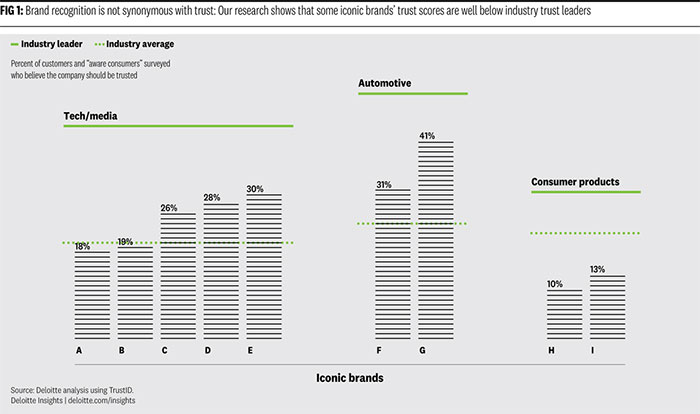
    But iconic brands like Aqua and Nestle regularly show up in annual, high-level trust surveys. While it seems intuitive that large, long-dominant brands with the most customers would also be the most trusted, a study found that many household-name brands fell below benchmark trust scores in many industries (figure 1)—indicating that brand recognition is not synonymous with trust.


    Consumers say that brands’ attempts to engage with them often go wrong when they lack relevance (76 percent) or authenticity (51 percent).


    Regaining brand trust

    While the erosion of trust in recent years presents challenges, brands can regain confidence by prioritizing transparency, authenticity and accountability.


    The need for trust is on the rise. Globally, 71% of people say that it is more important to trust the brands they buy/use today than in the past. (Edelman Trust Barometer 2023).


    By valuing customer privacy, being transparent in communications and practices, aligning with genuine social causes, and consistently delivering quality and value, brands can rebuild trust and establish lasting relationships with consumers. In the era of distrust, brands that proactively address these issues will stand out as beacons of trust, gaining a competitive edge and fostering loyalty in the hearts and minds of their customers.


    But most importantly, they need to be reminded that consumer is not a moron. They are babies who deserve care, not addiction, a plastic-free world, not beaches and playgrounds littered with bottles.


    Kunal Sinha is a senior strategy and foresights executive based in Jakarta, Indonesia. He is the author of several books including The Future of India’s Rural Markets and Raw – Pervasive Creativity in Asia. He writes for MxMIndia every other Monday. His views here are personal.

  • TikTok fears point to larger problem: Poor media literacy in the social media age

    TikTok fears point to larger problem: Poor media literacy in the social media age

    By Nir Eisikovits


    The U.S. government moved closer to banning the video social media app TikTok after the House of Representatives attached the measure to an emergency spending bill on Apr. 17, 2024. The House voted on each of the four components of the bill, and the one affecting TikTok passed 360-58 on Apr. 20, 2024. The packaging is likely to improve the bill’s chances in the Senate, and President Joe Biden has indicated that he will sign the bill if it reaches his desk.

    The bill would force ByteDance, the Chinese company that owns TikTok, to either sell its American holdings to a U.S. company or face a ban in the country. The company has said it will fight any effort to force a sale.

    The proposed legislation was motivated by a set of national security concerns. For one, ByteDance can be required to assist the Chinese Communist Party in gathering intelligence, according to the Chinese National Intelligence Law. In other words, the data TikTok collects can, in theory, be used by the Chinese government.

    Furthermore, TikTok’s popularity in the United States, and the fact that many young people get their news from the platform – one-third of Americans under the age of 30 – turns it into a potent instrument for Chinese political influence.

    Indeed, the U.S. Office of the Director of National Intelligence recently claimed that TikTok accounts run by a Chinese propaganda arm of the government targeted candidates from both political parties during the U.S. midterm election cycle in 2022, and the Chinese Communist Party might attempt to influence the U.S. elections in 2024 in order to sideline critics of China and magnify U.S. social divisions.

    To these worries, proponents of the legislation have appended two more arguments: It’s only right to curtail TikTok because China bans most U.S.-based social media networks from operating there, and there would be nothing new in such a ban, since the U.S. already restricts the foreign ownership of important media networks.

    Some of these arguments are stronger than others.

    China doesn’t need TikTok to collect data about Americans. The Chinese government can buy all the data it wants from data brokers because the U.S. has no federal data privacy laws to speak of. The fact that China, a country that Americans criticise for its authoritarian practices, bans social media platforms is hardly a reason for the U.S. to do the same.

    The debate about banning TikTok tends to miss the larger picture of social media literacy.

    I believe the cumulative force of these claims is substantial and the legislation, on balance, is plausible. But banning the app is also a red herring.

    In the past few years, my colleagues and I at UMass Boston’s Applied Ethics Center have been studying the impact of AI systems on how people understand themselves. Here’s why I think the recent move against TikTok misses the larger point: Americans’ sources of information have declined in quality and the problem goes beyond any one social media platform.

    The deeper problem

    Perhaps the most compelling argument for banning TikTok is that the app’s ubiquity and the fact that so many young Americans get their news from it turns it into an effective tool for political influence. But the proposed solution of switching to American ownership of the app ignores an even more fundamental threat.

    The deeper problem is not that the Chinese government can easily manipulate content on the app. It is, rather, that people think it is OK to get their news from social media in the first place. In other words, the real national security vulnerability is that people have acquiesced to informing themselves through social media.

    Social media is not made to inform people. It is designed to capture consumer attention for the sake of advertisers. With slight variations, that’s the business model of all platforms. That’s why a lot of the content people encounter on social media is violent, divisive and disturbing. Controversial posts that generate strong feelings literally capture users’ notice, hold their gaze for longer, and provide advertisers with improved opportunities to monetise engagement.

    There’s an important difference between actively consuming serious, well-vetted information and being manipulated to spend as much time as possible on a platform. The former is the lifeblood of democratic citizenship because being a citizen who participates in political decision-making requires having reliable information on the issues of the day. The latter amounts to letting your attention get hijacked for someone else’s financial gain.

    If TikTok is banned, many of its users are likely to migrate to Instagram and YouTube. This would benefit Meta and Google, their parent companies, but it wouldn’t benefit national security. People would still be exposed to as much junk news as before, and experience shows that these social media platforms could be vulnerable to manipulation as well. After all, the Russians primarily used Facebook and Twitter to meddle in the 2016 election.

    Media literacy is especially critical in the age of social media.

    Media and technology literacy

    That Americans have settled on getting their information from outlets that are uninterested in informing them undermines the very requirement of serious political participation, namely educated decision-making. This problem is not going to be solved by restricting access to foreign apps.

    Research suggests that it will only be alleviated by inculcating media and technology literacy habits from an early age. This involves teaching young people how social media companies make money, how algorithms shape what they see on their phones, and how different types of content affect them psychologically.

    My colleagues and I have just launched a pilot programme to boost digital media literacy with the Boston Mayor’s Youth Council. We are talking to Boston’s youth leaders about how the technologies they use everyday undermine their privacy, about the role of algorithms in shaping everything from their taste in music to their political sympathies, and about how generative AI is going to influence their ability to think and write clearly and even who they count as friends.

    We are planning to present them with evidence about the adverse effects of excessive social media use on their mental health. We are going to talk to them about taking time away from their phones and developing a healthy skepticism towards what they see on social media.

    Protecting people’s capacity for critical thinking is a challenge that calls for bipartisan attention. Some of these measures to boost media and technology literacy might not be popular among tech users and tech companies. But I believe they are necessary for raising thoughtful citizens rather than passive social media consumers who have surrendered their attention to commercial and political actors who do not have their interests at heart.


    This article was updated to indicate that the U.S. House passed the TikTok measure on Apr. 20, 2024.The Conversation Nir Eisikovits, Professor of Philosophy and Director, Applied Ethics Center, UMass Boston. This article is republished from The Conversation under a Creative Commons license. Read the original article

  • Complaint Management: Where bad experiences linger longer

    Complaint Management: Where bad experiences linger longer

    Sanjeev KotnalaWhenever there is a commercial transaction, there is a possibility of a complaint. The processes and responses to handle the complaints by a brand or organisation can transform perceptions, stabilise loyalty, and promote positive repeat purchases and references. However, most brands (including services) do lip-service to the concept. While they may standard operating procedures for complaint management, in most organisations, this department is the hidden face and unwarranted child. Most have a third-party call centre fronting complaints unless they have moved to Bot or IVR-based system, which is a different and equally horrifying story.

    All Complaint Management Systems work on set rules. They have scenario build-up for possible complaints and service delivery issues. The executive fronting the complaints is bound to play by the rule book. They are not expected to think. In fact, diversion from the SOP is not appreciated or encouraged. However, (one hopes) it is considered for future process refinement. The complaint handler is interested in the closure of the issue within timelines as they are evaluated on the number of calls and closures. The calls are mostly recorded for training purposes! Or so it is claimed. And surprisingly at times the complaint management systems suggest crazy solutions to the customer complaints.


    Can’t Find Fault with the Call Centres

    As a consumer, I have many issues and complaints with (some) brands. However, I realise that complaint-handling executives have hardly any leeway or authority to make decisions. Moreover, complaint escalation shows them in a bad light. I aim to register my complaint, hoping someone will look at it and resolve it. In the process, I would be helping the good brand learn and avoid repeating mistakes.

    Sometimes, I question this faulty thinking of mine. 

    Are these call centre executives not representing the brand? Don’t I have the right to a complaint resolution? Whatever the considerations, the interactions affect the customer’s disposition towards the brand and, hence, a critical part of the system.


    Differentiating Experience

    It is not that I have never had an excellent experience in complaint handling or it’s just that I am just a demanding customer. Trust me, a pleasant experience over a complaint or crisis helps create a stronger relationship.

    American Express Credit Cards is one of the brands with excellent timely customer complaint resolution and customer service/relations. The customer-fronting executive genuinely works and aims toward complaint resolution. At least, the impression is that they do, which is important.

    In Central India, at Dinshaw’s (dairy products) from Nagpur, all complaints land up with senior management, and they better be resolved as they are monitored.

    Brands like Make-My-Trip and Indigo (my experience) have good complaint handling. However, they have too many complaints appearing on social media.

    Then there are brands like Axis Bank, which tries to do its best and harness technology interfaces for a better experience. However, the unstable technology or a less than beta version of the apps is not resulting in the best of experiences.

    However, on the other extreme are brands like HappyEasyGo. Tough luck if you have a complaint with them.


    Complaining over Social Media

    A few trigger-happy, fastest-finger-first players use social media as the first port of call for complaint resolution. I believe people pin their complaints on social media when they don’t find a resolution in normal working. And if the complaint is addressed swiftly after it is featured on social media, it is still good as it kills the post. However, customers rarely go back to post a thank you or appreciation post after complaint resolution. I wish more of them would do so that others would know about the actual situation.


    Time To Take Customer Complaints Seriously

    In an idealistic situation, a complaint should not arise. However, as expectations and experiences differ, leading to dissatisfaction and irritation, complaints are a natural outcome. With increased social media interfaces and rising customer expectations in the challenging competitive environment, customers not only expect but demand the best experience and service – which a brand cannot ignore. They do not differentiate between local, regional, MNC, or start-ups. It is time for brands to wake up and take this part of customer complaint resolution far more seriously.


    Net-net

    People don’t buy products; they buy experiences that meet or surpass their expectations. No matter what you are selling, make them always feel better. People remember a bad experience more. They are likely to leave a bad review more than a good review. They will talk to more people about their bad experiences ( 5-10 times) than they will talk about a good experience. The brand has to nudge the customer to talk about a good experience or swift complaint resolution.

    In the new era of democratic voices, emotion and experience sharing, the experiences and the complaint management matter much more.

    ………………………………

    A story of mismanaged complaint handling

    Anupama, a young executive in an MNC firm, stays and works in Pune. Her parents stay in Aurangabad. Recently, on her father’s birthday, she used an urgent delivery service from an online flower and gift service company because she was a day late wishing her father. Forget why she forgot to wish on the day and let’s focus on what happened next.

    She went online- that’s what most people do. Like a new-age customer, she went through the process of ordering an urgent delivery from a reputed company that does flower and cake deliveries. She ordered a simple cake in a flavour that her father liked and a bouquet. She planned to call after the delivery of the make-good products.

    The company called to ask her if yellow wrapping paper would do as they were out of stock in the velvet colour she had chosen. Well, she appreciated their getting back and agreed to a colour change. The company, at this stage, earned a brownie point.

    As the delivery message came on, she called and wished her father.

    And that is when she realised they had forgotten to write on the cake. No message.

    It was the consignment bill that the delivery boy left in duplicate that her father knew who had sent the cake.

    In the phone call, her family told her that she couldn’t remember the date of her father’s birthday and, two, how stupid and careless she was- not to have any message on the cake. Was she so busy that she didn’t have time to add a message: say, dear Papa and wish him a happy birthday?

    It was not the desired experience and not what she was ready for. So she called the company with a. complaint.

    The next day, the front-line executive was all sorry madam- sorry madam for the mistake and then made the blunder of working by the book. The executive offered to send a complimentary cake to her father- this time with a message, not realising that it would amplify the error and make it messy.

    There was no way the diabetic dad was going to have another celebration and bite of the cake. The moment of glory and make-good was lost for the girl. And what was the compensation- well, a complimentary cake.

    Anupama knew there was nothing she could do. However, she made a mental note to refrain from using the company’s services again. She shared her experience on social media and with a few friends at the office. Anupama then deleted the 250 Rs digital voucher the company sent her as a goodwill gesture!

    I don’t know what would/should/could have been the best way to handle the situation. But the complimentary cake was not the right one. Hopefully, the company will review and recalibrate the response for the future.

  • Is Marketing coming Full Circle?

    AI-generated image


    Ashoke AgarrwalTime was when marketing was confined to the bazaar. Goods and services were sold in one-to-one transactions between a buyer and a seller. More often than not, the buyer and the seller had a relationship, if not of trust, then at least of familiarity.

    Then, the eras of mass manufacturing and mass media dawned. After World War II, the industrial age shifted into high gear, leading to a proliferation of products and services. The prosperous 1950s and 60s, driven by the economic boom in the USA, marked the birth of the consumer era.

    Marketing underwent a significant transformation, shifting from the traditional model of building one-to-one relationships to a new era of mediated one-to-many brand-building. Modern media made this shift possible, revolutionizing how mass audiences could be reached.

    Marketing and media forged a symbiotic relationship, each playing a crucial role in the other’s success. With its ability to attract and retain audiences, media provided the platform for marketing to communicate its messages. In turn, through advertising, marketing financed the accumulation of these audiences, ensuring the continued viability of media.

    In the initial days of mass media marketing, brands were the pegs through which information about the product or service was conveyed. In the early days of the consumer age, many products and services had differentiated features, and advertising was then the art of conveying unique selling propositions (USPs) memorably.

    A few decades into the consumer age, as categories matured, competition heated up, investment flowed into consumer businesses, contract manufacturing emerged, and brands in many categories didn’t have differentiating features to hang their stories.

    Brands morphed away from information providers to signalers of personas and lifestyles. For example, the Nike user was a never-say-die enthusiast, while the Adidas guy strived for perfection.

    Brands’ dependence on mass media increased. Signaling a persona or a lifestyle on mass media allowed the entire market–loyal users of your brand, potential users of your brand, and, as importantly, loyal users of your competition–to know what your brand stands for. Brand equity was built on what the brand stood for and what it did not. The acceptance among loyal users complimented the rejection by the faithful users of the other brand. Pepsi’s equity depended not just on its persona but as much of the persona of Coke.

    While mass media might have been primarily financed by marketing, its importance went well beyond its role as a vehicle for advertising.

    In its heyday, mass media offered society a shared cultural arena that builds societal cohesion. Most religiously read the same one or two newspapers in the morning covering the same news, watched the same prime-time TV programs and went to the same movies.

    The arrival of Facebook and the subsequent social media juggernaut fractured this cohesion. Today, the average person gets his information, views, entertainment, and cultural content from various social media and OTT sources that may have little in common with those in his family, his colleagues, or his neighbors. The cohort that shares his principal information, entertainment, and cultural sources is not a community in the traditional sense – they might not reside in the same city or even country, they might not share the same profession or educational level, and they may not be even in the same age group. The only thing they have in common is the echo chamber of partisan views and attitudes they share. They are the modern tribe – divorced from the shared everyday space and civic responsibility that defined traditional communities.

    This fracturing of societal cohesion has also fractured the rationale that drives modern brand-building.

    The core function of a brand as a widely accepted signal of a persona or a lifestyle is fast losing its potency, mainly because, in post-modern society, there is little that is widely accepted. In an era when even facts have alternate facts, what chance does a brand have as a widely accepted symbol?

    In light of failing mass media, brands have shifted their marketing resources to new media. However, the paradigm that drives their brand-building effort remains the same as in the modern era. By and large, they are yet to find a new paradigm that better suits the changed reality.

    Lately, I have heard murmurs from the marketing fraternity that perhaps digital and social media are better suited to “performance marketing” (another name for baiting someone to click on a link) than brand-building. And they must reweigh their mass media spending to strengthen their brands.

    Instead, the new reality calls for re-examining the very purpose of brands. Instead of brands being broad-based signalers of lifestyle or persona to a market, brands in the emerging new marketing era become builders of permission-driven one-to-one relationships with their consumers. Like the shopkeepers and the shoppers of the bazaar of the old days, a brand and its consumers must develop an interactive relationship of trust and constantly deepening understanding of each other.

    With the maturing of Big Data, a digital-immersed consumer, e-commerce, and the economies of scale of cloud computing, marketing can today shift to a paradigm where a brand can build and nurture a one-to-one relationship with consumers at scale.

    Given my current obsession with AI, as marketing reverts to building one-to-one relationships, the day is close when the one-to-one relationship will be between the brand’s AI avatar and the consumer’s AI avatar, as I have written in many of my MxM columns, starting with the first one.

    Marketers at the cutting edge, including many D2C start-ups, have started working on this new paradigm.

    Post-modern marketing could address another shift. The younger generation of consumers – Gen Z and, over the next decade, the Alphas (those born after 2010) – are opposed to marketing messages touting lifestyles and personas and, simultaneously, intensely devoted to a chosen cause. Can tomorrow’s brands be built based on a cause it espouses, not just in communication terms but through on-the-ground action? An exciting area to ponder in a MxMIndia column to come?

  • Two Types of News Media: A Tale of Two Indias?

    Two Types of News Media: A Tale of Two Indias?

    Shailesh KapoorThe divide between linear TV and digital (OTT/ streaming) in India is well established now. IPL perhaps is the easiest way to explain it. Both in terms of viewership and revenue, linear and digital are in the 40-60% share bracket. This near-equal split aptly tells the story of two media.

    But in examples like the IPL, the story is primarily about audience size and monetisation, but never about the content. Because the content is essentially the same, barring some paraphernalia. This is also true for catch-up television, where digital may be generating 20-30% of audience size, but the content is again the same.

    But there’s one category where the divide is fundamental in nature, and extends to content: News. It’s election season, and news is the genre of the season, apart from the IPL. Till a few weeks ago, this election was being called a no-contest. But no election is, even if many feel the result is a foregone conclusion. Things have heated up, and not always in a good way. We are still another five weeks away from the results, and we can expect more fireworks, to use a mild word.

    If you watch news on TV channels (or their YouTube feeds/ channels), you will see a certain kind of coverage. But if you follow the elections in digital media, including YouTube, you will see something very different. It’s a tale of two Indias, so to speak.

    Last week, PM Modi made a highly controversial speech in Rajasthan, where he specifically singled out a religious community, and quite uncharitably so. The way this story has shaped up in linear TV news channels and digital media is remarkably different. The digital coverage is more analytical and evidence-based in nature, while that on TV is more dramatic and confrontational. Of course, it also means very different political stances on the speech, in the two media.

    And that’s true for all political news, in general, today. It’s not just the content, but even the tone, tenor, and treatment are poles apart. This segmentation of the news genre is compelling, but also tricky, because it means that the nature of the media is deciding the discourse!

    Digital news is nowhere close to linear TV news on monetisation. Almost all of it is free, and YouTube monetisation is hard to come by, unless you have big numbers. Some digital news platforms do not take advertising to make the larger point about free media. Relying on subscriber support can be hard, especially in a category where there are too many options available. But it’s a fundamental stance these platforms have taken.

    Hence, unlike the IPL, the share of viewership or monetisation is not in the 40-60% range, but closer to 20-80% or even 10-90%. If the content was the same, digital news would have been on the fringes, battling irrelevance. But because of the content contrast, it manages to breathe. At least for the moment.

  • IPL ads: Entertaining or Philosophising?

    IPL ads: Entertaining or Philosophising?

    With apologies to none at all

    By Vikas Mehta

    Vikas MehtaA friend last week commented about the Indian Premier League (IPL) last week in a WhatsApp group. He likened the matches to the Roman colosseum where gladiators entertained thousands of cheering spectators to some gory spectacle. I was amused at the description and when I see the likes of Head, Abhishek, Salt demolish the bowlers, I feel for the bowlers who seem to be like the fodder served up for the kill, so that the spectators enjoy them being torn apart.

    And I feel the same when I see the ads on IPL. I visualise the various brand teams saying, ah! The gladiator season is here. We have an opportunity. Tens of crores of Indians will be watching the gladiators from the comfort of their homes. One opportunity to catch maximum number of Indians for 7-8 weeks. So, let’s make ads. We have 15-20 second slots. These are breaks in between the gladiator entertainment. Let’s give them some philosophy in the breaks. They are saturated with entertainment so let’s make the ads philosophical. These will stand out in all that entertainment gore.

    That is how, my dear readers, we see ads with such deep philosophical messages. I mean, how do you explain a brand like Pepsi, which all about irreverence, being a rebel, thinking out of the box, who use a Bollywood celebrity like Ranveer Singh, whose personality fits the personality of the brand to a T, suddenly spout lines like jitna bhi loud ho duniya ka shor, sunen sirf dil ki. Kyonki yeh dil mange more. There is nothing else, just the beleaguered celebrity spouting these lines on a mobike. Seriously, is that what’s Pepsi is about? Is Pepsi happy giving this speech to the Gen Z?

    Or take Parle. It tries to be funny in its execution, sorry, not funny, but slapstick. But the message it is giving is that Parle is about quality. Parle is about variety. Parle is about bharosa. Parle is about kuch naya. Parle is about sabki pasand. I seriously think they should have a contest asking viewers writing in and suggesting some more attributes that can be stuck to Parle. Here is my contribution. Parle is boring. Parle is unexciting. Parle is a yawn. Parle puts me to sleep….

    And then we have category which I think excites Gen Z the most. Financial apps which help you invest and make money. Actually, this category scares me too. Since I interact regularly with MBA students across the country and also with MBA aspirants, I have been noticing that a huge majority of these students invest in capital markets. To understand this better, I did some simple research. Between mid of January to end-March I was in touch with 315 such students. A staggering 263 out of these boasted of investing in stocks, derivatives and in options. That’s more than 80%. And these were not just kids from big cities but were from towns like Bheemavaram, Jhansi, Siliguri, Erode, Jhalawar, Latur etc also.

    The interesting part was that many of these were not from any financial background. But YouTube Videos and financial influencers had enticed them into making a quick buck. They did not understand any financial terms. Many could not differentiate between asset and liability or debit and credit. And yet they were following graphs and charts on you tube. Suggestions and tips from influencers. And most of them were happy that they had made good money on amounts ranging from fifteen thousand to a lakh.

    So, tell me, will an app like Groww not be wanting to rope in such students who will soon be earning and who may want proper financial guidance? And what does Groww tell them? Jo Groww karte hain woh life mein grow karte hain. Doosron ki nazar mein bade ho jate hain. Khud ke pairon pe khade ho jate hain. (Those who use Groww, grow in life. Become big in the eyes of others. They stand on their own legs) Nice philosophy. Nice emotion too. But is that good enough? Is capital market investment just feeding into your ego of coming to age only. And isn’t that what all financial apps and YouTubers and influencers want you to think. Upstox, on the other hand. does not spout philosophy but makes a bold statement (catches the attention of Gen Z, I say old chap) Kit kit hatiye. Stop the chatter, invest in mutual funds through Upstox. Sorry to pick up on the line from Sholay, but what did they think. Gen Z khush ho jayega, shabashi dega aur Upstox mein invest karega?

    If a brand like Pepsi was disappointing another brand which didn’t disappoint but actually shocked was Cadbury’s Dairy Milk. A brand which changed the way Indians looked at and consumed chocolates. A brand which gave us the hugely entertaining kya swad hai zindagi mein. A brand which made us include chocolates as a part of our sweet tooth habit with kuch meetha ho jaye (a popular idiom which means let’s have dessert). A brand which took CSR to another level with use of technology during Diwali in the last 3-4 years with Kuch meetha ho jaye, kuch accha ho jaya. That brand made such a flat, uninspiring and philosophical ad like #Thankyoufirstcaoch. The idea is not bad but the execution is very unlike Cadbury.

    Please, someone also explain to me what does the sound of India means? Jindal Steel has an ad which shows the various use of steel. From big to small. But then comes the philosophy of sound of India. The steel of India. Let me guess. Sound of India is construction happening all over India? India’s infrastructural boom? That makes sense but the ad shows even small things like hair clip or a nail or even a dancer’s headgear. So, what’s the sound of India? Philosophical nationalism for the sake of nationalism. I would any day still swear by Tata Steel’s We also make Steel or SAIL India’s There is a little bit of SAIL in Everybody’s Life. Not seen these? Watch here.

    And this philosophy mania has rubbed on some old advertisements being re telecasted during IPL too. Even the much-reviled apology of the pan masala ad featuring Sehwag and Gavaskar now spouts a line at the end which says har generation ka alag hai andaaz lekin sabke anokhe swad ka ek hai rang. Loosely translated: Every generation has a different style but in terms of taste it has the same colour.

    Am sure by now you are done with my pessimism. But it’s not all gloom and doom. I have already mentioned in the past about the Dream11 ads. I was also impressed with Rupay UPI Link credit card as well as the Make My Trip ads. These not only continue to entertain but have distinct messaging. You haven’t seen these yet? Go watch. And then of course, don’t miss the new Cred ad too, starring Warner with Rajamouli

    Thank God for some advertisers wanting to still give some gladiatorial entertainment and not spouting philosophy.