Category: Big Story

  • Breaking stereotypes, the Urban Company way

    Breaking stereotypes, the Urban Company way

    Sanjeev KotnalaWe cannot deny the fact that gender disparity exists, and we have a long way to go for equality to even become realistically possible. What has taken centuries of creation will take a few generations to be wiped out. What is heartening is that we are moving there, and the new generation is seeing an accelerated pace of change. The respect and recognition for women’s contribution and place in the workplace and family life are slowly being recognised. However, the change is at a different pace in different spaces and spheres of operation.

    The work of a woman, the choices she makes, the place or the kind of work she does, the timings she keeps are all still under scrutiny. It is not that the mindset has not changed or the efforts are not being made. The efforts need to be directed not only to empower the women and to ensure a safe working space but also at the individual and family grassroots level. The respect and sensitivity need to start at the smallest unit of the society- the family and its constituents.

    Hence, this communication on massage service by Urban Company is a welcome sign of tackling a sensitive issue and the stereotyped thoughts associated with a particular job.

    Happy Ending was all about Lived Happily Ever After – a story-ending where everything turns out for the best of the protagonists. At the same time, the villains are defeated. Then, the meaning changed to something different.

    There was no real need for the brand to communicate this. If there was something the brand could have said, no cross-gender service allowed, it could have been the end. But one must complement the brand that operates the on-site (mostly home) services, which has opened the discussion by leveraging one of their services. They have used the boundaries of the sensitive relationship of a brother and a sister and then turned it around the Happy Ending is worth appreciating.

    This is a small but sensitive step. The fight will continue. Women will have to fight the stereotypes and keep answering the stupid questions. We shall break it one chip, one person at a time. Most of the change must happen at the family level. Otherwise, such communications will have a limited ( read negligible ) effect. We must demonstrate through our behaviour, expectations, experience, and interaction a general sense of righteousness and respect for every gender and empower them to lead their life with dignity. Then only a tsunami of change can be expected; otherwise, the small waves of such beautiful communication will crash on the shoes of hardened choices through generations, and someone would still have to defend a Happy Ending.

  • MxM Live with Yashwant Deshmukh

    MxM Live with Yashwant Deshmukh

    Yashwant Deshmukh is a prominent figure in the field of opinion polling and political analysis, known for his expertise in deciphering public sentiment and electoral trends. As the founder, editor and managing director of CVoter, a near-30-year-old  global agency specialising in public opinion research and data analytics, Deshmukh has played a pivotal role in shaping political discourse and decision-making processes across various nations. With a keen eye for detail and a deep understanding of socio-political dynamics, he continues to be a trusted authority in providing insightful perspectives on elections and governance worldwide. Deshmukh and his company, Dataeye Asia, are now also focusing their energies on conducting the Consumer Mood of the Nation (COTN), overlaying the recently launched the Indian Socio-Economic Classification (ISEC).

    In this interview with Pradyuman Maheshwari, Founder and Editor-in-Chief, MxMIndia, Yashwant Deshmukh speaks on opinion polling, his views on ISEC and the Consumer Mood of the Nation studies that his company will produce.

    Watch. Enrich yourself. Enjoy. Like.

    For more news and updates on media and advertising, check our website http://www.mxmindia.com.

  • MxMLive with Rana Barua

    MxMLive with Rana Barua

    In early January 2024, it was announced that Rana will extend his remit to include South East and North Asia. The expansion of Barua’s scope adds nine additional markets under his leadership in his new role as Group CEO India, South East and North Asia. His new titled reads: Group CEO, Havas India, South East Asia and North Asia

    Over the last few weeks, he has met with the media, talking about his new role and vision for his agency network.

    As part of a new season of MxMLive, Pradyuman Maheshwari, Editor-in-Chief spoke with Rana Barua over an interview via Zoom.

    Watch. Enjoy. Like.

  • Detox from the Information Highway

    Detox from the Information Highway

    Ranjona BanerjiDoctors will scream themselves hoarse that there’s no such thing as “detox diets”. Our bodies have inbuilt ways of removing unwanted extraneous matter which is what keeps us going all our lives. If someone has gone out of their way to poison us, a day of juice and starvation is also of no use. Because starkly put, we may not have that much time.


    But. An occasional – or often – detox from the information highway (people, the misinformation highway is no way at all times) is definitely effective. The past few days, I have not checked the news and sadly, it has not destroyed my life in anyway at all. The endless obsession of being part of a conversation on the news cycle has dictated most of my life. Nor can I deny that I love sparring on social media, getting into the nitty-gritty of life via news break, and being on top of the “have you heard” game.


    Although I confess that I never was on top of that game! I like to know what’s happening, but I won’t go overboard to get there.


    To not know at all is an art that needs a bit of practice, but is oh-so satisfying. The past few days have vanished in friends and old times, sightseeing, shopping and eating. Do I know what has happened in the world? Umm, no.


    Playing catch up is its own kind of fun, except that you lose the nuance.

    People have been most upset about the following, depending on where I checked.


    The Big Movie Prize Day: why did this one get it and not that one, how could anyone wear that and yahoo to Donald Trump’s meltdown and of course he’ll win and he won’t.


    The Fancy Dress Man: How many changes can One Man manage in a day, what are those strange glances through a strew of garlands and who pays for all this.


    The Flying Horse Snooping Ring: The Spymaster met the Warring Seller and well, Destroyer of Innocents. Was it to buy more software to sneak into devices of anyone who is not a fan of eternal cosplay?


    The Travelling Man: Whatever he does is open to scrutiny so basically, why did he travel when Fancy Dress Man was also travelling in order to display his exotic feathers? Travelling Man should be Stay Put Man. And Silent Man. And Do Not Question Man and so on.


    The India Conundrum: This is a civilisational puzzle that no one can solve. This includes those who want to change its name and those who want to use one name as an acronym. The Travelling Man, the Switch Twich Man, the ED Who Man, the MMM Lady and various other people play excellent games like Jwaar Baata, Tana Bana and so on as they grow and shrink and move and flex.


    The Big Bank Ignorance Claim: As we know we all get fraud calls day and night. And this Big Bank Ignorance Claim is the biggest fraud of all. Luckily the Zoom Lecture Series on Occasionally Practised Ethics HQ has twigged on and now the Big Bank is being forced to spill some beans. Or maybe bonds. Something like that.


    Now that I have more or less caught up, I shall enter the whirlpool once again. Or soon. Whenever I do, it’ll be news to me!


    Ranjona Banerji is a senior journalist and commentator. She writes on MxMIndia on Tuesdays and Fridays. Her views here are personal.

  • Political Polarisation of Movies before Elections

    Political Polarisation of Movies before Elections

    Sanjeev KotnalaYou cannot ignore it anymore. Everyone can connect the dots. And though you may not be able to link it to the on-ground political aspirations and vote politics directly, it is on your face. The big screen has become more prominent and politically engaged. Political propaganda and vote requests are no longer restricted to the 60-second political films that run like other brand promotions. They are now The Film.

    It would be naïve to see it as a mere coincidence. It is political. Joh Dikta Hai Woh Bikta Hai. Let us not forget that the Modi government is all about the visible delivery of the promise – the guarantee – the works you can see- the inaugurations, and the promises fulfilled.

    The changes in the landscape in and around us are dominantly visible. The films provide stories that leave the audience emotionally charged and with memorable proof. Indeed, one can not underestimate the power of these suggestive screenplays. They definitely nudge the voters to think and pledge their support to the political narrative. You cannot claim an unequal fight if one of the political parties, in their strategic approach, has seen the big screen’s impact on vote swings and is leveraging it overtly or covertly.


    Recent Films

    I recently watched ‘Article 370’, and then I watched the Indian Top Gun equivalent “Fighter”, a hell of a simple entertainer ‘Teri Batoon Mein Aisa Uljha’ and ‘Main Atal Hoon’.

    In the theatre before the feature film and during the interval, I was relentlessly attacked with teasers of the forthcoming films. It is not surprising that half of them would qualify as a clear case of political propaganda with the content and timing of the release.

    Till one cannot directly correlate and find a strong connection and funding of the movie by political parties, one will have to give it to the ruling party to judicially leverage a media that was earlier not in the game.

    It is not something new. There has been a definitive shift in the content of the movies for some time. They are more pro-government and based on the action. They also target the inactivity or perceived wrongs of the opposition or the stalwarts of the opposition parties. The shift has intensified as we near the election time.


    The Orientation

    The main themes are simple and easy to see.

    Religion supremacy- and that is Hinduism. It, at times, tends to become Islamophobic but is supported with known facts of recent or historical events.

    The bold initiatives of the government- doing which no other party dared to do. In effect, it projects a few political leaders as superheroes.

    Re-aligning the misinterpreted freedom movement and giving due focus to many equally great leaders.


    List not Short

    Be it ‘Main Atal Hu’, ‘Accidental Prime Minister’, ‘The Kerala Story’, ‘URI’, ‘Kashmir Files’, ‘Article 370’ or ‘Fighter’. Or the yet-to-be-released ‘Accident or Conspiracy: Godhra’, ‘Razakar’, ‘The Sabarmati Report’, ‘Bastar’, and the biopic of Vinayak Damodar Savarkar’. Some movies suggested a similar narrative but failed to make a mark, like ‘Aakhir Palaayan Kab Tak?’.


    Indianising or Hinduising Factor

    The path to Indianising Bollywood started way back. The social media posts repeatedly projected a Bollywood conspiracy wrongly portraying Hindus. It questioned how all the wrongs were always committed by the characters who were Hindu. It asked why the films and the advertisements only questioned rituals and practices or made fun of Hindu gods and leaders.

    As a part of the survival act and surviving the boycotts, the foundation for a shift in narrative was laid in time. The success of Uri and other such movies did the rest.


    Commercialisation & Opportunistic Approach

    Can we blame Bollywood for the commercialisation and opportunism of seeking success and safety by making films about a particular ideology? And if that is right, where is the debate on any change? The industry has always believed in encashing opportunities and trends.

    This may be a change of demand and not necessarily a need for political favours. The political climate in the country has nudged the writers-producers to course-correct the earlier skewed content.


    Net-net: The Cycle may not last

    The trend may last a little longer before the audience starts reacting against overt political content.

    It has always happened in Indian cinema. A series of successful films opened doors for many more films with similar content. By the time they get released one after another – the audience is already satiated and starts revolting against unidimensional storytelling.

    The interested parties have sweet-timed their initiatives for peak engagement at the right time- the election time.

    But, by the time we hit the festive period this year post-elections, this content polarisation would be on the way out. So, if you are associated with some projects on similar lines, please tread cautiously unless you are well-funded by interested parties and the risk has already been taken care of.

    Aside

    As I saw the poster for ‘Bastar’, I remembered an evening brainstorming session in Raipur on the naxal issue and possible non-intrusive solutions. In that meeting, as part of the ideation process, I suggested making a movie about the Naxal movement with the active participation of the government and the naxalites. The solution was seen as impractical- it was a period when people saw cinema more as entertainment than a possible role play in the solution.


    Sanjeev Kotnala is a senior media and marketing services consultant, educator and now author. He writes on MxMIndia every Wednesday. His views here are personal

  • Psychographic Segmentation Framework – The R&D Effort Indian Marketing Needs

    Psychographic Segmentation Framework – The R&D Effort Indian Marketing Needs

    Ashoke AgarrwalIn my over four decades in the business, I have found that the critical psychographics that drive advertising are that of the client and the creative team. For example, if both the client and the creative honchos are introverts or extroverts, it leads to a happy meeting of minds, and if there is a mismatch, there is trouble ahead.

    Seriously though, over the decades, I have been part of teams that have devised marketing communication strategies for a wide range of brands – market leaders and challengers from multinationals and desi companies in FMCG, durables, fashion, and services – and yet to come across a case where psychographic segmentation was a crucial part of the strategy.

    Even the demographic segmentation that drove strategy was, by and large, of the broadest stroke – the young or mature adult, affluent or middle class, EMT (English Medium. Type) of VMT (Vernacular Medium Type) and, of course, male or female.

    Over the decades, I have seen the “young” morph from Gen X to Millennials and now Gen Z, but the picture of the young that most brand managers and advertising people cater to has remained more or less the same, except for external attributes that Gen Z are digital natives while the Millennials were partially there and so on.

    The reason for the benign neglect of psychographics among marketers and advertising people is not laziness or ineptitude but the realities of the Indian marketplace.

    For most of the past decades, the Indian people have been striving to meet basic needs, with some at the top of the income ladder doing it relatively easily and the rest. in a daily struggle for “roti, kapada and makaan”. Therefore, India’s consumer and media markets cater to basic needs with a thin patina of demographic segmentation.

    India and Indians are now climbing the income ladder.

    Household income projections by PRICE, a think tank, show that in 2016, 37 million Indians lived in households with annual income levels greater than INR 30 lakhs a month (at constant 20-21 prices). By 2021, this had gone up to 56 million, and the projections are that by 2031, there will be 169 million, and by 2047, there will be 437 million. Given the Purchasing Price Parity (PPP) conversion, as determined by the World Bank, is roughly INR 25 to 1 USD, the INR 30 lakhs plus income bracket translates to USD 1,25,000 plus income bracket in the US. Based on these numbers, Martin Wolf, the Chief Economic Commentator of FT, London, has predicted that the purchasing power of India will be 30% higher than that of the US by 2050.

    As India becomes increasingly affluent, social, cultural, political, and consumer choices will be nuanced and driven by personality, lifestyle, and attitudinal factors, in addition to basic needs.

    Therefore, it may be time for India’s marketing, media, and advertising communities to develop and invest in a common psychographic framework.

    Through the Market Research Society of India (MRSI), the community has created a solid framework for demographic segmentation through the SEC (Socio-Economic) system of classifying Indian households. It has taken a couple of decades for this system to mature and become universally applied across all marketing and media data sets. The latest tweak, released in February 2024, fine-tunes the system. While the SEC system is reflected in most data sets related to traditional media (for example, BARC and IRS), syndicated studies like TGI and Kantar World Panel and ad-hoc research studies, the community should push the social media giants like Meta and Alphabet as also the likes of Comnscore to adapt the system to the extent possible in their reporting and their targeting algos,

    Psychographic segmentation will become increasingly relevant in an increasingly affluent India. It is time for a body like the MRSI to start discussing, with all relevant constituencies, the first step to creating a psychographic segmentation framework for India. The objective should be to develop a segmentation framework that is most predictive of primarily consumers and media choices and secondarily of lifestyle, attitudinal, cultural, and political choices. Whether lifestyle and attitudinal choices will be dependent or independent variables will depend on the classification framework. To choose the framework with the highest discrimination power, we need a benchmarking study before settling on a final framework.

    We will need to evaluate a wide range of global frameworks:

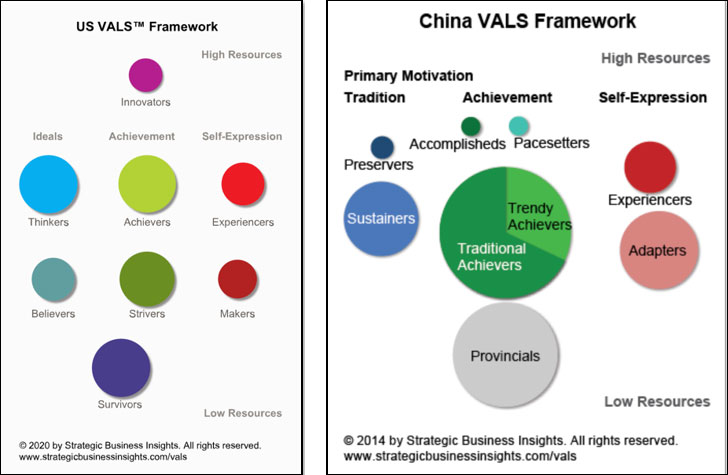
    • VALS (Values, Attitudes and Lifestyles)
      • Developed by SRI International, VALS divides consumers based on their primary motivations and resources.
      • It develops unique VALS systems for each country.
      • For example, the VLAS systems for the US and China differ widely.

    • PRIZM (Potential Rating Index by Zip Market)
      • PRIZM segments consumers into lifestyle types based on demographics, behaviours and geographic location
    • OCEAN utilises personality traits to predict consumer behaviour: openness, conscientiousness, extraversion, agreeableness and neuroticism

    The Myers-Briggs Type Indicator (MBTI), once very popular, is a psychographic framework that has recently been controversial.

    Kantar’s TGI is an audience profiling study that captures various data points—from product use to leisure activities to attitudes and media engagement. Since TGI has been present in India for decades, it offers a rich trove of data that can help develop an effective psychographic segmentation framework for India.

    Academic studies exist in the broad area of psychographic profiling of Indians, some of which can provide useful data sets or insights.

    It will take a decade or more to drive consensus and establish credibility for a Consumer Psychographic Segmentation Framework (CPSF) to become widely accepted and part of every essential marketing and media data set. If we start today, the marketing and advertising community will be in time to function optimally in an affluent and increasingly complex market called India.

    The use of CPSF will begin as early in the marketing process as product or service design and, of course, be central to marketing communication planning. A CPSF would also usefully inform social interventions and political campaigns.

    Developing a widely accepted psychographic segmentation framework is a vital R&D effort that ranks along with the attempt to create India-contextualised AI-driven martech and adtech. Let’s get on with it.

  • Content Innovation: AI and Beyond

    Content Innovation: AI and Beyond

    Shailesh KapoorIt’s hard to have a business discussion these days without a mention of AI very early into the conversation. Since the emergence of ChatGPT, artificial intelligence has been a buzzword that everyone wants to use. And not for the wrong reasons entirely. In the digital age, the role technology can play in businesses across the spectrum, including media and entertainment, is undeniable. And we have not seen it all. Not just as yet, anyway.

    Innovation is at the heart of many businesses, often featuring in core values of many companies, including some of the most traditional, brick-and-mortar ones. Technology is at the center of this innovation, and AI is expected to lead the way towards innovative creation and transformation of businesses.

    But there’s an irony in this idea too. I asked ChatGPT to define innovation in a business context. I got: “Innovation in the context of business refers to the process of creating new ideas, products, services, processes, or business models that add value to customers, improve efficiency, drive growth, or create competitive advantage. It involves transforming creative ideas into tangible outcomes that meet market needs or solve existing problems in new and better ways”.

    If we look at the keywords in this suitably verbose definition, the creative abilities of the human mind seem central to many of them. The deep linkage of innovation with technology can, hence, be a limiting thought. Especially because it can make those in “innovator” roles think only in one way. Yes, that’s the irony, right there.

    Tech-led innovation is great, but it will be heartbreaking if innovation begins to lose the human touch. In technology companies, this is a non-issue, because the innovators are also the technology guys. But if we look at something like entertainment, innovators are essentially writers, producers, directors, actors, marketers, salespersons, etc. The nature of the product relies on giving the audiences something compelling yet fresh. Self-learning technologies could simply be at cross-purposes with this idea.

    Suggestions that Generative AI can be used to write movie scripts is preposterous, for example. Think of the three most memorable movie dialogue lines of all time, across any language, and ask yourself: Can a “human-like” bot create the same human-like magic? We all know the answer.

    It is therefore crucial that entertainment businesses carefully craft the dos and don’ts of how to use technology for innovation. Technology, and AI within it, can be a content creator and distributor’s best friend. But like with all friendships, expectations must be set right. And the entertainment business worldwide runs the risk of erring on the wrong side here.

  • What business are the aggregator apps in?

    What business are the aggregator apps in?

    With apologies to none at all

    By Vikas Mehta

    Vikas MehtaA few weeks back I had written on the decline in the services of aggregator apps and related my personal experiences with a few apps. You can find the article here.

    Some of you readers wrote back and asked me for the reasons of this decline. As one put it, usually new offerings with new technology get ironed out over a period of time. So, why should the aggregator apps be an exception to this? Fair question and it set me thinking.

    Before I continue, I would like to convey my thanks to Hamsini Shivkumar, Brand Consultant and Semiotician par excellence. It was she who nudged me into thinking deeper and we had a fair exchange of ideas. Much of what I write today is the result of her thoughts.

    Let’s look at this decline in quality, first by looking at the Indian consumer.

    Most of the aggregator apps like Ola, Uber, Swiggy, Oyo; when they came on to the scene, they offered a new service, promising higher standards of delivery at cheap rates. I am using the word cheap deliberately. The transport aggregators offered cabs at your doorsteps within minutes and their rates were lesser than a traditional ‘kaali-peeli cab’. They offered not only the convenience of quick service but also avoided the hassle of looking for a cab and the cabbie declining to take you to your destination.

    Food service apps suddenly provided one with the comfort of home delivery from various restaurants at no extra cost.

    Oyo provided cheap hotels with a minimum quality assurance.

    Make My Trip offered everything one needed to travel including air schedules and bookings across airlines, railways and gradually also bus service. Hotels, cab pick-up and drop-offs and even guides for tourist places were gradually added on. And there was hardly any extra charge in the beginning.

    And almost all of them started peddling discount coupons and more offers to make the deal even sweeter.

    That’s why I used the word cheap. New services, new comforts and new conveniences were available cheaply.

    All these were targeted at the Indian middle class. And the Indian middle class still confuses value with cheap. Typically, value could be defined as same for less. Or more for same. Or more for more. Or even less for less.

    Same for less means cheaper, discounts. More for same means you add some more benefits. Buy one get one free or 200 gms extra in a pack of 500 gms at the same price of 500 gms. More for more would be pay only Rs 500 extra for buffet breakfast with a room. Less for less would be a star hotel giving you a room but not allowing you the facilities of a gym or a swimming pool.

    The Indian middle class as a generalisation picks up more for same or same for less. Give them a room at a discounted price and they are happy. Free airport drop and pickup is accepted. But adding buffet breakfast at a marginal cost may not be appealing. No extra money shelling out. Period.

    This is not to say that the middle class is not quality seeker. But they want best quality at low prices. They are not even looking at more for more. That’s why howls of protest arose throughout the country as transport aggregators started charging peak hour or rush hour or traffic surge surcharge. So much so, that public opinion forced some states to ban these surcharges by law! The typical middle class consumer has no problems accepting discounts but when charged extra due to high demand it demurs!

    More for more works for the luxury good or premium service seekers. These may not be the typical middle class. So, a Vistara charges you higher fare as they give wider seats, more leg space and free food and it has its premium users. Or these are people who will not want an anonymous biryani but a biryani from Paradise or Shah Ghouse in Hyderabad. The premium- or luxury-seekers are fine with these.

    And such people are few in numbers compared to the vast middle class who mostly is looking for more for same or same for less. The focus is solely on the price.

    Therefore, when the aggregator apps were launched and everything was same for less or more for same, these were lapped up. Cabs available at your location without any extra fees and maybe even cheaper than metered kali-peeli cabs were a hit. Food delivered in fast time without any delivery charge was a success. Hotel rooms available at much cheaper price with a promise of cleanliness and sanitation were lapped up.

    Now let’s see this picture from the viewpoint of the aggregator. Understanding the propensity of the middle class, they offered value but focussed on price. For the aggregator, it was hot food offered at the comfort of home at no extra cost but for the consumer it was about food at some discount too. It was not about cabs available quickly at your location without the fear of being declined by the cabbie but about great rates. It was not about an alternative available between 3-star and hole-in-the-wall shady hotels but about shady hotels available cheaper. To be honest, for both the cab aggregators and hotel aggregators, the story about cabs without declining and hotels with a standardised hygiene version were played up but these advantages were soon frittered away.

    Their partner service providers had been acquired also on the lure of substantial earnings. Hotels and restaurants were promised big incremental revenues. The delivery riders were promised lucrative, per ride fees. Transport aggregators too were giving the drivers big monies. And as word spread about easy money, more partners accrued.

    Discounts and price-cuts and subsidising of partners lasted for some time. And soon the aggregators were under pressure to improve margins. Move towards profitability. VCs wanted IPOs to cash out.

    The partners became disenchanted when aggregators cut the big incentives, subsidising of vehicles and even helping spruce up the hotel property. Rider fees were slashed. And delivery charges crept in. Travel aggregators included convenience fees. The situation became piquant as the consumer suddenly realised that the free or discounted does not make sense as extra charges were levied. So, s/he demanded more accountability. The brunt of this was faced by the partners such as delivery riders, hotels, cab drivers, airlines etc. In turn, these partners resorted to all sorts of jugaad. This led to service standards declining.

    And the jugaad mindset led to ingenuity of the partners. Cabbies, not wanting to travel short distances, would deliberately arrive late. Forcing the customer to call them. And on enquiring the destination, they would cancel the booking or say that they did not find the customer. Thus, not only causing major unhappiness but also destroying the advantage of ‘no declining’ as in traditional cabs. Restaurants realised that they could, in their own areas, do their own delivery. Hotels started asking regular visitors to book directly and gave them equal if not more discounts.

    The aggregators tried to control the partners with technology. OTPs, rating points, incentives based on ratings were introduced. But service is an interesting concept. It can be aided with technology but it cannot replace the human touch. The aggregators, under cost and margin pressure did not accentuate the human touch. Nor did they expand technology to aid the human touch. In fact, the reverse happened. It used to be difficult to get through customer service numbers. Now the customer service numbers just disappeared. Bots supported by AI came in. Social media sites were flooded with complaints. This spooked the investors who put more pressure on the aggregators. Things just went downhill.

    Another thing about service is that it becomes increasingly difficult to deliver consistent service online. In offline, service expectations differ according to customer segment and their location. Someone with a premium service mindset in Gurugram cannot be treated in the same way as a discount-oriented customer in Saharanpur. But in online, we have a single set of guidelines. We have one operating SOP. And this fails to deliver. No attempt has been made into moving into customisation of service.

    And because most aggregator apps have not defined their target group but want to engage all possible users, they are dealing with different set of users. This results in trying to keep all segments happy without aiming at anyone in particular. To use a mathematical analogy, this results in service systems which cater to the lowest common denominator, LCD. And not HCF, the highest common factor.

    Offline service standards are tweaked depending upon the location and your target customer. That’s why service companies do attain good standards, offline. But online, heavy investments are required to make it reach the customized HCF level. A luxury which the under-pressure aggregators cannot afford.

    And that’s why, all these aggregator apps, while realising that they are in different business must also realise that by being an aggregator, their core is about service. Transportation, food delivery, rooms, travel is the second level of tangible benefit. The most important tangible benefit is service.

    I think Amazon is the only aggregator which has focused on service. It openly declared that it isn’t in the business of ecommerce or entertainment. But it is in the service business. This has helped it achieve higher customer satisfaction and loyalty than other aggregators. And Flipkart which had the first-mover advantage in India, is today owned by Walmart, a discount store brand. Maybe therein lies a tale.


  • Thank heavens for independent media

    Thank heavens for independent media

    Ranjona BanerjiThe Indian media’s response to the Supreme Court’s decision of February 15, to strike down electoral bonds as unconstitutional, has been predictable. Sadly, unconscionably and unacceptably predictable. Let’s add condemnable to that as well.


    Had it been any other government which had come up with such a scheme and then had such a response from the apex court, ah well. We all know what the media would have done then. Most likely behaved like the media in a democracy should.


    The measly, mingy reports which have appeared since follow the template in place since 2014: play down any news which puts the Narendra Modi government in a bad light. I don’t have to repeat this because the template has not changed, but it’s here as a matter of public record.


    Since February 15, some very interesting details of how much money has flowed into the coffers of political parties has appeared in public. Mainly via the independent media. That most of the money had gone to the BJP is no surprise to anyone. But the manner in which several companies were arm-twisted into donating, after raids by various government investigating agencies, was remarkably brazen. It is hardly surprising that the Narendra Modi government fought tooth and nail to keep donation details secret.


    It’s thanks to independent journalists like Poonam Agarwal, who relentless covered electoral bonds since they were introduced and news sites like the Reporters Collective, that the general public has any clue about what exactly has been going on.


    https://m.thewire.in/article/politics/unique-numbers-recorded-by-sbi-investigative-journalist-who-bought-electoral-bond


    https://www.reporters-collective.in/electoral-bonds-tracker


    It is also amusing that the Solicitor General of India, Tushar Mehta, stood before the Supreme Court bench on Monday to complain about the proliferation of social media discussion on the matter. The Narendra Modi government has very effectively muzzled the mainstream media. But it has not managed – despite threats and bullying to private citizens as well as to the companies which own and run sites – to completely stop all social media interactions in India.


    An editorial in The Print, on the attacks on international students in Gujarat, who also happen to be Muslim, points out that such attacks are a “diplomatic embarrassment”. This is the crux of how the BJP and its media friends view making any information public: will it embarrass the Narendra Modi government and India or not? If yes, hide the facts. You may argue that other governments have been no different. That is true. But the difference between then and now is that the media did not dance as one Bollywood troupe to the diktats of the government. Unlike now.


    That the State Bank of India did not follow the Supreme Court’s instructions on full disclosure about electoral bonds and donors is a massive embarrassment. That the media did not tear the SBI to shreds is the other embarrassment.


    But most of all is that the media has not taken the Narendra Modi government to the cleaners. What you have here is clear proof of corruption, of blackmail of sorts, by a ruling party. Just contrast the media behaviour after CAG Vinod Rai’s report on the notional losses to the government over 2G auctions during the second term of the UPA to the revelations after the February 15 SC ruling. In fact, there is no comparison.


    And in that contrast, we see the last vestiges of a media in belly-flop stage.


    I see no signs of improvement.


    Anyone?


    Ranjona Banerji is a senior journalist and commentator. She writes on MxMIndia on Tuesdays and Fridays. Her views here are personal.

  • Why every episode of Shark Tank India is a must-watch…

    Why every episode of Shark Tank India is a must-watch…

    Sanjeev KotnalaShark Tank India is a programme I think every youngster with the thought of getting on the entrepreneur–startup landscape must watch. If not, it is their loss. It is different that the term reality show is not seen in a positive light by many, but a logic- and reason-driven ‘I am out’ works. Not a surprise when one hears a group member silently react to the next weekend’s programme by ‘I am out’.


    The Learning

    There is so much of learning in Shark Tank. It tells one what to watch out for, what the investors could be looking at, what is the right time and type of pitching, how the investors look at the founder’s history and passion to punt at the idea.

    It also explains various terminologies and demonstrates time and again why an entrepreneur must have a deep domain knowledge. It is superbly motivating and encourages the audience to try out and live their life. After Bigg Boss (Colors), Shark Tank India (Sony TV) is now one of my favourite reality shows and I am catching up on the episodes that I may have missed on YouTube.

    It is a good programme to learn from the approach of others, especially when it concerns success and failure. If one really immerses in the programme (which is recommended), it has the potential to help reflective self-meditation.

    It is an entertaining and educational experience. Many times, you get involved and like in a match pray for someone to get the investment. At some other time, you pat yourself in seeing the idea, its scalability or raising a question just like what the sharks do in the episode.

    It is a no cost training for the Indian entrepreneurs to learns about investing and pitching and be prepared in their real life to better negotiate the ground realities. If nothing else, it exposes them to the way how they should be evaluating their own business ideas and innovations. And that is a huge learning.


    The Sharks

    Shark Tank has brought the few famous dreamers and achievers from young India face to face with the other set of people wanting investments. People like Aman Gupta (Boat), Amit jain (Cardekho), Anupum Mittal (Shaadi.com), Ashneer Grover (ex-founder BharatPe), Azhar Iqubal, Deepinder Goyal (Zomato), Ghazal Alagh (Mamaearth), Namita Thapar (Emcure Pharmaceuticals), Peyush Bansal (Lenskart), Radhika Gupta (MD & CEO, Edelweiss Mutual Fund ), Ritesh Agarwal (OYO Rooms), Ronnie Screwvala (UpGrad), Varun Dua (Acko), Vineeta Singh (Sugar Cosmetics) have featured in the episodes since 2021 in the three seasons.


    Deals

    The first two seasons collectively had 87 episodes with some 244 deals worth approximately Rs 95 crore of investment across all the sharks. Season 3 (expected 35 episodes)  is streaming now and is expected to be of a bigger scale with higher value of deals.


    Concept

    The concept of the show is simple and straightforward. It entails the entrepreneurs and the founders making business pitches to a set of five sharks (investors- mostly self-made multi-millionaires) for investing in their business. They quote their ask and in terms of money against a pre-set percentage of equity.  The pitch presentation mostly is based around the people-their role-product or service- the turnover and financials. Basis that short interaction, the Sharks go on to probe further before deciding if they were willing to invest and at what valuation and how much. The discussion goes on to: possible duplication, other competition, status, EBITA, Profitability and future plans.  The negotiation is usually around the valuation and quantum of investment as well as how many sharks are individuality and or collectively participate in the investment- if any.


    Some Thoughts

    There have been cases when people have been on the show more for visibility and marketing then really needing an investment, but that is the smartness of the entrepreneur and the failure of the TV channel’s production team in scrutinising the candidates.

    There have been also cases when the promised investment has not been finally made because in the due diligence process, the sharks realised that the product or the service or the sales and the financial condition or parameters were not what they were shown- shared and presented on the show. It all happens, and any bad noise must be taken with a pinch of salt.


    My Learnings

    Through the shows I have seen, witnessed, and realised how wonderfully innovative people are.  It gives one more confidence on the path the country is taking, personally I have been introduced to few products that I have ended consuming like the Honey Twigs or while searching for a product presented on the show (Bacca Bucci), have been exposed to others like Mocobara and ended up purchasing them.

    Every episode has a learning embedded in it. It depends upon you how much you absorb from the show. Maybe reading the book Sponge and Catalyst could help.  I have my own understanding and thoughts from the show.

    • Investors are investing on to the founder and their dreams.
    • Investors at the end is looking for an exit bat a later date and a multiplier to their investment.
    • The founder – leader must deep dive on the category and know it as well as its supplementary and complimentary products and services.
    • Burnout is a term that is losing its importance and profitability and scalability is more important.
    • There is a stage before which one should not be looking at investors.
    • The investor should be synergic t the category and bring in more than just money.
    • The entrepreneur must negotiate the best deal.
    • The sharks are sharks because they are more concerned about their investment and hence the entrepreneur must be very clear about their ground realities.
    • The entrepreneur must have a valuation and investment below which they know they will walk out in-spite of which shark is making them the offer.
    • It may sound good- but must be clear that the multi shark investment may not always be a better deal.
    • At times one must stop being emotional and evaluate the future. Sometime, the best advice may not be further investment but closing the venture.


    Net-net

    You have an idea or not but want to be an entrepreneur at some stage of your life- or even if you don’t ever want to be starting your business- watch the show and enjoy free entertainment and learning.

  • Excess is success

    Excess is success

    Avik Chattopadhyay

    Avik ChattopadhyayWhile a significant part of the nation was busy with discussing dance moves and dresses of the rich and famous gathered in a little town on the west coast of India, a bunch of medical students danced around in joy on the east coast of the US. While one of the richest people on this planet spent a whopping 100+ million dollars on a family function, a retired professor at the Albert Einstein College of Medicine in the Bronx donated a mere billion dollars to ensure free tuition for all medical students, almost for life.
     

    It is cultural. Very very cultural. The two nations make up the world’s largest democracies, and have their own share of unemployment and poor, yet the two are poles apart. In a discussion with a social scientist who requested anonymity, I was reminded that we are basically a monarchy in the garb of a democracy. We celebrate 75 years of becoming a republic yet are deeply servile. We boast of some of the world’s biggest people movements, yet revel in creating demigods of the rich and the powerful. “We will always be a land of confluences, cross-connections and contradictions”, the social scientist commented, trying to explain to me how Indian brands are thereby quite different in their DNA from ones from the US or France or Germany or Japan.


    “Indian brands love to show-off. We love to live in the now, more than for the future. For us, excess is success!”


    What is wrong with showing off? Or for that matter, living in the now? Nothing wrong. It is just a matter of perspective. The same rich person who gave a pre-wedding bash will also go ahead and build a hospital or school, but the bash is very important as that sets a context. It is like when the ‘benevolent despot’ of an emperor used to throw silver coins in the air for the commoners to scuffle for at his child’s wedding. While the poor would get their clinics, night shelters and rations, they had to be reminded of the grandeur and graciousness of the mighty powers from time to time. The living in the present moment is a clever diversion from the present state of life into a world of make belief, with the subliminal message that this is a life that one could aspire for.


    When the personality of the brand is derived from the personality of the ‘promoter’, things get very heady. The socio-economic and cultural background of the promoter clearly determines the way the brand behaves. If one’s legacy has been mired in a fair bit of controversy, the need for periodic demonstrations of power and pomp are crucial to establishing authority. If the background has been less than average, then the attempt is always to go over the top. “It’s a natural response of the reptilian brain,” explained the social scientist, born out of some kind of inferiority complex. The need to set the narrative from time to time is important or such personalities suffer from inadequacy.


    This is why most Indian brands come across as more pompous than proud, more combative than competitive, more conflicting than collaborative. We see that in most of our communication. We experience it most in our service experience. We see that in the way most business leaders present themselves. We have an obsession with using terms like “#1” and “the best ever”, be it a toilet cleaner or an automobile. We love using pompous words like “unbeatable” and “unmatched” because, somewhere, the promoter or brand custodian is insecure and needs such posturing to reaffirm potency and power.


    “It is like a stand-up comedian starting a show with the words ‘Mind you, I am the world’s funniest guy’”, said the social scientist, to put things in perspective. An American brand is running an enterprise. An Indian brand typically wishes to run an empire. It could be a response to the fact that we were a colony for close to 200 years that we are yet to be out of the mindset while our colonisers have adjusted with a post-colonial world.


    We react positively to symbols of regality, power and authority. Which is why both our politicians and judges sit on quasi-thrones whether at a function or in judgment. Simple chairs will not work for either. It is the same with corporate India. Most board rooms I have peeked into have a larger chair and a fixed place for the leader. Everyone knows who the leader is yet the symbols are needed as constant reminders. The chair plays the role of omni presence.


    It is the very same mental wiring that makes millions of us take voyeuristic pleasure in an exhibition of excess that thrives on our culture code of the need to overtly establish leadership. And nothing really can change that. We thrive on contradictions. While we believe in rebirth and the after-life, we prefer to live as if there is no tomorrow. While we revere saints and seers who excuse themselves from worldly pleasures, we choose overt displays of wealth and grandeur. While we preach the power of ‘karma’, we portray the potency of the ‘fruit’.


    Avik Chattopadhyay is a Gurugram-based brand and business strategist and commentator. He is currently also working along with XLRI to set up the Indian School for Design of Automobiles. He writes on MxMIndia every other Thursday. His views here are personal. 

  • Are ‘Trust in News’ & ‘Happiness’ interconnected?

    Are ‘Trust in News’ & ‘Happiness’ interconnected?

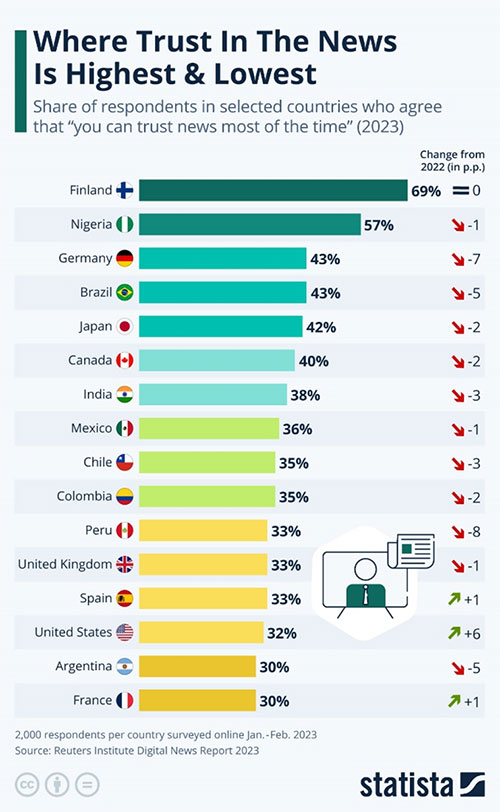
    Avik ChattopadhyayTwo very interesting global reports have been published over the last one week. The first is the Reuters Institute Digital News Report 2023 and the second is the 2023 edition of the World Happiness Report. As a marketer and ‘brand-o-phile’, I see a subliminal connect between the two.


    The Reuters Institute Digital News Report is an outcome of more than 90,000 responses across 46 countries on how much one trusts news, through conventional as well as digital media. While the overall global trust score has dropped a few percentage points, the report states that “it is not surprising that news consumers are increasingly feeling overwhelmed and confused, and many are turning away temporarily or permanently. Selective news avoidance and news fatigue have been exacerbated by the challenging times we live in.”


    India is somewhere middling with 38% of news consumers trusting what they read and see. It has dropped 3 % points since the 2022 report. Now with the election season looming upon us, one can expect a sudden drop in the score with every political party resorting to downright unethical and fake communication without batting an eyelid on the impact on an already tense social fabric.

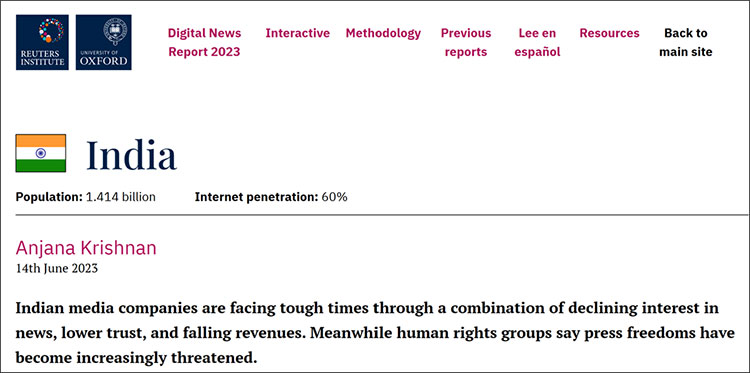
    The special note on India in the report is quite telling.


    Credibility is a huge factor. With the latest Press Freedom Index ranking of 161 out of 180, however much one may want to downplay the Reporters Without Borders study as being driven by agenda and deliberately disparaging towards the world’s biggest democracy, one cannot cross one’s heart and denounce it.


    The note states that “our Digital News Report survey finds steep falls in both the consumption and sharing of news. There was a sharp decrease in access to online news (12 percentage points lower than last year), particularly through social media (-11pp), the main sources of news for a predominantly younger audience. Television, popular among a large section of the population, also saw a 10pp decline as a news source with our younger and more urban-based sample.”


    While the government has brought checks and measures for media platforms, especially digital, on the authenticity of the news and its possible impact on factors like social harmony and national security, there are none for the social media teams of all political parties who deliberately churn out one-sided or fake posts, with the clear objective of misleading the populace and even instigating it into unrest. When the digital platforms dig up and expose these untruths, there is no legal recourse to punishing these people. All the Johnnies are consuming too much sugar without remorse.


    As the judiciary at the highest level seems to be the only panacea for most ills in the country, some sane citizens should file a PIL against such lie-spinners and let the court pull them to task.


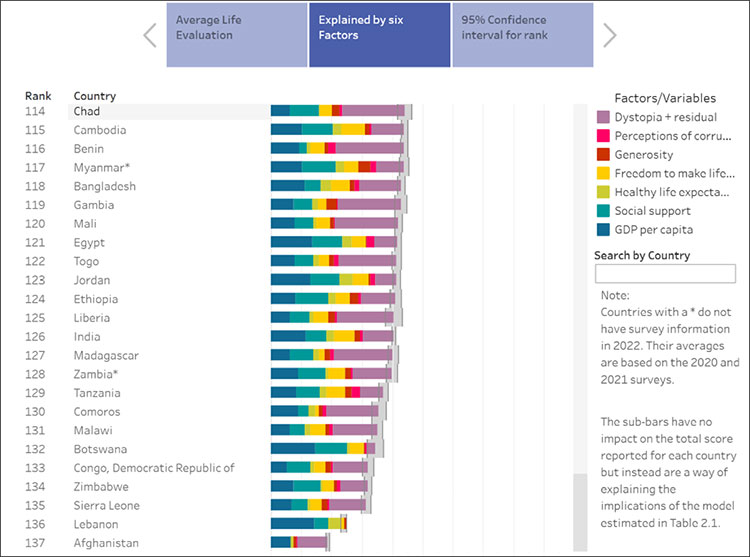
    The second report is the much debated and hated World Happiness Index by Gallup wherein certain sections of our thought leaders and citizenry cannot understand how can people in Pakistan, Bangladesh and Sri Lanka be happier than us, especially when we are going through our “Amritkaal” towards becoming the undisputed “Vishwaguru”. They need to understand that once again, this global report is not being undertaken with the sole purpose of showing India in bad light, but to help us introspect.


    If we study our score across the seven parameters in the second chart below, we will observe that we score badly on factors like life expectancy, corruption and generosity. These factors may not be as easily measurable like per capita income and are largely perceptual, but strong enough to take our score down. Also, the dystopia score is significant enough implying an undercurrent of social stress, possibly amongst certain communities.


    How are these two reports interdependent? Happiness is an active ingredient for trust. The lack of the first leads to increased scepticism and therefore the tendency to discount what you consume as news. You may put up a brave face in one report but the mask comes off in the other one.


    You posture to amplify the news that you opt to believe in as it shows you in better light. That is a fundamental defence mechanism, borne out of deep down insecurity and an inferiority complex. It is not that you openly consume and debate all sorts of news and digital content to logically establish that you are in the right. Similarly, you pose as happy, taking selfies next to objects, visiting places or doing things that take you away from your uncomfortable harsh reality. When it comes to responding to a survey, your disappointments with aspects of life around you get exposed. It is not the proverbial bed of roses.


    No external intervention can work in this case. Only a slow and gradual improvement in collective consciousness can shake the citizenry out of this sucrose-induced slumber.


    As a common citizen, you too are consuming enough sugar without even admitting to yourself. That is far worse than the media magnate spinning fake stories to drive you into a frenzy.


    The festival of democracy is less than a month away. Look before you leap.

    Jai Hind!


    Avik Chattopadhyay is a Gurugram-based brand and business strategist and commentator. He is currently also working along with XLRI to set up the Indian School for Design of Automobiles. He writes on MxMIndia every other Thursday. His views here are personal.