Category: Big Story

  • Beyond romance: Valentine’s Day campaigns across the world

    Beyond romance: Valentine’s Day campaigns across the world

    Kunal SinhaThe path to love is paved with gold. And strewn with flowers.

    In the United States, consumers plan to spend $25.8 billion on Valentine’s Day this year – an average of $185.81 per person. A 2023 Assocham report estimates the Indian Valentine’s Day market to be worth ₹25,000 crore, while the flower market around Valentine’s Day is estimated at about ₹500 crore.
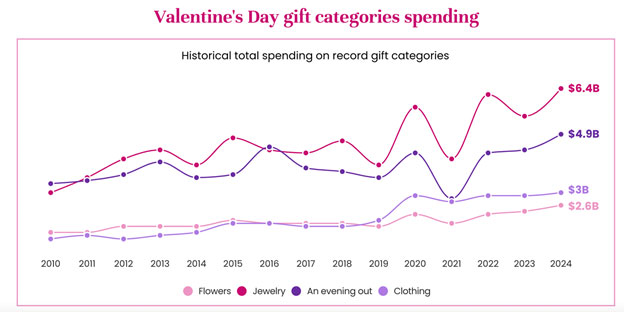
    Source: National Retail Federation, 2024

    While couples spending on jewellery, flowers, clothes and romantic dinners drive the lion’s share of that consumption, non-romantic celebrations are a growing trend across the world.

    A remarkable evolution of the target audience is apparent in the diverse celebrations associated with Valentine’s Day. Celebrations are now about various kinds of relationships, including friendships, family bonds, self-love, and even expressions of love for pets.
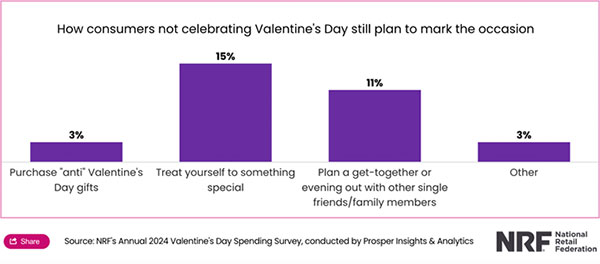
    Research amongst ‘non-couples’ reveals that people are spending on themselves – which is only to be expected in this age of self-love, getting together with other unattached friends or family members, or even buying ‘anti-Valentine’ gifts.

    These trends are particularly popular among younger consumers.

    Over half (53%) of 18- to 34-year-olds and 42% of 25- to 34-year-olds not celebrating Valentine’s Day still find a way to mark the occasion.

    Crafting campaigns that embrace this diversity resonates with a broader audience, capturing the essence of love in its myriad forms.

    For young women who mark the occasion by treating themselves or throwing a party with single friends, there’s “Galentine’s Day” gift guides from brands like Macy’s, Kay Jewellers and Walmart

    1-800-Flowers emphasises the importance of celebrating friendship, recognising that Valentine’s Day is not limited to romantic relationships.

    Their ad features a heart-warming scene between two friends, as they reflect on the bond they share and how their friendship has evolved over time. The friends engage in a touching conversation, asking each other meaningful questions about their friendship and the impact it has had on their lives.


    DoorDash Self-Love

    Knowing that most other delivery services would cater to traditional couples, delivery app DoorDash put forth a narrative that gave single women permission to enjoy Valentine’s Day to the same extent that couples would. This meant capitalising on the existing narratives around pleasure, passion, and romance that are always front and centre on Valentine’s Day – and tailoring them to single women.

    Since self-love isn’t new, it was important to have a fresh take. Taking self-love literally, the campaign tapped into the 72% of US adults that believe self-pleasuring is a form of “therapy”, and start a conversation that is weirdly taboo: female self-pleasure. Rooting the conversation in destigmatising female self-pleasure, it used the most iconic Valentine’s gift — a bouquet of red roses. The surprise element: The Self Love Bouquet, a bouquet exclusively on DoorDash made of 11 real roses and one Rose, the bestselling female sex-toy of the last five years. In creating the bouquet, DoorDash was able to deliver $6 million worth of flowers – twice as much as in the previous year to a new demographic – single people who don’t purchase flowers on this holiday, selling the stocks out in four days.

    Watch here: https://www.youtube.com/watch?v=f90ORAVPGSc


    My Muse

    In India, sexual wellness brand, MyMuse challenged love’s most well-known ambassador, Cupid, with its campaign, ‘Modern Love Needs Modern Solutions.’

    With Cupid representing age-old societal norms that represent only one right way to love, MyMuse shows how love and people’s expression of it have changed. So, whether it’s choosing your own path, picking your own traditions (old or new), or choosing to settle down or stay single, MyMuse understands that there is no one-size-fits-all in modern love.

    Proposing that “Modern Love Needs Modern Solutions – Cupid doesn’t get it, MyMuse does, the brand is running a campaign showcasing a well-meaning Cupid, who attempts to bring couples together in the name of love, using age-old tricks. As his attempts are rejected by people who prefer to find love and express it in their own way with the help of MyMuse products, Cupid has a complete meltdown and starts questioning his life’s purpose.

    Watch the series here:

    In addition to the films, MyMuse created a Cupid profile and launched a #cancelcupid campaign on LinkedIn, where it leveraged its employees as brand ambassadors.

    https://www.linkedin.com/posts/mymuse-india_cancelcupid-activity-7158445512885452801-J-cG/

    New forms of celebrating relationships notwithstanding, technology is allowing couples in love to experience Valentine’s Day in fresh ways.


    Gaming romance

    Zynga, the game publishing label owned by Take-Two Interactive, is commemorating the season of love with a variety of delightful Valentine’s Day 2024 festivities throughout its array of games.

    On Farmville, FarmVille 3 – Sweet Nothings, Ginny is brimming with enthusiasm for Valentine’s Day, eager to ensure that everyone on the farm feels cherished and included. She has organized a Valentine’s Phone Booth, where individuals can dial their loved ones and traditionally convey their affection. Participants can even win romantic rewards, contributing to making Valentine’s Day truly unforgettable under Ginny’s thoughtful planning.
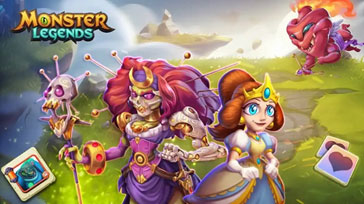


    Monster Legends is commemorating Valentine’s Day with an uproarious new Era Saga featuring Lovestruck, a playful creature known for stirring up mischief during this festive period. However, Lovestruck isn’t the sole attraction in this season’s array; they’re also unveiling Shakespearante, a romantically reimagined rendition of one of their  beloved characters.
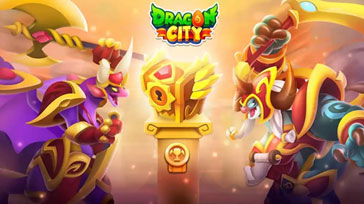


    Dragon City is staging a series of Valentine’s Day-themed events. Players are invited to gather around the campfire to listen to the twisted tale of the new Storyteller Dragon in Part I of the ‘Enemies to Lovers’ Valentine’s event. Participants can aid the new Hanshock and Gretackle dragons in piecing together this ancient narrative by unlocking storybooks filled with rewards and restoring honour to their families in Part II, ‘Sweet Revenge.’


    Cadbury Dairy Milk Silk – AI Stories

    Cadbury Dairy Milk Silk, the chocolate brand from Mondelez India, plays cupid once again to highlight love stories around us. This year, the brand brings an experience that allows couples to transform everyday moments of love into cinematic experiences, powered by generative AI and filmmaker Zoya Akhtar.

    Consumers can scan the QR code on Cadbury Dairy Milk Silk packs, leading them to a site where they will need to answer some questions that will help in curating their love stories with personalised avatars, which will be featured in the animated movie. The AI converts simple text input from the consumer into lovable character animations featuring the consumer.

    These AI-curated stories will be amplified through strategic media partnerships and personalised content collaborations with leading OTT and music platforms, as well as brand experience zones. Riding on the ultimate goal of making every couple’s Bollywood dream come true, selected videos from the campaign will be featured on the streaming platform Disney+Hotstar, allowing consumers to share their love stories with a wider audience.

    Watch the launch video here: https://www.youtube.com/watch?v=8FMhNiKYdOw


    Bumble

    Bumble, the dating app, is celebrating Lunar New Year and Valentine’s Day in Singapore by launching a new campaign called “Toss Love into the New Year”. The campaign is inspired by the traditional and iconic “Prosperity Toss” or Lo Hei and aims to help Singaporean singles cast out their dating fatigue and manifest a more prosperous love life.

    As part of the campaign, Bumble is giving away a curated exclusive ‘Lo Hei’ pack filled with eight goodies, such as fish ball crackers, Hershey’s kisses chocolates, and salted egg fish skin from Golden Duck. Each goodie represents Bumble’s eight mantras to manifest a prosperous love life, such as “Everything starts with a belief”, “I take control, love will unroll”, “Healing on the inside, beaming on the outside” and “I’m always real, authenticity is the deal”.

    The first 200 users of the app can get the pack on a first-come-first-serve basis. Bumble’s partners in the campaign are Singaporean influencer and content creator Saffron Sharpe and Feng Shui expert and TikTok creator Cliff Tan. Sharpe is featured in a video explaining the meaning of the eight mantras and setting up Bumble’s ‘Lo Hei’ pack. She also provides tips on rearranging one’s personal space to invite love back into their lives.

    Watch here: https://www.youtube.com/watch?v=OniSUjjTiV8

    Something to be inspired by when planning your next Valentine’s Day activation?

    Kunal Sinha is a senior strategy and foresights executive based in Jakarta, Indonesia. He is the author of several books including The Future of India’s Rural Markets and Raw – Pervasive Creativity in Asia. He writes for MxMIndia every other Monday. His views here are personal.

    [1] NRF and Prosper Insights & Analytics, 2024

    [1] https://startuptalky.com/valentines-day-india-economy/

  • How memes transformed from pics of cute cats to health disinformation super-spreaders

    A monster being fed baskets of infants and excreting them with horns; symbolising vaccination and its effects. Etching by C. Williams, 1802. Wellcome Collection, CC BY-NC


    By Stephanie Alice Baker and Michael James Walsh

    If you think memes are simply online images of cute cats and celebrities with funny captions, then you might be surprised to learn that they can have a more sinister function.

    Our research shows that memes form part of a highly sophisticated strategy to spread and monetise health disinformation.

    Memes may appear trivial, but they should be taken seriously. Dismissing them as harmless jokes is to grossly underestimate their influence – and bolsters their power to spread potentially harmful health messages.


    Anti-vaccine memes have a long history

    Memes aren’t a recent invention. They have featured prominently in anti-vaccination messaging for centuries.

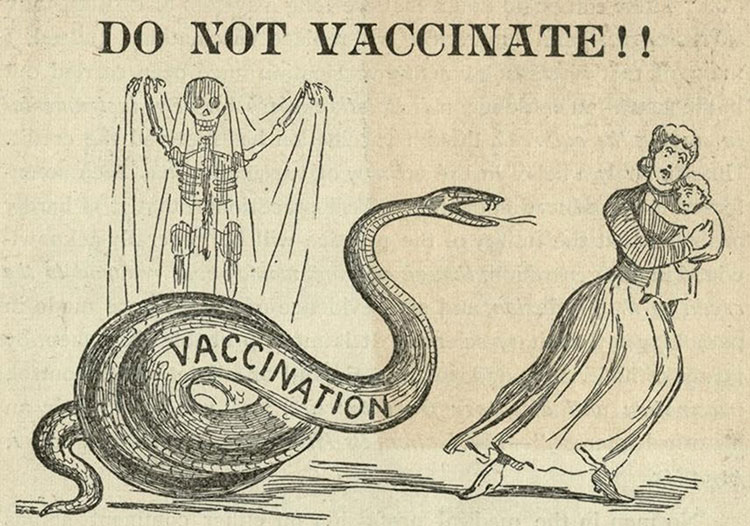
    When widespread smallpox immunisation began in the early 19th century, political cartoons published in print media used memes (see image below) to evoke fear about the safety of the vaccine.

    Cartoon from an anti-vaccination publication, titled ‘Do not vaccinate!’, 1892.
    The Historical Medical Library of The College of Physicians of Philadelphia

    The most infamous anti-vaccination meme, however, emerged from a now discredited 1998 study that falsely linked the measles, mumps and rubella (MMR) vaccine with autism.

    The meme “vaccines cause autism”, which appeared on billboards and was circulated widely in the media, provoked doubts about the safety of the vaccine. The study, since described as an “elaborate fraud”, was published the same year as the launch of Google’s search engine allowing “vaccines cause autism” to became a global meme.

    Today, memes remain an important part of the anti-vaccine movement. The internet enables memes to be created anonymously, repurposed and shared at scale – making them a highly effective medium for spreading health disinformation.

    They are often used as part of a meme war, defined as “the intentional propagation of political memes on social media for the purpose of political persuasion or community building, or to strategically spread narratives and other messaging crucial to a media manipulation campaign.” According to disinformation research platform The Media Manipulation Casebook.

    Memes play an integral role in disinformation campaigns by facilitating fear, uncertainty and doubt.


    Influencers and money

    Our study analysed how popular anti-vaccine influencers used memes to galvanise the anti-vaccine movement during the COVID pandemic.

    We discovered three recurring themes for encouraging vaccine refusal.

    First, memes were used to vilify the government and social institutions, portraying them as corrupt and politically compromised. Anti-government sentiments were used to support several claims. These included claims that the government is corrupt and tyrannical; that vaccines are unsafe and ineffective and that the government is using vaccines as a form of state surveillance, for control and profit.

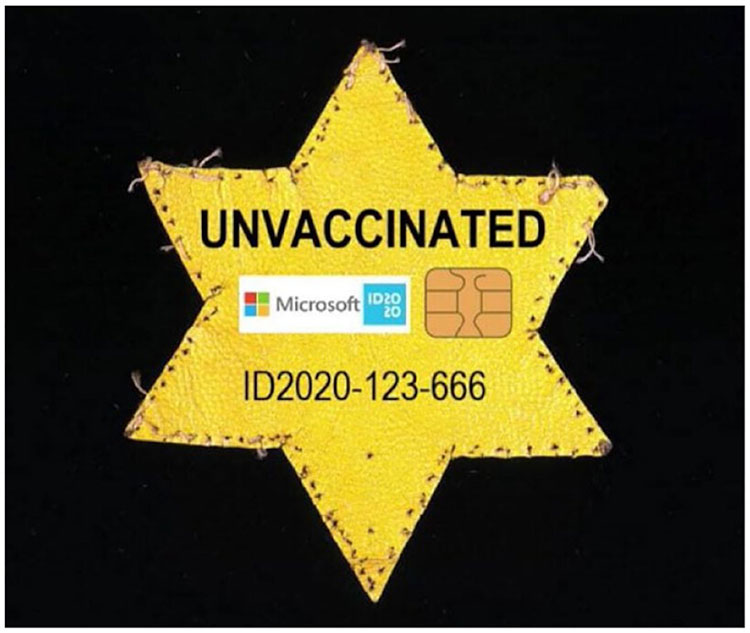
    Second, memes depicted unvaccinated people as unfairly stigmatised. Influencers suggested the unvaccinated were being persecuted, using evocative imagery to imply a false equivalence between those who remain unvaccinated by choice and the persecution of Jews during the Holocaust. Such memes portrayed unvaccinated people as victims subject to Nazi-like sanctions and social exclusion.

    A meme representing the Jewish Star to draw parallels between the victimization of the Jews during the Holocaust and the unvaccinated today.

    Third, vaccinated people were depicted as morally and physically inferior to the unvaccinated. Vaccination was associated with infertility, low sex drive and a lack of critical thinking. Those opposed to vaccines, however, were portrayed positively as virile, attractive and intellectually superior.

    To establish group membership and promote a sense of belonging, influencers referred to those who are anti vaccines as their “soul family”. But our research suggests there may be a more cynical motivation behind this apparently warm sentiment.


    Going viral – and avoiding challenge

    Influencers were strategic in their use of memes for political persuasion and commercial gain.

    Several influencers provided their followers with “meme drops”: packages of memes with dissemination instructions. These memes were tested and produced in meme factories, then distributed monthly to a mass audience via personal newsletters and websites, encouraging followers to spread anti-vaccination content. By adapting memes to current affairs, influencers increased their relevance and likelihood of going viral.

    Memes weren’t just a method of self-promotion for anti-vaccination influencers, however. They were also a way to profit financially from pandemic anxieties.

    Anti-vaccine sentiment became a powerful gateway to promote potentially harmful health products.
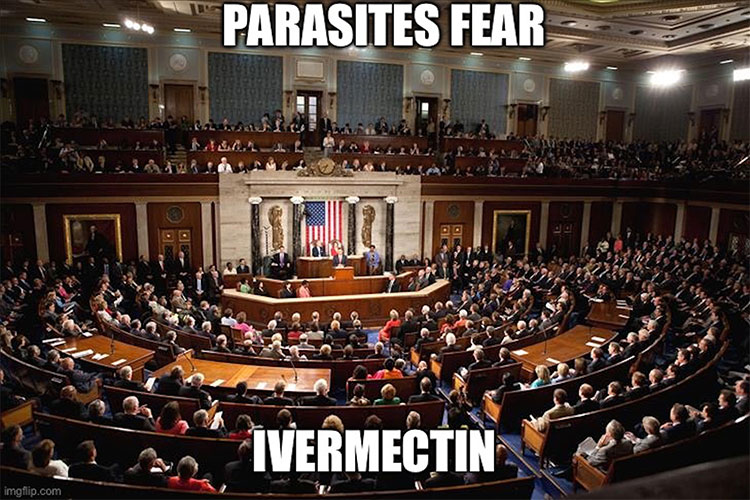
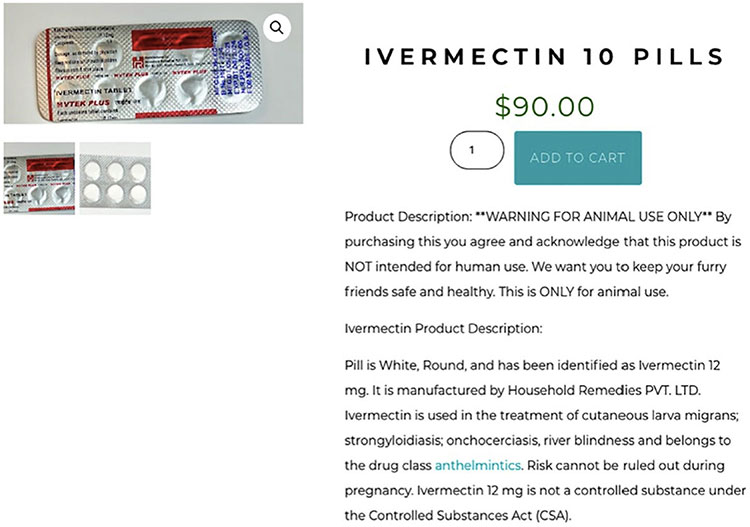
    We found that memes were used to market unauthorised medical products by directing consumers to online stores. For example, we found that clicking on satirical COVID themed memes directed consumers to purchase hydroxychloroquine (a treatment for autoimmune disorders) and veterinary Ivermectin (used to treat parasites in animals). Both medicines are unapproved for the treatment of COVID.

    A meme depicting the U.S. House of Representatives, which refers to elected officials as parasites, and links to the anti-parasitic drug, Ivermectin, which was promoted by some anti-vaccine influencers as an alternative (and unapproved) treatment for COVID-19.

    The Ivermectin pills sold by the influencer for $90USD were intended for animal use only.

    Memes are powerful propagators of disinformation because they allow influencers to claim plausible deniability. Under the protective guise of humour and satire, memes can evade fact checkers and content moderators while promoting anti-vaccine myths and unauthorised treatments.

    Influencers promoting vaccine hesitancy use memes to build their online following, sow distrust of health authorities and profit from the promotion of unapproved medicines. This enables them to evade responsibility for any negative consequences of their messaging.

    Memes may not look threatening – but that’s why they are such effective super spreaders of health disinformation.The Conversation


    Stephanie Alice Baker is Senior Lecturer in Sociology, City, University of London and Michael James Walsh is Associate Professor in Social Sciences, University of Canberra. This article is republished from The Conversation under a Creative Commons license. Read the original article.

  • 10.2% AdEx growth in 2024

    10.2% AdEx growth in 2024

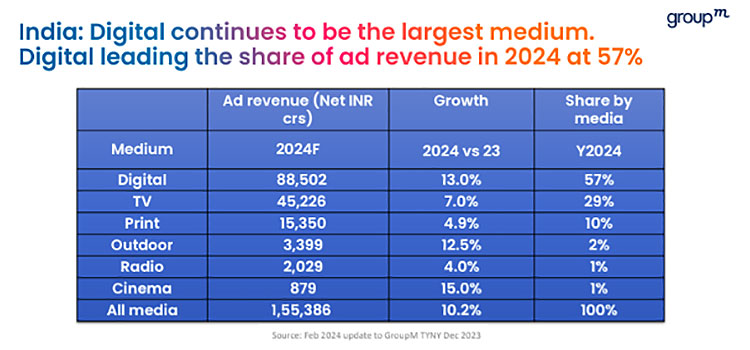
    GroupM India released its annual This Year Next Year (TYNY) report in Mumbai on Tuesdays. The overall ad revenue is expected to reach Rs 155,386 crore in 2024, with an incremental Rs 14,423 crores compared to 2023. This is a growth of 10.2 year-on-year.

    Digital at 13% growth is driving overall ad revenue growth in 2024, as per the report. It  will take 57% share of AdEx pie in the year. All other media combined to grow at 6.8% in the year.  Of the 14,423cr of incremental ad revenue in 2024, 70% to go to digital.

    Within digital, retail media driving growth; CAGR of 41% in 2019-24F. Digital extensions of TV estimated at INR 5,750cr in 2024. Auto, realty, retail, SME estimated to drive growth in 2024

    Prasanth Kumar
    Prasanth Kumar

    Said Prasanth Kumar, CEO, GroupM South Asia: “Despite facing macroeconomic challenges, we remain optimistic about the industry. At 10.2%, India will be the fastest growing top market. 2024 will also see an upside from the spends leading to the General Elections. Digital particularly retail media and digital extensions of TV are expected to drive the growth. SME continues to fuel the growth. Linear TV is at a point of inflection and needs to be enabled with rapid deployment of technology to stay relevant.”

    Ashwin Padmanabhan
    Ashwin Padmanabhan

    Added Ashwin Padmanabhan, President – Investments, Trading, and Partnerships, GroupM – India: “The advertising landscape is evolving with the fragmentation of search, rapid rise of influencer marketing and retail media. Reflecting this, at INR 88,502 crores of the overall Rs 155,386 crore, digital will contribute to 57% of all ad revenue. Within digital ad revenue, search contributes 22%, retail media 18% and the rest 60%. Sectors like Auto, Realty and Offline Retail are expected to power the overall advertising growth.”

    Parveen Sheik
    Parveen Sheik

    Said Parveen Sheik, Head of Business Intelligence, GroupM India:  “Global advertising presents a steady picture: a projected 5.3% global growth in ad revenue for 2024, reaching $936 billion, with digital leading the charge at a commanding 79% share of all ad revenue. India continues to be ranked 8th globally and its ad revenue growth among its peers is a testament to its potential and resilience. Adaptability is key to navigating an evolving advertising landscape amidst inflation and geopolitical tensions.”

    Parthasarathy Mandayam
    Parthasarathy Mandayam

    Added Parthasarathy Mandayam (Maps), Chief Strategy Officer – GroupM South Asia, “Zero Party Data will come to the fore, providing insights on attitudes, behaviour, and product consumption. The availability of granular data will lead to micromarketing strategies, be it in market prioritisation, ultra-niche consumer segments and micro influencers. Advances in AI will also transform measurement, messaging, and media optimisation.”

    Priti Murthy
    Priti Murthy

    Said Priti Murthy, President -GroupM Nexus, “In 2024, brands will shift their focus to consumer experience through performance marketing, integrating brand activities and emotions. Search marketing will become more diverse due to growing complexity and skillsets. Attention planning will impact growth narratives and ROI. Technology will aid hyperlocal marketing, but modern retail still has room for digital growth.”

    The GroupM TYNY report also unveiled several evolving trends for 2024.

    Key trends include:

    • Increasing influence of gen-alpha will drive distinctive marketing strategies
    • Attention Planning – customising insights for actionability
    • 21% of television homes to be addressable in 2024
    • Sports to focus on immersive experience journeys
    • Brand marketing becomes more accountable on performance, breaking silos
    • Step-up on search
    • Ecommerce drives deeper into organisations
    • India’s general and modern trade getting digitised leading to rise of omnichannel commerce
    • Rapid developments in AI will transform media, messaging, and measurement
    • AI and technology dominate the content landscape and creator economy
    • Importance of niche consumer segments will power the growth of micromarketing
    • With consent becoming critical, zero party data will empower various areas of marketing
  • The Morphing of Social Media & the Putative Rise of Conversation Marketing

    The Morphing of Social Media & the Putative Rise of Conversation Marketing

    Ashoke AgarrwalAt the dawn of the internet era and, a bit later, of the social media era, many sociologists believed they would lead to a more informed and enlightened world. The events at Tahrir Square, the subsequent Arab Spring, and later the Maidan revolt in Kyiv seemed, for a period, to support this contention. Marketing gurus posited the dawning of the age of interactive and one-to-one marketing, much like the bazaar of yore but on a global, post-modern scale.

    But then the medium took over the message.

    Marshall McLuhan, in his 1964 book, ‘Understanding Media: The Extensions of Man’, coined the phrase, “The medium is the message”, which went on to become a pop phrase that was widely quoted, right or wrongly, in a wide variety of contexts.

    Marshall’s theory posits that the form of the medium embeds itself in the message, creating a symbiotic relationship by which the medium influences how the message is perceived. A corollary of Marshall’s theory was that a dominant medium would influence societal norms, politics and personal identities.

    By 1964, TV was the dominant medium in the US and most of the developed world. In its days, TV as a medium was supposed to build a sense of collective experience and this community. Instead, it promoted a culture of consumerism and passive consumption. Advertising, of course, gorged on this medium that was so much in synergy with its objectives.

    Sidney Lumet’s 1976 movie ‘Network’ is a trenchant yet entertaining critique of the Age of TV and its social impact.

    When the age of social media dawned with Facebook and Twitter, the initial hope was that the medium would redefine interaction and create a participatory culture. Instead, it became another gatekeeper medium controlled by shadowy algorithms that created echo chambers promoting tribalism across many dimensions while delivering audiences to advertisers. The fact that it could provide a more narrowly targeted audience to advertisers than could TV resulted not in a more informed consumer but in an increased ability of brands to insinuate into the social and consumption profile of the consumer. Also, more brands could get into the act as social media lowered the threshold level at which advertising budgets were effective.

    Going by the ultimate societal effect of the TV and social media eras, another corollary to McLuhan’s theory can be posited: that the societal impact of a dominant medium settles into the lowest common denominator in human nature!

    With the rise of TikTok, social media is morphing, creating and strengthening a new medium.

    Initially, social media sites like Facebook showed chronological updates from users’ friends and contacts. As the volume of posts grew, the networks employed algorithms to prioritise posts that had proved popular among the user’s friends.

    TikTok changed that. As a recent article in The Economist notes, “TikTok decided that, rather than guessing what people liked based on their “social graph” – that is, what their family and friends liked – it would use their “interest graph”, which it inferred from the videos they and people like them lingered on. And rather than show content created by people they followed, it would serve up anything it thought they might like.”

    TikTok’s growing popularity forced every other big platform to follow suit – Reels on Facebook and Instagram, Watch on Pinterest, Spotlight on Snapchat, and Shorts on YouTube.

    The result is that social media is morphing away from an interactive medium into a video-first, highly curated engagement platform. In that sense, social media is on its way to becoming a TV-like medium. Thus, marketers and advertisers are beginning to adopt a grammar akin to their TV campaigns for their social media campaigns.

    While social media platforms become places for passive consumption, users move their conversations and arguments off the open networks and into closed private groups like WhatsApp and Telegram, with implications for the business of political campaigns and the news media. Political parties like the BJP have made WhatsApp groups a key pillar of their campaign strategy. As social media platforms have moved away from highlighting news stories in their feeds, news media are increasingly trying to create channels on instant messaging platforms like WhatsApp and Telegram.

    Currently, in India, the tendency is to use it as a mass promotional channel, sending messages to an undifferentiated mass of “mobile” numbers.

    Marketers need to recognise that the platform offers two unique opportunities:
    1) it allows for a convenient one-on-one interactive platform and
    2) it allows a brand to create, communicate and enthuse a “fan group”.

    WhatsApp marketing can become the communication edge of a whole-of-marketing Big Data and data analytics-driven approach. I call this Conversation Marketing. Data collected from retail outlets, e-commerce platforms, loyalty cards, and first-party data can enrich conversations with consumers and groups. Conversation Marketing allows marketers to open a genuinely interactive, one-to-one channel with consumers. Whether this turns out to be a chimaera as from the early days of social media depends on how both the owners of the messaging platforms as they move to monetise them as well as the campaign strategies of brands.

  • Television in 2024: A Story of Two Half-Years

    Television in 2024: A Story of Two Half-Years

    Shailesh KapoorIt’s that time of the year, when the General Elections are round the corner. While the dates are not out yet, we may be less than 75 days away from the first round of polling. Even if the outcome seems somewhat like a foregone conclusion, the next three-four months will be full of political and media frenzy.

    One of the direct impacts will be felt on the IPL. The dates have not been announced yet, pending the announcement of election dates. In the past, IPL has moved to outside India during the election years. But it is unlikely to be the case this year, and that could complicate the international cricketing calendar more than just a wee bit.

    It’s a golden period for news channels, who are having a windfall year, which started with the mega Ram Mandir event, before the elections programming takes over. June will feature theT20 World Cup in US and West Indies, a summer bonanza for news media, despite the odd match timings.

    Going by how things have been, there isn’t much new one can expect from our news channels in the coverage of these elections. Innovation in Indian elections coverage came to a standstill about a decade-and-a-half ago, and since then, news channels have focused on speed rather than engagement as the primary target, creating a sense of sameness across platforms, as they battle each other to be first to report new information. Legacy brands like Aaj Tak will continue to hold the advantage, when the content across platforms is differentiated per se.

    Neutrality is, of course, a thing of the past, and not even on the table right now. And a potentially one-sided contest allows news channels to legitimise their bias, as the “voice of the nation”, even if the idea is in direct conflict with core tenets of good journalism.

    It will be more exciting to see how digital news brands manage to cover elections. They do not have the luxury of big budgets that the TV channels have, but seem to have more intent to drive innovation and engagement, which can lead to a few compelling shows.

    Television seems to have become a medium where events, whose existence is outside the television ecosystem (politics, sports, etc.) are driving the buzz, even as content native to the medium (GECs, movies, etc.) remain inert and unexciting.

    The first half of 2024 will do well for television. But it’s from July that the real challenge will begin, of being able to sustain interest in the medium, and the revenue it earns, when the big-ticket events are all over. I’m afraid that we may soon be entering the trickiest phase of Indian television in July this year. More on it when we get there.

  • Aggregator apps- One step forward? Nah!Definitely two steps backwards

    Aggregator apps- One step forward? Nah!Definitely two steps backwards

    Vikas MehtaWith apologies to none at all


    I am an ancient relic. When I started working, forget email or computers even faxes were a rarity and corporates had STD phones (no, not the disease-inducing ones but the ones which enabled long-distance calls), which were always under lock and key lest they were misused. Telexes were the most often used mode of communication.


    In three decades, the evolution of technology in workplaces and for an individual has been astounding. And the last one decade has seen the emergence of new type of companies, brands and technology.


    But what stood out were the aggregator companies. These companies used technologies to aggregate various goods and services to be available at your fingertip and one could access it through the smartphones. Mobility, hospitality, food delivery, grocery delivery, in fact any type of delivery are all assembled under one platform. Now one did not have to go to a taxi stand or a travel agent or a market but the aggregators put everything together under one roof and it was all available at your doorstep.


    Personally, I revelled in the emergence of Ola and Uber, Swiggy and Zomato, Amazon and Flipkart, Make My trip and Oyo, sorry strike out Oyo. But I did enjoy the offerings of these aggregators. Planning a trip at a short notice, intra-city travel, ordering food, all became child’s play. And also, one experimented, tried new travel routes, destinations, hotels and of course food. Initial hiccups were accepted with a pinch of salt and improvements were always expected to be round the corner. But, when the novelty disappeared, the frustrations mounted. Improvements were far and few. Same problems were being encountered and overall standards of these new kids on the block was shockingly abysmal. On my travel two weeks ago, I used most of these aggregator apps and following is my review of these.


    I will start with Oyo. Inspite of persistent advice from my well-wishers, not to touch Oyo with a bargepole. I decided to try it out again, after a gap of maybe 6-7 years. Earlier, I have had mixed experience with Oyo and at least twice I was pleasantly surprised with their offerings in Gurugram. So, this time when I had some work in Delhi, in an area where Oyo seemed to be the only option available, I had to clock in by 8:30 am and I did want to stay, preferably, walking distance away, so I opened my Oyo app.


    I had about 6-7 Oyo options available in a kilometre radius and most were pretty cheap. The photographs were decent and approval ratings hovered between 3-3.5. I took the plunge. I even prepaid as the amount was not big. Big mistake, as I learnt later. One day before the trip I get an automated call saying there is a problem at the Oyo I have chosen. So, I was given an option to cancel or get my booking transferred to another Oyo. No mention of which. I just disconnected, worried about what to do next.


    After 15-20 minutes, a customer service executive called. Like a rote she repeated the automated message. When I ask her about the option she mentioned some hotel 500 metres away from this one. I was tempted to change but I asked her about the charges of this place and will it be adjusted against my payment? Oh, for that I need to call the helpline, she said. And she volunteered the number. Irritated, I ask her why should I call? You are changing my booking so please first tell me the rate and refund/ adjustment status, I retort. Sorry, sir. She replied without any hesitation, I do not have access to that information. You just tell me if I need to cancel or transfer your booking. By this time, I had lost my patience so I asked her to cancel my booking.


    I go back to my app and I find a message that my refund has been initiated. Emboldened, I look for alternatives and this time choose a Oyo Townhouse. Supposed to be a Oyo-owned property. So must be good. I book it and pay up. In the meantime, I got a message that my full money has been refunded. Since it was a UPI payment, I got it back the same way. I felt relieved and happy.


    Next day, I land up in the area and I find at least 4-5 Oyos exactly in the same place where my townhouse is supposed to be. In adjacent buildings. I trudge up one of those. The receptionist looks at my app, scrolls up and down, calls someone else who repeats the process and then tells me that ‘aapka Oyo’ is two buildings away. Off, I go again. Find my Oyo. Am checked in a jiffy and someone escorts me to my room. On the way up I see two young couples coming down. No bags. Nothing on them. They just handover the key to the guy accompanying me and say, check out. And leave.


    I entered the room. It was basic. Paint peeling off. The bathroom looked okay at a glance. The room had no towel or soap. On asking I was given a towel and two small bottles of body wash. I suddenly realised that I have not been given any room key. My escorter, searched the room for a lock and then saunters out saying I will get one.


    Ten minutes later, I was down, wanting to go out and I asked for my room key. The guy looked around and then asked me to wait. He was busy taking photocopies of Aadhar cards of another bagless couple. Another gent sauntered in and asks if his room was ready. He had been told to come back in 15 minutes and it was now 30 minutes. He was told to go upstairs and check it himself. He gulped. I rolled my eyes and realised that I have made a mistake. I ask for room key again and am told not to worry as CCTV cameras are everywhere.


    At this stage, I told them I want to check out and did some namedropping. Suddenly, a suitcase lock emerges and I am asked to please not cause a problem. I lock my room and leave. I returned late around 9 pm and found that my toilet was very dirty. The cold and my tiredness precluded me from checking out but I was clear: I will check out first thing in the morning.


    I was tired and late because of my experience with Ola, the second aggregator I tried. I booked an Ola to come back at around 6:30 pm and first, my ride was cancelled. Finally, another driver turned up. As I settled down amidst the Gurugram traffic rush, my driver told me that he will take a shorter route, it’s on the map but road is not good. Positive is that it will save 15 minutes. This was what his app told him. I agreed. Another mistake. The road was not all that bad, but the route was through narrow lanes and bazars and we ended up lost. At that stage, I put the map on my phone on and started directing the driver. On my app I was getting a message to rate my trip and the driver was getting messages to pick up another passenger! It was total breakdown. Chaos. Imagine if the passenger was a female.


    Technically, I should have not paid the driver as my trip was over and rating was being asked for. But I paid him in cash when he dropped me, not at my destination but a kilometre away. Oh, did I tell you? Ola now gives the option of paying online before your trip is over. Else you have to pay the driver in cash. And sometimes one pays, one gets a payment done message and 5 minutes later Ola sends a message that the transaction failed. If the money has been debited from your account please call Ola helpline. The onus is on the customer, not Ola!


    Two apps down, next morning I open Make My Trip. The first surprise was that when I broadened my search to a 3-4 km radius the majority of the hotels being shown were still Oyo. This time, I researched properly. I shortlisted 3-4 options. I did not even look at the cheap ones, I read at least 5-6 reviews, read the AI generated review summary and finally picked one hotel 3.5 km away from my meeting point. I must confess, the MMT app seemed easier to navigate, its reviews seemed balanced and it had more parameters like quality of food, closeness to metro station etc.


    And the place I chose, was good. The experience was as promised by the app. So, a thumbs up to MMT.


    But, and there is always a but. After I paid, I was sent an offer. I could buy through Swiggy and get a discount. It was very tempting. But the fine print said that the offer was valid only for some NCR restaurants. Here I am booked near Saket. So why would you send me offers for NCR? I know Swiggy can deliver from there. But the delivery time could be more than an hour and the delivery charges will be higher.


    So, is this how Swiggy or MMT use their data? They know I am in Saket so why can’t they give me an offer from nearby? I guess all this hype about using data to do targeting is an overblown proposition? Is it?


    On the positive side after abandoning Ola, I took up Blu. It was a very good experience. I prebooked cabs twice. Both times the cabs were on time. They were electric cabs so environment friendly. The drivers drove safely and were polite to a fault. The app was very user friendly. It seemed a huge improvement on Ola.


    But overall, I was really disappointed. It seems the new age product offerings have actually deteriorated, rather than improving. Oyo is really pits and I guess all these stories about being used mostly by unmarried couples for two hours is true. Is that its business model now? Ola seems to have lost focus completely. My trip was shown as finished without any payment or actually being finished. The driver was lost. And a one hour trip as predicted at the start ended in a two hour trip? And I do hear some pathetic stories about Ola electric scooters too. Quality, service. Is this an Ola trademark now?


    These could be exceptions but it shows major flaws in the product. If after 10 year these brands have gone from bad to worse and not improved, then they fail the first test of marketing. Bad product.


    And the worst part is that after I abandoned Oyo after one night, even though I had a three-night booking, even though my Ola trip had gone horribly wrong, there was no follow-up. No calls. No feedback mechanism. Both of them asked me to rate them. I gave the worst rating and then there was silence. Don’t they follow up if the rating is 1. Or maybe they cannot, as the number of ratings with least score is way too many. And therein lies a tale.


    Vikas Mehta is a senor business strategy consultant and educator based in Dehradun. He writes on MxMIndia every other Monday. His views here are personal.

  • WPL: The Big Opportunity for Women’s Sports

    WPL: The Big Opportunity for Women’s Sports

    Shailesh KapoorThe second edition of WPL, or Women’s Premier League, starts tonight. It took BCCI a bit longer than expected (perhaps the pandemic delayed their plans) to launch the ‘IPL of women’s cricket’, but they finally did so last year. BCCI is by far the richest cricketing body globally, and is in pole position to drive growth of women’s cricket, in India and worldwide.

    Of course, WPL is a welcome step, and one hopes the second edition continues to expand interest in the sport, especially among young women audiences. After all, the idea of gender inclusivity has been an elusive one in Indian sport, over many years now. It’s ironical, because some of India’s best individual achievement in sports over the last four decades have come from sportswomen, starting with PT Usha in the 1980s, followed by the likes of Mary Kom, Sania Mirza, Saina Nehwal, PV Sindhu, the Phogat sisters, Sakshi Malik, etc. In the Tokyo Olympics (2021), three of India’s seven medals came from sportswomen: Mirabai Chanu (Weightlifting), Lovlina Borgohain (Boxing) and PV Sindhu (Badminton).

    Yet, in a cricket-dominated sport, female sportspersons have operated on the fringes. It doesn’t help that football and kabaddi, the next two most popular sports in India, are male-dominated too. In our monthly popularity track Ormax Sports Stars, we ask audiences to name their favourite sportsperson, irrespective of their sport or nationality. On an average, only 4% audiences name a sportswoman as their favourite. Even among female audiences, this percentage is in single digits every month, without exception. While it’s understood that sport is male-dominated worldwide, 96:4 is an embarrassing ratio.

    Even as more and more Indian sportswomen are managing to break new barriers globally, they are fighting decades of gender bias, stereotyping, and conditioning embedded in our socio-cultural fabric.

    Sports is an expensive category, and sustainable sport at the top level has to be advertiser-funded. Sportswomen continue to struggle to get endorsement deals, even from brands that otherwise champion projects focusing on gender equality and women empowerment. Till the audiences (including women) begin to watch more women’s sport, it’s going to be an uphill task. The medals may come, but the deals won’t.

    Hence, WPL has a lot riding on it. It can become that one property that creates demand for women’s sports in India. It may take some time, perhaps 3-5 years. But the opportunity does exist.

    With great power comes great responsibility, Spider-Man famously said. That saying perfectly captures BCCI’s role regarding the growth of women’s sports in India.

  • Artificial Intelligence: The Road Ahead

    Artificial Intelligence: The Road Ahead

    Kunal SinhaInvestor enthusiasm for artificial intelligence (AI) soared to unprecedented heights last week, fuelled by remarkable performance from chipmaker Nvidia, which propelled stockmarkets across three continents to historic highs. The surge, commencing on Thursday and extending through Friday, saw Nvidia surpass Google’s parent company, Alphabet, to claim the coveted position of the third most valuable company in the US, boasting a market capitalization of $2 trillion, second only to tech giants Microsoft and Apple.

    Nvidia’s significance in the AI landscape cannot be overstated.

    The company produces chips essential for training and operating AI systems, facilitating rapid data processing crucial for applications like chatbots. As demand for such infrastructure skyrockets with major tech players entering the AI arena, and with consumer interest in AI-driven products like ChatGPT and Midjourney surging, Nvidia’s robust performance underscores the thriving demand for AI technology, inevitably attracting the attention of investors.

    The artificial intelligence (AI) boom has raised many questions, not least over safety and the impact on jobs, but there are also concerns that it might be driving unsustainable market exuberance.


    What do consumers think of AI?

    Consumers are still in a wait-and-watch mode with respect to AI, with feelings
of both awe and distrust.

    This is driven by the concern that it could replace
a human they can connect with. The desire for human connection reflects in their channel preferences, too – with most still preferring to interact with human channels over digital, especially for high-stakes tasks like resolving an issue with a bill, and switching to digital for simpler, transactional activities like checking an order status. Human interaction remains a top choice when considering aspects of decision-making, customer support, and returns or cancellations.

    There is also enthusiasm. Around 57% Indian consumers would prefer using Artificial Intelligence (AI) tools rather than to engage in human interaction while looking for products and services online, findings of a recent Adobe survey reveal. Recent research by Qualtrics tells us that 73% of consumers are fine interacting with AI is getting status updates on an order placed; and 48% of people are comfortable interacting with an organisation/ brand’s AI.


    Where are businesses with AI adoption?

    While shoppers try to work out exactly what to think of these technologies, the businesses that move quickly to incorporate AI and new data strategies into their operations will be best poised for success. In the early days of gen AI, it feels a lot like giving a toolbox to every employee and allowing them to experiment with what they could build, and possible gains in productivity and cost. As business use cases become clearer, we should be able to see how brands discover opportunities to drive innovation.

    Offering a consistent and accurate customer support experience is one of the main challenges which businesses face.
This is where businesses in India are still in the early stages of AI deployment.

    Only 15% Indian brands are leveraging generative AI to enhance customer experience (CX) initiatives compared to 18% globally.

    41% of Indian brands are seeing CX as a business priority today.

    87% of Indian brands are prioritizing CX enhancements over other business goals.

    76% of brands already have or will pilot GenAI solutions to support CX.

    Overall, 53% of Indian brands want to improve GenAI capabilities in the next 12 months.


    Bridging the gap between intent and action is going to be a priority in 2024.

    As consumers go from making a purchase to resolving an issue online, the customer journey often breaks down –
with satisfaction 22 % points lower compared 
to making a purchase.

    AI and Customer support

    For companies that get digital support right,
there are significant rewards. One study found customers are 2.7X more likely to return after a positive digital support experience — the highest of any channel and journey studied.

    Marketers must look to AI to empower their frontline teams with the tools, time, and insights to build stronger connections with customers and make that a better experience, too.

    While AI will undoubtedly help businesses make simple, repeatable tasks more efficient – something consumers welcome -
an effective AI strategy is not simply deploying more chatbots and automating tasks.

    Blinkit, the quick commerce platform of Zomato has introduced a new feature called ‘Recipe Rover’ driven by the most popular AI models ChatGPT and Midjourney. Recipe Rover displays multiple recipes related to the food items which the customer searches for in the app. The company also plans to integrate generative AI into product photography, customer support, etc. Zomato’s massive customer database can be effectively deployed to create more customer-friendly features in the future.

    Using data to predict customer needs

    Data will dictate how to best use gen AI – for both customer and business needs. While businesses are still in
the experimental phase, the push to monetize gen AI investments and quantify their value is becoming stronger. Leading that charge are decisions around how to use valuable internal data to maximize the value that generative AI is creating.

    AI’s predictive power enables brands to get ahead of customer needs through analytics of behaviours, interactions and preferences. It identifies subtle shifts that human analysis alone could miss, such as churn risk, service issues, up-sell opportunities or optimal times for engagement.

    These insights allow brands to engage contextually at just the right moments. Inevitably, while booking a flight ticket, the AI nudges me to book travel insurance as well. It makes excellent recommendations for hotels at the destination, often offering up significant discounts.

    Identifying customer needs through prediction is just the first step, though.

    Leading insurance tech company Policybazaar has been using AI tools for fraud detection using an AI-based risk framework that checks for liveliness and avoids deep fakes. It also uses AI tools for motor vehicles inspection where the customer can make a video of the vehicle and upload it while the AI does the damage assessment.

    The company has also developed predictive AI for voice to text conversion which can be used to gather consumer data and be used to assess consumer behaviour.

    Firing up Contextual Personalisation

    Companies that grow faster drive 40% more of their revenue from personalisation, according to a report by McKinsey & Company. But tailoring engagement across channels and customers is enormously difficult. AI systems can take individual customer insights and orchestrate relevant cross-channel personalisation at scale. The result is a tailored, proactive experience for every customer.

    When you think of your best customer experience, you realise that the brand seemed to truly understand and cater to you – personalised engagement is the magic behind this experience. It’s impactful, and it matters. It not only elevates the customer experience but also results in better business growth, because they return and keep ordering.

    An e-commerce platform can use real-time behavioural analysis to recommend products to a user based on their current browsing pattern. When a user looks at sports shoes, the platform can immediately recommend relevant products, such as sports socks or training equipment. This immediate, relevant personalisation improves the user experience, leading to greater engagement and potential conversion.

    With 62% of consumers comfortable booking an airline ticket through AI,

    MakeMyTrip, one of India’s leading travel booking companies has collaborated with Microsoft to use generative AI to introduce voice-assisted booking in Indian languages. It helps users by offering personalized travel recommendations based on their preferences, curating holiday packages and booking them.

    Being mindful of privacy

    While AI offers immense potential, it also brings significant risks if ethics and consumer privacy are neglected. Around 59% Indians do not feel positive about buying from a brand that isn’t transparent about the use of their personal data.

    To maintain ethical integrity, brands must establish clear guidelines for unbiased, transparent and privacy-focused use of customer data. Rigorous testing is essential to eliminate bias in predictive algorithms.

    There are three essential steps that companies can take to find the sweet spot between personalisation and data privacy.

    • Only collect data that’s essential to creating a better customer experience. Begin with the experience you want to deliver and then define the data required to deliver it.
    • Allow your customers to customize their experience. Let them choose how much personalisation they want and how much of their data they are happy sharing.
    • Be transparent about how their data will be used. Once they understand that, they will be more likely to share their data willingly.

    In a nutshell, think of AI as the neighbourhood chacha (uncle) at the kirana (mom- and-pop) store. They have all your weekly transaction data. They know everything about you and your family. And they use that information to give you personalised, unmatched customer service, while maximizing their profit.

    Pretty basic, right?


    Kunal Sinha is a senior strategy and foresights executive based in Jakarta, Indonesia. He is the author of several books including The Future of India’s Rural Markets and Raw – Pervasive Creativity in Asia. He writes for MxMIndia every other Monday. His views here are personal.

  • OTT, not communication, tops internet use in India

    OTT, not communication, tops internet use in India

    As high as 86% of internet users in India, that is 707 Mn people, enjoy OTT audio and video services, making it the top use-case for internet in the country. These numbers were revealed by the ‘Internet in India Report 2023’, jointly prepared by the Internet and Mobile Association of India (IAMAI) and Kantar, the leading marketing data and analytics company.

    The report was released by Harsh Jain, Chairman, IAMAI, and CEO and Co-founder Dream Sports, at the inaugural session of the two-day India Digital Summit 2024, being held in Mumbai (Feb 27 and 28). “‘Internet in India’, which is based on the ICUBE 2023 study, covering over 90,000 households across all states and Union Territories of India (barring Lakshadweep), is the most comprehensive survey of internet usage in the country,” he said.

    Puneet Awasthi, Director, Specialist Businesses, Insights, South Asia – Business Development, Kantar, India, presented the key figures of the report.

    The rise of digital entertainment services is also bolstered by the rise of non-traditional devices (smart TV, smart speakers, Firesticks, Chromecasts, Blue-Ray etc) that has witnessed a growth of 58% between 2021-23 at all India level. The adoption is driven by the new generation ‘cordcutters’ as for the first time, there are more people accessing video content over internet only devices (208Mn) than over conventional linear TV (181Mn).

    Other top use-cases of internet in the country are communications, with 621Mn users, and social media with 575Mn users. These are the second and third most popular services availed by Indian internet users. OTT refers to audio/video streaming either from subscribed or user-generated content UGC platforms while Communication refers to text/ voice/ video chat or used email, video conferencing, etc. using an online website or app in the last one year.

    The report points out that users from rural India are driving all these use-cases, accounting for more than 50% of the user base for each use case.

    The growing internet penetration in India surpassed a new milestone of 800Mn as total Active Internet Users reached 820MN in 2023, meaning more than 55% of Indians have used internet last year. Internet penetration grew across the nation at a modest 8% YoY. Rural India (442 Mn) is a clear majority accounting for over ~53% of the total user base.

    From a Male:Female ratio of 71:29 in 2015 we have reached 54:46 in recent times, which is almost at par with the overall sex ratio of the addressable population in the country.

    Reading between the lines the report reveals that the growth has decelerated in both urban and rural areas. Rural India, which has been driving internet growth rates for the last many years has been witnessing a slowdown lately (11% YoY), effectively in the post pandemic period, that is lowering overall growth rates (8% YoY). However, while the growth rate has slowed down, in terms of actual numbers it is still phenomenal, since 8 per cent and 11 percent in a base of over 800 million are huge numbers.

    One of the ways to accelerate the growth may be to focus on Indic languages which shows a healthy sign of growth in some states. The report finds that 57% users prefer to access content in Indic languages, with languages such as Tamil, Telegu and Malayalam having the strongest language preference for content.

    Finally, it is also a matter of great optimism that states with the lowest internet user base is also showing signs of highest growth rates. States such as Jharkhand (46% penetration) and Bihar (37% penetration) are showing above average growth rates of 12% and 17% respectively.

    For a copy of the full report please visit: thought-leadership | India Digital Summit.

  • The Reliance-Disney deal in 10 points

    The Reliance-Disney deal in 10 points

    1. Reliance Industries Limited (RIL), Viacom 18 Media Private Limited (Viacom18) and The Walt Disney Company (Disney) announced on Wednesday the signing of binding definitive agreements to form a joint venture that will combine the businesses of Viacom18 and Star India. As part of the transaction, the media undertaking of Viacom18 will be merged into Star India Private Limited (SIPL) through a court-approved scheme of arrangement.

    2. The Board of Directors of the Company, at its meeting held on Wednesday, approved primary investment of Rs 11,500 crore (~US$ 4 billion) in Star India Private Limited (SIPL) to acquire 16.34% of the paid up equity share capital of SIPL in terms of the subscription agreement between the Company and SIPL. SIPL was incorporated on February 8, 1994. The turnover of SIPL, as per its audited standalone financial statement, for financial years 2022-23, 2021-22 and 2020-21 was Rs 17,332.78 crore, Rs 15,500.77 crore and Rs 11,761.90 crore, respectively.

    3. The transaction values the JV at ₹70,352 crore (~US$ 8.5 billion) on a post-money basis, excluding Post completion of the above steps, the JV will be controlled by Reliance Industries (RIL) and owned 16.34% by RIL, 46.82% by Viacom18 and 36.84% by Disney. Disney may also contribute certain additional media assets to the JV, subject to regulatory and third-party approvals. Currently, Paramount also has 13% stake in Viacom18, but there are rumours that it may exit the venture in some time.

    4. Uday Shankar and James Murdoch (Lupa Systems) own Bodhi Tree Systems which owns 13% of Viacom18.

    5. Nita M Ambani will be the Chairperson of the JV, with Uday Shankar as Vice Chairperson providing strategic guidance to the JV.

    6. Disney to provide content licence to the joint The JV see the coming together of the linear TV and digital streaming properties from both stables. That is: Star Plus, Colors, Star Sports and Sports18. All the regional channels.

    7. Jio Cinema and Hotstar are likely to be merged.

    8. The JV will have over 750 million viewers across India and will also cater to the Indian diaspora across the world. So basically it will be the combination of the media expertise, cutting-edge technology and diverse content libraries of Viacom18 and Star Plus the domestic and global entertainment content and sports livestreaming services. Also. Disney’s films and shows to Viacom18’s renowned productions and sports offerings. The JV will also be granted exclusive rights to distribute Disney films and productions in India, with a licence to more than 30,000 Disney content assets, providing a full suite of entertainment options for the Indian consumer.

    9. The transaction is subject to regulatory, shareholder and other customary approvals and is expected to be completed in the last quarter of Calendar Year 2024 or first quarter of Calendar Year 2025. This includes the all-important clearances from the Competition Commission of India (CCI).

    10. The news operations of Reliance Industries (under Network18 Media & Investments Limited) are not part of this deal.

  • A Tale of Two Mergers, and the Future that Beckons

    A Tale of Two Mergers, and the Future that Beckons

    Shailesh KapoorIt was in December 2021 that we first heard an official announcement of the Sony-Zee merger. It took a little more than two years for that merger to be finally called off, unless we have another surprise in the offing. Since last year, there has been buzz about the Reliance-Disney deal. Earlier this week, there has been a formal announcement, leading to the creation of an Indian media behemoth, if there ever was one.

    Whenever someone has asked me this week what I think of the merger, my first response is that I’m glad it’s finally done. For more than two years, the news on these mergers have dominated attention, and now, we can move on. To more interesting things like content, marketing, technology, monetisation, the works.

    It’s largely speculative to predict how a merger of the nature of the Reliance-Disney one will impact the future of the industry. From the consumer side, there is unlikely to be any impact in the short term. Audiences eventually respond to content, marketing, and pricing, and it’s not currently clear how any of that is likely to be impacted. The first impact is felt at the level of the teams, as restructuring exercises are a natural outcome. Implementation of product and brand strategies can take their time, sometimes years.

    The Indian television industry is in the middle of a tough period. From single-digit percentage growth scenarios, it is now looking at potential degrowth in the coming year or two, however notional, in both revenues and subscribers. Of course, all the talk of young people not watching TV at all is highly exaggerated, and comes from a place of privilege. But there is no escaping the fact that linear television is no longer the first-choice destination of a section of audiences in India.

    But it’s not as if streaming is thriving. We are well past the pandemic-induced honeymoon period, and the reality that the Indian consumer is not willing to shell out the bucks for paid subscriptions is now upon us.

    The leadership team at Reliance-Disney has its task cut out, as do other major players in the category, including Sony and Zee. The next two-three years are going to see potential trend creation, across domains, ranging from streaming to linear TV to theatrical to news to sports. New rules will be written, and technology could play a decisive role. How exactly though? No one knows for sure. Technology giants Google and Meta are going to be very much at the centre of it all, enabling and influencing content and monetization decisions more than ever before.

    Successfully or not, the mergers are done with. The real excitement starts now.

  • Not just Quick Commerce

    Not just Quick Commerce

    With apologies to none at all

    Vikas MehtaFirst, a confession. I got it all wrong. About two years ago when quick commerce delivery started, I was sceptical. Indeed, I was a naysayer. My thinking was in a straight line. How many times would one need quick delivery? Why would we need things in 15-20 minutes over and over again. After all quick commerce will have a minimum order delivery benchmark. So, every time, I need a soap or a vegetable or a dal, will I be ready to spend not just for that one item but also a delivery charge as I may not fulfill the minimum order criteria. And then we got hooked onto ecommerce not just for convenience but also for the discounts. So, will the quick commerce guys give me discount similar to traditional ecommerce (never thought, would call ecommerce traditional, but we live in exciting times)? And boy, was I wrong? Just in two years, quick commerce controls a third of the e-grocery market, up from one-fifth.

    To add to this what surprised me was that the quick commerce players were not ecommerce players but either new ones or food delivery people. At best they had mastered the art of quick delivery. But not about warehousing, stocks, discounted pricing etc. During the pandemic when food delivery app like Zomato and Swiggy were out of play as restaurants etc were closed, they switched onto grocery deliveries. Like food, they tied up to pick groceries, vegetables etc from kirana shops, supermarkets etc and like food, delivered it. So, yes, they could deliver speedily but where was the experience of trading, stocking, pricing etc of groceries and fruits and vegetables? Wasn’t that more critical.

    I was an avid ecommerce shopper. Even before the pandemic, my monthly grocery etc shopping would be through Amazon or Big Basket. And the scales were tilting more towards Big Basket as that was a one-stop shop for groceries, knick-knacks, fruits and vegetables, packaged foods etc. Plus, their delivery time slot system was also a good attraction.

    So, when BlinkIt opened in Doon, their first dark centre or warehouse hardly 3.5 kms from my house, I ignored it. I would see the riders zipping in and out and standing in cluster outside the dark centre. What caught my attention was that the number of delivery people huddled around the dark centre kept on increasing exponentially, till the place started becoming a traffic menace.

    I dismissed this as an initial craze which would pass soon. I did download the app and was not too impressed with the offerings or the price. It was cheaper than MRP but in my biased view not as cheap as a typical ecommerce player. I did however notice that they also stocked socks and bedsheets and cookware and other homecare stuff. They also had electronics and pet items. But when the announced 15-minute delivery of iPhone 15 on its launch, I did start taking notice.

    And then on the day of Diwali when my wife asked me to get some fresh flowers and I could not find them in the neighbourhood, I checked on Blinkit. Not only were they delivering fresh flower but also a complete Puja thali with or without a small statue of Laxmi. I was really intrigued and I ordered.

    The app experience was wonderful. Once I registered my credit card, I did not even have to enter my PIN and BlinkIt has a tie up with MyGate. So, when my order was picked up by the delivery executive, Blinkit sent me a preapproval message and at a click, his entry was approved. All this from my locked home screen. The delivery was seamless in a neat bag, in 15 minutes. And the whole deal was not at all expensive.

    Now, I wanted to try more. So next week when we required household groceries etc including two bulbs, I looked at BlinkIt. The whole operation – from ordering to delivery – took around 20-25 minutes and the deal was worth it. The interesting thing I discovered was that whenever I needed something which does not fit into traditional grocery or vegetables, BlinkIt would have it. We needed some woollen socks and cap for our trip to Kashmir. I found it on BlinkIt without having to go to Myntra or Amazon.

    And I think this is the main reason why all naysayers of quick commerce have been proved wrong. It’s not about quick delivery only. What makes it interesting is that it goes beyond traditional grocery, fruits and vegetables and also stocks much more. Till now, I would rely on Amazon for anything other than groceries or vegetables. Then came Big Basket, and I could now get groceries, food, vegetables etc from one source. But I still required Amazon for everything else.  BlinkIt, for me, is a combination of Amazon and Big Basket. And delivered quickly. And at competitive prices. Not at a premium.

    So, for me, BlinkIt works as follows. One source where I find almost 95% of what I need usually. Prices competitive to other ecommerce players. A superior app experience. And finally, all that I need gets delivered in 15-20 minutes. I do not have to wait or follow up or even chase. This is as close to a offline personal shopping experience. You decide, you buy and it gets delivered. The shopping experience is complete. The circle is closed.

    I do not know much about Zepto or Instamart as they still do not deliver in Doon, but BlinkIt has, in my mind cracked the quick commerce code by not just focusing on speed of delivery but also on the range of products. I remember reading somewhere how some head honchos of quick commerce companies had spoken about opening many small dark stores storing about 2-3,000 SKUs. Each dark store would cover about 5-7 square kms. The thinking was that most households only need a limited range of goods quickly. So, the focus was not the width of goods available but the number of stores for quick delivery.

    This is exactly where the quick commerce companies could have gone wrong. And I see this happening with BBNow. They too are 3 kms away from my house but their range is quite limited. Indeed, I can find stuff on BigBasket but not BBNow. This is where I think BlinkIt has cracked the quick commerce code. As I write this, I get a notification that BBNow is delivering electronic items like chargers, power banks, phone covers etc in 15 minutes. So, they too are on a course-correction.

    It’s not about delivering a few products quickly, for that will be far and few per customer. But making available as wide a range as possible and delivering it all quickly. This also ensures a bigger order size. And psychologically it’s about completing the shopping process in real quick time. Threfore, if weekly offline shopping was a regular habbit, regular weekly quick commerce shopping is also now a habit

    So, convenience is not just about sitting at home and shopping or getting a missing product quickly. BlinkIt has added the dimension of completing the shopping loop in quick time. As I said, this imitates the complete offline shopping experience .

    And I know that it is working because I see more delivery guys, more two-wheelers and more yellow BlinkIt bags around. I have also, for the first time heard the local kirana shop owners complain as BlinkIt is eating into the traditional small buyer too. And most importantly I know that BlinkIt has found the successful formula when sometimes, even at 9 am, I open the app and I see an apology saying that they are overburdened with orders so I should try after sometime. And when they do accept the order, after sometime, they levy a traffic surge surcharge.

    Deja vu!