
 In my over four decades in the business, I have found that the critical psychographics that drive advertising are that of the client and the creative team. For example, if both the client and the creative honchos are introverts or extroverts, it leads to a happy meeting of minds, and if there is a mismatch, there is trouble ahead.
Seriously though, over the decades, I have been part of teams that have devised marketing communication strategies for a wide range of brands – market leaders and challengers from multinationals and desi companies in FMCG, durables, fashion, and services – and yet to come across a case where psychographic segmentation was a crucial part of the strategy.
Even the demographic segmentation that drove strategy was, by and large, of the broadest stroke – the young or mature adult, affluent or middle class, EMT (English Medium. Type) of VMT (Vernacular Medium Type) and, of course, male or female.
Over the decades, I have seen the “young” morph from Gen X to Millennials and now Gen Z, but the picture of the young that most brand managers and advertising people cater to has remained more or less the same, except for external attributes that Gen Z are digital natives while the Millennials were partially there and so on.
The reason for the benign neglect of psychographics among marketers and advertising people is not laziness or ineptitude but the realities of the Indian marketplace.
For most of the past decades, the Indian people have been striving to meet basic needs, with some at the top of the income ladder doing it relatively easily and the rest. in a daily struggle for “roti, kapada and makaan”. Therefore, India’s consumer and media markets cater to basic needs with a thin patina of demographic segmentation.
India and Indians are now climbing the income ladder.
Household income projections by PRICE, a think tank, show that in 2016, 37 million Indians lived in households with annual income levels greater than INR 30 lakhs a month (at constant 20-21 prices). By 2021, this had gone up to 56 million, and the projections are that by 2031, there will be 169 million, and by 2047, there will be 437 million. Given the Purchasing Price Parity (PPP) conversion, as determined by the World Bank, is roughly INR 25 to 1 USD, the INR 30 lakhs plus income bracket translates to USD 1,25,000 plus income bracket in the US. Based on these numbers, Martin Wolf, the Chief Economic Commentator of FT, London, has predicted that the purchasing power of India will be 30% higher than that of the US by 2050.
As India becomes increasingly affluent, social, cultural, political, and consumer choices will be nuanced and driven by personality, lifestyle, and attitudinal factors, in addition to basic needs.
Therefore, it may be time for India’s marketing, media, and advertising communities to develop and invest in a common psychographic framework.
Through the Market Research Society of India (MRSI), the community has created a solid framework for demographic segmentation through the SEC (Socio-Economic) system of classifying Indian households. It has taken a couple of decades for this system to mature and become universally applied across all marketing and media data sets. The latest tweak, released in February 2024, fine-tunes the system. While the SEC system is reflected in most data sets related to traditional media (for example, BARC and IRS), syndicated studies like TGI and Kantar World Panel and ad-hoc research studies, the community should push the social media giants like Meta and Alphabet as also the likes of Comnscore to adapt the system to the extent possible in their reporting and their targeting algos,
Psychographic segmentation will become increasingly relevant in an increasingly affluent India. It is time for a body like the MRSI to start discussing, with all relevant constituencies, the first step to creating a psychographic segmentation framework for India. The objective should be to develop a segmentation framework that is most predictive of primarily consumers and media choices and secondarily of lifestyle, attitudinal, cultural, and political choices. Whether lifestyle and attitudinal choices will be dependent or independent variables will depend on the classification framework. To choose the framework with the highest discrimination power, we need a benchmarking study before settling on a final framework.
We will need to evaluate a wide range of global frameworks:
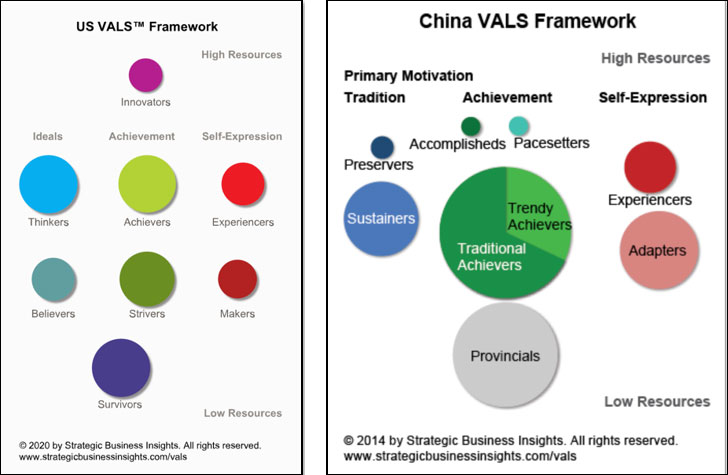
- VALS (Values, Attitudes and Lifestyles)
- Developed by SRI International, VALS divides consumers based on their primary motivations and resources.
- It develops unique VALS systems for each country.
- For example, the VLAS systems for the US and China differ widely.
- PRIZM (Potential Rating Index by Zip Market)
- PRIZM segments consumers into lifestyle types based on demographics, behaviours and geographic location
- OCEAN utilises personality traits to predict consumer behaviour: openness, conscientiousness, extraversion, agreeableness and neuroticism
The Myers-Briggs Type Indicator (MBTI), once very popular, is a psychographic framework that has recently been controversial.
Kantar’s TGI is an audience profiling study that captures various data points—from product use to leisure activities to attitudes and media engagement. Since TGI has been present in India for decades, it offers a rich trove of data that can help develop an effective psychographic segmentation framework for India.
Academic studies exist in the broad area of psychographic profiling of Indians, some of which can provide useful data sets or insights.
It will take a decade or more to drive consensus and establish credibility for a Consumer Psychographic Segmentation Framework (CPSF) to become widely accepted and part of every essential marketing and media data set. If we start today, the marketing and advertising community will be in time to function optimally in an affluent and increasingly complex market called India.
The use of CPSF will begin as early in the marketing process as product or service design and, of course, be central to marketing communication planning. A CPSF would also usefully inform social interventions and political campaigns.
Developing a widely accepted psychographic segmentation framework is a vital R&D effort that ranks along with the attempt to create India-contextualised AI-driven martech and adtech. Let’s get on with it.