
Category: MxM JOURNALISM REVIEW

  • Ranjona Banerji: TV does right by Baby Mahi!

    Ranjona Banerji

    By Ranjona Banerji


    Let’s cut TV news a little flak. What! Did I really just say that? The story of “baby Mahi” who fell into an abandoned borewell on her birthday last week but could not be rescued for almost five days is a made-for-TV story. Most newspapers would have reduced the story to a brief, if they carried it at all. Human life or in this unfortunate case death means very little in Indian newspapers unless it concerns high net worth individuals or happens in large numbers. Here also the concern is relative: for a Mumbai newspaper a bus that falls into a ravine and kills 50 of a marriage party in Bihar means less than an accident on the Mumbai-Pune expressway which kills 15. Geography and proximity carry more weight than the idea of death itself.


    TV news, however, challenges these assumptions made by the print media. While some may find TV’s attention to baby Mahi excessive or indeed point out that people fall into wells all the time, they are missing the point. Newspapers belong to the old, fatalistic India, where you took everything in your stride because life taught you that horrible things happen to everyone and especially to poor people. TV belongs to New India and as we learn every night, India always wants to know.


    And some questions, we must admit, need to be answered. There is no reason why people should regularly die because they accidentally fall into wells. There is no reason why we should not insist that safety protocols be put in place to prevent such accidents. There is no reason why local officials are not pulled up for being callous.


    Even if the hyperbole and hysteria generated by TV reporters and anchors can be vastly annoying, it does not mean that the reason they are having fits is not genuine. It took every bit of fortitude I could muster at midnight to listen to Arnab Goswami’s impassioned outburst against apathy and indifference (Wimbledon means I cannot get to TV news before midnight, yes I have no life and thank god I don’t watch football!) but behind all the bluster – there was a point.


    The trick for TV now is not to let this baby Mahi case turn into a real-life version of Peepli Live. They have to continue with the campaign they have begun so that they do not become as cynical as print journalists. It may be a tall order, but they started it.


    * * *


    I greatly admire Pakistanis who appear on Indian TV news discussions about terrorism. It takes great courage to withstand all that solid evidence against them and continue selling their government’s line. And they seem to be quite happy to do it. I do not get to watch Pak TV any more so I do not know if Indians appear on panel discussions to get pilloried. Does anyone know?


    * * *


    Football has taken over our newspapers. It is now emerging as cricket’s biggest competitor. We all know that Indian football does not generate any interest at all (somewhat like Indian hockey) but every FIFA tournament brings the lives of others to a standstill.


    The test I suppose is when cricket (with India playing) and football tournaments happen at the same time. Who do you think will win? Or will we then know whether sports pages are just lazy or have some top class brains involved in the planning?


    * * *


    The Times of India in its little debate section on the edit page has gone for and against on the use of the term “Bollywood”. It’s an old argument and an amusing one. We all know that the term is derogatory and was coined in the 1970s with that in mind. We also know that as long as the Hindi film industry continues to make song and dance potboilers, the term will continue to stick. No one calls Shyam Benegal or his oeuvre “Bollywood” so we all know the difference. TOI could have suggested options like “Goregaon”, since that’s where so many films are made and that’s how Hollywood got its name. Any takers?
     

  • Ranjona Banerji: Irritating ads that irritate

    Ranjona Banerji

    By Ranjona Banerji


    Am stepping on a few toes here and other people’s territory but then wothehell. As much news as you watch on TV (or as much TV that you watch, be honest) you’re forced to watch as much advertising as content.


    And sometimes it’s fun (like Hari Sadu and naukri.com) or even the poor chappie who thinks he’s eating chicken, but it turns out to be a doggie. Or Fastrack’s funny series on the risqué side with Genelia D’Souza and Virat Kohli. Or even the Flipkart ads where children play adults.


    But what does one make of Priyanka Chopra squirming about on the ground to a song that does not match the bizarre dance she does as she tells us she hates the “chip chip”. All that happens for Garnier is that most people throw up and switch channels.


    Through the telecast of Wimbledon on Star Sports you get to hear that “amazing Thailand always amazes”. Well, duh, couldn’t they think of another word? Or has someone done Thailand tourism in?


    The Kelloggs ads with that vastly annoying mother who does something as simple as throw a few almonds on a bowl of cereal and pretends she’s invented sliced bread is anodyne as such ads normally are.


    But the winners of the most irritating ads have to be Reliance Foundation and Coca-Cola. Insensitivity seems to rule the Coca-Cola ad in which a group of not very well off (how do I say this politely?) children play cricket in some dusty desert scrub land as a voice over tells us poetically how they have no cricket bat, ball, stumps, the pavilion has no roof and so on and ends some poignant note about how this is not play but the call of the earth or something. Then Sachin Tendulkar with his strange new hairstyle drinks a Coke and says play on. The children and Tendulkar never meet and you get the feeling that the children cannot afford to drink Coca-Cola, certainly not one each.


    And there’s the Reliance Foundation. I’m not getting to the connection with the programme Satyamev Jayate. For one, the ad looks like a copy of the Vedanta ad, which claimed to be saving the lives of various village children with schools and food and making their dreams come true. The ad ran into as many problems as Vedanta does with its mining projects and the company’s attempt to redeem itself with this real or exaggerated NGO social work effort did not work.


    If indeed Nita Ambani is moving into social work, an ad that copies an already discredited ad is surely not the best vehicle. Also, the figures put up for the number of children fed or schooled or clothed is embarrassingly small for a company the size of Reliance. Even worse, Nita Ambani’s look is so carefully crafted that it looks just that. Also makes her ears look unnaturally large.


    Hidden persuasion is fine. But these are attempts at such blatant manipulation that they are not just exploitative, they may not even work.


    For those interested in advertising and how it works, try and catch The Gruen Transfer on the Australia Network or Youtube. Hosted by Australian comic Will Anderson, it is funny, incisive, intelligent and hard-hitting. And did I say funny?


    All right, I’ll watch the news from tomorrow.


  • Ranjona Banerji: Media forgets more than it remembers

    Ranjona Banerji

    By Ranjona Banerji


    Most Indian newspapers stayed up late to bring readers the results of the Euro semi-final between Germany and Italy. The Times of India also managed to check up the Wimbledon scores and had a front page snippet on Rafael Nadal’s shocker of a second round exit. This is unusual because TOI usually does much less for tennis than other newspapers.


    (But CNN tennis reporter, I have a question for you: Is Rafael Nadal’s second round exit bigger than Pete Sampras’s fourth round exit in 2001, since you said that Nadal’s upset was the biggest in tennis history and no one could remember another? Nadal has two Wimbledon titles, Sampras at the time had seven Wimbledon titles – a record he holds with William Renshaw – and would never win another. The man Sampras lost to: Roger Federer. It was only 11 years ago, a little history is not a bad thing for a sports reporter. Or even, a good memory!)


    * * *


    The Houston Chronicle has fired a reporter for working as an exotic dancer (sometimes known as stripper) as a second job. The woman was exposed by a rival publication. Snitching on your competitors is a trend in Western journalism which is yet to reach India and one wonders whether that is not a good thing. The Guardian’s exposes of phone-hacking and other dubious practices by rival newspapers, especially those owned by Rupert Murdoch, perhaps fall in the realm of both public service and dogged investigative journalism. (The Hindu comes the closest in India, as it occasionally pulls up lesser media houses for journalistic and marketing transgressions.) But “investigating” fellow journalists of media houses and their personal lives to inform readers? Am not sure what category of journalism this falls into.


    * * *


    A minor storm in Indian journalism has been over the death of a photographer who worked with Tehelka, was sent into the hinterland to do a story on Naxals, got malaria there and died. The newspaper is at fault for apparently not factoring malaria into the threat element of this assignment.


    Newspapers in India are notorious for not being bothered about the dangers of newsgathering – mainly because most newspapers have dispensed with most kinds of dangerous reporting. (I could I suppose say the same thing about TV, in that they hardly started.) Gone are the days when even gossip columnists – like Devyani Chaubal being slapped by Dharmendra – faced physical dangers while working. I am being facetious I know but bullet-proof vests are hardly part of a reporter’s must-haves in India. There should be no room for callousness. But I am still unconvinced what Tehelka could have done about a mosquito. If they did not help the photographer or his family later, then there is cause for criticism.


    Still, it would not hurt media houses to take a closer look at employee welfare (this does not mean a box of mithai at Diwali) and on-the-job dangers.


    * * *

    Interesting that the anniversary of the Emergency came and went with little media attention. Are we moving on or did we just, like, forget?


    * * *


    The case of Abu Jundal or Jindal or Zaby or whatever his name is – the Lashkar handler of the 26/11 attacks sent to India by Saudi Arabia – is exciting but it is still in its early stages. Rather than focus their hysterics only on Pakistan, the Indian television media might like to look at it as a story first and probe all angles rather than jump into jingoistic propaganda.


    * * *


    The Indian media – particularly TV – got itself into a bit of a bind over Pakistan’s flip-flop over the release of Sarabjit Singh. Sarabjit is a celebrity prisoner whose family has ceaselessly campaigned for his release. Pakistan announced Sarabjit’s name and then changed it the next day to Surjeet Singh. Now the dilemma: should the media show happiness for Surjeet, rage against the machine for Sarabjit, damn Pakistan or blame Pakistan? Is one Indian equal to another or are famous Indians more equal? It is not known how hard Surjeet Singh’s family worked the media to get him released, so perhaps there’s an answer. Also Surjeet Singh walked across the Wagah border and claimed he was a RAW agent, a tag Sarabjit and his family have consistently denied!


    * * *


    Congratulations to Mid-Day on its 33rd anniversary and a whopping anniversary issue of 200 pages which I haven’t had the time to read yet. Might take me all week!.


  • Ranjona Banerji: India’s great football triumph = Viva Espana!

    Ranjona Banerji

    By Ranjona Banerji


    So who was bigger this week? European football or the prime minister as the finance minister? In spite of how much we love the Indian economy and can now all speak knowingly about repo rates and supply side economics, actually it is the question of whether Spain is really the greatest sporting nation in the world or not that concerns us.


    Since everyone stayed up all night on Sunday to find out – all the newspapers that is, not me – we can now safely say that football is the second biggest sport in India, after cricket. In fact, sometimes newspapers do not stay up all night to bring us the results of late night cricket matches, especially where India is not playing, so…


    I point this out because the chances of India playing at the Euro Cup are, of course, zero but the chances of India playing football at the international level are also, er, zero.


    No one, however, cares. Although we are often accused of being jingoistic (by me), when it comes to football, it is the beauty of the game which gets us. All these European countries fighting each other as they chase a ball around a field affects us deeply. We take on loyalties that are deep and meaningful, we become close to all the players and we have no compunctions about fighting with our friends who support the wrong team. I see “we” in a generous sense that has nothing to do with me, since I don’t understand any of this.


    Funnily enough, we don’t even care that we can’t even make tenuous Indian connections which make us so happy at other times – the white mayor of Pigsknuckle, Arkansas once ate an Indian meal made by second-generation Indian immigrant Lucky Kohli, thus proving how great India is.


    Spain is now top country for India (I make this arbitrary judgment based on Twitter), even though I don’t think that Spain has many of the celebrity footballers who make the news the rest of the time when they play for clubs (Messi, Ronaldo, Rooney are the ones who pop up all the time for philistines like me). Also, once the World Cup arrives and the South American teams take part, all these loyalties will shift again.


    Indian TV news does devote some time to football but not as much as Indian newspapers which even sent correspondents to Poland and Ukraine. That is why newspapers are at the vanguard of identifying the sports which fascinate the new India.


    TV news is involved in saving India night after night so sport, unless it involves scandal, is not really that newsworthy. No?


    PS: The prime minister as finance minister? Boring!


  • Ranjona Banerji: Don’t be jingoistic; do your job, journos!

    Ranjona Banerji

    By Ranjona Banerji


    The coverage of the arrest of Abu Jundal or Zahibuddin Ansari has, sadly and as usual, tilted towards being a spokesperson for the investigating agencies. Rather than take a cold and dispassionate look at investigations into terrorist attacks or activities, all too often even very senior journalists become jingoistic, as if criticism of the way a probe is being conducted somehow impacts on their own personal patriotic duties.


    Yet the fact is that in the Mumbai terror attacks at least, it was the personal bravery of constable Tukaram Ombale that led to the capture of the lone surviving terrorist Ajmal Kasab. The shame of the attacks is still enormous and the blame for that rests solely on our police force and state administration. (Is that my own sense of nationalism asserting itself, albeit in a converse manner? Perhaps.) The court which sentenced Kasab to death let off the other two names added to the case by the Mumbai police for lack of evidence. This was the worst, most audacious terrorist attack on India’s premier city and the police could not come up with enough evidence.


    The media in any other country would have gone to town on this. We instead had some mild criticism and more PR activity. It is only when there is enormous embarrassment like sending a list of wanted criminals to Pakistan for return to India only to find that some are dead and others are in Indian jails that there is obvious criticism.


    Crime reporting in Indian newspapers veers between police mouthpieces and gangster mouthpieces – a sad outcome of which is the murder of one journalist J Dey and the arrest of another, Jigna Vora, in his death. The onus for this lies with editors who seem unable to analyse the bigger picture in the race for some exciting story. Sensationalism is fine but somewhere there has to be a larger responsibility to present the reader with a more comprehensive story.


    In the Abu Jundul case, I would like to read more about how the police have been unable to crack these apparent sleeper cells all over the country, how the same names crop up as being responsible for most terrorist attacks in the country and yet we never get closer to catching them, why we still don’t know which dreaded terrorist is in the country and which is not, how the conflicts between various investigating agencies is impacting their efforts, the progress of our diplomatic efforts with Pakistan on the issue of terrorism… the list goes on. Yet what is available in newspapers is scanty and one can only glean all this from throwaway remarks here and there.


    TV news has to absolved from all this because its levels of maturity are still low. One of the funniest moments for me remains when the verdict on the Mumbai terrorist attacks was pronounced and the judge acquitted ?? and ?? for lack of evidence.


    Policeman turned activist and lawyer YP Singh was on NDTV. He said the acquittal reflected very badly on the Mumbai police. The NDTV anchor said: “how can you say that sir, they work so hard”. The expression of speechless incredulous horror on Singh’s face was classic!


    * * *


    As with terrorists, so also in the killings of “Naxals” in Chattisgarh, we put “patriotism” or adherence to state policies before journalistic rigour. It took the Indian Express to point out that many of these so-called dreaded Naxals were ordinary villagers and school children. If the media does not call out the government on these transgressions, then it is conceding all its “freedom of expression” space to NGOs and activists and thus abdicating one of its biggest responsibilities.


  • Oh God! Why Higgs-boson and not Bose-Higgson?

    Ranjona Banerji

    By Ranjona Banerji


    The main question in the discovery of a Higgs-boson particle at the CERN in Geneva is simple: How many Indians were involved? This is the conundrum that has enthralled and mystified many as the search began for this sub-atomic particle that explains how matter got mass.


    It has been well known for years that no discovery by the human race is of any significance unless Indians are somehow involved. In the case of Higgs-boson, this Indian connection is even more significant: it is also called “the god particle” and the world knows that India has first dibs on anything connected with god. Or even better, gods.


    The Higgs-boson god we will soon be told is described in detail in the ancient Indian scriptures. But there are other Indians involved too. Some worked at CERN or were seconded there. Then there’s that “boson” part of the Higgs name. That’s Satyendra Bose who worked with Albert Einstein and postulated the existence of sub-atomic particles in the 1920s.


    An international inquiry will now be held to find out why the particle is not called “Deva” particle and equally important, why it is not called Bose-higgson. Peter Higgs after all wrote his academic paper in 1964. I don’t know much mathematics but even I can guess that the 1920s is many years before 1964.


    The Indian media must now investigate this international conspiracy to demean India: this is almost as important as why McDonalds used beef fat to fry its French fries, even if the fast-food chain started in a country where cows are not holy and often used as food. Indians make up one-sixth of the world’s population most of which are Hindus and that has to count for something (80 per cent of 1.2 billion).


    Some in the media last night were very worried that the world famous scientific research institute which has been at the forefront of global work in quantum physics, the Indian Institute of Technology, was not involved in the Light Hadron Collider at CERN, Geneva, Switzerland. Subramaniam Swamy can file a PIL on this and at the same time, find out how much money from Swiss banks was used in this experiment.


    I might venture to point out to the media that there is a significant difference between science and technology, but I fear for my life. It explains why Steve Jobs was credited with inventing the computer after he died and Alan Turing’s birth anniversary only noticed by Google.


    Of course, few really understand this sub-atomic mass matter stuff, so we need to find a suitable person sorry I mean Indian to explain it all. How about Raj Koothrapalli from the Big Bang Theory? He’s the only famous Indian astrophysicist I can think of.


    Incidentally, in one of the early runs of the Light Hadron Collider, the experiment failed because of some faulty wiring. Anyone think an Indian was involved?


  • Ranjona Banerji: Times Now = Alternative government on Pakistan?

    Ranjona Banerji

    By Ranjona Banerji


    There is a need perhaps for news channels to rethink their positions as far as prime time studio discussions are concerned. One might be so bold as to suggest that they are running out of steam. Sadly, not everyday brings up a topic so incendiary that the nation’s hackles rise one way or another and as has happened over the past few weeks. If panel discussions (debates, fights, yelling matches, whatever you want to call them) are about subjects like India’s team selection for the World T20 Championships (NDTV) or one more interminable inquiry into Air India (Times Now), then who’s really watching?


    Times Now however seems to be setting itself up as an alternative government when it comes to Pakistan. Night after night it badgers various Pakistanis (not members of the government) and tries to get them to confess that Pakistan is sponsoring terrorism in India. There appears to be some sort of strange naivete at play here. No one in India doubts Pakistan’s involvement. But it is hard to imagine that this kind of TV assault is going to make the situation any better.


    * * *


    Are newspapers alive or dead? Two takes on the debate are in the links pasted below. Well, the first is certain that death is imminent. The second is one of those “India rah rah” stories which foreign news agencies alternate with ‘India boo hoo” stories. Sadly, the reasons given in these links on why newspapers are dying are as pedestrians as the reasons why newspapers in India are booming.


    I have another take: news is not dying. Conventional methods of dispersal are. Any other ideas?


    http://listverse.com/2011/07/03/top-10-reasons-the-newspaper-is-dying/


    http://www.bbc.co.uk/news/business-14362723


    * * *


    Senior journalist Sevanti Ninan of The Hoot writes a scathing piece in Mint on the collapse of newsgathering in newsrooms and the replacement of reporting with hectoring on TV channels. She also lifts the lid of newsroom practices and the ruthless retrenchment policies followed by newspaper managements.


    http://www.livemint.com/2012/07/04211735/The-changing-newsroom.html


    * * *


    Meanwhile excerpts from veteran journalist Kuldip Nayyar’s autobiography show the former editor to be in vicious form as he eviscerates former colleagues young and old. There is lesson here: refuse a former editor a column or suddenly cancel the column and you will pay the price later by being exposed in print.


    The link is from the blog sans serif: http://wearethebest.wordpress.com/2012/07/05/kuldip-nayar-on-shekhar-gupta-n-ram-co/


    Read and enjoy. And may there be a lesson for all those who have refused to give this writer columns…


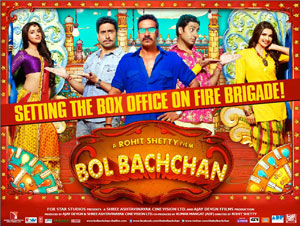
  • Critics don’t get generous with Bol Bachchan

    Bol Bachchan

    Directed by Rohit Shetty

    Produced by Ajay Devgn, Dhillin Mehta

    Screenplay by-Yunus Sajawal

    Starring-Ajay Devgn, Abhishek Bachchan, Asin Thottumkal, Prachi Desai, Krushna Abhishek


    Nobody in their right mind, except, of course those involved in the making and trade media could have anything good to say about Bol Bachchan.  It is loud, crude, garish and braindead. Rohit Shetty obviously wants box-office success, which such films seem to achieve, even if a majority of the audiences don’t actually like them, but with source material as rich as Hrishikesh Mukherjee’s Golmaal, there is no excuse for a film like Bol Bachchan. Except for The Times of India’s standard 3.5 stars, no critic could go over 2.5 stars, if they were feeling generous.


    It actually got 0.25 stars from Yahoo’s acerbic Kunal Guha. “Just after a cameo jig in the title song, Big B offers a disclaimer: he isn’t a part of this film, even though his name is. And that is hint enough for the wise. But for those who don’t know, Bol Bachchan (BB) jams chopsticks up the nose of Hrishikesh Mukherjee’s comic classic Golmaal and digs itself six feet under with it. While the story is same in theory, being a Rohit Shetty film only adds some cars nailing somersaults, trucks attempting a ballet, baddies playing mid-air Garba after being biffed and Ajay Devgn drawing his eyebrows close enough to show that he means business.”


    Sudhish Kamath of The Hindu savaged it too. “Sitting through Bol Bachchan is like sitting through multiple car wrecks. No, seriously. There is enough car-on-car action all through this unwarranted Rohit Shetty remake of Golmaal.   Well, it’s made by stuntmen, you see. Something they don’t want you to miss….There’s enough bad English in this film under the pretext of humour to make even Rowdy Rathore go: Don’t angry me. If you liked Hrishikesh Mukherjee’s Golmaal, which you sure did, you would want to protest this assault on one of the effortlessly funny films of all time.”


    Anupama Chopra of Hindustan Times gave it two stars and wrote, “Bol Bachchan, like most of Shetty’s earlier films, including the Golmaal series and All the Best: Fun Begins, isn’t so much a film as a series of gags strung together with songs and the requisite car-bashing action. There is no attempt at plotting, storytelling, delineating a character, building coherence or following logic. Shetty’s only agenda is to give you a good time.”


    Rajeev Masand of IBN went with 2 stars as well and commented, “‘Bol Bachchan directed by Rohit Shetty, revels gleefully in its silliness. This is a film whose pedestrian humor requires neither taste nor common sense to appreciate, and anyone seeking wit, a clever screenplay, or inspired performances might want to revisit Hrishikesh Mukherjee’s Golmaal, which Shetty plunders in the name of inspiration for this lazy film.”


    Karan Anshuman of Mumbai Mirror also gave it 2 stars and wrote, “The main problem with Bol Bachchan is that it unfolds like a play. There are literally a couple of sets where an overwhelming part of the action (and songs and dialogue exchanges) takes place. If you’ve experienced mainstream Hindi or Gujarati comedy theater (loud and forced comic situations devoid of experiment) you know precisely what to expect in BB. Even the genuinely funny bits are lost in a deluge of recycled jokes, preposterous situations, over the top ‘drama’ (you only know it’s drama because the background score suddenly spikes up to deafening levels), and – of course, how could a have a comic hit film without – offensive gay jokes.”


    Sukanya Varma of rediff.com raised it to 2.5 and ranted, “Shetty picks up all the major plot points of the original only to alter it with his boisterous, cheesy, slapstick and visually flashy sensibilities, known to work hugely in his favour given the success of the propitiously titled Golmaal franchise. Unlike the Utpal Dutt-Amol Palekar starrer, however, Bol Bachchan isn’t an out-and-out comedy throwing in large-scale action and irksome melodrama.”


    Shubhra Gupta of The Indian Express must have been in a good mood since she gives it 2.5 stars too and writes, “This is a Rohit Shetty film. Which means it is full of primary colours. I counted a red-blue-green-yellow palette more than a couple of times, all in the same frame. It is full of cars and jeeps hurtling down roads and crashing and smashing. It is full of Ajay Devgn, which is a given because Shetty and Devgn are long-time collaborators; plus, the star is the producer of the film. But this time around, there’s a slight difference. It’s also got Abhishek Bachchan, and that makes ‘Bol Bachchan’ not as much a Rohit Shetty film as his previous ones, which is not such a bad thing : I laughed more in this one than I have in his previous loud comedies.”


    Which brings one to Times of India’s Srijana Mitra Das of the 3.5 stars. “BB’s a dialogue-lover’s delight – lines like ‘fish and chips without water’, Devgn conveying the situation of a ‘jal bin machli’ – sparkle across the plot and you can feel the love as the actors reprise bits and bobs of vintage Bollywood. On the downside, it exceeds by about 30 minutes and has that odd, uneven heart-chart quality accompanying the film. But that aside, BB showcases Shetty as the maharaja of madness, Devgn clearly his crown prince. And Abhishek? His judwa bhai, of course. Tip-Off: Don’t strain your brain applying reason to this laugh-riot – but do buy more popcorn for that extra half-hour.”


  • Ranjona Banerji: Kudos to TV news

    Ranjona Banerji

    By Ranjona Banerji


    Wonders of wonders, I find myself forced to praise media efforts in a few rather reprehensible cases. The first is the curious story of former athlete Pinki Pramanik. This Asian Games medal winner was accused of rape by her long-time partner. As Pramanik is female, this raised all kinds of questions and plenty of salacious interest. It is just the kind of case that the media could have gone overboard with. But instead, it has concentrated on the human rights abuses which Pramanik has been subjected to. Not only has she been put through several gender determination tests, a video clip of those tests was made public with some extraordinary scenes apparently of policemen groping her breasts. She has also been placed in a male prison, pending the rape investigation. Thanks to media scrutiny we now know that West Bengal, where Pramanik lives does not have adequate gender determination facilities. Yet she was humiliated over and over again.


    This media attention will hopefully focus on the group of people who could be called “inter-sex” with indeterminate physical sexual characteristics. They may see themselves as male or female and society has to find a way to integrate them without stripping them of their dignity. Since there are situations where we see things only in the male-female perspective (like sports for instance), some greater awareness and sensitivity is needed in dealing with this issue.


    The media is often accused of being prurient and insensitive. However, in the Pramanik case the current “permanent outrage” mood has come to its assistance. Both TV and print media have taken up this story from the human rights angle.


    **


    The second case is that of Suja Jones Mazurier, a mother of three who has accused her husband, French consular officer Pascal Mazurier of sexually abusing their four-year-old daughter. The Bangalore police have apparently treated her as an accused rather than a mother trying to protect her child. This is extraordinary behaviour by the police who usually decide that all accused are guilty – as in the Pramanik case – without the benefit of investigation and trial.


    The media has informed us that the police not only delayed filing an FIR, they also delayed taking the accused into custody, well after it was made clear that he did not have diplomatic immunity. They also asked Suja Jones the most incredible questions as well as conducted tests on the child in the most appalling conditions.


    **


    The third case is that of the 10-year-old girl being forced to drink her own urine by a hostel warden at the prestigious Patha Bhavan school in Santiniketan. This is a case with very few grey areas and the media has gone hammer and tongs at the Vishwa Bharati university authorities for trying to protect the warden at first and slapping “trespassing” charges against the girl’s parents when they tried to rescue her as well as at the police for delaying taking action.


    **


    All these cases involve human rights abuses, exposing which has usually been the domain of NGOs. But the media now appears to have stepped in as well and upped the ante. This challenges old media notions of what is a “big” story or not and shifts the focus from politics. It might be too early to herald this as a shift towards a more mature society but it does appear to be a step in that direction.


    **


    All kudos to TV news however for having the courage and naivete to challenge old journalistic traditions, as they insist on answers for what India wants to know.


  • Ranjona Banerji: Don’t bother, Indian analysts… let Time do it

    By Ranjona Banerji


    The Indian media has taken a round beating here. Day after day, print and TV criticise the government and politicians. Columns, analysis, debates and discussions focus on the weakness, incompetence, “policy paralysis” of the current government. Does anyone care or pay attention? Of course not – unless the criticism comes in cartoon form about a person or issue long dead.


    But an article in the Asia edition of an American newsmagazine criticises the prime minister and the whole political community goes into a frenzy? Let us not be unfair to Time magazine, but the fact is that no one considers it to be a respected analyst of Indian politics. Nor indeed is the magazine the powerhouse it once was. Now if the Economist were to get so seriously critical, since it is known for its carefully considered views, then you might want to sit up and take notice.


    Time’s “crime” is to call Manmohan Singh an “underachiever” and ask whether it is time for him to move over and let someone else become prime minister. This made the Congress jump to his rescue and the BJP to behave as if they’d won Uttar Pradesh.


    The Congress then looked back at an old Time article which had said Atal Behari Vajpayee was “asleep at the wheel” as prime minister. This was supposed to shut up the BJP as the same newsmagazine had also criticised them. Sigh.


    The BJP however could point out that Time’s tally is still higher since last year the magazine appeared to favour Gujarat chief minister Narendra Modi. Then the Congress can point out that Modi did not make it to Time’s poll of the greatest people in the world or whatever because of negative voting.


    And so we can go on and on about the various articles and activities of a barely read newsmagazine and the political classes can carry on doing even less than they do normally.


    As for all you analysts in the Indian media, why do you bother? Clearly, no one pays attention to all your criticisms and opinions. Congratulations are due to Time for having successfully upstaged the entire Indian media. Henry Booth Luce would be happy.


  • Ranjona Banerji: I also hate the chip chip!

    By Ranjona Banerji


    I’m taking off from next week and staying with the advertising industry since it is also “news” as some Indian media organisations have told us for years. Also, you cannot escape advertising if you watch the news or read newspapers and magazine. After careful consideration and consultation with others, it is clear that Priyanka Chopra’s “chip chip” ad for Garnier remains the most annoying on television. It comes on so often and with such clever cross-channel planning that you are forced to watch it unless you jump up and run every five minutes. By this time, the sun, the dog, the grass have all started looking extremely embarrassed at being made party to the ill-matched song and dance routine.


    But close to this one are those with annoying children like the rude boy in the McCain’s ad. I don’t see why he deserves to be treated with various kinds of fried potatoes. He should stay in his room downloading food while his family has fun without him. Next is the little girl in the Cadbury’s ad who is smiled on indulgently/ protected for not wanting to share her chocolate. (I am far more generous. If anyone gives me a chocolate product made by Cadbury’s I promptly give it away.)


    Today’s newspapers say that table manners are becoming a thing of the past. The advertising industry has long known this which is why it is particularly fond of promoting messy eating. People who eat Cadbury chocolates not only give each other long and profound looks while discussing vegetables they don’t want to eat, they also manage to get half the bar of the chocolate they’re eating all over their faces. This is an Indian rule I think and also applies to eating ice-cream. To save money, these ads should be joint ventures with washing machine/washing powder companies and maybe even whatever Garnier is selling in that “chip chip” ad.


    Then there are irritating mothers – based on the general feeling that the advertising industry specialises in mothers you want to murder. The Kellogg’s mother, who does something as amazingly innovative (sarcasm emoticon please) as putting almonds on top of a bowl of cornflakes, wins the current round of MYWM. If Kellogg’s only sold their variety of cornflakes with almonds in it in India, she wouldn’t have to be quite so smugly clever.


    An award has to be given to both Rahul Bose and Mahesh Bhupathi for agreeing to tell us that their mouths are full of germs. This is courage extraordinary. Also, for the ungrammatical manner in which they both say: “and much less germs”. Since both speak very good English the rest of the time, one assumes (or hopes) that Colgate paid them a lot of money.


    Vodafone’s attempt to make old men cuddly and lovable after Tata Docomo’s portrayal of them as curmudgeonly and crotchety should win an anti-ageism award at one of the next 1,000 award ceremonies the advertising industry seems to organise. At which, the best actress award has to go to Anushka Sharma for not only being convincing in selling cameras, internet services, scooters and so on but also for beating Amitabh Bachchan, Katrina Kaif, Priyanka Chopra and all the rest of the stalwarts for successful grabbing of TV time.


    Currently, there are several ads for a film called Cocktail starring, I think, Saif Ali Khan and Deepika Padukone. I saw a film called Cocktail once. It had Tom Cruise in it. Any relation?


  • Ranjona Banerji: TV debates are sound, fury with nothing significant

    By Ranjona Banerji


    TV debates, it should now be universally acknowledged, have become a bore. This is not the fault of the news channels but of their guests. Though I suppose one could blame them for not getting better guests the way you might disagree with the way a newspaper chooses its columnists or edit page writers. I digress. Since my cablewallah condescended to give me CNN-IBN again, I decided to try and watch it. Karan Thapar on The Last Word tried to work out what he called the “natak in Karnatak”. A needless pun perhaps, based on two different language families being expressed in a third language, but never mind. Nirmala Seetharaman of the BJP was probably tired of being politely defensive so barely let anyone speak. Earlier in the week on Times Now, Smriti Irani as part of a discussion on P Chidambaram’s comment about the middle class being happy to spend money on ice-cream and bottled water but not petrol, shouted so much that she drowned everyone else out. She also moved the subject around so much that the rest of the guests were left quite bemused.


    Even more puzzled was Nidhi Razdan of NDTV on Thursday night when a discussion on Sharad Yadav’s comment that temple funds need some sort of regulation was turned into some long defence of Hindus being targeted by Tarun Vijay of the BJP. The other guests were equally amazed since no one had said anything derogatory about Hindus. Most in fact felt the government had a bad track record in managing temple funds and that was not the solution. In the second discussion on Razdan’s show about PA Sangma’s presidential campaign, Vijay accused senior journalist Kumar Ketkar of being prejudiced against people from the North-east even though Ketkar had not said a word about the North-east at all.


    Does this sound like I’m targeting spokespersons for the BJP? It is however surprising that for a party which is so media savvy normally, it has to depend on people who are so incapable of carrying on a discussion in a civilised manner. They just make the other parties look better, even if they are hardly deserving of that.


    I could not watch CNN-IBN any further because it went back to the fight in the civil aviation apparatus over Kingfisher Airlines which Arnab Goswami also took on later. By this time I was bored and the faces all looked the same. Headlines Today had no sound so I could not indulge myself in the battles of the two Rahuls.


    The fight against “apathy” and “indifference” on Times Now remains interesting however. The squirming by doctors as they tried to somehow explain why ward boys and cleaners were standing in for them in UP hospitals was amusing, especially when they were attacked by members of the public. The strike by UP doctors also attacked by callers, to which there was really no answer.


    But at the end of all this, these debates are just sound and fury signifying nothing. It is not the media’s job to find solutions but there is not even any food for thought to be found in these discussions. People invited to TV studios need to work a little harder on how they sound when they lose control of their thought processes and their behaviour. They’re becoming like MLAs in our legislative assembles. News channels must invest in silencer buttons for unruly panellists. Or come down to the lowest common denominator and become like the Jerry Springer show with physical combat as part of the entertainment.