Category: MxM JOURNALISM REVIEW

  • Ayaz Memon in Newswatch: A series that wasn’t

    Newswatch is a weekly series where we invite editors and veteran journalists from across the country to comment on media coverage. Last week we had Aroon Tikekar, this time, it’s Ayaz Memon:

    The English media’s coverage of the Indian cricket team’s ill-fated tour this summer went from heady expectation to surprise then astonishment followed by disappointment and finally distraught acceptance.

    By all accounts, this was a terrible tour, arguably the worst-ever in Indian cricket history. This was captured well in the mood and tenor of the media which, like the rest of the cricket world, had been taken by surprise by India’s utterly hopeless performances.

    The 4-0 whitewash in the Tests followed by a 3-0 defeat in the ODIs left the Indian team exposed to barbs and criticisms, not all unjustified. To twist a famous quote, no team had promised so much and delivered so little, which perhaps made the job of the media difficult. After all, how much can analyses vary if the team’s failures follow the same pattern every time, with only one player – the magnificent Rahul Dravid – performing in match after match?

    The build-up to the Test series had been fantastic; the best I’ve seen in three decades. In earlier years the media in England could be neglectful or patronizing, but this time the volume of space and tenor of opinion bespoke India’s status in the sport – both on and off the field.

    As the powerhouse that drives the eyeballs for cricket currently, India has acquired a curiosity, awe, envy, frustration, ire, appreciation, admiration across the globe. But interest in this tour was not only because of the financial clout India commands: this was also a marquee series, remember, because Mahendra Singh Dhoni’s team was number 1 in the ICC Test rankings and only a couple of months prior had also won the 50-over World Cup.

    The charisma of Sachin Tendulkar, poised to get his 100th international century, made the series even more seductive. Tendulkar had scored his first-ever international century in England in 1990 and had since gone on to become not just one of the greatest cricketers of all time, but also the Pied Piper of modern cricket, attracting fans and media everywhere.

    Tendulkar’s teammates were stalwarts like Rahul Dravid, V V S Laxman, Zaheer Khan, Harbhajan Singh, Gautam Gambhir and Dhoni which India an all-star attraction. The fact that the first Test at Lord’s would be the 2000th in the history of the sport and the 100th between India and England added to the significance and the glamour, always good grist to the mill for the media.

    Pre-series write-ups flooded the English newspapers. Broadsheets devoted big space to the greatness and virtuosity of Tendulkar, Dravid and Laxman – all on their last tour of England – as well as India’s phenomenal rise in international cricket in every aspect over the past decade.

    England’s victory in the Ashes series a few months earlier had made them strong aspirants to become the number 1 Test team, and this contest promised high drama and spectacular performances galore. But this proved to be unfounded as India crumbled badly because of poor preparation, and even poorer application under pressure.

    By the middle of the tour, it was clear that there was to be no turnaround in India’s performances and the tone of the media had gone from admiration to cynicism. The world champions were looking like they had feet of clay. Tendulkar’s impending 100th century became a matter of ifs, buts and sighs. Barring Dravid’s resilience – and to an extent the hard toil of Praveen Kumar – there was little to extol in the Indian team.

    Several causes and reasons were sought to explain the utterly abject performances of this highly regarded side and inevitably the Indian Premier League, the BCCI’s greed, recalcitrance to accept the DRS etc came under sharper focus than might otherwise have happened.

    One of these debates on TV led to an altercation between former captains Ravi Shastri and Nasser Husain – with the former defending the BCCI and Husain emphatic that he had a right to criticize as a professional mediaperson — that was to resonate even across the seven seas.

    In many ways, that was also the high point of a series that wasn’t in the cricketing sense.

  • Paid news: Who will bell the cat?

    By Akash Raha

    While it is generally agreed that paid news is a menace, newspaper editors across India are averse to the idea of a government regulatory body to check it. It could turn out to be a Big Brother and usurp the freedom that the media enjoys today. Yet, it is also acknowledged that something does need to be done to stop the iniquity of paid news, which affects the whole industry.

    Some critics suggest that a government-funded body be found which can be a regulator, yet remain independent of government intervention. Such a body will also be independent of media and corporate interests. The regulator thus formed will not only keep the print media, but also the electronic media under check from paid news. Some editors have suggested that the Press Council of India could be the regulator and given more teeth to take punitive action. As the debate seethes, MxM India reflects some voices and concerns from the industry.

    Paranjoy Guha Thakurta

    I think that organizations which indulge in such malpractices are undoing their own cause. Putting up ads in the name of news is not going to help them in the long run. Hence, it is in the self-interest of the media to act in a more responsible manner and discontinue such unethical practices. Moreover, now it is up to the Election Commissioner or India, Securities and Exchange Board of India (SEBI) and a group of ministers, a process that has already been initiated, to decide whether the government will make the law bring the corrupt practice of paid news under the conduct of election rules. What the group of ministers will eventually decide I cannot guess, but I think such a step should be taken.

    Some government intervention and interference is perhaps required if media can’t keep its own actions under check. Self-regulation is good, but only when everyone behaves like nice guys and we won’t have a problem. It is because self-regulation is failing, that’s why you need an independent regulator. I think the regulator should be independent of media and other corporate interests. Likewise, it could be funded by the government, yet not directly under the government.

    Moreover, whatever regulatory authority is set up, it should be empowered. Right now, we have the Press Council of India (PCI) which is a quasi-judicial authority, but unfortunately, it has no punitive powers. It can’t punish a journalist or newspaper management indulging in corrupt practice. Even if the PCI says that a particular newspaper should be denied government advertisements, which are released by Directorate of Audio Visual Publicity (DAVP)… Even that the PCI does not have the power to ensure that it is implemented. Government bodies are not obliged to implement the recommendations of the PCI. So basically we currently have a PCI which is toothless body without punitive power. On top of that the electronic media does not come under the purview of the PCI.

    Jayant Mammen Mathew, Deputy Editor, Malayala Manorama

    “I am not sure how paid news came in to being… However, I think the reader will see through those carrying paid news and this will ultimately end in erosion of trust the reader has with the newspaper. The Malayala Manorama group’s editorial policy is very clear about paid news. We have a zero tolerance policy and we are completely against paid news.”

    Shashi Shekhar, Editor, Hindustan

    I am strongly opposed to the idea of government interference in any form. It is true that paid news has to be checked, yet government interference is going to mess with the workings of the media industry. Debates are on in the industry if self-regulation is the best and the media industry as a whole should decide what is best for it. I can’t speak for other media houses, but as far as we are concerned, we have given a signed affidavit to the Editors Guild to stay away from paid news.

    Kulbir Chikara, Group Editor, Hari Bhoomi

    The problem of paid news cannot be solved by government intervention and there can be no law to differentiate between paid and un-paid news. Moreover, paid news can be camouflaged to suit purpose. For example, liquor owners were banned from advertising their product, but they have camouflaged their way out of it. Those who want to indulge in such malpractices will always find a way around it… There is a massive difference in promotional feature stories and paid news in political context. I think the second is more harmful as the future of India depends on it. It is indeed a problem when the readers are unsure whether it is the neutral media speaking or a political party. Such practices are bad and unethical. I think the efforts of PCI and government will be of no use till news broadcasters and publishers themselves understand that such practice hits credibility and thereafter the whole business. Regulation or law of any kind, according to me, will be ineffective.

    Ranvijay Singh, Group Editor, Rashtriya Sahara

    I strongly believe in the ethics of journalism and hence, evils such as paid news should be done away with. Having said that I am totally opposed to any sort of government role in this matter. I think that there is still a substantial part of media who are driven by ethics and they will decide the course of what should be done to curb paid news. I think PCI should come up as a strong body. PCI should be able to impeach a journalist or media house if there is evidence against them.

    Shyam Parekh, Resident Editor, DNA Ahmedabad

    I feel the newspaper industry survives on credibility. If newspapers lose credibility, there is no business. I am talking not only talking in terms of being a journalist but also in terms of the business. Newspaper is the first thing a consumer spends his money on to begin a day, and he would certainly not like to read bogus news. Eventually, the audience will see through the network of paid news and will stop spending time on something which is not in his interest, but in someone else’s interest.

    Sachin Kalbag, Editor, Mid-Day

    My opinion on paid news is very simple: It’s an abhorrent practice. It demeans journalism. I don’t really know when this crept in, but it has plagued the media for decades. Unscrupulous journalists have been on the take for several years, and this is not a new phenomenon. The widely cited example of institutional selling of content space is Bombay Times which introduced a rate card for coverage in the supplement. Recently, the supplement began putting a disclaimer under its masthead. The phenomenon of institutional selling of content space crept into the media for various reasons – but the root cause was always to increase revenue.

    Our editorial policy is very clear: any “Advertorial” is placed in a two-page section called Centre Stage, which is part of the Classifieds section of the newspaper. Centre Stage in Mid-Day is differentiated in various ways from the editorial part of the newspaper. Here’s how: 1) The Centre Stage carries a prominent disclaimer in a large point size under the masthead “People, Parties, Promotions”. This has been happening since the day Mid-Day started Centre Stage, which was more than two years ago. In Centre Stage, we carry items on movie releases and profiles of actors, fashion designers, parties, etc, that happened in Mumbai that week, apart from product launches.

    Close to 85 percent of the Centre Stage advertorial section is non-paid, that is to say the Centre Stage team of writers (this team is not part of the Mid-Day editorial team) interviews people or writes about their parties or products. Around 15 per cent of the items are placed where the content space is sold by the sales team. Once again, these items are only about Bollywood, fashion, parties or product launches. There is a separate, specialized sales team that sells this space, and at no point in time do they dictate terms to

    Editorial, mainly because Centre Stage is not editorial space, but marketing real estate. In fact, there have been several instances when the Editorial staff in Mid-Day has trashed Centre Stage advertisers in the review section of the newspaper, and the sales team has gotten into trouble due to that negative coverage. Yet, we are very clear at Mid-Day that the Sales and Editorial wires do not cross, and that the Chinese wall between them stays even though we may be good friends outside the office.

    We are also very clear that Centre Stage will not carry any “news”, but only information on these three or four categories listed above. There is neither any opinion nor any recommendation made in the section that is endorsed by the editor. In the strictest sense of the term, it is an advertorial. Mid-Day, therefore, has stayed away from “paid news” and will continue to do so.

    Photograph: Fotocorp

  • Hard Knocks: Ban terrorism coverage

    Knock, knock. Before you get into the blog, here’s an intro. It was meant to be a one-sentencer, but it’s turned to be a loooongish one. Anil Thakraney is an adman-turned-journalist living mostly in Mumbai, but sometimes in Bengaluru or Nashik. Or for a few days in a year or two: London. Many moons ago, he would edit The Brief:, an ad magazine that the adfrat loved to hate or hated to love. Well, they loved it and hated it. The Brief: was unceremoniously shut, but Thakraney had tasted the thunder. He went on to subject all and sundry to his interviews and stings (and stinging interviews) at Mid-Day and later with Mumbai Mirror. He was even editor of Mid-Day’s Bengaluru edition for a bit.

    When I joined the exchange4media group in 2008, I got Thakraney, a former colleague and friend, to write reviews and interviews. It was only natural that when I thought of launching MxMIndia, I asked him to be our Editor-at-Large. Do a blog, write reviews, interview the biggies. Etc, etc. Publishing Thakraney’s blog was like wearing a near-red shirt in a bull ring. But, heck, he’s one of the bestest writers on medialand. His views, most often contrarian, are interesting. I enjoyed reading his hat ke views today, and I am sure you too will. As for those who are at the receiving end of his commentary, I can only say: dil mein mat lena yaar! – Pradyuman Maheshwari

    Without much ado, Hard Knocks. By The Anil Thakraney:

    I am aware this is a heretical thing to say. And it goes against all tenets of good journalism. But drastic times call for drastic measures, as it’s said. I really think time has come for the owners of the mass media, in particular the TV channels and the newspapers, to come together and shun exhaustive coverage of bomb blasts and other terror attacks.


    And I propose this seemingly preposterous idea because the biggest source of motivation for terrorists is to sit back and watch (with beer and popcorn for company… the 76 virgins will have to wait) the hectic media blast of their actions. This 24×7 coverage not only provides oxygen to their deeds, it also encourages other terrorists to join the party. And their message of hatred quickly gets spread all over the world, free of cost. And sometimes, as it happened on 26/11, the TV coverage aids them directly in their planning and execution. In short, the media unwittingly ends up providing a huge bang for their buck.


    I wonder if their enthusiasm levels will remain the same if the oxygen supply is cut off. If they are ignored like petty pickpocketers. If they don’t get the bhav they currently get. I suspect it will be a setback for these buggers.


    So then what about the role of journalism, you ask? Isn’t it the duty of the media to inform the janata on what’s happening? How can the media ignore such a huge story? These are valid questions. But maybe for the greater good, these need to be compromised. I think a bomb blast should get a tiny slot in the coverage, as would a road rage incident. So people DO know it happened, but there’s no accompanying drama around it. The terrorists will deem this to be an insult to their work. And that’s a good thing, no?


    Yup, I know traditional journos and media barons will immediately scoff at this idea. Because it sounds crazy. But once the laughter dies down, they would do well to chew on it. Because often for difficult problems we need to search for lateral solutions. Especially when the horizontal and the vertical ones have failed. And especially when you are operating inside a soft state called India.

    PS: There’s this ad which the Pak government recently released in theUSpress. It would have won an award at Cannes for sure. But they screwed up a bit with a small typo. The headline should have read: ‘WHICH COUNTRY CAN DO MORE FOR YOUR PIECES?’


  • Mediaah!: Of a toothless Press Council and spineless Editors’ Guild

    By Pradyuman Maheshwari

    Apologies for not being regular. A colleague has been indisposed. We’ve been getting our share of exclusives and firsts. So a good part of the day is spent in ensuring that MxMIndia turns into a broadbased media website. So all of you who’ve been missing your daily dose of Mediaah!, chill! I don’t think the blog will be a daily, but an update at least three to four times a week?!


    Mint editor R Sukumar’s ‘Edspace’ is a delight to read. Pity it doesn’t appear every Saturday. Delight for me because it deals essentially with the media, and often on ethics. For instance, last weekend, he wrote about journalists being responsible for the state in which the profession is in the India – the corruption levels given the direct and indirect favours journos take (see link). Like awards, being part of a government committee. Sukumar hopes the Editors’ Guild of India will debate these issues.

    Being a Delhi-based editor and “an unacknowledged member” of the Guild, I guess he hopes the apex association of editors will do something. My own belief is that it will not. It could do precious little when the paid political news controversy first surfaced a couple of years back and Medianet did a decade ago.

    If the Press Council of India is toothless, the Guild is spineless. And this is despite having editors like T N Ninan, M J Akbar and Rajdeep Sardesai at the helm. Guess it’s one thing writing about the government or demining, say, a Narendra Modi, but another to take on biggies in their own biradiri.


    Paid news and Mid-Day

    Mid-Day exec editor Sachin Kalbag makes a brave defence for the paid news practice that his paper indulges in. Quoted in The Big Story on MxMIndia.com earlier this week, he defends the ‘Centre Stage’ feature in his paper that contains advertorials. Just 15 percent of the content is paid for. He also calls the tagline under the Bombay Times masthead as a disclaimer.

    I don’t think people see it as a disclaimer. If The Times of India and Mid-Day are serious about informing their readers that some of the stuff in their papers is published not on the merit of its editorial content but the amount someone’s paid for it, they must clearly state that they are doing it. They must tell the reader that the content in question must not be construed as that done by the paper’s journalists. Just as Mint has been doing about its advertorials. So in every sense of the term, the 15% of the paper’s Centre Stage section is paid content.

    So, lemme repeat what Sachin says:

    My opinion on paid news is very simple: It’s an abhorrent practice. It demeans journalism. I don’t really know when this crept in, but it has plagued the media for decades. Unscrupulous journalists have been on the take for several years, and this is not a new phenomenon. The widely cited example of institutional selling of content space is Bombay Times which introduced a rate card for coverage in the supplement. Recently, the supplement began putting a disclaimer under its masthead. The phenomenon of institutional selling of content space crept into the media for various reasons – but the root cause was always to increase revenue.

    Our editorial policy is very clear: any “Advertorial” is placed in a two-page section called Centre Stage, which is part of the Classifieds section of the newspaper. Centre Stage in Mid-Day is differentiated in various ways from the editorial part of the newspaper. Here’s how: 1) The Centre Stage carries a prominent disclaimer in a large point size under the masthead “People, Parties, Promotions”. This has been happening since the day Mid-Day started Centre Stage, which was more than two years ago. In Centre Stage, we carry items on movie releases and profiles of actors, fashion designers, parties, etc, that happened in Mumbai that week, apart from product launches.

    Close to 85 percent of the Centre Stage advertorial section is non-paid, that is to say the Centre Stage team of writers (this team is not part of the Mid-Day editorial team) interviews people or writes about their parties or products. Around 15 per cent of the items are placed where the content space is sold by the sales team. Once again, these items are only about Bollywood, fashion, parties or product launches. There is a separate, specialized sales team that sells this space, and at no point in time do they dictate terms to

    Editorial, mainly because Centre Stage is not editorial space, but marketing real estate. In fact, there have been several instances when the Editorial staff in Mid-Day has trashed Centre Stage advertisers in the review section of the newspaper, and the sales team has gotten into trouble due to that negative coverage. Yet, we are very clear at Mid-Day that the Sales and Editorial wires do not cross, and that the Chinese wall between them stays even though we may be good friends outside the office.

    We are also very clear that Centre Stage will not carry any “news”, but only information on these three or four categories listed above. There is neither any opinion nor any recommendation made in the section that is endorsed by the editor. In the strictest sense of the term, it is an advertorial. Mid-Day, therefore, has stayed away from “paid news” and will continue to do so.

    Thus, Centre Stage in Mid-Day is institutional selling of content space which I guess has a rate card. I am told revenues are healthy and though they don’t run over a 100-odd crore as Medianet is said to be generating, but even if it’s 1/100th that, it’s too much to sacrifice for stupid things like editorial integrity.

    Guess for some publications, editorial ethics is also an abhorrent practice. It demeans ad sales!


    Dabbang Sinha!

    As a strategy, it’s a win-win. He took on the information broadcasting minister in public saying that ever since DNA went ballistic with the anti-corruption drive of Anna Hazare, the government stopped advertising in his paper. (Link to column)

    Now, from whatever I’ve known of Ambika Soni, she’s a pretty reasonable minister. Given all the complaints that every I&B mantri receives, she could’ve made life miserable for media players. Especially broadcasters. Like her predecessors did.

    A senior journalist in the Capital told me that Aditya Sinha’s column last Sunday is sure to see his scalp. Subhash Chandraji could find it too hot to handle, and the Zee supremo needs the government for his plans a helluva lot.

    But this is why I said it’s a win-win for Sinha. If he gets the sack, he will turn a martyr (that doesn’t help much, I can tell you from experience). And if he continues, he’ll turn into a hero because after all, few have had the balls to say the government is kinda blackmailing the press.

    Sample some gems from his column:

    > Soni’s statement led us to infer that our Anna Hazare coverage was being punished by a suspension of government ads, and that Soni met our ad executives just to ensure the point was driven home.

    >This was not surprising because DNA recently has faced suspicion and hostility from the government which has apparently adopted an attitude of “you’re either with us or against us”. The prime minister’s media advisor has privately accused DNA of an agenda against the government, and its Editor-in-Chief of being close to a political party in the opposition.

    >The day after the meeting with Soni, DNA started getting DAVP ads again. Presumably, from the government side, mission was accomplished

    >Loss of business can be measured, but the loss of credibility cannot. Above all, that someone in government tried to be petty and vindictive is, to us, validation that we were doing our job right

    The views expressed here are my own and are not necessarily those of MxMIndia and its editorial team. In fact often it’s in variance with their views. Meanwhile, buzz me if you have a story to tell. Confidentiality assured. There are various ways you can reach me: pradyumanm[at]mxmindia.com, 23050B5D, pradyumanm@gmail.com, @pmahesh, 98338 76278.


    Tomorrow:  Is The Times of India taking on Times Now?

  • Editor Pataudi/Tribute by Vivek Sengupta

    By Vivek Sengupta

    Tiger Pataudi and I were colleagues: In the sense that an editor and a junior hack working for the same publishing house could call themselves colleagues. Pataudi was for long years the Editor of Sportsworld, a publication of the ABP Group. And I worked during different times for New Delhi magazine, Sunday magazine and The Telegraph, all publications of the same publishing house.


    This was during the heyday of ABP in the early Eighties when each publication of the group was a highly regarded market leader. What was more remarkable was that each publication was brought out by a bunch of very bright and very young journalists and editors. Those were heady days for hacks. To paraphrase Wordsworth, bliss was it in that dawn to be a journalist, but to be young was very heaven.  There was very little compartmentalization between the publications and a lot more camaraderie between the editorial teams than can be imagined today. Which is perhaps why, even though I never worked for Pataudi, in his passing it seems to me as if I have lost a former editor.


    Years later, in the early Nineties, we did become direct colleagues, when we both worked for Kapil Dev’s Dev Features in Delhi. We were part of the team that brought out the video magazine Sports Channel. Tiger Pataudi was the anchor of the video magazine and I was Executive Producer of the production house, in which slot I had succeeded the legendary SP Singh, who went on to found Aaj Tak.


    In between these two stints, I had watched Pataudi somewhat closely in another editorial avatar: He was Editor of the Wills Book of Excellence-Cricket, a collector’s volume of text and pictures. Friends and colleagues from ABP and Orient Longman, the publishing firm, were involved in bringing out the Wills Books of Excellence series and I would get regular reports of the ups and downs of the very ambitious project sponsored by ITC.


    How was Pataudi as an editor? By all accounts he was an exceptional leader, who preferred to inspire rather than control or micro manage. He was a man who led with a light hand and who, by his sheer gentility and understatement, made himself unforgettable. A man of very few words, he had a terrific sense of humour and an ability to connect with people on the strength of his easygoing manner.


    He was the very opposite of the typical hands-on editor of today. In fact, the legendary newspaper editors of the pre-Sameer Jain era, who were interested only in the editorial page and little else in their newspaper, were perhaps more hands-on than Tiger was! It seemed as though he was content to add star value to the editor’s job.  As Editor of Sportsworld, he worked out of Delhi, while the editorial team of the magazine worked out of Calcutta. He did like to have a say in the planning of editions. But he had little interest in putting them together. In other words, he was the epitome of the hands-off editor. The Associate Editor, the No. 2, was really the editor in that sense. It was he who commissioned the articles, oversaw the subbing of copy and the production of pages, grappling in turns with the Ad Department, the PTS (Phototypesetting) Department, the Art Department and the Printing Press. Tiger did not have to bother with any of that.


    But it was said that he read every word of what had gone into the magazine and always gave feedback. And in one key respect, Tiger was very much the Editor. The Editorial always came from him, written in impeccable Queen’s English. Not surprising when you consider that the Nawab of Pataudi went to public school in England and thereafter to Oxford. Come to think of it, he had also captained the Oxford University cricket team!


    Vivek Sengupta is Founder and Chief Executive of the consulting firm Moving Finger Communications

  • Choice between lion and jackal: Santosh Bhartiya

    Founder of Chauthi Duniya Mr Santosh Bhartiya is known for unabashed journalism, andhis radical approach to television, especially election coverage. He speaks to Akash Raha about politics, journalism and how the greed of media owners has led to the institutionalization of corruption.


    Q: From being a Member of Parliament to being an eminent journalist, you have been on both sides of the picture. How does it feel now to write scathing commentaries on politics in India?

    In politics, I have realized, no one can do anything positive in India. There is a lack of inspiration to do anything positive. Moreover, we have a “babu system” here in India, where the MP hardly even knows anything about the bill that is been drafted. I am back in journalism because I realized that most of the famous leaders we know today are nothing but middle-men. I think a journalist should stay in the field of journalism and write against corruption and the malpractices that we see in politics these days.


    Q: Internet TV sounds like a very interesting concept. How is it doing and do you have plans for a full-fledged television channel soon?

    Our internet TV has been very successful. The concept is one of a kind and the political subjects that we tackle are doing phenomenally well. Here, we have both live and recorded shows. If ratings are anything to go by, we will give quite a few news channels in India a run for their money. Definitely in the near future we will come out with our own television channel. The pressure from our internet TV viewers to start a 24-hour television channel is immense, as the comments on the site show. We are strictly against PR journalism and this is what our audiences like about us. However, the plan for a TV news channel is still at a budding stage.


    Q: Why haven’t you tried to monetize your online space?

    We are not here to do business, we are here only to earn credibility. We feel that when you have the treasure of credibility, money will come when the time is right. Our promoters are happy this way, and they fully support us in this thought process.


    Q: What do you think of the phenomenon of paid news in the media and how do you think it should be dealt with?

    In the current scheme of things and in our society, corruption is a way of life. And the people sitting in the highest echelons of power are responsible for making it so. When the topmost leaders of our country are corrupt and are sitting at Tihar jail today, what will the rest of the country do but follow suit? Journalism too is no stranger to corruption… Earlier, corruption in journalism used to be small, and there was only a minor case here and there of a journalist taking favours to write a particular story. But now TV owners and newspaper owners are committing corruption at a massive level and are charging huge commissions. I know at least one organization whose owner called a meeting in Delhi and spoke to his employees about ways of making money and to increase profits, obviously through malpractices. The greed of media owners has led to institutionalization of corruption. But like in the case of Anna Hazare, someday the public will stand against media too. Only then will “paid news” stop. Paid news can’t be stopped by seminars and discussion. Public opinion is building against media and it is time they do something about it. Journalism is at the lowest that I have ever seen in India… The concept of investigative journalism, which the 1980s were famous for, is over. This is the age of PR journalism.


    Q: People often say that there is sensationalism in language media. What do you feel?

    There is a difference between English and language publications here which one must understand. English journalism, by virtue of being the language of urban elites, caters to them. Language journalism, since it caters to even the poorest of poor, talks about grass-roots-level issues. What might appear sensational to the urban elite is not sensational in reality, but a part of the rural lifestyle. Rarely have I seen such stories on grass-roots issues in English media since the time of Ashwani Sareen when he did the story on Kamla. But such stories appear regularly in language publications.


    Q: Do you think in this age, where business and economics in media houses are of prime importance, content is still the king?

    Content is and always will remain the king, just as a lion will always be the king of the jungle. The question is whether you want to become the lion or you’re happy being a jackal. There is always a choice… Either you can earn money or earn satisfaction by hard work, doing stories that can’t be contradicted or challenged. Unfortunately today journalists only want to earn money and their stories lack veracity.


    Q: Can you talk about an instance of activism through journalism that Chauthi Duniya has achieved?

    One of the bright examples of this is our show Do Took (in Hindi) which is broadcasted on all Hindi language channels of ETV. We specially make this show for ETV and its idea is unique. There are many shows where there is an interview and the interviewer, but in this show, there is no interviewer and I directly address the audiences. We pick up intriguing and interesting political topics and do a complete show on this. The videos are available on our internet TV site too. There are several other examples of such journalism. I take pride in saying that Chauthi Duniya is known for its credibility and fearlessness in journalism. We aspire to recreate the golden era of journalism in India during the ’80s of which people like SP Singh, MJ Akbar and Pritish Nandy were a part.


    Q: How are your various publications doing? Are there any new publications on the cards?

    We are planning to launch an English weekly magazine soon. It might still take a couple of months before the magazine hits the stand. It will be a hard hitting political magazine with excellent content. We are on our way to building a strong team, after which we’ll launch. Like all other publications and offerings from our group, the English magazine too will become a personification of excellence in journalism. Apart from that, we are at the initial stages of planning for a full-fledged TV channel. Our Urdu weekly publication which was released approximately six months ago is doing well, too. The newspaper is available internationally as well, in countries like Canada, England and the Gulf. The total circulation of the weekly newspaper (both nationally and internationally) is about 45,000 copies. The website hits too are phenomenal.

  • Freaking News | Making sense of gobbedygook

    A week is a long time in politics said one British prime minister or another and as far as news cycles are concerned, a week could be an eternity. Last week’s newsmakers have vanished as the 2G scam took control of television once more. However, most of what was happening was official gobbledygook as everyone, from anchors to honoured guests tried to make sense of it. Even Arnab Goswami, as he demanded answers for things which India wanted to know, got caught up in dates, memos and LOIs, possibly leaving viewers searching for the remote as the evening’s melodrama had been denied them.

    Early on Wednesday, there was plenty of television excitement over the news that the Rashtriya Swayamsewak Sangh (RSS), the puppet-master of the Bharatiya Janata Party, had informed LK Advani that he was not a potential prime ministerial candidate for the next general elections. By the evening it became clear that no one really cared and no one doubted that the RSS controlled the BJP.

    In any case, it all became about a letter which the finance ministry under Pranab Mukherjee had written which raised questions about the position on 2G taken by the finance ministry under P Chidambaram. But much as TV channels tried to put to the Union home minister in the dock, the government did not bite. And then it all became about dates, LOIs (which it turned out means letters of intent) and memos.

    Internationally, the focus was on the plea to stop the execution of a man convicted in 1991 for killing a police officer in 1989, in the American state of Georgia. Questions had since been raised about the investigation, witnesses had retracted their statements and there appeared to be no physical evidence linking him to the crime. However the US Supreme Court did not stay Troy Davies’s execution. This led to debates about justice and capital punishment. However Indian channels did not find Davies to be newsworthy – although social networking sites were buzzing with it.

    The changes made to Facebook also got international airtime and certainly, both Twitter and Facebook were filled with angry comments from users. You get the feeling that Indian channels keep a close watch on various popularity measuring mechanisms which also tell them how much drama can be milked from a news event and how much jingoism can be added to it. If it fails on these two counts, the event is now news. Therefore one can conclude that possibly erroneous death penalties in other countries and social networking sites do not make Indian blood boil.

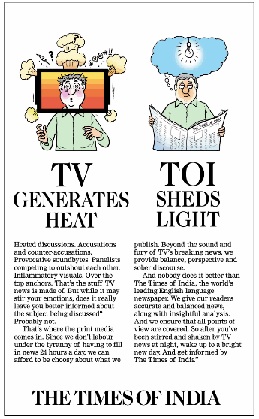
    Is it then surprising that The Times of India issued an ad that said that TV was all hot air and only newspapers can shed light on events?

    **

    Newspapers of course tried to explain what the latest 2G revelations mean but even they struggled between dates and memos. With the prime and finance ministers out of the country, further political explanations became difficult. The Supreme Court stepped in to make it clear that its silence on 2G should not be misinterpreted to mean that it is asleep.

    The Sikkim earthquake and the problems of rescue operations got adequate representation (although TV did not forget, it must be acknowledged).

    Also the Planning Commission’s bizarre figures to determine poverty in India got newspaper space and flak. Advani’s little problem was a single column here and there – this is not a new story after all.

    Salman Rushdie’s introduction to Twitter was found to be newsworthy, two days after he took the literati of the twitterati by surprise by showing up there.


    **

    Every time a new film is due, the India media behaves as if a new inhabitable planet has been found. This week, it seems, a new film will be released. One does not know yet whether space suits will be required or it will be one more black hole.

  • Mediaah!: Is Arnab Goswami the “over-the-top anchor” in the TOI ad?

    By Pradyuman Maheshwari


    This is not the first time that someone from within the Bennett, Coleman & Co empire has taken on Arnab Goswami and Times Now. In the past, Prashant Panday went hammer and tongs at Arnab. The post was on Prashant’s Facebook wall, and didn’t beat about the bush. I must say I was quite surprised that the CEO of a group company which runs the very popular Radio Mirchi network could write all of it so openly (read: An open letter to Arnab ).

    The fact that Prashant wrote it and still has his job speaks volumes for the internal democracy that exists in the group. Though my wicked brain thinks there’s more to it… especially when I saw this ad on the sports pages of the Mumbai edition. Chhota 15×3 ad, but very interesting.

    You must read the text… all of it.


    Heated discussions. Accusations and counter accusations. Provocative soundbytes. Panelists competing to outshout each other. Inflammatory visuals. Over-the-top anchors. That’s the stuff TV news is made of. But while it may stir your emotions, does it really leave you better informed about the subject being discussed? Probably not.

    That’s where the print media comes in. Since we don’t labour under the tyranny of having to fill in news 24 hours a day, we can afford to be choosy about what we publish. Beyond the sound and fury of TV’s breaking news, we provide balance, perspective and sober discourse.

    And nobody does it better that The Times of India, the world’s leading English newspaper.We give our readers accurate and balanced news, along with insightful analysis. And we ensure that all points of view are covered. So after you’ve been stirred and shaken by TV news at night, wake up to a bright new day. And get informed by The Times of India.


    Not all of it is untrue. Panelists do outshout each other on news TV. Put Jayanthi Natarajan and Ravi Shankar Prasad in one discussion and there’s more noise and less discussion. Also you can be sure you won’t find all the news on television… esp the private channels. Doordarshan News has a lot more meat, but it is soooo boring.

    What deserves another look and no real reading between the lines is a bit from the first para:

    Heated discussions. Accusations and counter accusations. Provocative soundbytes. Panelists competing to outshout each other. Inflammatory visuals. Over-the-top anchors. That’s the stuff TV news is made of.

    So let’s look at the people who dominate the nightly news on the English non-business news channels, which I guess is what the TOI ad is talking about: Rahul Kanwal (Headlines Today), Rajdeep Sardesai and Sagarika Ghose (CNN-IBN), Vikram Chandra, Barkha Dutt, Prannoy Roy (NDTV 24×7) and of course Arnab Goswami on Times Now. There’s also Rahul Shivshankar on NewsX, but my cable operator doesn’t offer the channel, so would reserve comment on him.

    Rahul Kanwal is aggressive and provocative, but he is not sound and fury. Rajdeep has mellowed (and become very good once again), but Sagarika can go high-pitched. On NDTV, Dr Roy and Vikram C are exceedingly softspoken and can’t harm a fly. Barkha still attempts to ask some tough questions, but like Rajdeep isn’t what she used to be around the time of the Gujarat riots.

    The one man who fits most of the attributes described in the Times (of India) ad is Arnab Goswami. I don’t agree with him being over-the-top, though there are many who believe so. I think he asks the tough questions, and is possibly the only one to do so day after day. Yes, he gets carried away, but needs to be cruel with our politicians. And even as I join others in lampooning Arnab for his the-nation-wants-to-know-line, the fact of the matter is that we all really want to know.

    I do feel that Times Now overstretches itself on issues like Pakistan, China or racism, but heck we need it.  As for inflammatory visuals, I think the print media is also fairly irresponsible. Though the impact of television is a lot, lot more on the common man or woman.

    Let’s keep this discussion on. Email Mediaah! at pradyumanm@mxmindia.com and I will carry the best comment here when I am back on Tuesday.


    Pataudi, RIP


    But for the time when he patted me on the back and gave me an autograph, I’ve never met him. But heard loads about him.

    When the news of Tiger Pataudi’s passing came in last night, almost by reflex I called a colleague to check if we could get someone in adland to reminisce dealings with him for endorsements. Then we tried checking on his connections as editor of Sportsworld and for his stint at Dev Features. The Sportsworld team is scattered all over. There’s an interesting tribute by Derek O’Brien in The Telegraph.

    I called Vivek Sengupta on reading his tweet, and finally convinced him to write a few lines. That was around midnight. Vivek may have turned into a public affairs and PR practitioner for a while, but he’s essentially a journo. He knew I wanted him to write, and sent his copy in an hour.

    Meanwhile, we had no luck with getting an adman to write on Pataudi’s ads. But here are two of his TVC that I found on YouTube (the  first a rather long Gwalior Suitings ad and the other being the recent Lays TVC with Saif)

    [youtube width=”350″ height=”260″]http://www.youtube.com/watch?v=iei989o4l-I[/youtube]


    [youtube width=”350″ height=”260″]http://www.youtube.com/watch?v=dTVIrhnt5x4[/youtube]


    Buzz me if you have a story to tell. Confidentiality assured. There are various ways you can reach me:

    pradyumanm[at]mxmindia.com, 23050B5D, pradyumanm@gmail.com, @pmahesh, 98338 76278.

  • Delhi Mid-Day takes Bollywood to offices

    By A Correspondent

    Mid-Day gave its Delhi readers an opportunity to come face-to-face with the star cast of the movie Soundtrack through the  Mid-Day Bollywood Lunch Contest. Rajeev Khandelwal visited the office of Vivaki Exchange, Gurgaon to meet and have lunch with Nitin Dhingra, winner of Mid Day Bollywood Lunch Contest. Rajeev Khandelwal was accompanied by actress Mrinali Sharma and director Neerav Ghosh of the movie Soundtrack.


    Speaking on the occasion,Anirban Bagchi, Publisher, Delhi Mid-Day, said, “Mid-Day Bollywood Lunch Contest is an international award winning property with Mid-Day since the last four years, wherein we take the stars of the movie to corporate offices and give its employees an opportunity to interact with the stars. It is one of our many successful properties in Mumbai since the last 4 years and we have started executing this property in Delhi too, with the first one being BLC for Jhootha Hi Sahi with John Abraham.”


    The Bollywood lunch contest is an activity wherein Mid-Day runs a contest for the readers to win a lunch date with the stars of the movie. And because of the winner; all the office colleagues get to meet their favourite stars at their office.


    Mid-Day had earlier done Bollywood lunch contests with stars like Aamir Khan, Ajay Devgn, Ranbir Kapoor, John Abraham, Arjun Rampal, Emran Hashmi and Anil Kapoor.

  • Freaking News by Ranjona Banerji: Where’s the fizz gone?

    Life is dull, I have to admit, when television is not having hysterics about some issue or the other. And this week has been particularly short on made-for-television news events. I know I’ve grumbled about the neglect of subjects like the civil war in Libya or the collapse of the world economy but even I know that we cannot whip ourselves into a jingoistic frenzy with such sparse material to work on. No anchors foaming at the mouth, no calls for answers and no heartfelt pleas for justice, mercy or anything at all, nothing in fact that makes television news compete with the top general entertainment channels.

    So yes, the collapse of the world’s economy did make it to Indian television at last but that’s only after the Sensex fell at the end of last week and investors lost a notional amount that ran into lakhs of crores. By now we are so used to inflation and rising interest rates that no one can drum up even one fleck of hysterical foam at the mouth.

    In fact, we seem to be so wrung out and tired by recent events that even some T20 cricket tournament has not filled us with our normal passionate exuberance. We did try to drum up some enthusiasm for that mysterious note that one finance minister wrote to another former finance minister, something to do with the 2G scam, but no one knows enough about it and the people who know aren’t telling.

    Then Headlines Today, which is trying to steal the top patriotic channel slot from Times Now, did get quite excited about the current fight between the US and Pakistan but even that didn’t go far. Shoaib Akhtar, the Pakistani cricketer, said something about Sachin Tendulkar in his new book (yes, apparently he can write). But for all the patriotic fervour which we could have shown, the only people who managed to make something of it were some political parties in Maharashtra.

    CNN IBN remained steadfast in its coverage of the earthquake in Sikkim and its aftermath while by Monday morning, the floods in Orissa and Bihar were all over television.

    Talking about Pakistan, the BBC has a fascinating Hard Talk with Imran Khan, asking some very tough questions as usual and allowing the guest to answer them.

    **

    The newspapers, obviously, were in the same boat. They also realised that the world economy was in trouble. They managed to explain something of it, throwing the collapse of Greece into the mix as well. The unfortunate plane crash in Nepal got the front pages. Patriotism is everywhere so the Hindustan Times headlined the number of Indians who had died. Lesser mortals of other nations not so fortunate to be Indian also died.

    The weekend saw some newspapers telling us that Paris Hilton, general celeb and heiress of the eponymous hotel chain, was in town. The opinion pages were still obsessed with Narendra Modi and his prime ministerial ambitions and whatever else. Am not sure that anyone else still cares, especially since we are currently in this non-news cycle.

    This morning The Times of India came to me bright yellow as if it had been dipped in haldi and this made reading it very difficult.


    **

    I can only hope that things pick up as the week moves on.

  • Newswatch: Covering the queer spectrum

    By Nitin Karani


    There’s little to be happy about the state of journalism today, but this piece will try to remain upbeat and offer constructive comments on coverage of LGBT (or queer issues). The focus is mainly on the English-language media. First, a pat on the back for doing by and large a good job, especially in the editorials department! A lot of the reportage is either by queer and queer-friendly journalists themselves or driven by them.

    These journalists are also the most innovative in their approach to queer issues and in touch with the pulse of queer communities despite not being on an ‘official queer beat’— another sign to management why they need diversity and inclusion in their organisation. Having people in your media house from different communities helps you understand them, reach out to the communities and broaden and strengthen your coverage. One editor deserves a special mention here. Aditya Sinha, currently with DNA, launched a weekly ‘Sexualities’ page (it was mainly about queer issues) back in April 2008 when he was with The New Indian Express. The practice continues at DNA, which has a monthly page. Quality may be ultimately important but for marginalised identities this is great exposure in the short run.

    This is not to say that there is no homophobia in the media. Of course there is sensational and sleazy reporting (TV9’s “sting” op in Hyderabad; “Central Park a Gay Paradise”: Mid-Day); insensitive, even biased writing (“A baby for gay, deaf, mute couple? It’s cruel”: Deccan Chronicle) and totally muddled, pseudo-scientific horrors as well (“Lesbian? Not quite, say psychiatrists” and “Trapped In Bad-Girl Taboo”: The Times of India). Then, there is the let’s-not-talk-about-it attitude, which is probably true of quite a few publications, but probably nowhere as ingrained as at the Reader’s Digest. However, change is inevitable and so is a debate on queer issues.

    What the media needs to do most is to go beyond the superficial, else both reader and writer will be bored! And which reader would like to start their day with a humdrum piece on a Pride parade when there are so many other colourful diversions? There are many interesting queer stories waiting to be told yet. If mainstream newspapers and channels won’t tell these, then the competition will (for instance online news magazines such as FirstPost.com). The White House has a new LGBT liaison but how many people know he is of Indian origin: Gautam Raghavan. Usually, the press goes gaga over desi achievers, even those who want to deny their Indian origins. So isn’t the Gautam Raghavan story worth an interview or at least some column inches? Let’s start with the basic issue though.

    The terminology: Admitted it can get confusing, especially with the never-ending acronyms (LGBTQI… – even The International Lesbian and Gay Association named its 2002 Mumbai regional conference ‘A-Z: The Other Asia’). However, journalists are supposed to know. Or find out! The latest NGO abbreviation is “MTH”, or men-who-have-sex-with-men, transgender and hijra. Label with care! Most people use ‘TG’ and ‘hijra’ interchangeably with eunuch. But hey, it’s all about letting people be themselves and choosing their own labels instead of imposing. Also, note that not only is the word ‘eunuch’ outmoded, but also a lot of queer people object to it as a derogatory term. Dictionaries can’t seem to keep up with these changes, so cultivate your go-to experts for advice on such matters. Ultimately, of course, people are more complex than labels.

    Pride marches: It’s been more than a decade since this annual event became a regular feature on the queer calendar in Kolkata, and every year new Indian cities are added to the list. However, in terms of visuals at least, our photographer colleagues give it the same hackneyed treatment – the usual close-ups of a hijra/transgender or of two transgenders kissing each other. The focus is always on the most garish. If they would only look more closely, and not get blinded by all the colour and pageantry, they will perhaps capture new stories of the gay couple with kid in tow, the gay bankers network, the lesbian elders who have been together longer than you have been a journalist and so on, instead of dismissing the rest of the crowd as ‘boring, normal-looking’ LGBs (lesbians, gays and bisexuals).

    TV debates/‘balance’: Twenty years of sat TV and all we have to show for it is a handful of coming-out stories and the same old discussion on every Oprah copycat show. These shows do face limitations because not many people are willing to out themselves on TV yet (even when given the honourable way out by hosts such as Simi Garewal). It’s a challenge that needs to be taken up, though, and tackled with ingenuity. Only ‘reality’ TV is pushing the boundary here, not the news channels. Although the distinction seems to be blurring!

    Meanwhile, newsroom discussions have the mandatory religious figure (to the point that it has become predictable which talking head will be on air and what they will say) even when the discussion on decriminalisation of homosexuality has nothing to do with any religion, especially Christianity. Politicians and ministers, who fight shy of the issue in public regardless of which side of the debate they are on, are never pinned down, unless they are also small-time politicians with a religious minority connection. Besides Tamil Nadu parties, which have shown some initiative on TG issues, no political organisation has been made to speak up on queer issues, although politicians are difficult to shut up on any other subject. When some of them do open their mouths to speak utter rubbish, like Ghulam Nabi Azad and Farooq Abdullah did, the media allows them to get away with it.

    On the other hand, sometimes journalists defend insensitive writing on specious grounds. In the name of religious celebration, it is common for people to dance on the streets of Mumbai to Sheela, Munni and Shakira numbers, and no one blinks an eye. What then would you say to a journalist specifically seeking out people who could have moral issues with Mumbai Pride week celebrations in suburban Bandra – just so that there is “balanced coverage” of the celebrations! That too in the midst of the Pride week, when some off-balance zealot might get provoked by irrational fears of children “getting into wrong things” expressed in the piece.

    The business of gay icons: Most stories about showbiz are created by PR people and so a new ‘gay icon’ emerges every few weeks. Often the actors too are fooled into believing their ‘iconic’ status by their producers. The rare actor does try to live up to the status with a sensible head on his shoulders and some genuine concern for gay equality. Seriously though, gay men have very diverse tastes, and rarely is an actor put on a pedestal by them. So most of the talk about someone being a gay icon, and asking every other actor what they think about being called one is, well, a con. Sure, let’s ask what actors think about playing gay on screen (though most will give you hypocritical answers as directors such as Onir will testify because they fight shy of doing such roles). But let’s also ask them the tougher questions, such as why they play the stereotypes and caricatures when they apparently root for gay equality.

    Staying with icons, how come we don’t read about lesbian icons in showbiz? Is it because it’s a male-dominated industry in a patriarchal society that still represses women’s sexuality? So the straight men will continue to enjoy the thought of girl-on-girl action but are unlikely to toast an actress as a lesbian icon anytime soon. The serious journalist would find enough genuine queer icons if they only looked.

    Reactive, not proactive: Most of what we read on the subject tends to be event-driven—a film festival, the launch of a business catering to the queer community, and so on—rather than being driven by the journalist’s imagination. With so much happening anyway (and so many press releases being dumped into the mailbox, not to mention the noise on social media), it may seem reasonable to forget about queer issues. However, bear in mind that the queer community works with limited resources (even if a certain set seems to party hard), can rarely afford to employ PR professionals and most community organisations are dealing with one crisis after another (such as suicides, threats from families, HIV-positive people falling seriously ill suddenly, hate crimes, ministers shooting their mouths off, big question marks over police permissions for public events and funders not releasing money on time). In such a scenario, the journalist needs to chase the well-networked individuals from the queer community for stories too.

    Outing, crime: Gossip is cheap but sometimes true. When it comes to a person being allegedly queer, the juice is passed around but rarely gets into print. Affairs of Bollywood stars and celebrities get written about endlessly, and not just in filmy magazines. Now even sports stars and politicians are making headlines for amorous achievements off the field. Only as long as it’s all heterosexual. Contrast this with the very polite treatment of gay rumours. Once in a while, a Shah Rukh or a Karan Johar will be asked about the enduring goss (okay, Karan, it wasn’t polite that one time). A Milind Soman will even admit that the silliest rumour he has ever heard about himself is that he had an affair with a man no less than Ratan Tata. However, even a quotable quote will remain buried, never receiving the same threadbare treatment of a hetero affair. Like Milind Soman telling Stardust years ago that had he not been in love with Madhu Sapre, he would have been in love with a man. No controversy there apparently, but great controversy about the Tuff in the buff ad!

    That is not to say that every silly rumour should be chased and every quote blown up into a headline. However, why the unequal treatment? The privacy argument should apply equally to queer and hetero individuals. Frankly, the privacy argument is bogus and just a convenient excuse to cover up. No one’s interested (okay, some may be) in who does what with whom in bed. How is privacy invaded though by just saying that you are gay, bisexual, transgender, asexual, intersexual, or whatever? In fact, unwillingness to answer that question, especially when you don’t tire speaking about every other mundane aspect of your life, can only mean one thing. If a person claims to be an environmentalist or feminist but runs a polluting industry or is a doormat wife of a bigamist, wouldn’t you point out the double standards at least? So if a closeted gay politician does anything to harm the queer community or a filmmaker produces a film with gay stereotypes or caricatures, shouldn’t such people be outed? Those are the questions that stare journalists in the face today.

    Once, in my journalism class, there was a group discussion where we students were given a hypothetical scenario. A cinema known for its gay porn gets burnt down and several male patrons lose their lives as a result. Among them are well-known, closed members of society. The newspapers have a choice to report the names of the dead, or hide them to spare the families of the dead person the stigma. Predictably, quite a few of my classmates recommended the newspapers should not publish the names. Many queer people would also agree, on the ground of ‘privacy’. However, not publishing the names, especially when that is the publication’s usual practice in case of such accidents, suggests and reinforces the sentiment that being gay is shameful. The dead person is not around to be affected by the ‘outing’, and we don’t even know what their choice would have been had they been alive: whether to come out, or not.

    As a matter of routine these days the police just hands out the names of queer murder victims whenever they think there is a ‘gay angle’ – sometimes one even wonders if they aren’t being overzealous about discovering a  sexual slant. The names get published, which is not problematic per se. What should bother us is whether any journalist even pauses for a minute and questions the police’s version of events in their minds.

    Dead people may be unaffected by the outing but it could be hell for closeted gay men abused, called names and forced to give out their names and contact details to the police simply for being at a party. If this isn’t torturous enough, they are put on display before an unquestioning, servile, insensitive media which has been ‘tipped off’ so that the pictures can be beamed to the world and played in an endless loop.

    How come no one argues for privacy when the cops ‘bust’ a private gay party? Who takes responsibility if one of the guys kills himself or gets beaten black and blue by his family? Even as the US President tells Manmohan Singh and the rest of the UN to protect their queer citizens, the Mumbai police won’t even let gay people party.


    Nitin Karani edits equity research for a living when he is not trawling the web for media reports on queer issues. He also blogs infrequently at queerindia.blogspot.com, and writes for Bombay Dost magazine.
  • When Arnab’s panelists turned argumentative

    By Ranjona Banerji


    Today is the turn of newspapers, which saved the day. That is, it gave readers a sort of clue about what was going on in the government over the 2G note about the former finance ministry from the current one. Or at least, we have been led to understand that a serious damage control exercise is going on in the government and Pranab Mukherjee has sought to clarify that his note did not target P Chidambaram. It also seemed evident that Congress president Sonia Gandhi had stepped in to stop her ministers from getting into public spats.

    Television made much of the ruckus in the J&K Assembly over a possible clemency plea for Afzal Guru, sentenced to death over the 2001 attack on Parliament. The plea started with a tweet put out by J&K chief minister Omar Abdullah after the Tamil Nadu assembly asked for clemency for some of the people facing a death sentence for their part in the assassination of former prime minister Rajiv Gandhi. A recurring problem with TV is that it does put matters into perspective or indeed explain the pernicious nature of using parochial interests to put forward such clemency pleas. Therefore, the debate should have covered all three recent incidents – Sikhs asking for clemency for Devender Pal Singh Bhullar of the Khalistan Liberation Force for a bomb attack in ’83, Tamils asking for clemency for Murugan, Santhan and Perarivalan for their role in Gandhi’s death and Kashmiri politicians asking for similar clemency for fellow Kashmiri Afzal Guru. All these people were sentenced on charges of terrorism and either the same standards apply to all or our polity will be in serious trouble.

    However, Times Now could not conduct a proper debate on this mainly because the panellists were unruly and argumentative and all Arnab Goswami’s pleas went unheard. He should have just cut the sound and continued perhaps. Most newspapers meanwhile, chose not to give this incident too much importance which may well be the more intelligent way of dealing with it.

    The Calcutta High Court verdict in favour of the West Bengal government over the Tatas in the Singur land acquisition was given prominence by most newspapers, with The Telegraph. Calcutta and most business papers giving it the front page.

    **

    Even in the dumbing down of newspapers which we are so fond of, it was interesting to read an edit page piece on the neutrinos which travel faster light at the CERN lab in Geneva. Even if not all can understand what is going on, it is important to keep track of such events.

    One would have expected more analysis on the current face-off between the US and Pakistan over the ISI’s terror links and the allegations made by US Joint chief of staff admiral Mike Mullen, since the fall out has direct implications for India. Perhaps our top analysts are sharpening their knives.

    **

    A fascinating TV-print-social media back and forth is going on over the BBC’s interview with an investment trader, Alessio Rastani, over the current economic crisis. Rastani told the BBC that traders like him waited for such moments to make money and that the markets were run by Goldman Sachs and could not be controlled by government actions. The interview went viral on Facebook and Twitter. Newspapers and magazines claimed that Rastani was a hoax and one paper quoted him as saying he was an “attention seeker”. Rastani’s finances, as investigated by the British newspapers, seemed none too healthy. The BBC however stood by its decision to call Rastani as an expert. The general consensus seemed to be that whoever Rastani is and whatever his credentials, he seemed to have spoken some very bold and harsh truths!