Category: MxM JOURNALISM REVIEW

  • Ranjona Banerji: Cartoons as weapons of mass destruction!

    Ranjona Banerji

    By Ranjona Banerji


    All efforts are now being made to wipe out India’s most dangerous weapon of mass destruction: the political cartoon. This awful instrument of power, if it falls into the wrong hands (ie, cartoonists), can end up doing the most terrible damage to reputations, thin skin and “sentiments”.


    In recent times cartoons have caused incalculable damage. But strangely – and this is their enormous reach – the cartoons have emerged from the past where they had been lurking. It is not enough to imagine that because today’s newspaper is tomorrow’s sev puri wrapping, the power of the cartoon is diminished. It has an insidious way of reappearing in other forms – like those other lethal objects, books. And even worse, textbooks.


    Young minds, while they can easily absorb news of war and cruelty and indeed thrive on the vulgarity which passes for entertainment in India, would be irreparably tainted if faced with a political cartoon. And yet, by stealth for what else could it be, these cartoons have managed to inveigle themselves into textbooks.


    It started however with that other source of free expression, the Internet. Someone committed the most heinous act of forwarding a cartoon making fun of West Bengal chief minister Mamata Banerjee. But in spite of the strict action taken against the transgressor, the cartoon has only got bolder.


    Soon after a cartoon from 1949 was discovered being satirical about the delays in putting the Constitution together. Not only did it show the Constituent Assembly as a snail but it showed Dr BR Ambedkar sitting on the snail, with a whip in hand and then Jawaharlal Nehru whipping the snail. This is wrong on so many levels and particularly to snails. What have these fat sluggish creatures done to deserve whips? They have no feet and they cannot move any faster. There are no records about the action taken against the cartoon in 1949 by the Royal Society for the Protection of Animals but one can only hope that People for the Ethical Treatment of Animals will soon be holding a mass agitation at the Ramlila grounds in Delhi to increase awareness about this subjugation of snails. Good luck with getting hundreds of naked girls to agree to have snails crawling all over their bodies – a normal PETA method of agitprop. But protests there have been and there must be.


    And now we have a cartoon from 1968 implying that students in Tamil Nadu knew neither Hindi nor English. Now what could be more insulting to the education system of the past? Implying that students had been taught nothing is most unfair. How can the education system from 1968 possibly stand up for itself? It is therefore only right that the protests should happen in 2012.


    The other way of course is to put the cartoon on the endangered species list and wait for the World Wildlife Fund to step in…


  • Ranjona Banerji: Getting a bum deal from Yahoo India

    Ranjona Banerji

    By Ranjona Banerji


    Last month, I dumped my Reliance internet connection (dip in connectivity and more importantly, rude service) and opted for Tata Photon. But my grouse is not with either of them. It is with Yahoo India. The Tata Photon opens with a Yahoo India page (I can’t shut it down too quickly because then Mozilla Firefox won’t reload and I can’t go back to Google Chrome because it slows down my machine and particularly did not like this website… so who said the internet was all plain sailing!).


    The page is dominated by Bollywood nonsense (celebrities who married young, star break ups that hurt us more than it hurt them) and then a sprinkling of political news in the next segment and only cricket news in the next.


    I am now inured to the stranglehold which Bollywood has on our lives. But I still question a news source which can look no further than the lowest common denominator. I also don’t quite know if the average internet user in India wants only Bollywood and cricket and nothing else. Has Tata Photon done any such research about its average user?


    Out of curiosity and since the damn page was open, on Tuesday evening I ventured further into the Yahoo India page and decided to see how it treated other news. In the sports category, there were only cricket, tennis and football, in that order. I went to tennis since that’s my area of interest. There was a story about Maria Sharapova, nothing at all about Rafael Nadal and Novak Djokovic’s French Open battle and Nadal’s historic seventh French Open title.


    Instead I see a story about how reality TV star, Kim Kardashian, “flashed her bums” during some family tennis match. I went no further into the story, credited to ANI, but it is wrong on so many levels. For one, the English. It is not “flashed her bums”. Bums when it applies to the buttocks is a singular entity, like bottom. Unless Kardashian has cultivated a collection of homeless drunks which she brought along to a family tennis match.


    But more than the grammar, it is the intent which is offensive. I understand that sex is a human impulse which beats all others (well…). But why should this daft little story find itself in a sports section of a well-known website? Is there any connection with tennis at all? If I wanted to fulfil my baser instincts on the internet there are enough explicit sites for my guilty pleasures. Yahoo India is not the preferred choice for anyone, unless that it is intention? The Yahoo.com website has an excellent, up to the minute and comprehensive sports section. Is Yahoo India so far away from there?


  • Ranjona Banerji: Is the media fickle, or just having fun

    Ranjona Banerji

    By Ranjona Banerji


    Television is, of course, very worried about the next President of India, but newspapers have given it the treatment it deserved – reporting on the news rather than trying to create it.


    Which means that Friday morning saw the straining of the ties between the UPA and Trinamool Congress get full play in the papers, although Mamata Banerjee’s mocking of the prime minister seems to have got a muted response.


    There has been a distinct movement to belittle Manmohan Singh and the media now appears to have been taken along for the ride. It seems a bit odd that rather take a non-partisan stand, the media has been party to this campaign. Or maybe it is not odd and I am not surprised.


    The downside for Team Anna is that Mamata Banerjee has stolen their limelight. Of particular interest is her declaration in today’s Times of India that she is a “simple man”. Indeed.


    * * *


    Mumbai’s newspapers have focused this week on the extraordinary behaviour of the Mumbai police, with its raids on bars and restaurants and treatment of customers. On Thursday, The Times of India, Mid-Day and Hindustan Times dedicated pages to the police’s highhanded methods and its reliance on archaic laws to harass people. Vasant Dhoble, the assistant commissioner of police who conducted most of the raids, was also targeted. Pritish Nandy has written an impassioned article on the destruction of civil liberties in Mumbai over the years in TOI.


    Some of this concerted media focus has prodded the minister of state for home to ask the police to exercise some restraint. There has also been some discussion to re-look at all these old and pointless laws.


    Friday’s Mid-Day has a story on how the protests against Dhoble and the police which started on cyber space are now entering real life as well. And, according to the paper the city’s “young leaders” like Milind Deora and Poonam Mahajan have also asked the police not to harass the innocent.


    * * *


    The unfortunate ego battle between Indian tennis stars Leander Paes and Mahesh Bhupathi has now got full media attention, especially as it affects India’s Olympic media chances. Here too, the media is divided between the two and as Bhupathi is better at building media relations, his case is being viewed with more sympathy. This is, in spite, of the fact that Bhupathi is the one putting up terms and conditions and refusing to play with Paes and also that Paes has bigger dibs on the Indian Olympic team because of his higher ranking.


    * * *


    The News Corp noose around British prime minister David Cameron gets closer and closer. Testifying in front of the Brian Leveson Inquiry into media ethics, Cameron tried to stand his ground that he had done no wrong but was hard-pressed to explain a text message from former News Corp CEP Rebekkah Brooks which said “we’re definitely in this together” just before the general election which the Conservative Party and Cameron won.


    The nexus between Britain’s political classes and the Murdoch organisation is no secret but its tentacles appear to have poisoned British polity, the establishment and the media itself.


    * * *


    Interesting to see after all the hoopla over former army chief VK Singh and all that bombastic media support, suddenly the media focus seems to have shifted to his detractors!


    Fickle or just having fun?


  • Reviewing the Reviews: Ferrari Ki Sawaari

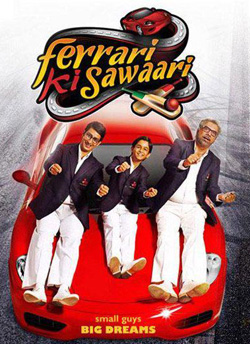
    Ferrari Ki Sawaari


    Directed by-Rajesh Mapuskar


    Produced by-Vidhu Vinod Chopra


    Written by-Rajesh Mapuskar, Vidhu Vinod Chopra, Neeraj Vora


    Starring-Sharman Joshi, Boman Irani, Ritvik Sahore


    Sometimes ‘well-meaning’ is not a compliment. When applied to a film that has a lot of good elements, but doesn’t quite make the grade, it sounds like a lot of critics struggling for compliments.


    Newbie Rajesh Mapuskar’s Ferrari Ki Sawaari, settled into the 2.5 to 3 groove, with only the usual suspects, Times of India and bollywoodhungama.com, going higher.


    It’s the kind of film that might get awards for wholesomeness, but doesn’t come anywhere close to the Hrishikesh Mukherjee kind of cinema it aspires to. (And just by the way, how does a middle-class, scooter-riding Parsi and a tapori manage to drive a Ferrari?)


    Rajeev Masand of IBN gives it 2.5 and writes: “Starting off nicely as a portrait of a middle-class Parsi home, Ferrari Ki Sawaari coasts along comfortably, delivering clean laughs punctuated by occasional moist-eye moments. But from the moment Rusy makes off with the master blaster’s hot-wheels, the film seems to abandon all sense of logic, and subsequently sinks into a sludge of melodrama.”


    Shubhra Gupta if the Indian Express is usually fair and not swayed by Bollywood hype. She gives it 2.5 too. “The title says it all. This is a film about a Ferrari and a boy who takes a very special ‘sawaari’ in it. The boy is cricket-mad. The super-fast, super-luxe car belongs to the one and only Sachin. Can a film which has these ingredients – cricket, cars, and how-dreams-can-turn-into-reality – turn out less than a cracker? ‘Ferrari Ki Sawaari’ is well intentioned, well produced and well acted, but doesn’t really vroom off the screen.”


    Preeti Arora of rediff.com, 2.5 again: “So much love flows around but nothing is really happening on screen. Sit back and admire the father-son duo, the narrative will move ahead at its own pace. It’s the predictability which pulls the story down. Like one knows even as Kayo’s father searches desperately for a new bat, he will reach the cricket field in time to hand it over to his son. Or when we see him enviously eyeing a new pair of shoes, Kayo’s shoes will come undone on the field, causing him to stumble mid-run. Ho-hum.”


    Saibal Chatterjee of NDTV, 2.5 too: “This competently crafted and well-intentioned cricket-themed film steers clear of many of commercial Hindi cinema’s narrative conventions – it sure gets full marks on that count – but succumbs to some of its most retreaded clichés. You might root for the young underdog and his honest-to-a-fault family as they chase an impossible goal, but Ferrari Ki Sawaari isn’t another Iqbal. It won’t have you springing off your seat. The protagonist’s battle against the odds lacks the dramatic horse power that could have sent the film zipping down the fast lane. The characters are lovable enough, but their little joys and setbacks, and the emotional ebbs and tides, dangle somewhere between reality and make-believe. Ferrari Ki Sawaari is a bit like a warm bear hug that eventually leaves you cold.”


    Now come the 3s.  Vinayak Chakravorty of India Today comments: “We have here a Rajkumar Hirani film that the director didn’t make. Every twist about Ferrari Ki Sawaari bears the Hirani trademark and logically so. The filmmaker co-wrote this script and also penned its dialogues that bring back the good-natured humour of the two Munnabhai flicks and 3 Idiots. Ferrari Ki Sawaari takes us back to Planet Hirani, where even evil is basically nice. It’s a world where the hero doggedly defines innocence and does a wrong turn only by chance. The baddies can’t quite mess with goodness no matter what they do, and a tearduct-friendly finale will see a large group of people coming together to root for the hero (recall the college Q&A session in Munnabhai MBBS or the FM radio/shaadi climax of Lage Raho Munnabhai). Debutant director Rajesh Mapuskar doesn’t break the formula. Being Hirani’s associate director on 3 Idiots and Lage Raho… obviously rubbed off on his cinematic sense.”


    Karan Anshuman of Mumbai Mirror gives it a generous 3 stars and writes: “In the end, Ferrari ki Sawaari tries too hard. With its manipulative music, serendipity-dependent writing, over the top characters and its length, it does get a little tedious. I love cricket, the underdog story, and well, who can resist a head turn at a Ferrari? It still didn’t work for me. But that’s not to say it may not for you.”


    Aniruddha Guha of DNA, 3 stars, comments: “Where the film flounders is the hyperbole. Time and again, we’ve compared Hirani’s films to Hrishikesh Mukherjee’s, and while the legendary filmmaker’s characters were as good-natured and lovable as Hirani’s, they were also very real. Hirani, and now Mapuskar, tend to show their characters to be a lot more extreme – either too good, or too honest, or too naive – and the situations they are put under are sometimes so unreal, you start feeling disconnected.”


    The gush and 3.5 stars come from Taran Adarsh: “On the whole, Ferrari ki Sawaari is a noble film, a film that has its heart in the right place. It’s well-intended and sincere and it goes about its business with incredible earnestness. Of course, the film has its share of hiccups, but then all films do, right? But keeping the fault-finding apart, Ferrari ki Sawaari is an accomplished effort. It’s that exceptional film that communicates a point and tells a sensitive story in those 2.10 hours. This heartwarming, tender and sprightly film should not be missed!


    And the crowning 4 from TOI’s Madhureeta Mukherjee: “Sometimes, it doesn’t take 11 players to make a dream team. Debutant director, Rajesh Mapuskar has a winning team with just three, plus a red hottie (Ferrari of course, we’re not talking about boombaat Balan). And guess what…we don’t miss the presence of a pretty ‘maiden’ here too. The spirit of the film is in the effusive chemistry between Rusy and his son, which is entertaining and utterly moving. The writing (Mapuskar and Vidhu Vinod Chopra) is refreshing, Raju Hirani gives the dialogues his trademark spin, and the film unfolds with sheer subtlety and simplicity. Except that, the ride could’ve been shorter (jumping a few red signals would’ve helped), and a few speed bumps saved (a song with a flying red car). The climax goes on an emotional overdrive, and at times, with extra spoonfuls of sugar the film is too-good-to-be-true. But that’s feel good cinema for you!”


  • Ranjona Banerji: Will Pranab Mukherjee be our next President?

    Ranjona Banerji

    By Ranjona Banerji


    Do we have a President of India at last in Pranab Mukherjee? The Union finance minister, perhaps inspired by incumbent Pratibha Patil’s wonderful lifestyle, wanted a similar retirement plan for himself. Lovely house and gardens, lots of fuss and protocol and nothing to do – perfect!


    This is hardly surprising since Mukherjee is the most hard-working man in the Universe. Not only is he the finance minister, a bad enough job, he is also the go-to man for both the government and the party. If the prime minister’s not there, Mukherjee’s in charge. If some ally is misbehaving, off goes Mukherjee to sort it out. If anything in the government is going wrong, Mukherjee to the rescue. If Parliament needs to be taught a lesson, up pops Mukherjee. Since he is 900 years old and has been part of every Parliament as long as anyone can remember, no one can contradict him. Earlier, in the 1970s, no one could contradict him because he always had a pipe in his mouth, so no one could understand him. Now he has got rid off the pipe but comprehension is still a prerequisite to contradiction. He also has a look in Parliament and if he gives you one, you quail and sit down quietly. This puts an end to the Opposition usually.


    In addition to this, he is head of some 8,000 Groups of Ministers and another 8,000 Empowered Groups of Ministers. (I really don’t know what these are but they sound important.) Effectively, this means the government will come to a standstill once Mukherjee moves to Rashtrapati Bhavan. Since we in a form of paralysis anyway, the government is hoping no one will notice.


    The main thorn in Mukherjee side is his “sister” Mamata Banerjee, also known as “I am a simple man”. The “simple man” does not want Mukherjee in the top chair. Bengali parochialism has still not recovered. This is akin to Bengalis supporting Kolkata Knight Riders instead of Pune Warriors. Oh, right, they’ve done that anyway. The TV channels are wondering how the man who everyone (except them) knew would get the job, eventually got it in spite of all their best efforts. India demands an answer here.


    The two comedy acts running on the sideline are PA Sangma and Arvind Kejriwal. The BJP is wondering whether or not to join this laughter challenge.


    The only person laughing all the way to the Mughal Gardens is Pranab Mukherjee!


  • Nanhi Kali: Story of the triumph of communication

    By Tuhina Anand


    Project Nanhi Kali along with StrawberryFrog has set a fine example of what an evocative communication can do for a cause. When KC Mahindra Education Trust, a registered public charitable trust in India and Mahindra Foundation USA, both not-for-profit arms of the Mahindra Group commissioned StrawberryFrog NYC (known for being the world’s first cultural movement agency), it had an inkling of the path ahead. The task for the agency was to help create awareness and support for its Project Nanhi Kali globally, especially through digital and new media campaigns.


    For decades, Project Nanhi Kali relied on paid advertising to generate awareness and support. Seeing the immense potential of the world wide web and the recent social media boom, the management decided to focus all its resources towards the cause and completely reinvent its marketing strategy to harness the potential of the digital media and online space.


    The collaboration between Project Nanhi Kali & StrawberryFrog has witnessed the design and launch of some unique and successful digital campaigns like the ‘A Girl Story’ (http://www.agirlstory.org/), ‘Girl Store’ (http://www.the-girl-store.org/) and the more recent ‘Girl Epidemic’ (http://thegirlepidemic.com/).


    Through these innovative campaigns Nanhi Kali has not only been able to successfully create mass awareness globally and raise sponsorships amounting to $44,218 for the project as well as drive traffic to the official Nanhi Kali website and generate a buzz on online communities such as Facebook and Twitter.


    The StrawberryFrog-Project Nanhi Kali collaboration has witnessed the launch of some innovative and hard-hitting campaigns that have created a buzz online. StrawberryFrog has purposefully designed these campaigns to be provocative to create an initial shock and awe response to the campaigns, and thereby create awareness and break through the wall of indifference.


    The websites individually and collectively not only put the issue of uneducated girls being most vulnerable to exploitation upfront, but also provides the viewer with a solution to join the fight against it by sponsoring the education of young girls. The idea is to bring about a shift in the “culture of silence” in our societies and bring critical issues to the forefront and seek global support to bring about effective change.


    Sheetal Mehta, Executive Director Project Nanhi Kali, on the Girl Epidemic (the recently launched campaign) said: “The Girl Epidemic must be seen and shared, there’s never been anything like it.”


    She added, “The work for Nanhi Kali could convert those who think that creativity in advertising is on the wane. The sheer volume of first-rate award winning work being produced is impressive. From the simple brilliance of “A Girl Story” which is the world’s first donation-based online film series to another standout – The Girl Store an opportunity to bring e-commerce and creativity together in an innovative campaign and where you can buy a girl her life back before someone else takes it.


    The creative excellence, strategic smarts and work ethic of StrawberryFrog working on Nanhi Kali has helped spark something special for brand Nanhi Kali. Further, StrawberryFrog has always understood that a nonprofit has limited resources, and therefore the message being sent needs to be strong and powerful enough to start a movement. The momentum, being slowly built over the past four years, has created a body of work that is outstanding. We are seeing Nanhi Kali at its best.”


    Scott Goodson, Chairman of StrawberryFrog said: “Our goal with this work is to generate more money to educate girl children through Project Nanhi Kali. Period! And we wanted to do this with the greatest weapon we have at our disposal: creativity and innovation.”


    Here’s a look at what StrawberryFrog has created for Nanhi Kali Project


    The Girl Epidemic

    StrawberryFrog & Nanhi Kali recently launched the Girl Epidemic. It shows how girls in some parts of the world are treated as an infectious disease. It highlights the centuries-old absurdity that would value the life and potential of a young girl less than a boy, the result of which is the disappearance of girls, the selling of young girls as young as 8-years-old into sex slavery or marriage. The extremely powerful campaign brings home the message that this is wrong, that it must stop, and that education is the cure. In fact, it is the cure to solving the most important challenge we face as human beings. If you educate a girl, you educate a family, and as a result you reduce overpopulation, environmental impact, hunger, disease and a host of other world problems. The Girl Epidemic shows how educating a girl can save the world.


    The multiplatform Girl Epidemic campaign features an innovative e-commerce site. The main spark to ignite the Girl Epidemic is a major film production for YouTube and the Girl Epidemic ecommerce site where you can make donations. It is a unique trailer-style film that dramatizes an already disturbing societal norm. Young girls are often sold into sex slavery, child labor, and are frequently killed at birth because they are not of the desirable sex: male.


    The cure for The Girl Epidemic is education. Donating to www.TheGirlEpidemic.org can help change deep-seated social norms by allowing girls to receive an education, therefore transforming young girls to become valuable members of society – making them indispensable.


    The Girl Store

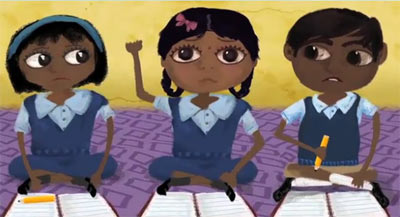
    In 2010 KCMET & StrawberryFrog together launched www.the-girl-store.org. ‘The Girl Store’ is an innovative website which allows the viewer to sponsor the supplies that allow an underprivileged girl in India to go to school and get an education. The Girl Store operates like an e-commerce site. The site asks visitors to a buy a girl her life back by donating school materials to underprivileged girls in India. Visitors can buy specific items, such as a backpack, workbooks, or school shoes for a girl pictured on the site.


    The core idea reiterated throughout the site is that the life of an underprivileged girl is not a condemned fait accompli. It is up to the viewers to change her destiny by ‘buying’ her life back – empowering her through education.  Funds raised through the site are used to provide holistic educational support (not only academic support through classes, but also material support in the form of a comprehensive material kit) to underprivileged girls in India. This website has raised $40,000 through online donations on the store, from 1115 donors globally till date providing educational support to 500 underprivileged girls in India.


    The site has received over 3 million hits till date, raising enough funds to send hundreds of girls to school, and has also received global media coverage. The ‘Girl Store’ has earned critical acclaim to its credit, including the ‘Bronze Pencil’ at the prestigious One Club Annual at One Show Awards held in New Yorkin 2011. It also received a ‘Bronze Cyber Lion’ at the Cannes Lions International Advertising Festival 2011.


    A Girl Story

    Launched in 2010, A Girl Story is a unique, donation-based film series that combines technology, film, and storytelling to shed light on the global challenge of educating young girls. The animated, emotional story follows the path of a young Indian girl named Tarla who wants to go to school to better her life. Whether she succeeds, however, is completely up to you, because Tarla’s story progresses only by audience donations that unlock new chapters within the film series. This website raised approximately $4,000 from 182 donors globally.


  • Troll travails thanks to Twitter

    Ranjona Banerji

    By Ranjona Banerji


    Warren Buffett’s research has shown that while people may no longer read mainline newspapers, they are still loyal to their local community papers. Or at least that’s why Hathaway has invested in any number of community papers in the US but will not put money into the mainstream media. The same research also shows that people who do not buy mainline papers will read them online but not if they have to pay.


    This is a lesson about the internet that the traditional media in the west especially has yet to understand. In India, newspapers are free online but even they have irksome proceedings – like having to register to read the e-paper format like The Hindu. Others like Mail Today only have an e-paper format and no website which is also annoying.


    The freedom of the internet is what makes it appealing – even if no more than 200 people gathered to protest internet curbs – and this includes freedom from opening the wallet.


    The Huffington Post and Daily Beast both every effectively use social media like twitter and Facebook to push their stories – the Indian media is not quite so effective. Although Firstpost (web) and Mid-Day (paper) are not too bad and Firstpost also has the advantage of a fan base which retweets.


    The Times, London is a downer because it requires a one pound payment to open any story and the question is not of the amount so much as the procedure. This also stops The Times from reaching a wider audience as its stories cannot get picked up websites which collate news of a certain kind or allow readers to pass interesting articles along.


    * * *


    Until someone invents something better, Twitter remains the best disseminator of news as it happens. There are disadvantages, as passionately delineated by Namita Bhandare in the Hindustan Times (http://www.hindustantimes.com/technology/SocialMedia-Updates/Running-away-from-the-trolls/SP-Article1-868619.aspx). Bhandare’s problem is mainly to do with the viciousness of internet trolls and she has clearly suffered. But of course it could be argued that the only reason that these “trolls” are so annoying/frightening is because of the enormous access that the internet provides. These “trolls” exist in real life also but we may not meet them that often. The internet cannot invent new ways of human behaviour.


    This response to Bhandare’s article by someone who calls himself a “troll” (aah, irony thou are not dead in India yet) is also illuminating  http://chamchaa.wordpress.com/2012/06/10/an-open-letter-to-namita-bhandare/.


    * * *


    From my personal experience as a columnist for many years I can safely say that people will insult you if they want via any medium of communication open to them. Twitter is just one more. I for one have got death threats, legal notices envelopes filled with talcum powder pretending to be anthrax and plenty of questions raised about the sexual habits of my ancestors and in the old days, all these came via the post office. So what, say I?


    Years of reading letters to the editor (in practically every publication I have been part of) has at least made me realise that people are dying to be heard and deeply resentful when their voices are blocked – or when they perceive it as such. Twitter gives them such a wonderful platform to vent and get rid off their frustrations. Worse than any “troll” remains the famous Mumbai postcard writer with the initials ‘MSK’ whose imagination and capacity for personal insults was prodigious. I believe he is no more and his loss is deeply felt. These are the people who make becoming a journalist worthwhile.


    Yes, there are offensive people on Twitter but one can either not encourage them or just shut them off!


  • Ranjona Banerji: Media double faults in Paes-Bhupathi match

    Ranjona Banerji

    By Ranjona Banerji


    After years of working with city reporters, I accepted the fact that many grappled to understand the concept of “presumption of innocence”: If the police made an accusation against someone, why then it had to be true. But, of course, every accused has the right to defence. And while reporting a story, journalists are supposed to be objective. If they cannot provide both sides of a dispute, they must explain to the reader why they have failed.


    But in the initial rounds of this rather unfortunate fight in Indian tennis, where Mahesh Bhupathi and Rohan Bopanna have refused to partner India’s top tennis player Leander Paes in the 2012 London Olympics, the media started out batting for Bhupathi alone. In what appears to be a well-thought-out campaign, the doubles pair of Bhupathi and Bopanna sent out a series of letters and emails signalling their refusal to play with Paes even before the All Indian Tennis Association decided on the Olympic team. Several newspapers and news channels did not even make a willy-nilly attempt to contact Paes.


    The exceptions are possibly DNA and Headlines Today, who got in touch with Paes’s father. But for the most part, it was about the terrible wrong that was about to be done to Bhupathi and Bopanna – being forced to play with Paes for the Olympics. Mail Today and The Times of India seemed like they had stakes in Bhupathi’s career.


    These pressure tactics appeared to have failed and the AITA decided to pair Bhupathi with Paes. This is where objectivity completely failed India’s sports journalists. Bhupathi came on air and was quoted in print making all kinds of allegations against Paes. The Times of India at last informed us that they could not contact Paes. Therefore, the story remained one-sided.


    Bhupathi and Bopanna meanwhile, perhaps emboldened by this out-and-out media support stated firmly that if either had to partner Paes, they were willing to forgo the Olympics. Despite the media’s usual pattern of extreme jingoism, even this display of lack of country love, did not deter the pro-Bhupathi-Bopanna journalists. One cannot state that sports journalists are less jingoistic than the rest – we see what they do to cricketers regularly. In fact I can guarantee that any top cricketer who refused to play for India because he did not like his team members would be hung, drawn and quartered by the media. By the way, cricket is not even an Olympic sport and technically, when Indian cricketers play, they represent the board. Not so for tennis, where professional players put aside career considerations to play Davis Cup and the Olympics.


    However, as the week of allegations by Bhupathi and Bopanna came to a close, the media slowly started to turn. Paes may have contributed to that by issuing a statement that he was willing to go by the AITA’s decision. The Indian Express and Mid-Day started to look at being fair to all concerned. The Hindustan Times later also presented a larger picture. The Times of India came to the party last – but more on its edit pages than its sports pages.


    Where a reader should have been given perspective on this battle and information to negotiate through this unseemly fight, he or she got a minefield of accusations from only one side. Now the villain of the piece is apparently the AITA as Bhupathi has approached the sports ministry to step in. Bhupathi has accused the selection committee of being a bunch of bureaucrats who know nothing about tennis. To me they appear to be former players – perhaps not of the stature of Bhupathi but tennis players nonetheless, a fact which needs to be pointed out in the media.


    Monday night saw Times Now’s Arnab Goswami ask Mahesh Bhupathi some tough questions – some of which he struggled to answer. This is the first time that Bhupathi’s accusations were questioned. Later, the fathers of Paes and Bhupathi were on Times Now, where Paes Senior pointed out that Bhupathi was not blameless in this battle, while Bhupathi Senior tried to shrug that off and say the Olympic riddle had to be solved not the mistakes made by the boys.


    Appalling as this ego battle between India’s top tennis players may be, the media’s partisan stand has been as appalling.


  • Ranjona Banerji: What the Whacky-dooky?!

    Ranjona Banerji

    By Ranjona Banerji


    I understand that advertising is vital to the well-being of a newspaper but just who invented these idiotic “half-jackets” which either split the front page of a newspaper or cover it with some meaningful and wholesome message about a bank or a soft drink?


    What I mean is, does one blame an advertising agency or the ad sales department of a newspaper?


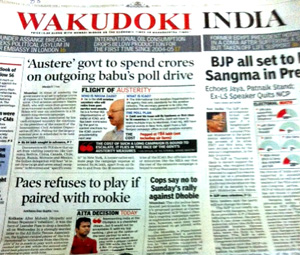
    My problem however is not to do with the advertising message itself – although I was hard-pressed to understand today’s Wakudoki message on The Times of India masthead. Why this car company had to say Wakudoki to us, I don’t know. What Wakudoki is I don’t know. In some places Wakudoki was one word and in other places Wako-doki was hyphenated. Actually this made me happy in a schadenfruede kind of way – copy checkers in ad agencies are of the same calibre as sub-editors in newspapers.


    My primary objection is that they don’t allow you to fold the newspaper properly. This is particularly annoying as you reach the last pages of the paper as the half-jacket page with not enough hold flies off or falls off or slips out. This makes me want to shout something far more robust and potent that “Wakudoki” or even “Waku-doki”. Hyphen or not, the words I’m thinking of do not start with a ‘w’.


    Halfway through reading about Leander Paes’s current tantrum to compete with Mahesh Bhupathi’s original tantrum, I suddenly find the names have changed to Drogba and Rooney. These names are as mysterious to me as “Wakudoki” (and “Waku-doki”) and as I wonder if my coffee has some magic mushrooms in it, I realise that the last page of the newspaper has slipped off.


    I realise that The Times of India is not the only guilty newspaper here. Everyone does it. It’s just that I was whacked in the face today by this vastly annoying invention. It even beats the detergent bubbles and spouting soft drinks I had to deal with as a young sub-editor.


    In my view, I would rather the newspaper just sold its front page, self-respect and identity in one go rather than in half-measures. That way you can just turn the page, know that it will fold obediently and carry on with the latest Purno, Pranab, Nitish, Narendra fight.


    Instead of wanting to start the day by whacking whoever comes close because the newspaper begins with some cheapie corporate who only wants to pay for half a sheet of paper.


  • Ranjona Banerji: TV lacks training to cover live events

    Ranjona Banerji

    By Ranjona Banerji


    The fire which engulfed and destroyed large portions of Maharashtra’s most important government building on Thursday afternoon dominated news broadcasts and the newspapers on Friday – hardly surprisingly. TV channels switched from whatever they were covering – mainly the unseemly drama over India’s tennis stars and the Olympics to concentrate on the fire in Mumbai.


    It’s self-evident that TV is the best medium to cover live events. However, this is where lack of training – both anchors and reporters – gets exposed. Having shown viewers the fire over and over again – which really points to the camerapersons being able to locate the targets – TV reporters then appear to be at a loss. Instead of hundred several of them “standing by” at various locations around an incident, news channels might be better served if they trained some reporters to collect information while others dealt with on-camera duties. This way, viewers would get some news instead of having to hear: “The fire is still raging and as you can see people are waiting anxiously and if my cameraperson could show you…” over and over again.


    This is an aside: Instead of concentrating on emulating some fancy foreign accent, reporters who appear on English channels might spend more time on their grammar. A young girl on Times Now kept talking about the “backside of the building.” Backside however refers to the derriere, posterior, bottom, buttocks, bum – that is, the rear end of humans. She could have just said “back of the building”. This would not have been so jarring – or amusing – if she had not acquired an ambivalent pseudo-foreign accent.


    * * *


    Incidentally, local channels usually win at times like this and Times Now, being the only major English news channel located in Mumbai had the clear upper hand.


    * * *


    And the same can be said of The Times of India. For the past four years now, Mumbai’s largest English newspaper has been flexing its muscle when it comes to local coverage. With the Mantralaya fire, they covered just about every angle. Since they have employed a large proportion of the city’s reporters, they also benefited from the expertise their staff has picked up in other papers!


    In order, Mid-Day comes next and the tabloid newspaper has done a comprehensive and detailed job, then the Indian Express and finally, Hindustan Times. It is at moments like this that Hindustan Times seems to pay the price for concentrating more on packaging than substance. The Times of India has dispensed with packaging to provide material and this seems to be a winning strategy. Undoubtedly, a commendable achievement for a “product” from a group which is also responsible for some of the worst practices in the media today?


    “Sabotage” asked the Economic Times in a boxed item on their front page, thus emphasising the suspicions that almost everyone has about this fire.


    * * *


    Eminent heart specialist Ramakant Panda’s defence of the medical fraternity (obviously still feeling hurt by Aamir Khan’s Satyamev Jayate) on Times of India’s edit page was not just weak, it was quite funny. Imagine using the incredible service provided by Prakash and Mandakini Amte to the tribals as an example of how great doctors are. If other doctors bothered to even do half of what the Amtes have managed for years, our healthcare to the poor would not be so despicable. Most doctors in Maharashtra however refuse to do their rural stint since it severely cuts into the ka-ching of big city cash registers. Please.


    * * *


    This is just a personal note. My rage against biased coverage of the tennis fiasco led one young (am assuming young from the way it was written and the handle Poopsonurface) person to call me a “Calcutta partisan presswalla”. Amused as I am, I must humbly declare that I have never worked in Calcutta or Kolkata in my career which spans almost 30 years. Other than Mumbai, the only other place I have worked in is Ahmedabad. As to his or her’s other suggestion that I “get a life”, I have taken that under advisement!


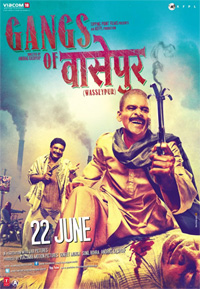
  • Mostly 3.5 *s for Anurag Kashyap’s Gangs of Wasseypur

    Gangs of Wasseypur


    Directed by: Anurag Kashyap

    Produced by: Anurag Kashyap, Sunil Bohra

    Written by: Zeishan Quadri, Akhilesh, Sachin Ladia, Anurag Kashyap

    Starring: Jaideep Ahlawat, Manoj Bajpai, Richa Chadda, Nawazuddin Siddiqui, Jameel Khan, Syed Zeeshan Quadri, Aditya Kumar, Reemma Sen


    Anurag Kashyap has annexed the role of rebel against Bollywood and by making dark, violent films, has got himself a following in the indie and festival circuit. But after the excessive Gangs of Wasseypur (Part 2 is coming up), one can only hope he has exorcised the ghost of The Godfather, and can now truly become a chronicler of the times; he has the style, he has the cinematic sensibility, he has to grow beyond a laddish fascination for violence and men who indulge in crude power games.


    Critics feel duty bound to praise his films, because he dares to go against the rules of Bollywood and thrives; he has edged out Ram Gopal Varma from his prince of darkness pedestal. He also drums up a serious amount of hype. But is there more to him than machismo?


    The film got mostly 3.5 star ratings, as if critics were shying to give it that extra half star and bring it to the excellent category- so despite the praise, it’s technically just a little above good in the ratings.


    Raja Sen of rediff.com found it boring, gave it 2.5 and wrote: “It must here be remembered that mob bosses, at least the ones Hindi cinema have accustomed us to over the years, have hardly been an efficient lot. They growl orders, surround themselves by those applauding their every maniacal move, and, intoxicated by their own bluster, proceed to boast about their convoluted plot to the protagonist, resulting in their climactic downfall. It is this look-what-I-did windbaggery that constantly weighs down Wasseypur, a highly competent and occasionally enjoyable product, and keeps it from soaring like it should have.”


    Anupama Chopra gave it 3 and commented: “Kashyap’s material is strong, but there’s just too much of it. There is so much plot squeezed into the two-hour-forty-five-minute running time that your head swims. We hardly ever stay with a character long enough to get emotionally invested, and a voice-over clumsily interrupts the story to connect the dots. At one point, I was so confused that I longed for a master key booklet to the film that outlined the various factions, relationships and rivalries. The narrative also moves constantly between the personal and professional (murder, revenge and thuggery being the main professions). So the film moves from the enmity track to Sardar’s mistress and at one point even segues into Sardar’s son’s Bollywood-inspired romance-over-Ray-Bans fantasy. It’s indulgent and much too long.”


    The 3.5 club included Rajeev Masand of IBN: “Filmed crisply, without any gimmicks by Rajeev Ravi, Gangs is both steeped in cinematic tradition, yet modern in its treatment. You’re especially seduced by the way Kashyap blends the songs into his narrative, often using them against the film’s most visceral, violent scenes. A big thumbs-up for composer Sneha Khanwalkar who goes all guns blazing to deliver a marvellous mixed-bag of a soundtrack that contains such irresistible gems as I am a hunter and Keh ke loonga. Bolstered by its riveting performances and its thrilling plot dynamics, this is a gripping film that seizes your full attention.”


    Karan Anshuman of Mumbai Mirror (3.5) wrote: “Gangs of Wasseypur is the kind of film you will have to watch in a theatre. You absolutely need to be sitting in the dark with no volume control to enjoy what Kashyap throws at you without a care of turning down the noise of gunshots and explosions, without exposing your expressions of guilty pleasures to others as a crude seduction scene plays out. The digressions – though merited – are one too many and this greatly affects length. Its lack of coherence may not work for everybody. Its runtime didn’t even work for me. That’s the only flaw here: it’s just too long.”


    Vinayak Chakravorty, Today (3.5), raved: “Anurag’s new film, first of a two-part saga, repositions The Godfather lore with a hardy Bihari twist. You spot tribute nods to Tarantino, Scorsese and Sergio Leone all along, as the film leaves you dizzy with its wanton celebration of the gory and the immoral. But Anurag isn’t aping the western masters. He wholly turns every inspiration into an original cinematic statement as the reels roll. In that sense, GOW comes across as a crossover film in the truest spirit of the term – juxtaposing global influences onto a desi gangland canvas, and setting off masala basics within a believable premise.”


    Madhureeta Mukherjee of the Times of India (3.5) gushed: “This one’s a gang bang. Sorry, make that a gang bang-bang; because that’s how this story explodes – with bullets, blasts and bust-ups. Throw in gallons of blood, body-counts and ‘boom-boom’, true Bihari ishtyle. It doesn’t need coal to fuel this revenge drama. It fires on Anurag Kashyap’s penchant for the dark, dubious, deadly and daring.”


    Blessy Chettiar of DNA (3.5) commented: “There are times the self-indulgent ghost of That Girl in Yellow Boots wanders around Wasseypur, with seemingly pointless gore and montages eating into precious screen time. Many a time the camera wanders aimlessly, on severed heads and pretty faces. The changing history of Dhanbad at its centre, over a dozen important characters, a web of plots and subplots moving deftly to a to-be-continued finale, can leave you exhausted and confused.”


    Saibal Chatterjee of NDTV (3.5) wrote: “The saga tosses and turns convulsively from one shootout to another as a bunch of amoral human bloodhounds sniff around for their next kill in a volatile, lawless landscape. The unbridled violence and fetid language – the expletives fly as thick and fast as the bullets – are, however, only one facet of this cinematically layered shot at a time-honoured and popular genre. The spirit of no-holds-barred derring-do embedded in the narrative sinews of Gangs of Wasseypur is so pronounced that there is little in the film that goes along expected lines. Gangs of Wasseypur is part Sergio Leone, part Sam Peckinpah on the one hand. On the other, it embraces elements from Quentin Tarantino and Johnnie To. But the manner in which Kashyap stamps his own home-grown style and sensibility on the manic melange makes it an exhilaratingly edgy movie experience.”


    Shubhra Gupta of Indian Express gave it a surprising 4 stars: “‘Gangs Of Wasseypur’ is a sprawling, exuberant, ferociously ambitious piece of film making, which hits most of its marks. It reunites Anurag Kashyap with exactly the kind of style he is most comfortable with: hyper masculine, hyper real, going for the jugular. It’s not so much about gangs, as about men who are pushed into ‘gangstergiri’ as a thing to live by; as you go along, you see that Wasseypur is not just a place, but a state of mind, which roars and strikes after each deceptively quiet patch. I liked most of ‘Gangs’, Part One, enormously.”

     

  • Ranjona Banerji: Crazy, like a fool; what about Daddy Cool?

    Ranjona Banerji

    By Ranjona Banerji


    If you are an aging tennis star in India, one element vital for your success is a Daddy. Without a Daddy, you can win on the tennis courts. But as we all know, that is not where wars are won, that is where minor skirmishes are fought. The big fight is in the media. You need a Daddy to defend you, speak for you, put forward your point of view – do all the things you are incapable of or couldn’t be bothered to do yourself.


    Which is why in the fight between Leander Paes and Mahesh Bhupathi, it is the Daddies who have taken centre court. Why is Bhupathi behaving like such an ass? Out pops Daddy Bhupathi to explain. What is Leander actually going to do? Only Daddy Paes can attempt to answer that.


    There are plenty of theories put forward about how men and their fathers operate and many experts use the Oedipus tragedy (son kills father to marry mother) to explain the tension between sons and daddies. But not for the old men of Indian tennis, all this psychobabble poppycock. Compete with their Daddies? Whatever for, when their Daddies are their biggest allies, wiping their botties, filling up their juice bottles, putting on their bibs and interpreting their baby babble for the public.


    In women’s tennis, daddies are usually more famous for teaching their daughters some hubble-bubble tennis based on their own crackpot theories and then stealing all their money. Heaven forbid that the Daddies of India’s most famous male tennis players could ever be accused of such reprehensible behaviour. Instead, here they are, speaking up for their adult sons who threaten, bully and sulk their way to the Olympic Games – or not.


    What a fine example of India’s famous familial feeling we have here – and dare we say it, India’s long traditions of patriarchy. Birds you know are quite cruel to their babies and push them out of their nests so they can learn to fly. But these tennis Daddies are not wicked birdies – they love their sons and will do whatever the sons want.


    I know many daddies who would give such sons two put-puts on their large almost 40-year-old botties and make them fight their own battles. Er, maybe if we had such grown-up, speak-for-themselves tennis stars and less protective Daddies, we might not find ourselves in this Olympic mess?