
Category: MxM JOURNALISM REVIEW

  • Ranjona Banerji: Media was hero & villain of Guwahati horror

    By Ranjona Banerji


    The media turned out to be the villain and the hero last week. The case was the same – the shameful and horrific molestation of a young girl on a busy street in Guwahati last Monday night. The girl was apparently coming out of a bar where she had gone to celebrate a birthday party. She was then attacked by a mob which beat her and stripped her for about half an hour till the police arrived. The reason for the attack seems unclear as yet but it is enough to say that no reason is justification enough. What increases the shame is that there were several bystanders – it was about 9 in the evening and the area was crowded – who did nothing but watch.


    A local TV channel, Newslive caught the incident on camera. One version is that a passing reporter from the channel alerted his office. Another is that the channel “got to hear” and came rushing out. Editors of the channel claim that its employees called the police. The DGP says the call came from a neighbouring hotel. The editors of the channel also claimed that they debated for a whole day about whether to show the footage or not and decided that it was in best journalistic interests to show it, if only to help catch the perpetrators. The incident was televised on Tuesday. By Thursday it was picked up by the national media and went viral on the internet as well.


    By Friday, it was the news of the day everywhere. Most news channels showed it, blurring the victim’s face. She appeared to be a young girl being brutalised by this mob of men. The men’s faces were seen clearly. Most channels also interacted with viewers who were obviously outraged.


    In the early evening on Friday, Times Now put its own spin on the story and decided that it was not going to show the footage because it would only lead to the victim being further traumatised. The channel said it would only show the faces of the attackers. It then asked its viewers to call in and discuss whether the channel was right or not.
    The media itself was now an integral part of the story. The first question is one that journalists regularly face when covering such events – should they do their job and observe, collect information or should they have a human reaction and help. It is a difficult problem and probably has to be answered on a case by case basis by the individuals involved. But it is fair to ask whether the journalists on this case needed to watch for half an hour without stepping in. This was not a war, this was a street fight. One journalist appeared on TV saying he was too frightened by the mob. Headlines Today interviewed the girl, face blurred, who said she was begging for help which did not come.


    Rajdeep Sardesai, editor-in-chief of CNN-IBN, tried to grill Assam DGP Jayanta Narayan Chaudhury on why so few arrests had been made and why the police took half an hour to arrive but only got anodyne answers.


    Then there is the issue of whether showing the footage served any purpose. The sad fact is that had Newslive not shown the story, no one would have known about it nor seen, in all its horror, what such an attack looks like. The anger which was felt across the country was precisely because people saw what happened. Just reading or hearing about it is not quite so moving. The helplessness of the girl, the glee on the men’s faces – the brutish nature of the human condition was laid bare for all to see. Was Times Now therefore being too squeamish or even self-righteous?


    Also, by showing the incident, the faces of the men were clearly seen and some were even identified. (It is another matter that the main culprit, Amar Jyoti Kalita, also identified by his Facebook page, is still absconding.) Many viewers pointed this out to Times Now.


    However, the involvement of the media has now become murkier. An India Against Corruption activist from Assam, Akhil Gogoi, has handed over footage to the police which shows Gaurav Jyoti Neog, a journalist with Newslive, inciting the mob to molest the girl. Gogoi showed the footage at the Guwahati Press Club. Neog has resigned his job and said he is “cooperating” with the investigation.


    If indeed Gogoi’s allegations are correct, then the shame on the media is incalculable. Sadly this is not the first time that TV journalists have been accused of inciting people to horrific acts just to get a story. But some attempts need to be made to ensure that this is the last. The Indian media has enough problems without walking down the News of the World road to get a scoop.
     

  • Reviewing the Reviews: Reluctant praise for ‘Cocktail’

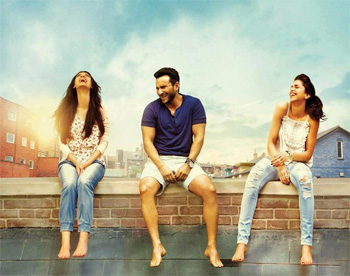
    Cocktail

    Directed by Homi Adajania

    Produced by Saif Ali Khan, Dinesh Vijan

    Written by Imtiaz Ali, Sajid Ali

    Starring: Saif Ali Khan, Deepika Padukone, Diana Penty


    Saif Ali Khan playing his umpteeth cool, flirty dude role, can’t carry it off now, at 40 plus. Which is one of the things Homi Adajania’s Cocktail got panned for, the other being its regressive stance towards women, while posing as a youth flick. The cheerful first half is absolutely at odds with the embarrassingly melodramatic and cliched second half.  What’s really sad is that in an urban story, set in London, the subservient girl gets the lechy guy, the wild girl was not thought worthy of even a jerk.


    The film got 2 to 3.5 stars, and a good opening, but reluctant praise, mainly for it’s breezy first half.


    Shubhra Gupta of the Indian Express wrote: “There’s this guy, he’s too cool, ya. Lives and works in London, chases girls, gets em, beds em, moves on. There’s this girl, she’s wild. Has this nice pad in a tony part of London, which she uses as a stop-over to change clothes in between all the partying. And, of course, there’s this other girl, who’s the ‘seedhi-saadhi’ type, you know, covered from top to toe, sweet, shy. Place these characters in a shiny glass jar, shake with a swizzle stick, and you get ‘Cocktail’. Which is just another name to call a one guy-two girls shtick, which is, as you and I know, one of the oldest in the book. ‘Cocktail’ starts off headily enough, and bubbles along till half time; post that, the sips get diluted, and the swallows take much longer.”


    Rajeev Masand of IBN Live cribbed: “Alas, Cocktail, directed by Homi Adajania, is no saucy menage a trois, although it does involve three friends living together in London, a little too close for comfort. No, Cocktail falls firmly in the rom-com space. But even as the tone shifts uncomfortably from breezy, light-hearted fun, to heavy drama in the second half, you’re never in danger of actually caring for the cardboard characters in this empty souffle of a film.”


    Raja Sen of rediff.com commented how spectacularly the film crashed and burned. “Adajania starts off breezily enough, all effortless-flirting and shotglasses and dramatically teary mascara, but the threadbare and increasingly inane plot unspools halfway through, leaving us with a shoddy, frustratingly random sequence of events. The last one-third of the film features the kind of emotional melee that can only be rightfully resolved by handing one of the girls a samurai sword. Alas, no such bloody respite is offered.”


    Karan Anshuman of Mumbai Mirror was disappointed by the writer Imtiaz Ali’s cop  out: “(He) goes on to self-censor, Indianize, romanticize, emotionalize, ergo commercialize the experience and give us a 1 part alcohol and 10 part water cocktail, an exercise in pointlessness. We now have abla nari, the Indian mother pushing marriage, and a… you get the point. All of this is well disguised of course with cutting edge club eveningwear on Deepika Padukone and luscious London.”


    Saibal Chatterjee was generous: “The heart has its reasons, the mind its methods. When the two are sought to be yoked together on Bollywood’s big romcom canvas, the result can be touch-and-go. One misstep either way could mean a hopeless nosedive either into mushy drivel or pretentious claptrap.  But no such worries here. For the most part, Cocktail, directed by Homi Adajania and scripted by Imtiaz Ali (a sort of high priest of the genre), steers clear of the pitfalls and delivers an eminently watchable love story that breaks the mould.”


    Taran Adarsh wrote: “On the whole, Cocktail has a fascinating first half, charismatic performances, harmonious music and the trendy look and styling as its aces, but the second half is not as tempting or intoxicating as the first hour. It pales when compared to the attention-grabbing first hour. Yet, all said and done, this one’s primarily targeted at the Gen Next, especially those in metros, who might identify with the on-screen characters.”


  • Ranjona Banerji: Foreign media is only credible observer of Indian politics

    By Ranjona Banerji


    There is now only one credible observer of Indian politics – the foreign media in India. We cannot fully assess if a politician is good or bad until a foreign journalist pops by, talks to a few taxi drivers and Indian journalists and then writes a complimentary (good) or scathing (bad) comment piece.


    Now, you’re thinking, aha, sour grapes but far from it. It is all a question of perspective. Indian journalists, especially in Delhi, are too close to the centres of power. They are so familiar with what’s going on and party to so many secrets that they now spend more time discussing whether the blue in Manmohan Singh’s turban has changed in the last eight years. (Some say yes, some say no and the rest are fence-sitters.)


    The foreign media however comes in from far away and has no clue about all this inner stuff. They attend a few parties (these are vital sources of information and political analysis, as those who read through the diplomatic cables made public by Wikileaks will know), meet a few Indian print journalists (bluer, paler, maybe both), they may meet a few TV journalists but that’s for entertainment since they have no political perspective, although I hear they throw really good dinner parties. And, obviously, the few taxi drivers. This is imperative as every traveller knows – one taxi driver can be equal to at least five other potential interviewees.


    Yesterday, I met a cabbie in Mumbai who told me that Indian politics turns on Uttar Pradesh. Now I know. If these foreign political commentators are really smart however, they will never even leave whichever country they come from (usually the USA or the UK). How else have I become a world renowned expert on Barack Obama and David Cameron? (Actually, by watching Comedy Central and Graham Norton.)


    Therefore we now know that Prime Minister Manmohan Singh is a poodle, useless, confused and steeped in doom and gloom. Everyone has said it from Time to the Economist to The New York Times to the Independent.


    The poodle reference can be translated in Indian terms to a puppet. Yes I know, Indian commentators have been saying that for years. But what do they know, eh? (On the other hand, their view has now been authenticated!) Meanwhile I must be off to watch a few more skits on Comedy Central so I can hone my analytical skills.


  • Ranjona Banerji: Why TV anchors must not write on edit pages

    By Ranjona Banerji


    I now understand the pain of being a TV journalist. There is no avenue within the medium to become a pontificator. For print journalists, it’s easy. You work a few years as a reporter-correspondent-sub-editor and then some boss type person decides you have some writing skills that can be further explored or some pages fall short of stories and some boss type person makes you write a quick news analysis or you are a boss type person and decide (or someone tells you) that the world wants to know what you think. And you know how angry print journalists can get if their “columns” are stopped, if you read the excerpts of Kuldip Nayar’s memoirs. The reader then believes that these columnists and analysts are experts.


    But what can a TV journalist do? Having spend years running from pillar to post saying “I am standing at the gate waiting for something to happen” interspersed with many in facts and of courses – “I am of course standing at the gate in fact” – does someone say to him or her, here’s half an hour of TV time as a reward for so much standing, now say what you want?


    No, instead you become a prime time anchor and you have to ask other people what they think. And some of those people, in fact, of course, have to be print journalists who have now become analysts and columnists. Talk about rubbing salt in it.


    The result is that you yourself don’t know what to think. If you have ever read any columns by famous Indian TV anchors (I think Rajdeep Sardesai and Sagorika Ghose of CNN-IBN and Barkha Dutt of NDTV, all have columns in Hindustan Times, which has reduced the effectiveness of its edit page by half) you will know what I mean. Half the time they plug their own channels and shows and the rest of the time they sort of sum up what’s happening. There’s very little original thought there except some anodyne comment. No provocation, no incisive comment, no contrarian viewpoints. This comes from years of TV panel discussions where you have to listen to other people. Print journalists are terribly egoistical and after a few years stop listening to other people and only like other people to listen to them. This gives them a great advantage as pontificators.


    (I must here advise newspaper editors to end this new trend of giving columns to journalists with little or no experience because they are even less readable than TV anchors. Youth may be attractive but it has its limitations.)


    What is the solution for famous TV anchors? Instead of bothering to write which they can’t, they should get their back on usual suspect panellists. Call them to their studios and make them question the anchor. The anchor will then hold forth while the panellists listen. However, the anchor is not allowed to ask questions…


    This way, we might find out if they can actually think. India wants to know.


    Ranjona Banerji is a senior journalist, commentator and Contributing Editor, MxMIndia. The views expressed here are her own. Twitter: @ranjona


  • Ranjona Banerji: How TV and print covered Rajesh Khanna

    By Ranjona Banerji


    The death of superstar actor Rajesh Khanna was felt very deeply by the Indian media. Although Khanna had been largely forgotten in the PR driven-celebrity obsessed circus that we now live in – except for his foray into an ad which many found offensive – his death brought out a tidal wave of nostalgia. Everyone tried to look back on their Rajesh Khanna moments and several actually found them.


    On Wednesday, TV followed its normal procedures, which in the current climate is outrage at various discriminatory procedures heaped on hapless citizens by ourselves or others. But once news of Khanna’s death came in, everything else came to a standstill.


    Is there scope for criticism here? There can be no doubt that Khanna was an enormous star and in his heyday, he was so high as to be untouchable. He was also a bit unfathomable, which made him all the more appealing. Many TV anchors – notably Nidhi Razdan of NDTV and Rajdeep Sardesai of CNN-IBN – found it hard to believe that Khanna did not “reinvent” himself in his later years. Their bewilderment is understandable. In a world where everyone endlessly (apparently) craves for fame, this man retreated once the world moved on. Of course, in Rajesh Khanna’s case this is not really true. He did try a few times to come back but it just didn’t work. Then, he retreated. But facts are often difficult to muster when you don’t have personal knowledge and everyone around you is 11 years old.


    Arnab Goswami jumped into the Times Now studio much before the appointed time but he was clearly clueless about Rajesh Khanna’s days in the sun. Most news channels therefore pulled out the guests they could – Shobhaa De, since the rise of Stardust coincided with the rise of Khanna, Shabana Azmi who acted with him later, Mahesh Bhatt who made his name a little later and Javed Akhtar, who wrote some of his films with Salim Khan (who is almost never acknowledged by the media although he is very much around). Sharmila Tagore was interviewed – she was the star with whom he had his biggest hit Aradhana.


    The biggest confusion was between Khanna the actor and the songs in his films. Few TV journalists seemed familiar with playback singing and the fact that Khanna did not sing anything and the songs in the movies had nothing to do with him. Endearing journalistic naivete or the need for a few more celebrity news anchors from Mumbai?


    However, at the end of Wednesday, one might conjecture that there was no need for TV panel discussions on why Rajesh Khanna was so popular. It’s not the sort of subject that needs to be debated the day a man dies. It’s not even a subject for debate really.


    **


    The newspapers the next day obviously did a more comprehensive job, especially the Times of India since it has better archival resources and institutional memory. It is at times like this that the youth tilt in the media at the moment becomes a liability. Wikipedia cannot give you everything you need to know. Also lack of journalistic imagination is a hindrance – although it seems to be very common – and this was evident in both Hindustan Times and DNA.


    Mumbai Mirror carried an informed and incisive piece by De, best qualified to do so. Mid-Day’s front page headline told us that Jatin Khanna is dead while Rajesh Khanna lives on, a play on the transience of life but the permanence of memory. Indian Express treated it like one more news story.


    **


    Since Khanna’s funeral procession saw unexpected crowds, his death practically overshadowed Rahul Gandhi’s ascension to who-knows-what in the Congress party on Friday morning.


    **


    Outlook’s latest cover is on Barack Obama, headlined “The Underachiever”, mimicking the recent Time magazine cover on Manmohan Singh. It may seem funny at first glance – I thought it was a joke, actually – but it is surely a tad childish. Why should an Indian newsmagazine take up cudgels for the prime minister? Time has a right to its opinion and is not Obama’s mouthpiece. Why should Outlook want to look like the PM’s mouthpiece?


  • Of ‘Pimple’ and ‘The Phenomenon’

    By Ranjona Banerji

    It was something of a shocker when Rajesh Khanna’s marriage to the young Dimple Kapadia made it to the front page of the venerable Times of India. I can still remember the shock with which my father read out the news to us. Newspapers in 1973 were serious and sober and did not have much to do with filmi matters. It was perhaps a measure of the enormous popularity of the film star that his marriage was worthy of mention in a space strictly reserved for politics and matters of great import. It was only decades later that The Times of India became what it is today. In those days, film stuff was reserved for film magazines and those were read assiduously by all faithfuls. My mother banned me from reading Stardust for some years to protect my young and innocent mind but that doesn’t mean that I didn’t sneak a peek whenever I could.

    Film stars in the 1970s were different and so were film magazines. It was not all PR driven and film journalists were usually bitchy rather than slobbering the way they are now. Filmfare of course was goodie-goodie and nicer than Star & Style and Stardust was irreverent and chock-full of stuff. The subjects of discourse would shock today’s pap-fed journalists as starlets discussed the colour of their nipples and their Playboy days. Katy Mirza burst her way into our lives long before Sherlyn Chopra was a gleam in her daddy’s eye. The fact that Mirza’s assets took her career nowhere was a subject of much sniggering. Cine Blitz came later.

    Rajesh Khanna was also the subject of much mockery. After he married Dimple, the family was often called Pimple (he), Dimple and Simple (her sister, who tried to imitate but failed). He was also dubbed “The Phenomenon”. Devyani Choubal promoted him heavily. And unlike Amitabh Bachchan, Khanna did not declare war on the film press.

    This is in spite of a colourful lifestyle lived openly. First with Anju Mahendroo for years, then marrying this young girl about whom there was already much speculation, the dumping Dimple for Tina Munim… It was as if Rajesh Khanna did not have to succumb to the hypocrisy which Indian society still demands. He was the eternal romantic and needed nothing else. And the press went along with that.

    It is perhaps fitting then that in his death Khanna has sent the media into one of the biggest nostalgia sprees I have ever seen. For anyone born before about 1970 at a vague guess – and there are many in the media of that vintage – Khanna was an inescapable part of the environment, crinkling his eyes and smiling down at you.

    And he’s taken us back to that journey with his death.

  • Ranjona Banerji: NCP ties itself for Whiner of the Week award

    By Ranjona Banerji


    The winner of the presidential election maybe Pranab Mukherjee but the award for Noosemaker/Whiner/Tantrum Thrower of the week is divided between PA Sangma and Sharad Pawar. One is former NCP, the other current NCP and both founders of the NCP.


    Pawar suddenly decided that he was very upset with the sort of musical chairs being played at Cabinet meetings. I quite sympathise because I never liked musical chairs as a kid at birthday parties. Today’s children will not understand, but in the olden days birthday parties were an elaborate form of torture for children, who were forced to compete with each other and make fools of themselves in order to get a slice of cake and a few chips. Sounds a bit like today’s political parties actually.


    Anyway, Pawar felt that every time the music stopped, he was forced to sit in another chair. Sometimes it was the second chair (first being the prime minister) and sometimes it was chair 3 or 4. This was clearly insulting. He might have only nine MPs but why should that other chap from a much smaller state holding a job that Pawar once did get the second chair?


    Later we were told he was not so petty to be worried about chairs. All he wanted was a coordination committee. Whatever.


    PA Sangma, former Lok Sabha speaker and the country’s best known Tribal and Christian – according to him – wanted to become President of India. This is a legitimate goal, but Sangma, one might say, went about it the wrong way. He approached, of all people, Naveen Patnaik and J Jayalalitha for help. However powerful they may be in their own states, they did not have the numbers to make Sangma President.


    Since Sangma was part of the UPA, he could have at least spoken to someone within the coalition. Instead he chose to go out of it. After much reluctance, the BJP decided to support him. The UPA and two NDA allies supported Pranab Mukherjee. Everyone except Sangma saw Mukherjee’s victory as a foregone conclusion. Not because Mukherjee is much loved or the greatest person ever but because the UPA had the numbers. Then Sangma and the BJP said he wanted to be the loser with the highest number of votes (this is a strange award category known only to Indian politicians).


    Then Sangma said that he had to win for India’s Tribals and Christians. Most Tribals and Christians were silent. (As it turned out, not all of their representatives voted for Sangma.) Then Sangma said that Mukherjee had used a comma where it was not needed in his nomination form and had not used the right kind of nib in his pen. Also, he did not stand on the right side of the table when submitting the form (unlike Sangma who seems to be heading quite firmly to the right). Since Sangma was by now advised by the world’s biggest litigator Subramaniam Swamy, the plan was to go straight to the Supreme Court with 1,000 public interest litigations. The Election Commission blocked that route.


    So now that Sangma has not become president, he is nibbling away at sour grapes. He should not, because he is now eligible for the Best Sore Loser and Most Ungracious Defeat speech awards, with a good chance of winning both. The Congress used bribery, extortion and threats to get Mukherjee to win and the North East states (which elected Mukherjee by the biggest margins) betrayed him.


    Boo hoo hoo.


  • Ranjona Banerji: TV news viewing can be injurious to the lower jaw

    By Ranjona Banerji


    Since president-elect Pranab Mukherjee spoke to almost everyone on Tuesday, it was hard to see why news channels rushed to qualify their interviews as “first” or “better” or whatever. Exclusive, in TV parlance, is apparently when you do the same thing as everyone else, except five minutes before.


    Anyway, Mukherjee did not say very much about anything he was going to do as President although he talked about his childhood and his early political career. The silliest question I reckon came from Sagorika Ghose of CNN-IBN who asked whether Mukherjee’s ascension to Rashtrapati Bhavan was a “return of Bengal to the mainstream”. At this point my jaw dropped so low that it fell off and I was so busy retrieving it that I couldn’t pay attention to the rest of the interview.


    The best I could get from Arnab Goswami’s interview with Mukherjee on Times Now was that first Mukherjee walked round his garden 40 times, then 33 times and now 30 times and he did not know how many times he was going to walk around the Mughal Gardens. He said he heard the gardens were very large. Anyway, as President he will have ample time to work out stuff like that. Or if he asks someone they might tell him how big the Mughal Gardens are.


    * * *


    Sunday was all about the presidential election as well as everyone gave us live coverage. Of course, after some time they ran out of things to say because there was very little to say about a presidential election in India, at least not enough that can last a whole day even given TV’s marvellous propensity for waffling on about nothing. The highlight of the day was losing candidate PA Sangma’s losing speech. He started by congratulating Mukherjee and then went into a whine about how the Congress had used bribery, extortion and threats to ensure Mukherjee’s victory and how the North East and betrayed not just him but all tribals and themselves as well. (They didn’t vote for him.) Sangma’s entire campaign was based on pettiness, so nothing surprising here. What was surprising was Navika Kumar of Times Now stating emphatically that this was the best, most gracious and most sportsmanlike speech she has ever heard from a loser. Her guests Krishna Prasad of Outlook and commentator NN Satchidanand tried to point out otherwise, but she would have none of it. Jaw-retrieval is a common affliction for those who watch too much TV news, as I should know by now.


    * * *


    Rupert Murdoch has stepped down from several boards which control News Corp’s titles in the US, UK and India. The pressure to do so apparently came from investors, after the phone-hacking scandal led to the closing of The News of the World and all the arrests of News Corp staff, current and former. Murdoch’s rise saw a lot of bile but in his fall are some abject lessons for media bosses and for those journalists who decide that principles are nothing when faced with corporate pressure to perform in a particular manner or to do anything to get results. The Nuremberg trials ought to be required reading for young aspiring journalists: the fact that you got an order is not defence enough.


    * * *


    I was appalled yesterday and continue to be appalled today about Monday’s front page anchor in The Times of India about a group of Indian athletes that went to the 1936 Berlin Games under a saffron flag singing Vande Mataram and impressed Adolf Hitler enough to give the group a medal. The story behaved as if getting a medal from the 20th century’s most frightening dictator was a great honour. There was not a squeak in the story about Nazism and what the organiser of the group thought of that. The glorification of Nazism in India is restricted to those influenced by the religious nationalism that comes of out of Nagpur. The story, therefore, should have mentioned or questioned the RSS connections of the group. Saffron flags and Vande Mataram were clear giveaways but why not come out openly and say so? And for a journalist – and a newspaper – to ignore the Nazi angle to such a story is criminal.


    * * *


    Vikram Doctor’s article in The Economic Times on food and the Olympics was extremely readable and well-researched. Try it: http://blogs.economictimes.indiatimes.com/onmyplate/entry/thanks-to-french-humour-here-s-best-of-british-food


  • Ranjona Banerji: Why I love Arnab Goswami. Really!

    By Ranjona Banerji


    Kudos must be given to Times Now for its drive to expose the little acts of callousness in India. These are problems which are so commonplace that they are overlooked, not just by the media but by the general public as well, perhaps even by NGOs. The death of a five-day-old baby girl in a Jalandhar hospital because her parents could not pay Rs 200 for a life-support system made it to Arnab Goswami’s News Hour. Just as a reference point, the story is on page 11 of the Mumbai edition of The Times of India – and made it there only because of television.


    Goswami dignified the death of the girl by cross-examining the doctors – and rejecting all their excuses. He and his guests discussed the callousness of the system, a Supreme Court ruling that bans taking money for life-support from poor people and asked whether the baby would have been treated differently if it was a boy.


    Goswami is right when he says that it is these little problems which have to be solved if our society is to be sensitised.


    TV continued with its campaign against crimes against women as all channels highlighted the plight of a woman in Kolkata who struggled to file a rape complaint even though she was bleeding profusely and a girl in Bangalore thrown off a train by molesters.


    **


    Even TV has realised that the Anna Hazare movement has run out of steam and merrily had discussions on it. I would venture to offer “Team Anna” some advice: if it took up the issues of the “little people” it might find greater resonance than its current policy of going after big sharks. In our everyday lives, it is the callous hospital staff, the indifferent police constable who hurt as the most. Let Team Anna follow the path that Goswami has forged for them.


    Sudden thought: Can you imagine what would happen if Arnab Goswami and Aamir Khan joined forces? Wow!


    **


    Of course, one’s love for television cannot go too far. The discussions on the Assam problem have been largely unsatisfying except perhaps for Karan Thapar’s Last Word on CNNIBN, if only because his guests did not have hysterics and screaming fits. It makes a life a little easier if you can understand what everyone is saying. The Jerry Springer version of TV gets tedious after some time.


    **


    The completely pointless discussions on Narendra Modi’s “hang me if I’m guilty” interview to Urdu weekly Nai Duniya were the other ear-sore. Modi, who likes to be in the news, manages to provoke some TV air time and create the same amount of sound and fury. The same guests every time on every channel on opposite ends of the political drama saying the same things as last time have become a yawn. The highlight on Thursday was apparently Teesta Setalwad walking out of the discussion on Times Now and walking back. This is hearsay evidence because I never saw it but was informed by people who did and by Twitter.


    **


    Chaos in the social media universe on Thursday incidentally as GTalk and then Twitter collapsed. How on earth did we manage before Twitter everyone asked when it came back. Indeed.


    **


    The “Greatest Show on Earth” begins. More on that next week. Happy viewing.


  • Reviewing the Reviews: Super un-cool sex gags in KSKHH

    Kya Super Kool Hain Hum

    Directed by Sachin Yardi

    Produced by Ekta Kapoor, Shobha Kapoor

    Story by Sachin Yardi

    Starring: Tusshar Kapoor, Ritesh Deshmukh, Neha Sharma, Sarah Jane Dias, Anupam Kher


    This is not the kind of film that critics would recommend anyway, but most of them have said that Sachin Yardi’s smutfest’s content is not what they mind so much as the bad quality of the sex gags.


    Kya Super Kool Hain Hum is a sequel to the Kya Kool Hain Hum, which had reportedly done well enough for producer Ektaa Kaoor to attempt a sequel.


    Most critics went for 1 or 2 stars if they were feeling generous, except, of course, TOI’s standard 3 and Taran Adarsh’s 3.5.


    Wrote Raja Sen of rediff.com: “There’s nothing wrong with bawdy sex comedies. The burlesque entertainer has been a part of storytelling from its very origins, from sultans being soothed by tellers of tall tales to cavemen sniggering at sideward-8s on their stick figures. It’s a grand, colourful, enjoyable tradition, and making something you can nudge, nudge, wink, wink at is as fine an ambition as any. Except – and herein lies the lack of rub – there’s really no point to a sexless sex comedy.”


    Aniruddha Guha of DNA commented: “Director Sachin Yardi’s KSKHH revels in its ability to present one stereotype after another in a long orgy of sex jokes, private parts’ references and general stupidity. It’s funny initially, and you feel like you may be in for a laugh riot. But KSKHH is like a party that starts to get boring in the first hour, one you keep looking for ways to get out of. And if you do stay till the end, a headache-inducing hangover is a certainty.”


    Saibal Chatterjee of NDTV grit his teeth and wrote: “Some films are aimed at the eye, some at the head, and still others at the heart. It takes an outrageous degree of audacity to fix the focus of an entire two-hour-plus movie a few inches above the solar plexus, or thereabouts. But for all its unabashed flirtation with tawdry humour, Kyaa Super Kool Hain Hum is about as scintillating as the drone of a dying bumble-bee. A bunch of bawdy blokes who have clearly taken leave of their brains and turned into sex-obsessed ‘loin’ kings run amok with a license to spill in this defiantly tasteless caper movie. Even the dogs aren’t spared.”


    Rajeev Masand rightly called it a cringe worthy: “If I had a penny for every time I laughed during ‘Kyaa Super Kool Hain Hum’, I’d be able to afford an Asprin, I so badly needed at the end of this roughly two-and-a-half-hour cringe-fest. The problem with this film isn’t that it’s so unapologetically vulgar, but that it’s just not very funny. And that’s a shame, because leading men Tusshar Kapoor and Ritesh Deshmukh have a winning chemistry and sharp comic timing…now if only they were required to do a little more than stripping down to their boxers and repeatedly making crude gay jokes.”


    Anupama Chopra slammed the lack of a plot: “I enjoy vulgarity, cheap lines and jokes with double meanings as much as the next person, but really, is this the best we can do? Writer-director Sachin Yardi is too lazy to create a plot, so the film is just a series of gags that allow him to bung in as many puerile sexual innuendos as possible. Kyaa Super Kool Hain Hum becomes a drag within the first twenty minutes and then continues for another two hours or so. Before you are done, you will have to suffer Chunky Pandey in a hideous wig, playing a fake godman named Baba 3G, and Tusshar Kapoor in drag wearing eyeliner, lipstick and a gown with a plunging neckline. Yes, that’s seriously scary. Only the brave need venture in.”


    Madhureeta Mukherjee of the TOI quipped: “Director, Sachin Yardi’s film will appeal to an audience who trips over ‘hard-core’ sex comedies. There are scenes that ‘vibrate’ with humour, and squeeze ample laughs (some forced), but it’s mostly a bleak story-line with random scenes which are padded with pun-fulls of adult humour, sexual innuendo, and expletive one-liners. For a sex-comedy, the film is a tad long (size really matters, can’t help it!) and songs like ‘Dil Garden Garden Ho Gaya’ slow the pace. If you were sex (comedy) starved after Kyaa Kool Hai Hum, this sequel force-feeds you a double dose. This one’s for teens who get a ‘boner’ out of bad jokes, but it may get a rise out of some adults too. Watch at your own ‘risque’.”


    Taran Adarsh raved: “On the whole, Kyaa Super Kool Hain Hum is sure to get the affirmation nod by its target audience – the youth. Despite the sexual tone, adult jokes, impish humor, the movie, at no juncture, gets offensive, distasteful or objectionable. In fact, it’s one big joyride from commencement to conclusion. This one is for the masses, for youngsters, for those who loved part one and enjoyed its crazy hilarity. Kyaa Super Kool Hain Hum offers entertainment, entertainment and only entertainment in large doses!”


    Sudhish Kamath of The Hindu nailed it, “The problem is of excess and repetition.  What’s the point of making a sequel if the idea is just to put the same jokes back in? Poppat is back with his tooths (suits). If the first one was let down by its length and lack of plot, here it’s just the lack of plot. The only movement or the ups and downs here are in the innuendo and physical comedy involving a pug who lives a Vicky Donor life. The pug performs every time its owner (Riteish) turns on the music. If you find that funny, go for it.”


  • Ranjona Banerji: Anna movement reaches its predictable end

    By Ranjona Banerji


    The news was quick to jump on India’s new Union Home minister after a series of bomb blasts hit Pune the day Sushil Kumar Shinde was appointed. In a revealing interview with Rajdeep Sardesai of CNN-IBN, Shinde exposed himself as a “family” man and also attributed his political success to his Dalit caste. These are just the kinds of things a new India does not want to hear. Even worse, he then went on to say that he had been an “excellent” power minister – this on the day that North and East India reeled under power blackouts for the second consecutive day.


    Fortunately for Shinde and his possible short-comings – and also therefore for the UPA government – escape came from what has been the top news story, especially on television: the Anna Hazare-led anti-corruption movement.


    Two days ago, Times Now editor-in-chief Arnab Goswami had practically been in tears over the frail but defiant condition of Anna Hazare adviser Arvind Kejriwal. The activist, who is apparently a diabetic, was in a bad way but was refusing to break his fast until all his conditions were met – arrest half the government and so on.


    Goswami therefore got into fighting mode as there were indications that the movement was looking for a political solution. Karan Thapar also explored this on his Last Word on CNN-IBN.


    By Thursday, it was announced that the anti-corruption movement would now become a political platform. The news was welcomed by all political parties since the fight had moved away from civil society to a battle ground they were all very familiar with.


    The media’s relationship with the Anna Hazare movement has been fascinating. TV went overboard last year as it supported the movement wholeheartedly and since most TV journalists are under the age of 11, they must have felt this was bigger than the freedom movement. The print media however remained cautious and in some cases critical. The people of India also get enthusiastic and social media was buzzing with anti-corruption rage. The government helped by bumbling and fumbling in its negotiations. But nothing topped the one lakh people who supported the movement in Delhi last year. The Lokpal bill was passed in the Lok Sabha but did not get past the Rajya Sabha.


    Buoyed by its success, the movement went a little overboard in its demands and so TV also started asking difficult questions. No one showed up in Mumbai in December and TV totally turned. All the allegations against people like Kiran Bedi and Arvind Kejriwal were discussed. Hazare’s rustic ideas on politics and society became public knowledge. The group’s diverse and contradictory views on the politics, on political parties and ideologies were exposed.


    This time’s agitation saw the love coming full circle. TV tried to be supportive but the people were not. The movement’s supporters roughed up journalists for reporting the lack of popular support. The government was unmoved.


    The result is that the movement has gone political. Media support, which bolstered the movement so much in its early days, is now no longer assured. An interesting tale of how activists took on the government and enthused some people for a short while has reached a very predictable end. The media, they will have to remember from now on, will never be a pillar of support if it has to be a pillar of democracy.


  • Ranjona Banerji: The shame of the PR influence on the media

    By Ranjona Banerji


    It is interesting indeed to see that newspapers have chosen to report on the Maharashtra government’s decision to ban the sale of Mahyco’s Bt cotton seeds in the state but has not gone very far beyond that. In another story on Friday morning, a Parliamentary panel has sought a probe into the current stand-off over the introduction of Bt brinjal in to India.


    Criticism of Bt cotton in the media started off by being as expected but soon buckled under the tremendous pressure brought upon it by Mahyco Monsanto Biotech. Earlier in this column we have discussed the “expose” on The Times of India done by P Sainath in the Hindu. The marketing department of the TOI used articles done after a Mahyco Monsanto junket to promote the company, years after they were originally written.


    Although there have long been allegations that the forced or over-encouraged use of genetically-engineered cotton seeds have been detrimental to farmers as yields have fallen and land has to be fallow for too long. The initial success of Bt cotton, coupled with the promises made, led to high expectations from farmers and a corresponding high debt burden. This in turn led to most of the suicides by farmers is what most activists and social workers have alleged.


    While many such stories appeared initially, the enormous pressure brought upon the media by the company and by the government saw the stories petering out. Monsanto, the American company and Mahyco, the government venture, both employed very persuasive PR to push their case. The Sainath column in Hindu, in fact, went through all the mistakes and misrepresentations in the Times of India Bt cotton junket, point by point. A Parliamentary committee which went to the same areas of Maharashtra a few months later found an area rife with debt and suicides – sometimes quoting the same people who claimed to be happy in the TOI report.


    In Friday’s papers, TOI has a single column story while Hindustan Times has a more detailed report.


    The shame of the PR influence on the media is not just about glamour or lifestyle stuff, although that is rampant and in some cases institutionalised. But when it comes to corporate pressure, especially from aggressive companies who are willing to use the law and every other avenue to protect themselves from criticism, the media comes up against a formidable opponent. In the case of Monsanto and Mahyco, having initially put up a fight, most of the media seems to have capitulated. Friday’s stories have been carried only because the Maharashtra government has finally accepted that the shift to genetically modified cotton has not been the universal success initially claimed.


    Time perhaps for the media to find its teeth again?