
Category: MxM JOURNALISM REVIEW

  • [MJR] Media has to protect freedom of expression and thought

    Ranjona Banerji

    By Ranjona Banerji


    The knee-jerk government response to the Ambedkar cartoon controversy – banning cartoons from text books – got a very strong response from Sunday’s newspapers. The need to protect freedom of speech, why cartoons frighten those in power, the personal attacks faced by cartoonists were covered by The Times of India, Indian Express and Hindustan Times in special features and detailed stories.


    Many also carried cartoons which have caused trouble in the past and tried to examine just why cartoons are seen as dangerous.


    Indian Express had a comprehensive interview with historian Mushir-ul-Hasan who has just written a book on Parsee Punch, a cartoon magazine brought out by Parsis in colonial India. The British in India at the time either had a good sense of humour or the good sense to realise that going after cartoons was hardly likely to end subversive thinking.


    The media has to come out and protect freedom of expression and thought – because in any battle against it, it will be the first casualty. The threat does not come just from those in power but also from pressure groups in civil society. Unfortunately in India, the first response by the government is to cave in to the demands of those whose “sentiments are hurt” rather than stand up for the Constitution.


    * * *


    After running through the IPL as the scourge of human civilisation, TV channels found something else to amuse themselves. Not, of course, the Indian economy, which seems perilously close to bad times ahead – there is after all little scope for a melodramatic studio-based jatra based on a falling rupee and rising inflation. Much better instead to concentrate on parties (not political ones, but the others where people gather to eat, drink and make merry and thus promote unconscionable evils), why the BCCI has insulted Kapil Dev by not giving him lots of money (and then providing the answer – because Dev hooked off to the rebel league ICL) and for all I know whether the sun will rise tomorrow or not.


    * * *


    It is always interesting to see journalists take the moral high ground when it comes to other people eating and drinking. Everyone knows that there are journalists who will do anything for a free meal and many attend press conferences only for the free drinks at the end. Even those who are not quite so greedy enjoy a drink or two at the end (or the middle) of a long and stressful working day. So why this moralistic posturing when it comes to others? Just to appeal to a puritanical audience or has alcohol dimmed their memories of their own excesses?


    In fine contrast, of course, the glamour sections of newspapers and glamour segments on news channels only serve to glorify the “having fun” lifestyle and employ almost no critical faculties at all.


    Just because the general public doesn’t know what you get up to in your spare time does not mean that you have to give in quite so much to hypocrisy.


    * * *


    Now that the Lokpal Bill has been put off till the next session, one can predict an all out publicity campaign by the Anna Hazare brigade – that’s easy. However, it is also possible to predict that while the movement may not fizzle out, the media coverage will.
  • [MJR] Wanted: sponsors to cover the Olympics!

    Ranjona Banerji

    By Ranjona Banerji


    The biggest sporting event in the world (no, not the FIFA World Cup) is due to begin in a couple of months. So how many Indian newspapers are going to send someone to cover the Olympic Games in London? This is where Indian sportspersons are hoping to make a breakthrough after Abhinav Bindra won the first individual gold medal by an Indian in Beijing. The Indian hockey team did very well in the qualifiers, leading to expectations that they will shine again in a sport which has won us eight gold medals but no one in India really watches.


    So what’s the grouse? The reluctance of Indian newspaper managements to spend money on newsgathering. The Olympics are not just any old event. They represent an ideal – of human endeavour, of a global spirit and a desire to push back boundaries of achievements. Editorials will declaim with thundering authority about the significance of “citius, altius, fortius” but when it comes to actually reporting on the efforts to get there, everything depends on a “sponsor”.


    That is, a newspaper or journal will often only cover an event like this if the marketing department can get someone to cover its expenses. One can understand the reluctance in the days when foreign travel was prohibitive and foreign currency limited by the government (yes, I know it almost seems like we’re back in those times!) but in today’s world, depending on agency feed is nothing short of laziness and taking your reader for a ride.


    Yet strangely, in the olden days (that is, when I was young), the idea of “junkets” was anathema and people I know lost their jobs for accepting favours. Over the years, managements realised, “why pay for something when someone else can be convinced to do it”. This is why so many sports pages – like The Times of India’s for instance – are so full of “sponsored columns” that there is hardly any place left for actual news.

    One doesn’t know yet of course how many newspapers are going to go for the easy route to the Olympics, but one hears rumours…


    Meanwhile, the entire film journalism community appears to be in Cannes for the film festival, where given the quality of our cinema, almost nothing makes it even within shouting distance of a tin palm, let alone a golden one. But visits to Cannes are now de rigueur on the junket circuit, so no dip in the newspaper’s bank balance there. And credibility? Well, we stopped worrying about that a long time ago.


  • MJR: TV worries about aam aadmi, forgets economics

    Ranjona Banerji

    By Ranjona Banerji


    The petrol price hike announced on Wednesday sent TV into a spin. Since the economy is not a strong point for our honourable anchors, they all decided it was a bad thing but then didn’t know how to go further so opted for passionate pleas on the plight on the aam aadmi. Economists have a slightly different view – they see the subsidies to the aam aadmi as the problem as far as India’s oil bill and budget deficit is concerned. The hike on petrol will apparently have only a marginal effect on easing the financial burden carried by the gas companies.


    Said The Economic Times on Thursday, “Subsidising petro-fuels is not something that India can afford: this subsidy accounts for a sizeable part of the fiscal deficit and drives up the current account deficit. These twin deficits depress growth by curtailing investment. India needs de-control and competition in petro-fuels.”


    The Times of India on Friday says more or less the same thing: “Despite shock and awe for the middle class, the surprising thing about the petrol price hike is that it will only have a marginal impact on the under-recoveries of oil companies or in curbing oil imports. Petrol accounts for just about one-eighth of total oil consumption. In fact most recent numbers show that it is diesel, kerosene and LPG – which account for almost three-fourth of the oil products consumed – that has pushed under-recoveries of oil companies by a massive Rs 1.38 lakh crore.”


    The Hindustan Times on Friday: “A steep hike in petrol prices has jolted Indian consumers out of a false sense of security that the government can shield them from the relentless rise in oil prices… India’s energy consumption has remained oblivious to how international prices moved. Our oil demand does not decline as prices rise and this adds to the downward pressure on the rupee. It is a vicious cycle that can be broken up by freeing up all fuel prices and reimbursing only those who cannot afford market rates. A sizeable chunk of the economy is getting a free ride on the government’s fuel subsidy.”


    Therefore, despite the hysteria generated by TV channels, the consensus from other sources is clear – we have nowhere to run, nowhere to hide from a price increase in all petroleum products. In their anxiousness to get a dramatic confrontation, TV channels forget that not everything makes for a good debate. Why not have a good, solid interview with an economist to explain the problem? They can of course intersperse the interview with song and dance (am I confusing this with IPL?) or run their earlier tapes of panellists yelling at each other so that viewers are not terribly confused with a large dose of sensible talking.


    **


    On NDTV, there was mudslinging at the media by the friends of the Talwars, now about to be tried for the murders of their daughter and their domestic servant. There is no doubt that the media goes overboard very often and did so in the Talwar case as well, over-dramatising the details of Aarushi’s life for instance.


    But nor can there be any doubt that the Talwars manipulated the media and milked the sympathy card for all it was worth. To get a respected popular historian like Patrick French to write an impassioned article in your defence and then follow that up with a TV interview – master stroke. Unfortunately for them, the judge did not quite see it that way and ruled that they be tried for double murder. Justice may or may not be blind but it is often oblivious to TV channel hoopla.


    Ranjona Banerji is a senior journalist and columnist based in Mumbai. She is also Contributing Editor, MxMIndia


  • [MJR] IPL symptomatic of the end of civilization

    Ranjona Banerji

    By Ranjona Banerji


    There’s only one newsmaker this morning and that’s the IPL. As Manoj Tiwary hit a four over Chepauk stadium winning the title for the Kolkata Knight Riders, season five of a very successful Indian Premier League comes to an end.


    And what a season it has been – a film star team owner fights with a security guard, another film star team owner castigates a third umpire for being unfair to one of her players, a player assaults a woman at a party, five players are exposed for spot-fixing and the management is exposed for unfair processes in the buying and selling of players… have I left anything out?


    And then there’s been the cricket. The drama over Saurav Ganguly now being with the Pune Warriors, the expectation that Sachin Tendulkar would soon reach his 1000th Test century, the thrilling last ball finishes, the sentiment attached to Rahul Dravid and all the news finds.


    And of course, the media. For some, like the ultra-bore Boria Majumdar parked in the Times of India stable, the IPL is symptomatic of the end of civilisation. The erudite Ram Guha doesn’t like it either. A player misbehaves at a party and a couple of former players threaten to go on a hunger strike – which I don’t think happened. Or at least, everyone forgot soon after. The TV channels also decided that IPL was the thin end of the wedge before the human race sinks into an irreversible path of iniquity. I would say the same thing about TV news as far as the fate of the media in India is concerned but…


    Sharda Ugra in The Indian Express lauds the good things, hopes the BCCI will fix the bad things and then focuses on what was really wrong with the IPL – the terrible pre and post shows on Sony’s SET Max, Extra Innings. I think there may be an extra ‘a’ in there for some inexplicable reason. Having dispensed with the dispensable Mandira Bedi, we have had the unpalatable and hysterical Gaurav Kapoor and those two girls foisted on us. Isa Guha, since she understood cricket and took it seriously, was a rare breath of fresh air. Why those two badly dressed, screeching and oddly accented girls had to interview minor starlets on the grounds was not explained to us. The cheerleaders in the studio were the worst available. I cannot understand a word Navjot Singh Sidhu says so I was spared tearing my hair out. My only concern was that he needed to go on a diet. Ever since Harsha Bhogle had a hair transplant, I cannot but concentrate on his new fringe to the exclusion of his platitudinous and fatuous observations on cricket.

    Ugra, I have to confess, was not this nasty.


    Mid-Day’s headline “Ra.Won” is the winner of the day. The Hindustan Times gave us a sort of truncated report, obviously written in a hurry and the reporter clearly did not like Shah Rukh Khan. The Times of India had a better report – a real surprise since its sports coverage has sunk to new lows recently – but its reporter is clearly no fan of MS Dhoni’s and called him out for his “standard tricks”, in this instance, slow over rate towards the end of the match.


    Now that the IPL is over however, it will be interesting to see how our perpetual moaning machines in the media will fill up their time…


  • [MJR] TV gets boring after IPL

    Ranjona Banerji

    By Ranjona Banerji


    The end of the IPL has seen a flurry of articles, analyses and edits – as well as some television breast-beating. Tuesday’s must-read is Ayaz Memon in The Times of India as he dissects the IPL and people’s reaction to it. TOI also carries an edit on the IPL – a day after everyone else.


    On TV, Rahul Kanwal of Headlines Today, wearing far too much make-up – almost like those pictures of stars like Rajendra Kumar and Biswajit with orange lipstick that movie halls used to carry – was in “hot pursuit” with BCCI chief TV spokesperson (if that’s not a designation it should be) Rajiv Shukla trying to solve all the problems with the IPL.


    The upheaval in the Uttar Pradesh Assembly also bothered our TVwallahs and led to one more verbal fisticuffs on Times Now. This followed another one on the Andhra High Court striking down a quota for minorities. One feels that TV channels need to stop inviting people like Ravi Shankar Prasad and Mohammed Owaisi on the same show as it only leads to acrimonious yelling rather than informed debate. Arnab Goswami did not even bother to control them. TV debates appear to have run through their usefulness. They provide little information or food for thought and now that the actors are the same on every channel night after night, there is no variety or novelty either.


    * * *


    The big news for newspapers in Mumbai was the horrific road accident on the Mumbai-Pune expressway where 27 members of a marriage party were crushed to death by a speeding truck. Several heart-wrenching details about the accident were in all the newspapers and were in fact almost too much to bear.


    The problems of no proper ambulance or paramedical services or the dangers of Indian roads and our lack of disaster preparedness were all covered. None of this makes the spectacle of accidental death any easier of course.


    The drought in Maharashtra is also now making almost a daily appearance in newspapers but I haven’t noticed it on TV yet. That is hardly surprising because unless there is mass-scale devastation, even 24 hour TV news channels struggling to fill in the gaps will not be interested. There is limited scope for engineered outrage and explosive TV debates when it comes to drought or even malnutrition.


    * * *


    The biggest media-related news was former British prime minister Tony Blair telling the Leveson inquiry into media ethics that politicians have to hobnob with the media in today’s world. He admitted to flying to Australia to convince Rupert Murdoch to support the Labour Party in the general elections. Interesting… Now how many Indian politicians would be so courteous to the Indian media?


    * * *


    On a personal note, was quite pleased to see the French Open get so much coverage in the newspapers. Of course, the IPL is over so there’s plenty of space… Hindustan Times gets top marks – but it has increasingly established itself as a newspaper which covers all sports not just cricket. Even the Times of India deigned to provide a little space to tennis and the Grand Slam which has just started in Paris. That is high honour indeed.


  • Wanted: translators for press conferences

    Ranjona Banerji

    By Ranjona Banerji


    This is targeted at TV newswallahs. They have a tendency to show us live press conferences that they deem to be important, from across the country. This week, we had Mamata Banerjee, chief minister of West Bengal, after the victory of the Kolkata Knight Riders in the Indian Premier League. Then we had Kiran Reddy, chief minister of Andhra Pradesh, on the arrest of his predecessor’s son Jagan Mohan Reddy by the Central Bureau of Investigation.


    All very commendable, bringing us the news when it happens. The grouse? Banerjee spoke in Bengali and Reddy in Telugu. This of course makes it virtually impossible for anyone to understand what they’re saying. The on-screen translation process was extremely slow and then, only paraphrased their remarks. Which means for about 3 minutes of someone talking, you got about two lines of material. The reason I know this is because I understand Bengali and have a smattering of Telugu.


    If anyone is old enough to remember, it was a bit like the scene in Charlie Chaplin’s Great Dictator where the typist is taking dictation from the Adolf Hitler character, Adenoid Hynkel. Hynkel talks and talks and the stenographer types two words.


    On the BBC and al Jazeera this week, a live press conference with the British foreign secretary and Russian foreign minister on the Syria issue was also covered.


    When the Russian minister spoke there was a live voice translation. One understands that the translations were provided by the governments concerned and not the TV channels but it is a process which a multilingual country like ours needs to understand.


    It might be more sensible for a reporter present to provide a paraphrasing of events rather than subject people to listening to something they cannot understand. Neither press conference, it has to be said, was particularly scintillating.


    * * *


    There were few scuffles and a lathi-charge in Kolkata’s Eden Gardens when the celebrations were being held. All afternoon, Times Now behaved as if it was covering a major riot and hundreds had been badly injured. Even if you dislike Mamata Banerjee and Shah Rukh Khan, some perspective please. NDTV called it a “mild lathi-charge” which is an unfortunate choice of words but perhaps a more appropriate sentiment.


  • Bandh a ‘partial success’, no effect on petrol prices

    Ranjona Banerji

    By Ranjona Banerji


    Tracking Thursday’s Bharat Bandh protesting against the petrol price hike on TV led to a bit of confusion – was it a success or not. As it turned out, the Opposition-led bandh was what is known as a “partial success” so if you’re a half-glass pessimist, that’s the same as a “partial failure”. For Mumbai, TV showed us a bus in Mulund being attacked by a man in a BJP T-shirt – who either did not have the good sense or was just to brazen to hide his face from the camera. But social networking sites seemed to suggest that people did go to work. The morning papers said 60 per cent turn out in private offices and slightly more in government offices (really!). The commercial loss, said The Times of India, was Rs1,000 crore while Mid-Day pegged it at a more conservative Rs300 crore. Of course maybe with current rupee-dollar rate, both figures mean the same thing?


    There is also the other question about the loss caused by damage to property by “bandh” enforcers which as every newspaper painstakingly informed us, we the people would have to pay for.


    Across the country, the bandh fared better in some parts than others and apparently had no effect in Kerala at all.


    Petrol prices, by the way, had not come down by Friday morning at least.


    * * *


    As the TV news day progressed however, the bandh was sidelined first by BJP veteran LK Advani who announced in his blog that the BJP had made too many bad decisions recently and used the party’s favourite word “introspection”. This kind of took the wind out of the BJP’s sails as the main “bandh” caller. Immediate speculation began about a rift in the party – something political commentators have long known about. http://blog.lkadvani.in/blog-in-english/bjp-a-hub-of-hope


    Arnab Goswami interviewed Ram Jethamalani who had said similar things in a letter to Nitin Gadkari and Jethamalani was a hoot as always, even as he lost his ear pieces for a while and Goswami watched precious air time and money dribbling away.


    Jethamalani told Goswami he was a clever man who was trying to get Jethmalani round to Goswami’s opinion. Goswami said he had no opinion.


    No comment from me either.


    * * *


    The other big bandh spoiler was the Indian economy and the fall in GDP growth to 5.3 per cent, the lowest in nine years. Our TV newswallahs who usually shy away from the economy – possibly because they know so little about it – were forced to sit up and take notice and so gave us some uninformed guff, interspersed with a lot of dramatic music and stuff.


    Since the economic recession in the West in 2008, international TV newswallahs have become experts at this economy stuff and our TV people could learn from them how to use jargon effectively and impressively. Or, they could hire some journalists with a background in business and the economy. This would be particularly useful for the Sensex channels.


    Amartya Sen on NDTV sort of turned the argument on its head by saying that this obsession with GDP was misplaced. He started talking about inclusive growth and stuff which usually makes business people and economists turn faint from boredom as they cannot understand what that means.


    * * *


    At prime time, Headlines Today was still worried about cricket and Rahul Kanwal was in “hot pursuit” of Gautam Gambhir. Arnab Goswami asked why we need such bandhs at all and then proceeded to have a quarrel with Ravi Shankar Prasad about the NDA’s petrol policies.


    Mohandas Pai formerly of Infosys came up with a novel solution to bandhs – he said all bandh-callers should sit around statues of Mahatma Gandhi and hold hunger strikes. BJP people looked bewildered having never heard of this man nor seen statues of him anywhere in India.


    * * *


    Chief Election Commissioner SY Quraishi in Thursday’s Indian Express said, “Serious thought needs to be given to the ‘paid news’ that is threatening to erode the value and pride of the press and is starting to shake the foundations of democracy. A voluntary code would be the effective answer”.


    He was speaking at the annual convocation of the Express Institute of Media Studies.


  • Poonam Pandey for Anna movement?

    Ranjona Banerji

    By Ranjona Banerji


    Urgently required: new media managers for the Anna Hazare movement against corruption. Applicants must have prior experience in rebuilding lost reputations, soothing over internal fissures, creating mass hysteria and taking the Internet by storm. No bar on people who have fudged a few travel bills or Income Tax returns here and there. However, no one with any links to the Congress Party need apply. RSS and other “social organisations” are permissible. Chances of yoga gurus being admitted is at this moment ambivalent.


    Okay, they haven’t put out such an ad, but they might do sometime in the future. Because Anna Hazare, Prashant Bhushan, Arvind Kejriwal, Kiran Bedi and Baba Ramdev are back on TV screens, desperate to get back some of what they lost when the movement fizzled out in Mumbai the last time.


    Oh, all those heady weeks of being on prime time TV night after night. Imagine the fun, rushing to buy new outfits, putting all that makeup on, practising your best self-righteous pursed lips pose in front of the mirror for hours, bristling with sanctimonious rage when anyone questioned you, trying to hide your contemptuous laughter when anyone had another point of view – where had it all gone?


    Sadly, in spite of their best efforts, it doesn’t appear to be coming back in the same force. What the media giveth the media taketh away. Often without any sense or pattern. One day, you’re god’s answer to India’s problems, the next day your own problems are headline news. Instead of focusing on the wicked prime minister, the media is looking at fights between Ramdev and Kejriwal – don’t they know that Kejriwal is a diabetic and that’s why he had to leave the stage on Sunday after being rebuked by Ramdev? Diabetics, it is well-known, don’t like to be crossed. Especially if their name is Kejriwal. Or even, Arvind.


    The need for help is glaring because according to wicked media reports, Kiran Bedi even wants Poonam Pandey, the starlet (actually I don’t know if she ever “starred” in anything) who took off all her clothes after the KKR victory as she had promised, to join the movement. The mind boggles. Apparently, Pandey’s many twitter followers were Bedi’s reason, not supposedly Pandey’s shapely derriere which she revealed to the world. Barack Obama and Ashton Kutcher also have millions of followers. Bedi can approach them next. And, Sunny Leone, porn star turned Bollywood hopeful, must be feeling quite bad.


    Even more tragically, a do-gooding film star has jumped into the fray, tackling social issues plaguing our nation. (Not corruption yet). Once this film star was on the movement’s side. Now he seems to be stealing all the limelight.


    Yes, that ad is badly needed.


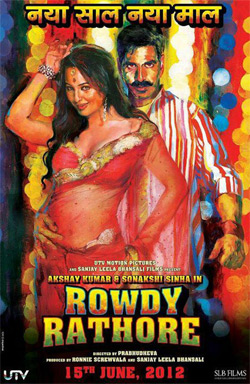
  • Reviewing the Reviews: Rowdy Rathore

    By Deepa Gahlot


    Producer: Ronnie Screwvala, Sanjay Leela Bhansali

    Director: Prabhudheva

    Music: Sajid-Wajid

    Cast: Akshay Kumar, Sonakshi Sinha, others


    These days, most critics have nothing against mainstream cinema. But Rowdy Rathore is the kind of film that has the mildest of then gnashing their teeth in frustration, because the success of such a bad and old-fashioned film is inevitable.


    The masses want mindless entertainment even today, they don’t care how loud, crass or silly the film is; does it give them their money’s worth?  For the non-massy types, such films are a kind of guilty pleasure.  What shocked most is that Sanjay Leela Bhansali is partly responsible for unleashing this on the public.


    Except for Taran Adarsh’s 4 and The Times of India’s now-standard 3 stars, everybody else tossed between 1 and 2. Writes Adarsh, with an eye firmly on the ticket windows of single screen cinemas. “On the whole, Rowdy Rathore, is designed to magnetize the masses in hordes. The accurate blend of action, emotions, drama and humor, besides a superlative performance by Akshay Kumar, makes this motion picture an immensely pleasurable and delightful movie watching experience. If you savour typical masaledaar fares, this one should be on your have-to-watch listing for certain. Dhamaal entertainer!”


    Srijana Mitra Das of the TOI gushes, “Indeed, Rowdy Rathore pays homage to iconic filmi characters – identical heroes, golden-hearted chors, brave Men in Brown beating evil people to pulp. However, it pays most homage to its own star, Akshay Kumar, who pulls off Shiva with style but Vikram less so, possibly because all that violence overwhelms acting itself. Not that the crowd seemed to mind. As Shiva exhorts a woman raped by Baapji’s son to beat him up, the girl next to me cried, “Why doesn’t she?” Her neighbour replied, “She will.” And she did – much to the crowd’s Rowdy delight.”


    Saibal Chatterjee of NDTV gave it 2 stars and commented, “Rowdy Rathore is a shrill action flick designed to help Akshay Kumar return to his hit-making ways. Accept that obvious intent and you might actually end up enjoying certain parts of the film against your own better counsel. Isn’t that the effect that many a Bollywood potboiler of the 1980s would have on us? Yes, Rowdy Rathore employs narrative elements that hark back to a bygone era of Bollywood potboilers: two men who look like each other without any apparent reason, a bunch of baddies that snarl and snap at the slightest provocation and indulge in rape and pillage with abandon, and the good old back-from-the-dead revenge seeker who goes back dispensing rough-and-ready justice.”


    Two stars from Raja Sen of rediff.com.”Inured to the kind of exploding-beedi violence promised by the trailer, the film instead starts stupid and stays silly. This is much more like an early Khiladi movie — where Kumar recklessly got away with anything, goofily stumbled towards the climax and then proceeded to kick bottom without mercy — than any of the recent films which have completely forsaken plot. As a result, it’s far less objectionable. Still moronically stupid and entirely pointless, but nowhere near as horrid as what the genre’s been reduced to in the last couple of years.”


    Shubhra Gupta goes with 2 stars as well, “We don’t have to be told that this is a remake of a Telugu film. It could have been in mainstream Tamil or Kannada. Because whether it is Priydarshan or Prabhudeva (who has directed this one), the film is bound to have South Indian actors trying to pass off as North Indian. Fictional towns which look as if they’ve been created on a set. Blinding colours. Songs at the drop of a hat. Dialogues which don’t go beyond a line. Or two. And a leading lady whose job description is, apart from possessing a swaying ‘kamariya’.. um, let me think about it.”


    Now come the one star rants. Anupama Chopra writes, “Don’t Angry Me! Akshay Kumar bellows this often in Rowdy Rathore. At one point, the command even plays out as background music. I think viewers need to co-opt the line. To all the directors, producers, actors who are inflicting eighties-style, low-IQ, deafeningly loud, unapologetically crass, mind-numbing movies on us, I just want to say: Don’t angry me! Don’t exhaust me! Don’t bludgeon me!”


    Rajeev Masand comments, “Rowdy Rathore is the kind of movie that’s made by people with a cash register in place of their brain. Because no legitimate reason, other than financial gain, can justify why this movie was made – it has no story or plot whatsoever, the characters are entirely forgettable, and it’s so long and loud and silly that the laughs dry up early on. That the film has such impressive pedigree – it’s produced by Sanjay Leela Bhansali, directed by Prabhudeva, and stars Akshay Kumar – is both baffling and shameful.”


  • Gimmicky, unappetizing green times

    Ranjona Banerji

    By Ranjona Banerji


    What is the general feeling on the pista-green shade adopted by Bennett Coleman newspapers for World Environment Day, June 5? To me, not only did it look unappetising (not that I have anything against pistachios, quite the contrary) but it also seemed gimmicky. The giant Fiama de Wills ad which ran horizontally from top to bottom and half the page on TOI did not help either.


    The effort has to be commended – Sunita Narain of Down to Earth as guest editor and a whole slew of stories on the environment. However, the kind of stories chosen were “same old, same old” and that, even for an interested party like me, it was a bit yawn-inducing. Wagging fingers about environmental degradation and human iniquity is now passé. The movement has progressed since then and practical applications and answers would have perhaps been a better track to follow. An opportunity lost, unfortunately.


    Most other newspapers just paid basic lip service to the day, so plaudits for Bennett Coleman there.


    **


    Sachin Tendulkar taking his Rajya Sabha oath should have been a fairly simple matter, with a requisite press presence suitable for a star. But this propensity for national hysteria can get a bit boring. Yes, we have already discussed in great detail the whys, wherefores, whens, hows, what-ifs and wisdom of this move. So apart from breathless coverage we also had some laboured debate on NDTV about Tendulkar and the Rajya Sabha.


    When there are no major issues at hand then TV’s desire for “scintillating” discussion (can’t find the sarcasm emoticon) falls a little flat. Even Arnab Goswami’s going round and round the mulberry bush over India against Corruption and Baba Ramdev’s on-off love affair was uninteresting since there were very few answers that India actually demanded from either of them.


    **


    Watching a press conference with Union finance minister Pranab Mukherjee after the Congress Working Committee meeting on Monday was fascinating. If he were not so busy being the main trouble-shooter, the Congress could have used him as their chief TV debater. His breadth of knowledge is so large and understanding so acute, he sort of stops people in their tracks. I suspect that journalists are a little frightened of asking him the frivolous questions they usually do of others. Imagine what Mukherjee would do to Nirmala Seetharaman or Ravi Shankar Prasad in a TV debate?


    **


    Since the French Open is into its second week at Roland Garros, it is a pleasure to see so much coverage on so many sports pages. I take the Hindustan Times and the Hindu off the hook here – they have always given fair play to tennis. But even the Times of India which barely manages a nod to other tennis tournaments has clearly decided that a Grand Slam is worthy of its venerable attention. So too the Indian Express, which gives a little nod to sports and focuses on cricket, has been covering events in Paris.


    However the cynic in me says that since some European football tournament is due to start this week, tennis may soon be back in the briefs sections.


  • Newspapers must make sense of TV news

    Ranjona Banerji

    By Ranjona Banerji


    Something has to be done about newspapers being so serious and stick-in-the-mud. Look at yesterday on television. There was so much excitement over two loos at the Planning Commission’s offices – spending Rs 35 lakh to do potty comfortably while millions of Indians were consigned to surviving happily on Rs 32 a day (am being generous here). To rub salt in the wound, Rs5 lakh was spent on a security system to keep the janata-public out. Everyone was spitting fire, from the opposition to activists to ordinary people. Montek Singh Ahluwalia, deputy chairman of the Planning Commission also had a wee tantrum – at the media and also RTI, which opened the bathroom doors as it were.


    Then Thursday morning comes and you open the newspaper. Hmmm. Does anyone oblige you by putting the story upfront with lots of diagrams and graphic details? Of course not – there’s just news on display like the economy and monsoon and a murder here and there. You have to trawl through the newspaper – page 12 or 15 or something to get a small little story about this toilet transgression. Even that CWG man who said that Indians have different cleanliness standards – anyone remember him – because of dirty bathrooms at CWG homes got more purchase on the press. Of course, I don’t remember his name but that may be because my brain has very strict hygiene protocols.


    If this example of newspaper perfidy is not bad enough, how about the other big story of the day? Some folliclely challenged man in Indonesia had something to do with Jharkhand politician and former chief minister Madhu Koda’s ill-gotten crores of rupees. The part of the day that wasn’t about Montek’s potty was about Koda’s friend. Some squeaky tapes played on and on as the anchors’ voices tried to match them for squeakiness and outdid them in decibel levels. Don’t ask me what the whole thing was about because I never figured it out. I must also clarify that I have nothing against men or women who don’t have a lot of hair on their heads but I have no other way of identifying this man who has something to do with Indonesia.


    Is one to find a code in the morning’s newspapers? Nyet, nada and all the rest of it. The monsoon and its arrival got more play in the newspapers than Koda’s not too hairy on the head friend and all that money. There will be at least one grateful person.


    It’s been said before, but it has to be said again. Newspapers must dedicate at least half a page a day making sense of TV news stories for hapless viewers.


  • Ranjona Banerji: Why I criticise Times Now most

    Ranjona Banerji

    By Ranjona Banerji


    Is the cacophony of television news adding anything substantial to the dissemination of news, views and information? In fact I should make that “substantive” since this seems to be the new fashionable word. I repeatedly hear people saying it on TV and since there is no editing provision for live TV debates, mistakes are exaggerated and emphasised. A man who was introduced as a Supreme Court lawyer (I cannot remember his name but he also hates the BCCI, if that’s a clue) said this repeatedly and I would have liked to have been a fly on the wall if he had ever appeared before Markandey Katju. Sadly, the print media is also unable to see the difference between “substantial” and “substantive” even as it continues to mis-spell “minuscule” as “miniscule”, probably because it doesn’t register on spell check in Microsoft Word. The dictionary has not been spotted in newspaper offices for over a decade now and sits high on the endangered species list. And of course the difference (or as they say on TV “differential”) between “less” and “lesser” is a lost cause as far as the print media is concerned.


    This segue from irrelevant debates to bad spelling is now over. This week, Times Now spent half an hour discussing a proposal by Air India to give special favours to MPs. The problem was that no one except the anchor, editor-in-chief Arnab Goswami, knew anything about the plan. So the discussion – if it can be called that – never went anywhere.


    There are events which are offensive and annoying. But not all of them have enough substance – substantial or substantive – to merit a debate. A little discretion is advised if you do not want to drive viewers away.


    **


    I have to admit that I watch more Times Now at primetime than any other English TV news channel . And that is why I criticise it the most. But even in all the seemingly manufactured outrage, it appeared that Times Now had a finger on the pulse of its viewers. Now I wonder – drama for the sake of drama gets boring after a while, even in a country which thinks that Rowdy Rathore is a good film.


    CNN-IBN is dull, NDTV I have ambivalent feelings towards and I stopped watching Barkha Dutt after her reaction to the Radia tapes, Headlines Today remains a channel for babies and NewsX appears to have not paid its carriage fees to over half the country’s operators. The best programmes on CNN-IBN are probably Cyrus Broacha’s The Week That Wasn’t and Karan Thapar’s Devil’s Advocate and Last Word.


    **


    The problem for TV of course is that issues like the economy, drought, government inaction, female foeticide – which newspapers have focused on today – have no visual or dramatic traction. Indian TV news does not seem to have as yet worked out how to develop a story. If everything has to be breaking news, then at best you have raw data which can move in any direction and at worst, you have nothing.


    The Indonesian connection to Madhu Koda is a case in point. For such a story to have maximum impact, it would have made better sense for Times Now to construct a story and then air it. By just running with what they had, they only confused and bored people.


    This lack of direction and journalistic skill is why they keep running to people for reactions, whether it is a tree that has fallen or a road accident. Or indeed, a proposal by Air India to treat MPs like kings.


    Ranjona Banerji is a senior journalist and commentator. She is also Contributing Editor, MxMIndia. The views expressed here are her own.