Category: MxM JOURNALISM REVIEW

  • Reviewing the Reviews: Ishaqzaade

    Ishaqzaade


    Directed by: Habib Faisal


    Produced by: Aditya Chopra


    Written by: Aditya Chopra, Habib Faisal


    Starring: Arjun Kapoor, Parineeti Chopra


    A Yashraj film, by the man who wrote Band Baaja Baraat and directed Do Dooni Char; an industry kid being launched and a modern day Romeo & Juliet set in the political badlands of Uttar Pradesh. At least the combination of plusses evokes interest.


    Parineeti Chopra walked away with accolades in Ishaqzaade, which otherwise got mixed reviews, mainly because critics expected more than just a collection of cliches from Habib Faisal.  Another Hindu-Muslim romance against an election backdrop? Oh no! Still, it got between 2-3.5 stars, which is not bad.


    Raja Sen of rediff.com gave it 2 stars and felt that it did a disservice to its heroine. “There is much craft on display, and some lovely moments, but the immense promise shown by the first half turns out as hollow as a politician’s. Soaked in sloppy sexism, the second half has the heroine repeatedly tortured — cheated, slapped, bound, gagged, shot at and abused — and yet the film decrees that she forgive. In the heartlands the film is set in, maafi is an all-absolving concept, an irretractable token of instant forgiveness, like a church confessional. Ishaqzaade, despite its artistry, deserves no pardon.”


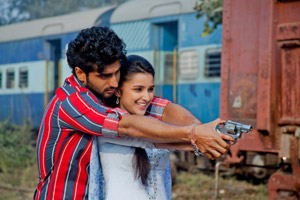
    Saibal Chatterjee writing in the NDTV website gave it 2.5 and commented: “ Faisal Habib creates the small town environment with an eye for detail, with many of the interactions between the young foes-turned-lovers taking place in and around a train station, in abandoned coaches and decrepit yards. It is a typical upcountry semi-urban space – dusty, crowded and cacophonous – with genuine and tangible dimensions.   The main characters, too, are by and large believable, especially because the roles are essayed by young actors who look real. The hero isn’t a sculpted hunk; the heroine is, at best, a pretty girl next door. However, the supporting cast, with the exception of Gauhar Khan, make little impression. That leaves too much of a load on the inexperienced leads. If only Arjun Kapoor’s dialogue delivery had greater punch and Parineeti Chopra could pull off the emotional moments without going shrill, Ishaqzaade would have been a markedly better film.”


    Rajeev Masand of IBN gave it 2.5 as well. “Much of the film’s strengths come undone by the use of such tired cliches as the religious differences that stand in the way of true love, and the sacrificial hooker with a heart of gold. Also Faisal resorts to an unforgivably unoriginal climax – for both the resolution of the lovers, and their families – that sticks out in a film with such promise. ‘Ishaqzaade’ benefits considerably from Amit Trivedi’s excellent soundtrack and Hemant Chaturvedi’s sharp cinematography. Faisal creates a believable world with charming characters, and his leads have crackling chemistry. I’m going with two-and-a-half out of five for director Habib Faisal’s ‘Ishaqzaade’. It’s far from perfect, but you won’t be bored.”


    Shubhra Gupta of the Indian Express also went with 2.5. “Small town romance is back again on Bollywood’s radar, and ‘Ishaqzaade’ goes about checking all the boxes. Locations yielding picturesque railway crossings, little bazaars, sprawling ‘kothis’. Determinedly dressed down characters. Lots of local patois, which these days, translate into a shower of ‘gaalis’. And a pair of lovers who wield guns with much more ease than roses. It’s all in there, and yet the result is mixed: some of ‘Ishqzaade’ hits the spot, the rest is a drag.”


    Anupama Chopra of the Hindustan Times was not too impressed, still, gave it 3 stars. “Faisal sets up the story with great precision. Kapoor and Chopra are terrific as the explosive twosome. The music, composed by Amit Trivedi, works well. The casting is bang-on:Parma’s swaggering grandfather and his long-suffering but strong mother are nicely etched characters as is the local dancing girl, played by Gauhar Khan. Which is why it’s so disappointing to see it unravel. Still, Ishaqzaade does provide half a good time. How many films can you say that for?”


    Sudhish Kamath of The Hindu wrote, “How do you take a story that’s been told over a hundred times at least in 100 years of Indian cinema and still make it relevant and reasonably engaging? Writer-Director Habib Faisal succeeds to a great extent in crafting an unpredictable first half full of spunk and spirit, but plays it boringly safe in the second, offering no new solutions or fresh perspectives in a story that has been done to death. You can’t help being disappointed with the limited ambition of this film that succeeds in creating characters who alternate between love and hate for each other.


    Taran Adarsh of bollywoodhungama.com gave it a generous 3.5. “On the whole, Ishaqzaade, a volatile and intense story with ample doses of fanatical romance, should appeal to a pan-India audience. This broadly engaging love story has a winsome pair who deliver dexterous performances, besides popular music and several poignant moments, which should appeal to fans of mainstream films. Go for it!?”


    Surprisingly Madhureeta Mukherjee of The Times of India gave it 3 stars, which is low by the paper’s standards. “Director Habib Faisal takes you into the heart of this small-town story, creating a politically-divided Almore with elan – penning gripping characters (a rigid and arrogant Dadda, a suppressed, dukhiari Amma, two overbearing brothers), but fails to maintain the crescendo in the second half. After highlights like a sensitively shot lovemaking scene on a rusty train berth, a subtly picturized romantic song (Pareshan), and a shocking pre-interval scene, it starts falling apart like a house of cards; ultimately folding into a predictable climax. The flatness of the second half is what takes away from the pace of a launch vehicle that could’ve been memorable.  ‘Ishaqzaade’ starts with a bang-bang, but ends up firing blanks.”
     

  • New Column: Reviewing the Reviews by Deepa Gahlot

    Mere Brother Ki Dulhan

    Key Cast: Imran Khan, Katrina Kaif and Ali Zafar

    Written and Directed By: Ali Abbas Zafar

    Produced by: Aditya Chopra


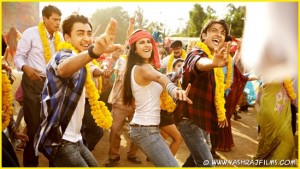
    This Yash Raj Films production by first-time director Ali Abbas Zafar,got mixed reviews ranging from 1 to 4 stars,leaving readers foxed as usual.This is a common enough occurrence these days when reviewers are so afraid of a slamming when films they pan like Bodyguard go on to become blockbusters, that in trying to please popular tastes along with trying to express their own critical opinions, they often tip over to the side, that is, what the masses might like. The public, as always, is quite unpredictable.


    There were certain common points across reviews:

    a)The plot was stale

    b) Katrina Kaif saved the film with her  bindaas act

    c) Imran Khan is getting typecast as a wimp

    d) Ali Zafar (the Brother of the title) can’t act


    Hardly anyone noted the similarity to Hollywood film Dan In Real Life.


    Our take:

    Romcoms everywhere are pretty clich’d anyway,so this one’s not a complete dud. You get what you expect,which is not much.


    Irritatingly, Katrina Kaif plays a half-way rebel,who is done with her smoking-drinking (no sex) ways and now wants to settle for an arranged marriage. Imran Khan and Ali Zafar play hopeless Mamma’s boys, who can’t stand up for themselves.


    The Reviews:

    Mayank Shekhar of Hindustan Times gave it 1-1/2 stars, with a headline stating Mere Brother Ki Dull One. He wasn’t too impressed with the Katrina Kaif character, writing, Katrina Kaif plays the said rock chick. It’s hard to tell if her character’s restlessly rebellious, or plainly retarded.


    The Dull word appears in Sudhish Kamath’s review in The Hindu, with a headline: Katrina puts the dull in Dulhan. While pointing out, And for a romance film, it makes you fall out of love with Katrina. Ouch!


    Shubhra Gupta of The Indian Express quite rightly says in her headline: We’ve seen this Shaadi before.This is a Yashraj rom com where funny-smart lines are a substitute for good old passion. Don’t go looking for any. Don’t go looking for any subtle notes, either. There aren’t any. Quite true Shubhra nails it there; plus she finds Katrina exhausting.


    Just 3 stars from the usually generous Nikhat Kazmi of The Times of India.It is the verve factor which works admirably for the film which doesn’t have much to boast about in the story department. The film tries to remain high spirited throughout, both in terms of the narrative and the performances and mostly succeeds in keeping the smiles coming, she writes, and concludes that it is pleasant weekend viewing.


    Pratim D Gupta of The Telegraph was one of the kinder ones, noting the freshness of the Katrina-Imran pairing.Imran and Katrina make sure you sit in that plex chair, eyes wide open with a smile fixated on your face, and just let them happen to you. A bit treacly, that, but then that’s probably the response of teens flocking to the cinemas to giggle at Katrina’s antics.


    Rediff.com’s Sukanya Varma recommended the film to Katrina fans and gave it 2-1/2 stars. All three look younger than they are and bear an incredibly fresh, genuine and genteel disposition. First-time filmmaker Ali Abbas Zafar avails of these qualities to fashion a feel-good, melodrama-free, candy floss rom-com about two brothers and a mutual love interest.


    Aniruddha Guha of DNA is probably the only one who likes Ali Zafar, but gives YRF a drubbing. Every year, YRF launches a director or two, who then make the same films other directors were already making for the banner. There’s not a shred of originality, not even an attempt to rise over the mindlessness; just a set pattern that is replicated to the T, even though it’s met with little success time and again. His one star is the lowest the film gets.


    And finally, the four-star extreme from Taran Adarsh of Bollywoodhungama.com. According to him, there’s nothing wrong with the film. It is a delectably wholesome, heartening, feel-good entertainer. Not just a comedy, but also a tender, bittersweet saga, this rom-com is sure to melt your heart, then restore it anew all over again. Yet another winner from Yash Raj! It seems he was watching a different film from the rest of the world.


    Deepa Gahlot is a National Award-winning film reviewer and a veteran writer and commentator on the arts. She currently heads programming for Theatre and Film at the National Centre for the Performing Arts, Mumbai

  • Reviewing the Reviews: Vanity Unfair

    Jaana Pehchana

    Key Cast: Sachin, Ranjeeta, Birbal, Vikram Sahu, Mehmood Junior

    Written and Directed By: Sachin

    Produced by: Ajit Kumar Barjatya, Kamal Kumar Barjatya


    One of the essentials of a movie sequel is that the original should have been a great hit, or at least a film that audiences remember with affection. And there really is no point for a sequel coming out 33 years later—by which time the original is not even a distant memory. So Jaana Pehchana, the very belated sequel to Hiren Nag’s Ankhiyon Ke Jharokon Se (1978), is just a vanity exercise for director Sachin Pilgaonkar, who was the toothy, curly-mopped, cutesy protagonist of the original, opposite Ranjeeta (who retired years ago after a fairly successful but also unremarkable career).

    The Rajshris, producers of AKJS and several small-budget, non-star-cast films in that period, have refused to change with the times. Their last monster hit was Hum Aapke Hain Koun in 1994, and for Jaana Pehchana, they have used the same strategy of releasing it in one moviehall – the delightfully retro Liberty. HAHK had picked up, thanks to its stars (Salman Khan-Madhuri Dixit) and popular music.  Jaana Pehchana mostly retreads the old movie in the form of lengthy flashbacks and reuses Ravindra Jain’s score that now sounds too high-pitched and annoying.

    Very few bothered to review Jaana Pehchana, and obviously it comes out rather poorly in comparison with the old film, which was hardly a classic to begin with—plucked as it was from 1970 Hollywood weepie Love Story. It’s not very likely that many of the current crop of reviewers would have seen the original—though they will get more than a glimpse in Jaana Pehchana.  And seeing Mehmood Junior, Birbal and the once ubiquitous Rama Kaka provides unintentional giggles.

    Our take: The stars have arrived in 2011 in decent shape, but did anyone miss Sachin and Ranjeeta so much as to want to see them romance again? The Rajshri style of filmmaking looks almost primitive by  today’s sophisticated standards, but it is also equally true that filmmakers of that period knew how to tell a story without relying on styling and digital tools.

    A generous two stars by DNA’s Akanksha Naval Shetye and Soumyadipta Banerjee (two to write on this film?) and a title that states: Jaana Pehchana is the cake rather than the icing.  “While many in their upper 40s will find it entertaining and won’t mind a nostalgic trip down memory lane, the younger cine-goers may find it hard to bear. Sachin clad in white shorts running around with Ranjeeta in pretty frocks on Juhu beach; Birbal and Jr Mehmood providing comic relief, in a way that – like the bell bottoms – only suited that decade, might evoke laughter, instead of get them to relate to the romance.”

    Mayank Shekhar gives the film one star and refers to the 50ish protagonists as “geriatric”—which is terribly ageist. Odd that only he remembers the Mallika Sherawat vehicle Khwahish.  He writes, “Calming allure of the earlier film comes through. The last time Bollywood remade Love Story, they’d turned the Ali MacGraw classic into a slut-fest on the rocks called Khwahish (2003), heavy publicised for its 17 kisses that the makers had kept count of. Sachin asks his girl out instead in more charming ways, “How about a date? Din mein dono saath saath rahenge, ghoomenge (We’ll spend a day together, travel around?) Any objections?” Not at all. Heroine’s floored. Hero drives her around in a two-seater convertible. This is ultimate comfort cinema in deliciously crummy Eastmancolor for those of a certain vintage that grew up appreciating film for its appealing simplicities.”

    Gaurav Malani writing in the online version of the Times of India notes, “So it doesn’t matter whether you have watched the original film since you get to see most of it in the sequel. But that’s precisely why the sequel doesn’t work for you either, because with the repeat telecast of the original, it sets a direct contrast and thereby highlights the mediocrity of the sequel.”

    Preeti Arora of rediff.com gives it two stars, but her headline says it all, ‘Jaana Pehchana is outdated.’  Not one to mince her words, she writes, “The characters live in a perfect world, a second opportunity for love is being handed to them but romance is something which happens once in a lifetime. Reaching out for it a second time around isn’t something selfless people indulge in. But in today’s times these perfect worlds do not exist. People do not give up on romance or life merely because one relationship ends abruptly.  It is these good-as-gold characters with outdated values in their simplistic uncomplicated world which make the film unbelievable.”

    Trade journalist Komal Nahata, whose reviews appear on koimoi.com, gives the film one star but is also rather kind, praising the script and the performances. But adds, “Today’s audience may not be enthusiastic to watch yesteryear actors Sachin and Ranjeeta play the central roles in what basically remains a love story albeit with a difference. Moreover, there is an entire generation of under-30s, which may never have seen Ankhiyon Ke Jharokon Se. Of course, the film can be fully understood even if one hasn’t seen the first part (AKJS) but again, the question arises: without having seen and loved AKJS, how many among the youth (which comprises a sizeable chunk of our audience today) would be keen to watch Jaana Pehchana?”


    Deepa Gahlot is a National Award-winning film reviewer and a veteran writer and commentator on the arts. She currently heads programming for Theatre and Film at the National Centre for the Performing Arts, Mumbai

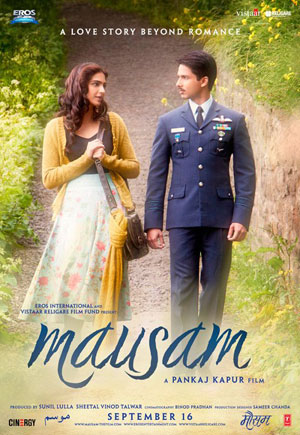
  • Reviewing the Reviews: Mausam

    By Deepa Gahlot

    Mausam

    Key cast: Shahid Kapoor, Sonam Kapoor

    Written and directed by: Pankaj Kapur

    Produced by: Sunil Lulla and Sheetal Vinod Talwar


    Pankaj Kapur’s debut film as director seems to have done the near-impossible—united critics across the board, with harsh-to-gentle panning and ratings from one and a half to two stars. All except the Times of India, of course, that rarely drops below three, and NDTV. Everyone agreed that the film fell fall short of its epic pretensions, and went on and on till the audiences were bored to tears.


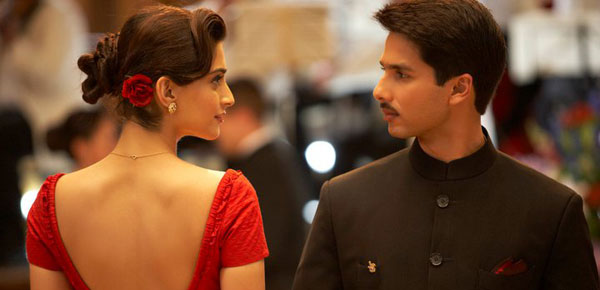
    The film, with the pompous tagline: A Love Story Beyond Romance (means what?), has its Punjabi hero and Kashmiri heroine meet and separate over several countries and calamities, till the pathos is wrung inside out to become farcical. All that fuss about the Air Force was needless, the bloke need not even need to be a pilot. Shahid gets to wear a uniform, a moustache, a still expression and pretend for a few minutes that he is Tom Cruise in Top Gun. Sonam Kapoor looks pretty, giggles, screams, weeps and dances in Scotland!


    Sudhish Kamath of The Hindu titled it “Epic Disaster”. “Think of all the possible clichés that have kept star-crossed lovers away in Hindi cinema over the years and put them all in one movie — jilted lover, jealous rival, death of father, change of address, call of duty, misunderstandings, unread letters and those riots every few years,” he writes.


    Mayank Shekhar of Hindustan Times gives it one and a half stars and writes, “There’s an old, popular Shailendra ditty in this movie that goes, of course, Ajeeb Dastan Hai Yeh, Kahaan Shuru, Kahan Khatam (It’s a weird legend. Not sure where it begins. Not sure where it ends). The second time they play that Shankar Jaikishen song on this screen, you’re convinced this is some kind of an inside joke between the film’s director and his drooping audience. He’s ushered you into the theatre all right, seated you comfortably with popcorn, Coke and other supplies for the day, it’s been over three hours (has felt like multiple mausams, seasons, of a television series), you’re still not certain when this epic tragedy will end, or if it will at all.”


    According to India Today’s Kaveree Bamzai, “Every scene is beautifully shot, the romance is meant to grow on you with its artful glances and coy exchanges. But instead of a slow burn, it’s just plain exhaustion.”


    Raja Sen on rediff.com echoed the sentiments of many, “This is a love story gone awry purely because of under-communication, and while that seems fine enough on paper, it’s rather hard to swallow two lovers cleaved for well over a decade simply because they don’t have each other’s forwarding address.”


    IBN Live’s Rajeev Masand calls it an unfortunate mess and says, “Plodding along for close to three hours, Mausam loses steam early on. By the time the film hobbles to its end at a riot-stricken Ahmedabad fair, all you can do is gasp. Gasp in complete shock at the inconceivably embarrassing climax that involves a Ferris wheel, a crying child, and a horse. This one scene alone hints at just how desperately this script was begging for a rewrite!”


    Aniruddha Guha of DNA quips that the only thing epic about Mausam is its length. “Two lovers separated by circumstances repeatedly would be acceptable if the situations were at least believable. But the story demands you to suspend belief repeatedly, and gets convoluted beyond repair eventually.”


    The Reuter’s Review headline says “Mausam is several seasons too long,” and then, “If director Pankaj Kapur hadn’t gone to pains to establish that Mausam plays out between the mid-’90s and the early years of this century, you’d be forgiven for thinking this film takes place in the ’20s — when there was no internet, no phones and no technology. Why else would two, reasonably well-off, intelligent people who obviously have access to technology be unable to trace each other? It makes no sense, and instead of feeling sad for them, you feel frustrated.


    The usually kind Taran Adarsh of bollywoodhungama.com surprisingly dubs it a “colossal disappointment,” and comments, “The screenplay, to put it bluntly, is unengaging and what makes it worse is the fact that it seems like a never-ending saga. The film just goes on and on and on, moving from one city/country to another, till the viewer gets jetlagged and exhausted by watching this saga unfold on screen. With a running time of close to 3 hours, Mausam has a few sequences that do stand out, but the weak script blows the efforts away.”


    And the usually sensible Shubhra Gupta of The Indian Express gives it an uncharacteristic two and a half stars, saying, however, that “Mausam starts like a dewy-fresh spring morning, where everything is familiar yet new. It then wilts, autumnal overtones taking over. And then never quite recovers, falling into a dreary never-ending winter.


    One of the few who recommends the film is NDTV.com’s Saibal Chatterjee. “To conclude, Mausam could quite easily have ended up being a stodgy, strenuous and self-conscious drama. Writer-director Kapur, the accomplished actor that he is, orchestrates the emotional ups and downs of his tale with a commendable degree of moderation for the most part. Mausam is certainly worth a viewing.”

  • [MJR] TV leads to early onset of maddening rage

    By Ranjona Banerji


    Sometimes, television viewing can be seriously injurious to health. On Monday night, I tried to wade through TV discussions and only landed up with all the signs of early onset of maddening anger which soon developed into full blown rage. And I didn’t even venture further than two channels – Headlines Today and Times Now.


    On Headlines Today, the discussion was about the decision to ban all cartoons in textbooks. The guests were all having hysterics, the anchor – Rahul Kanwal – tried to say that vital airtime should not be wasted this way but the panellists were having none of it.


    This makes one wonder whether this format of prime time discussions on the news of the day is working any more. Night after night, we watch these so-called experts descend to the worst examples of civilised behaviour. Nothing fruitful is discussed as a result.


    One panellist could not even distinguish between a political cartoon and comic books. The first was not suitable for children apparently while the second were Archie comics and all that are fine she says. Clearly she has not read too many comics or cartoons – regardless of the unintended hilarity of her arguments. All I know is that her first name is “Kakoli”, since the channel never repeated it after that.


    Cartoonist Suthir Tailang also gave up after some time, the gentleman from the Bahujan Samaj Party just yelled incessantly, the comic lady continued with her routine and the anchor ended the whole farce.


    * * *


    On Times Now, we shifted to another dimension. Editor in chief Arnab Goswami decided that the government had to step in to save General VK Singh’s reputation as the army chief edges closer to retirement. This is in response to a Press Trust of India story about how some official in the Cabinet secretariat is apparently going to be blamed for leaking the army chief’s letter to the PM about India’s lack of defence preparedness.


    The panel was full of former army officers, both them and their moustaches bristling away about how the army was all good and everyone was all bad. Where do they get their accents from by the way? Sometimes they sound like London meets Ludhiana or Kota meets Kanada or more likely Billy Bunter in Bundelkhand. Forgive me, I’m just more used to Salman Khan’s Mumbai meets Manhattan. Do you think they teach accents at the IMA? I concentrated on their accents because it was impossible to understand what they were saying. But anyway, they all went off on their own tangents with India demanding answers and the country wanting to know every two minutes.


    The only voices of sanity were Kumar Ketkar, editor of Divya Marathi and KC Singh, former ambassador to UAE. But since they did not join in the general outcry to save the army chief, they were shunned. Ketkar was roundly castigated for suggesting that VK Singh was “hobnobbing with Anna Hazare”.


    In all this, no one asked (or dared to ask) why the government should save VK Singh’s reputation when the general himself had scant concern about it during his date of birth fight and especially after the spanking he got from the Supreme Court.


    Anyway, by this I had burst a few blood vessels and could not even watch Jon Stewart’s Daily Show to restore my equilibrium.


  • [MJR] Un-miserable about Trai’s ad regulations

    Ranjona Banerji

    By Ranjona Banerji


    This is actually an “un-grouse” – I go with the current zeitgeist and fascination with the un-dead (vampires) and the unlikely (werewolves).


    Despite the criticism on MxMIndia.com yesterday over the TRAI regulations about ads on TV channels, needless to say, as a viewer I’m a bit un-miserable. I understand the need to make money and profits and all that but sometimes watching TV can be an unhappy experience.


    TRAI has asked for commercial breaks to be limited to 12 minutes for every hour that there should be at least 15 minutes between consecutive breaks for programmes and every 30 minutes for movies. In addition, there are to be no part-screen or drop-down ads for live sports events. What’s to complain? It’s not as if the TV channels themselves don’t know how damn annoying constant ad breaks can be – they themselves advertise “break-less” movies as a cachet, as if the producer suddenly released a new uncut version of the film.


    The worst transgressors are Indian general entertainment programmes. Producers shoot what seems to be about 10 minutes of programming for those popular soaps and serials and the rest of the time is spent on dramatic repetitions of the last two minutes that transpired before the 40-odd ad breaks. Obviously someone in TRAI (or their families) watches these serials.


    There can be no one – except for some very brain-dead advertisers – who actually thinks that part-screen drop-down ads which mask action during a live sports events endears one to the advertiser. TRAI has only stated the obvious here.


    News channels are no better in particular, NDTV and CNN-IBN. If you catch them on the half-hour or the hour, you can be treated to about 10 straight minutes of advertisement. I keep hearing about how news channels are financially precarious which only leads me to believe that they ought to charge more.


    Times Now is terribly smart about this. During prime time, which is when editor-in chief Arnab Goswami conducts his nightly inquisition, there are minimum commercial breaks. The channel knows that people are watching for the drama and are not interested for the moment in Katrina Kaif having sex with a mango. TRPs skyrocket during Goswami’s Newshour (sometimes two hours) and Times Now knows that that benefit can be spread across the other hours of the day.


    It must also pointed out that newspapers and magazines also operate under some restrictions about the editorial to ad ratio and this does not lead to general hand-wringing and despair.


    Plus, it is also true that some ad breaks are necessary. You can make a few quick calls, run to the loo and check that the dinner is not burning. In between you might also decide that the Appy Fizz is indeed incredibly annoying and a talking soft drink should indeed be un-alive.


  • [MJR] TV journos prove Katju is right

    Ranjona Banerji

    By Ranjona Banerji


    Journalists have evidently signed a pact to prove Press Council of India chairman Markandey Katju right – 90 per cent of Indians are idiots. There seems to be no other reason for this enormous media reaction to the late night fracas between film star Shah Rukh Khan and a security guard at Wankhede stadium two nights ago.


    Of course, the shenanigans of film stars are exciting and when they behave badly it’s even more fun. But is there anything to justify front page headlines and TV debates for two days? What exactly is there to debate? Khan arrived last the stadium around the time Kolkata beat Mumbai, with a bunch of kids. The kids ran into the field. A security guard stopped them. Khan intervened. Words were exchanged and some apparently not very polite ones and then Khan left.


    For this, the world has come to an end. We are discussing politeness, propriety, banning, apologies, role models, respect for the uniform, high-handedness, diplomacy, official inefficiency, entitlement or the sense thereof, protection of children and the decibel level of whistles.


    If we went to war with China, I cannot imagine more being discussed on television. The journalists on TV cannot seem to distinguish between a security guard and a policeman. Rahul Kanwal almost burst a blood vessel when on Headlines Today veteran adman Prahlad Kakkar tore into the behaviour of security guards: “You have to respect the uniform”. I would really like to know how any of these TV guests react when faced with the officiousness of a security guard.


    Kakkad was a rare voice of sanity as was Rohan Gavaskar who said: “Banning Shah Rukh Khan from Wankhede is like banning Sachin Tendulkar from PVR”. Meaningless, in other words. Except for Arun Lal on Times Now, no one wanted to discuss whether officials of the Mumbai Cricket Association, who called for a ban on Khan entering Wankhede, were not over-reacting. Lal said it’s a question of contesting fiefdoms – with Khan as an IPL team owner against MCA officials with their hurt pride at being event managers rather than stakeholders.


    The levels of self-righteous on Times Now were staggering, with anchor Arnab Goswami, veteran columnist and author Shobhaa De and not-so-veteran columnist Simi Chandok leading the way. Goswami kept bringing up police action against Hollywood stars Nicholas Cage and Russell Crowe, again unable to distinguish between security guard and a policeman. (Hint: different uniform.)


    Former Mumbai police commissioner MN Singh tried to point out that criminal charges against Khan were not possible and this led to him being dragged over hot coals by Goswami. When the nation wants to know, let no man or woman try and douse the fire.


    Commentator Charu Sharma however poured cold water on Rahul Kanwal’s spectacular rage – mainly it seemed because uniforms were not being respected, apparently a prime concern in his life – by forecasting that an amicable resolution would be reached and the incident would soon be forgotten. The truth is that everyone knows that that is what will happen.


    As a matter of interest, after all the hot air expended over the fight which Saif Ali Khan had in a restaurant at the Taj a few months ago, can anyone remember the names of those self-righteously hurt complainants from South Africa? Hmmm.


    * * *


    On NDTV, I watched another somewhat circular debate over whether PA Sangma could become the next president of India. These speculative discussion with weak premises only illustrate our emptiness of thought. I greatly admire Divya Marathi editor Kumar Ketkar for his fortitude and level of tolerance as he sits through so many TV debates these days, trying to inject a little sanity into proceedings.


    It seems amazing to me that no TV people seem able to realise that all this political hoopla over the next president is just a diversionary tactic from all the political problems this country is facing.


    Goswami even wants a debate between Sangma and Vice-President Hamid Ansari, since he possibly believes that India has a presidential form of government. Contestant 1: I will plant 400 varieties of roses in the gardens. Contestant 2: I will conduct the tours of Rashtrapati Bhavan myself. Contestant 3: I will never build a large retirement home for myself. Contestant 4: I will never bore school children with my poems and ideas.


    Please, somebody, save us!


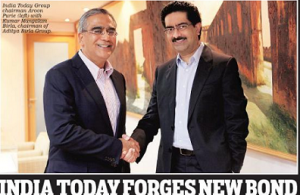
  • AV Birla group buys 27.5% in India Today group

    A Mail Today news article with Aroon Purie with Kumar Mangalam Birla in the photograph

    By A Correspondent

    The Aditya Birla group has announced a financial investment of 27.5% in Living Media India (better known as the India Today group).

    The move has been confirmed by a way of a communique to the stock exchanges. Says Kumar Managalam Birla, chairman, Aditya Birla group, “The media sector is a sunrise sector from an investment point of view. I believe that Living Media India offers one of the best opportunities for growth and value creation.”

    Comments Mr Aroon Purie, chairman of the India Today group, “I am delighted to partner with the Aditya Birla group to aggressively address the current and futre potential of the Indian media business which is at a tipping point. The Aditya Birla group with its strong leadership global footprint, diversified business interests and its shared values of integrity, commitment and social responsibility make it a perfect fit with the India Today group.”

    The transaction is of course subject to the statutory approvals.

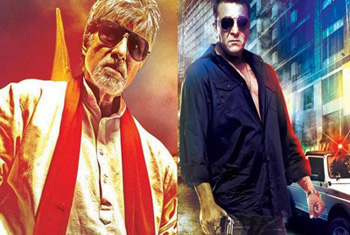
  • Reviewing the Reviews: Department

    Department

    Directed by-Ram Gopal Varma

    Produced by-Siddhant Oberoi, Amit Sharma

    Written by-Nilesh Girkar

    Starring-Amitabh Bachchan, Sanjay Dutt, Rana Daggubati, Madhu Shalini, Lakshmi Manchu


    Ram Gopal Varma doesn’t care about critics (he doesn’t care about audiences either!) or he would have spent a very depressing weekend, as his latest film Department is shredded into small pieces.  The lowest rating ½ , the highest 2.


    One opinion is that this film is even worse than Ram Gopal Varma Ki Aag.  It certainly is a toss up between the two to decide which one is more crass.


    Janhavi Samant of Mid-day gave it ½ star and wrote: “It doesn’t matter what the plot is, Sawatya has an endless supply of gang members who take till the end of the film to perish. And there is some random gyaan about Bhagvad Gita. At some point Mr Bachchan enters the fray to do some spectacular hamming of his own, showing his penchant for doing ‘legal things illegally’ rather than ‘illegal things legally.’ Really Ramu, did you have to say that thrice in the film?”


    One star from rediff.com’s Raja Sen, who calls it a failed experiment: “Varma, predictably, has fun with a couple of quirky lines – especially one that blatantly introduces Nathalia Kaur’s item number, a cameltoe-y milestone for Bollywood – and a scene with the camera mounted on the striker on a carrom-board is genuinely imaginative, but Department is an utter waste. The director who showed us how to film violence is now sucking basic action scenes of their dynamism, leaving them dry and dead, but filming his movie’s carcass from multiple angles. Tragically enough, Satya and Shiva are just names of characters for the new Ramu.”


    DNA’s Aakanksha Naval-Shetye and Chhaya Unnikrishnan moved up to 1.5: “Dizzying shots, bizarre camera angles and a confusing storyline mark Ram Gopal Varma’s cop and underworld drama, Department. With Varma returning to his forte, (read underworld), one expected a gritty drama but what unfolds is a saga of gory violence and crass scenes.”


    Rajeev Masand gave it 1.5 too and wrote: “Small cameras positioned at odd places, indulges his quirk for gravity-defying angles. It works occasionally in the action scenes that appear more visceral now, but for the most part the bizarre camera movements give you a headache. Just shy of two hours and thirty minutes, ‘Department’ is tedious and boring and doesn’t have any of the originality of ‘Satya’ and ‘Company’, or even the occasional tension of ‘Sarkar’. Dutt delivers his lines like he’s reading out the phone book, and Bachchan hams it up no end as the gangster-turned-minister. It’s only Rana Dagubatti who approaches the film with any earnestness whatsoever… It’s a lazy, indulgent film that tests your threshold for pain.”


    Karan Anshuman of Mumbai Mirror went with 1.5 too: “No matter what format a film is shot on, no matter what technique – whether it’s of conventional genre or found footage or experimental Dogme 95 – the gimmick is only a means to an end (a broad view of the end being audience engagement at a story level). With RGV, now the end is simply a different visual experience that does nothing to draw you in. So many times you’re missing dialogue and performances because the camera is overwhelmingly, utterly distracting. This would be acceptable if the visuals were any good, but they are not.”


    Anupama Chopra was kinder with 2 stars: “Varma has mined this material before, from Satya to Ab Tak Chhappan, which he produced, so he decided to embellish this film with a new technique that he calls “rogue filmmaking.” Which means he chose student camera operators and high-end digital cameras over a cinematographer and film camera. Which further means that strange camera angles, a regular feature of Varma’s films, are now the main event.”


    From the Times of India, 2 stars is a massive put down. Sriranjana Mitra Das wrote: “The violence might even have clicked, considering the tale’s twists – but crazy camerawork makes you forget all that. Varma’s experimented, placing multiple cameras at different angles, treating you to close-ups of bottles pressed to mouths, lips sucking cigarettes, zooms up Dutt’s hairline. The camera even flips upside down, puncturing the tension that should’ve vibrated between Bachchan and Dutt. One line – “Chamatkaar ko namaskar” – nails it. You stagger out sensing something wasted – Nathalia Kaur’s item number’s more hideous than hot, the prettiest thing around is a translucent tea-cup, the action is mind-numbing. Losing the plot and three strong stars, Department shoots itself in the foot.”


    The Zee News critics commented: “Watch ‘Department’ if you have been missing your headaches for a long time. Watch ‘Department’ to see the way in which brilliant actors can be wrung dry and left skill-less. And above all, watch ‘Department’ if you are an ardent Ram Gopal Varma fan. And then leave the theatre cursing yourself for watching this brilliantly crafted piece of – well, by now – you know what.”


    The Business of Cinema reviewers are brutal too: “The film opens with the line ‘Absolute power corrupts absolutely’, but Ram Gopal Varma’s action film frustrates absolutely. Not only is the story old wine in cracked bottles but also it’s shot with camera angles that make you nauseous and dizzy while leaving you wondering what Varma and his cameraman were thinking.”


  • [MJR] News TV declares IPL root of most evils

    Ranjona Banerji

    By Ranjona Banerji


    The Indian Premier League has now been declared responsible for all India’s problems. This has been unequivocally stated on our TV news channels, and is thus now the incontrovertible truth. This cricket tournament has destroyed our sense of morality, taken us down a road of sex, drugs, violence and betting, not to mention completely killed cricket. These evils, so far unknown and unseen in Indian society, will soon become widespread.


    Look at what the IPL has done:

    Item: Made a film star fight with a security guard (violence).

    Item: Made a cricketer molest a woman (sex).

    Item: Made two players go to a rave party (drugs).

    Item: Made five players work out spot-fixing deals with bookies (betting).

    Item: Made players restrict matches to 20 overs a side and then made this version popular with – shudder – cheerleaders (killing cricket).


    Against all these charges, the IPL does not stand a chance. It has been clear to the protectors of both cricket and Indian society from year one that the IPL was BAD NEWS. The very fact that so many people were interested was proof enough. And then, all those film stars, starlets, dancing girls, rich people, money, parties – my word, what is the world coming to?


    Each year, the IPL, our TV channels have found, has gotten bigger and thus by conclusion it has become worse.


    Just look, for instance, what it has done to Shah Rukh Khan: Forced him to fight with a security guard and with Mumbai Cricket Association officials. This is unacceptable behaviour and absolutely no way for film stars to behave. It is one thing to run over people, help gangsters bomb the city or beat up your wife (or even wives). For these crimes, if you’re unlucky, you will get a few newspaper editorials and maybe even go to jail but you will just be seen as a lovable rogue. But fighting with a security guard? That is the end of civilisation as we know it.


    It is hard to know what to do to save India after this. No doubt, the TV channels will tell us. A beginning has been made by former cricketers Kirti Azad and Bishen Singh Bedi, who have apparently gone on a hunger strike to save India from the IPL. The TV channels do not appear to have given this hunger strike the 24-hour coverage they granted to Anna Hazare’s hunger strike. But they do assiduously cover the cricket part of the IPL in their sports programmes. Come on, now, the whole country watches the IPL!


    * * *


    Having made it to the TIME magazine’s list of the world’s 100 most important people, West Bengal chief minister is now planning to top the list and every other list which will ever be made. This is the link to her latest dramatic act – storming out of a CNN-IBN audience meeting in Kolkata, leaving even the formidable Sagorika Ghose, TV anchor and event host, at a loss for words. The CM was furious because the students in the audience were “CPM cadre and Maoists”. That is, they asked questions she didn’t like.


    The other link is to the reply written by the erring student.


    Enjoy.


    http://ibnlive.in.com/videos/259724/question-time-didi-watch-the-show-that-mamata-walked-out-of.html


    http://www.telegraphindia.com/1120520/jsp/frontpage/story_15509625.jsp#.T7nCA1In3Vq


  • Congress-led UPA loses sheen as BJP inches ahead: ABP News-Nielsen Survey

    By A Correspondent


    The ABP News-Nielsen survey conducted on the eve of the UPA-II third anniversary has revealed that after eight years in power, the Congress-led coalition’s pull seems to be diminishing.


    The survey, conducted across 28 cities across the country in April-May 2012, revealed that the BJP would garner 28 per cent of the votes if Lok Sabha elections are held now, while the Congress would manage only 20 per cent.


    In fact, the BJP has turned out to be the most favoured party. In an interesting revelation, only 69 per cent of those who voted for Congress during 2009 Lok Sabha elections are still intending to vote for it, if Lok Sabha elections are held now. 31 per cent are moving away from it and 12 per cent now intend to vote for the BJP. Whereas for BJP, 84 per cent will stick with the party and only 2 per cent are switching away from it to Congress.


    In 2009 elections, 28 per cent of these respondents voted for Congress, while 27 per cent voted for the BJP. But for the BJP, the dip of 8 per cent in the Congress vote share is not a complete gain. The BJP is gaining only a marginal 1 per cent. The remaining 7 per cent dip in Congress vote share among these respondents is gain for regional parties.


    In the 2009 Lok Sabha elections, Congress had won 207 seats while BJP had got 116 seats.


    While 32 per cent believed the government’s performance was good or very good, a sizable 35 per cent rated the performance as average.


    Significant 21 per cent respondents said it was poor while 11 per cent rated the performance as very poor. The performance of UPA government has been rated slightly below average with a mean score 2.95, which is lower than the mean score of 3.22 last year.


    However, Manmohan Singh’s ratings are good with 37 per cent respondents saying his performance was good or very good. Another 33 per cent ranked him average, while 28 per cent believed his performance was poor or very poor.


    Around 32 per cent of the respondents felt that performance of UPA government is better or much better than its last term. A dip of 8 per cent is observed in the perception of people from last year survey, where 40 per cent of the respondents felt that the performance of UPA government is better than previous term. 39 per cent rated UPA performance as “about the same” this year, similar score in comparison to last year.


    Only 36 per cent of the respondents felt that performance of the PM is better than its last term. A dip of 8 per cent is noted in the perception of people from the last year survey, where 44 per cent of respondents said that the PM performed better than his previous term.


    When it comes to best leader in the country, Narendra Modi 17 per cent said he is the best leader over Manmohan Singh at 16 per cent. Modi was preferred at number four during last year’s survey (12 per cent).Manmohan was ranked at number 1 last year (21 per cent).  Rahul Gandhi’s scores have dipped from 19 per cent to 13 per cent this year.  Sonia Gandhi’s scores are down from 14 per cent to 9 per cent.


  • Birla may use personal money for buy, Mail Today may now launch editions in Mumbai, other metros

    The Aditya Birla group investments may help India Today invest in launching editions of its newspaper Mail Today in Mumbai and other metros.


    By A Corresdpondent


    Kumar Mangalam Birla, chairman of Aditya Birla Group, has bought a 27.5% stake in Aroon Purie-controlled Living Media India, the publisher and owner of India Today magazine and Aaj Tak television channel. Mr Birla will use his personal money to invest in the New Delhi-based group, which straddles the entire media chain, from television to magazines to tabloids.


    A statement from the metals-to-retail group said Birla has agreed to join the Living Media group as a financial investor. It did not specify the price for the deal or the valuation.


    However, investment bankers close to the transaction said the deal has been finalised for Rs 600-700 crore, valuing the media group at Rs 2,400-2,800 crore. Mumbai-based investment bank Ambit Corp was the advisor to the deal.


    This is the second big investment by an industrialist in the media space. In January, affiliates of Reliance Industries agreed to buy a large stake in the companies of Raghav Bahl, the promoter of Network18 and owner of channels such as CNBC-TV18 and CNN-IBN. The investment was worth over Rs 1,500 crore.


    TV Today is listed on the stock exchanges, but it is not clear whether Birla’s personal investment companies will now have to make an open offer to buy 26% from public shareholders.


    The financial investment also marks the realisation of Kumar Mangalam Birla’s cherished dream of owning a media company. “The media sector is a sunrise sector from an investment point of view. I believe that Living Media India offers one of the best opportunities for growth and value creation,” Birla said in a release.


    Birla made an unsuccessful entry into the entertainment space by launching a movie and TV production company, Applause Entertainment, in 2003. The company, which produced the acclaimed movie Black , was closed down in 2009 after the downturn in the entertainment industry sparked off by the global recession.


    Living Media will use the cash from the deal to expand its presence in media. It may now look at launching its New Delhi-based tabloid, Mail Today, in other metros, including Mumbai, according to persons close to the company.


    Source:The Economic Times

    Copyright © 2012, Bennett, Coleman & Co. Ltd. All Rights Reserved