Category: PRINT MEDIA

  • Don’t be complacent: N Ram’s goodbye letter

    By Tuhina Anand


    On his last day as the Editor-in-Chief and Publisher of The Hindu, Business Line, Frontline, and Sportstar, N Ram bid his colleagues farewell and exhorted them to seize the opportunities of the media world and face the challenges of the tough business environment the media faces today.


    Mr Ram’s mail states that Siddharth Varadarajan, D Sampathkumar, R Vijayasankar, and Nirmal Shekhar, all Editors, will take over, with effect from January 19, 2012, as Editors of The Hindu, Business Line, Frontline, and Sportstar respectively responsible for the selection of news under the Press and Registration of Books (PRB) Act of 1867.


    K. Balaji, Managing Director of Kasturi & Sons Ltd, takes over as Publisher of all Hindu Group publications and also as Printer as applicable. Ram informs that he will continue to be a wholetime Director of Kasturi & Sons Ltd.


    He states in the letter- “These changes on the editorial side are significant, indeed milestones in our progress as a newspaper-publishing company. On the one hand, they represent a conscious and well-prepared induction of fresh and younger blood at the top levels of our editorial operations, not of course as one-person shows but as captains of teams of talented professionals who work on the basis of collegiality, mutual respect, trust, professional discipline, and cooperation. On the other hand, these editorial changes are a vital part of the process of professionalization and contemporization under way in all the Company’s operations. I am clear that this is the only way to face the future – the opportunities as well as the challenges.”


    In the letter he also mentions, “About us it will certainly be no cliché to say: individuals come and go, the institution goes on.”


    He talks about the current situation of print press and broadcast television being in crisis across the developed world. He mentions Indian media being fortunate, “The chief differentiating characteristic of this media world is that printed newspapers (and also broadcast television) are in growth mode, some of us in buoyant growth mode. How long this duality will endure is a matter of conjecture. But there are exciting opportunities out there in our media world and they must be seized strategically and with deft footwork. Digital journalism – good journalism on the existing and emerging digital platforms – is an exciting domain where a combination of quality, reliability, interactivity, creative ways to engage the reader, and growth with commercial viability will be key. There are, equally, tough challenges – especially a hardening business environment and rising commercial pressure on editorial values and on the independence and integrity of editorial content, seen, for example, in the recently exposed notorious practices of paid news and private treaties. The negative tendencies that have surfaced in the Indian news media have been sharply criticized by the Press Council of India Chairman, Justice Markandey Katju; and Nobel Laureate Amartya Sen has reflected on the problem in a rather different way. The last thing we need is complacency.”


    “In my understanding, the two central functions of a trustworthy and relevant press (and news media) are (a) the credible-informational and (b) the critical-investigative-adversarial. A third is the pastime function, which is important, especially for engaging the reader in a wholesome way; but it must be constantly kept in perspective and proportion and must not, in my view, be allowed to outweigh, not to mention squash, the two central functions.”


    He concludes by thanking people he has interacted during his tenure and assures that after completion of the process of editorial succession, The Hindu publications will be in able and trustworthy hands and their values as strong as ever.

     

  • PM commends media while releasing book on Tribune

    By A Correspondent


    Prime Minister Dr Manmohan Singh released a book titled The Tribune 130 Years: A Witness to History, in New Delhi on January 19.


    In his speech on the occasion he said:

    “I am delighted to be in the midst of The Tribune family once again. The last time I was involved in your celebrations, I had the pleasure of releasing an anthology of selected writings to commemorate 125 years of this magnificent paper.


    “Today marks the release of a comprehensive history of The Tribune, on completion of 130 years of its publication. It is truly pleasant to go down the memory lane with the newspaper of my choice which has been my staple reading every morning for decades.”‘A Witness to History’ is an apt title of a book that records the 130 year old history of The Tribune. Indeed, this history stands closely intertwined with the story of our country’s journey during this turbulent period.


    “Sardar Dyal Singh Majithia, the newspaper’s founder was a man of rare foresight and a great reformist. He was inspired by high ideals and wanted The Tribune to be free of any sectarian or commercial bias, and unaligned to any dogma or political party. I am happy that the newspaper has by and large lived up to its founder’s vision. While being an effective watchdog of the interests of the people it has practiced responsible and credible journalism.


    “The Tribune has also been a wonderful example of good what trusteeship is about. Its Trustees have been men and women who have distinguished themselves in their respective professions and who embody the spirit of The Tribune very aptly.


    “The newspaper is one of the very few in the country where the editor is insulated – as much as is possible – from managerial demands and proprietorial interests. But even more importantly, the newspaper has always been blessed with Editors of impeccable credentials. My friend Raj is one of them, with many very illustrious names before him and some of them are present on this happy occasion.


    “I compliment all those who have helped shape The Tribune into the newspaper it is today-the generations before us and the current torch-bearers of this fine institution.


    “I congratulate the author of ‘A Witness to History’ Professor V N Datta for writing such a fine book. Prof Datta recounts how in the early years of the 20th century The Tribune became passionate as a patriotic and nationalist newspaper. He elaborates how from 1920 onwards, as events began moving at a fast pace and as communal tensions began building up, the newspaper’s sober and reasoned approach attempted to bridge the divide between the Hindus and the Sikhs on the one hand and the Muslims on the other. The Tribune was opposed to the dismemberment of India and made sincere efforts to prevent it, but in vain.


    “Glancing through the pages of ‘A Witness to History’ I was struck by the words of an avid Tribune reader who wrote to the newspaper on September the 25, 1947, the day The Tribune resumed publication from Shimla, after Partition had forced it to move out of Lahore. And he wrote: “The heart of Punjab has begun to beat again, though the pulse is yet faint.”


    “On May 13, 1948, to mark the Tribune’s shift to Ambala, the then Prime Minister Jawaharlal Nehru wrote in a special message to the newspaper in his inimitable style: ‘You have passed through many difficulties and have stood many tests. I trust you will not be carried away by momentary passions but will function with a vision of the future before you.’


    “We have come a long way from the early years of The Tribune. Today, while India sits at the high table of nations and is looked upon and heard with respect, a vibrant media is crucial to our needs-a media that informs and educates, a media that is inspired by public interest and not guided by sectarian or commercial considerations.


    “The Indian media of today has its inevitable highs and lows. Every day we see examples of journalism of a very high calibre. There are instances of fair and accurate reporting, free of biases. There are stories with painstaking research to back them up. Journalists often expose wrongdoings even at considerable risk to themselves. There are efforts to report constructively on subjects that are of vital national importance.


    “But we also see sensationalism, driven by a desire to sell a story at any cost. There are stories without a clear understanding of the underlined issues. There is reporting which is prejudiced. There is trivialisation of important matters. There is corruption. The prevalence of the practice of ‘paid news’ exposed recently has come as a shock to all right-thinking people.


    “It has been our government’s avowed belief that the Fourth Estate is an essential pillar of our democracy. We believe in complete independence of the media from external control. It is true that sometimes irresponsible journalism can have serious consequences for social harmony and public order, which the public authorities have an obligation to maintain, but censorship is no answer. It is for the members of the Fourth Estate themselves to collectively ensure that objectivity is promoted and sensationalism is curbed. It is for them to introspect how best they can serve our country and society and advance their well-being, and how best they can earn the respect of our common citizens. Those in the media should come together to exercise a degree of self-regulation to combat perversions like paid news.


    “It is an important responsibility of the media to expose corruption and other ills in our polity and society. It should also advise the government and even reprimand it when it goes wrong. But let me also suggest that it should not be all gloom and doom all the time. The world is looking up to us today and it would be but fair that positive news is also given its due share. The Indian development story is an exciting one and should be told through the print and visual mediums.


    “I believe that good journalism is very serious business and a very difficult work. The responsibilities that journalists carry are onerous – to inform and educate the public, to keep a watch on the government’s work and to highlight issues of critical importance. It is hard to be a good journalist – ever willing to learn, ever alert to new developments, objective, fair, sensitive, balanced and constructive in approach.


    “However, I also believe that collectively the country’s journalists have acquitted themselves reasonably well. I am convinced that the Indian media is on the balance responsible and attuned to serving national interest. I am also sure that the coming years will see even higher standards from our media.”


  • Filmwallahs, scribes mourn film critic Nikhat Kazmi’s death

    By A Correspondent


    “After people die, they become stars. Nikhat Kazmi just became four and a half”, a tweet by @NumbYaar as a tribute to Nikhat Kazmi aptly summed up feelings at her untimely death at the age of 53 on January 20, 2011. She was suffering from cancer.


    “Was truly shocked to hear about the untimely death of nikhatkazmi…the TOI critic of several years…prayers and thoughts with her family,” tweeted Karan Johar  (@kjohar25).


    “Tragic news. Extremely sad to know about the demise of Nikhat Kazmi, one of the most persistent film critics. Am sure wherever you are, it’ll be a 5 star rating, RIP. May God give strength to your loved ones,” tweeted Akshay Kumar (@akshaykumar).


    Ms Kazmi was the film critic at Times of India where she had been working for almost 25 years. According to media reports, she continued working till the very end. The last films she reviewed were Sadda Adda, Chaalis Chaurasi, Ghost and Blitz  (a Hollywood film). Ms Kazmi was always generous with her ratings, making no distinction between mainstream Bollywood and smaller independent cinema. And her generosity and grace were greatly appreciated by Bollywood.


    “Nikhat Kazmi was generous! Having come to terms with mortality she looked for something good in every film she viewed,” tweeted director Mahesh Bhatt  (@MaheshNBhatt).


    “Nikhat Kazmi was a great support for alternate cinema. Her reviews of Red Alert and Mee Sindhutai Sapkal, reaffirmed my faith in going global,” tweeted director Ananth Mahadevan (@ananthmahadevan19h).


    Many youngsters also gave her credit for always encouraging them in her reviews.


    “RIP Nikhat Kazmi. You enjoyed cinema and therefore encouraged us more than criticized us. We will miss you,” tweeted writer and director Milap Zaveri (@zmilap).


    “The 1st ever review I read of Refugee, my 1st film, was by NikhatKazmi. She always pointed out the road to improvement to me. RIP ma’am,” tweeted Abhishek Bachchan, (@juniorbachchan), mere hours after her demise.


    “Nikhat Kazmi ji the one person who has always encouraged me. Wrote so beautifully and one film critic I respected a lot! May her soul RIP 🙁 ,” tweeted Neil Nitin Mukesh  (@neilnmukesh).


    Not only Bollywood, Ms Kazmi’s death shocked many of her colleagues in the media fraternity too.


    Khalid Mohammed, film critic and filmmaker, said he wished he had known her better. “She was based in Delhi, while I worked in Mumbai. We would meet mostly at film festivals which required a group to cover the functions. I can’t say I knew her well, but I wished I had. I admire her perseverance, for she would review Indian as well as foreign language films,” he told MxM.


    Trade analyst and fellow film critic Taran Adarsh too expressed his condolences via Twitter: “Deeply saddened by the news of Times of India movie critic NikhatKazmi’s demise. RIP.”


    Parsa Venkateshwara Rao Jr, a senior journalist with DNA, had met Ms Kazmi once but she left quite an impression on him. Though he did not agree with her, he said liked her because: “Her heart was in the right place. She understood the importance of Hindi cinema and how it mirrored changing political and social winds of change. She was an anguished liberal,” he told MxM.


    Apart from being a film critic, Ms Kazmi was also an author who had written three books, Ire in the Soul: Bollywood’s Angry Years, The Dream Merchants of Bollywood and Times Guide to Hollywood Blockbusters. She had also written two plays.


    Whether people agreed with her critiques or not, there is no denying that her reviews in TOI will be missed. “RIP Nikhat Kazmi. A beautiful large theatre, with the coziest seat n all your favourite movies await you:) #respect” – Dia Mirza (@deespeak).


  • Arun Anant will be CEO, Hindu from Feb 6

    By Tuhina Anand


    It is learnt from sources close to the development that Mr Arun Anant is all set to join Kasturi & Sons Ltd as its Chief Executive Officer. He is slated to join on February 6, 2012 and will be responsible for all the non-editorial operations of the company.


    Mr Anant’s appointment comes following the recent development of Mr N Ram, the Editor-in-Chief and Publisher of The Hindu, Business Line, Frontline, and Sportstar stepping down thus paving way for restructuring at the senior level. Mr Ram had mentioned the appointment of a new CEO very soon.


    Mr. Anant, a B. Tech from BHU and a Post-Graduate in Management from IIM Ahmadabad, has earlier worked with The Economic Times and was the CEO of UTVi (now Bloomberg UTV). After moving from UTVi, he has set a management consulting firm called Inc Value. He has also worked on the agency side at Lowe where he was the GM Strategy.


    Also read

    N Ram to call it a day at Hindu

    http://www.mxmindia.com/2012/01/n-ram-to-call-it-a-day-at-hindu/


    Don’t be complacent: N Ram’s goodbye letter

    http://www.mxmindia.com/2012/01/dont-be-complacent-n-rams-goodbye-letter/


    Photograph: incvalue.com

  • What’s-On-India launchesTV streetmaps

    By A Correspondent


    What’s-On-India, India’s premier TV guidance company has launched a new business vertical – ‘television street maps’ – to monitor day-to-day changes to TV Channel availability and placement across Cable and Satellite households. The service has already gone live and has attracted a host of customers from the TV sector.


    The move to launchTV streetmaps by What’s-On-India is considered very strategic, especially in the context of dramatic changes expected in the distribution side of the TV business over the next couple of years due to digitalization being introduced by the government.


    What’s-On-India has already expanded this system nationwide to cover 700+ Analogue and Digital head ends across almost 300 towns and cities making it the largest ground coverage in the business.


    “Our plans are to expand the system to 1000+ head ends over the next 3 months, besides providing insightful value added services in this space to stakeholders,” said Joydip Kapadia, Executive Vice President, What’s-On-India.


    This new vertical has added a series of new customers which include One-Alliance, MSM Network, UTV Network, Viacom-18 among a host of others.


    Atul Phadnis, Chief Executive, What’s-On-India said: “We are very excited to enter this space. Over the next few quarters, What’s-On-India will be investing in this vertical to expand its scope across the country as well as to bring in newer technologies and automation for faster information from the ground. We are also integrating TV Street Maps with our EPG Systems for certain breakthrough solutions within the Indian market!”


    What’s-On-India Media Private Limited isIndia’s Premier TV Guidance and EPG Company. The company’s technology vertical powers EPG Metadata content from 500+ TV channels into more than 35 million Set-Top-Boxes and devices across Cable, Direct-To-Home, IPTV, mobile TV, Smart-TVs and Tablets.


  • Mid Day is a broadsheet – for a day

    By Akash Raha


    Mid Day appeared in a strange avatar on January 25 – as a broadsheet. The innovation was aimed at enhancing the impact of the launch of heavyweight wrestling show ‘Ring ka King’ in India.


    Manajit Ghoshal, MD & CEO Mid Day Infomedia Limited said, “This broadsheet innovation employed by us is a stimulating and stylised way of advertising. It introduces a surprise element, which helps in better impact and recall of the communication. It has been our continuous endeavour to create path-breaking strategic solutions for each of our clients to reach their target audience. This innovation has been one more step in that direction, as it strengthens our repute to innovate and be a solutions provider and a brand partner to our esteemed advertisers.”


    Colors had been looking for a strategic partner to assist in the launch of the show called ‘Ring ka King’, which will be launched on January 28, 2012 on Colors.  The brief shared with the Mid Day team was to communicate the debut of this show in India in a clutter-free manner. Further ideation on the brief led to the concept of creating a larger-than-life canvas where the launch can be communicated in an impactful manner.  The wrestlers are of enormous hulk and it was felt transforming into a broadsheet format would be a compelling way to communicate their arrival. The insights revealed from a study conducted on the kind of target audience led us to the following copy “Itna bada hai inka akaar, ki bada karna pada yeh akhbar.Teen din pehle de rahein hai khabar, Taaki aap rahein tayyar.””, which communicates the launch in a dazzling and eye-catching manner 3 days in advance. We wanted to highlight the fact that a special affair calls for a broader and bigger canvass.


    Commenting about this innovation, Rajesh Iyer, Head – Marketing, Colors, said, “The Ring Ka King thriller campaign is the physical representation of the excitement that the show embodies. We wanted to bring the action of the ring alive throughout our communication. To bring out the adrenaline pumped exuberance of the show into our promotional activities we collaborated with our creative partners to come up with a campaign which could do full justice to the thought. All our promotions for Ring Ka King, be it the print innovation with Mid Day or disruptive campaign across outdoor, radio and TV, are high on volume and scale.


  • Hindu hits back with a tough punch


    By Tuhina Anand


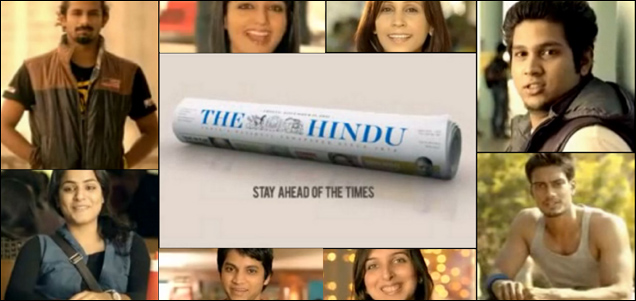
    The Times of India fired the first salvo with its hints at a “boring” newspaper. The Hindu has countered with its ‘Stay ahead of the times’ campaign. A bit of a revelation coming from the house of the newspaper which is perceived as traditional and old-fashioned, the 360-degree pan-Indian advertising campaign seeks to bring the core values of journalism to the fore. At the same time it shows how the ‘popular’ read has trivialised the kind of news being dished out to the readers, with the result that they are more clued in about Aishwarya’s baby and Hrithik Roshan’s pet name than knowing the name of the Vice President of India.


    What is more surprising is that in the campaign, even though it’s bleeped out, one knows that people who have been featured say that they read The Times of India, thus clearly acknowledging at one go that TOI is a force to reckon with but at the same time responsible for this trivialization of news. The tagline leaves no room for doubt as it states, “Stay ahead of the times.”


    This kind of aggressive marketing could be the answer to the campaign that The Times of India had come out with a few months ago in the Tamil Nadu market which targeted The Hindu for being boring. The Times of India campaign says, “Stuck with the news that puts you to sleep? Wake up to The Times of India.” In fact, it is learnt that the TOI had even printed a dummy newspaper, circulated within the industry, with The Hindu masthead and “zzzzz” printed all over, to underline its message that reading the newspaper put people to sleep.


    Mr Suresh Srinivasan, Vice President (Advt), The Hindu Group of Publications insists that the campaign is not a reaction to the earlier TOI salvo. He said, “We have been on a path of transformation and change where we have not only undergone organizational changes but also been contemporising our product in order to connect better with our reader. The changes have been in content, layout and packaging based on the research we had commissioned, and their suggestions.”


    He added, “We are the country’s most respected English daily and the number 1 English daily in the South, with a growing footprint in the North. While we build on our strengths there is also a need to protect our turf. The Times of India is definitely our single largest competitor down South.”


    The Times of India, meanwhile, has been watching the recent development with a  touch of amusement. Mr Rahul Kansal, Chief Marketing Officer at Bennett Coleman & Company Limited, said: “It is good fun to watch it from the sidelines. TOI is an all-India brand and has redefined the news and newspapers altogether. In fact, this doesn’t really damage our brand in any way. On the contrary, it reiterates the fact that we are a very strong contender for the leadership position in the Chennai market. Remember, the Coke and Pepsi war? It didn’t hamper Coke in any way but it did establish Pepsi as a worthy young brand.”


    One of The Hindu TVCs
    [youtube width=”400″ height=”200″]http://www.youtube.com/watch?v=xmXPBp7DpQw[/youtube]
    The Times of India TVC
    http://timesofindia.indiatimes.com/videos/news/Wake-up-Chennai/videoshow/10557020.cms

    “While advertising, one does exaggerate and that’s what we had done when we said in our earlier campaign that The Hindu is a staid brand. One takes extreme positions in advertising to bring out the humour, so even now when the ad says we give only Page 3 news that just to bring out humour. Everybody knows that the TOI is a complete newspaper,” added Mr Kansal.


    Despite the impressive numbers of The Hindu, there definitely seems some concern about the might of the TOI which led to this kind of aggressive marketing. Mr Narendra Kumar Alambara, Vice President at Starcom Worldwide, who has been observing the Chennai market, explained: “The TOI has made inroads into the Chennai English newspaper market and there is no denying that. While the gap between the leader and TOI is still huge, but the latter has become a strong competitor. Youngsters and migrant population have been picking up this newspaper, especially, because of the kind of news reporting that TOI has been doing. While earlier there was no option, but now there is an alternative read. In terms of readership, I think that for The Hindu it has remained stagnant while TOI has grown the category itself. However, one should remember that in the Chennai market retail advertisers lead and for them The Hindu is still a priority.”


    On the campaign, Mr Srinivasan said: “The Hindu believes that, more than ever in a globalising, knowledge-driven economy, it is vital that readers are well-informed about the world at large. And yet, over the last few years, the news and media industry in India has become increasingly focused on serving up a steady diet of trivia, shying away from the national and international issues that really matter. This may help sell more newspapers or get more viewership in the short term, but it is the news equivalent of junk food. And the long-term result is a steady dumbing-down of readers who end up knowing more about Aishwarya’s baby than the Arab Spring.”


    The campaign shows how one may be creating a country that is fully conversant with gossip and Page 3 culture but clueless about current affairs and world events.


    Mr Srinivasan says, “The campaign is aimed at triggering conversation and if we succeed in provoking thought and debate that would be the measure of our success. It is intended as an eye-opener to get people to re-evaluate their media choices, to demand a smarter newspaper.”


    The campaign will be on TV, radio, cinema, print, outdoor and digital. It will be supported by on-ground activities in malls, cafes and other locations.


  • The Anchor: 6 things for the publisher of a business publication to remember

    By Vivek Khanna


    #1 One of the most important things that the publisher of a business paper – or, for that matter, any publication – has to keep in mind is the content. Accuracy and genuineness of information is critical to the success of any newspaper.


    #2 It is extremely important that the content and business sides of a paper are always separate, especially in a business publication. There has to be a wall between the content and business side so that no one can influence the other.


    #3 Checking for errors is extremely important. Business news can make or break an economy, hence it is critical to keep many level of checks before any news goes into print. In our organization, we have several levels of checks to ascertain that the news which goes to print is genuine and credible.


    #4 Journalists and Editors for a business publication have to be handpicked as they are meant to have a very special skill set and knowledge of the business world.


    #5 Business news needs to have more clarity. A lot of information today is lost in business jargon which business papers must stay away from.


    #6 In a market where there is a plethora of publications, it is of importance that a business publisher finds the differentiating factor for his product. A differentiated product with credible content is the only way to success.


    Mr Vivek Khanna is the Publisher and Business Head of Mint, HT Media Limited.


  • Jaisurya Das and Shailesh Amonkar to return to Sakal group as COO & CMO

    By A Correspondent


    The winds of change are blowing across the media. MxMIndia learns that senior industrypersons Jaisurya Das and Shailesh Amonkar are returning to the Sakal group from next week. The news was confirmed by a spokesperson of the group.


    While Mr Das, who has earlier been a consultant to the Pune-based Sakal group, will be Chief Operating Officer, Mr Amonkar will be Chief Marketing Officer and head the sales and marketing functions. Mr Amonkar was with Sakal from 2003-06 and held the portfolio of Director-Sales. He moved on to be an entrepreneur and set up Kemistry Media in Pune.


    Mr Das, who has had a successful run with The Times of India group having launched the edition in Pune, also turned entrepreneur and set up Xanadu Consulting, a media and human resources advisory firm (Disclosure: Mr Jaisurya Das is also Contributing Editor, MxMIndia and writes the very popular ‘Dear MxM’ column).


  • Vinod Mehta turns mentor @ Outlook group, Krishna Prasad to head newsmag as Ed

    By A Correspondent


    The Outlook group’s editor-in-chief Vinod Mehta is moving on from his executive role to that of a mentor. This was confirmed to MxMIndia by a spokesperson of the group who added that Mr Krishna Prasad will be Editor of the flagship Outlook magazine.


    When asked specifically if Mr Prasad will also be overseeing editorial affairs for other group publications as suggested by a PTI reported relayed by many publications, MxMIndia was told that he will be Editor, Outlook.


    Mr Mehta, who has worked with the Outlook group since 17 years, has been editor of The Pioneer, The Independent, The Indian Post, The Sunday Observer and Debonair. He was unavailable for comment when reached on Wednesday evening.


    Last month, it was also announced that CEO Mr Maheshwer Peri had turned into a mentor passing on the baton to Mr Indranil Roy.


  • It’s wait ‘n watch for TOI-Matrubhoomi alliance

    By A Correspondent


    After much speculation, The Times of India has finally made its foray into the Kerala market, forging a strategic alliance with Mathrubhumi to make inroads into this market. While for readers this alliance might be the best deal as just for Rs2 extra they get a copy of Mathrubhumi and the TOI with its many supplements, as a reader quipped: “This is not a bad deal for 2 bucks”.


    This exactly is the sentiment that TOI wants to ride upon – the bundling with a regional newspaper which the readers are familiar with and allow them to test something new definitely is a great way to enter a new market dominated by regional players.


    Kerala, in that sense, is a unique market with high literacy rates and people who are proud of their culture, willing to try something new but not at the cost of old. Hence, it is primarily seen as a two newspaper-market where one paper is regional, which appeals to the older generation and is more of a habit, and the other is an English newspaper appealing to the younger population.


    It is this younger population that TOI is trying to appeal to. The English newspaper market is primarily dominated by The Hindu, The New Indian Express and more recently Deccan Chronicle. The Hindu too has become aggressive and gone all out to protect its turf.


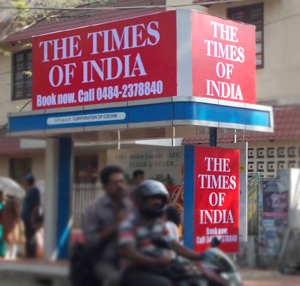
    Recently, on January 29, just two days ahead of the TOI launch, The Hindu and The Hindu Business Line launched its Kozhikode edition. This shows that The Hindu understands the might of TOI and has gone aggressive with its 360 degree campaign to reiterate its hold over this market. In fact, it has also taken around 30-35 hoardings to make itself visible while sources inform that TOI has taken up around 80 hoardings across to announce its presence in Kerala.


    The divide in Kerala, according to reading preference, is: South to Cochin (till Trivandrum) is where readers prefer Malayala Manorama whereas the area from Cochin to Kasaragoda is dominated by Mathrubhumi. This liking is also based on the political inclination too. Currently, TOI has come out with editions fromKochi, Thiruvananthapuram,Kozhikode, Kottayam, Pathanamthitta, Malappuram, Palakkad, Thrissur, Alappuzha and Kollam, thus being seen all over Kerala.


    However, it is learnt that the paper is having teething troubles: The newspaper is not available at many places; the hawkers union’s in Kerala raising ruckus over the availability of the newspapers in some pockets.


    Giving his view, Kiron Kurian, Group Manager, MudraMax said: “For TOI the real competition is The Hindu in this market. Their current strategy of tying up with Mathrubhumi, as I see, suggests that as the former caters to Sec A and B audience it will be easier to convert this TG to also adopt TOI as a second newspaper.”


    Swarup BR, Founder Stark Group, a Kerala-based 360-degree communication agency feels: “I think largely the TOI offering in Kerala market is nothing phenomenal from what has been seen in the other markets. There would be many people who would want to try out the newspaper and along with their aggressive marketing strategy, it should work out well for them.”


    However, for all, it’s ‘wait and watch’ to see how the market evolves. Some feel that a new trend might start with homes having three newspapers, with both Hindu and TOI having their share of readers. Also there could be revised rates to capture more audience.


    This TOI- Mathrubhumi alliance, while is advantageous for the former, will also be good for the latter as it might give it the much needed push that it requires to lessen the gap with the leader Malayala Manorama.


    Vidya Nandakumar, Business Director, LMG based in Cochin is doubtful that TOI will find it easy to break the monopoly of The Hindu. She said: “In Kerala people are die-hard loyalist and if they like a brand, it is difficult to make them switch. So it would be interesting to see how TOI gets them to convert.” She is of the opinion that probably it would be some pockets where TOI might succeed.


    But Mr Swarup countered: “Kerala is a ‘rurban’ economy; hence there is no clear divide between rural and urban. The brand proliferation too is across the market hence it is one big market. The opportunity for a TOI to reach across is immense. The entire state is a captive market, not just few pockets of interests. Yes, The Hindu is a formidable power and people would not be willing to give the newspaper so easily for TOI. So in that sense it would be interesting to see how the market plays itself out. It is possible that a whole new audience will evolve who will be readers of TOI.”


  • MJ Akbar’s The Sunday Guardian turns 2

    By Akash Raha


    The Sunday Guardian, the weekly Sunday newspaper, completed its second year in the market. The anniversary issue of the newspaper came out on February 5, 2012.


    Senior journalist and columnist MJ Akbar had launched the weekly newspaper from Delhi on January 31 2010. The newsweekly is also simultaneously published in London under the name of ‘India on Sunday’.


    Speaking about the two-year-long journey Kamal Shah, COO, The Sunday Guardian said, “It’s been an exciting journey so far. We’ve managed to create a distinct identity in a very short span of time, and have been able to assemble an excellent group of editorial staff who have consistently provided thought-provoking analysis and news. It is possible to be successful as a Sunday newspaper in this day and age of instant news. Our approach has always been analytical. We just don’t report news but look at news in depth!”


    When asked how the newspaper has grown in terms of revenue and circulation Mr Shah said, “We have concentrated since the beginning in establishing a broad circulation base and readership profile. We have managed the high net worth individuals, knowledge seekers and decision makers as our readers. Our revenues are growing and we’ll be able to capture a large percentage of advertising volumes in the weekly newspaper category.”


    According to sources in The Sunday Guardian, the newspaper circulates 74,500 weekly copies and 8,000 in its London editions. The weekly newspaper comprises of 40 pages of which 20 pages are devoted to the youth in the section Guardian20. The newspaper also has a digital presence on www.sunday-guardian.com.