Category: PRINT MEDIA

  • Anil Thakraney: So then what must The Hindu do?

    By Anil Thakraney


    The Times is on a rapid expansion drive. They’ve recently launched multiple editions in Kerala, including in small towns. This is quite understandable. Newspapers are in a slow death mode in large towns, and it makes sense to penetrate as many towns as possible to delay the inevitable demise of the newspaper as we know it.


    And this portends a serious challenge for incumbent brands. How can they protect their turf? How can they retain their readers in the face of stiff competition? It’s not going to be an easy task. The Times, which is a powerful challenger, has many strengths – the group has deep pockets, tremendous marketing fire power and the newspaper is wholesome; a healthy mix of serious news and entertainment. If the local brands remain lazy and complacent, they will struggle hard, that’s for sure. Deccan Herald learnt this lesson the hard way in Bangalore.


    Let’s take the current battle raging between The Hindu and The Times in Chennai as an example. The ad war between the two has already been discussed, and I mentioned in the Debrief section of this portal that I quite like The Hindu’s spirited fight back. But in terms of the content itself, what can the newspaper do to stay alive and relevant? This is a tough one; but allow me to put forward two critical points: The Hindu must NOT dump its image of an ultra serious brand. This is the newspaper’s core strength, it has been so for many decades, and it must be protected.


    If they attempt to emulate Times’s please-all mix, they will become a me-too brand and quickly lose the battle. Sticking to their core values will ensure they don’t disillusion their loyal readers. However, at the same time, they have to win over the hearts and minds of younger readers. Already, there is pressure from the internet, so this is going to be a huge problem. The Times is, anyway, particularly strong in its youth appeal. The trick here is not to dumb down the content and dive into a full on filmi and party coverage.


    The youth of India aren’t dumb. Yes, they enjoy entertainment coverage, but they also have their own serious issues to worry about, which include education and career opportunities. And this is what The Hindu must tap into very aggressively.


    The Express tries to do that but they haven’t achieved much success, and that’s because they are pretty clinical in their approach, and don’t make enough song and dance. The style of presentation and the marketing of youth-related stuff is critical. Features on career prospects don’t have to be boring; they can be made to rock. And marketed in such a way that the youth of Chennai perceives The Hindu to be a newspaper that understands their needs and concerns.


    As I said, it’s going to be a tough one. And I used The Hindu only as an example. The coming years will see massive newspaper wars because the category is on the decline curve. And each brand will have to be very smart and proactive to survive. Interesting times await!


    * * *


    PS: I am not a huge fan of authors who parade themselves at Litfests. And an even lesser fan of authors who tweet. I have always believed writers must remain enigmatic and should be known only through their books. That, the mystery enhances a writer’s appeal. Here’s an interesting article from The New York Times, it  explains the authors’ obsession with Twitter.


    Link: http://www.nytimes.com/2012/01/08/books/review/why-authors-tweet.html?_r=2&smid=tw-nytimes&pagewanted=all


  • Dainik Bhaskar asks voters to select the right candidate in Punjab

    By A Correspondent


    The state of Punjab went for polls just after the nation-wide public uprising against corruption. The whole nation was reeling under wide spread mismanagement and corruption, and it had provoked the citizens to rethink and hard.


    Elections are the most important part of democracies and societies in transition and the Punjab elections were an ideal platform for the people of Punjab to set tone for rest of the country, to rise and choose the right candidate, who would truly work in the interest of the public.


    Keeping in view the kind of awareness as well as apathy among voters, Dainik Bhaskar took an unique approach – Sahi Ko Chuno.


    Dainik Bhaskar, as India’s largest newspaper, felt that it was their responsibility to create the awareness among people, and to remind them that if they really wanted to eradicate corruption, and improve the overall system, they could not do it just by holding protests and picking up anti-corruption placards! If people really wanted their representatives to work for their benefits, to create policies and laws that were pro-public, they would have to choose their political representative with much thought. Sahi Ko Chuno (choose the right candidate) was Dainik Bhaskar’s call to the readers.


    The “Sahi ko Chuno” campaign did not align with any political party. It was a truly citizen agenda. It just provided platform for common public to voice their views and express themselves.


    On November 22, 2011, Dainik Bhaskar’s editorial team announced the start of campaign ‘Sahi Ko Chuno’ across all its editions in Punjab. This created high awareness and buzz on why was it important for voters to “Choose the right candidate”.


    A special initiative, “Yuva Sansad”, was organized in colleges and universities acrossPunjab, to catalyze productive discussions amongst youth on the prevailing political scenario and to educate them of the need to choose the right candidate.


    Public’s opinion on what is an “Ideal Candidate” was initiated in 32 cities of Punjab. The ground survey was completed in 26 days. Results of the survey were announced in Dainik Bhaskar on January 2. More than 85 per cent of voters inPunjabhad expressed their views that while voting they would be given due weightage to the “candidate” instead of “party”.


    The ‘Sahi ko Chuno’ campaign set a tone in Punjab, creating high awareness on need to choose the right candidate, as a right candidate would represent them in future as well as playing a significant role in policy making for the betterment of Punjab and its people.


    The campaign also used cable, FM, print promo ads as well as outdoor media including gates, standees, banners, posters in major touch points across 32 cities of Punjab.


  • Ready for the digital revolution: Vivek Khanna

    By Akash Raha


    Vivek Khanna, Publisher and Business Head of Mint, HT Media Limited

    Vivek Khanna joined HT Media in 2008 after working for more than 16 years, of which 11 were spent with Hindustan Lever Limited (HLL) where he led strategic and marketing initiatives – segmentation, positioning, advertising, and new product development. In his last assignment he was Director Marketing with Aviva, responsible for the company’s product and marketing strategy. He is a post-graduate in management from IIM-Ahmedabad and an economics graduate from the University of Delhi. In conversation with MxMIndia, Mr Khanna talks about Mint’s brand of accessible business news, new markets, and the digital wave, among other things. Excerpts:


    Q: Since its inception five years ago Mint has become a success story of its own. What has the journey been like, and what are some of the learnings that you would like to share?

    When we started off five years ago we identified a clear need gap amongst readers, which none of the existing business papers were satisfying. And that is how the entire positioning of Mint got developed, looking at the need gap and then asking how we could address it. We worked towards developing a product that would address the need gap; plus we said that we would get the best minds in the business – and we got editors and journalists from around the world and created a totally differentiated and unique product. I think the single biggest learning that we have is that as long as we are able to sustain this quality that we have been known for, we will continue to grow and do well. The journey so far has been very good, basically because of the fact that we have a product that is totally unique and well differentiated, and has been able to sustain and maintain itself from day one.


    Q: There are many reasons attributed to Mint’s success – the Berliner format, the content, and good marketing. What do you think is the main reason Mint has worked with both readers and advertisers?

    What clicks is with the readers first is the product. It is the quality of the product over the last five years that has helped us grow significantly since our launch. The advertisers are paying for the fact that we reach out to a certain number of very high-profile target audiences across the country. That’s really the key thing. Our product is something that this target audience likes, and therefore they are reading it on the regular basis. No one will keep picking up a product each day if it’s not good… Hence the fundamental thing behind our success is really our content.


    Q: Mint started off with emphasis on making business news easier for the masses. Is this still the ethos now and for the future?

    The Mint proposition is ‘clarity in business news’. We didn’t say we will be for the elite or for the masses. We just said that we will provide clarity to business news and that is what we continue to do – by analyzing and discussing a particular topic at length and presenting it in a manner that is easy to read as well as supported with facts, and therefore we have a certain credibility in the market. That focus has been there since the beginning, and it should continue.


    Q: What is the nature of Mint’s tie-up with The Wall Street Journal – content sharing or more?

    I can’t discuss what constitutes our tie-up with WSJ, as it is confidential information.


    Q: Following the Hindi and Gujarati editions of The Economic Times, do you see Mint also coming out with regional avatars?

    Well, as we speak, I have heard about some of these regional avatars getting pulled out from the marketplace. We will get to know over the next couple of days if that news is true or not. As far as we are concerned we have a certain growth path which is planned, we will continue to go on as per that planned growth plan. I can tell you that in the very near future, in the next 3-6 months, we don’t have a plan for any language business daily.


    Q: Regional media in India is still growing. How does the proposition of Mint in a Hindi or regional language avatar look to you?

    There is a increasing trend in smaller towns and among readers of Hindi and regional language. As the economy of some of these smaller towns continues to grow there is the tendency and the desire for people to be abreast with what is happening in the business environment. So if we feel that we have a certain role to play and we can provide those readers with news that will help them, then we will certainly evaluate it. But like I said, as of now there are no such plans.


    Q: Going forward how do you see the audience and revenue breakup for your digital editions? Specifically the web, tablets and smart phones?

    It is almost impossible to say that… You have different experiences in different markets. We have some western economies where people have moved predominantly towards digital and have dropped significantly. On the other hand we have a market like Singapore which has an 86 percent internet penetration, and 70 percent of the people there own a smart phone, and still there is no drop in circulation of leading products like The Straits Times. So we are talking about very different markets and very different experiences. I think in India the printed form still has some way to go. However, digital is going to emerge over a period of time. Now whether it is going to be five, 10 or 15 years is very difficult to say. What we have to do is, be prepared when it comes. Therefore, we have launched some apps and some more are going to come. So there is a whole plan to be ready for the so-called digital revolution in newspaper, when it comes.


    Q: What are the plans to break into newer markets?

    We are in fact evaluating a few markets. When we feel that the time is right for us to enter, we will do so. We still have some way to go in a few of the existing markets… So the focus remains in growing in the existing markets as well as looking at the right time to enter in some of the newer markets.


    Q: What are some of the marketing initiatives that the paper has planned and in which cities?

    We have two big initiatives coming up which are around the budget and around our luxury conference (in March), which is an annual event.


    Q: Since you are a listed company, will you be give us some numbers as to how Mint has been doing over the years?

    I can’t disclose that information.


    Q: What are some of the upcoming trends that you observe in the print industry?

    What is happening is that there is a clear trend, in terms of increase in readership, in some of the language publications that we have been seeing. Clearly, as the literacy level is rising, people’s urge to learn more and read more too is increasing. In times to come, this phenomenon will grow further with penetration of technology and spread of education in India. The other trend that we can observe is the proliferation and spread of digital media.


  • Vijaydutt Shridhar: Passion for the printed word

    The Padma Shri award for Sahitya (Literature) this year has gone to author Vijaydutt Shridhar, 60, former editor of Navbharat and the only journalist on the list. The award is well-deserved for the man who has almost single-handedly taken up the task of preservingIndia’s history through the lens of time, past and present – the newspapers, magazines and periodicals.
     

    In an email and telephonic interview with MxM India’s Archita Wagle, Mr Shridhar talks about his passion, the Madhavrao Sapre Samachar Patra Sangrahalaya evam Shodh Sansthan in Bhopal, Madhya Pradesh.


    Q: Tell us about your career, and what you are doing now.

    I am retired now and I concentrate on the museum and my books nowadays. Before that I was the director at Makhanlal Chaturvedi University of Journalism and Communications. I also worked as the editor of Navbharat. I have worked with several state level committees related to journalists and newspapers in Madhya Pradesh. I was a member of the Madhya Pradesh Vidhan Sabha Press gallery committee for two decades.


    Q: What prompted you to start the Sapre Sangralaya in 1984?

    I was working on my book Shabd Satta, which chronicles 150 years of journalism in Madhya Pradesh. I had to travel far and wide to research for my book. While researching for the book, I realised that there was no systematic classification of the material that I required. Authenticating the material was also difficult, and posed a lot of problems for me as history is incomplete without properly verified material. I visited individual collectors, but the newspapers in their collections had started deteriorating. This sparked the idea of preserving newspapers.


    Q: How did you get the material for starting the museum?

    I met Pandit Rameshwar Guru, a veteran journalist, Hindi poet and Mathematics teacher. He also had an extensive collection of journals, newspapers and periodicals going back two generations. But due to family obligations he was ready to donate them. He had two conditions, though. One, he wanted the material to be saved systematically and in the name of future generations. Two, the collection or the museum which would house them will not be handed over to the government or any university as Mr Guru feared that the material would not be cared for properly at either places and that the universities are more concerned with their salaries than preserving the heritage that such a collection represents.


    Q: Can you tell us more about the Sapre Sangralaya and the work it does?

    After Mr Guru agreed to donate his collection, a society was set up in the name of Madhavrao Sapre, the pioneer of Hindi journalism. The ideology that Lokmanya Tilak had when he started Kesari, was the same ideology that Shri Sapre had, so he launched Hindi Kesari. The Sapre Sangralaya collects all kinds of old periodicals and newspapers in all the languages – Hindi, Marathi, Urdu and so on – for the purpose of preserving them. Earlier I used to travel to different places scouting for materials. I once bought an old collection of Punch magazines from a man who sold them for a song because he wanted to pay for his liquor. But as time passed, people came to know about the work we are doing and they donate their private collections to us, knowing that we will take good care of the material they donate.


    Q: How are the footfalls in the museum? Do you get a lot of visitors?

    The museum is acknowledged as a research centre by many universities. We mostly get journalists and academicians who come to the museum as they know that what they might not get anywhere else, they will find it here. Once, the editor of an established and well-known Hindi newspaper came to the museum because he wanted to see a copy of a particular issue for January 1962 of his paper. It was a moment of pride that we had the issue which their archives didn’t have.


    Q: How do you arrange for the funding for the Sangralaya?

    The Central and the state government provide funding for the museum but they never interfere in the day-to-day working. We also receive donations. So funding is not a problem for us.


    Q: Any future plans for the Sangralaya?

    You should know that the paper a newspaper is printed on is not of the finest quality. We have newspapers and journals dating from the 1600s. Constant handling also accelerates the deterioration. We have preserved the material we have gathered so far by chemical treatment, pest control, laminating the old papers, and transferring the old papers onto microfilm. So far, we have transferred material up till the 19th century. But now we are looking at digitising the content we have. We are looking at transferring all the material to DVD so that people who come to the museum to look at these newspapers for their research will be able to go through the DVDs and the newspapers can be preserved better.


    Q: The website for the museum is in Hindi. Would you consider having a website in English, in order to reach a wider audience?

    The suggestion that you have given is a good one. We are translating the summary for the website in to English and other languages… but only the summary, the rest of the website will be in Hindi as that is the language we work in. But once we translate the summary, that will provide enough information for people about what we do.


    Q: You are an author; any work in progress on that front?

    I have written three books and now I am in the process of completing my fourth. My first book was Bhartiya Patrakarita Kosh, which is an in-depth study of Indian journalism in the pre-Independence period (1780-1947). The book covered the whole sub-continent -India,Bangladesh and Pakistan. It is the history of Indian journalism in all languages of country – origin, growth, struggles, achievements and contribution.

    My second book was Shabd Satta which covered the history of 150 years of journalism in Madhya Pradesh from 1849 to 1999. My book Choutha Padav is the history of 1000 years of Bhopal with special reference to BHEL. Now I am working on my latest work, Pahela Sampadkiya, which is a collection of the first editorial in prominent Hindi language newspapers. The book has about 28 editorials and my comments and analysis on each of the editorial.


    Q: How do you find time to manage both your writing and your day-to-day commitments?

    Now that I have retired, I can devote more time to writing and my work at museum. So it is not difficult.


    Q: How does it feel to have your efforts recognized by the government in the form of the Padma Shri in Sahitya?

    I didn’t expect to be awarded. I have been working on the museum for the last 28 years. I never expected to get the award as the government doesn’t declare it in advance, but it feels good.


  • Prabhat Khabar launches rural tabloid Panchayatnama

    By A Correspondent


    Mahatma Gandhi once said: “the soul ofIndialives in its villages”. In fact, he termed them ‘small republics’ and advocated for ‘a village-based political formation’ and the creation of Gram Swaraj. But in time, the essence of villages was lost in rapid urbanization.


    Where once almost 70 per cent of population resided in villages which also were our biggest contributor in terms of agriculture and agro-based products, now seems to have gone far away somewhere.


    In fact, now a day, even media, for commercial reasons or otherwise, don’t portray the real picture of villages. To bring development and growth to villages of Jharkhand, the leading Hindi daily Prabhat Khabar has launched its fortnightly tabloid ‘Panchayatnama’.


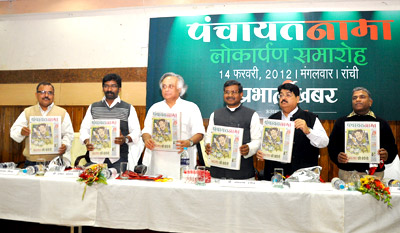
    The newspapers was inaugurated by Union Rural Development, Shri Jairam Ramesh in the presence of Shri Primal Nathwani , MP Rajya Sabha , Shri Hemant Soren, Dy. CM, Jharkhand and Ex-Chief Minister Shri Babulal Marandi at ATI Ranchi.


    The tabloid will cover and feature Panchayat-oriented news, information and issues such as empowerment to Panchayat people, monitoring and analyzing their development work, information about and reviewal of  government schemes for Panchayat, incorporation of better people in Panchayat for the post of Mukhiya and other Panchayat seats.


    The 40 pages colour tabloid with cover price of Rs12 is first of its kind in Jharkhand and will be available in all the 4423 Panchayats in 24 districts.


    The tabloid has promised to deliver news with credibility and already 15,000 copies have been booked. It’s a step to revive the identity of ruralIndiaand initiate development programs.


    The newspaper targets rural readers like farmers, NGOs, Panchayat members, Gram Sabha, government departments in rural areas and Zilla Parishad.

  • The Anchor: 10 media evils we’d like to see banished this Dassera

    By Pradyuman Maheshwari


    It’s Dassera tomorrow, a festival that symbolises good winning over evil. Here’s my list of 10 media evils that I would like to see the end of. You can say that some of these are predictable since I have written about the issues in the past, but they are genuine evils. Banish them!

    #1 Corruption

    The 10-letter word is not just a preserve of government and politicians. It exists in plenty in corporates and the private sector. Our business included. Bribes to get sales deals through, generating revenues by way of money payouts and favours. Sending media buyers and clients to see the FIFA World Cup or Wimbledon tennis is nothing extraordinary these days. Nor is selling of magazine covers, or newspaper or website stories, in lieu of monies very surprising. Ditto with awards: money or just for old times’ sake. Har ek friend zaroori hota hai!

    #2 Paid news

    This has been institutionalised by certain publications even if it’s for just for lifestyle, glamour and brand launch news. It needs to stop, and a dubious disclaimer won’t do. Paid News is prostitution of editorial space and I don’t have to spell out what its practitioners should be called.

    #3 Industry fiefdoms

    Trade associations are supposed to help the lowest common denominator, but in the media we have a situation that some of the aasociations have become fiefdoms and people hardly mentor or help the weaker players. In fact they often attempt to crush them.

    #4 The ratings race

    Revenues happen only if there is proof that your product is read or seen or heard. Nothing wrong with it. But some newspapers are rumoured to go to any extent to fix things. And channels see nothing wrong tweaking storylines for better numbers. Ratings ke liye kuch bhi karega!

    #5 Dearth of talent and disparity in salaries

    There is need for dramatic change here. Some wings of media and marketing are paid fantastically, others pathetically. Journalists, for instance, are very poorly paid in many establishments. Ditto with staffers in Tier 2 cities. The media needs to attract quality talent and offer great content. Both are critical for good content. Alas, I don’t see this changing in a hurry.

    #6 Abuse of Intellectual property

    In Indian media, copyright is mostly defined as the right to copy. Our media companies are fortunate that legal action takes its time or never happens. Else a few of them could be giving the more high profile criminals company in Tihar or Arthur Road. The discipline has to start from the ground-up. Googled pictures must be a no-no and only licensed content must be used.


    #7 Fake ads

    It’s not as severe as other issues here, but the fake ads that advertising agencies craft to win awards are not on. Yes, they are a given these days and some leading agencies patronise the practice. But there has to be a way to end it. Perhaps some introspection?


    #8 Content sucks

    The self-regulation mechanism has been set up, but I think some of our channels, especially a few newswallahs, could do with a drive to improve content. And a news channel must air news and possibly some kutta-billi stuff. Not the other way round.


    #9 FDI blues

    Foreign direct investment in radio was hiked to 26 percent last week and in news channels it’s restricted to 26 percent till date. However, GECs can be 100 percent owned by foreigners. And creative and media advertising agencies too can be fully owned by non-Indians. Given that ad agencies influence media buying decisions and hence can in turn influence the media, why not allow full FDI in news and radio?


    #10 No Ethics!

    It’s a dirty word in most media organizations. Look at how many have a Code of Ethics, and insist on employees (and the promoters) agreeing to practise it.


    The views expressed here are my own and are not endorsed by MxMIndia.com

  • TOI launches TWeek at INMA

    By Tuhina Anand


    The Times of India Group launched TWeek, first of its kind digital magazine at the INMA platform. The weekly will be released every Friday and can be accessed from iPhone, iPad or any Android tablet device.


    Elaborating on the product, Rishi Khiani, CEO, Times Internet Ltd, said, “The idea to launch this came seven days ago and digital provides the platform where content can be put together at such a short time. TWeek is largely sourced from content that is available on our blog verticals that we put together. Its content that has long shelf life and brings out the flavor of a week.”


    He added, “Its content that is repackaged in a format that works on iphone, ipad and whatever other android tablet devices available. It allows interactivity associated with the medium but at the same time is low on cost of production.”


    Mr Khiani calls TWeek the first digital magazine that doesn’t have print counterpart in India. However, he did add that the print version of the magazine could be planned in future. The magazine will cater to the youth. Apart from content that is available in form of blogs, it will also have original content like its cover story to attract more consumers to access it.


  • Lokmat Media thanks record-breakers with innovation

    By A Correspondent


    In what is possibly the first instance of a broadsheet newspaper innovation, Lokmat Media Limited used the full 16 columns across the front and back pages for a lead picture to physically communicate the size and scale of a world-record-setting event. It also spread its ‘front’ page coverage seamlessly across the back page over a span of 16 columns, perhaps creating another world record for its latest media innovation.


    Rishi Darda, Editorial Director & Joint MD, Lokmat Media Ltd, said: “Lokmat Connect had just assembled over a lakh of people in the stadium, and another 40 to 50 thousand outside, on a mid-week working morning, to set a world record for singing the National Anthem. It seemed as if all of Aurangabadresponded to our call to set the world record. So when we had our post-event editorial meeting to plan the next day’s issue, one of our main priorities, apart from excellent editorial content, was: How do we give the readers a sense of the scale of the mammoth turnout? While a picture normally speaks a thousand words, our lead picture bespoke a lakh”


    “To the best of my knowledge and belief, it was a world-first: a 16-column colour picture with the lead story of the day, with both, the front and back pages working seamlessly together as a unified ‘front’ page, ” he added.


    Getting a lakh-and-half people, which is around 8 per cent of Aurangabad’s population to congregate on a working day morning, is no mean feat. “Lokmat’s media innovation is not just a celebration of that success, but, more importantly, our way of thanking everyone who turned up, putting their lives on hold for the hours they spent with us,” said Mr Darda.


    Lokmat’s innovation not just communicated the scale, but also had a clever element of surprise for the reader. When one picked up the newspaper and saw the front page, it had a beautifully aligned 8-column banner picture. The layout of the other elements on the front page looked like a normal, well designed front page. “Only when the reader opened the paper and glanced at the back page did the picture reveal itself to be a full panoramic 16-column spread, and the editorial content on the back page too merged, seamlessly, with the front page layout,” explained Darda.


    Explaining the world record attempt, Mr Darda said: “Media brands do several things to connect with their readers. Ours was an activation exercise driven by patriotism, and a solemn sense of our duty to the nation. We wanted to help people gift to the nation, a World Record around our National Anthem, on the eve of Republic Day. We were not only commemorating 100 years of Jana Gana Mana, but also celebrating 30 years of our solid presence in, and bond with, Aurangabad.”


    Fittingly, even the massive backdrop had only Jana Gana Mana on it, with a tiny ‘Lokmat’ below – like its salute to the National Anthem.


    The media innovation was made possible by the depth of Lokmat’s emotional and enduring connect with the people it has been partnering and serving in their day to day lives for the past 30 years. “It was a never-before connect managed brilliantly by Lokmat Connect, our Events specialist team, which has organized many mega events. This connect with the people of the city, across barriers of caste, community, gender and age groups is what empowers us to contribute to and make an impact on the life of every Maharashtrian in general and Aurangabadkars in particular,” said Mr Darda.


  • “No Paid News” in Dainik Bhaskar

    By A Correspondent


    Dainik Bhaskar has unveiled a campaign  ‘No Paid News’ with a promised to readers that they will not be misguided.


    Simple yet stark statements and visuals in a very common man’s language and imagery were used to drive home the differentiator and the message was amplified by radio. The campaign ran through the entire election duration ending with the polling.


  • Leadership makes us tough, with ourselves first: DNA

    By A Correspondent


    Given Prime Minister Manmohan Singh’s recent statement that the “media should come together to exercise a degree of self-regulation and to combat perversions like paid news”, broadsheet Daily News and Analysis (DNA) announced its Code of Ethics on its front page.


    According to the paper’s leadership team and CEO Mr. KU Rao, the “road of integrity and honesty is always difficult but in the long run, we will come through as an organization that has greater value which will one day bear fruits for us as well as for our partners who work with us.”


  • Mudra Max OOH drives home HT’s No TV Day message


    By A Correspondent


    Hindustan Times returned with its popular and inclusive initiative on January 28 this year, following its success on January 29, 2011.


    What started as an HT initiative became a people’s movement in Mumbai, making it the only city in the world to have its own special day. Hindustan Times called upon Mumbai to switch off TV and be open to the immense possibilities that their relationships and the city had to offer.


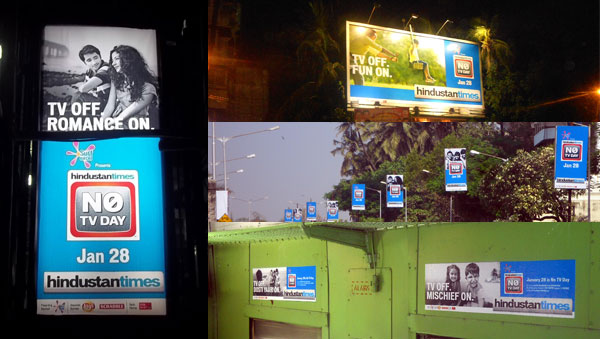
    To drive home the message – TV Off, Mumbai On, Mudra Max-OOH planned and executed an effective OOH media campaign for No TV Day, beginning January 13.


    The agency deployed a wide mix of OOH media, namely billboards, gantries, BQS, DBQS, pole kiosks, in-train branding, bus back/side panels, station branding & domestic airport branding.


    Considering the growing population which prefers air travel these days, a few interesting media vehicles such as cutouts on conveyer belts & standees were deployed at strategic locations inside domestic terminals.


    To break through the clutter, Mudra Max-OOH executed a couple of innovations at marquee sites in Mumbai (Juhu Koliwada & Mahim Causeway).


    Innovation 1: At Mahim Causeway (one of the important congregation points for vehicular traffic in Mumbai), the idea was to create the NTD Facebook homepage on a billboard. There was a daily change in the status, just the way one updates their statuses and the number of growing Facebook fans on the billboard. The status updated continued was for 5 days as a build up towards No TV Day.


    Innovation 2: This was executed at Juhu Koliwada / Juhu Tara Road (one of main arterial roads of Mumbai), since the core essence of NTD is TV Off, Mumbai On, this execution tried to bring that alive on a billboard by showing a father-son having fun on the swings in a park and the copy read ‘TV Off, Fun On’. The swinging movement on the billboard caught a lot of attention and was really talked about.


    Like last year, Hindustan Times organized a plethora of activities on January 28, encouraging Mumbaiites to step out of their homes and explore the city with their family and friends.


    The activities ranged from school painting competition attended by around 34,000 children with their parents, helicopter rides, and exclusive discount deals at more than 400 outlets in the city, heritage rides, dance workshops and many others.


    Across the city, around 250 housing societies registered for the No TV Day Best Society contest. A city specific treasure hunt was organized across three zones in Mumbai (western suburbs, Navi Mumbai andSouth Mumbai). While 1,300 participants raced against time to reach the finishing point, 3 winners were selected in each zone.


    The engagement with Mumbai was sustained in the social media space as well with the HT Mumbai No TV Day Facebook page and a special microsite. In just 3 weeks, 1.5 lakh new fans were added to the No TV Day Facebook community, taking the total strength to 2.5 lakh fans. The Facebook page also generated 6.5 million unique impressions and was the among the top branded Facebook pages inIndiain terms of engagement. On January 28, the strong buzz about the initiative resulted in No TV Day featuring among the top trending topics nationally on Twitter.


    There were various partners, such as Railways, Prince of Wales museum and MTDC, and brands like Surf Excel,Toyota, Lays, Micro Technologies and Scrabble who joined in this initiative.


    Ajay Dang

    Mandeep Malhotra, President, Mudra Max (OOH, Retail, Experiential) said: “NO TV DAY is an annual property built by HT and we were required to create a history connecting the brand with Mumbaikars. Our aim was to establish a property better and louder than the last year’s campaign. In a city dominated by competitors, it was an indispensable task to keep Mumbai ‘On’ for a quality life. We, along with HT, delivered the message effectively and took OOH from the position of a reminder medium to a call for action platform.”


    Ajay Dang, Marketing Head (West and South),HindustanTimes said: “Very few times does an initiative by a brand/ newspaper becomes a people’s movement. Hindustan Times has added an important day in the calendar of Mumbai when the city takes time to reconnect to important relationships be it family and friends or the city that we call home.”


  • Lokmat’s initiative puts Indian Guinness Book

    By A Correspondent


    In a rousing display of patriotism and unity, the voices of thousands of Aurangabadkars singing Jana Gana Mana created history. With a tally of 15,243 people singing the national anthem, they landed India into the Guinness Book of World Records for ‘the most people singing a national anthem simultaneously’, erasing the previous record held by Pakistan with 5,800 individuals.


    Andrea Banfi, Head of Adjudicators, Guinness World Records Limited, who had flown in from London, handed over the certificate to Rajya Sabha MP and Chairman of Lokmat Media Limited, Vijay Babu Darda, who accepted it on behalf of each and every Aurangabadkar who created the world record for India.


    Other Guinness World Records Limited officials present on the occasion were Lucia Sinigagliesi, Adjudications Manager, and Nikhil Shukla, Adjudicator - India.


    Commenting on the achievement, Rishi Darda, Editorial Director – Lokmat Media Ltd, said: “This is our gift, as a responsible media house, not just to Aurangabadkars, but to every Indian. We are delighted that Aurangabadkars responded so splendidly to our initiative for the world record attempt to commemorate the completion of 100 years of Jana Gana Mana, since it was first sung.”


    It will be recalled that Jana Gana Mana was first sung at the Calcutta Session of the Indian National Congress on December 27, 1911. It was declared the Indian National Anthem by the Constituent Assembly on January 24, 1950.


    Lokmat Media had pulled out all stops to inform every Aurangabadkar of the world record attempt. While Radio Mirchi was the radio partner, MCN Hathway, IBN7, IBN Lokmat and CNN-IBN were the TV partners, and Abhishek Advertisers was the outdoor media partner. The sponsors were WS Developers, while the Phadnis Group was the co-sponsor. “I would like to thank our sponsors and media partners who ably supported us in the initiative,” said Mr Darda.


    As early as 7 am, all roads leading to the District Sports Complex in Garkheda witnessed traffic jams, with students, working people, housewives and families making their way purposefully to take part in the historic world record attempt. The entire stadium, with an official capacity of 45,000 was jam-packed, with no standing room, and the gates had to be shut on thousands of eager locals waiting to get in and be part of the world record attempt. The final tally of 15,243 people came as a surprise to everyone.


    GWR head adjudicator Andrea Banfi said: “We were not able to include all the people present at the stadium in the count, as it was physically impossible since they were so closely packed. And after the first singing, many people left. But, for us to do a proper count as per the stringent GWR standards, we had to request Lokmat Media to ask the people to assemble once again, in a particular, countable order, and to sing the national anthem again. The figure of 15,243 is what we arrived at after the second singing.”


    Leading the swelling crowd in the chorus on stage were Shankar Mahadevan, Mahatma Gandhi’s grandson Tushar Gandhi, Prashant Damle, Roopkumar and Sonali Rathod, Vaishali Samant, Swapnil Bandodkar, Pramod Sarkate, Mrs Salaskar (widow of 26/11 martyr Vijay Salaskar) and others, who sang with Aurangabadkars to create the world record.


    “Our National Anthem is a wonderfully inspiring composition, and is a part of everyone’s psyche. I am truly excited to have been a small part of this gigantic experience,” said Shankar Mahadevan.


    Tushar Gandhi, grandson of Mahatma Gandhi, said: “I am very happy to be among the enthusiastic people of Aurangabad, who have given such a wonderful response to this initiative by the Lokmat group. It reinforces the magic of those 55 words written a hundred years ago by Rabindranath Tagore.”


    Prashant Damle, actor and singer said: “It is moving to see the surge of patriotic sentiment at the grassroots, as I have witnessed here in Aurangabad.” Singer Vaishali Samant said: “It has been a great experience to mingle with thousands of Aurangabadkars on this momentous occasion. I am happy to have paid my tribute to the Nation by singing with one and all.”


    The Fictitious Group, winners of talent reality show India’s Got Talent mesmerised one and all with their power-packed acrobatic dance routines.Vernonfrom Fictitious said: “It’s exciting to dance in the service of our Nation! We salute those who laid down their lives for the country.”


    Smita Salaskar, widow of Vijay Salaskar, who laid down his life defending his countrymen on November 26 2008, said: “I am overwhelmed by the patriotism of the people inAurangabad.” She urged the young students to study hard and serve with the defence forces, which need good officers.