Category: PRINT MEDIA

  • Corruption a symptom of governance: Mark Tully (Video Report)

    By Shruti Pushkarna


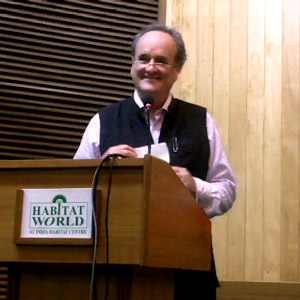
    Almost twenty years after he wrote ‘No Full Stops in India’, veteran journalist Mark Tully unveiled his latest addition to the India series, ‘Non Stop India’, in the capital on Saturday, November 19. Addressing a packed hall of avid readers, Mr Tully confessed that he was most nervous about talking to the Delhi audience. Citing an Indian cricketer’s concern, he said, “It’s hardest to play against a home crowd, and Delhi is very much my home and all of you all will be my severest critics.”


    Mr Tully also confessed that he didn’t want this book launch to be another one of the mutual admiration sessions that these things are often brought out to be. He admitted, “We journalists are actually very good at having self-congratulatory sessions.” He said he was delighted that his old friend, Karan Thapar, agreed to join him, “…as Karan would be the last person to give me an easy ride.”


    Acknowledging that much has changed in terms of how India looks at itself as well as how it is looked at in the international arena, since he wrote ‘No Full Stops in India’, Mr Tully said, “I think the danger in the Indian story, and this in a way is the point of this book, is that it can lead to ‘jugaad’, the concept that we are going to get there anyhow, so why do we worry about the problem which we have. It’s like the gentleman who I once met, who I asked, what does he think about India and he said, ‘Main bhagwan main bharosa karta hoon.’”


    [youtube width=”400″ height=”250″]http://www.youtube.com/watch?v=iUgdUEPanZA[/youtube]

    Known for his love and admiration for this country, Mr Tully also confessed to his audience that he didn’t find himself very settled in Britain so he thought that maybe his ‘karma’ has landed him here.


    Defending his work against one criticism made by Outlook reporter Pavan K Varma where the latter said that he would have liked Tully Saheb to leave the safer shelter of an observer and give his own views far more robustly, of what is wrong or right with India, Mr Tully said that it’s not entirely a negative book and it does warn about problems which lie ahead. He also added that for one to be able to criticize, one has to be extremely understanding and sympathetic of the issues at hand.


    Quoting a journalist who once said, ‘these are my conclusions on which I base my facts’, Mr Tully hoped that this book produces some facts which contradict some commonly held conclusions. A few of those that he has written about in this book include, the problem of Naxalites, the Dalit situation in the country today, the issue of privatization and the problem with ministers pouring money into troubled areas, like Kashmir. He said, “Overall the story is really about governance, something that you all hear about now. And I hope the story makes the point that this corruption that we are so concerned about, is, I think and many of the stories suggest this, more like a boil…boils are created by blood poisoning, they are not the blood poisoning themselves, they are a symptom rather than what is going wrong, And corruption in my view is basically a symptom of governance which needs reform.” Adding on, he said, “…And that’s why I fear that this whole Lokpal campaign. Yes maybe Lokpal will be a help but it would be more of a problem if everyone then sits back and says we’ve solved the problem, everything’s all right.”


    When asked how much of a problem was the Prime Minister himself, Mr Tully unswervingly admitted, “I think the PM has a major problem because we all know where the power lies very often and it’s not necessarily the PMO and we also all know that Manmohan Singh for all his many qualities, is not basically a politician who has grassroots experience. And in my view one of the problems with the Congress party is, at the Centre most of the people are not really grassroots politicians.”


    Probing him further on the issue of governance, Karan Thapar asked him whether the problem actually lies with Sonia Gandhi. To which Mr Tully candidly replied, “I think the difficulty and the problem with Sonia Gandhi’s position is that too much influence lies there when in fact it should lie in the PMO.”


    While Mark Tully spoke at length on the first two chapters of the book that concern the problem of Naxalites and Dalits in the country, he also remarked on the recent criticism of Indian media made by the Chairman of Press Council of India, Justice Markandey Katju. Mr Tully said, “I think that one thing that we should look at is, we are culpable as journalists because we don’t stand together, we don’t fight for our right to do our job, we are meant to be the professionals who know what goes on television screens, who should know what goes into newspapers and yet all the time we allow ourselves to be dictated to, by managements who basically have interests other than putting out the news in a readable and a fair and balanced way. And this is the problem everywhere. This is the problem which gives rise to this continuous obsession with breaking news and rolling news on Indian TV.”

  • The Anchor: 5 changes the publication industry is seeing

    By Adarsh Mishra


    #1 Nowadays circulation operates on an FMCG model. As most of the companies are subscription driven, they are able to track readers and their profiles. The conventional method of circulation has undergone revolutionary changes due to subscription module and publication aspirations to achieve higher numbers in terms of ABC and IRS.


    #2 Circulation, which is considered a cost centre in every organization, is playing a very important role in the present media scenario as media planners are giving more importance to numbers in comparison with class.


    #3 In the present scenario most publications are resorting to invitation pricing which helps them to get a larger base in a shorter time. The classic example can be Delhi where publications slashed their prices in order to get higher numbers.


    #4 In coming days it will be vernacular publications which make more money as against English publications. The reason being people’s inclination towards their own languages and lower operating costs.


    #5 The government should increase the scope of FDI as it will help the publication  industry in India to grow at a faster rate and also it will help small or regional players to compete in the national arena.


    Adarsh Mishra is Vice President, DNA.

  • INMA conference starts, packed house!


    By Akash Raha


    The International Newsmedia Marketing Association, better known as INMA,  kicked off its annual South Asia conference in Bengaluru today to a full house. The two-day event is taking place at ITC Gardenia under the theme ‘Roots and Wings: Strengthening Our Core Business and Exploring New Opportunities.’ MxM India spoke to Earl J Wilkinson, Executive Director and CEO, INMA to know about his expectations from the conference. Around 220 delegates from India, Pakistan, Bangladesh and Uganda amongst others are in attendance.


    Mr Wilkinson said, “What I’m looking for from the Bengaluru INMA South Asia Conference is, where are the new pockets of growth in the region? Have newspapers hit a peak with readership? What are the value drivers in advertising for newspapers as competition intensifies? Where does the creativity reside among South Asian newspapers? To what degree are global trends in digital media being adopted by South Asian newspapers? Where does the Indian newspaper story fit in the broader global context of transformation and culture change?”


    This INMA conference will also focus on the unique opportunities ahead for South Asian newspapers in which they seek profitability and would also like to adapt and create more revenue streams in the digital domain. The INMA conference will host top newspapers publishers and marketers in India, Pakistan, Bangladesh and Sri Lanka, and give them the opportunity to share learnings with each other. The sessions are expected to take delegates through a world of ideas and innovations which will give them insights into ways to grow newspaper advertising, circulation and brand across titles and across consumer platforms.


    Mr Wilkinson further added “It’s a very high-level, relevant programme for South Asian newspaper executives. I don’t just want to hear from the speakers. I want to hear from the delegates. Are they curious and pushing for answers and ideas?”


    Mr Tariq Ansari, INMA South Asia president and Managing Director, Mid-Day Multimedia welcomed the delegates and Mr I Venkat, Director, Eenadu, who is also the conference moderator, gave his opening remarks, charting the changes that have been seen in the newspaper publishing scene.


    Image courtesy INMA.org

  • Just below the surface: Filmmaker Umesh Aggarwal

    By Johnson Napier


    Dignitaries and members of the fourth estate may have found it a pill too bitter to swallow at Mumbai’s Madame Cama Hall, Kala Ghoda on Saturday when they were given the lowdown on the murky deals that transpire in the worlds of print and broadcast journalism. The affair was a documentary screening by Umesh Aggarwal, director of News & Entertainment Television on ‘Brokering News-the inside story of paid news.’


    Umesh Aggarwal talked to MXM India on the motivation and challenges encountered behind the making of the film, and what stance th industry needs to take to curb the menace. Excerpts:


    Q: What was the motivating factor for attempting to unveil hideous information prevailing in the news broadcast and print sector?

    For the last few years the manner in which news reports were presented in Newspapers and on News channels had become a topic of joke. It was not merely restricted to my group of friends but many people had started taking news reports with a pinch of salt.


    A copy that was sensational, almost making most news items “entertaining” had become a norm of the day. There were various examples where a serious follower of news could catch contradicting reports in the same newspaper/channel. The question was whether news organisations owed any answer to their readers/viewers.


    During 2009 elections, News media blatantly partnered with politicians and political parties. The entire journalist community was aware of what was going on but no one raised a voice. Perhaps, the Press Council & others had no teeth or intentions to rock the boat.


    As far as I can remember The Hindu was the only paper that allowed space for a debate on Paid News. Articles written by Late Shri Prabhash Joshi, &  P Sainath raised valid questions. Yet “market leaders” refused to touch the story. In early 2010, Outlook published a cover story “Paid News of India”. While reading that story I could visualise a film.


    I started following the story carefully. Just by scratching the surface a dark side of media was right in front of me.

    Every aspect of news be it political, business, sports or entertainment had a price tag.

    Even panel discussions on an important national issue were ‘fixed”. Guests were invited to give the discussion a particular slant. Selection of guests wasn’t dictated by the editorial policy of the group but there were other considerations.

    I thought that it was only English press that indulged in paid news. I was wrong. The problem was and is worse at the vernacular media. I was aghast to know that one of the most respected newspapers in north India actually auctioned its bureau. The highest bidder was made to pay to the group, he was also expected to run the bureau and pay salaries. In lieu of all this… all his stories straight went to the press.

    I had the notion that business journos were corrupt. It turned out that all industrialists cultivate political journos as well because they are the ones close to the powerful politicians – and they are the ones who broker deals.

    During the last 5 years most of the vernacular news channels were launched while elections were round the corner. It wasn’t merely to catch eyeballs but it was discussed openly during editorial meets that how political parties could be tapped (or trapped) for resources. These horror stories are not a products of my imagination, they came from the horse’s mouth. Many journalists shared their experiences, yet they couldn’t come on record.

    Political parties, corporate houses & event managers have devised newer ways to “buy” positive reports. At press conferences journalists are expected to drop their visiting cards. According to their position/ status a gift will be delivered to them. Not only that this gift can be exchanged for hard cash at designated outlets. Can you imagine journalists indulging in such practices?

    The final straw was when the two-member subcommittee of PCI submitted its report on Paid News, and it was scuttled. I somehow managed a get hold of the original report. I knew I had to make a film. Why should media be allowed to remain absolutely unaccountable for its actions?


    Q: What were the imminent challenges you faced in producing the documentary?

    The first challenge was to decide “who is this film for?” Journalists already knew what was happening… others though cared for news but “would they be interested / do they bother how ownership patterns, management dictating editorial staff/ business deals etc. impact news?”

    The next challenge was how to make it a visual narrative. Interviewing 5–6 people & converting it into a roundtable discussion was a format that didn’t appeal to me. And visuals narrative required great amount of research, & sourcing of news clippings.

    And there were people who agreed to come on camera but when we reached there to shoot they developed cold feet & we returned.

    And of course there always was this inner conflict of being a whistleblower to your own community…my connections with television news runs deep. Lots of my dear friends work with newspapers & channels but, finally, the urge to make this film went beyond all such personal conflicts.


    Q: Were you, at any point in time, influenced by people who were being spoken of in the documentary?

    No. No one ever tried to influence us. In fact most of the journalists were forthcoming in sharing their experiences but only OFF CAMERA.


    Q: Did you make any attempt to contact or gather information from those individuals or organisations who were being named/accused in the documentary?

    We contacted them. Either they were “travelling” or refused politely while wishing us Good Luck.


    Q: Cannot this documentary act as solid proof and be submitted to the concerned authorities to solicit action on the wrongdoers?

    That’s not for me to decide. The film is in public domain. Besides, this is not a film about individual wrongdoers – this is more about an evolving system of corruption that needs to be countered urgently if news media has to retain its credibility. Personally, I would be happier if the documentary has a preventive impact rather than a corrective one.


    Q: While a good start has been made, according to you what does the industry need to do to stem such a malpractice?

    I feel, there are enough reasons for us to be proud of Indian media. Yet its credibility is being questioned and there are valid reasons for that. Today it is run like any other business, yet it is not accountable to any one like other businesses are. A mere question about its conduct is treated as a threat to free press or freedom of expression. Those who advocate self regulation must ask themselves whether self regulation is working! If it is not what steps are to be taken? Media has to allow itself to be questioned.


    Q: What is your message to the youth who want to pursue a career in the field of broadcast and journalism?

    Choose your icons carefully. Primarily it should be journalism that should attract them… money and glamour should be the accessory and not the uniform, it should be a part of the package & not the package itself.


    Q: A word on the next project that you seek to undertake?

    India becoming a hub of clinical trials… legally & illegally…

  • Power-packed sessions at HT Leadership Summit

    By A Correspondent


    Leaders from around the world will congregate in the country’s capital, as the ninth edition of the Hindustan Times Leadership Summit takes place on December 2-3, 2011 in New Delhi. The theme of the summit this year is ‘Keeping Pace with a Changing World’.


    On the occasion, Sanjoy Narayan, Editor in Chief, Hindustan Times, said, “In modern India, change is constant. In the last two decades, it is said, India has changed a lot. So has the world around us… The changes that India faces are, thus, on several fronts – some domestic, others global. And all of these changes throw up for India the challenge of keeping pace with them. It is with this in mind that the 9th edition of the annual Hindustan Times’ Leadership Summit this year offers a platform for debating these issues, to which there are, of course, no easy answers.”


    The annual summit has become a powerful forum bringing together leaders from all walks of life and encouraging interaction and debate on the burning issues of the moment. The inaugural session at the summit will be that of Pranab Mukherjee who will share his thoughts on the opportunities and challenges facing India.


    It will be followed by an innovative session on education trends from around the world – ‘The Education Prism: Global Perspectives’. Montek Singh Ahluwalia, Deputy Chairman, Planning Commission of India, Dr John A Quelche CBE, Distinguished Professor of International Management, Vice President and Dean, CEIBS and Gregory W Cappelli, Co-CEO, Apollo Group and Chairman, Apollo Global, will be speaking at this session. The Keynote Address of the day will be given by Tun Dr Mahathir Bin Mohamad, former Prime Minister of Malaysia, and he will be speaking about ‘The Challenges of Change in the 21st Century’.


    The other speakers on day one will be Kaushik Basu and Norman Pearlstine, Chief Content Officer, Bloomberg LP, who will be discussing the global economic crisis; husband-wife team Carol and Ken Adelman, who make up Movers & Shakespeares, will be sharing management lessons from Shakespeare’s plays in a repeat of their hugely successful session from the World Economic Forum at Davos earlier this year.


    The highly anticipated penultimate session of the day will see economics maverick Dr Steven Levitt, author of the popular Freakonomics books and professor at the University of Chicago, share his unique perspective in a session entitled ‘Unconventional Thinking for an Unpredictable World’.


    The closing session on the first day will look at the hot-button topic of the Arab Summer and will see Dr Paul Salem, Director, Carnegie Middle East Center and Emile Hokayem, Senior Fellow for Regional Security, The Internal Institute for Strategic Studies, discussing its causes and consequences.


    The second day of the summit will start with the keynote address by LK Advani, who will share his views on ‘India’s Yatra into the Future’. Mr Advani’s session will be followed by a special session led by the former Prime Ministers of Australia and Spain – John Howard and Jose Maria Aznar – on the recent social and economic upheavals around the globe.


    Actor-director Farhan Akthar and actor Vidya Balan will chat with Vir Sanghvi in the popular Hindi Film Industry session.


    Other speakers on day two are Mehbooba Mufti, President, Jammu and Kashmir Prople’s Democratic Party, Asfandyar Wali Khan, President, Awami National Party, Pakistan and Dr Farooq Abdullah, Minister of New and Renewable Energy, in a session titled ‘Settling Disputes for a Common Cause’.


    Julian Assange, Founder and Editor-in-Chief, Wikileaks, will be addressing the delegates via video on the second day.


    The final session of the summit will be addressed by Chief Ministers Sheila Dixit (Delhi), Prithviraj Chavan (Maharashtra) and Dr Raman Singh (Chattisgarh), who will speak about the connection between Personality Power and Good Governance.


    The sessions will be chaired by eminent leaders of the media world such as Rajdeep Sardesai, Sagarika Ghose, Suhasini Haidar, Karan Thapar, Vir Sanghvi and Sanjoy Narayan.


    The Hindustan Times Leadership Summit 2011 is guaranteed to bring a fresh new perspective on the critical issues and problems we find ourselves facing today. By leveraging the power of debate and discussion, this ninth edition of the Summit will tackle the challenges of change with insight and clarity.

  • The Anchor: 5 publications you (nearly) forgot but are (often) unputdownable!

    By A N Chorrea


    #1 Caravan
    Published by Delhi Press, would be wrong to call it India’s answer to New Yorker, but a good read nevertheless. Was resurrected by the younger generation of the Naths and with a gora editor in tow.


    #2 Reader’s Digest
    Oh, yes, it’s still around. The format may not have changed much, but it’s the Digest content and attention to detail and fact-checking makes it a great buy.


    #3 Economic & Political Weekly
    You may not get it at all the railway stalls, but get hold of a copy and we’re sure you’ll enjoy it for the quality of content.


    #4 Current
    Resurrected by the late owner-editor Ayub Syed’s son Asif, Current is a super read with some incisive political analyses, often by heavyweights in the biz. Check content on the website, currentnews.in.


    #5 Screen
    Critics may say it exists more for the awards than to serve as the voice of the Indian film trade as it once did, but the bold new tabloid avatar is interesting and easy-to-navigate.One does miss those big broadsheet ads, but this is the age where smallness rules.

  • Citing profitability, Mid-Day bids ‘ta ta’ to Delhi & Bengaluru editions; to concentrate on Mumbai

    By Rishi Vora


    Mid-Day, Mumbai’s leading English daily, has announced the shutting of its Delhi and Bengaluru editions. The reason: profitability. Mr Manajit Ghoshal, MD and CEO of the company, confirmed this to MxMIndia. “Both Delhi and Bengaluru editions will shut down with immediate effect. Tomorrow is the last time the papers will be circulated in the respective markets,” he said.


    Elaborating on the reason behind the decision, Mr Ghoshal  said, “We have decided to shut down both editions in the strategy to be more profitable. Advertising revenues in the two markets was on the decline, and so we decided to focus on our Mumbai edition.”

  • Mid-Day shuts Delhi & Bengaluru editions, to focus on Mumbai


    By Rishi Vora


    After having tried out the Delhi and Bengaluru markets for a few years now, MiD-Day has finally decided to shut its editions in the two metros. The focus, as company officials inform, will be on Mumbai from now on, where the idea is to increase the paper’s circulation and enhance profitability.


    Mr Manajit Ghoshal, MD and CEO, Mid-Day Infomedia said “Advertising revenue in the two markets was on the decline, and so we have now decided to focus on our Mumbai edition.”


    Addressing the staff, he wrote in a mail on Monday evening, “It’s with a heavy heart that I have to announce the closure of MiD-Day – Delhi and MiD-Day – Bangalore editions. Tomorrow’s issue will be the last issue for both the editions. This has been necessitated by the prolonged losses we had to incur on these editions. The idea behind starting these editions was to establish these brands in these cities and make a difference in the lives of the citizens there. We had begun well and were appreciated for the quality of product we put out. However, in a corporate scenario, the books need to be balanced. Due to the ever increasing competition in the print media space, the funds required for breakeven in these cities kept escalating. Finally, we had to take this call. We will however, continue to maintain a news bureau in Delhi and our sales offices in Bangalore and Delhi.


    “By cutting our losses in Delhi and Bangalore editions, we will be able to bolster our circulation in Mumbai. Apart, from the plan to channel these investments, Jagran group (our parent company) will invest a large sum in boosting MiD-Day’s circulation in Mumbai. This will give our sales guys across the country to pitch Mumbai MiD-Day to clients and agencies in a new light. We need to now concentrate on building brand MiD-Day in Mumbai and monetizing Mumbai MiD-Day’s large increase in circulation and in this our sales colleagues in Delhi, Bangalore and Pune will have to play a significant part. Gujrati MiD-Day and Inquilab continue to go from strength to strength. We are increasing the circulation of GMD at a brisk pace and will continue to do so. Inquilab has flourished in the north and we now have 14 editions in all and are far ahead of any competition in the Urdu space.


    “MiD-Day Pune is an extension of MiD-Day Mumbai just as the Pune city is an extension of Mumbai. MiD-Day Pune will continue to run at an ever increasing pace and we will be monitoring the Pune media market keenly to spot opportunities to improve the circulation of MiD-Day Pune.


    “We will continue to invest aggressively in our digital properties as we believe that this is a medium whose time has come.


    While the shutting of the Delhi edition has been rumoured for a while, the same cannot be said for Benguluru. A senior member from the MiD-Day Benguluru office who did not wished to be named said that the letter took everyone by surprise.


    The paper was launched in the garden city in 2006. On why the edition failed, Mr Anil K Sathiraju, AVP and Head – Mudra Max Bengaluru said, “MiD-Day is a Mumbai paper, positioned as the traveller’s paper. The reason it didn’t work in Bengaluru is before it was launched, there were newspapers that had been in the market for ages and MiD-Day came with a different positioning which wasn’t right for a market like Benguluru.” He further added that the paper’s stagnant circulation was an indication that brand MiD-Day wasn’t very popular among readers, which led to a greater perception problem.


    The Delhi edition, as is known, was first launched in 1986, and within three years of launch, it was sold to industrialist Lalit Suri’s family. Then again in 2006, it went up for sale and was bought back by Mid-Day Multimedia. Madison Media CEO Ms Basab Datta Chowdhury feels that it was purely on the basis of market reality that the Jagran Group chose to shut the Delhi edition. “It’s a call that you need to take. If a product is not delivering as per expectations, and if you feel that shutting shop is the only way, then the sooner you do it, the better it is. The paper tried its best in Delhi, it didn’t work out. It’s doing well in Mumbai, so the decision to focus there.”


    Citing similar reasons is Mr Sundeep Nagpal, Director of Stratagem Media and a veteran planner who has been following the print media (and MiD-Day specifically) closely. In fact, he is of the opinion that the daily could have done better in its marketing efforts, especially in Benguluru to increase circulation and readership. Mr Nagpal said, “The scope for a No 4 or No 5 newspaper in any language category, to generate both readership or advertising revenue, especially in a cosmopolitan market/ metro, is quite minimal. Both, Delhi and Bengaluru were already dominated by giant groups like TOI, HT, and even Deccan Herald, not to mention others like Indian Express etc. And so they proved to be the big hurdles for Mid-Day, despite the fact that Mid-Day was always supposed to be an evening paper. Also, given the landscape of the public transport in these cities, vis-a-vis that in Mumbai, the scope for Mid-Day to find traction as a commuter’s paper, was also considerably lower than that in Mumbai. And lastly, as a late entrant in these markets, the paper also required very aggressive promotion, perhaps of the likes that we saw in the case of DNA and Hindustan Times in Mumbai.”


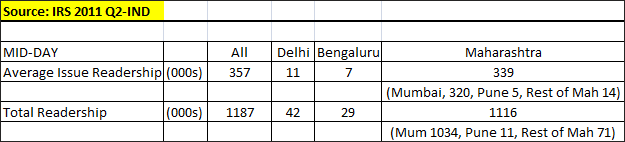
    The recent IRS figures (2011, Q2) indeed don’t show a good picture. The papers average issue readership in Delhi stood at 11,000, while in Benguluru, it was 7,000 (see table). Now that the two non-performing markets have been shut, and with investments to pretty much go to Mumbai, it will be interesting to see how the paper picks up on circulation in the city and whether it is able to pose a greater challenge to the market leaders.


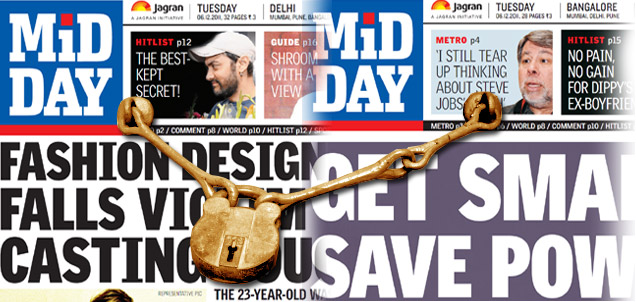
    Lock image: Nuttakit

  • Mid-Day Delhi & Bengaluru closure a shame

     Ranjona Banerji


    The day started with the sad news that Mid-Day was closing down its Delhi and Bangalore editions with immediate effect. Undoubtedly the owners have their reasons but it is still a shame.


    Having worked with Mid-Day many years ago and also having been part of a publication which shut down years before that, I can feel the pain. Commiserations to all involved.


    **


    Part of Tuesday on television and twitter was about Kapil Sibal wanting websites like Google and Facebook to screen “offensive” content on the internet. Outrage broke out on all levels. So far, except for China, no government has had much success with patrolling or reining in the internet, so good luck to Sibal and the government. Initial reactions have been largely over the top with twitterers and TV commentators rushing to protect India’s democracy, Article 19 A and so on. Without irony (actually irony is conspicuous by its absence on Indian television), Times Now rushed to Varun Gandhi to get his opinion on free speech, he of course, is known for an infamous hate speech.


    **


    Kudos to Mumbai Mirror on its story that “fans” were paid Rs 300 each to cheer for Hollywood star Tom Cruise, who was on a Mission Impossible promo visit to India. Since almost nothing in the media appears to be real, when it comes to entertainment, why not pay for a few people to cheer? The whole celebrity-entertainment culture appears to be a carefully constructed falsehood – and the media is an integral part of this.


    Sadly for the PR genius who came up with this scheme, the death of cinema stalwart Dev Anand pushed Cruise off the main Indian news pages and segments. Also, isn’t Rs 300 a bit cheap for a star as big as Tom Cruise?


    **


    Congratulations to film star Aamir Khan and his director wife Kiran Rao on their new baby. Good for them that they told the world it was through an In Vitro Fertilisation-surrogate process, thus giving untold free publicity to the expensive IVF process and its doctors. But is this headline in Hindustan Times’ HT Café appropriate: “Baby Boy! Produced by Aamir Khan, Directed by Kiran Rao’?


    Cleverness gone too far, I think.

  • Business Standard joins the iPad gang

    By Akash Raha


    Business daily newspaper Business Standard has extended its digital presence with the launch of its new iPad Application. Attracting readers for its business content, Business Standard has translated this phenomenon into a very strong presence on the web with over a million unique visitors from around the world accessing its website. According to Business Standard sources, a fifth of its online visitors are from outside India. A mobile website that can be accessed on most handsets has also been providing news feeds on the go to readers for a while now.


    Talking about the development, Arun S Natesh, Head – Marketing, Business Standard, said, “To cater to the fairly evolved, widely travelled and tech savvy Business Standard readers’ requirements, and to keep pace with the emerging content consumption landscape, an iPad application has been designed keeping their interests in mind. The BS iPad application chooses to focus on the selection of key breaking stories, incisive analyses and insightful opinion in an easy-to-navigate, clutter-free format.”


    A highlight of the app is its coverage of stock market information. Readers can access stock price information, charts and news on India’s top 500 companies through a simple search. The app also features videos on top business events of the day and updates on the stock market. Sharing stories on social and professional networks apart from emailing is a one-click exercise.


    The app can be downloaded for free from the App Store, and is optimized for iOS4 and above. The Business Standard iPad App can be downloaded at: http://itunes.apple.com/us/app/business-standard/id482532990?ls=1&mt=8

  • Hindustan launches 9th edition in Aligarh

    By Akash Raha


    Hindustan Media Ventures Limited (HMVL) launched its 9th edition in the state of UP from Aligarh on December 10, 2011. With the addition of Aligarh, Hindustan is now printed from 17 centres across the states of UP, Uttarakhand, Bihar, Jharkhand and Delhi.


    Commenting on the launch, Amit Chopra, CEO, HMVL said, “Aligarh is a unique region, culturally rich and prosperous. Its traditional segments like manufacturing and agriculture trade have made the region prosperous. And, education adds to its cultural heritage. It is the perfect setting for a progressive newspaper like Hindustan to enter. The team at Aligarh is setting the stage to making this a success right from the start.”


    Hindustan has launched in Aligarh with a strong 75,000 circulation that is unsurpassed in that zone. Aligarh edition launch comes a year after the launch of Gorakhpur edition which has continued to progress strongly.


    Shashi Shekhar, Editor-in-Chief, Hindustan said, “This is the city of Sir Syed and Maulana. We are honoured to have Aligarh as a key part of our network. For long, readers have had limited choice. Hindustan will offer a refreshing change for Aligarh and its surrounding region. High standards of integrity and journalistic reporting have made Hindustan a much loved and read newspaper in other areas. I am confident that Aligarh will respond to us in the same manner. We will understand and partner with the residents of this belt in their march towards progress.”


    Speaking on the launch Rajan Bhalla, Head-Marketing, Strategic Businesses – HT Media said, “The core proposition of Hindustan is ‘Tarakki ko chahiye naya nazariya’. We have approached Aligarh with the respect that the ‘Mecca of Education’ commands. Recognizing this we sought participation from college and school students in a unique initiative. We asked them to express themselves on the topic of ‘Aisa ho mera naya Aligarh’. Needless to say the response was overwhelming.”

  • HT celebrates Capital’s 100th bday with conclave & campaigns

    By Akash Raha

    Hindustan Times, the top English daily in New Delhi, has been celebrating the 100th Birthday of New Delhi under the banner of ‘I Love Delhi’ throughout 2011 and is getting ready for a high point on December 15 – which is the day the foundation stone of New Delhi was laid and which paved the way for the metropolis to develop.

    Shantanu Bhanja, Vice President – Marketing, Hindustan Times, has said, “I Love Delhi is a continuing initiative for Hindustan Times since it encapsulates our feelings for this beautiful city perfectly. Every year, we have a theme for the initiative and this year, what else could it be except the Centenary of the Capital. We have done a series of events already and hope to bring it to a grand closure now.”

    Hindustan Times is organizing the New Delhi 100 Conclave (on December 15,), inviting Delhi’s most prominent citizens to share their vision of Delhi over the next 100 years. On the occasion, Delhi Chief Minister Sheila Dikshit will release a coffee-table book that puts together Hindustan Times’ entire coverage of New Delhi 100 over the last year.

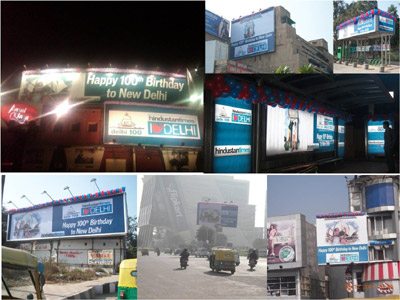
    Hindustan Times has a large outdoor campaign around Delhi-NCR on currently. In the campaign’s innovation, most sites have been decorated with red and blue balloons, wishing Delhi on its 100th birthday. The balloons give the city a festive and colourful look.

    Hindustan Times kicked off the celebrations for New Delhi’s 100th birthday on January 1, 2011 with an editorial series around various aspects of the evolution of the city. Chronicling how the political, cultural, social and architectural landscapes of the city have changed through the decades, this series was done at regular intervals throughout the year. One of the highlights of this series was the 100 Icons of Delhi – a listing of 100 buildings and institutions that define New Delhi as we know it today.

    In addition to the editorial features, Hindustan Times carried out several initiatives to increase reader engagement throughout the year under the Delhi 100 platform.