Category: PRINT MEDIA

  • Vinod Mehta: I just want to fade away quietly (Text + Video interview)


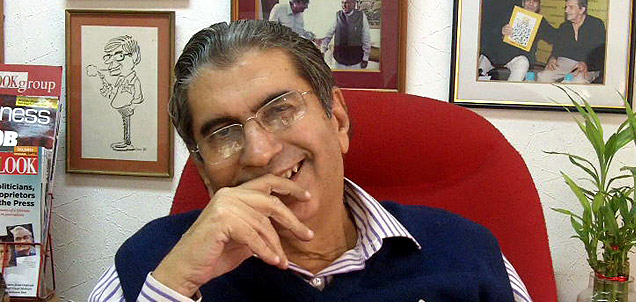
    This interview with Vinod Mehta was conducted in November 2011 soon after the launch of ‘Lucknow Boy’. As we look at the late Editor’s life and times, we replay this interview – in text and video – which so effectively captures what made him such a great journalist. Read on…


    By Shruti Pushkarna


    Soon after he launched his memoirs ‘Lucknow Boy’ in the capital, MxM India caught up with Mr Vinod Mehta, Editor-in-Chief of Outlook magazine, for an exclusive interaction in his Delhi office. He spoke at length about his memoirs, his editorial journey and of course, his dog, Editor.

    Prior to his memoirs, Mr Mehta has also authored biographies of Sanjay Gandhi and Meena Kumari. In 2001, he also published a collection of his articles under the title, ‘Mr Editor, How Close Are You to the PM?’

    Popularly referred to as ‘one of the most independent editors’ of our times, Mr Mehta has founded and edited numerous publications, including The Indian Post, The Independent, the Delhi edition of The Pioneer and also India’s first Sunday paper, the Sunday Observer. At present he is the Editor-in-Chief of the Outlook Group, which brings out ten magazines including the weekly newsmagazine Outlook.

    Q: Tell us a little about your memoirs.

    It’s not just my life that I am presenting; it’s a snapshot of India from 1974 when I started, to 2011 which is now. And I am giving you a kind of history of India from that period, a personal history as I have seen it. So it’s more than my life, it’s a history of India – and whether they agree with my version of history or not, that’s another point but I have tried to present people, places, incidents that I saw and I interacted with since 1974. In that sense, this is not just about a journalist writing about his life, it’s about a very important period of India’s history which should be remembered, and I hope that I got some of it right.

    Q: Why Lucknow Boy? You’ve always prided yourself as a Bombay Boy…

    No, I was born in Lucknow, and studied in Lucknow and I reached Bombay much later. So I called it ‘Lucknow Boy’ because I am, my education etc. was all in Lukcnow.

    Q: Was it tough writing a free-and-fearless memoir? Especially the admission about your daughter?

    Well, these things are never easy but if you’re writing a memoir then you have to tell the story of your life and you must tell it in its entirety, the good and the bad. So you can’t hold anything back, otherwise it’s half the story.

    Q: Anything that you’ve not mentioned in your memoirs? In hindsight, would you have liked to include anything?

    No, no; I made sure that everything that I wanted to put in my memoirs, I did put in my memoirs. There were so many other things which were not important, the more important things I’ve put in my memoirs.

    Q: Given that you had moved jobs rapidly before Outlook, what’s the secret of your lasting so long with the Rajan Raheja group?

    Well, I’ve been here for 17 years and I think the mean reason is the fact that I got the kind of editorial freedom which I didn’t get elsewhere, so I lasted so long – because I was allowed to do my work, and I was allowed to produce a magazine according to what I thought was right, and what my colleagues on the staff thought was right, and there was very little or almost no interference from the proprietors.

    Q: We missed you at the World Magazine Congress. Why were you not there?

    Well, I am told the magazine congress was mostly about the management side of things and not editorial, but I wasn’t invited.

    Q: If given the opportunity, would you like to edit a daily newspaper again?

    No, I’m too old now. I’ve done three daily newspapers and now I don’t want to do anything new. I’ve reached the end of my career so I just want to fade away quietly.

    Q: Wouldn’t it have been good to have an Outlook current affairs programme for television, if not a full-blown channel?

    No, we thought about this many times in Outlook and nobody in Outlook, including the proprietor, was very interested in television, simply because there were so many other… there are already about 300 news channels. So we felt that we couldn’t provide anything new or different and we were quite happy with print. And since I’m mostly interested in print, I didn’t show any great interest, neither did the owners, to get into television.

    Q: Your word of advice to a wannabe media baron?

    Well, my advice to a new media baron would be – don’t get into this business if you are just interested in making money. This is a business where, of course, profits are important but this goes beyond profits. So if you have any kind of commitment to the country and if you can withstand occasionally some kind of losses even to your investment, then get into the business. But if you are getting into the business because you think there are profits, or you think that you will have great political clout in the government etc, then those are all the wrong reasons for getting into publishing.

    Q: And your advice to someone working with a wannabe media baron?

    Be good at your job, that’s very important. Whatever you do, you must be very good at your job, outstanding at your job; therefore if you are outstanding at whatever you do, if you are sub-editor, or a correspondent or a photographer, if you are outstanding in your job, somebody somewhere will always hire you.

    Q: Debonair is dead. Would you like to revive it?

    No, that was just the beginning of my career and I wouldn’t like to go back there. But the seven-eight years that I spent there were very interesting, and I learnt a lot in that period.

    Q: Back to the book: worried about it upsetting anyone? Vijaypat Singhania?

    I don’t think so, because I’ve been fair to everybody. In his case, he was also under a lot of political pressure so I had full sympathy for his situation, where between Indian Post and his own business interests, he couldn’t sacrifice his entire business interest because at that time you had this license permit raj and the government would be active in economic affairs.

    Q: Did you read those barons wrong… Singhania and Thapar especially? And Ambani and the Jains?

    No, I didn’t read them wrong because they also I suppose, did not realize how difficult it is to be a media baron at that time, I am talking of 1980s and 90s, when businessmen who had say 5 percent interest in publishing and 95 percent interest in other things. If they attacked the government, then their other business interests would suffer, and I don’t think they fully appreciated this.

    Q: Any career regrets?

    Oh, I think there are always some regrets, some things that you should have done and you didn’t do. But by and large, I think I have played it by the book, as I say. I have no regrets. I think life has been very fair with me.

    Q: Do you think the news TV folk sensationalize more than inform?

    Yes, I think there is some need for self-regulation, there is some need for accountability. You can’t have a free-for-all as far as the channels are concerned. And I think most channels now are realizing that they are losing public support; the most important thing is their viewers’ support and therefore they need some professional guidelines. There is that appreciation now and I think that in the next few months, you will see something, some self-regulation.

    Q: We know you don’t agree with this, but still: do you think news only constitutes current affairs and matters of national importance?  For instance, would current affairs only mean political news or also whom Ranbir Kapoor is dating?

    No, I think current affairs is current affairs, anything which is current, for example, film stars, Aamir Khan made a film called Peepli Live , that was very much part of news. Entertainment is part of news, entertainment and news are not separate, but I think that there is a place for everything. Entertainment has a place, national politics has a place, everything has a place. So you must find the right balance I think; that’s the job of an editor.

    Q: Is there a need for a Press Council-like body, or should the print media too have a NBSA- like self-regulator?

    Well, we do have a Press Council but I think even the print media now realizes that the Press Council doesn’t have any teeth, doesn’t have any punitive powers. So, there is some need even in the print media for a new set of guidelines.

    Q: Your dog is called Editor. If you had another dog, what would you call it?

    Editor Junior. Well I have already got Editor Senior so I got Editor Junior now. But I can’t keep another… We tried to keep another dog, my wife was very keen that we should have two dogs. But Editor wouldn’t just allow another dog to come in. So we tried once or twice, actually brought a dog into the house but he made life hell for that dog, so we finally had to give him away to somebody because he is very possessive and he likes 24/7 attention.

  • The Hindu affirms seriousness with ‘Genuine News, Genuine Readers’ proposition

    By A Correspondent


    Chennai’s leading publication The Hindu has unveiled a campaign ‘Genuine News, Genuine Readers’ that is aimed at making readers and advertisers make a wise choice.
     

    Over the last few years, advertisers, the media fraternity and most importantly, newspaper readers have been plagued by a series of claims and counter-claims by various news publications vying for the top slot. Some of these claims are a blatant subversion of the truth, putting the media fraternity in a spot: they are no longer sure whether they are placing their bets on perception or on reality.


    The campaign, which The Hindu rolled out recently in Chennai, is supported by advertisements with simple, straightforward messages. With a primary objective of establishing the truth in an arena where claims of figures are rife, the campaign communicates a two-fold message – to advertisers that The Hindu is interested in genuine readers, and to readers that The Hindu stands for credible journalism – packaged in the tagline ‘Genuine News. Genuine Readers.’


    The Chennai-specific campaign, which will continue for a month, includes print, digital, and outdoor promotions.


  • Mathrubhumi’s reality check initiative in Kerala receives good response

    By A Correspondent


    Every year, come April 01, numerous brands across the world try to humor their consumers with bone-tickling campaigns. This year, Mathrubhumi, Kerala’s popular newspaper, through their classified pages apprehended that, the people of Kerala (like all Indians) aren’t made fools of only on April 1. It happens, every day, of every month and often for years.
     

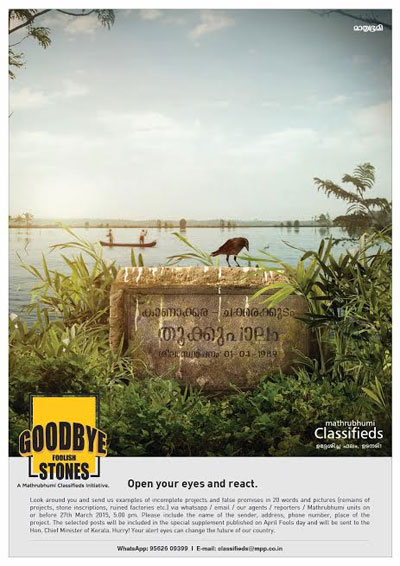
    When Mathrubhumi did a check, they concluded that every year, the State Government of Kerala announces numerous projects and public benefit programs with great fanfare. Yet, apart from an announcement, the projects never take off and get wasted away for years and decades. One can easily find such projects in plenty across the length and breadth of Kerala.


    This apathy by the government made Mathrubhumi Classifieds turn the tables and celebrate April fool’s Day, with a powerful message to the people and the Government. The brand along with the Kochi office of DDB Mudra South and East launched an interactive print campaign- Goodbye foolish stones starting 19th March 2015


    The creative of the print campaign showed foundation stones of largely publicized government projects. These foundation stones were the first and last step of the developments. There has been no progress made on these schemes after their inauguration. Even as everything around it is in a state of absolute decay and ruin, the foundation stone stands – a stark reminder of outright government indifference.


    The copy of the ads appealed the readers to ‘open their eyes and react’. A call of action was generated where in the readers were requested to act as citizen journalists and share instances of such neglect by the government through pictures, emails, WhatsApp, or by contacting the Mathrubhumi’s agents and reporters. The response was overwhelming. The publication received over 1000 claims in just three days. The brand conducted its own unbiased enquiry and investigated every claim.


    After collecting all the true claims, the newspaper carried a special supplement named- ‘open their eyes and react’ on April fool’s Day mentioning all the verified instances sent by alert, socially conscious citizens of Kerala. This supplement was specially shared with the Chief Minister of the state.


    The campaign was well received and people’s response showed that they are tired of being fooled. Mathrubhumi Classifieds gave common people a platform to put the blunt reality and truth in front of government’s eyes and inform them that the people are watchful and are not to be made a fool of.


    Quoting on the campaign, Jayakrishnan N, Cluster Head, Mathrubhumi said, “April Fool’s Day, is an occasion for real and virtual pranks predominantly played by the youth. This year, we decided to participate not just by playing the prank but bringing to light the pranks that are played on people by politicians for ages. Mathrubhumi wanted to connect with the younger audiences using classifieds by elevating the conversations beyond the paradigm of transactions. The campaign has been instrumental in helping us to that.”


    Commenting on the campaign, Dominic Savio, Vice President, DDB Mudra South and East- Kochi said, “The Mathrubhumi Classifieds campaign resulted in people enthusiastically owning the campaign, besides contributing to a greater good towards the society and creating an impact. It was overwhelming to see people integrating the campaign with their own social media channels delivering maximum reach for the campaign.”


  • Dainik Bhaskar unveils ‘Unmetro – The Action is Elsewhere’ campaign

    By A Correspondent


    DB Corp Limited (DBCL) announced the launch of ‘Unmetro- Action Is Elsewhere’, a new campaign aimed at marketers, advertisers and the media planner/buyer audiences. Designed as a digital / social media campaign, it will also be supported by Print, OOH and also supported by the company’s Unmetro Conclave events, which have over a period of time developed into one of the most noteworthy pan-India marketing events focused on exploring and analyzing the untapped economic potential of India’s non-metro towns and cities.


    ‘Unmetros’ signify the non-metro urban Indian markets (Tier 2 & 3 markets) which are fast emerging as India’s key growth centres. These markets are at the core of dynamic progress, being under served and hence presenting an opportunity of rapidly growing consumer demand, with significant purchasing power and greater media reach. This potential of Unmetros, together with the rise of digital media, the fragmentation of mass media, the growing power of young consumers, creates a very compelling proposition for the Indian retail industry. Also significant is the leveling out of purchasing power across India that brings into focus the markets beyond the metros.


    Kishore Biyani
    Girish Agarwaal

    Kishor Biyani, Group CEO, Future Group has flagged off the launch of the campaign, as a 60 second film, which will be amplified with the help of print ads, web banners and across the Unmetro web page. The campaign idea revolves around the fact that, generally people have been enamoured by life in the metros, while the real action is brewing in the Unmetro heartland of India, to say that the ‘Action is elsewhere’.


    Commenting on the launch of the digital campaign, Girish Agarwaal, Director, Dainik Bhaskar, said, “We see a whole new opportunity in Unmetros where the rising affluence levels and changing consumption patterns are opening doors for marketers to service these new regions. Consumerism is on the rise, as also the desire to experience better lifestyles and enjoy global brands. This has created numerous opportunities for both national and international brands in India. Through the Unmetro initiative, we champion the cause of Tier II and III markets, helping marketers and advertisers to serve these markets better and play a role in transforming them into stronger growth centers.”


  • Rajasthan Patrika to launch Catch News with Shoma Chaudhury at helm

    By A Correspondent


    What’s with the hinterland media groups and their desire to get into the English language. Bhopal-based Dainik Bhaskar group jved with the Zee group to launch news daily DNA in 2005. A few years later – in May 2010, to be precise – the Jagran group acquired Mid-Day, but this was not before launching a hybrid newspaper called ‘iNext’.  And now the third biggie from the region – Rajasthan Patrika – has announced its entry to the big world of English media with ‘Catch News’.


    Catch, as per a note put up on a LinkedIn announcement inviting applications for various positions, has been described as an “ambitious new media platform that combines the solidity of traditional journalism with a new-age approach to storytelling”. And it adds: “Catch will have a distinct voice. Informed. Questioning. We believe the time is ripe for an Indian digital news platform that at its core has three beliefs: journalism matters; quality matters; individuality matters.“


    A communiqué was reportedly issued, but MxMIndia didn’t receive it. The announcement though is juicy enough to give out some info. “We live in a complex, highly interconnected world where events, people and decisions both within India and elsewhere impact our lives every day. To navigate what it all means, people need not just information, but interpretation, insight and analysis. Our challenge is to provide that insight in a way that is engaging, relevant, entertaining and inventive.”


    So, Catch will be based out of New Delhi (note: not new media capital Noida) and will be run by former Tehelka grande dame Shoma Chaudhury.  Catch’s team of astute, experienced journalists and hardcore digital natives are a perfect reflection of its intriguing duality, the announcement says.


    Ms Chaudhury is known to be a tough editor, and one doesn’t know whether the Tehelka experience has softened or hardened her. But who we are to add our ‘vishesh tippany’ on anyone?!


    The Kotharis (who own the Patrika group) are fine with it, the journos who’ve joined her are cool with it, so we should just await the entry of another exciting publication in the ‘breaking views’ category. In no specific order: Scroll, Quartz, HuffingtonPostIndia, DailyO, FirstPost, Quint… uff, did we miss out on any?


    The story goes that the MxMIndia boss was also contemplating a HuffPost-like site four years back, but the lack of a revenue model then took him away to set up MxMIndia. Sigh.


    Chalo, chalo. If you are interested in working with Ms Chaudhury, apply to jobs@catchnews.com. You could well be their Prize Catch. If you are not, just wait for it to happen. Catch eeeet!


  • HT Media and North Base Media launch Mediahack.in

    By A Correspondent


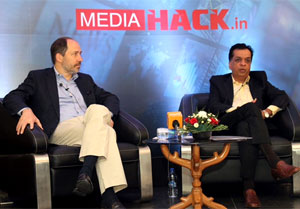
    HT Media Ltd. and North Base Media, an international investment firm, announced the creation of Mediahack.in, an innovative accelerator program aimed at fostering a new generation of digital media companies.
     

    Mediahack.in will identify and support entrepreneurs who want to build leading-edge, original content and advertising-related technology businesses in India. Both HT and NBM’s leaders have decades of global and Indian media experience that they will bring, along with extensive connections to pioneering technology and media companies around the world.


    Mediahack.in will invite entrepreneurs to apply to participate in the accelerator starting this summer. Successful applicants will spend several months on the program, interacting with each other and leading media and technology thinkers from around the world. They also will receive an initial investment of up to US$ 100,000 to convert their great ideas into fast growing and world changing businesses.


    Talking about the potential of the Indian media market, Marcus Brauchli, co-founder and managing partner North Base media and former editor of The Washington Post and The Wall Street Journal, said: “Mobile and social platforms are transforming the way billions of people consume news around the world. Nowhere is that more evident than in India, where more than 500 million people will have access to the Internet, many for the first time, in the next few years. We want to help the next generation of entrepreneurs create the platforms, products and technologies that will bring news and information to those new audiences. We are fortunate to have as a partner HT Media, with its deep commitment to news and innovation and its leadership’s strong interest in innovation. We hope to provide Media Entrepreneurs in India our expertise so that they can scale up to be global businesses.”


    Speaking about the launch of mediahack.in, Rajiv Verma, CEO, HT Media Ltd., said, “Media is one of the most exciting sectors in India today. I am therefore delighted that we at HT in partnership with NBM; are going to provide a platform which will encourage media entrepreneurship in India.  NBM with its global expertise will add immensely to this endeavor and provide great learning opportunities for upcoming media entrepreneurs.”


  • Mother-of-all-slip-ups as Mumbai Mirror publishes matrimonial ad praising ‘Hindu’

    By A Correspondent


    Given that we aren’t quite in the market for either a groom or a bride, we normally give the matrimonial ads in the various papers a miss. But when we were alerted about it later in the evening, we couldn’t help laughing out loud. Well, actually it was more of rolling on the floor laughing out loud. Or ROFLOL, in whatsapp-ese.

     

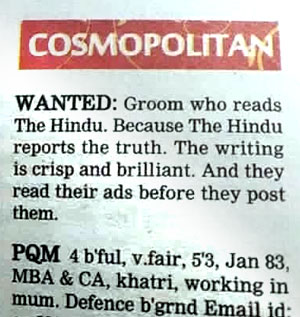
    So there was this matrimonial ad on Page 39 of Mumbai Mirror yesterday (Sunday, June 7), under the Cosmpolitan sub-headed. It started with:  “WANTED: Groom who reads The Hindu.”


    It was okay until then, but it later became evident that someone in the Times of India classified sales room has been had. Read this: “Because The Hindu reports the truth. The writing is crisp and brilliant.”


    It was clear that this is someone from a rival publication’s dirty tricks department. We’ve heard that the winds of change are blowing at the Mount Road MahaVishnu (as the Hindu is known, given its HQ is located on Mount Road in Chennai and it’s revered much by readers and all constituents), but we are not sure if the Hindu could take a joke to this level.


    Or it could be some other competitor, who will now use this as a testimony of the standards that it follows.


    Or it could be from someone within the system out to crucify and embarrass the biggie heading the matrimonials department.But the last line in that ad is what will really hurt Bennett, Coleman and Company Limited hard, and make everyone in that organisation hand his/her head in shame. “And they read their ads before they post them.”


    Read the entire ad again: “WANTED: Groom who reads The Hindu. Because The Hindu reports the truth. The writing is crisp and brilliant. And they read their ads before they post them.”


    In Bambaiyya, in the typical ‘tapori language of Mumbai’, one would say: “Poora, khol diya, bhai”. Or “Ijjat ka royal falooda banayaa”. Indeed.


    An important gatekeeping lesson for not just the folks at BCCL, but in every newsroom in the country. Watch that classified ad before  it’s published!


    Meanwhile, even though ideally some heads ought to roll for what’s happened, we would urge the BCCL management to handle this with care. And if you are going to sack/transfer the juniormost employee for this, ensure that his/her biggest boss also gets the same treatment.


    Uff, did we say a bit too much? Kya?

  • Harshad Jain made CEO at Fever FM

    By A Correspondent


    Harshad Jain

    HT Media Ltd. has elevated Harshad Jain to CEO of Fever. Prior to this promotion he was Business Head, Radio and Entertainment, HT Media Ltd. He has been working with HT Media for the last four years and will lead the business which now moves into an expansion stage with M&A and Phase 3 licensing round the corner and will involve building partnerships and expanding Fever brand into new geographies and beyond FM into entertainment and digital space.


    Talking about his new role, Harshad Jain, CEO – Fever, said “I’m humbled by this new role. Fever is a vibrant and dynamic organization, which has witnessed tremendous growth over the past few years. My focus will be to lead fever to the next level of growth and innovation and tap newer opportunities in the digital and entertainment space and phase 3 of FM radio.”


    Harshad brings with him over 20 years of cross-sectorial experience in the FMCG and media and entertainment spaces. On completion of his business studies in Sales and Marketing he joined PepsiCo and was with them for 14 years in roles across sales, marketing and business at regional and corporate level.


  • HT launches new weekend supplement in Mumbai

    By A Correspondent

    Hindustan Times has announced the rollout of ‘ht48hours’, a new weekend lifestyle supplement that will be distributed free in select areas in Mumbai. This supplement will come out every Friday and Saturday.

    ‘ht48hours’, the new weekend read,  has been curated for Mumbaikars so they can get the best of 48 hours of weekend activities in art, theatre, travel, shopping, offers at spas and salons, weekend brunches and everything else that is happening in the city. The cover stories, every week, will take an in-depth look at lifestyle activities, or an event, or a new trend which everyone is talking about, with the help of innovative design and fun elements.

    Talking about this new supplement, Nitin Chaudhry, Business Head – Hindustan Times, Mumbai said, “At HT Mumbai our endeavours have always been to provide our readers of this fast paced city, with more than just news and ‘ht48hours’ is a step ahead in that direction. This supplement will be a definitive weekend fix for our readers and will make their weekend unwinding even more exciting!”

  • Kalpana Sharma on Himmat’s defiance of press censorship in the Emergency

    Senior journalist Kalpana Sharma worked with Himmat magazine when the Emergency was declared. She took charge as Editor in the year 1976 until 1981 when the magazine ceased operations. Since then she has worked with The Indian Express, The Times of India and The Hindu and is currently Consulting Editor with Economic and Political Weekly. In an emailed interview with Dyanne Coelho, Sharma recalls the Dark Days and how when freedom of the press is denied, it is the poor who suffer the most 


    Q: Give us some insight about the plight of the press at the time. What was it like working under the pressure

    A:  On June 26, 1975, press censorship was imposed.  No one had a clear idea what that actually meant including those given the task.  In Mumbai, in Mantralaya, a room was set up for the Special Press Adviser (the official name for the Censor).  Around 15 people from the department of publicity of the Government of Maharashtra were assigned to assist him.  In the intial weeks, apart from daily newspapers that were compelled to follow the “guidelines” the government had issued, many smaller publications remained outside the net.  I worked with one such publication, Himmat, an English language weekly edited by Rajmohan Gandhi.  We read the guidelines and decided that we would not submit to pre-censorship.  If the government thought we had violated one of these guidelines, they could move against us.  Of course, this was risky, and we experienced the challenges right through the 20 months of the emergency.  But our defiance showed us that it was possible to challenge the censorship regime if you were prepared to take risks.  I might add that this was easier for smaller publications like ours than the big newspapers.  Even so, some like the Indian Express did resist, thanks to their owner Ramnath Goenka.


    Q: Would you share some incidents, memories, anecdotes during the period of Emergency, particularly in your capacity as a journalist.

    A:  There are too many to recount.  As I said, Himmat had decided not to submit to censorship.  But within a few weeks of the declaration of emergency, we were served a notice that we had printed “prejudicial” material and would have to submit to pre-censorship.  This was a report about a meeting on Gandhi Jayanti in Delhi at Raj Ghat where Acharya J. B. Kripalani spoke.  Those sitting on the stage with him were arrested by the police which disrupted the meeting.  For carrying that news, we had apparently violated the so-called “guidelines”.

    Many more such incidents took place, including a demand that we deposit Rs 20,000 with the Commissioner of Police or would be denied the right to continue printing.  Our printing press was also served a notice not to print Himmat.  We went through some really challenging times.  But we did not miss a single issue.  This was only possible because of the committed group of journalists working with the publication.

    What it taught me, and all of us, above all is that when freedom of the press is denied, it is the poor who suffer the most.  The government can then do what it likes, as it did during the emergency, and in the absence of the check that a free press provides, it can literally get away with murder. After the emergency, we heard about the terrible violations of human rights, the mass sterilisation campaign, the slum demolitions, the torture in jails, fake encounters etc.  Not a word of this could be reported during the emergency.


    Q: Do you think we’ve evolved since then, in terms of ensuring the freedom of the press is protected. Where do we stand now in your opinion?

    A:  Legally, it will be difficult to impose that kind of emergency and to bring in press censorship.  But I’m not sure we really value the freedom we have.  If we did, we would make sure that the untold and unrecorded stories, of the people who are marginalised, virtually invisible, find space.  But where do we see that?  We have another form of self-censorship in the media today where the nexus between big business and politics has ensured that certain stories never get told.  And is anyone really defying or resisting that?  Fortunately, the internet is providing some kind of democratic space for some of this information to come forth.  But for these stories to see the light of day, we need many more journalists committed to seek out the truth and report it.


    Q: In your opinion do we as a country have a strong enough leadership today to ensure history doesn’t repeat itself?

    A:  My short answer is No.  I don’t think any of our present lot of politicians, including those who suffered during the emergency, feel passionately enough about the real meaning of the freedoms guaranteed under a democracy.  These freedoms are not words on paper; they have to be seen in the actions and decisions made by those who govern.  Yet, no sooner than a group gets power, they are willing to resort to any measure to hold on to it.  How different is that from what Mrs Gandhi did 40 years ago?


  • The Indian Express launches edition in Jaipur

    By A Correspondent


    With a view to cater to a wide spectrum of target audience and expand its readership base, The Indian Express Group launched the Jaipur edition of its flagship brand, the Indian Express on July 5th 2015. This is the national daily’s tenth edition in the country.


    The paper is priced at Rs 4 on all weekdays and will be a 20 page edition, with both an up-country and a city edition. The Jaipur edition of The Indian Express brings with it the trademark brand of ‘Journalim of courage’ that the newspaper espouses. With a focus on unbiased news delivery, the newspaper will offer exclusive investigative stories and opinion pieces written by some of India’s best minds. The newspaper will offer the Pink city residents 20 pages of high quality news, containing all that a reader would need to know.  With customized pages, dedicated to new ideas across governance, opinions and explanations, war-torn conflict zones, relationships, skilling and education among others, The Indian Express Jaipur edition will bring more daily life to the daily.


    The launch will be supported with an extensive marketing campaign, both ATL and BTL programmes.


    Commenting on The Indian Express’s entry in Rajasthan, Pavita Puri, Group Head – Brand, The Indian Express Group says, “We are thrilled and excited with an overwhelming response to our launch in Jaipur. This is an important region, emerging fast on the national footprint of development. We are committed to making The Indian Express the preferred newspaper of the discerning reader who seeks credible news, knowledge and an incisive point of view.”


  • Madison OOH innovates to launch ‘Dailycious’

    By A Correspondent


    Madison OOH has executed an innovative outdoor campaign to launch Mother Dairy’s Dairy whitener Dailycious in Guwahati.


    The brand has the tag line “A Spoon Full of Magic” and the objective of the campaign was to reach out to the maximum TG, generate highest response and conversion into sales. The month long campaign, executed by MOMS created maximum impact by the effective use of a very innovative execution where the swirling of milk was shown with the help of an LEDand the cup and the saucer were made as a cut-out so as to give a 3D effect. These were installed at key areas were the T.G. frequented; i.e major market areas and bus shelters at the major nodal points of the city.


    Dipankar Sanyal, COO MOMS, says “At MOMS, we look at solving our client’s business needs using innovative, disruptive Outdoor strategy and execution to create high level engagement for consumers.”