Category: PRINT MEDIA

  • Times group launches education centres for professionals

    By A Correspondent


    As a part of its foray into the education business, The Times of India group has launched the TimesPro brand under the Times Centre for Learning. TimesPro aims to provide skills to the industry and transform graduates to professionals by offering specific courses in BFSI (Banking and Financial Industry), Media, Organized Retail, Hospitality and Healthcare.


    As a part of the launch, the company has set up state of the art learning centres in Mumbai, Noida, Jaipur, Lucknow, Ahmedabad, Hyderabad and Bhubaneswar. The company will leverage the group’s extensive resources, knowledge base and technology expertise to provide a first of its kind learning experience.


    In creating this new education initiative, the Times group has taken the lead from the fact that there exists a large gap between industry requirement and skillsets of fresh graduates. The extent of this skill gap has been highlighted in the 2013 employability survey by Associated Chambers of Commerce and Industry of India (Assocham) which states that only 10 percent of graduates are employable.


    On the launch of TimesPro, Managing Director Vineet Jain said, “The Times of India Group has innovation and excellence in its DNA. TimesPro through its unique and modern training programmes will provide the industry with graduates having relevant professional skillsets. These programmes will also make graduates more employable and job-ready.”


    In its endeavour to upgrade the skills and knowledge of graduates according to the needs of the corporate sector, TimesPro courses will be designed and delivered by industry experts having extensive experience across industry and academia. Its flagship programme – Post Graduate Diploma in Banking Management will be launched in June 2013 and will cater to the rise in demand for skilled graduates in the banking industry that is expected to be created by the influx of private banks in the next few years due to the amendments made by the RBI.


  • Forbes will stick to its DNA: R Jagannathan


    R Jagannathan or Jaggi, as he’s popularly known, is a veteran business editor, having worn the biz ed hat several times over. As Executive Editor of BusinessWorld (way back in 1987 till 1990), Business Editor, India Today (1990-91), Founding Exec Editor, Business Today (1992-93), Resident Editor, Business Standard (1993-96), Editor, Financial Express (1996-2000), Editor, myiris.com (2000-02), Exec Editor, Business Standard (2002-05) and Editor – DNA Money (2005-07). In June 2007, he was made Managing Editor and later Executive Editor of the six-edition DNA news daily, a position he held till 2010. He joined the Network18 group in 2011 to launch Firstpost and in March this year, he was elevated to Editor-in-chief, web and publishing for all of the Network18 group’s print and online publications.


    Late last month (May 2013), Mr Jagannathan took charge of Forbes India after four senior editorial heads including Founding Editor Indrajit Gupta exited the organization in controversial circumstances. The Editors’ Guild of India and Press Club Mumbai deplored the development and issued statements even as, according to rumours, Mr Gupta and his colleagues have taken the Forbes India management to court on the issue.


    MxMIndia spoke with Mr Jagannathan last week to find out how the transition has been and specifically what are the changes he’s planning to bring about in the fortnightly magazine.


    One can’t start this chat without asking how the transition has been. There was evidently much sound and fury when it happened.

    Yes, as far as I am concerned it was totally unexpected because as late as last year and even early this year there were several meetings with Indrajit and all to discuss common newsroom ideas and various things so I thought everybody would’ve been little bit prepared for it. So when the announcement was made in March, we were ready for it and we were not pushing it too fast also because we wanted people to buy into the idea of the common newsroom. I think for about a month I was attending their meetings just to understand their processes and various things. I always believe integration processes are slow, it takes time and we need to get people’s buy-in so that’s what I was working towards. But somewhere along the line, probably they were not happy with the idea.


    As a journalist who’s been through the ranks and who has seen things from both sides, did you find the entire episode unnerving?

    No, it was not unnnerving for me because I believe that certain things have to happen because today the cost of content is very high regardless of whether you are running a print publication or a dotcom. You have to see how you can synergize and get additional kinds of content from multiple sources so the move towards common newsrooms sort of has to happen. In India, it is happening at a slower pace than elsewhere.


    Integration is always a tough process…

    Of course it is. You are dealing people who have a way of doing things. Let’s say if you are in a magazine you are used to writing, say, one story in a fortnight whereas in Firstpost we are in a newsroom where we are churning out lot of copy on a dynamic level so obviously it will take some time…


    As somebody who has set up and worked with business magazines for long, what was your view of Forbes India when you took charge? And how has it been so far?

    Forbes is a fantastic product and is well accepted by the market. Anybody starting Forbes four years ago was doing the right thing by going in the direction that they were going. Later, ForbesIndia.com was set up so everything was going according to the plan. The only thing is that as you move along, you’ve got to see the challenges ahead and be pro-active. As a category, magazines have been stagnant for a long time and struggling in all domains. So just because you are not struggling does not mean that you should not prepare for the future. It’s this thinking that led the management and us to look at how Forbes needs to be in the future.


    You’ve helmed Forbes India editorially for a month-odd now. Any changes planned?

    No, nothing very significant because it’s not that everything in the past was wrong. We have made incremental changes in some parts which were not working… which you have to do regardless of who is the editor. You have to constantly keep reviewing the product and make it elegant.


    The one important thing that I am probably changing has to do with the fact that you are a franchised edition of a globally accepted product. So, there is no need for you to reinvent the wheel in India, you don’t have to stuff in India content because you are a foreign product with an Indian DNA. In fact if you make it more and more Indian, you are competing with Business Today and Business World. Now you want to be in a category where you are a global publication which has an Indian element in it. So what I am doing is not chucking great content and replacing it with 70 percent of your content. You do the other way around… you make sure that the 30 percent of the Indian content measures with the global brand and do that.


    What is the content ratio now and what it’s going to be?

    We haven’t significantly changed it but we have started the process. I think earlier Forbes US content was more like 40-50 percent or maybe lesser. Sometimes it was even 30 percent to 20 percent. But we are making it more like 50-60 percent range…


    Forbes India often was often fairly aggressive in its journalism. There was this story on DNA I guess when you were editor which was pretty damning… Are you going to follow the same aggressive approach?

    See, I do not know entirely what was done in the past, but you certainly have to tell the truth. There’s no doubt about that. But, as far as the core philosophy of Forbes is concerned, it’s largely pro-business, it is not meant to be an NGO. It is not meant to be anti-capitalism. We are for capitalism but not for crony-capitalism, so there is a difference. We don’t want to say that capitalists are good even if they are doing rotten things. We are not in the business of saying that the government is a lovely thing, food security is great. All those things we are not going to do, so I think shift in focus is happening little by little. We have not entirely changed it. We have an approach where we say entrepreneurship is key. We believe that if entrepreneurs are given the right inputs, India will benefit because entrepreneurs can create jobs that governments cannot.


    So good business is good and bad government is bad. We want less government and more business very clearly. I mean those are the broad philosophies of Forbes and that philosophy we have to adopt here.


    Will you continue with the current periodicity?

     Yes, we will be fortnightly as we have always been. In fact what we do is like even in the past when we have special issues, we will have additional issues.


    And will Forbes life continue as is?

    We do plan to do some tweaking in the product because I think it is little more artistically-oriented right now. It should be a little more lifestyle-oriented so we will be looking at content probably in the next few weeks. The current issue is going to bed, it’s doing well and has a fair amount of ads. We want to see if we can make it much better commercially and it’s far more oriented towards Forbes Life as it is in the US.


    Internationally, Forbes has a few extensions like Forbes Woman. Are you looking at those in the near future?

    No, what we may have is special issues which might come free with the magazine but that is like once in a year. We want to make sure that the core brands – Forbes India and Forbes Life, and Forbes India more than Forbes Life – will really succeed. It is a crime for Forbes India to not make money. Forbes is about the rich, about being profitable. So Forbes has to be profitable and we will be profitable if we stick to our core DNA, which we will.


    But the dynamics of the business are such that they weigh against all magazines.

    Yeah, so we are also tweaking the business model which is basically to be a little more asset light. That is we have a core team of editors who will continue to remain there but we are also taking more content which we will get others to do on a project basis so it’s not like we want to do everything in-house. Hence many things will get changed so that the cost factors probably work out a little better.


    Does this mean you will shed some weight?

    No, we are not shedding any more weight except if anything happens through the process of natural attrition.


    But there will be some re-allocation?

    Yes, because we are expecting people to contribute more so you bring down costs either by getting people to be more productive or you don’t replace when people leave.


    And on the website, will we see changes there too?

    We think ForbesIndia.com is eminently monetizeable because it has a very strong business environment in which advertisers want to put in money so we think we will build the brand by increasing the content in that and certainly it will be grown


    Will it be a business-y Firstpost?

    No, Firstpost and Forbes are two different brands and there is no question of mixing the two brands. Firstpost is an edgy, opinionated site. What we may do is occasionally re-publish some stuff from here for Forbes. And where it is relevant, the reverse also. People working for the two places might contribute separately for the two brands. A brand is a brand, you don’t want to screw up by mixing up the two brands.


    It’s about people synergy that is the person in Forbes might write something for Firstpost and the person in Firstpost might contribute and do something in Forbes Life. So in a sense it’s like free-of-cost content in some ways because you are doing it in the spare time. You are doing additional work, so it’s not about mixing up the brands.


    So, how do you divide your time? You have held multiple hats in the past but here Forbes must be taking a fair bit of your day?

    I think it’s largely a time management issue. In the first half of the day, I work for Firstpost and in the second half, I look at Forbes. This is a fortnightly so you need not have to look at it daily. At a later stage, there may be a line editor working under me who will be doing the actual running of the Forbes part but we have not come to a decision on whether to do that or not. In the foreseeable future at least I will be running the magazine and after that we have to internally discuss how it will go forward.


    What about the other publications which are part of your portfolio?

    There also there are some degrees of synergies that we have built in…


    Journalists typically crib about more work for the same amount of money!

    I have always believed that it’s not about more work or less work. It’s that journalists are very bad time managers. When I was in Business Standard, we had a Financial Times editor working with us and we used to ask him how he manages to file five stories a day. He said, “We have our beats and everything and there may be a story outside the beat that the editor might assign you. It’s a standard formula in terms of what kind of stories you do. You talk to a guy, a rival or whatever it is. Writing a 500-word story doesn’t take more than an hour or an hour-and-a-half so I can easily file five stories a day.” And this is for a newspaper. The point is in India the average newspaper reporter does one story and thinks it’s a great thing. Of course we do have great faith in the so-called exclusives. Often the exclusives are defined by the reporter and not actually what the reader wants. At Firstpost, I could do much more in the 8-10 hours because if you constantly look at how your time is going, you realize that you can actually do more.


    Would it help having a different breed of journalist for an integrated newsroom?

    Yes, unfortunately we tend to recruit the same people we know but when DNA started, one of the suggestions I made to the promoters was that beyond a few top level editors, you should spend six months taking on an entirely new breed of journalists who can be trained in your drill. On what makes for a story, how you should write a story and this is how many stories I expect you to file. Be internet-driven first and then write for the newspaper. This was the plan that I had made, but they were so excited about the product at that stage that we never went into it. But now there’s an opportunity to achieve that…


    Finally, would you say it’s going to be business as usual for Forbes?

    Yes, the responsibilities of content for the people will change a bit. But that’s at the margin because we want them to settle in first and then start contributing in other parts.

     

  • DNA launches Augmented Reality application

    By A Correspondent


    English daily DNA has launched an augmented reality application (‘DNA It’) to further enhance the reader experience. Most of the important stories are supported with multimedia features including video playback, audio transcripts, image galleries, related web articles, etc.


    DNA Editor Ravi Joshi said, “In today’s age when the young urbanite prefers to Google it, Tweet it and even WhatsApp it, we give our readers an opportunity to DNA it. The ethos of the new paper is to ensure that the connect between DNA and readers is no longer a one-way street. Interactivity is the only way forward and we are taking multiple steps to remain the most vibrant newspaper product. The response has indeed been overwhelming.”


    The ‘DNA It’ app can be downloaded from the App Store for Apple and Android devices. Readers can also download it from www.dnaindia.com/apps. The entire application and the technological backbone has been built by Prisma Global.


    Amitabh Roy Chowdhury, Executive Director & COO of Prisma Global, said, “This unique technology provides an excellent opportunity to amalgamate the print media with the mobile digital world, thereby providing relevant, timely, handy and augmented information to increasingly discerning readers. For today’s increasingly info-hungry, Google-addicted generation, this app whets their appetite for augmenting real news with add-ons in the palm of their hands.”


  • Time Out’s Top 100 apps that makes life simpler

    By A Correspondent


    Time Out India’s upcoming issue for its three editions of Mumbai, Delhi and Bengaluru has its annual tech cover story that comes with a curated list of 100 apps that make one’s life simpler, and put the smart in the smartphone. “We were clear when we began to assemble this year’s tech cover story that the approach would steer clear of fanboy geekiness and instead would look at apps that truly make life simpler,” said Jaideep VG, Editor-in-Chief, Time Out India. “Just as the magazine is intended to serve as a guide that helps readers navigate the city, the tech cover story is an essential manual for people attempting to make sense of the dense jungle of apps available for Android, iOS, Blackberry and Windows Phone users out there.”


    “The Annual Tech issue is very important to us as this gives us a chance to delve into technology from user’s point of,” said Rajnish Rawat, chief operating officer and Publisher, Time Out India, while adding that the issue is due for release on Friday (July 5).


  • Ritu Midha: Off with the false covers!

    By Ritu Midha


    To begin with a digression, even as I have print on my mind I mentally think ‘Facebook’ alongside. Facebook has succeeded in conditioning many a mind by the simple questions it asks in its status update field. The new kid on the block – changing consumer behaviour with tiny masterstrokes! But this is just an off-the-cuff observation. On my mind at the moment – really – is print.


    What is with the false covers on newspapers! Frankly, now if a newspaper lands on your doorsteps without a false cover – it, err, in a weird sense of way appears nude! Now tell me – if you are 30+, and if I ask you which was the last false newspaper cover that made you take note, and your answer is still Indya.com – Well I already rest my case!


    I am sure there must be plenty of customized research proving that noticeability of products promoted on false covers is higher than that on inside pages… and more! But is RoI (whatever be the measurement) directly in proportion to the monies spent on it? Does noticeability mean higher brand recall? Is yes, then what is all this noise about contextual advertising?


    One, of course, remembers a few print innovations that had nothing to do with false covers, but worked extremely well. Be it product sampling, a car promotion, first creative innovation for a soap with bubbles on the page (it has become mundane now), or experimentation with aroma!


    However, these innovations are increasingly taking a back seat as the false cover syndrome takes over. So much so that on occasion, a newspaper is endowed with not one, but two false covers! If I might add, I would love to understand what spiel do sales guys give for the second false cover to be sold. As effective as the first false cover – but at 50 percent rate? Some research to prove the same would be a big help, please!


    Print, at the moment, is in the danger zone. However much we shout from the rooftop, the fact remains. There is an effort on increasing reach and distribution – focus on smaller towns, and one does hope it works well for the newspaper industry.


    But does it imply that run-of-the-mill advertising in newspapers (including false covers) will become far more effective? At the risk of sounding risque – one needs to check out fake ads to realize what print advertising can be all about!


    It is time print woke up and smelled the coffee! And strove towards creating advertising that is far more effective!! The wow factor has to come back! Indya.com has to cease being the benchmark. The clients have to give right brief, ask right questions and push for right solutions. Let go of the false covers – return to me my newspaper, where the headlines that shocked and surprised stared at me when I picked it up. And I promise to take note of ‘noticeable’ ads in my morning newspaper and all the supplements it comes with.


    Ritu Midha is a senior journalist and web strategist based in Mumbai. She is also Consulting Editor and Editor – Special Projects, MxMIndia.


  • Awards for excellence in printing announced

    By A Correspondent


    Buoyed by the success of the PrintWeek India Awards from 2009 to 2012, Haymarket Media India, has announced the PrintWeek India Awards 2013 to recognise excellence in the Indian print industry.


    This edition of PrintWeek India Awards 2013 is supported by industry majors including AGS, Bobst, Canon, Dupont, EFL, Epson, Galaxy Propac, Henkel, ITC PSPD, Kala Jyothi, QuadTech, Roland, Skyscreen, Sona Commercial, TechNova, Vinsak and Welbound Worldwide.


    There are two types of Awards: the ‘Quality Awards’ which judge the quality of output from different sectors, such as labels, magazines, catalogues and posters and the ‘Performance Awards’, which are judged on financial performance, strategy, capital investment and training programmes. Within those Awards types, there are 25 categories in all with the choice of multiple entries.


    The jury for judging the entries and samples will be drawn from a wide spectrum of print buyers, print specialists, professionals, designers and technologists. Last year it consisted of professionals from Aditya Birla Group, Olive Design, Max Mueller, Grey Barclays, HUL, JWT, Leo Burnett and others.


    Speaking about the Awards, Suresh Ramakrishnan, publishing director, Haymarket Media India says, “Rather than piling the jury members with all the work, print firms were selective. They showcased the best and most relevant print jobs. I expect PrintWeek India Awards for 2013 to be bigger and better than those from 2009 till 2012.”


    Last year, the PrintWeek India Awards saw 334 entries from 116 companies -which were judged by a 30-member jury.  The final date for sending in entries for the fifth edition of PrintWeek India Awards is July 15, 2013.


  • TCS tops list of Fortune’s ‘India’s Most Admired Companies’

    By A Correspondent


    Fortune India magazine’s list of Most Admired Companies in 2013 conducted in partnership with management consulting firm the Hay Group has Tata Consultancy Services topping the list with Hindustan Unilever at #2.


    The previous year’s winner, Tata Steel, slips to #7 as Infosys shares the No. 3 position with ITC. This year, ICICI Bank makes its debut in the top 10.


    An interesting fact is two public sector companies – State Bank of India and ONGC -are in the Top 10. Last year, there were no PSUs in the Top 10 list.


    The Fortune India ranking of India’s Most Admired Companies was done in partnership with Hay Group India. Companies are rated on the parameters of corporate governance, endurance, performance, quality, financial soundness, innovativeness, leadership, talent management, social responsibility, and global business. Apart from the overall rankings, there are sector specific rankings, covering 16 key industries.


    This year, companies were also ranked based on unprompted endorsements by peers. This ranking threw up some surprises and, in many cases, differed from the overall rankings. According to its peers, Hindustan Lever is ranked No. 1, followed by TCS. Infosys stayed on at No. 3 in peer endorsements as well.


    Said D.N. Mukerjea, Editor, Fortune India: “In my interactions with many new entrepreneurs and CEOs, I have come to the conclusion that nobody today starts or runs a business just to get rich. They do it because they feel they can make a difference, and the ultimate prize they seek is the admiration of their peers. Our ranking of India’s Most Admired Companies, done in partnership with the Hay Group, rests on that central idea. Admiration is a composite of traits and, therefore, hard to earn.”


    Anita Mazumdar, National Advertising Director, Fortune India, added: “In bad times, when everyone tries so hard to overcome the odds, every company deserves to be a winner. The ranking features corporations who are true value creators and continue to rule because of good practices.”


    Congratulating the winners, Gaurav Lahiri, Managing Director, Hay Group India, said: “This year, two criteria in particular, Leadership and Creating Shareholder Value, separate the “Top 10″ from the remaining winners, with Talent Management coming in a close third.”


    The Top 20 companies in Fortune India’s Most Admired Companies for 2013 are:

    2012 2013 Company
    5 1 TCS
    2 2 Hindustan Unilever
    7 3 ITC
    12 3 Infosys Tech
    Not in Top 20 5 State Bank of India
    8 6 L&T
    1 7 Tata Steel
    16 8 ONGC
    Not in Top 20 9 Maruti Suzuki
    Not in Top 20 10 ICICI Bank
    19 11 Indian Oil Corporation (IOC)
    6 12 Tata Motors
    Not in Top 20 13 HDFC Bank
    13 14 Wipro
    Not in Top 20 15 Microsoft India
    3 16 Colgate Palmolive
    9 17 IBM India
    Not in Top 20 18 Samsung India Electronics
    Not in Top 20 19 Bharti Airtel
    Not in Top 20 20 HDFC (NBFC)


  • Divya Marathi launches 6th edition from Akola

    By A Correspondent


    DB Corp Limited announced the launch of its latest edition of Dainik Divya Marathi from Akola in Maharashtra. With this launch, the Marathi daily has expanded its presence into 6 cities in Maharashtra with 6 editions in the region and 65 editions across India for the Dainik Bhaskar group.


    Commenting on the launch, Sudhir Agarwal, Managing Director, DB Corp Limited, “Divya Marathi newspaper Akola edition launch has extended our footprint even further across Maharashtra, this being our 6th edition in the state. Akola is a developing city and one of the major cities of Vidarbha region. The city is taking rapid strides in the IT sector and also has a rich cultural heritage. Evidently, Akola brings with it a new proposition and reach to advertisers and we aim to fortify our presence here to emerge as the most preferred media for corporates while also strongly connecting with readers in this region.”


    As has been done by the group for the launch of its previous editions and newspapers, a survey was conducted to introduce the Divya Marathi brand to readers for the first time, connect with them, ascertain their individual preferences to ultimately develop news daily that will address their unique issues and highlight aspects that will contribute to Akola’s socio economic development.


    A brand campaign supported the launch and announced the progress of the survey at every stage – “Tumchi Marji Janoon Ghyayla Yetoye” (We are coming to know your opinion/wishes!) and “Na Ravanchi, Na Sahebanchi, Aata Chalel Tumchi Marji” (Neither of influential class, nor of politicians, now only public opinion will make a difference!)


  • Lokmat Samachar launches 7th edition in Chhindwara, MP

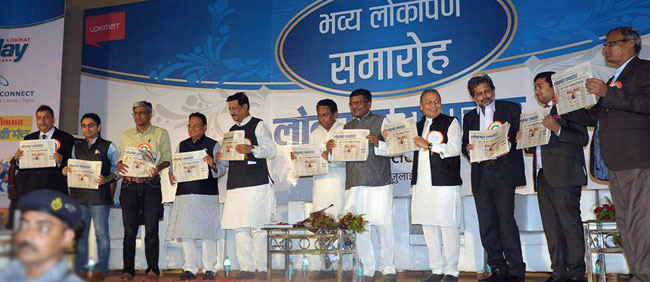
    Senior politicians and journalists at the launch of the Lokmat Samachar edition

    By A Correspondent


    The Lokmat group launched the seventh edition of its Hindi daily Lokmat Samachar with much fanfare in the industrial town Chhindwara in southern Madhya Pradesh last Friday (July 12).


    The edition was launched by Union urban development minister Kamal Nath who praised the Lokmat group for launching the paper in Chhindwara. “While Bhopal cannot become Chhindwara, Chhindwara can become Bhopal,” he said adding how the city had changed a lot over the years with its citizens redefining their concept of development.” An aggressive marketing drive was also initiated to coincide with the launch.


    Jaldi 5 with Vikas Mishra, Editor, Lokmat Samachar: Loads of surprises in store for readers

    A quick Q&A with Vikas Mishra, senior journalist and Editor of Lokmat Samachar.  The Hindi daily is published from Nagpur, Aurangabad, Akola, Kolhapur, Jalgaon, Pune and now Chhindwara

    01. It’s interesting that you have launched the first edition of Lokmat Samachar in Madhya Pradesh from Chhindwara and not a larger city like Indore or Bhopal? What was the reason for this decision?
    Chhindwara has very close contact with Nagpur and the distance is only around 130 km and earlier also Madhyanchal edition of Lokmat Samachar was circulated to Chhindwara and adjoining areas. There was a demand of readers to have a separate edition for Chhindwara because it’s a fast-growing city of Madhya Pradesh, hence we have launched our edition from here.


    02. You already have six editions in Maharashtra. Editorially, how much of a change will the Chhindwara edition have from the others edition in Maharashtra?

    We are having a separate edition of Lokmat Zamachar for the readers of Madhya Pradesh named Madhyanchal since two decades and it’s quite acceptable in several districts which are situated on the border of Maharashtra and MP. We already have bureaus in Bhopal, Indore, Jabalpur, Ujjain and Ratlam. We are making them more stronger.


    03. Any specific issues or campaigns that you expect to take up in the next few months at Chhindwara?

    Wait and watch. We have a lot of surprises for our readers which will be unveiled on a regular basis


    04. The language spoken by people in Chhindwara would be dramatically different from that of people in, say, Pune or even Kolhapur? Is the Hindi that use in the headlines and stories different in the Pune and Chhindwara editions to suit the local taste?

    Chhindwara edition of Lokmat Samachar may be the first independent edition of Madhya Pradesh but as mentioned earlier, we have had our Madhyanchal edition for two decades and hence have had a strong relationship with the readers of Madhya Pradesh. I personally know the journalistic taste of MP because I have spent 25 years in the state.  As far as the headlines and stories are concerned, we always try to write simple Hindi which is acceptable to each and every Hindi reader.


    05. In the run-up to the State Assembly elections in MP later this year, are you looking at expanding in MP and Chhatisgarh?

    The decision will be taken by the management.


    The event was also attended among others by Leader of Opposition in the Rajya Sabha Ravishankar Prasad, Maharashtra Chief Minister Prithviraj Chavan, Chairman and Editor-in-chief of Lokmat Media and Rajya Sabha member Vijay Darda, Maharashtra School Education Minister Rajendra Darda, Executive Editor of Aaj Tak Punya Prasoon Bajpai and Ashutosh, Managing Editor of IBN7.


    Editorial Director and Joint Managing Director Rishi Darda, Executive Director Karan Darda, Lokmat Samachar Editor Vikas Mishra, Product Head Mateen Khan, Resident Editor of Lokmat Samachar’s Chhindwara edition Devesh Thakur  were among those present on the occasion.


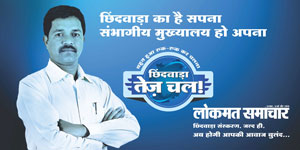
    The brand campaign for the Chhindwara edition launch of Lokmat Samachar


    A seminar on “Role of politics and media in the development of common man” was held on the occasion. The Maharashtra CM stressed the need for the media to maintain its neutrality and impartiality. He said both mediapersons and politicians carried a heavy responsibility on their shoulders. He expressed concern over a section of the media resorting to unscrupulous means to increase circulation. He said it is the primary duty of the media to inform the policies and programmes of the government to the masses.


    Speaking on the occasion, chairman and editor-in-chief of Lokmat Media  and Rajya Sabha member Vijay Darda said the main duty of the media is to bring about change in the life of the common man.


    He said Hindi can play a prominent role in unifying the country. He also added that Lokmat did not represent any political party but just acted as an impartial organ of public opinion.


    Maharashtra school education minister Rajendra Darda said there is a sea change in politics and media in the last two decades. During the pre-Independence era, there was coordination between the media and politics which is no longer seen. The media is the protector of the public interest.


    Ravishankar Prasad stressed the need for the media and politicians to establish a dialogue with the masses to prove their relevance. “The media should understand the agony and anguish of the common man and reflect the same through its columns only then it will win the appreciation and trust of the masses,” he said, adding: “The common man stayed buoyant about the future of the country.”


    Punya Prasoon Bajpai said there was a communication gap between the politicians and the common man. The politicians often use the common man during elections and then forget them till the next election. He also said the media needs to highlight the common man’s concerns to establish a link with the masses. If mediapersons or politicians establish a line of communication with the common man, the country will progress.


    Ashutosh said there has been a massive transformation in the country since 1950.  The country has seen technological as well as intellectual development. Common man has changed his thinking a lot. The Indian society has attained a maturity and they can no longer be conned by anybody. This is high time both politicians and mediapersons established a close contact with the common man and reflected his concerns.


    The Chhindwara launch marks the Lokmat group’s 21st edition in the country..


  • Open magazine launches breakfast chat series

    By  A Correspondent


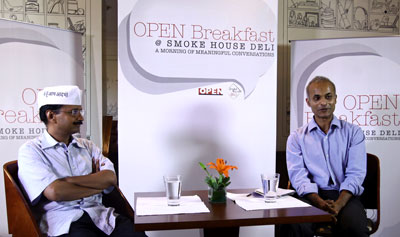
    Arvind Kejriwal with Open editor Manu Joseph Digivijay Singh with Open political editor Hartosh Singh Bal

    Open magazine has launched a breakfast chat series called Open Breakfast @ Smoke House Deli in association with restaurant chain Some House Deli. The chat series has been planned to be held every month and will host prominent public figures, in conversation with the journalists from the newsmagazine. Through the monthly conversations, the magazine desires to illuminate its readers’ understanding of politics, people and culture, notes a communique.


    The inaugural event on June 1 featured Arvind Kejriwal, activist and leader of the Aam Aadmi Party in conversation with Manu Joseph, Editor, Open magazine.


    The second edition of the series was hosted on July 6 with Congress Party General Secretary Digvijaya Singh in conversation with Hartosh Singh Bal the magazine’s Political Editor.


  • Mah Times, Navbharat Times & Ei Samay launch helplines for students

    By A Correspondent


    Three language brands from The Times of India Group -Maharashtra Times, NavBharat Times and Ei Samay – have launched a Readers’ Helpline called ‘MaTaHelpine'(Maharashtra), ‘NBT Help A Star’ (Delhi) and ‘EiSamayAlokshikha’ (Kolkata) respectively. The initiative enables the educational dreams of deserving students from humble backgrounds- by inviting, encouragingand managing monetary contributions from its readers, notes a communique.


    Rahul Kansal

    Explains Rahul Kansal, Executive President, The Times Group. “With a footprint of over 50 lakh premium readers in 14 cities, BCCL Languages have the vision, the scale and the credibility to conceptualize and execute such initiatives. We felt that a differentiated initiative like Readers’ Helpline not only enriches our readers’ lives but is also true to our brand philosophy.”


    Under the initiative, deserving students from Delhi, Kolkata and Maharashtra were selected by the editorial boards of NavBharat Times, Ei Samay and Maharashtra Times on basis of their academic performance and backgrounds.


    Launched in the first week of July for a period of around five weeks, the print ad campaign appeals to readers to support the dreams of these students. An editorial campaign profiles the students – their backgrounds, their potential and aspirations for the future. A special helpline and a microsite have been created where contributors can connect to nominate a particular student. There is no minimum or maximum limit for contributions that are being accepted through cheque payment mode.


    The respective BCCL Language brands will collect the fund for each student and deposit respective amounts into individual FD accounts, free of cost. The students can re-encash the certificates as per their need.


    Interestingly, Maharashtra Times has been conducting Mata Helpine successfully for the past 6 years and has helped scores of students achieve their dreams. Last year alone, the Mata Helpline initiative generated 2.5 crores for the students from its readers. This year, BCCL Languages has extended this popular and noble initiative to its other two language brands (Navbharat Times and Ei Samay).


  • People, Marie Claire & Geo India edition closure: Dues to be settled soon, no written intimation yet

    By A Correspondent [updated]


    It’s ironic that both Marie Claire and People magazines celebrated their seventh and fifth anniversaries respectively just last month. The Indian editions of the two magazines have been doing rather well, or so we were made to understand until recently. And then there was Geo, which has been in the niche space.


    On Friday, the Outlook group decided to announce the discontinuing the licensed editions of the three  magazines.  A press statement was issued as follows:


    “Outlook Publishing (India) Pvt. Ltd. wishes to inform its readers that it is discontinuing its licensing arrangements with People, Geo and Marie Claire magazines with effect from the forthcoming issues of these magazines.


    “Outlook, its promoters and management, however remain fully committed to all other Outlook Group magazines, which will continue to be published in the normal course.”


    That last bit is evidently to quash rumours that the entire publishing company is being sold.

    Although Outlook group president Indranil Roy wasn’t available for comment, we were told that all dues of employees impacted by the decision will be settled soonest. Staff salaries have been delayed as have the dues to some editorial vendors for a few months now. Interestingly, from the information received from a few of the affected staffers, no termination notice or written intimation has been issued.

    According to sources, the economics of the publishing licensed titles has been severely affected by the rising dollar prices. What was negotiated in the boom period at around Rs 40-45-odd to the dollar has now crossed Rs 60. Says an industry watcher on anonymity: “While there is advertising revenue for luxury publications, content costs of lifestyle publications have been very high given staff costs, photography and design expenses, et al.” The dollar/euro conversion rate has evidently made the business unprofitable if the revenues don’t go above a threshold.

    Meanwhile, a Facebook post by Marie Claire editor Neena Haridas has led to murmurs on whether the magazine would continue with another partner. “Marie Claire International is a very powerful media brand with 34 editions and we are NOT shutting down our interest in India. Marie Claire India is an integral and important part of our international strategy,” the post read. It is said that even Time Inc, the publishers of People, may not be averse to bring in a new partner or coming in to India independently.