Category: PRINT MEDIA

  • MiD DAY is back with 3rd season of corporate soccer championship

    By A Correspondent


    The tabloid newspaper MiD DAY has launched the 3rd season of its MiD DAY Corporate Soccer Championship. The third season of the ground event will have 20 teams battling it out for the top position and a prize money of Rs. 1,00,000/-. Also 1 player will get a chance to win the prestigious Golden Boots Award along with cash prize of Rs.20000/-.


    Registration fee is set at Rs. 15,000 per team for the tournament and matches are scheduled to be held on 03rd and 04thNovember, 2012. These matches will be held at Western Railway Ground, Lower Parel. Apart from the prestigious trophy of supremacy, the winner will also get a prize money of Rs. 1,00,000/- whereas the runner-up will get Rs. 50,000/- and the winner of the Golden Boots will receive Rs. 20,000/-.


    Organizations like HDFC Bank, Bigtree,Serco Global Services,Standard Chartered Bank, British Airways World Cargo, NCO India Pvt Ltd, Xoriant Solutions Pvt. Ltd, Hutchinson Global Services PVT LTD, TATA Consultancy Services and many more will compete for the top position of MiD DAY Corporate Soccer Championship 2012.


    Speaking on the launch of the 3rd season of MiD DAY Corporate Soccer Championship, MiD DAY Infomedia Limited MD & CEO Manajit Ghoshal said, ““MiD DAY Corporate Soccer Championship is back with another season giving the corporate executives a quintessential break from their hectic schedule. Also MiD DAY is committed in engaging its core target audience,i.e, the Young professionals of the city through such initiatives. The best of the corporate world will be on show and all are invited to witness the football frenzy.”

  • M&E to reach $37.6 bn by 2016: CII-PwC report

    By Ananya Saha


    The Indian M&E industry, with revenues of about 805 billion INR (17.2 billion USD) in 2011, is set to grow robustly over the next few years on the back of steady macro-economic growth, rising spending power and positive demographic indicators. The industry revenues are expected to reach 1,764 billion INR (37.6 billion USD) by 2016, with a CAGR of about 17% from 2012 to 2016, according to India Entertainment and Media Outlook 2012.


    According to the study, which was released by CII and PwC during the Media and Entertainment Summit 2012, the television and print segments continue to be the largest contributors to the industry, accounting for 66% of the total revenue. Internet access contributed 14%, up from 11% in 2010. However, the contribution from the print and film segments have reduced marginally, as year-on-year growth rates have been lower than the industry average. The internet access and gaming segments have been the fastest growing, with annual growth rates of 57% and 33%, respectively


    The report further lists that the Indian E&M industry has been one of the fastest growing, followed by countries such as China, Russia and Brazil. Going forward, the industry is expected to grow at a CAGR of 17% between 2012 and 2016, to reach a size of 1,764 billion INR. Internet access, advertising and gaming are projected to be the fastest growing avenues, each growing at a CAGR higher than 20%. The revenue from advertising is expected to grow at a CAGR of 13.4% to reach INR 525 billion in 2016, significantly up from INR 279 billion in 2011.


    The television segment is expected to retain its position as the largest E&M segment in the country, with an estimated CAGR of 15% till 2016. Given the high penetration of mobile internet in the country, robust growth has been projected in internet access till 2016 (given the current under-penetration), which will overtake the print sector by 2013, in terms of industry revenues, and become the second-largest segment in the Indian E&M industry. The print segment is expected to grow at 9% for the next five years, and claim 17% of market share by 2017.


    The report recommends that given the high potential growth, the industry should focus on collaboration and innovation to achieve the target numbers.


  • Robust outlook for Indian M&E: CII Summit

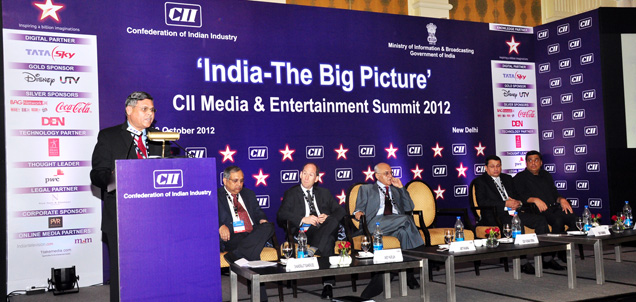
    L to R: Uday Kumar Varma, I&B Secretary, Chandrajit Banerjee, DG, CII; Andy Kaplan, President, Worldwide Network, Sony Picture Television; Amit Khanna, Chairman, CII National Committee on M & E and Chairman, Reliance Entertainment; Uday Shankar, CEO, Star India and Ronnie Screwvala, MD, The Walt Disney Co

    By Ananya Saha


    CII Media and Entertainment Summit 2012, India – The Big Picture discussed critical issues such as cause and effect of market-driven approach in the media and entertainment (M&E) sector, censorship hurdles, and the roadmap for $100 billion Indian M&E industry. The two-day conference saw the who’s who of the sector take a close look at the critical role that M&E plays in India.


    “We are drunk on our own volumes: largest number of newspapers in circulation, largest number of television viewers at 400 million, 100 million digital consumers. Digital, in particular, is an indictment of our creative and strategic limitations – we have 600 million mobile screens and yet we do not have a unique content proposition for the medium,” Uday Shankar, CEO, Star India, said in his keynote address, adding, “Our ability to convert that into corresponding value is disappointing.”


    “Media and industry is a globally growing industry – but our participation in that eco-system is zero and India is hardly factored into the global thought process of technology or content,” he added. Similarly, on the domestic front, the industry is yet to fully unlock the potential of the vast Indian market.” The size of India’s Media and Entertainment industry, which includes television, print, radio, digital media, was pegged at $15 billion at the end of 2011. The industry is growing at around 14 percent a year. “At this rate, we will still take 15 years to get to $100 billion. Obviously, we want to get there much faster. The question is: Why and how do we do that?” Mr Shankar quipped.


    Ministry of Information and Broadcasting Secretary Uday Kumar Varma, Leader of the opposition in Rajya Sabha Arun Jaitley, The Walt Disney Co MD Ronnie Screwvala, Viacom 18 Media Pvt Ltd CEO Sudhanshu Vats, Sony Picture Television President for the worldwide network Andy Kaplan, News Corp Sr Executive VP David Hill, NDTV Group CEO and Executive Director Vikram Chandra, Times Television Network MD and CEO Sunil Lulla, Sony Entertainment Television CEO Man Jit Singh, Times Group CEO Ravi Dhariwal, Prasar Bharti CEO Jawahar Sircar, eminent journalists such as Nik Gowing, Vir Sanghvi, Vinod Mehta and Aroon Purie shared their views at the summit.


    Uday Kumar Varma, Secretary, MIB, recent decision of the government to allow 74 per cent FDI in DTH, IPTV, mobile TV etc. are some of the steps that have been taken in this direction and underscored that those steps would be game changers. He said that many positive steps would be taken in revamping the FM Radio to enhance its reach and content. The empowered Group of Ministers are looking into some of the grey areas in the auction of 839 new FM radio stations across over 290 towns and cities in the country. “We hope to complete the auction of the first tranche of the stations by the end of the financial year,” he added.


    Day 1 of the summit saw Arun Jaitley, Leader of the Opposition, Rajya Sabha make a scathing attack on trial by media and said that most often such debates are based on half- truths and imaginations. Nik Gowing, Presenter, BBC World News said, “Media is greatly influenced by technology and speed in which the information travels. Political leaders and corporations have to realize that to become a leader in the technology driven environs, where they would be put to scrutiny not necessarily by the media but also by public at large, through twitters and other social media, was an onerous task.” Vinod Mehta said, “What we require is blending good business practices with news collection and dissemination, which is a formidable task of media industry.” Ravi Dhariwal, CEO, Times Group, said that media is judged by its contemporary relevance and trust it builds with the general public.


    Broadband penetration to reach 600 mn by 2020
    Speaking on the panel for ‘The Game Changers: Taking M&E industry to $100 bn’, R Chandrasekhar, Secretary, Information Technology and Chairman Telecom Commission said the government is taking proactive steps for enhancing the broadband penetration in the country from the present level of 20 million to 600 million by 2020 so as to cover the entire breadth and length of the country.

    “The government is investing Rs 20,000 crore over the next few years for strengthening the broadband network in the country. In its wake, such massive investment will give a boost to the digitization, cloud-based services and convergence to reach out to the common man in the far flung areas,” he said. The government’s role, he stressed, would be that of a facilitator and the last mile movers would be cable and telecom service providers.


    Manjit Singh, CEO, Sony Entertainment Television maintained that advertisement and subscription income from media business should be at a 50:50 basis and a business model based on these parameters would help penetration of broadband, inflow of more FDI and the government would stand to gain from realization of more taxes. The ratio of TV advertisement to GDP in India is abysmally poor as compared to developed countries and hoped that the stress on subscription would give a sustainable and healthy revenue stream to the media business. Narayan Rao, Executive Vice-Chairperson, NDTV said, “For the ambitious target to reach 100 bn, the industry needs to recognise three things: advertisers need to recognise that as audiences have grown, and thus, rates also need to grow; the broadcasters need to get rid of carriage fees; and the broadcasters need to look at alternate sources o revenue, which can currently come only from subscription revenues.”


    TGBCL’s MD and CEO Sunil Lulla said the industry needs to dream a collective dream to reach the $100 bn mark. “The industry needs to collaborate, partner and compete for a healthier industry status,” he said. Smitha Jha, Leader, Entertainment & Media practice, PWC India, observed that the game changers in the media industry would be advertisement, subscription and infrastructure and policy framework. In India, she said that the consumer spends only $7 per month as subscription as against US$ 500 in the US. Also, to help industry to achieve the potential, infrastructure has to be toned up, such as rolling out of 3G and 4G coupled with strengthening broadband network.


    Policy Conundrum

    Rahul Khullar, Chairman, Telecom Regulatory Authority of India (TRAI) stressed on the need for a separate regulator for content and carriage. He also said that the Indian market should not be compared to Western markets and stressed on the fact that India is a price-sensitive market. Harit Nagpal, MD and CEO, Tata Sky pointed out, “We are most heavily taxed business in the industry. We pay close to 30-35 percent as taxes, exclusive of the import duty on set-top boxes.” Agreeing with Mr Nagpal, SN Sharma, CEO of Den Networks said, “Taxation is going through the roof, and ultimately consumers will have to bear the costs.”


    Anuj Gandhi, Group CEO, IndiaCast, opined, “As we progress with digitisation, it is important that the issue of carriage fees is sorted out. We need to get the ARPUs right to be on the path to reach $100 bn-industry.” The panel also pointed out how the policies in India have not found the regulation support. Vanita Kohli-Khandekar, Contributing Editor, Business Standard said that tax holidays can do wonders for stabilising the industry. She also pointed out how regulation is required in the areas of cross-media monopoly; how 50-60 percent of media buying is concentrated in the hands of one agency and the ownership of news media.


    In response to the worries voiced by the panel, Mr Khullar said that the regulator is aiming at bringing out a white paper on cross-media ownership, which will be done with prior consultation. He also said that as digitisation progresses, the industry should foresee and prepare on changing business models.


    Managing M&E in digital era

    As digitization takes last steps towards sunset date, issues related to convergence have been taking centre stage at various discussions and forums. The panel on convergence issues chaired Neeraj Roy, MD and CEO, Hungama Digital Media was of the view that consumption and monetising of content, global IT systems, infrastructure and policies that deal with convergence need to be developed to provide clarity to industry players as well as consumers.


    Vikram Chandra, Group CEO and ED, NDTV, said, “With convergence and real-time interactivity taking shape, the only question that remains to be answered is how do we monetise the properties.” Vijay Lazarus, President, IMI pointed out how in absence of policy regulations, music became the first victim of technology in the form of piracy. “But then knowing there was no turning back, the music industry also embraced technology,” Mr Lazarus pointed out.


    The panel agreed that innovation in convergence will result in monetisation.


    The last panel on Sports and Entertainment focused on whether sports broadcasting in India is only about cricket or is there an opportunity much beyond which lies untested and unexplored. “The government, corporations, media and civil society should come forward to support sports beyond cricket with a long term roadmap,” maintained Atul Singh, CEO, Coca Cola India. He also hinted that dependence on one form of sports is not the ideal approach since that would lead to unbalanced growth of sports in the country.


    Mr Singh cautioned the corporations not to look for immediate results and dividends from sponsored games other than cricket. David Hill, Senior Executive Vice President, New Corp said, “Sports is predominantly a middle-class indulgence and with India’s middle class touching one billion by 2025, sports will receive a lot of attention in the future.” Referring to the lack of corporate support in India, Harish Thawani, Executive Chairman, Nimbus Communications said that corporates allot adequate budgets for CSR and massive commitment for advertisements but hardly any when it comes to sports.


    While there is no doubt that the Indian M&E industry is seeing unprecedented growth, the question is whether the industry will be able to shed policy inhibitions and grow to the $100-billion-stage by 2016.

  • Jaldi 5 with Vasant Gokhale, Head, Mobile Services, ABP

    Vasant Gokhale

    The Ananda Bazar Patrika Group recently announced its digital offerings for non-resident Bengalis. Though three months old, the platform is already gaining traction. MxM India caught up with Vasant Gokhale, Head, Mobile Services, ABP Pvt Ltd to know more.

     01. The digital offering is targeted at non-resident Bengalis. Is Indian market not ready for such platforms?

    We have plans to eventually reach to that point. The back-end plans are already at work. Also, we have our digital websites that are live currently in India. So, we have enough content here online for the resident Bengalis. We will launch the digital offering on same scale in India within this financial year.

    2. What are your subscription models?

    We have two subscription models. One is, standard that is offered for $5 per month and then we have exclusive premium content.

    03. How has been the response from advertisers?

    We do not have advertising options on the My Anandabazar Mobile App on iOS. Current focus is to increase paid subscriptions for overseas market. We already have over 1000 active subscribers MoM without spending a dime on marketing, and once we reach the critical numbers, advertising options can be looked at.

    04. What will be the marketing strategy?

    We will launch a robust marketing plan shortly. We have acquired the current subscriber base all on hearsay, and without spending a penny.

    5. When do you plan to break-even with the digital property?

    All I would like to say is that we are on track as far as investment and other targets are concerned.


    As told to Ananya Saha 


  • EPGP from IIM-B wins Bhaskar’s ‘Crack the Case’

    By A Correspondent


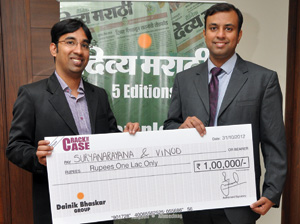
    Winners_Suryanarayana Pemmaraju (L) and Vinod Unnikrishnan (R)

    The final round of ‘Crack the Case’ drew competition from across India and sectors with 2 teams from the industry (a team from IMRB & a cross team from Maxus & Cognition Media, India) and 3 teams from top B-Schools (IIMB and XLRI) competing on Dainik Bhaskar Group’s Maharashtra Success story a case study by IIM Bangalore. The 5 teams battled it out to present the best solution to the question, ‘Keeping in mind the fast paced growth and unique market penetration strategy of the Group, which market should Dainik Bhaskar Group enter next?’ The EPGP team from IIM Bangalore – Suryanarayana Pemmaraju and Vinod Unnikrishnan walked away with the Rs. 1,00,000 Prize.


    Sharing their views on the experience, the winning team, EPGP, IIM Bangalore said, “The overall experience has been amazing. First it gave us an opportunity to work with a near live case and understand more about the print industry. Had it not been for this contest, we would probably never have known of Dainik Bhaskar Group’s success story and their out of the box approach of looking at a problem. Winning a pan-India contest organized by a leading newspaper such as Dainik Bhaskar is a matter of pride and achievement. It would be interesting to track what the group does in the near future and understand our contribution.”


    Suryanarayana Pemmaraju has a rich 8 year experience in software product development and project management with leading IT organizations such as TCS and Dell International & Vinod Unnikrishnan is a veteran engineering manager, boasting of a decade long experience across different industries and companies such as Schneider -Electric & Whirlpool.


    The judging panel included Ravi Rao, Leader, South Asia, Mindshare and Seema Gupta, Faculty Marketing, IIM Bangalore – in addition to Dainik Bhaskar Group’s Senior Management.


    The judges were looking for a solution backed strong logic and analysis. Commenting on the experience, Ravi Rao, Leader – South Asia, Mindshare said, “The teams went beyond the case, displaying an incredible level of secondary research. This forum provided a different perspective towards looking at the case. Every presentation was unique in its approach irrespective of the market they were recommending. The strategy, analysis by each group had a different flavor to their approach.”


    Seema Gupta, Faculty Marketing, IIM Bangalore who is the author of the case study said, “The case contest brought together academia, media and marketing research industry together. I was impressed by the analytical rigour of the teams. The teams combined quantitative analysis with qualitative judgment leading to divergent solutions which made the contest extremely interesting. The diligence displayed by the teams for an extracurricular intellectual exercise is admirable.”


    Commenting on the contest, Sanjeev Kotnala, VP, Dainik Bhaskar Group said, “The enthusiasm and dedication shown by the teams was commendable. We were overwhelmed by the quantity and quality of the total number of entries received. Shortlisting them and further bringing out the winner was a tough task for the judges. This was a unique experience for the Brand too since this was the first time that we have invited inputs beyond internal research teams.”


  • Print-Digital Bhai-Bhai!


    By Ananya Saha


    Print readership is declining the world over. And digital subscribers are rising. Does this mean that the digital medium would lead to closing down of print editions? Not according to the speakers and attendees at that The Digital Innovation Summit 2012 by INMA.


    Yasmin Namini

    While Newsweek made a smart move by announcing its move to the web-only space, the news print industry is taking it slow and steady. Yasmin Namini, Senior VP – Marketing and Circulation and GM, Reader Applications, The New York Times pointed out how NYT has been gaining readers with their innovative paid digital content, such as, repeated payment gateways screen and 10-articles-free-per-month-limit after which subscription is necessary. NT registered 56.6 lakh subscribers till Q3 of 2012. She said that NYT has been using cross-bundling approach to optimise profitability.


    Mark Challinor

    Mark Challinor, Director of Mobile Platforms, Telegraph Media Group,Londonwas upbeat about the usage of personal mobile devices and iPads. He said, “There are more iPhones sold in the world (4.6 seconds) than babies born in the world (4.2 seconds). This gives us a clear idea of the future. Today’s 2-5-year-olds learn to operate the iPhone and iPad much before they learn to tie shoelaces.” He supported the fact that remains important, and the future of newspapers depends on reinvention of news industry.


    Indian newspapers too are smart enough to invest in their digital properties to receive huge dividends in the future. Earl J Wilkinson, Executive Director and CEO, INMA shared smart bets forIndia, “Make consumer pay more, now and create digital company outside your current company, in case the existing structures do not support digitalisation and be willing to cannibalize yourself.” He also cautioned against making digital an excuse to stop investing in print.


    vasant-gokhale

    Vasant Gokhale, Head, Mobile Services, ABP Pvt Ltd shared the mobile strategy that his company had adapted for the non-resident Bengalis. With an aspiration to reach out to wider Bengali audience settled out of East of India, Ananda Bazaar Patrika started its paid digital content three months ago targeting only non-resident Bengalis. The standard service of $5 per month and exclusive packages were launched to create a subscriber base around Durga Puja. Mr Gokhale shared “We have been growing 30% month-on-month, without spending a penny on marketing. The growing base is the result of our unique Bengali content and offering.”


    Bharat Gupta

    Bharat Gupta, Executive President – Marketing, Jagran Prakashan Ltd said, “With our unique content mix, out Hindi website has been gaining more traffic. We find Facebook very helpful in engaging our users, targeting new demographic areas and making headlines of the print publication viral.” He added that the main focus for his publication on social media was “not to gather the ‘likes’ rather get spoken about on social media.” Puneet Gupt, VP and Head of TOI.com shared how The Times of India digital story has seen growth thanks to engagement, rewards and response to consumer tastes.


    Grzegorz Piechota

    While Grzegorz Piechota, News Editor, Gazeta Wyborcza, Poland shared how the future of journalism and communities in digital age depends on campaigning and bringing the society together through causes; Marcelo Benez, Advertising Director of Folha de S Paulo, Brazil talked about where digital solution fit in the multi-media advertising mix. According to him, digital and print will co-exist in the future and help with the growth of each other. The group recently launched a magazine exclusively for Tablets, called Fohla 10 that can be consumed through various digital devices.


    Pit Gottschalk

    Mr Benez noted, “Of the total advertising pie in the country, television still claims the maximum share of 64.8%, newspaper follows with 11.7% and internet gets 5.2% of this ad pie.” Thus, to get maximum benefit, he advocated that a news company should be able to deliver their content on all platforms. He also said that the news company should engage advertisers not only through content but multi-platform special projects as well. Concurring with his thoughts, Pit Gottschalk, Director – Content Management, Axel Springer,Germany, said that news companies need to integrate digital as much as in their companies.


    Talking about his brand, Bild, Mr Gottschalk said, “Our digitisation strategy focussed on our three strengths: content, classifieds and marketing. In 2004, we defined our core strategy and created portfolio of market leaders in various geographies corresponding with our core strengths.” He further added that Bild used the classic newspaper strategies to monetise, and “we have reach 47.49 million readers everyday from 12 million few years back.” Bild’s goal of generating 50% of all income digitally has been reached, according to Mr Gottschalk.


    The one-day conference ended on high note with speakers agreeing coherently on the fact that opportunity to gain advertisers and readers will arise from print and digital integration. While it might be a long-term strategy for India given the fact that cover price of printed newspapers is so less but this is just the right time to get digital.


    Imaging : Rafiq


  • Are suit-led agencies creatures of the past? And why AAAI must reinvent Goafest…


    Just a day after the vicinity was in grief over the Shiv Sena chief’s death, at Central Mumbai’s tony nightspot Blue Frog, friends and well-wishers of senior journalist Anant Rangaswami came in to witness (and celebrate) the release of the book ‘The Elephants in the Room – The Future of Advertising in India, 2016’. It was a simple event – emcee Karthik Iyer of Bengaluru-based Happy Creative Services made us chuckle with his wisecracks, Anant’s kids Rohan and Anya presented the first copy to his former boss and mentor Arun Arora (Chairman, Edvance and formerly President and ED, Bennett Coleman & Co Ltd) and finally a few words from Anant Rangaswami. For the rest of the evening, there were good spirits and food for company. The book surely asks some tough questions, and then puts recent history of the business in perspective. Our sub-140-character review: Unputdownable. If you’re in the biz of advertising, download now!

    To get a flavour of the book, we present two passages – one on suit-led agencies and the other on Goafest and why it must reinvent. Enjoy.


    The Elephants in the Room

    By Anant Rangaswami


    The very reason that suits ran most of the agencies in India till the late 1990s was due to a simple fact: the creatives didn’t care about, and didn’t know much about, managing a business and managing money. As a result, however talented and however critical to the business a creative was, he or she reported to a suit. It suited both well, during that time, till clients latched on to who, in the agency system, was the magician – and the answer was, ‘the creative’.


    [Creatives who aspire to head agencies must learn that, however painful it may be, they will have to gain more than a rudimentary understanding of accounts, of finance, of administration, of taxation. Currently, a number of agencies have suits as CEOs ONLY because the creatives fail at what are hygiene skill sets for managers].


    Ranjan Kapur perhaps saw this trend coming before anyone else. While he was clearly the head of Ogilvy in India, he saw the opportunity in leveraging the growing reputation and charisma of Piyush Pandey. During Kapur’s years, we saw the face and image of the agency change. While JWT (then HTA) had built a redoubtable reputation for their planning, by the late 1990s, Ogilvy was transformed into the most creative agency in the country as far as popular perception was concerned. Not just Ogilvy – it was Piyush Pandey who had become the God of Advertising Things.


    While Kapur pushed himself, cleverly, more and more into the shadows and pushed Pandey more into the sunlight, his contemporaries at the two largest competitors of the time, Prem Mehta at Lintas and Mike Khanna (and later Colvyn Harris) at HTA (to become JWT later), failed to notice what Kapur was up to – and why he was up to whatever they were up to. Mehta held on till he sold his stake in Lintas to Lowe; the status quo remains at JWT, and Ogilvy has, without a doubt, occupied the number one creative agency spot in India.


    Kapur, I would argue, saw the future and bet on it. It could not have been easy, at that time, to buck the trend and allow and encourage a creative to become the face of the agency. In hindsight, some of the most memorable advertising work in the past two decades have been on brands handled by Ogilvy – Cadbury, Fevicol, all the avatars of what is now Vodafone, and so on. All these resulted in glory for Pandey and a small amount of reflected glory for Kapur.


    But that was a small price to pay – the success of the agency, as far as Kapur’s boss Sir Martin Sorrell was concerned, was due to Kapur.


    Today, Lowe is run, whether you like it or not, by Balki. JWT is still run by a suit.


    It’s important, for many reasons, for the agency to be run by a creative. The foremost is that when it is apparent that a creative runs the agency, and is not just the head of the creative department, it sends a signal that the ‘environment’ will be more creative-friendly. It makes it easier to recruit and retain creative talent for the creative-led agency than for the suit-led one.


    It’s not that the only solution is to insist that a creative heads the agency. It could be in the form of the Piyush-Rane partnership (which was defined by Kapur’s formula), where the creative is the face of the agency. In Rane’s case, he has defined his job as one that will ensure that the environment allows Piyush and his team to focus on the creative product, while he looks after the mundane essential tasks such as finance, accounting and general administration.


    But make no mistake about it – the suit-led and the suit-as-the-face agency is a creature of the past. For a moment, let me get back to Salt, which is a new agency headed by a suit, Mahesh Chauhan. Why is Salt doing well, defeating my entire premise? Because, while Chauhan calls himself and sees himself as a suit, his clients and his creative colleagues see him as a creative. Chew on that.


    Take a look around you – at all the agencies headed by suits – and at all the agencies headed by creatives. Look at who is winning. Look at who is struggling.


    It’s not a surprise. As Sir Hegarty said, I’ll repeat, “How can we not have a creative person at the top of a creative business?”


    It’s time for the suits to actively push their creative heads forward and actively recede into the backgrounds. The creatives must be the faces of the agencies – otherwise the creatives will begin leaving.


    So will the businesses, as many have sadly learned.


    It’s not going to be easy, but it has to be dealt with, sooner rather than later. I told you, it’s an elephant in the room.


    A few days ago, my brother, JP Rangaswami, wrote in his blog: “Business is personal. It’s about relationships. It has always been so. Until we tried to forget it and concentrated on making money, not shoes. [As Peter Drucker said, people make shoes, not money]. Then, for a short while, business became not-personal.”


    In India, the entire advertising industry is about relationships. It’s personal. And, to paraphrase Drucker, in this business, you create communication, not money.


    ****


    The AAAI, in the current form, has become an elephant – a white elephant. Unless they change, there is no reason for them to exist.


    Which brings me to another elephant. The AAAI has given birth to it and, by some accident and aided and abetted by some office bearers (almost all heads of large creative and media agencies who convince their friends in media houses to sponsor it) it is still alive. The elephant is called Goafest.


    Speak to any event manager and tell him you want to do a major event in Goa in April – and he’ll tell you that you’re nuts. It is, verifiably, the hottest month of the year in Goa, with the average temperature being around 33 degrees C (high) and 27 degrees C (low). I’ve checked historic data to save you the time.


    Yet, from the time that Goafest was created, it’s been held in the first fortnight of April. Never earlier, never later.


    If you live in Mumbai, you’re tempted, every month, to run away to Goa and get away from the pressures of living in the megapolis. Every month except April – because not only is it hot, it doesn’t rain. March is alright, because it is cooler. May is alright, because it begins raining. April is a bummer, because it’s hot and humid.


    Yet Goafest is held every goddamned year in April.


    Why? Why? Why? When I first thought of the question, I was reminded of a lecture I attended when The Times of India, my then employer, sent me to a course at IIM Ahmedabad. The lecture was on the Toyota system, where ‘Seven whys’ would help Toyota employees on the assembly line arrive at the root cause of problems.


    Hazel Rogers from Australia makes the 7 Whys easy to understand.


    “The 7 whys is a technique that I believe was developed as part of the Toyota factory quality push, back in the mists of time. It’s since been taken from the manufacturing paradigm and used in IT quality theories. It’s a great method for getting to the root cause or at least one of the root causes of any problem. So it’s a great tool to use with EFT!


    What is it? Start with a problem. Keep asking “why?”, until you’ve gotten to where you can’t go any further, or you’ve found some interesting “hidden” thinking! You don’t HAVE to ask why 7 times precisely.


    For example:

    I’m procrastinating…


    Q Why do I procrastinate?

    Because I’m stuck on using the tools I have here (on the computer)


    Q Why am I stuck, when there people available to help me?

    Because I haven’t asked for help


    Q Why haven’t I asked for help?

    Because they will think I’m stupid, I should be able to figure it out.”


    I’m not going to the 7th question, as much as I didn’t need to when trying to figure out the answer to why Goafest is held in April.


    It’s held in April because the planning is appalling, so there’s little time to raise the money to afford Goa hotels in months with better weather.


    To give you an idea of what can be done with better planning, you need to look no further than another event held annually in Goa, Kyoorius Designyatra. Their 2012 edition was held in September; they’ve already announced that their 2013 edition will be held in August.


    As I write this, I’m certain that speakers are being spoken to, that hotel room prices are being negotiated and sponsors being contacted.


    Compare this with Goafest. Going by the history of Goafest that I can claim to be associated with (which is from the 2008 edition), it’ll be sometime in January 2013 before the AAAI management committee discusses the April 2013 event. Once they meet, and they decide on possible dates, they need to talk to The Advertising Club, the owners of the Abbys, the awards which are held at Goafest. Once The Advertising Club agrees, they will begin the process of contacting possible speakers – for whom, unlike Designyatra, they have no budget for. (They do pay for airfares when requested and for the accommodation within India). Ideally, they look for speakers who are happy to come to India at their cost – and that shrinks the pool of prospective speakers dramatically.


    It doesn’t help that speakers get notice of less than two months from the day the request is made.


    So this, then, is the product that is Goafest:

    1. On the Thursday, a meaningless Conclave ( I use the capital C to emphasise how AAAI views it), where the entry is by invitation only to CXOs and to the handful of marketers who are bullied into attending by their agency partners


    2. On Friday, the event is open to the public, and the bar is open as well. Kids loll around drinking and flirting (as I would if I was their age), while speakers like Dan Wieden, Sir Martin Sorrell, Sir John Hegarty, to name a few, are besieged by trade media for interviews in the burning April Goa sun.


    3. Speaker sessions start by around 4. Most of the kids are too drunk to attend; some have success with their flirting. It’s difficult to fill the seminar hall. All kinds of devices have been attempted, including a chance to win an iPod if you attend. So Scott Goodson of StrawberryFrog has an audience of less than 300, of the 3000 who are attending the fest.


    4. Friday evening sees the Media Abbys. Those from the creative agencies don’t care and they’re off to Martin’s for a piss up. The youngsters from the creative agencies continue to flirt. The media agencies win and lose, and there’s a piss up as soon as the bars open (inexplicably, they close during the awards presentation ceremony).


    5. Saturday morning sees most of the media agency executives leave. The bar is open, those who remain do the same as described in points 2 and 3 above.


    6. Saturday evening sees the Creative Abbys (during the presentation of which the bar is still closed).


    7. Losers bitch about the judging (admittedly, it was the least in 2012) but head for the bars once they’re opened.


    8. Some of the lucky delegates have sex with partners they’ve met for the first time in Goa.


    9. International visitors tell Indian trade media that they’re very happy with how their Indian offices are doing, even if their Indian offices are doing terribly.


    10. Sunday morning, all fall down.


    This is absolute rubbish. What the AAAI demonstrates, first by scheduling the event in April, and then by the content they create, is an absolute contempt for the intelligence of the average advertising professional in India. They have the temerity and the arrogance to call it the “Cannes of India”, much in the same spirit that Maharashtra’s chief ministers compare Mumbai to Shanghai.


    Unless the AAAI reinvents Goafest, it’s a downhill ride from here.


    The AAAI needs to re-focus on the premise of Goafest. To begin with, they’re trapped, by the very name of the festival, to hold the event in Goa. Goa has become, over the years, a very expensive destination – except if you live in Mumbai or Pune. To someone from Kolkata , Singapore and Bangkok are cheaper. At short notice, even in April, it could cost you a small fortune to fly to or from Goa at short notice. Ask Lodestar’s Shashi Sinha, who had to make a last minute change a few years ago and ended up spending Rs.18000 on a one-way ticket from Goa to Delhi on the Sunday after Goafest.


    Forcing the event to stay at Goa makes the festival exclusive and not inclusive. It is slowly becoming an annual ritual for the industry from Mumbai to take a few days off. We see a few hundred each from Delhi and Bangalore; from the rest of India, the number will be in the low double digits. Perhaps 10-15 from Kolkata, and another 10-15 from Chennai.


    It’s time to become truly inclusive, and start moving the festival around the country. That’s why Goafest traps you. For God’s sake, if the entire advertising industry cannot come up with a new name for an advertising festival, it’s a little sad.


    (In the short term, you can be sure that next year’s attendance will take a beating, thanks to the sluggish market and the pressure on margins).


    Learn from Designyatra that content is King, not the entertainment. I’ve attended two editions of Designyatra in Goa and one in Mumbai – and all three have had superlative content. Content that keeps you riveted to your seats and taking notes. Speakers you want to walk up to and hug once they’ve finished. Conference halls that are packed to the rafters.


    And there’s no free alcohol, no parasailing, no tattoos. Designyatra is serious business – and the delegates seem to profit from it – there are more attending every year. There are no major costs in event management, as all the sessions are held in hotel banquet halls. Sponsors are happy to support the event, because they’ve seen, over the years, the quality of the delegates and the level of involvement.


    The old adage goes, if it ain’t broke, don’t fix it. On the other hand, if it is broke, fix it. Goafest is broke. Fix it.


    Extracted with permission of the author Anant Rangaswami

    from The Elephants in The Room – The Future of Advertising, 2016.

    Pages 152, self-published.

    The book is also available as a free download from Firstpost.com.

    More information and interactions at facebook.com/theelephantsintheroom
     

  • Jaldi 5 with Sachin Kalbag: Upholding civil liberties…

    The arrest and eventual release of a young lady living in Palghar in suburban Mumbai thanks to a Facebook post as also her friend who ‘liked’ it sent shockwaves across India’s urban set who happily post their comments on social networks and microblogs. Leading English daily Mid-Day has announced a People’s Freedom Charter in defending the citizen’s right to free speech. MxMIndia interviewed Mid-Day executive editor Sachin Kalbag and asked him on what the paper hopes to achieve with the Charter.

     

    01. How do propose to ensure your Charter reaches its logical conclusion… as in ensure that students are not found to be on the wrong side of the law for exercising their rights, as stated by you?

    There will be no “conclusion” to this process. This is the first step in a long journey to defend freedom of speech. MiD DAY will, stridently and on a sustained basis, defend the freedom of speech of India’s citizens. It will mean that we give stories pertaining to this issue wide play. Of course, due to constraints of space in the print medium, we cannot be talking only of freedom of speech-related stories, or even all stories pertaining to the topic. But yes, it will be a large focus area.


    2. One of the biggest problems is the interpretation of how any speech or action will affect law and order and the social fabric. Don’t you think that what’s needed is public opinion against age-old laws and getting them changed eventually through the Executive or the Judiciary?

    In a true democracy, freedom of speech must be absolute. It is something we do not have right now because Article 19(2) of the Constitution puts “Reasonable Restrictions” on freedom of speech. Those restrictions are the sovereignty and integrity of India, the security of the State, friendly relations with foreign States, public order, decency or morality or in relation to contempt of court, defamation or incitement to an offence. If you read between the lines, practically anything can constitute as an offence (I calling someone ugly, or, for that matter, saying Sachin Tendulkar is an ordinary batsman). This is where the arbitrariness of “reasonable restrictions” needs to be highlighted. Another example of arbitrary interpretation and application of law is Section 66(A) of the Information Technology (Amendment) Act, 2008. Once again, anything can constitute as “offensive” and I could lodge a complaint with the police against you because I found your email or your Facebook post offensive. This is what we need to be guarding against. As right-minded citizens, we must oppose this arbitrariness. We should stand up against laws that can be used to settle scores or wrongfully applied.


    Through our Freedom Charter, we want to build public opinion in this regard. Ultimately, it is Parliament (the lawmaking body) which will have to debate and pass laws that do leave nothing to arbitrary interpretation. It is a tough challenge, but someone needs to be a catalyst.


    03. It’s been seen that not just the government, but also otherwise well-meaning, educated and well-read individuals do not take very kindly to criticism, especially when it’s on social media (and Twitter)?

    Not taking kindly to criticism is a universal trait. Who wakes up in the morning and says, “Come on, world, criticize me.”? The point is not about criticism, but my freedom as a citizen to speak my mind without any fear. If the person on the receiving side feels that the critic has no basis for what he or she said, the “affected party” can sue the critic for defamation so that the critic can prove whether his allegations are accurate or not. There are these laws that give the affected party a platform for redressal. But we cannot sit on a high horse and say, “No one can criticize me,” or “No one will oppose me because I am the government and I know what is best for the country.”


    04. Your report mentions that the Charter will be the guiding principle in your paper’s reportage. Could you give an example of how this will happen?

    We will ensure in reportage that civil liberties are upheld at all costs. You will see this in all our stories.


    05. This also means that in case of a situation where you or your paper are subjected to criticism, you’ll take it in the right spirit?

    Of course, we will take in the right spirit. We are an irreverent, anti-establishment, ideologically neutral newspaper. No matter what we do, our stories offend someone or the other. We believe that as a responsible newspaper, we will investigate our stories thoroughly, and that we will not carry stories without proper documentation to prove we are right. If in that process someone is offended, so be it. We are ready to defend our stand. And if we are wrong, we shall apologize and take steps to ensure that we do not repeat our mistakes. But at no point in time shall we say that, “We will not carry the story because it will offend someone.”


    Interviewed by Ananya Saha


  • FoxyMoron asks Femina readers to slow down

    By A Correspondent


    In an attempt to shut off from the streams of opinions at Twitter, unceasing parade of people living their lives in fast-forward on Facebook, to enjoy life and to relive the great moments without rushing, Femina roped in Foxymoron for their digital campaign.


    Femina’s anniversary issue, which hit the stands in November, celebrates slowing down, choosing the scenic route and taking a deep breath. Tanya Chaitanya, the editor of Femina, said, “Exhale! Femina’s anniversary issue tells you to do just that. In a world where time is at a higher premium than real estate, it’s smart to invest time in yourself — to find a hobby, to catch up with friends, read all the books in your bucket list… Femina’s 53rd anniversary issue asks you to relax, revel, recharge.” Soela Joshi, brand publisher, Femina, added, “The issue won’t tell you how to make more time; you’re already a pro at it. But it has a few ideas for what you can do with all that time you’ve saved up from years of rushing around.”


    Aiding Femina in communicating this message was the digital agency, FoxyMoron. Starting November 14, FoxyMoron brought this message alive on the digital platform via an innovative and comprehensive campaign on a variety of mediums like Facebook, Twitter and Pinterest.


    Harshil Karia, Founder & Online Strategist at FoxyMoron, said, “The brief was about rewinding and going back in time. Femina creates digital campaign for its every issue. This time, however since it was the anniversary special, we created the campaign in three phases. The first phase asked the women to switch off from browsing the internet, women to make time and enjoy the smaller pleasures of life and unwind. The second phase was about completing the story wherein, Femina released two lines, which started to a story. Fans, followers and pinners continued that story from there and take it forward to their desired end.” A new story was released every day, According to Karia, this gave the readers a chance to ponder and do something they always wanted to do but didn’t have the time for.


    The third phase is yet to come. Femina will be running a contest on its digital channels that ask women to express a moment in their life that they wish they could rewind and relish. And three lucky winners chosen by Femina will be given the chance of a lifetime to actually relive that special moment that they did not do justice to the first time around.


    The contest targeted at 25-40-year-olds has garnered fantastic response, according to Karia. He said, “On the first day of the campaign, about 650 women took part. We had a special application built around this campaign, which helped us to create higher engagement rate. Till date, we have received about 600 stories asking to relive the moment. “The content performed well for the brand,” he asserted. The 15-day campaign will end on November 30 as Femina gets ready for the next issue.


  • Must-read book on advertising


    Trying not to see
    By Kurien MathewsWikipedia describes Elephant in the room thus:
    “Elephant in the room” is an English metaphorical idiom for an obvious truth that is either being ignored or going unaddressed. The idiomatic expression also applies to an obvious problem or risk no one wants to discuss.


    It is based on the idea that an elephant in a room would be impossible to overlook; thus, people in the room who pretend the elephant is not there have chosen to avoid dealing with the looming big issue.


    All of us in advertising, for almost as long as I have been in it, have suffered and have been greatly affected by ignoring or not addressing some very obvious truths that have been staring us in the face. Forget about addressing it; we never even spoke about it, and went about our lives pretending that everything was just fine, and if there was a problem it was just temporary and would soon go away.


    Around the time I joined advertising, nearly three decades ago, everything was in fact just fine. No too many elephants in the room. If they were there, they were baby elephants, the playful kinds.


    In those days talent was good and abundant. Advertising was glamorous. Money was plentiful. Clients respected agencies, and thought of us as people who generally knew much more than them. We wined and dined. Almost everything was done in English, and then translated. Commercials were broadcast on one channel. No one asked for discounts. It was fun with many other such wondrous things in place.


    In his book, Anant Rangaswami speaks of many, many Elephants in the room today. All carefully chosen. All well articulated.


    These Elephants started emerging, one by one, somewhere in the mid 90s- perhaps with the arrival of satellite TV and the birth of the AOR. Suddenly the sacrosanct 15% was thrown out of the window. Before you knew it, agency revenues started shrinking and the demands on them started increasing. Simultaneously, the brighter MBAs found that there were other fun jobs that paid better, and then the vicious downward spiral of low pay, lower quality talent, suicidal discounting and the need to find revenue at any cost started.


    Soon more Elephants started appearing in the room and by the beginning of the new millennium the room was beginning to fill up, fast and furious.


    But no one cared. No one wanted to talk about it either.  If there was the odd murmur, it was quickly rubbished. Ostriches, all of us.


    In ‘The Elephants in the room’ author Anant Rangaswami not only points out to all the Elephants so glaringly visible to him, but he does so without holding back or being polite or gentle. He tells it like it is. He names names, speaks of incidents, and at places proposes action as well.


    If you have anything to with the business of building brands then this book is a must-read for you. While it is about serious business it is a fun read. Best of all, it is free - comes only in the form of an e-book, which can be downloaded from www.firstpost.com


    Kurien Mathews is Chairman & Managing Director, METAL Communications Pvt. Ltd, Director, Rage Communications Pvt. Ltd and Director, Conscious Food Pvt. Ltd


    Trumpets and snorts: A book review of sorts
    By Paritosh Joshi1984. That was the other book with a date in it that popped into the mind. A book that caused a proper noun, Orwell, to be recast as an adjective, Orwellian.

     

    And so to “Elephants in the Room – The Future of Advertising in India, 2016”, Anant Rangaswami’s self-published book launched with minimal fanfare on November 19.


    Prognostication is often grim business. With a date in the name, you are sort of prepared to deal with dystopic speculations on where Advertising is headed. The author doesn’t disappoint. This is sentence no. 1. “Let’s not fool ourselves; it’s going to be a tough few years ahead”.


    It is not unusual for business professionals at a certain stage in their lives to turn to writing and wish to be published. A few decades spent winning more business battles than they lost and they fancy themselves to be keepers of recondite truths that are hidden from the little people. Hindsight, a self-congratulatory attitude and a desire to elevate banality to wisdom compel them to couch their “insights” in prolix prose.


    Anant’s book, refreshingly, is at the exact opposite pole.


    The ‘elephants’ that populate this book are incipient problems that the Advertising industry will face over the next few years. The author has the journalist’s insatiable appetite for conversation. From the lowly Account Manager to titans that bestride the narrow world like Sir Martin and Sir John, he talks to them without fear or favour. His inquisitiveness is unbridled and uninhibited. The ‘elephants’, therefore, are distilled from empirical knowledge and documented anecdote, not idle speculation. From the endless hand-wringing over talent scarcity, through the challenge that digital specialists pose to the traditional creative agency to a near future where many of today’s marquee names from the advertising industry may retire, each ‘elephant’ warrants a chapter where the author attempts to lay out the problem as he sees it, a prognosis of where it will go next and prescriptions that may alleviate or remedy that problem.


    What makes the exercise utterly unusual is the author’s unabashed willingness to name names, individual and corporate that are the protagonists in this unfolding epic. To be clear, there is not one reference that might be considered libelous or intemperate, though there will be several that will cause people to squirm.


    Now while the author is almost consistently objective in his assessment, he is human enough to let some deeply held beliefs; they are logically constructed so they cannot be labelled prejudices; show through. One such, which I have had the pleasure of debating with him on many occasions, is the role and functioning of the Advertising Standards Council of India. He devotes a sizable chapter to the theme and in the interest of full disclosure I record my vigorous disagreement. There will be a rejoinder in these columns soon.


    Here is my big problem: The urgency that informs the book, while making it a real page-turner, does it a huge disservice. This is not a rash pamphleteer whipping up a mob to frenzy but a thoughtful commentator’s significant contemplation of important questions that plague, arguably, the wider Communications industry and not Advertising alone. Identical or analogous problems exist, inter alia, in the broadcast industry. And none of these problems will suddenly disappear in 2016. Media & Communications professionals, particularly those holding senior responsibilities would all be well advised to read what Anant has to say in “The Elephants In The Room”, now and for many years to come.


    And finally this. I wish, I really wish, that I had bought this book and not got it gratis as I left the launch party. Content creators, particularly when they create content as important as this, have the right to demand fair economic value for their work. Now Anant will almost certainly see this as his responsibility towards the industry he calls home, we will be unable to show our appreciation and gratitude if we can’t pay for the cry of the conscience keeper.


    Elephants in the Room: Essential reading!
    By Pradyuman MaheshwariI’ve read the book twice over. Well, actually, two-and-a-half times. First to decide what part to pick for an extract… that was a pdf which Anant shared with me a few hours before the formal launch. I did a rapid read, like the ones you do when reading those tomes that come out from government or regulator documents posted online.
     

    So how many enemies will I make, Anant asked me at the launch. I muttered a couple of names but also told him that the book was brilliant. And unputdownable.


    The half-read was when I had to actually pick the extract. I decided on two to give MxM readers a perspective on what to expect from it. The first on whether it should be a suit or creative who should head an agency. And the other on Goafest.


    The last time I read it was after Paritosh Joshi suggested the idea of this joint review.


    The Elephants in the Room is not an academic account of what ought to be done by the industry. It’s no white paper. Yet, in its chatty style, it highlights all that needs to be stated about the business. Racy in style, it’s almost like some of his blogs on Campaign India put together. Except that here they are longer, and the issues are dealt with in detail.


    I tend to agree with his views on industry associations – the AAAI and ASCI specifically. There is much scope for improvement, in fact what’s needed is an overhaul. The Advertising Club also needs to get into activities that attract the youth. And above all: Goafest. Why have it in Goa in April?


    So, my sub-140-character review continues to be what I gave on the morning after the launch: Unputdownable. If you’re in the biz of advertising, download now!


    I wouldn’t want to get too much into the book, and would urge readers to download it off Firstpost, but I have two peeves about the book. Or possibly three.


    The first: In the attempt to make it quick-and-racy, I think Elephants in the Room rushes through some of the issues that impact the business. For instance, corruption. I could list a few more.


    Second: The focus is Creative. It delves into digital, talks a bit about media, but it’s essentially the big creative agencies and gods who have been discussed.


    And, third: why the hell has Mr Rangaswami not priced the book. Why offer it as a free download? Printing a book doesn’t take an arm and a leg. I would’ve been happy to have MxMIndia publish the book. Or possibly Firstpost could have.


    The Elephants in the Room is an excellent book. It’s essential reading for all those in advertising, and all those who deal with creative folk and creative agencies.


    Pradyuman Maheshwari is Editor-in-Chief and CEO, MxMIndia


  • Azim Premji wins Forbes India’s inaugural philanthropy award

    By A Correspondent


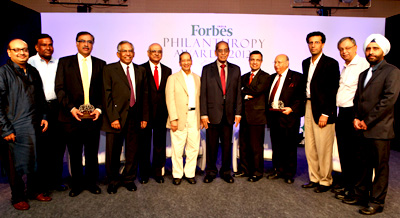
    Azim Premji with the jury (L-R): Abraham Moses, Sanjiv Sarin, MV Subbiah, AN Singh, Bhawarlal Jain, Narayanan Vaghul, Nachiket Mor, Lord Raj Loomba, Ashish Dhawan, Dr Madhav Chavan, Gurmeet Singh

    Azim Premji, chairman of Wipro Ltd, won the inaugural Forbes India Philanthropy Award in Outstanding Philanthropist category for 2012. Mr Premji, 67, the third richest Indian with a net worth of $12.2 billion, has pledged close to $2 billion from his personal wealth to Azim Premji Foundation, which is working to improve elementary education across India. He was among the ten outstanding individuals who received the award under different categories.


    The philanthropy awards were instituted by Forbes India to recognize the efforts of individuals who have given time, money, skill and expertise to solve some of the most pressing societal issues, to create model institutions and to inspire others. The winners received their awards – metalwork keepsakes depicting the Mubhi Tree, which symbolises the art of giving – at an event in Bangalore on Wednesday.


    “Our hope is that business should emerge as a strong force for good in this country and that our list of nominees for each of the ten categories will continue to grow as more and more people from the world of business step up and find new exciting ways to give back to society,” Indrajit Gupta, editor of Forbes India, said during the event.


    Mr Premji spoke about how his foundation’s university, which has 230 students and 70 professors, complements the field work they do in education. “Our objective is that we have to get more results and to scale up much more significantly in the grassroot level in the field,” he said. Later, he joined his fellow winners N Vaghul, former chairman ICICI Bank and MV Subbiah, former chairman Murugappa Group in a fireside chat to discuss what it takes to build a network of engaged corporate citizens, deepening the culture of giving back, galvanising corporate action, and how to take philanthropy in India to the next level. The session was moderated by Subroto Bagchi, chairman and co-founder Mindtree.


    In yet another fireside chat, Nachiket Mor, Chairman of the Board of Directors, SughaVazhvu, Ashish Dhawan, Founder and CEO of Central Square Foundation and Ramji Raghavan, founder Agastya International, discussed the challenges that philanthropists face when they work with multiple stakeholders, especially the government, in bringing about change. Ajit Rangnekar, dean of the Indian School of Business in Hyderabad, moderated the session.


    The event was attended by entrepreneurs, executives and academics with interest and passion for philanthropy and social good. They shared their views on themes related to philanthropy. Kiran Mazumdar Shaw, chairman and managing director of Biocon said that philanthropy is about making changes, and partnerships play a crucial role in that. Mr Mohandas Pai, Chairman of Manipal Global Education, and one of the driving forces behind Akshayapatra a mid-day meal programme, said he was motivated to do more when he realised that he was lucky to have won ‘the ovarian lottery’, many others aren’t so fortunate. Lord Raj Loomba, founder of clothing company Rinku Group, whose foundation works for the cause of widows, said his inspiration was the story of his mother, who became a widow when Raj Loomba was just 10 years old.


    The latest edition of Forbes India devoted to philanthropy was also released. Containing features on philanthropy with detailed case studies about each of the award winners, the special edition has four covers, featuring four of the winners Azim Premji, N Vaghul, MV Subbiah and Ashish Dhawan and a caption that runs across four covers: Philanthropy, done right, is too important to restrict to one cover.


    Speaking on the occasion, Gurmeet Singh, CEO, Forbes India said, “We at Forbes India strongly believe that Wealth and Philanthropy are two sides of the same coin. Therefore it was logical that we scaled up our earlier events on “Purpose Of Wealth”, “Business as a Force For Good” and “Conscious Capitalism” into a full-fledged Philanthropy Awards Evening.  Forbes India Philanthropy Awards and Dinner was a very well attended evening bringing India’s biggest philanthropists, guides and catalysts on the same platform and exploring what motivates leaders to embrace philanthropy and how India Inc needs to bring a stronger giving culture”.


    The winners were selected by a jury comprising of Narayanan Vaghul, Former Chairman, ICICI Bank, Madhav Chavan, Founder and CEO, Pratham, Shashi Tharoor, Member of Parliament and Dr Devi Shetty, Founder Chairman, Narayana Hrudayalaya Hospitals.


    The complete list of award categories and winners:


    Outstanding Philanthropist:

    The flagship award recognises an outstanding individual whose leadership and contributions of time, money, skill and expertise has brought in new thinking into solving complex social issues.

    Winner: Azim Premji, Chairman, Wipro Ltd


    Outstanding Corporate Foundation

    This award honours foundations that have taken up a social issue and have long term vision, strategy, a sustainable model and have created significant impact in their chosen areas.

    Winner: Tata Trusts


    Distinguished Family of the year

    This award honours families who have dedicated their private wealth for public good and benefited an institution or organisation in recognisable and sustainable ways across different generations

    Winner: Murugappa Family


    NextGen leader in Philanthropy

    This award recognises the accomplishments and contributions of emerging leaders in philanthropy, those who have signaled their intent through meaningful giving, have also begun to contribute significant time, skills and resources to the causes they have helped advance.

    Winner: Ashish Dhawan, Founder, Central Square Foundation


    Cause Marketing

    This award is for a company that has successfully marketed products or services in conjunction with a charity and brought significant benefits to both parties.

    Winner: Tata Tea – Jaago Re


    Corporate Catalyst

    This award is for a senior business leader who has used his influence to promote the cause of giving back not just in his or her company, but also across the entire industry.

    Winner: N Vaghul, Former Chairman, ICICI Bank


    The Good Company

    This award recognises pioneering strategic initiatives undertaken by large business corporations, where they have used market-based models to balance the twin objectives of doing well, while also doing social good.

    Winner: Jain Irrigation Systems


    The Good Samaritan Award

    This award is for an exceptional individual at any level in a company who has successfully led and galvanised support within the organisation to mount programs that help more people within that organisation to support worthy causes and give back to society.

    Winner: Abraham Moses, Director, Administration & Facilities, MindTree Consulting


    Distinguished Non-Resident philanthropist

    This award is for a non-resident Indian who has contributed significantly to a social cause in India, by giving wealth, time and expertise.

    Winner: Raj Loomba, Loomba Foundation


    The Crossover Leader

    This award seeks to recognise a professional who has successfully made the transition from a thriving career in the corporate world to work for the social or not-for-profit sector and has served as an inspiration and role model for others.

    Winner: Nachiket Mor, Non-Executive Chairman of the Board of Directors at SughaVazhvu


  • Bhaskar Das takes charge of DNA as CEO KU Rao to moves to corporate role @ Zee

    By A Correspondent


    Bhaskar Das

    After serving as CEO of the six-edition Daily News and Analysis (DNA) for six years, K U Rao is moving to the Zee group in a senior corporate role. It is not known if and when his position will be replaced, but Dr Bhaskar Das, who joined Zee recently as Group CEO, will be in charge of the newspaper.


    Mr Rao, who joined DNA from Shell, helped consolidate the paper and weather slowdown storms, ensured a smooth transition from the paper’s management by the Dainik Bhaskar group to Zee in 2008. His move was disclosed internally last week.


    Zee is learnt to be launching an English news channel and recently appointed Dr Das from The Times of India group with a specific task of consolidating its news offerings. The Zee group is reportedly in advanced level discussions with Amar Ujala to pick up a significant stake. There could be other acquisitions in the offing.


    Although Zee News pioneered independent news bulletins on television and the company has had a reasonable financial statement, it has not fared too well in ratings in recent years.