Category: PRINT MEDIA

  • Jaldi 5 with Roop Sharma: Govt must be transparent with consumers on digitization

    Roop Sharma

    She has been one of the most vocal voices in various discussions on digitization having been part of the cable industry for over two decades. While the government came up with a status report stating that 68 per cent of the TV households in the four metros was digitized, in the run-up to the Sunset date of October 31, we first asked Roop Sharma, founder President of the Cable Operators Federation of India, on what the reality is on the ground.


    1. We have a little over a month to go for digitization in the four metros. If the government estimates of last week were to be believed, by now over 70 per cent of Mumbai, Delhi, Kolkata and Chennai would be digitized. What is your information?

    Well, there are still some issues, but we think the government figures are off the mark. Our figures are as follows:
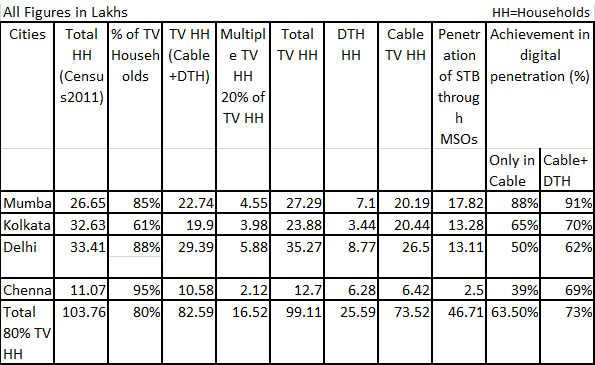
     

    Corrected STB Penetration Table -17 September 2012

    ( Includes DTH HH as part of Multiple TV HH not considered by I&B)

    Note:-
    1. Ministry has not included DTH TV HH in multiple TV HH where as it should have done so, being part of the same universe.
    2. Basis of % of TV HH in the Metros is hypothetical. Mechanism of its working out or its source has not been mentioned.


    The time has come to incentivize MSOs, but instead the licences have been cancelled of two of them.


    We are on September 24, and the price that consumers would have to pay is still not out, so things need to be moving faster.


    Broadcasters need to also ensure that there is availability of digital signals in all four metros.


    2. What is your information: are the lower income groups in these cities buying set-top boxes?

    They have been asking many questions. They want to know how much it will really cost them. Remember, some of them don’t even have colour television sets.


    Unfortunately, there is only one group representing consumers in the various taskforce meetings. Consumers would like to know how much it will really cost them.


    There will be an uproar if people don’t get to watch TV from November 1 because of this lack of information.


    3. There is a worry that there will be some piracy in the form of pilferage of signals after November 1…

    Why should there be any such pilferage? The broadcasters can simply stop the analogue signals. The question is: do they want to stop these? Will they fear loss of advertising if according to them digitization is not complete?


    4. What more would you like the government to do to ensure 100% digitization?

    Well, the government needs to do a variety of things.


    First, through the various advertisements, tell consumers very truthfully and clearly that one needs a set-top box for every TV set. And there’s an entertainment tax to be paid per TV set. So in Delhi, a consumer needs to pay Rs 20 for one set-top box and Rs 60 for three, if he or she has three TV sets.


    Second, consumers need to be made aware, that there is electricity consumption of around 18-20 watts per month which would roughly mean an extra spend of Rs 100. Also, they need to be aware that on these vanilla set-top boxes, they can’t get broadband or video on demand. There is no swap scheme and there is no portability currently.


    Third, consumers must also know where are the service centres for these set-top boxes in case the boxes need to be repaired.


    And broadcasters?

    Broadcasters also need to do more. For instance, in the various serials and reality shows, they must get the stars and anchors to talk about the need to buy set-top boxes!


    5. The last mile which is managed by the local cable operators is the key to the implementation of Digitization. Are all cable operators in the four metros about the implementation of the October 31 deadlline?

    Let me reiterate here that all cable operators want digitization. We will be happy to see consumers getting a choice and they will only pay as they watch.


    In fact had there been good availability of set-top boxes, we could have achieved things much faster. Right now, when a cable operator goes to the MSO for boxes on paying money, you don’t get the entire lot of boxes.


    We will be happy to see total transparency. We would like to also see deals between broadcasters and operators signed not on a lumpsum basis but as per the set-top boxes.



  • Vikatan group to launch weekly mag Timepass

    By Tuhina Anand


    Vikatan Group which publishes nine titles in Tamil is gearing up to launch its tenth title – Timepass. As the name suggests, the magazine will focus on entertainment and will cater to those young at heart. The offering is an aberration from Vikatan’s usual tone and tenor which is seen as a serious player and stays away from relying on any kind of controversy that magazines today rely on.


    The magazine is a weekly and will be available every Saturday starting October 6, 2012. Priced at mere Rs 5, it will have 64 pages plus 4 pages of cover and will be A5 size. Initial plan is to have a print run of 5 lac copies which will include both sample copies as well as sold ones. In 3-4 months’ time the idea is to consolidate this number to 2.5 to 3 lakh sold copies. It will be sold predominantly in Tamil Nadu.


    Explaining the idea behind the new magazine, Pravin Menon, National Head, Ad Sales, Vikatan Media Services, said, “This is entirely people driven product. At Vikatan, we have introduced a concept called Hello Vikatan where people can call and listen to few tips that is addressed in our magazines. Since its launch around 7 months back, the concept has become highly popular and we have 1.5 lac calls per month. Since we already had involved readers based on the info from the calls, we did a sample of six thousand people asking them what they would want from Vikatan. The response that we got was that they would like to read something irreverent and purely entertainer from us.”


    The content of the magazine and even the pricing is all decided by the readers. However, the low pricing raises few questions as print industry is already pressed with low pricing and pressure on margins plus the debate is whether even our daily newspapers should be charged more as the case in many countries.


    Mr Menon said, “At Vikatan we don’t rely only on advertising as source of revenue and we have various innovative ways to generate revenues.” The group’s publications also has a strong digital presence.


    The group plans to go all out to promote the product and will be spending approximately Rs 2.5 crore to market it taking television, print, OOH, mall activation, radio and even cinema theater. The tone of the advertising campaign will be irreverent in keeping with the tone of the magazine.


    Vikatan Group publishes Tamil titles including AnandVikatan, Aval Vikatan, Doctor Vikatan, Junior Vikatan, Chutti Vikatan, Shakti Vikatan, Pasumai Vikatan, Motor Vikatan, Naanayam Vikatan.


  • Cartoon Network to launch Ben 10 magazine on Sept 30

    Image of Ben 10’s UK version, courtesy Newsstand.co.uk

    By A Correspondent


    It’s time for Ben10 fans to rejoice. Cartoon Network and Sterling Publishers are launching the first ever, bi-monthly, Ben 10 magazine in India on September 30, 2012.


    The Ben 10 series are an international phenomenon and have successfully been leveraged into the biggest global licensing and merchandising franchise. Taking it to the next level, Cartoon Network and Sterling Publishers will launch the magazine loaded with 32 pages of endless fun. Kids can indulge in playing games, battling with their friends on alien adventures, solving puzzles, cracking codes, reading action-packed Ben 10 adventures, and collecting facts about Ben’s alien transformations, enemies and their origins. Each magazine comes with a unique pull-out poster.


    Gaurav Brar, Director, Cartoon Network Enterprises, South Asia, Turner International India Pvt. Ltd. said, “Kids across India adore Ben 10 and constantly demand new and innovative branded products. The launch of this unique and interactive Ben 10 magazine will give kids an exciting portal into the adventurous, fantastical, alien world of Ben 10. This is yet another attempt mode by which Cartoon Network Enterprises aims to bridge the gap between kids and their favourite TV characters so that they too can be a part of the toon world they admire!”


    Gaurav K Ghai, Director, Sterling Publishers Pvt. Ltd. commented on the launch of the new Ben 10 magazine: “Sterling is excited to partner with Cartoon Network to launch the first-ever Ben 10 magazine in India. Ben 10 has a strong and special connect with boys 4-10 years. This magazine is packed with fun facts, games, puzzles and everything Ben10. We are sure this magazine will bring hours of reading and activity fun for Ben10 fans.”


    The magazines will be available at all key retail stores like Landmark, Crossword, Time Out, Big Bazaar, WalMart and also at individual book stores across India for Rs. 60.


  • Zee News, Amar Ujala win EC awards for voter awareness

    By A Correspondent


    The Election Commission of India has selected Zee News for the National Media Award on Voter Education for its outstanding campaign towards creating voters’ awareness in the Assembly elections (January-March) 2012, especially in Uttar Pradesh and Uttarakhand. The Hindi daily Amar Ujala has also been selected for a Special Award for its remarkable contribution towards voter education and awareness in the aforementioned elections, says a release from the Press Information Bureau.


    This follows the decision taken by the commission and announced during a media convention in January this year at ECI that the media house with the best campaign on voter education and awareness would be awarded.


    The award will be presented during the 3rd National Voters’ Day on 25th January 2013 at New Delhi.


    The commission has now decided to constitute separate awards for electronic and print media for all the forthcoming elections.


  • IRS 2012 Q2: Magazines perform a tad better than dailies

    By A Correspondent


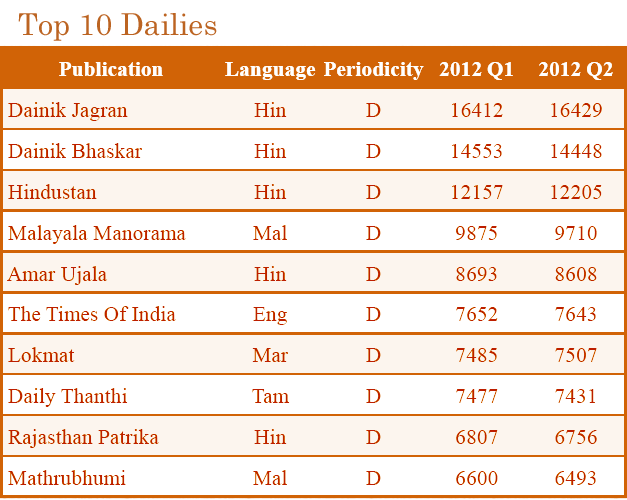
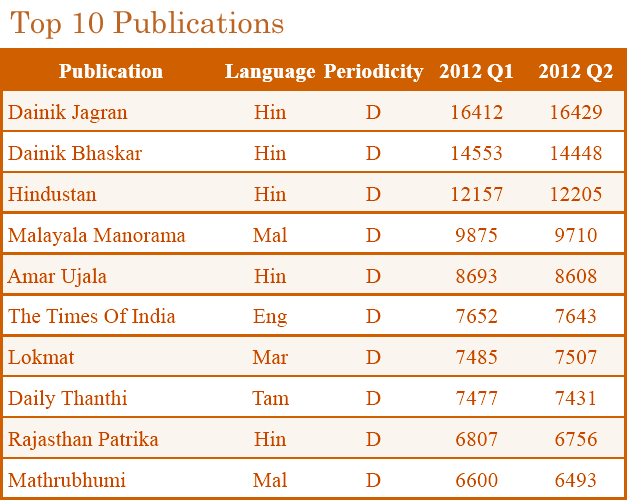
    Dwindling readership numbers for print players now seems to be a given as the just-released IRS 2012 Q2 numbers would suggest. If the Q1 readership numbers was about publications struggling to stay afloat, the trend hasn’t gotten any better for the second quarter with 7 of the top 10 publications reporting a marginal decline. But for Dainik Jagran, Hindustan and Lokmat that have shown a hike in readership, the other seven players that constitute the top 10 including Dainik Bhaskar, Malayala Manorama, Amar Ujala, The Times of India, Daily Thanthi, Rajasthan Patrika and Mathrubhumi have reported a downfall in their IRS numbers.


    In the list of top 10 publications, that also constitutes the top 10 dailies, Hindi daily Dainik Jagran emerges the clear leader yet again with an IRS 2012 Q2 AIR of 16429. This is slightly better than what it had registered in the previous quarter with an AIR of 16412. Emerging runner-up yet again is Dainik Bhaskar that has reported an AIR of 14448 a slight fall over last quarter’s number of 14553. Hindi daily Hindustan is third on the list with an AIR of 12205 compared to last quarter’s 12157. Malayala Manorama is fourth with an AIR of 9710 followed by Amar Ujala with an AIR of 8608. English daily Times of India too failed to elicit a keen interest amongst readers as it reported an AIR of 7643 as against an AIR of 7652 last quarter. Marathi daily Lokmat emerged a winner with an AIR of 7507 as against an AIR of 7485. Tamil daily Daily Thanthi recorded an AIR of 7431 followed by Rajasthan Patrika at the ninth spot with an AIR of 6756. Mathrubhumi concluded the top 10 list by recording a downward AIR of 6493.


    (AIR numbers; All figures in '000)


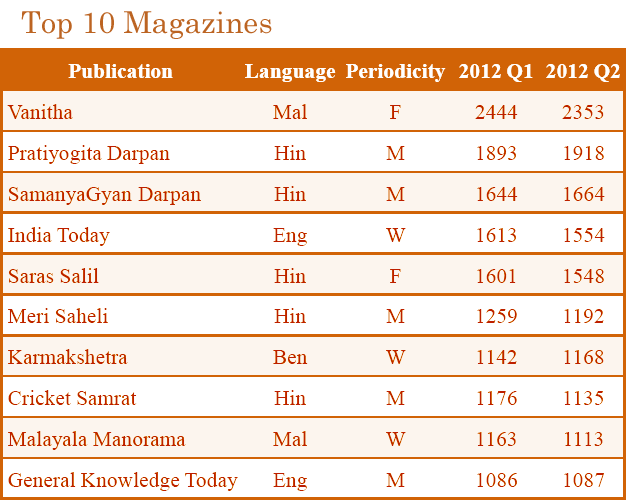
    (AIR numbers; All figures in '000)


    (AIR numbers; All figures in '000)


    The magazines seem to be better placed compared to their newspaper counterparts with 4 out of ten magazines showing an upward growth. These include Pratiyogita Darpan, SamanyaGyan Darpan, Karmakshetra and General Knowledge Today. With an AIR of 2353 Malayalam magazine Vanitha leads the pack ahead of second-placed Pratiyogita Darpan that has recorded an AIR of 1918. At the third spot is SamanyaGyan Darpan with an AIR of 1664 followed by India Today with an AIR of 1554. Hindi mag Saras Salil is next with an AIR of 1548 followed by Meri Saheli with an AIR of 1192. Bengali mag Karmakshetra is next with an upward AIR of 1168. Cricket Samrat at 1135, Malayala Manorama at 1113 and General Knowledge Today with an AIR of 1087 wrap up the top-10 list for magazines.


    Where the language dailies are concerned, the trend is somewhat similar to that of the top 10 dailies with 7 out of 10 dailies reporting a decline. Malayala Manorama is at the top spot with an AIR of 9710 followed by Marathi daily Lokmat at 7507. Daily Thanthi is next with an AIR of 7431 followed by Mathrubhumi with an AIR of 6493. Telegu daily Eenadu is next with an AIR of 5925 followed by Ananda Bazar Patrika with an AIR of 5859. Another Telegu daily Sakshi occupies the seventh spot with an AIR of 5306 followed by Gujarat Samachar at the eighth spot with an AIR of 5205. Tamil daily Dinakaran is ninth with an AIR of 4999 followed by Daily Sakal at tenth with an AIR of 4437.


  • IRS arbitration clause is binding: Court

    By A Correspondent


    The Calcutta High Court has held that the arbitration clause embedded in software of the Indian Readership Survey, which is part of the terms and conditions a user must accept before accessing data, is binding. Disposing of a petition filed by ABP Private Limited and vacating an injunction earlier granted by the Court, Justice Nadira Patherya referred the dispute relating to IRS 2008 to arbitration, in a judgment delivered on September 25.


    Responding to ABP’s petition challenging IRS findings, MRUC had contended that the dispute had to be referred to arbitration, as this clause was a part of the terms accepted by users. This was contested by ABP.


    The court held, “The issue sought to be raised by the plaintiff in C.S. No.242 of 2008 is covered by the arbitration agreement as the same has been couched in the widest terms and encompasses the issue raised, and the same be referred to arbitration”.


    A statement from MRUC said that it is a body constituted of media research users by media research users for media research users. It succeeds only when it advances the interests of its diverse stakeholders in the communications industries. MRUC recognizes that there will be situations in which users may disagree with some aspect of the conduct of various researches that it conducts. It is precisely to handle such disputes in a spirit of collaborative resolution that MRUC places so much emphasis on arbitration, the statement added.


  • Print degrows, but will regrow, say media agency captains


    By A Correspondent


    The second quarter results of 2012 for the Indian Readership Survey (IRS) were published on Monday, October 1, and going by the topline numbers, the overall print readership has seen a slight decline. When compared to IRS 2012 Q2, both newspapers and magazines readership figures looked quite grim. While seven out of the top ten dailies witnessed a decline in readership, on the magazine front, six out of the top ten magazines were also seen on the decline. (Editor’s Note: Unlike a year ago, the Media Research Users Council (MRUC) does not share detailed readership figures with the news media for publication. We would urge readers and students of media to approach the MRUC (www.mruc.net) for this information. Our apologies for being unable to analyse the numbers for you).


    As far as the Top Ten publications are concerned, the rankings have more or less been the same in Q2 2012 v/s Q1 2012. Interestingly, Hindi publications continue to dominate the top ten rankings (in the Top 10 publications), with 5 out of 10 publications in the top ten rank belonging to the Hindi publications. The other five are from regional or Indian language publications, with Malayalam dailies continuing to be the second most read language daily in the top ten publications. However, The Times of India which is the sixth most read daily, continues to be the sole English language daily in the Top Ten category.


    Another interesting finding from the topline numbers is that the Top Ten language dailies are dominated by the South Indian language newspapers. 6 out of the Top 10 Language Dailies belong to South India. The others include Marathi dailies – Lokmat (the second largest language daily, in terms of readership) and Daily Sakal which is ranked #10. Bengali daily Ananda Bazar Patrika is ranked sixth and ranked eight is Gujarati daily Gujarat Samachar.


    The Top 10 magazines too are dominated by Hindi language, with five out of the ten magazines belonging to the Hindi language. However the only other regional or Indian language magazines that have made it to the top ten ranking are namely Malayalam – Vanitha, the most read language magazine and Malayala Manorama magazine, which is ranked nine, while the other language magazine that in the top ten is Karmakshetra, a Bengali magazine.


    So, do these trends indicate any sign for things to come? Does the industry need to worry about the declining trend in print readership? After looking at the numbers, MxMIndia spoke to some senior media agency professionals for their views on the IRS Q2 2012 Topline numbers.


    According to Suresh Balakrishna, CEO, Brand Programming Network (who was COO, Mail Today until last year), the print media has nothing to worry about as it is seen not as a decline but a minor blip, and in the long run the readership numbers will further grow.


    Janardhan Pandey, Associate Vice-President, DDB Mudra Max opined, “The decline in readership of top dailies is not significant and doesn’t reflect any trend in the long run. In fact, going forward I see further growth in print readership, particularly in the language publications. There is much more potential for growth in the readership of language publications with literacy rate increasing and the circulation growing, as the publishers are becoming more aggressive in their marketing, aligning the content to the readers demand/interest and expanding their territories. So the overall growth in print readership will continue with the regional press driving it.”


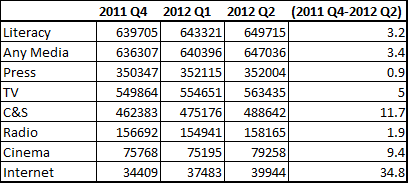
    Growth: Literacy & Media Consumption
    % CAGR


    While media agencies are very optimistic about the readership growth, they do not see the latest IRS figures as a decline but a minor hitch. Although the print readership may have shown slight decline, when compared to 2011 Q4, the overall print media consumption in Q2 2012 has seen a marginal increase of 0.9 per cent CAGR (Compound Annual Growth Rate). Not only has the overall print media consumption increased but the overall media consumption too has shown an increase of 3.4 per cent CAGR. The internet however continues to be the fastest growing medium today with a whopping 34.8 per cent CAGR.


  • Guinness recognises Divya Bhaskar’s ‘Gandhi Jayanti’ record

    By A Correspondent


    Divya Bhaskar initiated ‘Ahimsa Dandi Yatra’ campaign in association with Spiritual Guru – Muni Tarun Sagar. The initiative was aimed at strengthening the support against ‘Animal Cruelty’ and ‘Human Tobacco Addiction’. This initiative was promoted through editorial, print campaign and school contacts. School kids were asked to register for participation, and all registered kids were provided Gandhi attire by Divya Bhaskar.



     

    On the occasion of Gandhi Jayanti, schools kids gathered at Abhay Ghat (Sabarmati Ashram) dressed as Gandhiji. The venue saw a total footfall of 7,000 citizens including dressed kids ready to participate in the yatra.


    On this initiative, State CEO Saras Sethi commented, “Gandhiji believed in Ahimsa and taking this thought forward an innovative concept was designed. The idea behind this initiative was to not only support the cause but engage our readers to support as well. Kids play a catalyst in any society and engaging them will get the entire family involved and also creates an impact.”


    State Editor Avnish Jain also commented, “The idea behind this initiative was to encourage the citizens to adopt Gandhiji’s philosophy of ahimsa and simplicity which is reflected not only in his dressing but also in his values.”


    The Guinness recognition was received for 891 kids dressed as Gandhiji. The event culminated with the Dandi Yatra along with Spirtual Guru Muni Tarun Sagar. Apart from kids few foreigners, MLA fromBelgaum, Management Guru Ujjwal Patani (Chattisgarh) also dressed like Gandhiji and participated in the march.


    The group’s other initiative ‘Junior Editor 2012’ has also been recognized by Guinness World Record as ‘The Largest Writing Competition’.


  • Jaldi 5 with Suresh Nimbalkar: Print is not declining

    The findings of Quarter 2 of the Indian Readership Survey for the year 2012 published by the Media Research Users Council saw alarm bells ringing as there was a decline seen in print readership. Although we haven’t yet seen doomsayers out on the streets, the numbers did worry print evangelists. We asked Suresh Nimbalkar, Senior Vice President, Hansa Research (which conducted the IRS research) to comment on what lies beneath the numbers:


    01 What do you infer from the continuing decline in readership (IRS) numbers that the print players have been witnessing quarter-over-quarter?

    Let’s split this question into a) Changes in print reach and b) Changes in leading publications.


    a) The print reach has been continuously going up in absolute terms. If you look at the past 3 quarters, the numbers are 350347, 352115 & 352004. Thus, there is no statistical decline in reach.


    b) If you look at the top 10 publications, 3 publications have shown a growth in numbers. What the charts may not tell you is that some of the publications which seem to have shown decline in 2012 Q2 v/s Q1 have shown good growth in past two years. There are publishers who have launched new publications and have ensured overall growth.


    Hence the print market is not declining. We always advise people not to look at quarter-on-quarter changes but look at the long-term trend to arrive at a conclusion.


    02 Ideally, few publications should gain in readership numbers at the expense of other publications where loyalty is lost on account of readers migrating to newer titles. But that is not the case here as most titles have shown a decline. What could be the possible factors for the equilibrium not being maintained?

    You have possibly looked at the top 10 publications for this inference. If you look at a wider number of publications, this may not be true. The print market is undergoing change owing to other factors such as spread of C&S, good growth in internet penetration, resulting increase in number of media used (for information, entertainment & news), paucity of time for an average individual, decreasing title loyalty etc.


    03 Regional publications have somewhat bucked the decline trend to some extent compared to the Hindi and English players. Your comments?

    There has been a significant increase in the level of marketing, new launches, geographical expansion, investment on product and reader connect among language publications for the past 3-4 years. This is evident in their market presence as well as their reach.


    4 Within the space of regional dailies, publications from the south (like Daily Thanthi, Eenadu, Malayala Manorama etc) have shown good composure over publications from rest of India like Lokmat, Gujarat Samachar etc. Will they continue to emerge a potent force going forward too?

    Owing to relatively higher literacy levels and presence of one or two dominant players in the each of the southern states, you find quite a few southern dailies in the top 10 list.


    Also, it is difficult to predict the future. However, if you look at the level of competition, it has gone up in at least 3 southern markets of AP, Karnataka and TN. This suggests that there could be changes in market shares.


    05 Do you see advertisers taking a relook at their association with the medium given the  slide in readership?

    As I said, there is an increase in the overall reach of print medium. The budget allocation by the advertiser depends on the relative attractiveness of each medium.


  • Chitralekha presents 3rd edition of Watch World Awards

    By A Correspondent


    The Watch World Awards, 2012 hosted by the Chitralekha Group is all set to return on the 12th of October 2012 in Gurgaon. The third edition of the award will also seek attendance from eclectic brands such as Cartier, Harry Winston, Zenith, Hublot, Bulgari, TAG Heuer, Dior, Greubel & Forsey, Breitling, Corum, Parmigiani, Romain Jerome, Seiko, Citizen, Titan, Timex, HYT, Rotary, and many others.


    The event which will see well-known watch brands vying for the coveted commendation of ‘Watch of the Year’ will see intense competition across eleven categories in the Product Awards section and five categories in the Marketing & Merchandising Awards category. The jury list of the evening includes Master watchmaker with five decades of experience in watchmaking – Antoine Simonin; Leading image consultant Chhaya Momaya; Noted designer Priyadarshini Rao; Cricket Commentator Ravi Shastri along with established marketing consultants from Market Gate – Shripad Nadkarni and Sharda Agarwal.


    Mitrajit Bhattacharya, Publisher and President, Chitralekha Group said, “The third edition of the Watch World Awards is a testament of the success of the property wherein the increasing participation of international watch brands is an indication of the trust reposed by the international horology eco-system into the property. This success of the Watch World Awards has been only possible due of the whole hearted involvement of iconic watch brands along with a de-jure participation of an eclectic jury list comprising of the best from the world of horology, fashion, sports & design.”


    This edition of Awards will see the same format and award categories being followed as the past two years, “though it will be high on style quotient,” added Mr Bhattacharya.


  • Bhupesh Bhandari’s book ‘Spectrum Grab’ released

    By Ananya Saha


    Bhupesh Bhandri

    Interested in reading all about the 2G scam and didn’t know where to look? The three-book-old Bhupesh Bhandari, senior associate editor of Business Standard, has been tracking the 2G controversy from its early days, helping him put the pieces together as a 272-page book. Mr Bhandari’s Spectrum Grab hit the shelves recently, and boasts of being a comprehensive and objective account of the scandal that has rocked the Indian government and shocked its people. The blurb on the book says, “The book is the first objective account of the scam that has become a national shame.”


    The author told MxMIndia, “Spectrum Grab is what happened behind the scenes, the inside story. Readers know that spectrum was sold cheap to a bunch of companies, a controversy broke out when the CAG said that the government had suffered a loss in the process, some people were arrested, and finally those licences were cancelled. The book explains, in great detail, what transpired at each step.” The book is purely based on reports of various agencies and documents.


    Mr Bhandari has also written The Ranbaxy Story (Penguin, 2005) and co-authored The Satyam Saga (Business Standard Books, 2009). On his romance with non-fiction, Mr Bhandari said, “Ranbaxy, when I wrote the book, was a multinational in the making. Not too many Indian companies had a global footprint like Ranbaxy. The book tried to catch this transformation. Satyam, like the 2G scam, was a story waiting to be told. People knew something had gone wrong but didn’t know what was that something. The Satyam book attempted to tell how the scandal happened and how was the situation corrected.”


    His forthcoming book is a biography of Lala Shri Ram of DCM. ‘Spectrum Grab’ is priced at Rs 350.


  • BBC Good Food India launches kitchen-studio

    By A Correspondent


    A good kitchen is integral to culinary creativity and quality assurance, and that is the motivation behind the launch of the brand new BBC Good Food India kitchen. Like the magazine, the Good Food test kitchen is the first of its kind in India and firmly establishes the brand as the pioneering authority in food in India.


    BBC Good Food India has at its core the triple testing of every one of the 80 plus recipes featured in the magazine each month. This makes the kitchen crucially important to the magazine. It has been designed to fulfil the brand’s central philosophy of fool-proofing every recipe so our readers get it right the very first time they try it in their kitchen. The kitchen will also serve as a laboratory for the creation and development of new recipes by the Good Food cookery team, thereby underlining our commitment to culinary innovation and growth.


    Located centrally in Mumbai’s Prabhadevi, the 1,800 sq ft property houses a fully equipped kitchen as well as a photography studio. The mod cons in the fully fitted state-of-the-art kitchen include stovetops, wok burners, griddles and ovens and fryers, besides essentials such as a refrigerator, a cooler and a dishwasher. The kitchen is designed in a modular style, with an ergonomic central kitchen island.


    Commenting on the launch, Tarun Rai, CEO Worldwide Media, said, “BBC Good Food is India’s first and only international food magazine. And we are very happy that, in another first for the magazine industry, we now have our own kitchen and studio to test each recipe and create new, original ones. The food scene in India is changing rapidly and people are experimenting with cuisines both in their kitchens as well when eating out.”