Category: PRINT MEDIA

  • INMA 2012: ‘Print must engage audiences effectively’

    By Shruti Pushkarna


    Day 1 of the sixth annual South Asia INMA conference opened with a host of promising sessions which addressed key issues facing the industry.


    Ashish Pherwani
    [youtube width=”400″ height=”225″]http://www.youtube.com/watch?v=WfREkdmTRuc[/youtube]

    The session ‘Winning the Ad Growth Challenge: Is it a Plausible Model’ was moderated by Ashish Pherwani, Partner- Advisory Services, Ernst & Young India and the other panelists included Bharat Bambawale, Director, Global Brand Bharti Airtel Ltd; Mayank Pareek, COO (Marketing & Sales), Maruti Suzuki India Ltd; and Shashi Sinha, CEO, LodestarMedia.


    The moderator, Mr Pherwani opened the discussion on the ad growth challenge by listing out four factors that he felt were impacting ad growth: inherent competition, technology change, slow economic growth and growth of television. Citing a recent research, Mr Pherwani said that there were clear indications that consumers are spending more time on digital media at the expense of traditional media.


    He also listed out some questions for the print industry to address, the broad one being, how to stay relevant and grow revenues. Among the other questions he raised were: New ways advertisers can use print, how to enhance effectiveness of print for advertisers, what makes advertisers continue on print when times are tough and finally how can print companies explore new media.


    Mayank Pareek
    [youtube width=”400″ height=”225″]http://www.youtube.com/watch?v=PYJJnTGb12U[/youtube]

    Mr Pareek said that the demography is changing because the way people seek news is changing. He said that Maruti had redefined their strategy to invest in print, looking at the changing trends in consumption: “We’ve gone from 67 per cent to 23 per cent in our spends on advertising in print in the last five years.” He said that it is important that companies continuously adopt to the changing demographic needs. He added that even though digital spends are low today, digital is growing and changing rapidly. So for print to remain relevant, there is need to develop engaging content as the other media are offering. However, Mr Pareek agreed that print will continue to play a role in the future as well.


    While the other panelists agreed with Mr Pareek that print will continue to be the part of a media plan for an agency or an advertiser, they also shared his concern on the need for print to adapt to changing consumption patterns.


    Mr Bambawale of Airtel said: “We are using much less print. There is one strong global trend which holds true forIndiaas well, young eyeballs are moving away from the printed word to the video. So for print medium to engage this audience is a great challenge. The conversation should change from ‘how can we put an ad out there’ to ‘how can we engage’. In a newspaper, content is all about facts and events but in engagement, content is about making things interesting. The answer lies in creating content that has high degree of engagement even around topics of news or current issues.”


    Mr Sinha said that the strength of print lies in the fact that it brings a lot of credibility: “Print still stands for credibility, I am not so sure if digital has that. We’ve embraced digital because of the youth. For certain brands which go through an erosion of trust, print is the best place to be in.”


    He added that not growing fast enough is the problem of measurement: “The current measurement metrics are limited to cost and reach. There is no way to measure engagement or performance. Unless we start showing these to the advertiser, things won’t change. There is a need to introduce new metrics of measurement.”


    Mr Bambawale echoed Mr Sinha’s view on measurement being limited to cost and reach as far as newspapers are concerned: “If you change the matrices by which you present the title to an advertiser, it’d be a more fruitful conversation perhaps.”


    The discussion concluded with two key takeaways, Print needs to find new ways of engaging its audience to stay relevant in a changing era. And second, there is a need perhaps to look at other matrices of measurement for print, a way of measuring effectiveness of an innovation.


     

  • INMA to address ‘Complexity Advantage’ at Sixth Annual Conference

    By A Correspondent


    The International Newsmedia Marketing Association (INMA) is set to host its sixth Annual South Asia Conference on August 7-8 in New Delhi under the theme ‘Complexity Advantage’. In today’s scenario of accelerated change and complexity, strategic competitive advantage is created by the combination of strategy, culture, systems, brands, products, services and by the people that operate throughout the organization.


    The INMA South Asia Conference aims to address some of these tectonic shifts that are creating the complexities in our business, so as to stimulate the industry towards evolving a roadmap to convert the various existential challenges into opportunities. As such, the theme of this conference is aptly titled ‘Complexity Advantage’.


    Sanjay Gupta

    Mr Sanjay Gupta, who was elected as the President INMA South Asia 2011, and is the Director, CEO and Editor of Jagran Prakashan Ltd said: “This year’s theme would discuss driving readership and circulation. My expectation from the conference is that the industry people from South Asian countries can get their act together when it comes to talking about how to tackle various issues, including digital revenue models.”


    Mr Bharat Kapadia, INMA Board Director, and Chairman of Whatuwant Solutions, said, “Even though India is better off when it comes to print market, the last quarter can only be described as tough. The two-day seminar will get the industry to come together and talk about the challenges and work towards a better future.” He added that the complexities of businesses in driving revenues and circulation will be the focus of the conference.


    Bharat Kapadia

    INMA aims to bring together top newspapers from South Asia into a two-day, fast-paced tour de force of ideas and innovations to grow newspaper advertising, circulation and brand across titles and across consumer platforms. Over 35 speakers, several partners, press and over 180 delegates from 25 newspapers and another 20 companies across India, Pakistan, Bangladesh and Europe will be attending this conference.


    INMA is the only industry association that is able to pull together South Asia’s top publishers and specifically executives charged with growing advertising, circulation and brand. There will be excellent opportunities to network and share the “INMA conversation” among this exclusive fraternity of the world’s most innovative newspaper executives. INMA is the world’s leading provider of global best practices and marketing ideas. It provides its members thought leadership and practical ideas to grow audience, advertising, brand and profit. Currently, INMA has over 5,000 members in over 82 countries worldwide, which include several members from Indian and now Bangladesh and Pakistan newspapers.


  • New name, look for HT’s Brunch Quarterly

    By A Correspondent


    HT Media Limited (HTML) has unveiled the new avatar of its magazine Brunch Quarterly.  Having completed a year, Brunch Quarterly has been renamed Brunch Q. The magazine will take on a new and improved format with each issue created around a special theme. Brunch Q seeks to help readers in their ‘Quest for the Good Life!’


    Poonam Saxena, Editor, Brunch Q, commented on the revamp, “With the Brunch Quarterly completing one successful year of publication the time was right to give our growing reader base something more punchy and exciting.  The revamped magazine hits the stands with an eclectic collection of stories and features – the equivalent of an unputdownable book.  There’s Aamir (Khan) and Sunny Leone like never before, plus a special Wellness section and a guide to portable gadgets. We are planning to continue this new format in the following issues with a wide variety of interesting and engaging content making each issue of Brunch Q a collector’s special.”


    The 140-pager Brunch Q will retail at newsstands for Rs 100. The first issue under this new format, August-October 2012, has a special segment on wellness covering spas, tips from celebrity dietitians and trainers, a story on organic and healthier alternatives to everyday food items plus a feature on Yoga.


    The revamped magazine comes in a larger format (22.5wX29.5h) and the paper and production quality has also been kept on par with the best international magazines.


    Rajan Bhalla, Head – Corporate Marketing and Magazines, HT Media said, “We decided to give Brunch Quartely a makeover for the benefit of our readers. With over 31.53* Lakh readers who enjoy HT Brunch every Sunday, the demand for Brunch Q is high among the targeted SEC A & A+ segments and it is most popular among the 25 -45-year age bracket. We wanted to give our readers, who are progressive, smart and well read, a sharper, wittier and more exciting experience. We have improved the design and added new content complemented with international print quality. We are certain that Brunch Q will be embraced by our readers.”


    Approximately 1.25 lakh copies of Brunch Q will be circulated on newsstands each quarter, across the country. The magazine will be heavily promoted in HT Media Group properties such as Hindustan Times, Fever 104 FM and Mint. The Brunch Weekly, circulated with Hindustan Times on the weekend, however, will remain same.


  • Digital Literacy conclave by HT and Intel

    By A Correspondent


    With one of the key issues for India being how to integrate its citizens into an increasingly digital economy, Hindustan Times brought together a panel of experts from the government, private sector and non-profits at Digital Literacy conclave to discuss the topic ‘Digital Literacy – Keeping India Ahead in the Information Age’.


    Moderating the discussion at the conclave, Gautam Chikermane, Executive Editor (Business), Hindustan Times said, “Digital literacy is an essential but unexplored component of economic development and citizen empowerment in the 21st century. With this conclave, we hope to build the foundations upon which this idea can be built.”


    Shantanu Bhanja, Vice President Marketing, HT Media Ltd, on the objective of the conclave said, “The need of the hour is to make our country and its people abreast with the digitization that the world is undergoing today. As a newspaper working in the field of education and literary, this conclave is a great platform to bring all influencers and players in the ICT ecosystem together to drive the urgency of making India Digitally Literate and to overcome the digital divide.”


    Speaking at the conclave, Debjani Ghosh, Managing Director, Sales & Marketing Group, Intel South Asia said, “One of the biggest concerns facing us today is the lack of user awareness about what technology can do to help their lives. If used effectively, technology can play a huge role in driving personal growth, be it in developing job skills or providing easy access to quality education, healthcare and critical government services. Unfortunately a lot of Indian consumers are still not aware of how they can benefit from technology. Not only does this limit growth, but will significantly increase the problem of haves and have-nots in India. Digital literacy is essential along with technology access, broadband and local content for improving national competitiveness. We are happy that the entire ecosystem is coming together to put in place a Digital Literacy mission. The sustained focus by all of us on digital literacy awareness, education and training will help India take a lead in the global digital economy and help us maintain our competitiveness and also shape a technologically empowered society.”


    Panelists on the forum included Sachin Pilot, Minister of State Communications & Information Technology, Govt. of India, Debjani Ghosh, Managing Director, Sales & Marketing Group, Intel South Asia, Sanjay Kapoor, CEO, Airtel India & South Asia, Osama Manzar, Founder & Director, Digital Empowerment Foundation and Rajendra S Pawar, Chairman & Co-Founder, NIIT Group.


  • Suresh Balakrishna now also CEO of Lintas Outdoor

    Suresh Balakrishnan

    IPG Mediabrands has announced the appointment of Suresh Balakrishna as CEO of Lintas Initiative Outdoor. The leadership responsibilities of all the OOH businesses of IPG Mediabrands will now report to Suresh Balakrishna, with immediate effect, according to the official communique.


    Mr Balakrishna, a media veteran with over 25 years of publishing, brand building and media agency experience, had rejoined Lintas Media Group in January this year to roll out and lead BPN, the third agency network of IPG Mediabrands.


    He will be handling this assignment in addition to his current responsibilities as CEO of BPN India.


    Hemanth Shah, Managing Director of the company resigned a month ago and will be with the organisation till the end of August. His next destination is not known. He joined the company two years ago from Times OOH.


    Some of the leading OOH businesses in IPG Mediabrands include Nokia, Hindustan Unilever, Union Bank ofIndia, Coca Cola, Tata Consultancy Services, Expedia, Citibank, Monte Carlo etc.


    For the record, Lintas Initiative Outdoor has 22 offices around India.


  • Bhaskar celebrates 2nd anniv in Jharkhand

    By A Correspondent


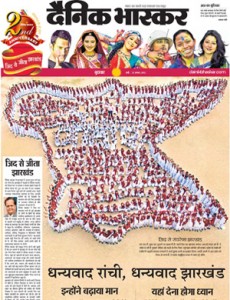
    Dainik Bhaskar celebrated two years in Jharkhand, which it had entered with the launch of the Ranchi edition in August 2010, followed by the Jamshedpur and Dhanbad editions in December 2010 and April 2011 respectively.
     

    Dainik Bhaskar offers its readers a tailor-made newspaper as per their needs and expectations. It is a voice of the area with a deep sense of reader connect and quality, unbiased news reporting – and that has lead to its tremendous success across editions.


    As part of the celebration, a special 16-page issue was released along with the main newspaper. Dainik Bhaskar in Jharkhand has been a voice raising citizens’ concerns on infrastructural development and progress. Last year on the first anniversary the special issue had spoken about the thought of “Badlav Miljulkar”- collective change. This year the special issue highlighted the socio-economic changes witnessed by the state in the last few years, taking it that much closer to achieving dream state status.


  • Bengal (paper) tigers set to roar


    By Ananya Saha


    Once the domain of Ananda Bazaar Patrika,West Bengal is now readying itself for an emerging newspaper war. The Times of India has trumpeted its entry into the traditional market with the announcement of its Bengali broadsheet Eyi Shomoy, and is putting its marketing muscle behind the promotion of the product. The Bengali broadsheet from BCCL will have to fight for numbers with Bartaman, Pratidin, Ganashakti and of course Ananda Bazaar Patrika.


    This is also for the first time that ABP’s dominance is facing a huge challenge. Whether as a gameplan or a coincidence, ABP has announced its evening tabloid Eyi Bela at the same time. The industry veterans are calling it mother of print battles: BCCL’s strong marketing and distribution against ABP’s loyalists. ABP currently dominates the print market with many of its publications aimed at each segment: Ananda Bazaar Patrika (Bengali daily), The Telegraph (English daily), Desh (Bengali magazine), Anandamela (Bengali children’s magazine), Anandalok (Bengali cinema magazine), Sananda (Bengali women’s magazine) and Sportsworld (English sports magazine).


    While some may argue that ABP is entrenched in this polarised Bengali market, others say that TOI will be able to make a definite dent in the market. Call it retaliation or just a good act, but ABP is said to be lowering rates, and increasing the pages of the newspaper. This is something that the Bengali newspaper has not ever done to counter any of the other newspapers’ entry. Meanwhile, it remains to be seen if TOI’s youthfulness will reflect on its Bengali broadsheet as it takes ABP on home turf.


    So far, the Bengali print market has been without any incident, and nobody has been able to impact it. A media veteran said that TOI will not have it easy. Why? “The Kolkata market is biased and opinionated. With its regional paper, TOI will not be able to address the local Bengali readers… It may do well in a Delhi or Mumbai where people do not have the time to read opinions.”


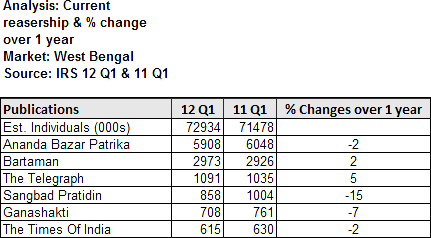
    ABP, moreover, has emerged as a clear (and consistent) leader in the market. It is true that when the English daily Times of India entered, ABP’s Telegraph did feel the jolt. Currently, in the market of 15-16 lakh readers, APB’s readership is close to 12-13 lakh, according to an analyst who has been observing the market keenly. But media specialists are sure that the TOI Bengali edition will pick up well when it launches, and managing two lakh copies initially will not be difficult for Eyi Shomoy. However, a media veteran noted that even with its marketing muscle, TOI’s Eyi Shomoy may find it tough to get the numbers until it  addresses the Bengali janata the way ABP’s Bengali daily does or is capable of.


    Currently, 70-80 percent of newspaper revenues are lapped up by ABP of the Rs 250 crore (rupee/advertisement) Bengali print market. The share of revenue by ABP is much more than readership, noted the media analyst. The idea of ABP’s launch of Bengali tabloid Eyi Bela is probably to target the lower-end advertisers in various districts and smaller cities. This may well become the golden opportunity of revenue for the paper, since it could attract a bulk of advertisers who are not able to advertise in high-priced media vehicles.


    Also, Eyi Bela is aiming to attract the growing youth population of the city. Industry analysts are divided given that the commuting culture in the city is different from Mumbai’s. “The evening segment dynamism is missing in this market,” noted an analyst.


    However, Sundeep Nagpal, Director, Stratagem Media, differs. He said, “I am actually surprised that no one launched an evening tabloid earlier in this market. Wherever there is a commuting culture, the tabloid can succeed. However, in this case, it is going to be the case of high distribution since an eveninger’s content cannot guarantee readership.”


    Even as the politically aligned market is going to see new entrant, the dynamics within the market is also undergoing a change: the rise of double-income couples, the need of smaller retailers to reach out to the aspirational class, evolving youth and rising city phenomenon. The evening tabloid may cater well to this segment.


    Media veteran Sajal Mukherjee shared his observation, “The West Bengal market is one of the oldest traditional markets inIndia. One might argue that the Bengali community is loyal to ABP but it is also true that readers want value for money. And loyalties shift depending on the value they get. In the Karnataka market, Prajavani had a stronghold where Vijay Karnataka challenged it and succeeded. Similarly, Divya Bhaskar was able to make a clear dent in the Gujarat market, which was led by Gujarat Samachar and Sandesh.”


    “If there is good marketing support in the new market, combined with good benefits to the readers, the loyalty will obviously be dislodged. TOI has had enough experience in the local markets, and it will be a good war to watch in Bengal,” Mr Mukherjee noted.

     

    What may also act in favour of TOI is that they will be able to offer a 360-degree national bouquet on good rate to advertisers. Mr Mukherjee opined that Eyi Shomoy has huge scope to gain the second spot in the market. TOI is already making itself familiar to the local audience by sponsoring ground events. This might work in the favour of the new broadsheet since people will be ready to subscribe to it. TOI is clearly aiming at growth for the future, and is not looking at short-term benefits. The industry veterans note that after Eyi Shomoy hits the 3-4-lakh mark, it might get troublesome for ABP.


    But ABP will not let go of its domain so easily. Will it result in a new strategy? Can Eyi Bela actually make a new market in Bengal? And will Eyi Shomoy’s challenge to ABP be tackled more forcefully? Advertisers and analysts might differ, but it is readers who are bound to get the sweetest deal.


  • Sujoy Ghosh quits BCCL as Joy Chakraborthy returns

    Joy Chakraborthy

    By A Correspondent [updated from Friday]


    It’s now official. Bennett, Coleman and Co Ltd’s long-serving Director-Response Sujoy Ghosh has decided to move on as Joy Chakraborthy is set to take the position. Mr Chakraborthy will report to Arunabh Das Sharma, President, BCCL. A mail is said to have been circulated to senior employees on Friday evening.


    Mr Ghosh was not reachable for comment, but is rumoured to be keen on pursuing entrepreneurial interests. Mr Chakraborthy is scheduled to join today (Monday, September 3). This will be his second stint with BCCL.


    Meanwhile, there have been rumours that Dr Bhaskar Das, President and Principal Secretary to the MD at BCCL was also not planning to pursue his service extension following his retirement. Dr Das has denied this to MxMIndia.


  • i next launches Indore edition

    By A Correspondent


    Adding yet another city to its kitty, i next is launching its 14th edition (13th being inextlive.com) in the ‘sweet’ city of Indore on 2nd September. This edition allows the leading compact daily from Jagran group, which already has big presence in four states (UP, Uttarakhand, Bihar and Jharkhand), to spread its wings across Madhya Pradesh, a key Hindi speaking territory. To the readers, i next Indore edition would reach in combo with Nai Duniya, which is already an established name in newspaper industry in MP.


    Set to complement Nai Duniya, i next as a relatively new and youthful daily offers a right balance to the mix; the former being a part of Indore’s famous journalistic traditions and its socio-cultural journey for more than six decades now.  The development is likely to slake the rich and diversified tastes of Indorians.


    Commenting on the launch, Shri Mahendra Mohan Gupta, CMD Jagran group held, “In the past six years, i next has moved from strength to strength. Its presence will also consolidate the already strong position of Nai Dunia.”


    Recently in news for winning World Young Reader ‘Newspaper of the Year, 2012’ award at WAN-IFRA summit, i next eyes for market expansion through an aggressive integrated campaign completing the loop between the readers, advertisers and the agencies. The development is set to alter the industry equations. Revealing the strategy behind the move, Salil Tandon, VP marketing, Nai Duniya said, “Indore is an education hub and a well read city. There is a huge variety in tastes and preferences of the readers here. We would try to leverage on this by giving our readers the combined advantage of a regular newspaper and an exciting compact daily.”


    He further emphasized the relevance of a tabloid like i next in the young city like Indore. “There are a lot of well off and progressive youngsters out here which have always been a core Target Group for i next. With its unique style of presentation and storytelling, I am sure, i next would be able to win their hearts.”


    Shailesh Gupta, Director, Marketing, JPL provided a perspective, “Indore is a very active market. A vibrant mix of traditional and modern attributes; be it entertainment, fashion, food, education or real estate. The infrastructure development has triggered a spate of growth in almost every industry here. From marketing point of view, Indore presents a huge retail market to benefit from.”


    The launch is being actively promoted through the campaign ‘Indore is my next’, supported by outdoor, radio, digital promotions, print Ads, banners and road shows. The targeted communication is being undertaken to introduce i next to the young audience of Indore.


  • Divya Marathi now a case study at IIM Bangalore

    By A Correspondent


    The fast paced growth and unique new market launch strategy of Dainik Bhaskar Group, an Orbit-shifting innovative process featured as a case in IIM Ahmedabad, and the successful launch of Divya Marathi, the group’s Marathi newspaper, this time has attracted IIM Bangalore to study and create a classroom case on group’s success through the years.


    Seema Gupta

    Prof. Seema Gupta of IIM Bangalore did a detailed analysis of Dainik Bhaskar group processes in her attempt to understand what makes this group succeed. She met with the senior management across verticals; Editorial, Production, circulation and marketing to deep dive into their independent and cross-functional working. Result; ‘Dainik Bhaskar group: Aspiring Growth’ a case study by IIM Bangalore.


    The case delves into the history of the group, the aggressive launch strategy, accelerated business growth and robust marketing plan. It strongly points out that launching of a newspaper and venturing into a monopolistic market space is definitely a decision that is governed by the faith in the brand. Considering the nature of the category, where reading habits are relatively strong and the market leaders create high entry barriers including the competition-intensive cut-throat ground zero strategies, it makes for an interesting study in management strategies, processes and execution. Success in such situations cannot just be attributed to the business acumen, understanding of market dynamics and identification of the need-gap within the market. There are other elements like agility, empowerment, passion and high ambition across the employee set that is a real differentiator and helps convert strategies into reality.


    Elaborating on selecting Dainik Bhaskar Group for the case, Prof. Seema Gupta said, ‘Dainik Bhaskar with its ambitious growth plans exemplifies gutsy business strategy and marketing. It changed the contours of the marketplace by entering into markets with strong and entrenched incumbents. This task was even more arduous considering the nature of the category as it is difficult to change the habit of readers. Newspapers touch the life of every consumer and hence the case would drive strong emotional connect and animated discussion in the classroom. The focus of the company on tier II towns makes it an apt material for case study as small towns would be the drivers of future growth of Indian economy.’


    The case in detail traces the sustained leadership strategy adapted by Dainik Bhaskar Group over the years. It places importance on the way the group evaluates and  identifies the gap between supply and demand. And the process of creation of a product that truly answers the overt and latent needs in the ever evolving market. It identifies that the core business philosophy of the group remains a singular focus on close in-depth understanding of the consumers’ pulse and being consumer-centric in its product creation.


    Girish Agarwaal

    Speaking about this development, Girish Agarwaal, Director, Dainik Bhaskar Group said, “It is always a moment of pride when an institute of repute like ‘Indian institute of Management Bangalore’ seeks to study the organisation and creates a case study. We do believe that in the process of the case creation and discussion, the group also benefits in getting some raw, unbiased and unfiltered views. We attended the first classroom sessions held on July 20 at IIM-B, where second year students discussed the case. It has been a healthy experience and we respect the level of analysis that the students presented in their understanding of the challenges faced by the group.”


  • Time Out pays musical tribute to Mumbai on 8th anniv

    By A Correspondent


    For almost a decade, Time Out Mumbai has celebrated the city in all its wonderful and maddening ways. This anniversary the magazine asked renowned artists, chefs, designers, musicians and writers to pay tribute to Mumbai and express their love and ways to what the city means to them personally.


    The campaign for the anniversary is around a tribute song to Mumbai. Mumbaikar Sid Coutto, a well-known singer, has composed an anthem-like number which encapsulates the good, bad and magnanimous side of Mumbai, and Time Out has produced a video to support it. The video encompasses vivid images depicting the true character of Mumbai using different people and places all around the city.


    Unlike other magazine publishers, Time Out is the first publication to break the tradition by not doing a regular campaign, said Rajnish Rawat, COO Paprika Media.  “On our eighth anniversary, we asked eight renowned Mumbaikars to pay their tribute to Mumbai in their unique way and now we have our own cocktail called Churchgate, a comedy play, a special recipe, an installation, short story, photo project and a product design, all on the pages of Time Out latest issue. We also have a Mumbai Anthem – a song dedicated to Mumbai. The tribute song is becoming viral and already got more than 10,000 views on Yahoo on its debut day.”


    After receiving an overwhelming response Time Out is now planning to promote the Mumbai tribute song on different social media like Facebook, Twitter and YouTube and will be also running the promos on  channels like VH1, 9XO, Channel V, WB and Radio One.  People can also watch it on timeoutmumbai.net or on you tube at http://youtu.be/yhE0kNVQPEE


    The eight Mumbaikars who paid tribute to the city through works created especially for Time Out are:

    Artist: Shilpa Gupta has created a photo mosaic of her images that show Mumbaikars queuing up. It captures residents of Mumbai in mundane situations – waiting at bus stops, at railway ticket counters and at ration shops. But there are a few bizarre queues, like that of people waiting to meet a couple at their wedding. Through the work, the multimedia artist addresses Mumbai’s unfailing ability to make us wait and force “dreariness in our capacity to think and act”.


    Photographer: Fabien Charuau has shared four images from his ongoing photo project on what Mumbai means to him.


    Writer: Jerry Pinto has written a short murder mystery called Never on a Friday, set in his neighbourhood Mahim.


    Musician: Sid Coutto has written and composed an anthem, called This is My Home.


    Chef: Viraf Patel, from Café Zoe, has created three dishes that typify the city for him: bombil fritters, batter-coated, deep fried; a bowl of missal-pao, a Maharashtrian classic, made with chorizo sausage to bring in the city’s old Portugeuse influence to light. And there’s some masala-smacked bheja, lightly seasoned, rolled in panko and then deep-fried until golden crisp on the outside.


    Product Designer: Lokesh Karekar has created a taxi meter light.


    Play: Anuvab Pal has written a short fun play called Young Love about two city youngsters trying to meet on a date and communicating through their BB Messenger apps.


    Bartender: Devendra Sehgal who works at Ellipsis has whipped up a cocktail called Churchgate: the ingredients are white rum, tamarind and jaggery topped with a frothy foam of Earl Grey tea.


  • ‘Entrepreneur’ celebrates 3 years

    By A Correspondent


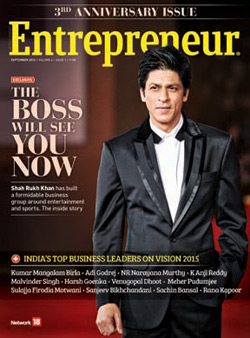
    Monthly magazine Entrepreneur has completed three years in India with its anniversary special issue now available on the stands across the country. Entrepreneur’s 36th issue includes a mix of stories and voices, which captures the essence of the Indian enterprise – from blue-chip companies including family-owned businesses, small and medium enterprises to start-ups.


    On the cover story of the issue is a man who is thought of mostly as an actor and entertainer, but does a lot more when the spotlight is not on him. Shahrukh Khan has followed his instinct and his passion to build a business group that covers sports, films and more with his business philosophy. Entrepreneur’s story looks at how Khan, with his very own brand of management style, has made his top team function virtually like co-owners, taking each of the businesses he runs to success.


    The special issue is also loaded with a lineup of 12 of India’s biggest business leaders – the likes of Kumar Mangalam Birla, Adi Godrej, NR Narayana Murthy, Malvinder Singh, and K Anji Reddy – who have spelled out their predictions for India, its economic landscape and challenges, and what it would take for entrepreneurs to succeed to the year 2015.


    The issue also features a parting note from Kaushik Basu, India’s chief economic advisor for the last three years, as he recounts his successes and failures, and a look at the three Nair sisters – the third generation of the Leela Group of hotels – and how they are taking the homegrown hotel brand into the next stage of its growth.


    Entrepreneur Editor-in-chief Sourav Majumdar said, “Entrepreneur has always sought to be a catalyst in the exciting entrepreneurial ecosystem in India, providing credible information and trends to arm our readers with. In our 3rd Anniversary special issue, we have sought to present to our readers the best thoughts, trends and stories which encapsulate the best of the Indian entrepreneurial spirit. It is also a time when we renew our resolve to be the business owner’s magazine of choice.”


    Sandeep Khosla, CEO, Network18 Publishing commented “When we launched Entrepreneur in India, we were focused at providing a magazine which is fully dedicated to the needs of the Indian business owners. Witnessing the magazine’s growth in the last three years, we are convinced that Entrepreneur has remained true to its spirit, continuously facilitating entrepreneurship across industry sectors.”