Category: PRINT MEDIA

  • Good Times with Arnab Goswami

    By A Correspondent


    He is one of Assam’s most famous sons, probably the best known Assamese face in the world. Okay, there have been other big names from the state – Bhupen Hazarika being the foremost, but there’s no doubting the fact that Arnab Goswami is undoubtedly the most prominent – not just in the media but from other walks of life as.


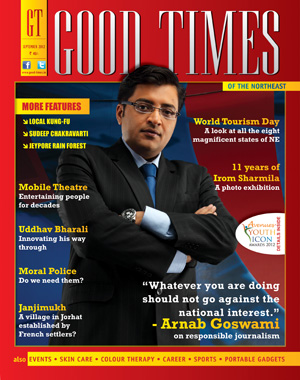
    Little wonder that he was on the cover of the second issue of Good Times, an all-new lifestyle magazine that is edited by Guwahati-based mediaperson Koushik Hazarika.  Mr Hazarika was until earlier this year Executive Editor and Marketing Manager with Eclectic Publications. His magazine is priced at Rs 40 and Mr Hazarika can be reached at: koushik.h@gmail.com


    Sample some questions posed to Mr Goswami:

    Coming to debates, there are a lot of talk shows that are aired in the television channels now. What is the kind of impact that these shows should aim to create with these discussions? It seems like it has happened on TV and then it’s over!


    I have often thought about this and I have come to a conclusion that only when the people, who need to be embarrassed and the people, who need to be humiliated are exposed, only then can a change happen…


    Personal and professional future in the next 5 years?

    I wouldn’t know about the professional future but yes, I do dream that at sometime in the future, our country will have a channel like BBC or CNN which is going to be broadcast to the world and if such an opportunity arises, I would certainly like to play a role in it. Personally, I hope I get more time to visit my parents who are in Guwahati and to spend time with my family. That would be good enough.


    One last thing – regarding the recent open letter by Madhu Kishwar. Any comments?


    I have a postal as well as an e-mail address and if anyone wants to reach me, they can write directly to me.


  • The ‘Magic of Print’ is Usain Bolt of Media

    By A Correspondent


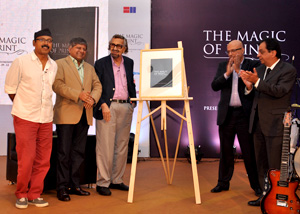
    From left to right: Josy Paul, Shashi Sinha, Alyque Padamsee, Vikram Sakhuja and Rajiv Verma at the unveiling of ‘The Magic of Print’

    We live in an era where technology is at the core of everything that we do. Whether it is about updating ourselves about new product launches or being abreast of the developments that transpire around the world, technology has enabled us to consume news at the quickest time possible – and without burning a hole in our pockets. Amidst this reality, it is the traditional mediums that seem to be taking the brunt of this newfound liking between consumers. From television to out-of-home and even print, mediums today are being threatened to put up a fight and adapt to this new truth or end up being relegated as the medium of yesteryears.


    Celebrating the creativity of print advertising, HT Media on Friday, September 14, 2012 launched a coffee table book on print advertising – ‘The Magic of Print’. The hardbound volume features contribution from prominent Indian advertising expert Mr Alyque Padamsee.  The book comes complete with a treasure trove of outstanding print advertisements of the last few decades from around the world as well as tips on how to create great print ads. The content is put together by Rajan Bhalla, Head Corporate Marketing and Magazines, HT Media and Mr John Thangaraj, Vice President, Planning, LOWE Lintas.


    Addressing a packed audience in Mumbai’s Taj Lands End, Rajiv Verma, CEO, HT Media Limited said that the best ads to remember are all print ads. In the earlier days, there was a certain charm to the print ads which you don’t find today. “I realise news and entertainment will be increasingly consumed on digital media, but print is nevertheless here to stay as long as the content is engaging, good and relevant.”


    A panel discussion was also held which delved on the various aspects of print, the impact of innovations, and the future of print advertising and so on. Print is one of the best reach building medium, and while television basically relies on emotions, print requires more brain power. With the literacy rate growing, newspapers will not decline in a hurry, reading newspaper has become a habit and to break this habit will take a really long time. These were some of the points made at the panel discussion. The panelists included veteran adperson Alyque Padamsee; Vikram Sakhuja, Global CEO, Maxus (and CEO, Group M India and South Asia); Josy Paul, Chairman and National Creative Director, BBDO India; and Shashi Sinha, CEO, Lodestar UM. The session was moderated by Sitaraman Shankar, Deputy Managing Editor, Hindustan Times.


    According to Mr Paul, the magic of print is a sudden impact; it is the Usain Bolt of the media industry.


    Mr Sakhuja pointed out that print is one of the best reach building medium and the top reason why most advertisers use print is for response, reach and editorial credibility.


    Mr Padamsee observed, “Television is basically reliable to emotions whereas print which also relies on emotions at the same time requires brain power. Print is a medium which remains with you and it has a mandate, and the mandate is that it is a very reliable medium. If print is going down today, it is because it is not responding to today’s needs. I don’t think print media even realises, it is an excellent medium for knowledge and education. Once it realises this, the swing will automatically go back to print.”


    So is there a success mantra for the growth of print? Will print die in the long run?


    Mr Josy Paul was of the view that print must not be isolated but integrated and its impact must be maximized. Today innovations is almost a loose word, it has become a bad word, in fact there is a lack of idea today. “Print is in your DNA, so it cannot die, it has been alive for over 800 years, it can only evolve.”


    Mr Vikram Sakhuja  explained, “Print won’t die in a hurry, it may be threatened by television or digital, but it won’t die in a hurry. There will a downward trend, starting with the metros, trickling down to smaller towns and villages, but it will certainly take some generations. In the long run however print will no longer be a mass medium as not many people will be consuming print.”


    Mr Alyque Padamsee was of the view that newspapers have a big advantage of analysing news which is not the case with television as television is a surface medium. “Innovation I believe is great, but some innovations are memorable, and some are clever. However innovations alone won’t sell anything, there is a lack of thinking today as far as print ads are concerned.” He further said, “Any medium will die until they reinvent. Radio would have died a long time ago had they continued the way they were. Yes, even print will die, but they must re-invent to survive and to thrive. Cinema was expected to die after television came in, but they re-invented. As long as print is desirable, it will be buyable.”


    While the panelists were of the view that print advertising needs to regain the charm it once had, there was a near unanimity among the panelists that print media is here to stay. However they were also of the view that if the medium was to die in the future, especially with the advent of digital, the death of the medium will be slow. The impact would first be witnessed in the metros which will trickle down to smaller towns and cities and in the long run, print will no longer remain a mass medium. Nonetheless as of today, the panelists were of the view that print advertising must not depend solely on innovation, that the medium must re-invent and make itself a desirable medium.


    Shortly after the panel discussion, the book -‘The Magic of Print’ was unveiled.


  • HT Brunch Dialogues on the changing face of Indian heroine

    By A Correspondent


    The launch of a coffee table book on print advertising – ‘The Magic of Print’ – by HT Media was followed by the HT Brunch Dialogues. The second edition of HT Brunch Dialogues was launched by Hindustan Times Brunch, and was themed, The Changing Face of the Indian Heroine. Two rounds of panel discussions were held.


    The panellists in the first round included Film Director, Madhur Bhandarkar; Producer, Siddharth Roy Kapur and filmmaker and screenplay writer, Raj Kumar Gupta. The panellists discussed the filmmaker’s role in portraying the Indian female lead. They delved on how the female oriented films and the roles offered to actresses have changed and evolved over the years. They also pondered on whether an actress in the long run would be at par with the actor, in terms of pay.


    “Times have changed, today heroines are willing to experiment with their roles or even their image which was not so earlier, when they were very conscious about their image and the roles they play” said Madhur Bhandarkar.


    On whether heroines will also be paid on par with heroes, Siddharth Roy Kapur said, “If a female oriented film crosses Rs. 100 crore, it may see heroines getting paid as much as the heroes.”


    The second session of the panellists included film personalities Kareena Kapoor, Karisma Kapoor and Sharmila Tagore. Both these sessions were moderated by Vir Sanghvi, Advisor, HT Media.


    Their discussions revolved around the way scripts or films have evolved over the years for the Hindi film heroine. And how they have managed to stay relevant or break the myth about actress only as a show piece in the film and their take on whether things will get any better for the Hindi film heroine in the near future.


    According to Sharmila Tagore, there is a huge difference in the roles women or heroines do today. Times have certainly changed, cinema has become professional today, unlike before, but roles are still not written for women.


  • Industry to analyse Dainik Bhaskar case study

    By A Correspondent


    The Dainik Bhaskar Group has placed IIM Bangalore’s recently completed classroom case study of Dainik Bhaskar group’s Maharashtra success, titled ‘Aspiring Growth’, for the industry to analyse.


    The case showcases the fast-paced expansion of the group into 13 markets and the successful launch of Divya Marathi in Aurangabad, Maharashtra with a roaring success with five editions within such a short span of time. The case leaves the reader with a pertinent question in the current scenario ‘Which market/ territory / language should Dainik Bhaskar Group enter next?”


    The contest will follow a two-stage process. In stage 1; teams registering at Dainikbhaskargroup.com will send in their summary of recommendation and approach. In Stage 2; 5 to 7 shortlisted teams will then finally make presentation to a jury of Bhaskar team, senior fraternity members and IIM Bangalore professor Ms Seema Gupta who has developed the case. The winner team stands to get Rs 1,00,000 as prize money.


    Elaborating on this further, Sanjeev Kotnala, Vice President, Dainik Bhaskar Group said, “Before the case was finalised, we had two classroom sessions at IIM Bangalore and the Brand team raised a simple question – what if the case was to be solved by the media-advertising-marketing fraternity. This was the birth of this unique innovative contest. We debated this with Prof Seema Gupta, who has been encouraging and excited by the innovative contest. She agreed that this will make the case that much stronger for future classroom discussions. We as a team are gearing to hear some totally differentiated point of view and approaches- as the professionals working within the industry definitely have an advantage.”


    The contest is open to professionals in media, advertising, communication and marketing and students of premier management institutes, he added Those wishing to register and download the case can do so at www.dainikbhaskargroup.com.


  • Video: Good effort to evangelize print: Vikram Sakhuja, Shashi Sinha & Josy Paul. Sequel planned: Rajan Bhalla

    By Robin Thomas


    On the sidelines of the HT Media event to unveil the book – ‘The Magic of Print’, MxMIndia caught up with some industry players for their views on the evolution of print advertising, the road ahead for the medium and of course their reactions to ‘The Magic of Print’ and whether such initiatives really help the industry?


    1. Vikram Sakhuja, Global CEO, Maxus

    [youtube width=”400″ height=”220″]http://www.youtube.com/watch?v=gleSCF4K05A[/youtube]

    Your reactions on the book – ‘The Magic of Print’…?

    It’s a great book, it’s a beautiful production, it’s got some very good tips. There are some twelve tips to re-create the magic of print and an absolutely mind blowing compilation of ads. I think Rajan Bhalla has done a brilliant job.


    Does the industry need more such initiatives?

    Yes, absolutely. The good thing about these kind of initiatives that it makes you stop back and think, reflect and when you are tuning with some great minds and if something comes out of it, is always nice.


    2. Shashi Sinha, CEO, Lodestar UM

    [youtube width=”400″ height=”220″]http://www.youtube.com/watch?v=9vILEEM6PeQ[/youtube]

    Your  reactions to the book (‘The Magic of Print’)…?

    It’s a lovely book, and it’s got a combination of some great ads, and there are some simple tips. Copywriting is one area which is very difficult for a beginner in advertising to enter into and the ones that have managed to enter into this field can also learn quite a lot from this book.


    On whether the industry needs more such endeavours?

    There are so many business schools, but no one teaches you the craft of advertising. So I believe this is a great endeavour and for a publisher in-house to do this initiative and to inculcate the spirit, I think it’s a great opportunity.


    Does the industry need more innovation for better growth?

    I won’t be worried if innovations happen or not because ultimately if there are a lot many ads on print, innovation will automatically happen. Innovation is something you do for the long term, so I won’t be worried if innovation happens or not. The fact is that advertising in print will continue to grow and as television rates go up, automatically people will come back to print. Whether it takes two years or five years, I won’t be able to predict, but, this will happen.


    A word of advice for print media…?

    Keep providing great content, contents which are engaging and the rest will follow.


    3. Josy Paul, Chairman and National Creative Director, BBDO India


    [youtube width=”400″ height=”220″]http://www.youtube.com/watch?v=h83bzcVtlck[/youtube]

    Your reactions on the book – ‘The Magic of Print’…?

    It’s a good book, well printed, it’s got some nice images and makes me want to spend more time with it and share it with my team and may be even have some discussions on which of those are fantastic work.


    And does the industry need more such endeavours?

    I think more discussions are good because a discussion makes you think about the medium a little more. Basically it is about focusing on the medium and what makes the medium a little more interesting and exciting. So I think that conversations are good, always.


    Does the print industry need more innovations for better growth?

    I am not sure about the word innovation in print because as a reader if I find people coming in the way of my news, I do get irritated. I believe true innovation is when within the context of the page and with respect to the page you can still create magic and still have a point of view that will make people think again or get excited or share things or put it up on their board, then that’s great. However this whole thing of irritation to the reader is not innovation, in fact is suddenly makes the news a nuisance.


    Where do you see creativity in Print media, five years from now?

    Creativity can never die, it’s forever. I expect newer things to happen, more beautiful things, and younger people will bring in more filters to print and we will see beautiful things that we never thought about. So one cannot really predict, creativity in fact evolves.


    What about print as a medium five years from now?

    I think print will take a new avatar. We all know that education is a big necessity in this Country and newspapers will become an integral part of education and it will start finding new audiences and I think it will further penetrate into the different strata of the society. So, newspapers or print media is like a river that will grow very deep and I don’t think it will just die like that.


    4. Rajan Bhalla, Head, Corporate Marketing and Magazines, HT Media

    [youtube width=”400″ height=”220″]http://www.youtube.com/watch?v=1P8utJgX-EA[/youtube]

    On the idea behind initiating- ‘The Magic of Print’?

    Well, I think the magic of Print is our contribution, our effort to help everybody in the industry associated with print advertising to understand how to create the magic in print advertising. I think it is absolutely clear that print is an absolutely great media vehicle from the point of view of showcasing brands and above all lending a lot of credibility to the message. It is time that we all started looking at how great print advertising can be created and this is our effort in that direction.


    On the process that went behind creating this initiative?

    It was a tedious process that lasted us almost a year. We first identified the content of what we wanted to present in the book. Once we had the content right, we then started scanning for the best examples we could find across the globe to fit into that category. We were not so concerned about picking brands from India, we just looked at global advertising as a market place and we looked at just the best in class advertising that was created under every single theme that you will see.


    How have the advertisers responded to the book?

    The book has just launched, so I am very positive that both the media fraternity as well as the creative fraternity is going to view this as a great initiative, which is also going to help clear a lot of thinking that they put into creating great advertising that works for them. So, it is just the beginning and we would like to probably move on this path as we go forward, year on year.


    So, will there be a sequel to this book – ‘The Magic of Print’?

    Absolutely yes; so we would be looking at various genres in which we can actually help impact the print industry, impact print advertising and help our advertisers in different ways. So you can look forward to another such initiative one year from now.
     

  • Jaldi 5 with Shailesh Gupta: Both readership & circulation will co-exist & complement each other

    On Friday, Shailesh Gupta, Director-Marketing, Jagran Prakashan was unanimously elected Chairman of the Audit Bureau of Circulations (ABC) for the year 2012-2013. S M Ahmad, Executive Vice President – Marketing of ITC was also unanimously elected as the Deputy Chairman of the Bureau for the year 2012-2013. Sam Balsara, Chairman and Managing Director, Madison World was the outgoing Chairman of the ABC.

     

    MxMIndia caught up with Mr Gupta on the sidelines of a dinner hosted by Mr Balsara on the occasion and sought his answers in the first edition of a new ‘quick interview’ series.


    01.   What will be your priorities as Chairman of the ABC?

    The priority is to bring about a more transparent system, evolve the ABC as a currency and make it a powerful decision-making tool for the industry.


    02.  Over the last few years, the ABC’s role has diminished given the growth of readership as a currency… what will be your attempt to reverse it?

    The idea is not to reverse it. Both Readership and Circulation as currencies will co-exist and complement each other. However, in order to make it more relevant to decision making, the currency needs to evolve with the changing times. The attempt will be to ensure that circulation as a currency regains the confidence of the industry and is of genuine use for decision making by both planners and media owners.


    03.  With the merger of the NRS with the IRS, the readership currency will only get stronger with newspaper marketers. Do you see a further diminishing of the role of the ABC and the currency of ‘net paid sales’?

    The core issue I think is that while the Readership currency has evolved on the one hand, the circulation as a currency has lived in status quo. Also while Readership as a currency will always be a sample-based study, Circulation is the census – therefore, the importance of the NPS is very clear. Rather than the role being diminished, I look at a scenario where we see these studies complementing each other and eventually benefiting the print industry at large.


    04.   One of the charges that many publishers have had is that the ABC – over the last 15-20 years – has failed to take into account present-day practices of invitation pricing and low cover prices of publications. As publisher of India’s largest daily, do you see that rule being amended in the near future?

    It’s too early to talk of the possible amendments. But clearly we will need to march ahead, look at the changes in the environment, and be able to evolve the currency to reflect the changes. For this, we will need to have all publishers on the same page. It will be important to consider suggestions and opinions of all stakeholders to create a robust and transparent currency – one that truly reflects what’s happening in the marketplace.


    05.   In the United States, there’s an ABCi for measurement of traffic on websites. Do you see the ABC in India doing that in the future?

    Too early to comment on that at the moment, but as of now we have a clear priority ahead in terms of restoring the sanctity of ABC as a currency and making it more relevant for the entire industry eco system.


  • Jaldi 5 with Sorbojeet Chatterjee: Quality editorial is core for any news brand

    A disclosure: he’s our quizmaster and hence part of the MxMIndia family.
    But he’s a professional first and as he sets out to make a dramatic switch from television to print, we thought it would be good to do a ‘Jaldi 5’ with him. For the record, Sorbojeet Chatterjee assumes office today as Vice President – Marketing at Diligent Media, publishers of the multi-edition DNA newspaper.


    01. From the No 1 Hindi news channel network to a challenger sports network to a challenger newspaper brand… you could”ve been sitting pretty with the leader at Aaj Tak. So why change?

    The answer lies in the question… as a marketing professional it’s critical to get varied exposure and not get too comfortable. After a fantastic stint in television news, the scale of sports was indeed tempting. I have been quite fortunate working across strong leader and challenger brands with some of the sharpest minds in the media industry. The momentum continues with DNA.


    02. You don’t hear of too many people switching from television to print. As a media marketer, do you see fair amount of action in print?

    There is no denying that the relevance and more importantly the impact of newspapers are constantly growing… especially in India.


    For me it completes the proverbial ‘circle’ in media…television, radio and now print. The complexities of building a strong newspaper brand are quite different from what I have done so far and I am looking forward to a new set of marketing challenges.


    03. What’s the first big thing that one can see on you joining DNA? Will there be more synergies with the parent group’s media offerings?

    Too premature to say anything. Will be suitably poised to answer this after a few weeks of rolling up my sleeves and getting my hands dirty.


    04. There are various views on it, but we would like yours: what’s more important for a newspaper’s success – quality editorial or great marketing?

    This is hardly a debate. Quality editorial is the core product for any news brand and is the solid foundation. Aggressive marketing is essential to create consumer awareness and overall buzz. A strong product without strategic marketing or a struggling product with cutting edge marketing yield the same result – a failed attempt!


    05. How’s Mumbai been for you at work? Pardon our putting you into a spot on this, but a quick Mumbai v/s Delhi analysis?

    Ah, this is a toughie! As a professional in this dynamic environment, one can’t afford to get attached to any particular location… it’s not the city that matters, but the culture in the workplace. How’s that for diplomacy?


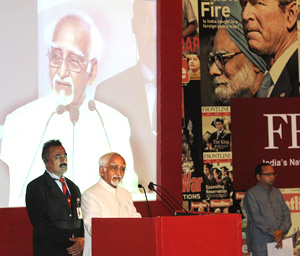
  • Vice-President Hamid Ansari lauds relaunch of Frontline

    By A Correspondent


    “I may be forgiven for admitting that I am moderately conservative and tolerably radical – conservative in habits and radical in thinking. For this reason, I was less than enthused when the Shri Venkitesh Ramakrishnan met me with the suggestion that I attend today’s re-launch function,” said Hamid Ansari, Vice-President of India at the re-launch of Frontline. The fortnightly magazine from The Hindu Group will not be available for Rs 40.



     

    “I could not help recalling the old maxim don’t fix what is not broke. To me personally, ‘Frontline’ has always been a stimulant to the mind apart from providing good reading on most matters that I care to spend time on. The need for a remix in Bollywood terms therefore did not arise. Nor was there a need to replace persuasion with titillation,” said Mr Ansari.


    The magazine was re-launched in the presence of N Ram, former Editor-in-Chief, The Hindu, and Professor Romila Thapar.


    “In today’s age, the audio-visual media has emerged as a dominant medium for quenching the thirst of the target audience for real time news on current affairs, culture
    and entertainment. Despite this, there remains a real and popular demand for serious publications on topical issues which cannot be substituted by the ‘breaking news’ culture and short-attention span snippets in the domain of the electronic media,” Mr Ansari added.


    The new Frontline will hit stands in October, and will have 150 pages.


  • Jaldi 5 with Supriyo Sinha, VP – Bengali Dailies, ABP

    Supriyo Sinha

    Ebela, the tabloid from Anandabazar Patrika Group, recently launched in Kolkata and Howrah, priced at Rs 2. Supriyo Sinha is positively hopeful about its success. Jaldi 5 with him reveals more about the Bengal market.


    1. Since ABP is the undisputed Bengali daily in the market, why was there a need to launch another Bengali daily?

    ABP is the most iconic group in Eastern part of India. The group has been in the market for almost a century. ABP is, by far, the leading newspaper. A Bengali tabloid is a historic milestone for us. We launched Ebela to address the certain need gap that arose from communicating with Bengali youth, and the Bengali young-at-heart.


    2. Why has the launch been restricted to only in Kolkata and Howrah? How is ABP marketing Ebela?

    We launched in these markets based on market research. The research estimated that the appetite for a tabloid is higher in Kolkata and neighboring regions. The other markets are still traditional when it comes to news consumption and believe in broadsheet.to market the product, we are using a four-pronged approach. We are out-of-home media in a big way to spread awareness. Then there is web promotion to capture the youth on Facebook and Youtube, Television and radio commercials created by Ogilvy, and on-ground events. We are also driving subscription promotions.


    3. Is the advertiser profile for ABP and Ebela the same?

    Yes and no. National brands who wish to target the young-at-heart and local brands with youth as TG have been approaching Ebela. The ad rates for both the products is different.


    4. TOI is entering the market with Eyi Shomoy. Would it imply any strategy shifts for ABP?

    No. There is a core market reason for us to be doing this. TOI has been changing its own marketing and communication strategy in this market because of our strong presence.


    5. What are your expectations from Ebela?

    I dare not speak for the market but I am hoping for a positive response. From the initial print of three lakh copies, we only wish to grow. The readers, and advertisers, are calling it a refreshing and exciting product.


  • Promising tales of tiny, tall agencies


    By Johnson Napier


    The last few weeks were rife with news of independent — or shall we say not-so-big — advertising agencies that were going all out to make their presence felt in the M&E space in India. Whether for the awards they had bagged across festivals or the largescale client wins that they had managed to pocket in their kitty, these agencies were in the news for some reason or the other. But while it may be the ‘popularity’ tag or the affiliation to a large parent company that may have done the trick for these agencies, there are others that fall shy of this honour.


    For instance, one may have faint acquaintance with an agency that goes by the name Apex Advertising or for that matter Flagship Advertising but if one were given a glimpse of the kind of clientele they have to boast – be it RBI, Taj Group of Hotels, BSNL, Pantaloon Retail, Pidilite Industries, MTV Networks etc – or even the kind of billings that they manage to pile up that ranges anywhere from Rs 5 to 50 crore, it would make for an interesting cover. And that’s precisely where the industry seems to be holding back or rather not giving these small yet powerful ad independents their due.


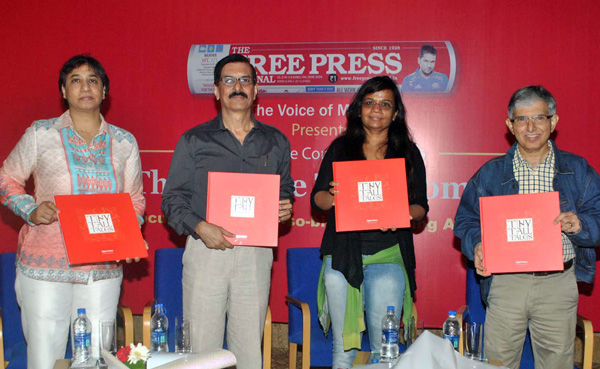
    This lacuna is currently being addressed by veteran print player Free Press Journal, that has come up with an interesting coffee table book titled ‘Tiny Tall Tales’. As the tagline suggests, this book plays up the initiatives of small agencies that are making it big. Said to be a slice of the coverage from The Free Press Journal’s column ‘Small Size Big Ideas’, the book will be launched at FPJ’s second roundtable conclave on 22nd September by Lynn De Souza, Chairman and CEO, Lintas Media Group.


    Abhishek Karnani

    Throwing light on the thought-process and the merit behind warranting such an effort that has been the benchmark of FPJ for some time now, Abhishek Karnani, Director, Free Press Journal said: “There are around 180 accredited ad agencies in Mumbai but we always hear and talk about the Top 15 agencies. There is life beyond them and these not so big agencies are doing great work away from the limelight. These agencies also represent a substantial business and have close affinity with the clients. We are proud of this initiative of the Free Press Journal, where we have taken time to look not at the obvious leaders but at those who are important and often overlooked by the media. This outlook builds on our worldview that there is deep value in the big and the small and it is important to study the not-so-big to learn about ground realities and to spot trends and understand markets that much better.”


    Sharing his experience, Author & producer of the book Sandeep Singh said, “Traditionally if you see, everybody just loves to talk about the top 10-15 agencies but there is a whole volume of business that comes from smaller agencies. Some of them are intentionally small because they want to be creative or whatever way you want to look at it, but great works do come across from them. This book is an attempt to cover these agencies.” Elaborating on the participation factor on behalf of the agencies, Singh said, “Though a few agencies refrained from participating citing some reason or the other, the book profiles most of them. Also, it is worth noting that the minimum billing of the agencies in this book is around Rs 5 crore while the maximum is pegged at Rs 50 crore.”


    Elaborating on the scope and scale of the initiative, Jagdish Rattanani, Business Editor, Free Press Journal who along with his team has helped in putting together the book said, “We hear a lot about the top 10 or 15 small ad agencies in India who are spoken about and praised a lot by the media but if you go beyond there are these ‘not-so-big’ advertising agencies that are still big in terms of what they manage to bring to the table. They are big in being strong and powerful enterprises and are dealing with a lot of interesting ideas. We sensed that there was a lot of energy and growth potential amongst these small agencies. Also we found that nobody ever tries to cover them and understand their perspective or see what they might need in this era of change to make the next big leap. That’s what encouraged us in taking this initiative further.”


    As for the point on finding the cause to be an apt fit with the model with which Free Press Journal itself moves forward with, Rattanani asserted by saying, “Though Free Press Journal is not among the biggest of the big, it is but the oldest Indian-owned English newspaper in Mumbai. Basis this, we said that we have a special interest and focus on trying to look at the others who are as good but are not so big and thus started the journey of deliberately trying to exclude the very big and focussing on the not-so-big,” affirmed Rattanani. Adding further he said, “For this exercise, we ended up going and visiting these agencies and even ran features over a period of two years and tried to play up their point of view and perspectives. All said and done, the larger story is of the ideas that lie just beneath the surface.”


    On whether the initiative was carried out to bring about intangible benefits for the newspaper group in terms of revenue from advertisers, Karnani thwarted the thinking by suggesting, “We are rendering this as a Corporate Social Responsibility. Our only concern is to help this segment to take a leap to the next level. We want to empower the not so big ad agencies to not only survive but also thrive and outgrow the market in these times.”


    In fact the group is looking at other avenues to take forward similar causes on behalf of the industry. Asserted Karnani: “We have already kickstarted our Knowledge Series wherein we invite experts to come and share their views with this group. We are also in talks with international ad associations wherein we plan to use their platform to host events for the not-so-big agencies. Also, we are also hosting our second exclusive conclave “The Change That Cometh” that is focused on the not-so-big advertising agencies. So there is a lot to look forward to.”


    While it is too early to predict the outcome of the book from peers from the ad industry, Singh is hopeful that the book will receive a positive approval from all concerned. He avers: “I hope the bigger agencies are happy and take note of the initiative in a positive light.”


    As for its plans of coming out with a sequel to the book, Singh said, “We would like to explore an opportunity of coming out with a sequel to this edition but it is still early days to be talking about that.” Agreeing with Singh, Rattanani said, “I can only say that the idea is rich and we can build on this idea but how the idea will further shape up only time will tell.”


  • RIP, G Kasturi, Editor, The Hindu (1965-91)

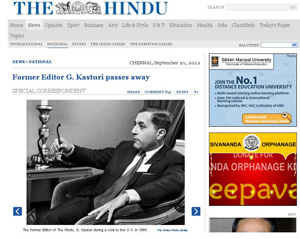
    Screengrab of The Hindu report announcing the passing away of G Kasturi

    By A Correspondent


    Mr G Kasturi, veteran journalist and Editor of The Hindu from 1965 to 1991 passed away last Friday (September 21). He was 87.


    Reports The Hindu: “The end came peacefully at 2 a.m. on September 21. He had been unwell for some time, but was alert and active till the last. The cremation took place on Friday afternoon at the Mylapore crematorium. He is survived by his wife of 64 years, Kamala, sons K. Balaji and K. Venugopal, daughter Lakshmi Srinath, and five granddaughters and two great-grandchildren.”


    Links to coverage on Mr G Kasturi:

    Report in The Hindu and former Editor-in-Chief N Ram’s comment:

    http://www.thehindu.com/news/national/former-editor-g-kasturi-passes-away/article3919690.ece


    Photo feature in The Hindu

    http://www.thehindu.com/news/national/a-photo-feature-on-g-kasturi/article3919952.ece?homepage=true&ref=slideshow


    Links to various tributes in The Hindu

    http://www.thehindu.com/system/topicRoot/G__KASTURI__1924-2012_/


    Mahesh Vijapurkar on G Kasturi in Firstpost

    http://www.firstpost.com/india/what-made-g-kasturi-different-from-other-editors-464693.html


    Sans serif: Hindu’s longest serving editor G. Kasturi: RIP

    Hindu’s longest serving editor G. Kasturi: RIP


  • FPJ boost for small agencies


    By Johnson Napier


    Seldom does the media think of moving beyond the influential set of players when it comes to playing up the achievements of a particular sector or an industry. While the top 10 or 20 is what the goalpost seems for most in terms of coverage, quite often it is the players who are bundled up in the lower end of the spectrum that contribute as much if not significantly more to the growth of any sector. But this divide was almost forgotten at Grand Hyatt, Mumbai on September 22 when a host of mid- and small-sized advertising agencies came together to pick up nuances and mantras from doyens of the upper strata of the advertising industry.


    The initiative was part of the annual conclave hosted by Free Press Journal that seeks to empower SMEs in the advertising sector. The theme this year was ‘the change that cometh’. The panellists comprised Sam Balsara, CMD of Madison World, Punitha Arumugam, Director – Agency Business at Google India and Bharat Kapadia, founder of ideas@bharatkapadia.com. The conclave was well attended by the who’s who from the ‘not-so-big’ advertising agencies.


    The day began with Madison’s Sam Balsara taking the lead and enlightening the audience on the road ahead for the industry. Speaking on the topic “How to make the leap to the next level”, Balsara began by assuring all gathered in the audience that they were indeed in the right place at the right time. “Advertising is a booming business and the long-term perspective is indeed bright for all players in the industry. But while our economy continues to grow at a healthy 7-8 per cent, advertising’s contribution to the overall economic growth is not as satisfactory. Advertising as a percentage of India’s GNP is just 0.35 per cent compared to the global average of 0.8 per cent. In fact in the US, the number is around 1 per cent.” He cautioned the audience that there was no reason to be weighed down by the slowdown as there were better days ahead for the industry.


    Belting out some of the mantras that enabled Madison Media reach where it is today, Balsara highlighted that the small and medium agencies can indeed give a run to the big agencies by ‘thinking small, beating big’. “Most agencies would advocate one to thing big but we did the reverse and that’s how we managed to work our way to the top,” he averred. Balsara even went on to tag his agency as being a David amongst the Goliaths that existed in the industry, but he cautioned that it didn’t mean that one has to get bogged down by the size of the bigger agencies.


    Advocating to the audience his recipe for success, Balsara said that it was essential for the agencies to do what is right for the client only then will success come one’s way. According to Balsara, the key aspect was the need for agencies to develop core competency. Sharing with the gathering his favourite definition of advertising that steered him to deliver his best, Balsara said that advertising is the art of arresting human intelligence long enough to be able to make a person reach out and open his wallet. This will ultimately benefit the client leading to the growth of the advertising agency as well.


    Presenting the mantras that led Madison to emerge where it is today, Balsara shared the 10 immutable laws that he believed could do wonders to the fortunes of other agencies as well. These include: the law of disadvantage, law of service, law of innovation, law of research/technology, law of specialisation, law of focus, law of organisational building, law of conservation, law of patience and law of perception. Balsara further went on to burst a few myths about advertising which he believed was highly prevalent in the marketplace. These include advertising is too expensive; advertising is only for big companies; advertising is only for FMCG companies; good marketers do not believe in advertising and finally, consumers do not believe in advertising.


    Post Balsara’s unmissable takeaways, it was the turn of Bharat Kapadia to hand out his secrets as he spoke on ‘Getting ready for the future.”. Rather than term them as not-so-big, Kapadia took the liberty of altering the name to aspiring to-be-big agencies. Kapadia began by straight away highlighting the influential role that technology played today. “With technology eliminating most middlemen out of business, there is a fear whether advertising agencies may survive in the future? But according to me ad agencies won’t just survive they will continue to throw up spectacular growth as well.” Presenting his ideas on the secrets to chart out good growth and profitability for the company, Kapadia enlisted a few pointers that included: knowing well what the client’s opportunities were; understanding the role and importance of research/data in business; need to lay more emphasis on new media that is not only cheap but cost-effective as well; need for experiential marketing; and most importantly, the need for agencies to be more innovative. Kapadia shared with the gathering an innovation that he had effectively carried out in a newspaper in the recent past that was reasonably successful – Bru Coffee.


    Highlighting the strengths that small or medium agencies possessed compared to the big giants, Kapadia asserted that one didn’t need a sword to cut vegetables. A small knife itself could do the job more effectively. The possible strengths that the aspiring to-be-big agencies possessed include ability to garner more trust and ensure personalised service to clients, be able to deliver a local touch and the ability to offer specialisation services.


    Assigned the task of acclimatising the gathering to the role of new media in running any business, Punitha Arumugam of Google began by saying that the thing about new media is that if you do not know where you are going any road will take you there. Taking inspiration from her mentor Sam Balsara, Arumugam too went on to present the ten commandments of new media, which would help any agency to emerge successful in the future. The first was the need to think business: it was essential to have a big idea; being small or big by size is secondary. She went on to cite examples of Myntra.com and dollarshaveclub.com that went on to become successful case-studies in the recent past due to the power of thinking big. Next was the need to think fluidity: this was essential if one wanted to become successful and get good ROI. The third was think mind-casting: it was important for agencies to narrowcast and address a certain section of the audience as the underlying motive should be about targeting change leaders. The fourth was think re-imagine: with television and print both co-existing as effective mediums it was essential that agencies come up with ads that could work wonders across multiple mediums. The next mantra was think continuity: this had to do more about getting metrics that are used offline to be used successfully in the online world as well. The next was think solutions: this would be made possible with the help of technology that would make any solution come alive. Next commandment was think co-exist: the obvious need to see that all mediums co-exist seamlessly with a role being prioritised for each. Next was think adaption: need to pollinate offline ideas to online and do so effortlessly. The next was think structure: it was important that agencies learn to collaborate whether with generalists or with specialists if the job so demands. And the last but not the least, think covet: at the end, it is all about money. So it is okay if one desired a better share of the client’s attention and hence the business if he had to stay ahead of the race.


    The conclave concluded with a Q&A session where the panellists cleared a few doubts from the audience. This was followed by a vote of thanks by Jagdish Rattanani, business editor of FPJ.