Category: PRINT MEDIA

  • Dainik Bhaskar group ties up with Time & HBR

    By A Correspondent


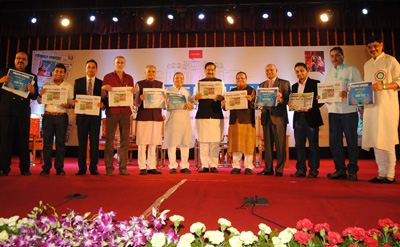
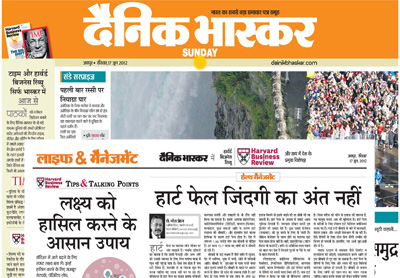
    Dainik Bhaskar Group has become the first newspaper to provide exclusive content from Time, the current affairs magazine and Harvard Business Review to its readers on a regular basis. The exclusive content will feature in the Sunday edition of the newspaper.


    The three media giants have come together to leverage their specific content strengths and collectively provide rich and relevant world class content to the readers. Dainik Bhaskar Group isIndia’s largest newspaper group with 1.9 million readers in 13 states. Time is the world’s largest circulation weekly news magazine with a readership of 25 million, of which 20 million are in theUS. It is widely regarded as one of the most popular magazines. Harvard Business Review delivers the latest techniques, best practices and the most thoughtful advice from the world’s leading management experts.


    Elaborating on the collaboration, Kalpesh Yagnik, National editor, Dainik Bhaskar Group said: “We at Dainik Bhaskar focus at generating the best and most relevant content for our readers. Time and HBR are relied upon by the policymakers, the world over. We will thus, bring to our readers, the latest trends in international politics, strategy, diplomacy, environment, entertainment, science or economy.”


    The content for the Sunday edition has been completely revamped. The edition will focus on management lessons to be applied in day to day life along with wide spectrum of topics like Health, Fitness, Career, Self Help, Money management, Politics, education, Music, Lifestyle, Environment, Good reads through columns by eminent experts of the respective fields.


    Dainik Bhaskar, in reflection to the changing times and women empowerment, will also provide a separate segment devoted to women. Fashion, Food, Travel, Health, Life, Career and money management besides this, there will be a Sunday Jacket, above the regular front page of the newspaper. This will carry exclusive news analysis, ground reports and so on.


    Speaking of the change, Sanjeev Kotnala, VP Dainik Bhaskar group said: “Content is always the king for any media brand. And we are loved by our readers as we focus on them. Our strategy revolves around being ahead of the curve.”


  • IRS2012Q1 findings out: No change in Top 10 Publications and Dailies

    By A Correspondent


    The numbers from the latest round of the Indian Readership Survey (IRS) are out as the Media Research Users Council (MRUC) and Hansa Research Group (HRG) announced the findings of the first quarter of 2012.


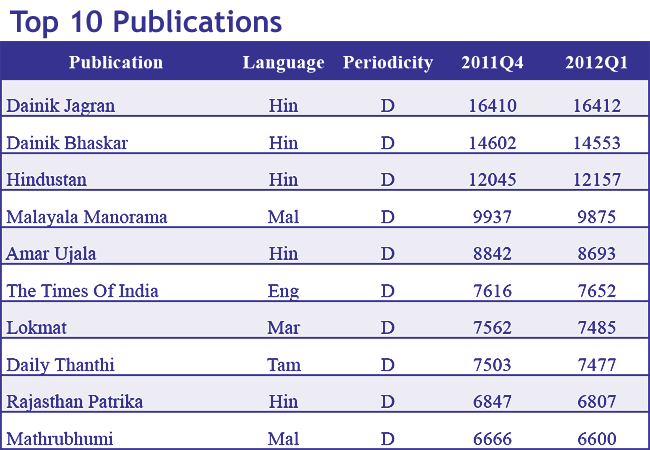
    According the AIR (Average Issue Readership) figures, Dainik Jagran continues to lead as the most read publication across the country. While Times of India is the only English daily to make it to the top 10 most read publications, Lokmat is the only Marathi daily in the top 10 most read publications.


    (AIR numbers; All figures in ‘000)


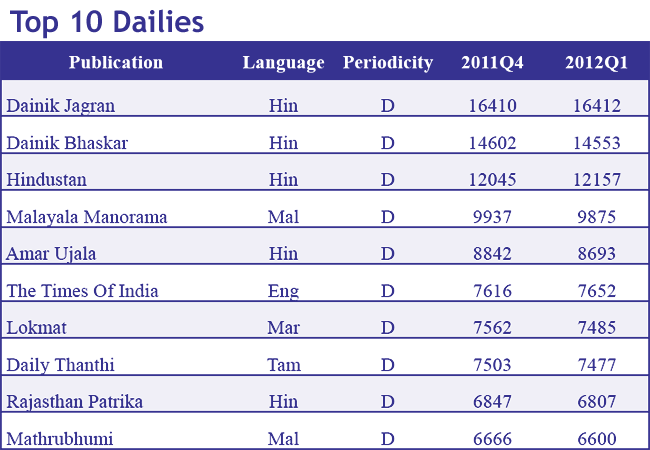
    The rankings of the top 10 dailies are the same as the top 10 publications.


    (AIR numbers; All figures in ‘000)


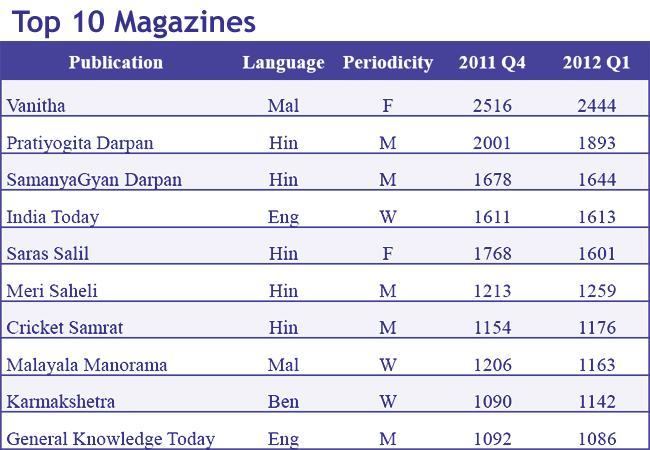
    The top 10 magazines of the country are mainly dominated by Hindi languages followed by English and Malayalam language magazines. There are a few changes in the rankings of the Top 10 Magazines.


    (AIR numbers; All figures in ‘000)


    Note AIR  or Average Issue Readership is defined as the readers of an average issue of a publication i.e. the estimated number of those who have read or looked at any issue of the publication within a specified time interval, which is equal to the periodicity of the publication (excluding the day of the interview).


  • Karan Darda to head Lokmat ops, COO Jwalant Swaroop takes on advisory role

    By A Correspondent


    Jwalant Swaroop
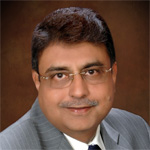
    Karan Darda

    The winds of change are blowing at Marathi daily, Lokmat. Senior mediaperson and a veteran newspaper business professional Jwalant Swaroop, who was the Chief Operating Officer of Lokmat Media since June last year, will now take on an advisory role. Meanwhile, executive director Karan Darda, who was being groomed to take full charge of the business operations, is likely to assume the role of the COO.


    As Executive Director, Mr Darda has been involved in the operations and circulation areas of the group and has been working towards conceptualizing and implementing marketing programmes. He has been on the board of the Company since April 2009 and is credited with conceptualizing and successfully implementing Aurangabad Premier League for cricket and Kolhapur Premier League for football, thereby creating new opportunities for the group in sports.


    Mr Swaroop has been with the Lokmat group since 1992 and was instrumental in the group’s wide acceptance in Delhi amongst marketers and media agency professionals. Mr Swaroop has also worked with the Northern Indian Patrika for a bit and spent around six years in ad agency, Advertising & Integrated Marketing (AIM).


  • Lokmat Samachar’s Pune edition launched

    By A Correspondent


    Maharashtra’s Chief Minister Prithviraj Chavan launched the sixth edition of the popular Hindi daily, Lokmat Samachar in Pune. Also present on the occasion were Minister of State for Education Rajendra Darda along with media luminaries Balbir Punj (senior columnist and RS MP from Rajasthan), Prabhu Chawla (Editor-in-Chief – The New Indian Express), Tarun Tejpal (Editor-in-Chief, Tehelka.com) and Vijay Darda, Rajya Sabha MP and Chairman of Lokmat Media Pvt Ltd.


    “Lokmat Samachar will enhance the quality of life in Pune and will make it more cosmopolitan,” said Chief Minister Chavan at the launch ceremony.


    A panel discussion on “The Relationship between Media and Politicians” was organized to mark the launch. “A journalist is also a politician. Not only should the media help in shaping public opinion, it should also play a critical part in the development of the political process,” the CM observed.


    Senior journalists and editors Mr Chawla, Mr Tejpal and Mr Punj highlighted the increasing complexities of the media world, and the need to maintain a balance in giving coverage and direction.


    “Media is a fish that lives in the vast ocean of democracy,” said Mr Punj. “Hence strengthening the media will result in the strengthening of democracy.”


    Highlighting the sharp difference between the cover prices of newspapers in India and abroad, Mr Tejpal pointed out that the readers India are not willing to pay enough money to run these institutions. “This is the structural flaw due to which quality deteriorates,” he said.


    Mr Chawla decried the increasing incidences of ‘paid news’ inserted by politicians, due to which media is facing a credibility crisis. “Media has become a victim of this phenomenon,” he maintained.


    Speaking about the Pune edition of Lokmat Samachar Rishi Darda, Joint Managing Director – Lokmat Media Pvt Ltd, said: “The Hindi-speaking population of Pune, which has emerged as an education hub and IT city, was in need of a national daily. Since Hindi is our national language and therefore connects people throughout the country, Lokmat Samachar would definitely fill the gap.”


    The newspaper offering consists of the main paper of 12 pages along with a 4 pager Apna Pune that will detail the local civic issues and also leisure options for the Puneites. For You for the young, Sakhi for Women and Lokarang Sunday supplement will accompany the paper on 3 different days in a week.


    This is the sixth edition of the popular newspaper which first appeared in 1989 in Nagpur, and was thereafter launched in Aurangabad, Akola, Kolhapur and Jalgaon in that order. Lokmat Samachar has 13.56 lakh readers as per IRS 2012 Q1 AIR


    Its Pune edition has a cover price of Rs3 plus an attractive subscription scheme.


  • Bhaskar digital biz nets 200 mn page views

    By A Correspondent


    The Dainik Bhaskar digital business has achieved 200 million page views (PVs) and to commemorate their success, the group had noted filmmaker Ekta Kapoor visit their Noida office and participate in the cake-cutting ceremony with Pawan Agarwal, Director and Promoter, Dainik Bhaskar Group, Gyan Gupta, CEO, Dainik Bhaskar Digital Business, Harrish M Bhatia, CEO, My FM and employees.


    Highly impressed with the wide digital reach of the Dainik Bhaskar digital business, Ms Kapoor said, “This achievement speaks volume of the interest people take in their content and how successfully they have catered to the varying demands of the readers.”


    With the number of people accessing their websites – Dainik Bhaskar (www.dainikbhaskar.com), Divya Bhaskar (www.divyabhaskar.com), Daily Bhaskar (www.dailybhaskar.com) and Divya Marathi  (www.divyamarathi.com) -  increasing by the day, it is obvious that their readers not only relate to their news and articles, but also find these interactive and engaging.


    The local language websites have found a connect with the viewers. While Dainik Bhaskar has achieved 136 million page views, Divya Bhaskar has 61 million to its credit, explaining the impact local languages leave on the minds of the readers.


    Since the websites’ highest traffic is generated from their cardinal sections such as local news section, e-paper, entertainment, sports, business and stories flashed on flicker, all websites are designed keeping in mind viewers’ interests.


    Considering the interesting blend of articles, news items, movie reviews, videos and audio links, which all websites offer, there is something substantial for everyone!  In addition to presenting the news of national and international significance in a rational way, it is planned in a way which is simple, enlightening and attention-grabbing!


    Commenting on the group’s accomplishment, Mr Gupta said: “We have been making constant endeavours to give our readers what they want, beyond news. Our huge growth is an endorsement of the fact that our readers are right.”


  • The Best of Print Ads – 2011


    By A Correspondent


    You may have seen only a few of them and probably even forgotten the underlying message that the campaigns had to tell. But now you could make a dash to have a hard copy of MOSAIC, a compilation of the Best in Print (campaigns) to have hit India n shores in 2011. The compilation has been put together by 23 creative agencies who have submitted their best pieces of work for the category in 2011. Conceptualised by Sanjeev Kotnala and team from the Dainik Bhaskar Group, the initiative has been made special through the “insights” and “personal favourite” sections that have been provided by Media agency bosses. These include Lynn de Souza of Lintas Media Group, Mallikarjun CR, CEO, Starcom MediaVest Group, PM Balakrishna, Chief Operating Ofiicer, Allied Media and Punitha Arumugam, Director – Agency Business, Google India.


    Lynn de Souza, Chairman and CEO, Lintas Media Group, Chairman, Aaren Initiative and Director, Karishma Initiative

    “An excellent idea to recreate interest and remind all about the power and impact of the print medium. My only reservation is that there were too many submissions of ‘pretty pictures-pithy headlines’ work that may or may not have been published and did not appear to fully grasp how the medium must be used effectively.”


    TOP 5 Choices:


    Click on the picture for larger view

    1) DNA – ISKCON (Scarecrow India)

    Reasons for choosing: The intelligent use of the cigarette-turned-food visual immediately targets the smoker and invites him/her to contribute in a very simple way to a cause that benefits both beneficiary and the giver – something not easy to achieve. I like the simple, clean look of the ad and the directness of the headline and copy.


    Click on the picture for larger view

    2) Flying machine “What an Ass” (Lowe)

    Reasons for choosing: This is my idea of perfect ad! One that has used all the elements of the print medium – headline, visual, copy to present a bold, modern attitude through a perfectly harmonised contribution of all three. It’s an unmissable ad whether you are a guy or a gal.


    Click on the picture for larger view

    3) Parker – Ramnath Goenka Excellence in Journalism Awards (Lowe)

    Reasons for choosing: A stark headline supported by the simple bottle of ink that says it all. An attention grabbing reminder of the power of the pen to influence the world. Perfect synergy for the subject – Journalism awards and the ‘always memorable’ image of a gold Parker fountain pen.


    Click on the picture for larger view

    4) The Times of India – A day in the Life of India (Taproot India)

    Reasons for choosing: Fantastic art direction – great visual appeal that hooks you into reading the whole ad. The contemporary feel, using India n kitsch, with attention to detail, is riveting. (Check out the dog lifting his leg to pee on the bed of nails!) Bright, colourful, crowded yet not messy. I could read it again and again!


    Click on the picture for larger view

    5) Vaseline ‘Dear Mr. Vaughan’ (BBH India)

    Reasons for choosing: The kind of ad that every Creative Director who woke up to it that morning would have said: “I wish I had written this”. There are some things you can do impactfully in a topical yet ‘permanent’ medium like print that you can’t do anywhere else, and this ad fits the bill. Nose-thumbingly outstanding!


    Mallikarjun CR, CEO, Starcom MediaVest Group

    “This is a fantastic initiative. As media agency professionals, our lenses to view the world are different. However, what comes across is that great creative work is universal. Really enjoyed it.”


    TOP 5 Choices:


    Click on the picture for larger view

    1) Audi – World Cup (Creativeland Asia)

    Reasons for choosing: Great connect with the Champion’s Trophy ’85 win. Most of the target audience that can buy an Audi will connect immediately with that moment. For a lot of us India ns, that was the first moment of connect with Audi.


    Click on the picture for larger view

    2) DNA ISKCON Food Relief Foundation (Scarecrow)

    Reasons for choosing: A nice calculus linking smoking to food relief. Very innovative, eye catching visuals.


    Click on the picture for larger view

    3) Indigo Campaign (Weiden+Kennedy)

    Reasons for choosing: Stark, consistent visuals. The colours, space everything reflects the qualities of the airlines. Nice word play that grabs your attention and makes you read the copy. The reference to price is as value and not cheap.


    Click on the picture for larger view

    4) Nissan Micra (TBWA\ India)

    Reasons for choosing: Simple stark visuals. Driving home the relevance of a small car without talking price, affordability etc. Great, understated use of a celebrity.


    Click on the picture for larger view

    Reasons for choosing: Great expedient use of Michael Vaughan’s comment. Superb cut through and great visuals.


    PM Balakrishna, Chief Operating Ofiicer, Allied Media

    “I think this is a wonderful initiative and exposes the fantastic creativity. It is a very different platform as it is more an appreciation of great work rather than a competition as I believe each creative is great on its own.”


    TOP 5 Choices:


    Click on the picture for larger view

    1) Bajaj Fans (Leo Burnett)

    Reasons for choosing: The best part of this creative is the way it has integrated everyday common issues and weaved them into the core communication of the product. The creative is also very well crafted visually using the very cause of the product making it very effective.


    Click on the picture for larger view

    2) Birla Cellulose (Salt Brand Solutions)

    Reasons for choosing: The sheer aesthetic treatment to the communication draws you and I like the beautiful and colourful way the creative has used nature and the human body (woman). It brings out the environmental friendly nature of the product in a very soft and appealing manner.


    Click on the picture for larger view

    3)Fuji(Grey)

    Reasons for choosing: Colour and background are intrinsic material for any great creative and nothing better than drawing inspiration from Mother Nature and wildlife. The beautiful use of the animals brings the message home effectively and creatively and connects with any photographer or photo enthusiast.


    Click on the picture for larger view

    4)NipponPaints (JWT)

    Reasons for choosing: They say a great picture is worth a thousand words and the effect is breathtaking when it is beautifully woven into the message making the communication very compelling and effective. In this case the product USP, a central factor in the category has been brought home very beautifully for correct impact.


    Click on the picture for larger view

    5) Zee 24 Taas (Draftfcb Ulka)

    Reasons for choosing: Ganpati Bappa has a significant connect with the India n diaspora and especially with Maharashtrians who revere the elephant God. I like the way the creative has beautifully engaged the viewers in an innovative and personal manner and makes it unique and different.


    Punitha Arumugam, Director – Agency Business, Google India


    “This initiative continues the long tradition of Dainik Bhaskar – breaking boundaries and setting new trends in the industry.”


    TOP 5 Choices:


    Click on the picture for larger view

    1) DNA Mumbai Marathon (Scarecrow)

    Reasons for choosing: The power of long copy. It brings back memories of the old era, which was marked by a great headline and the power of long copy. It inspires and bonds with its audience.


    Click on the picture for larger view

    2) Murphy Richards epilators (Contract)

    Reasons for choosing: The power of a picture. The visual intrigues, makes you pause, demonstrates the benefit and brings a smile – all this without a single word.


    Click on the picture for larger view

    3) MTR Spicy Pickle (Ogilvy)

    Reasons for choosing: The power of insight. A true South India n like me will see this ad and can only say “How true!” Equating spicy with ‘tears’, the way the ad captures the cultural nuances – awesome!


    Click on the picture for larger view

    4) Parker – Ramnath Goenka Excellence in Journalism Awards (Lowe)

    Reasons for choosing: The power of words. While most entries used the power of the picture, this ad stands out because it uses print for what it does best – leverage the power of words and intriguing headlines.


    Click on the picture for larger view

    5) Saffola Healthy Heart (McCann)

    Reasons for choosing: The power of an innovation. A great collaboration between the creative agency, the brand team, the media agency and the publication to convey the brand message interestingly and inclusively so as to trigger an action from the reader.

    Best of Print in Dainik Bhaskar Group’s MOSAIC
     

    Some may see India’s performance of bagging just four Press Lions at Cannes out of the 30 that were shortlisted as a drab effort, but then there are some who would like to think of it as being otherwise. After all, Press Lions as a category managed to get India its largest tally of four metals versus any other category at the awards – a valiant effort considering that India finished 2012 with just 14 metals in its kitty.


    While the category may have received its fair share of fame at the pinnacle of creative awards, many would agree that Indian adland has failed to laud the finesse that stems out from Print creatives over the years. While such is not the case in some large international markets where creative works across categories gets noticed and rewarded that gesture seems to be missing when it comes to India. Luckily for the creative frat in India, an opportunity to showcase their best works – besides the awards shows – were given a fillip by the Dainik Bhaskar Group that released the first of its kind creative compilation of the finest works produced in Print in the form of MOSAIC 2011.


    Elaborating on the initiative, Sanjeev Kotnala, VP & National Head, Dainik Bhaskar Group said, “This has been a first year for MOSAIC, which is a rich collection of 150 creative units part of 77 campaigns that have been submitted by 23 agencies.” The creative showcase has been made special through some individual comments and insights that have been posted by creative leaders of individual agencies.


    Elaborating on the thought process behind the compilation, Mr Kotnala said: “As a group, we believe that the Indian creative across mediums and media is of international standards, in its thinking, relevance and in its execution. Unfortunately there has been no single reference point for the same. MOSAIC bridges this gap and we would want it to be referred by the creative, clients, media and trade.”


    As for the method that was adopted in getting the agencies to submit their campaigns, Mr Kotnala said that it began with Dainik Bhaskar requesting the creative heads at the agency to send their best Print work. “They know better than us – as by placing it in MOSAIC affirms it to be their best work. Though we did have constraints on the number of campaigns we could place in Mosaic from a single agency. This has all been a by-invitation. On the other side, there were few agencies that sent lesser number of creative units as they felt others were not up to the standard to feature in such a compilation. So it was created and evaluated by the creative teams themselves.”


    On how print has evolved over the years as a medium, Mr Kotnala said: “Today print ads are working on all fronts of communication. They are not just for the purpose of awareness building or as a source of providing tactical information; they engage and involve the readers and are very result-oriented in their approach. We always held that the idea is more important than the medium. And it will automatically find its right medium for better efficiencies and effectively delivery of the message.”


    In fact, the compilation has been made special with the involvement of four media agency heads who’ve provided their assessment of the campaigns. They include Lynn De Souza, Chairman and CEO, Lintas Media Group, Chairman, Aaaren Inititative and Director, Karshma Initiative; Mallikarjun CR, CEO, Starcom Mediavest Group; PM Balkrishna, Chief Operating Officer, Allied Media and Punitha Arumugam, Director- Agency Business, Google India.


    With the first edition already finding appreciation within the industry, the Dainik Bhaskar group have their task cut out for the next year too. On his plans for a sequel, Mr Kotnala said, “We would want to see more regional and language work in the collection – and they still should meet the standards set. We would and could try getting clients and media owners also picking their favourites and definitely may wish to incorporate a section on media innovations. Though we have taken the task and brought out the book, in our mind it is an industry level initiative and we would want to keep it that way.”


    Mosaic 2011 can be accessed and downloaded at http://i10.dainikbhaskar.com /dainikbhaskar2010/books/ Final_Book.PDF


  • Vijayavani launches 9th edition in 3 months

    From the MxM Infodesk


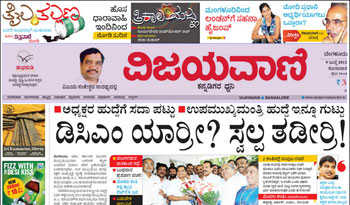
    Vijayavani launched its ninth edition in Karnataka from Gulbarga on June 30. The Kannada daily started with only three editions when it launched on April 1 this year. It now has editions from Bengaluru, Mangalore, Hubli, Bijapur,Mysore, Gangavathi, Chithradurga, Shimoga and Gulbarga.


    Vijayavani was launched by Anand Sankeshwar, a leading businessman in the logistics space and a former newspaper baron. Mr Sankeshwar’s logistics company, VRL Logistics Ltd, has a fleet of commercial vehicles in the private sector. The company operates from 1,000 branches and franchisees across the country.


    In the last 3 months, Vijayavani is said to have averaged more than am innovation every week. An average main issue of 16 pages comprises four pages on local/ hyperlocal issues, two pages each on national, state and sports, one calendar page on entertainment/events, one page on serials/stories and  one page on commerce/business.


    In addition, Vijayavani carries  four page-supplements on various subjects – Vittavani (Commerce), Lalitha (Women), Masth (Youth), Samskruti (Culture), Cinivani (Cinema), Putani (Children), and VijayaVihara (Sundays). The paper is the only daily in Karnataka with all colour pages across all its editions.


  • Magazines high on engagement but efficacy is key (+Video)

    By Our Correspondents


    The best compliment that befits the domain of print is its ability to appease the readership preferences of its readers while continuing to be a favourite with the advertisers as well. This is especially true in the case of magazines that continue to demand loyalty from consumers while at the same time enabling brands to come up with campaigns that can be as intimate and personal thereby ensuring maximum bang for their buck. But despite all the hype and hopes surrounding the medium, there is also talk of magazines not being able to do enough to prep up advertisers to loosen their purse strings, a fact that is compounded by the lack of (creative) ad innovations that continue to deprive the sector of its fast growth.


    As a way to measure the acceptability of magazines amongst its readers and find out its favourability with brands, Association of Indian Magazines (AIM) engaged the services of two research agencies IMRB and Quantum to carry out an Engagement Survey in the Indian marketplace. With a sample size of 3600 and spread across 10 cities, the survey had pretty interesting facets to throw up. Facets that could help revive the glory that magazines once commanded and even emerge an absolute favourite with the advertisers.


    Tarun Rai
    [youtube width=”400″ height=”225″]http://www.youtube.com/watch?v=cZuu2VvNty4[/youtube]

    Unveiling to the gathering some of the findings from the survey, Tarun Rai, CEO of WWM and President of AIM began by bringing to light how the media marketplace in India has seen an immense transformation. Be it television that has seen the number of channels exceed 745 in the last three decades or even newspapers and magazines that keep sprouting intermittently, the medium has never seen such a head rush ever before. In effect, media has become an ‘Always On’ medium in India today. But too many options have also led to the consumer becoming more distracted and confused leading to him/her losing trust on the medium. According to Mr Rai, the question that needs to be asked is whether everyone is communicating messages or just communicating noise and better still, whether there was a need for owners to move from more messages to better connections with the consumers? Mr Rai didn’t hesitate here when he said that “magazines make better connections than any other medium.”


    Proceeding to present more findings, Mr Rai said that magazines stood out as it was able to connect with the readers at a far deeper level and that they rated higher on engagement and trust scores. Other stats include: 68 per cent readers read magazines when they’re alone while 66 per cent turn to magazines when they want to relax; 87 per cent readers do nothing else while reading a magazine compared to television that recorded 40 per cent; only 12 per cent ad avoidance was recorded for magazines – the lowest by far for any medium and most importantly, 84 per cent of the readers believed that ads are part of the magazine experience and that they are not interruptions as was previously thought.


    Adding further, Mr Rai said, “The high points are the facts that this research very conclusively prove that magazines engage the readers and audiences the best across all media. Whether it is on trust, whether it is on propensity to purchase or whether it is time spent on magazine, there is no other medium which engages as best as the magazines do.”


    Shashi Sinha
    [youtube width=”400″ height=”225″]http://www.youtube.com/watch?v=UAGJWPzAEeM[/youtube]

    To verify the several advantages that magazines had to offer and whether the power of the medium was being harnessed to its fullest, the evening proceeded to a panel discussion that included the likes of KV Sridhar, National Creative Director, Leo Burnett; Mrinmoy Mukherjee, Director – Marketing & Business Development, Raymond; Nathalie Gerschtein, General Manager, Garnier India; Shashi Sinha, CEO, Lodestar Universal and Shubhranshu Singh, Director – Marketing, India & South Asia, Visa. The session was moderated by Annurag Batra, Chairman & Editor-in-Chief, exchange4media group.


    According to Ms Gerschtein, while magazines were a key medium for FMCG companies like Garnier, it was essential for them to be relevant and contextual to the needs of brands. She went on to cite one such example which demonstrated the power of magazines in enhancing the visibility and personality of a brand. The brand was L’Oreal Paris that was celebrating 40 years and the magazine with which it partnered was Femina, that had attributes which were similar to what was required.


    Mr Sridhar was at his explosive best as he began by expressing his love for the medium of print. “I have grown up on print advertising and I can say that if you are a book lover you will never go to the movies. That’s because the written word has more power; in fact it will never go out of power.” Adding further, Sridhar said that all mediums today are efficiency driven but it was important for them to have an emotional connect with their consumers – something that television has being doing so well. “It is important for every medium to reinvent itself because ultimately branding is about finding a purpose in people’s lives. According to a recent survey it was found that people were inspired more by brands (13 out of 20) than by celebrities, which is noteworthy. It is therefore essential for brands to build an emotional connect as it does in providing efficiency.”


    Mrinmoy Mukherjee
    [youtube width=”400″ height=”225″]http://www.youtube.com/watch?v=BCGbwMf89Wg[/youtube]

    According to Mr Singh, it is important to know that engagement is a two-way thing. Consumers are leading their lives in continuum today and mediums have to be able to accommodate to his needs faster than ever. “When I talk to a brand, I expect it to talk back to me and keep evolving. That is where the challenge lay for brands and magazine owners.”


    Said Mr Mukherjee, “There were several high points from the survey but what is important is that this survey brings out several areas which ensure that you get the information about how the consumer connects with magazines and that is overall a high point. It is also an enabler for decision making for brand owners.” Speaking on the importance of such surveys for the magazine industry, he said, “the survey is a first of its kind and it is important because it tells media planners and brand owners what they should be putting their monies on. Therefore it is like creating a currency basis which they get to decide.”


    Providing his insights on the survey, Mr Sinha said that the Engagement Survey is a very powerful idea. “There is a lot of data, but the data must be presented in the right manner to the media planner because media planners look at the numbers from IRS (Indian Readership Survey). The best thing would be to go agency by agency and present this data to media planners at the universal level, which is when this survey will be very powerful.” According to him, “Such surveys are important to open up people’s eyes and minds but, finally if you make it part of the mainstream survey like for instance a substitute for IRS or part of IRS on continuous basis, then that is where it is important otherwise it will be the way it is.”


    Advocating the future that lay ahead for the magazine industry, Mr Sinha said, “I believe that the year 2013 and 2014 will be a very big year not only because of what the magazines are doing but also what is going to happen to television. So depending on what the government decides to do both from digitization point of view and the restriction of advertising point of view, there will be an increase in cost for television. So a lot of advertisers who cannot afford television will look at alternate medium and magazines will be very viable for SEC A audiences. So I think it will become a lot more mass effective medium then.”


    When asked whether magazines have been looking to overpower other prominent media vehicles in the future, Mr Rai said, “We are not here to replace any media. All we are saying is that magazines do certain things that no other media can do. Magazines engage with consumers at a much deeper level and at a much more consistent level than any other media. A lot of people think magazines only build brands and that they don’t need to actually purchase but, our research shows that the propensity to purchase the call to action after seeing an advertisement in a magazine is highest amongst all media. So we are trying to now talk about the fact that magazines are not just good for brand building but, we also give you the best return on investment (ROI) where purchase and call to action are concerned. So we just want to start a new conversation which is beyond numbers, beyond eyeballs and talks about the quality of engagement and the quality of messaging.”
     

  • Bhaskar’s Brain Hunt gets 80k qualifying entries

    By A Correspondent


    Brain Hunt 2012, an initiative of Dainik Bhaskar Group, was a national level creative contest based on ‘out of the box thinking’ for young Indians. It set a benchmark with a response of 80,000 entries that qualified for the contest.


    This follows earlier initiatives like Junior Editor 2011 which was recognized for ‘Largest Writing Competition’, with 67,130 entries by Guinness World Records, Limca World Record and India Book of Records.


    To participate in Brain Hunt 2012, the contestants had to complete 16 activities featured in the workbook specifically created for kids between 6 to 16 years of age. Questions like ‘What if ‘Bapu’ was alive today?’, ‘After a series of inventions like iPhone, iPad and iTunes, what’s next and why?’, ‘What 10 things would you like to take with you on your journey to moon?’ are example of the questions the kids had to answer.
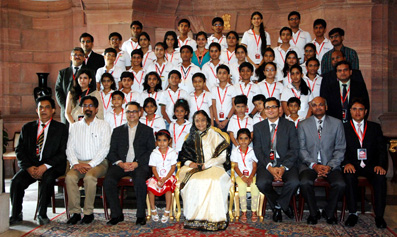
     

    The 80,000 qualifying entries included a letter written to the President which shared the kids’ ideas on ‘How can we makeIndia even a better country’. The winning letters were handed over to the President at Rashtrapati Bhavan during the award ceremony.


    Vinay Maheshwari, Vice President- Sales and Market Development, Dainik Bhaskar Group said: “The journey which started with a mere idea turned into some beautiful masterpieces of the imagination of 6 to 16-years-old kids, giving a new dimension to every challenge on which they were tested.”


    He added: “The reader engagements are carried out with a sole objective of engaging and involve our readers to strengthen the relationship. The group has successfully raised the bar with constant innovations and simultaneously reaching out to almost all household with its smart engagement proposition. Our upcoming smart reader engagements will now put higher emphasis on participation and contribution of both children and parents through such initiatives provided by Dainik Bhaskar to nurture their hidden talents.”


    The award function at Rashtrapati Bhavan, presided by the President of India, Hon Pratibha Patil was also attended by Dr Bharat Agrawal, Executive Director, Dainik Bhaskar Group.


  • Prabhat Khabar launches Panchayatnama in Bihar

    By A Correspondent


    Prabhat Khabar successfully launched fortnightly tabloid Panchayatnama, targeted towards the rural areas of Jharkhand and its Panchayat related issues, in Jharkhand. Now taking it a step further, Prabhat Khabar has now launched Panchayatnama in Bihar on July 11. This launch took place with an inaugural function in Patna, presided by Mr. Nitish Kumar, chief minister of Bihar.
     

    Panchayatnama will have 40 pages tabloid and will come with a price tag of Rs10. It will be circulated in all 38 districts (8842 panchayat) of Bihar with approximately 25,000 copies on day one.


    Panchayatnama is a way to allow the growing media industry to connect with the vast rural population ofBiharand let the rural population get an opportunity to voice their problems and developmental aspirations.


  • Free Press Journal celebrates 84th anniv

    By A Correspondent


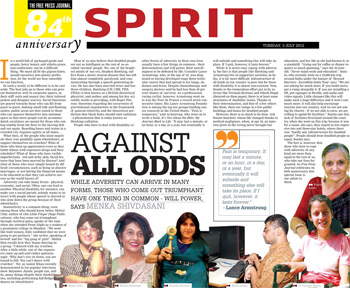
    The Free Press Journal, one of the oldest dailies published from Mumbai, recently celebrated its 84th anniversary by publishing a special eight page pull-out called Spirit.


    To celebrate this intangible, yet very relevant, human trait called ‘spirit’, The Free Press Journal decided to profile Mumbaikars – men and women of courage – who did not give up. The issue was an attempt by The Free Press Journal to inspire Mumbaikars and present them with living examples of persons who surmounted obstacles by summoning the indomitable spirit.


    Each page of the supplement had profiles of persons who summoned their inner strength, to deal with life challenges. The pull out had people like Raageshwari Loomba spoke on how Bells Palsy did not stop her from fighting back and opening up a new world; activist and lawyer Flavia Agnes spoke about the struggle of fighting domestic violence and how she battled years of abusive marriage.


    The anniversary issue was received very well across the market thanks to the theme and the array of articles.


  • Sanjay Sharma joins Bhaskar for sales

    By A Correspondent


    Sanjay Kumar Sharma has joined Dainik Bhaskar group as Regional Head (West). He will be responsible for sales revenue across all products in Dainik Bhaskar Group’s portfolio.


    Mr Sharma has a rich experience of 22 years in Sales, Marketing, Customer Service and Business Development. He has an extensive experience in spearheading businesses across Telecom and Consumer Durable companies.


    Mr Sharma is an MBA (Marketing) from Pune University and have worked in companies like Unitech Wireless (Uninor), Bharti Airtel, Reliance Communications Ltd., ZIP Telecom, Samsung India Ltd. and Philips India Ltd. His last assignment before joining Dainik Bhaskar group was with Unitech Wireless.


    At a personal level, Mr Sharma likes to read, is an ardent fan of cricket and likes to travel and explore new locations.


    On his appointment Mr Sharma said: “Media is a new challenge for me and I am happy to be part of Dainik Bhaskar, the leaders in Print Media business.”