Category: MEDIA

  • Avik Chattopadhyay: The Poverty of Indian sport!

    Avik ChattopadhyayBy Avik Chattopadhyay


    Well, the games are finally over, and we have done our best in the ‘arena’. The euphoria around the medal winners will remain till the time our “men in blue” ‘conquer England’!


    While we celebrate and savour our first ever gold in athletics and a total tally of seven medals, we lie in the 40s in ranking. The question remains as to why we end up winning so few medals in every edition of the Olympics. Before Tokyo, our best performance was in London when we got six medals. Since 1980, we have not won a team gold and the only previous individual gold was in 2008.


    It is not that we do not create world champions outside of cricket. We have quite a few of them in boxing, shooting and archery over the last decade. This has been despite the state of Indian sport and our collective deliberate apathy.


    Indian sport is poor. The poverty is not in the talent and the individual drive to excel. The poverty of Indian sport lies in the ecosystem built around it, composed of administrators, sponsors, policy makers, media, supporters, public and business enterprises. The commitment and support of the eco-system lets the sportsperson down, time and again. The hypocrisy, grandstanding and posturing gets exposed. And it got exposed once again in these Olympic games…


    • When we had debates on television channels on how to become a “sporting nation”! Experts professed how all children should be made to play a sport and only then will the parents appreciate this aspect of growing up as well produce a huge talent pool. Given the obesity rates in children in the US, GB, and Italy right now, they surely cannot be sporting nations!! Sport is treated there as a viable profession for the athlete and as serious business for some of the world’s biggest brands, from apparel to equipment and supplements.


    • When we admire pictures of the less than humble living conditions of many athletes and talk of their ‘struggles’ without being ashamed of keeping them in such a state in the first place!


    • When the broadcasting channel shifts focus on the sports minister cheering from a studio while your national team is marching past in the opening ceremony.


    • When Amitabh Bachchan, Bipin Rawat, Akshay Kumar, Sudha Murthy, Sajjan Jindal and Kiren Rijiju are brought in to cheer your contingent and give ‘victory punches’ while PT Usha, Abhinav Bindra, Rajyavardhan Rathore, Dhanraj Pillay, Karnam Malleshwari and Leander Paes are ignored!


    • When not a single state government adopted a sport inspired by the way Odisha has done with hockey, instead of merely congratulatory tweets and banners up in their respective cities.


    • When you share lists of “India’s narrow misses in 4thplace finishes” and feel that is enough to satiate us as a nation.


    • When the broadcasting partner starts promoting an upcoming cricket series on its channels telecasting the Olympics as if directing the nation to go into its “comfort zone”!


    • When we do not have a single world-class sporting brand all these years while other developing nations have created a few that are endorsed globally and proudly displayed by the national teams.


    • When the national channel with terrestrial reach is not allowed to share the feed by the broadcasting partner depriving more than 60 million television owning households who watch only DD. It could have actually been a “Barshim-Tamberi moment” for Indian broadcasting.


    • When there are clear best practices available from lesser privileged nations like Ethiopia and Nigeria on how to develop talent, but we wish to be bound by archaic methods of grassroots development.


    • When state governments announce rewards for an athlete after winning a medal but provide no incentives and infrastructure to him / her when preparing for the same!


    • When corporates look for returns on investment from sponsoring sports that need long gestation periods while lamenting why we do not win more medals than Cuba or Kenya does!


    • When names of sporting awards need to be changed as a political gimmick after a certain team wins in the Olympic year and not in the normal course of time!


    • When most sportspersons look forward to getting a secure job with a secure salary in a corporate / PSU / government as a career in sports has none.


    • When the broadcaster wastes time on stretched inane discussions and debates instead of covering as much live action as possible.


    • When our sporting federations are headed by politicians or political appointments for decades, damaging all chances of progress through nepotism and corruption.


    • When a state government announces crores as prize for a medal winner and will build a stadium for him in his village after the win but not before.


    • When a football league for children folds up for want of Rs.20 lakhs per annum when brands vie with each other to spend the same amount on 3-4 ad spots on IPL.


    • When media covers foreign football leagues more than raising the issue of building local ones.


    • When we hunt for foreign coaches for our athletes but have no Indian coaches doing the same for other nations.


    • When the country’s premier football league boasts of international players and coaches who are either spent forces or come from second / third division leagues.


    • When the country’s national sport was not officially accepted as one by the Ministry till the chief minister of Odisha had to write to the Prime Minister to officially declare it so in 2018!


    • When e-commerce brands give you 15% off using code ‘HOCKEY’ after the games but have no crowdfunding initiative for the team when they train.


    Avik Chattopadhyay is a senior brands strategy consultant based in Gurugram. He writes on MxMIndia on most alternate Thursdays but sometimes on other days as well. His views here are personal.



  • Avik Chattopadhyay: By BMKJ, it’s ISRO!

    By Avik Chattopadhyay


    For the last one week the nation has been obsessed with the moon, and for the right reasons. After all, a bunch of unsung people who have dedicated their lives to true scientific research were about to perform a feat that brings adulation and accolades for the nation from all corners of the world. There would be no divided opinion, no detractors and no sceptics for this. This was pure ingenuity combined with dedication and determination, ably supported by a frugal budget, out to once again prove that the “Indian” can and is above caste, politics, isms and polarisation.


    ISRO is a unique brand, in a brand called India.

    It is unique in its very history and legacy…right from being set up by a man who understood what scientific temper would mean for future generations, supported by a Prime Minister much maligned and ridiculed now, to inducting people purely on merit and passion, to constantly punching above its weight in the missions it takes up.


    ISRO is what the public sector undertaking was envisaged as by the ridiculed PM when he called the PSU the ‘temple of modern India’. It is all that a newly independent country’s aspiration was… building world-class institutions, filling them with the best talent from within and the world and then giving them the freedom to go ahead and achieve…for collective benefit and progress. That is the model of true nation building.


    There are no ‘reservations’ in ISRO. There are no quotas. Politicians do not recommend appointments. There are no hidden agendas to cater to. At the same time, it is very un-private enterprise like too. It works on shoe-string budgets for “launches”. It typically shuns the limelight. It believes in nurturing its employees for life, and it has 16,000+ of them. And it does not make investor pitches or shareholder presentations.


    In this context Chandrayaan 2 has been a curious exercise, for me as an observer. Never before has there been so much hype generated for any Indian space mission.


    This looked like an event manager’s delight with an omni-channel overdose of “space science”. The social media was alive and clicking with all types of messages and memes. Television programmes were created with otherwise boundary-line jesters at cricket matches being flung at us. There was even one ex-NASA astronaut who was roped in for one such circus. Poems were written. T-shirts were made. News channels found a reason enough to fill in 24 hours of content, day after day.


    And then the marketing wunderkids from the government flew in onto this entire jamboree being conjured. Their MBA schools had taught them about focused communication. And that had to be the moment Pragyaan would imprint the Indian national symbol and ISRO’s logo on the lunar south pole! So, the entire Chandrayaan 2 mission came out to be that single defining moment when we Indians would leave our imprint on the moon. Just like we do on historical monuments! “Ravi loves Archana” kind of stuff, literally. The entire focus was on Vikram and Pragyaan. “Fifteen minutes of terror” as the national lapped up. This was “national pride” re-defined. Thankfully the Pakistanis have had nothing to do with space or we would have had another occasion to bash them up digitally.


    Someone, just someone, had to step back and tell these spinmeisters to back off and give the entire mission the proper perspective it deserves. The Prime Minister sitting with the scientists there and texting away to the nation is not camaraderie. That comes from increasing the mission budgets and allowing the team to truly flex its muscles without constraints. Frugality is not a virtue expected from a space mission. It very much is from government spending on MPs’ salaries. And there is no need to have every moment of the Prime Minister’s sojourn recorded for the “wow” moments to be beamed up to the world. Some events need their correct dose of gravity and sterile distance. They need to be accorded that level of respect. Not everything is to be instagrammed or tweeted upon. Not every event is a photo opportunity until the mission is complete. Wish the same level of collective national excitement could be built on the 1st day of the harvesting season.


    A milestone space mission is not a ‘Mata ki chowki’.

    And for the Prime Minister to conclude his pep-talk with “Bharat mata ki jai”…completely off the mark and inappropriate.


    Obviously, the scientists at Bengaluru know their jobs and have already dusted off this little trespass!


    Avik Chattopadhyay is a senior marketer and strategy consultant. This column appears on MxMIndia every Thursday. His views here are personal


  • Are ‘Trust in News’ & ‘Happiness’ interconnected?

    Are ‘Trust in News’ & ‘Happiness’ interconnected?

    Avik ChattopadhyayTwo very interesting global reports have been published over the last one week. The first is the Reuters Institute Digital News Report 2023 and the second is the 2023 edition of the World Happiness Report. As a marketer and ‘brand-o-phile’, I see a subliminal connect between the two.


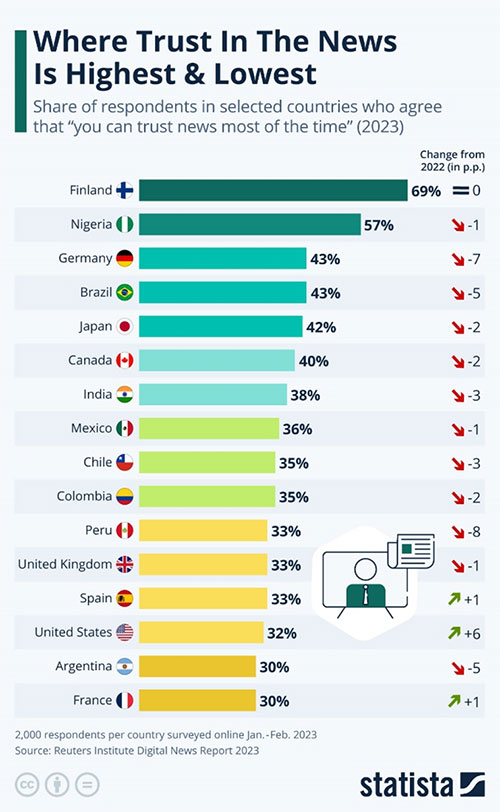
    The Reuters Institute Digital News Report is an outcome of more than 90,000 responses across 46 countries on how much one trusts news, through conventional as well as digital media. While the overall global trust score has dropped a few percentage points, the report states that “it is not surprising that news consumers are increasingly feeling overwhelmed and confused, and many are turning away temporarily or permanently. Selective news avoidance and news fatigue have been exacerbated by the challenging times we live in.”


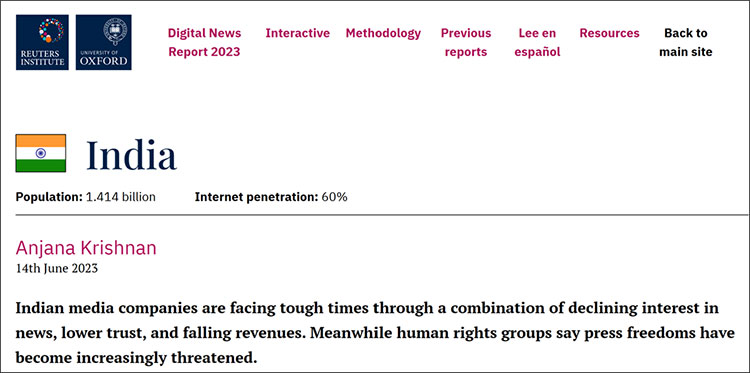
    India is somewhere middling with 38% of news consumers trusting what they read and see. It has dropped 3 % points since the 2022 report. Now with the election season looming upon us, one can expect a sudden drop in the score with every political party resorting to downright unethical and fake communication without batting an eyelid on the impact on an already tense social fabric.

    The special note on India in the report is quite telling.


    Credibility is a huge factor. With the latest Press Freedom Index ranking of 161 out of 180, however much one may want to downplay the Reporters Without Borders study as being driven by agenda and deliberately disparaging towards the world’s biggest democracy, one cannot cross one’s heart and denounce it.


    The note states that “our Digital News Report survey finds steep falls in both the consumption and sharing of news. There was a sharp decrease in access to online news (12 percentage points lower than last year), particularly through social media (-11pp), the main sources of news for a predominantly younger audience. Television, popular among a large section of the population, also saw a 10pp decline as a news source with our younger and more urban-based sample.”


    While the government has brought checks and measures for media platforms, especially digital, on the authenticity of the news and its possible impact on factors like social harmony and national security, there are none for the social media teams of all political parties who deliberately churn out one-sided or fake posts, with the clear objective of misleading the populace and even instigating it into unrest. When the digital platforms dig up and expose these untruths, there is no legal recourse to punishing these people. All the Johnnies are consuming too much sugar without remorse.


    As the judiciary at the highest level seems to be the only panacea for most ills in the country, some sane citizens should file a PIL against such lie-spinners and let the court pull them to task.


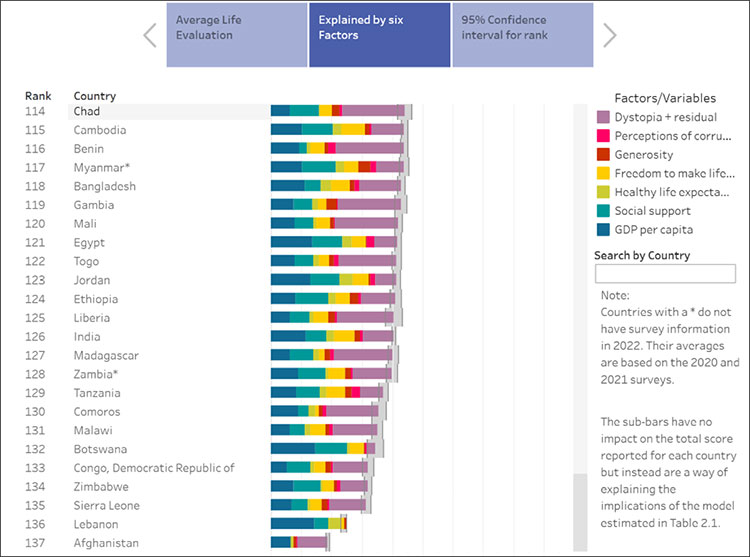
    The second report is the much debated and hated World Happiness Index by Gallup wherein certain sections of our thought leaders and citizenry cannot understand how can people in Pakistan, Bangladesh and Sri Lanka be happier than us, especially when we are going through our “Amritkaal” towards becoming the undisputed “Vishwaguru”. They need to understand that once again, this global report is not being undertaken with the sole purpose of showing India in bad light, but to help us introspect.


    If we study our score across the seven parameters in the second chart below, we will observe that we score badly on factors like life expectancy, corruption and generosity. These factors may not be as easily measurable like per capita income and are largely perceptual, but strong enough to take our score down. Also, the dystopia score is significant enough implying an undercurrent of social stress, possibly amongst certain communities.


    How are these two reports interdependent? Happiness is an active ingredient for trust. The lack of the first leads to increased scepticism and therefore the tendency to discount what you consume as news. You may put up a brave face in one report but the mask comes off in the other one.


    You posture to amplify the news that you opt to believe in as it shows you in better light. That is a fundamental defence mechanism, borne out of deep down insecurity and an inferiority complex. It is not that you openly consume and debate all sorts of news and digital content to logically establish that you are in the right. Similarly, you pose as happy, taking selfies next to objects, visiting places or doing things that take you away from your uncomfortable harsh reality. When it comes to responding to a survey, your disappointments with aspects of life around you get exposed. It is not the proverbial bed of roses.


    No external intervention can work in this case. Only a slow and gradual improvement in collective consciousness can shake the citizenry out of this sucrose-induced slumber.


    As a common citizen, you too are consuming enough sugar without even admitting to yourself. That is far worse than the media magnate spinning fake stories to drive you into a frenzy.


    The festival of democracy is less than a month away. Look before you leap.

    Jai Hind!


    Avik Chattopadhyay is a Gurugram-based brand and business strategist and commentator. He is currently also working along with XLRI to set up the Indian School for Design of Automobiles. He writes on MxMIndia every other Thursday. His views here are personal.

  • Warner Music partners JetSynthesys’s Global Music Junction

    Warner Music India has expanded its partnership with Global Music Junction (GMJ), the music and entertainment subsidiary of JetSynthesys.  The companies struck a distribution deal in 2021, but this new agreement sees Warner Music make a strategic investment in GMJ, giving it a seat on the Board.  The move, notes a communique, will establish Warner Music India to become the largest player in the central Indian music market.

    Says Alfonso Perez Soto, President, Emerging Markets, Warner Music: “This is a significant milestone in the expansion of our presence across India.  Working with the amazing team at GMJ last year not only strengthened our partnership but enabled us to better support artists from the central regions of India, bringing them the best artistic support that any company can provide, and helping them connect with fans across the country and around the world.  India is one of the most exciting music markets in the world and with GMJ as a partner we’re right at the heart of it.”

    Added Rajan Navani, CEO and founder of JetSynthesys: “Our journey with Warner Music has been remarkable, highlighted by some successful collaborations. The indigenous languages in which we operate, such as the Bhojpuri, Haryanvi, Oriya, Kannada and Gujarati language markets in India, have seen incredible growth in the recent past. Warner Music’s investment in Global Music Junction and its continued collaboration with us will fast track the increasing expansion of India’s regional music industry. With our combined collective vision and understanding of audience preferences, we aim to strengthen the ecosystem by meeting the growing fan demand in the music and entertainment space. We are looking forward to more successful outcomes from our longstanding collaboration.”

    Said Jay Mehta, Managing Director of Warner Music India: “Our partnership continues to have a significant presence in the places in the Indian market which are growing most rapidly, and so enables us to be the fastest music company in our expansion.  GMJ is a leading player in five language markets in central India and works with some of the biggest names in Indian music and show business.  This is a critical moment in our expansion across the country as we seek to position Warner Music India as the number one choice for all discerning artists and labels.”

  • The Rise & Rise of the IPL

    The Rise & Rise of the IPL

    Source: www.iplt20.com


    Shailesh KapoorThe 17th edition of the Indian Premier League kicks off tonight. To say that it’s the biggest media event in India by some margin will be stating the obvious. The gap between IPL and other big-ticket properties has only grown wider over the last decade.

    The stature of IPL is reflected in our new report, titled The Ormax Sports Audience Report: 2024. The sampling of IPL in the 612 million audience base of cricket in India is higher than that of the ICC World Cup, by a good six percentage points. The list of most-recalled sporting franchises in India (across sports) sees a clean sweep, with the 10 IPL teams taking the top 10 positions, ahead of Manchester United and Patna Pirates, which are the most-recalled leagues in football and kabaddi respectively.

    In its first few years, IPL faced its share of controversies. But in its second phase, the league has been able to put cricket first, and that has helped it move away from the erstwhile imagery of a flippant brand, towards building credibility as a talent platform. This shift is fundamental in nature, and has held IPL in good stead.

    IPL is now a way of life for those in the media industry. Till not too many years ago, there was a lot of chatter about how GECs should dodge the IPL googly. Now, everyone has a playbook of sorts, and it’s not a topic to lose sleep over, anymore.

    This year’s IPL will be held amid the political fervor around the General Elections. News-wise, IPL will play second fiddle. But in terms of monetisation and viewership, it will continue to stay at the top. The stronger franchises are profitable now, and BCCI continues to get richer with each edition. Yet, there’s ample room for growth, as fan bases are continuing to build, especially for franchises that have made late entries, or taken their time to get going.

    This year’s IPL will also see younger captains across most teams. The average age of the 10 captains this year is 30 years, which is three years younger than the 33 years average age in IPL 2023. The old guard is passing the baton to the new, and that’s always a good thing, especially in a talent platform like IPL.

    Amid all the excitement, the biggest highlight of this IPL is going to be the return of Rishabh Pant. The actor survived a near-fatal road accident in December 2022, and his incredible recovery over the last 14 months has been a miraculous one. How National Cricket Academy has helped Pant get back to match readiness against all odds is perhaps the best example of BCCI money being put to great use.

    Pant is leading the Delhi Capitals side, and their first match is scheduled for tomorrow afternoon, at Mohali. We can expect a roaring reception to a special talent, who first got noticed via the IPL itself, before making it big at the international stage. I won’t be surprised if he makes this IPL his very own, to announce a comeback we have all been waiting for. Game on!

  • SBI Life Breast Cancer Awareness programme

    Taking cognisance of the trials and tribulations of the women in police, SBI Life on the occasion of ‘International Women’s Day’, organised a Breast Cancer Awareness Programme under its ‘Thanks-A-Dot’ initiative for the women officers of Mumbai Police, in association with Lion’s Club.

    Addressing the women officers of Mumbai Police, Amit Jhingran MD & CEO, SBI Life Insurance said: “It is an honour to stand alongside the courageous women of Mumbai Police together, we intend to pave the way for a future where breast cancer is no longer a threat to the lives and dreams of our loved ones. SBI Life’s ‘Thanks A Dot’ serves as a beacon of hope, empowering women across the nation to take charge of their well-being. By instilling the importance of regular self-examination, we aspire to redefine the narrative surrounding breast cancer awareness in our country.”

  • Market Research in the Age of AI

    Market Research in the Age of AI

    Ashoke AgarrwalWhen one plots the future of Artificial Intelligence (AI) in marketing, one arrives at a singularity where all of marketing is the AI avatar of a brand in direct conversation and interaction with the AI avatar of the consumer. I have called the AI avatar of consumer – Concierge Intelligence in many of my columns here, including my first MxMIndia column back in Jan 2022 -“The Coming Post-Digital Age”.


    However, plotting and thinking about the intermediate points would be helpful.

    I have been part of a team working since 2020 on using Natural Language Processing (NLP) to generate secondary research semi-autonomously. The launch of GPT-3 and subsequent versions reframed the project for us. Like scores, perhaps hundreds worldwide, we are now trying to find a market niche, proprietary prompt engineering, and the correct interface to support a viable business. Say, a freemium WhatsApp interface for Indian SMEs offering online business consultancy services based on open-source predictive and generative AI models working on public and paid data sets.

    What about the emerging role of AI in primary consumer research? The big two—Alphabet and Meta—have been using predictive AI for decades to segment consumers, keep them engaged with their social media feeds and search results, and harvest clicks so their advertisers can pay them big bucks.

    Over the past decade, big corporates from both the B2C and B2B worlds have been using Big Data and Predictive Analytics to fine-tune their business and marketing plans. However, it is unclear whether they are at the cutting edge of predictive AI, just as Alphabet and Meta are. While a lot is currently being made of Generative AI and the likes of GPT, Llama, Gemini, etc., I bet that we shall discover that the disruptive power of AI will come not from generating sentences, pictures, videos or music but from underpinning key business, economic, social and personal decisions based on a dynamic array of multi-dimensional data sets. While predictive AI underpins generative AI, a different kind of predictive AI will also underpin the AI age. It will be predictive AI that works on an integrated, dynamic view of the natural world to deliver strategic action plans and monitor and fine-tune them. To use this level of AI, corporations and governments will need to go beyond internal data sets and subscribe to a whole range of third-party data sets.

    One category of these third-party data sets will be garnered through an IoT network of sensors synthesised with publicly available identification data sets—for example, vehicle movement with ownership details or scans of browsing shoppers, personal IDs and billing details. The ownership and personal ID can be scrubbed of all details except for basic demographics to meet privacy rules. Alternatively, the individual could opt to belong to an ID Bank that holds his details in escrow and can release them, using blockchain technology on payment of a fee – thus making the individual the valid owner of his ID and personal data.

    The ID Bank idea will fuel the second category of third-party data sets. These data sets will contain in-depth profiles of individuals, including contact information, demographics, psychographics, societal and cultural attitudes, media usage, product and brand usage, and purchase behaviour and intentions. The ID Bank will have a watertight agreement with the individual on securely holding the data and releasing any of it to a third party only upon approval and release of a specified fee.

    Corporations can then request the release of specified data from a selected consumer profile. For example, a car company may ask for a data set consisting of individuals who own one of a set of car models and have indicated a purchase intention for a new car in the next six months with permission to contact with offers. The ID Bank, in discussion with the consumer, will quote a certain fee on payment, for which the data will be released in a blockchain format that allows for usage tracking. The fee will be released to the consumer’s account, and the ID Bank will get a management fee.

    Creating, managing and marketing the two categories of data sets envisaged above will define the future of the market research industry over the next few decades.

    The corporation’s predictive AI systems will define the need for data from third-party data sets, consider the cost-benefit of buying them, and incorporate them into predictive analysis to build business and market plans.

    Over the decades, as AI and consumers become more sophisticated, intermediaries like ID Banks will be cut out, and a brand’s AI will be in direct touch with a consumer’s Concierge Intelligence (CI) with market research evolving into a version of anthropology focused on studying the behaviour of AI systems. “AInthropology” anyone!?

  • Chrome unveils ‘Galact’ TVC

    Chrome Pictures has unveiled its latest film ‘Galact’, directed by Roopali Singhal. The film, notes a communique, celebrates motherhood and the bond between the child and their mother in a candid, authentic, and graceful manner.

    Said Sidhant Mago, Creative Head at Daftar Creative Consultancy: “When I first heard about Galact, it instantly reminded me of the iconic Bollywood line ‘Ma ka doodh piya hai toh saamne aa…’ We all know there’s nothing that compares to a mother’s milk. That’s why we wanted to craft the film around this powerful theme, reminding everyone of the irreplaceable bond between a mother and her child. Kudos to Roopali and the team for bringing this vision to life so beautifully.”

    Added Singhal: “Sidhant Mago yet again came up with a unique and edgy script and Abhishek Notani (Producer) and I were instantly hooked.  As a Director I knew it was paramount to get the tonality right. While retaining the essence of the subject, the biggest challenge was to make an engaging and light-hearted film. On top of that, we had to get viewers to accept the visual of a mother breastfeeding on camera. I was sure that the best way to do this was to shoot with real lactating mothers. Thanks to an incredibly sensitive and graceful crew we were able to overcome that challenge with ease. It was a joy to shoot with children and is reflected in the film. Shubhojit Mukherjee’s music was the last magic touch that the film needed.”

  • Colors launch third collab with Imperial Blue

    Viacom18’s flagship Hindi entertainment channel Colors launched a campaign to launch its third collaboration with Seagram’s Imperial Blue Packaged Drinking Water and Wavemaker India for its #FansWaliHoli campaign, powered by generative AI technology. This initiative delivers a personalised and interactive Holi experience for the fans, unprecedented in its scope.

    Said Vivek Mohan Sharma – Head, Branded Content, Viacom18: “We are constantly striving to push boundaries and explore innovative ways to connect brands with audiences. Building on Viacom18’s vision of adopting technology every step of the way, we are approaching content marketing through the lens of technology as well. By leveraging generative AI, we have created a fun and interactive experience for fans to celebrate Holi with their favourite Colors stars, while seamlessly integrating the Seagram’s Imperial Blue Packaged Drinking Water brand message. This campaign is a perfect example of how we are marrying content solutions with cutting-edge tech to deliver a holistic brand and content experience.”

    Added Ishwindar Singh, Pernod Ricard India: “Seagram’s Imperial Blue packaged drinking water stands for embracing life with a smile and Holi, the festival of colours, is the perfect occasion to showcase our brand’s commitment to inspiring smiles and light-hearted moments. Partnering with Wavemaker and Viacom18 has allowed us to merge technology with celebrations to amplify the consumer experience through developing engaging campaign around key festivals like Holi.”

    Said Shekhar Banerjee at Wavemaker India: “At Wavemaker we are extremely proud to partner with our client Pernod Ricard India and brand Imperial Blue packaged Drinking Water to have continuously deliver on engaging innovatively with our consumers. Holi wishes delivered through an AI led campaign which puts you in the same frame with your favourite celebrity and recreates a beautiful poster which can be shared on social, go up as a poster in your room, be your wallpaper or give you bragging rights within your circle, is simply magical.”

  • BBC Studios Social searching new talent globally

    In the first event of its kind, the commissioning team from BBC Studios Social is inviting indies of all scales and backgrounds to pitch fresh, short form concepts that extend and enrich existing IP, engage loyal fans, and reach new audiences on digital platforms.

    Said Chris Allen, Director, Digital Content Development: “In an increasingly competitive and fast maturing digital-first market, BBC Studios Social are committed to finding, developing, and partnering with the best independent producers and new talent globally. We love our world-class brands, and we’re super excited to share them with you to deliver new formats, new talent, and new ideas that are critical and commercial successes. Whether silly comedy sketches, or a mind-bending science documentary, we hope this will be the start of some beautiful creative partnerships.”

  • Digitas India wins digital creative mandate of Deoleo Olive oil

    Digitas India, a connected marketing agency within the Publicis Groupe, has won the digital creative mandate of Deoleo India Pvt Ltd., the global leader in olive oil with esteemed brands such as Figaro and Bertolli.

    This collaboration entrusts Digitas India with the creative and social media responsibilities for Deoleo’s marquee products, including Figaro Olive Oil, Bertolli Olive Oil and Figaro baby range. The objective is to transform these classic brands through cutting-edge digital narratives and enhanced consumer engagement. Digitas India will also help the brands to venture into new markets while reinforcing the allegiance of existing clientele and heightening awareness about olive oil consumption.

    Sonia Khurana
    Sonia Khurana

    Sharing her enthusiasm on the partnership, Sonia Khurana, Chief Operating Officer (COO), Digitas India, said: “We are excited about our partnership with Deoleo. Building a brand on social media takes a deep understanding of the platforms, how the audiences interact with the content on these platforms and an appreciation of the brand & category. We hope to bring the best of all these to make Figaro and Bertolli a success on social media.”

    Satarupa Majumdar
    Satarupa Majumdar

    Added Satarupa Majumdar, Marketing Director – India and Middle East, Deoleo: “Collaborating with Digitas India represents a significant step in our strategy to connect more deeply with our consumers leveraging social media. Their creative ideas align entirely with our brand ethos, and we are confident that this partnership will help us tell our story in more convincing and significant ways to our audience.”

    This partnership heralds the launch of a series of innovative campaigns designed to showcase the distinct attributes of Deoleo’s products while engaging a wider audience through creative and interactive social media marketing initiatives.

  • Technology and the immortality of an advertising theory @IPL

    Technology and the immortality of an advertising theory @IPL

    With apologies to none at all

    By Vikas Mehta


    Vikas MehtaYet another season of IPL is underway. And like many millions, I have been following the matches keenly on JioCinema. Since I am travelling, I do not have access to DTH or cable to watch it on TV. So, my writing is based on my JioCinema experience only.


    Usually, I comment on the ads during the IPL. I will continue to do so. But this particular column is going to first recount my experience with JioCinema from a technology- and consumer-friendly viewpoint and then I shall take just two examples to highlight some issues in the IPL ads.


    I find the app very consumer-friendly during IPL. The home page highlights the match of the day and with one click, I am into the match. But when there are two matches then the homepage keeps on highlighting the first match, well beyond 7:30 pm and the second match requires real searching. The issue does not get resolved even by refreshing the page.


    In terms of the content, I find the ‘Jeeto Dhan Dhana Dhan’ contest very interesting. It’s a simple multiple-choice question based on what will happen in the next over. With one click, the answer is submitted. And before the next question comes up, one is informed if one got it right. But the beauty is that for all those who got right answers there is some prize. Usually, a discounted product from an online e-commerce portal. I, played it almost at the end of each over for two days and I had around 20 prizes. And the redemption was also well-planned. Click on the same page to redeem the prize. The right page, which offers only the products on offers open up. Your discount has been copied to the clipboard. Choose, fill your details, pay if required and the offer has been redeemed. No choosing of products and at check-out realising that your preferred products have no discount. No ambiguity. Very well-organised and planned. And at the last count, I came across nine brands offering the prizes. Two of the three I redeemed were delivered in Dehradun within 48-72 hours. And of course, there are bigger prizes for those who answer the most correct answers daily. Unfortunately, I did not have the patience to sit through all 40 overs and answer all questions. But kudos to a well thought through and planned contest.


    In terms of communication, I remember that ‘Jeeto Dhan Dhana Dhan’ was an offer that Jio had offered in the IPL four to five years ago. So, to find that this year MyCircle11 was sponsoring the contest was bit of a let-down. It also clashes with the MyCircle11 advertising as it caused a confusion in my mind if the contest had something to do with the gaming app offering discounts to play games on the app. I then realised that Tata had sponsored ‘Jeeto Dhan Dhana Dhan’ contest in 2021 and last year it was MRF. Personally, it’s a simple and rewarding contest and any sponsor will reap the rewards with a longer association. Like, I think Jio did for two-three years. I still remember it.


    Now, let’s focus on the ads. There were many new ads this year. Predictably, Dream 11 came up with, till now, the best campaign. Simple thought. Good use of the cricketers. I particularly liked the Mr Sharma ka beta mera beta featuring Rohit Sharma, KL Rahul and Sunil Shetty. It crossed the thin line between a cricketer and his personal life in a beautiful, interesting and heartwarming way, with a hint of comedy. Communication theories always say use celebrities who add to the brand personality and to the memorability of the ad. This is a great example of the same.  Watch the ad here.


    The other ads in the series have focused on personal rivalries. Bumrah vs Shreyas and then Shreyas vs Bumrah. Preity Zinta, co-owner of Punjab vs Pant got me cracking up at the end. Not in the same league as Mr. Sharma ka beta but at least Dream11 is not just splurging money on celebrities.


    I am now hoping to see a Hardik vs Rohit. Oh sorry. It’s about team loyalty. So maybe Hardik and Rohit.


    But the ad campaign which got me thinking was actually Parle. It has released a series of ads, thankfully without any cricketers or film stars. These address issues which are mostly intangibles. Difficult to pinpoint, prove or substantiate. So, difficult to communicate too. Quality, trust, variety, new products. The campaign has tried to use some odd metaphors or join some improbable dots to convey these messages. I just felt that someone is ramming down these virtues down my throat.


    And that’s when I remembered a gem of theory that was part of the JWT thinking process. The difference between stimulus and response. The theory mandated that do not put your benefit or message as a stimulus, rather let it be the response from the consumer. Do not spoon-feed. Let the consumer discover it. That way it will be more memorable and the communication will have a lasting impression. Remember the Ericsson black coffee ad? Nowhere it said the world’s smallest phone or even a small phone. It demonstrated its size as a stimulus and the response was “a phone so small it can hide in my palm.” No wonder the ad is recalled even after three decades. Watch the ad here.

    I feel that Parle has missed a trick. The amount of money that is spending trying to hit us with trust, quality and other parameters would have been much better spent if the desired response theory had been used.

    And this thought got amplified when I saw the Apple iPhone 15 app on storage for photos. It beautifully showed someone marking photos to be deleted and then they used a perfect song “Don’t let me go”. Each photo that was being marked for deletion suddenly came alive with the character in the photo singing the song. And at the end there was just a simple message which said lots of storage for lots of photos. They could have gone to town on memory capacity or on transferring photos to cloud through their cloud service. But by using the stimulus of each photo imploring not be deleted, through a song, the benefit was like a stimulus which I will not forget. Great ad.


    And we wonder why Apple iPhone commands such a premium and is yet a world leading brand! Watch the ad here.


    In fact the Preity Zinta vs Pant ad also is a stimulus vs response theory ad. Watch the ad here.


    I sincerely hope that some of the JWT theories like the stimulus vs response one are not buried along with the venerable brand.


    Before I end, I saw as a part of media co-sponsor super “Pepsi yeh dil mange more”. I was intrigued and excited to see what was the contemporary version of this classic Pepsi campaign. So, I found it on you tube. See it here. And let’s match our reactions in my next column.