Category: MEDIA

  • Content Innovation: AI and Beyond

    Content Innovation: AI and Beyond

    Shailesh KapoorIt’s hard to have a business discussion these days without a mention of AI very early into the conversation. Since the emergence of ChatGPT, artificial intelligence has been a buzzword that everyone wants to use. And not for the wrong reasons entirely. In the digital age, the role technology can play in businesses across the spectrum, including media and entertainment, is undeniable. And we have not seen it all. Not just as yet, anyway.

    Innovation is at the heart of many businesses, often featuring in core values of many companies, including some of the most traditional, brick-and-mortar ones. Technology is at the center of this innovation, and AI is expected to lead the way towards innovative creation and transformation of businesses.

    But there’s an irony in this idea too. I asked ChatGPT to define innovation in a business context. I got: “Innovation in the context of business refers to the process of creating new ideas, products, services, processes, or business models that add value to customers, improve efficiency, drive growth, or create competitive advantage. It involves transforming creative ideas into tangible outcomes that meet market needs or solve existing problems in new and better ways”.

    If we look at the keywords in this suitably verbose definition, the creative abilities of the human mind seem central to many of them. The deep linkage of innovation with technology can, hence, be a limiting thought. Especially because it can make those in “innovator” roles think only in one way. Yes, that’s the irony, right there.

    Tech-led innovation is great, but it will be heartbreaking if innovation begins to lose the human touch. In technology companies, this is a non-issue, because the innovators are also the technology guys. But if we look at something like entertainment, innovators are essentially writers, producers, directors, actors, marketers, salespersons, etc. The nature of the product relies on giving the audiences something compelling yet fresh. Self-learning technologies could simply be at cross-purposes with this idea.

    Suggestions that Generative AI can be used to write movie scripts is preposterous, for example. Think of the three most memorable movie dialogue lines of all time, across any language, and ask yourself: Can a “human-like” bot create the same human-like magic? We all know the answer.

    It is therefore crucial that entertainment businesses carefully craft the dos and don’ts of how to use technology for innovation. Technology, and AI within it, can be a content creator and distributor’s best friend. But like with all friendships, expectations must be set right. And the entertainment business worldwide runs the risk of erring on the wrong side here.

  • What business are the aggregator apps in?

    What business are the aggregator apps in?

    With apologies to none at all

    By Vikas Mehta

    Vikas MehtaA few weeks back I had written on the decline in the services of aggregator apps and related my personal experiences with a few apps. You can find the article here.

    Some of you readers wrote back and asked me for the reasons of this decline. As one put it, usually new offerings with new technology get ironed out over a period of time. So, why should the aggregator apps be an exception to this? Fair question and it set me thinking.

    Before I continue, I would like to convey my thanks to Hamsini Shivkumar, Brand Consultant and Semiotician par excellence. It was she who nudged me into thinking deeper and we had a fair exchange of ideas. Much of what I write today is the result of her thoughts.

    Let’s look at this decline in quality, first by looking at the Indian consumer.

    Most of the aggregator apps like Ola, Uber, Swiggy, Oyo; when they came on to the scene, they offered a new service, promising higher standards of delivery at cheap rates. I am using the word cheap deliberately. The transport aggregators offered cabs at your doorsteps within minutes and their rates were lesser than a traditional ‘kaali-peeli cab’. They offered not only the convenience of quick service but also avoided the hassle of looking for a cab and the cabbie declining to take you to your destination.

    Food service apps suddenly provided one with the comfort of home delivery from various restaurants at no extra cost.

    Oyo provided cheap hotels with a minimum quality assurance.

    Make My Trip offered everything one needed to travel including air schedules and bookings across airlines, railways and gradually also bus service. Hotels, cab pick-up and drop-offs and even guides for tourist places were gradually added on. And there was hardly any extra charge in the beginning.

    And almost all of them started peddling discount coupons and more offers to make the deal even sweeter.

    That’s why I used the word cheap. New services, new comforts and new conveniences were available cheaply.

    All these were targeted at the Indian middle class. And the Indian middle class still confuses value with cheap. Typically, value could be defined as same for less. Or more for same. Or more for more. Or even less for less.

    Same for less means cheaper, discounts. More for same means you add some more benefits. Buy one get one free or 200 gms extra in a pack of 500 gms at the same price of 500 gms. More for more would be pay only Rs 500 extra for buffet breakfast with a room. Less for less would be a star hotel giving you a room but not allowing you the facilities of a gym or a swimming pool.

    The Indian middle class as a generalisation picks up more for same or same for less. Give them a room at a discounted price and they are happy. Free airport drop and pickup is accepted. But adding buffet breakfast at a marginal cost may not be appealing. No extra money shelling out. Period.

    This is not to say that the middle class is not quality seeker. But they want best quality at low prices. They are not even looking at more for more. That’s why howls of protest arose throughout the country as transport aggregators started charging peak hour or rush hour or traffic surge surcharge. So much so, that public opinion forced some states to ban these surcharges by law! The typical middle class consumer has no problems accepting discounts but when charged extra due to high demand it demurs!

    More for more works for the luxury good or premium service seekers. These may not be the typical middle class. So, a Vistara charges you higher fare as they give wider seats, more leg space and free food and it has its premium users. Or these are people who will not want an anonymous biryani but a biryani from Paradise or Shah Ghouse in Hyderabad. The premium- or luxury-seekers are fine with these.

    And such people are few in numbers compared to the vast middle class who mostly is looking for more for same or same for less. The focus is solely on the price.

    Therefore, when the aggregator apps were launched and everything was same for less or more for same, these were lapped up. Cabs available at your location without any extra fees and maybe even cheaper than metered kali-peeli cabs were a hit. Food delivered in fast time without any delivery charge was a success. Hotel rooms available at much cheaper price with a promise of cleanliness and sanitation were lapped up.

    Now let’s see this picture from the viewpoint of the aggregator. Understanding the propensity of the middle class, they offered value but focussed on price. For the aggregator, it was hot food offered at the comfort of home at no extra cost but for the consumer it was about food at some discount too. It was not about cabs available quickly at your location without the fear of being declined by the cabbie but about great rates. It was not about an alternative available between 3-star and hole-in-the-wall shady hotels but about shady hotels available cheaper. To be honest, for both the cab aggregators and hotel aggregators, the story about cabs without declining and hotels with a standardised hygiene version were played up but these advantages were soon frittered away.

    Their partner service providers had been acquired also on the lure of substantial earnings. Hotels and restaurants were promised big incremental revenues. The delivery riders were promised lucrative, per ride fees. Transport aggregators too were giving the drivers big monies. And as word spread about easy money, more partners accrued.

    Discounts and price-cuts and subsidising of partners lasted for some time. And soon the aggregators were under pressure to improve margins. Move towards profitability. VCs wanted IPOs to cash out.

    The partners became disenchanted when aggregators cut the big incentives, subsidising of vehicles and even helping spruce up the hotel property. Rider fees were slashed. And delivery charges crept in. Travel aggregators included convenience fees. The situation became piquant as the consumer suddenly realised that the free or discounted does not make sense as extra charges were levied. So, s/he demanded more accountability. The brunt of this was faced by the partners such as delivery riders, hotels, cab drivers, airlines etc. In turn, these partners resorted to all sorts of jugaad. This led to service standards declining.

    And the jugaad mindset led to ingenuity of the partners. Cabbies, not wanting to travel short distances, would deliberately arrive late. Forcing the customer to call them. And on enquiring the destination, they would cancel the booking or say that they did not find the customer. Thus, not only causing major unhappiness but also destroying the advantage of ‘no declining’ as in traditional cabs. Restaurants realised that they could, in their own areas, do their own delivery. Hotels started asking regular visitors to book directly and gave them equal if not more discounts.

    The aggregators tried to control the partners with technology. OTPs, rating points, incentives based on ratings were introduced. But service is an interesting concept. It can be aided with technology but it cannot replace the human touch. The aggregators, under cost and margin pressure did not accentuate the human touch. Nor did they expand technology to aid the human touch. In fact, the reverse happened. It used to be difficult to get through customer service numbers. Now the customer service numbers just disappeared. Bots supported by AI came in. Social media sites were flooded with complaints. This spooked the investors who put more pressure on the aggregators. Things just went downhill.

    Another thing about service is that it becomes increasingly difficult to deliver consistent service online. In offline, service expectations differ according to customer segment and their location. Someone with a premium service mindset in Gurugram cannot be treated in the same way as a discount-oriented customer in Saharanpur. But in online, we have a single set of guidelines. We have one operating SOP. And this fails to deliver. No attempt has been made into moving into customisation of service.

    And because most aggregator apps have not defined their target group but want to engage all possible users, they are dealing with different set of users. This results in trying to keep all segments happy without aiming at anyone in particular. To use a mathematical analogy, this results in service systems which cater to the lowest common denominator, LCD. And not HCF, the highest common factor.

    Offline service standards are tweaked depending upon the location and your target customer. That’s why service companies do attain good standards, offline. But online, heavy investments are required to make it reach the customized HCF level. A luxury which the under-pressure aggregators cannot afford.

    And that’s why, all these aggregator apps, while realising that they are in different business must also realise that by being an aggregator, their core is about service. Transportation, food delivery, rooms, travel is the second level of tangible benefit. The most important tangible benefit is service.

    I think Amazon is the only aggregator which has focused on service. It openly declared that it isn’t in the business of ecommerce or entertainment. But it is in the service business. This has helped it achieve higher customer satisfaction and loyalty than other aggregators. And Flipkart which had the first-mover advantage in India, is today owned by Walmart, a discount store brand. Maybe therein lies a tale.

  • After revenue, Zee streamlines tech and data vertical

    Last week, Zee Entertainment Enterprises Ltd announced strategic changes in its technology and data vertical, implemented by MD & CEO Punit Goenka, under the guidance of the company’s Board. The MD & CEO has accepted the resignation of President and Group CTO Nitin Mittal.

    Amrit Thomas, responsible for Data Science, Kishore Krishnamurthy, responsible for Engineering, Bhushan Kolleri, responsible for Product and Vishal Somani, responsible for Enterprise and Content Technology; on an interim basis, will report into Amit Goenka, President – Digital Businesses & Platforms.

    Notes a communique: “Under the guidance of the Board and in line with the strategic approach undertaken by the MD & CEO, significant steps are being implemented to build a new lateral structure that lays a sharper emphasis on accountability and results,” adding: “The steps taken by the MD and CEO are aimed towards achieving a cost-effective structure, optimizing the resources, and maintaining a sharp focus on quality, enabling continued success for the long-term growth of the Company.”

  • Digital Media’s decisive role in elections: iCubesWire Survey

    A survey by iCubesWire,  ad technology platform, reveals the unprecedented impact of digital media on voter engagement and decision-making in the lead-up to the General Elections. With an astounding 72% of voters engaging with digital campaigns, the survey underscores the pivotal role of digital platforms in modern electoral processes.

    The survey, involving 1,000 participants, highlights the transformative power of digital media in shaping political opinions and behaviors. A remarkable 89% of respondents expressed their intention to vote, indicating a highly motivated electorate. Digital platforms emerged as the primary source of election-related information for 43% of participants, with social media leading the way in influencing voter perceptions and engagement.

    Said Sahil Chopra, CEO and Founder of iCubesWire: “These findings illustrate a clear shift in the electoral landscape, with digital media playing a central role in engaging and informing voters. Our survey highlights the critical importance of digital strategies in reaching and influencing the electorate, marking a new era in political campaigning.”

    Survey Insights Summary:

    Voter Turnout Intentions: A robust 89% of respondents indicated their plans to vote in the upcoming General Elections, demonstrating a high level of electoral engagement among the populace.

    Research on Candidates: Over half of the electorate, with 52% stating they are ‘very likely’ to research candidates’ positions and backgrounds before voting, showcases a proactive approach to making informed voting decisions.

    Primary Information Platforms: Social media is the predominant source for gathering information about election candidates for 43% of survey participants, emphasizing the central role of platforms like Facebook and Twitter in political communication.

    Influence of Digital Ads: 41% of respondents consider digital advertisements ‘very influential’ in shaping their opinions about candidates, highlighting the significant impact of digital marketing strategies on voter perceptions.

    Engagement with Digital Campaigns: A substantial majority, 72%, have engaged with a candidate’s digital marketing campaign (e.g., liked, shared, commented on posts), indicating active participation and interest in digital political content.

    Impact of Digital Marketing on Elections: A notable 42% ‘strongly agree’ that digital marketing strategies have a significant impact on election outcomes, reflecting the perceived effectiveness of digital campaigns in influencing electoral results.

    Digital Engagement and Voter Preference: An overwhelming 75% of participants would be more likely to vote for a candidate who actively engages with constituents through digital platforms, underscoring the importance of digital presence and interaction in contemporary political campaigns.

    Credibility of Political Information: Nearly half of the respondents, 48%, find political information shared on social media more credible or equally credible as compared to traditional news sources, indicating a shift in perceptions of information credibility in the digital age.

  • Thank heavens for independent media

    Thank heavens for independent media

    Ranjona BanerjiThe Indian media’s response to the Supreme Court’s decision of February 15, to strike down electoral bonds as unconstitutional, has been predictable. Sadly, unconscionably and unacceptably predictable. Let’s add condemnable to that as well.

     

    Had it been any other government which had come up with such a scheme and then had such a response from the apex court, ah well. We all know what the media would have done then. Most likely behaved like the media in a democracy should.


    The measly, mingy reports which have appeared since follow the template in place since 2014: play down any news which puts the Narendra Modi government in a bad light. I don’t have to repeat this because the template has not changed, but it’s here as a matter of public record.


    Since February 15, some very interesting details of how much money has flowed into the coffers of political parties has appeared in public. Mainly via the independent media. That most of the money had gone to the BJP is no surprise to anyone. But the manner in which several companies were arm-twisted into donating, after raids by various government investigating agencies, was remarkably brazen. It is hardly surprising that the Narendra Modi government fought tooth and nail to keep donation details secret.


    It’s thanks to independent journalists like Poonam Agarwal, who relentless covered electoral bonds since they were introduced and news sites like the Reporters Collective, that the general public has any clue about what exactly has been going on.


    https://m.thewire.in/article/politics/unique-numbers-recorded-by-sbi-investigative-journalist-who-bought-electoral-bond


    https://www.reporters-collective.in/electoral-bonds-tracker


    It is also amusing that the Solicitor General of India, Tushar Mehta, stood before the Supreme Court bench on Monday to complain about the proliferation of social media discussion on the matter. The Narendra Modi government has very effectively muzzled the mainstream media. But it has not managed – despite threats and bullying to private citizens as well as to the companies which own and run sites – to completely stop all social media interactions in India.


    An editorial in The Print, on the attacks on international students in Gujarat, who also happen to be Muslim, points out that such attacks are a “diplomatic embarrassment”. This is the crux of how the BJP and its media friends view making any information public: will it embarrass the Narendra Modi government and India or not? If yes, hide the facts. You may argue that other governments have been no different. That is true. But the difference between then and now is that the media did not dance as one Bollywood troupe to the diktats of the government. Unlike now.


    That the State Bank of India did not follow the Supreme Court’s instructions on full disclosure about electoral bonds and donors is a massive embarrassment. That the media did not tear the SBI to shreds is the other embarrassment.


    But most of all is that the media has not taken the Narendra Modi government to the cleaners. What you have here is clear proof of corruption, of blackmail of sorts, by a ruling party. Just contrast the media behaviour after CAG Vinod Rai’s report on the notional losses to the government over 2G auctions during the second term of the UPA to the revelations after the February 15 SC ruling. In fact, there is no comparison.


    And in that contrast, we see the last vestiges of a media in belly-flop stage.


    I see no signs of improvement.


    Anyone?


    Ranjona Banerji is a senior journalist and commentator. She writes on MxMIndia on Tuesdays and Fridays. Her views here are personal.

  • TV9 Network, Sensodyne launch oral health initiative

    World Oral Health Day falls on March 20 (that’s tomorrow) and TV9 Network and Sensodyne have joined hands to spread awareness to the people on following their “funda-dental” duties and being sensitive to oral health.

    Said Raktim Das, Chief Growth Officer (Broadcasting & Digital), TV9 Network: “In the post-Covid scenario, people are prioritising health and fitness. However, oral health holds key importance when it comes to well-being as it contributes to one’s overall health and quality of life. With this idea in mind, TV9 Network has partnered with Sensodyne to spread awareness and enable people to #TakeTheFirstStep towards oral hygiene.”

    Talking about the initiative, Amit Tripathi, Chief Revenue Officer, TV9 Network added: “Optimal oral health is crucial to the wellness of people of all ages. With its wide reach in seven languages, TV9 Network is well poised to help Sensodyne reach out to our viewers to disseminate the impactful message of being sensitive to oral health. With media amplification across digital and broadcast, we are spreading awareness in multiple languages.”

    Added Navneet Saluja, Area General Manager, Indian Sub-continent, Haleon, manufacturers of Sensodyne: “It’s an absolute privilege to continue our partnership with TV 9’s Oral Health Summit for the second consecutive year. As an organisation committed to improving everyday health with humanity, we proudly support this significant initiative and thank all the stakeholders from various sectors including government, public health experts, and representatives from key dental forums, for joining us. I’m confident that through our collaborative efforts and collective expertise, we will be able to set the right tone for oral health in India and elevate our country’s overall health. After all, oral health, often overlooked, is intricately linked to general well-being. Additionally, with Sensodyne’s latest education campaign #BeSensitiveToOralHealth, launched this World Oral Health Day, we’re further taking forward our agenda of bolstering oral health literacy and tackling preventable oral health issues through free dental consultations across the country.”

  • Media cannot play the role of the opposition: Kalli Purie

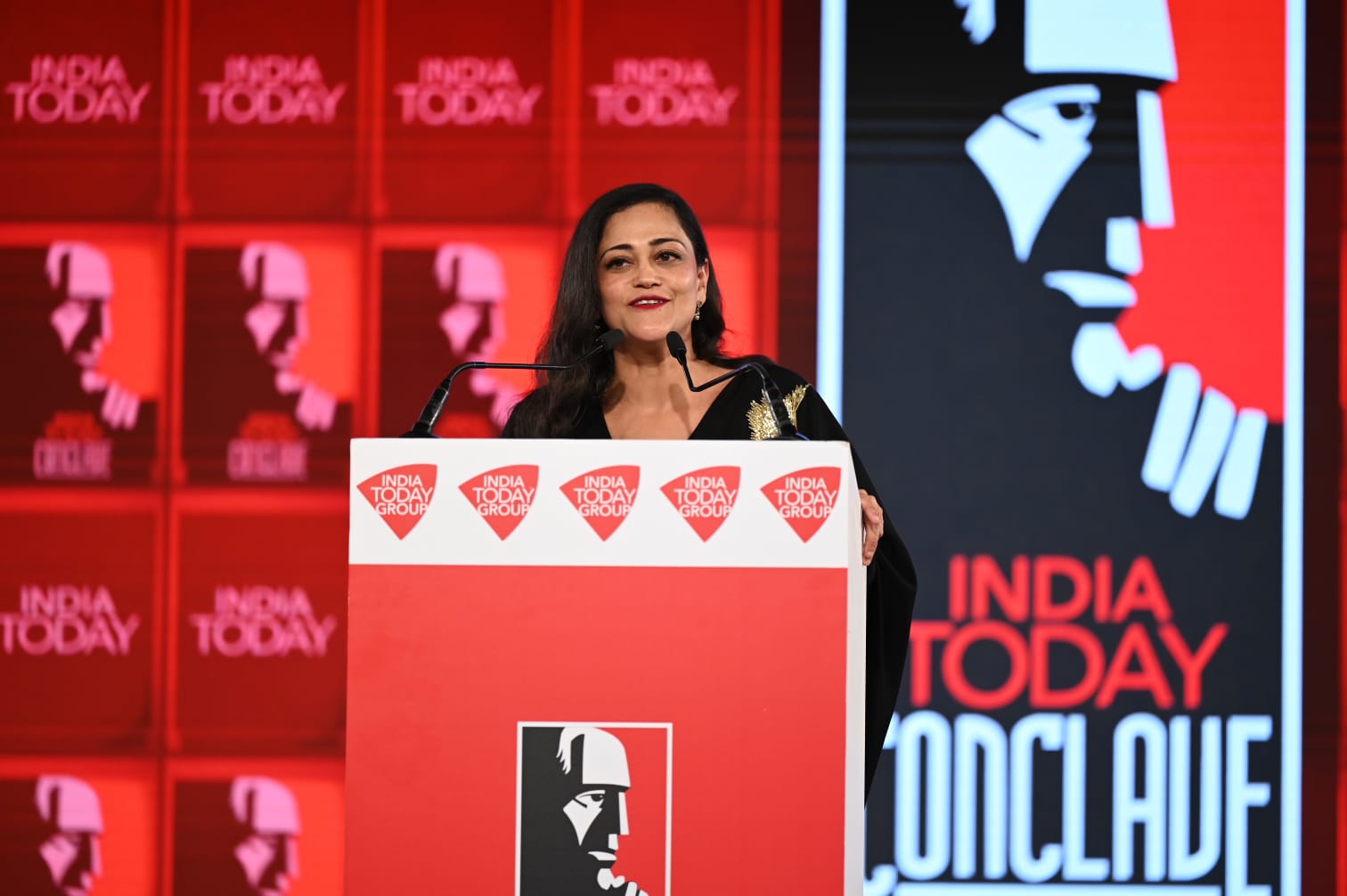
    Kalli Purie at India Today Conclave 2024

    In the run-up to the Lok Sabha elections, India Today Group Vice-Chairperson and Executive Editor-in-Chief Kalli Purie Saturday said the media cannot play the role of the opposition.

    “Expecting it to do that leads to unfair charges of Godi or Modi media,” she remarked while delivering her thank you note towards the end of the two-day-long India Today Conclave.

    Purie’s comments came in the backdrop of the election commission announcing the schedule for the 2024 Lok Sabha elections which is set to further raise the political temperature in the coming months when media will be subject to larger scrutiny and attack.

    “If the opposition is in disarray the media cannot be blamed for it. We cannot present another side equally strongly if it doesn’t exist,” Purie said, adding: “We are observers in this boxing match. We are not the players. If one side is weak or doesn’t show up, we cannot jump into the ring. This is not fear. This is a matter of rules, roles, and competence. We are the medium. We are not the message,”

    Delivering another “thank you” note after the keynote speech by Prime Minister Narendra Modi, Purie said, “Recently, I had the good fortune of walking from the old parliament to the new parliament. They are just 30 steps apart. But it’s like walking between two Indias. The one I was born in and the one I will pass on to the next generation. I love them both.”

    “But they are a world apart. The new parliament is pristine, organised, efficient, full of light, and holds a lot of promise and hope for the future. The old is musty, dusty, full of our rich history, the corridors whisper of our triumphs, great debates, and remembrances, embodying the soul of our ancient nation and young democracy. Walking between the two is a surreal experience. You enter in one century, and you come out in another. It is the story of your leadership, Prime Minister, in 30 steps,” she said.

    “Both of them have their own charm, and I believe both are essential if we are going to be a great nation. I hope that you will be able to bridge the two as only you can. The great Indian spirit in an enriched, enlightened new avatar,” Purie concluded.

  • Why every episode of Shark Tank India is a must-watch…

    Why every episode of Shark Tank India is a must-watch…

    Sanjeev KotnalaShark Tank India is a programme I think every youngster with the thought of getting on the entrepreneur–startup landscape must watch. If not, it is their loss. It is different that the term reality show is not seen in a positive light by many, but a logic- and reason-driven ‘I am out’ works. Not a surprise when one hears a group member silently react to the next weekend’s programme by ‘I am out’.
     

    The Learning

    There is so much of learning in Shark Tank. It tells one what to watch out for, what the investors could be looking at, what is the right time and type of pitching, how the investors look at the founder’s history and passion to punt at the idea.

    It also explains various terminologies and demonstrates time and again why an entrepreneur must have a deep domain knowledge. It is superbly motivating and encourages the audience to try out and live their life. After Bigg Boss (Colors), Shark Tank India (Sony TV) is now one of my favourite reality shows and I am catching up on the episodes that I may have missed on YouTube.

    It is a good programme to learn from the approach of others, especially when it concerns success and failure. If one really immerses in the programme (which is recommended), it has the potential to help reflective self-meditation.

    It is an entertaining and educational experience. Many times, you get involved and like in a match pray for someone to get the investment. At some other time, you pat yourself in seeing the idea, its scalability or raising a question just like what the sharks do in the episode.

    It is a no cost training for the Indian entrepreneurs to learns about investing and pitching and be prepared in their real life to better negotiate the ground realities. If nothing else, it exposes them to the way how they should be evaluating their own business ideas and innovations. And that is a huge learning.


    The Sharks

    Shark Tank has brought the few famous dreamers and achievers from young India face to face with the other set of people wanting investments. People like Aman Gupta (Boat), Amit jain (Cardekho), Anupum Mittal (Shaadi.com), Ashneer Grover (ex-founder BharatPe), Azhar Iqubal, Deepinder Goyal (Zomato), Ghazal Alagh (Mamaearth), Namita Thapar (Emcure Pharmaceuticals), Peyush Bansal (Lenskart), Radhika Gupta (MD & CEO, Edelweiss Mutual Fund ), Ritesh Agarwal (OYO Rooms), Ronnie Screwvala (UpGrad), Varun Dua (Acko), Vineeta Singh (Sugar Cosmetics) have featured in the episodes since 2021 in the three seasons.


    Deals

    The first two seasons collectively had 87 episodes with some 244 deals worth approximately Rs 95 crore of investment across all the sharks. Season 3 (expected 35 episodes)  is streaming now and is expected to be of a bigger scale with higher value of deals.


    Concept

    The concept of the show is simple and straightforward. It entails the entrepreneurs and the founders making business pitches to a set of five sharks (investors- mostly self-made multi-millionaires) for investing in their business. They quote their ask and in terms of money against a pre-set percentage of equity.  The pitch presentation mostly is based around the people-their role-product or service- the turnover and financials. Basis that short interaction, the Sharks go on to probe further before deciding if they were willing to invest and at what valuation and how much. The discussion goes on to: possible duplication, other competition, status, EBITA, Profitability and future plans.  The negotiation is usually around the valuation and quantum of investment as well as how many sharks are individuality and or collectively participate in the investment- if any.


    Some Thoughts

    There have been cases when people have been on the show more for visibility and marketing then really needing an investment, but that is the smartness of the entrepreneur and the failure of the TV channel’s production team in scrutinising the candidates.

    There have been also cases when the promised investment has not been finally made because in the due diligence process, the sharks realised that the product or the service or the sales and the financial condition or parameters were not what they were shown- shared and presented on the show. It all happens, and any bad noise must be taken with a pinch of salt.


    My Learnings

    Through the shows I have seen, witnessed, and realised how wonderfully innovative people are.  It gives one more confidence on the path the country is taking, personally I have been introduced to few products that I have ended consuming like the Honey Twigs or while searching for a product presented on the show (Bacca Bucci), have been exposed to others like Mocobara and ended up purchasing them.

    Every episode has a learning embedded in it. It depends upon you how much you absorb from the show. Maybe reading the book Sponge and Catalyst could help.  I have my own understanding and thoughts from the show.

    • Investors are investing on to the founder and their dreams.
    • Investors at the end is looking for an exit bat a later date and a multiplier to their investment.
    • The founder – leader must deep dive on the category and know it as well as its supplementary and complimentary products and services.
    • Burnout is a term that is losing its importance and profitability and scalability is more important.
    • There is a stage before which one should not be looking at investors.
    • The investor should be synergic t the category and bring in more than just money.
    • The entrepreneur must negotiate the best deal.
    • The sharks are sharks because they are more concerned about their investment and hence the entrepreneur must be very clear about their ground realities.
    • The entrepreneur must have a valuation and investment below which they know they will walk out in-spite of which shark is making them the offer.
    • It may sound good- but must be clear that the multi shark investment may not always be a better deal.
    • At times one must stop being emotional and evaluate the future. Sometime, the best advice may not be further investment but closing the venture.


    Net-net

    You have an idea or not but want to be an entrepreneur at some stage of your life- or even if you don’t ever want to be starting your business- watch the show and enjoy free entertainment and learning.

  • HT Media announces leadership changes

    HT Media Group has announced key leadership transitions in line with its commitment to sustained growth in operational strategies and nurturing talent within the organiation.

    Ahijit Dutta, the current National Circulation Head for the Print Business, is transitioning to a new role within the organisation. Indra Narayan Das, formerly Chief Revenue Officer for North 2, will succeed Ahijit Dutta as National Circulation Head. Swati Sharda will take over from Indra Narayan Das as CRO for the North 2 and East regions. Vijay Nair takes over from Swati Sharda as Head of Events. Jaideep Dahiya, currently the Head of Ad Operations and Pricing, is promoted to CRO for the West region. Roopali Dhawan, currently leading the school edition – PACE, will now head the Ad Operations division.

    Said Rajeev Beotra, Executive Director of the Group: “These leadership changes reflect HT Media Group’s commitment to sustainable growth and market leadership through continuous innovation. We believe in nurturing internal talent and acknowledging deserving achievements, as they bring invaluable insights and understanding of our audiences and stakeholders, powering us to continually evolve with their changing needs. I am confident that with this restructuring, we will continue to steer our business towards an even brighter and more successful future.”

  • Media.Monks launches AI-powered consumer insight solution

    S4Capital’s operating brand Media.Monks, a digital-first, data-led advertising and marketing services company, has launched Persona.Flow, a professional managed service that “gives brand marketers the ability to talk to their data”.

    Notes a communique: “As a consultative AI partner, Media.Monks aids brands in leading the new economy and becoming AI-first through the deployment of customized solutions. Unhindered by traditional agency compartmentalization, Media.Monks’ in-house team of data scientists, machine learning engineers, and creatives boast profound expertise in AI and machine learning technologies. Consistently at the forefront of integrating and applying these technologies, Media.Monks is pioneering a revolutionary commercial model for the marketing and advertising industry that addresses brands’ most urgent commercial requirements.”

  • Star Sports collaborates with YouTuber CarryMinati for IPL 24

    As the countdown to IPL 2024 begins, Star Sports has collaborated with YouTuber and content creator, CarryMinati aka Ajey Nagar. The 24-year-old Delhi-based creator, who is popular for his expletives-laden satirical roasting videos, has been signed as the new face of ‘Cheeky Singles’, Star Sports’ special weekly show that captures the fun side of the sport.

    The show is being written by Vishal Dayama, who has worked with CarryMinati on some of his previous YouTube sketches.

    Notes a communique: “With a long-term vision to transform sports broadcasting, the collaboration will marry CarryMinati’s authentic brand of sharp humour and strong youth connection with Star Sports’ vast cricket viewership, promising an unprecedented viewing experience. The first episode airs on March 21, 9:30 pm, on the Star Sports Network.”


    Now will CarryMinati minus all the abusive words lose his following on Star Sports?

  • Prime Video upcoming slate features a diverse range of new series

    Prime Video unveiled close to 70 series and movies, with most of them premiering on the service over the next two years at its second Prime Video Presents India showcase on Tuesday. Notes a communique: “With 40 Original series and movies, and 29 of some of India’s biggest and most anticipated movies, the new slate promises to bring the best of Indian entertainment to delight and engage customers.”

    Said Sushant Sreeram, Country Director, Prime Video, India: “At Prime Video, it has been our focus to super-serve Indian customers with the best of entertainment across formats. From clutter-breaking Original series and movies, direct-to-service premieres to post-theatrical launches of some of the biggest hits across languages, our goal is to be the first choice of entertainment for every customer. Our content broke new grounds in 2023, helping India remain a front runner, across international locales, in new customer adoption and Prime member engagement. We are humbled by the love we have received from our customers, and want every story on our service to be someone’s favourite show or movie. In sync with this, we are thrilled to unveil our biggest, most diverse slate till date, and are certain that our upcoming series and movies will continue to enthrall audiences, not just in India but around the world.”

    Added Aparna Purohit, Head of Originals, India and Southeast Asia, Prime Video: “At Prime Video, it has been our ongoing mission to be a global showcase for diverse, authentic and rooted Indian stories, that can transcend linguistic and geographical borders,” “In just 2023, our content was watched in over 210 countries and territories, in any given week, and trended in the top 10 on Prime Video worldwide for 43 of the last 52 weeks. It has been gratifying to witness the national and global impact of our shows and movies, and this fuels us to further champion Indian content on the global stage. As the home for storytellers and talent, we are also excited to partner with some of the most prolific names in Indian entertainment, and empower dynamic, new voices, to create stories that are fresh, powerful, inspiring and entertaining. We are confident that our upcoming slate of series and movies will pave the way for even more compelling narratives from India to emerge.”