Category: MEDIA

  • NDTV Profit to convert to NDTV Prime post trading and on weekends

    By A Correspondent


    For a few months now, news and lifestyle television network NDTV has attempted to shore up the fortunes of its business news channel, NDTV Profit.


    Having been unsuccessful with attempts to sell the channel, operations were rationalized and non-stocktrading hours were converted to content reruns and special programming.


    Now the channel is official converting to a hybrid format with the business channel staying on during market hours, but with an all-new channel called NDTV Prime coming on in the evenings and on weekends. This was announced along with the earnings release on Friday where NDTV announced standalone positive EBITDA of Rs 9.5 crore in Q3 as opposed to an EBITDA loss of Rs 5.8 crore in the previous quarter.


    NDTV Prime, billed as a first-in-India channel concept, will be launched on March 17.2014.


  • What form of Regulation in India?


    Observer Research Foundation, a New Delhi-based think tank, held a seminar last week on Perspectives in Media Regulation: Lessons from the UK, with featured speakers from the Reuters Institute for the Study of Journalism, London. The question, as always, is, can we effectively regulate media in India? Indeed, should the media be regulated? By whom?

     

    By Chintamani Rao


    The on-going debate on media regulation is in many ways the stuff of the coffee house debates of the sixties, in which jhola-carrying intellectuals diagnosed the ills of the world and prescribed remedies, while the rest carried on running the world in their own ham-handed way.


    The best indication of this, at last week’s seminar, was perhaps in the presence – or otherwise – of a member of the broadcast regulatory body, TRAI. The hosts indicated their seriousness by having Dr Vijaylakshmi Gupta give the keynote address, obviously to set the Indian context before we heard about the UK. Dr Gupta indicated hers by reading out prepared platitudinous speech and then leaving immediately.


    And so the coffee house debate carries on….


    In a discussion on regulation on another occasion I wondered why the media have a say in whether they wish to be regulated: were the banking, or insurance, or telecoms or airline companies asked if they do? The Chairman of the News Broadcasting Standards Authority answered that was because the media is special, not like any ordinary business, and has a role of national importance. Unlike banks and insurance and…?


    If you break the broad regulation issue into its component parts, it comes down to two distinct aspects: ownership and content. Issues of ownership include both, the who? question- who should own the media; and the what? question – what they should be allowed to own, i.e., cross-media ownership.


    The ownership question has no real answers. The discussion at another seminar a few weeks ago was perhaps typical. A senior journalist who had recently had a fairly public falling-out with his corporate employers, was critical of non-media corporates owning media companies. He was also not in favour of media conglomerates; owner-editors; journalist-owners; and of government or political parties owning media. I said I couldn’t disagree with what he had said, and asked who then, in his opinion, should own the media. No answer.


    The point is not to find fault with this speaker. It is, rather, that this is an unresolvable issue, in which every answer raises fresh questions.  What is necessary is not to limit who may and who may not own, but transparency about who does. It calls, as with most things in India, not necessarily for new regulations but first for implementing existing regulations.


    The other aspect of the ownership question is cross-media holding: born of the concern that media conglomerates, through cross-media domination, can drivepublic opinion. That’s a theoretically sound concern, but in practice doubtful at two levels. First, it is questionable whether in the pluralistic environment that is India even the largest media conglomerate can actually drive public opinion.


    Second, what is the efficacy of such regulation? Even in the highly regulated and media-rich United States the media business is oligopolistic. And yet, going back to the first question, it is doubtful if any of the six dominant houses is in a position to actually drive public opinion.


    The real issue in cross-holding is, to my mind, not when a single company owns properties across print, TV, radio and the internet, but when a broadcasting network owns distribution channels. For a content owner to be in a position to control what gets to the viewer, and so be able to choke the pipeline for its competition, is a serious travesty of consumer rights. In India every major broadcasting network owns distribution platforms, the two biggest networks have collaborated in a joint ventureto distribute content, and there is no law to protect the consumer. That is a serious issue for the regulatory authorities to address.


    The real, vexed question is of content regulation. Can we? Indeed, should we? Self-regulation or statutory? And, all the while,a government that has been trying for five years to regulate audience measurement wants you to believe that it is committed to self-regulation in content! It is the same government that in its previous term tried to create a broadcast regulator who would be not a constitutional authority but be hired and fired by the government. The proposed structure also required each broadcaster to have on its rolls a Content Auditor who would screen content and tell the Editor what to drop or modify and – incredibly – inform the broadcast regulator if the Editor didn’t comply.


    The UK currently has no regulation of print media. The response of the press to the Leveson enquiry and the consequent government proposal is to resist any regulatory mechanism, which is to be expected. But it must be said, in fairness, that the News of the World scandal, though huge, was a ‘rarest of the rare’ case that was effectively exposed and dealt with swiftly, which is a great deal more than we can expect. Whether one NOTW should lead to from no regulation to statutory regulation is debatable.


    In the US, too, there is no regulatory mechanism – self- or government. It depends entirely on good practice. The Editor is responsible, and owners typically take a back seat on editorial decisions. Would an editor carry content prejudicial to the owner’s interests? Probably not, but in a robust media environment you can’t stop the rest of the world from seeing you.


    In India broadcasters, in particular, have made moves to self-regulation by setting up the News Broadcasting Standards Authority (NBSA) and, for entertainment content, the Broadcast Content Complaints Council, both under the aegis of the broadcast industry bodies. A necessary limitation of such self-regulation is that it is limited to the members of these bodies. In the case of news, that means 53 channels of 23 NBA member broadcasters. The other 150 known news broadcasters in the country are beyond the pale.


    The effectiveness of self-regulation is often questioned because, even if you don’t doubt their intent, self-regulatory bodies do not have the statutory authority to penalise offenders. Members themselves often don’t accept the rulings of the regulators they have created. Indeed, the first time the NBSA indicted a broadcaster the peeved member quit the NBA in protest.


    Dr David Levy of the Reuters Institute had an interesting take on the matter. Effectiveness of self-regulation, he said, is a function first of culture: far more than of legal guarantees.In other words, some of us are made that way, and some just aren’t. The implication that we are incapable of self-regulation may raise some hackles but let’s face it, that’s fundamentally true.


    The very idea of statutory regulation, on the other hand, is anathema. Those of us of a certain age have actually lived through it in its extreme form, nearly 40 years ago, and can’t begin to contemplate what it might be like in this multimedia age.


    So where does that leave us, between the devil and the deep sea?


    Giving statutory penal authority to self-regulatory bodies has its own set of issues.The only viable answer seems to be co-regulation. I see a system in which a self-regulatory body such as the NBSA conveys a verdict and recommends a penalty to a statutorily authorised one, such as perhaps the TRAI. If the statutory body does not agree with the recommendation, it must respond to the recommending body through a laid-down process, and the two come to an agreement.


    That media owners protest against any and all forms of regulation is not surprising: who wants to be regulated? Every time content is mentioned in the same breath as regulation, even a limit on advertising time, they get all excited about Article 19, freedom of speech, democracy, et al. While no one doubts the sanctity of our constitutional freedoms, there can be no such thing as unfettered freedom. The trouble is, the press think everyone should be accountable and subject to criticism and control – the legislature, the executive and the judiciary; indeed, both Church and State – except themselves.


    There is no perfect solution. The best solution is one that protects consumer interest, and that necessarily means some measure of control while enabling and protecting media freedom.


    Chintamani Rao is an independent marketing and media consultant. A former news broadcaster, he served on the boards of both the IBF and the NBA, and was involved in the creation of the NBSA.


  • Mint celebrates 7th anniv with new campaign

    By A Correspondent


    HT Media has unveiled a new advertising campaign to capture the story of its business daily Mint as it celebrates its seventh anniversary this month. Notes a communiqué: “Since inception, at the core of Mint, lies ‘innovation’. From the Berliner size format to the design of the paper; from the content and presentation style to the name ‘Mint’ – everything was new, energized and refreshing!


    Rajan Bhalla

    Said Rajan Bhalla, CMO, HT Media on the Mint story said, “Before the inception of Mint all our efforts were in the direction of putting together a differentiated business daily which was fresh, clear-minded and straightforward while being extremely credible and well-rounded in its analysis of the business world. That’s how the product was born, exemplifying the concept of ‘innovation’.  It is this line of thinking that provoked the name of the paper as well – ‘Mint’. Our readership numbers, and the loyalty of our readers over these past 7 years, validates that we have been successful in providing ‘Refreshing Clarity in Business’, which is what we aim to continue doing.”


    The campaign will run in print, digital and radio.


  • GroupM estimates: TV degrows, Digital, print grow


    By Rishi Vora


    At the launch of GroupM’s This Year Next Year (TYNY) Report  2014,  chief executive officer CVL Srinivas, while presenting the report to a media gathering in Mumbai, stressed on the media agency’s renewed focus on digital, and the need for a change in approach and mindset in order to be relevant with the changing business scenario.


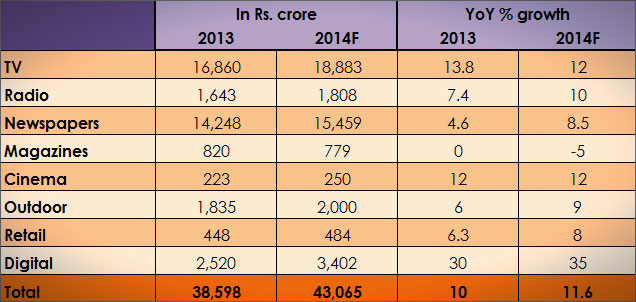
    Mr Srinivas, of course, stated that in the context of GroupM’s advertising expenditure (AdEx) 2014 where digital is the fastest growing medium with a 35 per cent growth rate, followed by TV with an estimated growth rate of 12 per cent. It may be noted that TV’s growth has reduced from 13.6 per cent in 2013 to 12 per cent in 2014.


    Sector – wise growth


    Elections

    With general elections and 5 state elections on the anvil, government spending and political party election spending adding significantly to the AdEx of all media. It is estimated that the government spending will lead a 2.5 per cent growth in the industry.


    FMCG

    FMCG will continue to be an important sector for the industry as it accounts a 29 per cent share in total ad spends this year due to the following factors:

    [] Volume growth back for FMCG companies on the back of good monsoon and hence good rural income


    [] Raw material prices benign and hence more flexibility with advertisers


    [] Ad spends of most FMCG companies on the rise to ride on the back of higher disposable income due to election spending


    Retail

    The retail industry will experience growth from the entry of new players into the food and beverage segment, growth in E-commerce, and regional retailers  expanding their reach across markets in India.


    Auto

    Despite slowdown in the  four-wheeler segment, there is growth for entry level cars, sports and multi utility vehicles.  Two-wheelers to continue the focus on small town and rural India.


    Competition is likely to intensify  on the back of recent market developments leading to more launches by existing players, which subsequently mean higher ad spends.


    Telecom

    Smartphones penetration  is on the rise, however, stiff competition in the segment will continue. Phablets  and connected devices will gain popularity in 2014.


    Cellular phone service providers too will witness growth in revenue.  Service providers will bring down the price points for 3G, therefore completion is more likely to intensity.


    Banking, Financial Services & Insurance

    For the Banking and Financial Services and Insurance industry, year 2014 will see a revival happening with a likely reduction of interest rates. IPOs to pick up pre-election owning to better market sentiments.


    Recent RBI policies will result into a more favourable business environment and new bank licenses will push advertising expenditures of the category.


    The report estimates  that print will grow at  8.5 per cent in 2014 as against the 2013 estimate of 4.6 per cent, thanks to the growth in vernacular print publications across the country. The report also states that while newspapers  are to grow by 8.5 per cent, magazines will witness a negative growth of 5 per cent.  Outdoor will grow at 9 per cent, Cinema 12 per cent and Retail 8 per cent, states the report.


    If one looks at the sector-wise break up of spends, FMCG constitutes a majority share (29 per cent) followed by Consumer Durables (22 per cent)  and retail (12 per cent).


    CVL Srinivas

    Commenting on the growth prospects for the industry in 2014, Mr Srinivas said: “It’s going to be an okayish year for the media industry. I’m saying this because the 11.6 per cent growth estimate also accounts for the 2.5 per cent growth that will come from advertisements from political parties as the elections are around the corner. If you take elections out, which is a one-off event, the growth in 2014 is about 9 per cent.”


    He further noted that the growth of the industry will also depend on how things are panned out on the measurement front, on IPL’s success or failure and the outcome of the elections, which will have an impact on government policies.


    In his final remarks, Mr Srinivas said that the year 2014 will be remembered for two reasons — one being the fast growth of digital at 35 per cent as is estimated, and also the fact that the industry will cross the Rs 40,000 crore mark in 2014 from its current size of Rs 38,000 crore.


  • Gurmit Singh quits Forbes India as CEO to join Yahoo as India MD

    By A Correspondent


    Gurmit Singh

    The announcement was made WPP’s Stream digital unconference being held in Jaipur. Former CEO of Forbes India Gurmit Singh will be the new Managing Director for Yahoo India. As MD, Mr Singh will oversee the internet giant’s business in the country and responsible for its growth. He will report to Yvonne Chang, VP & Head of India and South East Asia at Yahoo. The position of MD at Yahoo India was vacant since Arun Tadanki resigned last year.


    With over 20 years of experience, Mr Singh brings with him a deep understanding of the M&E sector in India..


    Commenting on the appointment, Yvonne Chang, VP & Head of India and South East Asia, Yahoo said, “Gurmit comes to Yahoo with a strong track record of delivering growth. His understanding of users and advertisers will be a great asset for Yahoo as we bring a number of product innovations to India. Yahoo is a loved brand in India, and we are very happy to have a leader of Gurmit’s caliber leading the team.”


    Mr Singh, who starts his assignment with Yahoo today, said “An Internet industry pioneer, Yahoo is now at a very exciting point in its journey. It truly reflects the energy and spirit of the world’s largest startup. Working together with an extraordinary team in India and colleagues across the world, I am looking forward to unlocking the full potential of Yahoo products and services in India.”


    During his career Gurmit has held leadership roles across Consumer Products, Music & Entertainment and Media sectors, working for companies such as Sony Music, Hindustan Times, India Today Group, Rajshri Media, Marico Industries and most recently at Network 18 where he worked until yesterday.


    Although there is no official statement from Network18 on who will replace Mr Singh, it is rumoured that Anil Unyal, COO – Network18 Media and Head TV18 Media Operations will hold additional charge of the magazine.


  • Reprieve for TAM as Kantar gets stay on govt’s crossholding guidelines

    By A Correspondent


    TAM co-owner Kantar Market Research Services petition to the Delhi High Court asking for a stay on the the government’s guidelines on TV measurements has had a favourable response from the High Court.


    While all the other requirements need to be fulfilled , the High Court is said to have stayed the key cross-holding component of the guidelines till March 6.


    However, over the next two weeks, TAM will need to register with the I&B ministry. It will also be required to put the names of all the advertising agencies and firms owned by its joint owners on its website as well as a list of all its clients.


  • Vinod Dua, Sanjay Pugalia to star in revamped IBN7 primetime

    By A Correspondent


    The pecking order amongst Hindi-language channels doesn’t place IBN7 in the Top 3, as per ratings at least. And even in terms of perception. But in a coup of sorts, the channel has announced two shows – Vinod Dua Ka Prashnkaal at 8pm – Monday through Thursday and India 9 Baje at 9pm Monday through Friday with Sanjay Pugalia as the host.


    Mr Dua’s show starts February 17 and Mr Pugalia will be on air from Feb 18.


    Speaking on IBN7’s new prime-time line up, Vinay Tewari, Managing Editor, CNN-IBN and IBN7, said, “Elections are a complex, engaging and diverse event. It needs solid professionals who understand the complexities, who can simplify it for our audience and who believe in clarity over noise and sensation. We have brought in two of India’s leading journalists to take our primetime programming to the next level and who symbolise our beliefs about news. Vinod Dua, with his experience and unique style, is back to give viewers his take on the elections and engage them in our daily discourse while Sanjay Pugalia, whose understanding of politics and political economy is unparalleled, will debate and encapsulate the day’s major news on India 9 Baje.”


    Rajdeep Sardesai, Editor-in-Chief, IBN Network, said, “We are looking at possibly the most crucial general elections in Indian history. And IBN7 is set to launch two new shows anchored by two of the most influential and experienced journalists in the industry.”


    Indeed.


  • 8 things Marketers ought to know about Facebook’s new Trending feature

    By Saurabh Parmar


    Facebook recently launched a trending section which is visible on the top right hand side of the homepage for its web visitors (not currently available on Mobile)


    Since this is a major change on the homepage and seems to compete with Twitter’s trending topics it has generated interest amongst marketers. So what does trending mean for us marketers and can we use it to our advantage?


    Here is my take:

    1. First, what is trending?

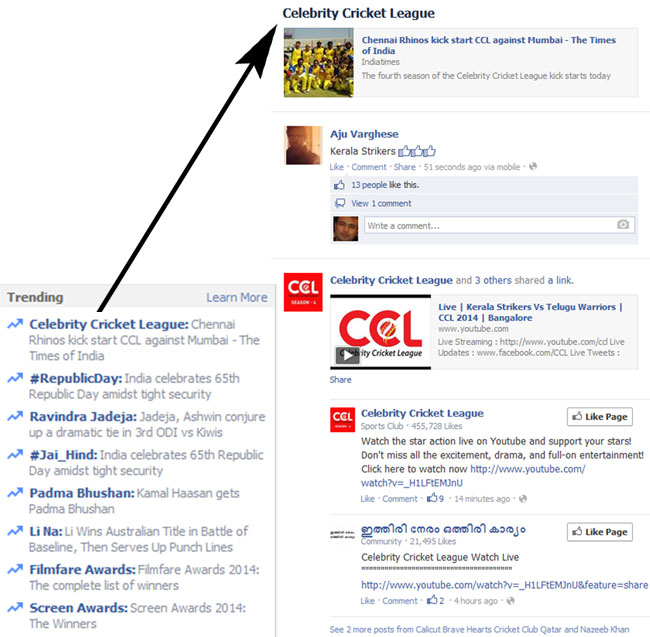
    It’s a personalized lists of the most mentioned words and phrases at the current time with short explanations of why each is blowing up. A click-through leads to a Page of mentions by friends, Pages, and public posts by anyone who lets people “Follow” them.


    2. What is this ‘Explanation’ feature which Facebook is talking about?

    Facebook's explanation features details why a particular topic is trending

    The challenge with Twitter trends is that a lot of times one is not clear why exactly something is trending on Twitter but the explanation bit on Facebook clarifies that thus stoking a user’s interest and hopefully for Facebook getting more clickthroughs.


    Compare the two trends on the same day.


    Facebook explanation makes it clear why a certain topic is trending.


    3. Is Facebook personalizing trends based on a user’s interests?

    Facebook claims “Topics are personalized based on things you’re interested in and what is trending across Facebook overall.” However I haven’t seen this till now.


    A quick analysis of trends basis what I have been seeing on my profile over the last two days:

    Day 1:

    I have hardly liked any sports page and am as uninterested in Microsoft as Justin Beiber (had to clarify the latter). Even on my friends list, there are hardly any people who are talking about Jai Ho the day the trend appeared . In fact more people on my list spoke about it the next day but its not trending then.


    Day 2

    No one on my list is talking about ‘Celebrity Cricket League’ or ‘Li Na’. On ‘Republic day’ there are definitely a bunch of posts by friends or pages I like but that is still on second place for me.


    So it appears that Facebook seems to take a more macroscopic view of trends, looking at the region (like Twitter-which shows trends on the city level) but nothing seemingly at an individual level.


    4. How are the algorithms different -Facebook vs Twitter trending?

    Facebook Trending aggregates the headlines of the day, while Twitter Trending Topics check the pulse of the moment.  With Trend on internet being something very’ in the moment’, I think in the current avatar more users are would go for the latter than the former.


    5. So can we as marketers use promoted trends?

    Twitter has this feature but Facebook is yet to announce anything like that.


    Even in the near future, I don’t think Facebook trends will directly be used as a revenue source at least not until Facebook gets the product right via various iterations.


    It’s something which seems to be done to:

    1. Build further engagement and clickthroughs via the users and get them to spend more time on the site

    2. Serve Facebook’s objective of being the ultimate news destination (remember Facebook is currently the largest medium in the world.Bigger than any newspaper or TV channel… ever!)

    3. By capturing current consumer interest Facebook could drive more real time marketing/advertising. Real Time is the goldmine which most advertisers are trying to target.This could probably help them in that direction.


    6. Can we as brands tap in at all?

     Apart from brands which are involved in the highly topical stuff like movies, cricket, politics or current events I see this having little benefit to marketers in its current avatar.


    So if you are promoting a new movie which will get mass traction on a specific day or a politician gets talked about a lot on a given day the trending features makes what’s popular more popular , but no it currently can’t make something which people would hardly be interested in trend.


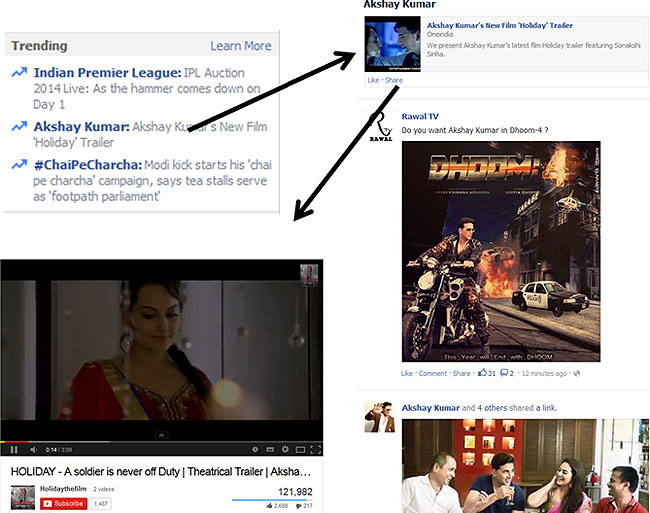
    For example, Akshay Kumar’s new movie ‘Holiday’ probably reached out to a much larger audience since it was trending across the home page of millions of people who logged onto Facebook yesterday in India. On the other hand, over the last two weeks this was one of the few movies which was trending. Parineeta Chopra started trending post the release of her movie when her performance was appreciated and not like this case when the trailer/movie was released. (Since obviously an ‘Akshay Kumar’ release has more interest to begin with)


    7. Does that mean we should # everything and talk about current events?

     No,definitely not!


    The challenge for Facebook is that most users do not make their profile public or allow everyone to follow them. Thus typically brand pages and a few users  (usually celebrities) are the only ones which will be visible when we click on a trend. This would mean brands or celebrities which talk about current news will have more clicks.


    CCL has no conversations from my friends list or pages I like


    Brands can definitely talk more about current events and post news but hopefully most social media agencies won’t be dumb enough to do that.Since:

    1. They will end up alienating their current user base by appearing more of a news site rather than what the brand is about

    2. Even if they do that they will end up competing with news sites & may not even appear on the first page which completely defeats the purpose.


    8.Given Facebook’s popularity in India, will this launch pose a bigger challenge for Twitter in India?

    Not quite .The nature of the products (Their current definition of trends) is different. Facebook Trending aggregates the headlines of the day, while Twitter Trending Topics check the pulse of the moment.


    Also since most content on Twitter is public and therefore I see opinions from people I know or have heard of (thus more personalization) whereas Facebook because of its privacy settings will be more restrictive & thus less personalized.


    The trend for Facebook seems more in its goal of being a one stop news source rather than a brand medium. Brand messages will come up when Facebook as a news source is firmly established in the minds of the consumer.


    And frankly considering the fact that it’s the largest platform in history seems quite possible, but definitely not now. Not this quarter or in the next six months.  That’s all one can predict on the internet!


    Saurabh Parmar is Founder, Brandlogist Communications (www.facebook.com/Brandlogist) and is a visiting faculty at Indian Institute of Mass Communications


  • Chief Digital Officer: A fancy meaningless designation or a crying need of the hour?

    By Amit Bapna


    A recent Gartner study in the US predicted that by 2015, 25 per cent of organisations will have a CDO and that the chief digital officer may be the most exciting strategic role in the decade ahead. While such statistics are often swept aside by Indian head honchos as a US reality, the wave may reach Indian shores faster than expected.


    Though a relative late starter, digital has made swift inroads into the Indian marketplace. Brands are upping the ante on digital allocations. No Indian marketing head can have a conversation without talking about how serious they are about digital. They’ve even moved to saying “It’s not the wave of the future but what’s happening right now!” which is an improvement.


    But where are all the CDOs then? Globally, organisations as diverse as Starbucks, Metropolitan Museum of Art, BBC Worldwide, Amnesty International are known to be already deploying the services of a CDO. While the title is yet to gain vogue, some companies are making a few non-cosmetic changes.


    PepisCo tweaked its structure to make digital a strategic vertical reporting in directly to the head of marketing. Earlier, it resided with individual brands. Deepika Warrier, vice president – Po1 (Power of 1) marketing, PepsiCo India, is clear that digital needs to be incubated by the CMO as it requires focused mentoring to build interactions with other business functions. Their team is led by Rishi Dogra, who along with the digital mandate is involved with a unique concept called Pepsi Labs. He works with co-creators incubating, experimenting and testing new content ideas. PepsiCo claims to have doubled its digital budget from last year.


    SBI Life has a business vertical to tap the potential of online sales of life insurance policies. Shares Chandramohan Mehra – country head – digital business, SBI Life Insurance, “Through the channel, it distributes products exclusively developed for online business, and has gained leadership position in direct-to-consumer sales.” He was formerly the VP and head of brand at SBI Life Insurance.


    Jasmin Sohrabji

    Jasmin Sohrabji, CEO India and South East Asia, OmnicomMediaGroup is convinced about the case for a CDO. The reason it hasn’t happened thus far is due to scale and scope. Even among the more digital aware, spends hover at about 10 per cent, offering little or less than threshold scale. As focus (and spends) move to digital platforms, the relevance for a CDO will come into play, she feels.


    Adds Rishad Tobaccowala, Chairman, DigitasLbi and Razorfish, “CDOs should be the evangelist for ensuring the company remains relevant to changing behaviour. His role is important in the early years of digital to ensure a voice for tomorrow.” The case for a CDO becomes even stronger in a backdrop where digital budgets are increasing but cutting edge case studies are few and far between.


    Most conversations hover around aggregating fans and likes on Facebook as also prerolls of campaigns on YouTube. But has the market reached a stage where the advent of a CDO is imminent? Or is this yet another instance of India leapfrogging a few stages of development, to create its own delivery-mechanisms?


    At L’Oreal India, where the digital spends have been ramped by nearly 125 per cent over the last year, the function is embedded within respective brands. Satyaki Ghosh, director, consumer products division, L’Oreal India avers that they could eventually have a CDO, but he would service the entire company as against just the Consumer Product division.


    The CDO role needs to have a larger platform to build the digital capability of the entire organisation and the digital business, according to Arjun Srivastava, consumer practice leader – India, Egon Zehnder.


    Marico too is currently embracing a decentralised structure. Sameer Satpathy, EVP and business head, Marico India says, “The medium gives enormous flexibility in terms of engagement, creativity and speed.” All their brand managers are being trained and certified on using digital, in order to have an enabling ecosystem.


    CVL Srinivas

    Which is as it should be says CVL Srinivas, CEO (South Asia), GroupM: “CMOs need to drive digital as part of their core job. Most advertisers still look at digital as a silo and struggle to integrate it into their mainstream plans.” However digital specialist Harshil Karia, cofounder, Foxy-Moron makes a case for digital having grown too big for a CMO’s mandate.


    He says, “CMOs haven’t naturally taken to ‘digital thinking’ and ‘digital as an ecosystem’. It is difficult in a world where maintaining Share of Voice, pleasing brand ambassadors, coordinating to get the best out of various agencies and reporting to management and sales teams is a priority.”


    A private sector bank claims that only 5 per cent of its business is coming from branches. The rest is from other channels that include digital: mobile and internet as well as telebanking. In such a scenario the medium is no more just for marketing or brand building but has a huge business implication as well. The biggest need for CMOs today is to adapt or otherwise provide for the digital landscape since it will emerge as a key component of marketing strategies.


    Kent Wertime, COO, Ogilvy Asia Pacific, and co-author of DigiMarketing, believes “The CMO has to determine today how to integrate traditional means of marketing/channels with digital channels, the capture and use of data, and build new relationships with big digital media players/platforms.”


    Digital gives insight in real time through social media and its endless streams of conversations and insights. Increasingly, it will be about harnessing this information. For instance, Dell has a chief listening officer, who “listens” to what consumers are saying and feeds these insights to the CMO. So whether as an adjunct to the CMO or his equal, a company serious about the future would do well to consider the CDO.


    Source:The Economic Times

    Copyright © 2014, Bennett, Coleman & Co. Ltd. All Rights Reserved

    Licensed to republish


  • Sports on the Go from Vodafone & Star India

    By A Correspondent


    Vodafone India has entered into a strategic partnership with Star India for multi-sports offering called ‘Vodafone Sports’ portal on Vodafone Live.


    The initiative will give consumers access to sports content on the go – on feature phones and smartphones.


    Powered by starsports.com, Vodafone Sports will offer sports such as Cricket, Football, Tennis and Hockey and going forward it will also cover  F1 and Tennis.


    Said Vivek Mathur, Chief Commercial Officer, Vodafone India, “The launch of Vodafone sports is an industry first initiative to bring across best of premium live and curated sports content blended with interactive platform and content delivery.”


    Sanjay Gupta

    Sanjay Gupta, Chief Operating Officer, Star India, noted, “Star India’s ambition is to shape the future of entertainment on a mobile screen and sports is a first big initiative for us. Starsports.com has already set a new standard for sports fans hungry to consume sports without being tied to their television. This partnership will bring the power of our service to a whole new audience.


    As part of the content offering, Vodafone Sports will offer unadulterated content such as  news, trivia, scores, instant access to live matches, interactive video scorecards, exclusive insights and analysis, columns, photos and wallpapers.


    A special feature for cricket fans  is an interactive video scorecard that allows users to watch the fall of a wicket, replay of individual innings, highlights for a particular player.


    Snack pricing plans

    • Watch a match at INR 10/INR 20
    • Watch a video clip at INR 3 /INR 5
    • Adorn your home-screen with Cricket wallpapers at INR 3


    All you can eat plan

    • Sign up for an individual series at INR 49/INR 99/INR 150
    • Watch archived video clips (e.g. Sachin’s best knocks) at INR 30/INR 50


    Subscription-based plans

    • Rs. 5 per day
    • Rs. 150 per month


    Customers can avail Vodafone Sports by visiting live.vodafone.in/sports or sending a simple text message SPORTS to 111. If not for the smartphone users, this one would be a great offering for feature phone users, who wants to enjoy sports on-the-go.


  • IRS 2013 Update: DNA sends legal notice to MRUC, Nielsen. Bhaskar gets stay order on IRS

    By A Correspondent


    The six-edition English news daily dna has sent a legal notice to the Media Research Users Council (MRUC) and Nielsen India as it “believes its readership figures are grossly misrepresented”.


    Announcing this in an announcement next to the masthead on the front page of the daily, dna communicated this move.


    Meanwhile, MRUC has pulled out the topline numbers of the IRS 2013 possibly in deference to a stay order of the District Court of Gwalior. Subscribers though can reportedly still access the data.


    According to the information received, the next hearing is on February 28 where an appearance has been sought of the MRUC representatives. The case by Bhaskar Publications and Allied Industries was filed on January 31, three days after the release of the data. The first hearing was on February 7.


  • Star Plus touches the skies in Week 6

    By A Correspondent


    It’s a record as big as the Brian Lara 501 not out in twenty years back. Huuuge.


    In Week 6 of the TAM ratings, the flagship general entertainment channel (GEC) of the Star India network generated for itself ratings of 728,231. Last week it was 626,570.


    “The milestone is historic,” Gaurav Banerjee, the recently mandated General Manager of Star Plus told MxMIndia. Mr Banerjee, who is said to be among the top programming thinktanks of the network, praises the work done over the year on the programming front. “We should look beyond the numbers at some of the great work done. We found the right partners to deliver a deep understanding and connect the viewers.”


    When asked about the reasons for this dramatic shift and whether the decision to have a sixth day for fictions did the trick, Mr Banerjee attributed the success to the storylines of the fiction shows. “When we started talking of the new Indian woman, we stayed with it. Yes, there were a few knocks, but we perseveared.”


    On whether he hopes to repeat the act in the coming weeks, he compared the feat to that of winning an Olympic medal. “No one gives an Olympic-winning performance every week. It doesn’t really matter what is the rating next week,” he said.


    Meanwhile, the pecking order of the rest of the Hindi general entertainment channels was unchanged. Zee at 495313 was second, Colors was at 424431. Life OK was 343882, Sab at 291599 and Sony at 251650.