Category: MEDIA

  • CDOspeak | Do less, but effective


    By Rishi Vora


    From the many aggressive moves Star India has made in the past two to three years in the area of content, it is evident that the broadcast major is leaving no stone unturned in ensuring its continuous dominance in the industry.   Digital, which is seen as central to consumers’ lives, is at the core of Star India’s strategy to augment growth, says vice president and digital marketing head of Star India, CVS ‘Venke’ Sharma. A former marine engineering officer with the Indian Navy and an MBA gold medalist, Mr. Sharma, who comes with around 17 years of experience in shaping the digital strategy for brands, was last with Leo Burnett in Indonesia where he built the digital practice in the agency.  Prior to that, he built a marketing services agency Arc for Leo Burnett India and a digital agency Tribal DDB India for Mudra DDB..

    Excerpts: 

     You joined as the digital marketing headfor Star India network a little less than a year ago. What was the brief given to you and how far have you reached in achieving your goals?

    We are  making steady progress. The brief remains  to increase the demand for the network’s content using digital marketing.   As you know Star India is a leading broadcast network in India with 40 plus channels. And digital being central to consumers’ lives today, it certainly forms a critical part of the network’s overall strategy.    Over 600 million watch television in India, of that, about 90 million are on Facebook and other social networks.  In Sports, the English cluster and even general entertainment channels Star Plus and V, there are a lot of young audiences who engage with these brands on social media on a daily basis.

    Generally in India, the dominant social conversations are about sports, entertainment and politics.  As a network, we cover a wide gamut with definitive content in sports and entertainment. Thus our content inspires conversations on social media. Consumers are interacting while consuming content on TV or on any other device. Our endeavorto shape meaningful conversations that can help create content demand for our channels/shows. So that consumption increases and ultimately morepeople watch our channels.

     Has it changed from what it was earlier?

    The fact is that the network is leading across many genres – like Hindi GEC and English, Sports.  We have made progress in reaching out to people via digital media and engaging with them.   We have been far more focused in terms of not doing too much and doing stuff effectively. It’s more about listening, analyzing, and connecting the dots with actionable insights. I wouldn’t say we are already there but with the effort we are putting in, hopefully we should be.


       What are the kinds of mobile initiatives the network comes up with?


    All our digital marketing initiatives are mobile centric.  Social media usage itself is largely on mobile. So whatever digital marketing we do is to connect with the audience on the go.  In addition, we do build  appsif there is a genuine consumer context.  For example, we have an app for Mahabharata where consumers can get some exclusive content and keeps them engaged. The app was an important part of the show launch strategy.  We launched an app for Channel V called Vith U. It is an app devised for women’s safety. It has received a phenomenal response.

    The Star Sports app as you know  is very popular, so yes we do invest in mobile and we believe that mobile and social is the way to go.  

    From a brand’s perspective, do we have enough penetration of 3G to support mobile initiatives? Interestingly, social media platforms are aware of this problem and are coming up with ideas to tackle this. Twitter, is promoting an initiative where you can give a missed call on a certain number and you can converse with or follow a brand without an internet connection via SMS.   What’s happening is that the smartphone penetration is really increasing rapidly and also the operators are pushing usage. There is a reasonable amount of usage happening even from lower end handsets.   In fact, the discovery of internet for many people in India is happening via the mobile phone.  And for these new consumers, the digital initiation happens not through email but social media or search. And that’s a very interesting trend.

     With so many brands across categories trying to reach out to the consumers, is there a method to the madness? What is your view on this from the point of view of promoting Star India’s content via digital media?

    The point is that you need not do too much in the digital space. Do less but be effective and disruptive. That’s our mantra. It is not about how loud and how much we can talk but how interesting can we be. That can come from having the social voice being led by the brand  personality.  A brand is an experience and that has to have a voice. This voice will attract consumers to take part in conversations with brands and that’s how the bonding happens. When you’ve established the voice for your brand, you don’t need to do too much. You don’t need to tweet every half hour. Not required at all. On Facebook, if you do too many posts, the actual reach will go down drastically. It’s better you do limited; do the posts which are content rich and which can get meaningful engagement and a wider reach.   If you look at the Facebook page of Channel V, you’ll find we are far more focused. We are not trying to be excessively funny or  irreverent. We are just trying to be what Channel V is as a brand – “Politically Incorrect, Emotionally Correct”.

    Can you share initiatives undertaken to promote the sports channels of the network in the digital space?

    Take the case of  Wimbledon in India. You got about four to five million fans of tennis on social media, and as you know, tennis is a niche sport. So how do you promote it online so that many people would end up watching it?   We came up with an idea of giving out alerts to tennis fans. The insight was that people follow their favorites and they do not typically know when they are playing.   So we said we will send you an alert when your hero is playing. That was the proposition and we got a terrific response. We gave them a site, a number they can give a missed call on and choose the players for receiving alerts. Thousands of people subscribed and  consumed more tennis on TV. These are the kind of initiatives where digital marketing  increases the buzz and viewership on TV.


    From a network standpoint, is there a bigger thrust on digital marketing vis-a-vis traditional advertising?

    Of course the network strength is in favor of TV – that is a given. But is there a bigger digital push? Definitely there is a lot of thrust on digital marketing from a network standpoint. Star is a very progressive network and have taken to digital marketing earlier than most other brands. Every media has got its own role to play. The network’s digital thrust is very interesting as it goes into areas where no other media can venture.   Digital media engages with consumers when the TV is on (via mobile) and it of course engages with them deeply when the TV is off.

     For the network’s regional channels, do you think language is a barrier as the most preferred language for digital which includes mobile, social and web is English? Is there an attempt to engage with them in their local languages?

    Language is not a barrier. Our regional and GEC channels use the local language to connect with audiences on digital.

    Are audiences moving away from TV and consuming content only on Digital?

    There are over 90 million social media users (whom we can consider as heavy internet users) and the usage varies from user-to-user. There are people who consume everything on the smart phone and there are also people who are active internet users but when it comes to entertainment-they want to lean back and watch their favorite shows onHD television.   We believe one size doesn’t fit all. We need to be prepared to engage with all of them in the way they are most comfortable with. At Star India, our endeavor is to do all of this with a singular goal which is to create demand for our content and increase overall consumption. There is scope to use digital marketing to increase TV consumption as well as digital consumption.


    Wish to feature in MxMIndia’s CDOSpeak? Write to MxMIndia Digital Lead Rishi Vora at rishiv@mxmindia.in with a cc at editor@mxmindia.com.

     

  • Ronnie Screwvala sets up Unilazer Sports; Supratik Sen to head biz

    By A Correspondent


    Former Disney UTV head Ronnie Screwvala’s Unilazer Ventures has ventured into sports and has hired seasoned sports marketer Supratk Sen as its CEO for the venture. Supratik Sen joins in from Red Bull India wherein he was National Head for Sports and Events Marketing.

     

    Unilazer Sports, a division of Unilazer Ventures, led by Mr Sen will focus on teams, leagues, academies as well as creating IPs and franchises in two or three selected sports.


    This ex-national rugby player, who was also a professionally trained footballer and cricketer spent the last five years at Red Bull India leading all their marquee projects with athletes, sports projects and events in the country. Before joining Red Bull, Mr Sen worked with Australian major Repucom. He has also worked with sports, event marketing and media management companies Procam, Percept D’Mark and E-Sense Entertainment.


    Unilazer Ventures Ltd, promoted by First Generation Entrepreneur Ronnie Screwvala is a diversified entity with focus on creating ground up businesses and being a Strategic Equity Investor in others. Unilazer brings hands on business experience from its Founders backed by an expert team that adds value to strong entrepreneurs/founders in varied aspects of their business growth. While Unilazer is sector agnostic it has a leaning to new greenfield and high growth segments like Agriculture, Healthcare and Pharma, Education, E-commerce and sectors deeply entrenched in the India Consumption Story


  • FremantleMedia launches CEO’s Got Talent

    By A Correspondent


    FremantleMedia, the production company which produces India’s Got Talent, has announced a unique initiative called ‘CEO’s Got Talent’, in which CEOs will compete against each other to put their unique talents under the spotlight, that usually don’t come into play in the boardroom. The programme will feature 12 CEOs on CEO’s Got Talent and will happen in Mumbai on March 7 and will be aired on CNBC TV18.


    Produced by FremantleMedia and presented by Blackberry Messenger, the initiative will invite CEOs from India Inc. who will compete on this stage. The event will have Raj Nayak, CEO, Colors on the jury along with a host of others.


    Speaking on the occasion, Anupama Mandloi, Managing Director – FremantleMedia India said, “We are excited to launch this unique format, a first-of-its-kind adaptation of our global ‘Got Talent’ Franchise.  The response has been fantastic and we look forward to some very enthusiastic participation.”


    Proceeds from CEOs Got Talent will go to Genesis Foundation that provides financial support for life-saving and life-changing medical intervention for critically ill under-privileged children in areas of cancer, cardiac disorder, organ failure, thalassemia and extreme deformities.


    Krishnadeep Baruah, Senior Marketing Director – BBM (APAC) said, “CEOs have always loved BBM for its immediacy, trustworthiness and control features. As part of the show, CEOs will be setting up their own BBM channels and seeking a following of their fans through their channels page. The number of subscribers on their BBM channel will contribute to their overall score.” To participate write to ceogottalent@fremantlemedia.in.


  • Shailesh Kapoor: Fact Check: Daily Soaps – Regressive or Progressive?

    By Shailesh Kapoor


    For the last 15 years, a word has been used ad nauseam to describe weekday fiction programming on Hindi GECs: regressive. I’m not sure who started this usage. Perhaps it was the English print media. But over time, it’s become a part of popular lingo, not just in the media but within the industry too.


    A condescending description of GEC programming, with a casual use of the word “regressive”, is a common occurrence in a niche channel or a media agency interaction. Implicit in this description is the assumption that the women who watch daily shows on Hindi GECs are regressive in their thinking and actions.


    Nothing can be more away from the truth. There are some shows (about 30%) that may portray a regressive mindset, but they are the low-performing ones. The majority, and the top success stories, have worked on the opposite premise – that of progress and change. And that also describes the need they fulfill for their target audience – to evolve and progress with the changing times.


    Let’s take the top two shows of the current times, for example. Diya Aur Baati Hum is the story of a fairly conservative family in a Rajasthan village. Watch the show passingly for five minutes (which is how non-GEC industry folks watch GEC fiction) and you may end up ascribing the words “rural”, “regressive” and “old-fashioned” to the show. But you are reacting only to the setting, not the story.


    The story of Sandhya’s journey to fulfill her dream of becoming an IPS officer, and her almost-illiterate husband supporting her in this journey, oozes of progress and change. After two years of struggle, Sandhya is now undergoing IPS training. The out-of-home episodes, playing out currently, are touching new viewership highs.


    Jodha Akbar is a romance set in a period era. But it is essentially a Taming Of The Shrew story, where Jodha, the most popular character on Indian television for the last two months, is playing a fearless heroine who stands for the truth. Her ‘historical’ character is loaded with 21st century aspirations. Confidence and self-respect are strong values her character drives amongst viewers who are seeking both these values in their personal lives too, more than ever before.


    Even in the past, from Tulsi to Anandi, strong and progressive women have been the backbone of blockbuster shows. How is the idea of “regressive” justified, then? Evidently, those who use that word use it because it is fashionable. For me, any usage of “regressive” is a cue that the person on the other side does not have enough knowledge of GEC fiction content in the first place.


    I’m certainly not suggesting that all is hunky dory with GEC fiction. There are several issues. Stories dragging and slowing down in pace is an issue of epidemic proportions. The look-feel has not progressed much over the last six years, barring Mahabharat, which is in another production league altogether. And I agree with what Anurag Kashyap said in a panel discussion about a year ago: “My problem with TV serials is that everything looks so scripted.” Essentially, he points out bad direction and unimaginative execution, in terms of acting and treatment. I have to agree at least 50% serials suffer from this issue.


    There may be enough and more issues, but the “regressive” tag is a big scam our elite media managed to pull off. India is a country of 1.2 billion people. TV has played a proven role in the progress and evolution of Indian women at large, over the last two decades. Undermining this achievement is nothing short of misrepresentation of facts.


    TV Trails is a weekly column written by Shailesh Kapoor, founder and CEO of media insights firm Ormax Media. He spent nine years in the television industry before turning entrepreneur. The views expressed here are his own. He can be reached at his Twitter handle @shaileshkapoor


  • Chill! Facebook won’t let WhatsApp lose its mojo


    By A Correspondent


    Diehard Whatsapp loyalists needn’t worry about the Facebook impacting the messaging platform. Like it happened post its Instagram buy, WhatsApp’s brand will be maintained.


    On Wednesday, Facebook announced it had reached a definitive agreement to acquire WhatsApp, the rapidly growing cross-platform mobile messaging company, for a total of approximately $16 billion, including $4 billion in cash and approximately $12 billion worth of Facebook shares. The agreement also provides for an additional $3 billion in restricted stock units to be granted to WhatsApp’s founders and employees that will vest over four years subsequent to closing.


    WhatsApp, according to a Facebook communiqué, has built a leading and rapidly growing real-time mobile messaging service, with:

    • Over 450 million people using the service each month;
    • 70% of those people active on a given day;
    • Messaging volume approaching the entire global telecom SMS volume; and
    • Continued strong growth, currently adding more than 1 million new registered users per day.


    “WhatsApp is on a path to connect 1 billion people. The services that reach that milestone are all incredibly valuable,” said Mark Zuckerberg, Facebook founder and CEO. “I’ve known Jan for a long time and I’m excited to partner with him and his team to make the world more open and connected.”


    Jan Koum, WhatsApp co-founder and CEO, said, “WhatsApp’s extremely high user engagement and rapid growth are driven by the simple, powerful and instantaneous messaging capabilities we provide. We’re excited and honoured to partner with Mark and Facebook as we continue to bring our product to more people around the world.”


    According to a communique, Facebook fosters an environment where independent-minded entrepreneurs can build companies, set their own direction and focus on growth while also benefiting from Facebook’s expertise, resources and scale. Whatsapp’s headquarters will remain in Mountain View, CA; Jan Koum will join Facebook’s Board of Directors; and WhatsApp’s core messaging product and Facebook’s existing Messenger app will continue to operate as standalone applications.


    Neeraj Arora: The man who played key role in WhatsApp’s rise

    From the WhatsApp blog:


    By Anumeha Chaturvedi


    Neeraj Arora says he is responsible for “all things business at WhatsApp” and considers himself “generally a good guy” on his website. His friends and batchmates agree, at Indian School of Business, where he earned a management degree.


    From Times Internet to Google to WhatsApp, Arora has had an uncanny ability to identify opportunities, said Mohit Garg, co-founder of training software firm MindTickle and a batchmate at ISB. “He is well-connected and this has helped him move up the ladder. He’s also very unassuming and down-to-earth.”


    With Facebook buying WhatsApp for $19 billion, Mr Arora, the vice-president for business development, is likely to be a very prosperous man indeed although everyone is tightlipped about just how prosperous.


    “I feel great” was all that Mr Arora, 35, would tell about the financial implications of the deal for him.


    “His career really took off with Google, where he was also thinking of either launching a startup or funding one,” said Shameek Chakravarty, director of product management at Yahoo, who was also the president of the entrepreneurship and venture capital club at ISB.


    When Mr Arora went to Mountain View, his role involved hunting down startups for Google and that meant meeting and connecting with numerous people in the Silicon Valley to understand what was happening in the market, Mr Chakravarty said.


    “It was not an engineering role and meant forging crucial connections with people in the Valley.” He joined WhatsApp in November 2011 when it had about 10 employees. He was specifically recruited for his corporate development background at Google. Text messages are the most costly form of data transfer and his role meant travelling to different geographies to connect with phone firms to negotiate SMS rates (users get an SMS after downloading WhatsApp; 450 million users means 450 million SMSes) and striking distribution arrangements and partnerships with them.


    “Over the years, we have connected to discuss how I should manage my startup, which I sold in 2012,” Mr Chakravarty said, adding he had even told Mr Arora that WhatsApp would make a really good exit and that he should fund his friend’s startup with his share of that fortune. In May 2013, Mr Arora said in an interview that WhatsApp is very different Google, Facebook or Yahoo.


    “Our founders came from Yahoo and they actually saw how the mechanism works with advertising. You have to collect a lot of data to have targeted advertisements. It’s a very strong stance that we have taken and I think we are going to stick with it.” Mr Arora, who studied mechanical engineering at IIT-Delhi, met his future wife Ruchi Bansal at ISB. She is a chartered accountant. “He is a really smart guy and had it all — the looks, the brains,” said Shrutkeerti Khurana, another batchmate.


    “He always got things done on time, and used to wake us up after finishing assignments. We knew he will go places as he was not a cookie cutter guy, was diligent and knew where he had to reach in life.” Mr Arora said life will not change very much after the blockbuster deal.


    Source:The Economic Times

    Copyright © 2014, Bennett, Coleman & Co. Ltd. All Rights Reserved

    Licensed to republish


    Almost five years ago we started WhatsApp with a simple mission: building a cool product used globally by everybody. Nothing else mattered to us.


    Today we are announcing a partnership with Facebook that will allow us to continue on that simple mission. Doing this will give WhatsApp the flexibility to grow and expand, while giving me, Brian, and the rest of our team more time to focus on building a communications service that’s as fast, affordable and personal as possible.


    Here’s what will change for you, our users: nothing.


    WhatsApp will remain autonomous and operate independently. You can continue to enjoy the service for a nominal fee. You can continue to use WhatsApp no matter where in the world you are, or what smartphone you’re using. And you can still count on absolutely no ads interrupting your communication. There would have been no partnership between our two companies if we had to compromise on the core principles that will always define our company, our vision and our product.


    On a personal note, Brian and I couldn’t be more proud to be part of a small team of people who, in just under five years, built a communication service that now supports over 450 million monthly active users worldwide and over 320 million daily active users. They have helped re-define and revolutionize communication for the 21st century, and we couldn’t be more grateful.


    Our team has always believed that neither cost and distance should ever prevent people from connecting with their friends and loved ones, and won’t rest until everyone, everywhere is empowered with that opportunity. We want to thank all of our users and everybody in our lives for making this next chapter possible, and for joining us as we continue on this very special journey.


    Sanjay Menon, Global Capability Lead and India Marketing Services Lead, SapientNitro:

    “The WhatsApp acquisition will enable Facebook to achieve a wider youth user base in the mobile segment along with access to real users since it is anchored to a phone number unlike Facebook users. There could be a possibility of intersecting data from both for context based promotion or targeting. We might also see a flurry of acquisitions in the wireless messaging/chat segment in the next few months. Typically, one would have imagined a company like Google to acquire WhatsApp since they have the infrastructure to leverage this additional massive consumer base to bolt on from mobile.”


    Dippak Khurana, CEO & Co-Founder, Vserv.mobi:

    Mobile is disrupting the dominance of PC Web era companies. Online-first companies are struggling to innovate in the mobile space, as many of them look at it as a mere extension to the PC Web, instead of leveraging it’s unique aspects. Many of the big players have realized this and have rapidly acquiring mobile first companies – for eg. Google acquired AdMob in 2009, while Apple bought Quattro Wireless in 2010 and Facebook acquiring Instagram 2012. The current generation of users is making the mobile their primary screen for living a connected life, so it comes as no surprise that companies are focusing their energies and investing top dollars to have the best mobile experience for their audience.


    Facebook’s overarching charter has hinged on ‘connecting everyone’ in the world. Interestingly, the global youth population, a very relevant demographic is slipping away and exploring other social apps outside of Facebook. Estimates show 62% of global teens claimed to be active on Facebook in Q2 2012, which dropped to 51% in Q2 2013, demonstrating that a vital audience is on the decline as far as Facebook is concerned.


    On the other hand, Whatsapp is the most successful and fastest growing social communication app. If you compare the growth rate over the first four years, Whatsapp also has the sharpest growth trajectory as compared to other social communication platforms such as Skype, Twitter, Gmail, Facebook etc. Over 450 million people are using Whatsapp every month, and 70% of them are active on any given day. This makes Whatsapp, a strong logical extension to Facebook’s ‘connecting the world’ goal, by helping them develop new mobile experiences which until recently was restricted to the Facebook app.


    It will be interesting to see if WhatsApp moves away from its subscription model and adopts advertising. After all, in effect, Facebook is going to be able to have access to 450 million verified mobile numbers, many of whom may not even be on the Facebook app. Additionally with Google pushing Hangouts as a default mobile messaging app, Facebook was forced into doing something in the mobile messaging space and this was the best way to capture that market. This presents a distinctive opportunity for Facebook to garner increased user engagement and a greater fillip to their mobile strategy.


  • Wills Lifestyle appoints iContract for digital marketing

    By A Correspondent


    Wills Lifestyle, the fashion and lifestyle brand from ITC, has appointed iContract, a part of Contract Advertising, to handle its digital marketing and social media portfolio.


    After a rigorous selection process involving 12 top agencies, from which three agencies were shortlisted for the final round of consideration, iContract was selected for its creative strategy and execution plan to build the brand in the digital space.


    Karan Kumar

    Speaking on the selection process, Karan Kumar, General Manager, Lifestyle Retailing Business Division, ITC said, “The marketing paradigm has changed with the dawn of digital age. Consumer engagement and consumer dialogue has taken the forefront to drive brand salience. With online shopping going live it was inevitable for us to mandate an agency with the brand’s digital duties. With iContract on board we look forward to strengthen brand presence online including social media platforms.”


  • BBC study reveals impact of mobile ads on affluent consumers

    By A Correspondent


    BBC World News and BBC.com/news have released the results of a global study examining the usage of mobile devices by consumers around the world. The study was conducted by Millward Brown.


    The study surveyed 6,000 smartphone owners in Australia, Germany, Sweden, India, Hong Kong and the US and compared the habits of affluent consumers – the highest 20% income earners in each country – to those of the general population.


    The results reveal the increasing importance of smartphones to affluent consumers and demonstrate the extent to which mobile devices are integrated into their personal and, crucially, their business lives, as improved technology enables greater engagement with content. The study also provides clear evidence that affluent consumers are significantly more receptive to mobile advertising than the general population.


    Key findings include:

    • 51% of affluent consumers use their mobile phone for business, compared to 40% of the general population


    • 39% of affluent consumers access the internet via their mobile devices at least once an hour, which is 18% higher than the general population


    • Affluent consumers are 18% more likely to share their location to get relevant services than the general population


    • Affluent consumers are more likely to prefer mobile devices to desktop for news-related content than the general population.  The contrast is particularly notable for current affairs or breaking news, where the figure is 15% higher for affluent consumers than the general population, and business/finance news, where it is 28% higher


    • News apps are the most commonly used mobile phone apps for affluent consumers, whilst social network apps are favoured by the general population


    • A third of affluent consumers agree that, if a brand wants to be modern and dynamic, it needs to be on mobile – 15% higher than the general population


    • Mobile advertising is twice as effective as the already proven advertising medium desktop in driving key brand metrics such as awareness, favourability and purchase intent amongst the total population. This figure rises to four times as effective for affluent consumers


    • High income earners are as positive towards advertising on mobile (19%) as desktop (18%). The percentage who are happy to see ads on mobile websites rises to 41% for sites where the content is free.


    India

    • 55% of affluent Indian consumers access the internet hourly in India on mobile devices vs. 39% of total affluent consumers


    • Affluent Indian consumers are far more likely to use their phone for business (79%) vs. 51% for total affluent consumers


    • Over half of affluent consumers in India agree that their smartphone is the primary tool for organising their personal life


    • 58% of affluent consumers in India agree that an increasing amount of their work is being accomplished on their mobile device (compared to 35% all affluent consumers)


    • 56% of affluent consumers in India prefer to use their mobile device to access news, rather than using a desktop (30% for all affluent consumers)


    • 52% of affluent consumers in India are more likely to share stories on mobile rather than desktop (compared 31% for all affluent consumers).


    • 56% of affluent Indian consumers agreed that to be seen as modern and dynamic a brand needs to be on mobile (compared to 30% all affluent consumers).


    The survey emphasises the growing trend for news consumption on mobile platforms and reflects the results of the BBC’s 2012 study of news consumption -http://www.bbc.co.uk/mediacentre/worldnews/news-consumption.html- in which 59% of affluent consumers expected to consume more news on their phones over the next five years.


    When asked which single device they prefer to use for news, the number of affluent consumers who name the mobile phone has risen by 15% since 2012 and tablet is up by 9%. In contrast, the amount of people who say they prefer desktop has decreased by 17%.


    Additionally, 2012’s survey found that news consumption on mobiles was mainly restricted to scanning news headlines. In comparison, 34% of new handset users (new/latest handsets are defined as those released since September 2012) surveyed in the new study say they now dive deeper when consuming news and are likely to read additional articles connected the original piece. This is 42% higher than for those using older handsets. Owners of the latest handsets are also 10% more likely than the general population to watch news video or stream content on their mobile phones.


    Jim Egan, CEO of BBC Global News Ltd said: “The rapidly growing importance of mobile to our global audiences is one of the big themes for our industry and we are constantly working to create the best mobile browsing experience, be that with the introduction of our international BBC News and Sports apps, or on-going responsive design innovations. This new research reveals significant change in mobile consumption – people are delving deeper into stories on their mobiles, consuming more video and, significantly, growing accustomed to advertising on their mobiles. This large study provides compelling evidence that mobile advertising works with affluent mobile consumers in particular and that has big implications for publishers and advertisers alike.”


  • Indian Magazine Congress opens. Minister Tewari asks trade to look digital

    By A Correspondent


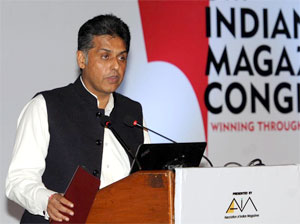
    The Minister for Information & Broadcasting Manish Tewari has called upon the magazine industry to strengthen its presence in the digital and new media age by playing the role of an objective, analytical and authentic source of information. Innovation needed to be used as a sustained tool for bringing the change in the lives of the readers rather than being a tool for ‘short-cut’ solutions, Mr Tewari stated while delivering the inaugural address at the 8th Indian Magazine Congress held in New Delhi with the theme “Winning through Innovation”.


    Elaborating further, Mr Tewari said that in recent times, many iconic publications had turned digital and the need of the hour was to empower the World Wide Web through agreed rules of engagement. It was necessary for the digital world to go through standard editorial checks so as to ensure rich and authentic content in the new media space. The challenge before the magazine industry was to withstand the flow of instant information emerging from different media streams.


    On the magazine industry trends, Mr Tewari said the industry’s future performance would be a critical player determining the macroeconomic environment necessary for print media stakeholders. This would be possible if the Industry was able to achieve greater operational efficiencies and connect with readers through delivery of high quality content. The industry could focus on profitable growth by implementing cost control initiatives and adopting technology across key business performance areas such as planning, budgeting, customer relationship management, strategic outsourcing, etc. While leading players had taken necessary steps, it was necessary that the industry reviewed the process in its entirety.


    On the trends for the print media industry, the minister stated, the market for regional and vernacular markets continued to grow in an environment which was fruitful in view of rising literacy levels, low print media penetration in certain areas and the desire of stakeholders to use the platform. Mr Tewari further added that the inherent advantages of print industry – extensive reach, localisation benefits and ability to create trust and achieve a higher ‘attention span’, were expected to serve as a base for growth and ensure that print continues to be one of the most important platforms for Indian advertisers.


    The minister said that in marked contrast to the global trends, the Indian print industry was growing with steady increase in both advertising and circulation revenues. Although, internet broadband penetration has been increasing at an enormous pace, print industry would continue an upward trajectory due to growth in vernacular and regional markets. The magazine Industry, both vernacular and English, had shaped public discourse for over 60 years and still had potential to grow.


    Speaking on digitization, Mr Tewari mentioned that the first two phases had provided a learning experience as far as implementation of the process was concerned. These learnings would be incorporated while implementing the remaining two phases. The minister reiterated that digitization was bound to be a game-changer for the sector and would define contours of orderly growth. Digitization while providing qualitative choices to the consumer would also ensure that the subscription revenues and skewed business models were rectified, he said.


  • MobileMix study puts Apple, Samsung on top in APAC

    By A Correspondent


    MobileMix, the mobile device index from the house of Millennial Media is out with its findings for the year 2013. Highlighting the various trends that shaped up the mobile device platform last year, the report sheds light on the key advertising trends in Asia Pacific, with a focus on mobile manufacturers, devices, operating systems, connected devices and more.


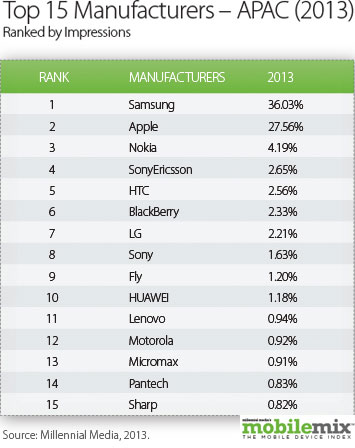
    Where the APAC region was concerned, the report confirmed Samsung as the largest manufacturer in 2013 growing over four percentage points year-over-year. It was followed by Apple that retained its position as the second largest manufacturer, but growing nearly six percentage points year-over-year. Nokia was third on the list followed by Sony Ericsson that occupied the fourth spot.


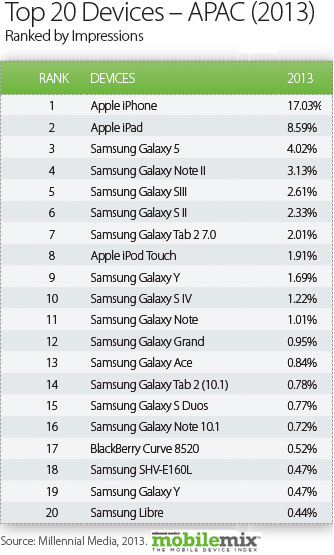
    When it came to devices, the report put Apple’s iPhone in the number one spot as it saw the largest amount of impressions in 2013, a 20 per cent year-over-year growth over the previous year. Next in line was another Apple product – iPad, that registered the second largest amount of impressions in 2013, registering a 51per cent year-over-year growth. Samsung Galaxy 5 was the third device on the list as it registered a 4.02 per cent share in 2013. A key trend in 2013 was that three tablets made it to the list of the Top 20 devices, accounting for 11 per cent of platform impressions in 2013.


    Where the device mix was concerned, smartphones accounted for 72 per cent of platform impressions while non-phone connected devices drove 21 per cent of platform impressions in 2013, representing a 35 per cent year-over-year growth from 16 per cent impression share in 2012.


     

    Where the operating system mix was concerned, the report put Android as the leading OS in 2013, accounting for 66 per cent of platform impressions in 2013, growing two percentage points year-over-year. iOs was the second on the list accounting for 31 per cent market share followed by BlackBerry in the third with a share of 3 per cent followed and Windows at the fourth spot with a 1 per cent share.


    Moving on to performances by individual countries, in India it was Samsung that emerged the top manufacturer, accounting for 48 per cent of platform impressions in India, followed by Apple with 13 per cent of platform impressions in 2013.


    As for devices, Apple was the top device in India representing 8 per cent of platform impressions in 2013 but Samsung had 14 devices in the Top 20 Device list, accounting for 36 per cent of platform impressions in 2013.


    As for the operating systems, Android led the category with 79 per cent impression share, up from 65 per cent in 2012. iOS was the second largest operating system with 15 per cent impression share in 2013.


  • MEC gets Sidhraj Shah to head Brand Activation unit

    By A Correspondent


    MEC has announced the appointment of Sidhraj Shah as Head of Brand Activation. His mandate will be to deliver innovative consumer experiences and to expand MEC’s brand engagement and implementation services.

    Mr Shah’s last assignment was at Wizcraft as Deputy General Manager. An MBA from Bombay University, Mr Shah will report to T Gangadhar, MD, MEC and to Dalveer Singh, Head Experiential Marketing, APAC, GroupM’s experiential marketing unit.


    With prior stints at O&M, SSC&B Lintas and Bates 141, Mr Shah has conceived and executed ground-breaking campaigns for clients such as McDonald’s, Standard Chartered, Virgin Mobile, Siemens, MTV and MiD-Day.


  • Infibeam to acquire digital marketing firm ODigMa

    By A Correspondent


    Ahmedabad-based ecommerce company Infibeam has acquired a 100 percent stake in ODigMa, a leading digital marketing company headquartered in Bengaluru. The buy will help the seven-year-old ecom firm strengthen its offerings.


    ODigMa is a specialist in customer engagement via social networks and Twitter and Whatsapp. Infibeam, on the other hand, runs a B2C platform Infibeam.com and a B2B platform at BuildaBazaar.com.


    With more than 400 brands as clients, ODigMa will help Infibeam’s merchant on its B2B service. Said Sachin Oswal, COO, Infibeam.com: “The OdigMa acquisition will expand our digital marketing capabilities in the key areas of social media and SEO, SEM etc. complementing our existing strengths.”


    Advit Sahdev, CEO of ODigMa, added: “We are excited to build tools and processes to deliver transformational marketing services for SMEs and enterprise clients by attracting the best talent in the industry.”


  • Mitrajit Bhattacharya is new President of Association of Indian Magazines

    Mitrajit Bhattacharya
    R Rajmohan

    By A Correspondent


    Chitralekha group President and Publisher Mitrajit Bhattacharya will be the new President of the Association of Indian Magazines. He takes over from Tarun Rai of Worldwide Media.


    Meanwhile, R Rajmohan, Publisher of Open magazine will be the new Vice-President and B Srinivasan, Managing Director of Vasan Publications will be General Secretary. Pradeep Gupta, CMD, Cybermedia will continue to be Treasurer.