Category: MEDIA

  • Shailesh Kapoor: Rahul Gandhi and We, the Interview-Starved Nation

    By Shailesh Kapoor


    Rahul Gandhi’s interview on Times Now, telecast first on Monday, has dominated the news landscape this week. Rival channels too were forced to cover the interview extensively (without video footage), given its importance in the year of the General Elections and also the reactions some of Gandhi’s comments evoked, especially those on the 1984 and 2002 riots in Delhi and Gujarat respectively.


    Much has been written about how dysfunctional the interview was, given that most answers did not match the questions they were answers to. As an exercise, I read the transcript, published in The Times Of India on Tuesday, in a read-a-random-question-and-then-read-a-random-answer way, and it made no less sense than the original transcript read in sequence.


    It would have clearly been Rahul Gandhi’s decision to do a big TV interview. I think he was ill-advised about the journalist he should choose for it. When you have nothing specific to say, Arnab Goswami is the last person you want around you. With no room given to explicate, Gandhi’s ideas came across as inward and theoretical, than pragmatic and action-oriented.


    But what has fascinated me about the interview is the ability of one interview to generate so much commercial media and social media talk, especially when nothing new was said in it anyway. It is not difficult to understand the frenzy. All you need to think is: When did I last see a proper, classical interview on television in India?


    My attempt to answer that question was rather embarrassing. All I could think of was Koffee With Karan interviews, Bollywood interviews on a dozen Zoom-like channels, sportsperson interviews and Arvind Kejriwal. A few corporate bigwigs (Ratan Tata) and foreign leaders (Aung San Suu Kyi) from recent times then came to mind. And that was the end of my interview recall.


    Most Bollywood interviews are not even interviews. They are casual chats, often with a limited purpose, like promoting a film. The reluctance of the political class to give interviews (not counting short chats with journalists used to clarify their position on an issue) is well known.


    In 2012, Narendra Modi walked out of a Karan Thapar interview in the first three minutes, unhappy with persistent questioning on the 2002 riots (Video). Prabhu Chawla, one of the most seasoned journalists of our times, had a tough time getting political heavyweights on his immensely popular show Seedhi Baat, and had to resort to entertainment celebs (all the way to Rakhi Sawant) to keep the show running.


    The reluctance of the political elite here seems to be a curious mix of arrogance and insecurity. Arrogance that makes them feel they are not answerable to people at large, and insecurity arising out of lack of confidence, in their work or speech or both. That it has happened over almost three decades now is another testimony to the well-accepted fact that we don’t have visionary leaders anymore.


    Much as Rahul Gandhi made a joke of himself on the interview that he was hoping to use to build his image, some credit must be given to him for at least exploring the idea of an interview.


    Many channels have been sending covert and overt feelers to political parties for a US-Presidential-style televised debate ahead of the General Elections, between Modi and Gandhi. It’s just wishful thinking. Even if we get Modi to give an 80-minute interview like Gandhi, we would have come a long way in breaking the tradition of media snub that senior politicians have mastered in this country.


    TV Trails is a weekly column written by Shailesh Kapoor, founder and CEO of media insights firm Ormax Media. He spent nine years in the television industry before turning entrepreneur. The views expressed here are his own. He can be reached at his Twitter handle @shaileshkapoor
     

  • #1 daily Dainik Jagran damns IRS on its Page 1

    By A Correspondent


    When we wrote about dna’s questioning of the IRS findings, we had used the phrase ‘knives are out’ to describe the development. But now it appears newspapers are bracing themselves for the war.


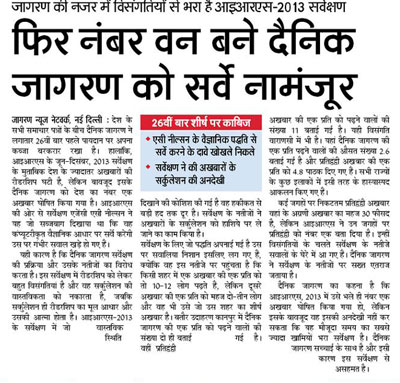
    Leading news daily Dainik Jagran,  the numero uno daily in the  country as per the IRS 2013 study, has published a large front-page story say it doesn’t approve of the IRS findings. In fact it goes a step further and says the AC Nielsen’s claim of scientific method of surveying is ‘khokhla’ (Google translate: ~hollow, gossipy).


    Legal eagles are being consulted on how to combat the MRUC, RSCI and AC Nielsen in Court, but in the meantime those whose publications have gained much in the study or reflect favourably vis-à-vis competition are saying that it’s unfair to damn the readership study authorities.


    As reported by MxMIndia yesterday, some aggrieved dailies are considering collectively or individually filing law suits.  When alerted about this, a senior MRUC functionary told us that Court cases files by aggrieved members and newspaper groups after the publication of readership numbers is nothing new for the MRUC.


  • Firstpost.com launches new business portal, Firstbiz

    By A Correspondent


    A little less than three years after the highly visible launch of Firstpost.com, the online news destination from the Network18 group, has launched www.firstbiz.com, a standalone business news and views site. Network18 already has moneycontrol and the Forbes India websites amongst its business-y web news offerings.


    While Firstpost has in the past covered business, economy, investing and brands as a part of its general news coverage, this standalone approach comes at a time when India gears up for its giant, general election where economic and business agendas are set as much as the political, notes a communiqué. Said R Jagannathan, Editor-in-chief: “With Firstpost, we walked right into the middle of a rising tide of public anger against poor governance and corruption. By reflecting a diverse range of public opinion that mainstream media was slow to respond to, Firstpost made a space for itself. Durga Raghunath, CEO Firstpost added: “We are also thrilled to take Biztech, that was previously a standalone property into our fold. Enterprise technology is a phenomenally important space that we will build a multitude of experiences around. We will focus on great depth in this area, both online and offline.”


    We are not sure whether we would agree with Mr Jagannathan’s comment on mainstream media has been slow. On the contrary – one of the charges against the television media specifically and even the newspapers in recent years – is that they’ve been exceedingly belligerent. The group’s subsidiary runs CNN-IBN, IBN7 and IBN-Lokmat, and one can be sure that editor-in-chief Rajdeep Sardesai has a different view on the slow responsiveness. The news media genre has in fact grown in the last two years. But, of course, the internet access numbers have increased too which is why web destinations like Firstpost.com and MxMIndia have benefitted.


  • MTV and Twitter partner on #RockTheVote

    By A Correspondent


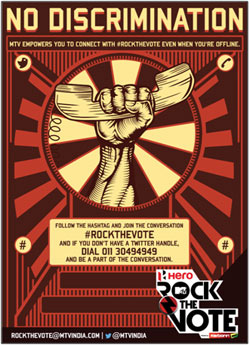
    MTV has announced a strategic use of the Twitter platform as part of the Hero MTV Rock The Vote initiative to enhance the interactivity and reach of the campaign across youth. Users of all kinds of devices can engage with the #RockTheVote conversation on Twitter.
     

    This will be the first time this kind of call-to-action innovation will be visible to the audiences globally. Through this feature, the mobile user does not need to be online while listening in to the conversations on #RockTheVote on Twitter, noted a communiqué.


    Speaking about the innovation, Sumeli Chatterjee, Head – Marketing & Insights, MTV India said, “MTV Rock the Vote initiative is an interactive campaign that is designed to fuel conversations around elections. The ‘Follow the Hashtag’ feature will ensure we reach out beyond just the smartphone users…thus allowing the large user base of regular (feature) phones to interact with the Rock The Vote campaign.”


    Commenting on this innovation, Rishi Jaitly, India Market Director, Twitter said, “In India, Twitter has brought our users closer to the issues and moments that matter to them, while also enabling them to express their views and participate in real-time. We applaud MTV India for innovating on our platform on the occasion of Rock The Vote and for using Twitter’s unique mobile service to engage its viewers.”


  • Don’t reject new IRS, correct it: Amit Ray


    By A Correspondent


    Sometime in the afternoon today (Feb 3), the Indian Newspaper Society is meeting the top brass of the Media Research Users Council for a discussion on the new Indian Readers Suvey findings . On Friday, 18-odd publishers issued a joint statement. The basic message: “We, the leading newspapers of the country, condemn the newly published Indian Readership Survey (IRS 2013) in the strongest possible terms.  The survey is riddled with shocking anomalies, which defy logic and common sense. They also grossly contradict audited circulation figures (ABC), of long standing. We also strongly ask RSCI and MRUC, the conductors of the Indian Readership Survey, to withdraw the results of IRS Q4 2013 immediately and  as well as put a stop to all future editions of this survey, as their continued publication will cause irreparable injury to the reputation of established publications like ours.”


    According to the information available to MxMIndia, a senior INS officebearer wrote to the MRUC saying that members of the apex body of newspaper publishers will pull their subscriptions if the new IRS findings weren’t disbanded.”


    The print media ecosystem is divided on what should be done with the new IRS. While many publishers have damned the findings and pushing for it to be dumped in the scrapyard, there are a fair number of media agency professionals and advertisers who believe that the media research findings must be honoured.


    MxMIndia Comment: Post IRS, worries for broadcasters * When publishers hailed IRS * Likely outcome of INS-MRUC meeting

    By A Correspondent


    Guess who should be most worried after the IRS 2013 survey findings that were out last week? The entire broadcast ecosystem of course, especially the folks at BARC. While the monsieurs at tech vendor Mediametrie and the yet-unappointed panel manager may mouth a few ouis, nons or whatever, the knives and suparis will surely be out if there’s any dramatic changes from the present.


    Let’s look at a few hypothetical scenarios.

    Scenario 1: Sony is Hindi GEC #1, ratings of the #1 GECs drops 100 GRPs

    Scenario 2: India News turns #1. The current leaders fall by the wayside

    Scenario 3: In Tamil, Pudhu Yugam becomes GEC #1


    These are of course just scenarios, but if the results of the IRS 2013 out last week are an indicator, they aren’t impossible to happen. It’s going to be a change of methodology, a change of vendor (possibly not fully if TAM is selected as panel manager), a change of philosophy and an all-new Technical Committee ensuring the processes are followed and the system is robust. And above all: BARC with a chairman from the industry, a CEO and his secretariat and a techcom that has reps of a broadcaster, media agency and advertiser.


    The problem, as many industrypersons told us, is not the process, but in the final numbers. These are after all IRS survey. As in the case of BARC, even the IRS saw representatives of all stakeholders actively participating in the processes.


    In fact on the day the IRS was launched in Mumbai in March 2013, Peter Suresh, the much respect research head (Head-Strategy) at the Dainik Bhaskar told MxMIndia:  “The entire process is automated, and that is incredible. Attempt to report individually on a far larger number of geographical units is also very heartening. District cut too has increased - hence the data can be analyzed at a far more granular level. Bulk of action of late has been in rest of India, beyond six metros and hence granular cut is extremely important. Data slicing at a deeper level, and multiple ways of presenting it, make far more sense. Readership numbers are the cornerstones of most media marketing and sales strategies - and the finer they can be cut, the more robust they are. And, of course, these will help in delivering better stories to the marketers.”


    Dainik Bhaskar is one of the signatories of the statement issued on Friday against the IRS. Interestingly, a day after the IRS was released - on January 29, to be precise -several newspapers front-paged their successful showing in the readership study. These include some of the signatories to the statement.


    The meeting between the Indian Newspaper Society (INS) and the Media Research Users Council (MRUC) at 2/2.30pm today is most likely going to end in a stalemate. It may be remembered the RSCI was formed by the MRUC and INS-sponsored National Readership Studies Council to govern  the new IRS. So the buck is clearly in the RSCI court. For the INS to damn the IRS is tough because its members had endorsed the process.


    The MRUC is being represented by Chairman Ravi Rao, TechCom chaiman Paritosh Joshi and Director General Shaswati Saradar. At the time of writing, one is not aware of who will represent the INS. But Hormasji Cama, a former head of the INS and MRUC and now chairperson of the RSCI, is travelling, the decision will need to be finally taken by him.


    According to the grapevine, the MRUC/RSCI has already written to Nielsen, asking the research agency to clear a few doubts. It’s possible that the new IRS findings will be put under suspension for a few weeks until the clarifications come in and Mr Cama is back.


    MxMIndia spoke with veteran media professional and former chairman of the MRUC Technical Committee Amit Ray for his views and to suggest the way forward of the mess.


    1. Is there really any anomaly as it is being made out to be? And if yes, why has it happened?

    a. There appears to be a lack of experience in the current dispensation vis-à-vis readership research. Instead of letting go of the previous experienced professionals, MRUC and RSCI should have engaged them more significantly given that the task was assigned to the same research agency that had failed earlier. If you remember, AC Nielsen was the agency which did the NRS in the past.


    b. The questions that are now rightly being asked are: Was Nielsen the right agency? Does it have the requisite experience for newspaper readership study in India? Did we forget that NRS had failed thanks to the same agency?


    c. I strongly believe that publishers ought to have got their own experts to validate Nielsen’s methods and later the results. How can the publishers let a body like new MRUC decide about their future knowing fully well that the real pillar of the earlier IRS was the research agency and the techcom together?


    d. One of the reasons why the print media rejected the NRS and opted for MRUC’s IRS was the concept of ‘continuous research’. So why was this junked overnight? It is very likely that the current people will defend this by asking for more time. This time the publisher would do well to have their own team of experts with experience and not just blindly trust the experience (or the lack of it) of the current technical committee and the research agency.


    e. Everyone inside MRUC would’ve known about what has happened historically. Even MRUC had a problem in the past when circumstances forced MRUC to choose a new agency NFO. This was the around 2000/2001. If my memory serves me right the new Agency took almost 3 years to complete the research. May be the current office bearers were not aware of this


    2. What are the next steps? Scrap IRS?

    a. Rejecting the new IRS will be a regressive decision. Instead of rejecting it, we should look at correcting it. If we reject it, we will be starved of another 15-18 months of data which will be counter-productive to publishers.


    b. Call the people from the earlier MRUC technical committee especially those who took it to another level because of which the INS agreed to team up with the MRUC. May be a good idea to urge the veteran Roda Mehta who set up the IRS to intervene and suggest changes. I will be happy to help too and possibly pull in a few others.


    c. Ask AC Nielsen to allow a detailed audit of their actual work. Invite some of the senior folks at Hansa Research Group to come in as professionals – and not representing Hansa – to offer their advice. They are clearly best suited to find the soft spots where mistakes are committed so that we don’t repeat them


    3. Both RSCI and MRUC are part-sponsored by print publishers. The officebearers of both bodies have publisher representatives. So is it right for the INS to now play Big Brother to decisions taken by its own members?

    For the sake of the industry and the entire print media sector, it’s important that IRS 2013 is salvaged. As I stated earlier, publishers will suffer the most if it’s scrapped. Media studies like that of KPMG, PwC etc make sectoral assumptions and projections based on these. I believe the entire sector shouldn’t suffer because of the mistakes of some.


  • Helios Media forays on to digital with SanjeevKapoorKhazana

    By A Correspondent


    Helios Media, the speciality services company for the broadcast sector, expanded its services to now also include digital media monetisation and the venture begins with bagging the mandate of representing Sanjeevkapoorkhazana


    Helios will work in embedding brand’s messaging within the content of the channel which claims to be the largest non-Bollywood YouTube channel in India, generating over 85 million views per month.


    Sanjeev Kapoor

    Speaking on the assignment, Chef Sanjeev Kapoor said, “Sanjeevkapoor.com was one of the first websites to make its presence in the country. Being a pioneer in the space, it is quite evident that our YouTube channel has garnered a huge subscriber base of 2.7 lakh. Our popular videos generate as much as 1mn+ plus views. This therefore becomes a great destination for brands to not only reach a large consumer base but also to capture the most appropriate mind-space. Helios Media has been partnering us on monetising FoodFood for a year now and I believe in their understanding of the space and the skill to position brands in the right environment which will help SanjeevKapoorKhazana realise its full potential in terms of revenue maximization”.


    Divya Radhakrishnan

    Commenting on the win, Divya Radhakrishnan, MD of Helios Media, said: “Helios Media’s focus is on selling brands and not just commodities by appropriate positioning and working with brand custodians to provide seamless solutions that go beyond regular commercial advertising. We strongly believe that TV has grown beyond just providing reach and its content has the Power to Influence. Therefore it is important for commercial messaging to chase the content irrespective of the screen it comes on. It’s because of this approach that the SanjeevKapoorKhazana mandate came our way and we are delighted to be entrusted with this responsibility by Chef Sanjeev Kapoor”.


    Helios Media has augmented its existing team with a central digital team in Mumbai under Kirtan Mankad who has earlier worked with UTV, Zoom and Hungama.


  • Yeh clients maange more. PR agency honchos say in third edition of MSLGroup’s annual report

    By A Correspondent


    PR and social engagement network MSLGroup has released the third edition of its annual PR industry report. Titled ‘Public Relations in India: The Impact of the Economic Downturn and the 2014 Outlook’, the study carries a survey of senior PR professionals – account directors and above – to understand where they believed the industry was headed in 2014.


    What emerged was a picture of cautious optimism. Most respondents felt that growth would be strong but there were serious challenges: squeezed cash flows, clients expecting more for the same fees, and shrinking budgets in some cases. The talent shortage continues to remain a major concern, notes a communique


    Some of the survey’s findings:

    • About 20% of the respondents said industry growth would be in the 15%-20% range in 2014. What’s interesting is that this growth would happen despite clients cutting overall communication budgets. This indicates that money is being diverted from other disciplines, such as advertising, to PR.
    • Despite the downturn, 30% of respondents said clients had increased budgets either ‘somewhat’ or ‘drastically’.
    • Most felt that the tough times would last for several months more.
    • An overwhelming majority – 90% – said clients were demanding more for the same fees.
    • Respondents identified integrated marketing communications as the best way to grow business.
    • Apart from digital, clients are demanding crisis communications, training, content and research and insights from their PR agencies.


    Jaideep Shergill

    Said Jaideep Shergill, CEO of MSLGroup in India: “This is a time of great churn for the industry. Ground realities – from the evolution of media to the increasing number of stakeholders to what clients want – are changing fast and it’s a challenge to keep up. Thankfully, the industry has shown the capacity and resilience required, and this is evident from the survey’s findings.”


    The second section of the report examines the rise of cheap smartphones and their impact on marketing communications. As India becomes the new battleground for high-end smart phones, there is a ‘sub-revolution’ bubbling under. Given the country’s price sensitivity, several firms have unleashed a range of cheap smart phones that have become very popular. The Slideshare link of the report is: http://www.slideshare.net/mslgroup/india-pr-report-2014-mslgroup.


  • 10 years of being much-liked


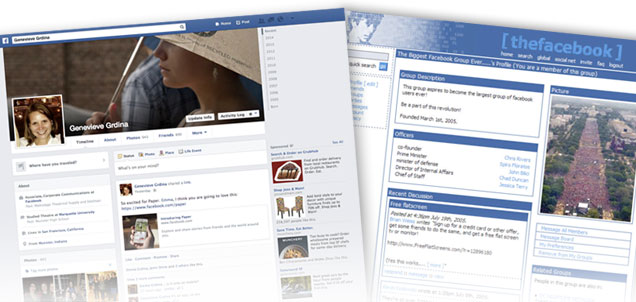
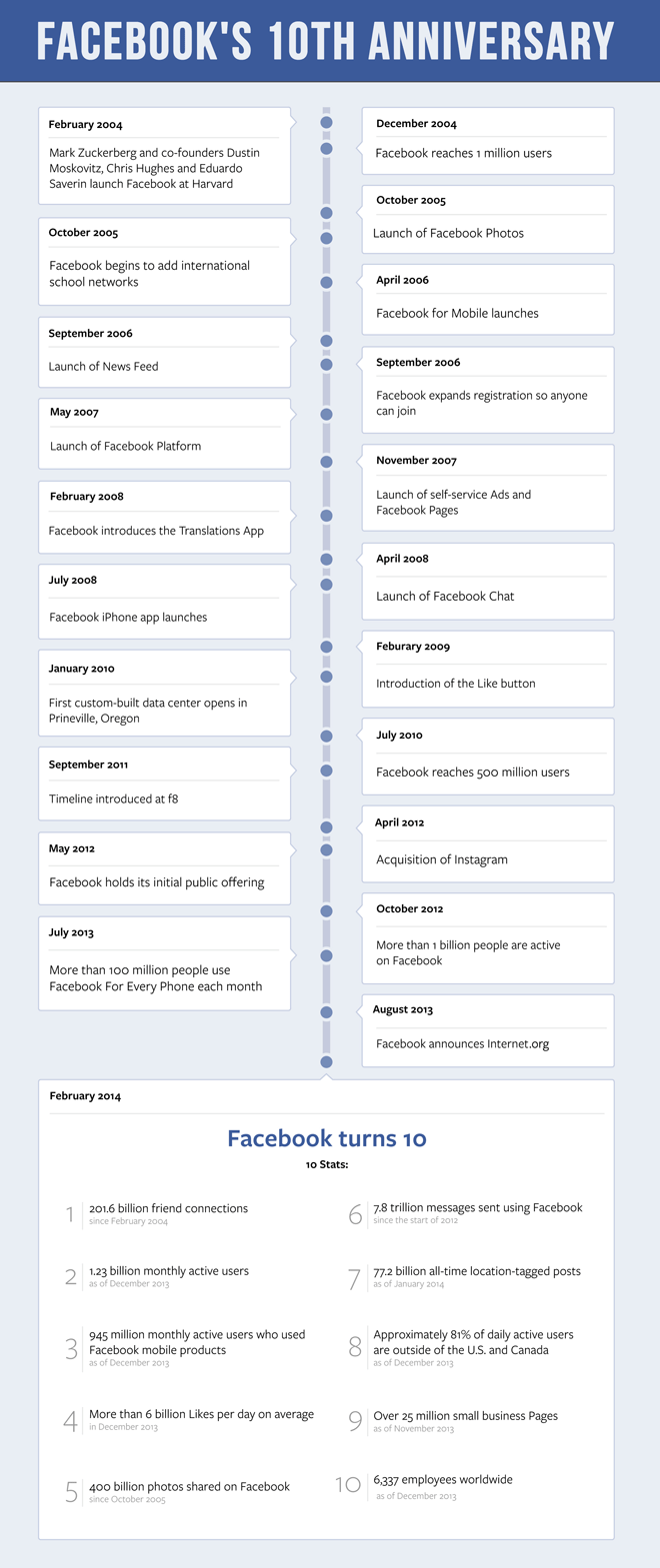
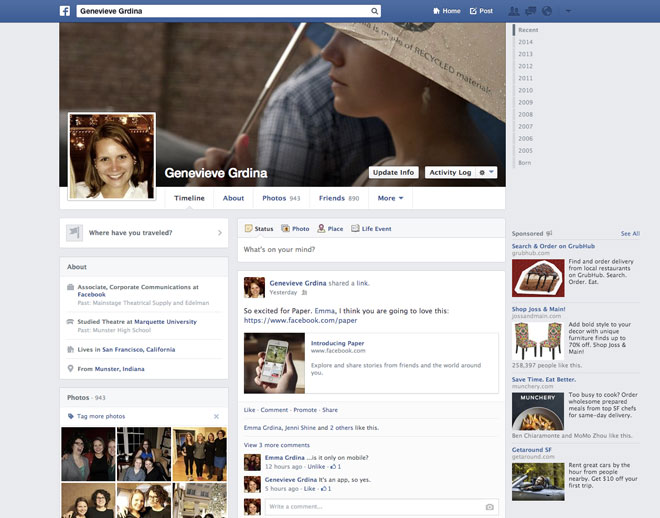
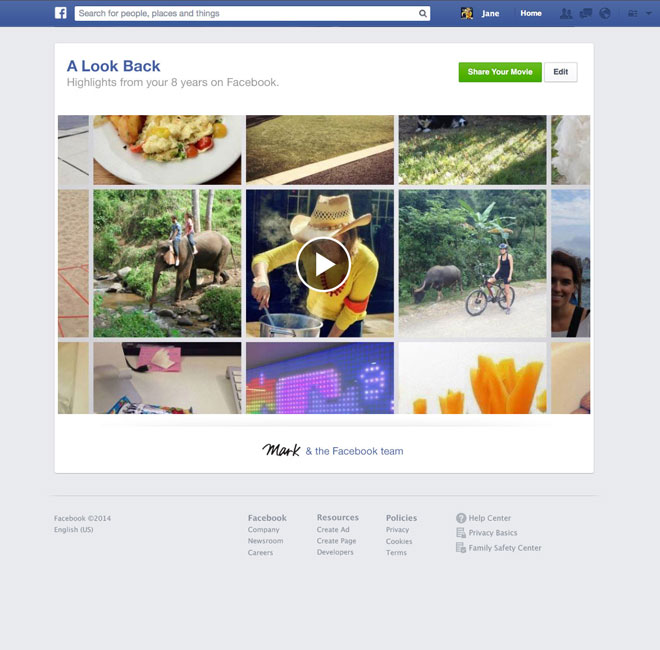
    Today (Feb 4) is social networking platform Facebook celebrates its 10th anniversary. The site went live on February 4, 2004 in founder and CEO Mark Zuckerberg’s Harvard University dorm room, and since then has grown to become a global service with more 1.2 billion monthly active users.


    Said Zuckerberg on the occasion:  “It’s been an incredible journey so far, and I’m so grateful to be a part of it. It’s been amazing to see how people have used Facebook to build a real community and help each other in so many ways. In the next decade, we have the opportunity and responsibility to connect everyone and to keep serving the community as best we can.”


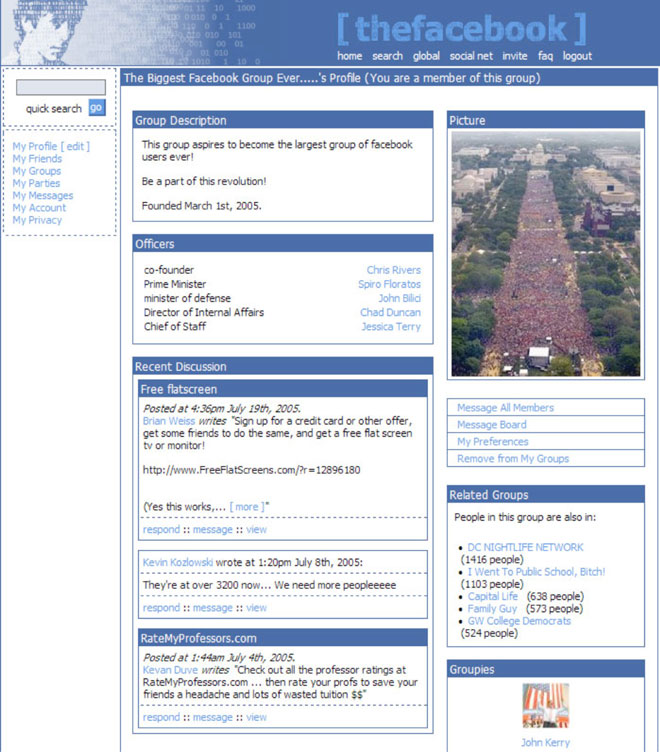
    Take a look at the pages above on the site today and the way it was around 2004-05. Plus timelines, milestones and vital stats.


  • Jaldi 5 with Nitin Chaudhry, HT Media: More than just media sponsorship of the Kala Ghoda Festival

    It was a coup of sorts for Hindustan Times when it was awarded the title sponsorship of the the Kala Ghoda Festival. Built over the last few years as the leading festival of art and culture in Mumbai, the newspaper group has attempted to go beyond the role of a media sponsor and integrate with the events. MxMIndia spoke with Nitin Chaudhry,  Business Head – West and part of the HT Media leadership team on the Hindustan Times association with the Kala Ghoda Festival 
     

    01. How is the Hindustan Times Kala Ghoda Festival different from last year’s The Times of India Kala Ghoda Festival?

    Well, a few things on the programming side have changed. We have tried to make it bigger. We have international authors coming in for the first time, as compared to Indian authors only. We have bigger stars like Farhan Akhtar this time. More importantly, we have added a very Mumbai-specific vertical. Earlier it used to be all around art and culture, but we have Urban Architecture and Design. We have installations and panel discussions some of the issues that Mumbai as a metropolis faces – whether it is unplanned growth or traffic despite the fact that we have the best public transport system in the country.


    02. And how much of these changes are thanks to HT’s involvement?

    In fact, this is one big difference between previous Kala Ghoda festivals to this year’s edition. We have been very involved with the designing of the whole programme right from the beginning. Other than programming, we also looked at how do we make it more accessible and spread more awareness to people because the festival happens at multiple venues and people get overwhelmed with the schedules and how to get there. We have developed an app which does two things: one is at the tap of key it gives you the calendar of every day, of every vertical. You don’t have to download one big app from the internet, all have to do is scan the Kala Ghoda logo, which is available everywhere and the app downloads on you phone, whichever phone you have.


    Second thing is, if you go to kalaghoda.hindustantimes.com, the microsite syncs with your Outlook calendar and you can pick and choose events. Most of these changes have happened because both of us have been talking for the last few months, wanting to make it better and more accessible to everyone. The promotional campaign was not limited to the newspaper. We have created a full programme for radio and have a live studio at Rampart Row where people walk in and talk about their experience. On the social media, we have created a Facebook page, there is a Twitter contest and there is also a photography contest.

    There’s also this huge wall which displays the pictures our photographers have taken. So we tried to bring out the role of a newspaper in a far more integral way that rather than just supplying our ad columns for generating awareness.


    03. The one problem with associating with events which have had a long relationship with another publication or sponsor is that people still recall the old association. Like in the case of the Screen Awards, it was Star and in the case of the Kala Ghoda festival, The Times of India was the sponsor for many years. Did you factor that when you took this on?

    Yes, it had an association with The Times of India. But what we also figured was that the association was more in the minds of the media audience than that of readers or consumers. No one called it Times of India Kala Ghoda Festival, it was Kala Ghoda Festival. But yes, nevertheless the transfer of the association and the brand will have to be done, which is why the connect can be seen throughout the city, in all media. Because we want to make the transfer of the association and the brand as quickly as possible…


    And is this a five-year contract?

    To begin with, it’s a three-year contract. But the intention is to make it a life-time one.


    04. Since Kala Ghoda is located in South Bombay, people from the suburbs are hardly able to make it there to partake in the festivities. Have you thought of doing other festivals elsewhere or will it be only this one?

    I completely agree with you. Mumbai cannot be served by one event. We talk about the western suburbs, the central suburbs, Navi Mumbai and South Bombay separately, although I would still think, the decibel level created in the market has reached everywhere. But given the commute issue, the distances and the hectic lifestyle of people, it is very difficult for people to reach the venue and we should ideallty have multiple events in multiple geographies throughout the year. And we will also be working towards that. So, for example, last year, when we launched the Navi Mumbai edition and although the scale was smaller than that of Kala Ghoda, we had a mini-cultural event in Navi Mumbai over two weekends, where we called artistes, did plays, musical recitals, and concerts in Navi Mumbai.


    05. The worry is that when events such as the Kala Ghoda Festival which are all about culture, art and literature, have an association with a paper like Hindustan Times, the competition between various publications comes in the way of the coverage of the festival. And hence art and culture suffers.
    I completely agree with you. It is very unfortunate. If you look at the Hindustan Times of the last four, five or seven years, even though a rival publication was sponsoring it, we always published schedules, carried photographs of people having fun, of what is happening, and that is the spirit one should have. It is a festival of the city, ahead of it being a festival of The Times of India or Hindustan Times.
    If a small play were to happen at the NCPA or Rang Sharada, everyone covers it. Why then should we not cover an event where four or five lakh people come and have fun? It is unfortunate that the rivalry comes in the way, but that’s not how it should be.


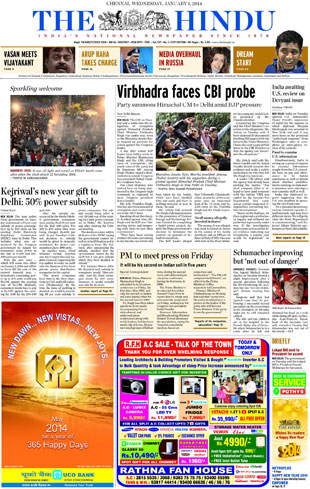
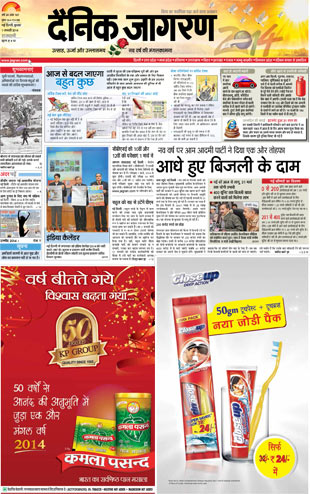
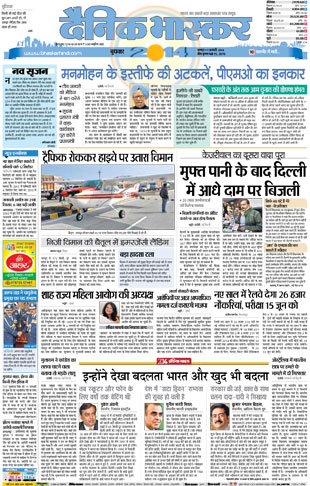
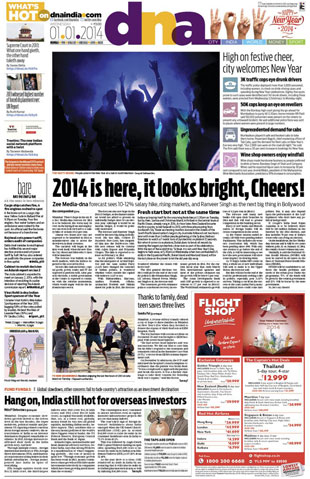
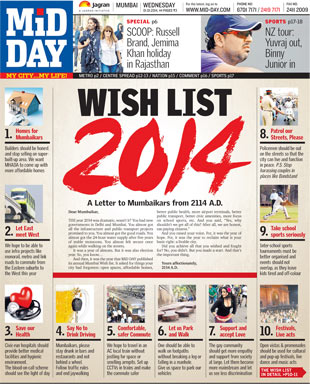
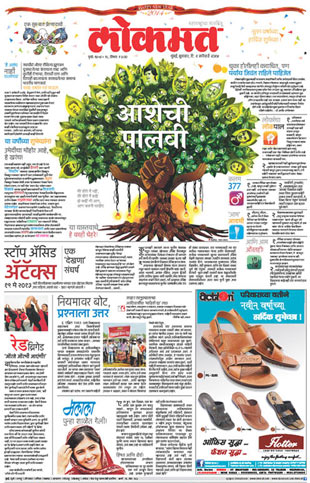
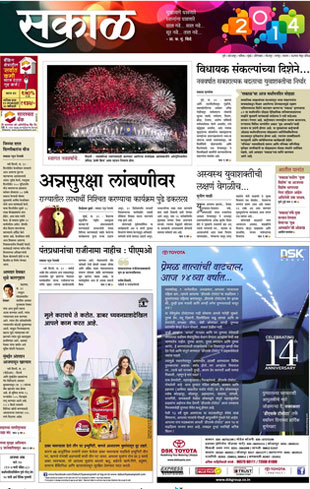
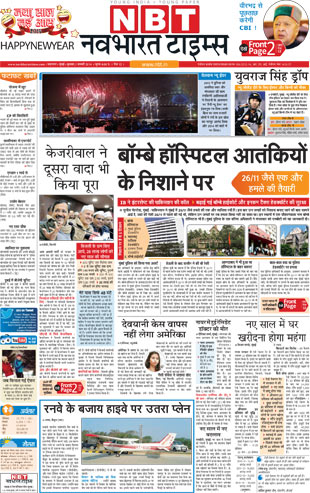
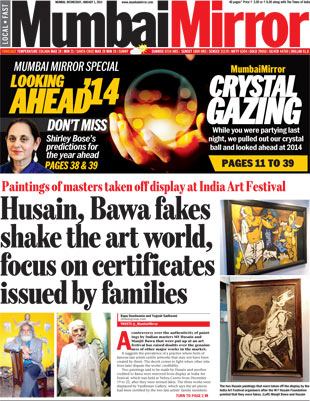
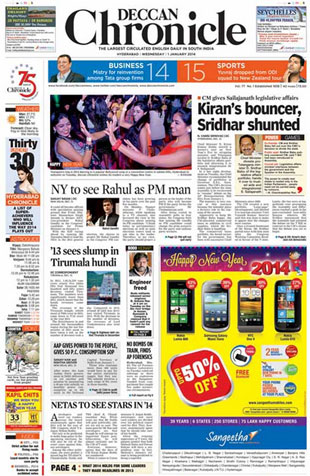
  • NewsStand: How the various Page1s looked on Jan 1, 2014


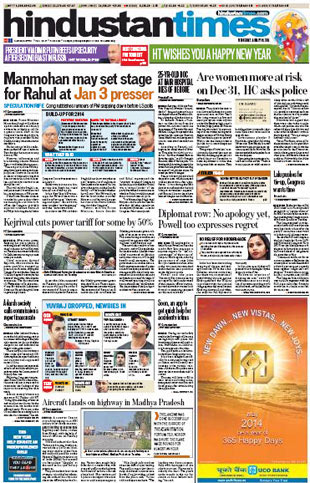
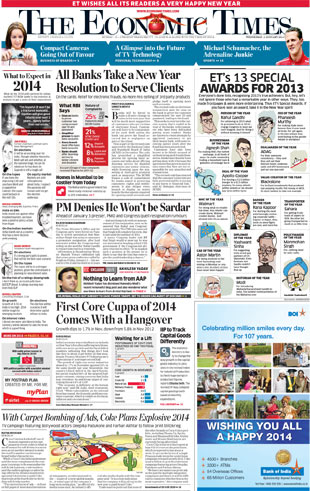
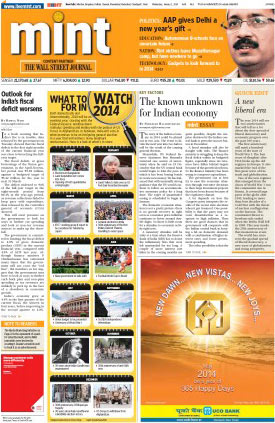
    A scan of the front pages of select national and regional dailies on January 1, 2014:


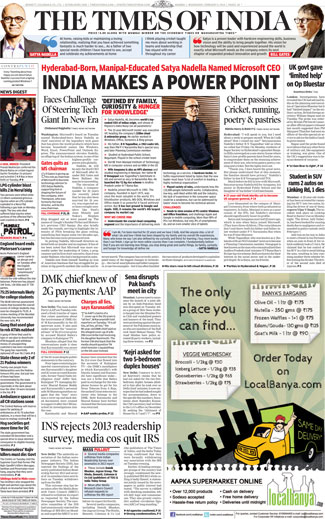
    The Times Of India

    Hindustan Times

    The Economic Times

    The Hindu

    Dainik Jagran

    Dainik Bhaskar

    dna

    Mid-Day

    Lokmat

    Sakal

    The Indian Express

    NBT

    Mumbai Mirror

    Deccan Chronicle

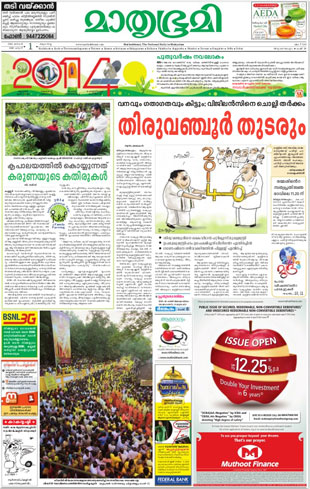
    Mathrubhumi

    Mint
  • Comment | IRS mess: Heads: publishers lose. Tails: publishers lose

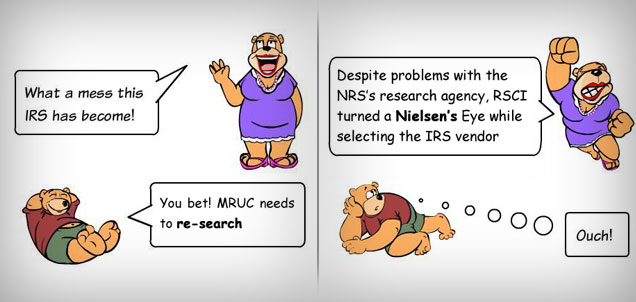
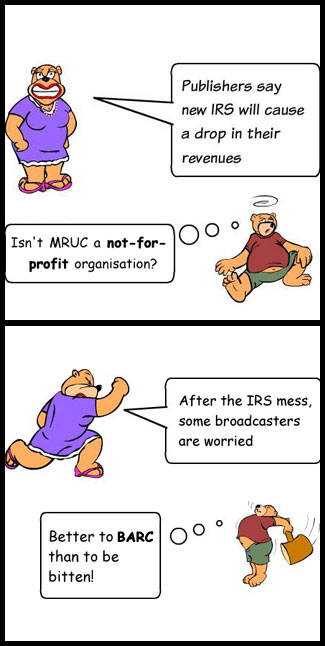
    Cartoons: Text by Bharat Kapadia. Created on Toondoo.com


    By Pradyuman Maheshwari


    Not many moons ago, Lynn de Souza, then CEO of Lintas Media Group, had tweeted: What would it take to bring the MRUC and NRSC together? The United Nations?


    Well, it didn’t need the United Nations to get MRUC and NRSC to come together and Ms de Souza was in fact first chairperson of the joint body called RSCI.


    Jokes apart and the toons rendered on veteran mediaperson Bharat Kapadia’s lines by cartoon-maker Toondoo.com are indeed funny, but the truth needs to be told.  Even if it’s harsh. The only people laughing after the mess of the Indian Readership Survey 2013 that was released on January 28 will be advertisers and media agencies representing them.


    Cartoons: Text by Bharat Kapadia. Created on Toondoo.com

    MxMIndia spoke to a cross-section of marketers, agency folk and publisher representatives and everyone believes that the process followed by the RSCI (an MRUC and NRSC combine) was fine. This is what many of them told MxMIndia soon after the process was unveiled in March 2013. There were ‘wah, wahs’ all over (see link: New, improved IRS hailed by industry).


    But when the findings got public, it took a day or two for the news to sink in. In fact the following day, many newspaper groups gloated over the results.  In print, and in private. News daily dna took the lead in the offensive and was the first to question the numbers. And then the others followed. Dainik Jagran dubbed the Nielsen’s scientific method ‘khokhla’ or hollow. On Saturday, 18 publications carried a joint statement damning the IRS.


    Events happened in quick succession thereafter. On Tuesday (Feb 3), the INS representatives met people from MRUC and Nielsen. RSCI’s current chairperson Hormasji Cama was travelling and hence absent. The MRUC-Nielsen foursome weren’t allowed to show a presentation of the process followed and asked to withdraw the IRS. The MRUC folks said it needed to discuss the matter internally and revert within 24 hours. Which they did and said since the IRS is run by RSCI which in turn has been formed by NRSC and MRUC, it said it couldn’t take a unilateral decision (see link: IRS issues statement, Decision on IRS by RSCI on Feb 19).


    The INS shot back near-instantly with an advisory asking its members (esp the 18 members who had signed the statement) to send MRUC, RSCI (and possibly NRSC/ABC too) withdrawal letters. A publisher and INS functionary even told MxMIndia that it was mulling legal action (stay on IRS) if not withdrawn) and its own currency for readership measurement (see link: INS rejects MRUC response. Mulls alternative currency. Key publicatns to start withdrawing fm IRS)


    The cross-section of the print ecosystem we spoke with had mixed feelings on the developments. While they believe that the RSCI/Nielsen/MRUC should’ve had a more humane and practical approach on the study and factored in the old rankings and status of publications, they believe an outright rejection will set back the industry by nearly three years.


    “In this period, many editions and publications have gained ground or fallen in readership. There is no capturing of this data. What we will now see is an anarchy – claims and counter-claims and no audited numbers,” one planner told us.


    Another media buyer and planner was matter-or-fact: “The agency frat already has the data. We will of course use it to beat prices down, even if it’s informally used.” A senior industryperson also echoed this fear.


    Clearly, newspaper  and magazine-owners stand to lose the most in this face-off. It is imperative that corrective action is taken soonest.


    And will an alternative currency presented by INS work? The senior media planner we spoke with replied in a “Yes and No”.  “Yes, it’s a question of credibility. It all depends on who is doing it. Also a joint industry body/committee-run study is better, even though we do know that there is some really top talent working with print players,” she said.


    Tweeted on May 28, 2009

    The question that a lot of media agency and some advertisers are asking is what will happen when the first BARC-led television measurement data comes in? “The stakes are much higher in television, and we may suggest Z-category security for the BARC bosses,” an agency senior joked.


    Meanwhile, it does appear the United Nations may need to be brought in to clear get the INS and IRS together. Right, Ms de Souza?


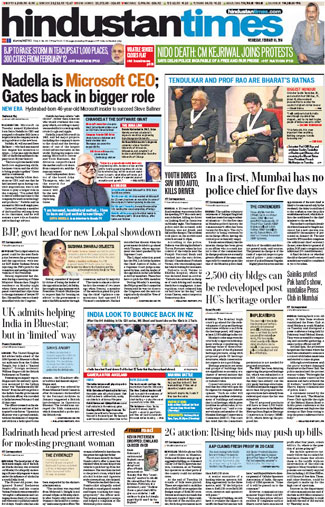
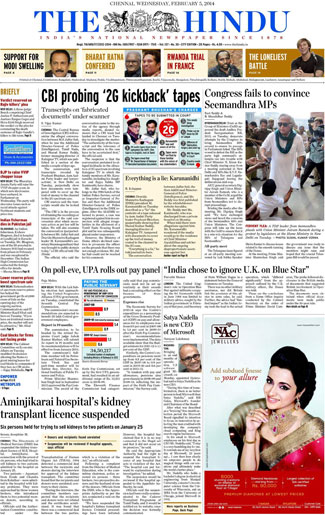
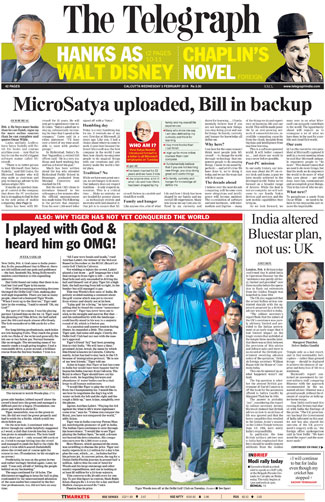
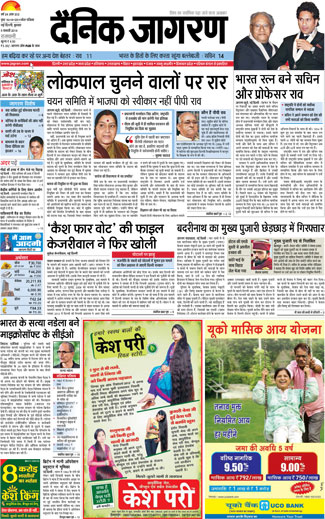
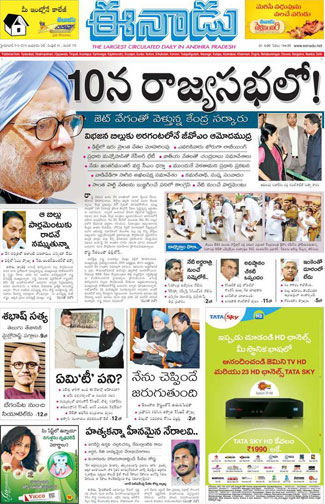
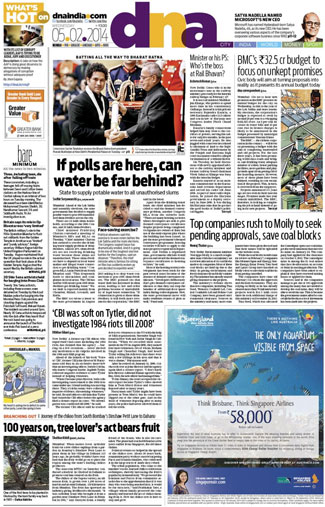
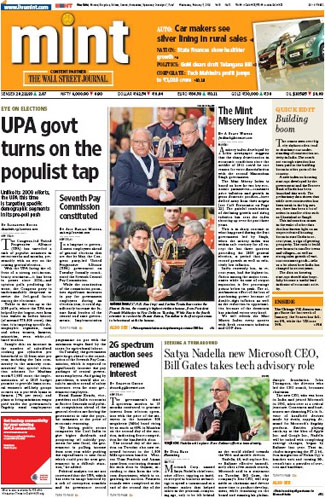
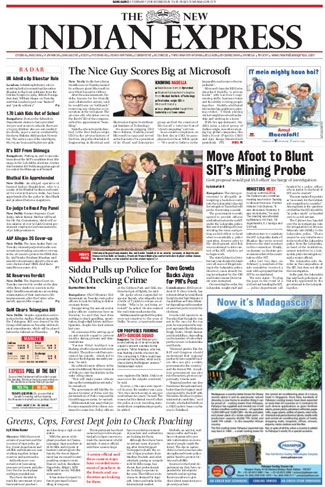
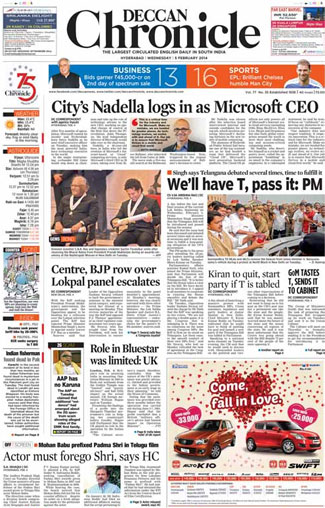
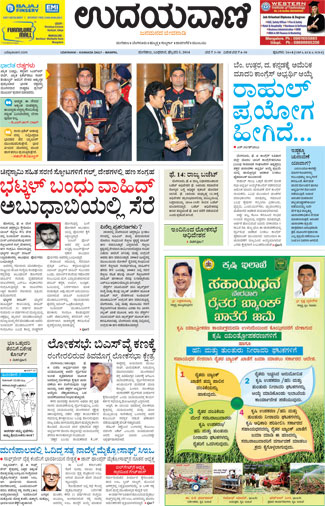
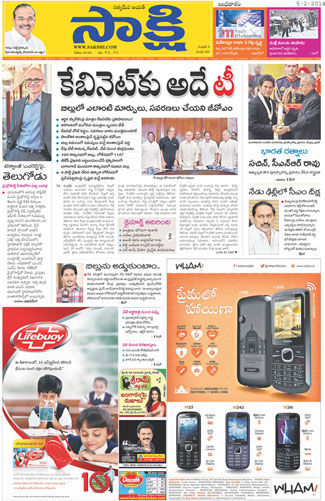
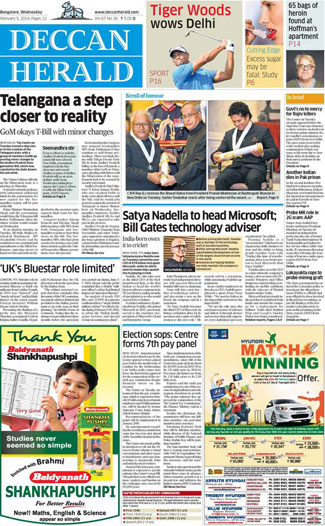
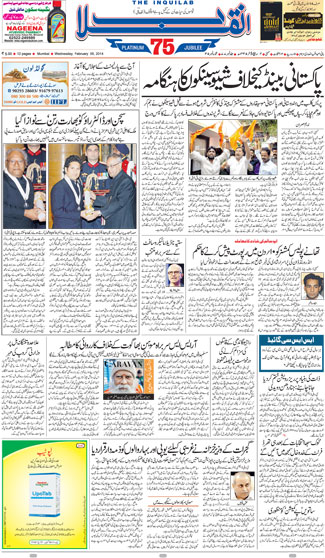
  • NewsStand: How our Page 1s covered Satya Nadella garu’s ascent

    NewsStand comes back after a long gap with the coverage of the news on the appointment of Hyderabad-boy Satyanarayana Nadella to the post of CEO of Microsoft Corp. We’ve brought in the Page 1s of some Telugu papers too as well as those from Karnataka (specifically Manipal where Nadella garu studied his engineering). PS: Garu, for those who aren’t familiar with the Telugu word, is an honorific suffixed to the name like the Hindi ‘ji’.


    The Times Of India

    Hindustan Times

    The Hindu

    The Telegraph

    Dainik Jagran

    Eenadu

    dna

    Mint

    The New Indian Express

    Deccan Chronicle

    Udayavani

    Sakshi

    Deccan Herald

    Inquilab