Category: Digital

  • Amazon celebrates the many quirks of the Indian consumer with #WeIndians

    By A Correspondent


    Amazon India has launched an integrated campaign that highlights the unique traits of Indian consumers and their behaviour, bringing alive the spirit of “what we Indians love”. It celebrates Indian quirks whether it’s about dropping newspaper to block a seat in a bus or about seeing Rs500 note under sunlight to check its authenticity. It celebrates who we are, what we like and how we behave as Indians.


    The campaign effortlessly ties back these quirks to the brand’s promise of 100% Original Products, Easy Returns, Fast and On-time Delivery and many other customer centric benefits to inspire trust in the brand.


    The campaign features series of films that talk about Amazon’s critical customer benefits. Commenting on the launch of the campaign, Amazon India Spokesperson said, “Our brand always tells a story that the customers feel connected to and in a manner that is simple to understand and relevant. It’s about being a part of their lives at the right time and at the right place. On the same lines, our new campaign theme #WeIndians conveys many benefits that Indian consumers seek while making their purchase decisions including original and genuine products, convenience of easy returns and experience of fast and on-time delivery. As always, the new campaign takes the route of everyday situations in an Indian consumer’s life and the customer’s intrinsic responses to these situations.”


    Continuing with Amazon.in’s trademark desi style, #WeIndians campaign effectively celebrates Indian style using interesting narratives and established how our offerings and services are in complete sync with what the consumer wants.”


    RajDeepak Das

    Elaborating on the thought process behind the campaign, RajDeepak Das, Chief Creative Officer, The Leo Group India, said, “All our campaigns for Amazon have focussed on insights that tell us about the psyche of the Indian shopper. Truths about the Indian consumer that are never spoken about but are so evidently seen in daily life situations.”


    Das further added, “The idea of #WeIndians emerged from the fact that Amazon’s strong understanding of the Indian consumer has led to an experience that is top quality and unmatched in the online shopping space. The campaign showcases the Indian consumer’s many quirks in day-to-day life situations. It uses real people, real locations and situations that land a smile on your face.”


    Neha Contractor, Senior, Vice President and Branch Head, Orchard Bangalore, commented, “We are proud to partner with Amazon on their journey of building the brand and leveraging rich Indian insights from #AurDhikhao to #TryTohKar, #Apni Dukaan and now #WeIndians.


    With We Indians, we have created a strong slice of life connect with the Indian consumer, driving top-of-mind recall by staying true to the brand’s customer-centric approach.”


  • L&T appoints LinTeractive as digital marketing agency

    By A Correspondent


    Lin Teractive, the digital division of Mullen Lowe Lintas Group has bagged the mandate for digital marketing of L&T across all its businesses, including performance media buys.


    After a multi-agency pitch that saw leading national agencies compete, L&T chose LinTeractive as its digital partner. L&T was impressed with LinTeractive’s strategic framework which provides a roadmap for companies looking to be digital future ready in communications.


    Deepak Morada

    Commenting on the appointment, Deepak Morada, Vice President Corporate Brand Management & Communications at L&T said: “Digital is a key focus area and as a group we wanted to go beyond looking at it as just another medium, truly harnessing the power of digital to change the conversation. At L&T, we’re at the forefront of technology across multiple domains and industries – we aim to provide an equally cutting edge experience to our customers, and we have reason to believe that LinTeractive possesses the requisite skills and experience.”


    Sumanta Ganguly

    The challenges of digital for a large conglomerate is not a simple thing, but Sumanta Ganguly, Executive Vice President, LinTeractive feels that it needs to start with changing how digital is perceived across the multiple stakeholders inside the organization.


    On the state of digital marketing in India, Ganguly commented: “The business of digital in India for most brands today remains an additional check box –a thing to do. At LinTeractive we look at digital as a way of doing things instead. With L&T we sensed an opportunity to deploy the power of this concept in response to the increasingly digital world of today.”


    Vikas Mehta

    On partnering L&T, Vikas Mehta, Group CMO & President – Marketing Services, MullenLowe Lintas Group said: “In the past 70 odd years, the L&T Group has played a pivotal role in building things that are at the core of today’s India. During these 70 odd years, Lintas has partnered hundreds of brands into becoming a part of India’s popular culture. The opportunity to collaborate with L&T, as they aim to re-imagine their businesses for a digital world, is a matter of great pride for the MullenLowe Lintas Group. We realize the tremendous responsibility that L&T has entrusted LinTeractive with.”


  • It’s #UnreasonablyFashionable for Yepme.com

    By A Correspondent


    Yepme.com has redefined fashion in their latest TVC that launches its Spring Summer Collection 2016 with a theme of “Unreasonably Fashionable”.


    Fashion is all about experimenting and inventing your style statement. Yepme has been dynamic in making its customers experience fresh fashion effortlessly. Hence this time they have brought in the Spring Summer Collection based on an entirely different yet ground breaking idea.


    The tagline “#UnreasonablyFashionable” helps the customer let loose and break free of all stereotypes. It out rightly ditches the idea of looking for excuses to be fashionable. Hence be fashionable with no explanations!


    Speaking about the new campaign, Vivek Gaur (Founder & CEO, Yepme.com) said, “The concept behind this TVC is that the consumer today is defining his or her own rules and means to live and enjoy their life. It is all about speaking out the minds of the customer where they want to be free to make their fashion statement. You don’t need a reason to be fashionable in fact being unreasonable is pretty reasonable nowadays.”


    The main aim behind projecting such ideas through the TVC is to make Yepme, an aspirational and desirable brand for all 21- 35 year olds, to reinforce Yepme as one-stop destination for fresh fashion providing latest collection to its customers.


  • Snapdeal appoints Kanika Kalra as VP-Marketing

    By A Correspondent


    Snapdeal announced the appointment of Kanika Kalra as Vice President – Marketing. A seasoned global marketing professional with a career spanning over 12 years, Kanika joins Snapdeal after several triumphant stints at Hindustan Unilever limited, Pepsico and GlaxoSmithKline Consumer Healthcare Limited.


    At Snapdeal, Kanika will be focused on making the business more customer-centric and ensuring creativity and impact in all communication.


    Welcoming Kanika, Rohit Bansal, Co-Founder, Snapdeal said, “We are thrilled to welcome Kanika. She comes with a vast and distinguished experience in brand marketing. As we look at defining more innovative solutions for our customers, I am sure she will add tremendous value and further fuel our growth”.


    Speaking about her appointment, Kanika Kalra said, “As ecommerce continues to revolutionize the Indian economy, I am confident that Snapdeal is poised to play an even bigger and more impactful role in the coming years. I am excited to be a part of Snapdeal’s journey and to shepherd the company’s growth as the country’s most preferred retail brand.”


    During her eight year stint as the Global Brand Director for Hindustan Unilever Limited, she spearheaded key innovations in the skincare category. Prior to that she was a part of the brand marketing teams at Pepsico and Glaxo Smith Kline Consumer Healthcare Limited.


    Kanika holds a Post Graduate degree in Marketing from IIM, Lucknow and a Bachelor’s degree in Mathematics from Delhi University.


  • It’s all about experience at Adobe symposium


    By Anuka Roy


    The Grand Hyatt Mumbai played host to the Adobe Symposium on April 27 and 28 and almost everyone who was concerned with the world of digital marketing was in attendance.


    The first day was reserved for an executive panel discussion and Q and A session with select media groups.  The panel comprised Paul Robson, President, Adobe Asia Pacific, Aseem Chandra, Adobe Vice President, AEM and Target Business and Umang Bedi, Adobe Managing Director, South Asia. The interaction started with a presentation by Robson who gave an introduction to what Adobe has been doing for the past 30-odd years. He said, Adobe tries to provide, “Technology that allows creating great content”.  Robson referred the present time period as the ‘Experience Era’, an era where ‘experience starts with great content and experience is powered by data’. After Robson, Chandra spoke on the current products that Adobe offers and how their clients have been satisfied with the latest technology they have to offer. He also touched upon the innovations that they are working towards. “From the business point of view, experience needs to look consistent, continuous and compelling” said Chandra. Lastly, Bedi discussed the opportunities that India has. He shared some of the Indian brands for which Adobe has played an instrumental role in terms of digital transformation.


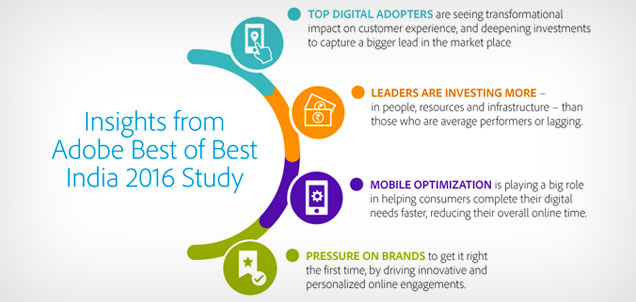
    ‘Experience’ was the buzzword in symposium on Day Two. The day started with speakers from SpiceJet Ltd and IDFC bank explaining how they are making major strategies and adapting new technology to ensure a fulfilling customer experience. There were other speakers from different brands who stressed on the importance of being an experience centric business in the digital era. Tamara Gaffney, Principal Analyst, Adobe Digital Index, spoke on how data has helped businesses to evolve digitally. She released a study in context of India showing how mobile traffic is on the rise across all industry sectors, especially in the banking sector, people are investing more on mobile related services and mobile optimisation is playing a big role in helping consumers complete their digital needs faster and saving their time. According to Gaffney, Voice Assist Technology is the new battleground. “It will take time to penetrate into India but it surely will be big in the future” said Tamara about the same technology coming to India. She also touched on the topics of augmented and virtual reality which might be our future.


    Post-lunch, there were parallel sessions on creating rich content and getting it to the customers, the various apps being developed for mobile and various other relevant digital topics.


  • FCB Ulka creates a new campaign for Pixarom

    By A Correspondent


    FCB Ulka Bangalore has created a new campaign for Pixarom, a comprehensive post production studio that provides creative solutions for print and digital media. The campaign captures the perfection of retouching which looks so real that the viewer feels that he/she is in the scene performing it. Retouching is the next realm of creative expression which infuses life in photographs.


    Pixarom’s services range from image retouching, 3D for print as well as 3D animation and videos for online and TV commercials. Equipped with the latest technology as well as a group of skillful and creative people, Pixarom is able to turn the ideas into reality in the fastest and most cost efficient way.


    The campaign was created from a point of view of the retoucher. The idea was to highlight the fact that retouching brings out the much needed perfection which makes the picture come to life.


    Commenting on the campaign, Steve Koh, CEO, Pixarom said “When I first heard the idea, it instantly brought a smile on my face & said, ‘We will do it.’ The brilliance of this campaign is in its execution itself, which is our forte. Usually, we do retouching & campaign creation for other brands, but, for a change, we are delighted to have created our own campaign promoting Pixarom Imagerom.”


    Vinci Raj, Sr. Creative Director, FCB Ulka Bangalore said,“In any art, we usually give life to an idea through photography, retouching, production, etc.Why can’t these then create the idea?”


    The campaign is aimed towards the niche segment of advertisers, art directors and photographers.


  • AAAI to host one-day workshop on ‘Digital Hackfest’

    By A Correspondent


    Advertising Agencies Association of India (AAAI) under the aegis of the AAAI Prowess initiative announced a one-day workshop ‘‘Digital Hackfest – How to Power-up Brands in the Digital Space’’ scheduled for 26th May 2016 in Mumbai at the AAAI’s Training Centre at Lower Parel.  This workshop will be led by Meera Sharath Chandra.


    Today it is not about brands wanting to go digital but brands deepening their connect and co-creating experiences with their consumers across interesting and emerging digital apertures. Digital is more than a medium. It is a way of life. A whole new sphere where brands can sharply define their mission, personality, positioning and conversations with consumers. How can the digital strategy seamlessly dovetail with the brand intent? How can it be the heart of a totally integrated experience? How can we better understand the art and the science of digital engagement?


    The workshop will be in four parts. First, a look at how our digital and physical worlds collide. Second, examining how brands can leverage the online space in impactful and meaningful ways. Third, an understanding of the role and power of social media. Fourth, joining the dots to create a holistic brand story. Every session will conclude with a fun hack on the theme.


    Meera Sharath Chandra is Founder, CEO & CCO of Tigress Tigress – an agency that specialises in integrated communication with digital at the heart of the experience.


    An integrated creative professional with 35 years of global experience, handling both MD and ECD responsibilities, Meera has over two decades of specialisation in the digital and integrated space. She has been an award winner and jury member at Cannes Lions, One Show, D&AD, Clio, Art Directors Club and New York Fest among others.


    Meera has worked in the US, the UK, Hong Kong and India. As an entrepreneur, Meera has earlier run an Intel-funded dotcom enterprise servicing clients in the US, Europe and Hong Kong, leading a 250-strong team. She has been a member of global task forces on brands such as Nestle, Unilever, Ford and Citibank. She has specialised in UI/UX from the University of Maryland’s Human Computer Interface Lab.


  • Interest of Internet users should drive “Encryption Policy”: IAMAI

    By A Correspondent


    Encryption is a fundamental and necessary tool to safeguard the digital communication infrastructure. The interests of Internet users should be foremost in framing any encryption policy, according to a “discussion paper” released by the Internet and Mobile Association of India [IAMAI]. “Trust, convenience and confidence of users are the keywords to designing an ideal encryption policy that will help in getting more people online with safe and secured internet platforms,” said Dr. Subho Ray, president, IAMAI.


    The association has published this discussion paper with the view to encourage discussions and debates around the issue, and has suggested that a broad-based public consultation with all stakeholders including users groups should precede the making of an encryption policy.


    According to the paper, the foundation of a user centric Encryption Policy consists of: Freedom of Encryption, Strong Encryption Base Standard, No Plaintext storage and Mandatory legal monitoring or No Backdoor Entry.


    The most essential element in the paper suggests that support for strong encryption is critical to counter cyber security issues around the globe. Mandating a framework of legal monitoring or building backdoors will affect the users’ trust in the internet. It will make the system weak and prone to illegal hacking without eliminating the real concerns. There is no point in having the world’s best lock if the keys are kept under the doormat.


    In addition, the paper suggests the importance of freedom of encryption for the users, organizations and the business entities. Prescribing a minimum standard is quite retrograde considering various users and internet companies need different encryption strength given the fast pace at which technology is changing.


    Instead of a low ceiling, a high base should be specified based on the internationally proven encryption standards viz., AES-128 and 3DES and 256-bit. In India at present a low ceiling of 40-bit standard is prescribed, beyond which prior approval of the government and handing over the keys is mandatory. This standard is the weakest, outdated and can be easily hacked.


    Antiquated policies such as mandatory plaintext storage and key disclosure violate the objectives of a strong encryption policy. It burdens the users and internet companies while not affecting the actual offender. Instead practices such as forward secrecy and authenticated encryption should be adopted where decryption keys are deleted immediately after use so that stealing encryption keys used would not compromise data protection and privacy.


    Careful consideration should be given to the impact and effectiveness of any proposed policy so that it does not compromise the existing robust system in place or pose unnecessary burdens on the internet users and firms.


  • Social media to play key role in Kerala & Tamil Nadu elections: IAMAI

    By A Correspondent


    The poll outcome in as many as 71 high impact assembly segments out of 140 constituencies in Kerala will likely be influenced by social media users, a report by IAMAI said. Ninety two percent of social media users in Tamil Nadu are following the election on social channels, with 28 per cent of the 234 constituencies likely to see netizens play a decisive role in determining the winner.


    Taking the theme of “Impact of Social Media on Elections” a level deeper than General Elections, the Internet & Mobile Association of India (IAMAI) with the support of The Campaign 360, has released a report titled “Social Media Impact on the Kerala & Tamil Nadu Elections, 2016.” This report is a part of the series of assembly election reports, and follows the hugely successful social media impact report that IAMAI published in 2014 on the eve of the General Elections.


    According to the report, there are 71 High Impact constituencies in Kerala, the results of which are likely to be influenced by social media users in the state. There are 4 medium impact and 65 low impact constituencies in the State. The report contends that 51 per cent or as many as 1 out of 2 constituencies, which have been classified as High Impact could determine the eventual winner in the State.


    There are 66 High Impact constituencies in Tamil Nadu, the results of which are likely to be influenced by social media users in the state. There are 14 medium impact and 154 low impact constituencies in the State.  The report contends that 28% or more than 1 in 4 Constituencies, which have been classified as ‘High Impact’ could determine the eventual winner in the State.


    Conducting a web survey of a representative sample of 250 social media users each in Kerala and Tamil Nadu, it was found that in Kerala, TV (53 per cent) and Print (48 per cent) still stand as the most trusted media sources for election related content, while 31 per cent rely on Social Media and only 9 per cent access Digital News. In Tamil Nadu, 32 per cent rely on Social Media and only 15 per cent access Digital News, while reliance on TV is 46 per cent and print is 40 per cent.


    During the 10 day tracking period between 11-20 April, using social media “listening tools”, Corruption emerged as the topmost topic of discussion. Oommen Chandy, the incumbent Chief Minister was the most discussed leader in Kerala while BJP was the most discussed party. The LDF has minimal presence on Facebook and Twitter both from a Party and Leadership perspective. The incumbent UDF makes up for 1 in 3 mentions with a 9% negative sentiment. The Left on the other hand makes up for the least negative sentiment though its share of volumes are significantly lower than its vote share in the State.


    In Tamil Nadu, the DMK alliance dominates the conversation on social media channels. However, the net sentiment is negative. The AIADMK has significantly lower presence but also very high negative conversations, with 1 in 3 conversations about the AIADMK on Social Media are negative. The same trend impacts all the other parties/alliances except the small PMK which has more positive than negative conversations.


  • Yahoo-Mindshare study analyses online shopping behavior of Indian consumers

    By A Correspondent


    Yahoo and Mindshare announced the findings of their joint study of the India market: ‘Mobile Consumer Journey – 2016’. The study is based on research of users’ shopping behavior across devices for 31 different categories including travel, electronic devices and consumer packaged goods. Findings highlight the dominant play of mobile devices in the consumer’s purchase decisions.


    The study throws light on the role of mobile in a consumer’s purchase journey – how the devices get used in different stages, key drivers and barriers to the final purchase decision, consumers’ preferences of how to buy and where to buy, top selling categories on mobile, and cities that see the most mobile transactions. The study aims to equip marketers with insights on India, to sharpen their digital and mobile commerce initiatives and build a strong mobile strategy.


    Commenting on the findings, M A Parthasarathy, Chief Product Officer, Mindshare South Asia said, “The ecommerce landscape in India is perhaps the most dynamic in the world, largely due to the rapidly evolving mobile ecosystem. This research highlights the role of mobile from the top of funnel to the bottom and how it varies across product categories. It will help us develop sharper, more connected communication strategies for brands.”


    Francis Che, Head of Insights, APAC, Yahoo added, “The study shows that the consumer path-to-purchase is turning more complex and nonlinear, with mobile at the center of this evolution. As mobile devices become more important in the consumer’s last mile of purchase decision, brands need to build targeted, more seamless shopping experience across all channels to strengthen sales and acquire new customers.”


    Key findings from the study:

    1. Drivers and barriers of online transactions:

    a. 31 per cent of online shoppers cite saving time or effort as their main reason for shopping online.

    b. Attractive discounts and promotions is another key driver as stated by 28 per cent of online shoppers.

    c. 21 per cent cite the convenience to shop anywhere, anytime as a big draw.


    The barriers that keep them away from shopping online include – non-authentic goods, unreliable delivery and lack of quality control.

    2. A city-wise break-up for mobile transactions show that 75 per cent online shoppers in Kolkata are open to mobile transactions followed by Chennai with 64 and Delhi with 57 per cent. Surprisingly online shoppers in metros like Mumbai & Bangalore seem more ‘cautiously open’ with less than 35 per cent of them preferring mobile transactions over other mode of payments.


    3. Mobile “browse” tends to convert to mobile “buy”

    a. Of the total number of consumers browsing for products on mobile, 79% prefer buying on a mobile device compared to 9% on PC/laptop and 12% in a physical store.

    b. Clearly, brands have a big window of opportunity – from creating awareness to final purchase decision – to connect and engage with their target audiences on mobile devices.


    4. Distinctive consumer journeys by category Online shoppers are more likely to use their mobile device to make regular or impulse purchases rather than expensive, high consideration purchases.

    a. Over 90% of the consumers use mobile devices for quick and frequent purchases of Travel, Music & Movies.

    b. 36% consumers prefer buying high-consideration products like Insurance on their PC/ Laptop. 24% consumers prefer buying health supplements on PC/ Laptop.

    c. Categories with significant in-store purchases include Personal Hygiene (30%) & Luxury Accessories (27%).


    5. Categories on the high growth quadrant – ranked by number of consumers buying them on mobile over other modes – include apparel, electronic devices, baby and pet care products. Users are less likely to buy financial services products on mobile as they see these as more complex purchase decisions.


  • FirstHandle appoints Alchemist as its communications agency

    By A Correspondent


    Delhi based Mobile App firm FirstHandle has hired Alchemist for brand building and enhancing its footprint across the country even as its traction has extended to Mumbai and Bengaluru since its launch in the capital, less than a year ago. The agency will handle the strategy, planning, and the creative responsibilities of the brand. The account will be handled by the agency’s Delhi office.


    Says CEO Gaurv Sinha, “We, at FirstHandle were looking for a team/agency that matches our standards of operations, understand our business philosophy and will help us find a standing in a market as diverse as India. We are happy to have on board Alchemist, a leading Marketing Solutions provider, as the drivers of our brand and social strategy and execution partner.”


    This strongly backed mobile app is meant to help find treats and treasures at a discount! Manish Porwal, MD Alchemist said: “We pride ourselves in contributing to strategic growth for businesses. We are excited to partner with FirstHandle, to work on their brand and social strategy. The challenge for us is to create an exciting communication plan to make this brand into a go-to-app for every person who steps out to shop.”


  • 8 reasons your business must have a digital strategy


    By Jaspreet Bindra


    Angela Arhendts, the CEO who made Burberry the first, truly-digital luxury company, once said, wistfully: “I grew up in a physical world and I speak English. This generation is growing up in the digital world, and they speak social.” The point is that the world is fast changing into one where customers speak a different language, and their physical reality effortlessly coexists with the virtual.


    As the world changes around people, so must businesses — especially if they are not born digital in the first place. Here are eight reasons why your business cannot afford not to have a digital strategy:

    1. Customers are going digital: They live in an alternate world – the world of WhatsApp, Facebook, Google, LinkedIn, Instagram – and they want to find you there, speaking their language. It does not matter whether your company is B2B or B2C; you need to interact with them in that world.


    2. New channels of sale have emerged: e-commerce marketplaces, mobile commerce, selling on social networks and such. Customers expect you to be available in all these channels, and you need to embrace multiple digital avenues.


    3. Business models are changing in this digital world: Now, the sharing economy has come in and upended traditional business models, with Airbnb making existing, idle houses available to travellers, and Uber enabling every car to become a taxi. The ‘platform’ business models are disrupting the most traditional business models.


    4. Disrupt, or be disrupted: Even as you run your traditional business, you need a strategy to experiment with new, digitally-enabled business models and move your businesses towards them. Otherwise someone else will come in and disrupt you out of business. Many times these new business models will cannibalise your business.


    5. Speed: Digital is faster, and speed is a massive competitive advantage. Any facet of digital you can think of — whether online marketing, social media, etc – the speed is blinding compared to its traditional avatar. Digitally-enabled companies, therefore, bring products to market much more rapidly.


    6. Combined with speed is scale: Digital companies are inherently scalable. They grow and the scale is disproportionate  to the resources you add. They use network effects, and the economies of scale much more efficiently. Having a digital strategy implies using tools of scale such as algorithms, sensors, artificial intelligence, mobility, etc


    7. Mobile phone: A mobile digital strategy is mandatory. It could be in the form of apps, mobile sites, messenger bots, location-based services and such. A phone can be used to augment your business.


    8. Finally, going digital is about changing the culture of your people: The Internet is collaborative, crowdsourced, imperfect, and all-pervasive. A digital culture implies creating products that ‘just work’ and then rapidly iterating and improving them through crowdsourced ideas, tolerating and celebrating failure; active collaboration and informality. A digital strategy is incomplete without a people or culture strategy.


    The digital web has staged an interactive coup, and has handed power firmly to the consumer. We as businesses which serve them, need to have a strategy to cope with this new reality. Or perish.


    Jaspreet Bindra is a digital native, a change agent, organisation builder and a day-dreamer. He also happens to be Senior Vice President – Digital Innovation and Ecommerce, for the Mahindra Group of companies. The views here are personal. Twitter: @j_bindra. This article appeared first in dna of brands dated May 23, 2016.