Category: Digital

  • Tulu YouTube channel crosses 1mn mark

    By A Correspondent


    “Music is to soul what words are to the mind”. Indeed the quote is true for all musicians and music lovers around the world. Another very important aspect is music has no language. Music in any form and language appeals to everyone. So, here is good news for all music lovers,  the YouTube channel of Muzik247 Tulu, claims to have crossed one million views. According to a communiqué, Muzik247 Tulu was the first digital entertainment publisher to bring out a dedicated YouTube channel exclusively for Tulu movie content.


    Said Ruchika Gupta, Muzik247 Tulu’s Head Of Operations, in a press release: “This milestone of touching 1 Million views for a Tulu-specific YouTube channel is a testament to the growing prominence of Tulu film industry. We are extremely thrilled to see that we are able to contribute to this emergence. As a prominent music label for Tuluvas everywhere, Muzik247 Tulu will continue to support and bring forward the movie industry through our associations with more Tulu movies.”


    Muzik247 Tulu has been on YouTube since September 2015 and boasts of viewers from India, United Arab Emirates, Saudi Arabia, Kuwait, Qatar, Oman, Bahrain, United States, Israel and the United Kingdom.


  • Govind Rajan elevated to CEO at FreeCharge

    By A Correspondent


    FreeCharge has announced the appointment of Govind Rajan as the Chief Executive Officer of the company. Govind, joined Freecharge in August 2015 and is currently the Chief Operating Officer at FreeCharge.


    In a related move, Kunal Shah, currently the CEO of FreeCharge will now be the Chairman of the company. Kunal Shah is the co-founder of the company, along with Sandeep Tandon. In April 2015, Snapdeal had acquired FreeCharge in the biggest deal that the e-commerce sector has seen in India till date.


    In October 2015, within five months of the acquisition by Snapdeal, FreeCharge launched its wallet. The FreeCharge wallet is now the fastest growing wallet in the country, with exponential growth both in terms of users and number of daily transactions.


    Commenting on the elevation of Govind Rajan, Kunal Shah said, “Govind has led with great insight and initiative. His understanding of the payments industry and its future trends is equally matched by his discipline and ability to get things done. In Govind, we have an exceptional leader, who will lead FreeCharge to become the No. 1 player in the payments ecosystem in the country.”


    Reacting to the appointment, Govind Rajan said, “FreeCharge is built on a robust foundation of cutting-edge technology, superlative customer experience and a deep understanding of consumer needs. Kunal has built a great tech team and an iconic brand. It is a privilege to take the baton from him. We are fortunate to have his guidance as the Chairman and mentor-in-chief. I am very excited to carry forward our mission to build FreeCharge as India’s digital payments OS”.


    In his previous stints, Govind was the Chief Marketing Officer (B2C) at Bharti Airtel and concurrently also served as the CEO for Airtel Money. An alumnus of Indian Institute of Foreign Trade (IIFT), Govind spent the first 15 years of his professional life at Hindustan Unilever, where he served in various marketing and leadership roles. Govind’s experience of nearly twenty years has seen him drive exceptional results across building market share, driving revenue and building marketing capabilities.


  • Day 2 of IAMAI Marketing Conclave: The Digital story continues


    By Anuka Roy


    It was the twelfth edition of the Internet & Mobile Association of India (IAMAI)’s annual marketing conclave. And as the proceedings concluded on Thursday, some of the takeaways from the two-day event were: focus on context and content, understand your target group, utilise social media tools properly and mobile marketing will be the next big thing.


    The digital storytelling journey continued on Day 2 of the Conclave. Saurabh Varma, Chief Executive Officer- South Asia, Leo Burnett Group, carried forward the topic of ‘Art of Storytelling with Digital Marketing’, which was touched upon a little on Day 1. In his presentation, Varma emphasised on the point that organisations need to find a purpose and once they find that everything falls in to place. He also cautioned that in the process of getting the act and purpose right, brands sometimes become too noisy while implementing their plan, which should be avoided. “We need more human brands, especially in digital,” stated Varma. He focused on the need for the right content and context, which eventually helps a brand to be successful. This was explained through two videos, one by Gatorade which paid tribute to a retiring baseball player and the other was Bajaj V, which showed motorcycles being made from the metal of, now dismantled, INS Vikrant. By giving examples of these two videos, he tried to reason that if the context and content of the brand are in proper place, everything gets going for a brand. Varma also spoke about ‘Functional integration’, something which is followed in his company and it pushes agencies to focus more seriously on client needs. He also pointed out that Social tools need to be used more efficiently.


    In a marketing conclave which has been mostly dominated by discussions about digital marketing, how can a discussion focused on social media not take place? Karthik Nagarajan, National Director- Content and Social Media, GroupM moderated the discussion on ‘Social Media- Marketing through Videos’, with Sameer Pitalwalla, Chief Executive Officer, Culture Machine, Malay Dikshit, Chief Communications Officer, Tata Sky, Vijay Nair, Chief Executive Officer, Only Much Louder and Shreyas Rao, Senior Vice President, #fame as his panelists. Before the discussion, each panelist made a short presentation on the same topic. Pitalwalla presented the case study of ‘Being Indian’- a brand which they are associated with. Through the case study he showed how this brand expanded using different social media platforms. Taking the unconventional route, just like the videos that Nair’s company makes, he chose to just talk about the topic rather than showing a PowerPoint presentation. Jain stated, “Creators are going to be the agencies themselves and content marketing should not be confused with advertising.” Dixit’s presentation highlighted the fact that very soon traditional media platforms will merge with internet. The presentation ‘Video is the new text’ by Rao showed how just through videos and live video streaming his company made an impact within one year of its launch. The panelists agreed to the attention required for correct content and context, just like Saurabh Varma did in his session. Another very important change in today’s scenario that surfaced in the discussion was that due to the plethora of digital platforms, consumers give their feedback almost immediately and they can be brutal. So, brands need to be very careful about what they are offering. This pre-lunch discussion definitely gave the audience some great food for thought.


    The session on ‘Programmatic Marketing- Make the best out of it’ was moderated by Nadeesh Ramachandran, Vice President- Sales and Strategy, Vserv. The panelists of the session were Ashish Sahni, Head- Digital Marketing (Passenger Vehicle Bussiness Unit), Tata Motors, Manish Kalra, Chief Business Officer, Craftsville.com, Hitesh Malhotra, Chief Marketing Officer, Nykaa and Henry Stokes, Vice President of Client Development- APAC, Xaxis. When the moderator asked the panelists to define programmatic marketing, Kalra was quick to reply, “It is a jargon and basically, the use of technology that enables marketers to target right people at the right time.” The discussion was mostly about how advertisers should know their audience and should be clear about the target group. This discussion was carried forward by Stokes, who made a presentation about the same topic immediately after the discussion, explaining the concept of ‘Programmatic Marketing’ more extensively. “Take control, by defining and managing your own target audience,” he said in conclusion.


    From programmatic, the discussion moved to ‘Performance Marketing- pay for outcomes only’. The post-lunch session moderated by Siddharth Puri, Chief Executive Officer, Tyroo with panelists Sevantika Bhandhari, SVP- Marketing and Head Products, DHFL, Shivani Dhanda, Director Marketing, eBay, Nikhil Rungta, Chief Executive Officer, Housing.com, Venkatesh C R, Chief Executive Officer, Adatha, Atit Mehta, VP and Head of Media, Sequoia Capital and Vivek Singh, Sr VP- Marketing and Analytics, Firstcry, made sure the audience was attentive through their insightful discussions. Dhanda and Singh had contradictory opinions on the definition of Performance Marketing, as the former said: “From eBay perspective, performance marketing is when you are paying for a click or the end transaction that takes place, while negotiating with a vendor, the performance metrics come in to play” while the latter opined: “Performance marketing is the process in any kind of marketing. It is about having an end goal while using any form of performance marketing.” The discussion concluded with each panelist giving their view on what they will be discussing about in a year from now, the common consensus was “about integrated marketing devices.”


    The last panel discussion was quite a fiery one, with quite a few contradicting views on the topic ‘Using mobile marketing to build healthy brands’. The session was moderated by Chandranshu Mishra, Consultant, Tata Strategic Management Group and the panelists included Ritza Trivedi, Director- Marketing India and South Asia, Visa, Uday Sodhi, Executive Vice President and Head- Digital Business, Sony Pictures Network, Anuj Kumar, Co-founder and MD, Affle, Martin Nygate, Founder and Chief Executive Officer, Gentay Communications and Lavin Punjabi, President, Affinity. While discussing about mobile advertising, Nygate said that his company conducted a survey which should people are annoyed by mobile advertising. “We believe the industry is in crisis,” he said. Kumar disagreed and said, “I do not buy the survey. The data consumption aspect in terms of mobile ads is overrated. This platform is giving free content.” Punjabi was quick to ask in reply to the statement, “Are viewers ever going to be ready to pay for content?” But everyone agreed to the fact that the future of mobile advertising is brand and eventually the obstacles of this platform will go away. “Mobile content is getting very exciting now. It allows you to communicate to the individual directly. It is the fastest growing space in the advertising ecosystem.”


    Day 2 also had three case study sessions taking place parallel to the panel and individual sessions. The case study session on ‘Building a brand on digital’ was taken by Anindita Chatterjee, Senior GM Marketing, Spaces and Ajit Nair, Region Head, Quasar. ‘SME Advertising Market- Big opportunity, bigger challenge’- case study session was taken by Samir Chaudhary, Co- Founder, The Media Ant and another session was taken by Priya Jayaraman, Co-founder and Business Director.


     

  • Nanu way to go!


    By Anuka Roy


    We all will relate to that annoying situation of trying to read an interesting article on a mobile but getting interrupted by an ad which keeps blinking and diverts your attention. A recent study was conducted by ‘Nanu,’ among a targeted group of Gen X, Gen Y and millennials from India using smartphones and who have a diverse work profile on mobile advertising. Nanu is a mobile call app developed for the emerging markets. It utilises proprietary ultra-low bandwidth VoIP (Voice over Internet Protocol) technology and an ad-sponsored free call business model to provide high quality free calls to everyone, everywhere, even on 2G.  A Singapore-based startup founded by a father-son team of Martin and Daniel Nygate.


    The study reveals that 60 per cent respondents are annoyed with mobile advertising and thought the ads to be most annoying and obtrusive. But banners still hold some preference for mobile users due to its unforced nature since approximately 52 per cent of respondents have rated banners as least annoying while more than 55 per cent respondents find pop-ups and video ads the most annoying form of mobile advertising.


    The focus of advertising is mainly on two factors – increase in sales and brand-building. In its present form, mobile advertising fails to do either of them as indicated by the survey. The survey reveals that 46 per cent respondents may click intentionally on banner ads, but 80 per cent still avoid clicking on pop-ups and video ads. Moreover, about 75 per cent of them indicate their doubts on making any purchase decision based on mobile advertising.


    According to Founder and CEO Martin Nygate, there is need understand the evolution of advertising on mobilephones and smartphones. When smartphones came out, technologists took the technology from desktop and laptops, which was a banner, and put it on a mobile phone. “But the reach on the mobile phone is so small, the banner as a call to action is so small that no one can see what they are saying. Now, technologists say that the banners do not work so let us do the pop-ups. And, I do not need to tell you how annoying and intrusive that is. Then they said people do not like pop-ups so let us do video ads. They are even worse because they consume data. In the last few months, the data consumption in everyone’s phone has soared and that is because of the proliferation of these video adverts. Basically, they are stealing your data. It’s worse now as even if you do not click on it, it is downloaded in the background.”


    So, what is the solution that Nanu provides for mobile advertisers? “First and foremost, our form of advertising is the voice over, over the ringtone and is completely non-intrusive. When you are calling me, instead of the ring you hear the voiceover, but the moment I pick up the advert stops. Let us not forget everytime you make a phone call, it is about 10 seconds where you are listening ‘ring ring’, that is the 10 seconds we use. So, that is completely non-intrusive. Second thing is, when you download Nanu we ask your age, sex, profession and education. We can do targeted one-to-one marketing in a very effective way. Thirdly, advertisers are very excited because when you are listening to the adverts it is not like radio playing in the background and you are actually listening, that means the recall rates are very high. Finally, probably, the most important thing, this is one of the few forms of advertising where the consumer gets a direct benefit for consuming the advert. You are getting a phone call for free and you are positively disposition to the advertiser because ‘this call is brought to you by McDonalds. Well thank you McDonalds for giving me a call for free’. So, it is a win-win for everyone.”


    Not only mobile advertising, the company is also coming up with another powerful statement in the OTT (Over The Top delivery system)-telco relationship. Nanu claims that they are ready to pay the telecom operators  for using the telecom infrastructure, hence bringing a paradigm shift in the present conversation around OTT and Telecoms. Commenting on the same, Nygate said, “TRAI said telcos cannot block VoIP. What this means that telcos have a threat because if more and more OTTs steal their voice calling revenues they are going to have serious problems. What we are saying is that we are the only OTT company in the world that is willing to pay the telcos for transmitting a Nanu to Nanu call over their network. We don’t have to but we want to because we want to maintain their profitability. It is important for us to partner with telcos because without them we would not work. So, we have to make sure they still make money and because we get money from advertisers so we can pay them.”


    Today, mobile advertising is the core of any brand’s digital marketing media strategy and marketers are aggressively looking at options to ensure the right visibility for the brand, thereby enhancing brand recall for the products and services. The outcome of the survey indicates the status quo of the mobile advertising segment, leading to annoyed and irritated consumers coming at the cost of brands’ advertising budget for mobile.


  • Aroon Kumar: AI in search, the way forward

    By Aroon Kumar


    I have often said that search is constantly evolving as technology improves the lives of people and consumer behaviour shifts. Search is getting more into local mode. Local consumers are now using mobile technology more that has affected how marketers engage with and convert the local shoppers who are always curious about deals and discounts. This means search must be an integral part of a strong marketing strategy in a smarter way which can’t be a one-size-fits all approach and need to be planned meticulously to understand the consumer activities. Data available from social media channels is a great example of the way in which new digital technologies provide business with a more comprehensive understanding of the consumer. Social media has become embedded within nearly every sphere of life. News stories circulate social media channels side-by-side business promotions and the everyday sentiments of users (consumers). The daily actions and interactions are smartly recorded and collected by marketers and brand owners to be used to get ahead of the curve.


    From 1998 when there were about 300 million people online, to 3 billion people whom Google the search leader is catering today are searching for information on various devices including their mobile phones. As per Sundar Pichai, the Google CEO, “the mobile phone has really become the remote control for our daily lives and we are communicating, consuming, educating and entertaining ourselves, on our phones in various ways unimaginable just a few years ago”. Google has come a long way from organising world’s information and making it universally accessible and useful to helping them organise their day, get them from one place to another and keeping in touch with their peer group and to the world. And with the dominance of mobile phones in daily life and majority of searches for various types of information are coming from mobile devices where people are looking for more local, more contextual information at their finger tips. Here Google Now becomes really helpful in providing contextual information like the weather at your destination city where you are intending to visit next, airport crowd and traffic in a busy lane by saving us from inconvenience and time; making people rely more on the search giant for information. Depending on the context or need, people may want to know what time is best to avoid the crowd, whether the salon is open right now or what are the best things to do in a new city where one lands for the first time. Based on upcoming trends Google customises products for example people across the globe collectively will take 1 trillion photos this year with their devices and seeing this in advance, Google launched ‘Google-Photos’ (currently 100 million active users per month) to make it easier for these photo crazy people to organize their photos and videos, storing their personal memories digitally through mobile devices. Mobile web is becoming prominent and a vital source of traffic for the large majority of websites across the globe. And Google is closely working with publishers, developers and stakeholders in the ecosystem to help make the mobile web a smoother, faster experience for the users. There are two examples for this; one is the Accelerated Mobile Pages (AMP) project which was launched as an open source initiative in partnership between Google and news publishers to create mobile optimized content that loads instantly everywhere. The second one is Progressive Web Apps (PWA) which combine the best of the web and the best of apps -  allowing companies to build mobile sites that load quickly, sending push notifications, having home screen icons and much more. And all of these are integrated with Chrome which is having 1 billion plus monthly active users on mobile. All of these indicates towards machine learning and artificial intelligence as the next important factor for Google Search.


    The world is getting smarter with the people living in it and the ever evolving technology advancements are making them empowered with information that is pervasive. From Vishal Sikka, the CEO of Infosys to Sundar Pichai of Google, all are advocating heavily on artificial intelligence in computing, cloud and search. As per Sundar, the next big step will be for the very concept of the ‘device’ to fade away. Over the time the computer itself will be an intelligent assistant (in its next form factor), helping people throughout the day. It’s like moving from mobile first to AI (Artificial Intelligence) first world. By analyzing humungous amount of digital data, Google’s AI (which includes deep neural networks, mix of hardware and software networks that approximate the web of neurons in human brain) can learn all sorts of useful tasks, such as identifying photos, tracking specific communication logs, recognizing commands given into a smartphone and going a step further by responding to internet search queries. In some cases, these specialised algorithms will perform the tasks so well that they will outperform the humans, faster and much at a large scale. This approach termed as deep learning is fast reinventing so many of the most popular services across internet from Facebook to Twitter, Skype to Slack and many others. And this approach has reinvented Google’s search business as well, where the internet giant generates most of its revenue. On 26th October 2015, Google rolled out a deep learning system called RankBrain which helps generate response to search queries and currently RankBrain plays crucial role in a very large fraction of the millions of queries that go through the search engine with each passing seconds.


    In the past, Google relied mostly on algorithms that followed a strict set of rules set by humans and as per some of the search marketing specialists it was more difficult to understand why the artificial neural net behaved in such way and difficult to tweak their behavior. The neural networks work in their own mysterious ways which the experts including internal Google experts don’t understand completely. But the fact is if one feeds enough photos of a platypus  into artificial neural net, it has the ability to learn to identify a platypus, if it sees enough computer malware code, it will learn to recognize the virus. If it gets enough raw language (words and phrases that people might type into a search engine) it will learn to understand search queries and help respond to them. In many cases it can handle queries better than algorithmic rules hand coded by human coders. Artificial Intelligence is the future of Google Search and if Google is betting its future on it then it’s the future for so many existing and new things in the world.


    The implications on marketing are very encouraging as people can expect more accurate search results and RankBrain will better understand what users are searching for. Along with RankBrain it will affect the other Google algorithm Hummingbird. This will enable customers to play a bigger role with their reviews and remarks. Customers who are providing reviews use real languages and mention it in ways that other users might also ask a question through Google. AI will help in improving mobile search with better relevancy that will help marketers in better conversions justifying higher ad rates. Least not the last, Artificial Intelligence can help search engines deliver better search results that is personalized for a specific point in time – a micromoment when users might be most interested in a certain set of results.


    Aroon Kumar is a new age marketer currently working as GM-Global Marketing with CricHQ, the cricket technology company. Available on Twitter: @aroonin. Pssst! It’s his birthday today 🙂


  • MRSS India inks agreement with Wakoopa for cross platform digital tracking

    By A Correspondent


    MRSS India announced its strategic partnership with Wakoopa, an Amsterdam-based company specializing in behavioral data. This business alliance marks the launch of Wakoopa Hub in India, a new behavioral data marketplace.


    Wakoopa Hub provides behavioral data to market researchers through a global network of panel companies that have implemented Wakoopa technologies into their panel. This marketplace broadens industry access to behavioral data while simplifying the purchase process and driving economies of scale.


    Under this partnership, MRSS India can now offer digital behavior data from PC or mobile devices helping clients capture a 360 degree view of their specific target audience’s digital journeys. Clients can use this to build digital profiles of their consumer segments, or understand the path to purchase with richer insights than what can be provided from survey research alone.


    Raj Sharma, Chairman, MRSS India said, “We are excited to tie-up with Wakoopa to bring passive metering technology in India. This strategic tie-up gives brand owners and researchers an access to the ability to decode the digital consumer across the world. It’s a huge boost to our recruitment expertise to work with best in class technology.”


    Simon van Duivenvoorde, Managing Director of Wakoopa said, “This is an exciting step for market research. By connecting supply and demand in the market for behavioral data, Wakoopa Hub lowers the barriers to conduct behavioral data fuelled studies. We look forward to continuing the journey of driving adoption of behavioral data as a standard element in market research.”


  • E-commerce to touch Rs 2.1 trillion by Dec 2016: IAMAI-IMRB


    By A Correspondent


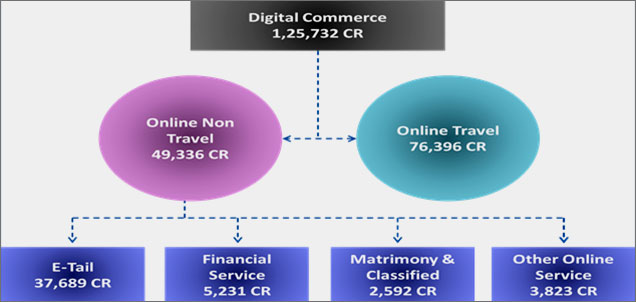
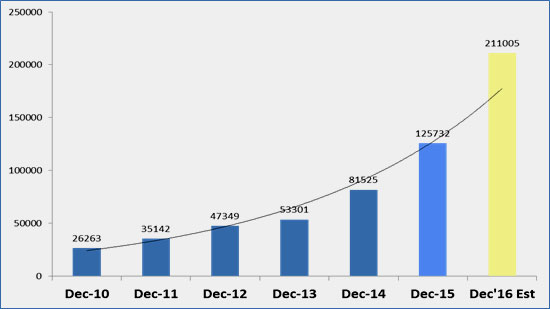
    The Digital Commerce Market has grown at a CAGR of 30%, between December 2011 and December 2015 and was valued at Rs 125,732 crores by the end of December 2015. It is estimated to reach Rs 211,005 crores by December 2016, according to the Digital Commerce Report 2015, published by the Internet and Mobile Association of India (IAMAI) and IMRB today.


    The report finds that Online travel industry continues to grow strongly with 61% share while share of online non-travel has improved over the previous year to reach 39%. In December 2015 share of e-Tail was 29%. Mobile Phone and Accessories, PCs and Apparel and Footwear continue to be the dominant categories that are selling within the e-tail segment. According to Nilotpal Chakravarti, AVP -IAMAI, “The growth trajectory of digital commerce signifies the coming of age of online transactions in India. No longer Indians are wary of transacting online. Another notable facet of the report is the substantial growth in non travel online transactions.”


    Domestic air ticket and railways booking continue to be among top contributors to the Online Travel spends.  These were the segments that were the top contributors in previous year also. Hotel Booking has seen a substantial movement in Y-o-Y growth at 165%, from Rs 1965 crores in December 2014 to Rs 5200 crores in December 2015. Spend on online railway ticket booking has also grown at around 34%, from Rs 16200 crores in 2014 to Rs 21708 crores in 2015. Online travel is expected to grow at a CAGR of around 40% to reach Rs 122815 crores by end of 2016.


    The report also finds that E-Tailing maintained a strong performance with a 57% Y-o-Y growth. Among E-Tail categories, Mobile Phone and Mobile Accessories continue to be the top contributor to the overall pie. Given that there is an increased demand for Smartphones in India, this could be a contributing factor. Computer and consumer electronics, as well as apparel and accessories, account for the bulk of India retail ecommerce spends contributing close to 49% collectively to overall spend in E-Tail segment. Apparel and Footwear sale has almost doubled as compared to the previous year, recording a 52% Y-o-Y growth from Rs 4699 crores in December 2014 to Rs 7142 crores in December 2015. This segment is expected to gain further momentum and reach Rs 72639 crores by end of 2016.


    Component share of E Tail (Rs 37,689 CR)

    Mobile Phones + Mobile Accessories

    14,109

    37%

    Apparels + Footwear + Personal / Healthcare Accessories

    7,142

    19%

    Consumer Durables + Kitchen Appliances

    6,452

    17%

    Laptops / Net books / Tablets / Desktops

    4,726

    13%

    Home Furnishings

    1,468

    4%

    Jewellery 

    1,120

    3%

    Other Products (Vouchers / Coupons, Toys, Gifts, Flowers, Handicrafts, Stationary etc.)

    994

    3%

    Books

    875

    2%

    Cameras + Camera Accessories

    803

    2%


    According to the report, Financial services market grew at a CAGR of around 17% between 2012 and 2015. The market reached close to Rs 5231 crores in terms of transactions as of Dec’15.  The demand for online utility payment is expected to reach Rs 6068 crores by Dec’2016.


    Other online service market that includes booking movie tickets and tickets for other events, online commuting or cab hire, online grocery and food deliver, was Rs 3823 crores in Dec’2015. In December 2014 the market was around Rs 2025 crores. In future online grocery and online food delivery are expected to emerge as big ticket items. Demand for other online service is expected to grow at a CAGR of 36% to reach Rs 5207 crores by December 2016.


  • Cartoon Network Anything mobile app launched

    By A Correspondent


    With the launch of Cartoon Network Anything, kids now have a new platform to engage and entertain to complement their favourite cartoon channel. Cartoon Network Anything serves up an array of micro 10-15 second snack-sized content specifically created for mobile wherever and whenever they have a free moment, no matter how long their attention span.


    Cartoon Network Anything is available on all iOS and Android devices for free. The young audience will have a huge variety of original content from hit shows like Roll No. 21, Adventure Time, We Bare Bears, The Powerpuff Girls, Uncle Grandpa, Regular Show, The Amazing World of Gumball, Teen Titans Go! and more.


    Commenting on the launch of Cartoon Network Anything, Siddharth Jain, Managing Director, South Asia, Turner India says, “As leaders in the Kids entertainment space, it has always been our focus to bring the best and most exciting form of entertainment to our consumers wherever, wherever and however they want it. We are focussed on the total consumption of our brands and content be it on TV, online, on-mobile, on-the-ground through our consumer events and local based entertainment, or through our branded merchandise and games. CN Anything is our initiative that brings world class entertainment for our kids on their mobile phones and tablets.”


    Turner India’s recent research – New Generations 2016 – revealed that the use of technology has increased massively as more and more kids live in connected homes, and are utilizing more than one device for media consumption. Also, gaming has come across as the number one online activity. In 2016, Turner Asia Pacific will produce a total of 137 new games, 60 of which are just for the Cartoon Network Anything app which is in addition to 160 games already available on the app. Turner already has a library of 618 games, ranging from free, freemium and paid, available across web, mobile and on apps.


  • DigitasLBi wins Tata CLiQ’s Digital mandate

    By A Correspondent


    DigitasLBi has been appointed as digital creative AoR for Tata Group’s newly launched e-commerce venture, Tata CLiQ which will offer consumers a ‘Phygital’ shopping experience across categories.


    The agency will be responsible for the launch and subsequent ongoing digital creative campaigns.


    Prathyusha Agarwal, Head – Marketing, Tata CLiQ commented, “In a category cluttered with product forward, sales, discount advertising or high end fashion and lifestyle imagery that is indistinguishable from one brand to the other, we chose to tell a quirky tale using camels and associating them with the guarantee of finding authentic and genuine products at TataCLiQ.com  With a quirky idea like C.A.M.E.L and our authenticity  promise of #SureThing, it was critical that we choose the right partner to help us develop this potentially viral thought in the best way possible. After an extensive pitch process, it was DigitasLBi’s understanding of the space that stood out the most and we are happy to partner them as we embark on an exciting journey with this brand.”


    Prithviraj Banerjee, Head of Agency – India, DigitasLBi, commented, “We are very excited with this appointment and believe that together, we can create a world of “firsts” in the e-commerce space. Our global commerce practice gives us a breadth of insights, tools and learnings ranging from our worldwide Connected Commerce study to our Responsive Retail framework. We will leverage these tools extensively to aid our creative process and bring alive the unique phygital experience that Tata CLiQ will offer customers”.


  • Twitter launches #EveryCharacterMatters Week in India

    By A Correspondent


    Twitter India will celebrate young creators and users in its first-ever week-long live showcase called #EveryCharacterMatters. This curated showcase across Comedy, Lifestyle, Modern Romance, and Music will see over 20 comedians, chefs, musicians, stylists, and more, harness Twitter, Vine and Periscope to connect and create with their followers.



     

    #EveryCharacterMatters, as the theme suggests, will highlight how every content genre, every character, every personality has a voice on Twitter, and the curated showcase will be a reflection of the diverse youth and creative voices of India. The initiative will celebrate new forms of digital and live storytelling, and will help users discover and interact with new creators across their daily lives.


    This week-long showcase will also encourage the creator in every user on the platform, and will showcase how best to use Twitter’s tools and features. Users can join the conversation by following @VideoIndia account or #EveryCharacterMatters hashtag on Twitter.


    “Twitter is current and live – it’s just like serving a dish at the restaurant – you get instant feedback. I can bounce off ideas for seasonal menus at The Bombay Canteen with our followers and I can also reach out to them asking about new ingredients I come across. I often look to Twitter for travel tips, and hyperlocal recommendations from foodies in the city I am visiting. Twitter helps build connections, inspires my work, and I learn something new everyday through my conversations,” says chef Thomas Zacharias at The Bombay Canteen.


    “#EveryCharacterMatters will put a spotlight on the new young, delightful, hyperlocal Twitter. It will allow people to enjoy their interests such as food and music in a new dimension, and in a more inclusive and collaborative manner. The content across categories on Twitter is authentic and relatable, and that helps us redefine digital lifestyles on the world’s largest live communications platform today,” says Keya Madhvani (@keyamadhvani), Lifestyle & Culture Partnerships, Twitter India.


  • Amazon, Flipkart & Snapdeal have highest brand equity amongst e-comm sellers, notes new Nielsen study


    By A Correspondent


    Amazon, Flipkart and Snapdeal have the highest brand equity amongst e-tailing websites. The three e-comm majors ranked first, second and third amongst sellers as per Nielsen’s newly launched E-commerce Sellers study Q1 2016 (Jan-March2016). Familiarity, which had come up as the top driver for building equity in the category, is demonstrated by top-of-mind recall. The top three players among the first brand spontaneously recalled were Amazon (25%), Flipkart (21%) and Snapdeal (20%). In terms of overall awareness, Amazon (86%), Flipkart (82%), and Snapdeal (75%) were leading among the others. Intent to sell on the e-tailer is also an important parameter to demonstrate familiarity where the leading brands were Flipkart (58%) and Amazon (55%).


    “This study outlines the need gaps in the eco system, and opens avenues for E-commerce platforms  to support sellers.  E-tailers can play a big role in helping sellers develop their category and build businesses – thus also becoming a preferred brand for sellers,”  said Dolly Jha, executive director, Nielsen India.


    The findings from the study indicate that 39 per cent online sellers explore two or more e-commerce website as an option to sell products on and grow their business.


    The Nielsen study launched aims to understand the inclination and experience of selling products on e-tailing platforms. The study also gauges the brand equity of e-commerce websites amongst connected online sellers, and of those who intend to sell their products online in the next few months. The first wave of the study was conducted in 16 markets with a population of more than one million, and a sample size of over 1100 respondents.


    “With the e-commerce industry growing in double digits, there is surge in demand by customers, and an evolving online seller category that is fuelling supply on portals. To ensure the equilibrium of demand and supply, it is essential for e-commerce portals to focus on developing an inviting platform for online sellers in India. Sellers are also increasingly discerning when it comes to reaching their customer and meeting business needs,” said Jha, adding: ”Considering the juncture at which the category is, it is now very critical for e-tailers to understand push and pull factors that make sellers pick one website over the other. The study will also help understand the impact of marketing activities.”


    A high level of familiarity along with indepth  knowledge of an E-commerce website is the most important factor that drives brand equity, notes a Nielsen communiqué. Other key factors that impact brand equity are certain perception of the e-tailers: “They help the sellers stay relevant and ahead of competition” , “Provide new market opportunity”  and “Help minimise costs to reach out to more customers” .   At a micro level, other important attributes include potential of reaching out to customers from the same locality , ensuring publicity for the shop, and those websites used by peers and competition. Helping sellers save on in-store and inventory management, as well as a platform that would be most profitable to sell products on are critical when looking for new opportunities and markets. The ability of reaching out to a pan-India customer base, savings on logistics and requiring minimal investment are other considerations sellers look for while choosing e-tailers.


  • DigitasLBi creates global VR experience for OnePlus 3 launch

    By A Correspondent


    OnePlus is launching its third flagship smartphone –in virtual space. Behind this creative and break-through use of virtual reality technology is the combined efforts of creative and technology professionals from DigitasLBi.


    Rasmus Frandsen

    “The Loop” is the name of the VR experience that creates a mélange of never ending animations in a virtual space station high above the Earth’s surface. While inside The Loop, users can explore many of the key features of the new OnePlus 3, and even order the smartphone in the virtual world – and then have it delivered to the real one.


    “To create the most realistic and immersive experience possible, we’ve employed a number of innovative, never-before-seen, usages of CGI and 4D technologies, as well as 360° films,” explains Rasmus Frandsen, Creative Director at DigitasLBi Nordics. “Together, these create an experience designed to excite the global community of OnePlus fans, as well as tech enthusiasts.”


    “Last year OnePlus held the first-ever product launch in VR. This time with The Loop, we’re taking things a step forward by pushing accessible VR

    Carl Pei

    technology to its outer limits,” said Carl Pei, Co-founder and Head of Global at OnePlus. “It’s going to go down in history as the first global shopping experience in VR!”


    The OnePlus 3 launched on June 14, 2016, and The Loop can be downloaded from Google Play and the App Store. For the first 2.5 hours OnePlus 3 could only be ordered from inside The Loop.