Category: Digital

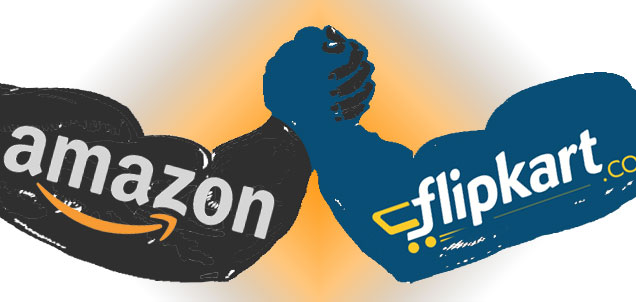
  • In ecom-land, it’s Bezos v/s Bansals


    By Radhika P Nair


    Deep discounts for customers and big incentives for merchants who sell on their marketplace are what Flipkart, India’s largest online retailer, is planning as it aims for fourfold growth in sales over the next 12 months.


    In the aftermath of the biggest round of fund-raising in India’s Internet industry, Flipkart and challenger Amazon plan to open more warehouses, hire in larger numbers and acquire companies with newer products or technology as they battle for supremacy in one of the fastest growing markets for online commerce globally


    “It is still day-one of Indian e-commerce,” said Amit Aggarwal, vice-president and India country head at Amazon. Last Wednesday, Amazon founder Jeff Bezos said he will spend $2 billion (.`12,000 crore) to build operations in India without offering a timeframe. The announcement came a day after Flipkart declared funding of $1 billion from a host of global investors.


    Amazon’s announcement is being viewed as the strongest call for battle between the two protagonists.


    This month, Amazon will add a new category and also increase the range of books and electronics – its two main product lines in India — as it powers ahead to reach sales of Rs 6,000 crore this fiscal. In the past year, 8,500 sellers have hawked their wares on Amazon’s marketplace.


    Flipkart, which adopted a marketplace model last year, aims to increase the number of sellers to 50,000 in the next year from the current level of over 4,000.


    “China’s ecommerce industry reached its inflection point in 2005 when Alibaba raised $1 billion. We believe Indian ecommerce is at that inflection point right now,” said Sachin Bansal, Flipkart’s cofounder who expects a significant chunk of the latest funding to be used to enhance services for sellers. The Bangalore company runs six warehouses and intends to open 50 more in the next three years.


    Amazon is also increasing its warehouse count to ten with three new ones coming up in Maharashtra’s Bhadarpur, Haryana’s Manesar and Ghaziabad in the next few months.


    Experts said the focus of all this splurging will be dominated by one ultimate goal, attracting more customers. “Consumers will be wooed like never before. And it will not just be in the form of discounts; the two companies will unleash assortment and services that are specifically meant to retain them,” said Arvind Singhal, chairman of retail advisory, Technopak.


    Merchants who do business with both companies said Amazon for now, is more focused on electronics and books. “This brings scale and helps them show customers that they can provide products at lower costs quickly,” said one person.


    This is exactly how Flipkart scaled up, by focusing on books initially and then on electronics. Now, fashion has become its most important category, especially after it acquired fashion portal Myntra in May, contributing to one-third of the company’s sales, said Mr Bansal.


    The Flipkart site will focus on fastselling fashion products that will bring in volumes, while Myntra will focus on the higher-value products and inhouse brands that deliver profits, said a senior official at Flipkart. Branded apparel can bring in margins of up to 35% while in-house apparel brands command profit margins of up to 60%.


    “We are here for the long term. Our aspiration is to make Flipkart a $100-billion company,” said Mr Bansal, 32, whose company clocked $1 billion in sales in March 2014.


    Amazon also aims to reach the milestone this fiscal. “The aim is to have a 30% market share soon,” said a senior executive at Amazon, who did not want to be identified.


    Flipkart also plans to get a bigger share of exclusive sales on its portal, as it did recently with Motorola phones. Last month, it started selling China’s Xiaomi phones while Amazon launched sales of a Samsung phone and Swipe’s Slice tablets exclusively.


    Flipkart is also actively scouting for companies to purchase. “We are looking across the board. We will acquire if we find interesting companies in wearable devices, fashion technology, mobile internet, and robotics and in other areas,” said Flipkart’s Mr Bansal.


    The companies are also setting aside money for hiring and for increments. “War on talent is yet to begin as both are targeting the FMCG and telecom industries,” said a consultant. Flipkart will double headcount to 26,000 this fiscal. Amazon too is expanding and pays two-year joining bonuses of over Rs 40 lakh at the top levels.


    “Many companies who scaled up much slower than these two have faltered before,” said Technopak’s Mr Singhal. “It is like making an entire army move in tandem. Who will get that right is what we need to see.”


    Source:The Economic Times

    Copyright © 2014, Bennett, Coleman & Co. Ltd. All Rights Reserved

    Licensed to republish


  • JWT unveils first campaign for CommonFloor.com

    By A Correspondent


    Leading real estate portal has launched a new marketing campaign with the tagline – “No Darr. Find Ghar”. The campaign, executed by JWT, targets nervous newbies to help them overcome the fear of property related decision making. It drives home the key advantages of CommonFloor.com like exhaustive choices, accurate information, deep insights, easy-to-use tools and innovative technology. It also showcases how CommonFloor.com’s features like Verified Property Listings, Map Search, Direct Call to the Property Owners (available on mobile app) and even a Virtual Tour of the Property can empower every consumer.


    Sharing his views on the launch, Sumit Jain, Co-founder and CEO, CommonFloor.com, said “This is a major milestone in our journey. As a company we have come this far without a large scale marketing push, so I can only imagine how inspiring our growth trajectory will be with a campaign of this magnitude. This endeavour is the work of some of the brightest and most sought after talent in the industry. I am thus certain that this will take our organization to the next level.”


    Vinayak Warke, VP- Marketing, CommonFloor.com said “At CommonFloor.com, our focus has always been on empowering people to realize their property dreams. The objective of this campaign is to highlight the problems faced by property seekers and how CommonFloor.com addresses this through a fearless and informative experience, leading the user to an easy and effective property decision.”


    Sharing his thoughts on the strategy and creative idea of the campaign, Senthil Kumar, National Creative Director, JWT said” The Creative Idea of House Haunting versus House Hunting leaps straight from the consumer insight that finding a dream house can become a nightmare. We translated this insight literally in form of a very comic Eighties Indian Horror Movie flick narrative that makes the spot something you’ll surely watch out for. The TVC shows the crazy story of a couple who end up House Hunting in an unknown location with a ghost for a house owner. It then shows how the smart husband saves the day by using the CommonFloor mobile app. The execution is true to the Eighties Indian Horror Film style that will make every viewer laugh out loud. I am also sure that when it comes to House Hunting, it will make viewers remember India’s biggest and most trusted online real estate portal CommonFloor.com.”


  • ‘Twitter Amplify’ gets a like from starsports.com & Vodafone

    By A Correspondent


    Starsports.com, in association with Vodafone India, has announced its participation in the Twitter Amplify program In India. The Twitter Amplify program is developed to tap into the growing social conservations around TV programmes, especially live sports. starsports.com and Vodafone India aim to enrich the live sports experience through social media. Sports fans will be able to experience this product during the current Indian cricket team’s England tour.


    The Twitter Amplify program enables broadcasters to publish video to Twitter and then jointly monetize the premium content by creating sponsorship packages. Powered by Promoted Tweets, the program will “amplify” the reach of the video content distributed via the broadcasters’ and sponsors’ Twitter accounts.


    For advertisers, Twitter Amplify provides an opportunity to tap into the social conversations on Twitter, especially on mobile devices. It also provides a multi-screen audience engagement strategy essential to satisfying users’ needs to consume content whenever or wherever they want it.


    “2014 is a great year for Twitter becoming the social soundtrack for television as 95% of the public social conversation around TV is happening on Twitter today, especially for live sporting events. Broadcasters and brands know that Twitter is a natural TV companion that drives audience tune-in, engagement and affinity,” said Rishi Jaitly, India Market Director, Twitter. “We look forward to working with cutting-edge broadcasters and advertisers, like STAR Sports and Vodafone, who want to tap into a compelling second screen experience We are delighted that cricket fans can now enjoy TV highlights in real-time on Twitter.”


    Ajit Mohan, Head of digital business, Star India, said: “We have built starsports.com as the most compelling destination for fans in India to follow sports on a mobile screen and the best platform for advertisers to reach an attractive audience on digital. This program is a new innovation for us to understand the possibilities of being present when the conversations are happening on Twitter.”


    Vivek Mathur, Chief Commercial Officer, Vodafone India, said, “As a brand we are always looking at innovative ways of driving brand engagement and conversations on social media. Cricket (and sports in general) is one of our identified passion points and one with which Vodafone has a huge association. We are very excited to be the pioneers in launching a new social innovation in India centered around Twitter and cricket.”


  • Bijli, Sadak, Pani, Broadband & Smartphone?


    By Pradyuman Maheshwari


    The in-laws are scattered across India and the United States. It’s been 13 years since all of us met. A little over a decade back, I set up an e-group that facilitated the family to stay connected. The group – called ChapraNet, named after the town in Northern Bihar where the wife hails – from was an instant hit with the family.


    We started wishing each other on birthdays and anniversaries that no one remembered and suddenly there was much conversation between sections of the family. Auto alerts on special occasions and photo albums etc ensured that the e-group didn’t require day-to-day monitoring.


    I tried moving it to a Facebook group, but that didn’t much favour. The group lives on, and the family stays connected.


    We’ve even had a family meet-up via Google Hangout though have just managed to do that once. Meanwhile, my mother-in-law is able to join in from Chapra, in biting cold cuddled up with multiple layers of woollens. Under a mosquito net, iPad in hand, Facetiming with her grandkids in Mumbai or Maryland.


    Bijli, Sadak, Paani and Broadband. That last bit was added by the late Dewang Mehta, head of the software industry association NASSCOM. Mehta would’ve had a hearty laugh as he would see politicians fighting over getting broadband or wifi to their voters as part of their poll promise. Although we are lightyears behind other economies on internet speeds, mobile phones have been a huge gamechanger.  The proliferation and usage of basic feature phones and smartphones has redefined the way Indians will seek information and transact in future.


    The arsenal is getting readied.  Reliance Industries is planning to launch 4G next year, Airtel already has it in the air. The problem currently is of the rest of the ecosystem. For instance, save a handful of mobilephones, 4G cannot be accessed by most devices currently in shopshelves.


    Already wireless connectivity has ensured that you could be on Manori beach off Mumbai, and checking out the newest season of an American soap.


    As devices get more dexterous, newer apps are being built to achieve the impossible. Get your heartbeat by placing your finger on the back camera of your phone or tablet. Count the number of steps you have taken or the calories you’ve burnt by wearing what looks like a ‘friendship band’.  Not all these things come cheap,  the Nike ‘fuel band’ can set you back by Rs 11,500.


    Clearly, even the sky doesn’t appear to be the limit when it comes to information technology.  Soon, you could scan the quality of alphonso mangoes being sold at the neighbourhood bhajiwala and figure if they’ve riped right.  All this with the help of the Google Glass, the early variants of which are with a select few in India. The price is upwards of a hundred thousand rupees currently, but don’t be surprised if breaks the Rs 50k barrier in a year or two.


    Advancements in IT will dictate the way we live. And they are indeed a great equaliser. The watchman’s daughter has as much access to information as your kids and the networked device (television set included) can be a great equaliser.  There are stories of how a domestic at a stockbroker’s home made a few crores off online trading from the various tips he gathered while attending to his sa’ab. No fantasy from a Manmohan Desai flick, but happy nuggets from Mumbai.


    A small provisions store-turned-supermarket in Lokhandwala Complex now asks its patrons to Whatsapp their shopping list and a fisherwoman sends pictures of her morning catch to regular customers so that they can place their orders. A young lady sells cookies off the boot of her Nano in South Mumbai by Facebooking messages and the location where she will be parked. A tuition teacher communicates with students from across the country via an e-learning software and a therapist heals patients globally via Skype.


    The mind boggles at the possibilities. Will life in Mumbai (and the rest of the country) be governed by information technology. Perhaps it is, and perhaps it will finally save a lot of the infra problems that plague the city. You don’t have to suffer the traffic jams because you needn’t get out of your home to work.  No need to sweat it out to pay your utility bills as they are all payable online. Many automated, with standard instructions and pre-defined caps so that you don’t pay extra if there’s an error in a bill.


    There are of course issues here. Not all information that you get on the internet is authenticated. Especially Wikipedia.  A lot of news sources – on Twitter and Facebook included cannot be trusted. Transactions may be secure but there is need to be careful about fly-by-night operators.


    Believers in the new information order will tell you that all these worries are misplaced. While Wikipedia cannot be trusted, it’s the same democratised media that ensures that untrusted sources are flagged off. Ditto with news sources and e-commerce players out to con unsuspecting netizens. And just as you have fake university taking students for a ride and quacks-turned-medical practitioners getting away scotfree in the real world, they exist online too.


    What’s important hence is to exploit the medium to its fullest, but follow old world values to check the bonafides of the source.  While technology must decidedly be handled with care and caution, we can’t not embrace it.


    While a lot of what’s likely to happen is inspite of the government, much could be achieved if the administration at the State and city level contribute to the cause.  Successive regimes in Maharashtra have ensured that infrastructure in the state sucks, and while it’s impossible to reverse that, there’s an opportunity to ensure the state is has a large wi-fi cover. In addition to infra, the State must also deploy software and tools (apps included) to communicate with citizens. Bijli, sadak, paani and broadband.  Perhaps we should add smartphone, right?


    This article first appeared in the Free Press Journal dated July 11, 2014


  • On eve of anniversary, Loginworks unveils new brand identity

    By A Correspondent


    Kicking off its eighth anniversary celebrations, Loginworks Softwares has unveiled a new brand identity, symbolized by the introduction of a new logo, new brand portfolio and a re-designed website.


    Speaking on the occasion, Dheeraj Juneja, Founder & CEO, Loginworks Softwares, stated, “Our new brand identity resonates with what we stand for today. As a technology partner and service provider, our company plays a crucial role in fueling business gains and realizing competitive advantage through Loginworks DataStream and Loginworks ONE. We help our clients during their transformation stage by incorporating advanced solutions to their business strategy.”


    The new logo comes in a sleek and modern design with initials “L” and “W”, that signifies our growth and transformation. The colours “Red” for the initials and “Black” for the base have been advertently used to align our corporate brand values of passion, energy and action.


    Another key element of this transformation is the company’s new portfolio that includes Loginworks DataStream, Loginworks Advanced Solutions, and Loginworks One.


    — Loginworks DataStream delivers up-to-date quality data for Actionable Decisions and Strategy Formulation, Analysis and Monitoring. This service is a boon to market research companies, online retail business and upcoming ventures in exploring new markets and staying competitive.


    — Loginworks Advanced Solutions caters to responsive web and mobile application development using latest technologies for today’s dynamic market environment.


    — Loginworks One provides online marketing strategy and implementation for building brand reputation and enhancing engagements.


  • FCB Ulka highlights ‘Shake Feature’ for Snapdeal

    By A Correspondent


    Smartphones have empowered consumers to shop on the go, at a time convenient to them. This calls for a shift in focus to a more tech savvy way of shopping i.e. via a mobile phone. But how do online retailers get consumers to download their mobile app instead of the competition? One way of course, is to innovate and introduce new features and thereby create a superior shopping experience. Snapdeal’s Shake Feature does exactly that. The new TVC created by FCB Ulka gets the message across, by highlighting the app cleverly.


    Keeping the quirkiness that is the hallmark of Snapdeal’s communication, the Shake Feature TVC, crafted by FCB Ulka, shows the protagonist (played by actor Pulkit Samrat) dancing at a colorful Indian wedding. Every time he does a shake with his smartphone in hand, he is given money by an enthusiastic relative in the wedding party. The voice over meanwhile tells the viewers that using Shake Feature is a sure shot way to get additional discounts from Snapdeal.


    Sachin Das Burma, Group Creative Director, FCB Ulka, commented on the campaign “The shake feature is a new thing and we wanted the communication to demonstrate this in an interesting manner, without losing out on the entertainment quotient and slice of life situation that has been our attempt for all work we do on snapdeal. I think we have managed to achieve that.”


    Sandeep Komaravelly, Vice President Marketing, Snapdeal.com, said, “The smartphone has become an extremely important medium to reach out to our customers. 50% of our transactions on Snapdeal.com come via our mobile app. The Shake feature is an innovative step to amplify the user experience while shopping on the mobile application. The customers will be able to avail exciting offers on diverse range of 4 lakh products across 6000+ brands.”


  • I-Day Eve Feel-Good: Meet the Flipkart Crorepatis


    By Radhika P Nair


    About 400 employees with stock options at online retailer Flipkart have hit the ‘crorepati’ jackpot because of the surging valuation of the online retailer.


    The bonanza is reminiscent of the times when thousands of employees – among them office assistants, drivers and receptionists – at another Bangalore-based company Infosys hit Esop paydirt. “About 400 of the employees who own a stake have now become crorepatis,” said a person who has direct knowledge of the employee stock option scheme at Flipkart, which received $1 billion (Rs 6,000 crore) in funding last month, valuing it at $7 billion.


    About one-fourth of Flipkart’s 7,000 full-time employees own a stake in the company.


    At the seniormost level, nearly 20 employees who are at the grade of senior vice-president or above and joined over two years ago are now dollar millionaires, meaning their stock options are worth at least Rs 6 crore on paper. The firm’s stock options get vested over four years. Flipkart declined to provide details for the report.


    It is the online retail market leader’s valuation jump that has led to this wealth creation.


    In 2012, the company was valued at about $850 million when it raised about $150 million.


    In two years, Flipkart’s valuation has grown eight times. For the company’s founders, Esops are a conscious attempt at creating wealth for their employees. “While we are competitive when it comes to salaries, Esops offer the opportunity for wealth and value creation,” said Sachin Bansal, 32, Flipkart’s co-founder and chief executive. “It’s a long-term reward for those who believe in the future of Flipkart.”


    After the IT services industry, ecommerce is now the next big opportunity for employees to create wealth, said Anshuman Das, managing partner at Longhouse Consulting, a recruitment firm that works with startups. “The message going out to entrepreneurs is that wealth creation cannot be restricted to just the founders.”


    A number of junior employees at Flipkart too hold sizeable stake in the company. This has helped employees like 29-year-old Ambur Iyyappa, a senior manager of customer operations at Flipkart. “I was getting married in 2012 and the buyback allowed me to take care of my wedding expenses,” said the graduate of Annamalai University.


    Iyyappa, who sold only a part of his stake at the time of the buyback, declined to reveal how many shares he still holds.


    He was the second non-founder employee to join Flipkart in 2008. It was only in 2009, the same year that the company raised its first round of funding of $1 million (over Rs 6 crore) from Accel Partners, that Flipkart started providing Esops.


    Fashion e-tailer Myntra, which was acquired by Flipkart in May, allowed employees to sell shares at the time of the acquisition, according to a person with direct knowledge of the deal. The company declined to confirm this. Myntra provides Esops to all its core employees, numbering about 600, in functions such as technology and marketing across all levels.


    For existing employees like Iyyappa, Esops provide recognition. “Esops are a motivation for us employees,” said Iyyappa. “It is how the company recognises our work.”


    Source:The Economic Times

    Copyright © 2014, Bennett, Coleman & Co. Ltd. All Rights Reserved

    Licensed to republish



  • Seven3Sports bags digital rights of Bundesliga

    By A Correspondent


    Seven3Sports has bagged the digital rights of the 52nd season of Bundesliga. Bundesliga is the best-attended league in football. After the success of the 2014 FIFA World Cup, that was broadcasted by Seven3Sports across five Indian sub-continental and South Asian countries, acquiring digital rights for Bundesliga came as a natural extension of the organisation’s services for the Indian Football fan base.


    “With inclusion of this undertaking to our portfolio, Seven3Sports is bringing a bouquet of diverse sports to its viewers. We are targeting to go beyond the conventional sports loved in India; introducing new experiences such as French Open in the past and now the Bundesliga. This will be an exciting new venture for us with the ultimate aim to provide live viewership to those who are always on the go,” said Jatin Ahluwalia, Founder and Chief Executive Officer of Seven3Sports.


    Seven3Sports has established itself as a leading Sports Rights Company and has been associated with most of the major sporting events across the globe including French Open, 2014 FIFA World Cup and IPL to name a few. Keeping up with this momentum, through Bundesliga, Seven3Sports aims to bring about a surge in the Football viewership within the country.


    Seven3Sports has put together a digital plan to bring ‘Bundesliga’ closer to over a billion Indians, live on their mobile phones and Internet screens. These digital rights cover Mobile, Internet, App, Video on Demand, Live streaming on digital platform, Highlight, Audio commentary on Mobile and Internet besides anything you would like to power on digital platforms.


  • FCB Ulka campaign for MakeMyTrip’s mobile app

    By A Correspondent


    Growing beyond just providing voice calls, text messages, games and music, mobile devices have now also become the preferred choice to do online bookings. Though the mobile phone is convenient in many ways yet sometimes it puts us in sticky situations. Bringing on this insight that phone can put you in trouble, FCB Ulka has come up with its new TVC for the MakeMyTrip mobile app.


    The commercial aims at empowering the consumers to make instant flights and hotel bookings from anywhere, anytime and redeem themselves when stuck in an awkward situation.


    Mohit Gupta, Chief Business & Marketing Officer, MakeMyTrip, said “Mobile is the perfect channel for a travel company to provide real value to the customer and create higher engagement by enabling an easy travel-booking experience. Mobile provides a smoother user experience, increased personalization and allows faster access to relevant information. The film exhibits how MakeMyTrip mobile app provides instant bookings and cancellations of flights and hotels from anywhere.”


    The latest TVC is about a husband who is getting ready for taking a trip to Bangkok. His wife asks if the family can join him but he is insistent that it’s an official trip he and cannot take them. In the midst of their conversation they get interrupted by his friend’s call. Since he is busy getting ready he asks his son to put the call on speaker. The friend goes on talking about how efficiently he managed to fool wife into believing that it is an official trip, while in reality they are going to Bangkok to have fun.


    The commercial closes with the thought that if a mobile can put you in trouble then it can save you from trouble as well. Panicking, the husband asks for the solution which is the MakeMyTrip mobile app and cancel his current booking and re-book a trip for his entire family instantly.


    Commenting on the TVC, Sanjay Tandon – Chief Operating Officer, FCB Ulka said, “Life is really really on the go nowadays. So are travel plans that seize us at a moment’s notice. That is a key role that we are sure makemytrip’s mobile app will fulfil. And we needed to present that in an unexpected burry way.”


  • Loyalty, Social Media & Data


    Guest Column/By Mark Spicer


    We live in a data-driven world: A world of “3 V’s of data” (volume, velocity, variety). As per IBM estimates, around 2.5 quintillion bytes of new data are created every day. These large set of unstructured data available through various mediums and channels like social media, mobile devices and myriad of other sources are filed away in massive databases. The trick to navigating through these massive tracts of information is to know how to look for the ‘right data’ which drives an understanding of your customer.


    This data explosion has taken many marketers as well as loyalty marketers by surprise. Relationship marketing has always been a very data-centric activity, and for a long time the data that drove loyalty programmes was structured transactional and customer profile data, held in relational databases. Today, progressive loyalty managers are harnessing social media and web data to enhance their understanding of customer behaviour and their sentiment. If an organisation’s highest value customers are referring to them in blogs or on social media sites, then loyalty practitioners have an interest in that data footprint both from a customer service perspective but also from an analytical sense.


    The challenge for loyalty marketing is how to incorporate these new data sources into the traditional Single Customer View (SCV) approach to organising and centralising all that is known about each individual member. A true SCV model for the modern day ideally should encompass some, if notall of the new universe of available data and integrate them seamlessly; alongside traditional transactional and profile data, individual-level views of social media sentiment and mobile device engagement should be available, for example. This in turn should be able to drive marketing across traditional direct channels but also through digital and mobile personalisation. This is no small task and in order to deliver on this vision, a number of issues need to be fully understood and addressed:


    Scale. The sheer volume of data and the number of different sources is potentially overwhelming. Even within the sphere of social media, different channels (e.g. Facebook vs. Twitter) may require different approaches. Added to this there is web data and mobile data each requiring understanding and a bespoke approach.


    Matching. How to match the ‘new’ data sources with the ‘old’ is fundamental. The existing SCV approach requires the capture of a unique reference number, email/physical address or some other identifier. It is unlikely that these will always be present amongst mobile, social media or web data. However, cookies, URL’s, tagging, social media ‘handles’ and other identifiers may provide a solution here.


    Technology. What, if any, technology is required to support a ‘New SCV’ proposition. Do existing IT and database platforms provide some or even all of what is required or are there IT solutions in the market that can help support the achievement of objectives? The existing traditional relational database/SQL server based platforms and BI tools of many organisations will not offer sufficient capacity or speed for today’s data volumes. Cloud-based services and tools created to scale exponentially are likely to play some part here.


    ROI – Most crucial of all, how do organisations investing in new data ventures make a return on this investment? Actionability is fundamental. Data needs to be delivered to marketers in a commercially-useful form to drive targeted, personalised customer experiences and communications, as well as adding value across other disciplines such as product development.


    Mark Spicer is General Manager, ICLP, a customer loyalty consulting firm. He is based in London and Mumbai


  • It’s a deal! Ratan Tata invests in Snapdeal

    By A Correspondent


    Ratan Tata, chairman emeritus at Tata Sons, has invested in Delhi-based online marketplace Snapdeal. The company did not disclose the amount invested. The announcement comes a day after Snapdeal entered into a partnership with Tata Value Homes to sell apartment units of projects spread across five cities, namely, Bangalore, Chennai, Pune, Mumbai and Ahmedabad.


    Snapdeal’s cofounder and chief executive Kunal Bahl termed Tata’s investment a validation of the company’s growth. “An investment by a legendary and respected figure like Mr. Tata is an excellent validation of our focused strategy on building a long term enterprise and marks the start of a very important phase for the company,” said Bahl.


    This investment also underlines the growing interest shown by India’s traditional industries in the fast-growing ecommerce sector. Recently traditional retail majors like Reliance and Arvind have made forays online.


    The sector has also attracted large investments in the past few months. Snapdeal raised over $233 million this year in two rounds from investors like eBay Inc, Singapore-based Temasek and Wipro chairman Azim Premji’s family office Premji Invest. Market leader Flipkart too raised two rounds of funding this year. In July it raised $1 billion from existing investors and Singapore sovereign wealth fund GIC. Global major Amazon also announced a $2 billion investment for its India operations in July.


    Snapdeal, which is estimated to have crossed $1 billion in sales this year, is rapidly adding new categories of products. Apart from apartments, it has launched a catering supplies segment recently. In the next few months the four-year-old platform is planning to add 10 more categories.  Bahl has stated in the past that the company will focus on adding new merchants, new categories and focus on mobile commerce to ensure growth.


    Source:The Economic Times

    Copyright © 2014, Bennett, Coleman & Co. Ltd. All Rights Reserved

    Licensed to republish

     

  • Success of Flipkart and Snapdeal spawns name-copying in the e-commerce market

    By Rasul Bailay


    You have an e-commerce business model, you have startup funding, you are all fired up, and now you need a name for your company. Take note – the online bazaar is stuffed full of something ‘kart’ or something ‘deal’, a manic copying frenzy thanks to headline grabbing successes of Flipkart and Snapdeal.


    There are at least 15 e-commerce sites that have ‘kart’ appended to their name. ‘Deal’ has attracted at least a dozen ventures. So, you have relatively well-known HealthKart and LensKart to relatively less-known e-tailers such as VeggieKart, SafetyKart, Mygreenkart, Metalkart, Bagskart, Jewelskart, Yaari Kart, AssamKart and even a Spritualkart. Just as you have entedeal, freedealsguru, indiasmartdeal, Dealtz, and the very prosaic, Daily Deal.


    Ecommerce entrepreneurs are divided over whether such name cloning works. Some like Arun Chandra Mohan are dead set against ‘kart’ or ‘deal’ or ‘for you’, another awfully common online venture naming strategy. Mohan’s venture went online in 2011.


    And the name? Jabong. Jabong, as everyone knows, has done pretty well for itself, despite being nonkart and non-deal.


    But e-entrepreneurs still finding their feet in the tough online marketplace differ. There are startups that say naming ventures ‘kart’ and ‘deal’ will quickly identify them as ecommerce websites.


    “Many ecommerce ventures now use the ‘kart’ thing so people can easily understand what they are about,” says Bikash Kalita, cofounder of Guwahati-based AssamKart. com.


    AssamKart sells e-books in Assamese as well as English language books written by Assamese authors. “If we had any other name then we would have had to explain ourselves. Since Flipkart, Lenskart, etc, are well known, people know from our name what we are about,” Kalita says.


    Aasheesh Mediratta, CEO, Fashionandyou. com, takes a ‘it doesn’t matter’ line. ‘Karts’ and ‘deals’ may give short-term advantage to newbies and irritate the established ‘karts’ and ‘deals’, but what matters over time is service quality, Mediratta argues. “This can divert small share of traffic to such sites. But along with the name, it is the business model, execution and offering which make the brand difficult to be cloned or impacted,” he says.


    But what about cases where similar sounding names are a coincidence? Then the less-famous ‘kart’ or ‘deal’ just has to live with it. Peyush Bansal, founder of online eyewear seller Lenskart, says his company had registered the domain name in 2008, “years before Flipkart became famous”.


    “Were I naming my company today there’s no way I would pick the same name,” Bansal says, “but now I have no choice because our brand is well known.” This Bansal simply didn’t know that the other Bansals, running the big daddy of all ‘karts’, Flipkart, would one day make it so big.


    There’s a darker side to the name cloning story – straight copying and infringement. Last year, Shopclues executives were shocked to discover a site registered in Dubai that not only used Shopclues’ logo but even copied the Gurgaonbased firm’s contents.


    “They had completely copied the whole thing. That was copyright infringement more than anything else. They had even copied the management profile by just changing the names,” says Radhika Aggarwal, co-founder of Shopclues.


    Aggarwal says there are many cyber squatters in China sitting on cloned names – Shopklues and Shopcluss are among the more inventive ones. “Many times we let it go…but if there is blatant copyright infringement we make sure to send legal notices,” Aggarwal says.


    India’s largest fashion and accessories portal Myntra.com had a name problem, too. Its Twitter handle was stolen and then restored and on YouTube, ‘Myntra’ was taken. So, the Bangalorebased company had to settle for Myntra.com for its YouTube account. But at least, Myntra is tougher to name-clone than a kart or a deal.


    Source:The Economic Times

    Copyright © 2014, Bennett, Coleman & Co. Ltd. All Rights Reserved

    Licensed to republish