Category: Digital

  • Viber unveils first ever ad campaign

    By A Correspondent


    Viber, one of the fastest growing instant messaging app in India has unveiled its first ever television campaign in India. An app for today’s youth, Viber is being used heavily in both the metropolitans as well as the emerging cities.


    The new campaign is fun and exciting and seeks to connect to the youth via a talking dog who chronicles the benefits of using Viber. It showcases how Viber changes the dull life of the dog’s owner and make him more social and connected with friends and ultimately becomes ‘Mr. Popular’.


    Anubhav Nayyar, Country Head,Viber said, “Viber is a young and fun brand that connects people for free. We have grown organically as one of the biggest global instant messaging and calling apps. Whether it’s our wide range of stickers, our photo editing and sharing feature or the fact that we are available across mobile and PC, Viber is differentiated and has grown tremendously over the last few years. The idea behind the campaign is to showcase the different features and benefits to our existing and new customers. We strongly believe that anyone who once tries Viber cannot do without it.”


    The ad which was first rolled out on various digital platforms can now be seen across various Television channels.


  • Digital catches the Bollywood bug


    By Ishani Duttagupta


    From watches to sportswear to jewellery to apparel to even soap, the connection between Bollywood and fashion goes back a long way – perhaps more than 80 years back Leela Chitnis became beauty brand Lux’s first brand ambassador (followed by the likes of Madhubala, Nargis and Waheeda Rahman).


    Today, in the digital age, even as Lux persists with the starlet formula – its latest endorser is Deepika Padukone – there’s a relatively new segment of retailing that’s reaching out to the Bollywood brigade. A clutch of online retailers has signed up stars of the silver screen as brand ambassadors to sharpen their connect with potential customers. For instance, recently when online fashion brand Jabong launched a first of its kind event, the India Online Fashion week, it roped in actress Yami Gautam, who played the lead female role in Vicky Donor, as a brand ambassador for the event.


    Star Power

    Jabong is not the only online fashion brand that’s taking a trip down the Bollywood boulevard. Myntra, an e-commerce platform for fashion and lifestyle products that was recently acquired by another online retailer Flipkart, signed up actor Ranveer Singh to endorse its in-house contemporary jeanswear brand Roadster. LimeRoad, an online fashion brand that raised $15 million in a second round of funding in May, has inducted Neha Dhupia, who has several Bollywood hits to her credit, into its management team to help connect with social media-savvy customers.


    Then Yepme, an online fashion brand launched in 2011, has not just one but three Bollywood icons on board – while Bollywood strongman Sonu Sood endorses PlayCool, a line of sportswear and sports shoes, actress and model Esha Gupta, who is seen in the recently released flick Humshakals, is endorsing Yepme’s women’s wear line in a TV commercial; and filmmaker and actor Farhan Akhtar is not just brand ambassador but has also extended the association by writing and singing a song for a Yepme music video composed by musicians Ehsaan and Loy. Finally, Snapdeal, another online marketplace, recently signed on mint-new Bollywood star Pulkit Samrat as brand ambassador to be in sync with a young target audience.


    The online ambassadors appear to match the brands they endorse as well as the customers they address in their online savviness. “In a world where online shopping is fast catching up amongst the youth, it’s a matter of pride for me that I get to represent a brand most sought after for any fashion essential,” says Gautam explaining her role as celebrity mentor of the online fashion week event. She sees herself in the role of nurturing young talent among Jabong’s consumers and giving guidance as a fashion influencer.


    Explains brand consultant Harish Bijoor: “Brand ambassadors bring with them a very important item: their awareness scores with potential consumers of such fashion brands. Fashion offerings from online brands are at best generic in their identification and differentiation scores. It is these brand ambassadors that add a clear identity and differentiation.”


    Riding on the Net

    The internet has become the go to destination for fashion essentials, explains Praveen Sinha, cofounder and managing director of Jabong. “Bollywood plays a big role in shaping the fashion scene in India. Consumers today draw their sense of style and fashion from celebrities because there is a certain value attached to their judgement,” points out Sinha. He adds that for e-commerce sites, this outreach is not restricted to the metros but is even going to tier II and III cities where the demand and purchasing power were always there; the only hassle was that accessibility to fashion was restricted.


    “We at Jabong are giving access to these consumers to dress up like celebrities. Mainstream brand ambassadors give a certain level of authenticity to the brand and help weave a better connect with the target audience,” adds Mr Sinha.


    For Myntra, the choice of Ranveer Singh to endorse brand Roadster was driven by the current position of the brand in the market and the position that it aspires to achieve. Launched in December 2012, Roadster has become one of the top-selling brands on Myntra within a span 18 months, claims Vikas Ahuja, chief marketing officer, Myntra. “With this association, the brand will truly elevate itself beyond Myntra and become one of the most sought after labels for denims in the country,” he says.


    Myntra’s private labels, explains Mr Ahuja, play a significant role in creating differentiation, choice and value for shoppers, thereby contributing to making Myntra the preferred fashion destination of the country. Roadster products, for instance, are known for their combination of style and class and unparalleled quality, he points out. “Signing on Ranveer Singh, known for his power-packed and unconventional persona, is a sturdy step towards the evolution of the Roadster brand, which we intend to take to another level,” adds Ahuja.


    Similarly, Yepme too is becoming a far more widely known brand with its new celeb campaigns, according to Vivek Gaur, CEO, Yepme. “We believe in democratizing fashion and our audience base is a large one – people in their 20s and 30s who are interested in accessing the latest styles online, irrespective of geography. Bollywood is a source of inspiration and influence and the use of icons such as Farhan, Esha and Sonu will help highlight different ranges within the Yepme collection,” he says.


    Bollywood’s Appeal

    Well-known fashion designer Ravi Bajaj, too, agrees that roping in Bollywood stars is important for fashion brands – online and offline – in India to connect with the mass market. “For any fashion brand that has to reach out to the masses and sometimes even create a classy niche for itself in India, the focus has to be on movie stars. In fact, it’s not just the upcoming online fashion brands; sometimes even established and iconic luxury fashion brands need to rope in Bollywood stars,” he says.


    Endorsing online brands calls for a differentiated strategy, and to that extent endorsers have to accordingly calibrate their actions, explains Bijoor. “Online brand ambassadors need to be engineered to connect with consumers in a different manner than offline brand ambassadors. While offline brand ambassadors can get away by being macro and generic in their sway, online brand ambassadors need to be specific and focused.”


    Example: online offers scope for interactivity from a distance, something that LimeRoad is leveraging by having Neha Dhupia as a style director who engages with customers to help them shop for different products online based on their previous purchases. According to the company, so far roughly 10,000 women have created some 300,000 looks with Dhupia as the mentor. “She is not just a pretty face, she has a distinct fashion identity, dedication to make it big in life and a strong connect with social media-savvy customers. We are building a social discovery platform for making shopping a great experience and Neha brings this social media connect,” explains Suchi Mukherjee, CEO and cofounder, LimeRoad.


    For her part, Dhupia sees herself in a new role as a businesswoman and believes that LimeRoad is a breakthrough company. “Exclusive products being shown through beautiful user-generated scrapbooks [visual looks created with clothes, footwear and accessories] via live streaming on mobile is a one-of-a-kind concept in India. I want every girl/woman across the country to find a platform to express her own personal style,” she says.


    The fashion ecommerce space is a crowded one too with, at last count, at least a dozen online fashion brands slugging it out to connect with young consumers. Having a familiar, iconic and admired face endorsing it will clearly help in brand recall. “Bollywood celeb endorsements quickly provides a captive audience for the products sold online as people strive to wear or use something a celeb wears or endorses; they also help provide an instant credibility to the brand,” says Ashish Jhalani, founder, eTailing India, an e-commerce consultancy. As for fashion mongers, what’s in and what’s not is now theirs to know at the proverbial click of the mouse.


    Source:The Economic Times

    Copyright © 2014, Bennett, Coleman & Co. Ltd. All Rights Reserved

    Licensed to republish


  • Key Trends in Mobile Advertising


    Presenting key trends in mobile advertising based on actual standalone campaign and platform data from Millennial Media. The Scorecard for Mobile Advertising Reach and Targeting (S.M.A.R.T.)â„¢ delivers regular insights on key trends in mobile advertising .


    Global Mobile Vertical Spending
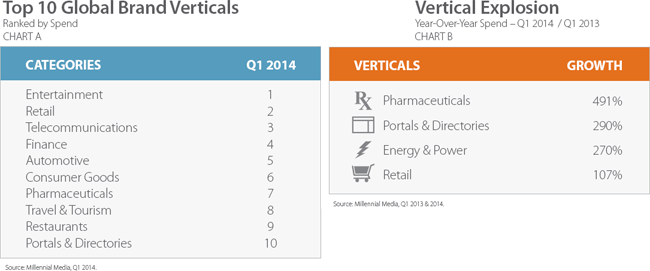


    Retail was the second largest vertical on our platform in Q1 as ranked by spend (Chart A). Typically, retailers spend about 3x more in Q4 than the rest of the year. This year, Q1 was a strong quarter for retail advertisers as well, spending 107% more than the same quarter the previous year (Chart B). Brands were looking to drive consumers into stores and online for great holiday closeout deals.


    In Q1, Pharmaceuticals was the seventh largest vertical on our platform (Chart A), growing campaign spend 491% year-over-year (Chart B). Pharmaceutical advertisers ran mobile campaigns that drove consumers to landing pages where detailed drug information could be found.


    Spend by advertisers in the Portals & Directories vertical was up 290% year-over-year on our platform (Chart B). Brands advertising in this vertical include browsers, app stores, and directories mobile users can install on their devices. These advertisers often leverage tactical targeting in their campaigns to make sure the device is on a compatible operating system.


    In Q1, advertisers in the Energy & Power vertical grew mobile campaign spend by 270% (Chart B). Brands in this vertical often leveraged video in order to drive consumers to mobile sites that explained the many sides of the business, while creating positive brand awareness.


    Global Mobile Advertiser Trends – Campaign Engagement Methods & Goals
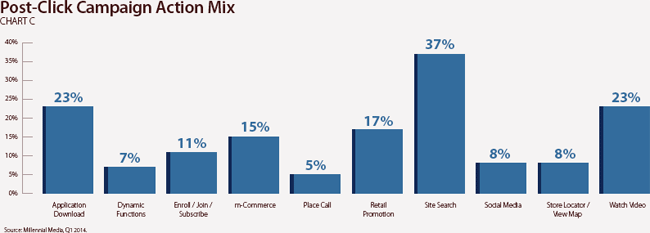


    Drive to Social Media actions were used in 8% of all campaigns on our platform in Q1 (Chart C). Entertainment advertisers, specifically Motion Picture Release brands, frequently leverage social media actions in order to drive consumers to a social site where they can see what other people are saying about a movie, and create buzz in order to entice ticket purchases.


    23% of campaigns on our platform in Q1 included a Watch Video action (Chart C). This is nearly twice as frequently compared to the same quarter last year. Mobile video adoption has become an effective tool for advertisers to not just reach, but also engage their target audience through sight and sound.


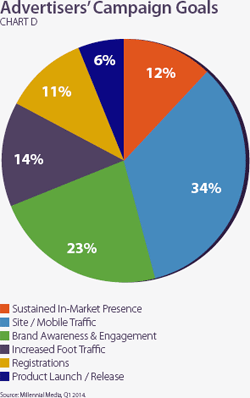
    Site/Mobile Traffic was the goal of 34% of mobile campaigns on our platform in Q1 (Chart D). Site/Mobile Traffic campaigns can have many purposes. For Restaurant advertisers, these campaigns were driven by “learn more” language offering consumers a view into new menus or updated interiors.


    6% of campaigns on our platform in Q1 had the goal of Product Launch/Release (Chart D). These campaigns specially focused on new products to the market, for example, a new model year car, new cleaning products, or a newly approved drug.


    Vertical Insight – Telecommunications


    The Telecommunications vertical on our platform is unique; these advertisers are using the products and platforms they build and sell to advertise their own products and platforms. Because of this, brands running campaigns in the Telecommunications vertical are skilled at using tactical targeting, which reaches consumers based on the characteristics of their mobile devices and connections. In this tightly competitive market, brands use strategies such as conquesting around competitors’ devices, or reaching consumers at home on a particular Wi-Fi network. Telecom brands have the opportunity to take this targeting to the next level by integrating behavioral audiences across screens to reach and engage the consumer.
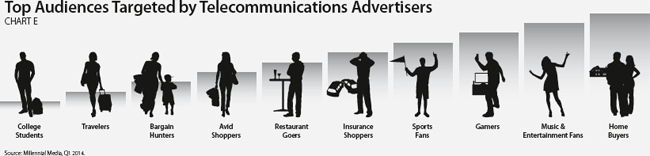


    The Top 10 Audiences Targeted by Telecommunications Advertisers on our platform in the first quarter are shown in Chart E. This vertical most frequently targeted Home Buyers, an audience that may need to set up cable and internet services at their new home. Telecom advertisers targeted this audience with sign-up promotions to encourage new subscriptions. College Students, the tenth most frequently targeted audience, could have similar needs as they move into new apartments at the beginning of a school year.


    Music & Entertainment Fans and Gamers were the second and third most targeted audiences by Telecom advertisers, respectively (Chart E). Mobile users downloading and consuming a lot of digital content need strong signals and high bandwidth to do so seamlessly. Landline and cable companies target this audience to promote their network speed and reliability to entice consumers to switch providers.


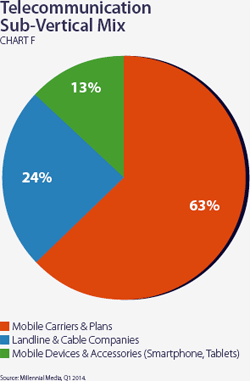
    Of the Telecommunication advertisers on our platform in Q1, 63% were Mobile Carriers & Plans brands (Chart F), such as the major mobile phone networks consumers order cellular service from. Within the sub-vertical, advertisers often ran mobile campaigns promoting new network plans and sales to drive consumer awareness.


    Landline & Cable Companies accounted for 24% of the Telecom advertisers on our platform in Q1 (Chart F). These brands, including landline telephone, internet, and cable and satellite TV companies ran mobile campaigns to drive new subscribers.


    Vertical Insight – Telecommunications
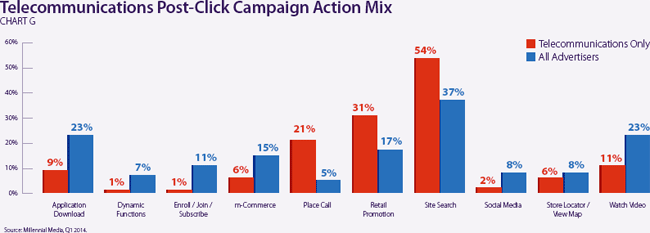


    Telecommunications advertisers utilize three actions in their creatives more frequently than all advertisers: Retail Promotion, Place Call, and Site Search (Chart G). Retail Promotion was included in nearly twice the number of Telecom campaigns on our platform in Q1 compared to all advertisers. Mobile carriers often promoted discounted devices using multiple and re-targeted creatives designed to generate awareness, and then site traffic.


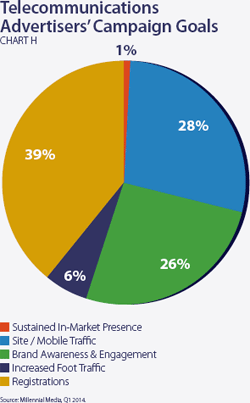
    Place Call actions were included in 21% of Telecommunication campaigns in Q1 (Chart G), used at 4x the rate of all advertisers. Brands in the Landline & Cable Companies sub-vertical leveraged this “click-to-call” function more frequently than any other sub-vertical to drive consumers to sign-up for service. This action was also most frequently used to achieve a campaign goal of Registrations. Registration campaigns accounted for 39% of all Telecom campaigns in Q1 (Chart H), compared to 11% for all advertisers (Chart D).


    Site/Mobile Traffic campaigns were utilized by 28% of all Telecommunication advertisers on our platform in Q1 (Chart H). The drive to Site/Mobile Traffic campaign goal can have many purposes and various actions used to achieve this goal. For Telecom, the Site/Mobile Traffic goal was most often achieved through “learn more” calls to action included in the mobile campaigns. This action often sat alongside an image of a mobile device with new features.


    S.M.A.R.T.â„¢ Glossary of Terms

    Audience Targeting – A strategy used by advertisers to deliver relevant messaging to specific target audiences. Built upon massive volumes of diverse user, location, app, and 3rd party data, Millennial Media’s audience targeting uses a variety of targeting techniques to reach audiences, including behavioral, local, contextual, demographic, retargeting, tactical, and content-based solutions.


    Cross-Platform – Pertaining to multiple devices (smartphones, tablets, feature phones, non-phone connected devices), carriers (AT&T, Verizon, Vodafone, etc.), or platforms (iOS, Android, BlackBerry, Windows Phone, Symbian, etc.). Millennial Media is cross-platform – or “platform agnostic” – because we do not focus on one single OS or device type. This enables advertisers to reach as many mobile users as possible, regardless of their mobile device or carrier of choice.


    Developer – Provider/creator of mobile applications and sites. Developers range from large entities (brands, portals, news sites, etc.) to individuals who focus on just a handful of applications.


    Feature Phone – Any web-enabled mobile phone that is not a smartphone.


    Impression – A count of the number of times an ad unit appears on a mobile device.


    Interactive Video – A high-impact video ad layered with interactive features that deliver a uniquely mobile, actionable experience to customers.


    Inventory – The ad space available on mobile websites and applications.


    Non-Phone Connected Device – A non-phone mobile device. This includes tablets, gaming devices, e-readers, MP3 players, etc.


    Post-Click Campaign Action – The action a marketing campaign is driving the customer to take once an ad is viewed (i.e., Place Call, Download Application, View Map, etc.).


    Rich Media – Advertising that deviates from standard display advertising in that it goes beyond an image file to include coded features, such as it is interactive, engaging, or it breaks free of basic, accepted IAB-determined online standards.


    SDK – Software Development Kit. A tool that enables developers to seamlessly integrate mobile advertising into their applications, thus monetizing their apps. Developer partners on Millennial Media’s platform download and integrate our SDKs (available for a variety of operating systems – iOS, Android, Windows Phone, etc.) to gain access to the ads run by our advertising partners.


    Smartphone – Any web-enabled and application-enabled mobile phone that runs on an operating system and offers the user more advanced capabilities beyond just voice and mobile web access.


    Vertical – The classification of advertisers by industry.


    Visit www.millennialmedia.com/mobile-intelligence to sign up to receive Millennial Media-related news including the Mobile Mixâ„¢ report, the Scorecard for Mobile Advertising Reach and Targeting (S.M.A.R.T.)â„¢ report, and the Mobile Intel Series.

  • TAM to provide measurement updates through new mobile app

    TAM Media Research has announced the launch of the first ever mobile app called “TAM India”. The objective behind this launch is to provide quick and easy access of weekly top line TAM data to its subscribers including Advertisers, Media Agencies and TV Broadcasters. This mobile app has been exclusively designed for the TAM subscribers using iPhone, Android & BlackBerry and, therefore, is available for download on App Store, Google Play and Blackberry World. Subscribers can also get the download link by visiting TAM Website: www.tamindia.com.

     

    The Mobile App will be updated every Thursday immediately after the regular release of TAM data to the Industry.


    Commenting on the launch of TAM India Mobile App, LV Krishnan, CEO, TAM Media Research, said, “Our focus, as always, has been to enrich our customers with actionable insights through credible data. With this first ever unique initiative of launching “TAM India” Mobile App, we have fortified our service commitment to the industry with that of anytime anywhere access to data and quicker decision making process for clients. I am especially excited about the different ways in which this Mobile App will be of value to the Senior Management across Advertiser, Media Agency and TV Broadcast Organisations.”


    L V Krishnan

    “TAM India” Mobile App will, on a weekly basis, provide a quick snapshot of different TV channel genres, markets andprograms. At any given point in time, this App will have data for the latest week but also the preceding four weeks. The data will be updated every week immediately after the regular industry release of TAM Weekly Data. “TAM India” mobile App user will get anintimation for the update of the data.


  • Germany on the field, Twitter off it!


    By Delshad Irani


    World Cup 2014 had socially active fans of football, and everyone else who didn’t want to be left out, spend as much time watching the likes of Goetze and Suarez make history as sharing their two cents on the moments of joy, agony, madness and comedy on social media. Their eyes darted like Captain Luiz’s caught in the Mineirão lights between the antics on pitch and the tweets and posts off it.


    The sheer volume of World Cup tweets that flowed like tears on a Brazilian babe on Black Tuesday has given the good folks at Twitter and marketers who bet big on the first truly social World Cup, reason enough to celebrate, regardless of national allegiances.


    The opening match between Brazil and Croatia was bombarded with 12 million tweets, that’s more than the entire tweet volume of the previous FIFA World Cup. So, for Pele’s sake, let’s be reasonable, and put things in perspective shall we? Yes, your team crashed out in a blaze of shame leaving in its wake psychologically scarred five-year-olds who can no longer bear to look at a football.


    But what’s a little heartache, even if it’s splashed on the front pages of every major paper in the world, when you’ve got a couple hundred more followers in 90 minutes? No extra time required, Ref. (Hear that, #ARG?)


    00:00

    Before the 20th FIFA World Cup kicked off in early June, Twitter went all out to woo people to use the platform as an ideal companion that enhances your World Cup experience and not as just another megaphone for the newborn soccer pundit in you. Though a few didn’t get the memo. Twitter’s campaign included an all-you-can-tweet buffet of hashtags like #BRA #GER #NEDARG #WorldCup, et cetera.


    They made sure every player on every team for every country is on the platform, knows how to tweet and is tweeting. All 32 countries were active on the platform and most players tweeted regularly be it from practice sessions or the stands. The company made certain the content flowed across media. There was even a video akin to the likes of World Cup favourites Nike (‘Write The Future’ – 2010, ‘Risk Everything’ – 2014), Adidas, Coca-Cola and Pepsi. The site quickly turned in to a carnival of planned and reactionary content around the Cup.


    In 32 days, 672 million tweets related to the World Cup were unleashed, that’s over 10 per cent of the planet’s population. Brands had conversations and engaged not only with fans but with each other also. Tweets went back and forth between McDonald’s and Visa who indulged in a round of Twitter joust in the group stage. Taking a hands-on approach, the social media platform sent in specialists to work closely with brands like McDonald’s and Coca-Cola to operate their social newsrooms from Rio to Tokyo, and drove conversation further and wider than in any previous marketing campaign to date.


    Coca-Cola India garnered a social footprint of 6.2 billion impressions on Twitter. According to a Coca-Cola spokesperson, “This has by far been the brand’s largest ever social campaign in India which was a result of integrated marketing supported by a well knitted TV, radio, print and on-ground activity in its key geographies.” The social campaign was led by an editorial team at a specially created Live Wire room by Coca-Cola India. This team created and seeded real time content using meme images, Vine videos, leveraged multiple celebrities along with 250 advocates or influencers to cover everything from stats, WAGs and wacky hairdos to contests.


    While Coke had the big global TV campaign, “in India the goal was to drive real-time conversations and content around the global asset, #WorldsCup. Twitter was at the heart of the social media strategy integrating multiple touch points from TV and radio to on-ground to leverage available content,” says Anamika Mehta, CEO, Initiative, who led the media team for Coke’s campaign.


    45:00

    “Compelling moments like the World Cup become the way to make Twitter more concrete,” says Shailesh Rao, VP – Asia Pacific, Latin America & Emerging Markets, Twitter Inc. “If you are following a match, well, participate in the conversation. If a goal excites you, tell the world. Not only was it hugely successfully in terms of engaging users but brands as well did some phenomenally creative things.”


    Big ticket marketers pump in millions in the Cup, in the range of $25 – $50 million, to realise their marketing strategies, to be part of the conversation and to engage with fans, old and new across the world. For instance, markets like the US saw a surge in popularity of football and renewed interest in the game from marketers. The US goalkeeper, Tim Howard being its greatest beneficiary.


    India, a Top 10 market for Twitter, was responsible for 3.2 per cent of the entire buzz on the platform, according to reports. Since the first match on June 12, @DFB_Team and @Argentina have increased their followers by 62 per cent and 139 per cent, respectively. Whichever way you look at it, that’s good news for kit sponsors and global and national brands associated with the teams and the game’s international stars.


    Says Adidas Group CEO, Herbert Hainer; “From having both finalists, the winning team and all three Adidas golden award winners to being the most talked about brand in social media, we were able to dominate the tournament on and off the pitch.” From its base in Rio, “Posto adidas” (Posto is the name for local landmarks along the beaches of Rio de Janeiro), the sportswear brand’s marketing team uploaded planned, anticipated and reactive content to drive its conversation online with football fans.


    Focussing its campaign on share of voice and reactive moments, Adidas had 917,000 mentions of #allin on Twitter – more than three times as much as any other brand during the tournament, the official sponsor claims. Certainly, the Adidas poster of Uruguayan striker Luis Suarez channelling his best Fox Terrier near Copacabana which turned in to a tourist attraction helped. Adidas took down the poster, of course, but not before hundreds of fans shared their Suarez bites with the world. Along the way, Twitter became a powerful and efficient tool in the marketer’s arsenal to amplify their efforts so one can get more shots on goal. And, according to Rao, “what we saw in terms of results was that TV conversation retargeting in Brazil lifted the engagement rate substantially when it was included in the overall campaign.”


    GOAL!

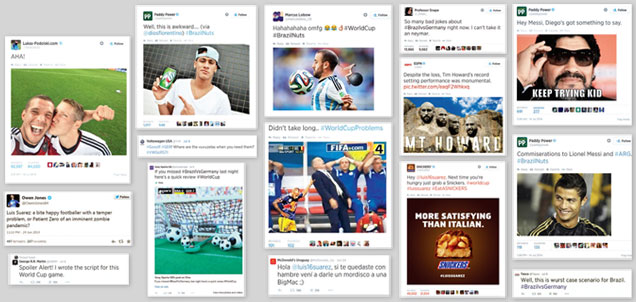
    During this World Cup, in the seconds that followed spectacular goals, saves, dives and bites and referees fixing their hair on screen and Lukas Podolski and Bastian Schweinsteiger’s smooch selfie, fans, brands and “newsjackers” got to work on the platform to share comments, vines, memes and japes with the planet. When Italian centre-back Giorgio Chiellini’s shoulder ran in to Suarez’s teeth it launched a thousand tweets. Brands dived in to the action with their own cheeky takes. Real-time marketing war rooms are set up for exactly this kind of stuff.


    “More Satisfying Than Italian” Snickers tweeted. Budweiser and Listerine promptly bought Promoted Tweets around the #Suarez hashtag. And @Listerine tweeted: ‘We recommend a good swish after grabbing a bite of Italian. #WorldCup #PowerToYourMouth’. Brazil’s catastrophic 1-7 loss to Germany in the semi-finals (a match that triggered a record breaking 35.6 million tweets) and Germany’s ultimate triumph gave some marketers their Oreoesque moments as well. Irish bookmaker, Paddy Power tweeted a picture of Brazilian striker Neymar Jr brandishing a 7Up can with a tweet that read: ‘Well, this is awkward…. (via @diosflorentino) #BrazilNuts’.


    And, in case you missed it, Sony Xperia recreated the match in Vine form with Subbuteo figures and a goal net with seven holes in it. Besides receiving countless retweets and favourites, they and many more were extensively shared and covered in the news, online, TV and print. Even traditional ads got traction online, when people tweeted a Singapore anti-gambling ad in which one boy tells another “I hope Germany wins. My dad bet all my savings on them.” @Mr_Mike_ Clarke tweeted: ‘This anti-gambling poster has backfired a little.’ Instead of just taking down the poster, the National Council on Problem Gambling had to come up with a save à la Howard with another ad. “Your dad’s team won. Did you get your savings back? “No, Dad never stops.


    He wants to bet one more time.” Says Vishal Sampat, CEO, SMG Convonix, “One could easily follow the entire game by just being on Twitter. This meant that Twitter became important not just for a digital campaign but also a 360 degree campaign. As a platform it allowed brands that used it effectively to run a two way communication campaign with potential or existing consumers of their products.”


    90:00

    Although the following might sound needlessly laudatory, the fact is while the beautiful game was played on the green pitches of Brazil, the drama unfolded on our Twitter timelines. That’s where the millions who couldn’t afford a trip to the Maracana watched the game together and shared their collective glee and distress. Sure we could spend hours attempting to put results in to tangible returns on investment and argue over matters close to the CFO’s heart, for instance, raking up the mentions is all dandy, but what did it do for sales? As it stands today, social media is more about engagement and awareness and not how many shoes flew off the shelves.


    It’s about engulfing your brand in a thick cloud of buzz. For now, it’s all worth it when people stop seeing the brand as a nuisance trying to butt in on a conversation and instead become the friend at the party everyone wants to hang with. Isn’t that the point of all marketing nowadays anyway?


    So to answer the question which brand won the first social World Cup? The one who scored the equivalent of Mario Goetze’s goal to take home the marketing trophy are not the sponsors or the unofficials, Adidas or Nike, Coca-Cola or Pepsi, Hyundai or Mercedes or Audi or Visa or Sony or any of the marquee marketers.


    Those who’ve dominated cups past and spend years and many millions to leverage the biggest, most electrifying, spectacle in the history of mankind (the Indian General Election comes a close second). The brand champion of FIFA World Cup 2014 is, in fact, Twitter. Because much like Germany it had the best, most dedicated team players in the tournament – @YOU.


    Source:The Economic Times

    Copyright © 2014, Bennett, Coleman & Co. Ltd. All Rights Reserved

    Licensed to republish


  • Google Search Trends unveils popularity of young Bollywood stars

    India’s crazy love for Bollywood stars, movies, and songs is a celebrated and known fact. With the entry of fresh talent and dynamic performances over the last year, Bollywood fans across the country have been extending their support to the stars of tomorrow. While some are new to film fraternity, the others hail from filmy homes and have grown up in Bollywood.


    Starry kids including the likes of Alia Bhatt, Shraddha Kapoor, Arjun Kapoor, Varun Dhawan and Tiger Shroff are leading searches on Google. Although filmy background gives them a clear edge, the other non-filmy newbies on screen including Sidhartha Malhotra and Ileana D’cruz have made their way to fans’ hearts with their performances and talent.


    An analysis of recent searches on Google (Google Search trends) takes a look at the popularity of these stars among the fans online. Mahesh Bhatt daughter Alia Bhatt’s dream launch in Student of the Year followed by blockbusters movies including Highway and Humpty Sharma Ki Dulhania has gained a lot of interest online as she leads search interest among fans for emerging stars.


    Among the male stars, actor Arjun Kapoor is the latest on the block attracting huge search interest online. With he made his debut in 2012 with Isaqzaade, he took on the spotlight with his blockbuster hit 2 States this year. Sidhartha Malhothra’s journey with his charming performance in Student of the Year & Hasee Toh Phasee to Ek Villian has been followed closely by his fans. The actor has shown steady and charismatic performances that are driving searches online.


  • 10 Minutes to 1 appointed creative partner for IOFW

    Online fashion brand Jabong.com has collaborated with 10 Minutes to 1 as its creative partner for the India Online Fashion Week (IOFW). 10 Minutes to 1 bagged the account with the mandate involving direction, filming and creation of a concept film revolving around IOFW and also the website conceptualization, designing and development for the same. The agency will be involved in translating India Online Fashion Week’s vision across all media platforms.


    Praveen Sinha, Founder & Managing Director, Jabong.com, said, “We appointed 10 Minutes to 1 as our creative partners as they demonstrated a research based understanding and the capability to provide a solid creative platform for IOFW. I strongly believe that they have the ability to render our vision into a visual as well as web platform with great vigor. We are happy to have them on board and excited to see the output.”


    Expressing her delight on this creative collaboration Reena Bhattacharya, Director, 10 Minutes to 1 said, “At 10 Minutes to 1, effective and creative communication is at the core of all our services and our objective has always been to build a concerted communication strategy through a single window offering a complete marketing communication consultancy to all our clients. We are pleased that Jabong placed their confidence in our services adding further credibility to our web and filming capabilities. We definitely look forward to a long and fruitful association with Jabong.”


    The agency has worked closely with Jabong.com in creating various marketing communiqués for the property including IOFW’s launch video and its website, which will act as the hub of all IOFW action where the shortlisted participants will showcase their creations from July 28th to 30th, 2014


  • Quasar wins digital mandate for Philips TV

    Quasar has won the digital duties for leading television brand Philips from PE Electronics Ltd. The full service mandate encompasses creating the digital strategy encompassing owned media assets, social media and digital media planning and buying. The account will be handled by the Quasar Mumbai office.


    Speaking on the announcement, Neeraj Sethi, CEO, PE Electronics said, “We are extremely glad to welcome Quasar on board to help us manage our digital mandate. TV is a dynamic industry and we needed a disruptive agency with a unique approach, which Quasar was able to demonstrate. We are impressed with Quasar’s capability as an all-rounder in the digital industry, their thought leadership and above all their passion and enthusiasm to partner with us made them an obvious choice as our digital partner.”


    Commenting on the win, Gaurav Nabh, Head, Quasar said, “We are excited about working with PE Electronics on the Philips LED TV digital mandate. Quasar will manage a 360 degree digital marketing campaign, encompassing paid, owned and earned media initiatives. Our task includes setting up a digital ecosystem encompassing Philips television and its consumers to facilitate positive engagements and build strong brand association.”


  • Facebook signs first agency deal in India with GroupM

    By A Correspondent


    Facebook has signed its first agency deal in India with GroupM, WPP’s integrated media and marketing company. This partnership was announced during the recent visit of Sheryl Sandberg, COO, Facebook to India.

     

    “Our partnership with GroupM will benefit clients to reach over 100 million people in India, 84 million on mobile - both smartphone and feature phone –  and custom audiences within the 100 million in urban and rural India,” shared Kirthiga Reddy, Head, Facebook India. “We’re excited about this wide-ranging collaboration which combines the strength of the world’s best global advertising platform with GroupM’s market-leading position to deliver personalized marketing at scale.”


    CVL Srinivas

    GroupM South Asia CEO CVL Srinivas said, “We are delighted with the Facebook partnership that can help unlock even greater value for our clients. We work closely with Facebook globally, regionally and locally. India is projected to be the largest country for Facebook by people very soon and we see exciting possibilities for our clients. This partnership adds to the set of enablers we have created over the years that can help drive digital adoption in our market.”


    GroupM has been creating cutting-edge digital solutions for clients for close to 10 years. Given its leadership position and access to data and research, GroupM has been integrating digital with traditional media for its clients. GroupM agency brands today have fully embedded digital resources that are supported by the scale and leverage of the network.


  • Hic, Hic, Hurray!


    By Pritha Mitra Dasgupta


    On Monday, @BudweiserIndia tweeted out a cheery message to its 6,000 followers: “How are you coping with your #MondayBlues! Keep your #Buds close and watch them disappear!” Does a tweet urging beer consumption constitute advertising? It’s not quite clear. The rules banning the advertising of liquor products are at least about half a century old and predate the computer age. Social media is, naturally enough, a grey area.


    No matter, liquor companies have been happily making use of the platform. Diageo, the world’s biggest liquor company, the UB Group’s Kingfisher beer, Budweiser, Tuborg, SAB Miller, Johnnie Walker are all active on Facebook and Twitter, using them to spread the message about their brands, complete with visuals. Kingfisher tweeted to its 44,000 followers on Wednesday from @kingfisherworld: “Okay so beerheads, here we go. Remember that 1st #KFBeer you ever had?


    We want to know the story! Tweet to #HowIMetMyKFBeer right away!” Last year, Diageo’s vodka brand Smirnoff, using the handle @SmirnoffIndia, had this to say: “You don’t need an occasion to gift someone gold! Treat your friends to the royal taste of Smirnoff Gold today.”


    Samar Singh Shekhawat, senior V-P (marketing), UB, said: “The guidelines do not clearly define ban on social media and there are no clear clauses for liquor companies by the I&B (information and broadcasting) ministry on social media and online advertising.”


    However, he added that liquor companies tend to self-regulate by strictly following the age-restriction policies of the sites. “So whoever comes on to the social media platform are well within the drinking age limit. Whatever is not allowed on mainstream media we do not put on as digital advertising unless it is age gated,” Shekhawat said.


    However, while brands ask consumers to enter their age or date of birth in order to access their websites, there is no way to restrict the visibility of tweets.


    A top executive at another leading liquor brand said, “The maximum traction that social media gets is from our core target audience. The absence of any law has made it easier for us to interact with them directly.”


    Arvind Sharma

    Arvind Sharma, former chairman of the Advertising Standards Council of India (ASCI), said social media messages from a manufacturer qualify as advertising.


    “On the whole any message put out by a company is an ad,” he said. “It is not an ad if it is created by the consumer.


    While ASCI is yet to receive any complaint against liquor brand related to social media activities, “such messages should not be allowed as social media is also a form of media”, he said.


    Although the rules haven’t been amended in the last 50 years, the spirit of the law can still be implemented, said Prem Rajani, managing partner of legal firm Rajani, Singhania & Partners. “While one may argue that you need a clear statute to pin them, I would say the current statute if interpreted properly should be enough to pin them down.”


    The information and broadcasting ministry hadn’t responded to queries as of press time. Interestingly, tobacco brands in India which are also barred from advertising, have not taken the social media route. Even international brands such as Marlboro don’t have any social media engagement with Indian consumers.


  • ShopClues.com unveils new media campaign

    By A Correspondent


    ShopClues.com has announced the launch of its end-to-end advertising and branding roadmap to gain higher recall in the Indian e-commerce segment. The brand has already carved a strong niche for itself in the Indian e-tailing space with over 65,000 merchants powering an extensive selection of 5.3 million products across 3000 listing categories. It is now ready with a full-fledged branding and mass communication campaign to further its penetration and recall in broader geographies and demographics. To achieve this objective, ShopClues.com has engaged partners across functions to lead its large-scale consumer engagement campaign.


    The e-commerce platform has partnered with agencies which have a history of creating memorable creative campaigns reflecting its vision of establishing itself as a preferred brand of the Indian masses. Enormous Brands, headed by advertising veteran, Ashish Khazanchi, has been appointed as its creative partner. The Public Relations mandate has been assigned to Value 360 Communications, headed by Kunal Kishore Sinha who has a tremendous track record of scaling up several start-up brands.


    Radhika Ghai Aggarwal, Co-Founder & CMO, said, “We observed early on that our country has millions of small merchants with interesting products and we Indians love to shop in local bazaars. This is the basic and defining essence of our product. At ShopClues, we’ve built properties like the Sunday Flea Market, Wholesale, Cash-Before-Delivery, Factory Outlet, keeping the orientation of our shoppers and their comfort zones in mind. We have an approach to merchandising which is unprecedented. Our build-up is focused on extensive unstructured products categories, offerings and unique cataloging.”


    Notably, ShopClues has spent less than US $10 million to reach the status of India’s 5th largest, while every other company in the top five list has spent an over ten times the amount.


    While ShopClues covers a broad range of products, prices, categories, brands, and sellers, it specialises in non-standard categories, unbranded products or less-known brands, smaller merchants, and tier II and tier III cities. In addition to strong traction and a very well-developed marketplace ecosystem, it also has an unmatchable cost advantage and rapidly improving fundamentals – the company is close to gross margin break-even and will be operating margin positive by March 2015.


  • News18 India announces entry into US market

    By A Correspondent


    TV18 Broadcast Limited has entered the US market with the launch of News18 India, a 24-hr television news channel designed to give global audiences a window into India. The channel went live on July 30th on Dishworld and Dish Network Channel 711. News18 India is already present in key South Asian diaspora markets that include the UK, Singapore, and the Middle East and is distributed by IndiaCast, a TV 18 & Viacom 18 company for monetizing its channels & content in India and Overseas.


    News18 India will be available to all viewers on the International base pack, English News pack and Hindi Mega pack, making it one of the most widely distributed Indian News channels in the US.


    News18 India is produced by the award-winning editorial team that runs TV18’s leading business and general news services in India that include CNN-IBN, CNBC-TV18, CNBC TV18 Prime HD, IBN7, CNBC-Awaaz & CNBC Bajar. News18 India will serve as the destination for definitive news & views from India including in depth analysis, business news and local weather reports. Through a power packed delivery format including bulletins, feature shows, interviews and a rich graphic interface, News18 India will be a one-stop destination for all the latest from the subcontinent.


    News18 India is a unique news channel offering a dynamic and customized blend of business and general news programming at times that suit the US audience ensuring greater relevance for the viewers in the region. In addition to News18 India, IndiaCast distributes the flagship general entertainment channel ‘Colors’, its sibling ‘Rishtey’, MTV India International and 6 ETV branded services in overseas markets.


    Commenting on News18 India’s US foray, Avinash Kaul, CEO, IBN News Networks said, “It gives me immense pleasure to expand our global footprint and to take the best of Indian News to every household outside of India. News18 India is a destination for definitive news for the Indian diaspora, a community of high achievers seeking Indian news & for ethnic conglomerates with business interests in India. At a time when the world is watching India, News18 India will serve as the world’s window into India.”


    Gaurav Gandhi, Group COO India Cast said, “After UK, Singapore and the Middle East, News18 India now launches in the United States. We are confident that News18 India, with a customised offering for the US market, will fill the void of a comprehensive business & general news service from India. This would be our 7th channel on the Dish network and with them we found a perfect partner to bring this channel to all viewers who want a window into India”