Category: Digital

  • How Foursquare, Netflix & Spotify are developing agile organizations


    These three case studies – on Foursquare, Netflix and Spotify – give an indicator of some of the methods being deployed by digitally agile organizations to foster this culture of innovation (and growth). Reproduced with permission from Ernst & Young from the report Digital agility now published as part of the Digital Leadership Study Series from EY’s Global Technology Centre and Global Media & Entertainment Centre


    Media and Entertainment (M&E) companies recognize that to achieve the culture of innovation they desire, they must structure their organizations for agility. M&E companies’ vision of meeting high-velocity, continuous change with a steady stream of innovative product, service, distribution, marketing and business model ideas can only be achieved through organizational agility. Research indicates that M&E companies expect to use technology to enable agility and a culture of innovation. Their goal is to break down organizational silos so the business can work synergistically – and rapidly – to deliver products and services that are highly integrated and meet customer expectations. For example, borrowing the phrase “loosely coupled” from software architecture, Netflix labels its own organizational approach “highly aligned, loosely coupled”. That means strategy and goals are clear, and management works hard to ensure they are well articulated and broadly understood. But tactics are executed with minimal cross-functional discussion or approvals, replaced by trust among groups, and leaders who reach out proactively for ad hoc coordination as appropriate. This attracts top-flight talent and affords significant power to solve problems without extensive chains of command that slow decision-making.


    Foursquare’s start-up culture

    More than 35 million people use Foursquare worldwide, the mobile location-sharing-and-discovery application, to learn about areas they are visiting, “check in” with friends or find deals from merchants or restaurants in their vicinity. Its CEO, Dennis Crowley, believes the company is perfectly positioned to become the location-data platform of choice for the internet.


    The mobile world changes rapidly, however, and Crowley is determined to keep Foursquare’s start-up feel, even as the head count has grown from just a handful of employees to more than 160. His executive management committee consists of just five people.


    “A lot of the work we do is consensus-driven,” he explains. “We’ll take the 10 smartest people on mobile and ask, ‘Should we do this or not?’” If a key decision requires a tie-breaker, then an in-person meeting takes place. “There is no CTO that is making the call,” Crowley says. “A lot of times these guys will duke it out, and if the argument goes on longer than a couple of days, then I’ll step in and make the decision.”


    His company, he says, doesn’t have time for formal committee meetings. “Everyone is weighing in on these critical decisions all the time,” he says, “because we’re making 25 of them every single day.”


    He also believes small, innovative companies like his need to rely on their own “gut instincts” in order to maintain their momentum. Building a technology infrastructure is the “easy part, and assembling the user base and getting something that people are passionate about and really feel strongly about, that’s the part that is really difficult.”


    The shared goal is to make each individual customer experience a unique and personal one and to maintain a strong bond with each customer.


    Netflix’s flexible approach

    Netflix, the video streaming service, says its goal is to be “big, fast and flexible.” Indeed, in the first quarter of 2013, its viewership exceeded that of many conventional cable TV channels when subscribers streamed some 4 billion hours of content, a remarkable turnaround from a very public 2011 misstep when it quickly lost 800,000 customers after a poorly communicated attempt to separate video streaming from DVD rental services.


    Most small companies inevitably become bureaucratic and hierarchical as they grow larger. Netflix, by contrast, aspires to grow fast without becoming complex or chaotic, according to company executives. In fact, the company’s recruitment materials note that it doesn’t want to hire “jerks” but high-performing individuals who don’t “wait to be told what to do,” and will also “pick up the trash lying on the floor.”


    Instead of creating lots of rules and hierarchy, it believes in trusting its people to make their own decisions. “We have a very non-hierarchical approach that stresses freedom and responsibility,” explains Jonathan Friedland, Chief Communications Officer and a member of the Netflix executive committee. Executives spend a lot of time “making sure everybody has the right context to forge ahead with what they’re doing” by laying out specific strategic goals and timetables, but without micro-managing or asserting control. In essence, the company tells its staff that over the long run, flexibility is key.


    What does that mean in practice? There are no limits on vacation or sick days at Netflix. No one tells workers when to come and go, or clocks when they do. But doing B-level work will likely earn you a severance package. (Indeed the annual attrition is a chilling 20%.) A-level work results in more money and responsibility.


    The company calls this strategy “Highly Aligned, Loosely Coupled”. “Each of us is responsible for our own particular areas,” Friedland explained. “If we do a good job on it, we keep our jobs. If we don’t, we get fired.”


    Spotify’s squads and tribes

    “Think it, build it, ship it, tweak it.” That mantra, together with its agility-focused organizational structure, has helped build music-streaming service Spotify to more than 6 million subscribers in 20 countries.


    Spotify rapidly releases software solutions it improves iteratively thereafter. Its focus on rapid-fire development influences not only how it designs and releases products, but also how it organizes its workforce. The basic work unit at Spotify is the “squad” – a self-organizing team whose members have autonomy to design, develop, test and release products. Members of a squad sit in the same office, and jointly decide how they will fulfill their specific mission. A squad doesn’t have a formally appointed leader. It does have a product owner who is responsible for prioritizing the work – but not how the work is done.


    To help identify impediments and improve their development methods, squads also meet regularly with an “agility coach”. “Autonomy is one of our guiding principles,” explains Henrik Kniberg, an agility coach at Spotify. “We aim for independent squads that can build and release products on their own without having to be tightly coordinated.” Quarterly audits of its teams identify which squads are working well, and which might require additional support.


    To coordinate within the company, squads are aligned into “tribes” that meet to share information and identify development roadblocks. The number of workers belonging to a tribe is held at about 100. In addition, Spotify organizes its employees into “guilds” and “chapters” to support cross-tribe knowledge sharing.


    Squads are told to release products “early and often”. Rather than distribute “perfect” upgrades or new services, Spotify focuses instead on achieving simple results that can be subsequently perfected. Leaders establish a “minimum viable product” for each product or upgrade being released then gather customer feedback to iteratively improve it. By testing, tweaking and releasing constant upgrades, Spotify expects to remain agile and continuously improve the customer experience.

     

  • International Herald Tribune rechristened International New York Times, shuts Indian print edition

    By A Correspondent


    The New York Times Company has decided to shut down the India edition of what was until yesterday (Oct 14) called the International Herald Tribune (IHT). The IHT has been rechristened the International New York Times with effect from today (Oct 15).


    The newspaper has decided to do away with the Indian print edition published by the Hyderabad-based Midram Publications, a company promoted by Deccan Chronicle group promoters which has had veteran editor M J Akbar as director and editor.


    Established in 1887 as the Paris Herald, the European avatar of the New York Herald, the paper has changed multiple hands and has been called variously over the years. While the New York Times is the sole owner currently, until the early 1990s, it was co-owned by the now-Jeff Bezos-owned Washington Post.


    The paper is edited from newsrooms in Paris, London, Hong Kong and New York. The introductory offer for Indian subscribers is $99 for the first 12 weeks after which the charge varies from $3.75 to $8.75 per week.


    he International Herald Tribune is an English language international newspaper. It combines the resources of its own correspondents with those of The New York Times and is printed at 38 sites throughout the world, for sale in more than 160 countries and territories. Based in Paris since 1887,[1] the IHT is part of The New York Times Company, and will be renamed the International New York Times starting October 15, 2013


  • Rajan Srinivasan bigs adieu to Web18

    By A Correspondent


    IBNLive CEO Rajan Srinivasan has decided to move on. During his stint with Web18, Srinivasan managed a variety of mandates including head of sales for moneycontrol, head of sales and marketing for Web18 and CEO, IBNLive. Mr Srinivasan has not revealed where he’s moving to, though he did mention he was planning to take a month-long break before he announces his next move in December.


    Speaking on the development, Lakshmi Narasimhan CEO, Web18 said “Rajan has been with our web business for over eight years and has been a pillar of strength for our business. He has taken on every challenge we have thrown at him and has come out tops. He has been an integral part of our team and has made a big difference to us in many ways. I would like to wish him the very best in all his future endeavors.”


    Added Mr Srinivasan added: “I am proud of what we achieved over the past many years at Web18. I am more than grateful for the immense support I’ve received from the Network18 team, our customers and our partners. Clearly, this is a rather emotional and tough call but I am happy to know that the Web18 suite of products are well positioned as well as future ready and wish them every success “.


    Mr Srinivasan has over eighteen years of experience in the media industry, including nine in the digital space. Prior to joining Network18 in 2003, he had stints with the Indian Express, Sony Entertainment Television and BBC World.


  • 10 cultural trends that will define entertainment in future: Mindshare report

    By A Correspondent


    The future of entertainment will follow 10 cultural trends, according to a report by media agency network Mindshare. The report, “Culture Vulture, Entertainment – inspiring original thinking through a deeper understanding of cultural trends”, was released this week to coincide with the 90th anniversary of the Walt Disney Company.


    The report, which details the ten cultural drivers of change within the entertainment industry, includes a scout report from Mumbai, detailing its addiction to Electronic Dance Music (EDM). From the numerous dance events popping up all over the city, such as the Sunburn Festival in nearby Goa and Submerge; toTenzi FM, the EDM-dedicated internet radio station, featuring over 200 international DJs and broadcasting all genres to listeners world-wide, Mumbai is cementing India’s place as a premier destination for EDM.


    Predictions from the paper include continued demand for real-life experience despite availability of virtual and artificial entertainment and an increase in snacking – consuming small pieces of entertainment, often delivered on the move.


    Ten Cultural trends:


    1. Collective Curation, Helping consumers navigate entertainment. (Me Nation)

    2. Press Play, The spread of gaming to new audiences and to new activities. (Power Play)

    3. Immersive Layered Entertainment, Entertainment in multiple environments. (Maximising Moments)
    4. Feast for the Eyes, Visual images that simplify stories and immerse our senses. (Visualization)
    5. Real Deal, Craving credible talent & live experiences in the face of the artificial and the virtual (Seeking Authenticity)
    6. Unplugged/Plugged In, Uncluttering the entertainment world, both by turning off technology and by turning it on. (Simplification)
    7. Social Entertainment, From group fun to group decision making. (New Networking)
    8. Snacking & Bingeing, Snacking or indulging in moments to be entertained. (Snacking)
    9. Local Talent, Celebrating and consuming locally grown talent. (National Celebration)
    10. There’s New Business Like Show Business, Traditional models broken, new rules abound (New World Order)


    Experts from global entertainment brands including YouTube, VEVO, Parlophone/Warner, Microsoft and Spotify were also interviewed on the trends they are seeing in the market, which included the move from a passive viewing audience to a creating audience enabled by global content platforms.


    The report includes a breakdown of each cultural trend and what it means to brands, plus “Scout Reports” from twenty cities in the Mindshare network, providing insight into local trends in entertainment and how they map against the research. City reports include “Big vs Small” in London, “Dance in Trance” in Mumbai and “Youth Power” in Toronto.


    Said Catherine Williams, Partner – Strategy at Mindshare Asia Pacific said, “Entertainment in Asia is now an always-on customised experience. People have power to adapt their entertainment instantly by choosing to curate, binge, turn off or collect. Content now has competition and it’s consumer control. If brands want to continue to play in this space they need to be on their A game because the consumer is spoilt for choice.”


    Ravi Rao, Leader – South Asia,added: “We already know from our studies – like Mindreader – that music is one of the most loved entertainment indulgences. EDM in fact is second only to Bollywood film music in terms of popularity with GenNext in India. The city specific ‘Dance in Trance’ culture vulture report takes a deep dive into this phenomenon of EMD with an eye on being able to craft culturally adaptive entertainment experiences for consumers. This is just one of the many initiatives that Mindshare is driving in pursuit of providing our clients’ customers, experiences in media which will have a remarkable resonance.”


    The report, “Culture Vulture, Entertainment – inspiring original thinking through a deeper understanding of cultural trends” can be downloaded from: http://www.mindshareworld.com/s/CultureVulture


  • Starsports.com partners McLaren Mercedes F1 team in Indian GP

    By A Correspondent


    Starsports.com has entered into a partnership with the Vodafone McLaren Mercedes Formula 1 team for the 2013 Indian Grand Prix (Oct 25-27). As a part of this tie-up, the 200mph-plus Vodafone McLaren Mercedes cars, driven by 2009 world champion Jenson Button of Great Britain and his team-mate Sergio Perez of Mexico, will carry Starsports.com logos on their rear wings. This will be the first time that an Indian digital brand will become part of a Formula 1 team’s livery.


    Starsports.com will be streaming the Indian Grand Prix race live on Oct 26 and 27. In addition to the live streaming, Starsports.com will be working closely with the Vodafone McLaren team in the run-up to the Indian Grand Prix. The website will develop Formula 1 programming including exclusive interactions with the team drivers, Button and Perez, as well as senior management of the team including Martin Whitmarsh (team principal) and Sam Michael (sporting director).


    Speaking on the occasion, an ESPN Software official said, “We believe this partnership will help in promoting starsports.com as the definitive destination for sports on digital.”


  • Vijay Mukhi: My Klout score is 0

    By Vijay Mukhi


    I have been writing for over 30 years and my editors taught me one big lesson about writing, get your headline correct and the war is half won.


    This time I wanted to write about companies like Klout or PeerIndex or Kred that decide whether you will get your job or your next promotion or worse still, decide who would marry you. I was reading this article on Wired that started off talking about this bright guy whose interview got shortened because his Klout score was in the 30s and the job finally went to someone whose Klout score was in the 70s. I then chanced to discuss this with old friend Harish Mehta who told me that he knew of lots of people in the technology world who hold C level posts in large reputed companies and wake up in the morning by checking their Klout score first, which then decides their mood for the rest of day. I am waiting for Shaadi.com to display Klout scores on their websites. (when I use Klout, I am also referring to  Kred and PeerIndex and the rest of the gang, as Klout is the most well-known of all social media scores).


    I knew that my Klout score would be approaching 0 because my social media footprint does not exist at all. This is what I do on the social web. I hate Twitter because being a writer, saying something in just 140 characters is alien to my existence, anything less than 600 words ( the size of this column) is just not enough. The only tweets in my name are that of my computer program that posts one tweet every day on my behalf. I love (check for a stronger word to use) Facebook, spend at least 30 minutes every day without fail but do not post. Facebook should get a Nobel prize for making the world a happier place to be in because all that I do is read inspirational/ motivational/ funny/ etc/ posts/ videos/ pictures. This brightens up my life and that of lots of people I know. On LinkedIn I just accept whatever requests I get for people who want to connect with me. I do not have the creativity to create You Tube videos or take pictures. This sums up my conversation on the social web , which is silence and more silence.


    I created a Klout account and then came back after 48 hours to see my Klout score and I was expecting a number approaching 0. To my utter surprise and horror it was actually 39. I am not joking, that is my Klout score while I am writing this column. My first reaction was that for marketing purposes Klout gives everyone a minimum score of 39, as a score of 0 would be too insulting. After doing some serious research (ironically using the social web), I realised that people actually had scores in their teens. I then thought that maybe Klout needed to be fixed. After all who am I, a nobody on the social web, to dare question the social media rankings that these companies give out. So I will not say that Klout is broken and needs to be fixed, all that I would do is ask three simple questions.


    Question 1

    This is the million dollar question, how does Klout arrive at my score?

    The answer I got was very simple, if Klout tells you all about the secret sauce they use to determine your score, then you would be able to artificially inflate your score and thus beat the system. For example if we give a high ranking to say Followers on Facebook over Followers on Twitter, then you would focus on getting more Facebook followers over Twitter. It’s not very expensive to buy followers on the social web and if anyone can determine a fake follower, he/she would have more money than Bill Gates and Warren Buffet put together. This becomes a Catch 22 situation, do and you are dammed, don’t do and you are damned too!


    Google faced a similar problem in the last century. If they told us how they ranked websites when you did a query, then it would be very easy to make sure that your website come in the Top 10 list. Even today there is a more than a cottage industry of people who claim that they can give you a higher ranking on a Google search. This only means that if Klout tells us how they calculate my score, I would be able to decide what my score would be. If they do not, which is the case at present, I have no idea how they compute a score and therefore I now have a right to criticise Klout till the cows come home. The day my score goes through the roof, then Klout is the best thing since sliced bread.


    Question 2

    The Social Web or the Internet is as different as chalk is from cheese.

    The first question can go either way, This one can never have a easy answer. Twitter is text, Facebook is pictures, YouTube is moving pictures, LinkedIn is resumes. Fortunately for us there is no monopoly on the web and I can list at least 25 entities that I would use to rate someone. The bigger players in the social media in, say, China do not mirror the important social media players, say, in Europe. How can any one decide which of these social media players should get what weightage in computing my score. Here we are on a slippery slope because we now have to take a call on who is more important, do we give more marks to Twitter or Facebook or even worse do moving pictures score over static images? Even within pictures, does Instagram score over Facebook. I do not think anyone would even dare answer the question without starting a virtual riot, one reason why the likes of Klout do not tell us how they compute a score. The bigger problem is that within Twitter, for instance, how do you rate a person. Do you give a higher score to the followers count, the number of retweets or the number of times a person is mentioned in a tweet. Do the number of tweets made count. Even within retweets , a retweet by someone with a zillion followers has to have more weight than someone who has only 6 followers like I do. If you give a weightage to the number of times I am mentioned on Twitter, should we not give a positive mention more weight than a negative mention or do we believe that all publicity is good publicity? This is where manipulation comes in. If I know that Klout puts a greater emphasis on positive mentions, then I hire bots that write positive things about me on Twitter and get a Klout score of 100.1.


    Question 3

    The Internet is not created equal when it comes to sharing data.

    With volumes on the social web going through the roof, the entire process of calculating a score would be done by a computer program, no humans would be part of that process. Thus 500 million tweets or 1 billion Facebook users is par for the course, we do not treat these volumes as big data anyone as we have the technology to deal with these vast volumes of data. The problem is that different parts of the Internet follow different policies when it comes to allowing you (better still, your computer program) to access this data. Twitter is most open about this, you have access to nearly all of Twitter’s database, the only restriction is the amount of data you can access per minute. Facebook on the other hand is very stingy with its data access policies. For example, you can figure out the number and names of followers that Mr Bachchan and Mr Salman Khan have in common on Twitter but not on Facebook. Surprisingly Facebook protects my privacy more than most of the social web. Google is at the other extreme, it hates sharing even 1% of its massive database. LinkedIn’s philosophy of life is to charge you for sending ads to its users. I cannot imagine how Klout can use Facebook to determine my score if I do not give Klout access to my Facebook data. A lot of this data created by the social web is free, a lot has to be paid for. After all all social media companies are after all big data companies, they make money by selling your data. Look at the cost of just storing all the tweets we make everyday, forget about processing them. The business model of these ranking or influence companies does not cut any ice with me. How would Klout cover every blog that is out these is a mystery to all of us. Some bloggers may be very influential in their space but will be invisible in all the junk floating around.


    To sum up, the social web is just too complex to be bought down to a simple number. We will never know how this number is generated. All of us should take these numbers with loads of salt and treat them like fairness cream, at one level they must be banned or carry a injurious to health label.


    Klout should at least reduce my score to under 5 if they have to regain any credibility with me.


    Vijay Mukhi is one of India’s best known infotech gurus. His books on technology (especially the one on C) written in the mid-1990s have been considered must-reads for all those learning C. He has been writing on business and social issues concerning IT since the early 1980s. PoliTech, his fortnightly column for MxMIndia, is now more broadbased and will appear every other Thursday.


  • Golfing legend Gary Player to lead jury for India Golf Awards

    By A Correspondent


    Legendary golfer Gary Player will lead the jury for India’s first golf awards called the Take Solutions India Golf Awards powered by www.golfingindian.com. The awards will reward and recognize excellence in golf and is supported by the country’s top golf patrons.


    “It’s important in any industry to recognize leaders, and the India Golf Awards will do just that,” said Mr Player.”The recipients of these awards will have shown that they see the huge potential of golf in India, but their efforts need promotion and a media platform to inspire others.  This annual event will help golf gain important momentum to establish itself as a prominent sport in India.”


    The India Golf Awards 2013 is backed by Take Solutions, a technology company and a supporter of the game. Vice Chairman HR Srinivasan, who is a prolific golfer himself said, “The Take Solutions India Golf Awards will set new benchmarks and create pathways to bring about positive change to promote golf in a rapidly changing business, leisure and recreational environment.”


    Golfingindian.com has been set up by award winning business journalist and golf enthusiast Shaili Chopra. Said Ms Chopra: “It’s a real honour for the India Golf Awards to have such an eminent personality launch this event, which promises to be a benchmark in the sport. Gary’s presence makes it world class.”


    The awards will be held on November 5, 2013 in Gurgaon also have other eminent jury members such as Kavita Singh, Director on Ladies European Tour Board and Abhi Parmar, Director General of Indian Golf Union along with former India #1 Vikramjit Singh and former Callaway India boss, Vivek Mehta. The research and jury was conducted by global consultants Technopak.


  • Over a quarter of working adults globally now banking via mobile phones

    By A Correspondent


    According to global report from leading mobile advertising network, BuzzCity, mobile banking is on the verge of cashing in, BuzzCity surveyed 17,000 consumers across 22 countries on their attitudes to mobile banking and payments.


    Amongst working adults over a quarter (26%) are using their phones for some form of financial or banking transaction, with nearly a fifth (16%) intending to try mobile banking. But it is those without bank accounts, ironically, that are fuelling the growth of mobile payments – a higher percentage than those with bank accounts.


    Of those who are already mobile banking, balance enquiries (30%), bank transfers (26%) and cash withdrawals (28%),are the top three most-used banking features. When it comes to non-banking activities, 13% now use their phones to receive their salaries, and 12% pay for goods via their phones.


    The research has brought to the fore the emerging demographic group of the UnderBanked – those who do not have traditional bank accounts -  who  make up 30% of working adults using mobile. The UnderBanked are connected with exposure to mobile financial services and this is fuelling the growth of mobile payments: a higher percentage (19%) is using mobile payments for paying bills then those with traditional bank accounts (13%). Mobile is bridging the gap for those with no access to traditional banking services – some 12% use mobile money transfer services.


    The UnderBanked are not necessarily a high credit risk group. While many (43%) believe they don’t have enough money to open an account, only 8% have a bad credit history. At least a fifth (21%) feel they do not need a bank account probably because banks do not offer services that are important to them, such as fast cheque cashing services (31%) and small cash loans (50%).


    Said Dr KF Lai, CEO of BuzzCity on the findings: “Our research is showing a seismic shift in global consumer confidence when it comes to mobile banking, as well as how and what people are using mobile payments for. Mobiles are intrinsically wedded to our daily lives and our research highlights that this now extends to how we bank, whether we are with or without a traditional bank account – and what we are happy to pay for with via our mobiles. For the UnderBanked the mobile phone has become, in addition to a communication and surfing device, a necessary banking and payment channel and is filling a gap that the banks cannot meet.”


  • Mumbai tops Net penetration, Cal is fastest growing: IAMAI

    By A Correspondent


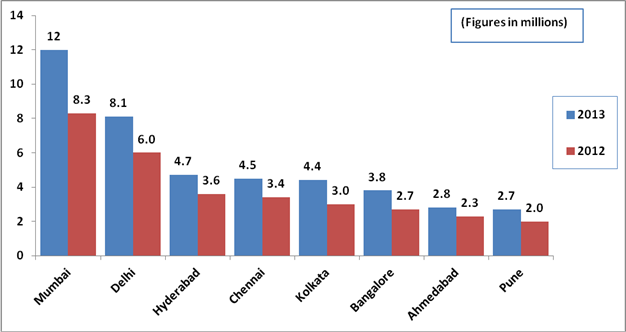
    Mumbai with 12 million internet users has emerged as the topmost city in terms of internet penetration, followed by Delhi with 8.1 million internet users and Hyderabad with 4.7 million internet users. Chennai with 4.5 million internet users and Kolkata with 4.4 million internet users are fourth and fifth respectively. These are figures put out by the Internet and Mobile Association of India [IAMAI]. In 2012, Mumbai had 8.3 million internet users, while Delhi had 6 million internet users. There were 3.6 million internet users in Hyderabad in 2012, while Chennai had 3.4 million internet users and Kolkata had 3 million internet users.


    With 47% year-on-year growth, Kolkata, however, registered the highest growth of internet users among all the top cities in India. Mumbai with 45% y-o-y growth is second while Bangalore with a growth y-o-y of 43% is third. Pune, with a growth of 37% is fourth while Delhi with a y-o-y growth of 35% is fifth.


    Source: IAMAI-IMRB I-Cube 2013 Findings


    Ahmedabad, with y-o-y 26%, registered the lowest growth rate among the top eight cities. Overall, the the top 4 metros have a 37% penetration of active internet users. Among the other 4 Metros, Hyderabad leads the charge with a penetration of 37% active internet users. Coimbatore with a 40% penetration leads in the small metros category.


  • In Google & Facebook-dominated world, Yahoo invites entries for Big Idea Chair Awards India 2013

    By A Correspondent


    A few years back when this correspondent was invited with some media maharathis to an event organized by a premier Ahmedabad-based management institute (not the IIM), the large student crowd expressed its unfamiliarity with the Yahoo! brandname to a senior functionary from the internet giant. Evidently, to a generation for whom Google, Microsoft, Facebook and Twitter are the most visible digital brands, Yahoo’s name belongs to sepia-tinted history books.


    Sad because Yahoo and Yahoo India in particular have done some pioneering work in the business ever since they announced their entry to the country with a mother-of-all-parties at Mumbai’s Taj Mahal Hotel over a decade back.


    Yahoo! is of course still relevant in the Indian digital media scenario, and it ensures it stays there by hosting the fourth edition of the Yahoo Big Idea Chair awards by inviting advertising and media agencies in India to showcase their best work in digital. Spread over nine categories, the call for entries will be open till November 25, 2013.


    Interested teams can now register for free at www.bigideachair.in. The winners will be announced next month (Dec 2013)


    Announcing the Yahoo Big Idea Chair call-for-entries, Nitin Mathur, the normally out-of-bounds Senior Director & Head of Marketing, India and South-East Asia, Yahoo, said:  “India is seeing some amazing creativity in digital advertising, helping brands integrate more meaningfully into consumers’ everyday lives.  Yahoo Big Idea Chair Awards honours individuals and agencies who are pushing the boundaries on digital in their search for the next big idea with the highest impact.”


    Last year, as many as 376 entries were received, with over 100 brands and 57 agencies participating in the Yahoo Big Idea Chair awards, noted a communique, adding: Acknowledging the increasing importance of content marketing in brands’ digital marketing strategies, Yahoo has added a brand new category of Best Content Marketing, to the existing stack of awards. Advertising and media agencies can now submit their exceptional creative and innovative ideas across 9 award categories including:


    Best Use of Display Advertising to recognize the most creative and innovative use of display advertising.


    1. Best Online Video Advertising for excellent work on video ads or video series created for digital


    2. Best Use of Social Media for the most innovative use of social media for brand advertising


    3. Best Use of Technology recognizing innovative use of technology for digital advertising on the Internet or mobile (includes technological innovations such Augmented Reality, applications, blufi, other tools).


    4. Best Use of Mobile Advertising to recognize campaigns that use mobile as a medium for to effectively communicate the brand message and engage consumers


    5. Best Use of Search – to recognize creative and innovative use of search advertising in a brand campaign


    6. Digital 360 degree Award -This award recognizes campaigns that strategically used digital as the core medium and implemented all digital channels including display, search, social, mobile.


    7. Best Content Marketing Award to recognize campaigns that strategically use content to ensure targeted message delivery and high levels of consumer engagement


    8. Yahoo Big Idea Chair Award flagship award to recognize fantastic digital campaigns which combine ideas, content, execution and real innovation to deliver with impact


    The entries will be judged by a panel of eminent industry leaders and professionals drawn from diverse sectors, including marketing, advertising and media planning. The jury panel will be announced soon.


    Now if only the digital generation would do a Yahoo! for Yahoo after all of this.


  • Times Internet gets on Coast

    By A Correspondent


    Times Internet Limited (TIL) has announced a partnership with Opera Software to preload the group’s websites on Coast by Opera, the web browser for the iPad. TIL websites like Gaana.com, Timescity, Box TV, Speakingtree.in, Zoom and ET will be bookmarked as Speed Dial entries on Coast.


    Speaking on the development, Pratik Mazumder, Vice President and Head Marketing, Times Internet, said, “We are excited to enter this strategic partnership. Technology has always been very central to Times Internet’s plans of reaching out to maximum users, and this partnership with Opera will help us achieve that. TIL websites have maintained its number-one position across categories, and they engage with millions of users globally. This tie-up will help in the expansion of the entertainment sector, as this will open avenues of reaching out to new discerning readers.”


    “We are glad to offer the popular websites from the Times Internet portfolio to our users,” said Sunil Kamath, Vice President for South Asia, Opera Software. “Coast was custom-made with the iPad in mind and offers users a unique way of viewing the web by letting content take priority, and also makes watching online video a breeze.”


    Coast by Opera is available as a free download in Apple’s App Store.


  • 7 Indian entries in Digital Asia Fest shortlist

    By A Correspondent


    Indian works haven’t been doing well in the various digital media awards. So when there’s news that at the shortlists announced for the Digital Asia Festival Awards, seven Indian entries occupy pride of place, there’s some relief.


    Chaired by Jason Kuperman, Vice President of Omnicom Digital Asia Pacific, India, Middle East & Africa, the jury consisting of 40 industry professionals made up of leading client marketers, digital media practitioners and agency strategists, judged 506 pieces of work based on strategy, creativity and innovation, execution and results with a total of 80 entries making it onto the shortlist. Japan leads with the most shortlisted entries (14) followed by Australia (13), New Zealand (10), China (9), Hong Kong (9), India (7), Singapore (7), The Philippines (5), Malaysia (4) and Thailand (2). India is joint sixth in the tally.


    Commenting on the judging process so far and the quality of the work, some jury members had the following to say:  “I found this year’s entries seamlessly integrating technology into the creative leap turning the communication into truly refreshing and engaging consumer experiences. Several of the shortlists had started with a fabulous consumer insight and market/media opportunity that had never been explored before. We saw a lot of first-of-its-kind innovations and we could see technology playing along beautifully with the big idea. That’s a very encouraging sign,” said Meera Sharath Chandra, Founder CEO & CCO, Tigress Tigress


    Added Ashok Lalla, Global Head – Digital Marketing, Infosys: “The work that stood out for me was based on a single sharp insight and a strong idea – simply presented and well executed. Several entries made me go, Aha, wish I had thought of it!” –


    The winners of the 2013 awards will be announced online through www.digitalasiafestival.com on November 18.