Category: Digital

  • Guest Column: Manish Agarwal on Basic Principles of Gamification

    By Manish Agarwal


    Gamification, the new argot that has been making headlines lately, is not the same as game development; it’s not about making console or mobile games for mere entertainment. As the best in the business describe it, Gamification is the use of game mechanics and game design techniques in non-game contexts and is a powerful tool being used by brands globally to engage with their stakeholders.


    Gamification has helped marketers get their users engaged in desired behaviours by taking benefit of humans’ psychological tendency to connect with game techniques. Since the term is a recent buzzword in India, it remains largely unlearnt by the same marketers. Here are a few basic principles to Gamification that I think can go a long way in strategising for your next Gamification effort.


    Defined Objective: You got to determine the primary objective. What is the desired action out of the effort? If you think its entertainment, you are not a marketer but a gaming company. You will have to invest a few days and brainstorm on this; try and involve the team that will be eventually gamifying your service.


    Make It Measurable: You have a boss somewhere who trusts in you but is concerned about the RoI too. You will have to prove to him that the gamification effort has really helped; ensure you are able to measure and map the performance. A combination of techniques can help – include a call to action that can be measured, evaluate the KPIs before and after the implementation, have trials with focus groups and so on. We are a digitally connect world, exchange notes with marketers across the globe on relevant forums if you wish to.


    Repeated Feedback: Feedback is crucial. Repeated feedback is unavoidable. As Charles Coonradt explains, “Increasing the frequency of feedback improves the quality and quantity of performance. When feedback is illustrated on charts and graphs, the impact is greater.” Feedback will help you find answers to some of the questions that have been sitting in your head unattended.


    It’s Not About Rewards, It’s About a Sense of Achievement: The most powerful rewards are intrinsic not extrinsic. Personalise the reward mechanism. Incorporate a mechanism that allows the user to show his status (a personalised message on his social media page, a direct congratulatory message, a leaderboard etc.) It makes a difference on an individual level.


    Don’t Stop: Gamification effort is never a one-time assignment, it’s a process. It requires to be practised regularly, with an improved shot each time. Keep some budget aside for this every quarter.  What is more important is that you rethink about your objective (point #1) each time you want to gamify!


    Manish Agarwal is CEO, Reliance Entertainment Digital


  • MxM @ Social Media Week, discussions on how social media dictates journalism and how entertainment, television and cricket dominate social media

    By A Correspondent


    MxMIndia is hosting two discussions at the Social Media Week Mumbai. The first one – on Tuesday, Sept 24 – is one how social media dictates journalism and the second – on Wednesday, Sept 25 – is on how entertainment, television and cricket dominate social media.


    Both sessions will be held at the Barking Deer, Lower Parel, Mumbai from 12noon to 1pm.


    In the session on journalism (and journalists) getting influenced by social media, the panelists are: Sidharth Bhatia, senior journalist and author; CP Surendran, editor-in-chief, DNA and Sachin Kalbag, executive editor, MiD-Day.


    For the panel on how social media in India is dominated by entertainment and cricket, the panelists are: Raj Nayak, CEO, Colors, Hemant Kenkre, former cricketer and columnist, Deepa Gahlot, awardwinning critic and Head of Theatre and Films at NCPA and Omar Qureshi, editor-in-chief, Zoom.


    Registrations can be done at the Social Media Week website.


  • IAA webinar with Bookmyshow CEO Ashish Hemrajani on Sept 26

    By A Correspondent


    The International Advertising Association, India Chapter (IAA-IC) is hosting its fifth Mentorship Webinar with Ashish Hemrajani, Founder and CEO, BookmyShow.com on Thursday, September 26 at 3pm.*See Disclaimer


    The IAA-IC ‘World Goes Digital’ platform is for professionals to learn and equip themselves with what’s happening in the digital domain, notes a communique. Said Manish Advani, Co-Chair IAA-IC webinar series: “IAA is happy to host yet another good speaker whose journey of building the Bookmyshow brand will add great value to understanding the strategy behind a very successful portal.


    IAA-IC  has recently hosted speakers like Rajan Anandan, MD, Google India, Ajit Balakrishnan, Founder, Rediff.com, Nishant Rao, Country Head, Linkedin and Julie Roehm, Chief Story Teller, SAP.


    Questions for Mr Hemrajani can be sent via the IAA India Chapter Facebook page - www.facebook.com /IAA.IndiaChapter.


    The hangout will be broadcast live on the IAA YouTube channel - www.youtube.com/iaaindiachapter on September 26 at 3pm.


    *MxMIndia has partnered the IAA-IC webinar series


  • Mumbai goes Social – Day 1


    By Fatema Rajkotwala


    Does social media contribute to socio-economic growth of the economy? Of course, it does, or so it emerged from the audience’s response to a debate held on Day 1 of the inaugural Social Media Week currently on in Mumbai.


    The week-long Social Media Week took off in Lower Parel’s tony gigspot Blue Frog.  Brought to India by New York-based strategy firm, Crowdcentric, Social Media Week is organized by Bengaluru-based marketing services firm R Square Consulting. Co-founders Rohit Varma and Hemant Soreng kicked off proceedings with a keynote =that highlighted the day’s agenda, the process of putting together the event, the speakers and partnerships fostered and the key takeaways for the public.


    Ben Shiem, Director – Social Media Week, Crowdcentric spoke about the global theme of SMW 2013, Open and Connected and how India and specifically, Mumbai was chosen as the logical destination to host the event, he said. Crowdcentric believes that India, with its strength in terms of democracy, population and increasingly mobile market, is an exciting place to be for social media. Talking about the company’s approach to expanding SMW worldwide, “We allow the local organizers to collaborate, for people to connect and build community. Our goal is to find teams world over to bring SMW to different countries and markets.”


    Verdict: Social Media does help socio-economic growth
     

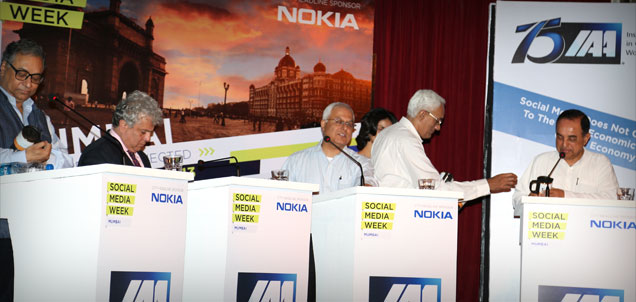
    In the debate organized by the India Chapter of the International Association of Advertisers hosted by Gul Panag, the panel comprised Jawhar Sircar, Chief Executive Officer, Prasar Bharti, Suhel Seth, Managing Partner, Counselage India, Dr. Subramanian Swamy, MP and senior BJP leader and Kiruba Shankar, digital entrepreneur and author. The topic was Social media does not contribute to the socio-economic growth of the economy’ and Messrs Sircar and Seth were for the motion and Dr Swamy and Mr Shankar against.


    Mr Sircar opened the argument with facts about India’s current economic change in terms of the fall in GDP rate and the devaluation of the rupee. He argued whether even though the number of broadband penetration and smartphone users has risen to about 50 million, in a population of 1,300 million people, is social media proving to be effective. “As a postal service of a very high order that helps connect us to our friends, social media helps as a medium. But to assume that social media has picked up from 2003-4, given the fraction of people availing it, where has this contributed to socio-economic growth? 22 per cent of our population in 1981 was below the poverty line. While China has changed the number for itself, at 2011 we are now at 33 per cent. There is no empirical proof that tweeting or posting on Facebook is going to change the world. It may connect businesses but the disparity of wealth continues. To the exception of certain bright examples of socio-economic change with a political flavor such as in Egypt or during the Delhi rape case, where is the change? ”


    On his part, Mr Shankar also quoted some hard facts and statistics with real examples such as Kalyan Varma (who spoke earlier in the day), NGOs and more stories of people that have reached out and received help and success via social media. As a teacher, he said, “If every student or entrepreneur can become a better learner and be more successful, it would lead to contributing to the economy as a whole.”


    Mr Seth took stage next and put forth an explosive argument on why social media, though beneficial in many ways does not contribute to the socio-economic growth of India today. Citing examples of citizens being arrested for posting a message on Facebook , he argued that this shows us out to be a more regressive race than we already are. “In today’s India, given the limited penetration, usage and familiarity with the tools of social media, social media is great for awareness, for reading about blogging expertise or professing one’s undying love to an actor – but it doesn’t allow people to make people accountable beyond that. We are in the throes of a social media evolution like many other economies. To say that we have arrived at a stage where Twitter or Facebook power the engines of growth, keeping in mind economic parameters of growth, is incorrect.” He went on say that as far as penetration of social media is concerned; we are talking of an India that does not have access of drinking water, leave alone mobile handsets. Apart from an erudite set of the population and the country’s journalist intelligentsia, the political bosses remain undisturbed despite of repeatedly bringing issues to the forefront. “Social media, in fact mocks the socio-economic growth of the country. It shows us that India runs by numbers; it does not necessarily run by intelligence. We don’t deny that the role of social media is important but by saying that today it has contributed to the socio-economic growth of today’s India, we are doing two things – minimizing the real impact, of real people of a real country and over emphasizing the limited impact that limited usage has on a country of our size and diversity.”


    In his closing argument, Dr Swamy argued that more than once has social media been instrumental in bringing about social and political change on many occasions. He pointed out that social media helps brings about awareness, helps educate, promote political thought, transparency and more and if there is no concrete evidence to substantiate that yet, the media should make it our business to find evidence to support these facts. “If we agree that theoretically social media does contribute to India’s growth, then it is all the more reason to encourage and develop it in our country.”


    With sharp rebuttals and counter arguments, the audience did shift its loyalties to small extent but the verdict fell in favour of a majority that believe that social media definitely does contribute to the growth of the economy.


    Sharing his views on social media today, Alex Oberberg, Global Head of Markets Engagement, Social Media and Digital, at Nokia said: “It is no longer the rebellious teenager and is not just restricted to the ‘cool kids’ or marketers anymore. At Nokia, we are a social business and social is a focal point of our business.” Deepak Taneja voiced Nokia India’s angle by elaborating on how brands are embracing the social medium now, “Over 60 per cent of most brand’s total traffic comes from India, not just for Nokia. That’s why social is the future.”


    To bring in an artist’s perspective on how social media helps build a personal as well as professional brand, successful wildlife photographer and filmmaker, Kalyan Varma shared his story and experience with social media. Varma left the corporate IT world at Yahoo! to pursue his passion. Through his personal experience, he urged the audience and Indian artists to be unafraid to share their work online and use it as a platform to brand and distribute their work.


    Next followed a panel discussion on “Social Media: Global platforms and local cultures? Perspectives from different regions” moderated by Madan Sanglikar, digital media specialist and founder, AD2C. Along with Ben Shiem and Alex Oberberg, the panel also saw Unni Radhakrishnan, Head of Digital, South Asia Maxus Global, and Max Hegerman – Managing Director, Edelman Digital India. The panel shared some interesting anecdotes on various countries connecting via different platforms, how marketers and sales people can look at social media from a new light, keep their target audience in mind while choosing a social media platform, concentrate on community building and social influencing and insights gathered. From an Indian standpoint, the panel agreed that the future of social media for India is mobile, which presents many challenges and opportunities for marketers and advertisers who can keep their eyes and ears open and create content in the cultural context.


    As a mobile data and services platform company, IMI Mobile’s Alex Campbell presented on the company’s product and offering, the DaVinci Platform, a multi-channel customer management platform. He took the audience through a power packed slideshow on “How the world’s most social event in 2012 became a little more social” where he highlighted “being inclusive, knowing your audience, staying relevant and planning” as some of the main takeaways for SMW.


    The highlight of Day 1 of the Social Media Week Mumbai was the debate conducted by the India Chapter of the International Association of Advertisers.  The topic was social media does not contribute to the socio-economic growth of the economy. Hosted by Gul Panag, the panel comprised Jawhar Sircar, Chief Executive Officer, Prasar Bharti and Suhel Seth, Managing Partner, Counselage India,  in favour of the motion and Dr. Subramanian Swamy, MP and senior BJP leader and Kiruba Shankar, digital entrepreneur and author arguing that social media, in fact, does help enhance socio-economic growth.  At the end of the discussion, on the basis of a show of hands in the audience, the team of Dr Swamy and Shankar won the debate.


    Examining social media from a purely woman-centric perspective, the next session broached the topic, “Women’s health and fitness: Is social media helping the cause?” Part of the discussion were Milind Soman, model, actor, film producer; Gul Panag, model, actress, fitness enthusiast; Devika Bhojwani, social activist and cancer survivor and Dr Sudeep Gupta, professor of Medical Oncology, Tata Memorial Hospital. Moderated by author and journalist Geetika Anand, the panel discussed how the Anna Hazare protests and the gangrape in Delhi are examples of how social media brought people together for a common cause and what are the challenges and possible solutions to addressing the issue of women’s health in India today.


    Soman spoke of why he decided to be a part of Pinkathon, which was started last year to involve women to take time for their health and fitness and to spread the message on breast cancer awareness. “The overwhelming response from Pinkathon has inspired me to be a part of Mega Pink, which is a social media experiment for me, to encourage runners across the country to come together, form their own groups and we can then, facilitate and support them,” he said.


    Gul Panag added by saying that there is an increased conversation on wellness today, and pointed out that there is a perceptible trend in social media of being topical but when it is the topic of health, all conversations contribute in spreading the word.


    Bhojwani spoke of her challenges and triumphs in putting together the ‘Women’s Cancer Initiative’, where a traditional outdoor campaign by creative agency Lowe Lintas, amplified in impact when it hit social media by causing a controversy. The panel discussed ideas and agreed that to amplify the effect of social media campaigns and sustain them, one has to add catalysts, add conversation starters, instead of bursts of activity, so that the message keeps getting underlined and repeated.


    The evening concluded with an interesting discussion on music and the social media as well as performances by Ayush Shrestha and the band Coshish.


  • Brands make a Shubh Aarambh with Twitter


    By Shephali Bhatt


    16,000 retweets, 18,000 Facebook likes and 5,000 Facebook shares were registered within the first hour of the Oreo tweet during the Super Bowl XLVII blackout. ‘You can still dunk in the dark’ said the Twitpic (a tool for people to post pictures on Twitter) and it was followed by analysts tracking Mondelez’s rising interest in digital, predicting a love-story brewing between the brand and the medium. The two announced their marriage plans less than two weeks ago. The salient facet of their pre-nuptial agreement being that Twitter will have dedicated teams working for Mondelez in India, Brazil, the UK and the US. As soon as the knot is tied, Mondelez will be able to leverage Twitter’s real-time analytics capabilities.


    Mondelez, in return, is bound to have made an ad spending commitment to Twitter which only aids the latter in building its share and profile in the market before it goes public and launches its IPO in early 2014.


    This pact that brings the bird closer to the delicious confectionary world has been facilitated by Mondelez’s global media buying agency Starcom MediaVest. According to eMarketer, Twitter is set to capture $580 million of ad spend this year which is double the amount they garnered last year. This move will only help Twitter surge upwards as far as that prediction is concerned. The partnership will also allow Mondelez to avail of a preferential media rate, an access to brand boot camps (training on brand building strategy), research and a first-look access to Twitter’s beta products.


    Mondelez is currently working with Twitter’s global team to chalk out the details of the resource embedding. Without disclosing any details on the magnitude of the deal, Bonin Bough, VP – global media and consumer engagement at Mondelez International, said that the development reflects a commitment to dedicate 10% of global marketing spend on mobile. Boosting impulse sales has been the snacking brand’s top priority starting 2013. In May, Mondelez signed a mobile-only deal with Google to develop m-commerce tools to give a fillip to in-store purchase of brands such as Cadbury and Oreo. This was followed by hiring AKQA, We Are Social, Vice and Proximity to expand the digital imprint of Trident and Belvita in international markets. Closer home, Mondelez India works with multiple digital partners like Madison Digital, Grey Digital, Pinstorm and Interface communications.


    While the zeitgeist terms this as “exciting news”, it’s critical to understand how these Twitter teams will add value to a brand that’s already being handled by a plethora of digital and social media agencies across countries and continents.


    To begin with, the deal should help Mondelez get earlier access to what’s likely to trend so that it is better equipped at reacting to news. It’s a step towards making timely tweets the norm and not the exception. The brand will then be in a position to convert trend based insights into brand relevant messages. Venkat Mallik, president at Tribal DDB and RAPP India, equates it with Amul’s outdoor strategy of creating topical ads. Only that Mondelez will be playing it on Twitter which will have a faster turnaround and a global impact.


    Moreover, these Twitter teams will definitely have a better understanding of their own tools versus any specialist. “Their offering will come with far more evolved features than we’d know of, simply because we are trying to understand the medium while they are its creators,” states Manan Mehta, Sr VP and head of business in India for Razorfish, a digital marketing agency from Publicis Groupe. Mehta also believes this move makes logical sense for the Indian market in particular. “We lost the desktop race, this is our chance to win the mobile race,” he points out.


    So, a meeting of minds, and a consolidation of specialists to bring in fine-tuned insights on how to make the existing tools work; but how does it change the lives of the existing digital agencies of Mondelez? Says Sindhuja Rai, AVP – media at Cadbury India, “The Twitter teams will work with us directly and collaborate with our digital agencies at the same time. Since we have multiple partners, it makes sense for us to drive this centrally from within Mondelez.” For all those wondering whether the existing digital partners might lose their clout in Twitter’s presence, there’s nothing much to worry about just yet. One, because Twitter is a medium and not an agency. Generating content is not its forte, putting the content in the right context is. So, agencies that generate great (and now Twitter-specific) content, will have an increasingly relevant role. Two, Twitter is just one of the many aspects that comprise the vastness of social and digital media. So, specialist agencies will continue to have a bigger role.


    This might just serve as a paradigm for the new collaborative model, a tripartite model involving the agency, the client and the platform. And if you ask Vivek Bhargava, CEO of iProspect Communicate2, this is just Twitter catching up to Google and Facebook. “Google has been doing this for 10 years now. I don’t think Amazon has its own agency, Google has dedicated teams that work for them,” he mentions. Bhargava feels that the current social media landscape is not built to meet the needs of large enterprises. Perhaps that explains why only a brand increasing their digital expenditure becomes news; because it’s still a rarity. A move like this translates into a big opportunity for Twitter to provide customised application and solution based offering to suit the needs of large enterprises.


    With all the buzz around real time engagement initiatives, Cadbury India has tasted a bit of success with hashtags like #ShubhAarambh during IPL and with #NotSoSweet for Bournville resulting in high engagement and buzz around the brands. “The idea is to build on this success further by leveraging Twitter’s scale and analytical capabilities,” avers Rai. The pundits are predicting this marriage would be a success. Are there more such on the cards? Well, Twitter’s CEO Dick Costolo is tightlipped for now. But we can always ask: how many of you brands are up for an inhouse Tweetdeck?


    Source:The Economic Times

    Copyright © 2013, Bennett, Coleman & Co. Ltd. All Rights Reserved

    Licensed to republish


  • Winners of Social Media Week last entry pass contest at 10pm

    We got so excited about the whole proposition that we put all the info in the headline. Well, almost.


    So here’s the Deal:

    Social Media Week Mumbai, the hottest tech thing happening to have happened in the city this year, is ending on Friday, September 27. But not without a bang. A day full of top draw content is being hosted by Group M at the Westin Hotel, Goregaon (Western Express Highway).


    Group M is giving away 10 passes to MxMIndia readers for free access to the day’s proceedings. Each of these cost Rs 6000, so it is indeed a BIG deal.


    Here’s how you can win the prize. Just send us a one-liner to editor@mxmindia.com with the subject line saying: SMWM13. Also, please put your full name, telephone number and email id. Don’t worry, we are not going to onpass these to a holiday resorts company. It’s just to ensure that your registration formalities get complete.


    Here’s what you need to write:

    In not more than 20 words, tell us why is Social Media so important for a business to be successful.

    You need to send in your entry by 4pm India time today (Wednesday, September 25, 2013). The best 10 of the first few entries get the passes. We will announce the winners by the last five digits of their mobile numbers at 6pm today (Sept 25). Winners will receive a letter from us and then a letter/regisistration intimation from the Group M office.


    So, let’s list what you need:

    1. Tell us in 20 words or lesser why Social Media is so important for a business to be successful.

    2. Also write your name, telephone number and email id

    3. Put SMWM13 in the subject line of the mail

    4. Send the mail to editor@mxmindia.com. It must reach us by 4pm India time today (Sept 25)

    5. Await the winners’ list at 6pm


    Update: Due to a technical hitch with our mail server, we have not been able to announce the results of the contest at 6pm. It will be posted on the website at 10pm. Our apologies.


  • BBH converts radio spots to digital content for Skoda

    By A Correspondent


    How do you ensure that a great idea travels far and gets noticed?


    BBH India created a series of radio spots to launch the limited edition Skoda Rapid Leisure which comes loaded with a host of features including a rear view parking camera.The spots were received well on radio, but the agency wanted to reach a wider audience. They realised that nobody (outside of advertising) ever shares a radio spot online. The challenge was to convert the audio spots into visually interesting digital content.


    Said Russell Barrett, CCO and Managing Partner of BBH India: “It’s clear that to reach a wider audience, your idea needs to be media agnostic. A genuine idea should cut across languages, cultures and media as well. Thankfully with Skoda, we have clients (Kamal Basu and his team) who believe in the same philosophy. They agreed that a video rendition of an audio idea was an exciting, new way to approach communication in today’s age. We also lucked out with the talent we could tap in to at BBH with the likes of Manish Darji, Yohan Daver, Sushma Joseph, Hitesh Kalia and the rest of the team on Skoda. I’m actually really excited about the implications of this kind of project. It’s clear that low budget need not mean low quality.”


    Credits:

    Chief Creative Officer: Russell Barrett

    Executive Creative Director: PuneetKapoor

    Director: Sushma Joseph

    Creative Director Art and Illustrator: Manish Darji

    Copywriter: YohanDaver

    Agency Executive Producer: Hitesh Kalia&Sushma Joseph

    Account Director: Anirban Mukherjee

    Account Manager: SuraviPradhan

    Account Planner: Kanishk Kabiraj

  • Worldwide ad growth buoyed by digital, mobile adoption

    By A Correspondent


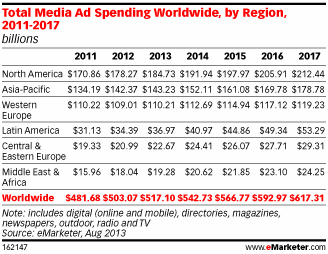
    Global ad spending will rise 2.8% to more than half a trillion dollars in 2013, driven by continued adoption of digital devices and internet connectivity, according to eMarketer’s latest Global Media Intelligence Report, produced in collaboration with Starcom MediaVest Group.


    Still, the global economy is in recovery mode, and while total media ad spending will be up this year, the rate of increase will not be particularly strong. eMarketer estimates ad expenditures will rise 2.8% worldwide to $517.10 billion, compared to last year’s 4.4% spending increase. There are no India-specific numbers with what has been shared with us.


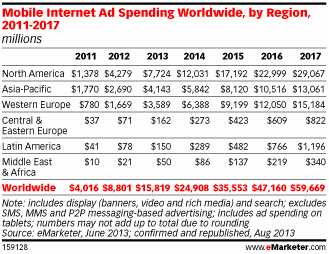
    Digital, however, is a bright spot-particularly mobile. eMarketer estimates spending on digital advertising will reach $117.60 billion this year, up 13.0% compared to 2012 levels, while mobile spending will hit nearly $15.82 billion, representing a whopping 79.7% year-over-year increase.


    Much of the spending growth stems from broader digital adoption on the part of consumers. The full report, which covers six major regions-including Asia-Pacific, Western Europe, Central and Eastern Europe, the Middle East and Africa, North America, and Latin America-and 40 countries, paints a picture of continued device adoption globally.


    Key figures on media usage and spending from the report include:

    :: Internet users: More than 36% of the global population today, compared to 21.7% in 2008

    :: Mobile phone users: 60.7% of the population this year, compared to 40.0% in 2008

    :: Smartphone users: Just under one-third of mobile users and about 20% of the global population, compared to 3.7% of mobile users and 1.5% of the population in 2008

    :: Social network users: About a quarter of the global population, compared to 8.3% in 2008

    :: Facebook users: More than 15% of the global population, compared to 3.1% in 2008

    :: Total ad spending: $517.10 billion in 2013, up 2.8% from last year, compared to $484.30 billion in 2008

    :: Digital ad spending: 22% of total ad spending in 2013, compared to 12% in 2008

    :: Mobile ad spending: Just 2.6% of total ad spending and 11.9% of digital ad spending, compared to 2.1% in 2008


    The Global Media Intelligence report is eMarketer’s largest and most comprehensive snapshot of the state of media usage and spending globally. The report contains more than 700 charts collected from over150 global research sources, which SMG helped identify and gather for local and core global markets, in addition to benchmarks, analysis and context provided by eMarketer.


  • Content & more on Social Media Week Day 3


    By Fatema Rajkotwala


    As the Social Media Week Mumbai progressed into its third day, the panels delved deeper into ways in which conversations are dominated by entertainment and cricket, the negative practices prevalent in social media, and how crowdsourced journalism can be used effectively for content creation. There was even a discussion around youth and how social media has benefited women entrepreneurs in India. The proceedings happended across five hubs in the city and this report covers only the events at two of the venues – Blue Frog and Barking Deer.


    Within the Indian context, social media seems to be predominantly ruled by conversations by two major industry giants, entertainment, that is Bollywood, and cricket. In the second of the sessions curated by MxMIndia, Hemant Kenkre, former cricketer, commentator and PR consultant; Deepa Gahlot, senior journalist, awardwinning film critic and Head of Theatre and Films Division at NCPA; and Krishna Vilasini, Managing Partner, Entertainment and Brand Marketing, Genesis Burson-Marsteller to share their insights (Disclosure: MxMIndia is also a Media Partner of the Social Media Week Mumbai).


    Agreeing that social media conversations on cricket do seem to overshadow most other talks on social media, Mr Kenkre said, “Cricket, as we know, is a religion in India and even though it seems to be in our face and on our screens, there is very little known about what goes on behind the scenes. This is why social media is a relevant space for fans. Cricket in India is run by an ‘old boy’s club’ and as fans, we don’t get much interesting information on our cricket icons.”


    Similarly, Ms Gahlot said that in India Bollywood tends to dominate everything. “Today, you cannot do a book launch, an event or a press conference without involving Bollywood lending its name. In this space, social media caught on fast as a PR marketing tool because a lot of people tend to watch movies than vote. Now everyone is a critic. On the flipside, this has helped small films that would’ve otherwise sunk at the box office, gain mileage and manage do recover costs and do reasonably well. It also creates controversies such as the one surrounding The Lunch Box and The Good Road Oscar nomination. So, social media is a powerful public tool but it is a platform where you cannot control negative opinion.”


    Representing the PR industry side of things, Ms Vilasini spoke about how social media is a definite godsend for the communications industry. “Entertainment and television in India is very close to people’s hearts and egalitarian, in sense. We have realized that television viewing is now a multi-screen experience for viewers, counting mobile screens and PC viewing. Social interaction is welcomed and created by us. It makes everyone feel important, have a voice and we embrace, work to amplify and maximize it to fully channelize the power of social media. ”


    The panel went on to discuss what the impact of social media has on cricketers and if it affects their performance on the field. Mr Kenkre agreed that at times it does, “Cricketers do check what is being said about them but what is said on any public communication platform is very controlled. Even when they are not officially connected, cricketers or selectors or any official person within the system does not have a chance to come out and explain themselves because at some point they may be part of the industry again. So nobody speak honesty on social media and people who matter in cricket are largely not on social media.”


    In response to how do PR agencies handle negative criticism on social media, Ms Vilasini pointed out that maintaining a buzz is of prime importance and that the hotel industry closes the loop well when it comes to negative publicity. “We advise our clients to first listen to what is being said, by whom it is being said and then address it. Most times, if you acknowledge someone’s opinion, the ranting stops. We encourage conversations on Bigg Boss, even though a lot of what is being said is negative. We will be petrified the day no one is talking about a show on television.”


    As the head of theatre and art at NCPA, Ms Gahlot spoke on whether apart from affecting Bollywood, social media is making inroads into theatre. “We do monitor reviews and use social media for disseminating knowledge about upcoming events. It also has helped in improving or changing content according to feedback, which is possible with theatre, as opposed to after a film is made. It is considered safe to vent or rant on Bollywood as compared to politics, for example.”


    Mr Kenkre spoke for the panel with his closing remark, “The challenge in social media is to engage the audience and do so at the right time.”


    Crowdsourced journalism

    Day 3 at SMW also brought up the new byproduct of social media – crowdsourcing in journalism. Avid Learning called in Gauri Vij, Editor of Time-Out Mumbai magazine to share her insights on “Crowdsourced journalism and viral news in the city”. She cited innovative examples of how crowdsourced journalism is being used internationally by the Guardian through its app – Guardian Witness or by Indian helpline, CJNet Swara or Traffline. She also gave example of successful collective blogging ventures such as Moifightclub, a film blog where people can record, report, perceive and share through social media.


    Speaking about how her magazine successfully used crowdsourcing for the compilation of its urban dictionary issue, Ms Vij said, “We realized that we needed help and the wisdom of our crowds and we asked for it. Samosapedia has also done this effectively. Social media helps in interacting with your readers, from a marketing perspective it creates a buzz and it also gives immediate feedback on hard worked stories.” When asked if social media undermines the work of resident journalists or comprises on creditability, Ms Vij added, “You have to verify facts and be careful of what you carry.”


    Negative practices in the Indian social media

    Moving away from the good face of social media, social media consulting firm Social Samosa brought together a panel of social brand managers and agency experts to talk about the ignored elephant in the room with their discussion on “Negative practices plaguing the social media industry”.


    Commenting on the approach of brand managers and brands alike when it comes to social media, Ekalavya Bhattacharya, Head, Digital, MTV India said, “The problem is that brand managers are not working for the brand but more to impress their bosses or are more concerned about the fans or followers of the competition. The buzzword now is Engagement and Facebook is changing its offering accordingly. It is heartening to see some brands care about their content but many a times, contests are being confused with content.”


    Bringing in the advertising agency outlook, Ashwath Ganesan, National Strategy Director, Social @ Ogilvy said, “Social, more than digital, tends to be looked at as a cost cutting way of advertising but its is not free. There are time, opportunity and transparency costs. Digital is an expression; social is a behavior and ideas are ideas.”


    Iyer Premkumar, Head, Online Marketing, Gozoop spoke about how the problem of client’s insistence on numbers was created by brand managers themselves. “We made clients realize that look at how well your competition is doing.”


    Does undercutting by brands and agencies affect innovation due to a decrease in the amount of money pumped into the market? Does this in turn pose the problem of talent retention? Panelists agreed that undercutting of opening up business opportunities. Mr Ganesan said, “I think it is more of a valuation problem than a pricing problem. People don’t know what they want to do on social media. Until companies understand the real impact or value of social media until it becomes a core business position rather than an imposition.”


    Is there a lack of ideation in terms of social media campaigns and content which are often inspired from international content or complete rip-offs but are by being applauded through awards? When can we expect a Redbull or an Oreo kind of success in Indian content? Speaking on innovation and new ideas, the panel discussed how most times there is a global mandate being pushed towards a digital spend and the fact that these brands are semi-local leads to global campaigns being adapted and distributed. “Innovation is often confused as doing something first rather than doing something better. All stories have been told; can you do it more interstingly?” said Mr Ganesan. Mr Bagchi added: “While incremental success can be improved upon, explosive success can never be improved upon. Said Mr Bhattacharya: “There is a lot of cool content on the web in India but we are not sure the audience is ready for it.”


    The panel also discussed why social media is being used primarily for marketing rather than as a tool for market research or a strong customer service platform. The panelists agreed that an edgy brand can adopt a bolder stand rather than an FMCG brand that is looking at reaching out to a more conservative audience. Said Mr Bhattacharya: “Yes, you can do so much more with it. As an edgy brand, we can take on someone if someone takes a dig at us. This culture is still not high in India.”


    However, panelists agreed that it is still too soon to specifically create content for the web audiences in India. Saugata Bagchi, Vice President, Tribal Worldwide stated, “The evolution of the audience is what makes the campaign a success. In India, we’re far away from there. So, I agree with the market forces, which combine to create the concept of adapting, or getting inspired so that in the short term the campaign becomes successful and the medium gets more traction than what it currently has. Another market reality is that even though we’re talking about publishing content, it is seen as a media driven rather than a content driven vehicle.”


    Youth and Social Media

    Considering the youth make up for almost the entire userbase of the Indian social media, Naman Sharma, founder and CEO, U’th Time Magazine hosted a discussion on the challenges and proposed solutions for the youth while using social media and the need for better content creation in this context.


    Rishi Vohra, author, Once Upon the Tracks of Mumbai shared his experience with social media during the promotion of his book, “After understanding the power of this medium in our country, I completely relied on social media to market my book. I kept my story in mind while writing my first book but I have kept the youth in mind for my upcoming book. Social media is a great tool to advance your word of mouth publicity, to brand and position your product but it is not meant for advertising it.”


    Addressing the key question of how much social media interaction translates into sales, Sumit Verma, independent film-maker and founder, FitHead Factory shared his personal learning from how social media can be used by artists such as himself to monetize content, “For crowd-funding, Linkedin works better than Facebook or Twitter, which helps more in direct chatting. Social media helps in spreading the word, finding like-minded people, connecting content creators and their audience and turning content viral because of youth and we are a young country. If your content is good, social media will help.” Some other solutions for raising funds were Vimeo, which has begun paid distribution for content or by partnering with Youtube, Wishberry, Indiegogo or Kickstarter.


    The panel discussed pertinent issues such as the social media to be used as a tool to bring about social change, a need to train the youth on how to conduct themselves on social media, and how despite the negative content, it can be used to retain consumers and turn critics into loyalists.


    Women Entrepreneurs and social media

    Helping leverage women entrepreneurs gain valuable insights on how to use and mark their presence on social media to advance their businesses, Moxie Media and Communications drew a large charter of female audience for their panel discussion. Hosted by Moxie Media Marissa Bronfman, founder and President, the panel comprised Malini Agarwal, founder, MissMalini Publishing; Pooja Dhingra, founder, Le 15 Patisserie and Priyanka Khanna, fashion features Editor, Vogue India. The panel of enterprising women shared their personal social media story, personal insights and techniques on what worked well for them, and urged women to use the platform to the best of their advantages.

     

  • Winners of Social Media Week Entry Pass to Last Day Contest

    Social Media Week Mumbai, the hottest tech thing happening to have happened in the city this year, is ending on Friday, September 27. A day full of top draw content is being hosted by Group M at the Westin Hotel, Goregaon (Western Express Highway).


    Here are the winners of the Contest that we ran earlier in the day:


    Four of the last five digits are:


    01. 752×0
    02. 493×4
    03. 338×1
    04. 911×9
    05. 819×8
    06. 989×0
    07. 879×5
    08. 736×2
    09. 805×2
    10. 947×6


    Congratulations!


    Winners will receive a registration/invite mail by 1pm on Thursday, September 26.


  • Srinivasan Swamy re-elected President of IAA India Chapter

    By A Correspondent


    Srinivasan Swamy

    Srinivasan Swamy, Chairman & Managing Director of R K Swamy BBDO was re-elected President of India Chapter of International Advertising Association at the Annual General Meeting held in Mumbai on Wednesday, September 25.


    Neeraj Roy, MD and CEO of Hungama Digital Media Entertainment, was elected Vice President. Jaideep Gandhi, Chairman, Jaya Advertising and Monica Tata, MD, HBO India were re-elected as Treasurer and Secretary respectively for the year 2013-14.


    Neeraj Roy

    “IAA India was on an over-drive in 2012-13 under the leadership of Srinivasan Swamy” said Pradeep Guha, VP & Area Director, Asia Pacific of IAA.


    Noted a communiqué: in the eleven months since the previous AGM, there were six major events – IAA Leadership Awards, IAA Seminar on Gender Sensitization, IAA Olive Crown Awards, IAA Knowledge seminar on Real Estate in a Digitized World, IAA-Kyoorius DigiYatra and the one scheduled on 30th September, IAA Platinum Jubilee – Global Marketing Summit. In addition, there were five IAA Debates and five IAA Mentorship Webinars – 16 industry defining events in 11 months.


    “I am happy I was at the helm at IAA when many new initiatives were planned and unfolded. I had a great team who executed much of these programmes with élan. As we move forward, our aim at IAA India is to be seen by IAA Global as the most vibrant of all IAA chapters worldwide. I am sure that recognition is not far,” said Srinivasan Swamy. Mr Swamy was co-opted onto the global IAA Board in May this year as Vice President- Development, Asia Pacific, as an acknowledgement of the initiatives that were undertaken in the first six months at the helm in India.


    The other members of the new Managing Committee are: Pradeep Guha, Pheroza Bilimoria, Kaushik Roy, Sam Balsara, Raj Nayak, Ramesh Narayan, M G Parameswaran, M V Shreyams Kumar, Kunal Lalani, Avinash Pandey, Arunabh Dassharma, Neville Taraporewalla, Partho Das Gupta, Rajesh Kejriwal and Abhishek Karnani, Manish Advani, Janak Sarda, Vishakha Singh, C V L Srinivas and Atit Mehta.


  • dna to evangelise governance with 500+ multi-lingual social platforms

    By  A Correspondent


    Zee Media’s dna has launched ‘I Am IN – dna of India’, an ambitious technology-driven initiative, that promises to “enlighten, engage and empower citizens of India in getting involved in  the cause for better governance”. It gives power to the people to be vocal about local issues, to report news, connect with governance representatives and like-minded fellow citizens and more by way of a multilingual, hyperlocal, pan-India digital platform that will encompass over 500 local circles and neighbourhoods across the country over the next few months, notes a communique.


    Said ZEE Media Corp chairman Subhash Chandra: “We keep complaining about India, we keep saying we don’t know what to do and how to do it. We try to look at the big picture, not realising that it is made up of smaller problems. Solve the smaller problems and the big problem will be solved.  The change in India has to be ground up, and with the launch of “I am In – dna of India” we hope that can be achieved, enabled by technology and powered by the desire of 1.2 billion plus Indians who want a better tomorrow.


    Dr Bhaskar Das, Group CEO, Zee Media added: “The power of hundreds of hyperlocal networks, each made of thousands of people, all of who act in a focused manner to improve their locality can surely bring the much needed qualitative change in our country. ”


    The hunt to find volunteers for around 200 localities / neighbourhoods that the platform is launching with, has already begun.