Category: Digital

  • Crowd-funding, crowdsourcing and cinema in the age of the social media

    By Fatema Rajkotwala


    The influence of the internet age and social media has left few areas of creativity untouched and has then seeped into how this creative output is produced, marketed, received and consumed by the audience. Indian cinema and filmmakers are no exception to the impact of social media. What is the future of the Indian film industry in this scenario? What is the untapped potential of social media in India compared to the West and what are some of the detrimental ways in which it affects us today?


    In a freewheeling and candid conversation, Rohan Sippy, Director and Producer and Guneet Monga CEO, Anurag Kashyap Films Pvt. Ltd joined Pragya Tiwari, Editor-in-Chief, The Big Indian Picture at the GroupM office in  Goregaon on Day 4 of Social Media Week Mumbai 2013. The panel discussed and debated the areas of Indian filmmaking that have been impacted by social media, alternate ways of marketing and crowdfunding, censorship, criticism and box-office collections for an enthusiastic audience that devoured in each tidbit of the views of the respected movie makers.


    While crowdfunding, as an instrumental tool for raising funds for a project through social media networks such as Kickstarter, Indiegogo and Wishberry is gaining popularity, crowdfinancing and equity financing has still not picked up in India. Voicing her strong belief that the Indian film industry needs to come together to form an ecosystem, new wave producer of films such as Gangs of Wasseypur – Part 1, Peddlers and The Lunchbox, Ms Moonga said, “We cannot function in isolation. The indie community really needs to come together and we need more people talking.” Ms Moonga has successfully used new age techniques like crowdfunding for her films and believes that raising money on networks such as Kickstarter has worked well for many. “Raising money through crowd funding is comparatively, much more structured and popular in the West.”


    Talking about the importance of word-of-mouth promotion and freedom from censorship in the advent of social media, the panelists shared their personal experiences on movies such as The Lunchbox, which gained immense buzz on social networks. Movies such as The Good Road, Ship of Theseus and Grand Masti also came up in conversation when the matter of box-office collections came up. Mr Sippy admitted that social media networks such as Twitter as a great leveler but confessed to missing the blissfulness of the simpler ways of filmmaking and marketing of the earlier days. “Taking a film out there still faces a lot of challenges beyond raising money. While it is great that there are now conversations on social media networks and people are getting in touch, these people are now bombarded by everyone. The joy of using these networks was of genuine discovery of something that people are talking about but with the corruption of trending and bought popularity on social media, is lost. There are no rules here and fans can turn a conversation in a national debate. For mainstream films, television is still big in terms of marketing.”


    On the issue of box-office reviews and collections, Ms Tiwari asked the panelists if marketing budgets are eating into film budgets and how much is one to believe in the social media popularity for a film’s success. Mr Sippy expressed his refreshing points of view, “Marketing efforts are driven towards the first week of screening, which results in collections and ticket sales tapering down to almost 30 per cent soon. Studios have sold their souls to exhibitors by accepting this arrangement. The pros of social media are that people are listening to their peer groups due to a possible lack of connect made by film critics but we can’t be sure now with marketing hawks having taken over Twitter too.” On the flipside, he agrees that a film can be affected by negative word-of-mouth. “We like shouting; that is the nature on Twitter. Sometimes a big budget film’s collections may also get affected by these immediate bad reviews.”


    Ms Guneet differed in her opinion here, “There is only this much you can do for small budget films in terms of promotional efforts. Money on television is so high so this is where word-of-mouth helps. We have seen a standard pattern in box-office collections across our films. In the grander scheme of things, the audience for mainstream movies is huge for even one time watchers and B and C sectors.”


    Social media is also showing us a new way of watching films -niche or genre films such as zombie films but the panelists agreed that this still doesn’t guarantee it commercial success. “This is good for personal interest. Kids these days like to collect movies because the internet is limitless.”


    Moving on to the topic of alternate movie release platforms that are popular internationally, such as Netflix, what hopes do we have for India in this regard and as a way to curb piracy? Playing the devil’s advocate, Mr Sippy light-heartedly admitted, “What else do we have other than hope? Satellite television is so big in India that the bureaucracy results in us having to show a movie on television within two months of release.” On a practical front, he believed that alternate platforms are good for audiences but making it sustainable is a different matter. “We are a different culture of audiences from the Netflix subscribers abroad. Youngsters have a fixed entertainment budget and if they can avail of a censored free version and watch it online, then something is better than nothing.”


    Ms Moonga cited Voodoo.com that has turned piracy into a money making model. She believes that Video on Demand is the future in India. “VOD is bigger than satellite television rights in the West and is waiting to happen.”


    Ship of Theseus was the first film in India to use crowdsourcing as a way to zero in on filming locations. Lamenting on the closing down of many iconic theatres in Mumbai such as Liberty Cinema, Mr Sippy said, “We have to engage exhibitors who want to maximum ticket sales with the highest prices and more popcorn sales. Conversation on social media is great but it finally results in buying a ticket and watching the movie, which will encourage exhibitors.”


     

  • Social Media Week Mumbai: A Recap


    By Fatema Rajkotwala


    It was India’s first attempt at what has been a rage internationally. Social Media Week Mumbai happened in the metrop from September 23 to 27 at five different venues from South to North West parts of the city.


    Many of the movers and shakers of the digital world converged at India’s first ever dedicated week for social media – Social Media Week’13 or #SMWMumbai. Brought to India by New York’s strategy firm, Crowdcentric, SMW is in its fifth year and has been instrumental in bringing together marketers and advertisers together in over 20 cities globally. For those who could not make it to the #SMW’13, let us take you through the week’s highlights and takeaways with this Executive Summary (Disclosure: MxMIndia was Trade Media Partner of Social Media Week Mumbai).


    Key Learnings and Insights

    If one were to sum up the pearls of wisdom gathered from the many conversations, discussions, debates and chats at #SMW, these are our picks:


    - Engage, Engage, Engage

    - Collaborate and create to translate into consumption and sharing

    - Cross-platform integration is essential

    - Internet penetration and more specifically, social media users in India represent a small subset of the diverse Indian population

    - Choose your social media tools with caution, but your analysts with more caution

    - The social media community and audience is yet to evolve in India

    - Your collective audience will always be smarter

    - There are no rules or rights and wrongs in social media yet

    - Mobile is the next big platform

    - Focus on the trend, not the data point

    - Social media is not cheap - to be truly digital and social, brand need to think 365 days, not 360 degrees

    - Marketing is no longer about creating awareness but what you can do with and for consumers.


    Organised by Bengaluru-based marketing services firm R Square Consulting, the week’s agenda saw events held at five locations, over a wide range of themes that spoke on ways to integrate social media in business strategies, how it impacts media and publishing as we know it, politics, entrepreneurship, lifestyle and culture, education and learning and health and wellness. The platform also presented unique opportunities to learn, interact, network and party as it was kept open to the general public.


    Day 1- Monday, 23 September

    SMW unofficially began on Sunday, 22 September with Mega Pink, a run with Milind Soman for women’s fitness.


    Monday September 23, had a range of interesting sessions lined up at Bluefrog, Lower Parel to kickstart conversations.  An explosive debate organized by IAA with industrious participants such as Jawhar Sircar, CEO, Prasar Bharti, Suhel Seth, Dr Subramanian Swamy, senior BJP leader and Kiruba Shankar, digital entrepreneur on “Social media does not contribute to the socio economic growth of the country”, entertained and gave audiences food for thought.


    The day also saw Kalyan Varma, well-known wildlife photographer taking about social media for entrepreneurs; a session by Ben Shiem, Director – Social Media Week, Crowdcentric and Alex Oberberg, Global Head of Markets Engagement, Social Media and Digital, Nokia. Panel discussions on “Social Media: Global platforms and local cultures? Perspectives from different regions” and “Women’s health and fitness: Is social media helping the cause?”,  saw interesting perspective from Unni Radhakrishnan, Head of Digital, South Asia Maxus Global, Max Hegerman – Managing Director, Edelman Digital India; actor, Gul Panag; Devika Bhojwani, social activist and cancer survivor and Dr Sudeep Gupta, professor of Medical Oncology, Tata Memorial Hospital.


    The evening concluded with an interesting discussion on how social media has impacted the Indian music scene, followed by live performances by Ayush Shrestha and the band, Coshish at Bluefrog, Lower Parel.


    Day 2 – Tuesday, 24 September

    The second day of SMW witnessed a range of sessions on how social media impacts various spheres such as journalism, education, politics, personal branding and data insights on advertising investment on Facebook. The venues for Day 2 and Day 3 were Bluefrog and The Barking Deer, Lower Parel.


    A panel of publishing gurus discussed the role of social media in journalism today. Siddharth Bhatia, senior journalist and author; C P Surendran, editor-in-chief, DNA and Sachin Kalbag, executive editor, Mid-Day shared their valuable experience and insights with the audience and with Pradyuman Maheshwari, editor-in-chief, MxMIndia who moderated the session.


    The second enlightening session of the day was Social Squared’s panel discussion on “The Role of Social Media in Politics” with Priti Gandhi, Head Mumbai BJP Communication cell; Mayank Gandhi, Head Mumbai Aam Aadmi Party; Dilip Chalil, Secretary – Indian National Congress; Priyanka Chaturvedi, national spokesperson for the All India Congress Committee; and Gul Panag, model, actor and Twitter buff.


    Other informative events of the day were panel discussions on pertinent topics such as “Traditional Social Media – Done! What next? – Influencer Relations!” by MindShift Interactive; “Hardwiring SoLoMo to Business and not just to Marketing” hosted by AD2C and a presentation by Alexandre Corso, Head of Asian Business Unit, KRDS on “Inside Facebook Insights and Mapping it to GRP”. Mr Corso shared innovations within Facebook that will be game changers and optimistic statistics to help marketers sell and yield better returns for their client investment monies.


    The evening switched to the theme of music with an event on “Music Makes Mumbai Go Round” hosted by Drizzlin Media. Audiences were then treated to a live performance by band, Empty Café.


    Day 3 – Wednesday, 25 September

    Taking a closer look at how social media conversations are dominated by entertainment and cricket, MxMIndia called upon Hemant Kenkre, former cricketer, commentator and PR consultant; Deepa Gahlot, senior journalist, award winning film critic and Head of Theatre and Films Division, NCPA; and Krishna Vilasini, Genesis Marxstellar to share their insights.


    Another point of scrutiny was the negative practices prevalent in social media, and how crowdsourced journalism can be used effectively for content creation. Discussions also percolated around youth and how social media has affected and benefited women entrepreneurs in India. Some of the speakers of the day were Gauri Vij, Editor, Time Out Mumbai; Ekalavya Bhattacharya, Head, Digital, MTV India; Ashwath Ganesan, National Strategy Director, Social @ Ogilvy; Iyer Premkumar, Head, Online Marketing, Gozoop; Saugata Bagchi, Vice President, Tribal Worldwide; Naman Sharma, founder and CEO, U’th Time Magazine; Malini Agarwal, founder and blogger-in-chief, MissMalini Publishing; Pooja Dhingra, founder, Le 15 Patisserie and Priyanka Khanna, fashion features Editor, Vogue India.


    Y B Chauhan Centre hosted an interesting set of events including a workshop on digital media by DMTI; “Social by Design” by KRDS and “Mobile governance” by IMI mobile. At evening, there was a live performance by Neeraja Arya and Nitesh More on djembe.


    Media agency, GroupM’s office, Goregaon was the third venue of the day where the agency held crowd-pulling sessions such as “Brands in the Youth X Social equation: Expectation & Serendipity”; “Search <3 Social” and “MasterSpeak: Socialization of Branded Content”. Music artist, Winit Tikoo and Sriram Sampat performed live to end the evening.


    Day 4 – Thursday, 26 September

    As SMW was coming to a close, you could choose your pick of events from an array of sessions for the day.


    At Bluefrog, FoxyMoron held a session on aspiring digital marketing entrepreneurs. Numbers and more were discussed by Mindshift Interactive in “Social Media Analytics – Going Beyond Numbers”.


    Other sessions included “Mobile Photography goes Social in The City” by AVID Learning; “Learning Experiments with Social Media” hosted by Jardine Lloyd Thompson India and “Integration & Importance of Search Marketing in Social World” by Web Marketing Academy at The Barking Deer. The final session was hosted by Indian Bikers Week on “Challenges of Riding in India. How social media can help propagate?”


    Sessions at GroupM began with a live music performance by Pratyul Joshi. Next was Madhouse’s session titled, “Next stop: Mobile”, followed by sessions on managing customer expectations better by IMI Mobile and interpretation of data and actionable insights by GroupM. The most scintillating session for the day however was the panel discussion on the topic, “Cinema in the age of the internet”. Part of the conversation were Rohan Sippy, Bollywood Film Director and Producer; Guneet Monga CEO, Anurag Kashyap Films Pvt. Ltd and Pragya Tiwari, Editor-in-Chief, The Big Indian Picture.


    Day 5 – Friday, 27 September

    The final day of SMW’13 was organized by GroupM at Westin Hotel, Goregaon. After the opening address by Rohit Varma, Co-Founder, R SQUARE Consulting (CO) and Toby Daniels, Founder & CEO, Crowdcentric, the day covered talking points such as the changing face of advertising agencies in the dynamic social media scenario, brand building, media analytics, technology innovations, the consumer angle to social media, experiential marketing and much more.


    Through the day, influencers from their fields discussed and debated various topics at hand. Some of the speakers were Karthik Natrajan, National Director – Social Media Insights, GroupM; Viral Oza, Director Marketing, Nokia India; Ayeshea Perera Executive News Producer, Firstpost.com; Anika Gupta Product Manager – Citizen Journalist Digital CNN-IBN; Ramaa Sharma Digital Editor BBC; Lakshmanan Narayan CEO & Co-Founder Unmetric; Krish Ashok, Head – Web 2.0 Innovation labs Tata Consultancy Services and Anant Rangaswami, Editor, Storyboard.


    The entertainment for the evening was a shot of soothing live music by band, Filter Coffee.


    Day 6 – Saturday, 28 September

    As part of the Indian Bike Week, bike enthusiasts gathered for the “Chai & Pakoda Bike Ride” at Fountain Hotel, Western Express Highway No. 8 at 7am for an 82 kms bike ride to Hotel Ahura, NH 8.


    Through the week, NCPA hosted open exhibitions for photography, lifestyle and culture lovers. “Call of the wild”, “Click Rights”, “Mumbai on Canvas” and Phototalk by Kalyan Varma themed on Mumbai, wildlife photography and art were held at the Piramal art gallery, NCPA.


    For those eager to learn, a master class workshop on Mobile Photography by Nokia, a creative workshop by DMTI, a Creative Writing workshop by Yellow Seed Content Solutions and art workshops by Amol Pawar, Kavitha Kale, Neena Singh, Devyani Parikh and Rahul Dangat were also enthusiastically received.


    To celebrate – was another important aspect of SMW. The opening and closing bashes, coupled with Miss Malini’s Bombay Street Style Party hosted at Olive Bar and Kitchen and The Barking Deer Meet pulled crowds from all walks of life.


    Among the various partners of the Social Media Week (other than MxMIndia) are: BBC, SAP, IMIMobile, Germinait, MindShift Interactive, Unmetric, GroupM, chlorophyll, Genesis Burson-Marsteller, Crossworks, Avid Learning, Sportskeeda, Yellow Seed Content Solutions, Social Samosa, Page Traffic buzz, Social Times, Time Out magazine, Cartel Advertising, Miss Malini, authorSTREAM, and The Indian Networker.


  • Apple, Google topple Coca-Cola out of top slots in Interbrand’s Best Global Brands report

    By A Correspondent


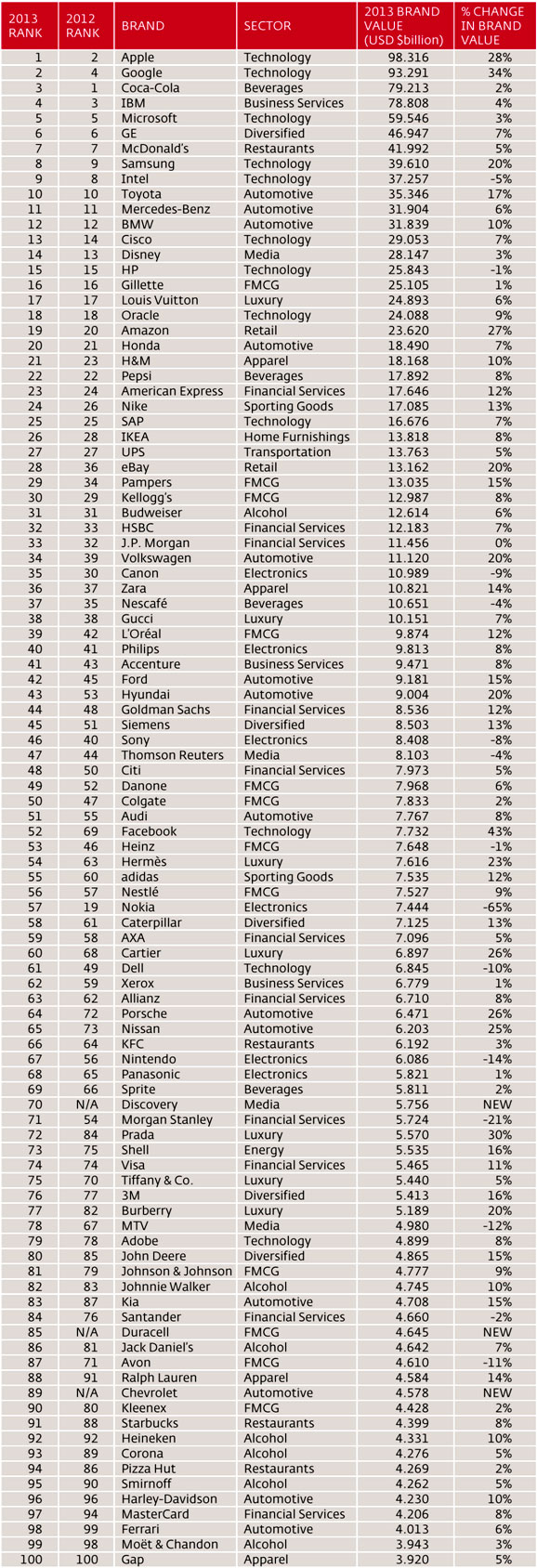
    For the first time in the history of Interbrand’s Best Global Brands report, there is a new #1 brand: Apple. Leading brand consultancy Interbrand publishes Best Global Brands on an annual basis, identifying and examining the Top100 most valuable global brands.


    With Apple claiming the top position this year, Google jumps to #2 and Coca-Cola, the brand that held the #1 position for 13 consecutive years, moves to #3.This year, the total value of all 100 Best Global Brands is USD $1.5 trillion — an 8.4 percent record increase over the total value of the 100 Best Global Brands in 2012.


    Apple hasappeared on Interbrand’s Best Global Brands ranking since 2000, when the ranking debuted. In 2000, Apple ranked #36 and had a brand value of USD $6.6 billion. Today, Apple’s brand value is USD $98.3 billion- almost 15 times the amount of its brand value in 2000.


    “Every so often, a company changes our lives-not just with its products, but with its ethos. This is why, following Coca-Cola’s 13-year run at the top of Best Global Brands, Apple now ranks #1,” said Jez Frampton, Interbrand’s Global Chief Executive Officer. “Tim Cook has assembled a solid leadership team and has kept Steve Jobs’vision intact – a vision that has allowed Apple to deliver on its promise of innovation time and time again.”


    Ashish Mishra

    Adds Ashish Mishra, Managing Director, Interbrand India – “Yes, for the first time in the BGB’s 14-year history, Coca-Cola is no longer #1. This year, Apple claims the top spot – and Google captures the #2 position.This to our minds is the single biggest story of the new times, of a changed world. Of who really leads the brand – the marketer or the consumer, or both? And how anticipation, co creation, conversation, innovation, investment in people &big data, strategic CSR and new leadership is the new way”.


    When determining the Top100 most valuable global brands, Interbrand examines three key aspects that contribute to a brand’s value:

    :: The financial performance of the branded products or service
    :: The role the brand plays in influencing consumer choice
    :: The strength the brand has to command a premium price, or secure earnings for the company

    Interbrand’s 2013 Best Global Brands (Top 100)


  • Big spenders advertisers prefer start-ups for digital


    By Kala Vijayraghavan & Lijee Philip


    In September 2012, when Mahindra & Mahindra was preparing to launch its compact SUV Quanto, it overlooked its mainstream advertising agencies Interface and Lodestar, and went to Hungama, a boutique agency, for a digital ad campaign screened in malls. Hungama developed a technology where a consumer’s electronic car key started a Quanto ad on a computer screen, which went on to simulate a feel of the vehicle in typical weekend settings. The idea was to create a digital experience of the SUV and help the brand break out of the clutter in a competitive segment.


    “The response time for social media activities should be next to nothing,” says PN Shah, CEO, automotive, Mahindra & Mahindra, explaining why he preferred a specialised digital agency over tried-and-tested partners.


    “We need tailormade, online, onsite and on-time solutions that help us react and respond quickly.” Like M&M, top consumer companies, including HUL, Godrej Consumer, Ford and Honda, are now cold-shouldering their traditional ad agencies such as JWT, Dentsu, Mindshare, Interface, Lowe Lintas and Mudra to tap social media marketing agencies such as WATConsult, BCWebWise, Bloggers’ Mind, Blogworks, Digit9.0 and other such startups for their digital requirements.


    “Traditional agencies are not thinking digital adequately,” says Hemant Bakshi, executive director, home and personal care business, HUL. “They are creating digital as separate divisions. Digital has to be at the heart of the communication and not peripheral to it.”


    Counters Suman Srivastava, ex-CEO, Euro RSCG and founder of Marketing Unplugged, a marketing consulting company: “It is fashionable to blame agencies or say they tend to think in silos. But the fact is the traditional marketers themselves do not understand the medium.”


    HUL has worked with BCWebWise quite a bit ever since Chaaya Baradhwaaj, its founder and CEO, launched HUL’s Sunsilk Gang of Girls, an online social networking website built around its leading beauty shampoo brand in 2006.


    Youngsters, who embody the credo of the internet age of being ‘digital natives’, are now guiding companies in digital, which is emerging as a disruptive force in consumer marketing. “Our roots are in digital. We come with no baggage of other media,” says BCWebWise’s Ms Baradhwaaj. “The dynamics of the technology-driven medium, the interactivity it offers, and the fact that consumer pull by far supersedes brand push can be inherently understood if you have been eating, breathing, and living digital in your advertising/communication life.” Adds Sunil Kataria, chief marketing officer of Godrej Consumer Products: “Twenty-something youngsters are able to understand digital better as a disruptive force in consumer marketing. We are tapping such specialised agencies and startups.”


    Mainstream advertising agencies counter this, saying there’s no great work happening. “These are college kids charging a low fee from these companies to earn extra money,” says Partha Sinha, director Asia, Publicis, a large advertising agency.


    “None of our digital ads have even been shortlisted at Cannes.” According to Mr Sinha, companies have created a perception barrier, and themselves do not have the systems and skills to understand digital.


    “They are only doing basic maintenance work on social media,” he says. “The fact is, companies are not desperate on digital. They are still hung up on outdoor and television. The day companies get serious about social media internally is when they will find similar change in their advertising agencies.”


    HUL is integrating social media and mobile into the marketing of its brands at the planning stage itself. These were premium brands that have a high online audience such as Tresemme, Sunsilk, Lakme, Closeup and Surf. In the next two years, it expects to treble ad spends in online and digital, taking it to 10% of its overall ad spends.


    Similarly, Godrej Consumer opted to tap an integrated design company, Creativeland Asia, for its digital campaigns to relaunch its Cinthol brand (MakesMeAlive) and launch its air purifier brand, Aer (colouryourfriendsapp). “Social media cannot be just an appendage to your traditional medium,” says Mr Kataria. “We are a new breed of organisation that thinks from the society aspect and then fashions our campaigns, and not vice versa,” says Sajan Raj Kurup, founder and CEO, Creativeland Asia.


    Sourav Jain, a social media marketing specialist, feels traditional advertisers have a lot of catching up to do. “They do not understand the technicality of the process in social media,” he says. “Social media is not only effective, but is also relatively inexpensive. Here, one gets a chance to interact, and build relationship and reputation for their brands.” Admitting that big agencies took to digital with a lag, Arun Iyer, creative director at Lowe Lintas, says they are up to the task today. Like Mr Sinha of Publicis, even he sees it as a perception problem at the end of the companies.


    “Even when we make our presentation in the digital space, clients do take a look at it, but then chose a smaller specialist,” says Iyer. In the current context, smaller players are packing more punch. “They are far more specialised and are able to build expertise faster,” says Rajesh Lalwani, founder and principal of Blogworks, a Delhi-based social media agency. Its team of 28-30 people has worked for Harley Davidson and Ford Fiesta AT model.


    Mr Lalwani says that, for most auto companies, social media accounts for 10-20% of their marketing spends. “Bigger agencies seem indifferent to social media at this point of time since it is too small to interest them,” adds Jnaneswar Sen, senior vice-president (marketing and sales), Honda Cars India.


    Despite working with Soho Square (part of Ogilvy), Dentsu and Grey Worldwide, when it came to leveraging social media to launch Amaze, Honda selected Blazar, a small boutique advertiser. “They are managed largely by a younger team,” says Sen. “They clearly know what the young generation wants.” Adds Rajiv Dingra, CEO of Mumbaibased social media agency Wat Consult, which ran the social media campaign for the Mahindra two-wheeler Centuro and Ford: “Car buying is a high involvement purchase and social media helps to keep the buzz alive.” Dhingra feels this does not come naturally to large agencies. “They are unable to specialise and build depth. We were able to quickly foresee what the consumer wanted. ” Understanding feedback/data, and modifying plans quickly, is a challenge best handled by smaller players, according to Carlton D’silva, chief creative officer of Hungama Digital. “Most likely, larger ad agencies will acquire boutique agencies rather than developing capabilities from scratch.”


    Source:The Economic Times

    Copyright © 2013, Bennett, Coleman & Co. Ltd. All Rights Reserved

    Licensed to republish


  • Vijay Mukhi: Why can’t we use tech to increasing voting percentages?

    By Vijay Mukhi


    This is the time of the year where TV channel after TV channel, newspaper after newspaper, celebrity after celebrity would ask you to go out there and vote. And guess as it happens all the time, a large population of Indians simply does not vote. And who is to blame for this, not the people who do not vote, but all of us for not using technology to make it easier for us to vote.


    Why can I not vote in the 2014 general elections either sitting on my computer at home or in the office and vote or voting from anywhere in the world using my mobile, not necessarily my smartphone. We allow Indians to use the phone for online banking, to buy stuff, but would not allow an Indian to use his or her phone for casting a vote. But wait, I am as always running too fast, let me rewind a little.


    Most of you would not know of a Mr Chand Goel, IAS who was Additional Chief Secretary, State Election Commission (SEC) , till he retired some months ago. A year before the last BMC elections took place, he created a committee under the SEC to look into the feasibility  of allowing us to vote for the BMC elections using a computer or a mobile phone. I was a member of this committee. We met a zillion times and were also about to award a pilot project when things went awry. What I am placing before you is my journey in the use of technology in the political process. For the uninitiated, the SEC is a state body that conducts all elections other than the Lok Sabha and the Assembly elections which are conducted by the Centre.


    Let’s start at the end and not the beginning. We all complain about people not voting, but not asking ourselves why do we make it so difficult for them to vote. I have not missed voting at an election to date but I have not enjoyed the process. The first problem is checking whether I am yet a voter, then finding out where the venue for polling is, the venue is a moving target at Parel at least. Then finding the actual polling booth is very easy, that booth that has the smallest line is where I vote because the rich and famous in my area do not come out and vote. The largest queue is where the poor reside, it’s a very stark contrast at Parel. Its great castigating the rich and famous for not voting, deriding them on TV, the fact is that they do not vote and if we need to give them one less reason for not voting, they will vote.


    Let me start by making it very clear that I am not saying  anywhere that we only have people voting by phone or computer, we allow anyone to vote either by a phone/computer or by the old way using a EVM, which by the way is state-of-the-art technology. Once you chose one method, you would have to stand on your head to use the other method. This means we have two voting lists, one for the EVM or physical vote, one using technology, the safer cyber way.


    My gameplan at the SEC committee was as follows. The computer/laptop was dead and the mobile phone rules. If we had to allow only one device to be used to cast a vote, my vote would go to the phone. I have yet to see an Indian who does not carry a phone at least in a city, in villages the rules would change but we are fooling ourselves if we believe that rural India does not use technology. We are also fortunate that Android and oOS take up a bulk of the phone market, the other two yet in the fray are Windows and Blackberry. Thus to cover nearly 99% of the phones, the Election Commissioner has to create just four Apps. We have Apps that do everything the human mind has not thought off and it would cost under Rs 10 lakh to create such an App. For using a laptop or a computer you can use a website instead of an App or download programs and install them on your computer.


    I, as a person who would want to vote using a technology solution, would simply have to go once to a voting centre and get myself removed from the physical voters list and get myself electronically registered. If we had a technology savvy state, this process could have been undertaken at the same time I applied for an Aadhaar card. My biggest problem with the Aadhaar card is that it does not use technology, I would want it to use a chip, it instead uses a piece of paper and hence it really needs to be renamed to an Aadhaar paper than a card. The state already has my eye scan and my fingerprints, you need no more biometrics. At the voting centre all that they do is take my fingerprints and eye scan and Computerji will identify me as Vijay Mukhi, remove my name from the physical voters’ list and add my name to the electronic voters’ list along with my current constituency. All this should take less than a second if the voters list was computerised. I forget to mention that before I went to the centre, I had already downloaded the App on my mobile and now to activate it, I simply use my Aadhaar card number or another number the system gives me or my biometrics. This is simply a question of detail. For using a laptop, I would visit a website, download a program for my OS, the rest would be the same.


    Come voting day, when I activate my App, it simply goes to the master server owned by the EC, finds out my constituency and then displays the candidates, I use touch to select the candidate and my vote is cast. No finding voting booths, no standing in short or long queues, no summer heat or winter cold, no finding time to vote, etc, etc. Now if I refuse to cast my vote, the state can put me behind bars for life and throw away the key. There would be teething troubles like me losing my phone, the App would not start, if it does start, no network connectivity etc. Lots of such problems would arise, all of them solvable. The physical voting list would be smaller in size and hence boothcapturing would also come down as a large percentage of the population would not use the present form of voting.


    I spoke to a large number of people from all walks of life. The political class had lots of issues. The main one was that a large mass of people who did not vote would now vote. The uncertainty there was who would they vote for. Because of this not a single political party came out and supported what we were planning to do. The second issue was of secrecy of your vote. In the present system, no one knows or can ever know who you voted for. In the new system, a political party can insist that unless you vote for me in front of my eyes, I will not pay you for your vote. If I want to sell my vote, no law can stop me. By using technology, you can only vote once. The political class should be happy with this as voters cannot commit their vote to more than one political party. The biggest unknown for politicians was that some political party would hijack the entire process by using a virus and hence win the elections. My only answer was that if this was possible, then the banking system would have already crumbled. Why use a virus to win a vote in a country, I would use technology to rob the entire banking system. This way I would not have to govern nations, I could buy them all.


    Another area that needs reforms is the creation of election rolls. I keep seeing ads asking me to check physically whether I am on the rolls or not. It is only recently that I could check the voters rolls online. Once I am on the rolls, why should my name ever be removed. The day I die, my family registers my death and automatically my name gets removed. If I move from one place to another, I should fill up an online form, get authenticated and my name moves from one roll to another. Every political party I spoke to was worried that as the election rolls have not been updated the right way, election malpractice is very common. We can use the Aadhaar card as starting point for cleaning up the voting lists.  After all maintaining a database of a billion people is a very easy job to do in the world of big data.


    We all need to vote otherwise democracy does not survive. At the same time we need to make sure that we must use technology to make it easier to get people to vote. There was a huge hue and cry when we shifted to the EVM from paper ballots, there will be a high hue and cry when we take the next step and allow people to vote from the device they choose. Take the case of the old and infirm, how do we get them to vote. We are also being very elitist because I can take a week off to vote, the daily wage earner cannot take time off to vote, he/she needs technology more than the rich. If we do not make voting easier, then people will not vote and society would lose. We trust technology with our lives – robotic surgery, to drive our cars, our money, everything important that we do. Then why do we not use technology to help us cast our vote. It great seeing our idols, coming out and asking us to vote, time has proved that we turn a deaf ear to what they say to us.


    Ideally, the Election Commission of India should be everywhere asking people to remove their names from the physical voters list. After all we are a country that runs technology for the advanced world. Knowing our EC, and I am not being a cynic and I am not yet a senior citizen, but it is highly improbable that I would ever cast my vote using my mobile phone.


    Instead of banning exit polls, opinion polls, etc, our EC must use more technology and not less technology in our entire election process.


  • Online matrimonials ads leapfrog 124% since Jan ’13: IAMAI-IMRB

    By A Correspondent


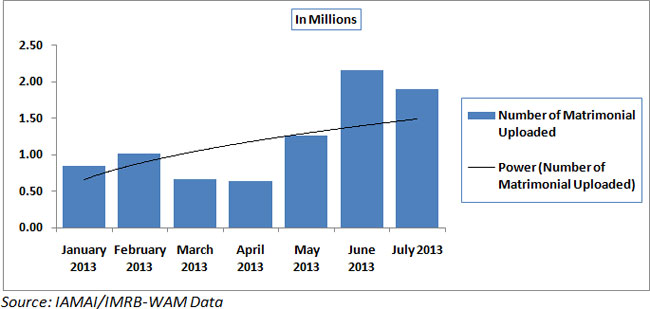
    Uploading of profiles on matrimonial portals has registered a quantum jump since January 2013, registering a growth of 124%. According to the Internet Economy Watch data by IAMAI & IMRB, in January, the number of matrimonial profile uploads were 0.85 million, while in July, it recorded 1.91 million uploads.


    Uploading of matrimonials was lowest in the month of April with 0.64 million uploads. The month of June saw the maximum profile uploads with 2.16 million.


    Commenting on the upward trend, Gourav Rakshit, COO and Business Head, Shaadi.com said: “The Shaadi.com TV campaign launched during the IPL 2013 Finals in May and ran through until the end of July.  The ‘Love, Arranged by Shaadi.com’ TVC featuring Chetan Bhagat” captured the imagination of parents and individuals alike, resulting in a new segment of prospective match seekers entering the online matrimonials category.


  • TelevisionPost launches. Armed with research, will go part-pay soon

    By A Correspondent


    The B2B media space specialising on television and allied industries finally has competition. Dominated by IndianTelevision.com (ITV) for over a decade, it now has senior media journalist and former ITV editor Sibabrata Das teaming up with broadcast and distribution professional Himanshu Dhoreliya to launch TelevisionPost.com.


    The website launched today (Oct 7) amidst much anticipation built over a few months. Seasoned media journalists have joined the venture, and some advertisers are already on board.


    Said Mr Das who is designated co-founder and Editor-in-Chief, in a statement: “These are exciting times for the whole M&E industry and there could not be a better time to launch. There is a clear need gap when it comes to content and understanding of the Indian media industry. We intend to fill that up through comprehensive and holistic reporting on the industry with a special focus on research.”


    Himanshu Dhoreliya, who is co-founder and chief executive officer, added: “Our goal from the start is to create a different news offering, which will be global and journalistically serious. We will write and deal with the cutting edge of the industry and offer a host of value additions and specials along with it.”


    The site will be updated six days a week in the mornings. On what will see TP stand out from the rest and specifically ITV, Mr Das said: “We will go beyond news. Research will be our unique feature. Our research reports will reflect business intelligence and ground reality. Every month we will offer our readers rich insight into the world of cable, DTH and broadcast. Also, for the first time, readers will be able to compare channel packages offered by DTH and cable companies. The emergence of digital technology has inspired us to have a dedicated section that will give our readers a heads-up of latest developments in the world of technology.”


    While Mr Das is tightlipped about who is backing the site financially, there have been rumours of some senior distribution professionals putting in some monies. “As the industry is moving towards digitization and the Pay TV economy is evolving, we feel that there is a huge gap in the market. We aim to build a strong and credible news media brand,” he told MxMIndia, indicating that part of the content will go pay soon. “That is our medium-term plan,” he said adding the focus is initially on establishing the website and events will follow in the last quarter of this fiscal.


  • FoxyMoron adds colour to Maybelline’s digital campaign

    By A Correspondent


    Digital media firm FoxyMoron has been engaged to launch Maybelline New York’s Color Show across platforms like Facebook, Twitter and Instagram. From edgy metallic to stunning pop shades, consumers can pick from funky colors like Downtown Red, Midnight Taupe, Mint Mojito, Lavender Lies to Pink Voltage to make a fashionable nail statement this season with Color Show.


    Fans will get an opportunity to experiment with Nail Art combinations and Maybelline will educate them about how they can get the ‘complete look’ – right from shoes, accessories to match with their preferred shade. The campaign will also include ‘Do It Yourself’ nail art videos for the latest nail art trends. An exciting facet to the ‘Color Show’ is the introduction of an application that will get fans to try all the 40 shades with varied nail art patterns!


    Commenting on the new campaign, Mr. Satyaki Ghosh, Director of L’Oréal Consumer Products Division said, ‘Maybelline is an innovative brand that loves its consumers and assures to give them something new and exciting all the time. With the launch of the Color Show range, we hope to once again do something different for our consumers and engage them as much as possible with the brand.’


    Harshil Karia, Co-founder & Online Strategist, FoxyMoron said, ‘The Color Show is an innovative and interactive way to introduce the entire new color range of nails paints on offer by Maybelline New York. This is an opportunity for fans to experiment with their nails like never before! Maybelline is a fore runner in the make-up category so it only seemed fitting to create a campaign that allows fans to score high on the fashion meter with their favorite brand.’


  • Social media campaigns can swing 3-4% of votes: IAMAI-IMRB

    By A Correspondent


    This is a report that political parties and their campaign managers will make a rush for. According to the report ‘Social Media in India – 2013’ by the Internet and Mobile Association Of India (IAMAI) and IMRB, released on Tuesday (Oct 8), the number of social media users in urban India would reach 86 million this month and 91 million by end-2013.


    Social media users in urban India are expected to grow by 19% between June and December this year. The report further found that 19.8 million users use mobile phones to access social media platforms in urban India.


    Based on the number of eligible voters, data of actual voter turnout from the Election Commission of India and field interviews, the report estimates that there could be a vote swing of 3-4% in 24 states – states where the internet users are sizeable. The vote swingers can be pre-dominantly young men and non-working women whose affiliation towards social media is high.


    Talking to representatives of major political parties in India, the report also found that parties have earmarked around 2-5% of their election budgets for social media. While political parties are gradually investing in social media, corporate have long realized the importance of the medium. Corporates are spending nearly 13% of their digital advertising budget on social media in FY2012-2013, according to the report. It was only 10% in FY2011-12.


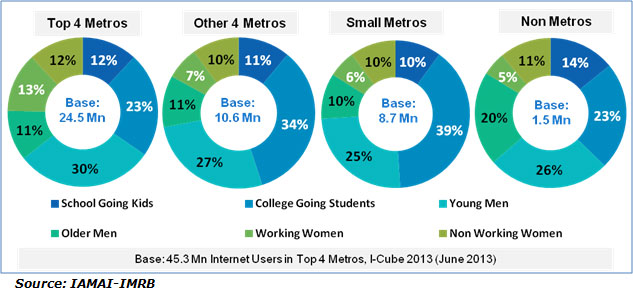
    Predictably, the report finds that the highest proportion of social media usage in the Top 4 metros and the non-metros was among the demographic segment “Young Men” with 30% and 26% penetration levels respectively.


    Interestingly, the report finds that younger women are increasingly using social media, whereas, in the other metros and small metros, “College-going Students” show the highest proportion of social media usage. “Working Women” demographic segment is observed as having the lowest proportion of social media usage in other, small and non-metros whereas they show a moderate proportion of social media usage in the Top 4 metros.


  • Times Internet partners Ziff Davis to bring IGN & Askmen to India

    By A Correspondent


    When it’s not hiring whizkids to its fold, it’s striking deals with media hotties to bring them to India.


    Times Internet Limited (TIL) has now entered into a strategic partnership with Ziff Davis, Inc. – the leading all-digital media company specializing in the technology, games and men’s lifestyle markets with over 120 million in-market buyers every month. Thanks to this alliance, Times Internet will manage and drive local Indian destinations for IGN (IGN.com) and AskMen (AskMen.com), the premium gaming and men’s lifestyle sites.


    As part of the collaboration, Times Internet will have exclusive rights to the IGN and AskMen brands and their content in India.


    While IGN is dedicated to video games and pop culture – including comics, film and TV, AskMen carries men’s lifestyle content on the web since launching in 1999.


    The partnership grows the list of brands under the Times Local Partners (TLP) group – which is an initiative by Times Internet to partner with global digital companies. IGN and Askmen join the fledgling TLP portfolio, which has already rolled out the Indian editions of Gizmodo, Lifehacker and Business Insider.


    Satyan Gajwani

    Said Satyan Gajwani, CEO, Times Internet: “We are really excited about this partnership and the arrival of Ziff Davis’ respected brands coming to India. The IGN name is incredibly respected, and this brings us the opportunity to create premium editorial and video content for the Indian gaming community. AskMen will augment our leadership in men’s lifestyle content offering and deliver the best to our users and advertisers in the coveted male 18-34 demographic.”


    Vivek Shah, CEO, Ziff Davis, added: “We’re delighted to be partnering with India’s leading media group to bring localized editions of our brands to this vibrant market for the first-time. The media landscape is evolving rapidly, and millions of Indian males 18-40 will benefit from AskMen and IGN’s globally respected advice.”


  • Jaldi 5 with Jasmin Sohrabji: Digital is always a focus for Omnicom Media Group

    By A Correspondent


    It’s been around a fortnight since the Omnicom Media Group announced the setting up of PHD, its second media agency in India. Some six years back, OMD opened shop and has since been recognized by all – competition included – as an established player in the Indian market.

    Although she didn’t reveal revenue targets, Jasmin Sohrabji, Chief Executive Officer – South East Asia and India of Omnicom Media Group spoke on the setting up of PHD, client acquisition and how digital is huge for Omnicom.


    01. OMD started operating in India in 2007. So why did it take so much time for PHD to take off in India, especially since it’s been here informally in the country for almost a year?

    We wanted to establish OMD’s value proposition clearly in the Indian market, and consolidate operations before launching our second brand. In the short span of six years, OMD has carved a distinct identity for itself in the market and provided Omnicom Media Group a strong base to launch PHD.


    02. From the year-odd that PHD has been in India, are there any learnings for the way the business is done here vis-a-vis other markets?

    While it’s still early days, we expect to see PHD India as a strong shining star within the global network given the focus on planning and digital already in our group’s DNA in India.


    03. The Unilever digital business is with you in India. Are you expecting other alignments to happen soon?

    Going forward there will be some restructuring and realignments for PHD India including HP, HTC, SC Johnson etc


    04. Is there too much reliance on these alignments happening, or is this what you expect will happen in terms of commitments?

    Global alignments provide an opportunity not a guarantee of business. Like OMD, we will grow PHD from wherever opportunities come, globally, regionally and locally.


    05. Digital is typically what PHD is focused on. But in India, the spends (and if one may even add trust) on digital isn’t much with the budgets of even the big spenders being very small. In what way are you looking at evangelising the medium?

    Not just at the brand level, digital is always a focus for Omnicom Media Group. In India, digital accounts for a significant percentage of our growth and we see this only scaling further.


    5a. Are you going to be working with creative solution providers externally or in the long run will you have some resources inhouse?

    We operate on a flexible model, with both internal resourcing as well as strategic partners.


  • With $160 mn fresh funding, Flipkart’s $1.5-bn valuation comparable to P&G India, Tata Global Beverages

    By A Correspondent


    Continuing its capital-raising successes, online retailer Flipkart.com has mopped up a further $160 million ( Rs 976 crore) from mostly new investors, taking the total in the fifth round to $360 million ( Rs 2,196 crore).


    The latest funding values Flipkart, considered the Amazon of India, at over $1.6 billion, or Rs 9,760 crore. This is similar to its valuation in July, when it raised $200 million. Incidentally, Flipkart is worth more than the total market cap of all 15 listed retail companies, including Future Retail, Shoppers Stop etc. Among brand-led firms, Flipkart’s valuation is comparable with heavyweights such as P&G India and Tata Global Beverages (Tata Global Beverages owns Tata Tea, Tetley and Himalayan). It is also more valuable than 28 banks, including the likes of IDBI Bank, Union Bank, Central Bank of India, etc.


    Investment advisory firm Dragoneer Investment, investment bank Morgan Stanley Investment Management, private equity firm Sofina and Vulcan Capital participated in the latest round. Tiger Global – one of the first backers of the Bangalore-based company – also invested.


    “It’s the quality of the asset that is attracting investors,” said Raja Lahiri, partner at advisory firm Grant Thornton India. “E-commerce is a cash-intensive business. The top four-five players in this space will keep attracting investments in the next few years.”


    Experts point out that the latest fund-raising by Flipkart is an indicator of the growth potential of the Rs 10,000-crore online retailing industry, which is expanding at 54% annually, according to Internet and Mobile Association of India. E-commerce is expected to grow to $200 billion ( Rs 1.2 lakh crore) in India by 2020.


    Besides Flipkart, online marketplace Snapdeal has so far raised about $50 million ( Rs 305 crore) while fashion e-tailer Myntra received about $25 million ( Rs 152 crore) in risk capital.


    “These new investors are willing to participate again if required like Naspers, Accel, and Tiger. Investor alignment with our strategy is very important,” said Sachin Bansal, 32, co-founder of Flipkart.


    Started as primarily an online book store in 2007 by two former Amazon India employees – Sachin Bansal and Binny Bansal – Flipkart has till date raised $541 million (Rs 3,300 crore). In the first phase of this round, Flipkart raised $200 million from South African Internet company Naspers, venture fund Accel Partners, and investment firms Tiger Global and Iconiq Capital.


    The company has ventured into payment gateway solutions this year by launching PayZippy. Flipkart, which employs close to 3,000 people, has close to 10 lakh visitors on its website every day.


    The company’s revenues were Rs 217 crore in 2011-12, according to a filing with the ministry of corporate affairs. But in 2012-13, it soared to an estimated Rs 2,000 crore.


    “Flipkart has got its timing, investments and vertical business strategy right,” said Rajesh Sawhney, angel investor and founder of GSF Superangels. “It will be difficult to replicate Flipkart’s success again, as that phase of scale is already over. New entrepreneurs will have to mine newer verticals.”


    The company changed its model from being inventory led to that of an online marketplace earlier this year.


    As per India’s current FDI rules, foreign investors are not permitted to invest in branded online retail business. Some experts feel that the change in model is also attracting foreign capital.


    The participation by San Francisco-based Dragoneer Investment Group ratifies Flipkart’s success globally. A long-term investor, Dragoneer, has backed companies such as Facebook, Alibaba and 360Buy in the past.


    “All our investors think long term; this is patient capital,” said Mr Bansal. “Dragoneer also brings a network that is really helpful.”


    With inputs from Ramkrishna Kashelkar


    Source:The Economic Times
    Copyright © 2013, Bennett, Coleman & Co. Ltd. All Rights Reserved
    Licensed to republish