Category: Digital

  • Matrimonials rise 202% in wedding season: IAMAI-IMRB report

    By A Correspondent


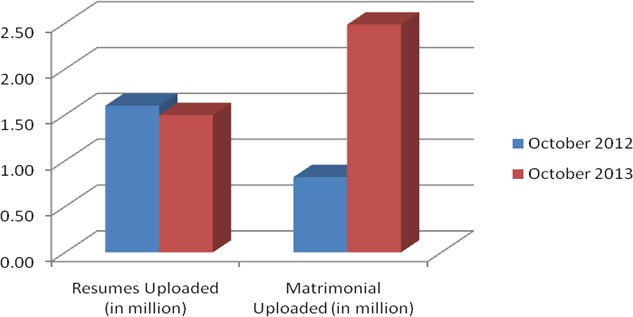
    According to the latest Internet Economy Watch, published jointly by the Internet and Mobile Association of India (IAMAI) and research firm IMRB, the number of uploads of matrimonial ads rose to 2.49 million in October 2013 as compared to 0.82 million in October 2012, registering a y-o-y growth of 202%. The number of resume uploads though has decreased to 1.50 million in October 2013 as compared to 1.60 million in October 2012.


    Fig: 1

    Source: IAMAI/ WAM Data October 2013


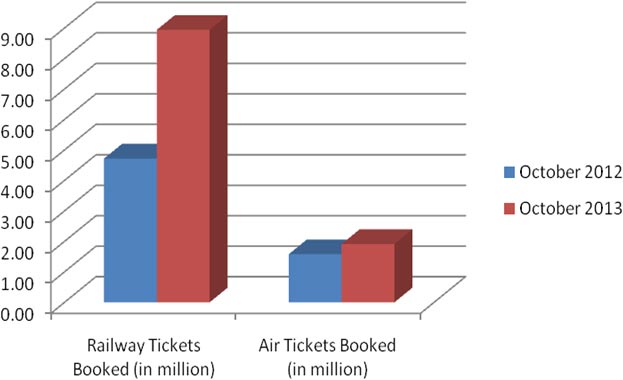
    Online bookings of railway tickets registered a y-o-y growth of 90%. Railway tickets booked online in October 2013 were 8.94 million as compared to 4.72 million in the corresponding month last year. The online bookings of air tickets witnessed a marginal increase with 1.91 million online bookings in October 2013 as compared to 1.58 million bookings in October 2012.


    Fig: 2

    Source: IAMAI/ WAM Data October 2013


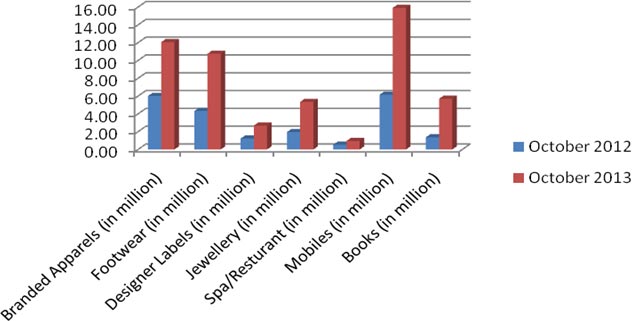
    According to the data captured from major e-tailing sites online user visits to jewellery segment increased to 5.35 million in October 2013 as compared to 1.95 million in October 2012 registering a y-o-y growth of 174%. The mobile segment has registered a significant increase with 15.91 million online hits in October 2013 as compared to 6.15 million hits in October 2012.


    Fig: 3

    Source: IAMAI/ WAM Data October 2013


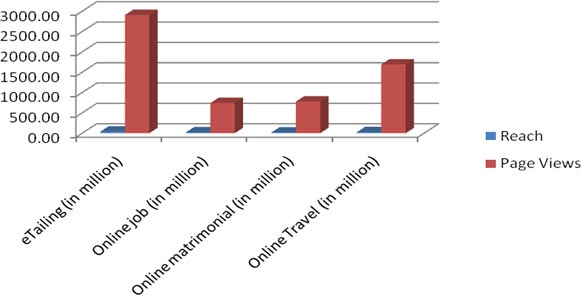
    The monthly tracker further indicates 41.16 million people accessed various e-tailing sites. There were 2906.78 million page views in the category. The user reach for job and matrimonial websites is 20.59 million and 18.03 million respectively with 741.60 million and 777.16 million respective page views. Online travel segment has reach with 24.51 million reach and 1691.095 million page views.


    Fig: 4

    Source: IAMAI/ WAM Data October 2013


    Sourced from all India active internet data, the monthly internet tracker is based on WAM data captured from various relevant sites, and encapsulates online usage for E-tailing, Online Travel and Vertical Classifieds.


  • Madison Media wins HomeShop18 Media AOR

    By  A Correspondent


    Madison Media Group has been appointed as the media Agency on Record for leading shopping channel  Homeshop18. The account will be handled by Platinum Media in Delhi. The account was previously handled by Mindshare and the estimated media spend is in the range of Rs 30 crore.


    Vikrant Khanna

    Commenting on this, Vikrant Khanna, Chief Marketing Officer, HomeShop18 said, “Homeshop18 is proud to be associated with Madison, which is the leading media planning agency in the country. I am confident they will be a strong partner in our journey to become India’s leading virtual commerce player. Having worked with Madison in the past I know that Madison is best equipped to help us  reach our intended audience in the most economical and integrated way.”


    Says Basabdatta Chowdhuri, CEO, Platinum Media, “We are delighted with this new win and are confident that we can add strategic value in building the HomeShop18 brand in the country.”


    According to a communique, Madison Media has been on an account winning spree, having recently won a host of new businesses including Raymond Apparel, Piramal Healthcare, Epic Channel, McCain Foods, Ruchi Soya, Max India’s corporate account, Café Coffee Day, Radikal Rice and Crompton Greaves.


  • Amitabh Bachchan is ‘Shahenshah’ of Twitterverse

    By A Correspondent


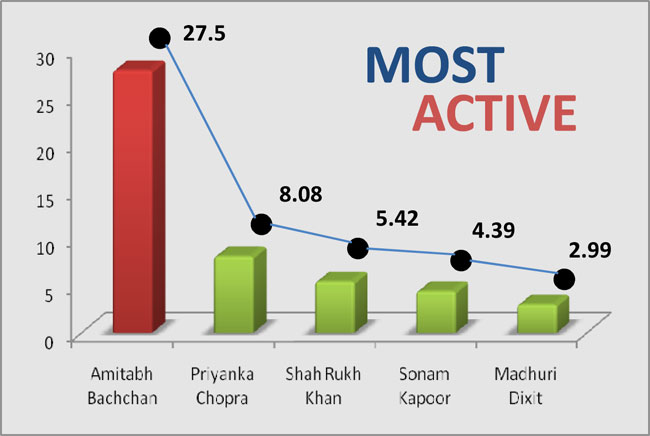
    Amitabh Bachchan has been crowned the king of Twitter among his Bollywood counterparts, as per the ‘Bollywood Twitter Index’, a social media analytics report released by To The New, a digital services network in India (which has Ignitee Digital in its fold). The report is based on research by ThoughtBuzz, the social media analytics’ arm of To The New. The Bollywood Twitter Index reveals that Amitabh Bachchan continued to reign over the microblogging site with the highest number of followers, clocking a growth of 87% over the last year. He is followed in the list by the Khan-brigade – Shahrukh Khan, Salman Khan and Aamir Khan. Making an appearance at #5, Priyanka Chopra is the only actress in this top five Indian movie celebrities’ list.


    Despite gaining the maximum number of followers over the last one year with 151% increase, Madhuri Dixit narrowly missed making it to the list this year. She was nudged out by the fashionista of B-town, Sonam Kapoor, who hung on to the Number 10 position with an 87% increase in followers since last year. Other significant gainers include Akshay Kumar with a 99% increase and Deepika Padukone with an 82% increase in the number of followers over the last year.


    It is interesting to note that with virtually no activity in the year, Aamir Khan has continued to gain significant numbers, having amassed nearly 2 lakh new followers in the last 2 months alone. Aamir’s only tweets in the current calendar year are about narration of his experience of meeting David Cameron, Prime Minister of United Kingdom and #ThankYouSachin during the cricketer’s last test match in Mumbai.


    The majority of conversations (around 27%) that Bollywood celebrities indulge in are about promoting their work or films. Stars also like to share their personal experiences or interact with their fan base using Twitter, about 24% of the tweets are contributed towards both of these activities. The rest of the Twitterverse discussions are based around promoting their own brands (9%), favourite quotes (7%), opinions about specific issues (6%) and social causes (4%).


    Commenting on the Bollywood Twitter Index, To The New managing director Puneet Johar said, “Movie stars have always been held in awe and treated as demi-gods by Indian audiences. The rise in popularity of social media platforms, particularly Twitter, has broken down barriers allowing fans to gain personal access into the lives of the stars that they may never have had the opportunity to interact with otherwise. Bollywood stars, who have taken to micro-blogging to engage with their fans, have gained millions of followers and emerged as powerful social influencers.”


  • Mobile adspends grow 10% of total online spends in 2013: IAMAI-IMRB

    By Our Research Associate


    With Over 930 million mobile users in India and the figure increasing by 8.35 million every month, there is a huge opportunity for small and big brands to explore mobile for marketing their products and connect to consumer in a more efficient way, notes the Internet and Mobile Association of India [IAMAI]. The ability to leverage mobile to target and reach out to the right audiences in the best possible manner is what will make the difference and determine the success or failure and the future seems to be inclined towards mobile marketing, IAMAI adds.


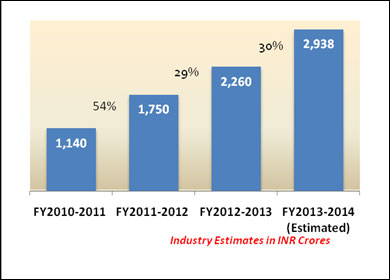
    The online advertising market in India is projected to reach Rs 2,938 crore by March 2014, according to the findings of ‘Digital Advertising in India’ report, jointly published by the Internet and Mobile Association of India (IAMAI) and IMRB International. It is to be noted that during 2012-2013, online adspend amounted to Rs 2,260 crore and advertisements on mobile phones and tablets grew from a 7% share in FY 2011-2012 to 10% of the Indian online ad market in FY 2012-2013, totaling to spends of around Rs 230 rore.


    Figure 1: Indian Digital Advertising Market Growth

    Source: IAMAI & IMRB International


  • Impact of tech & techcos on consumer & advertiser behaviour: GroupM report


    Presenting extracts from GroupM’s observations of the impact of technology and technology companies on consumer and advertiser behaviour. This is a preview of the final report, which, complete with media investment data from around the world, will be published in the early part of 2014:


    This year twenty five years have passed since March 1989 when Sir Tim Berners-Lee, a Fellow at CERN, wrote a paper that proposed connecting ‘…the hypertext idea and connecting it to the transmission control protocol and domain name system ideas…’ The quote finishes ‘…ta da.’


    The ‘ta da’ became the World Wide Web. The rest, as they say, is history.To be clear the web created at CERN is not the web of today. For the first time tablet sales exceed PC sales and the sales of smartphones exceed both comfortably. Few of the next billion online users will use a PC-like object as the principal method of access. Additionally much of today’s digital experience is driven by the app universe in which the wire frame of the web is largely invisible. To paraphrase an Oldsmobile commercial of similar vintage, ‘This is not your father’s internet’.


    By some means of access or another it is estimated that one third of the world’s population is online. In August Mark Zuckerberg announced the foundation of Internet.org, a partnership between Facebook, Nokia, Samsung, Qualcomm, Ericsson, Opera and MediaTek to close that gap at a faster rate than the current annual growth rate of 9%.


    AdvertIsIng Was Broadcast

    Advertising as we understood it in 1989, and for at least another decade, was a function of the broadcast age. From the mid-1950s and the mass penetration of television and peaks in print circulation to the middle of the last decade when broadband became pervasive first to the PC and now to mobile devices advertisers had a reliable supply of large and mostly attentive audiences. Screen based entertainment with the exception of video games, was, in broad terms, a passive activity that became a key driver of popular culture and conversation. In this environment,marketers had few challenges in capturing the attention of audiences, which is not to say their efforts always provoked the desired action.


    In the broadcast age the short history of marketing from packaged goods to politicians was characterized by applying maximum pressure to as many people that funds and optimization allow, and pursuing share of voice which is hoped to translate over time to share of mind, wallet and,  ultimately, loyalty. The targeting of advertising used context, day-parts and geography as proxies for audiences, that everyone knew to be only modestly accurate.


    Advertisers have always built reach through the aggregation of audiences from multiple channels but this is far harder to do amid the precipitous decline in the reach of non-live individual units.


    The challenge is magnified by extreme fragmentation, ad avoidance (albeit often overstated); adblindness (often understated); time shifting; multi-tasking; active screen time and the increasing adoption of over-the-top and often ad-free or ad-light media.


    Less attention, fragmented audiences and even more fragmented channels create financial pressure on advertisers to deliver effectively in more places and on more platforms with little additional available resource.


    They are doing this by:

    # Aggregating ever more fractured audiences in an effort to recreate simultaneous and time-specific reach by matching time spent with media with the funds allocated


    # Leveraging more engagement from the premium reach they do invest in by activating against media properties in ways similar to sponsorship – this may not save money in the short term but might hedge against diminishing effectiveness


    # Rebalancing investments to increase the volume and value of owned assets (content and utilities) earning an organic dividend by successfully executing in the new stream or feed based marketing forms like Facebook and Twitter


    # Redefining audiences and realigning their planning around revenue events or proxies for them by applying better, faster, data to increase the precision of targeting and the value of outcomes


    All these strategies have two things in common. All require expertise in digital marketing and require deep data skills and both the ability and desire to leverage the creative application of technology to increase audience engagement. They also require proof that engagement pays as well as the old-fashioned, less surgical approach to advertising.


    Aggregation of audiences and Allocation of Budgets

    Mary Meeker, a partner at Kleiner Perkins Caulfield & Byers, has long been a leading commentator on the digital economy. She has been a consistent and persistent observer of the apparent disconnect between time spent with media and the allocation of marketing investment by channel.Her expectation is that eventually the eyeballs and the advertiser dollars reach parity. To a degree Ms Meeker’s view is coming true: the usage-to-spend ratio on online display, desktop and mobile, is increasingly proportionate to user time allocation. The falsehood inherent in this is that time spent is not an accurate proxy for utility nor the allocation of advertising dollars. Search is the highest utility activity but hardly the greatest consumer of time. Further, much online time is spent on activities in which advertising is either not permitted or is simply inappropriate.


    Ms Meeker also believes technology to be a catalyst of wholesale industrial disruption. This is certainly true of media. Around the world broadcast audiences are not so much in decline: rather, they are fragmenting at speed. Hours spent with traditional broadcast channels are in decline, yet linear TV hours as a whole are stable and total video consumption is rising. Last year we discussed in some detail the redistribution of long-form programing via full episode players and over-the-top TV including Netflix, Hulu and Amazon Prime, and the rise of YouTube and its global analogs. The growth of these channels continues and accelerates as the penetration of tablets, which outsold PCs in 2013, and video-capable smartphones become favored video consumption devices. 25% of YouTube’s views are to mobile devices, yet the idea of the  best available screen persists.


    As last year however a comparison with television offers useful perspective. According to Nielsen’s September US Q3 2013 Cross Platform Report 7% of all viewing is now online; the top quintile of internet video and streaming video users consume 25% of their video minutes online; and the second quintile 13%. These quintiles represent 23% of the US population. Incidentally the top quintile of all TV users is also the heaviest-consuming group of online video. The lean-back TV experience is very much alive, and often enhanced by a second screen, as we explored in this report last year. We now spend over a third of our waking time interacting with screens.


    Video usage is geographically inconsistent. Television supply is restricted in many markets and as we commented last year we expect to see viewing minutes by screen and by delivery mechanism vary significantly by market. Share of online tends to be higher where one finds ample bandwidth,device penetration and sensible ad loadings.


    The search for practical metrics between and across channels continues. Thus far, despite the progress made on viewability and cross-channel rating currencies the industry remains far from aligned. Nielsen OCR is a huge step forward but it requires all the owners of inventory to agree on the metric as a common and comparable currency.


    Click here to download complete report


  • Ogilvy shows off its digital power with ‘Techtonic’

    By A Correspondent


    The agency’s dominance in the traditional creative advertising has been so major that one doesn’t really associated Ogilvy with the digital media.


    But over the past few years, OgilvyOne has grown to become India’s largest, most awarded full-service digital agency. But there is more to this story than just growth and fame. It’s built specialist capabilities, completed digital acquisitions and now has over 400 digital resources across Ogilvy India.


    On Thursday, the agency organized Ogilvy Techtonic in Mumbai with an attempt to bring to its clients a series of relevant, usable conversations around the shifting digital landscape. Perspectives from industry leaders from Facebook, Google, Myntra, social influencers Miss Malini and Gabbar Singh and Ogilvy’s own digital leaders from across the country. The venue was the Bluefrog nightspot in Central Mumbai… we aren’t like some of those newspapers which only carry the venue name if it’s paid for.


    Guest speakers included Kirthiga Reddy, Guneet Singh, Mukesh Bansal, Miss Malini and Gabbar Singh and the Ogilvy speakers were Abhijit Avasthi, Vikram Menon, Karthik Srinivasan, Sanjay Ramakrishnan, Shivakumar Viswanathan, Nalini Guhesh, Anand Morzaria, Upasana Roy, Dharam Valia and Kunal Jeswani. And we even spotted bossman Piyush Pandey also in the house.


  • Return of dotcom boom, small e-com cos spend big on TV advtg

    By Shambhavi Anand


    The dotcom boom seems to be back, at least for television advertising. And it is not only the big and known names spending money on the most popular and preferred mass medium but also the small online retailers are spending humongous marketing dollars on extremely expensive television advertising.


    Fabfurnish, an online furniture retailer, which is less than two years old, is about to kickstart its first television campaign in January 2014. Backed by German e-commerce incubator-cum-investor Rocket Internet, the company has put in half a million Euros into this campaign. However, the company did not disclose the size of the fund it has raised.


    “Online home decor market is in a nascent stage. We need to create awareness about the category as well as build brand for ourselves,” Vaibhav Aggarwal, CEO and co-founder, Fabfurnish.com said. The campaign is planned for four weeks in January and will be supported by simultaneous digital initiative also.


    TV advertising forms a significant part of media mix for Lenskart.com, the online portals which sells eyewear is backed by venture capitalists. “We spend approximately Rs 10 crore annually on mass media advertising which is mainly done for brand building and gaining trust of the consumers. TV allows us to educate and create much needed awareness for the brand resulting in traffic and building trust,” Peyush Bansal, CEO and founder, Lenskart.com said.


    While the prospects for e-commerce companies cannot be doubted, does advertising on television lead to increased sales? Most e-commerce companies claim that the traffic of their portal increases and so does awareness and trust but most of them do not have numbers to back their claims.


    GreenDust, an online portal, which sells branded factory seconds products (electronics) that are repaired and refurbished that comes with a warranty spends heavily on advertising in the mass media including radio and TV.


    Its founder and CEO, Hitendra Chaturvedi, said, “TV advertising has helped us in reaching to mass audience and building trust for the brand. This in turn has improved the brand recall and we witnessed 100% increase in number of prospective customer’s queries in the month we released our first advertisement itself.”


    He added, “TV ads have helped to break the clutter and to reach across all target audience which has been achieved by targeting different channels covering all the genres and different languages.”


    According to estimates of Madison Media, the advertising spend of online portals have gone up in the last two years. The ad spends of online portals in the April to July quarter of 2013 was 1.2% as compared to 0.8% in the same quarter of 2011.


    The Indian ecommerce market is going through a huge surge of growth. According to a 2012 CRISIL report, Indian online retail industry will grow from Rs 32 billion in 2012 to Rs 100 billion in 2015, a CAGR of 45%-48%. To add to the growth prospects of the industry, infrastructure such as internet connectivity is expected to grow exponentially in the country. Apart from laptops and desktops, mobile phones and tablets are becoming major growth drivers.


    The I-Cube 2013 report released by the Internet and Mobile Association of India (IAMAI) and IMRB International said India has 200-million internet users as of October; the number will grow 40% year on year by December. The number of internet users in India is expected to rise 18.53% in the coming months to 243 million by June 2014.


    In spite of the huge potential, critics seem sceptical about the effectiveness of mass media advertising for e-commerce players, especially the beginners. They say there is hardly any data to establish the link between high traffic and increased sales conversion.


    “There has been a spurt in traditional advertisements by e-commerce sites and this is primarily because mass media such as television tends to bring more credibility. But the question is whether TV advertising brings in the expected return on investment (RoI),” said Gaurav Gupta, senior director, Deloitte in India.


    He, however, says mass media advertising might be done more for brand building and spreading awareness or for establishing credibility to get private equity rather than for increasing sales.


    Seema Gupta, faculty – marketing, IIM Bangalore, advises small ecommerce ventures to look towards marketing activities such as activation in malls or initiatives on the digital media, which can be done over a prolonged duration and, hence, prove to be more sustainable, rather than opt for expensive mass media advertising. “Below-the-line advertising can prove to be more sustainable as they can be done for a longer duration. It will also help in reaching out to the right target audience as compared to mass media advertising, which can burn money very quickly,” Ms Gupta said.


    Source:The Economic Times

    Copyright © 2013, Bennett, Coleman & Co. Ltd. All Rights Reserved

    Licensed to republish


  • As Sholay releases in 3D, Jai-Veeru come alive on games

    By A Correspondent


    Hungama Digital Media Entertainment and Gameshastra Solutions have brought alive the famed Jai and Veeru duo of the megahit Sholay in a free-to-play game created as the 3D version of the film is being released.


    ‘Sholay: Bullets of Justice’ will be a single player finite level-based side scroller game. The game will have a ‘wild west’ feel and would also portray the locales of Ramgarh as in the movie, with each character having its own stylized animations.


    Said Neeraj Roy, MD and CEO,Hungama Digital Media: “The concept of gaming has caught on across the world and is gaining rapid pace especially in the mobile and connected devices environment. The Sholay: Bullets of Justice Game is engaging and addictive for the average gaming enthusiast.”


    “Sholay 3D is looking and sounding awesome! We have taken three years to painstakingly restore this film to an impressive quality level for all to enjoy for decades to come! I am thrilled with the game as it has 12 levels and is a complex game both on mobiles and on all other platforms,” said Sascha Sippy, Chairman of Sholay Media & Entertainment Pvt. Ltd.


    Take out the dacoits attacking Jai and Veeru in a moving goods train. Teach the dacoits lessons that are harassing the villagers for money. Assist in spreading around happiness and keeping the auspicious festival of Holi sacred. Unshackle Basanti (Hema Malini) from the jaws of the Gabbar Singh and balm the sadness of disconsolate Radha (Jaya Bhaduri) by bringing the maniac to justice.


  • MouthShut’s plea on IT Rules 2011 to come up for hearing in SC

    By A Correspondent


    The writ petition filed before the Supreme Court by Mouthshut.com, India’s online community for consumer reviews, challenging the Information Technology Rules, 2011 is to come up for hearing on January 13, 2014. The plea seeks to declare the IT Rules as violation of Articles 14, 19, and 21 of the Constitution of India which guarantee freedom of expression. Mouthshut.com will be represented by senior counsel, Harish Salve.


    It may be recalled that Mouthshut.com had approached the Supreme Court with a writ petition under Article 32 of the Constitution of India, to rescind India’s Information Technology Rules 2011 that “jeopardises the freedom of expression”. The appeal declares the IT Rules to be offensive under Articles 14, 19 and 21 of the Constitution of India. “We are pleading with the highest court in the land to protect the rights of Indian citizens and consumers that are granted by the Constitution of India,” said Faisal Farooqui, Founder & CEO, MouthShut.com.


    Mouthshut.com says it has stuck to its own policy of taking down content only under legal coercion. But the IT rules stating that ‘any affected person’ can simply send an email to request the removal of any content within 36 hours or they can lose their ‘safe harbour’ protection as an ‘intermediary, pay damages, legal fee and court time’. Web-based organisations need to have a difference between free expression and making feasible services.


    Mr Farooqui further added, “We have been threatened with hundreds of legal notices, cybercrime complaints and defamation cases. At other times, officers from various police stations call our office, demanding deletion of various reviews or face dire consequences under the IT rules.”


    “It is a privilege to be a citizen of a democracy like India, where an ordinary citizen can appeal to a powerful court. Laws are meant to ensure the well-being of the nation – its people and institutions. Despite good intentions, IT Rules fall short of doing that. This law has the potential to weaken or, worse, entirely corrode the robust protection that the constitution of India offers to the freedom of speech,” he continued


  • 6 tech-driven trends to look out for in 2014


    Wearable fundraising, smart bras, e-Government and ambient Bluetooth consumer messaging are all set to trend in 2014. Digital technology will continue to provide new connections, revenue streams and communications channels for brands, consumers, charities and businesses.


    Said Norm Johnston, Chief Digital Officer, Mindshare Worldwide: “Expect 2014 to be the year when the internet of things gets pretty weird. At Mindshare, we believe that everything begins and ends with media, and that is underlined by the hugely ambitious projects global organisations are working on to launch in the next 12 months. Companies have to get more and more creative in order to capture the attention of consumers. That means that they will try to find new touch points, new technology and new strategies to capture the imagination of increasingly discerning audiences.”


    1 / THE RISE OF THE SHARING EPHEMERAL

    This year we will see an increase in the popularity of apps like Snapchat and Wickr that enable users to establish multimedia conversations that erase themselves after a given period of time. The flirtatious and secretive nature of these apps is driving adoption and where a few heave led, expect plenty more to follow.


    2 / ADAPTIVE GOVERNMENT
    David Cameron tweets. Obama had a social media cave. Even the German police are developing technology (an App that detects Neo-Nazi lyrics in music). Governments and political parties are beginning to switch on to the fact that they need to embrace technology to remain relevant and in 2014 we’re going to see more tech led NPD from governments worldwide.


    3 / THE INTERNET OF WEIRD THINGS
    Wearable technology, particularly health-related devices have finally become affordable, accurate and accessible, but that is just the tip of the iceberg when it comes to the internet of things. Samsung has patented ‘smart wig’, Microsoft has developed a ‘smart bra’. Expect 2014 to be the year when the internet of things gets pretty weird.


    4 / SOUND TAKES CENTRE STAGE
    Companies such as Sonic Notify and Apple are leveraging ambient sound using BLE (Bluetooth Low Energy) to deliver a message to consumers when they are at the key purchase decision making time. Mindshare and Shazam have launched AUDIO+ – a partnership to allow brands to leverage their investment in sound. Brands are switching back to the marketing power of sound – it’s just not radio.


    5 / FITNESS + CHARITY + TECHNOLOGY + FASHION = KERCHING
    We all liked to wear Livestrong bracelets as a show of our support (and coolness) to others, but what if it actually raised money at the same time? Apps such as Charity Miles – where consumers earn money for their favourite charity by using the app to track fitness (ad supported) – will become more popular. Consumers like something for nothing, so interacting with brands and getting a value in return will become important, and a great way for charities to raise cash.


    6 / GOOGLE, FACEBOOK, TWITTER – BEWARE
    2013 was the year of the social and search giants; Record revenues, IPOs and future predictions of huge growth. Watch out as 2014 will be the year of the guys who actually sell stuff. Amazon and Alibaba lead the field. E-commerce in China alone is worth $1.4 trillion and Alibaba, fuelled by Taobao and T-Mall, has become the world’s largest online retailer, selling more than $170bn in goods in 2012, more than eBay and Amazon combined. Don’t expect these guys to not be looking at leveraging their huge scale and reach into the world of digital advertising – and when they get it right, Google watch out.


    Republished with permission from Mindshare Worldwide. This was published as part of Mindshare’s Original Thinkers Series, circulated weekly


  • Bharti AXA General Insurance takes streets to spread health insurance awareness

    By A Correspondent


    Bharti AXA General Insurance has launched a viral communication campaign on the internet around the theme of Lifestyle Protection which underlines the need for a critical illness insurance cover.


    Seven videos have been developed that narrate the predicaments of ordinary people who suffer from critical illnesses and are forced to work while they are ill, owing to the financial commitments.


    Commenting on the campaign, Dr Amarnath Ananthanarayanan, MD and CEO, Bharti AXA General Insurance said, “Innovation is one of the core values on which our company is built and we are constantly looking at new perspectives, methods and approaches when it comes to any aspect of business, service, product development, delivery etc.  With this viral communication campaign, we aim to increase awareness about health insurance and help the aam aadmi choose the right health insurance policy.” The company also launched a television commercial centred around the working patient last month.


    The digital campaign was created by Publicis iStrat while the TVCs are by Publicis Ambience.


  • VServ infographic on mobile app development

    By A Correspondent


    VServ, a popular mobile advertising facilitator, has come up with an interesting infographic on in its ‘Developer Survey 2013’ where 1500 app developers were surveyed.


    According to VServ, the global mobile ecosystem has grown “immensely” in the last few years. Adds a communiqué: “Mobile App development is a thriving industry with huge scope for aspiring developers. Every single day brings news that reflects interesting mobile technology breakthroughs that propels app development opportunities to the next level. Smartphones have brought with them smarter consumers, who have adopted apps to become integral part of their lifestyle. Considering that many developers have been able to innovate across mobile devices and operating systems to create entrepreneurial avenues which has scaled their business faster. This opens up great opportunities for developers to build great products that can reshape the way people use technology. However, developing such apps is a herculean task for the developers, where they have to figure out ways to integrate crucial app developed lifecycle services such as ad monetization, analytics, bug tracking and in-app purchases.”