Category: Digital

  • Reliance Games launches Dancing With the Stars mobile game

    By A Correspondent


    Reliance Games, a developer and publisher of mobile games, has set the stage for enthusiasts to groove along with the dance-based TV show, Dancing with the Stars. This rhythm-based mobile game is inspired by the enormously popular television show and lets users prove they are the best dancer on the virtual floor. Dancing With the Stars: On the Move can be played on iPhone, iPad and iTouch (https://itunes.apple.com/us/app/dancing-stars-on-move/id642440504?mt=8).


    Manish Agarwal

    “Dancing with the Stars: On the Move mixes the glamour and high-stakes drama of the competitive show with the rhythm-based gameplay people love,” says Manish Agarwal, CEO of Reliance Entertainment Digital. “Both new and seasoned casual gamers will be addicted to the combination of music, colourful costumes and amazing dance floor moves.”


    Players can also share their game progress with friends via Facebook Connect, allowing users to share their dancing outfit and show off their winning score.


    “It’s an amazing, immersive experience,” said Paul Joffe, VP BBC Worldwide Digital Entertainment and Games. “It puts the excitement and energy of Dancing with the Stars in your hands. Fans get the chance to enjoy first-hand the journey to becoming a champion. They can even team up with their favourite dancers from the show.”


    Dancing With the Stars showcases paired celebrities and professional dancers who compete for the trophy.


  • Dentsu buys 80% of Webchutney

    By A Correspondent


    Rohit Ohri, Executive Chairman, Dentsu India Group along with Webchutney co-founders Sidharth Rao (L) and Sudesh Samaria (R)

    The Dentsu India Group has announced that it has acquired an 80 percent stake in digital agency Webchutney. With around 200 employees across offices in Delhi, Mumbai and Bengaluru, Webchutney has been credited with developing award-winning and memorable digital experiences for some of the biggest brands in the country, many of them of global repute like Airtel, Unilever, MasterCard, Coca-Cola, Bacardi Martini, Budweiser, ITC, Marico, Madura Garments, Titan, Bajaj, Reliance Retail and Saint Gobain.


    The work done by the agency has been awarded at various domestic and international events over the years including Adfest, Goa Fest (Creative Abbys), Yahoo! Big Idea Chair Awards, Campaign India Digital Media Awards, IAMAI Indian Digital Awards, W3 Awards and Olive Crown Awards among other prominent recognitions.


    Founded by Sidharth Rao and Sudesh Samaria in 1999, Webchutney boasts an impressive client roster and some of the most recognized digital work over the last few years spanning web design, social media, mobile and experiential digital advertising. Rahul Nanda, President, Mobile Initiatives, joined the agency in 2005 as Partner and Chief Operating Officer. The agency will continue to operate independently under the management control of its current leadership.


    Sidharth Rao, Chief Executive Officer and Co-founder, Webchutney, commented, “In Dentsu and Rohit Ohri, we have found a partner who is willing to invest in and cultivate our passion to provide path breaking digital creative services to our clients. We are thrilled to be working with such a strong global leadership and are ready to enter a new phase of our growth. We could not have made it this far without the unfaltering support of our clients, our leadership teams and the talented bunch of team members. I am also personally grateful to Sarbvir Singh who has been my mentor for the last five years and his team at Capital18 for ensuring that we shared a wonderful journey together.”


    Sudesh Samaria, National Creative Director and Co-founder, Webchutney, said, “The Dentsu network is ‘future obsessed’ and that fits in perfectly with what we do here at Webchutney. We’re always trying to be ahead of the curve and we love people, ideas and technology that will help us and our clients get there faster. So in that sense both from a philosophy point of view as well as synergies across capabilities, we believe we’ve found the ideal growth partner in Dentsu.”


    Speaking on the new partnership, Rohit Ohri, Executive Chairman, Dentsu India Group, said, “Dentsu is the first global network that’s being built out in the post-digital era. We believe we’re building the network of the future. Our partnership with Webchutney is another step in that direction. We’re now going to be able to put world class digital solutions in the centre of our offering to our clients. I’m delighted to have Webchutney as a part of the Dentsu India Group.”


  • Jaldi 5 with Vivek Srivastava, Digital Head, Colors: Jhalak online pageviews will double this year

    There’s more to the new season of Jhalak Dikhhla Jaa, the Indian version of the BBC show Strictly Come Dancing, than just the airing on Colors from June 1. The channel has planned an online offensive that will not just extend the on-air excitement, but also engage internet users with the show and its stars. MxMIndia posed a few questions at Vivek Srivastava, Digital Head of Colors, to get a sneak peek.


    01. We’ve been hearing about the various online activities that you are doing for Jhalak. How critical is online for the promotion of a television programme? Or are you looking at attracting an entire set of people online who may not necessarily watch it on telly?

    Digital is a critical part of our promotion strategy. This year, we are taking the brand Jhalak and our promise to make Non-Dancers dance to the next level. Throughout the season,  we will release one dance tutorial every day for our viewers. This will be from different dance forms , for example, Seven Steps salsa etc. These videos will be released every week on our website, Jhalak app and social media. To make this more exciting we have tied up with Dancewithmadhuri.com – Madhuri Dixit’s online dance academy. Viewers can now learn, practise and upload their videos. Madhuri Dixit will herself select the winners and one lucky winner will get a chance to dance with Diva herself.


    Apart from this, we are also launching a microsite for Jhalak and soon we would also be launching a Jhalak app. Also, there will be lots of action happening on the day of the launch – June 1, as viewers will get a chance to come face-to-face with Madhuri on our website and Facebook page at 11:30am. In the afternoon (3pm), we have a 20-min web premiere on YouTube.


    02. Some of the content that you have on the internet requires fast broadband speeds, which is a reality only with people in offices… at least in India. What were the numbers like last year, and what do you expect it to be this year?

    Connectivity has been improving –  Smartphone/tablet penetration, 3G and access to Internet has gone up significantly in the last few years. We did 100 million pageviews on our website last year. We are looking at doubling these numbers this year.


    03. In terms of audiences, how many of them from India and abroad? And in India, where are the people coming from? Could you share some of these statistics?

    At over all level approx 30 percent of our consumption is from outside India. In India, the consumption is across states and towns the Tier 2 however are slowly gaining in numbers and we expect them to be a sizable number this year.


    04. In terms of revenues, are you going to be having the same set of sponsors, or will your digital presence have an all-new sponsor set?

    The on-air title sponsors will get preference since they have a existing association. However, we do approach a larger set for digital sponsorship.


    05. Until last year the TV show (JDJ) winners were decided by votes received via phone (smses). Will this year’s edition be factoring in votes received via the app?

    A JDJ viewer has the option of voting through sms and the website, last year too, the SMS voting option was incorporated in the JDJ app. We will have the same option this year as well.


  • Pulp Strategy powers Yebhi.com with NFC

    By A Correspondent


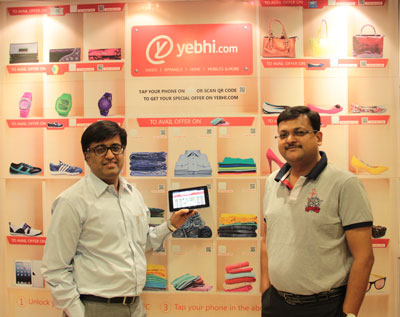
    yebhi.com launching virtual stores L-R: Mr.Nikhil Rungta Chief Business Officer, Yebhi.com, Mr.Manmohan Agarwal, Co-Founder & CEO, Yebhi.com

    Pulp Strategy Communications has launched Near Field Communication- based engagement solutions, allowing brands to engage with consumers in an interesting and meaningful way on a real-time basis. NFC is wireless technology for smartphones and similar devices to share information via touch. With smartphone penetration at 10% in India, the stage is set for creating unique experiences and enhanced engagement campaigns for consumers.


    Pulp Strategy recently powered the first NFC initiative with 30 virtual stores in Delhi and Bangalore for Yebhi.com. The virtual stores were strategically placed in premium cafes and saw a lot of interest from consumers. The virtual stores allowed consumers to shop for a product of their choice with a single tap of their smart phones. It takes seconds to get the product of your choice and in all sizes and colours. Commenting on the occasion.


    Nikhil Rungta, Chief Business Officer, Yebhi.com said, “30 Virtual Stores is first-in-class initiative in the eCommerce category from Yebhi.com. We have used the latest NFC technology to enhance user experience, as it is quick, easy and very interactive. We feel this is our first step towards training and exciting users towards mCommerce. We feel this kind of initiative can be a true game changer in etailing as it is a hybrid of both online and offline.”


    Ambika Sharma

    Commenting on the new offering Ambika Sharma, MD & CEO Pulp Strategy said, “Every marketer’s dream is a consumer who looks for value but appreciates innovation. A marketer’s nightmare is the consumer easily bored, wants everything on the go, and has seen it all before. Our NFC solutions for retail and brand activation help enhance the consumer experience, spice up and prolong the engagement with the consumer.”


    In the realm of new technologies, Near Field Communication (NFC) has clear potential and practical uses. This short-range wireless connectivity technology makes it possible to browse, choose, review, download, connect with brands on social media and even buy with a single tap.


  • RCB emerges as Twitter war winner: Asterii

    By A Correspondent


    If Twitter was the pitch the game was played on, Vijay Mallya’s Royal Challengers Bangalore (RCB) would’ve been the clear winner. Asterii Analytics, a marketing analytics company that’s part of the Draftfcb Ulka Advertising, conducted an in-depth study on the Twitter wars among the IPL teams. To leverage their popularity and build consumer connect all teams have created several social media platforms, the primary being Twitter.


    And the key findings were:

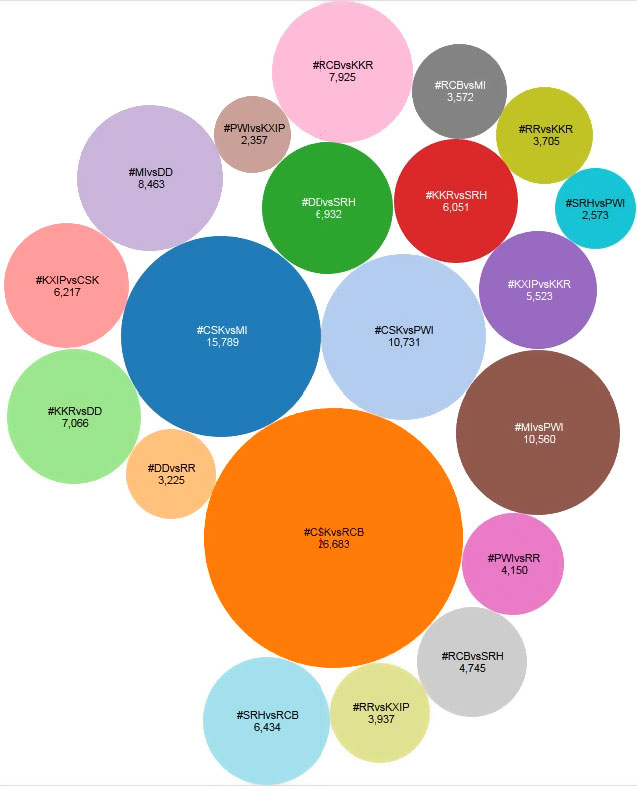
    • Royal Challengers Bangalore (RCB) proved to be a clear winner with over 1,23,000  tweets, and Kolkata Knight Riders (KKR) team coming to a close second with over 116,000 tweets. Excited fans of RCB have been most excited and tweeted
    • The Asterii Analytics team analysed the tweet patterns based on win and loss scenarios. KKR and RCB celeberate when they win and are subdued when they lose. However CSK bucks the trend and fans tweet more on the team hashtag when they lose.
    • The most exciting match turned out to be the one between CSK and RCB as this match attracted over 26,000 tweets
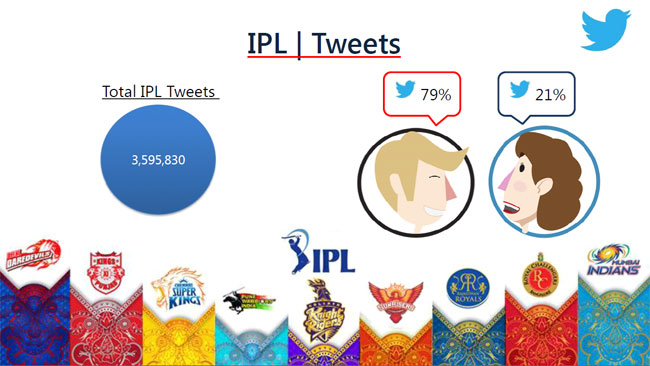
    • A good number of women participate in Cricket-Twitter wars. The study shows that 21% of tweeple were women


    Twitter trends show the popularity of a brand or franchise, considering this Asterii Analytics observed keenly that ever since IPL started at least two hashtags of IPL have been trending daily. Asterii Analytics reviewed all matches held in the first 13 days. For this study, over 3.5 million tweets were analysed across 21 matches in 13 days.


    The Asterii Analytics team analysed the tweet patterns based on win and loss scenarios. KKR and RCB celeberate when they win and are subdued when they lose. However, CSK bucks the trend and fans tweet more on the team hashtag when they lose.


    (Source: Match hashtags and hashtags of both teams competing)


    Which match got the most tweets?


    The most exciting match turned out to be the one between CSK and RCB as this match attracted over 26,000 tweets.


    (Source: Match Hashtags)


    Cricket may be perceived as the game that is pre-dominant among males, however a good 21% women have been found tweeting for their favorite teams.


    21% of tweeple were women


    (Source: All IPL tweets)


    Before Match/During Match/After Match: Expectedly the most tweets were during the match, which accounted for approx 80% of the tweets for the match. KKR, RCB and CSK seem to continue getting tweets even after the match is over.


    (Source: Match hashtags and hashtags of the individual team)


    Commenting on this initiative Niteen Bhagwat, CEO, Asterii Analytics, said, “The era of the multi-screen consumer has truly arrived. Millions of viewers are engaged not just with their TV screens but also with their phones and laptops to give real time interactivity. It is a phenomenon that will grow exponentially in the years to come.”


  • Video’s the way to go: Ajit Balakrishan @ IAA Webinar


    The International Association of Advertisers (India Chapter) conducted its second webinar on Thursday, May 23 with Ajit Balakrishnan, Founder and CEO, Rediff.com. The IAA Webinar series with the theme ‘World Goes Digital’ is spearheaded by Abhishek Karnani, co-chair and director, Free Press Journal group and Manish Advani, head – marketing and public relations, Mahindra Special Services Group. *


    The panellists included: Abhishek Karnani, Co-chair, Director, Free Press Journal; Ajay Pandey, founder and CEO, Badhai; Gaurav Mendiratta, CEO, Sociosquare; Aditya Kuber, CEO, Media Sphere Communications and K Narssimhan, CEO, Commit. Pradyuman Maheshwari, Editor-in-chief and CEO, MxmIndia moderated the event. Other than the panellists, some questions that came in from the public in response to our announcements on social networks were also posed to Mr Balakrishnan.


    Excerpts from the Q&A:

    Opening Remarks by Ajit Balakrishnan, CEO, Rediff.com

    There is little doubt that the internet has come a long way since all of us started messing around with it around 18 years ago. The way I look at it is that it has often been a surprise to me that the web technology and internet happened first in the media world and my suspicion is that very soon we are going to see internet and web-based thinking in trade areas like education, healthcare etc what I call as the less-frivolous parts of human endeavours. I for one, am looking forward to that.


    Q. With a large number of players venturing into the digital space, how according to you can brands fight with the larger players and continue to make a mark in the digital media space?

    Ajit Balakrishnan: Let me say that every giant killer started off by being small. I remember Google when it started in 2000 was a tiny company with revenues to the tune of US $35-40 million. I think the successful ones that we have seen throughout the world tend to offer some consumer promise in a new technological way, which they manage to deliver. If you manage to do that at all times then you have a chance to upstage the big players. I have no doubt about that whatsoever; the field is wide open at all times.


    Q. You have been a pioneer in the industry and have seen the industry grow from nothing to what it is today. Have you seen any change in the customer behaviour and expectations on the medium as yet, and, what is the change you foresee in the next 3-5 years?

    Ajit Balakrishnan: My guess is that India is at a very early stage of revolution of the internet and the number of users in India who have unconstrained access to high-speed internet on mobile as well as PC is very small. So what has happened so far is that about 12-15 million users in India have so far access to high-speed internet which in relation to about 300 million middle class Indians is a very small number. So it’s a relatively English-speaking, mostly westernised group of people who tend to follow latest trends and what is going on latest in the US and whose brand values are built around the internet. I think that when this number rises from 12-15 million users to around 200 million users in the next 3-5 years by that time you will see more typical Indians landing up on the internet. The first likelihood is that people at that juncture may not necessarily be coming from an English background and secondly, what they do on the internet will also be different – doing more of social. Some of you will remember that in the mid-80s on television there were only a handful English channels that was ruled largely by Star. Then, a pioneer in Subhash Chandra stepped in and broke the rules of the game. Today, English-language television is a very small proportion of the total. So one will see such kind of initiatives taking place in the near future. But, it is still early days and things like email or social messaging will take precedence. In the early stage of all that is happening, technology is very important. I think technology-oriented pace will continue for another 3-5 years. Post that there will be a blending of mediums like content, applications that will be blended with technology…it will become more media applications oriented.


    When you started Rediff, what did you expect in terms of users or economic outcome…?

    Ajit Balakrishnan: I did not start hoping for any financial outcome from entrepreneurship. I saw an interesting idea at that time and was fascinated by the possibilities that the internet had to offer. I was fascinated by the possibilities of the internet by watching Compuserve and AOL experiment with the medium. So I told Arun that I am going to take a room somewhere in Fort, South Mumbai and figure out where this has to go. So I didn’t have the faintest idea where this would go to but yes, even today it is very unclear to me where the internet is headed next. I personally think that the technological tricks dominated the trade are going to pass in a year or two. In fact among the top 100 companies, everybody uses the same technology; there is nothing unique one can do. The problem in India is that early adopters of sophisticated technology are very small but all that will change soon.


    The same could be said of Rediff as well which has undergone a change in the way it now presents itself on the online space. Is that an indication of the changing times…

    Ajit Balakrishnan: We essentially took a ‘tight look’ as one would like to call it. Web is increasingly becoming a visual medium today. That is different from 10-15 years ago where it used to imitate the newspaper paradigm. But it is now moving to be a visual metaphor. There is a big swing being observed towards video as well but as yet nobody in the world knows how video on internet will play out. But one part of it is where pirated video is played out more and the second part of it is bloopers. Nobody knows what will be the grammar of the 2-3 minute video but I am sure it will arrive soon. In the early days of television there were not much popular sitcoms, people played movies. But then the sitcoms arrived with 2-3 slots for ads, so something like that will happen for 2-3 minute videos as well.


    What according to you will be the low hanging fruit that will make the fence-sitters start using this second screen to complement television, newspapers etc?

    Ajit Balakrishnan: I feel the reason why digital ad agencies are not as big as the others is because they tend to be conservative. I have been on that side so I know how it happens. Their best clients are typically the ones that are very large and that make products for mass media conservative audiences. Be it a Colgate or the others, the main market for such clients is outside the sophisticated audience. The internet doesn’t make as much sense to them because their growth comes from smaller towns and rural India. So, big ad agencies tend to be full of such clients. But there are clients in the financial services sector for example, who love to have a sophisticated audience. I’d say do not give up, wait for 2-3 more years and you will see big bucks coming to the sector.


    What problems do you face in online shopping for Rediff where you have many big players in the space?

    Ajit Balakrishnan: As a group, there are lot of things that are going good for Indian online e-commerce sites like us. First is that private equity has more or less withdrawn from organised retail. So if you are based in some Tier 2 town and you cannot find a good phone in a retail shop you can rush online and shop for your product from there. There has been a sudden explosion in 2011-12 in the range of $ 600mn that has been pumped in the Indian e-commerce sector across say 50 companies. That has woken up the e-commerce industry in India. This injection of capital and excitement has made a player like us grow by 100 per cent year-on-year. While that is good news, the bad news is that infrastructure around e-commerce has not yet developed. For example, if you have a credit card you can shop easily but the failure rates with debit cards on the internet tends to be in the range of 40-50 per cent. The reason for that is that for debit cards to work well through banks it has to be communicated well through an internet high speed line and that kind of telecom service will be tougher to achieve in smaller towns and cities. So while there are 100 million debit card users there are only about 8 million credit card users. But this problem is being looked into. Once this problem is sorted the debit card e-commerce will jump up.


    The other thing is that the cost for courier companies is high in relation to margins. So the courier companies need to be much more efficient and make money in no more than Rs 10 per delivery. This is the reason why some players have their own delivery people to capture the imagination of the public. But there are some who are doing a good job compared to Blue Dart and the others that follow a hub-and-spoke model. But like all things in India, these things take some time but when it happens it happens very well. E-commerce is about 2-3 years away from a gigantic boom in India.


    How big a role do you see for video playing on the internet in India?

    Ajit Balakrishnan: The thing about video is that it jumps over the language barrier. The fact is that Indian language-based internet has not taken off at all but with video, you leapfrog that barrier. So video is indeed terrific. In fact the sales people keep telling me that the ad agencies have woken up from their slumber on the internet and they love video because that is something they understand well. So video is destined to be successful.


    The problem that small companies face is talent who get lured away by MNCs after working for a year or two with us. How did you confront a challenge such as this?

    Ajit Balakrishnan: This is not a new problem that any new enterprise faces in Mumbai or elsewhere. There are plenty of jobs and lots of talented people mingling together. This problem will continue to happen at any stage in your professional career. When you grow a little older, things like stock options are technical ways of holding things back but I think that there is a pattern among people you recruit. Some who love the idea of doing innovative work, some who love security, some who like the thrill of changing jobs every year. There are guys my age who have changed some 20-odd jobs. So there are things that you cannot control but try and build an anchor group of 5-6 people whom you feel will be critical to the success of a business. The risk with that again is that those who are among your core group today may not be with you tomorrow. While we had the stock option scheme for us it does not work in every industry. But I can promise you that hiring and retaining talent will remain a 24-hour job and will be so at all stages of your life and not just the start-up.


    How do you mass-produce content that is creative and engaging enough?

    Ajit Balakrishnan: We don’t need to mass-produce content, we should see how we can cost-produce content especially for a 2-3 minute video. I think at most it costs just 5 lakhs but the idea is much more important there than the grand production. I think with television it has come to a point where the ads costs at least 1-2 crore behind an idea which is laughable. I think they have bought this upon themselves. But nobody knows what kind of an idea would work. We are in a situation which Charles Dickens was or the book publishing industry was in the 1830s. Charles came in and showed with ‘Great Expectations’ how we can write a book and we all know that there were more than hundreds of imitators after that. We need such kind of creative geniuses.


    In India, most ad revenues go to global top 5 websites that works up roughly to about 75 per cent. What is left for everyone else is a small pie. What do you foresee of this trend?

    Ajit Balakrishnan: Advertising has such a trend where the winner takes it all; it is not just a web phenomenon. Take the newspaper industry for example, whoever is No 1 takes about 60 per cent of the revenues while the No 2 takes in another 20 per cent. So from No 3 to 10 barely mange to hang in while all the others hang in for prestige reasons. A similar thing is observed with channels as well where the top 2-3 players take in 70 per cent of the ad pie. So media is akin to ‘winner takes it all’ situation partly because audiences tend to gravitate towards what is most popular. The internet space also such a practice but that will change as the industry evolves. People who mix technology and creativity platform will emerge winners. When things begin to change there is an opportunity to move in. I have seen many creative companies that have created successes especially from Korea. I think it is possible in India too. First we have to get the audience then the revenues will follow.


    As an industry, we still hover around the 4-5 per cent ad pie. At Rediff, have you taken any initiatives to increase the pie at a faster pace?

    Ajit Balakrishnan: Where ad spends is concerned, my sense is that big agencies should control about 90 per cent of spends in India. I think they are looking for ideas. If each one is able to produce one success story for brands, overnight the pie could increase significantly.


    With the youth taking to the web in a big way for content consumption, do you foresee the beginning of the end of live television in 5 years time from now? Do you think there will be convergence of internet with television for content consumption?

    Ajit Balakrishnan: I think it is a trend of time-shifting today. It started with the VCD/VCR device that enabled us to record and watch content at leisure. The youth of today are similarly doing time-shifting and watching it whenever they please. The television audience is so large that there are lots of audiences who have nothing to do most of the time. These families will prefer the social family programmes and watch it with friends and family. I think these trends will co-exist.


    Do you see independent publishers including bloggers becoming financially independent in India?

    Ajit Balakrishnan: I am a great proponent about blogging and I think the innocence about the internet was blogging. Individuals who had ideas could go and publish it without the consent of publishers and editors…that is the touching thing about the internet. Unfortunately, the business model has not yet developed but I am sure that it will develop soon. For example, if you see the NY Times paper, you will want to read the columnists first. I keep wondering what if somebody decides to have his own blog; what are they going to do? Many of us will go directly to the blogs. So in a way the magazines and newspapers ought to be threatened. So why is blogging not economically sustainable in India is because of the scale. If there are 300 million users and if even 4-5 million users come to your blog the ratio would be about $2 per user per year. You will end up being a blogger with about $ 3-400,000 a year. That is much more than what you would get if you work for somebody. So we are waiting for scale to come about but blogging will be about text and video in the future.


    If you were to invest $ 1 million in digital in the next two years what would be the three ideas that you would chase?

    Ajit Balakrishnan: It’s a tough one but let me give it a try. I think one will be where there is a language application which does not depend on English or anything; probably more voice-based in approach. The other would be something that will be big for professionals like lawyers and doctors because their business models are local in nature. The web will allow them to practice across more places. So an idea that will enable them to expand their business models further. The third would be doing something in education but I am not sure what. These three are likely to be models that will be successful. And all these will also be highly successful on the mobile platform.


    • MxMIndia was a partner to the IAA Webinar

     

  • One Minute view: Grow by breaking the language barrier

    Should we return to the silent era of audio-visuals or at least the type of content served by Charlie Chaplin films?


     

    One of the takeouts from the webinar with Rediff CEO Ajit Balakrishnan organised by the International Association of Association (India chapter) is that what will work on the internet/digital media is something that can break the huge language barrier that exists in India. Mr B suggested 2-3 minute quickie videos as a possibility. Videos that are low-priced and don’t cost a few crores as ad films do.


    What we need is the top creative talent to channelise their energies on this. Thanks to social networks,  online media have got huge viral power. The bucks can be big from just Google ads!


    As the adline says: What an Idea Sirji!


  • IndiaCast appoints Tangerine Digital for digital content management

    By A Correspondent


    IndiaCast Media Distribution, a joint venture of TV18 and Viacom18 has appointed Tangerine Digital Pvt Ltd, digital content management agency to manage the digital content of their flagship channels on digital platforms. As India’s first multi-platform ‘Content Asset Monetization’ entity, IndiaCast is mandated to drive domestic and international channel distribution, placement services and content syndication for TV18, Viacom18, A&E Networks, TV18 and the Eenadu group. Tangerine will be responsible for curating and packaging all Video on Demand (VOD) content in order to aid discovery for IndiaCast while at the same time, ensuring stringent turnaround time for publishing of episodic videos.


    Tangerine will bring its experience in content management and metadata services for the broadcast industry. They will not only assist IndiaCast in its endeavour to increase operational efficiencies to consolidate their distribution functions of both media houses but also support the distribution venture reach newer markets. Tangerine will capture, curate and publish episodic videos of six channels (including Colors TV) within 45 minutes of its premier on-air telecast in India. It also will create individual episodic videos of shows like Balika Vadhu and Uttaran etc of Colors in addition to regional content from five of ETV’s bouquet of channels.


    Anuj Gandhi

    Commenting on the relationship with Tangerine, Anuj Gandhi, Group CEO, IndiaCast said, “Tangerine has been a very strong partner in growing our digital footprint. The team has always delivered successfully to our tight and aggressive schedules and has a rapid and effective response mechanism to meet dynamics of the digital environment. We are pleased to work with Tangerine and look forward to a long term fruitful association.”


    Kesavan Kanchi Kandadai, CEO, Tangerine Digital Pvt Ltd, said, “The media distribution industry is currently witnessing a phenomenal revolution in the way media content is circulated and consumed. Increased bandwidth and easy access of Internet through tablets and smartphones is fuelling exponential growth of online video consumption, in turn unlocking new channels in the way content is created, distributed and monetized. We at Tangerine are entirely focused on this evolving digital environment and will continue to pioneer new and creative ways to engage, entertain and inform audiences. We believe we have the capabilities and the focused strategic approach and expertise to add value to the brand IndiaCast.”


  • Focus launches Worldoo’s first TVC

    By A Correspondent


    Focus Circle, the creative arm of Focus, launches the first TVC created for worldoo.com, an online ecosystem for children. This will be the first time that a website dedicated to kids has come up with a TVC. The campaign rolls out today with the aim of targeting kids, as a part of creating wider awareness about the platform.


    Speaking on the campaign, the creative team including Nayan Bagawde and Deepak Band from Focus Circle said, “Creating communication for kids is always a challenge. They have short attention spans and have strong opinions about what they like and dislike. Worldoo.com as a platform involves a number of interesting aspects and highlighting all of them in 30 seconds was impossible. Hence, we chose not to talk about Worldoo’s offering, instead we tried and teased the kid with words and expressions that intrigued them to find more about the site. The film is a collage of disorderly expressions constituting a Worldoo experience. We hope that the film will be a strong hook for kids, one that leads to a discovery in their actual game play in Worldoo.com.”


    Harsh Wardhan Dave

    Highlighting the vision for the website, Harsh Wardhan Dave, Head – Experience & Brand, Worldoo.com said, “The sole intention of launching the TVC for Worldoo was that of inviting children to explore the uncharted territory of online ecosystem. Worldoo is a unique platform which showcases role play of kids without any involvement of parents’, reinstating the fact that the platform is safe and is specially designed for kids to live, express and play. With the TVC we aim at reaching out to an audience spanning across metros, semi and non metros. We hope that we can hook the kids with the campaign and instills the sense of discovery in them.”


    This TVC release will be witnessed across the Category A media like Cartoon Network, Pogo, Disney and Zee Q. The TVC campaign will be supported by marketing efforts, on-ground activations and key strategic associations.


  • Firstpost acquires satire portal Faking News

    By A Correspondent


    Network18’s online news portal Firstpost.com has acquired FakingNews.com. FakingNews.com will remain as a standalone entity, and founder Rahul Roushan will remain its editor.


    “Two years after launch that we are a social news product is beyond doubt. Our audience through social networks and the interaction on our site, have proven, unequivocally, that social relevance will drive our future,” saidDurga Raghunath, VP Product and Exec News Producer, Firstpost.


    “Our first step into this future, is the acquisition of Faking News, a site that has defined satire and humour writing in India. Our strong belief is that those who are digital news addicts, are also those who have an enormous appetite for satire,” she added.


    Rahul Roushan of Faking News said, “It was clear that the ‘next step’ involved finding the right partners for growth, and growth in the right direction. Faking News had to continue being a “news satire” website and not lose its focus. And after a lot of thinking and evaluating various options, I decided to go ahead with Firstpost. Firstpost is not your typical “mainstream media” outlet. It values its readers, it believes in interaction, and doesn’t see the “social media” as its antithesis.”


  • e-tailing websites saw 2253.35 million page views: IAMAI

    By A Correspondent


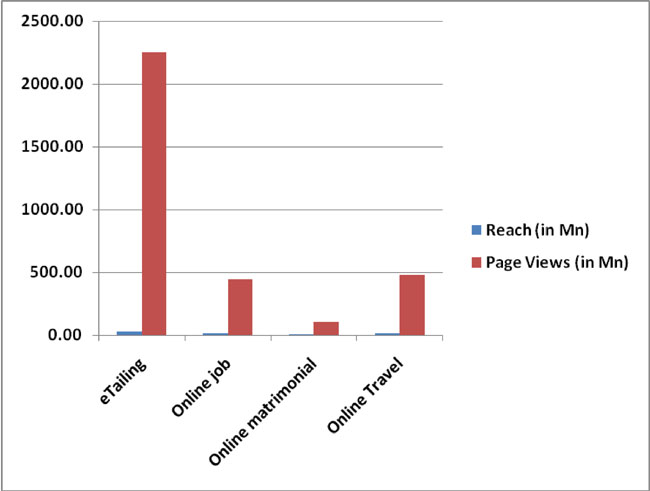
    The Internet Economy Watch Report for the month of April 2013, released by the Internet & Mobile Association of India (IAMAI), indicates 24.84 million people accessed various e-tailing sites. There were 2253.35 million page views in the category. The user reach for job and matrimonial websites is 13.28 million and 7.17 million respectively with 447.68 million and 104.99 million respective page views. As compared to e-tailing and job and matrimonial websites, online travel segment has less reach with 11.14 million reach and 477.52 million page views. The total time spent by users on the e-tailing, online job portals, online matrimonial portals and online travel portals was 52014276 seconds, 25687398 seconds, 7281667 seconds, and 22959918 seconds respectively.


    Fig 1

    Source: IAMAI/ Different websites


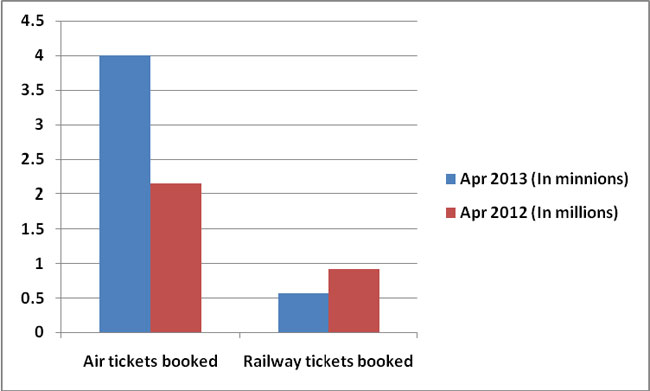
    Report also states a significant y-o-y growth of 87 percent in online booking of railway tickets when compared with the numbers of corresponding month last year. Railway tickets booked online in April 2013 were 4.00 million as compared to 2.14 million in April 2012. The online bookings of air tickets witnessed a decrease of -37 percent with 0.57 million bookings in April 2013 as compared to 0.91 million bookings in April 2012.


    Fig 2

    Source: IAMAI/ Online Travel Portals


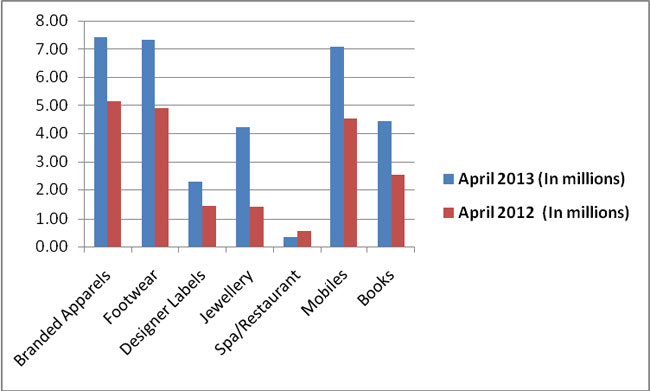
    According to the data captured from major e-tailing sites in the monthly tracker, online visits to designer labels and book segments has increased by 58 percent and 76 percent respectively, when compared to the numbers of the corresponding month last year. A significant increase has been registered in the online users visit to mobile segment. The number of visits has increased to 7.07 million in April 2013 from 4.52 million in April 2012. The online users visit to spa and restaurant segment decreased from 0.57 million in April 2012 to 0.57 million in April 2013, a y-o-y decrease of 38 percent.


    Fig 3

    Source: IAMAI/e-Commerce sites


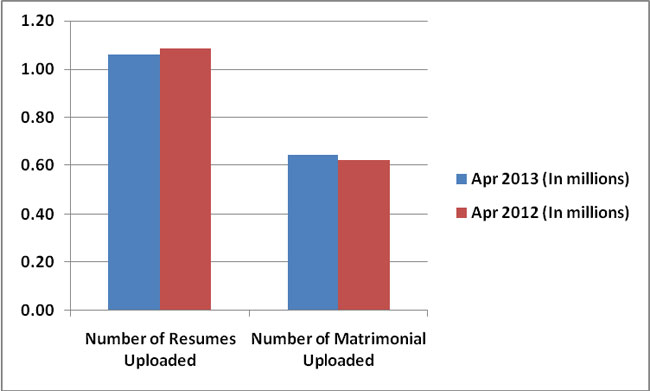
    In April 2013, the number of profile uploads on matrimonial sites has indicated a y-o-y growth of 4 percent. The number of resume uploads in April 2013 was 1.06 million as compared to 1.09 million in corresponding month last year, a y-o-y decrease of 3 percent. The number of profile uploads on matrimonial websites was 0.64 million in April 2013 as compared to 0.62 million in April 2012.


    Fig 4

    Source: IAMAI/ Vertical Classifieds


    The monthly internet tracker by IAMAI is based on absolute numbers captured from various relevant sites, and encapsulates online usage for E-tailing, Online Travel and Vertical Classifieds.


  • Campaign India Digital Crest Awards 2013 on June 11

    By A Correspondent


    Campaign India’s platform to recognize excellence in digital advertising and marketing is back in a new avatar, as the Campaign India Digital Crest Awards (www.campaignindiacrest.com). In its fourth edition, the awards will be judged by an all-client panel comprised of senior marketers and business heads from across industry segments and geographies.


    The process of evaluating entries is currently underway, in 18 categories across web, mobile and OOH. A special category for ‘Showcase’ work has also been introduced.


    Suresh Ramakrishnan, Publisher, Haymarket Media India Private Limited, said, “Like in previous editions, the awards have received excellent response from specialist digital agencies, ad and media agencies, clients and other stakeholders in the digital ecosystem. Work on over a 100 brands is in contention this year, across 18 categories. The handpicked jury is currently evaluating entries, with emphasis being on results delivered against stated marketing and business objectives.”


    Winners will be announced at an awards ceremony on June 11, at Hard Rock Cafe, Mumbai.