Category: Digital

  • WPP highlights key social commerce trends in China

    By A Correspondent


    With ecommerce firmly established as an integral part of China’s highly competitive retail scene, businesses are now looking to social commerce to fuel their next phase of growth. WPP has released a “Content, Conversation & Commerce” white-paper, providing insights into what is tipped to be the next disruptive formula to owning China’s marketplace.


    Buying and selling on social media apps have become commonplace in China. The consumers of today are better informed, sophisticated and particular about what they like. ‘Casual shopping’ is on the rise, driven by the 5Cs; namely content, customer voice, convenience, conversation and commerce, adds a communiuqe.


    Said Patrick Xu, CEO of WPP China: “Chinese shopping habits differ from the rest of the world, due to the tremendous reach of ecommerce and high penetration rates of social media. With unique functions such as Key Opinion Leader (KOL) live-streaming, social activations, content sharing and referral selling, social commerce is challenging the status quo of traditional commerce.”


    China’s social commerce market is forecasted at CNY 2 trillion this year, with more than 48 million users and a growth rate of over 60 percent on-year, according to the Internet Society of China.


    Since 2014, ecommerce sales have more than doubled, thanks to its 650 million users in China. Seasonal events like Alibaba’s Singles Day, the increased adoption of digital wallet usage within rural China, and the creation of market places for buyers and sellers on the same platform have all contributed.


    Key learnings:

    – The ‘now’ consumer

    They are known as the now consumers – shoppers who are quick to browse, bookmark products and buy. Chinese consumers today are better informed and feel more empowered about their purchase decisions. A recent Kantar survey found that consumers’ insights are most effective in influencing purchase decisions. Consumers are more trusting of knowledge that is self-sourced, especially those based on other users’ reviews.

    – New ways of interaction
    The now consumer follows trends and has unplanned brand experiences and retail interactions. They can be shopping while at home, at work, on the go, or just before bedtime. In fact, it is this behaviour that is driving the need for new approaches to planning social commerce.

    – Social-first customer conversion
    Brands are challenged to go beyond traditional marketing strategies. From a desire to buy to making an actual purchase, the customer conversion process now has to be augmented by social-first approaches. These include user-generated and promoter-generated content (UGC/PGC) and live broadcasting. Social commerce channels have had a late start but they are steadily catching up. Wechat Commerce has grown seven-fold since 2014, while other platforms like Pin Duo Duo has doubled its sales in just two years.

    – Measurable customer ‘voice’

    User reviews are verbatim and customer ‘voice’ measurable on ecommerce channels. Such feedback better informs brands on how to build their content and messaging strategy to impact sales conversion. Through these, brands are also rewarding consumers for their referrals and for being brand advocates.

    – Countering inflationary pricing pressures with content

    The advertising and promotional expenses for leading ecommerce platforms have increased notably. CPM (cost per thousand impressions) has tripled within a few years (2015 to 2018) and ecommerce operational costs have increased. As paid ad inventory on ecommerce channels increase in costs, brands are compelled to leverage brand content (UGC/PGC) as an alternative for growth.

    “Brands need to find more efficient ways to connect with consumers. A strategic approach using data and technology would allow brands to tap into the full benefits of social commerce. Should brands rely exclusively on ‘classic’ commerce activities for growth, they may risk long-term brand equity in exchange for short-term gains,” said Xu.


  • Viacom18 offers first SVOD OTT platform with Voot Kids

    By A Correspondent


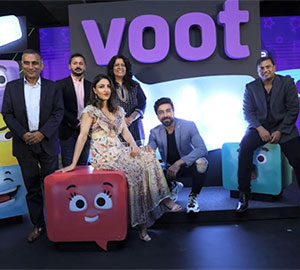
    Viacom18 launched of its first subscription-based service VOOT Kids on Tuesday. Certified by Early Childhood Association (ECA), Voot Kids is built as a multi-format app for children offering some 20,000 videos, e-books, stories and quizzes amongst other things. Priced at Rs 799 for a year and Rs 99 per month with a seven-day free trial in both packages, the app is available to download on iOS and Google Playstore.


     

    Said Sudhanshu Vats, Group CEO & MD, Viacom18: “Viacom18 has grown over the years by focussing on white spaces that are challenging and yet have tremendous potential. As a network, we have been the undisputed leader in kids’ entertainment content since the past five years. Our digital play VOOT is the second largest video-on-demand platform in the country today. VOOT Kids is a synergy of these two growth stories from the house of Viacom18. Marking our sharper segmented foray into the world of subscription-based VoD, VOOT Kids is India’s first and only multi-format Kids app offering Fun & Learning. No other kids app offers Watch, Read, Listen & Learn all at one place”


    Added Gourav Rakshit, COO, Viacom18 Digital Ventures: “The foray into the subscription space with VOOT Kids is the first step in our journey towards building an entire digital ecosystem under brand VOOT. VOOT Kids has been built on the 3 pillars of Product Experience, Content and Safety. In VOOT Kids, we are bringing an offering that is child-friendly, yet parent focussed and gives them an opportunity to bond with an immersive co-consumption experience. Our brand philosophy of ‘Masti Mein Acchai’ reflects our mission to make screen time meaningful.”


    Said Saugato Bhowmik, Business Head, VOOT Kids: “VOOT Kids is a category creating product in the space of digital fun learning that caters to needs of discerning Indian parents who seek meaningful screen-time that aids in holistic development of the child’s mental, emotional and social faculties. The app has the largest and most versatile offerings in the space of toon videos, e-books, audio stories and fun quizzes that provides children with a parent-controlled, safe and entertaining content destination.” He further added, “We believe masti should never be served up without acchai and the same holds true the other way around. And this is our guiding philosophy at VOOT Kids”


  • Men Rule OTT in India. 66% males dominate viewership


    By A Correspondent


    The audience size of regular OTT (online video content) audience in India stands at 76.5 Million (7.65 Cr), according to the findings of The Ormax OTT Audience Report: 2019. Mumbai and Delhi lead the top markets, with 3 million regular OTT audience each, followed by Bengaluru, Hyderabad, Kolkata, Ahmedabad, Surat, Chennai, Pune & Jaipur.


    The study, conducted among 15+ age group, also profiles the OTT Universe. 66% regular OTT audience are men, while 34% are women. 25% belong to the 15-21 yrs. age group, 34% in the 22-30 yrs. age group, 21% in 31-40 yrs. and 20% in the 41+ age group.


    The research report covered a sample size of 10,000 audience over the period of May to September 2019, whereby audience were sized and profiled based on their OTT consumption behaviour, usage of various OTT platforms/ apps, and their content choices. The study defined ‘regular OTT audience’ as someone who watched two or more hours of OTT content every week, and uses at least one website/ app besides YouTube and social media to watch video content online.


    Speaking about The Ormax OTT Audience Report: 2019, Shailesh Kapoor, CEO – Ormax Media, said: “OTT is an emerging and fast-growing category in India. While individual platforms have a lot of a data on their own audience, there is little industry-wide understanding available on who the OTT audience in India exactly is, how many are they in number, where do they exist, how do they watch, which genres do they prefer, what are their subscription triggers, and many other such questions that are extremely relevant to any OTT business. This report, which will be an annual feature, answers many such questions in a manner that’s highly actionable, with direct implications in decision-making in the areas of content selection, target audience choice, media planning, market research and brand communication”.

     

    Among the OTT platforms, YouTube emerges as the most-preferred OTT brand, followed by Netflix, Amazon Prime Video and Hotstar closely vying for the second position. ALT Balaji’s Gandii Baat emerged as the most male-skewed show, while Amazon Prime Video’s Mind The Malhotras emerged as the most female-skewed show.


    The report also highlights how solo consumption is still the dominant viewing behaviour seen in the OTT category, with 82% audience typically watching online videos alone. Hindi emerges as the most-preferred language of online video consumption at 62%, followed by English at 22%, while regional languages, led by Telugu and Tamil, control the balance 16% share.


    The Ormax OTT Audience Report: 2019 is a syndicated report that’s now available for subscription.


  • Sadly, India Shining in Mobile Ad Fraud


    By A Correspondent


    Mobile Marketing Association, a global non-profit organisation, has released its ‘Ad Fraud Benchmark Report’ on the state of mobile ad fraud in India. The report revealed telling facts about the level of fraud, and its awareness in the country and aims to help marketers benchmark their exposure to various kinds of fraud.


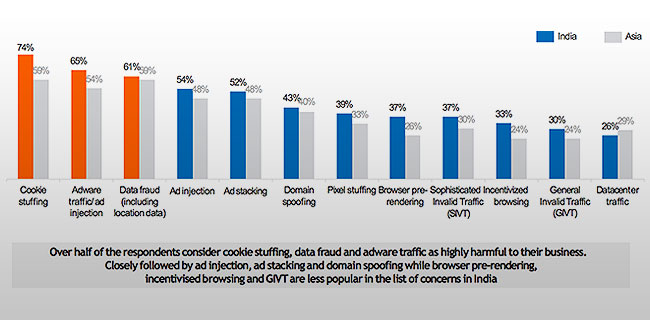
    The report has been published in collaboration with research firm Decision Lab, with the objective of understanding the current industry practices around ad fraud and the methods adopted by marketers. It also highlights the rising and prevalent issues such as adware traffic, ad stacking, domain spoofing, that will help marketers understand organizational challenges and combination of various measures to tackle the problems effectively.


    Speaking on the launch, Moneka Khurana, Country Head, MMA India said: “In India, the awareness on ad fraud risks is very low with almost a fifth of the marketers being unclear of their ad fraud budget and majority of them believing that fraudulent activities will only increase. Brand safety on mobile is the biggest concern today and this benchmark report clearly demonstrates that this needs immediate addressal. Marketers will need to be extra cautious to attacks such as ad injections, data fraud, cookie stuffing, etc. Marketers must understand the potential of technologies such as Blockchain that can help solve issues related to fraud and create security and transparency in mobile marketing ecosystem.”


    Key highlights from the report are:

    :: With a rate of 62 per cent, mobile ad fraud remains as one of the biggest challenges in India

    :: Indian marketers spend nearly 20 per cent of their advertising budget on ad fraud

    :: 9/10 marketers feel there is scope for improvement in ad fraud prevention methods

    :: 95 per cent respondents feel that lack of penalties and transparency in industry regulations give rise to ad fraud

    :: 95 per cent respondents agreed that lack of data sharing and large number of middlemen are also a cause to ad fraud risks

    :: Major types of ad fraud – Cookie Stuffing (74 per cent), Adware Traffic (65 per cent), Data Fraud (61 per cent), Ad Injection (54 per cent)

    :: Only 37 per cent respondents are aware of Blockchain and its application to fraud prevention


  • Bhuvan Bam makes a point in latest ad film for Lenskart.com

    By A Correspondent


    Lenskart.com has unveiled its ad film with digital star and brand ambassador Bhuvan Bam to launch its AIR range of eyewear.


    Commenting on the new TVC and product offering, Peyush Bansal, Founder and CEO, Lenskart.com said: “Disruption is the DNA for Lenskart.com and consumer obsession remains our sole guiding principle. From our passion to deliver the best in class product like Lenskart Air to engaging Bhuvan Bam, a youth icon and the relatable hero for the masses, we stay committed to reaching and delivering only the best to our customers and fans. The new campaign Halka Rakh yaar is born out of a key consumer insight- the increasing need to keep things light and easy going, in every facet of life and the Halke Phulke frames of Lenskart Air are the trustworthy partner in this endeavor. The TVC is an ode to this carefree, spirited approach and with his unique lighthearted attitude, Bhuvan has added a fresh twist to the TVC.


  • The Big OTT Growth Story: Chapter 3


    This is the third in a series of columns on the OTT Growth Story in India.

    Links to previous chapters: Chapter 1, Chapter 2

    By Shailesh Kapoor

    76.5 Million. That’s the all-important number to look at from The Ormax OTT Audience Report: 2019. The recently-concluded research, designed to size and profile the OTT audience market in India, took up the task of first measuring the number of ‘regular’ OTT audience that exist in the country currently.

    The definition of ‘regular’ can be subjective. Based on our category experience and market feedback, we defined it as: Audience who watch online videos for at least two hours every week, and use at least one OTT platform/ app, apart from YouTube and social media, to watch videos.

    The study covered 15+ audiences, and hence, does not include kids. It emerged that 76.5 Million, or 7.65 Crore, is the size of this market in India currently. The next track in 2020 will establish the growth rate. The question is: How small or big is this number?

    Comparing to TV universe can make the number look very small at this early stage of the OTT category. But a more obvious comparison can be made to the theatrical universe. The Bollywood regular theatre-goers universe stands at 33.3 Million, or 3.33 Crore. Add the unduplicated components of regional universes, especially the bigger ones in Tamil and Telugu, and the overall regular theatre-goers universe in India touches the 6 Crore mark.

    Let that sink in. The regular OTT audience universe in India is already bigger than the regular theatre-goers universe in India. And the former is growing in top gear, while the latter has flattened out for almost a decade now. This gap will only get wider.

    Only 15% of the regular OTT universe belongs to the top 6 metros in India. There’s a healthy longtail, created because of falling data costs and the penetration of Jio into small towns and villages in the last 2-3 years. But there’s enough scope for growth across markets. Mumbai and Delhi, the top 2 cities, have about 3.0 Million regular OTT audience each, which is nowhere close to saturation, given the huge adult population of these big metros. The equivalent theatre universe size in these metros is 3.2 Million (Mumbai) and 2.8 Million (Delhi). Hence, the two biggest cities have similar OTT and theatrical universe sizes. It’s beyond the metros, where theatre penetration, content relevance and ticket pricing remain key issues, that theatre-going habit loses out to OTT, a scenario that would have seemed quite unlikely till three years ago.

    The recent trend of films going directly to OTT (read here) is another sign of how OTT has emerged as a robust option for entertainment, and the price factor, which would have earlier been a big discussion point (“Indians are not used to paying for ‘television’ content”) is slowly becoming a lesser factor, with most OTT platforms coming up with rationalized pricing packages for the Indian market.

    As an aside, Amazon Prime Video’s The Family Man has emerged as the big show of the year, scoring an Advocacy Rating of 80, just a point below Sacred Games S1, to become the second most-liked India OTT show ever. A few more such winners and the OTT universe will continue to flourish.

    125 Million by 2020?


  • Grapes Digital to handle Omved Therapies’ digital

    By A Correspondent


    Grapes Digital has won the entire digital duties of Omved Therapies. Grapes Digital will manage the company’s digital mandate comprising social media, digital strategy, influencer marketing along with creating innovative content strategy.


    The account was won in multi-agency pitch and will be handled from the Mumbai office.


    Commenting on the win, Himanshu Arya, Founder and CEO, Grapes Digital said: “Skin care market in India is rapidly evolving and growing market. We see a lot of scope of interesting digital campaigns which will help Omved Therapies reach out to a larger customer base across the globe. We look forward to our association with them.”


    On this association, Vaasu Birudukota, Director, Omved Therapies added:  “We are super excited and proud of our new partnership with Grapes Digital. We were looking out for an agency for quite some time with good experience and understanding of the growing digital & social platforms. In the process, we identified and joined hands with Grapes Digital to strengthen our digital reach. We noticed real good work contributed to various brands and look forward to mutually beneficial journey ahead for both of us”


  • Myntra highlights its role as a fashion expert in new ad

    By A Correspondent


    Myntra has announced the launch of #BeUnskippable, a new brand campaign that highlights its role as a fashion expert for its customers. The positioning pivots on Myntra being the facilitator for people to make an impression with fashion.


    Said Harish Narayanan, Head – Marketing, Myntra Jabong: “This is an important campaign for Myntra from a brand perspective as it implies a shift in our positioning with the progress we have made so far as a brand. We have passed the stage of defining who we are or what we offer, which is clear in the minds of our consumers and so are focussing on aspects related to enhancing the spirit of fashion in people, showcasing that we understand their needs and how we can help them. The new campaign establishes a strong pay off for people looking to make a lasting impression through fashion.”


  • Voot brings out the fun in kids via #MastiMeinAchhai campaign

    By A Correspondent


    Voot Kids has unveiled its launch brand campaign, #MastiMeinAchhai. The film is created and directed by McCann Worldgroup India.


    Commenting on the campaign, Saugato Bhowmik, Business Head, Voot Kids, said: “Digital literacy is important, and we strongly believe parents play a pivotal role in making the digital journey of their kids more profound by exposing them to appropriate and entertaining content. Voot Kids is the only app to offer Watch, Read, Listen & Learn all in one platform and our brand campaign #MastiMeinAchhai decodes this proposition and bridges the gap for parents and kids to explore Edutainment in its truest form.”


    Speaking on the key insight that lead to the campaign ideas Ashish Chakravarty, head of creative and executive director, McCann Worldgroup added: “The story in the film revolving around the constant tussle between parent and child over mobile screen time is a highly relatable one and will find resonance in every household with kids in India, we feel. What is fun to watch in the film, is the story told both from the perspective of the kid and the parent. The little boy -a bonafide James Bond scheming and plotting for his parents’ mobile phone and the parent who is in-the-know all along. The nostalgic track Akkad Bakkad takes us down memory lane, captures the mood and sentiment of the ‘cat and mouse’ situations and complements the film perfectly!”.


  • Sidharth Kedia appointed CEO of Nodwin Gaming

    By A Correspondent


    Nodwin Gaming has appointed Sidharth Kedia as its CEO to spearhead and drive the online gaming business in India. Kedia, who was until recently EVP and Head of Strategy, Data Science and e-sports at Viacom18, will be based out of Mumbai where he’ll open the first regional office for Nodwin Gaming.


    Announcing the news, Akshat Rathee, Founder and Managing Director of Nodwin Gaming said: “It’s an exciting time for the firm as the overall e-sports scene in India is on the cusp of exponential growth. We are thrilled to have Sid joining us as the CEO at this time. With his rich experience in the media, entertainment, technology, and investment sectors coupled with his in-depth understanding of the gaming space and his proficiency in scaling businesses, I’m confident his leadership will provide the fuel that will propel e-sports and Nodwin Gaming to the next level. We wish him all the best. The CEO function will continue to report to the Managing Director and the Board.”


    Added Kedia: “In today’s age of digital disruption where several of our cultural experiences are undergoing an online evolution, e-sports has become an unequivocal buzzword. The gaming business in India is finally coming of age. The journey of e-sports that began as a virtual battle between geeky gamers in the confines of their homes or cybercafés a decade ago, is no longer just fun and games but has evolved into a major organized sport recognized at the Asian Games and even the Olympics. I am equally enthusiastic and anxious as I take up my new role as CEO and aim to make Nodwin Gaming a global player when it comes to e-sports.”


  • VMateFilmistan campaign encourages users to participate and win cash prizes

    By A Correspondent


    UCWeb’s short video platform VMate has introduced #VMateFilmistan campaign for its users who can collectively win cash prizes and rewards worth Rs 3 crore.


    Said Nisha Pokhriyal, Associate Director, VMate: “As India’s first VR sticker app in the short-video making community, VMate is paving a new path for the users to explore an entirely different side of the world of technology. This also adds a new dimension in the entertainment industry and allows users to experience the innovative concept of VR on their fingertips. Since Bollywood is highly relatable among Indians, we are receiving a huge response from users of all age-groups irrespective if their technical know-how especially the Housefull 4 movie set.”


  • Nielsen India predicts the scope of e-commerce sector in India

    By A Correspondent


    Nielsen India expects the fast-moving consumer goods (FMCG) sales coming from the e-commerce channel to grow to $4 billion by 2022. The channel contributes 2 per cent to the current FMCG market. These are insights from Nielsen’s recently launched E-Trak Index – a measurement solution that tracks the FMCG E-Comm industry.


    Metros lead the e-omm FMCG race with a 6 per cent contribution from the channel to total FMCG sales. Amongst these, Foods is the biggest contributor with 44 per cent; then it is personal care (40 per cent) and household care (13 per cent).


    India’s first such solution is created using aggregated ePOS (electronic point of sale) data from cooperating E-commerce players and data science backed estimation for non-cooperating E-commerce players in India. The index adds a crucial element to the Retail Measurement Services that Nielsen provides by adding a view of the FMCG E-Comm space for All India Metros currently – with monthly read for Total FMCG, Super-categories, Category level for about 20 categories and for 11 categories at a top manufacturer level. Manufacturers and marketers get data, information and insights that can be further used to hone their E-Comm channel sales strategy to help shape a smarter market.


    Announcing the launch of E-Trak, Prasun Basu, South Asia Zone President, Nielsen Global Connect, said: “Measurement is necessary. Measurement is difficult. Best possible measurement.” Explaining this further he added “Data and insights from Nielsen’s Retail Measurement Services continue to provide an essential foundation for manufacturers and marketers to understand their market. In this rapidly evolving world of commerce, India’s FMCG industry is now making its presence felt in the E-Comm channel – appealing to consumers’ need for convenience, and in sync with increasing smartphone and internet penetration. To give a truly complete picture of the changing marketplace, we are happy to announce that Nielsen India has launched a specific E-Trak index that will now measure FMCG consumer offtake in the E-Comm space – marrying this with trends seen in modern and traditional trade to get a read on omnichannel in the country.”


    Added Sharang Pant, Head-Retail Measurement Services and Retailer Vertical, South Asia, Nielsen Global Connect: “While the foundation is taking shape, E-comm’s dynamic nature has made it a disruptor in the marketplace. E-Comm has seen a transformative journey and is now a $1.2Bn Industry growing from 0.5 per cent contribution in 2016 to a 2 per cent contribution in 2019, and slated to be 5 per cent in 2022 – this is in half the time that brick and mortar retail took to evolve. That said, these channels are not cannibalizing each other, and all continue to grow with E-Comm outpacing modern trade and traditional trade. The view that Nielsen presents on understanding channel, category and consumer trends will directly help players understand the right strategy in terms of assortment, pricing and positioning to win with the evolving consumer”


    Said Nitya Bhalla, Head- Data Science, South Asia, Nielsen Global Connect: “Given the significance of the channel from both a current as well as future perspective, Nielsen has built a unique state of the art hybrid model for estimating this dynamic and growing channel. The methodology involves leveraging data from key collaborating E-tailers in the FMCG space. We then use crowd sourced data coupled with machine learning techniques from a panel of 200K+ consumers to estimate the Ecommerce sales for FMCG products.”