Category: VIKAS MEHTA

  • The South South divide


    With apologies to none at all

    By Vikas Mehta


    Vikas MehtaLast few years I have spent a considerable amount of my time visiting business schools in South India. In cities like Hyderabad and Coimbatore, I had the opportunity to interact with thousands of Gen Z students. And, because I always stayed on the campus for any time between one to three weeks at a stretch, it also gave me an opportunity to mix and interact with students as humans. I have also been involved in interviewing MBA candidates and as such I have gleaned some interesting information and, dare I say, insights into Gen Z and their families from South India.


    We have always talked about the North-South divide in India. The difference is in almost everything. Appearance, food habits, culture, religiosity, politics, language. It’s almost as if India has two types of people, the northeners and the southerners. While it may be ok to lump the states of UP, Uttarakhand, Bihar, Rajasthan, HP and MP together as there are lot of similarities; linguistically, food-wise, religiously and even culturally, the same does not hold good by lumping all south states together as one. I am not saying that northern states are similar in all aspects but they have a commonality that runs through. The same is not the case in the southern states. And the dissimilarities start with language which are very different in not just oral but also in script. But let’s avoid the obvious dissimilarities and try to focus on some not so obvious.


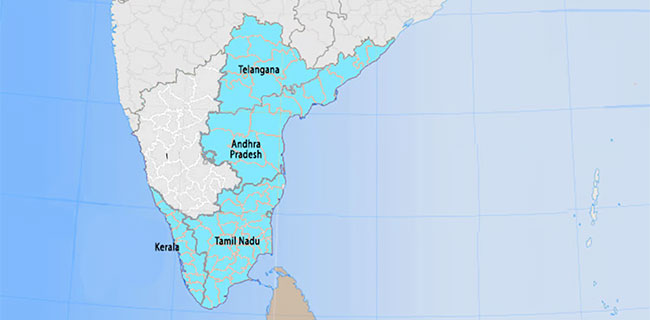
    My inferences cover the four states, Telangana, Andhra Pradesh (AP), Tamil Nadu (TN) and Kerala as Hyderabad is a magnet for Gen Z for not just jobs but also for education from all southern states and Coimbatore being close to Kerala, attracts Gen Z talent due to its educational institutes and textile industry.


    Before, I talk about the divide, one similarity which I saw across the states was that almost like in north, most state students are not too fluent in English. The common perception is that since they do not know Hindi, their English should be good. But they think in their own language and then try to translate the thought in their mind. So, these Gen Z know English but are not comfortable expressing themselves in english.


    The first thing that surprised me was the number of parents of Gen Z who were self-employed. And this was very true for AP. We think that Gujaratis and Marwaris from Rajasthan have a flair for business in India and most traditional business houses reflect that. Birlas, Tatas, Goenkas, Mahindra, Bajaj, Ambani et al are all from Gujarat or Rajasthan. And then who has not heard of the Patels and Shahs and Jains and Solankis into some business or trade. In the US, Patel motels is almost used as a generic term for inexpensive highway hotels.


    But the Reddys and the Rajus and the Raos and the Naidus are catching up. Look up who owns the GMR and GVK conglomerates. Which state has the largest number of fish farms? Gujarat exports the most seafood from the country and is also the largest marine exporter. But that is because most of its produce comes from the fish farms of AP besides its fresh catch. Andhra has a long coastline but the business acumen of its inhabitants has turned aqua farming into a huge export business.


    With the bifurcation of AP and Telangana, and the consequent need for land to set up government and administrative offices and also residences, land prices in both states have shot up. Consequently, both states have reaped many entrepreneurs dealing in property and construction. AP is also very rich in certain mineral reserves like bauxite, limestone, mica, asbestos and even iron ore. Granite is another mineral which is mined and exported from AP. All this has spawned a huge wave of entrepreneurs, from mine-owners to dealers to traders to exporters and to retailers.


    There is a big number of private moneylenders too. They lend money at exorbitant rates to a small circle which grows only by introduction. Usually, these money lenders thrive when there is some economic crisis and currently with RBI tightening the lending conditions, and  even NBFCs and fintech companies shying from small ticket personal loans these lenders are the lenders of last resort. A business which reflects the thin line between legal and illegal. A business which the Gen Z children do not either approve of or do not want to continue.


    The spirit of entrepreneurship has also caught up with much of the Gen Z. They want to not just take over the business but also diversify. And the presence of Hyderabad city as a cyber-hub has spurred many Gen Z into startups. Many MBA students or aspirants from a business background want to use the opportunity of grabbing a job in IT companies as a starting point to gain experience and maybe save some money. But three to five years down the line, the entrepreneurship bug catches on. Traditional family businesses are diversifying, automating or venturing into totally unrelated areas.


    This also has caused a conflict. The Gen Z entrepreneurs are more risk-taking. They don’t mind getting into capex with loans. Many into the food and service industry are finding the franchise model to be lucrative. All this does not go well with the elder generation. Though they are steeped in risk-taking, they still are not sure of growing too fast too wide. As a result, the spirit of rebellion or charting their own course is strongly manifested in the Gen Z thinking in AP and now also in Telangana.


    Another very interesting aspect in both AP and Telangana is that they send the highest number of PG and B Tech students to the US. While this may be attributed to the flourishing self-employed businessmen who can afford to pay hefty fees in the US, it also points to another interesting trend. The AP and Telangana students are worldly-wise and well-informed.


    It’s almost as if the internet revolution and the emergence of Hyderabad as a cyber-capital has spurred on a new internet culture. Gen Z is not only well-informed but also less traditional. They question rituals and traditions are not scared to question authority, The reverence towards elders, religious men, professors etc which spawned a no-questions-asked culture seems to be disappearing.


    And this is amplified when one compares to Gen Z from the state of Tamil Nadu. The generation is still steeped in tradition. Every year, I find students who follow the 41-day spartan living called manadalam before undertaking the Sabarimala climb. Being barefoot, eating non-spicy food, wearing black or blue veshti is followed even in classrooms. I am not criticising or calling it out. Just saying how it is prevalent as compared to Telangana where a visit to Tirupati temple is no more a must for Gen Z.


    What is more interesting however is the acceptance of the rituals without any questions asked. I always ask the students the significance of 41 days or why is fasting required? Their answers or the lack of them show an absolute respect to authority, with no questions asked. I get the same attitude in my classes. Questions are asked but not debated. The respect for authority, restrains the mind which can explore much more.


    Interestingly, I find the global effect in the food habits of Gen Z from AP and Telangana. Their cuisine tastes go beyond the local. So, a biryani or kebab or the chilli in food is loved in Hyderabad but a burger or a pizza or a salad is a part of the menu on the campus. In a Coimbatore campus, the traditional food still matters. There is non-vegetarian but hardly any fast food or salad types. And when I ask Gen Z students about burgers or [izzas, the answers are muted. Maybe even here, what the authority say is what matters.


    Tamil Nadu Gen Z is risk-averse. Most students are looking for jobs. Entrepreneurship is not something that they want. Maybe do some consultancy later on but not setting up industry or get into production. They seem to have moved somewhat away from the lure of a permanent government job to a result-oriented and more rewarding private sector. But the ultimate leap of entrepreneurship is still not burning strong as in AP student.


    The students from Kerala are very similar to Tamil Nadu. Except they are also well-exposed to the world. And I suspect that is so because of the high population of NRIs in Kerala. They may be white collar offsprings but the advancement in the Middle East is something they are aware of. Their exposure to global knowledge makes them maybe more inquisitive. Yet, not many are inclined to go abroad to work. About a decade ago, when I was in the Middle East, I would interact with many Keralites whose one dream would be to get their children get a job in the tax-free countries of the Middle East. But I am surprised that most of the Gen Z that I have come across from Kerala are not inclined to do so. They believe that the future in the country is bright and they aspire to do something on their own.


    So, while Gen Z who belong to the flourishing self-employed business families of AP aspire to go to US and do their Masters (and settle down there), the Gen Z of families from Kerala who are working in the Middle East do not want to go abroad to settle down. The divide could not be starker.

     

  • Arrogance of a leader


    With apologies to none at all


    By Vikas Mehta


    Vikas MehtaI write this column from 30,000 plus feet in the air while travelling on an Indigo flight. This is my seventh Indigo flight in the past four months and almost every flight has convinced me that Indigo is a classic example of a brand leader which has taken its leadership for granted.


    Sure, in the initial stages of growth, the brand did all the right things. It had a relevant product. Its pricing was just right and it invested in good systems and processes. Its brand communication, personality and its touchpoints with its customers were consistently on the mark. It was a professional approach and was marked by learning and taking on board international practices too.


    It also was one of the few brands which handled its growth well. Its on-time performance and a no frills experience never took a back seat. But then hubris set in


    The brand did not understand that there is a thin line between professionalism and lack of empathy. There has been enough talk in media of cases where Indigo staff did not show empathy for passengers with disability or were rude while dealing with consumer complaints at the airport, but let me share two-three small examples to highlight the lack of empathy.


    My current flight was delayed by 90 minutes. I have a connecting flight to catch in 150 minutes. Since the PNR was different, Srinagar could not check my bags through and through. So, I had to deplane, collect my bags and check in again. With check-in closing 45 minutes before departure, it would’ve been an impossible task. And the delay messages came only after I had cleared security. I contacted Indigo on Twitter, with a DM as well. An apologetic response came after well over an hour. I tried the AI assistant who couldn’t help and asked me to call helpline or get in touch with ground staff. I called helpline, which spent two minutes through an automated message to convince me to go to the AI assistant! Finally, I was connected with a customer service rep after eight minutes. She was also helpless as she said that I can book you onto a later flight only if the flight is delayed by two hours not if it’s late by 90 minutes.


    In frustration, I contacted the ground staff. They were warm and courteous, a very Kashmiri trait and assured to help out. After going through three ground staff members, one rescheduled my connecting flight to a later flight. No two-hour rule now? But I don’t care. I am a bit relieved. But frustrated as hell about this 2 hour delay rule. The empathy shown by the ground staff was not only rare but a very cultural and personal trait. And yes, one of the ground staff also assured me at boarding that my bags (he had taken screen shot of my baggage tags) will be delivered on priority basis. More on that later.


    While flying to Srinagar, with a slightly sore throat, I had prebooked a meal. It included a beverage. I asked for a hot one. But was first informed that no hot beverages were served on this sector. I immediately showed them the fine print in their menu which said that hot beverages were served on flights longer than 60 minutes. This was a 75-minute flight. Then she switched to the excuse that as the seat belt sign was on the rule prevents them from serving hot beverage. Yes, the seat belt sign was on, in fact it was never switched off after take off and I do understand that serving hot beverage may cause inconvenience to the passenger. But, there was no turbulence and passengers were not being stopped from going to the toilets or move around.


    When I refused to have a cold beverage due to my sore throat and insisted that either I get a hot beverage or no beverage and that I intend to question on why was there an inconsistency in applying rules for ‘seat belt on’ sign, the stewardess promptly went to the galley and got, not just me but another passenger the hot beverage. Why could she not show a little empathy? Professionalism demands that you do not serve hot beverage when seat belt sign is on. But it also demands that you apply it consistently. Why, even the food service should have been stopped. But then that would have meant loss of revenue as refunds would have come into play.


    Exactly the same story was played out in this trip too. First, the story about no hot beverage. Then about no seat belts and then that they are not carrying coffee. I spoke to the senior stewardess and said that the same story being repeated twice is not a mistake but a deliberate attempt to avoid service and I intend to complain. At that stage, she was apologetic and offered to placate me with some nuts or a cookie jar which I promptly refuse. Clearly, the airlines is taking advantage of the flier ignorance and throwing arrogant rules which is contrary to their own rules. And for that to happen twice is arrogance.


    And the fact that revenue is more important than empathy was further highlighted when at Coimbatore airport the same airline changed its departure gate four times in 15 minutes. We were first informed that the boarding will be from ground floor, then made to climb up, then come down and then move to an adjoining gate. All this was happening with announcements over the PA systems with no Indigo staff at hand to ensure that escalators or lift were working, specially for the aged. Finally, I called for the duty incharge. I had to do some name dropping before I got some explanations. He said that the gate was changed as the incoming flight was slightly delayed and another airline was scheduled to take the ground floor gate. But as that airline completed boarding fast and the Indigo flight had not yet landed they reverted to the original gate as the first floor gate was aero bridge which would mean longer de boarding and boarding time and subsequently a delay. So, empathy was dumped and the airline shuffled its passengers around. To keep its on-time record perfect, under the guise of professionalism, the airline became arrogant vis a vis its customers. Oh, you ask why the fourth change? Because, the ground staff had not informed the security who had locked the gate and gone away. So, again empathy was dammed.


    I am not going to bore you with more examples, but you get the drift. So, why do I continue with Indigo is the next question? And the answer is the reason why this market leader brand has become arrogant. I have no choice. Air India has hardly any good connections or scheduling choices. Go First is dead. SpiceJet is limping. And Indigo knows that. So, it’s become arrogant. And that’s a pity. Because the day I have alternative, I will dump Indigo. And so will many others.


    The link between being professional and being empathetic is very strong. For that you have to empower your employees. Their KRAs have to include empathy demonstration, specially when you are in customer facing role. If I am staying at the Taj, not any 5 star hotel but the Taj, and my toothpaste or shaving cream, which I am carrying is running out, the employee actually replaces it, with a sweet note. She gets the same brand, without my telling her or asking her, in fact without even meeting and it’s quietly replaced. So, that one empathetic gesture allows me to forgive some mistakes. And she has done it because she is empowered to do so. Similarly, when I complain to Amazon about late delivery or wrong delivery of an order the CS executive issues on the spot refund. That’s empathy because the employee is empowered.


    Maybe Indigo has streamlined empathy also. So, if fasten seat belt sign is on, do the food service. Allow the passengers to go to the toilet. But no serving hot beverage. Or has it empowered the stewardess to take the decision? For Airlines, definitely safety is the first criteria but does it make empathy its second criteria?.


    Or it is all just about streamlining and standard operating procedures, leading to arrogance. This one lady at Srinagar airport showed empathy. But it was her. Not as a rule but as an exception.  Indigo needs to build on its market leadership opportunity with empathy and consistency not arrogance or profit oriented empathy. Else remember the Taj example. Indigo will give an opportunity to someone like Air India, which has had a reputation for empathy, to sneak in.


    And, yes, my bags that were promised to be delivered on a priority basis? They came last. I am not joking. The last two bags on the belt were mine. Arrogance for asking to be helped out? You decide.


    Vikas Mehta is a Dehradun-based business strategy consultant and educator. He writes on MxMIndia every other Monday. His views here are personal.


  • Vikas Mehta: Time to reset education

    With apologies to none at all

    By Vikas Mehta


    Vikas MehtaI am a father of a daughter who pursued humanities and now wants to combine her passion for sports (she plays tennis, football and follows cricket) and communication with a career in sports journalism. Further, she has a flair for sketching and I thought that the three ingredients will make a deadly concoction which will help her to carve out a career which she will not only embrace but also be fruitful.


    Note the use of the word “thought” and not “think”. Because in the last one year, I am struggling to understand how fast the world is changing. I have written in some of my past posts that I am associated with some postgraduate courses and also screen MBA candidates. This has helped me understand the changes in the world of education also from close quarters. I am now very worried, both as a father of an aspiring journalist and as an educator for the skills of today’s generation.


    And the one factor that has caused this upheaval is artificial intelligence, AI.

    I think the early adapters of AI, besides the technologist and innovators have been students. Till now, Google was the equivalent of Goddess Saraswati for them, a huge store of knowledge which would dissipate information at the click of a key, Google became a teacher by default, specially during the pandemic. But, it was still all about information and knowledge. AI has taken it a step further. It now fulfills the role of a creator. Maybe its like God Brahma. But unfortunately, what it is doing is akin to Lord Shiva, the destroyer. And unfortunately, the students are not realising or understanding it.


    You have to submit an assignment? Chill. Chat GPT will do it. Need data dissertation? Use Kyndryl. Write an application to a University or write an SOP, I don’t even need to tell you which AI tools to choose from.  And now even if you have to crack a case study, study.corgi.com has a case study analysis generator.


    So, why am I calling them as destroyers? Simply because it has made the students lazy and they don’t learn anything. Sure, they get good grades but have they added to their skills? Are they now industry ready?


    You may say that the fault lies not with the students but with our examination or grading system. Grades count. So, the students main aim is to score marks. Game the system. Partially true. Because even if we remove exams or grades and just ask for submissions and give them just a genuine feedback, the students will still use the tools because they pander to the basic human habit of being lazy.


    Education institutes have reacted typically. With penalties. Some first tried banning AI tools. Then came plagiarism or AI tool detector software. And then institutions allowed a certain percentage of the report or submission to be AI generated. Ok, so, you are submitting a report on how the Ukraine Russia war helped the Indian economy? Only 15% of your report should be AI generated. Who decides the 15%? The detecting software. So, what is the message we are giving the students?


    We caught you cheating. Now you will be punished. Copying has been a bane of the Indian education system. Harsh punishments were devised. But did it stop students from cheating? No. So, with the advent of AI what we have done is that we have made AI the new cheating hero and the new grading villain. And we are inventing new software to stop them from cheating. We are just continuing the cat and mouse game.


    What then is the solution? I have always believed that the best solution is to do away with any type of exam, grading or ranking. Teach. Then discuss. Then try some real life case as problems and try to crack it. And no, this is not a solution for MBA but also for schools. Let me explain with one example.


    Today, many a times, UG students are unable to explain the meaning of their percentage score. If they have secured 80% marks, they cannot explain it except for telling the formula used to arrive at it. But they do not understand that 80% means that if the total marks were 100 then one scored 80. Or ask an intermediate science student to give an example of Newton’s third law, mostly they will give an example from their text book. If you throw a ball at the wall……. Ask them from one more and they struggle.


    But what if they are explained these concepts with examples. They understand its importance and its usage. How to use a formula is not even required. Because your phones or calculators do that. So why waste time and effort in the calculations and based on that grade them or rank them? Instead teach and then discuss. Discuss real life instances. Discuss exceptions. Discuss deviations.


    Use AI to break down concepts. Use AI to understand a complicated concept by asking the tool to simplify it or by giving an analogy. Use AI tools to discuss different scenarios. Make AI the hero. Not the villain. Make AI your ally in a positive way. Can’t beat it? Join it. That way the students will learn more and find studying interesting too.


    Sure, in some areas you still may need some exams. But the exam system has anyways produced mass of underskilled students. Why not try something different? From the school stage itself.


    So, is the use of AI what worries me about my daughter’s future? Yes and No. Definitely AI is a threat in taking away jobs and making human redundant. But no, because the way we have siloed even education into humanities, commerce and science means that humanities and commerce student shy away from AI.


    “I hate maths or numbers” is the most common refrain from humanities students. The point is they don’t hate numbers. They hate the way it is taught. So, if one removes exams and just teach, discuss and relate it to real life, there will be less hate type of statements. There will be more acceptance of science and technology even amongst the humanities or commerce inclined.


    And that should be the ultimate objective. Get everyone to learn some technology. Don’t ghettoise or silofy it. Doing this from the ground level in school will help. But there is a huge chunk of students today who need indoctrination in technology. The challenge is to bring this already mature, already set, already decided student to accept and try and learn bit of technology.


    So, can we reset now? The NEP will help but it is work in progress and will not help current graduates and undergraduates. Education institutions need to start looking at and address this issue first.


    Is there any education institute which will take up the challenge to make science, AI type of subject more acceptable to my daughter?


  • Ram Mandir Consecration: Opportunities drowned in Moment Marketing?


    With apologies to none at all

    By Vikas Mehta


    Vikas MehtaJanuary 22, 2024, I guess, will become a watershed day in the Indian history. It was a culmination of a well-orchestrated movement led by the state and I think it may become a celebrated case study in marketing too. But my article today is not about the temple consecration or how it became a marketing case, lest I be accused of sacrilege, it is about how brands did or did not latch onto this moment marketing occasion. And as I live in Dehradun, close to the heartland of the temple movement, I shall look at it from this viewpoint.


    I take back my words. This was not a moment marketing case. It could have been an opportunity to take the whole occasion as an opportunity and drive maybe even a long-term marketing campaign for a brand. But, unfortunately, that’s not what happened. Brands and companies by sheer shortsightedness turned it into just moment marketing.


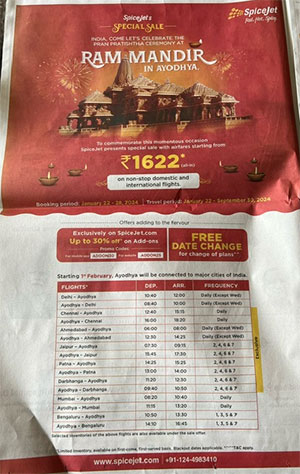
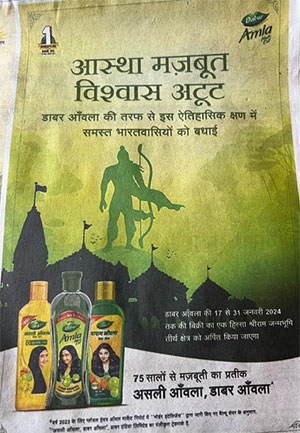
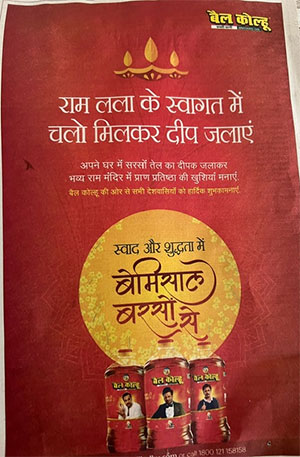
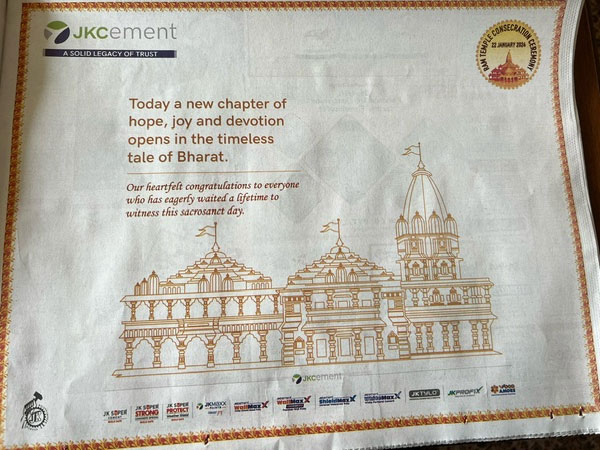
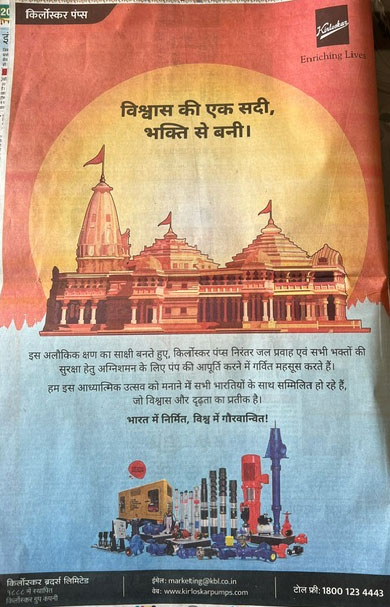
    Ok, I take back this also. As the first thing that I noticed was that very few national level brands did anything at all. There were some lame or limp attempts at moment marketing by the likes of Kirloskar, Dabur Amla, Dabur Gulabari, JK Cements, SpiceJet and Amul. These were the only national brands that were visible to me. Dabur Gulabari was the one brand which used some brand properties and kept it strictly related to the temple. SpiceJet used the occasion to give some discounts and freebies along with the schedule of Ayodhya flights. But the rest were just about cautious congratulatory messages. As I said limping moment marketing.


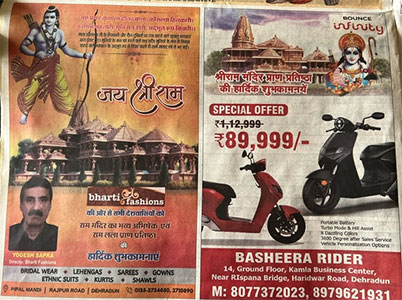
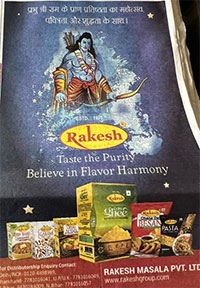
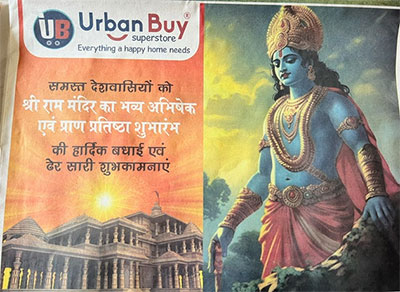
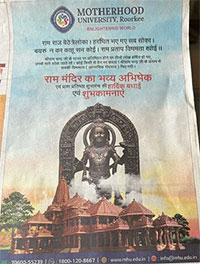
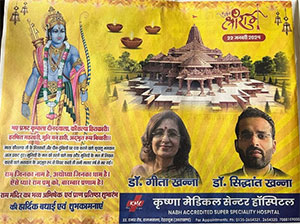
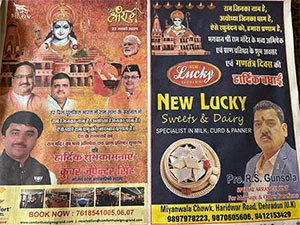
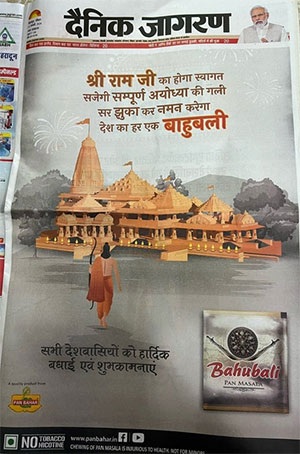
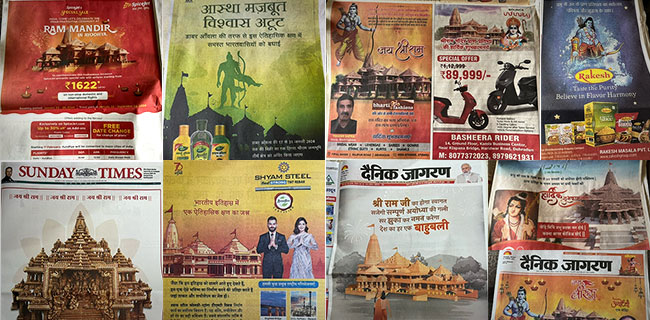
    It was local brands that ruled the roost. On the day, Dainik Jagran had two newspapers. One was a regular newspaper with some news in between a plethora of local ads. Sadly, even these were forgettable. But what was interesting was one the diversity of categories. From food masalas to construction companies to personal product companies to local fashion brands to local politicians to two-wheeler dealers to local cooking oils to local dairy and sweets brands to local jewellers to local event management companies to pan masala to resorts to medical centres and even local grocery stores. Some educational institutes, hearing aid centres, and local construction material retailers and brands added to the confusion. In my estimate, the news was maybe 45% and the ads took up rest of the space.


    The second newspaper was full of various articles on the temple. Historic angle, legal angle, the development in the city of Ayodhya… all of this was highlighted. And this was also full of ads as well, though maybe the ratio (of ads to editorial content) was more equal.


    A few weeks ago, a news portal had asked me to predict about what brands will do around the consecration ceremony. And my first instinctive reaction was that they will play it safe. Most brands will not do anything. Some will pay lip-service and a few who may have been involved with the construction of the temple may talk about their contribution. It looks I was correct in my initial thinking. Though I found it quite puzzling why brands which contributed to the building of the temple kept quiet. Initially I though JK Cement had contributed to the structure. But they did not mention it in their ad and I also read somewhere that no cement has been used in the construction. They too had just a congratulatory message.


    Why did most brands stay away? Because religion being a divisive subject, brands did not want to seen to be taking sides. And MNC, global brands are worried about repercussions in other markets too. That’s the main reason which explains the total absence of multinational or foreign brands. They did not want to alienate certain sections of the society and the world. Therefore, the few national brands that did advertise were Indian origin brands and some like Kirloskar did play up its Indianness. So, nationalism was the message. But that still does not explain the absence of many brands who have almost positioned themselves on nationalism. Kajaria Tiles, for example.


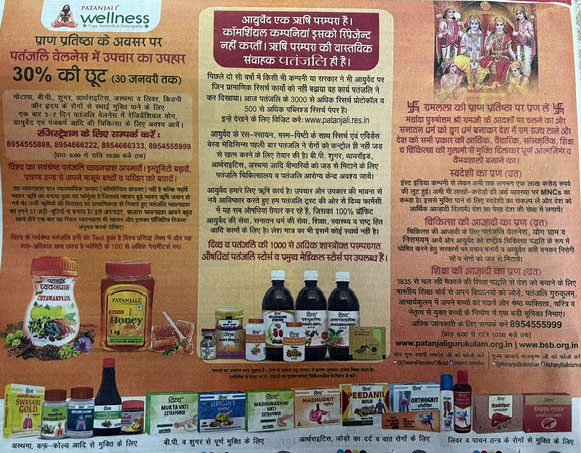
    Patanjali was the other brand which has for long played the nationalism card. Surprisingly, they were very low key. One press ad which looked like a 3-in-1 did appear. It spoke about an offer. About Ayurveda. And then some resolutions to take on this auspicious occasion. The last point was just about nationalism, whereas in my mind it could have been about some healthy resolutions combining the occasion and Ayurveda.


    The local brands had nothing to lose. Most of the brands who advertised, hardly advertise. So, this was a one-off which they could afford. Interestingly, the messages were quite brazen. Many of the ads had big mugshots of the owners. For once, some two-wheeler dealers found an opportunity to put their mugshots along with the product photo. Ditto for real estate developers, medical centre owners, dairy and sweet centre owners, construction material dealers. It was an opportunity to show themselves as Ram Bhakts. And I think that was the most important point for them. Announcing to the society and their circle of acquaintances about their religious and I suspect, even political beliefs.


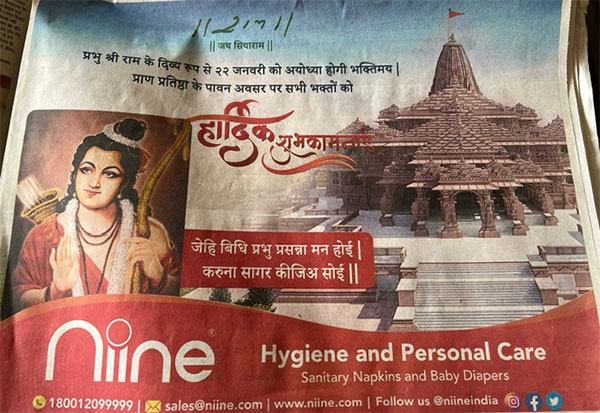
    There was a local brand for sanitary napkins and diapers, which also advertised. Would any national or MNC brand have the guts to associate an ostensibly (unfairly labelled) unclean product with Mandir?


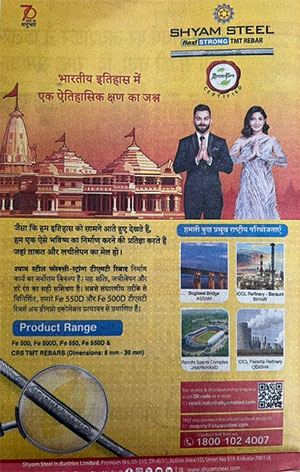
    Take Bahubali Pan Masala, and the brand is not about a surrogate. It openly says masala in the headline, very cleverly almost like a rhyme and has incorporated its brand name in it. Ayodhya ki galli and Bahubali. Shyam Steel has a prominent photo of Virat Kohli and Anushka with hands folded juxtaposed with a shot of the temple.


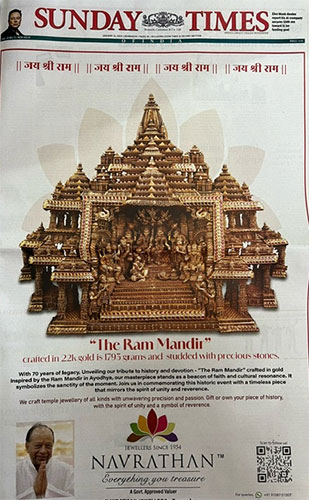
    And then there was one jeweller, based out of Bengaluru who had a full-page ad selling a model of Ram Mandir made in 22k gold weighing 1795 grams, studded with precious stones. The brand spoke about its 70 years of legacy and also had a mug shot of its owner with folded hands. Want more information and want to order? A QR code was provided. Religion, commerce and technology… a heady mix.


    In all this hullabaloo, there was another twist in the story. Republic Day was just four days later. And this is the time when durables, online stores, supermarkets etc have sale offers. And the advertising for the same starts a week before. Some of them tried gamely on Jan 22 too. But they were drowned out in the cacophony of the mandir ads. In fact, I don’t see many more brands or offers coming our way around Jan 26 as brands know that consumers have spent money for the Ram Mandir event. Every society, every mohallah, every market had some ceremony or an event or even bhandaras (free food). And it was all organised on the back of donations. People spent on bhagwa (saffron)-coloured clothes, flags, lights, diyas and crackers. Everyone contributed something somewhere. So, I guess Republic Day sales will be muted.


    Yes, I am being critical of brands. So, what more could they have done? For starters, they should not have looked at this as moment marketing. They should have seen this as maybe a property to associate with and organised activities around it. CSR? Offers and discounts to spur sales and not just to pay lip-service?  And do it according to the category and brand values. Patanjali could have set up shop at the railway stations, airports and bus stations and given wellness or Ayurveda products at good reduced rates while offering a loyalty programme. And rather than dress up the crew as Ramayan characters and earn derision, Indigo could have offered substantial discounts to all senior citizens travelling during a time period. Maybe tie up with some old age homes and offer few free seats per flights. Haldiram could have organised free bhandaras….


    The problem was that big national brands saw this as an aberration. A one-off. I think they have not realised that this day will be celebrated every year. Not just in a religious sense but also in a nationalistic and political sense. If the brands had looked at it through a long-term prism, they could have not only done more but also gained empathy and set the cash tills ringing. Let’s not forget that big brands including some MNC brands have thrived during Kumbh Melas. But this time they lost out on the big picture. The small brands did not see the big picture but they saw this as an opportunity to loosen the purse strings a bit and proudly proclaim their arrival.


    Frankly, moment marketing became the Achilles Heel for brands.


    Vikas Mehta is a Dehradun-based business strategist and educator. He writes on MxMIndia every other Monday, but sometimes on other days as well. His views here are personal.


  • Poonam Pandey & Cervical Cancer: A Case of Generation Gap?

    Poonam Pandey & Cervical Cancer: A Case of Generation Gap?

    With apologies to none at all

    Vikas MehtaBy Vikas Mehta

    Things moved fast last week. On Thursday, February 1, Union finance minister, Nirmala Sitharaman, announced in her interim budget speech that the centre is proposing a plan to encourage use of vaccine for preventing cervical cancer amongst girls 9-14 years of age. Cervical cancer is the second-most common cancer in India and almost a fourth of global cervical cancer deaths happen in India. No details of the government scheme were forthcoming but the initiative was lauded and welcomed.

    The very next day, news came in through her media team that controversial and newsmaker model Poonam Pandey had died at the age of 32 of cervical cancer. For me, it sounded too much of a coincidence but social media was trending with the news and there was much shock reaction too.

    Then a day later, Ms Pandey appeared to say that the news of her death due to cervical cancer was part of a campaign to raise awareness of Cervical cancer.

    And yesterday was World Cancer Day.

    All hell broke loose after Ms Pandey’s disclosure. My social media was full of angry friends and acquaintances. Influencer marketing had hit a new low, said someone. Another mentioned Ms Pandey’s past and said that she is not new to controversies. Her act may be for a noble cause but given her past it could cast a shadow on her intent, opinioned another. Someone mentioned that this marketing stunt had crossed all limits. The editor of this portal lamented the death of journalistic good practices as breaking news was more important than checking it out first.

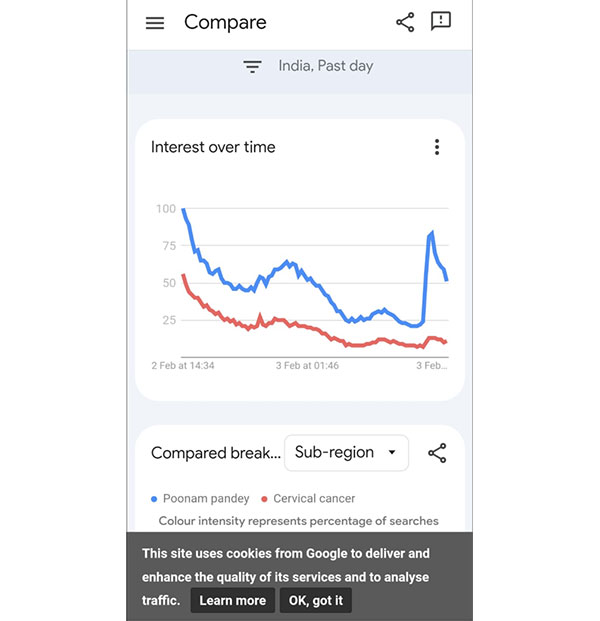
    A digital guru tweeted (or should I say Xed) a google analytical graph that demonstrated that search for Ms Pandey had gone up substantially whereas cervical cancer search was languishing.

    In the meantime, I had posted about this marketing deed on some groups which are solely populated by GenZ and the reaction I got was exactly opposite.

    How clever, said one. Don’t know who she exactly is but she seems to be famous and has used her fame well, chipped in another. Fake news is bad but nothing wrong in using fake news for good was another response I received.

    Sensing a generational gap (me, my friends and acquaintances are all over 50) and also a distinct shift in values and ethics, I challenged GenZ with similar comments as listed above by my generation.

    What I am narrating below are not my views but as generated by GenZ.

    • She didn’t die and willingly gave her name to a cause. What’s wrong in that?
    • We see worse fake news which is actually fake. This was not actually fake.
    • I did not know about cervical cancer and when my mother shared this news with me (of a celebrity dying so young), I found much more about it.
    • She did not kill anyone. She did not hurt anyone. She did not cause a loss or a scam. So how does it matter?
    • She may have gained lot of publicity for herself but it has brought cervical cancer in the news too.
    • Ethics and morality evolve with times. I am told a few decades ago it was not right for a boy and a girl to meet alone. Today it is accepted.
    • My parents want me to get high marks in exams. They don’t bother how. If I cheat and get it, it does not matter. The end result matters. Here too the end result is good.
    • What matters is grabbing attention. Nowadays news portals give sensational headlines which are only half true or in some cases not true at all. Or brands send message that my card is waiting despatch when I haven’t even applied for a card. If they can do so to catch attention then what’s wrong in this stunt?
    • Journalists anyways are all sold out and have no spine. So why expect them to chase the truth or research well before publishing a news (hear hear Mr. Editor!).
    • She seems to be old, but she thinks like us. Maybe I will follow her.
    • She should not have done this as it is inauspicious to fake death was a stray comment. But it was latched on to by 2-3 others and attacked. How can one be so old fashioned and traditional was the refrain. Do not believe in such superstitious things. Don’t you wear black?
    • I never knew that a form of cancer can be prevented with a vaccine. At least now I am aware.

    This last point resonated with me. I have a daughter who is now approaching her twenties and neither me nor my wife had ever heard about the dangers of cervical cancer or its vaccination. As I write this, my wife is talking to our doctor to see if she can be vaccinated.

    Now let me add my two bits to this generational gap issue.

    I do confess that initially I too was dismayed at this whole issue. In fact, because it was Ms Pandey and the news was released by her team and not family had seemed quite odd. But I could never suspect that someone will fake one’s own death unless it was for some subterfuge. So, my morality, traditional thinking and values were shaken.

    But when I heard some of the arguments, I realised that there are worse things happening to be upset by this. And it definitely was for something good. Even though data shows that the cause was a distant second to the influencer at least it had been stirred up. A small technicality too. I don’t think Ms Pandey is an influencer. At best she is a celebrity.

    This episode not just highlighted the generation gap but also reinforced a marketing dictum. Your users may be many but identify your target and talk to them. Don’t forget that this initiative was not Ms Pandey’s. It was initiated by the HPV vaccine and they should be lauded for targeting teenagers to get their attention to the dangers of cervical cancer.

    It also tells me how sharply segmented we are by demographics. News portals and social media like Facebook which are more frequented by the older generation have been quick to criticise Ms Pandey. Issues more relevant to this older generation like ethics, morality, tradition, good old days etc matter more and that dictates their writings and rants. It becomes a closed circle where nothing else matters or exists.

    The GenZ is not too troubled by these attributes. They are more open, not affected by past and more result focused. Some of my generation call GenZ instant gratification generation, but I think that’s unfair. They live in the present because they have no history to dwell upon. And with the rapid technology evolution, history becomes historical rapidly.

    Let’s not forget that brands have in the past also used half news or fake news to create sensation and frenzy. As a friend reminded me, Taj Mahal tea ran a PR campaign in the 2000s announcing that Ustad Zakir Hussain, who was the brand endorser, had decided to stop playing tabla. There was lot of frenzy and health speculation until it was revealed that it was a challenge, wherein the Ustad had announced ‘find me a better tea and I will stop playing tabla’.

    Wasn’t this also spreading fake news? Distorted news? So how was that acceptable? For, last I heard that became a case study on how to do good PR. How come Ms Poonam’s case was going to an extreme and falling to a new low? Or her past will shadow the noble deed? Or was it just because Poonam Pandey was used and not a “more respected celebrity”.

    Come to think of it, this campaign (that’s what I will call it from now, not a stunt) was about shock value but maybe it will also fall into the awe category.

  • Aggregator apps- One step forward? Nah!Definitely two steps backwards

    Aggregator apps- One step forward? Nah!Definitely two steps backwards

    Vikas MehtaWith apologies to none at all


    I am an ancient relic. When I started working, forget email or computers even faxes were a rarity and corporates had STD phones (no, not the disease-inducing ones but the ones which enabled long-distance calls), which were always under lock and key lest they were misused. Telexes were the most often used mode of communication.


    In three decades, the evolution of technology in workplaces and for an individual has been astounding. And the last one decade has seen the emergence of new type of companies, brands and technology.


    But what stood out were the aggregator companies. These companies used technologies to aggregate various goods and services to be available at your fingertip and one could access it through the smartphones. Mobility, hospitality, food delivery, grocery delivery, in fact any type of delivery are all assembled under one platform. Now one did not have to go to a taxi stand or a travel agent or a market but the aggregators put everything together under one roof and it was all available at your doorstep.


    Personally, I revelled in the emergence of Ola and Uber, Swiggy and Zomato, Amazon and Flipkart, Make My trip and Oyo, sorry strike out Oyo. But I did enjoy the offerings of these aggregators. Planning a trip at a short notice, intra-city travel, ordering food, all became child’s play. And also, one experimented, tried new travel routes, destinations, hotels and of course food. Initial hiccups were accepted with a pinch of salt and improvements were always expected to be round the corner. But, when the novelty disappeared, the frustrations mounted. Improvements were far and few. Same problems were being encountered and overall standards of these new kids on the block was shockingly abysmal. On my travel two weeks ago, I used most of these aggregator apps and following is my review of these.


    I will start with Oyo. Inspite of persistent advice from my well-wishers, not to touch Oyo with a bargepole. I decided to try it out again, after a gap of maybe 6-7 years. Earlier, I have had mixed experience with Oyo and at least twice I was pleasantly surprised with their offerings in Gurugram. So, this time when I had some work in Delhi, in an area where Oyo seemed to be the only option available, I had to clock in by 8:30 am and I did want to stay, preferably, walking distance away, so I opened my Oyo app.


    I had about 6-7 Oyo options available in a kilometre radius and most were pretty cheap. The photographs were decent and approval ratings hovered between 3-3.5. I took the plunge. I even prepaid as the amount was not big. Big mistake, as I learnt later. One day before the trip I get an automated call saying there is a problem at the Oyo I have chosen. So, I was given an option to cancel or get my booking transferred to another Oyo. No mention of which. I just disconnected, worried about what to do next.


    After 15-20 minutes, a customer service executive called. Like a rote she repeated the automated message. When I ask her about the option she mentioned some hotel 500 metres away from this one. I was tempted to change but I asked her about the charges of this place and will it be adjusted against my payment? Oh, for that I need to call the helpline, she said. And she volunteered the number. Irritated, I ask her why should I call? You are changing my booking so please first tell me the rate and refund/ adjustment status, I retort. Sorry, sir. She replied without any hesitation, I do not have access to that information. You just tell me if I need to cancel or transfer your booking. By this time, I had lost my patience so I asked her to cancel my booking.


    I go back to my app and I find a message that my refund has been initiated. Emboldened, I look for alternatives and this time choose a Oyo Townhouse. Supposed to be a Oyo-owned property. So must be good. I book it and pay up. In the meantime, I got a message that my full money has been refunded. Since it was a UPI payment, I got it back the same way. I felt relieved and happy.


    Next day, I land up in the area and I find at least 4-5 Oyos exactly in the same place where my townhouse is supposed to be. In adjacent buildings. I trudge up one of those. The receptionist looks at my app, scrolls up and down, calls someone else who repeats the process and then tells me that ‘aapka Oyo’ is two buildings away. Off, I go again. Find my Oyo. Am checked in a jiffy and someone escorts me to my room. On the way up I see two young couples coming down. No bags. Nothing on them. They just handover the key to the guy accompanying me and say, check out. And leave.


    I entered the room. It was basic. Paint peeling off. The bathroom looked okay at a glance. The room had no towel or soap. On asking I was given a towel and two small bottles of body wash. I suddenly realised that I have not been given any room key. My escorter, searched the room for a lock and then saunters out saying I will get one.


    Ten minutes later, I was down, wanting to go out and I asked for my room key. The guy looked around and then asked me to wait. He was busy taking photocopies of Aadhar cards of another bagless couple. Another gent sauntered in and asks if his room was ready. He had been told to come back in 15 minutes and it was now 30 minutes. He was told to go upstairs and check it himself. He gulped. I rolled my eyes and realised that I have made a mistake. I ask for room key again and am told not to worry as CCTV cameras are everywhere.


    At this stage, I told them I want to check out and did some namedropping. Suddenly, a suitcase lock emerges and I am asked to please not cause a problem. I lock my room and leave. I returned late around 9 pm and found that my toilet was very dirty. The cold and my tiredness precluded me from checking out but I was clear: I will check out first thing in the morning.


    I was tired and late because of my experience with Ola, the second aggregator I tried. I booked an Ola to come back at around 6:30 pm and first, my ride was cancelled. Finally, another driver turned up. As I settled down amidst the Gurugram traffic rush, my driver told me that he will take a shorter route, it’s on the map but road is not good. Positive is that it will save 15 minutes. This was what his app told him. I agreed. Another mistake. The road was not all that bad, but the route was through narrow lanes and bazars and we ended up lost. At that stage, I put the map on my phone on and started directing the driver. On my app I was getting a message to rate my trip and the driver was getting messages to pick up another passenger! It was total breakdown. Chaos. Imagine if the passenger was a female.


    Technically, I should have not paid the driver as my trip was over and rating was being asked for. But I paid him in cash when he dropped me, not at my destination but a kilometre away. Oh, did I tell you? Ola now gives the option of paying online before your trip is over. Else you have to pay the driver in cash. And sometimes one pays, one gets a payment done message and 5 minutes later Ola sends a message that the transaction failed. If the money has been debited from your account please call Ola helpline. The onus is on the customer, not Ola!


    Two apps down, next morning I open Make My Trip. The first surprise was that when I broadened my search to a 3-4 km radius the majority of the hotels being shown were still Oyo. This time, I researched properly. I shortlisted 3-4 options. I did not even look at the cheap ones, I read at least 5-6 reviews, read the AI generated review summary and finally picked one hotel 3.5 km away from my meeting point. I must confess, the MMT app seemed easier to navigate, its reviews seemed balanced and it had more parameters like quality of food, closeness to metro station etc.


    And the place I chose, was good. The experience was as promised by the app. So, a thumbs up to MMT.


    But, and there is always a but. After I paid, I was sent an offer. I could buy through Swiggy and get a discount. It was very tempting. But the fine print said that the offer was valid only for some NCR restaurants. Here I am booked near Saket. So why would you send me offers for NCR? I know Swiggy can deliver from there. But the delivery time could be more than an hour and the delivery charges will be higher.


    So, is this how Swiggy or MMT use their data? They know I am in Saket so why can’t they give me an offer from nearby? I guess all this hype about using data to do targeting is an overblown proposition? Is it?


    On the positive side after abandoning Ola, I took up Blu. It was a very good experience. I prebooked cabs twice. Both times the cabs were on time. They were electric cabs so environment friendly. The drivers drove safely and were polite to a fault. The app was very user friendly. It seemed a huge improvement on Ola.


    But overall, I was really disappointed. It seems the new age product offerings have actually deteriorated, rather than improving. Oyo is really pits and I guess all these stories about being used mostly by unmarried couples for two hours is true. Is that its business model now? Ola seems to have lost focus completely. My trip was shown as finished without any payment or actually being finished. The driver was lost. And a one hour trip as predicted at the start ended in a two hour trip? And I do hear some pathetic stories about Ola electric scooters too. Quality, service. Is this an Ola trademark now?


    These could be exceptions but it shows major flaws in the product. If after 10 year these brands have gone from bad to worse and not improved, then they fail the first test of marketing. Bad product.


    And the worst part is that after I abandoned Oyo after one night, even though I had a three-night booking, even though my Ola trip had gone horribly wrong, there was no follow-up. No calls. No feedback mechanism. Both of them asked me to rate them. I gave the worst rating and then there was silence. Don’t they follow up if the rating is 1. Or maybe they cannot, as the number of ratings with least score is way too many. And therein lies a tale.


    Vikas Mehta is a senor business strategy consultant and educator based in Dehradun. He writes on MxMIndia every other Monday. His views here are personal.

  • Not just Quick Commerce

    Not just Quick Commerce

    With apologies to none at all

    Vikas MehtaFirst, a confession. I got it all wrong. About two years ago when quick commerce delivery started, I was sceptical. Indeed, I was a naysayer. My thinking was in a straight line. How many times would one need quick delivery? Why would we need things in 15-20 minutes over and over again. After all quick commerce will have a minimum order delivery benchmark. So, every time, I need a soap or a vegetable or a dal, will I be ready to spend not just for that one item but also a delivery charge as I may not fulfill the minimum order criteria. And then we got hooked onto ecommerce not just for convenience but also for the discounts. So, will the quick commerce guys give me discount similar to traditional ecommerce (never thought, would call ecommerce traditional, but we live in exciting times)? And boy, was I wrong? Just in two years, quick commerce controls a third of the e-grocery market, up from one-fifth.

    To add to this what surprised me was that the quick commerce players were not ecommerce players but either new ones or food delivery people. At best they had mastered the art of quick delivery. But not about warehousing, stocks, discounted pricing etc. During the pandemic when food delivery app like Zomato and Swiggy were out of play as restaurants etc were closed, they switched onto grocery deliveries. Like food, they tied up to pick groceries, vegetables etc from kirana shops, supermarkets etc and like food, delivered it. So, yes, they could deliver speedily but where was the experience of trading, stocking, pricing etc of groceries and fruits and vegetables? Wasn’t that more critical.

    I was an avid ecommerce shopper. Even before the pandemic, my monthly grocery etc shopping would be through Amazon or Big Basket. And the scales were tilting more towards Big Basket as that was a one-stop shop for groceries, knick-knacks, fruits and vegetables, packaged foods etc. Plus, their delivery time slot system was also a good attraction.

    So, when BlinkIt opened in Doon, their first dark centre or warehouse hardly 3.5 kms from my house, I ignored it. I would see the riders zipping in and out and standing in cluster outside the dark centre. What caught my attention was that the number of delivery people huddled around the dark centre kept on increasing exponentially, till the place started becoming a traffic menace.

    I dismissed this as an initial craze which would pass soon. I did download the app and was not too impressed with the offerings or the price. It was cheaper than MRP but in my biased view not as cheap as a typical ecommerce player. I did however notice that they also stocked socks and bedsheets and cookware and other homecare stuff. They also had electronics and pet items. But when the announced 15-minute delivery of iPhone 15 on its launch, I did start taking notice.

    And then on the day of Diwali when my wife asked me to get some fresh flowers and I could not find them in the neighbourhood, I checked on Blinkit. Not only were they delivering fresh flower but also a complete Puja thali with or without a small statue of Laxmi. I was really intrigued and I ordered.

    The app experience was wonderful. Once I registered my credit card, I did not even have to enter my PIN and BlinkIt has a tie up with MyGate. So, when my order was picked up by the delivery executive, Blinkit sent me a preapproval message and at a click, his entry was approved. All this from my locked home screen. The delivery was seamless in a neat bag, in 15 minutes. And the whole deal was not at all expensive.

    Now, I wanted to try more. So next week when we required household groceries etc including two bulbs, I looked at BlinkIt. The whole operation – from ordering to delivery – took around 20-25 minutes and the deal was worth it. The interesting thing I discovered was that whenever I needed something which does not fit into traditional grocery or vegetables, BlinkIt would have it. We needed some woollen socks and cap for our trip to Kashmir. I found it on BlinkIt without having to go to Myntra or Amazon.

    And I think this is the main reason why all naysayers of quick commerce have been proved wrong. It’s not about quick delivery only. What makes it interesting is that it goes beyond traditional grocery, fruits and vegetables and also stocks much more. Till now, I would rely on Amazon for anything other than groceries or vegetables. Then came Big Basket, and I could now get groceries, food, vegetables etc from one source. But I still required Amazon for everything else.  BlinkIt, for me, is a combination of Amazon and Big Basket. And delivered quickly. And at competitive prices. Not at a premium.

    So, for me, BlinkIt works as follows. One source where I find almost 95% of what I need usually. Prices competitive to other ecommerce players. A superior app experience. And finally, all that I need gets delivered in 15-20 minutes. I do not have to wait or follow up or even chase. This is as close to a offline personal shopping experience. You decide, you buy and it gets delivered. The shopping experience is complete. The circle is closed.

    I do not know much about Zepto or Instamart as they still do not deliver in Doon, but BlinkIt has, in my mind cracked the quick commerce code by not just focusing on speed of delivery but also on the range of products. I remember reading somewhere how some head honchos of quick commerce companies had spoken about opening many small dark stores storing about 2-3,000 SKUs. Each dark store would cover about 5-7 square kms. The thinking was that most households only need a limited range of goods quickly. So, the focus was not the width of goods available but the number of stores for quick delivery.

    This is exactly where the quick commerce companies could have gone wrong. And I see this happening with BBNow. They too are 3 kms away from my house but their range is quite limited. Indeed, I can find stuff on BigBasket but not BBNow. This is where I think BlinkIt has cracked the quick commerce code. As I write this, I get a notification that BBNow is delivering electronic items like chargers, power banks, phone covers etc in 15 minutes. So, they too are on a course-correction.

    It’s not about delivering a few products quickly, for that will be far and few per customer. But making available as wide a range as possible and delivering it all quickly. This also ensures a bigger order size. And psychologically it’s about completing the shopping process in real quick time. Threfore, if weekly offline shopping was a regular habbit, regular weekly quick commerce shopping is also now a habit

    So, convenience is not just about sitting at home and shopping or getting a missing product quickly. BlinkIt has added the dimension of completing the shopping loop in quick time. As I said, this imitates the complete offline shopping experience .

    And I know that it is working because I see more delivery guys, more two-wheelers and more yellow BlinkIt bags around. I have also, for the first time heard the local kirana shop owners complain as BlinkIt is eating into the traditional small buyer too. And most importantly I know that BlinkIt has found the successful formula when sometimes, even at 9 am, I open the app and I see an apology saying that they are overburdened with orders so I should try after sometime. And when they do accept the order, after sometime, they levy a traffic surge surcharge.

    Deja vu!

  • What business are the aggregator apps in?

    What business are the aggregator apps in?

    With apologies to none at all

    By Vikas Mehta

    Vikas MehtaA few weeks back I had written on the decline in the services of aggregator apps and related my personal experiences with a few apps. You can find the article here.

    Some of you readers wrote back and asked me for the reasons of this decline. As one put it, usually new offerings with new technology get ironed out over a period of time. So, why should the aggregator apps be an exception to this? Fair question and it set me thinking.

    Before I continue, I would like to convey my thanks to Hamsini Shivkumar, Brand Consultant and Semiotician par excellence. It was she who nudged me into thinking deeper and we had a fair exchange of ideas. Much of what I write today is the result of her thoughts.

    Let’s look at this decline in quality, first by looking at the Indian consumer.

    Most of the aggregator apps like Ola, Uber, Swiggy, Oyo; when they came on to the scene, they offered a new service, promising higher standards of delivery at cheap rates. I am using the word cheap deliberately. The transport aggregators offered cabs at your doorsteps within minutes and their rates were lesser than a traditional ‘kaali-peeli cab’. They offered not only the convenience of quick service but also avoided the hassle of looking for a cab and the cabbie declining to take you to your destination.

    Food service apps suddenly provided one with the comfort of home delivery from various restaurants at no extra cost.

    Oyo provided cheap hotels with a minimum quality assurance.

    Make My Trip offered everything one needed to travel including air schedules and bookings across airlines, railways and gradually also bus service. Hotels, cab pick-up and drop-offs and even guides for tourist places were gradually added on. And there was hardly any extra charge in the beginning.

    And almost all of them started peddling discount coupons and more offers to make the deal even sweeter.

    That’s why I used the word cheap. New services, new comforts and new conveniences were available cheaply.

    All these were targeted at the Indian middle class. And the Indian middle class still confuses value with cheap. Typically, value could be defined as same for less. Or more for same. Or more for more. Or even less for less.

    Same for less means cheaper, discounts. More for same means you add some more benefits. Buy one get one free or 200 gms extra in a pack of 500 gms at the same price of 500 gms. More for more would be pay only Rs 500 extra for buffet breakfast with a room. Less for less would be a star hotel giving you a room but not allowing you the facilities of a gym or a swimming pool.

    The Indian middle class as a generalisation picks up more for same or same for less. Give them a room at a discounted price and they are happy. Free airport drop and pickup is accepted. But adding buffet breakfast at a marginal cost may not be appealing. No extra money shelling out. Period.

    This is not to say that the middle class is not quality seeker. But they want best quality at low prices. They are not even looking at more for more. That’s why howls of protest arose throughout the country as transport aggregators started charging peak hour or rush hour or traffic surge surcharge. So much so, that public opinion forced some states to ban these surcharges by law! The typical middle class consumer has no problems accepting discounts but when charged extra due to high demand it demurs!

    More for more works for the luxury good or premium service seekers. These may not be the typical middle class. So, a Vistara charges you higher fare as they give wider seats, more leg space and free food and it has its premium users. Or these are people who will not want an anonymous biryani but a biryani from Paradise or Shah Ghouse in Hyderabad. The premium- or luxury-seekers are fine with these.

    And such people are few in numbers compared to the vast middle class who mostly is looking for more for same or same for less. The focus is solely on the price.

    Therefore, when the aggregator apps were launched and everything was same for less or more for same, these were lapped up. Cabs available at your location without any extra fees and maybe even cheaper than metered kali-peeli cabs were a hit. Food delivered in fast time without any delivery charge was a success. Hotel rooms available at much cheaper price with a promise of cleanliness and sanitation were lapped up.

    Now let’s see this picture from the viewpoint of the aggregator. Understanding the propensity of the middle class, they offered value but focussed on price. For the aggregator, it was hot food offered at the comfort of home at no extra cost but for the consumer it was about food at some discount too. It was not about cabs available quickly at your location without the fear of being declined by the cabbie but about great rates. It was not about an alternative available between 3-star and hole-in-the-wall shady hotels but about shady hotels available cheaper. To be honest, for both the cab aggregators and hotel aggregators, the story about cabs without declining and hotels with a standardised hygiene version were played up but these advantages were soon frittered away.

    Their partner service providers had been acquired also on the lure of substantial earnings. Hotels and restaurants were promised big incremental revenues. The delivery riders were promised lucrative, per ride fees. Transport aggregators too were giving the drivers big monies. And as word spread about easy money, more partners accrued.

    Discounts and price-cuts and subsidising of partners lasted for some time. And soon the aggregators were under pressure to improve margins. Move towards profitability. VCs wanted IPOs to cash out.

    The partners became disenchanted when aggregators cut the big incentives, subsidising of vehicles and even helping spruce up the hotel property. Rider fees were slashed. And delivery charges crept in. Travel aggregators included convenience fees. The situation became piquant as the consumer suddenly realised that the free or discounted does not make sense as extra charges were levied. So, s/he demanded more accountability. The brunt of this was faced by the partners such as delivery riders, hotels, cab drivers, airlines etc. In turn, these partners resorted to all sorts of jugaad. This led to service standards declining.

    And the jugaad mindset led to ingenuity of the partners. Cabbies, not wanting to travel short distances, would deliberately arrive late. Forcing the customer to call them. And on enquiring the destination, they would cancel the booking or say that they did not find the customer. Thus, not only causing major unhappiness but also destroying the advantage of ‘no declining’ as in traditional cabs. Restaurants realised that they could, in their own areas, do their own delivery. Hotels started asking regular visitors to book directly and gave them equal if not more discounts.

    The aggregators tried to control the partners with technology. OTPs, rating points, incentives based on ratings were introduced. But service is an interesting concept. It can be aided with technology but it cannot replace the human touch. The aggregators, under cost and margin pressure did not accentuate the human touch. Nor did they expand technology to aid the human touch. In fact, the reverse happened. It used to be difficult to get through customer service numbers. Now the customer service numbers just disappeared. Bots supported by AI came in. Social media sites were flooded with complaints. This spooked the investors who put more pressure on the aggregators. Things just went downhill.

    Another thing about service is that it becomes increasingly difficult to deliver consistent service online. In offline, service expectations differ according to customer segment and their location. Someone with a premium service mindset in Gurugram cannot be treated in the same way as a discount-oriented customer in Saharanpur. But in online, we have a single set of guidelines. We have one operating SOP. And this fails to deliver. No attempt has been made into moving into customisation of service.

    And because most aggregator apps have not defined their target group but want to engage all possible users, they are dealing with different set of users. This results in trying to keep all segments happy without aiming at anyone in particular. To use a mathematical analogy, this results in service systems which cater to the lowest common denominator, LCD. And not HCF, the highest common factor.

    Offline service standards are tweaked depending upon the location and your target customer. That’s why service companies do attain good standards, offline. But online, heavy investments are required to make it reach the customized HCF level. A luxury which the under-pressure aggregators cannot afford.

    And that’s why, all these aggregator apps, while realising that they are in different business must also realise that by being an aggregator, their core is about service. Transportation, food delivery, rooms, travel is the second level of tangible benefit. The most important tangible benefit is service.

    I think Amazon is the only aggregator which has focused on service. It openly declared that it isn’t in the business of ecommerce or entertainment. But it is in the service business. This has helped it achieve higher customer satisfaction and loyalty than other aggregators. And Flipkart which had the first-mover advantage in India, is today owned by Walmart, a discount store brand. Maybe therein lies a tale.

  • Technology and the immortality of an advertising theory @IPL

    Technology and the immortality of an advertising theory @IPL

    With apologies to none at all

    By Vikas Mehta


    Vikas MehtaYet another season of IPL is underway. And like many millions, I have been following the matches keenly on JioCinema. Since I am travelling, I do not have access to DTH or cable to watch it on TV. So, my writing is based on my JioCinema experience only.


    Usually, I comment on the ads during the IPL. I will continue to do so. But this particular column is going to first recount my experience with JioCinema from a technology- and consumer-friendly viewpoint and then I shall take just two examples to highlight some issues in the IPL ads.


    I find the app very consumer-friendly during IPL. The home page highlights the match of the day and with one click, I am into the match. But when there are two matches then the homepage keeps on highlighting the first match, well beyond 7:30 pm and the second match requires real searching. The issue does not get resolved even by refreshing the page.


    In terms of the content, I find the ‘Jeeto Dhan Dhana Dhan’ contest very interesting. It’s a simple multiple-choice question based on what will happen in the next over. With one click, the answer is submitted. And before the next question comes up, one is informed if one got it right. But the beauty is that for all those who got right answers there is some prize. Usually, a discounted product from an online e-commerce portal. I, played it almost at the end of each over for two days and I had around 20 prizes. And the redemption was also well-planned. Click on the same page to redeem the prize. The right page, which offers only the products on offers open up. Your discount has been copied to the clipboard. Choose, fill your details, pay if required and the offer has been redeemed. No choosing of products and at check-out realising that your preferred products have no discount. No ambiguity. Very well-organised and planned. And at the last count, I came across nine brands offering the prizes. Two of the three I redeemed were delivered in Dehradun within 48-72 hours. And of course, there are bigger prizes for those who answer the most correct answers daily. Unfortunately, I did not have the patience to sit through all 40 overs and answer all questions. But kudos to a well thought through and planned contest.


    In terms of communication, I remember that ‘Jeeto Dhan Dhana Dhan’ was an offer that Jio had offered in the IPL four to five years ago. So, to find that this year MyCircle11 was sponsoring the contest was bit of a let-down. It also clashes with the MyCircle11 advertising as it caused a confusion in my mind if the contest had something to do with the gaming app offering discounts to play games on the app. I then realised that Tata had sponsored ‘Jeeto Dhan Dhana Dhan’ contest in 2021 and last year it was MRF. Personally, it’s a simple and rewarding contest and any sponsor will reap the rewards with a longer association. Like, I think Jio did for two-three years. I still remember it.


    Now, let’s focus on the ads. There were many new ads this year. Predictably, Dream 11 came up with, till now, the best campaign. Simple thought. Good use of the cricketers. I particularly liked the Mr Sharma ka beta mera beta featuring Rohit Sharma, KL Rahul and Sunil Shetty. It crossed the thin line between a cricketer and his personal life in a beautiful, interesting and heartwarming way, with a hint of comedy. Communication theories always say use celebrities who add to the brand personality and to the memorability of the ad. This is a great example of the same.  Watch the ad here.


    The other ads in the series have focused on personal rivalries. Bumrah vs Shreyas and then Shreyas vs Bumrah. Preity Zinta, co-owner of Punjab vs Pant got me cracking up at the end. Not in the same league as Mr. Sharma ka beta but at least Dream11 is not just splurging money on celebrities.


    I am now hoping to see a Hardik vs Rohit. Oh sorry. It’s about team loyalty. So maybe Hardik and Rohit.


    But the ad campaign which got me thinking was actually Parle. It has released a series of ads, thankfully without any cricketers or film stars. These address issues which are mostly intangibles. Difficult to pinpoint, prove or substantiate. So, difficult to communicate too. Quality, trust, variety, new products. The campaign has tried to use some odd metaphors or join some improbable dots to convey these messages. I just felt that someone is ramming down these virtues down my throat.


    And that’s when I remembered a gem of theory that was part of the JWT thinking process. The difference between stimulus and response. The theory mandated that do not put your benefit or message as a stimulus, rather let it be the response from the consumer. Do not spoon-feed. Let the consumer discover it. That way it will be more memorable and the communication will have a lasting impression. Remember the Ericsson black coffee ad? Nowhere it said the world’s smallest phone or even a small phone. It demonstrated its size as a stimulus and the response was “a phone so small it can hide in my palm.” No wonder the ad is recalled even after three decades. Watch the ad here.

    I feel that Parle has missed a trick. The amount of money that is spending trying to hit us with trust, quality and other parameters would have been much better spent if the desired response theory had been used.

    And this thought got amplified when I saw the Apple iPhone 15 app on storage for photos. It beautifully showed someone marking photos to be deleted and then they used a perfect song “Don’t let me go”. Each photo that was being marked for deletion suddenly came alive with the character in the photo singing the song. And at the end there was just a simple message which said lots of storage for lots of photos. They could have gone to town on memory capacity or on transferring photos to cloud through their cloud service. But by using the stimulus of each photo imploring not be deleted, through a song, the benefit was like a stimulus which I will not forget. Great ad.


    And we wonder why Apple iPhone commands such a premium and is yet a world leading brand! Watch the ad here.


    In fact the Preity Zinta vs Pant ad also is a stimulus vs response theory ad. Watch the ad here.


    I sincerely hope that some of the JWT theories like the stimulus vs response one are not buried along with the venerable brand.


    Before I end, I saw as a part of media co-sponsor super “Pepsi yeh dil mange more”. I was intrigued and excited to see what was the contemporary version of this classic Pepsi campaign. So, I found it on you tube. See it here. And let’s match our reactions in my next column.


  • Gig Workers: Charity begins at home

    Gig Workers: Charity begins at home

    With apologies to none at all

    Vikas MehtaBy Vikas Mehta

    Yes, I had ended my last post with a link to the new Pepsi rehash of the old ‘yeh dil maange more’ ad. And had promised to review it. But, hey, promises are meant to be broken. Am actually so disappointed at the ads dished out during the IPL that I refuse to talk about them. Instead, I will narrate two contrasting tales that I picked up over Eid.

    A friend was just settling down to enjoy the Eid holiday when he got a call from a friend who was coming over with some Eid sweets. My friend panicked as he had nothing to offer. But then being a millennial and having acquired the habits of Gen Z, he immediately remembered Blinkit. Sure enough, Blinkit was offering Eid sweets, not the typical Eid sweets like Sewaiyan but Feni Lachha, Agra Petha, Panjeri Laddoo…you get the drift.

    As luck would have it, my friend’s guest and the Blinkit delivery guy reached almost together. The guest was dressed in Eid livery and as my friend opened the door to his apartment, the Blinkit delivery guy too turned up. He delivered the order and then wished the guest Eid Mubarak in a choking voice. While the guest reciprocated heartily, my friend checked on the app and discovered that it was Eid for the delivery guy too. Instinctively, he called the delivery guy who had by then almost reached the lift, and handed over the Blinkit packet to him wishing him Eid Mubarak.

    Taken totally by surprise, the delivery guy burst into tears. It seems he had reported for his job against his family wishes, because he knew that being Eid there would be a shortage of riders, an excess of orders and he could earn better. So, while he ached to be with his family and celebrate the festival, economic compulsions and family responsibility steered him away from it. But, my friend’s gesture bowled him over. Watching all this, the guest too slipped in a note into his palms and urged him to go home to enjoy Eid with the family.

    Now, before we all go mushy and applaud the generosity of the two gents, listen to another incident that I picked up the same evening. My wife’s friend had called her over for a small Eid party. While they laid out a sumptuous dinner, the lady of the house seemed a bit off-colour. On enquiring, she found out that the friend was upset with Myntra. She had ordered an Eid dress for her daughter, a bit late but the delivery date as promised was on Eid. So, she was relieved that she had not failed her daughter.

    But, on the morning of Eid, she got a message from Myntra that due to some operational issues, the delivery will be delayed. Now, this lady was tracking the package and she knew that it had reached Dehradun. So, she deducted, rightly, that due to Eid, there was a shortage of delivery guys. And that upset her. She was angry and upset that her Eid had been spoilt.

    What contrasting tales. Here were two people who had instinctively succumbed to the spirit of the festival. Caring and sharing had come naturally to them.

    On the other hand, was this person who had a narrow selfish view of the festival. Who did not get the spirit of the festival and treated it very transactionally.

    That’s of course, my view. But the diversity of human behaviour never stops to amaze me. And also, the unpredictability of it.

    More crucially it also tells us the indifference we have towards the gig worker. As consumers we have lapped up the culture of home delivery. We marvel at the technology. We are awestruck by the whole process. We are delighted by the speed of delivery. And we are also happy that employment is being generated in the form of delivery guys. But, have we ever thought about humanising the last mile delivery.

    The word gig comes from an early twentieth century jazz slang. When two or more musicians would combine together to perform informally. No contract, no formal agreement, no payment promised. In today’s economy, it stands for any informal job. And that is what I cannot understand. Why is this last mile delivery an informal job? Isn’t it one of the most important parts of the delivery process? When every day, nay, every minute counts in making the delivery happen, why is the role of the delivery boy downgraded to a foot note?

    These people have no formal timings. No structured holidays. No minimum payment guarantee or even a basic pay. Their remuneration is linked to just delivery. Come rain, come extreme heat, come festivals, come illness, these gig workers have to soldier on.

    And please, do not compare them to a train driver or to a medical worker or to a public transport official. All these people have jobs. Not gigs. Fixed pay, not just a variable component. Sick leaves, designated holidays. Either gratuity or pension or both. Even insurance. Nothing of that sort exists for a gig worker.

    Before you accuse me of turning socialist or maybe even communist, all I am actually doing is to draw the attention of us, the consumers, who meet and interact with these people daily, to the fact that delivery people are not robots. They are as humans like you and me. But is our behaviour towards them human?

    I have a theory called the Indian housewife theory. It is expected that the housewife will make tasty meals every day. In fact, three times a day. And rarely do we have a word of appreciation towards the food cooked. Because we take it for granted. But once in a blue moon if the food goes wrong for whatever reason, the whole family rains down on the housewife. No appreciation for the 99% good food. But protest and howlers for that 1% of mistakes.

    And that’s how we treat the delivery or gig workers. We rarely acknowledge them. We hardly notice them. But they become our target if they are late or there is a problem in delivery.

    All I am asking therefore is that we as consumers must change our attitude towards the gig workers. Have empathy. Treat them with respect. It’s getting hotter. We do not venture out but expect them to deliver. On time. The least one can do is ask them if they need a glass of water. Maybe a small snack. An orange a day will not burn a hole in your pocket but it will not only refresh them but also make them feel appreciated and human.

    And some apps like Blinkit now give you the option to tip them. Do that. If you have saved Rs 20 in that delivery, tip it. And if you are really transactional, satisfy yourself by thinking that you save much more than the twenty rupees. You saved the effort of venturing outdoors. Didn’t you? So, nothing wrong in tipping them a small amount.

    We, the customers have to start this movement. One may call this socialist thinking but frankly I don’t care what it’s called as long as it helps us be humane. Can we at least make a beginning?

  • IPL ads: Entertaining or Philosophising?

    IPL ads: Entertaining or Philosophising?

    With apologies to none at all

    By Vikas Mehta

    Vikas MehtaA friend last week commented about the Indian Premier League (IPL) last week in a WhatsApp group. He likened the matches to the Roman colosseum where gladiators entertained thousands of cheering spectators to some gory spectacle. I was amused at the description and when I see the likes of Head, Abhishek, Salt demolish the bowlers, I feel for the bowlers who seem to be like the fodder served up for the kill, so that the spectators enjoy them being torn apart.

    And I feel the same when I see the ads on IPL. I visualise the various brand teams saying, ah! The gladiator season is here. We have an opportunity. Tens of crores of Indians will be watching the gladiators from the comfort of their homes. One opportunity to catch maximum number of Indians for 7-8 weeks. So, let’s make ads. We have 15-20 second slots. These are breaks in between the gladiator entertainment. Let’s give them some philosophy in the breaks. They are saturated with entertainment so let’s make the ads philosophical. These will stand out in all that entertainment gore.

    That is how, my dear readers, we see ads with such deep philosophical messages. I mean, how do you explain a brand like Pepsi, which all about irreverence, being a rebel, thinking out of the box, who use a Bollywood celebrity like Ranveer Singh, whose personality fits the personality of the brand to a T, suddenly spout lines like jitna bhi loud ho duniya ka shor, sunen sirf dil ki. Kyonki yeh dil mange more. There is nothing else, just the beleaguered celebrity spouting these lines on a mobike. Seriously, is that what’s Pepsi is about? Is Pepsi happy giving this speech to the Gen Z?

    Or take Parle. It tries to be funny in its execution, sorry, not funny, but slapstick. But the message it is giving is that Parle is about quality. Parle is about variety. Parle is about bharosa. Parle is about kuch naya. Parle is about sabki pasand. I seriously think they should have a contest asking viewers writing in and suggesting some more attributes that can be stuck to Parle. Here is my contribution. Parle is boring. Parle is unexciting. Parle is a yawn. Parle puts me to sleep….

    And then we have category which I think excites Gen Z the most. Financial apps which help you invest and make money. Actually, this category scares me too. Since I interact regularly with MBA students across the country and also with MBA aspirants, I have been noticing that a huge majority of these students invest in capital markets. To understand this better, I did some simple research. Between mid of January to end-March I was in touch with 315 such students. A staggering 263 out of these boasted of investing in stocks, derivatives and in options. That’s more than 80%. And these were not just kids from big cities but were from towns like Bheemavaram, Jhansi, Siliguri, Erode, Jhalawar, Latur etc also.

    The interesting part was that many of these were not from any financial background. But YouTube Videos and financial influencers had enticed them into making a quick buck. They did not understand any financial terms. Many could not differentiate between asset and liability or debit and credit. And yet they were following graphs and charts on you tube. Suggestions and tips from influencers. And most of them were happy that they had made good money on amounts ranging from fifteen thousand to a lakh.

    So, tell me, will an app like Groww not be wanting to rope in such students who will soon be earning and who may want proper financial guidance? And what does Groww tell them? Jo Groww karte hain woh life mein grow karte hain. Doosron ki nazar mein bade ho jate hain. Khud ke pairon pe khade ho jate hain. (Those who use Groww, grow in life. Become big in the eyes of others. They stand on their own legs) Nice philosophy. Nice emotion too. But is that good enough? Is capital market investment just feeding into your ego of coming to age only. And isn’t that what all financial apps and YouTubers and influencers want you to think. Upstox, on the other hand. does not spout philosophy but makes a bold statement (catches the attention of Gen Z, I say old chap) Kit kit hatiye. Stop the chatter, invest in mutual funds through Upstox. Sorry to pick up on the line from Sholay, but what did they think. Gen Z khush ho jayega, shabashi dega aur Upstox mein invest karega?

    If a brand like Pepsi was disappointing another brand which didn’t disappoint but actually shocked was Cadbury’s Dairy Milk. A brand which changed the way Indians looked at and consumed chocolates. A brand which gave us the hugely entertaining kya swad hai zindagi mein. A brand which made us include chocolates as a part of our sweet tooth habit with kuch meetha ho jaye (a popular idiom which means let’s have dessert). A brand which took CSR to another level with use of technology during Diwali in the last 3-4 years with Kuch meetha ho jaye, kuch accha ho jaya. That brand made such a flat, uninspiring and philosophical ad like #Thankyoufirstcaoch. The idea is not bad but the execution is very unlike Cadbury.

    Please, someone also explain to me what does the sound of India means? Jindal Steel has an ad which shows the various use of steel. From big to small. But then comes the philosophy of sound of India. The steel of India. Let me guess. Sound of India is construction happening all over India? India’s infrastructural boom? That makes sense but the ad shows even small things like hair clip or a nail or even a dancer’s headgear. So, what’s the sound of India? Philosophical nationalism for the sake of nationalism. I would any day still swear by Tata Steel’s We also make Steel or SAIL India’s There is a little bit of SAIL in Everybody’s Life. Not seen these? Watch here.

    And this philosophy mania has rubbed on some old advertisements being re telecasted during IPL too. Even the much-reviled apology of the pan masala ad featuring Sehwag and Gavaskar now spouts a line at the end which says har generation ka alag hai andaaz lekin sabke anokhe swad ka ek hai rang. Loosely translated: Every generation has a different style but in terms of taste it has the same colour.

    Am sure by now you are done with my pessimism. But it’s not all gloom and doom. I have already mentioned in the past about the Dream11 ads. I was also impressed with Rupay UPI Link credit card as well as the Make My Trip ads. These not only continue to entertain but have distinct messaging. You haven’t seen these yet? Go watch. And then of course, don’t miss the new Cred ad too, starring Warner with Rajamouli

    Thank God for some advertisers wanting to still give some gladiatorial entertainment and not spouting philosophy.

  • Speed thrills. But it kills. Kills creative rigour…

    Speed thrills. But it kills. Kills creative rigour…

    With apologies to none


    Vikas MehtaI live in the foothills of Himalayas and whenever I drive up the mountains, I see this sign on the roads. Speed thrills. But it kills. And this also reminds me of the state of Indian advertising. How? Let me outline it.

    Every year, I watch the Indian Premier League (IPL), eager to watch the cricket and also the new ad campaigns. IPL would mean that many brands would be ready with new ads. Much thinking and effort would go into the same. Brands like Vodafone would release campaigns just for IPL. Zou Zou ads were released by Vodafone only during the IPL. New brands like Cred made a splash and an impact with some outlandish campaigns during IPL. Swiggy’s ‘no order is too small’ with its ubiquitous uncle was another such memorable campaign. Even fantasy betting brands like Dream 11 made their beginings during IPL. Amazon’s Chonkpur cheetah was another memorable campaign which resonated during IPL. And who will forget the Indian Panga League ads done by Virgin mobile which were produced enmasse and was the first example of brand going viral in India.

    But, sadly, in the past two-three years even though advertising spends during IPL have increased and the opportunity to advertise has also increased manifolds with OTT channels now hogging a lion’s share of the advertising budget, the level of creativity and the memorability of the campaigns has moved in the opposite direction. Even brands like Cadbury’s Dairy Milk which have almost always been synonymous with memorable creative ads, have become pedestrian.

    I have seen marketing and advertising pundits commenting about the same. Everyone has some solid reasons. Lack of talent bemoan a few. Advertisers are not remunerating ad agencies enough so good talent is staying away from advertising. True to a certain extent but this is not a recent phenomenon. No long-term relationships between clients as every advertising execution is seen as a project and every project is pitched for. So, agencies do not understand the DNA of the brand. Again, partly true as I will explain later. Digital and ROI/ measurability is destroying the concept of creativity. That is an overrated statement as almost all clients for decades have been trying to understand impact and effectiveness of advertising. It’s like saying that science and its rigor kills creativity. Many a pre and post tests have existed and many brands have lived by them and still produced some memorable advertising.

    All the above reasons may have combined to contribute to the decline in the advertising standards, but in my thinking the single most reason that has caused a decline in creative standards is the lack of rigour in advertising.

    Starting from the brand or client. Is there a good brief? Is the marketing objective clearly spelt out? It’s not just about increasing sales. It could be differentiating a benefit. It could be reinforcing a new benefit. It could be creating a brand perception. It could be strengthening an emotional connect. But is it spelt out and defined? Does the agency convert a marketing brief into an advertising brief?

    Is the Target Group well-defined? I am not saying buyer groups but target group. The misunderstanding today unfortunately, is that since IPL is a universal event liked by all, the brand should talk to all. That’s a big mistake. Because a brand can use different tone of communication for different target groups. One tone means the lowest common standard. Please all and fall flat on your face.

    Is the brand personality clear? That can also affect the tone and the type of communication. Pepsi is cheeky, fun, rebellious, thinking out of box. But not Coke.

    And brand personality can decide the brand ambassador. Every brand need not use the Khans or the Bachchans or the Kapoors. Or even the Kohlis or the Sharmas. Nor should their price or availability decide the brand ambassador.

    How much is all above discussed and debated and decided upon? It’s all about doing things fast and immediately.

    I would like to take a simple example. RBI is doing a good job alerting people against frauds and financial awareness. From what I read and from experience of my relatives, I think RBI is trying to alert senior citizens who may not be either tech savvy or even financially savvy from potential frauds. And an ambassador like Amitabh Bachchan is for that TG a respected and looked upon icon. So, RBI ads are doing a good job. But are they making an impact with the GenZ, who are into money management in a big way from a young age? I doubt it. If RBI has to talk to them then its messaging, tone, ambassador all need to change.

    Are RBI ads memorable? Not exactly. My definition of memorable is simple. Will the TG remember it amongst a clutter. Will they think about it? Will they talk about it and maybe forward it on social media? The answer is no. They could have been much more memorable if these had a good consumer insight. Currently, the ads are just a proposition and explanation type of ads.

    And insight like all the above points needs a strong rigour. It’s something which one does not think about or even imagine but it lurks in the mind and is semi-conscious. It’s not an obvious thing but needs astute observation, deliberation and peeling of layers by asking questions. Every guy’s fantasy is that the girl makes the first move, is an insight. When it comes to cricketing loyalties or for that matter sport loyalties families can be divided, is an insight. The biggest enemy of the child getting into winning ways is the love of mother, is an insight. Consumption is not a guilt, is an insight.

    The rigour involved in defining the target group, in defining and maintaining the brand personality, in finding a relevant TG insight is what is missing in today’s advertising. And these are missing for the reasons that pundits mention.

    Short-term relationships mean not understanding the brand in terms of either brand personality or their TG. Incidentally, this holds good for the marketing teams also. Marketing people keep on jumping for better prospects. So, there is no one who really understands the brand or it’s TG or it’s personality.

    Marketing teams going through revolving doors means that marketing objectives are all short-term sales-related. Bonuses and increments are linked to the same. All ROI or effectiveness is measured in those parameters. And since Digital has various ways to measure immediate returns the concept of TG gets converted to user, or bluntly put the whole universe. So, brand-building, emotional connect, TG relationships etc are rarely considered as objectives. Either for marketing or advertising.

    This results in poor communication, improper results and poor remuneration for agencies. And finally, short term relationships.

    It is a vicious cycle that keeps on repeating.

    I am not saying that this happens with all clients or brands but my experience shows that this is symptomatic.

    So, everything happens in a rush. There is no time for proper TG understanding or clearly defining the TG. Everything is required immediately. There is no time to even craft an ad in terms of casting or art direction or editing. Rigor is sacrificed. Fundamentals are not pursued.

    As I said. Speed thrills but also kills. In this case it kills creativity, memorability and sadly the advertising industry.