Category: VIKAS MEHTA

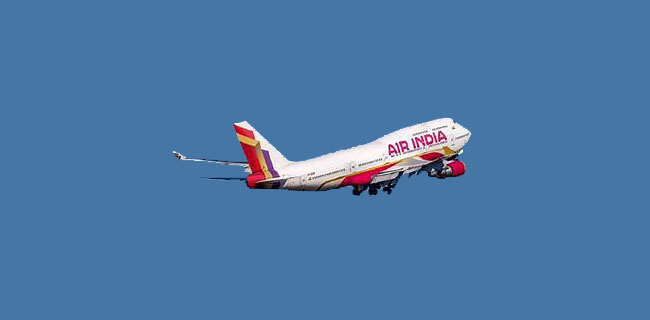
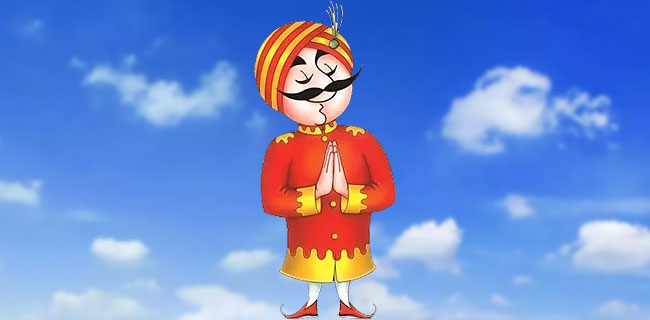
  • Air India Maharaja debate: barking up the wrong tree?


    With apologies to none at all

    By Vikas Mehta


    Vikas MehtaI call my column ‘With apologies to none at all’ for a reason. And my article today actually justifies the title.

    For the last almost a month, since it was announced that McCann Worldgroup India shall be handling the Air India account, marketing and advertising professionals have been tying themselves in knots arguing for and against the use of the iconic Maharaja identity for the brand. Arguments ranging from nostalgia, royalty, Indianness, contemporary image and what not have been flung in the rung. Suggestions like contemporise the Maharaja or that royalty is defunct in today’s day and age are being touted. Compromises are being suggested and a few are sticking their neck out, asking to bin the Maharaja.

    And this is where most marketers exasperate. It’s also the reason why digital experts are gleefully claiming that advertising is dead. For, we forget that while marketing is an art, it’s foremost a science. And when we think from the gut or the heart and not follow simple marketing dictums then advertising opens itself to debate about its existence. We tend to go all mushy-mushy, not following some simple logic that defines marketing.

    The one big mistake which I see all advertisers make is not defining their target group and more importantly, not understanding the difference between target group and the user. Please do indulge me for a moment.

    Everyone uses a soap but a Lifebuoy soap talks to a mother. A Lux soap talks to a youngster who aspires film star beauty. A Dove soap user talks to a slightly middle-aged lady who feels that she is losing the softness of her skin. That does not mean that Dove will not be used by young females or even men. Similarly, Lifebuoy is used by working men too. But the brand always talks to a predefined TG. Just because everyone uses a soap all soaps do not talk to everyone.

    So, everyone may be wanting to fly but Air India has to decide who will it talk to. Just as Indigo clearly decided that it will talk to the no-frills guy who wants to reach from Point A to Point B with some basic amneties at an affordable price. This person is not looking for meals or a newspaper or a luxurious seat. He or she just wants an inexpensive ticket with a professional experience and on time flights.

    The question that needs to be debated therefore is who will Air India be talking to. And once that decision is taken the debate about the Maharaja is resolved by itself. So, please indulge me again.

    Air India is very clear that it is not a no-frills airline. In industry parlance, it’s a full-service airline. Young fleet of aircraft (on its way). Tick. Comfortable reclining seats. Tick. Choice of meals as part of the ticket. Tick. Entertainment on board. Tick. Higher ratio of cabin crew to passengers. Tick. Frequent Flyer programme. Tick. Lounge facility. Tick. Choice of premium classes. Tick. So, the whole experience is premium, specially when compared to no frill airlines like Indigo.

    Therefore, when we are debating Air India’s Target Group, very clearly we are talking to the premium-seeker. Someone who prefers fine dining over quick service restaurants. Someone who would much rather be looking for a vehicle at Nexa and not Arena. Maybe, someone who is not into Maruti Suzuki at all but into Honda or Hyundai or Kia.

    Very clearly, we are talking to someone who has that much bit more to spend. Or someone who wants to be seen in a slightly elevated company. Someone who has tasted some success in life and wants to enjoy it. Now, for argument sake, let’s say that this person is mostly the Millennial. Gen Y.

    My question therefore is simple. What is Air India to this person? Maharaja? Premium? Royalty? Or is it bureaucratic? Not dependable? Poor service? Surly cabin crew? I am not giving any answers but I do think that millennials had the worst of Air India in terms of their brand experience and for them Air India is anything but Maharaja. So, does it make sense to pitch the Maharaja to them?

    On the other hand, the Tata story could appeal to the millennial. Caring. Customer-first. Quality. Trustworthy. All these are the association with the Millennials. And of course how the Tata group treated its employees and customers post the 9/11 carnage is something that the millennial empathises with.

    Therefore, if Air India has the millennial as its target group, then more than the Maharaja, it’s the Tata association which will work. And that’s just one option. There could be many more.

    I am in no way suggesting that Air India ditch Maharaja or use the Tata connection. I don’t have enough data or research to back me up but as a hypothesis, it could work. And that’s my point. Rather than aimlessly get into a debate about the goodness of Maharaja or its non-relevance today, the marketing and advertising gurus must first try and define the Target Group for Air India. Rest will follow automatically.

    There is a very interesting corollary to this. Is there any Target Group for which the Maharaja is relevant? Does this Target Group have sufficient numbers to be attractive enough as a target group?

    Am not sure if there is any? Tales, nostalgia, reminiscences and stories are not good enough. Experience is. Air India was a Maharaja when? In the sixties or maybe till early seventies. Is the nostalgia or reminiscences of a few vanishing breed good enough?

    Not to forget the fact that Air India aspires to be a major international player. Is an airlines from India, in today’s day and age all about royalty and land of exotic animals and snake charmers. Or is India shining for them?

    And what about the future? The current Gen Z. These people in a few years will be looking at premium flying experience. Does the Maharaja mean anything to them? Will a 50-60-year-old icon excite them?

    The answers are there. But only if we ask the right questions. Unfortunately, that’s not what is happening now.


  • Vikas Mehta: Jaago Grahak, Jaago

    With apologies to none at all

    By Vikas Mehta


    Vikas MehtaFour years ago, when my father passed away due to the negligence of doctors at Max Hospital Dehradun, I was advised by all and sundry including close relatives and friends that it is impossible to fight a big hospital and its might. There was no one who had a word of encouragement and most just shrugged their shoulders saying, what’s the point. Some even narrated their own cases where they had seen a relative or friend suffer due to carelessness of doctors but they just accepted it and moved on. That’s what I was being asked to do. Move on. Not to fight for my rights as a paying consumer.


    The life of a consumer in India is not easy. Inspite of competition, inspite of various forums available to voice the complaints, most consumers accept what they get, bad quality, broken promises, brazen flouting of laws… it’s an endless list. What surprises me is that inspite of all the technology available, it’s not easy to get your due as a consumer. Companies use the chimera of technology to become more inaccessible.


    I get enough messages every week from Jio Fiber encouraging me to use their app to self-repair any problem in my broadband connection. So, last week when my set top box was showing all the signs of working properly and yet I was not getting any internet connectivity, I used the self-diagnosis. It promptly did a diagnosis and declared that my router was not working. I was advised to restart my router by switching it off and on or by replugging the power cord. It continued to say that if the issue persists that I should clean the power cord and ensure it is properly connected! That was all. No further solutions. No contact number or mail id. How do I lodge a complaint? How do I get the router rectified?


    So, I did what an average Indian does. Look for contacts. Luckily, some senior Jio Fiber executives stay in my society. I got in touch and requested for help. A technician came, checked the router and reset my username and password. When I asked for an explanation, his simple response was that whenever this problem arises, I must reset my username and password. Now, I am sure this is not a problem that most Jio Fiber users face. Obviously, something was wrong with the router. And my router was hardly 18 months old. So, I got in touch with the executives again. I insisted that my router be thoroughly checked and if the need arises be replaced. Because I am not going to be resetting it every time the problem arose. And it did arise in less than 24 hours. First, they demurred but when I insisted, a technician came and said that my router needs to be replaced. Because I was in touch with some senior people, the replacement happened almost immediately and free of cost. But it happened.


    And that’s my point. We, as consumers, do not fight. We give up too easily. It’s almost like the companies with their products are doing us a favour and we must accept whatever is given to us. Maybe the philosophy of believing in fate extends to the consumer & product relationship too.


    The problem also is that almost all companies, all products and all brands are the same in terms of consumer service. So, even if the consumer theoretically has choice, there is no choice. Incidentally, I have a Airtel Fiber connection also. And it’s not any better in terms of service. My only solace is that both rarely go bad together!


    And the laws do not help us. Even if they are there. Most consumers do not even know their rights. Sure the government has tried to communicate consumer rights through some ads and PR. Jago Grahak Jago is one such attempt. But even if the consumer is aware, the process and outcomes are complicated and prone to delays. Plus there is the omni present fear of corruption creeping into the system. Not to forget the ambiguity in the laws and rules.


    Take the case of service tax which restaurants tend to levy. The government has clarified that this is not a tax but a service fee which is not mandatory. If a restaurant is charging the same, it must ask customers whether they are willing to pay it. And yet, many restaurants and hotels just slip it into the bill. Some association of hoteliers and restaurants even challenged the government’s mandate in court. I do not know what happened finally. But this is a typical example of ambiguity. Every time I dine out, I check if I have been charged service fees and some times it is there. In one or two cases, the restaurant managers have insisted that this is legal. Now, tell me who wants to get into an argument after a dine out? It spoils the whole experience. So, most diners just quietly pay up.


    Talking about awareness, today almost all retailers ask us for our mobile number, email id etc. The way it is done, when the bill is being prepared its almost like one should mandatorily divulge the data. How many know that one can refuse to give the data? I steadfastly refuse and when I do the retailer is quite surprised. Two days ago, at a Nike outlet when I refused to give my details the cashier was startled. He said, you are the first person who has actually refused to do so. I asked him whether he has been told not to sell to those who do not give their data? He smiled and said of course not. But we as consumers meekly give it away. And then we worry about data privacy.


    India desperately needs a Ralf Nader type of consumer activist. Someone who can work around the issues of misinformation, communication, interpretation of the law and most importantly, someone who can lead a movement. To educate and galvanise the consumers to their rights. Who cannot just inform, but also embolden them.


    Ah, yes! What happened to my father’s case? I complained to Indian Medical Council (IMC) with all the paperwork and attached proof. I followed it up even with the Union Health ministry. IMC instituted a bench which heard my case. It took time because Covid intervened, but I persisted. Max tried delaying tactics but I persisted. IMC also was slow (it was doctors judging other doctors), but I persisted. And I got justice. After two years. Eight doctors were found guilty and were censured and given some punishments. Even the CEO and COO of Max were held responsible, the IMC could not punish them as they were not from the medical fraternity, but the judgment said that I could legally start proceedings against them under the principle of vicarious liability; senior management are responsible for the action of the employees. Mind you, I fought this myself. No lawyer or any external help was used.


    So, If I could fight against a big name, if I could do it all myself without spending anything else but my time and if I could get justice as a consumer, if I could do it inspite of the pandemic, why can’t we all as consumers rise and fight for our rights? It’s our rights and our battle to lose. Let’s not wait for an Indian Ralf Nader but become our own small Ralf Naders.


    Vikas Mehta is a senior marketing and business strategist and educator. He writes on MxMIndia every other Monday. His views here are personal.


  • Is there enough Tomato in your Puree?


    With apologies to none at all


    By Vikas Mehta


    Vikas MehtaWe Indians have suddenly discovered a new food ingredient. Tomato Puree’ is now the talk of town of the urban and even semi urban Indian. Price of tomatoes is passe’. I actually joked with my vegetable vendor while asking him the price of tomatoes, that will he charge me for just asking the price. The fact is that at the price of a kilogram of tomatoes one could buy 4 kgs of Langda mango in Doon. (Last enquiry showed the price of tomatoes as Rs 250 per kg in my neighbourhood). The big issue today at retail outlets and on ecommerce sites is the availability of Tomato Puree’. I am told that in Mumbai there is already a blackmarket of the exalted product. Retailers are claiming that the demand has gone up by 6-8 times for the puree’.


    Now, I am no cook or an expert in food ingredients. But I was intrigued. Price of basic tomatoes was going through the roof. Every Tom, Dick and Harry worth their salt were asking people to use tomato puree’. The demand for the product had soared. Puree’ was being touted as the next best thing to fresh tomatoes and yet, wasn’t it processed food? Didn’t it have any other additive? And if tomato is costly, anything being made out of tomato should also see a price hike. Old stocks notwithstanding.


    Let me also confess that having worked on food brands, I do have some basic idea about Tomato Sauce and Tomato Paste. But Puree’ for me is a new one. So, I turned to my wife first for some information. I recollect that when we were in Egypt, tomato paste was a common ingredient found in local kitchens and it was used as a base for cooking of many a vegetable dishes. My wife informed me that puree’ is a much thinner version of the paste. It is more natural, less processed and closer to the actual flavour of tomato.


    Next, I looked up the web and found the following descriptors for puree’ and paste.


    Tomato puree is a product made from fresh, ripe tomatoes that are cooked, then blended into a thick liquid just slightly thicker than a typical tomato sauce. However, unlike tomato sauce which can be chunky, tomato puree is smooth and uniform. An acid (like lemon juice) and salt is usually added giving tomato puree a bright flavour.


    Tomato paste is a concentrated form of cooked tomatoes, where tomatoes are cooked, strained and recooked until most of the liquid has evaporated and the tomatoes reach a thick, pasty texture similar to toothpaste. Because tomato paste is cooked for a longer period of time, it has a deep red hue and sweet flavour thanks to the natural sugars present in the tomatoes. Like tomato puree, store-bought tomato paste may contain added acid and salt.


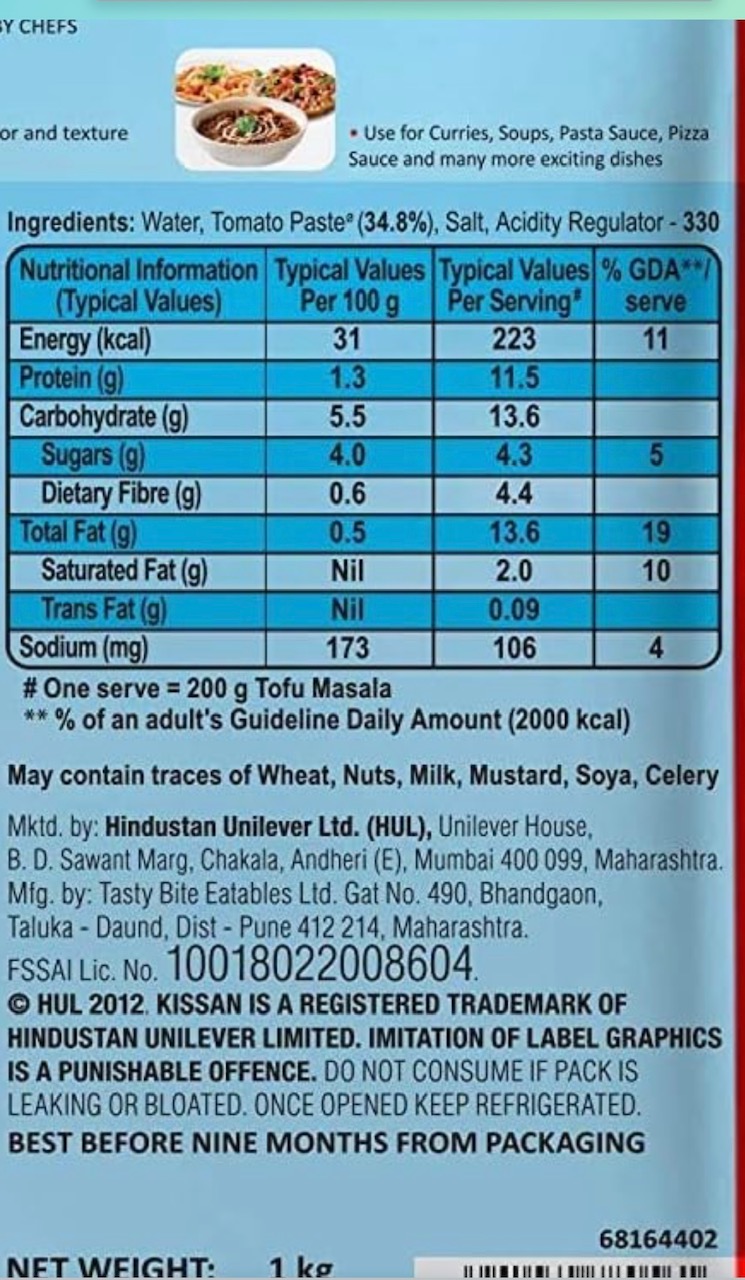
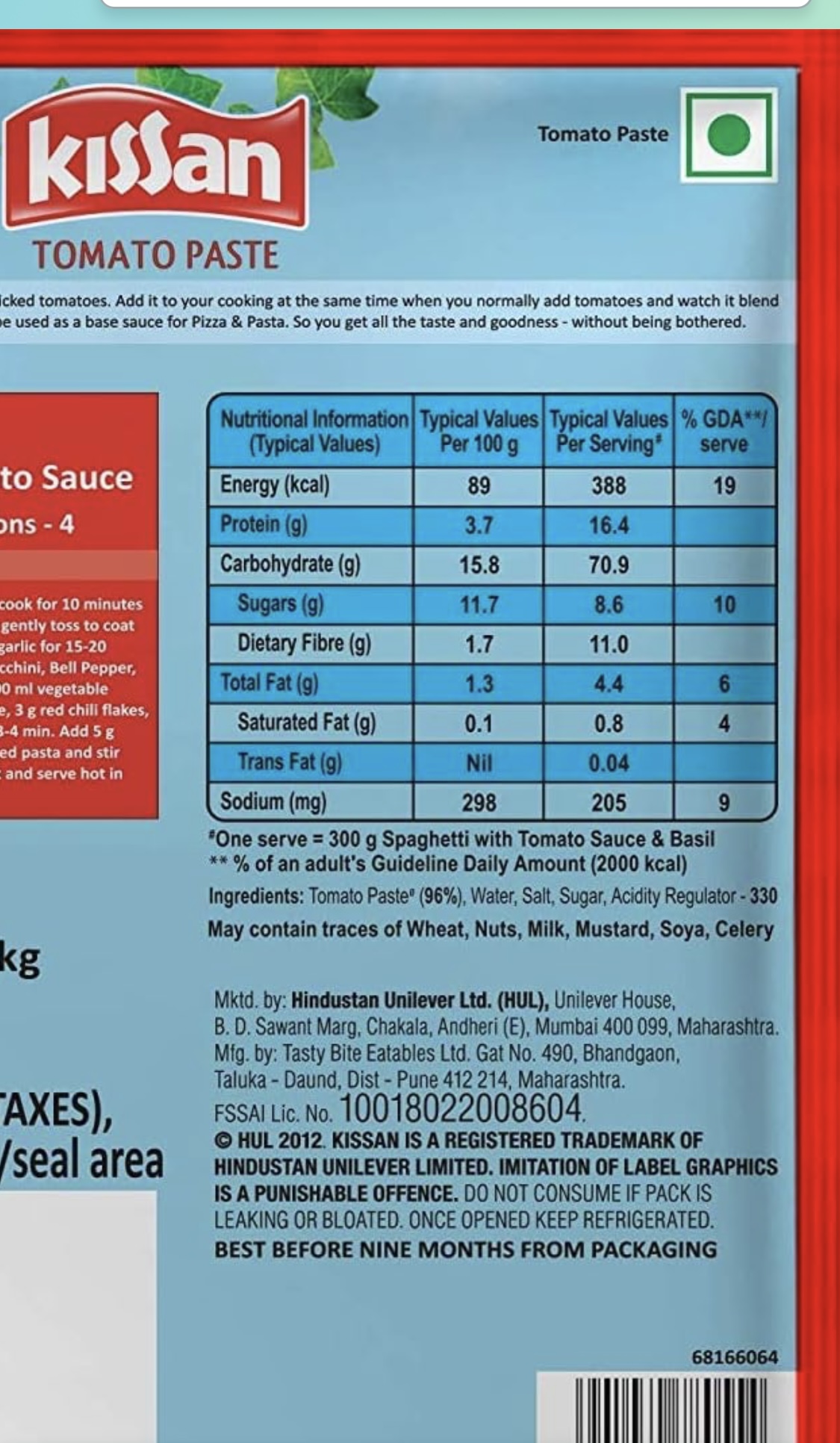
    Having armed myself with some basic knowledge I searched for actual products. The first brand I came across was Kissan puree’. And the ingredient information shocked me. It said water, tomato paste, salt and acidity regulator. Tomato paste? Not from tomato itself? And only 34.8% was tomato paste. So, what was the rest? Water, salt and acidity regulator. How could this therefore be a substitute for natural tomatoes. The rule when one writes ingredients on the pack is that the ingredients will come in a descending order of total composition. So, Kissan tomato puree’ is actually water mixed with tomato paste, salt and acidity regulator.  The good thing was that the brand was being honest but the brainwashing on puree’ does not prepare one for these facts. I mean how can something, read paste, which by definition is cooked twice so that it is devoid of water be used to make another product, read puree’ which is more liquidy? By adding water. So, we are being charged for adding water to paste?


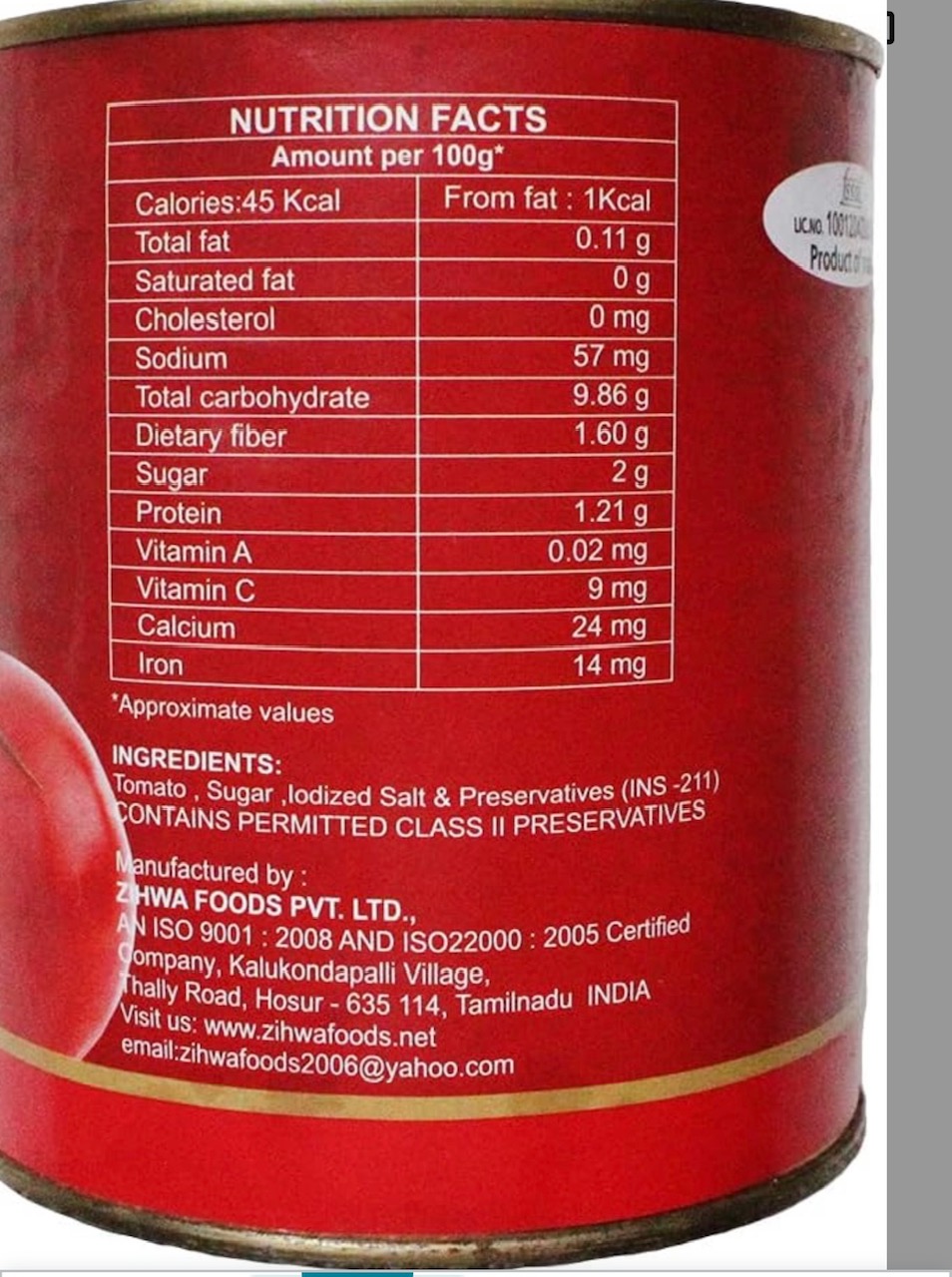
    The next brand I encountered was Topps puree’. In ingredient information it said tomato, sugar, iodised salt and preservative. Now, look at the inconsistency in the ingredient information. No mention of what amount of tomato or salt or preservative. Just by its absence it can be presumed that all is not healthy. Though tomato written as the first ingredient means that the brand has more of tomato.


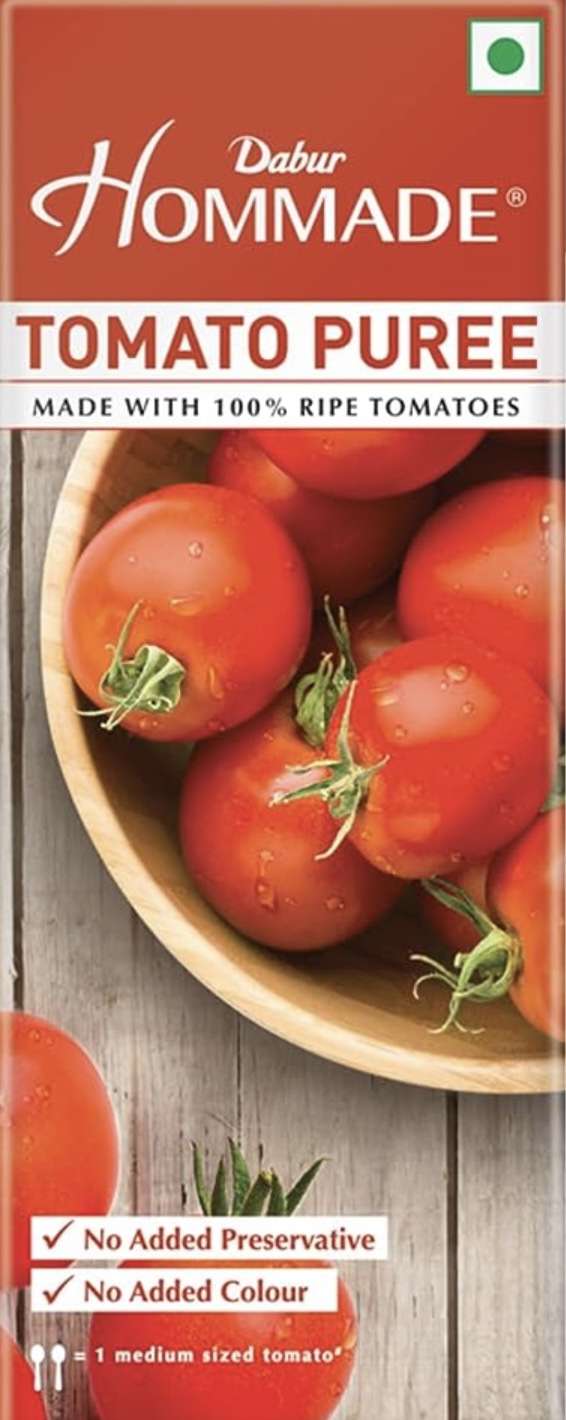
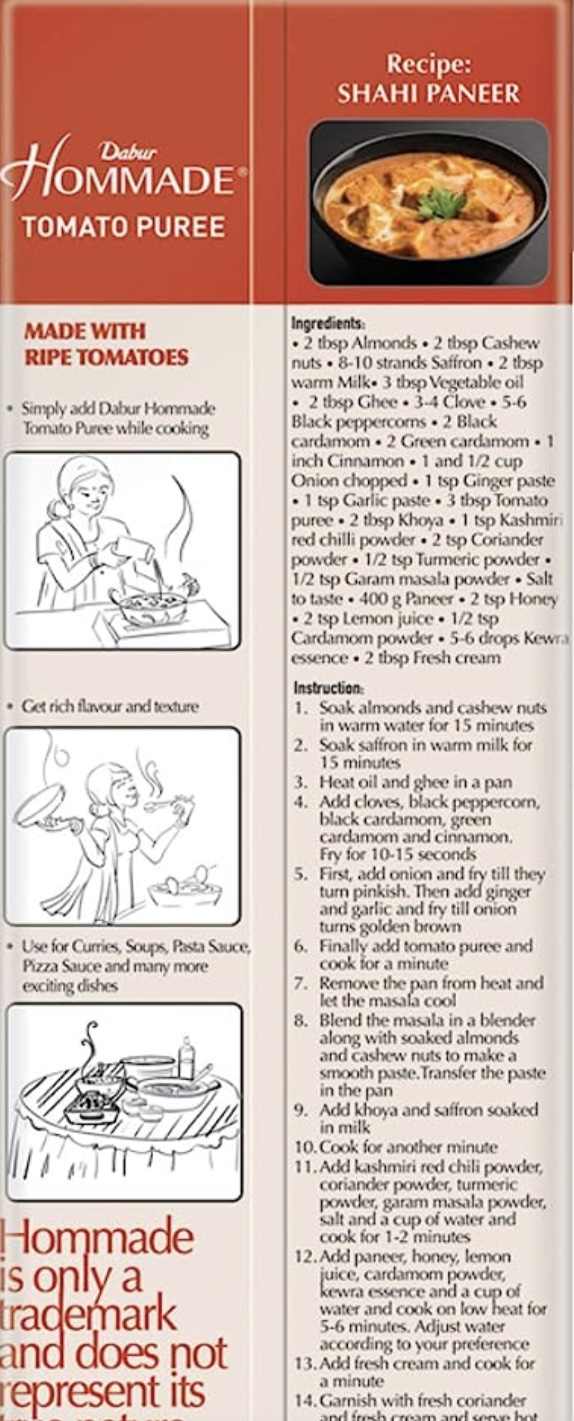
    But the real surprise about how rules regarding packaging, ingredient information and even branding are vague and open to interpretation happened when I came across Dabur Hommade Puree’. Sounded too good to be true. And it was. As behind the pack is a disclaimer which says “Hommade is only a trademark and does not represent its true nature.” Seriously? Hommade is a Dabur brand which is quite misleading but that’s another story. The pack says made from 100% ripe tomatoes. And yet if one looks at the ingredient story it is almost the same as Kissan. Water, Tomato paste (37%), acidity regulator and anti oxidant. Tomato paste?  So, what’s this about made from 100% ripe tomatoes. Misleading? To a lay consumer like me, definitely.


    I did look up Kissan Tomato paste also. Its ingredient story had Tomato paste (96%) as the first ingredient, followed by water, salt, sugar and and acidity regulator.


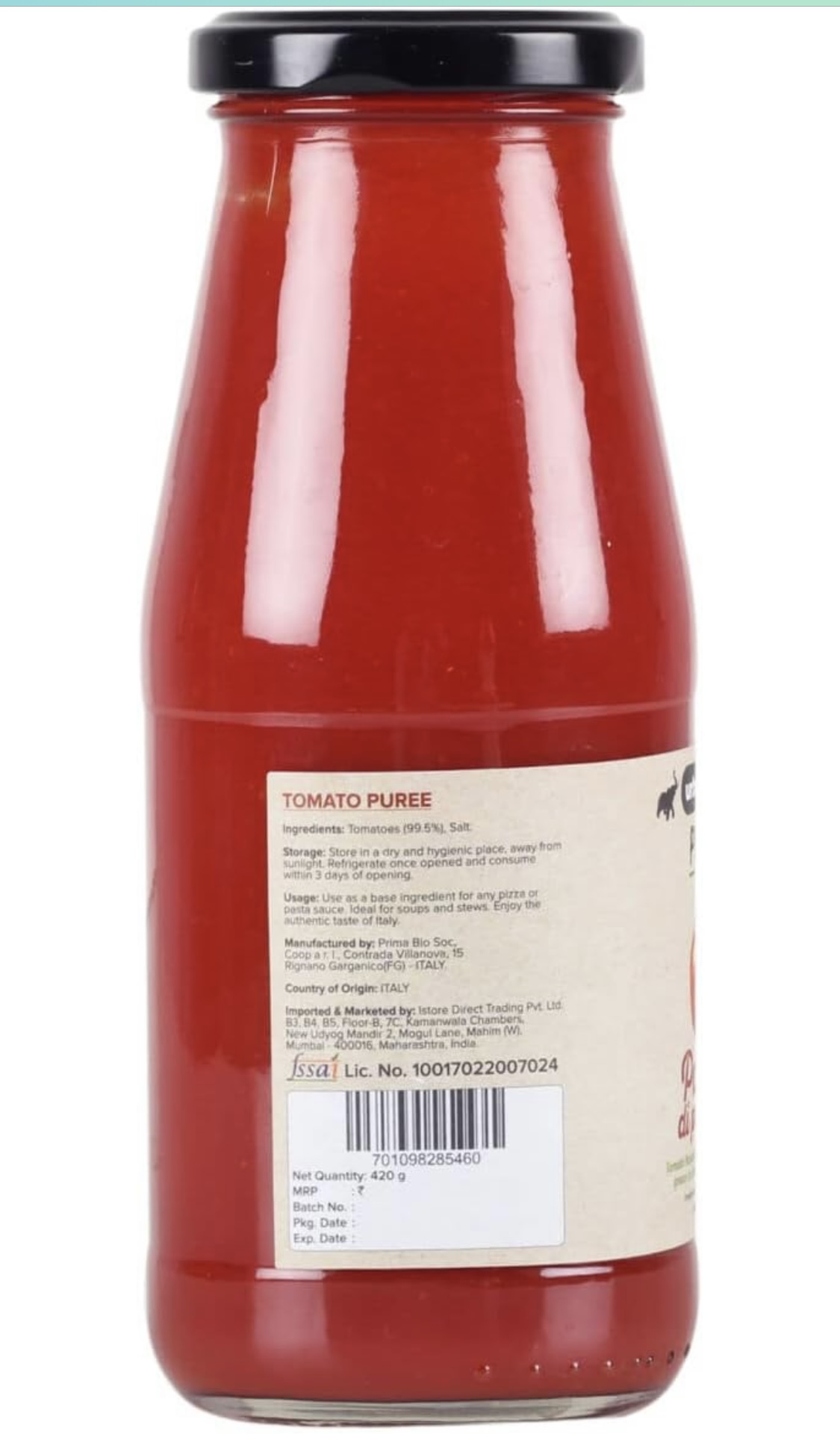
    And I also came across some imported Italian brands which had 96% tomatoes and salt as the only two ingredients in puree’.


    This is what I had written about in my last blog. We consumers are being taken for a ride. The packaging rules are not clear. Ingredient story is incomplete and sometimes not consistent with the claims. Phrases are being used as brand names which have to be defended within the packaging but in an obscure fashion. So called influencers who obviously are being paid then drive the gullible us to use products which are not exactly what they are supposed to be.


    I am sure that the legal departments of these companies will have arguments to counter all this. But, why do they need legal to justify a product?


    Looks like the Tomato story is not just about the price.


    Vikas Mehta is a Dehradun-based business strategy and marketing consultant and educator. He writes on MxMIndia every other Monday. His views here are personal.


  • Air India- let’s not confuse logo with a mascot


    With apologies to none at all


    By Vikas Mehta


    Vikas MehtaOk, let’s begin with a question. What is the current Air India logo before the unveiling of the new logo? Simple question and the answer should be simple too. While we are all ranting about the new logo or mourning the demise of the Air India Maharaja, we must not forget to compare like to like.

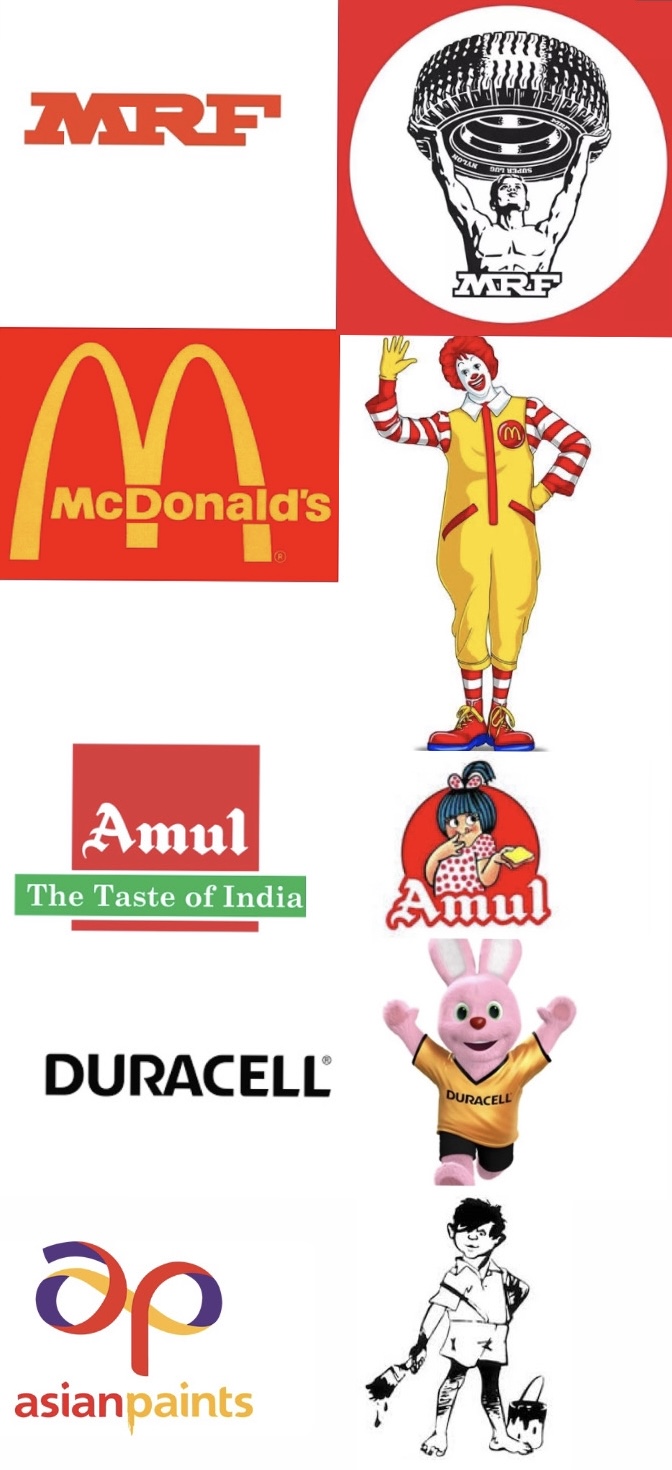
    Let’s get this very clear. Maharaja is not the current Air India logo. It never was. At best you can call it a mascot. I would prefer to call it brand personification. Every mascot, be it the Asian Paint Gattu or the Amul girl or KFC Colonel Sanders or the Michelin man for Michelin Tyres were not brand logos but mascots. Amul’s logo is the way it writes Amul in a distinct registered typeface. McDonald’s logo is its famous M arch. But its mascot is the clown, Ronald McDonald which you will find outside its outlets. Duracell Bunny is its mascot. Not its logo.

    Below are some examples of logos and some examples of mascot of the same brands.

    So, what is the difference between the two and can they be used interchangeably?

    Let’s dive in.

    Simply put, the logo is the identity of the company. It’s a reminder of the brand or company. The name. The mascot defines the value, personality and sometimes even the culture of the company. In a way, a mascot is the extension of a logo. Many companies incorporate the logo in the mascot or make it a part of it. KFC is a good example of the same. So is the Duracell bunny.

    Earlier, brands strived to have a mascot. Even in India, MRF had the muscle man. Cherry Charlie for Cherry Blossom shoe polish. Asian Paints Gattu. Air India Maharaja. These mascots told a story. They were the brand personified. Gattu was the personification of Asian Paints. It was a mischievous boy, maybe a brat who could not stop painting. And in old ads, Gattu painted anywhere. Even used a bald man’s pate. And the tag line that went with Gattu was ‘any surface that needs painting needs Asian Paints’.

    In India, all these mascots worked because the also transcended the literacy barrier. Specially in rural areas Gattu, MRF Muscle man etc stood out as they identified a brand and also what the brand stood for.

    But we must not forget that for all brands with a brand mascot, there were always two elements to play with. Twin identities. One was the brand logo. In many cases it was just the way the brand was written, with a tag line. And the second was the brand mascot. As media proliferation started and media started becoming more expensive with a premium on space or time, something had to give. Mostly, it was the mascot. Because the logo was the brand identity. Indispensable. And over a period of time most brand logos were just the way you write the brand. No separate design element also.

    So, coming back to my initial question. What was the last Air India logo? And in categories like airlines, logos become more important because that’s what you see on the planes. The airlines is recognised by its logo. Air India also went through various logo transformations. I think its most famous logo was the centaur.

    And its last logo, which is in current use, is the swan with the konark wheel inside it. Remember this?

    The new design that Air India has released is therefore a replacement of the same. The vista along with the way Air India is going to be written now is the new logo of Air India. It is not replacing the Maharaja. For all you know, the brand may continue to use the Maharaja as a property in a limited way. Or maybe a different version of the Maharaja which imbibes the thinking behind the new logo.

    I raise this point because I was dismayed to see not just marketing pundits but even national media announcing the death of the Maharaja when the new logo was unveiled. It may still happen. But it will not happen because a new logo has been designed. It’s not about a logo vs a mascot.

    And let’s not forget another point. Logo is not just a design to be seen in isolation. Logo cannot be judged immediately just because of a design element. Logo is what the company makes of it. And it evolves, registers and rules, over a period of time.

    The famous Nike swoosh. When Nike launched it, it was not exactly the current design but close to it. It evolved to what it is today. I am sure, if it was presented to the world then it would have met with outrage as a failed design. Nike was the name of the Greek goddess of victory. So, what had the swoosh to do with that? What Nike did over a period of time was identify the swoosh with its tagline, “Just do it”. Indeed, today the logo is so strongly identified with the brand that the brand name is not necessary when the logo of swoosh is around. Even Nike outlets today just have the swoosh logo outside. The brand name sometimes appears very discreetly in a small corner. Who would have thought of it, then? As I said, it’s what you make of the logo.

    Or take Apple. Imagine calling a technology company with the name of a fruit. And that too a half-eaten one! But today, Apple is the ultimate in technology and design. And the Apple logo is ubiquitous. Indeed, it’s so famous that in India I have seen the logo being used by even a potato chip manufacturer and as a garment brand too. This logo also evolved and was used in an iconic way on its products too. The logo is so important that a cursory check on Amazon and Flipkart reveal that most of the iphone covers have a punch at the back which reveal the logo. Full covers or covers without the punch are not many. For, who would want to own a iPhone without flaunting its logo. I am also amused that Apple still gives in its product boxes 2 stickers of its logo. And people use it. On their laptop bags, back packs, indeed even on cars and scooters. Again, it’s what you make of the logo.

    I would therefore not pass any judgment on the vista logo. It’s too early to make anything out of it. Even the critique that it’s not Indian is hollow. The brand is owned by a private company. It no more represents India. It’s as private or global as is British Airways or Air France. Why should it stick to representing India?

    How will Tatas use the logo? Will they be more creative with it? Will they strive to make it standout? Or will they just let it be one anonymous airline logo? Indigo has done very well with its logo of the dots as a plane, its typeface and the colour indigo.


    Indeed, even its airline code. It’s not 6E. It’s to be read as sexy. And all that has contributed to the brand personality. But that story is for another day.

    The ball is now squarely in Air India’s court to make the new logo count.


  • Hospitality sector – no more hospitable?


    With apologies to none at all

    By Vikas Mehta


    Vikas MehtaAbout seven years ago, I planned a Europe trip for my family with a global travel agency, Indian-owned which had done a reverse acquisition of a more-than-100-year-old European parent company. The company was owned by Indians but headquartered in the UK. I took a bus tour package of 18 days covering seven countries and had paid the full amount which had run into a few lakh, got the necessary visas and were now just two-three weeks away from the departure date. The payment etc was facilitated by the agency’s office in Dehradun, where I stay.


    At that point we got a call from the travel agency’s head office in India, informing us that the tour beginning date that we had chosen was not operational and they gave us two alternative dates, both before the designated date. This was not acceptable to us as on those days schools were still on and both my daughter and wife would not be able to make it. But the agency was adamant saying it had no other dates as rest of the trips were fully booked. And then the customer representative threw the rule book saying that according to terms and conditions that we had signed on the agency could change the travel dates. The arrogance and take-it-or-leave-it approach was shocking. We were caught in no man’s land and a cancellation would mean forfeiting 50% of the money.


    The attitude of the travel agency was huge and crushing. Specially for my daughter. My regular readers will recall my earlier articles where I have emphasised on how we Indians do not take customer service and consumer rights seriously and give in too easily. In this case therefore, my basic instincts kicked in and I wrote an angry email to the Indian CEO of the agency in London detailing the arrogant and one-sided approach of his company.


    I was completely taken aback when I got an answer within a few hours from the CEO himself. He not only apologised for our experience but also informed me that a senior executive from Mumbai will call me and sort out the issue to our full satisfaction. And within an hour I got the call. The gentleman apologised profusely and then made us an offer. We will go for the tour on the dates that we had booked. We will follow the exact schedule of the trip with all inclusions as promised. The only difference being that the trip will not be in a bus but in a private vehicle with a chauffeur driving us for the 18 days and a local guide will accompany us at each destination. Just for us. In our vehicle.


    It sounded too good to be true. No? But it exactly happened that way. We had a seven-seater Mercedes van with a chauffeur for all the 18 days and each destination had a local guide, a three- or four-star hotel accommodation and we were driven to all the tourist spots. It was a royal treatment that we will never forget.


    So, why am I recalling this episode in such details now?

    Because I think the hospitality business in India has forgotten what hospitality is all about. We have a culture which says Atithi Dev Bhavo. A guest is like god. But nowadays a guest is treated like a lemon. Squeeze as much out of /herhim as possible and then discard her/him. In the service industry and specially in hospitality, one of the first principles of marketing is (getting a) repeat consumer. Make the consumer happy so that s/he becomes loyal to you. And keeps on visiting you again and again. It is also a fact that a loyal, happy consumer is cheaper to service and maintain than acquiring new consumers. And for that the attitude of happy, satisfied consumer at whatever cost is the uppermost priority.


    Take my example. After that episode where do you think that I went for my future holidays and travel bookings? And I shared this episode with all my friends and family. Where do you think, they went for their holiday bookings. Positive word-of-mouth is the second principle in the service industry. And in hospitality, word-of-mouth recommendation is worth its weight in gold. That’s the reason almost every marketing campaign in hospitality has an element of satisfied testimonial from consumers.


    I once remember at the one of the Taj restaurants, my kebabs were replaced without even asking as I had got busy talking on my mobile and these had gone cold. It was not the restaurant’s fault and yet they stepped in. Or at the Oberoi, where when we ordered a basket of bread comprising three different types of rotis, they just got a quarter each and brought fresh quarters as we finished off the hot ones. Nobody would have complained if the Oberoi restaurant had not done that. But then Taj and Oberoi are in a different league, most of the other five-star luxury hotels do not fall in the same league.


    And things seem to have changed for the worse, in the last few years. Even when the brands are at fault. The focus has shifted to buying loyalties. Loyalty programmes with their digital reach have become more important. Today, we talk about digitally generated word-of-mouth which has numbers but no empathy.


    It’s not about the bang for your buck but just your buck is what matters. As a result, short term profitability, immediate targets and lack of empathy seems to have become the norm. Arrogance has crept into the hospitality sector. Humans have been reduced to just a number. Let me give you three experiences that I have had in the past few weeks.


    We had a family get-together in Doon where my sister-in-law had come down from the US. We decided to throw a three-in-one party to celebrate three landmark birthdays which all were happening within a few months of each other, for my daughter, my mother-in-law and my wife’s niece. We chose a five-star hotel brand rooftop for a celebration with about 40 invited friends. Incidentally, we had a horrible dining experience at a premium property of the same brand last year. But since this was a different property, we went ahead with the event.


    And it was quite a sad experience. The service was slow and poor. The place leaked like a sieve when it rained, so we had to shift our tables two-three times. And worse was that a senior staff member who volunteered to help out was actually suffering from conjunctivitis. When I confronted him, he quietly disappeared. But can you imagine this happening in a premium hospitality brand? And the arrogance of the F&B head had to be seen to be believed. Inspite of all the troubles, we paid and cleared our bill in full immediately after the event. From the property there was no apology or even contrition.


    Next day, I sent a detailed mail to the property GM and also to the brand’s India CEO. There was no reply for 48 hours. I then sent another strongly worded mail and that’s when things started to move. The VP operations called. Apologised. Promised to look into the matter. Made the right noises and then landed in Doon four days later, on a routine trip. He invited us over to the premium property. Became a gracious host. Fed and hosted us in a yet-unopened-to-the-public bar. Again, made the right noises. Apologised, but threw up his hands in despair as the property where we were hosted was a franchised property and he claimed that they cannot do much with that management. Bewildering, as the brand name is of the hospitality chain. And as a consumer, I care two hoots if your business model prevents you from taking someone to task. Instead, we were introduced to the GM of the premium property and were told that he will take care of our any future interaction with the hotel. The GM promptly handed us his card which had his email and the hotel telephone number. I wrote to him on the email address thanking him for his hospitality. There was no response. Would you want to make Hyatt your destination after reading this?


    Then, two weeks ago we went on a short holiday to Goa. We have been Club Mahindra members for more than 15 years and enjoyed the new river resort at Assonara. The place was good but lacked in service and the food had some issues. We complained to the executive chef but the same problems persisted. I am not getting into the details, but the resort did fall short of service levels, compared to other resorts we had been to. In fact, we bumped into the CEO of Club Mahindra at the resort who was trying to travel incognito. He asked us to write to him with our experience which we did. And he responded very graciously. He mentioned the name of a senior executive who would look into our feedback. Well, that was two weeks ago. I have been getting messages and mails from Club Mahindra asking me to refer some friends or relatives. Do you think I will?


    The lack of action or any corrective step is glaring. Don’t get me wrong. I am not looking for any freebies or my expectations are not at all what happened during my Europe trip. It’s just that the hospitality industry seems to have strayed away from the core of keeping the consumers happy. Mistakes will happen. It’s how the brands bounce back after the mistake to keep the consumer happy, is what matters. A mere acknowledgement and mouthing of platitudes is not the solution. The tone, the action and the follow up is what matters.


    Finally, we flew back from Goa with Indigo. I need not get into the arrogance of Indigo but when I asked for a Cappuccino as part of my pre-booked meal, I was curtly told that no coffee was available. The reason? It seems Indigo is changing its menu from September 1 so it had run out of stock of some existing menu items. This was on August 20. And the arrogance is that the airline has no compunction or shame in telling me that. When I protested, I was curtly told to send my complaint via the link which I will get after the flight to rate my experience.


    Compare all this with my experience seven years ago. In all the cases involved now, the brands involved needed to maybe show contrition with some simple acts. But they chose not to. And served some platitudes which were right off some training manuals. The lack of intent in hospitality was very obvious.


    Has Atithi Dev Baha become just a tagline?


  • Vikas Mehta: The changing temperament of citizens

    With apologies to none at all

    By Vikas Mehta


    Vikas MehtaI have been a Urban Bhartiya citizen, living in Dehradun for almost 10 years now. Urban Bhartiya because while mid-size towns like Dehradun retain a local and slightly rural oriented stance to culture, traditions and habit, it has been quick to adapt to urban modes like consumerism, lifestyle and new products.


    The one area where Urban Bharat seems to be degenerating is unfortunately neither a rural nor a metro city phenomena. It is more a function of the change which has been sudden and not gradual. The rise of impatience and temper. Everyone seems to be having a short fuse and is in a great hurry.


    Cities like Dehradun were famous for a leisurely, almost lazy lifestyle. Shops would not open before 11 (they still do not) but would close by 7 (now they are open till beyond 9). And it was not uncommon for most shops to close for lunch for two hours in the afternoon. People would not commit to a time. I will see you around 12-12:30, was the common refrain and no one would bat an eyelid if that would become 1. Traffic was far and few with two-wheelers, also of the non-motorised types being more visible. There was no rush to overtake or to be ahead. Indeed, to a metro visitor, it would seem that the Lucknowi tehzeeb of ‘pehle aap’ was evident on the road too. And early mornings and evenings had more brisk walkers than traffic on the road. Polite small conversations on the road were not uncommon. Polite eye contact, recognition and acknowledgement, care for each other, exchange of festival greetings… all was par for the course.


    While the change was already underway when I moved to Doon, the situation has deteriorated quite rapidly in the last few years. Yes, unplanned growth and urbanisation is the primary cause of impatience and a sense of anger in almost everyone, but I think there is much more than meets the eye. The city is going through some major changes.


    From being a city that prided itself on individual houses to a city which is now being overrun by flats and apartments.


    A city that had narrow lanes which did not seem narrow for two-wheelers or walkers to a city, which still has narrow lanes but has now been dwarfed by four-wheelers of all sizes.


    A city where time was measured maybe in hours to a city, where every second now seems to be like an hour.


    A city which regarded tourists as guests to a city, which looks at tourists suspiciously like outsiders.


    A city, which was actually a village at heart with a sprawl of a city to a city which thinks that being smart is its pride. The city it seems is becoming too smart for itself.


    Primarily, the change is happening because of narrow outlook. Both literally and metamorphically.


    Maybe we are feeling hemmed in and claustrophobic. Both literally and metamorphically.


    Maybe there is a sense of being overrun. Both literally and metamorphically.


    Maybe there is a fear of missing out. Both literally and metamorphically.


    And maybe there is a true sense of alienation. Both literally and metamorphically.


    That is why, a two-wheeler driver is always angry because s/he is not happy being elbowed out.


    That is why a four-wheeler driver is on short fuse because s/he is not allowed to dominate the small lanes.


    That is why a walker refuses to acknowledge a co walker because they are fighting for the same limited space.


    That is why a visitor is looked at upon as an intruder because he is buying property and driving prices up.


    That is why there is anger and sadness to mass cutting of trees because the locals think it is only for the benefit of the tourists.


    And that is why the smart city project is dragging on because no one knows if the negative connotation of the word smart as in “smart boy” is what the city should look forward to.


    It’s uncanny how the physical change in a city can spoil the mood, behaviour and temperament of the city.


    We talk about consumer behaviour from a viewpoint of culture, language, tradition etc. But physical transformation also affects our behaviour.


    Frankly, it also tells us how much wrong is happening in the city.


    And I suspect a similar story is being played out in other Urban Bhartiya cities.


    I don’t know if a similar trend played out in the metros but I suspect the metros had never seen the ill-effects of a big unplanned city. They just did not know what they were getting into it.


    But we, the citizens of Urban Bharat, have seen our metropolitan cities. And we are seeing our small towns careening towards exactly the same place.


    So, we are mad, bad and definitely not glad.


  • A trip through an Urban Bharat landscape


    With apologies to none at all


    By Vikas Mehta


    Vikas MehtaI have always preferred bus trips wherever possible as it leads to some interesting observations of semi-urban and rural India: Bharat and Urban Bharat. And these observations lead to some very interesting insights. So, last week I got a chance to do a bus trip from Delhi to Dehradun, all in broad daylight. The unfortunate part was that the trip was non-stop, except for a five-minute relief break, so I could not take as many photos I wanted to and could not speak to local people. And as most of the photos were from a moving bus, they were all not as good as one expected. Most of what I am writing are observations and not insights, if you understand the difference between the two.


    My experience actually started at the Delhi ISBT (Inter-State Bus Terminal). This place, in lot of ways resembles a mini-Bharat and Urban Bharat. And the first thing I noticed was Jugaad. There are lot of shops selling snacks and also some staple Indian dishes like Puri-Alu or Rajma-Chawal, inside the passenger terminal. But this time I saw that a few of them had taken over empty spaces, put up two-three big fans, placed some chairs and stools in front of them so that the passengers could be lured into this cooler oasis and empty their wallets. I am sure the set-up was illegal as it was temporary, but it had the feel of a dhaba with some waiters trying to get customers inside.
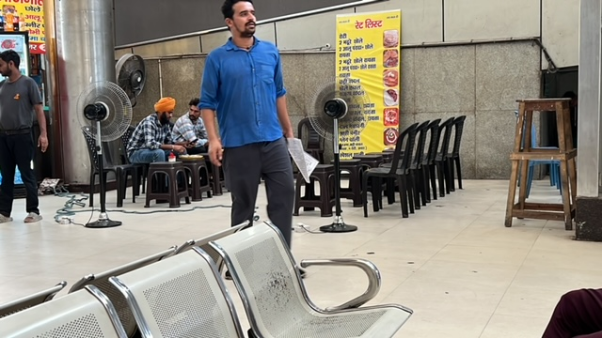


    And then there were the booksellers. Selling pirated books. In two-three languages. Hindi, English and Punjabi. They could understand with your dress and luggage if you were an English or vernacular bookreader. I was approached by two sellers. Both had sorted out English books before they approached me.


    There were socks-sellers and watch-sellers too. Again, all fake stuff but with the real label. The price printed for Adidas pack of three was Rs 499 but these were being offered for Rs 250. I bought one pack, without any haggling and the vendor therefore opened up a bit to me.


    According to him, these were bought for Rs 150 from some wholesalers at the Delhi borders. The vendors pay protection money of Rs 200 per day to some people at ISBT. Sellers like him manage to sell about 10-12 sets each day. There is haggling and per set anything between Rs 75-100 is profit. The travel cost and lugging of the same means about Rs 150-200 per day. So, at the end of the day. They are left with an earning of Rs 1000-1500. I asked him about his education. The guy was a BCom and so were the others, he said. They spend about 12 hours on their feet selling socks or fake watches. Or fake sunglasses. They come from villages in Haryana and UP and lack of jobs force them to come to Delhi and take up this job.


    I asked him what he hated most about his job. Lack of respect, he said. People are rude, haggle endlessly even if they have no intention of buying and are too smug in their own way. He then muttered “Maybe because they have a job, can afford to travel by AC buses, eat aloo-puri and drink Coke whereas I can’t afford to do the same.” “I do make decent money,” he added, “about 25-30k a month but it’s a back-breaking job and lack of respect hurts.” Plus, there’s the dealing with the protection gang, authorities raids when they seize all the goods, all that adds to the burden. He also confirmed that the stalls putting up eating areas was all controlled by the protection mafia in cahoots with the authorities. See photos below
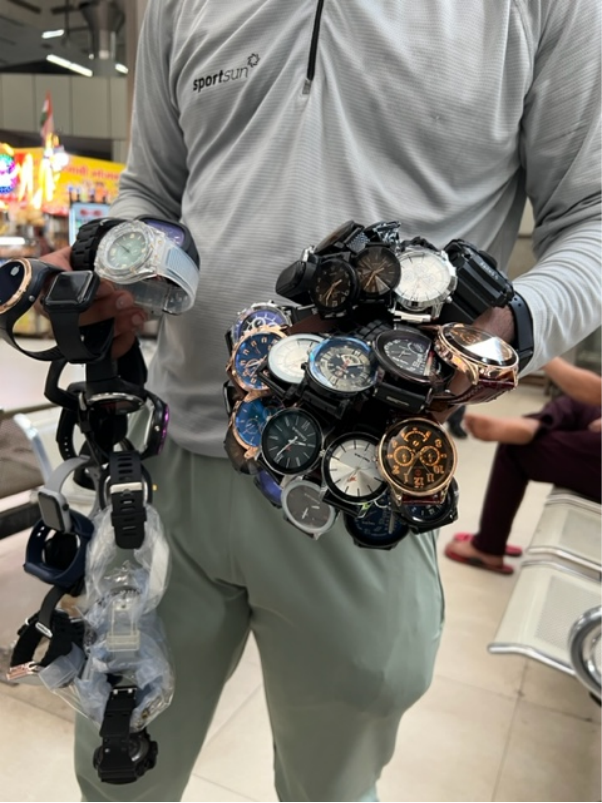
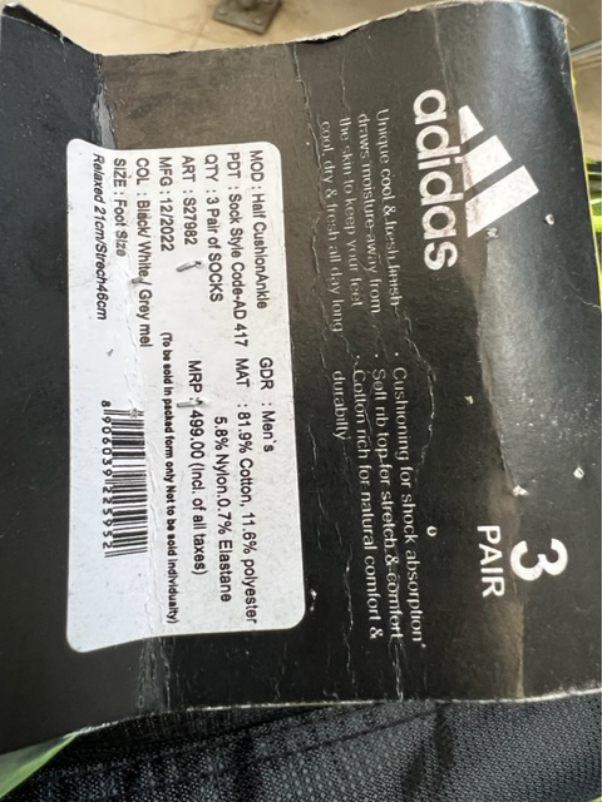


    I used the socks. The quality as well as the branding on the socks sucks.


    ISBT also offers a kaleidoscope of clothes, both Indian and western, a smattering of various languages and a variety of luggage. Not just in terms of merchandise but also attire and accessories that passengers use. Lot of fake clothes, shoes etc being worn and a lot of mix of old and new, modern and traditional, utility and jugaad. This picture below really says it better than words. A traveller with a VIP strolley in one hand and a polythene gunny bag with god knows what on his shoulder.
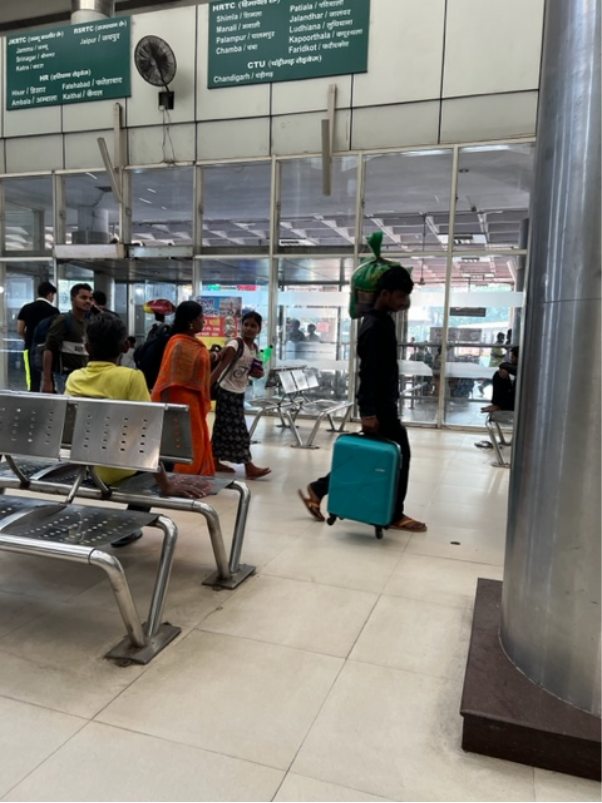


    The first thing that hit me about an hour into the trip was the development that has happened on the route. I have been doing this route since my childhood. The route has changed with many bypasses and freeways that have come up. But the development along the route ensures that nothing remotely rural can be seen from the bus. Sure, one does get to see sugarcane fields, some fruit orchards, but these are all vanishing. As connectivity improves, land prices go up, the farmers realise that they are well off selling their land at good rates and starting some business. And the best business to start along highways is restaurants, dhabas and resorts. And therein lies a tale.

    Hardly a kilometre passes when you don’t see a dhaba. Eating spots of various cuisines, novelty items and amenities exist. And there are some interesting lessons in their branding and communication.


    Since this is the highway to Doon, Haridwar and then onward to Char Dhams of Kedarnath, Badrinath, Gangotri and Yamunotri, most of the dhabas are vegetarian. And to cue vegetarianism, they give all types of religious names to the dhabas. From the mundane, Krishna or Hanuman or Shiva or Dwarka to the more innovative ones like Mahalaya or Natkhat or Mahakaal or Rudraksh. Then there are the ones which cue masculinity. Pehelwan or Sardar or Nambardar. These serve non-vegetarian too. Some cue the cuisine with speciality cuisines like Marwari or Jain catching the eye.


    Besides the name, the differentiation is happening in the offerings too. Jain Shikanji is famous for its Shikanji, a cool Indian drink that one looks forward to in summers. Today, it is a full-fledged restaurant offering all types of cuisine but still calls itself Jain Shikanji. Of late many other Jain shikanji wannabes have arrived on the scene. So this guy has put his photo on the restaurant, hoardings, any piece of communication, saying look out for the photo to recognise the true Jain Shikanji!


    And that’s a communication trick that many restaurant owners are following. I have seen restaurant-owners proudly declare that they eat in the restaurant and it has added to the credibility of the place. I have seen CEOs and owner of companies appearing in ads like the famous MDH owner or even Lee Iacocca of Chrysler, but here it’s just the photo of the owner being used to cue that this is the famous “fill in brand name”. Hoardings for Shiva Dhaba, Ganpati Dhaba, Jain Shikanji and even Bhagatji sweets dotted the highway.
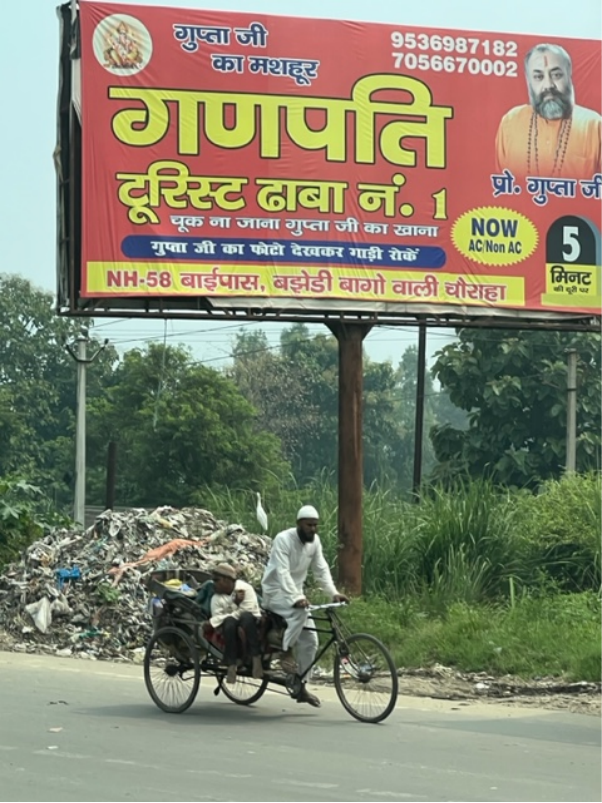
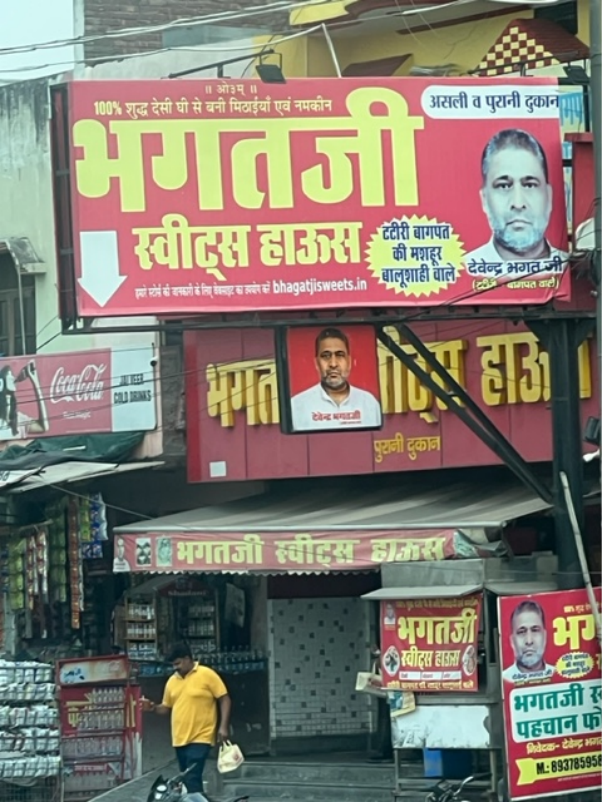


    The other interesting thing about these desi entrepreneurs was that they had opened more than one outlet. Maybe it was franchised but I saw at least two-three of the above-mentioned brands in different locations.


    Another interesting aspect of the communication is that almost all of them showed a milestone. It was not about how far it was but about how long it will take to reach them. And mostly these hoardings would appear from 25-30 minutes away.


    Interestingly, some outlets which have by themselves become famous elsewhere have also opened on this route. Like Murthal parathas which have become famous in Haryana on the Sonepat highway are being aped by a local dhaba.


    But my favourite name and communication is in the picture below. It also shows the owner but his name and association is unique.
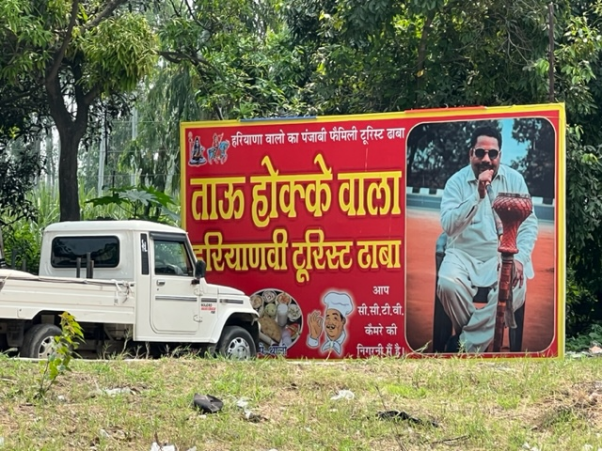


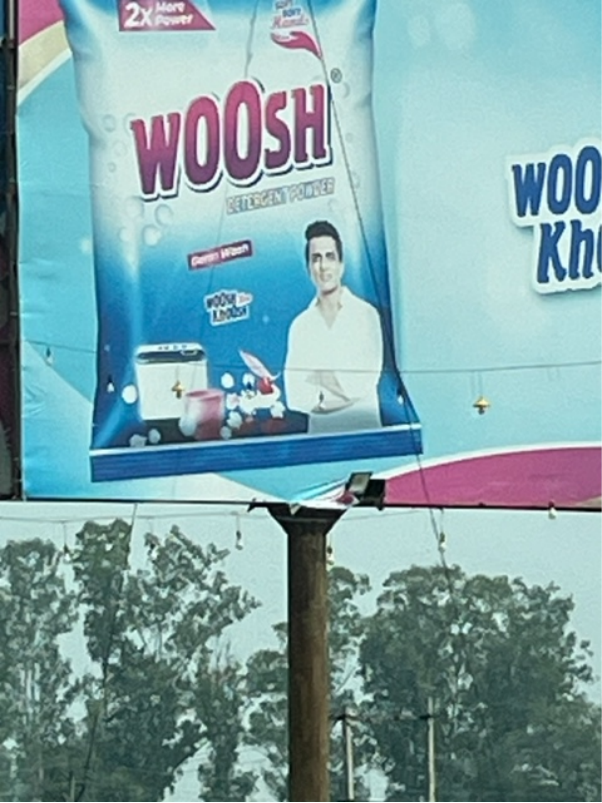
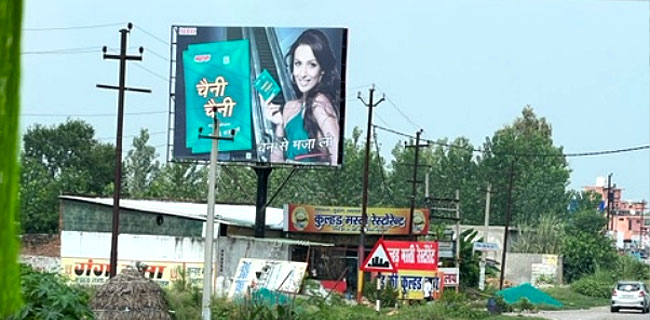
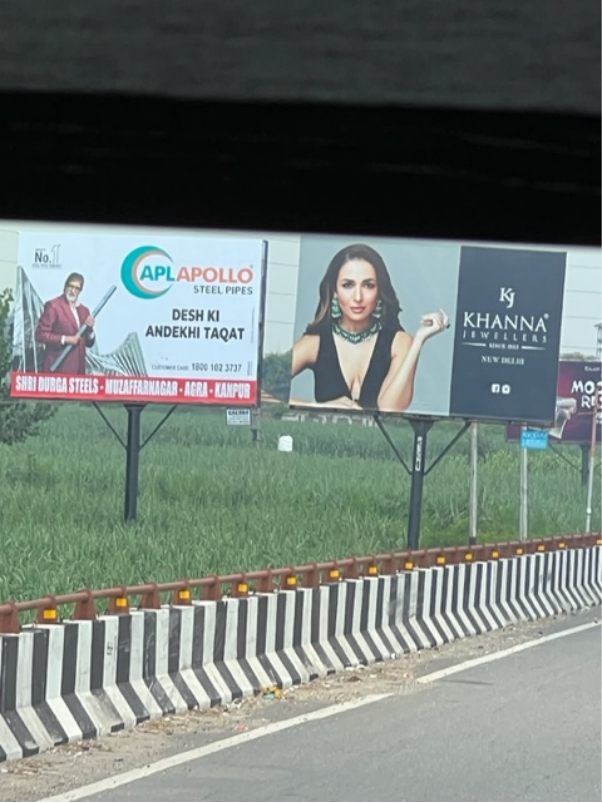
    During the trip it was quite fascinating to see the use of celebrities. I hardly saw any cricketer being used and not many top Bollywood personalities were on display too. Sure Akshay, Shah Rukh, Amitabh, featured in national brands like Apollo Pipes or Vimal Elaichi or Dollar vests. But it was celebrities like Sonu Sood in a detergent hoarding or Pankaj Tripathi promoting Lux undergarments or even Malaika Arora in Chaini Chaini Pan Masala who stole the show. Most of them were endorsing more than one brand. And not just national brand but also local brands like Swoosh detergent or Khanna Jewellers. Ajay Devgun was also very prominent as brand ambassador for many brands. I guess it was the raw earthy appeal of the male celebrities that was a major pull. Not the sophistication or urbanness of other endorsers. And of course, not to underestimate the raw appeal of Malaika Arora.
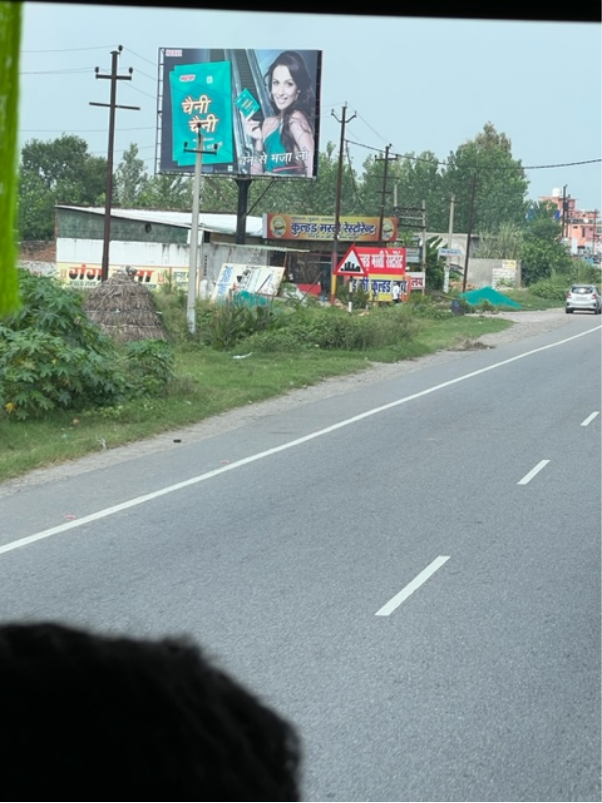


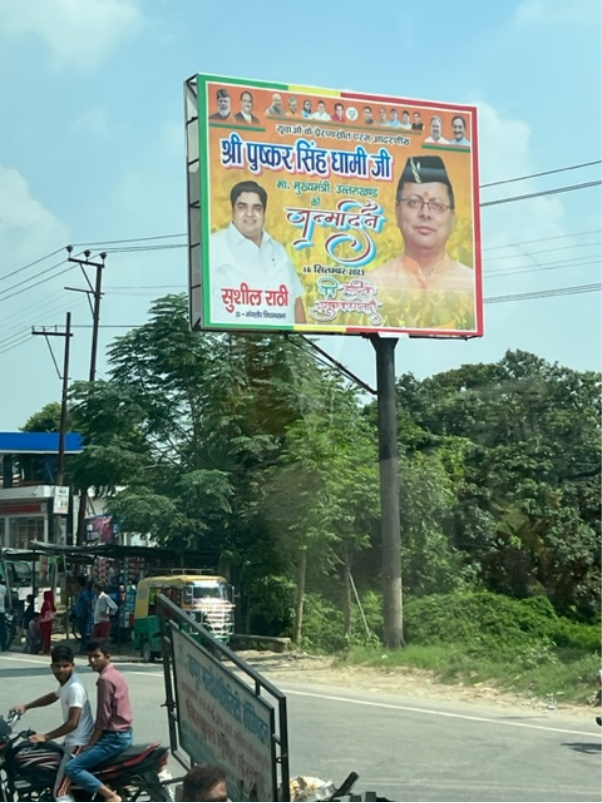
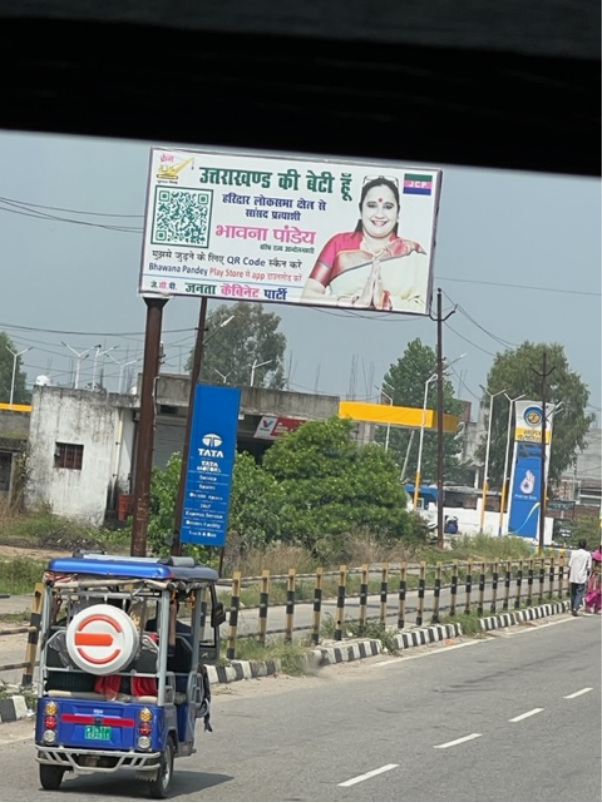
    While the celebrities enjoyed the limelight, politicians were not too far. Candidates were already lining up to highlight their candidature for the next elections. And smalltime politicians wishing the CM or the PM on birthday was not to be missed.


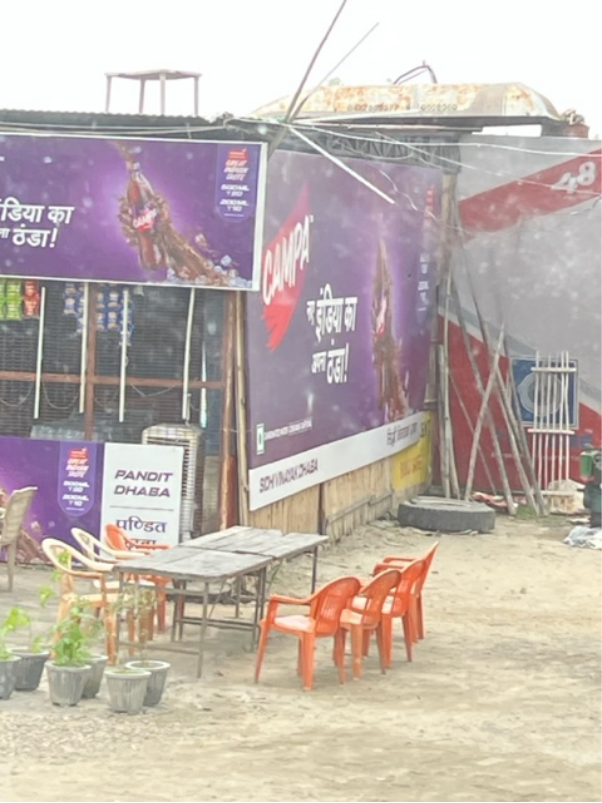
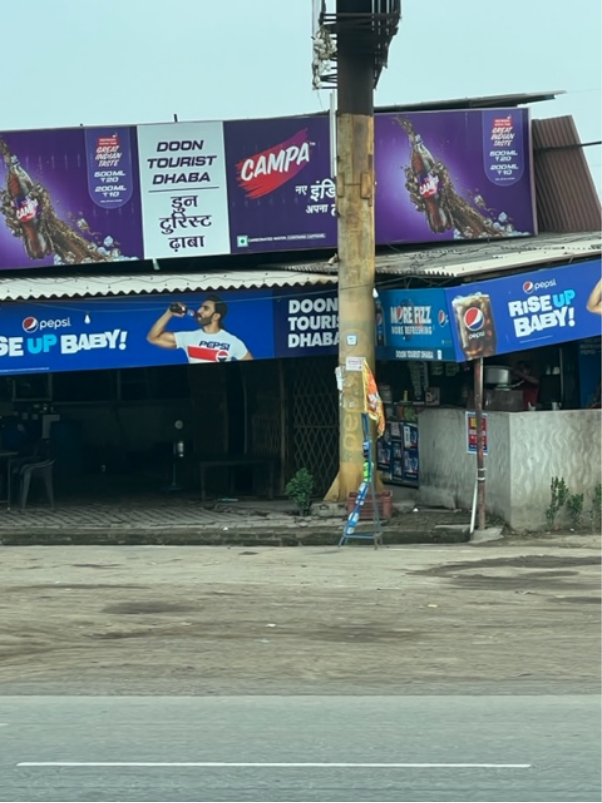
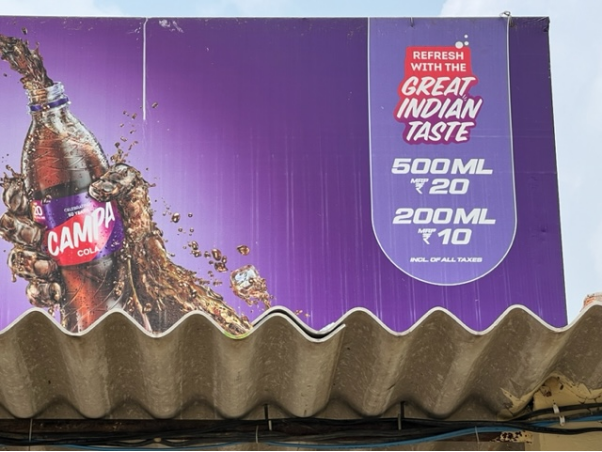
    I am sure most of you readers who are residing in metros have heard about the acquisition and the launch of Campa by Reliance Retail. But have you seen the product or its communication? The one brand that was ubiquitous in its presence throughout, be it wall paintings or restaurant signage or just plain hoardings, Campa had outsmarted both Pepsi and Coke. It had cleverly overshadowed Pepsi in some places and seemed to be the default soft drink through the route. It has an interesting line, Naye India ka apna Thanda. Clearly it is capitalising on the nationalistic mood and the Amrit Kaal fervour. And it does not fall shy of communicating its cheaper, sorry, competitive pricing too. At the five-minute stop, I asked the dhaba guy about Campa. He claims it sells very well because of its price and though it still has distribution and therefore availability issues it is giving Coke and Pepsi a run for their money. While Coke and Pepsi with big endorsements and advertising budgets seem to be going strong, it looks like Reliance Retail is building a solid foundation at the ground level.


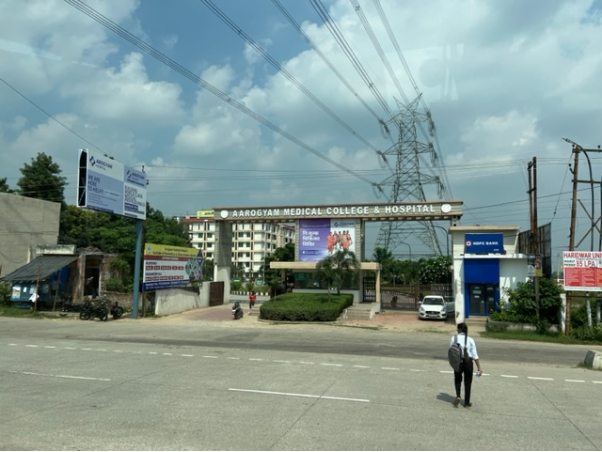
    Talking about nationalism, the impact of ayurveda was visible in outdoor communication and branding of various categories. An allopathy hospital was called Arogyam. Wall paintings associated with Gupt Rog (cue sexual illness) which have been omnipresent all along Indian highways for a long time now have an ayurvedic slant. Even some vegetarian restaurants had ayurvedic-sounding name. Near Haridwar there was a housing society calling itself Amrit Arogyam. The marketing and communication bug has not escaped Urban Bharat or even Bharat.
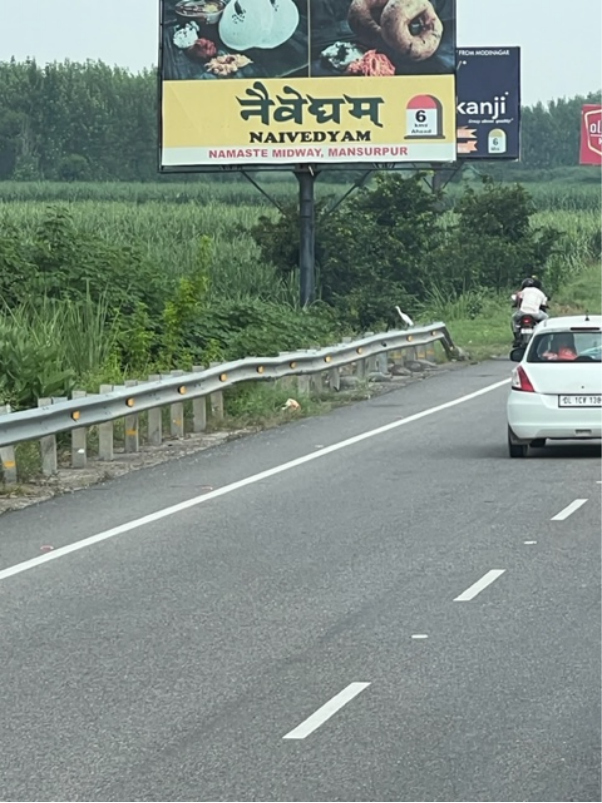


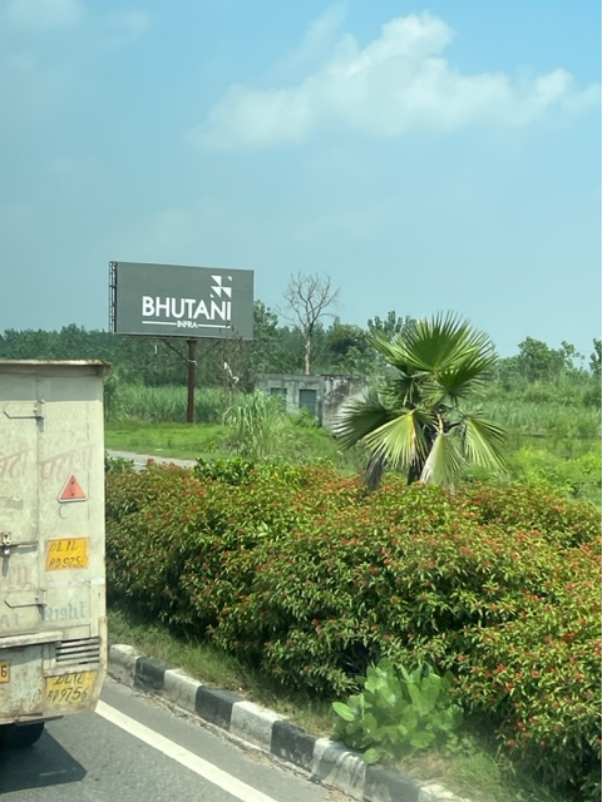
    Almost everywhere it was the local brands which stood out in their presence and communication. Be it Tehri TMT Bars or Tirupati Pipes, or even Bhutani Infra, these brands were present right throughout UP and Uttarakhand part of the route.


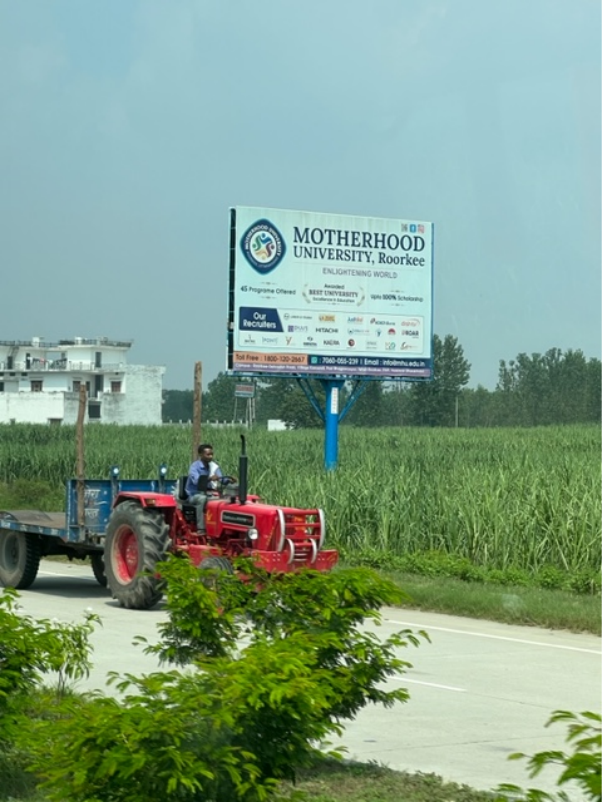
    As far as local brands are concerned, the education sector was dominant right through the route. I lost count of UG, engineering and management institutes that I saw on the way. Almost all were private deemed-to-be universities or colleges. And there was no shortage of private schools too. Motherhood University or Om Group of Institutions, here also branding was critical. It mostly had English names cueing a western approach or some had acronyms which sounded very western.


    But it was the school names that took the cake. Almost all had English names. Some even French-sounding and some outlandish. I mean a school called Good News School or called Laureate School. How many teachers or students would pronounce that correctly. In a country, where the dealer of Renault calls it Renolt and not Reno (right pronounciation), my mind boggles on what Laureate school would be called.


    As you can see, my four-and-a-half hour trip passed in a jiffy. There were some more observations like the presence of a many hoardings advertising a helicopter service to see the Himalayas, cashing in on the Char Dham route. Or wall paintings by Finolex Pipes wishing all Char Dham yatris a safe trip.

    But the one insight I got from all these observations is the importance of branding that is catching on even in Urban Bharat or Bharat. Culturally, we take our names seriously. It’s not just an art but also a science on how we name our children. The same seriousness is now going in the naming of various products and services. Who could have thought of a vegetarian restaurant called Natkhat (Naughty as in Lord Krishna ) or a school called St Kabeer. Do you call it Saint Kabeer or Sant Kabeer? Go figure.


    Vikas Mehta is a senior advertising professional and now a branding and business strategist and educator. After having worked in various geographies, he is now based in Dehradun. His views here are personal.

     

  • World Cup cricket advertising in the times of digital


    With apologies to none at all

    By Vikas Mehta


    Vikas MehtaLast week and this week, am on the road and as such am watching the World Cup cricket, streaming on my phone or laptop. So, after a long time I am actually cut off from the traditional DTH media and have a unique opportunity to assess the state of advertising in a digital world. Let me start with my observations:

    It didn’t seem to be a Cricket World Cup event. Because I actually saw more cricket than ads.

    It was unbelievable that sometimes no ads were shown for 3-4 consecutive breaks. Can we even call them ad breaks anymore?

    Earlier Hero, LG, Pepsi were “traditional” advertisers and sponsor of global cricketing events. Then came the new age brands like Cred, Groww and Byju’s. Also: the online gaming brands like Dream 11, My Circle 11. Hardly anyone of these survive today as a mega event advertiser or sponsor.

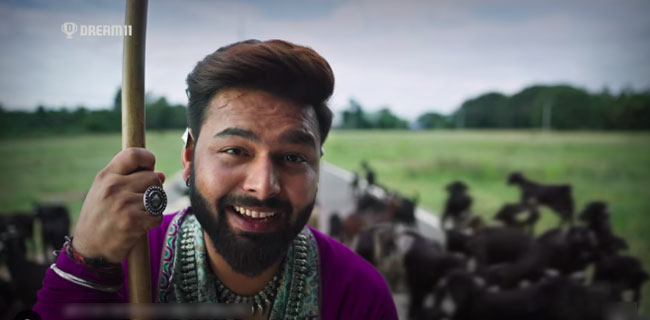
    And am I glad that Dream 11 is an exception that survives. Because it’s the only piece of communication which stands out with a good thought ”Uthana hai to uthana padega” (If you have to lift, you have to get up), alluding to the cricket heroes having to make an extra effort to lift the cup.

    Not only is the thought interesting its execution is also spot on by using the out-of-sight-out-of-mind Rishabh Pant as the anchor exhorting his teammates.

    Or does it point to the fact that Rishabh Pant is the next Virat Kohli or Dhoni in terms of his status and acceptance by the Indian public?

    Talking about execution there were two ads that I saw which had interesting thoughts. But the execution left a lot to be desired. First was Oreo. The thought of ‘mat bol’ (do not speak) captures the Indian thinking of ‘nazar lagna’. Of not talking about something because if we do then it won’t happen. It will be jinxed. And it sounds eerily true if one looks at all the campaigns run in the last decade which were in the hope and build up to India winning the world cup. But the straightforward mouthing of the concept by Dhoni and no creative leap points to a wasted opportunity

    The second one is Kit Kat. They have used the thought of fingers crossed. Though, my first thought was “fingers crossed” Indian enough for the masses to understand? The execution was better than Oreos straightforward narration but this too was a case of missed opportunity.

    But wait, I discovered that Kit Kat had done an exactly similar campaign in the UK in 2010 hoping England will win the Football World Cup. Well, so much for originality and creativity. And the gall to use a jinxed thought!!!

    It may also point to the fact that account planners are playing a bigger role in brand strategy. But were these ads also scripted by account planners? Oreo sure looks like one.

    On Kit Kat, one thought. Why doesn’t Nestle use Mrs Rohit Sharma? In almost all matches, not just at World Cup but even much before, my lasting image of hers has been sitting with her fingers crossed on both hands. She will be the best brand ambassador for fingers crossed. You read it here first, Nestle.

    And Dhoni is still endorsing more brands than the Rohit Sharma. Does it mean that Rohit is not as bankable, even though he is breaking records and is the Indian captain?

    I daresay that Bumrah seems to be more bankable than even Rohit. After Kapil, Sachin, Dhoni and Virat he is the next Boost endorser. And also Thums Up. Now, which brands have I seen Rohit Sharma endorsing? Hmm, let me think. An airline… was it Emirates? I think I saw him in a frame of Bookings.com too. But I saw Rahul Dravid also being used. And not many brands used Rahul, even during his heydays. You draw your own inference.

    Then brands like Booking.com and Mak Lubricants were desperate to connect to cricket. Howzatt for the perfect stay. Huh! Seriously?

    There were Parle brands like Kisme, Kacha mango bite, platina… but I forget what they were all about. Same for Sting. Or MRF. All eminently forgettable. And guess what, Sachin has ditched MRF for another tyre brand. Was it Apollo? Or did MRF ditch Sachin? Musical chairs, I say.

    But the other brand which caught my eye was Herbalife. Not for its insight, nor for its strategy and definitely not for its execution. But for the fact that it has used varied sports stars giving them equal prominence and weightage. Manika Batra, Mary Kom, Smriti Mandhana and Virat Kohli. It has also used Ronaldo for a long time. It was not a Kohli-dominated ad and Kohli just happened to be in it like all others. Brave decision. Because I am sure it must have paid many more times the amount paid to Kohli than others and still to resist the temptation not to give him a higher exposure is commendable.

    Amul must have been worried that it’s a jinxed sponsor given the results of Sri Lanka and Afghanistan. But last night’s result would have given it some relief. And of course South Africa is its trump card.

    My reckoning is that Disney Hotstar, did not anticipate the India-Afghanistan match to last for 85 overs. What otherwise explains the fact that close to end of the match, when 2 crore people had switched on the live streaming, they ran out of advertising inventory. While, when Afghanistan was batting and at the start of the Indian innings, with live streaming figure fluctuating between 90 lakh to 1.5 crore most of the advertising was scheduled. Go figure.

    And for the India-Pakistan match, I had both my laptop and my mobile switched on to Disney Hotstar and both had different inventory of ads. How does this happen? Different streams within digital too?

    So, are there any conclusions. Yes, one big one. Advertising in the times of digital is getting swayed by all digital parameters. It’s about measurements. It’s about brand presence. Disney Hotstar displays a figure of how many people are watching the livestream next to their logo on the top right-hand corner. And I think brands reach orgasam with such figures. Big metrics which run into crores of viewers (read measurable metrics) means everything. What happened to brand building? What happened to storytelling? Did those crores of people even register your brand? Or did they even connect with it?

    What else explains that almost all ads were straightforward presentation of benefits. Statement of facts. The types of services offered. So Lendingcart.com ad had no differentiation. No insight. No emotional benefit. It could have been and ad for Groww for all you know. That’s what Oreo did. Got Dhoni to mouth some superstition and then tried desperately to connect with the brand. There were some big brands. MRF, Parle, Pedigree…none tried any bonding with its target group. None tried to connect. No story telling techniques like twist at the end, stimulus response or even building momentum was used.

    Some brands may not feel the need to build a brand or differentiate. They may think they already have a strong positioning and they need to be just reminder brands. Maybe that’s why Finolex Pipes or Avalon cycles just used static presence of the brand name and maybe a line. But do all brands fall in this category? Categorically, no.

    And then the industry moans that it is losing relevance and not attracting talent or not getting enough remuneration. What you dish out is what you get. It’s not a chicken or an egg syndrome. It’s not a vicious cycle. Break the cycle. Start building brands. Rediscover the art of storytelling.

    Maybe I am jumping the gun. Maybe the next few weeks will prove me wrong. I did see some new ads in the India-Pakistan match from Credit Bee, Thums Up and Snickers. More about the same next time.


    Vikas Mehta is a senior marketing services and business strategist and educator based in Dehradun. He writes on MxMIndia every other Monday. His views here are personal.
     

  • World Cup Cricket: Digital Streaming vs DTH


    With apologies to none at all


    By Vikas Mehta


    Vikas MehtaFinally, home after two weeks on the road. Watching World Cup Cricket streaming on the mobile or laptop was fun. But I am a traditionalist. Give me large screen TV and a DTH connection and you have me hooked. You may say that I can watch streaming on my large screen at home also. True. But my streaming experience has been mostly imperfect. I may be watching streaming on 5G or on broadband but the fluctuation in internet speed is imminent and hardly a day went by while watching World Cup streaming when the quality of video did not deteriorate or I did not face buffering. DTH at least lets me watch all the action without any drop in picture quality or interruption. My wife though was quick to point out that DTH also faces interruption, when it rains or when the electricity supply is interrupted. At least 5G or even broadband with a mini-UPS assures no disruption due to power cut. Well, that’s India for you. So many permutations, so many pros and cons.


    But I digress. Today, I am going to talk about what advertising I encountered on DTH and how it was different than on digital streaming.


    The first observation I had was that digital streaming was always a ball slower than on DTH. The reason I found out was technical. But it definitely is a bummer, specially during close matches. Not that there have been many in this World Cup, but I would hate to be watching matches like Pakistan vs South Africa or Australia vs New Zealand on streaming and my daughter telling me the result before I know it!!!


    The second obvious observation was the sheer number of advertisers on DTH vs digital streaming. And that was a surprise to me. Disney + Hotstar is streaming the matches free on mobile through its app and I would have imagined that this in turn will get them more advertisers. And the overall audience for streaming has been good. The India vs New Zealand match for example got over 4 crore viewers, more than the India vs Pakistan match. So, what explains the less number of advertisers on streaming?


    The answer I think may lie in the type of viewership that DTH vs digital streaming offer. If I may take the liberty of slotting the type of audience by the media channel, though this is purely hypothetical and I have no data to back it up, but do hear me out.


    During my travels, I noticed that mostly it is the GenZ which was comfortable watching the matches on mobile screens. Definitely because it was free but more importantly because matches on mobile could be watched anywhere. GenZ could watch it in her/his university, while travelling by public transport or at home in her/his own cocoon with earphones plugged on. There is a sense of individuality and privacy while watching the matches on mobile, something which GenZ craves for.


    Laptop or maybe tablet screens is the preferred choice for the millenium. Specially during working days. The Disney + Hotstar window would be minimised, volume muted but catching the action  every few minutes is the norm. I witnessed this even during a presentation!


    DTH is a family pastime at home or for the retired people. The millennials with their friends, or spouses or even parents watch the action late evening at home. The exception here again is the GenZ. They value their privacy. But they multitask while watching the matches. Multitask in terms of chatting about the matches with friends, exchanging instant memes, all the while maybe doing their college or school tasks.


    And I think advertisers have observed the same. And most of the advertisers are targeting the family or the millennial. No wonder, auto brands like Skoda and Mahindra are active on DTH but absent on streaming. GenZ is not whom auto brands are targeting. And they catch the millennials in the evening on DTH. That’s also the reason I do not recall seeing any Dream 11 ad on TV but discovered that it is a broadcast sponsor on digital streaming. Mostly, it’s the tech-saavy GenZ and to some extent the millennial who are the TG for gaming apps like Dream 11. Not necessarily a family type or retired person.


    I guess that’s what public sector banks like SBI, PNB etc were thinking with their presence on DTH. So too was Fogg as it has had a family personality as opposed to Axe which is more individual, seductive. No wonder Axe is on streaming. But I was surprised to see that Axis Bank was advertising for its app on DTH. Maybe streaming would have been a better choice for the same.


    The presence of health brands like Herbalife or Emami Herbal Kesh on streaming again was a no-brainer, since such health products are preferred more by millennials and GenZ to some extent.


    And the best example of media segmentation and targeting came from Hero. It has used DTH for its festival offers on motorcycles under the sub-brand Hero GIFT (Great Indian Festival of Trust). Targeting the family and maybe more small-town buyer who is middle-aged and not into technology but wants an affordable mode of personal transport. DTH and cable are the perfect media to catch this person. Whereas for their EV scooter Vida, digital streaming is the targeted medium.


    But then what explains the presence of a new brand of EV, Eblu Feo on DTH and cable broadcast? And it seems to be targeting independent women as Neena Gupta is the brand endorser. Your guess is as good as mine but I think it wants to announce its presence nationally on a medium which gives it a wider reach and also depth of reach. Digital streaming maybe is restricted on those parameters.


    I was also impressed with the use of digital streaming by Whisper. Targeting young women who want the best protection for themselves, Whisper is alluding to the reality that these women are also avid cricket fans. Something that has been reinforced by the presence of Pantene, another P&G brand on digital streaming. As an aside, it sems that P&G is making a big play on cricket and that too through digital streaming. The first two weeks matches on streaming were dominated by an overwhelming presence of Tide and truth be told, the one ad being repeated ad nauseam had started to grate. Will Tide or Pantene make a comeback or some other P&G brand will come in the later stages on streaming?


    Very few brands, I can recall only Phone Pe and Bookings.com, who were present on both DTH and digital streaming. The reason again is simple. They are targeting very wide instead of narrow focusing. They are still selling their categories and brand building is incidental.


    But the most significant presence for me on DTH has unfortunately been the presence of surrogate brands. The various brands of Pan Masala posing as silver-coated elaichi or whatever and also liquor brands under dubious categories like water or experience or playing cards. Interestingly, none of these brands are on digital streaming. What does it tell us? That there is hope. That the advertisers know that targeting GenZ may get them into trouble. That the younger generation is more into healthy products and doesn’t care too hoots about such ads. That the same younger generation is maybe more ethical and frowns upon such surrogates. Or very simply it is the family man who is into these vices? Whatever the reason, the divide is stark.


    Join me next time as some new campaigns unfold in the final phase of the World Cup. Let’s see if some new observations are going to unfold.


  • From D2C to Omnichannel


    With apologies to none at all


    By Vikas Mehta


    Vikas MehtaLast week, Unilever sold off its D2C brand Dollar Shave Club to a private equity firm. This was quite a shocker, something that made me think away from the Cricket World Cup. There had been lot of media hype when Unilever bought the brand six-seven years ago for reportedly a billion dollars. It was a vindication of sort that direct-to-consumer (D2C) brands had arrived and maybe traditional brands were under threat. A lot was being made about the Millennials and Gen Z preferring new D2C brands. And the pandemic gave the D2C brands a bigger boost. Enough entrepreneurs started using social media platforms to peddle their wares directly to the consumers. From clothes to chocolates to baked food to homemade beauty products to accessories to collectibles, D2C was the buzzword.


    And this was not limited to first time entrepreneurs working from home. In fact as a business model, it had started catching on since early last decade. Most of these like Nykaa, Mamaearth, Zivame, Bombay Shaving Company, Chumbak or even Pepper Fry, Lenskart, BoAt, Licious had used the online boom smartly. And some of them have even had successful IPOs. India is estimated to have more than 600 D2C brands with a market size of about $ 65-70bn in 2023. Not numbers to sneeze at. And, this was of course fueled by the fact that around 600 million Indians have access to internet with 185 million online shoppers.


    On the face of it, D2C is a win-win for all. For the entrepreneur who need not get entangled with a distribution system or has to spend big monies on getting his consumers to the store. For the consumer it was hassle-free shopping from home and getting delivery at the doorstep.


    Customisation, no geographic boundaries, choice and the spread of social media lead to a surge in this business model. And then there were ecommerce portals like Amazon, Flipkart and Meesho which were ready to embrace the D2C model. Indeed, Meesho differentiated itself by not only claiming to be doing social marketing but also keeping regular traditional brands at arms length and promoting D2C brands with their no fees model.


    However, the very factors that initially spawned success for D2C have come back to haunt the model and caused a deceleration in its growth. Let’s look at some such factors.


    Value proposition

    D2C brands went into a value proposition overdrive (Read discounts and offers). BoAt was giving same for less. Same features of premium brands like Sony or Sennheiser but at discounted prices. Mamaearth, Nykaa, Bombay Shaving Company were all following this model. Lenskart was about more for same. Buy one and get one free. And then with the help of ecommerce companies these brands made discounts or freebies a habit. So, when there was no discount, the allure of buying D2C lessened. As a result, the pricing structure and strategy of most D2C brands was based on discounting. They had to therefore keep a close watch at their costs and any increase in costs hurt their margins.


    No distribution setup

    This was a big plus for the D2C players. They were not at the mercy of the distributors, wholesalers or retailers and could theoretically serve any customer anywhere on earth. So, when a brand In Bengaluru wanted to send stuff to someone in the metros or mini metros all it had to do was negotiate with logistic companies and ensure speedy and timely deliveries. But as an analyst put it, it was easy to do this in the initial phase and achieve a turnover of maybe Rs 100 crore. But after that one needed to penetrate into smaller towns. And the cost of sending courier to more than 100 towns in India, without any delay meant that each sale was burdened with a distribution cost which was unlike traditional distribution where the wholesaler or distributor send stuff in big bulk quantities thus ensuring low distribution cost per item. The dilemma was clear. Grow and increase your cost per order or hit a growth ceiling. This again was eating into the margins. Just online sales was not good enough.

    Not surprisingly, most of the D2C brands are now into offline selling too. Nykaa, Mamaearth, Lenskart have all either opened their own stores or are trying to be available in regular offline stores. I am told that the Mamaearth IPO prospectus claimed that their offline sales is now 37% of their total turnover in FY ending March 2023. Anyways, D2C was a misnomer as a huge part of their sales, analysts say upto 75-80%, came form ecommerce platforms. Indeed in 2021-22 more than 80% of BoAt sales was through ecommerce platforms Amazon & Flipkart. Which meant that they had not only distribution cost of paying commission to ecommerce platforms but also the logistic cost of each piece shipped, which given the category, was not something to ignore.

    And as I write this, comes the news that Big Basket, the quintessential D2C brand. Quoting from the Times of India “currently its offline business is on a pilot mode with some 25 stores across Hyderabad, Bengaluru and Kolkata. The idea is to experiment with different store formats with different price points and find the right store strategy before launching a broader rollout in the coming quarters.”


    Returns

    A big allure of D2C brands has been the return policy. If the consumer is not happy with the product then it can be returned at no cost. While in personal care this does not come into play, but in categories like apparel and electronics this can again be a margin killer. In apparel the return percentage is supposed to be as high as 30-35%. All this not only adds to the cost but also makes the value proposition difficult to sustain. How long can these brands survive with losses and VC funding?


    Online spends and not traditional advertising

    With D2C brands using online selling platforms they started spending money more on online. So, the objective was to direct traffic to their website or ecommerce platforms. Or use social media influencers. This was not very expensive compared to traditional advertising. But the focus moved away from brand building. With value into play (it was more discounting) the communication was more about discounts, offers and promotions. No effort was made to build an emotional connect or base with the consumers. Value or an influencer was the only emotional connect. This meant that the brands had difficulty in selling without discounts or offers.

    So, when the brands needed to grow and break the ceiling of limited markets and they moved offline, they had no connect with traditional distributors. Traditional brands which had been nurtured and had long term association with distributors, wholesalers and retailers resisted these new upstart D2C brands. Also, since these D2C brands had not done much brand building they did not have sufficient consumer pull. As a result, product turnover, in terms of inventory, at retailers was a laggard to traditional brands which had build bonds with the consumers over a period of time. That did not help matters as the distribution channel was not too keen to stock products whose turnover time was in many cases three-four times than that of traditional brands.

    Many D2C brands have now realised the need to do brand-building. That’s why many of these brands are now doing traditional TV advertising. Again, Mamaearth IPO states that while social media spends have increase three times TV ad expenditure is up by almost ten times. Lenskart is trying to cash on to the cricket fever on TV. And BoAt is also into traditional TV advertising.

    With high inflation and funding becoming a problem most D2C brands have to start showing profitability or the path to profitability. Ironically, this is the time when their costs are going up. Offline distribution, spending on expensive traditional TV advertising while sustaining online presence to build brands are all factors which may hurt the future of D2C brands.

    That’s one reason D2C brand are now talking more omnichannel. That’s their new buzzword. They are now trying to justify being jack of all trades. Their advantage against traditional brands is now their vulnerability.


  • Men’s World Cup Cricket ad review – Zara Hatke


    With apologies to none at all


    By Vikas Mehta


    Vikas MehtaInspired by some memes and posts of ads that appeared during the World Cup Cricket, my ‘hatke’ take on the same.


    It’s not just us Indians who are proud of our culture. The Aussies were offended by the use of ‘fork’, the two fingered sign with the palm-facing inward, common in Australia as a slur, which the Bollywood stars used in the Vimal elaichi ad. The Aussies were infuriated.  How dare these stars pass off something insulting, as something acceptable? And that my readers is the simple answer as to why we were outplayed by the Aussies in the final.


    Can’t afford medical insurance premiums? No problems. Just yank away the plaster from your hand or simply walk away while still in your surgery gown and attached to the drip. Don’t believe me? Oh! I forgot to give you an alternative solution. Simply pay your premiums every month via PhonePay.


    Talking about PhonePe, if you cannot digest big payments use PhonePe lite. It’s as lite as not having to remember your PIN.


    Now we know the secret of how children playing badminton, can become champions. By playing alone at night on mud courts with Polycab cables lighting up the place.


    It’s only the older, retired, mature cricketers who can handle Kamla Pasand. Or maybe Kamla Pasand can afford them only.


    You thought Danube is a river? Naah! It’s a builder in Dubai.


    Never go to buy a mixer grinder with your wife. Unless you only want Sujata mixer


    If I follow Dream 11 philosophy, Indian players did not lift the World Cup as they did not do some heavy lifting. Literally. I didn’t say it. Rishabh Pant said that.


    Hardik could not recover from his injury as he did some strenuous shots for Jindal Panther ad which dominated the airwaves even after he retired hurt, out of the tournament.


    Dhoni is no more in demand as Indigo paint is a better crowd puller


    The Thums Up toofan did not blow away the doubts in the mind of Rohit, Bumrah, Siraj & Jadeja but the Toofan worked for SRK.


    Lays wanted us to stock up on the brand as Dhoni drops in to random homes to see the match, with the condition that Lays is available at those homes. I mean, Dhoni cannot afford a TV?


    Kit Kat fingers crossed was inspired by Rohit Sharma’s wife’s screen presence.


    Rahul Dravid was more dependable for MAK lubricant than for team India.


    The Aussies were definitely watching the world cup ads. Maybe they wanted some endorsement deals! But they took the Sprite ads very seriously. The team was Thand Rakh personified.


    Nobody takes Oreo seriously. They had said mat bol. And, we took for granted that the world cup is ours!


    Fog is a storm, not perfume.

    And even dogs sulk when they hear nationalistic spiel in such ads.


    Lendingkart hai toh business is good. So, no need for business schools churning out MBAs?


    Maybe, Lenskart didn’t give SKY the correct lens.


    Snickers made a noobie mistake in trying to link the brand to cricket. Err! What’s a noobie mistake, please?


    Good for Amul that neither SA or SL or Afghanistan defeated India. Else nationalists would have had to butter their toast with some other brand.


    It seems PC Chandra Jewellers is in property business too as it advises us to own a piece of Calcutta. No Kolkata baiters?


    Size is important for Ranvir Singh. Sorry, I mean Royal Stag. Actually, just make it large.


    And Dettol soap also wants us to believe the same.


    For Neena Gupta foreign sounding exotic names matter. No am not talking about her partner or daughter. Just look at her choice for Electronic scooters.  So, what if one cannot remember or pronounce it.


    Mahindra SUVs have set a very high benchmark for their breaks. If your father in law comes in front it stops. Is that why the foreign sounding protagonist looked displeased? Or because  they did not want to show an Indian son law symbolising stereotypical, son in law, father in law relationship? How very correct!


    And suddenly many automobiles ads are also paying lip service to women power. All being driven by women. What’s the desired response? Women have arrived? Safe driving? Women handling power? Naah! It’s just a tick box.


    Tide is only about colour? Not Whites? By default therefore is Ariel about whites only?


    Surf Excel Matic liquid is about mummy getting angry about stains. And I thought Surf Excel stood for stains are good.


    I had fun doing these as watching the ads seemed to be a better idea than watching all those boring one-sided matches. Not that the ads were very interesting. They competed with the matches to fight for the boredom crown. But at least I could look at their brighter side.


    If you have some more interesting takes on the ads telecast during the World Cup, write into the comments column.


    Vikas Mehta is a senior marketing and business strategist based in Dehradun. He writes on MxMIndia every other Monday. His views here are personal.

     

  • How and why defence personnel families have different consumer behaviour traits


    With apologies to none at all

    By Vikas Mehta


    Vikas MehtaI shall be soon completing 10 years, living in the small, yet cosmopolitan and progressive, yet steeped in tradition and eclectic, and yet distinct city of Dehradun. And while the transition and experience has been both interesting and challenging, I am amazed at how I keep on discovering new facets of not just culture and tradition but also consumer behaviour. In this column, I will try and touch on a few of these points.


    Dehradun was always known as the city of retired people. Slow, sedentary lifestyle. Nature at every step and the ability to lose oneself in its myriad seasons. Institutions like ONGC, FRI, Geological Survey of India are steeped in history and even folklore. And many of its employees, hailing from all parts of India, settled down in the city, post retirement. Indeed, such was the case with my father too.


    But Dehradun is better known for its retired population of defence people. From Lt Generals to Brigadiers to Majors and to Captains. It’s not just the army people but even the other wings. As an aside, do you know that Dehradun also has a naval office? The Indian Naval Hydrographic Department.


    But I am digressing. It’s not just the retired defence people who stay in Doon. There is also a decent population of currently serving defence personnel whose families live in Doon. With frequent transfers, posting to non-family stations, most families prefer settling down at one place, mostly because of children’s education. And Doon with its plethora of schools, proximity to border areas, bustling cantonment life, and medical hospital for defence people is an ideal place.


    During my morning walks I would come across retired defence people. Mostly they would stand out because of the typical stick, not walking stick, but the small stick of a commanding officer that one would see in many Hindi films, and their gait and posture. I would interact a bit and over a period of time got to know a few of them and their families including some serving ones. I am not professing to be an expert on defence people as consumers but I encountered some interesting behaviour and insights which I would like to share.


    Living in cantonment areas in small towns and sometimes in far flung places is a unique experience. One is living in a secluded township which has its own rules. The life is steeped in discipline and protocols. And this includes the lives of families too. Seniority matters in family relationships too. There are formal and informal occasions with dressing according to the occasion. Life is regimented and strictly routine. And almost all purchase happens from the canteen stores.


    I am sure most of us have heard of how defence personnel and their families get groceries etc at discounted rates at canteen stores. Today, it’s not just groceries but almost anything that a household wishes to buy, is available at canteen stores. Not just durables like ACs or refrigerators but also two-wheelers and four-wheelers. At subsidised rates. A defence person can buy a car at a subsidised rate every 8 years and a two-wheeler every four years.


    For a brand it therefore becomes imperative that they register to sell through canteen store department and in some categories like fans a brand could have almost 10% of its total annual sale coming through canteen stores department (CSD). Even premium brands like BMW and Audi sell through CSD. And it was news when Kia was made available through CSD earlier this year. I also gathered that defence people get a 50% discount on GST to be paid on vehicles. Though some capping on the above is in place now.


    If you now look at it from the viewpoint of serving and retired defence personnel, CSD is an important part of their life. Except for a few perishables like milk or bread, almost everything they buy is through CSD. And the distance from a CSD is an important consideration when they are settling down or renting property in a place. Indeed, when the defence person comes home on leave from his posting a visit to CSD for a major purchase or a big ticket item purchase is always on the agenda. Their visit to a local grocery store or an electronic store is very limited. Even elements like servicing or repair are handled through CSD. And CSD has kept pace with time. If something is not available at the nearest CSD, one can order it through the online site of CSD, for delivery.


    Therefore, if an FMCG brand or a durable or an electronic brand is not present at a CSD, it is not in the consideration mindset of most defence people. They have not seen it. They have not discussed it. They have not felt the need to know about it. This hurts new brands and new categories more. They may be exposed to something new through some media but the familiarity and interest comes through CSD, offline or online. The bottomline is that a brand, to make a difference in the life of a defence person must be a part of CSD.


    And this is more important when these families are placed in remote areas. Their exposure is limited to CSD only. This has a ramification for brands. Because, later on in life when these people move on to bigger cities the perception and awareness that has been built in their minds about brands persist. CSD therefore has created impressions and perceptions which can last for life.


    Sometimes, this also leads to family conflicts. The younger generation which is more technology oriented is more aware and knowledgeable about brands, their benefits, their cool quotient etc. So, they try to look beyond the CSD brands or their impressions for personal use. The parents are at odds with such thoughts. They cannot reconcile to the same. Also, the discounts that CSD offers goes a long way in their decision making.


    Moving beyond CSD, defence personnel face a dilemma and social unease when they get back into society. The career path of a defence person is shorter than the civilians. Most at the level of Major or Colonel retire between 50-54 years. For most of their life they have lived a regimented, disciplined and structured life. They are taught working in a team. They live unselfishly. Sacrifice of personal needs and comfort is part of their upbringing. And yet, when they get back into general society they see indiscipline. They encounter selfishness. They are not trained to do anything else. They try alternate career and find it difficult to fit.


    To make matters worse, families face different problems in amalgamation. With an unregimented society they find issues of adjustment. Their time discipline and selflessness goes unappreciated. And children find themselves woefully inadequate in terms of new type of hobbies or sports. One of them asked my daughter what was Sushi when she said she had it for dinner. Examples of this kind create a divide amongst children and gives an inferiority complex to the defence force children.


    These adjustment issues sometimes force defence people to live in their own enclaves. That in turn makes the “civilians” a bit more wary of the defence types. It’s a lose lose situation for both as the defence people dig their heels in and refuse to accept the reality of the bigger world and the civilian see them as snobbish and entitled (CSD adds to it).


    Surprisingly, it’s the children  who finally integrate better. They go to schools and education institutes where they rub shoulders with all types and they learn to adjust. But this also means that they compromise on their “defence values” like discipline or regimented life. Within the family the clash of generation ensues. The children are quickly enticed by the lure of new products, new services and consumption. They look at their parent’s choice of career vs their new found friends parents and the grass seems greener on the other side. And that’s one of the reasons that unlike in the past, many defence children no longer want to pursue defence as a career option.


    It’s such simple observations that have ensured that I still keep learning new things. Here is to the next ten years of learning in this quaint little town called Doon.