
Category: COLUMNS

  • How accurate media representation can promote empathy and acceptance of diversity

    How accurate media representation can promote empathy and acceptance of diversity

    Shruti PushkarnaJuly is Disability Pride Month. It started initially in 1990 when the landmark legislation, Americans with Disabilities Act (ADA) was signed into a law. Since then, it’s celebrated every year to honour the achievements, experiences as well as struggles of those living with some form of disability. Typically, you’ll see Instagram, X (Twitter) and LinkedIn flooded with posts from disability advocates, rights activists and people with disabilities in general, sharing their stories and lived experiences through this month.

    Interestingly, disability has been in the news for the past couple of months. And this is not confined to conversations within the disability rights groups. Cinema and OTT are rife with it.

    On May 10, a film inspired by the real life of visually impaired industrialist Srikanth Bolla was released in theatres. Rajkumar Rao plays the lead role of Srikanth, showcasing on screen the various odds stacked up against a person with blindness in the mainstream world. It is one of the few exceptional portrayals without any inspiration porn or pitiful pathos around the character’s disabling condition.

    Srikanth is born blind into a farmer family in Andhra Pradesh. His uneducated parents were urged by relatives and surrounding community to bury the blind child as they would be burdened by his lifelong dependency. Of course they decided otherwise. The boy perseveres myriad challenges to end up becoming the first international visually impaired student at Massachusetts Institute of Technology (MIT). Today, he runs a Rs 150 crore company, Bollant Industries, also employing other persons with disabilities.

    My favourite part, there are several moments in the film where I feel Srikanth is annoyingly arrogant. He is just as human as anyone else. There is nothing ‘divyang’ about him. He is a relatable guy who made it big with his hard work and determination, also with immense support from his teacher. But he has his follies. And that’s good representation. Life as it is, with or without disability.

    Also, last I checked, the film had grossed Rs 59.58 crore in India and 3.34 crore internationally. Inclusion not only makes sense for sensitisation but also has the potential to make bucks!

    Another recent film with a disabled protagonist is Chandu Champion. Starring Karthik Aryan, the movie recounts the story of Muralikant Petkar who survived nine bullets in the 1965 Indo-Pak war and won India’s first Paralympic gold medal.

    Muralikant grew up in a small village in Maharashtra with an ambition to win a gold medal for India in the Olympics. He is mocked for his dream by fellow schoolmates, neighbouring community and even his own father. But life takes its own turns, and Petkar ends up in the Army, where he trains for boxing. Unfortunately, while on duty, he is injured in an air raid which leaves him with multiple gashes and a spinal cord injury. Olympics might be out of bounds but his coach introduces him to Paralympics and some world renowned para champions. After rigorous training, Petkar builds a world record and bags gold for 50m freestyle swimming in 1972 Germany Games.

    Yet another account of aspiration, grit and acceptance. Also, entertaining. The film amassed Rs 59.1 crore in India by the third week since its release.

    Srikanth was born with a disability. Muralikant acquired one on the job. The direction their lives took were a mere outcome of their defiance and commitment towards mastering everything they were initially denied.

    I’m currently watching an American detective TV series (Monk) on Netflix which first aired in 2002. It follows Adrian Monk, a private detective with multiple phobias and obsessive compulsive disorder which are heightened after his wife’s murder. A case he is unable to resolve. There are several episodes which have a complex interplay of disability, race and other diverse identities. There is often an exaggeration of the condition to generate humour but it’s undercut with Monk’s brilliant curiosity, attention to detail and ability to close cases.

    Two decades later, when neurodiversity is a household term and mental illness is no longer belittled, a series involving ADHD, OCD, anxiety disorder et cetera is being consumed with a different (refined) lens altogether.

    The evolving representation of disability in media is indicative of the progress society has made towards inclusivity and awareness. As nuanced stories like these reach wider audiences, they not only promote empathy and understanding but also underscore the potential for commercial success when inclusion is prioritised.


    Wondering why MxMIndia publishes a disability advocacy column? Well, we strongly feel that the media can dramatically transform the world for persons with disabilities. This series attempts to help bring forth issues that the media must champion to create a truly inclusive and accessible India. Writing  this column is Shruti Pushkarna, a former journalist and now a disability inclusion advocate based in New Delhi. Her views here are personal. To access the archives of her 95-plus columns, please visit: https://www.mxmindia.com/category/ columns/shruti-pushkarna/


    If you have a view on the issues raise or would like to align with MxMIndia on this cause, write to us at editor [at] mxmindia.com.

  • Food For Thought: TV’s Pop Culture Problem

    Food For Thought: TV’s Pop Culture Problem

    Shailesh KapoorScrolling through TV ratings reports a couple of weeks ago, I could not help noticing Laughter Chefs. The show, launched on Colors on June 1, 2024, is doing better numbers than most reality shows, including established franchises, have managed in the last year or so. A rating of 1.5 on the weekends, over a duration of 1.5 hours (sometimes longer), is no mean feat in a category where 1.5 is now seen as a successful number even for mainline fiction content. And here’s a low-cost non-fiction show that comes without much fanfare, and manages to score very well, largely on account of engagement (time spent).

    I ended up watching an episode, and then a few more. The show is irresistibly unapologetic about its loose format, which is in itself a loose adaptation of the iconic Tamil show Cooku With Comali, which created the most unlikely hybrid TV genre ever – comedy-based cooking competition! In Laughter Chefs, a string of TV stars, recognised via their work in fiction series, comedy shows and/or Bigg Boss, take part in a cooking competition, where the rules are limited to the bare minimum.

    There’s nothing here that can add to your knowledge, or inspire you, nor strike an emotional chord. It’s pure fun, but a lot of it at that, if you find cheesy Hindi comedy in the mainstream format palatable (all puns intended). I particularly liked the specific use of Bollywood songs in the background to enhance the comedy. It’s not a lazy selection of popular songs, but songs across the decades, including many from the 90s, that have been handpicked to dial up the humor at that very moment. I almost wanted to watch more just for this reason.

    Why is this show not being spoken about more? A search on social media only gives you fan posts, where fanbases of stars in the show are propping their favorites. But there is no media coverage in the trade media on this show, and its unexpected numbers. There’s no analysis on non-fiction comedy finally delivering in the prime-time, after The Kapil Sharma Show had faded away a couple of years ago.

    This absence of coverage is TV’s growing problem. As it is, not too many GEC properties are managing to make any impact whatsoever. But when one does, it has to rely on native channel marketing and organic buildup of word-of-mouth. There’s no social media or general media narrative at all. In an age of extreme content clutter, a worthy property may never find some of its potential audience, because television has moved out of the pop culture even for the most ‘mass’ audiences, it seems.

    Marketing departments at TV networks should be focusing on this as one of their objectives. Because programme, or even channel, marketing will only take you so far, if you are not relevant to the prevailing zeitgeist.

  • THE NRI SENTIMENT

    THE NRI SENTIMENT

    Kunal SinhaAbout one month after the election results were announced and the new government took charge, what do non-resident Indians feel, and what are their expectations?

    I spoke to several senior executives in Indonesia and China about their wishlist from the new government.


    Political participation and cooperation

    NRIs seek greater inclusion in the political process. They expect the right to vote in Indian elections without having to be physically present in India, ensuring their voices are heard even from abroad. However, only about 118,000 NRIs registered to vote in the Lok Sabha 2024 elections, out of which 12,000 were eligible voters, predominantly from Kerala.

    The logistical challenges of traveling back to India to vote means many NRIs cannot participate directly in the electoral process. Additionally, they desire representation in legislative bodies or advisory councils, allowing them to voice their concerns and interests directly. Engagement in policy-making processes that affect the diaspora is also crucial, as it ensures that their unique perspectives and needs are considered in the governance of India.

    Poonam Sagar, Founder of Indoindians, Jakarta says, “OCI/PIO are said to have all rights as an Indian citizen except to vote & own agricultural land – however in reality there are many differences in policies, paperwork and taxation.”

    Soumen Biswas, Founder, Smartfactory4u, Shanghai, says, “Since moving to China in 2006, I’ve seen India’s global reputation soar during Modi’s tenure. As an NRI, I would be thrilled to see India-China relations improve even more rapidly.” According to many Indian business folk resident in China, the potential for India China trade is immense, and mutually beneficial as the balance of world power tilts eastwards.


    Business and Investment

    In fiscal year 2023- 24, the Indian diaspora, scattered across the globe, set a record by sending more than $100 billion in remittances to their families back home in India. This figure not only surpassed the previous milestone but also emphasised the key role of the Indian diaspora in India’s financial inflows.

    It’s worth noting that these remittances exceeded the combined net Foreign Direct Investment level and portfolio investment amounting to $54 billion. The scale at which Indians received their remittances in 2023 even exceeded the GDP of 11 countries recorded in 2022.

    While NRIs have been repatriating such large sums back to India, they find it almost impossible to raise funds for their own ventures overseas.

    Bipin Mishra, Founder and CEO, Ketitik.com, makes an appeal to policymakers in India. “As an Indian national running a startup in Indonesia, we would love if grants and support provided by Government of India is passed to us as well.  It has become very difficult for Indians to invest in Non Indian startups, if an exemption can be made for Indians to invest in Indian-owned foreign based start-ups, it will be a great”.

    Sagar would like the government to ease the repatriation of money from NRE accounts to NRIs, as well as make it easier for NRIs to invest in various financial schemes in India. “NRI’s need to maintain an active Indian phone number to manage their bank accounts etc in India – despite the advances in technology, this is still an issue. Aadhar card is required for most transactions in India, but it is difficult to get for NRI’s who have been overseas for many years and for OCI/PIO. Also, property sale TDS should be at par with resident Indians; after all NRI’s are also Indian citizens,” she explained.


    Connectivity and fostering cultural ties

    In December 2019, India and China were connected through 539 direct passenger flights. Now there are none.

    IndiGo and Air India had operated flights to China while Air China, China Southern Airlines, and China Eastern Airlines, had connected Beijing, Shanghai, and Guangzhou to Indian cities.

    The two countries suspended these flights during the Covid-19 pandemic and subsequent border clashes in June 2020. Flights have not resumed four years on. In the absence of direct flights, travelers between India and China must rely on connecting flights through third countries, such as Hong Kong, Bangkok, and Singapore. The detour adds time and cost.

    The lack of direct flights between the two nations poses major challenges for hundreds of Indians who study in China as well as the families of many Indians, including businessmen, who began to work in China after travel restrictions were lifted by both countries in 2022.

    Low levels of air connectivity are also a hindrance to trade and tourism between India and Indonesia. The island nation’s Hindu heritage can be leveraged for enhancing traffic into India, and much more can be done to promote various Indian destinations amongst the Indonesian population. “Tourism in India is underdeveloped while it has a massive potential. With safety measures and promotions, I would love to have more of my Indonesian friends travel and marvel at India,” says Mishra.


    Personal and family

    Many NRIs maintain close ties with their home country, and eventually wish to return. They expect the government to make that return smooth and hassle free. Sagar would like to see an enhanced duty-free allowance upon transfer of residence, and an increase in health insurance coverage. There also needs to be opportunities for NRI children to participate in national level entrance exams through satellite examination points at the Indian embassy in different countries.

    Biswas says: “Religious and communal harmony is the most important for Indians living in India. However, it gets more crucial for Indian expats. It has the ability to impact their survival in some parts of the world. Hence. I hope that the government continues to ensure that religious harmony remains intact.”

    He added: “I wish to see the government put significant effort into improving civic sense in our society. Great nations are built on the foundation of responsible and thoughtful citizens. Promoting civic awareness through social media, educational videos, and campaigns at transport hubs, schools, and workplaces can foster a more conscientious and responsible society, helping to build a stronger nation.”


    Kunal Sinha is a senior strategy and foresights executive based in Kuala Lumpur, Malaysia. He is the author of several books including The Future of India’s Rural Markets and Raw – Pervasive Creativity in Asia. He writes for MxMIndia every other Monday. His views here are personal.


  • Ranjona Banerji: The Big Bombay Wedding… Enjoy!

    Ranjona BanerjiIn my early days in journalism, I reported quite a bit on celebrity events, fashion and stuff like that. My Mother would say sadly, “When are you going to stop writing about people swinging from chandeliers and do some serious work?”. This was in the 1980s, so long before Sia was probably born, let alone singing about chandeliers. Do not get fooled into thinking I know anything at all about current musical trends, other than the names of a few singers.


    The difference between writing about the world of glamour and rich people then and now is stark, though. Somehow in those days, we were irreverent and often downright nasty. The incomparable Stardust was so wicked, that sometimes my Mother would not let me read it. No one was so great that they could not be taken down a peg or two. Amitabh Bachchan refused to speak to the film media because of their nastiness! Did they care and go crawling to him? No chance! Anyone old enough may remember the saga of Dharmendra and Devyani Chaubal!


    Did I make mistakes, go too far? All the while. Did I give in? Ha ha! I destroyed a happy professional camaraderie with a top fashion designer because I criticised him on a radio show. I upset a well-known artist because she went back on a quote she had given me on the uselessness of art critics. If your editor supported you because they believed you over the “celebrity”, well and good. If not, you learnt some lesson or the other and moved on. For the most part, people understood. If they didn’t, too bad.


    We didn’t at the time dress up to go to fashion shows – who could anyway on the salary of a print journalist? I once sent a reporter dressed in jeans to an event where the invite specifically said “no jeans”. Who was anyone to tell us how to dress, as observers? We kept that distance between them, the people we interviewed and us, the print media.


    With economic liberalisation, we changed in many ways and one of them was the corporatization of both the media and the glamour world. No access to anyone without going through a massive phalanx of managers and PR people.  Salaries increased. Fashion and style magazines erupted. Journalists who worked for them were expected to dress like the people they interviewed. Subsequent generations accepted this as normal, because they knew no other way of working. To be a journalist in the glamour world was to be a PR agent of another sort. Only praise was acceptable, or face the consequences.


    This trip down memory lane is largely because of the Big Wedding which has dominated some media space, as a change from the usual politics. I remember a massive wedding from the 1980s. We were still a quasi-socialist country in those days. Extravaganzas and vulgarity were frowned upon. So when one of the richest Indians in the world decided to get their daughter married in Bombay, there was a lot of excitement. And secrecy. Every five-star hotel in the city was booked. Planes were chartered from London to Bombay and from a few other places as well. The wedding was for some reason in Juhu, although life in those days for the rich and very rich was largely contained to South Bombay. Film stars may have lived beyond South Bombay, but remember in those days only tourists got excited about seeing a film star. No Bombaywallah would stoop that low.


    My editor at the time was a high flier, who was invited to the big day, full of expectation of a grand celebration. The next day in office she could not contain her laughter. The bride was decked in diamonds from head to foot she said. But guests were only served a bowl of ice-cream and a glass of Thums Up. The hosts said that they were against ostentation and pomp!


    Soon after that, some jeweller booked Wankhede Stadium for a wedding. Caparisoned elephants were part of the wedding parade. Bombay was outraged and shocked at such gaudiness and temerity.


    How things have changed!


    So enjoy all the hoopla of the Big Wedding happening in Bombay after all the hi jinks in Jamnagar and the PR debacle of the cruise ship in Portofino. Enjoy the photos of celebrities, Indian and foreign, whether you’ve heard of them or not. Do not be an old person and grumble that one pop star performed in a torn dress at the Pre Wedding Tamasha while another appeared in publicity photos in his kachcha-banyan.


    Gasp at the decorative lights and traffic jams strewn across the city. The designer clothes and over-the-top jewellery, the glitz and glam, the big names who attended and who didn’t.


    And spare a thought for us, who once upon a time would have given you an honest, if a bit sarcastic and bitchy, account of what actually went on!


    Ranjona Banerji is a senior journalist and commentator. She writes on MxMIndia on Tuesdays and Fridays. Her views here are personal.

  • Ranjona Banerji: A world falling apart?

    Ranjona BanerjiLooks like the BIG wedding is over, or sort of over, because festivities now move to England. That’s how clued in I am!


    Has the rest of India remained at standstill during the excitement or has life and its calamities continued with no concern for what was going on?


    Out there in the US, someone shot at President Donald Trump who hopes to become President Donald Trump once again. In between Kim Kardashian’s non-existent choli and packets of bhujia sev for employees, I have gathered that the bullet hit Trump’s ear, that the shooter was killed, that the photos of the incident were fake, that the photos were not fake, then TV interviews of the photographer who took the photo that was not fake but only looked fake, that this was the end of the USA, the beginning of the USA, how assassinations and assassination attempts do not change history, how they don’t change history, that now Trump will return, won’t return…


    If you have not watched the satirical film Don’t Look Up, please do. Not only does it excoriate the circus that the media has become, from trivializing every issue it faces to sidestepping reality to focus on the lowest common denominator, it also rips apart the charade of politics which is only about staying in power and how big money controls the world.


    The film Civil War now on streaming platforms tackles the state of the world and in the media in almost a straight-out documentary manner – every different from Don’t Look Up. As it follows the journey of embedded journalists in a USA that is falling apart, it is disturbing, distressing and yet very real. The dissonance of reporting on a world falling apart and your own fears in such a world is portrayed with amazing sensitivity by an almost deadpan Kirsten Dunst, in one of her best performances.


    If the great Ambani wedding was like a reality show, then so was the hoopla around the reactions to Trump and even to US President Joe Biden’s verbal miscues. They all fit into this image of a world falling apart, struggling not to fly off the edge and yet pushing themselves off the edge in the attempt.


    Shades of the same dystopian reactions continue with the western world’s reactions to and support of Israel continued attacks on the Palestinian people. From the Hamas strike on October 7, 2023 to date, the deaths of thousands of Palestinians have meant nothing compared to the “right” of Israel to defend itself and the right of a few western countries to sell arms to Israel so that it can kill Palestinians more effectively.


    I suppose we need to relate all this to the Indian media. In many ways, perhaps even for the media, the Ambani celebration a short and welcome distraction from reality? We could laugh together at the shenanigans of the rich and famous, even as we struggled in our own world. Rising inflation rates especially in retail and fresh produce have put additional strain on households already struggling with economic distress. Terrorist attacks, collapsing infrastructure, continuing anarchy in Manipur, sectarian violence, none of that has changed.


    While a TV channel has apparently justified political assassination, or at any rate, not questioned a BJP spokesperson who did so, there are rumblings from territories within the BJP’s domain. A priest at the Kedarnath Temple, part of the Char Dham pilgrimage, has alleged a Rs 125 crore scam in gold layering work. The temple is in Uttarakhand, a BJP-ruled state.


    https://www.livemint.com/news/india/kedarnath-temple-priest-alleges-rs-125-crore-scam-in-gold-layering-work-management-responds-11686995866850.html


    In some countries this is known as corruption. But, well, never mind.


    NRIs excited about Modi’s foreign visits are so important.

    No?


    Ranjona Banerji is a senior journalist and commentator. She writes on MxMIndia on Tuesdays and Fridays. Her views here are personal.

  • Transform or Bust – Advertising Agencies in 2030

    Transform or Bust – Advertising Agencies in 2030

    Source: https://ccnull.de. Published under Creative Commons Licence

    This image shows the year 2030 in gold numerals on a blue-toned, textured background


    Ashoke AgarrwalLately, I have been forecasting the future of the Indian economy as part of a consulting assignment.

    It was interesting to consider the future of my first love, the advertising agency business.

    Everyone in the advertising agency business knows that the future is not what it used to be.

    The rise of digital advertising, the increasing value of data, and the transformative role of adtech are reshaping the advertising landscape.

    New advertising behemoths have sprung up while long-established agency groups are losing importance.

    Today’s advertising business is vastly different from 10 years ago.

    Budgets have already shifted substantially towards digital. Within digital, programmatic prevails and automated processes increasingly replace human skills in advertising placement.

    Adtech is becoming an increasingly important part of the business. Deloitte estimates that the global ad software market reached USD 16 billion in 2018. Consumers are becoming more demanding and less patient about advertising. They want ads to offer a clear added value—highly relevant or entertaining. If not, they skip them.

    One constant of the modern world is not just change but rapid change.

    What will the advertising agency business look like in 2030?

    The advertising business has five major players:

    • Digital Platforms facilitate online interactions between brands and consumers. Google and Facebook are examples. They act as content aggregators with high reach and direct consumer access. Their technology competence and data ownership are the basis of solid analytics capabilities.
    • Media companies produce relevant content for consumers. They adapt to the digital world by transforming their offerings, distribution, and business models. Advertising alongside paid content is an important revenue source.
    • Agencies and agency networks nurture competencies ranging from creativity to media space transactions. New agencies with comprehensive tech skills have arisen in the digital advertising world.
    • Advertisers are the payers in the ad ecosystem. Increasingly, they are internalising advertising skills, especially in technology.
    • Consumers increasingly avoid advertising that does not meet their rising expectations regarding relevance and entertainment.

    A wide range of factors will impact the future of the advertising business. A seminal factor will be the depth and strength of regulations regarding data privacy and the use of data for ad targeting.

    This factor will determine the emerging scenario in the ad business and, thus, the role of ad agencies.

    One scenario is that Big Tech, by and large, wins its war against the regulators on data privacy. An important reason this would happen is that a new generation is much less sensitive to data privacy.

    In such a case, transactional marketing will become a norm. Advertising will use data to predictably target consumers with highly relevant ads on the right channel at the right time to effectuate a shopping transaction. Advertising content will be designed to be informative rather than appealing. The large digital platforms will become all-powerful in the advertising business. Advertisers will play by the rules of digital platforms as brands battle for attention and suffer from decreasing brand loyalty. Media companies will increasingly depend on paid content, and advertising agencies will disappear in their current form.

    In the second scenario, Big Tech is highly regulated, and marketing and advertising shifts to interactive, permission-driven targeting of individual consumers based on first-party data owned by brands. This will spark a creative renaissance with advertising campaigns tilting towards a form of content marketing. Advertising will evolve into personalised entertainment that uses emotional formats and creates strong relationships between consumers and brands. A new creative sector will emerge, and it will be a tug-of-war between media companies on who wins this new sector. The erstwhile agencies will offer their brand advocacy skills with their newly integrated content creativity skills, and media companies will compete with their established content creation mastery with newly acquired brand advocacy skills.

    Both scenarios may coexist, with some geographies and consumer segments becoming driven by transactional marketing and others by interactive content marketing.

    Either way, the advertising agency business is primed for a major upheaval in the next few years.

  • Sanjeev Kotnala: Shaadi abhi baaki hai kya?!

    Sanjeev Kotnala‘Kya Shaadi Abhi Baaki Hai?’ Is the wedding ceremony still on? That’s a question people have repeatedly asked in the last few months. The wedding process has been long and tiring for the outsiders. The public remained in the arc, consuming all the details of the pre-wedding and wedding ceremonies of Anant Ambani and Radhika Merchant spread over destinations. They saw entertainers like Rihanna and Justin Bieber and guests on the global who’s who list of politicians, sports, and business with the top stars of Indian cinema dancing. It was a wedding in which the global power centre was divided into invited and uninvited, making it an international social event.

    The ringside experience continued for far too long for the masses. One is unsure if the family got tired of it. However, the masses trying to meet the demands of inflation and the hardships of life were tired of the experience. Someone commented that the wedding ceremonies were so prolonged that India lost and won a World Cup during the whole ceremony. And then someone asked, how long would the post-wedding ceremony be if the pre-wedding were so long?

    Indian social media has been full of news and comments on the wedding of the century. Some question the grandeur and term it an ostentatious, shameful display of wealth, and some question the administration’s bending to facilitate the ceremony. The thing is, everyone is right—as per the tint of their glasses.

    We are a secular Democratic country where the right to personal freedom and expression is paramount. This includes celebrating significant life events in a manner one deems fitting or can afford. Shri Mukesh Ambani, the biggest of the big industrialists, hosted an ostentatious wedding for his son, which was marked by grandeur and significantly astronomical expenditure by usual standards. This aligns with the principle of individual liberty and personal choice. Different estimates put the spending at a mere 0.3% of Motabhai’s net worth –much below the 5-8% an Indian family would spend on such an event.

    The final phase of the wedding started with Motabhai revoking Sanatan Dharma and the Devtas, which placed the situation in a different context. The extravagant celebrations became expressions of cultural heritage and personal achievement.

    A wedding is a significant life event that merits grand celebrations. Families have always used it to reflect, demonstrate, acknowledge, and reiterate their social status and personal milestones. In this case, their success, hard work, vision, and contribution to the economy are not even disputed. Hosting a lavish wedding is a legitimate way to celebrate success and share their joy with friends, family, and the community. The community definition, as expected, would change with each ceremony and context.

    People who criticise this extravaganza forget the economic impact of it. Such a wedding generates substantial revenue for various industries, including hospitality, catering, fashion, entertainment, and transportation. Local vendors, artisans, and service providers often benefit from the increased business, creating a positive ripple effect on the local economy. The influx of guests, including VVIPs, can also boost tourism and raise the profile of the hosting city, potentially leading to long-term economic benefits. It is different that Motabhai would have a finger in each pie.

    Oh, it is cheeky for people who live undisciplined lives, don’t bother to respect rules, and don’t think twice about justifying inconvenience for religious, regional, political and community events to raise questions on the appropriateness of administrative arrangements.

    Cities frequently host large-scale public events such as concerts, sports matches, and festivals, which require significant logistical coordination and may cause temporary disruptions. Ensuring the smooth conduct of such events is part of the civic infrastructure, and administrations are equipped to handle these challenges efficiently.

    Come to think of it, if the arrangements are not made- what would happen? Sheer chaos.

    VVIPs of global standards at the wedding necessitate additional security and traffic management, including diversion and closures. No city can afford a mishap. These high-profile guests bring attention and prestige, reflecting well on the location and the family.  The inconvenience caused is typically temporary. This much the public can do for Motabhai.

    Oh yes, such weddings or events will highlight economic disparities. And they should. It could be motivational for some. It also respects individual choices and the right to celebrate personal achievements.

    There is no reason to penalise Motabhai, unarguably a hugely successful industrialist who contributes to the economy with his empire when he chooses to host a grand celebration. Instead, their spending should be celebrated as a reflection of their success and a source of economic stimulation for many sectors.

    Motabhai has earned enough; he could have saved or invested this money into yet another money spinner, but he chose to act otherwise. His Sanatan frame of mind embraces the philosophy that life is meant to be lived richly and fully, a reiteration of. o this world with nothing and that we leave empty-handed. The wedding is, after all, a manifestation of the joy and success that hard work and enterprise have brought. There is hope that this extravagant celebration, a reward of dedication, business acumen and ambition, inspires others.


    Net-net

    It is Motabhai’s right to host an ostentatious wedding for their son despite the grandeur and potential public inconvenience. It is a legitimate expression of personal freedom and cultural celebration. Such events mark personal milestones and contribute positively to the economy and society, highlighting the importance of respecting individual choices within a democratic framework.

    When one is a public figure and spends so much, different people will see it with their own frames of reference and filters. Now, they wonder, what has changed? What’s so special about this third wedding in the family in recent times for  Motabhai to spend so much? The other wedding ceremonies, though equally rich and grand, were not a patch to this wedding as far as the display of wealth is concerned. Was it more of a business than a mere family affair? The public can question and keep speculating about the reasons and possibilities. I know each one will have their theories and take on the situation. What’s your theory and reactions?

  • Difficult times for Direct-to-OTT films

    Difficult times for Direct-to-OTT films

    Shailesh KapoorEarlier this week, Ormax Media released the mid-year streaming report, on the top original content on OTT in India, in the first half of the year (link). The report is on expected lines, with Panchayat S3 and Heeramandi being the two most-watched OTT originals in the first half of 2024 in India (Mirzapur S3 was released in July and is not covered in this report). However, the decline of the direct-to-OTT film format stands out as a key streaming trend in 2024 so far.

    Only four direct-to-OTT films across languages (though all four happen to be Hindi films) have crossed an estimated viewership of 10 Million in the first half of the year: Amar Singh Chamkila, Murder Mubarak, Ae Watan Mere Watan, and Maharaj. In contrast, nine fiction series (8 Hindi and The Boys S4 from Hollywood) and four unscripted shows (reality/documentary formats) have managed to achieve this mark.

    The direct-to-OTT film format gained immense traction in 2020-21, during the lockdowns, when theatrical films were forced to release directly on the medium. This led to many films being commissioned for OTT, and many films that were originally conceived for a theatrical release curtail their ambition, and opt for a safer, invariably profitable, OTT release.

    Last year’s viewership report had Prime Video’s Bawaal at more than 20 Million estimated viewers in India, despite the film getting mixed reactions from the audience and the critics. Those numbers seem like a distant dream now. No film has touched the 13 Million mark in the first half of this year, and from what it looks like, we may not have one in the second half either.

    Platforms are not keen on commissioning direct-to-OTT films anymore. These films must be marketed as standalone properties, compared to theatrical releases, which come pre-marketed. Theatrical films dwarf direct-to-OTT films on viewership, and carry much higher potency to generate new subscriptions too. Direct-to-OTT films don’t offer the scope for franchise building either, like a series would do. Franchise shows dominate the viewership charts for all platforms.

    This spells bad news for cinema that lacks a certain minimum scale needed to make it big-sreeen worthy. With big films continuing to get bigger (Kalki 2898 AD alone accounted for 15% of India box office in the first half of 2024), the smaller, more intimate films, that rely on realistic storytelling rather than larger-than-life portrayals, were beginning to find a good destination on OTT. But that’s no longer the case.

    Where do such films go? If they release theatrically, they carry the tag of a flop when they come on streaming. They invariably underperform, and this creates further doubts at the platform end, on whether such films are worth spending money on.

    We may well be entering a phase when such cinema, that cannot appeal to the theatrical audience’s post-pandemic taste, will phase itself out. The makers would try and tell the same stories through series instead. But it’s not as if the series business is flourishing in 2024 either.

    The streaming honeymoon in India is clearly over. And the decline of the direct-to-OTT film format in 2024 is a telltale sign.

  • Is customer service just a cost centre?

    Is customer service just a cost centre?

    With apologies to none at all

    By Vikas Mehta


    Vikas MehtaOver the past few months, I noticed that while buying stuff from e-commerce sites, specially stuff made by small players, mostly new entrepreneurs, I would get an unusual request. It would be in the form of a leaflet or a visiting card which would request the buyer to get in touch with them directly if there were any issues with product quality or delivery etc. One or two of them would even request not to complain to Amazon or give a negative feedback. They would reassure of sorting out the problems. There would be a phone number or a WhatsApp number and also an email id. The products I bought were either accessories or small electrical or electronic devices. This is an example of the same when I bought a phone cover recently.
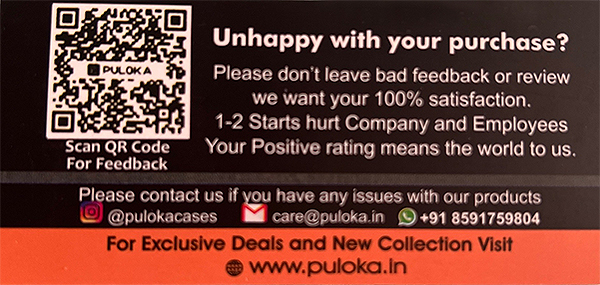
    Frankly, I hardly noticed or gave a second thought to such messages till one day, I actually faced some quality issues with a mini UPS I had got for my broadband router. I found the card with the contact details. I tried calling the number, which was a mobile number, but got no response. I send an email and still had no response. So, after three days I finally got in touch with Amazon who got my product replaced as it was in the warranty period.

    This set me thinking. First, the trend of brazenly asking not to report any problems and not to give a negative feedback. Some may say that it could reflect confidence in the quality of the stuff so if by any chance there is a problem they can handle it, but I think it’s exactly the opposite. It’s the worry that too much of negative feedback will lower the rating score. It also tells me that ratings score is an important parameter that contribute to the sales of the smaller unknown brands or products. I do follow rating scores and was not sure if buyers take it seriously, but this type of communication tells me that they do.

    Secondly, this raises a question whether this is just a gimmick with the sole purpose of avoiding lower ratings and bad publicity? Because if the sellers are genuinely interested in building good consumer relationship then they would respond to complaints. In my case, what happened was that my complaint was finally resolved but the seller escaped as I did not give any negative feedback on Amazon. I am sure Amazon took them to task or lowered some metric because of my complaint but the seller managed to avoid a public complaint from me.

    Which brings me to two simple questions? One, why do we still have a jugaad mindset? Why are we being smart in a negative way and not using the smart to build a strong brand or a better customer relationship. Second, is customer relationship seen as a cost centre or as a sales promotion tool?

    Let me explain the second point with a very recent example.

    I am an e commerce addict and do not hesitate to buy even large ticket items like TVs or AC etc online. I find the process easy. I am able to compare across brands sitting at home and rating points gives me a fair idea of consumer feedback and experience. Exchange allows me to dispose off old products and even get some value out of them. Not to mention the thrill of discounts and the psychological feeling of getting a good deal.

    Three years ago, during Covid while using my Dell Laptop I faced some issues. Given the fact that it was Covid time I was not too keen to go to a service centre. So, when I discovered a Dell store close to my residence, I visited it. The salesperson, was very helpful. Thankfully, the issue was software related so he set it right in 10-15 minutes. Not once did he ask me to visit a service centre. In fact, he gave me his mobile number and asked me to call him if I face any more issues. He did not make any sale nor did I promise him one.

    But a few months later when I was looking to replace my laptop with a new model, my thoughts turned to the helpful salesperson. I did my homework on Amazon and then approached him with my shortlist. I asked him to match the discounts. He actually showed me another model which was not in my shortlist and explained to me why it could be a better choice. I was not totally convinced but just his effort impressed me. Ultimately, I ended up buying a laptop from him. Even though it was slightly more expensive. It was as if his helpfulness, his going out of the way and his efforts in making me feel important was an extra feature to which I was assigning some value.

    And he became our go to guy on anything technical in electronics. My wife had a different brand but he did not hesitate in helping out with any issue with that too. He would even volunteer to come over if the need arose.

    In the last more than three years as a family we have bought three new laptops. And no surprises in guessing that all three have been bought from this one person. More than any celebrity he has been the influencer or endorser for Dell for us. I am even sticking out my neck to say that if he shifts to any other brand, I would follow suit.

    It’s not just the first experience with him but also subsequent experiences. Whenever we have bought a laptop, he has undertaken it on himself to transfer all data to the new laptop. Mostly from cloud but some from old laptop too. And this includes ppts, word documents, images, videos; everything. My trust in him is so strong that I leave the old laptop with him to transfer the stuff. Sometimes, he comes over and does the work. Any issue and he is available to sort it out.

    And every laptop that I have bought from him, I could have got it cheaper online. I could have saved 3-5,000 rupees each time.

    What has happened is simple. The customer service has not been a cost centre. It has become an additional feature. One, which makes me shell out extra or in plain words pay a premium.

    That’s something that new startups or small entreprenuers must understand.

    Do not look at customer service as a cost.

    It could be your extra product benefit.

    It could be a tangible value addition.

    It could be your differentiator.

    Neglect customer service and treat it like a gimmick at your own peril.

  • Ranjona Banerji: That ’70s feeling…

    Ranjona BanerjiFalling bridges and train accidents… Scrolling through the news in India, it almost seems like we’re back in the 1970s when we were still not fully established as a successful growing nation. Plus the 1970s version of an Emergency, except as a non-Constitutional emergency, in that it is undeclared. Add to that a media that is state-controlled, high levels of unemployment, low levels of industrial and manufacturing growth and lo and behold, maybe it is the 1970s after all, just with the addition of social media and colour television and phones for everyone.


    Except of course that it’s 2024. And perhaps one of the main differences is that you’re not permitted to demand accountability. In any BJP-run government, it is clear or has been made clear, that you are not allowed to expect, let alone demand, accountability. Everything that goes wrong is because of some earlier, non-BJP, preferably dead, prime minister. This pattern has not changed for 10 years. And since the much-reduced victory in the last general election is still being understood, we have not it seems yet changed our kneejerk reactions up in the high command.


    The upshot is that the bulk of the media has not yet understood that responsibility for a flailing economy lies with an incumbent government. Any minute now the Union finance minister, same as the last Union finance minister, will make a Union Budget speech. She has already literally cooked the halwa, which in colloquial metaphorical expression implies that we are cooked. Whether this Finance Bill will fix any problems is another matter, but we should not expect much media insights on this.


    We also cannot expect the media to focus in full measure on the completely unconstitutional move by the UP government in getting shops and stalls owned by Muslims to identify themselves on a particular so that Hindu religious pilgrims know where to shop. That the police is implementing an unconstitutional decision is worse. But sectarian division is part of the BJP package and so is the media.


    That the UP government itself appears to be in some distress and that the RSS chief keeps making potshots at the prime minister ought also to be top of media over-excitement. And yet. I did see one “editor in chief” – it’s very amusing when TV people give themselves big fat titles like these – justify in a badly worded tweet the clear Islamophobia of the Assam chief minister. No language skills, no editing skills, but more than enough talent when it comes to creating and spreading hatred.


    This knack which TV has is demonstrated in the case of Captain Anshuman Singh died a year ago, saving people in Siachen. A medical doctor, Singh had specified his wife as his next of kin, which means she gets his pension. Singh’s parents have made a sorry spectacle of themselves, demanding more money, vilifying their daughter-in-law with all sorts of allegations and speaking endlessly to TV channels about their family issues and their arcane views. The media is happy – it seems – to continue to amplify the abuse poured on the young widow, as they were happy with blaming Rhea Chakraborty for the death of Sushant Singh Rajput. Whether the parents know that they are being used is unclear, but they have become the next drama after the Ambani wedding.


    Internationally, we have a media which behaves in similarly absurd ways. The Western media in general still hasn’t twigged on to the fact the whole world knows that Israel is the aggressor in Palestine and responsible for genocide. It insists on equating Israel and Hamas, as if the two are equal or that Hamas has killed thousands since October 7, 2023.


    And the American media in general has plenty of questions for President Joe Biden – is he well enough, suitable, senile or not, makes sense, doesn’t make sense. For former President Donald Trump, who almost never makes sense, we hear about his rallies, the state of his poor ear and so on. The rules are not the same.


    As we should know by now.


    Ranjona Banerji is a senior journalist and commentator. She writes on MxMIndia on Tuesdays and Fridays. Her views here are personal.

  • Ranjona Banerji: Bhakt meltdown post Budget

    Ranjona BanerjiSocial media on the Union Budget was definitely amusing. Try as they might, most BJP-Modi supporters could not find enough to be happy about as taxes went up, indexation was removed and so on. Even the stock market, their dear indicator and their reference that all is well in Modi-land, fell after the Budget was announced. Given that most national budgets do not get the same attention elsewhere in the world – government expenditure, income and debt – in India, it’s always been a spectator sport. With high profile commentators (like Nani Palkhivala), interpreters and since economic liberalisation introduced by Dr Manmohan Singh as Union finance minister in 1991, a boon for graphic artists and editors addicted to comic strips.


    Let us also be honest: most budgets introduced by successive Modi governments since 2014, whether by the late Arun Jaitley or Nirmala Sitharaman, have been pretty dismal, uninspiring and lacking in both vision and thought.


    But this one has upset the BJP’s core supporters the most. Social media yesterday was full of Bhakt meltdowns, many of them people who work in some capacity in money, finance, real estate, the share markets etc.


    Or, it is possible that they’ve been upset for years and it is only the election results which have given them the courage to speak out? The loss of a few seats has changed India in so many ways…


    As amusing as the anger was the reaction of the BJP’s IT cell which now had to attack its own people, its core supporters. Now that is not good PR, is all I can say. The small money people, the merchants, the brokers, these are the BJP’s most constant support base. Billionaires are fickle, they will sway with the wind. For all the flak that Mukesh Ambani faces today from non-BJP people, do not forget that his father Dhirubhai Ambani was a hardcore Congress supporter. So were the Birlas, the Bajajs and so on.


    I know this is useless advice. The BJP IT cell’s main job is to protect Narednra Modi, and so what if it’s from the BJP’s own people.


    I have even heard rumours that some TV anchors, like Sudhir Chaudhury on Aaj Tak have criticised this Budget.


    How’s this for a headline, from the Times of India: “How not to create jobs, help allies”?


    Or this, from the Hindustan Times: “FM disappoints investors, rewards (some) taxpayers”?


    The Indian Express offers this: “Budget 2024: Modi 3.0, an economy in search of a plan”.


    The details of the Budget are not my concern here. The upshot appears to be a post-election result budget – a bit of this and that, big money to the NDA allies who shore up the BJP’s numbers in Parliament, the TDP and JD (U) and according to the Congress Party, quite a bit borrowed from their manifesto. From a political point of view, this is a Budget which has tried to keep some people happy, pretend that it has some ideas about the state of the nation and widespread economic misery and also create some money for empty coffers while actually doing nothing.


    The two funniest takes on social media are from businessman and TV personality Ashneer Grover: “Budget 2024: ‘Boring, Lifeless and Meaningless’

    Instead of delivering this Budget they could have just said – “Iss baar man sa nahi kar raha – agli baar delh lenge kuch karna hai tho”.

    Actually watching yet another Ambani wedding function over this – would’ve been more value and better use of time”.”


    And influential Youtuber and entrepreneur Akshat Shrivastava: “The best career path in India (after today’s budget):


    Rather than becoming an FnO trader, become a bridge/road contractor in Bihar.”


    The only happy people appear to be one TV person who informed us all about Sitharaman’s sari and a newspaper journalist for the Hindu who felt that the Budget reflected political pragmatism. Both are well-known for their love for Modi, no matter what.


    Ranjona Banerji is a senior journalist and commentator. She writes on MxMIndia on Tuesdays and Fridays. Her views here are personal.

  • Sanjeev Kotnala: A structured approach to becoming an Expert

    Sanjeev KotnalaNo, this isn’t a debate on whether it’s better to be a generalist or a specialist. It’s not a joke about experts knowing more about less. This is about the journey to becoming an expert in a chosen field that does not require practical experience. It is about transitioning from being a novice to being knowledgeable and perhaps even an expert. Such a journey can be relevant, intriguing, and meaningful to the individual’s ecosystem and growth.


    The Realisation

    Early in life, I recognised that one cannot be an expert in every subject. Admitting ignorance in some areas was necessary, and there was no shame in saying, “I don’t know” or “I will find out.” However, I also realised the need to become an expert in particular subjects was a justified expectation from both my organisation and myself.


    The Demand for Expertise

    My job in advertising often required quick mastery of new subjects. Deep knowledge was crucial for pitching new categories or brands. The digital information resources were at a nascent stage. Despite the challenges, agencies continually impressed clients with their knowledge, competitive analysis, consumer insights, and strategic recommendations.


    The Shift in Information Value

    Today, information is commoditised. It is readily available, accessible, and affordable. The democratisation of information has reduced its unique value, as everyone accesses the same sources.

    AI-led data interpretation and summaries are very helpful, but true differentiating insights still come from primary research and direct experiences.


    The Challenge of Becoming an Expert

    Becoming an expert has never been easy. It requires dedication, perseverance, and prioritising learning within hectic schedules. It demands disciplined efforts and self-belief in self-education.

    Continuous learning and adaptability are crucial to staying future-proof. Skimming through industry publications or attending events for the latest news is insufficient; a deeper dive into the subject matter is imperative.

    There are no shortcuts to expertise; it demands patience and dedication.


    A Pragmatic Approach to Expertise in 90 Minutes a Day

    Here’s a pragmatic approach to embarking on your journey to becoming an expert, dedicating just 90 minutes a day:

    1. Identify Your Subject: Begin by narrowing down the subject you wish to master.
    2. Immerse in TED Talks and Free Lectures: Watch relevant TED talks and free lectures on platforms like YouTube.
    3. SEO Mindset: Compile a list of contemporary keywords and phrases related to your subject. Use these for Google searches and read the top 10 results for each query.
    4. Books and References: Create a list of books on the subject. Obtain these books physically, on Kindle, or as free PDFs. Read at least 50 pages daily.
    5. Leverage LinkedIn: Connect with subject leaders and practitioners on LinkedIn. Engage them in discussions and seek their input. Many people are surprisingly approachable and willing to share their knowledge.
    6. Notes and Reflection: Make notes and reflect on your learning. Continuously fine-tune your approach based on what works best for you.


    The Cumulative Effort Multiplier

    By following the process, you will have consumed hours of instructional content, numerous TED talks, and multiple books within 12 weeks. You may even pursue additional classes or certifications if necessary.

    In six months, the cumulative effect of your efforts will be evident. Armed with a wealth of knowledge and insights, you’ll be well-equipped to delve deeper into your chosen field or explore new areas of interest. You may not become a real expert you would want to consult on the subject- but you can be an expert people listen to.


    Net-net:

    Knowledge acquisition through a structured approach, discipline, and dedication can help you stay future-proof. If you’re in a hurry, increase your time and effort investment. This approach has worked for me and can work for you, too. Embrace the journey, and may your day be fruitful. Remember, excellence often involves embracing imperfection.