Category: COLUMNS

  • ‘Kill your Darlings’ to find time and energy in life

    ‘Kill your Darlings’ to find time and energy in life

    Sanjeev Kotnala‘Kill Your Darlings’ is not a new Idea. I, too, have referred to it in some way in my book – ‘25 Rules of Life- I wish I had known earlier. However, reading it on #Firstprinciple by The Ken worked wonders for me. It pushed me to take a snappy audit of my work. Re-check the listless old projects that I kept on working on. Things I have become emotionally attached to. Ones which are more of a comfort zone for me. Projects that eat into my time, which I could have definitely used more productively.  I had not been able to amputate from my life emotionally. Though I have prescribed it, I have found it most challenging to execute and follow.

    Here, I reiterate it as one of the most important things to do. And it is not just about entrepreneurship; it is about life, balance, passion and direction.

    1. Knowing what not to do is as important as knowing what to do.
    2. Every time you decide to “not do” something, you free up energy to do something.

    ‘Killing the First Principles podcast wasn’t an easy decision for me’. With these words, Rohin Dharmakumar, The Ken’s co-founder, informed his passionate readers that he dares to walk the talk. He is discontinuing the two-year-old newsletter – the ‘First Principle’, which has covered 41 CEOs and their thinking.

    I selfishly wish he continued it for the benefit of readers like me. But I know no amount of audience pressure would make ‘The Ken’ rethink its decision. I also know whatever they add, replace, or create will be based on deep understanding and focus. Maybe it will help them recheck their thinking and success mantras.

    I have often been given this advice to ‘Kill my Darlings’ in different formats. Unfortunately, I have not been strong and have followed it in spurts. I plan to do it again and believe one must do it many times a year. It is like Diwali cleaning the house. It is liberating. It releases time and makes the energy available to be put into other more efficient and productive work.

    ‘Kill Your Darlings’ –  kill projects and products that are not going anywhere and focus efforts on the most important bits of the business and life. Be willing to emotionally amputate yourself from these unnecessary time and energy eaters- which have outlived their lives. Be ‘Positively Selfish’- because you are your biggest asset and because you are only responsible for yourself.  And it is important to say- that when you do- you will realise you can do the rest of the things better- because- If you can’t do big things better, then at least do the small things the best. I thought it was worth framing and keeping it in front as a reminder.

    Here is another gem from the newsletter. And I have practised this almost every day to great success. It is called subtraction, meaning that if I am taking anything new on my platter, I must decide what I am willing to drop from the things I am doing. Because remember the total energy and time available to you is finite. So, go ahead and look at your set of projects dispassionately and Kill the Darlings. There is another concept about ‘Helping the Jobs commit suicide’ but that I leave for some other day.

    Now, yes, the ‘First Principle’ newsletter and podcast are no longer alive at The Ken, but it is one place where my subscription has given me a lot more thoughts, insights and learning than what I have paid. So think again- and if you want- check out or subscribe to The Ken.

  • Ranjona Banerji: Unveiling facts with Julian Assange & Wikileaks

    Ranjona BanerjiJulian Assange challenged the pillars of journalism more than any other person in recent times. He took the comfort out of information-gathering and went right to the edge. Journalists who relied on sources for information, by cosying up to people in power, were suddenly outed for cowardice and collusion. By leaking confidential government communications, without all the checks and balances which keep newsrooms safe, Assange and Wikileaks turned normal practice on its head.


    For this, he spent years in hiding and in jail. Over time, the journalistic community forgot about him, except for occasional reports on his condition. But we have all benefitted from Wikileaks and Assange’s ideas of what journalism should be. We have had to recalibrate what governments can and cannot or should and should not keep secret. The details in the US State department cables which Wikileaks published had loads of gossip, straw opinions and comments rather than any explosive stuff. But it provided us with knowledge on how governments work and more importantly, it shared that with the world. In a sense, what Assange has tried to do is break the vows of importance with which governments cover themselves.


    Many of us, even or especially in the mainstream media, are happy with status quo. We also like to worship at the altar of power so we bow down to government rules, government systems to protect themselves, to accepting the need for secrets in the upper echelons of “Government”. Wikileaks worked very well to break those myths and brought governments down to size.


    That is why Assange was persecuted and jailed. He removed the veils which we, as a society, felt that Power was allowed. He also made us realise how mundane some secrets were, as well as how governments protected themselves from their own misdeamenours, how government agencies infiltrated operations in other countries, how torture was used against people of other nations by Western Democracies, how spyware was used to target sovereign nations. The Iraq War provided a treasure trove of information via Wikileaks.


    Much of the information about then presidential hopeful Hillary Clinton using her private email id for public work also came via Assange. These leaks set up a whole other conversation about Assange, his political leanings and his methodology. There was also information about how the controversial firm, Cambridge Analytica which was accused of manipulating voters’ minds towards the far right and Donald Trump through social media, especially Facebook, had possibly worked with Assange.


    https://www.theguardian.com/uk-news/2018/jun/06/cambridge-analytica-brittany-kaiser-julian-assange-wikileaks


    The US was a common target for Wikileaks, and thus it was the US which fought for his extradition. The fact that he is out on a plea deal is some measure of how the influence of Wikileaks has waned and possibly seen as less of a threat than it was before.


    https://www.reuters.com/world/us/wikileaks-assange-expected-plead-guilty-us-espionage-charge-document-says-2024-06-24/


    Controversial as Assange is, his use of data has triggered a new form of journalism within the mainstream media. Exposes like the Panama Papers are testament to collaborative journalism which uses massive data leaks on a global scale to highlight fraud and chicanery. The tools of journalism have also changed as a result.


    To some Assange is still a hero; others may be hard-pressed to remember him and might have to go back to movies to find out!


    But we owe him, either way. For changing our ways of working, understanding and respecting power, for better or for worse.


    Ranjona Banerji is a senior journalist and commentator. She writes on MxMIndia on Tuesdays and Fridays. Her views here are personal.

  • Crumbling of the Bollywood star system is imminent

    Crumbling of the Bollywood star system is imminent

    Shailesh KapoorOver the last year or two, there has been escalating media coverage how remunerations demanded by Bollywood stars are making Hindi film-making an increasingly-difficult business. The top rung of stars, such as the three Khans, have either turned producers, or forgone their fee against what’s called a ‘backend’ deal (typically referring to a distribution or licensing deal), the next line continues to operate on fixed fee structures, where the numbers increased significantly since before the pandemic. There’s also a lot of conversation about star entourages, and how ridiculous their costs are.

    Now all this would just be gossip, if the stars could justify these fees through their box-office performance. But that’s not happening at all. The biggest ‘Hindi’ language film of the first six months of 2024 is likely to be the dubbed Hindi version of Kalki 2898 AD, which released yesterday. A non-starcast, concept-led film Munjya is set to cross the Rs 100 cr mark, even as star-led titles made at much higher budgets, such as Bade Miyan Chote Miyan, Maidaan, and Chandu Champion, have fallen well short.

    For a year or two after the pandemic, streaming platforms were in a mad rush to acquire theatrical films. Since these deals happened before the theatrical release, the star power came into the picture. With time, and facing their own share of challenges related to stagnant subscriber growth and profitability, streamers have become conscious, and are often insisting on deal structures that have box office linkages.The message is clear: If the star cannot pull an audience in the theatres, he (or she) is not ‘saleable’ on OTT either.

    Movie channels in linear television have been on the decline anyway in the post-NTO world. Licence fees for satellite rights is no longer a prominent item on the P&L of most films. The reliance on theatrical (box-office) revenues is only going to go up in the coming year or two. And all evidence suggests that stars cannot pull in the audience anymore on their own strength, and need the story or the concept to work for the film to stand any chance on the theatrical front.

    It is hard to imagine how any of this is sustainable. Hindi film producers cannot even make films that go direct to OTT anymore. There is no demand for such films, either from the streamer or the audience side. There is only one way out: Stars must understand that the audiences and the marketplace has evolved, and bite into the humble pie that a pay cut can be. They can also be a lot more prudent in their film selection, aligning it with evolving audience tastes and expectations in a digital-first, post-pandemic era.

    Whether that will happen is anyone’s guess.

  • Shruti Pushkarna: Can the media amplify voices of disabled and elderly to build an Inclusive India?

    Shruti PushkarnaLast week, I engaged with global leaders in the space of Accessibility and Inclusion. Neil Milliken, Debra Ruh and Antonio Vieria Santos started AXSChat 10 years ago, an online community of individuals dedicated to creating an inclusive world. They host weekly video interviews, podcasts, and Twitter chats.

    Given my experience in the media and more recently as a disability inclusion specialist, our video chat focused on breaking attitudinal societal barriers to inclusion through media advocacy and representation. The half-hour conversation spotlighted the essential role of media in shaping (or breaking) stereotypes.

    Interestingly, we also agreed on the need for the disabled community to speak in a language that the media can relate to. Essentially stepping away from headstrong activism to a more constructive solutions focused narrative. This to steer media reporting from awe inspiring accounts to a more pragmatic approach on ‘how to include’ persons with disabilities in the mainstream.

    True to the format, the thread of conversation extended to a Twitter chat, where several inclusion advocates engaged in a series of questions around Building an Inclusive India. Here’s a synopsis of the online discourse.

    Disability not an outcome of bad karma

    How can India ensure Persons with Disabilities (PwDs) are not excluded due to cultural biases?

     Is it fair to punish (read exclude) someone who is presumably cursed (read disabled) for bad karma in a previous life? Absolutely not! Neil Milliken emphasized that regardless of religious beliefs, everyone should be treated well in their current lives. Green Disability urged to focus on accessibility and customized trainings, while Puneet Singhal called for cultural sensitivity training and inclusive policymaking. India must dismantle physical and digital barriers to ensure PwDs are visible and heard.

    Better media representation

    How can Indian media, Bollywood included, appropriately represent PwDs? How essential is this for a societal change?

    Bollywood and Indian media must stop using PwDs as objects of ridicule or villainy. Instead, they should portray PwDs as integral parts of society. Puneet Singhal and Antonio Vieira Santos suggested including people with disabilities in leading roles and consulting with disability advocates on how to normalize disability on screen. Anna M proposed creating a dedicated media channel for disability, similar to Canada’s Accessible Media. Accurate representation can challenge stereotypes and foster acceptance.

     Changing the narrative from ‘they can’t’ to ‘they can

    Why is it important for Indian media to engage in discussions about accessibility and assistive technology?

    Media representation should evolve from exposure to disability solutions. The current quality of reporting is reflective of the media’s limited understanding of challenges and possible fixes. Awareness of assistive devices and innovative technology can transform the narrative. Neil, Puneet and Antonio collectively highlighted the need for media to disseminate the benefits of accessibility and inclusion efforts. Spotlighting these through mainstream media discussions can inspire better policies and innovations for PwDs.

    A6 the media can chose to feature disability issues as part of the mainstream because disability is part of everyone’s life journey at some point #AXSChat

    — Neil Milliken (@NeilMilliken) June 18, 2024

    Altering cultural perceptions

    What role does cultural perception play in the inclusion of persons with disabilities in India, and how can the media impact these positively?

    As mentioned earlier, cultural perceptions often see disability as a karmic fallout, leading to stigma and rejection. Positive media representation can change these views. Anna M recalled that older Indian immigrants show discomfort around disabled people, indicating the persistence of cultural attitudes. Are we imprisoned and colonised by our cultural contexts that follow us everywhere we go? Puneet Singhal suggested India’s pluralistic culture can promote empathy and respect, shifting perceptions through storytelling, inclusive policies, and community initiatives. Antonio also emphasized the need for awareness campaigns by the media to embrace diversity and cultivate equality.

    India’s role on the global stage

    How can India’s commitment to inclusion reshape the international landscape?

    India, a country with over 1.4 billion people, holds immense potential for creating a society that is inclusive and accessible for all, including Persons with Disabilities. As Anna M pointed out, India’s population is comparable to the global number of PwDs, offering immense potential for setting inclusion standards. Puneet Singhal believes our country’s commitment can inspire other nations to prioritise accessibility and equity. Neil Milliken noted the potential of a population as large and diverse as India, to both shape and create markets for innovative assistive technology. India is complex also because of disability’s intersection with caste, gender, economic and social ranking et cetera. Once we crack this problem, perhaps some solutions can be replicated across the world.

    A6 Indian media can lead on disability and aging inclusion by featuring diverse stories, hosting expert panels, and running awareness campaigns. They can influence public opinion by normalizing inclusion, challenging stereotypes, and promoting positive narratives. #AXSChat

    — Antonio Vieira Santos (@AkwyZ) June 18, 2024

    Media’s role in leading the conversation on inclusion

    What initiatives can the Indian media take to drive the conversations around disability and aging inclusion to influence public opinion?

    The Indian media should start with hiring persons with disabilities to understand barriers and solutions first hand and invite diverse disabled voices to speak on significant issues. Inclusive storytelling and social media campaigns can influence public stance. Neil Milliken suggested featuring disability issues as mainstream topics as everyone encounters disability at some point in life. Puneet Singhal recommended collaboration with NGOs and advocacy groups to champion disability and aging inclusion by amplifying voices of PwDs and the elderly. Green Disability recommended having dedicated programming on ageing and disability issues.

    India’s journey towards an inclusive society requires concerted efforts across cultural, media, and policy domains. Improved media representation to replace existing misconceptions and promote accessibility can ensure that no one is left behind.

    You can watch the AXSChat episode on Breaking Barriers: Media and Disability Advocacy here.


    Wondering why MxMIndia publishes a disability advocacy column? Well, we strongly feel that the media can dramatically transform the world for persons with disabilities. This series attempts to help bring forth issues that the media must champion to create a truly inclusive and accessible India. Writing  this column is Shruti Pushkarna, a former journalist and now a disability inclusion advocate based in New Delhi. Her views here are personal. To access the archives of her 95-odd columns, please visit: https://www.mxmindia.com/category/ columns/shruti-pushkarna/

    If you have a view on the issues raise or would like to align with MxMIndia on this cause, write to us at editor [at] mxmindia.com.

  • Momentum Shifts & Miracles

    Momentum Shifts & Miracles

    Sanjeev KotnalaOn June 30, 2024, much before sunrise, the whole nation was sleepless and celebrating the famous Houdini act of the Indian cricket team. The wait was finally over. A few of the articles covering the event rightly said, India snatched victory from the jaws of defeat or snatched the T20 World Cup from the hands of South Africa. The South African team did nothing wrong, but they still ended up strengthening the choker branding.

    The nation of armchair commentators and experts, with the right of ardent, passionate fans in the country where the game is a religion, was up for debate in person and on social media. In a relay of comments, they took what was served to them by the experts on TV and ran with it with their versions. Each tried to outdo the other in understanding the game’s intricacies.

    So was the fight between turning points and tipping points among the armchair experts. The T20 World Cup Final in Barbados was a great example of the unpredictable nature of Cricket and sports in general.

    A turning point in cricket is the dramatic moment when the match’s momentum shifts decisively from one team to another. Yesterday, there were many such moments in the seesaw battle. The absolute gem of the catch by Surya Kumar Yadav—SKY is the limit on the boundary; the 22 runs over of Axar Patel, the change of gear by Kohli, and the Bumrah 18th over are all examples of it. These are easily identifiable moments, providing clear markers in the match’s narrative.

    On the other hand, a tipping point is more nuanced and subtle. It is the cumulative effect of numerous small events that collectively build up to a decisive shift in the game’s outcome. Unlike a turning point’s sudden and noticeable impact, the tipping point results from sustained pressure, consistent performance, or a series of minor mistakes by the opposing team. The slow and steady build-up of these small factors eventually leads to a significant change, tipping the game’s balance in favour of one team.

    Now, both the tipping and the turning points result from players’ belief that everything is possible until the last moment. It is not just a motivational slogan. A fundamental mindset that fuels resilience, creativity, and relentless effort. This unwavering self-belief is crucial, especially in high-pressure situations with high stakes and uncertain outcomes.

    However, if the same belief shows signs of weakness and doubts creep into the team’s collective psyche, they could choke.

    Self-belief among individual players plays a crucial role in these high-stakes moments. For a batter facing a daunting target, believing in their ability to chase it down can transform their approach, allowing them to take calculated risks and innovate in their shot selection. Kohli, Karlsen and Axar Patel showed it. Similarly, a bowler who believes in their skill can maintain focus and precision under pressure, delivering match-winning performances even in the most challenging circumstances- well, Hardik and Bumrah showed what is possible.

    Cricket history is replete with instances where teams have snatched victory from the jaws of defeat, demonstrating that a match is never truly over until the last ball is bowled. The T20 Final on June 29, 2024 was another example of these uncertainties.

    Having celebrated the individual brilliance, we refocus on the fact that cricket is inherently a team sport, and collective performance is equally important. A team of champions need not make a Champion team.

    While individual brilliance can turn games around, the combined effort of the entire team determines the outcome. Effective communication, strategic planning, and mutual trust among team members are essential to a successful collective performance.

    Each player must understand their role and contribute to the team’s objectives, whether building a solid partnership in batting, maintaining high fielding standards, or executing bowling plans meticulously.

    Cricket’s unique charm combines individual heroics and collective synergy. The glorious uncertainties on the field, with everything possible until the last moment, make cricket so thrilling and unpredictable.

    This belief fuels remarkable comebacks, stunning upsets, and the sport’s enduring appeal to fans and players alike. But hell, I would any day take a straightforward, solid win over these tense moments—however, I must admit there is more fun in a win like the T20 World Cup 2024.

  • Brrrrrrr! The news media is shivering!!!

    Brrrrrrr! The news media is shivering!!!

    Ranjona BanerjiIn Monday, as Leader of the Opposition, the first in a long while, Rahul Gandhi gave a speech which had the Lok Sabha laughing with him and the treasury benches squirming, with the BJP all riled up.


    The speech got enormous traction on social media all day, it has got 5 lakh views on Gandhi’s Youtube channel.


    Narendra Modi has not uploaded his Lok Sabha pronouncements to his Youtube channel. One short clip of Modi talking about former vice-president and fellow BJP member Venkaiah Naidu received 22000 views.


    How did our legacy media cover this speech? Often, as is the norm, headlines do not represent the bulk of the copy which follows. For instance, the Times of India headline reads: Lok Sabha sees rare PM Modi vs Rahul Gandhi faceoff. The copy however is mainly about Gandhi’s speech. Since the actual “face-off” was a bit of a damp squib.


    https://timesofindia.indiatimes.com/india/lok-sabha-sees-rare-pm-modi-vs-rahul-gandhi-faceoff/articleshow/111403045.cms


    This “report” from NDTV cleverly attempts to present happenings in Parliament from the BJP’s perspective, and further, is written to mislead the reader into thinking that the BJP and Modi had the upper hand. The reality of anyone who actually watched the proceedings was quite the opposite. Even TOI hints at that.


    https://www.ndtv.com/india-news/pm-narendra-modi-rahul-gandhi-lok-sabha-bjp-rss-not-entire-hindu-community-rahul-gandhi-vs-pm-in-lok-sabha-6008976


    The Hindustan Times also concentrated on the poor beleaguered BJP with this pathetic “point by point rebuttal”. I am unable to understand whether they actually believe their own drivel or were directed to write like this:


    https://www.hindustantimes.com/india-news/on-rahul-gandhis-hindus-agnipath-scheme-charges-bjps-point-by-point-rebuttal-101719878748437.html


    The fact that the BJP misrepresented Rahul Gandhi’s speech – especially his remark about Hindus – has not been covered, rather shamefully.


    Factcheckers have checked the misinformation in the BJP-led government’s “rebuttals” which makes the newspaper’s coverage even more embarrassing.


    The Hindu provides more comprehensive coverage of Gandhi’s speech and the BJP’s reactions:

    https://www.thehindu.com/news/national/you-are-not-hindus-rahul-gandhis-dig-at-bjp-draws-protests-in-lok-sabha/article68355018.ece


    India Today’s tawdry notion of being the “gold standard of journalism” apart, the following link is interesting because it gives the people of India an idea of how the BJP wants to limit how much the people of India are allowed to know. All the items “expunged” from Gandhi’s speech are important subjects for us to discuss. Whether India Today is aware of this or not, well. I’m not going there.


    https://www.indiatoday.in/india/story/rahul-gandhi-lok-sabha-speech-parts-expunged-from-parliamentary-records-2560992-2024-07-02?onetap=true


    A more complete report of Gandhi’s speech comes from the digital non-legacy media, obviously:


    https://thewire.in/politics/in-maiden-speech-as-lop-rahul-gandhi-tears-into-bjp-on-hate-politics-price-rise-and-neet


    What I have not been able to find is another newsworthy event which happened in Parliament yesterday: that Prime Minister Modi was reduced to being just one more MP, one more politician in a Constitutional post. Not a non-biological divine being – both Gandhi and A Raja referred to this – and not the Teacher of the World. This was perhaps more significant that Gandhi’s speech. And the squirming of the worms in the media is directly related to this downsizing.


    Mahua Moitra gave an extremely fiery no-holds-barred speech. Happily, the legacy media was happier with giving Moitra her due. Massive congratulations all around for such courage.


    https://www.telegraphindia.com/india/hear-me-dariye-mat-mahua-moitra-tells-pm-narendra-modi-in-lok-sabha/cid/2030875


    https://timesofindia.indiatimes.com/videos/international/tmc-mp-mahua-moitra-bashes-bjp-in-fiery-lok-sabha-speech-paid-heavy-price-for-watch/videoshow/111410814.cms


    Both Rahul Gandhi and Mahua Moitra emphasized the fact that they do not fear Modi and the BJP.


    Judging from this coverage though, the Indian media though is still shivering and snivelling in its collective shoes. Uriah Heep has nothing on them.


    Ranjona Banerji is a senior journalist and commentator. She writes on MxMIndia on Tuesdays and Fridays. Her views here are personal.

  • Dealing with Disbelief of Winning at Cannes

    Dealing with Disbelief of Winning at Cannes

    Sanjeev KotnalaWell, there comes a time in life when one is shaken to the core. This is the case of Naveen (name changed), who mostly appreciates the excellent work in the advertising industry and usually refrains from attacking or downgrading any work because he knows how much goes into producing the collective output. As an advertising marketing professional, he prides himself on his ability to judge campaigns and their reflection or alignment with the brand identity. However, without naming the campaign or the brand, he was shocked and shaken when a few campaigns he believed were lacking or were majorly misaligned with the brand’s perceived core values or the changing market dynamics won awards at the Cannes Lions. It has him questioning the judgment, the possible reasons the jury saw while making the decision, and the creative process.

    He has been honest. He is one of the numerous creative-client–agency personals who entered their work confident of a win.  Understandably, not making the shortlist gave him time to recover. Making the shortlist and not winning for another entry was painful but acceptable. Where it crossed the line was someone else (a known competitor in India) winning it. Yes, he celebrated with the other delegates from India. He drank the whole night, but the pain was immense. And that’s when dear Vermajee, my mentor and friend, a brand and marketing consultant, came out of semi-retirement to counsel him.

    The result of Vermajee’s surprisingly effective counselling helped Naveen. Here is what Naveen said and wanted to share with the other potential winners who did not make the cut.


    The Shock of Disbelief

    My initial reaction was naturally of sheer disbelief. How could a campaign so flawed be recognised as one of the best? How did the jury miss the clinks in the armour or the details that made the piece of brilliance a has been? Several factors compound this shock:

    Trust me, at such times, it is hard to reconcile to the jury’s apparent admiration and point of view when my evaluation finds the campaign’s creative execution, messaging, or strategy lacking. When I see that the campaign is clearly misaligned with the brand’s core values or identity. Did the jury miss this crucial aspect? Have I not moved with the industry? And if my expectations are unjustified? What was my campaign lacking?


    The Imperative of Self-Evaluation

    Beyond the initial stage of disbelief, the next stage forced me to introspect and critically evaluate my professional judgment.

    I mustered enough courage to reanalyse and see the winning campaigns from a different perspective. I’m trying to understand what I might have overlooked. Were there any innovative elements or insights that escaped my notice during the first interaction? What made it resonate with the judges? I then engaged with colleagues and industry peers to gather diverse perspectives. Their constructive criticism and different viewpoints illuminated aspects of the campaign that contributed to its success. And still, I could not negate the possibility of biases or preconceived notions that might have influenced the jury or my judgment. I look back to check and recheck if my personal preferences cloud my professional assessments. And the silly answer is, maybe.


    Questioning the Jury and self.

    Naturally, I was not going to escape this question: whether the jury was wrong or if my perspective was limited. Did they see something I missed? Is their collective wisdom superior to my assessment? These questions are tough but necessary for growth.


    Maintaining Self-Belief.

    On the other end, I am shaken, and it is essential for me to regroup to maintain self-belief, stay motivated and confident:

    So, I took the emotional insurance of strategic thinking and acknowledged the subjectivity inherent in creative output and engagement. What resonates with one person may not resonate with another, and hence, there is a wider jury panel that could be given the benefit of better wisdom against a verdict of sample size—1.

    The Cannes Lions jury, like every other respectable award, has diverse industry leaders who bring differing spectrums of perspectives and likes to the table.

    I reiterate, telling myself that embracing differing opinions does not negate my expertise. Instead, they enrich the creative landscape. Acknowledging and embracing a broad spectrum of perspectives enhances my creative approach and broadens my understanding of successful advertising. Such an inward-looking examination is a learning opportunity. It is an opportunity to reframe my own set of expectations. A window to channel my energies into developing innovative ideas and strategies that align with my client’s creative vision and professional standards.


    Net-net

    There is no need to repeat that staying resilient and open-minded is crucial in advertising. The disbelief explosion caused by the unexpected success of some campaigns should not deter me, but it should inspire a deeper commitment to excellence and continuous learning. Creativity is a journey, not a destination—so are awards and market results.

    The relentless pursuit of improvement and a willingness to see things from different angles will help drive my success. I celebrate the achievements of others, learn from them, and use those lessons to fuel my creative endeavour. After all, in the world of advertising, the ability to adapt and evolve is as crucial as the ability to create. Cannes 2025 will be a different ball game. Thanks for the long call over WhatsApp, and I tell you- Mere Number Aayega.

  • Can India be an MaI and AdI Powerhouse?

    Can India be an MaI and AdI Powerhouse?

    Ashoke AgarrwalThe world awaits the paradigm-shifting potential of Machine Intelligence (MI) and Advertising Intelligence (AI).

    MI and AI are foundational technologies like electricity that need to be deployed for specific purposes to generate economic and social value.

    The competition is fierce, with established corporations and countless start-ups worldwide vying for a piece of the MI and AI pie. With its unique strengths, India can make a significant mark in this arena.

    This column briefly explores India’s opportunity and potential to be a leader in applying MI and AI to marketing and advertising—a field I term as MaI and AdI.

    The first requirement for MaI and AdI is the accumulation of relevant data, including public-facing data like syndicated market, media, and consumer data compilations and research and, to the extent possible, private data on sales, consumer profiles, and research with brand owners from across the world.

    Developed on this data, MaI and AdI engines can offer a brand owner the following based on deep and evolving consumer insight:

    • Fine-tuned and dynamic marketing mix plans that maximize ROI
    • Messaging templates that turbo-charge the marketing mix
    • Product enhancement and development ideas

    Can India become a global leader in this game?

    Yes, if we move fast and move-wise.

    The first step would be to test and perfect new modes of collecting consumer data.

    The internet, the smartphone, MI, and AI promise a new age of syndicated consumer research. Currently, syndicated consumer research sits in silos. Sales numbers are compiled through retail audits. With retail worldwide increasingly dominated by e-commerce and big-box retail, retail audits largely fail as market share indicators simply because e-commerce and big-box retailers treat sales data as a valuable resource and loathe sharing it with third parties.

    Conventional media research needs to be improved. The increasingly dominant digital powerhouses like Alphabet and Meta think of audience data as the engine central to their business, and they have it at a level of granularity that no conventional research technique can match.

    As OTT platforms like Netflix and e-commerce giants like Amazon muscle into advertising, they will keep their audience data close and be equally impenetrable to conventional research.

    Media research focused on traditional mass media has a utility and funding problem. As a hangover from the halcyon days of advertising agencies when they fed at the 15% trough, brands wanted the agencies to fund media research and who, in turn, twisted the arms of media houses to share the costs. Audience research for traditional media thus came to be split into silos – press, TV and even radio, OOH and cinema – had research funded and controlled by narrowly focused bodies.

    As the percentage of marketing communication budgets allocated to traditional media continues to shrink brand, mass media owners and media agencies are finding it hard to continue funding research and the brand managers who are increasingly used to the clarity of performance marketing and pay-per-click contracts, wonder whether bland broad-brush data of who watched what is adds any edge to their marketing data.

    The third data dimension is brand lift. Marketing is going down the AIDA funnel – from awareness to consideration set to intention to purchase, with the final sale, satisfaction, brand loyalty and advocacy culminating in the process. Currently, very little syndicated consumer research is available in this area. The big brands invest in privately funded research to track this dimension, with others adopting a set-of-the-pants approach to this crucial aspect.

    The answer to the challenges above is developing a technology-led process in which the consumer is the direct and single source for all three data dimensions—brand lift, 360-degree media exposure, and purchase. The two critical issues to be resolved are compliance, incentives, and data privacy regulations. The answer lies in innovation in technology, including LLMs and contractual relationships. In the spirit of full disclosure, my partners and I are experimenting with one such system in collaboration with a UK-based company.

    A critical element differentiating successful brands is a nuanced understanding of what works and what does not in advertising and other marketing communication for a particular product category, geography and consumer segment. Ogilvy, in its heydays, used to generate multimedia Magic Lanterns for product categories of interest that laid out, with examples, the dos and donts when creating advertising for a particular category. These Magic Lanterns were assiduously produced by a cell of PhDs running factor analysis on advertising from across the world and some measure of the efficacy of each ad.

    The single source data envisaged above will produce multidimensional efficacy data for campaigns across categories, markets and segments. A state-of-the-art AdI engine could be developed that uses Deep Learning to pinpoint what works and what doesn’t.

    While MaI and AdI will be the first generation of AI in marketing, the third generation will likely result in AI avatars of brands.

    Parallelly as the Siris and the Alexas of the world will, over decades, morph into Concierge Intelligences (CI) that will become AI avatars of individuals. I have written about the idea of CIs in an earlier MxMIndia column. In the age of AI, marketing and marketing communication will evolve to primarily be an interaction between the AI avatars of brands and the AI avatars of consumers.

    In the near future, the single source would meld with the client’s private data, providing a never-before-used base for effective marketing planning.

    There is scope for more than one Indian player to make India the single-source powerhouse of the world for the following reasons:

    • India has the technology nous in the high quality, low-cost quadrant.
    • India is an evolved B2C and B2B market that can support the development of single-source-research-based MaI and AdI systems.

    Since the single-source system will be digital, India can market its fully developed MaI and AdI systems worldwide.

    Single-source data coupled with MaI and AdI are the future of marketing and advertising, and India, on its way to Viksit Bharat, can own it.

  • Ranjona Banerji: Rah-rah, Mr Shadow PM

    Ranjona BanerjiThe high voltage dramatic world of Hindi television “news” is outside my comprehension as well as my mandate for this column. However, out of my commitment to you (ahem) and some insane curiosity, I dipped a toe into the muck, as Lok Sabha proceedings began.


    And I was genuinely amazed. Okay, that’s an exaggeration. I was slightly shocked. And confused. For instance, on a programme on ABP News, after Rahul Gandhi’s first speech as Leader of the Opposition, the guests seemed to actually praise Rahul Gandhi’s speech. Some pointed out that this was Gandhi’s moment of arrival, others felt his success was clear since three Government ministers stood up to counter him. And one made the suggestion that the Opposition should now create a shadow Cabinet, as is done in the UK.


    And lo and behold, India Today has apparently called Gandhi the “Shadow PM”.


    It is worthwhile to remember that many (most?) of the channels did not cover Gandhi’s Bharat Jodo Yatra, and whipped up as much Hindu-Muslim hatred as possible and have consistently given Modi 1, Modi 2 a free pass. On Modi-NDA 3, well, it’s early days yet.


    The possibility is that criticism of Modi-NDA 3 will be weak. But the India Alliance will no longer be wiped out, dismissed and ridiculed as much as earlier.


    My reason for caution is this: as Prime Minister Narendra Modi was droning on and on in his reply to the Opposition, in an extremely lacklustre speech, reports started coming in of a terrible tragedy unfolding in Hathras, Uttar Pradesh. People had been trampled to death in a stampede at a religious event organised by some godman. The casualties kept rising, but some of these channels did not shift from the PM’s speech to cover the news. Nor was the PM corrected on his most egregious assertion that his government had done a lot to “normalise” the situation in Manipur.


    On the other hand, I did watch a young female Muslim anchor (I make the religious distinction deliberately) berate a member of the BJP for the BJP’s discriminatory and violent behaviour towards Muslims. This young woman did not hold back. It was most intriguing. Not so long ago another TV anchor listened to Modi claim he was not born from biology but had divine connections, and did not even ask a mild question.


    The American media and some media across the world are currently debating the suitability of US President Joe Biden for another term. Most of the questions are based on Biden’s flat and fumbling performance in the first debate with Republican candidate Donald Trump. (“Why Joe Biden must stand aside”, is a headline in The Economist). Biden is still President. I can’t think of anyone in the legacy/mainstream Indian media who will question Modi’s many mistakes, lies and garbled speeches. O no. How dare I even ask such a question???


    There have been reports of the Indian public resisting the snide and manipulative questions asked by what TV journalist Ravish Kumar termed the “Godi media”, as in sitting in the lap of the powers that be. A clip is doing the rounds of a reporter from India TV trying to trick the family of a young man killed in combat into admitting that they got Rs one crore as claimed by Defence Minister Rajnath Singh (in answer to Rahul Gandhi). Modi’s Agniveer scheme of short-term soldiering has been much debated.

    Gandhi had stated that the scheme does not provide adequate compensation and that the family did not get the Rs one crore as claimed. The family got angry with the reporter for twisting their answers and threw him out. The need of channels to push the government line can put the lives of their staff in danger. But the need to promote Modi remains. Other TV people put out information about the claim of Rs one crore paid to the family as true. And yet their own documents showed that the family had received an insurance pay out. Not all the money the Central government had claimed. If you are so full of “Praise Modi Propagate Modi Karyakram”, you cannot even read your own information.


    Meanwhile, Modi hooked off to meet the Indian cricket team after their fabulous win at the T20 World Cup.


    And the Shadow PM went to meet the families of those killed in the stampede at Hathras.


    Ranjona Banerji is a senior journalist and commentator. She writes on MxMIndia on Tuesdays and Fridays. Her views here are personal.

  • Fantasy cricket apps & brand-building- A lesson for advertising agencies?

    Fantasy cricket apps & brand-building- A lesson for advertising agencies?

    With apologies to none at all

    Vikas MehtaBy Vikas Mehta

    My last column titled ‘Why are we building products and not brands’ seemed to have sparked off many reactions. Some raw, I dare say. The questions ranged from differentiation to personality to digital. But one question stood out. I was asked if all new age brands are just products? Is there anyone building a brand?

    The answer was not difficult, but I will take the liberty of using this column to explain how a brand is being built by a new age product. Disclaimer first: I have nothing to do with the brand except I know the founder of the communication company which is spearheading the brand-building exercise. This is totally an outsider’s perspective.

    I am talking about Dream 11.

    Not many know that the brand was launched in 2008. The fantasy cricket app which is what they are all about today was launched in 2012 and by 2014 they had a million registered users. This figure rose to around 45 million around 2018, just when serious brand-building efforts started and today, the figure stands at around 150 million. I am deliberately starting with numbers because this is a brand which has been successful by all standards.

    The brand started advertising during the Indian Premier League (IPL) around 2018 or so. It had a simple positioning. The cricketers, who play for India, back Dream 11. It was decidedly an endorsement but an endorsement done with a positioning, personality and differentiation in mind.

    First, they aligned with the best Indian cricketers. Dhoni, Rohit, Pant, Bumrah, Hardik, Ashwin, Dhawan. Dhoni dropped out after a season or two but the core has remained the same. One of the first campaigns I remember was using Dhoni which was about khelo dimaag se. Dhoni was always an astute cricketer and the brand used his personality to show that it was a game of skill and not luck. This was required at the time because Indian laws did not allow any game which could be seen as betting or lottery. So khelo dimaag se, worked for the brand in more ways than one.

    And then the brand took off. It decided that its personality needs to be light fun, cricket humour, and showing the human face of the Indian cricketers.

    The positioning evolved into snippets of Indian street cricket as portrayed by star Indian cricketers. It was not too focused, neither too narrow. It did not get bogged down by a consistent tagline. I am not saying that consistent tagline is bad but the positioning is not just what the brand says in a tagline. Positioning is what the consumer stores in his mind. A tagline is static, positioning needs to evolve. Not change but evolve. Dream 11 did it brilliantly.

    Yeh apna game hai

    Yeh main kar leta hoon tum Dream 11 pe team banao

    Dream big. Dream 11

    Sab khelenge

    Team se bada kuch nahin.

    And each one of these taglines had a story. An emotion.

    Weaved into the game as played by Indians everyday. Using the Indian stars.

    Remember, pehle main batting karoonga kyonki bat mera hai, leaving Rohit stumped. Yeh apna game hai. Watch here

    Or the film stars like Amir challenging the cricketers who are acting in ads.  Sab khelenge. Watch here.

    Pant’s dream of becoming a singer or Bumrah acting as a romatic hero. Dream Big. Watch here.

    Or even magnifying the role of seemingly insignificant people. Ashwin’s soup wallah. Or the groundsman who prepared pitches for Rohi. Allowing them to Dream big. Watch here.

    And Sharmaji ka beta. Team se bada kuch nahin. Watch here.

    The brand owned cricket. And how.

    For IPL, it focused on team or club rivalry which overtook national rivalry. So even cricketers from other nationalities were used. Even family members. Sunil Shetty for example.

    For World Cups there was collectiveness, national pride. Ek se dikhoge toh best kheloge. The Mummyjee ad.

    This was brand building at its best.

    Dominate cricket. Own cricket. Emotionally own the category.

    And they did many other things too. If one searches for Dream 11 on YouTube there are many videos made by the brand which are not brand-building but which support brand-building. Stories of ordinary people who won big. Videos of how easy it is to play the app. Videos made by influencers on why winning is so easy. Or videos on how Dream 11 employees have grown…… Watch here

    And you know what. The competition too did all these. My circle 11. MPL. They too have such videos. They have big offers. Rs one crore prize everyday. An SUV to win everyday. They too talk about the big winners. They too have influencers in you tube videos. They have also used some Indian stars like Shubhman, Rinku, even Sourav Ganguli in the past.

    But what they don’t have is a brand.

    That is distinct.

    That differentiates. Emotionally.

    That dominates the category.

    Chances are that if you want to play fantasy cricket you will first download Dream 11.

    Because you remember it.

    Because you connect with it.

    Because it seems to dominate cricket.

    In a category where big prize matters.

    Where spends are high

    And where quantitative parameters are easy to judge by.

    So how much you spend where, gets immediate results or not can be the sole criteria to judge success.

    In such a category, Dream 11 has built a differentiating, preferred and leadership brand.

    So, should we still focus on products?

    And ignore brand-building?

    In my mind that is the role of advertising agencies.

    Build brands.

    That is the focus which the agencies have lost.

    And that is why they are struggling.

    Agencies need to start reemphasizing the need to build a brand.

    Do not tell me that clients do not want it.

    Do agencies explain it to them?

    Do the agencies explain what the brand idea is?

    How it can be differentiating and can be sustained long term.

    The agencies are trying to do what the clients want.

    Not what the brands need.

    Agencies need to create a niche.

    And they will find it is much beyond a niche.

    Do you agree?


  • Sanjeev Kotnala: Celebrating India Style – Nation’s Collective Joy T20WC

    Sanjeev KotnalaFor India, cricket is a religion. The T20 World Cup in Barbados is another rare moment of unprecedented joy. The only other time cricket fans celebrate is when India beats Pakistan- which happens regularly in most World Cup formats. Something that has even given the chant mauka-mauka a cult status.

    Now, this is one of those rare wins after the World Cup win in 1983 & 2011, and the T20WC in 2007 and now in 2024—reason enough for large-scale celebration- more over when the trophy was sailing over the ropes before one of the most booed – Hardik Pandya and the Mr 360 Sky plucked it from a resilient South Africa’s hands. Hardik Pandya atoned for all his past sins – something that could be felt with the Pandya chant in Wankhede stadium. In the process, one would believe Hardik has ensured he will be the next to Captain India. Naturally, he will get all the love back at his original franchise in IPL- the Mumbai Indians.

    The T20WC 2024 win is a momentous victory that naturally sparked nationwide celebrations. The celebrations were scaled up with the team meeting PM on their arrival and then the iconic celebrations—the open bus parade of the winning team along Mumbai’s Marine Drive.  A delay in team return due to a hurricane did not dampen the mood. Air India’s charter AIC24WC was one of the most tracked flights online. What do people get by monitoring the flight? Nothing, but does it give fans the extra dose of being a part of the celebration and the team?

    This jubilant procession, though not that spontaneous and much pushed on social media, was not just a celebration of a cricketing triumph but a testament to the unifying power of sports in India. It reflects collective festivity and celebration, which is part of the Indian cultural fabric.

    The open bus parade along Marine Drive was a spectacle. Fans thronged the streets, waving flags, chanting, and dancing, waiting for the bus to arrive. No one wiser of the actual schedule. And everyone in the organising committee, including BCCI and Mumbai Police, crossed their finger- wishing no stampede- which was a major possibility. However, Mumbai’s self-discipline and comfort gained from local trains and the Ganesh Festival helped the situation. I am unaware if business offices in and around Marine Drive gave their employees half or full days off to manage their way better home.

    The cricketers, perched atop the open bus, waved to their adoring fans. The fans would not get more than a glimpse of their stars, but that was enough for them.  The energy in the city, known for its frenetic pace, was huge. The parade was more than a celebration of achievements; it was a community event where fans from all walks of life came together to share in the national pride. Such celebration provide a shared narrative that transcends regional, linguistic, and cultural differences, fostering a sense of belonging and national identity. Even today, people talk of Kapil’s inning and the catch, the Dhoni winning team, and they remember where they were when the win happened. This win has given the current generation a reference point of memory of a similar high.

    When a nation celebrates a sporting victory, it experiences a temporary but powerful sense of unity and happiness. In India, where cricket is a religion, the T20 World Cup win offers a much-needed respite from the everyday struggles. It unites people in a collective experience of joy and pride, boosting national morale. Celebrations like these also highlight the positive aspects of nationalism, where pride in one’s country is expressed through unity and collective happiness.

    Surprisingly, the event apt-for-moment marketing saw only a few unqualified brand messages. Zomato and  Swiggy played the delivery and arrival of the cup well. Other brands tried to stand out in the noise, but there was no flood, as was seen during the Tokyo Olympics. It was much subdued and entirely restricted to social media. How did that happen? Were the brands cautious of the possible backlash from the organisation in protecting the rights of legitimate sponsors? Or have they learnt the lesson with the Tokyo Olympics- when every brand threw their javelin faster than Neeraj Chopra? Have they realised that when every brand is saying the same thing and celebrating- none stand out? Besides the much-publicised 135 crore pay-out by BCCI – brands seem to be missing from announcing awards. Are they saving for the Paris Olympics?

    However, the whole event needs far better planning and execution, much more regulation and discipline, and something that will remain tough to achieve. There will always be another time to test them out. The authorities will learn and do better the next time. Until then, let’s enjoy the moment—see the highlights again and again from the 15th onwards. Enjoy.

  • Ranjona Banerji: Dancing with Bears!

    Ranjona BanerjiAll that matters in Narendra Modi’s visit to Russia, according to some Indian news outlets, is that evidently lots of Indians who live in Moscow are very excited. For some reason, these strange outlets also showed us people in New York who are very excited by Modi, although it is not completely clear why they are excited.

    Is this excitement over the fact that in India, people showed they were not quite as excited by Modi?

    In the days since the general election results, we have seen the following things happen in India:

    An increase in lynching of Muslims by Hindutva gangs, with affiliations to the BJP/RSS.

    A number of bridges collapsing in Bihar, 12 in two weeks.

    Massive floods in Assam, with loss of life and property.

    Massive rainfall, landslides in Uttarakhand, with damage and loss of lives.

    A stampede at the religious event in UP where at least 120 people died.

    Huge consternation over leaked papers in common entrance exams, mass cancellation and students in severe distress.

    Continued violence in Manipur over a year after the near-civil war began.

    Increasing economic distress, industry slowdown, inflation high, retail sales in trouble.

    Terrorist attacks in Kashmir.

    You can add anything you want to this list, almost none of it good news.

    What is most notable is that Prime Minister Narendra Modi has been missing from action in all these problems listed. Why the Indian media thinks random people singing and dancing in Moscow and New York is of any significance is not a question worth asking. Or is it? It underlines once again how Modi’s PR machinery and his captive media continue to sing to their own tunes, regardless of the reality around them.

    Editor in Chief Chamchagiri: “Find me six Indians in Moscow and make them say they are excited about Modi.”

    Staff: “Madam, what about Manipur?”

    Editor: “Don’t talk rubbish, you Rahul Gandhi stooge. We only exist for Modi ji and dancing foreign fools.”

    Something like that must happen in these newsrooms.

    It is not that the mainstream media is out of touch with reality. Or it does not know what’s happening. But because it remains unable to disassociate itself from the Modi-means-publicity dance it has performed for so long, it cannot provide sufficient coverage to matters of pain and suffering that the average Indian may feel.

    Consider the amount of time wasted asking people whether Rahul Gandhi had “insulted” Hindus by calling them non-violent or by saying that the BJP version of Hinduism is not Hinduism. This is a total non-issue and was only drummed up because Gandhi’s speech as Leader of the Opposition showed Modi and the BJP in a poor light.

    While media outlets wasted their consumers time on stuff like this, problems over NEET exam leaks escalated, the monsoon did its damage, bridges collapsed. Is it then business as usual for the media? Regardless of the election results, regardless of the voice of the people, can the media recover from over 10 years of supine worship? Is it worth wasting newsgathering expenses on happy Indians in Moscow when you did nothing for all the Indians who died in heat waves and are now dying in monsoon fury?

    The best is, you won’t even really find out what this trip to Russia has achieved, apart from dancing Indians and some bear hugs…

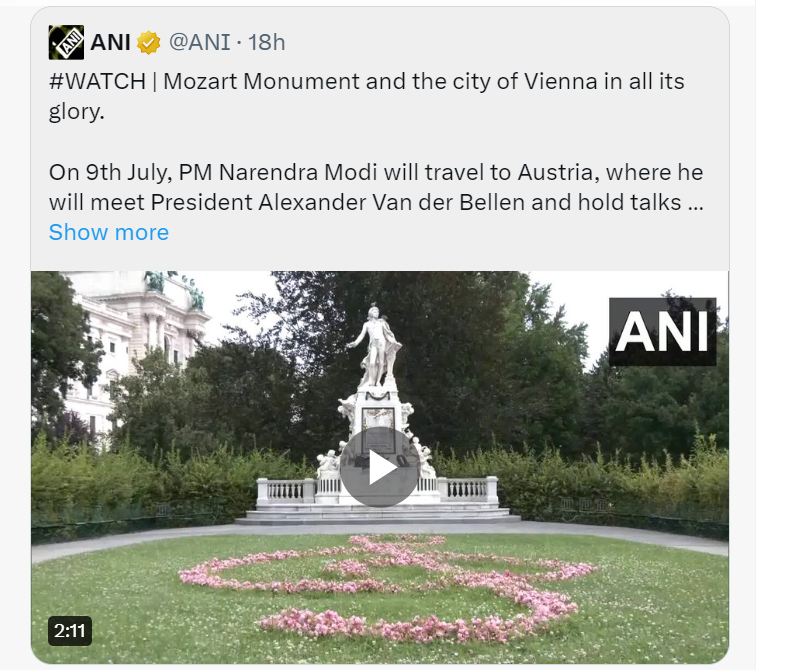
    ANI amused me the most in this “who loves Modi more” game. It put up a photo of a statue of the Mozart monument in Austria as a highlight of Modi’s impending visit to that country. How do you think ANI and other such lapdog outlets will now contrive to prove Modi’s lifelong connection to Mozart?


    Ranjona Banerji is a senior journalist and commentator. She writes on MxMIndia on Tuesdays and Fridays. Her views here are personal.