Corian Design has mandated Mirium India to manage its digital and social media platforms and focus on analysing the buying and consideration journey of core intermediaries and developed a content strategy that targets them using social, digital, and mobile technologies.
Said Abhishek Goyal, Market Development Leader – Asia Pacific, Corian Design: “Digital Marketing is the new-age way of communicating with the target customers to connect well with them as a brand owner. In addition to reaching out to a wider set of target audience, digital marketing provides loads of data which can help the companies optimize their campaigns and deliver better ROI. While looking for a digital marketing partner we evaluated various agencies and found Mirum most suitable, both from the perspectives of domain knowledge as well as the flexibility to try out different approaches. We look forward to working together with Mirum and deliver to the expectations of the business.”
Added Sanjay Mehta, Joint CEO, Mirum India: “As an agency, we are committed taking on new challenges and diversify our portfolio with well-known brands from across the globe. DuPont provides us with another great opportunity to showcase our expertise in the field of creativity, media, and content and we’re looking forward to some great work in the months to follow.”
Said Arvind Nair, Branch Head – North India, Mirum India: “Digital is constantly evolving in terms of both customer experience and direct sales, and we are working towards connecting DuPont with their customers in this evolving market. DuPont is an iconic brand and we’re really excited to be partnering with them take their digital first approach forward.”
Nowadays, it is becoming tough to be a man. And even Gillette is getting into the act.
I am into this simple brand-feature-benefit-transactional relationship with the multi-edged Gillette razor, when suddenly from every article on marketing communication and potential award list now has started questioning me.
Gillette Started The Battle Of Toxic Masculinity.
When on January 13, Gillette tried its toxic masculinity concept and was brave enough to accept that maybe it was wrong to project the kind of masculinity that they have a party to. And perhaps they have been inappropriate in their reflection and projection of not only men act against woman but the woman herself. (The toxic masculinity advertisement has some 700,000-plus dislikes on YouTube). How right!
The brand told you “We believe in the best in men: To say the right thing, to act the right way. Some already are in ways big and small. But some is not enough. Because the boys watching today will be the men of tomorrow” and I ask, who gave Gillette the right to contextualise and define what is wrong and what is right.
Surely, I have multiple sources to listen, read and follow then a razor brand sharing this purposeful new doctrine. Well, the brand, in a way, went on to almost stereotype all the men in one bucket.
All that from the fundamental insight ‘I am not the bad guy, but I don’t know how to be a great guy,’. Wow, is that advertising trying to be defining a cultural context. And which man does not know the difference between right and wrong, it’s as much as can’t and won’t.
You are free to hold another point of view. That’s Okay.
Is Gillette Advertising Really Purpose-Led.
I want a razor and not a lecture on morality.
Sincerely, I don’t like drifting aimless advertising.
I thought that was international. And then suddenly we have this Spain Gillette asking you Are you man Enough?
The definition of masculinity and what really is a man has been shifting. You can ask the razor brand that is finding it difficult to add more edges to its multi-edge blades.
https://youtu.be/sfL2vpJJ1uE
We have indeed been domesticated at home. We have been along with the daughters of the world lived through a generation of can’t, don’t and won’t. It was always more about how to behave, and that meant more of what not to do.
We have grown with the idolised definition of what a man is or should be. Across the country, there are various definitions of masculinity. Masculinity, revenge, honour, bravery, money, wishes and dreams were rolled into an undefined heterogeneous mix of directives. Add virility, beard and performance into that list, and that’s what we know.
Tear, fear and accepting defeat was never part of that definition. It’s still not, other than the time when on social media, one wants to be politically right. And now this silly hair-cutting tool manufacturing company believing research wants men in Spain to re-evaluate the stereotypes as it makes the real man feel uneasy.
The Complete Man Was Another Level Of Masculinity.
Raymond’s ‘The Complete Man’ has been trying to tell us what is the construct of a perfect, complete man. It is non-intrusive and has been working. It never shouted or disturbed you with the question, Are you man Enough? And I am still talking of the earlier ‘The Complete Man’ series that was subtle and moderate by any standards.
Men Will Be Men Is Another Polarised Masculinity.
It is okay. It is absolutely fine when we men laugh at ourselves. Look at the Imperial Blue ‘Men will be Men’ series. Don’t they teach you and remind you of obnoxious silly behaviour. They tell you in many ways what’s wrong or what’s right. And we men knowing what’s in it for us can take it easily. We don’t need this sharp blade razor manufacturing brand to overtly threatening tone to ask ‘Are you man enough?” or I will…
Gillette Disturbs Asking – Are You Man Enough?
Funny then for someone to ask “Are you man enough to admit you’re afraid?” And in the Spanish version, it begs the viewers if they are man enough to be a queen? I don’t think Gillette is thinking of asking such questions in India.
Every research points out that the new age consumers are looking for brands with a purpose. But this? Seems like someone searched for the purpose and then tried fitting in the brand.
I am not sure how easy or tough it was for the team at Proximity, Madrid, Spain to internalise this changing definition and shifting stereotypes before they made the client see their way.
Oh, it is different when the question gets mellowed down to a simple and more acceptable format. “Are you man enough to be you?” Now, you see, the communication is far too convoluted and complexly un-related with the brand.
It may be artistically exceptional and commercially well-produced. It may be superbly directed and well-executed. The truth remains that it is trying to be courageous in contextually correcting its earlier smooth shave gets you everything approach. It’s good that the brand is trying to GLOCALISE the concept, as there will be a razor-sharp difference from well-executed to downright polarised failure.
The brand wants you to relate it to another simple fact that “It takes a real man” to do things, to be himself and do things that may not be right but a must. And this it thinks will add and facilitate an inclusive freer world. Help identify the new modern idealistic stereotype of contemporary man. Follow that changing expectation Gillette have moved from its own admissible toxic masculinity of “The Best that a man can get” to “The best men can be”. Well, that for a change is definitely within the challenging new definition. Gillette seems to be man enough to express regret and change.
…………………..
Gillette May Not Affect Toxic Masculinity Or Help You Find the Answer- But It Will Win Awards
Why do I have a feeling that this long-term commitment to a right directional swipe by the brand is going to get a lot of awards: ‘The Best that a brand can get’.
Do not forget, in Spain under this programme is a small scale prototyped 20,000 students connect programme by sociologist and psychologists. Additionally, there is that judges polarise Gillette Interactive teen chats focussing on real masculine values. There the teens will debate, reflect and surely realise (for the brand’s benefit) that masculinity means a lot different. They will get rejuvenated and charged for breaking barriers that that stop them from being themselves.
Admit, Gillette Has Been Courageous In Their Act. Now They Need To Just Hold On To Their Belief. They may be saying it right and the way they want to say and shake up male thinking and stereotyping – but then I personally see a lot of gap between product-brand and the purpose. Hopefully I am not alone in it.
…………………………………………………….
DUREX STABS MEN.
Meanwhile, another Man’s friend in need- DUREX CONDOMS tried starting a conversation under # OrgasmInequality. It is talking about a woman faking orgasm to satisfy the male performance ego.
You’ve heard the numbers, you’ve heard the women and you’ve heard the men. Now it’s time we hear you! It’s time to talk #OrgasmInequality and Fake Orgasms. Ask a question, tell us your story or just be part of the conversation with #IFakedItToo. pic.twitter.com/cxeZRHkA0N
— Durex India (@DurexIndia) May 31, 2019
Something that every man knows but is afraid to speak about.
The best friend Durex did not trade sides but reminded Man that lovemaking is all about mutual intimate pleasure.
Horrible brand, it is asking women to share their fake orgasm story under #FakedItToo. Even if they open about these stories to the man they are intimate with, it can hurt many dudes psychologically to the level of dysfunction.
It is different that in our country, not many women will share such stories even if it is Swara Bhaskar and Pooja Bedi prompting them, but everyone would play their stories in mind. It did have an expected adverse playback from men. There was a lot of twitter debate about it. Yet, think the brand is still the winner.
Another brand making it tough to be a Man knowing that the females can really influence the choice. The brand knows that it is absolutely true in the case of condoms. A man will get what everything that gets him the action and boosts his ego. And anyway it is all about Durex Mutual Climax Condom- another pressure point..
This is confusing, as it is the case of “The best men can be” to “The Best that a man can get”. I just hope people get what is being said above. I hope the stance and comments are not taken at face value.
Isobar has elevated Shekhar Mhaskar to Chief Growth Officer. He was earlier Executive Vice President, a position he has held since 2018. He will continue to report into Isobar South Asia, Group MD, Shamsuddin Jasani.
On the appointment, Jasani said: “I am delighted with Shekhar’s elevation as Chief Growth Officer. He has played an important role in developing the vision and leadership needed to shape our business and brand strategy across our client, marketing, and technology functions. In addition to his responsibilities, he will also work with me, bringing alive our vision of being the Digital Transformation experts while keeping our amazing agency credentials growing.”
Commenting on the elevation, Mhaskar said: “In today’s age, when businesses are getting transformed and disrupted globally at the speed of light, Isobar has an industry-leading proposition to deliver experience-led business transformation for our clients in a truly agile way. I am excited to shoulder the new responsibility to drive complex & strategic digital transformation programs that ensure our clients thrive, and commercially succeed in the present-day experience economy.”
Dentsu Impact has won the communications mandate for Editorji, a personalised news app for snackable news content created by Vikram Chandra, until recent a senior editor with NDTV.
Amit Wadhwa
Commenting on the win, Amit Wadhwa, President, Dentsu Impact said: “Consumers at large are clearly spending more time with their phones today than TV. Therefore, it’s appropriate that video-based news broadcasting reorganizes itself to cater to the changing audience. I want to congratulate Vikram and the team at Editorji on developing such a unique AI-based platform, which will surely change the way news is consumed and give many the much-needed respite from watching news on TV. We couldn’t have been happier to partner them on this interesting journey.”
Biswajit Borkataky
Added Biswajit Borkataky, Head of Operations & Platform Relations, Editorji: “Watching video news on a mobile device can be a frustrating experience. The news clips are usually short, leaving the users to constantly search for clips that interest them. Editorji aims to improve this experience by creating a linear video stream from non-linear video clips curated to the users’ interest. Users can not only watch a curated news playlist but also curate their own and share. To take this experience to the consumers, we are excited to partner with team Dentsu Impact, who’ll help us power our growth trajectory.“
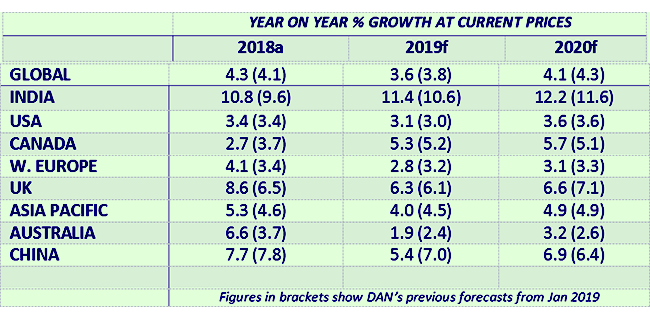
Dentsu Aegis Network’s latest advertising spend forecast, based on data from 59 markets, predicts global growth will reach +3.6% in 2019, following growth of 4.3% in 2018, taking total investment to US$609.9 billion. In Asia Pacific, there is a predicted +4.0% growth in 2019, following +5.3% in 2018, taking total investment to US$216 billion.
Geographically, Asia Pacific is the leading contributor to the global increase of US$20.9 billion in 2019 compared to the previous year, contributing 39% of the global increase, closely followed by North America 34%. Comparatively, Western Europe is forecast to contribute 14% to new ad dollars with Latin America at 11% and Central and Eastern Europe at 3%.
In Asia Pacific, forecasts have been revised downwards (-0.5%) from January following market softness at the beginning of the year particularly for TV, the lack of major events scheduled was also a contributory factor. China continues to be the leading contributor to Asia Pacific and global ad spend and will continue to grow in 2019 by +5.4% to reach RMB 671 billion, a surprisingly healthy and stable growth rate, which remains on track despite the headwinds from trade tensions with the U.S.
The global forecast reflects softening growth across 9 of the top 13 advertising markets worldwide, with India and Brazil bucking the trend with accelerating growth in 2019. Some markets saw downward revisions from January 2019 forecasts including Italy and Russia with both markets seeing GDP slow alongside ad spend.
Said Takaki Hibino, Executive Chairman, Dentsu Aegis Network Asia Pacific: “Asia Pacific has long been the melting pot of digital and technology developments. Though we have been facing a tougher economic environment, our ad spend forecast has shown that digital connectivity in APAC remains at its peak and consumer adoption rates have leapfrogged. Our business is built for the digital economy and we’re at the forefront of this growth, working alongside our clients to provide integrated solutions and build long-term sustainable growth for their brands.”
Key market trends
:: Australia:2019 is expected to grow by 1.9% to AUD$16.6 billion, which is a modest increase in overall spend from 2018. Majority of the growth is expected to come from Digital and Video channels. Digital continues to drive advertising revenue growth and is expected to increase by 6.8% in 2019 representing roughly half of total media spend (54%). Online Video is a key driver for Digital spend and is expected to increase by 28.4% in 2019. Video is the golden child of digital with strong momentum making up a large proportion of general display. This positive trend is backed by publishers as brands continue to seek premium environments in which to showcase their offerings.
:: China: thead market continues to be a leading contributor to global ad spend and will continue to grow in 2019 by +5.4% to reach RMB 671 billion but at a lower growth rate than the +7.0% growth forecast in the January 2019 report. Growth for the market in 2019 has been revised downwards due to higher than expected decline in TV spend at the start of the year. Digital is still the biggest driver of growth in total ad spend in China with the biggest share (63.6% in 2019) and growth rate. E-commerce is growing consistently and strongly, taking the biggest share within Digital. The decline of TV advertising (-6.8% in 2019) has affected the total market trend. Within TV, ad investments in CCTV and provincial satellite TV are still on an increasing trend, while ad investments in Provincial and Local TV channels have declined significantly.
:: India: forecast double-digit 2019 growth of 11.4%to reach INR 696.9 billion (up from the 10.6% forecast in January and 10.8% growth in 2018) with the Cricket World Cup putting growth on the front foot. Lok Sabha Elections are also set to increase spend in 2019. Digital media spend is forecast to grow by 32.7% in 2019 to account for INR 144.1 billion, making up 21% share of total spend. Infrastructure has propelled the growth in digital consumption. TV continues to be the leading media in 2019 and will contribute 39% share of total spend. Despite digital growth, TV continues to be dominant as it enjoys unmatched share of audiences. With 40% allocation of advertising spends, TV is forecast to expand in 2019 by 9.5% to reach INR 271.4 billion.
Global media trends
:: Digital continues to power ad spend growth and is forecast to grow 11.5% in 2019 to reach US$249.7 billion and 41.8% of global share. Growth is steady into 2020 putting digital’s share of ad spend at nearly 45% by the end of the year.
:: Mobile is the fastest growing platform within digital and is forecast to grow 21.4% in 2019. Powering this growth is the increasing consumption of video on mobile – from Instagram Stories, TikTok and Snapchat to YouTube and VOD – with online video in general set to grow 20.5% in 2019.
:: TV ad-spend is forecast to shrink slightly in 2019 (-0.1%) with a return to modest growth in 2020 of 0.6%. Into 2020 growth will be driven by more dynamic TV opportunities and innovation as the penetration of smart TVs continues.
:: The decline of traditional print has accelerated from our January 2019 forecasts (Newspapers -7.7% and Magazines -7.4%) as digital continues to dominate.
:: Out of Home sees continued growth and an upwards revision from January to 4.3% in 2019 to reach 6.3% share. Growth is driven by innovations in DOOH.
Figure 1: Growth in global advertising spend 2018-20f
Year on year % growth at current prices
2018a
2019f
2020f
GLOBAL
4.3 (4.1)
3.6 (3.8)
4.1 (4.3)
NORTH AMERICA
3.3 (3.4)
3.2 (3.1)
3.7 (3.6)
USA
3.4 (3.4)
3.1 (3.0)
3.6 (3.6)
CANADA
2.7 (3.7)
5.3 (5.2)
5.7 (5.1)
W. EUROPE
4.1 (3.4)
2.8 (3.2)
3.1 (3.3)
UK
8.6 (6.5)
6.3 (6.1)
6.6 (7.1)
GERMANY
0.2 (1.0)
0.4 (0.5)
0.5 (0.5)
FRANCE
5.3 (3.6)
3.6 (3.1)
3.0 (2.5)
ITALY
2.0 (1.6)
-1.6 (0.8)
0.6 (1.6)
SPAIN
2.1 (1.8)
0.5 (1.2)
0.4 (0.8)
C&EE
8.6 (8.6)
4.9 (5.8)
5.6 (6.2)
RUSSIA
12.3 (12.0)
4.5 (6.9)
5.8 (6.7)
ASIA PACIFIC
5.3 (4.6)
4.0 (4.5)
4.9 (4.9)
AUSTRALIA
6.6 (3.7)
1.9 (2.4)
3.2 (2.6)
CHINA
7.7 (7.8)
5.4 (7.0)
6.9 (6.4)
INDIA
10.8 (9.6)
11.4 (10.6)
12.2 (11.6)
JAPAN
2.2 (0.2)
1.2 (0.6)
1.8 (2.4)
LATIN AMERICA
7.9 (9.9)
9.1 (7.9)
6.1 (8.6)
BRAZIL
7.1 (7.1)
8.8 (3.6)
4.5 (6.2)
Figures in brackets show our previous forecasts from Jan 2019
Figure 2: Share of global ad spend by media, 2018-20 (% y-o-y)
2018a
2019f
2020f
Television
34.9 (35.4)
33.6 (34.1)
32.4 (33.2)
Newspapers
8.0 (8.0)
7.1 (7.1)
6.3 (6.3)
Magazines
5.0 (5.0)
4.5 (4.5)
4.0 (4.1)
Radio
6.2 (6.2)
6.1 (6.0)
5.9 (5.8)
Cinema
0.6 (0.6)
0.6 (0.6)
0.6 (0.6)
OOH
6.3 (6.3)
6.3 (6.3)
6.3 (6.2)
Digital
39.0 (38.5)
41.8 (41.4)
44.5 (43.8)
Figures in brackets show our previous forecasts from Jan 2019
This cricket season, Thomas Cook wants fans to travel from wherever they are to watch the World Cup with their first cricket buddy, their father. The digital video campaign, #CricketDateWithDad leverages a significant trend close on the heels of Fathers’ Day (June 16, 2019) and in sync with the ongoing ICC Cricket World Cup.
The campaign has been conceptualized and created by Law & Kenneth Saatchi & Saatchi and includes a TVC, which is live on social media and digital mediums.
Speaking about the campaign, Abraham Alapatt, President, Group Head – Marketing, Service Quality & Innovation, Thomas Cook said: “The new wave of father-child bonding trips is a significant opportunity for our brand. Through our campaign #CricketDateWithDad, we aim to focus on the sentiment shared by father and child, and induce in our customers the need to take time out from their schedules and spend some exclusive time with their first hero – their dad. With cricket being India’s passion and Fathers’ Day coinciding with the ICC Cricket World Cup, we’ve combined the two to present it as a compelling proposition to our customers.”
Speaking about the film, Debarjyo Nandi, Senior Vice President, L&K Saatchi & Saatchi added: “We don’t realise until it’s too late that these moments with our dads will never come back. We don’t realise that while we have now moved on to watching matches with our friends, he’s still at home, probably watching it alone. We don’t realize that watching a World Cup in the stadium is probably on their bucket list too, which we should prioritise over ours…else regret not realising this dream for the rest of our lives! ”
iProspect India has roped in Abhishek Balsara and Vineet Sawant as AVP – Analytics and Director of Technology, respectively. Based out of Mumbai, both Balsara and Sawant will report to Karan Jaitapkar, EVP – Technology, to strengthen the agency’s martech division.
Commenting on the agency’s latest appointments, Rubeena Singh, CEO, iProspect said: “At iProspect, we believe in delivering data-driven integrated marketing solutions to our clients. And with Abhishek and Vineet joining the martech team, I believe we are now a force to reckon with. Both bring with them a rich experience in digital technology and will play an integral part in our next phase of growth.”
Godrej Interio has awarded its creative mandate to Contract Advertising. The business will be handled by the agency’s Mumbai office, which won the account over a multi-agency pitch.
Said Anil Mathur, COO, Godrej Interio: “We were looking for a partner who believed in the power of the brand Interio and had the vision of making it a buzzing brand in the shortest possible time. Team Contract has taken up this challenge.”
Commenting on the win, Contract CEO Raji Ramaswamy added: “Godrej Interio is one of the legacy interior brands in the country and to partner it in the next stage of growth is a great opportunity and honour for us”.
Said Sagar Mahabaleshwarkar, Chief Creative Officer, Contract: “I am really excited and looking forward to working in this brand. Winning this strengthens our belief that clients have started recognising and appreciating our new approach towards creative work, which is built on design and digital thinking.”
Healthcare company USV Private Limited has appointed Lowe Lintas as creative agency for its consumer business including SebaMed range of products. SebaMed is a premium skincare brand from Germany, best known for its pH5.5 products.
Lowe Lintas won this business following a multi-agency pitch. The agency’s key mandate will be to launch SebaMed’s range of Baby and adult care products across both traditional and digital channels.
Said Shashi Ranjan, Head – Consumer Products, USV: “We strive to provide an assurance to every mother that Sebamed range of products are superior in quality and are clinically proven to provide the best protection for babies right from Day 1. We see immense potential in this category to disrupt the market and hence we needed a partner who can do complete justice to our aspirations. Lowe Lintas had an intuitive understanding of what we’re trying to achieve and came up with a strategic approach which we resonated with and we are really looking forward to a great partnership.”
Commenting on the win, Anaheeta Goenka – President, Lowe Lintas, added: “SebaMed is a great brand to work on, and we are really excited with the mandate! Lowe Lintas is known for creating challenger brands and disrupting the marketplace…and we look forward to the David vs Goliath fight in a category which is synonymous with a single player.”
SOTC Travel has appointed Dvio Digital as its creative agency for offline, digital and social marketing. The account was won following a multi-agency pitch.
Speaking on this association, Sowmya Iyer, Founder and CEO of DViO Digital said: “We are very bullish on this partnership. We have so much work and experience in the segment that I see this as our opportunity to build an unforgettable brand through innovative campaigns, partnerships and distribution. I am also looking forward to building some exclusive branded properties. You’ll hear more from us on this soon.”
Added Asif Riaz, AVP and Head Marketing, SOTC Travel: “A new age innovative holidaymaker, SOTC strives to inspire people to explore the world and ensure they create their best memories with us through co-created travel experiences. We are pleased to have DViO Digital on board as our creative partner and look forward to introducing a range of innovative and exciting holidays and services to the Indian Traveler.”
Strong work, weak industry. With the Cannes Lions International Festivity of Creativity under way this week, many of the world’s creative and media agencies will deservedly receive accolades. However, it will be difficult to not notice the contrast between the high quality of the work on display against the weak business conditions of the industry which produced it. We previously explored some of the reasons behind those conditions and some alternative ways to analyse them in a note which can be found here: https://www.groupm.com/news/agencies-basis-optimism
A key topic we did not explicitly review in that previous assessment, but which overlaps with the factors we described (and which serves as a basis for negativity among those with bearish views on the industry), is the insourcing of work commonly provided by agencies to marketers.
In-housing was once the default option for all marketing-related activities before agencies came along. At least as far back as the mid-19th century, marketers could contemplate whether or not some of the labour required to produce the work they required should be performed by their own employees or by external specialists. By the late 20th century, most creative and media activity from large brands was outsourced to agencies. However, marketers still continued to perform many functions in-house. In many industries, without formally declaring the formation of an inhouse agency, large marketers commonly oversaw the development of creative assets as well as some media buying, especially in print). Media owners often served as partners in these processes, and agency involvement could be minimal.
Biddable media, access to data and changing needs encouraged some marketers to revisit insourcing in the past decade. In more recent years, several factors caused many marketers to revisit what they insource vs. what they outsource. Those factors include:
:: The rise of search and self-service buying platforms in general
:: The anticipated emergence of other forms of biddable media
:: Access to sensitive customer data that could be used in trading integrated with other non-media functions and
:: The increasing need for tighter time frames in accomplishing tasks.
While costs or fee concerns (or sometimes, relatedly, fee transparency) might have been cited by some marketers as they considered revisiting in-housing, those who ultimately followed through typically did so because they believed the choice presented strategic advantages. Some who have explored in-housing ultimately chose not to do so, while some who have in-housed have reversed their choices.
Others have found hybrid models to be a preferred approach and now work with agencies differently than they did in the past. Some who have followed this path have taken ownership of more of their contracts, used creative agency production decoupling services or engaged with their media agency’s programmatic consulting services to complement in-housed efforts.
Knowing how much money has flown in-house is difficult (if not impossible) to assess. Knowing the advantages agencies offer is much clearer. Attempting to quantify the scale of any shift towards insourcing is tricky at an industry level, largely because marketers never publicly disclose spending on the agency-like activities they perform in the first place. Further, companies merge, demerge, grow and decline over time, making it particularly difficult to make reasonable historical estimates. It’s safer to recognize that there always has been a significant amount of work performed in-house and there likely always will be.
By contrast, the reasons why marketers benefit from using agencies are much clearer. At the risk of appearing promotional – although what is the advertising industry about if not that? – it is always worthwhile to be mindful of the advantages that agencies provide to marketers when marketers choose to outsource:
:: Lower fees on a like-for-like basis for most inputs vs. what the marketer can realize on its own, such as technology licenses or non-biddable media
:: Application of learnings and best practices, many of which can lead to meaningful cost savings vs. not applying them. For example, a media agency will typically have superior knowledge on aspects of campaigns (such the optimal length of a campaign flight on a given medium for a given type of advertiser) which can lead to lower overall costs even where like-for-like media inventory costs are identical
:: Better access to talent, both because of the breadth of the experience talent can receive and the career paths those individuals are more likely able to pursue
:: Development of proprietary products for use by multiple clients who can then take advantage of an agency’s scale
:: More institutional experience working with tools, such as data analytics products
:: Application of insights from across any one media channel to any other channel (for example, assessing the impact of a TV campaign on search effectiveness and vice versa)
:: Prioritization from partners (such as media owners and technology vendors) both because of scale but also because of presence of greater numbers of staff with relevant technical expertise
:: Better visibility on the critical issues facing the industry and thus a louder potential voice on topics that vendors and marketers should focus on. This can help inform the product roadmaps for media owners to better meet client needs.
The development and execution of world-class ideas will not necessarily be a growth business in any one year. As well, the work performed by agencies needs to be put into context of other priorities that marketers have, which could include driving short-term costs down or tightening the integration of agency-like-work into core operations in order to better achieve business goals which go well beyond what agencies might be able to help with. Consequently, it’s not a given that every marketer will always want to work with agencies in the future. But for those who do, it’s reasonable to assume that they will benefit from the generally superior capabilities that they will durably possess.
Published on GroupM website at: https://www.groupm.com/news/agencies-and-now-commercial-break
To coincide with the start of Cannes Lions International Festival of Creativity, marketing intelligence and research firm WARC has released ‘Anatomy of Effectiveness’, a white paper for brand marketers and advertising agencies alike, highlighting five key priorities for brands seeking greater impact.
The report has been created by distilling evidenced best thinking, expert opinion and real case studies, all combined with 30 years of WARC’s experience on helping the industry advertise effectively.
Says Paul Coxhill, Managing Director, WARC: “Poor marketing wastes money, time, attention and resource. All of which we can ill-afford in this fast-moving, resource constrained world. With ‘Anatomy of Effectiveness’ we provide five lessons to help combat this and make marketing more effective.”
Data suggests that advertising, in its current forms, is not driving the growth it should be. Advertising spend is not having the intended impact, and, at its worst, it is alienating the people it is supposed to be engaging:
:: A study by the Advertising Research Foundation found that 69 per cent of all US TV commercials receive no visual attention (putting up to $40 billion of investment at risk in the US alone); 27 per cent air in an empty room.
:: A focus on short-termism has halved the business impact of creativity, according to researcher Peter Field.
:: Only 12 per cent of supposedly ‘viewable’ ads are actually noticed by consumers, according to Lumen Research
:: Nielsen reported that only 53 per cent of the impressions served in the UK reached their intended target.
:: More than 600 million devices now have ad blocking, in what US journalist Doc Searls called the biggest boycott in history.
Says David Tiltman, VP Content, WARC: “Against this background, we wanted to pull together the best thinking from around the world on effectiveness. This white paper examines what the current range of evidence shows, and where it is being challenged by a fast-changing industry.”
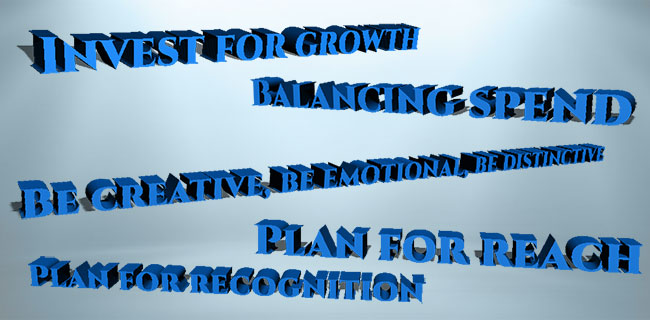
WARC’s ‘Anatomy of Effectiveness’ highlights the following five priorities for brands who want to improve the impact of their advertising:
:: Invest for growth: Covers the wide range of factors that marketers need to consider when drawing up budgets, setting objectives and working out what they want a campaign to deliver.
:: Balancing spend: Sets out the frameworks for investment between brand-building and performance marketing.
:: Be creative, be emotional, be distinctive: Analyses the arguments for investing in creativity – including the power of emotional communications and the importance of distinctiveness.
:: Plan for reach: Discusses the factors to be considered when planning media spend.
:: Plan for recognition: Focuses on the need for strong brand assets in an era of short-form ads to ensure consumers know whose ads they are seeing.
Adds Tiltman: “While it sounds simplistic, none of these concepts is easy to apply. Every element involves trade-offs and hard decisions on where to invest. And, of course, insights and creative thinking are required to bring it all to life – that’s what makes marketing such a dynamic industry. The five priorities are not a linear process. We increasingly live in a world where media selection and creative development go hand in hand, where creativity can be at the heart of business strategy, and where real-time feedback can allow strategies to evolve during the campaign. We hope this report promotes the evidence that exists to help advertisers – and ultimately their consumers.”
For each of the five key priorities on how to advertise more effectively, the white paper includes evidence, what’s changing, common mistakes, examples, and expert commentary from industry experts including Paul Dyson, founder of Data2Decisions; Les Binet, Head of Effectiveness at Adam&Eve DDB; Peter Field, Marketing Consultant;, Faris Yakob, Co-founder of Genius Steals; and Jenni Romaniuk, International Director of the Ehrenberg-Bass Institute.

 By Sanjeev Kotnala