By Ashoke Agarrwal
 The election season is upon us. Soon, the taxpayer-funded DAVP-type campaigns touting governmental achievements will stop, forced by election regulations. And political parties will need to dig into their coffers and launch advertising campaigns.
Over the decades, I have been part of the agency teams pitching for such campaigns. Personally memorable was when, in 2009, as a freelance account planner, I was part of two mainstream agency teams, one pitching for the BJP campaign and the other for the Congress campaign. Both campaigns were won by small shops with insider connections.
The 2004 BJP campaign, ‘India Shining’, was crafted by a mainstream agency, and the result probably put off both major parties from appointing mainstream agencies in 2009.
In 2019, the BJP overcame the reluctance and had ad stalwarts from not one but two agencies crafting its campaign. The result was the ‘Acche Din Aaane Waale Hain’ and ‘Abki Baar Modi Sarkar’ campaign. The campaign was one of the many factors that drove the election results. The campaign linked a specific promise based on a critical consumer insight – disgust with alleged big-ticket corruption scandals and a slide in the growth rate – to a particular personality. After Indira Gandhi’s campaigns in the late seventies, this was the first time in India that a Lok Sabha election took on the hue of a Presidential election.
In 2019, the usual wheels-within-wheels decision-making matrix of a party in power did result in a somewhat diluted strategy with the campaign theme ‘Modi Hai To Mumkin Hai’. The presidential tone of the campaign continued, but a deep hook into the existing consumer psyche was missing. 2019 was won, and with a higher margin, because of a general level of satisfaction with the performance of the government and then nationalistic fervour triggered by an external event.
Anecdotal evidence suggests that the 2019 BJP ad campaign did not have as big a hand in the BJP’s victory as the 2014 campaign.
The Congress ad campaign themes in 2014 and 2019 were ‘Har Haath Shakti. Har Haath Tarakki’ and ‘Ab Hoga Nyay’, respectively.
The 2014 campaign was focused on the UPA’s achievements in the past decade and fell flat in being clouded by big-ticket corruption scandals like the Commonwealth Games and 2G. The 2019 ‘Ab Hoga Nyay’ was based on the promise of a significant freebie and might have worked better than it did (for example, the 2023 Karnataka campaign) if the leadership, such as it was, dug into a ‘Chowkidar Chor Hai’-themed Rafale scandal-based campaign, in an unsuccessful effort to avenge 2014 and turn the tables on the BJP.
More importantly, in 2014, the BJP turned the Lok Sabha campaign into a presidential one, with the electorate being asked to choose one person for the PM’s post, and it continued to do so in 2019. Congress, by contrast, continued to fight a Parliamentary election with no projected PM face.
So what is in store for 2024? The BJP seemed to have already zeroed in on a campaign theme – some variation on ‘Modi ki Guarantee’. At this stage, the strategic underpinnings of this theme are unclear.
The theme could be a response to the freebies-driven Congress campaign in Karnataka and Telangana, with the implication that promises made by Modi are more potent, a reactionary stance that cedes space to the opposition.
On the other hand, if it is a guarantee of a large mission – of translating a vision of India into reality – then the ‘Modi ki Guarnatee’ theme is incomplete and needs to be completed by a vision of India that meets the aspirations of the electorate.
India is the world’s largest and most diverse democracy, and the aspirational vision of its people’s varied aspirations constitute the idea of India. Is it time for Modi to have a co-star – the people of India? A campaign that projects individual Indians from many walks of life along with Modi. A campaign that pithily translated the many dimensions of the ideas of India that its people have. A campaign with the theme – ‘Aapka Sapna. Modi ki Guarantee’ gives the campaign a forward-looking stance that appeals to the young and increases Modi’s already high relatability.
What about the opposition INDIA alliance? Sharad Pawar’s contention that they can choose the PM face after winning the election is a textbook example of wanting to put the cart before the horse. In the electorate’s minds, the 2024 election is about choosing a PM, and there will be no contest without the “INDIA” alliance going with a consensus PM before the electorate. Is Mallikarjun Kharge the man? Maybe. However, it is essential to have a clear consensus and projection.
With a projected PM candidate, the INDIA campaign must launch a key promise based on a clear insight into the electorate. Can the promise be a list of freebies? Freebies, as a promise, can be quickly replicated and even outdone. The BJP learned this lesson, which is evident in Chhattisgarh, MP, and Rajasthan. Instead, the INDIA alliance needs to project an Idea of India that runs counter to the BJP’s and still has as much relevance to the people of India. Aspirations are multi-dimensional, and some of the dimensions run counter to others. For example, in the individual realm, an ambition to be rich contradicts the aim to do selfless work for the community.
The BJP’s idea of India is a muscular India with economic and hard power. It has chosen GDP growth as the leitmotif of this idea of India.
Could the INDIA alliance choose an alternative leitmotif – say Gross Domestic Happiness (GDH) – that defines India and grows its soft power worldwide? The idea of GDH is just illustrative, and formulating an idea that will work will require deep research and high expertise. The kind of work that I am paid to do not just write about.
Translating an idea into a political campaign could be creative work of the highest order. Usually, creativity is lost in the battle of egos, the size of mugshots and the listing of iffy achievements and shady promises. Once in a while, a piece of work crosses these hurdles and hits the bullseye.
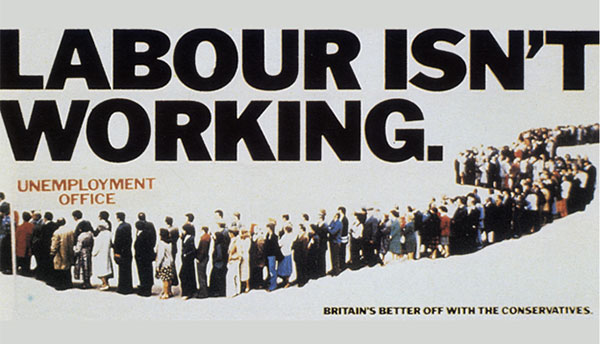
An example is the 1979 campaign poster by Saatchi and Saatchi for the Conservatives in a Britain troubled by strikes.