Author: mxmadmin

  • GSK launches campaign to raise awareness about vaccinations

    By Our Staff


    GlaxoSmithKline Pharmaceuticals Limited (GSK) has launched a multi-channel campaign to raise awareness about vaccinations that provide critical protection to children who are one to two years of age.


    Said Dr Rashmi Hegde, Executive Vice President – Medical Affairs, GlaxoSmithKline Pharmaceuticals, India: “In the past three years, there have been outbreaks of certain vaccine-preventable diseases such as chickenpox, measles, and flu in the country. Vaccine-preventable diseases not only disrupt children’s health for a short time, but they have a long-term effect on their developmental milestones. Completing the full immunisation schedule holds the promise of a healthy and happy childhood, which further ensures that children grow into healthy adults. Through this campaign, we want to communicate to parents the need to give their children the recommended vaccinations even in the 2nd year of their life.”


  • Wieden+Kennedy collaborates with Hero Cycles

    By Our Staff


    Hero Cycles has collaborated with Wieden+Kennedy to bring a “fresh, contemporary perspective” to the entire brand portfolio of the company.


    Said Ayesha Ghosh, President, Wieden+Kennedy India: “When a storied brand like Hero Cycles is revitalised with the energy that Aditya Munjal and his team have brought in with their ambitious plans, it can only mean that the future looks rosy for the brand. Wieden+Kennedy has been known to infuse the spirit of the times into legacy brands. That’s our single point agenda on this one.”


    Added Aditya Munjal, CEO, Hero Cycles: “As we embark on a journey to transform not just ourselves but also how consumers see cycling in India, it is imperative to have an equally committed partner onboard. With Wieden+Kennedy’s unique approach and experience, I believe Hero Cycles will bring about an impactful change in its interactions with consumers, and we are very excited to start this ride with them.”


  • ZMCL launches Al-Driven Pinewz Hyperlocal News app

    By Our Staff


    Zee Media Corporation Limited, (ZMCL) has launched an Al-driven PINEWZ Hyperlocal News app.


    Notes a commuique: “It provides professional journalists with a platform to create online profiles and share impactful stories and videos, connecting directly with a local audience.”


    Notes an unnamed Zee Media Corporation Limited spokesperson: “At PINEWZ, we seamlessly integrate cutting-edge AI with the art of human storytelling to craft a unique experience. Beyond being a mere app, we stand as your community’s storytellers, where diverse voices—ranging from everyday individuals to seasoned journalists. Picture a space where these local perspectives intertwine, offering a personalized narrative curated as per the users’ PIN code. We’re not just transforming how news is delivered, but look forward to elevating it into an art form. Join us on this journey, and together, let’s capture the authentic essence of your community as it unfolds in real time.”


  • Tata Power’s ‘Globey’ seen at Tata Mumbai Marathon 2024

    By Our Staff


    At the Tata Mumbai Maratho 2024, Tata Power’s Sustainability Champion Globey was seen cheering on the runners and praising them for their perseverance, will power and resilience by participating in the marathon. Starting in the early hours of January 21.


    Notes a communique: “Globey is Tata Power’s messenger telling one and all to “Embrace Mother Earth. Love Our Planet. Switch to Green and Clean Energy.” #’DuniyaApneHawale’. Tata Power’s enduring dedication to sustainability aims to transform Mumbai into a greener and smarter city through a series of thoughtful initiatives and strategic partnerships. With an unwavering focus on quality, safety, customer satisfaction, and ethical business practices, Tata Power continues to be a trusted name in powering Mumbai for over a century.”


  • Ram Mandir Consecration: Opportunities drowned in Moment Marketing?


    With apologies to none at all

    By Vikas Mehta


    Vikas MehtaJanuary 22, 2024, I guess, will become a watershed day in the Indian history. It was a culmination of a well-orchestrated movement led by the state and I think it may become a celebrated case study in marketing too. But my article today is not about the temple consecration or how it became a marketing case, lest I be accused of sacrilege, it is about how brands did or did not latch onto this moment marketing occasion. And as I live in Dehradun, close to the heartland of the temple movement, I shall look at it from this viewpoint.


    I take back my words. This was not a moment marketing case. It could have been an opportunity to take the whole occasion as an opportunity and drive maybe even a long-term marketing campaign for a brand. But, unfortunately, that’s not what happened. Brands and companies by sheer shortsightedness turned it into just moment marketing.


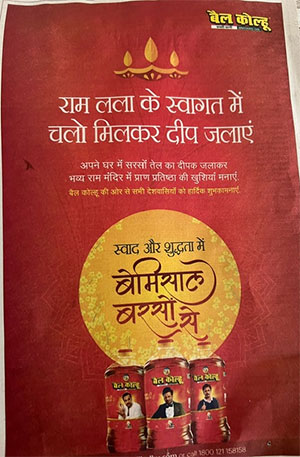
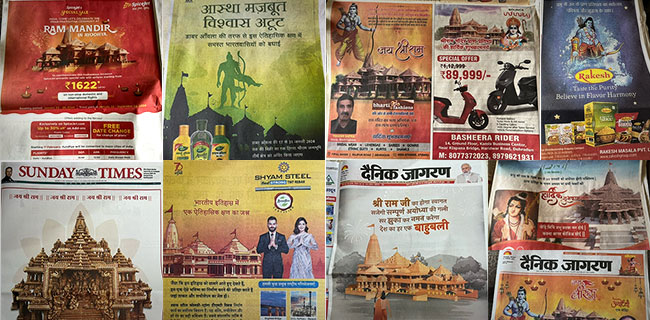
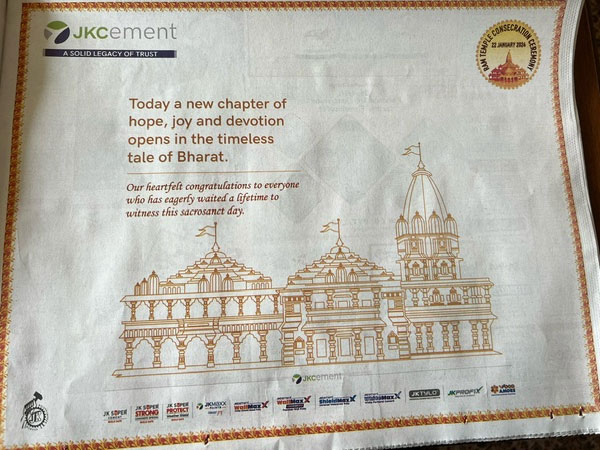
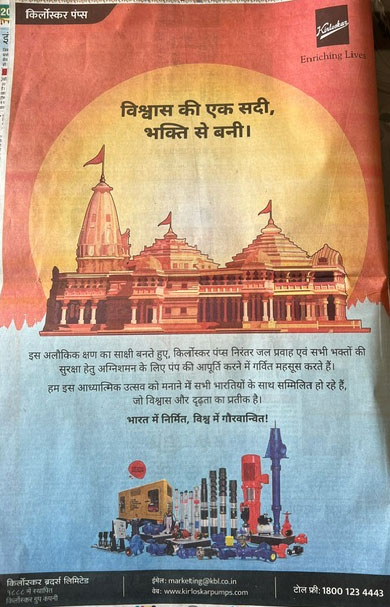
    Ok, I take back this also. As the first thing that I noticed was that very few national level brands did anything at all. There were some lame or limp attempts at moment marketing by the likes of Kirloskar, Dabur Amla, Dabur Gulabari, JK Cements, SpiceJet and Amul. These were the only national brands that were visible to me. Dabur Gulabari was the one brand which used some brand properties and kept it strictly related to the temple. SpiceJet used the occasion to give some discounts and freebies along with the schedule of Ayodhya flights. But the rest were just about cautious congratulatory messages. As I said limping moment marketing.
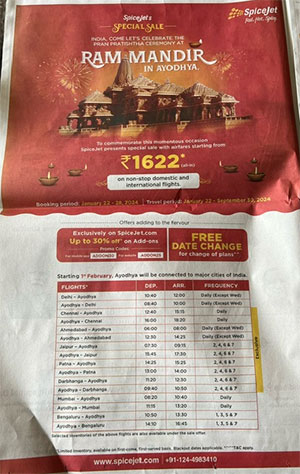
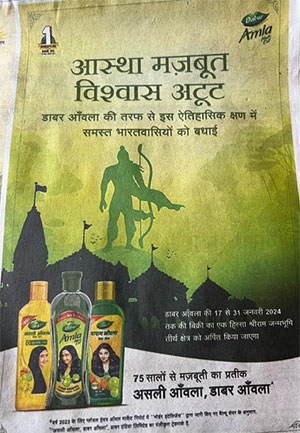
     

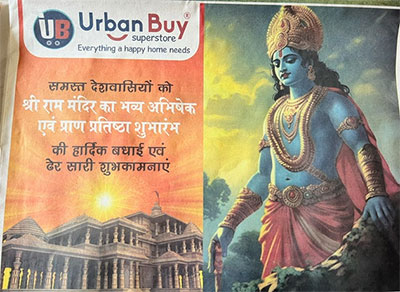
    It was local brands that ruled the roost. On the day, Dainik Jagran had two newspapers. One was a regular newspaper with some news in between a plethora of local ads. Sadly, even these were forgettable. But what was interesting was one the diversity of categories. From food masalas to construction companies to personal product companies to local fashion brands to local politicians to two-wheeler dealers to local cooking oils to local dairy and sweets brands to local jewellers to local event management companies to pan masala to resorts to medical centres and even local grocery stores. Some educational institutes, hearing aid centres, and local construction material retailers and brands added to the confusion. In my estimate, the news was maybe 45% and the ads took up rest of the space.

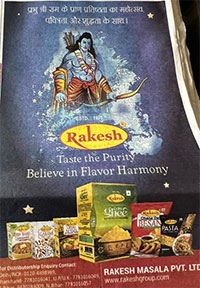
     

    The second newspaper was full of various articles on the temple. Historic angle, legal angle, the development in the city of Ayodhya… all of this was highlighted. And this was also full of ads as well, though maybe the ratio (of ads to editorial content) was more equal.


    A few weeks ago, a news portal had asked me to predict about what brands will do around the consecration ceremony. And my first instinctive reaction was that they will play it safe. Most brands will not do anything. Some will pay lip-service and a few who may have been involved with the construction of the temple may talk about their contribution. It looks I was correct in my initial thinking. Though I found it quite puzzling why brands which contributed to the building of the temple kept quiet. Initially I though JK Cement had contributed to the structure. But they did not mention it in their ad and I also read somewhere that no cement has been used in the construction. They too had just a congratulatory message.
     

    Why did most brands stay away? Because religion being a divisive subject, brands did not want to seen to be taking sides. And MNC, global brands are worried about repercussions in other markets too. That’s the main reason which explains the total absence of multinational or foreign brands. They did not want to alienate certain sections of the society and the world. Therefore, the few national brands that did advertise were Indian origin brands and some like Kirloskar did play up its Indianness. So, nationalism was the message. But that still does not explain the absence of many brands who have almost positioned themselves on nationalism. Kajaria Tiles, for example.
     

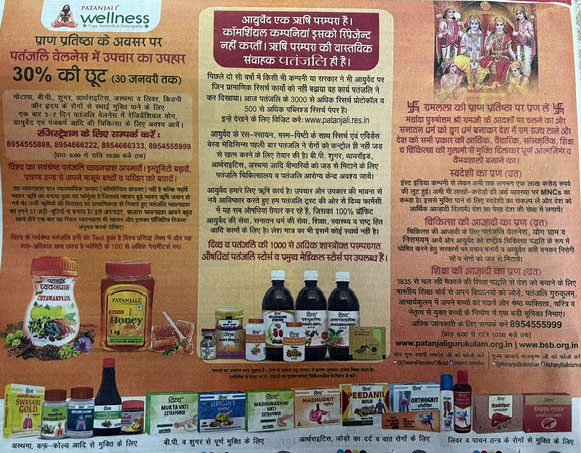
    Patanjali was the other brand which has for long played the nationalism card. Surprisingly, they were very low key. One press ad which looked like a 3-in-1 did appear. It spoke about an offer. About Ayurveda. And then some resolutions to take on this auspicious occasion. The last point was just about nationalism, whereas in my mind it could have been about some healthy resolutions combining the occasion and Ayurveda.
     

    The local brands had nothing to lose. Most of the brands who advertised, hardly advertise. So, this was a one-off which they could afford. Interestingly, the messages were quite brazen. Many of the ads had big mugshots of the owners. For once, some two-wheeler dealers found an opportunity to put their mugshots along with the product photo. Ditto for real estate developers, medical centre owners, dairy and sweet centre owners, construction material dealers. It was an opportunity to show themselves as Ram Bhakts. And I think that was the most important point for them. Announcing to the society and their circle of acquaintances about their religious and I suspect, even political beliefs.
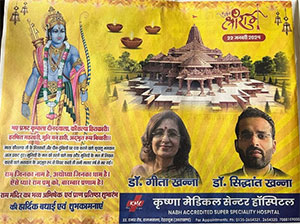
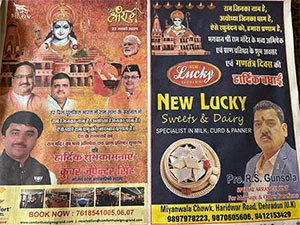
     

    There was a local brand for sanitary napkins and diapers, which also advertised. Would any national or MNC brand have the guts to associate an ostensibly (unfairly labelled) unclean product with Mandir?
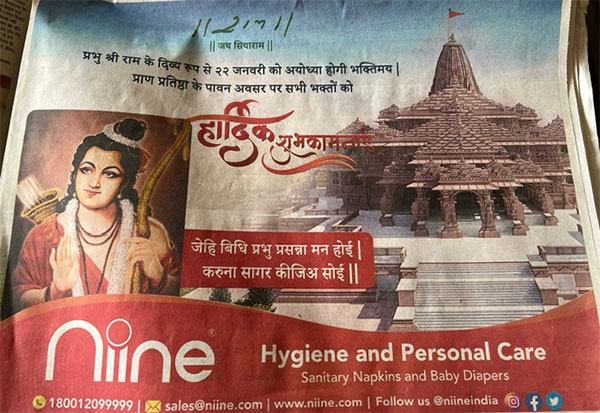
     

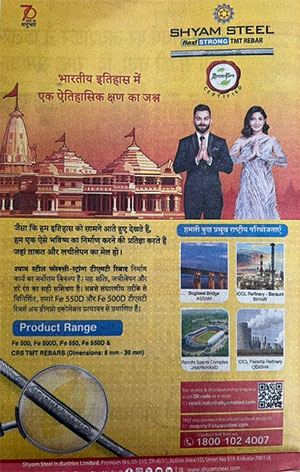
    Take Bahubali Pan Masala, and the brand is not about a surrogate. It openly says masala in the headline, very cleverly almost like a rhyme and has incorporated its brand name in it. Ayodhya ki galli and Bahubali. Shyam Steel has a prominent photo of Virat Kohli and Anushka with hands folded juxtaposed with a shot of the temple.

     

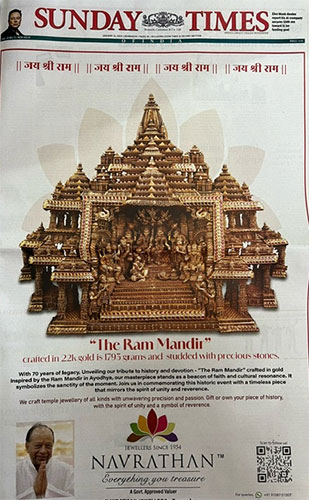
    And then there was one jeweller, based out of Bengaluru who had a full-page ad selling a model of Ram Mandir made in 22k gold weighing 1795 grams, studded with precious stones. The brand spoke about its 70 years of legacy and also had a mug shot of its owner with folded hands. Want more information and want to order? A QR code was provided. Religion, commerce and technology… a heady mix.
     

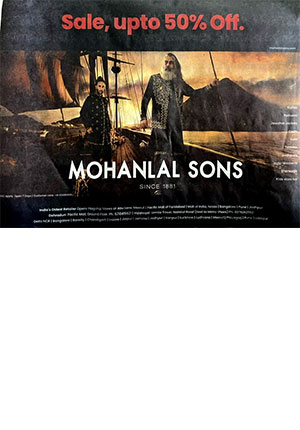
    In all this hullabaloo, there was another twist in the story. Republic Day was just four days later. And this is the time when durables, online stores, supermarkets etc have sale offers. And the advertising for the same starts a week before. Some of them tried gamely on Jan 22 too. But they were drowned out in the cacophony of the mandir ads. In fact, I don’t see many more brands or offers coming our way around Jan 26 as brands know that consumers have spent money for the Ram Mandir event. Every society, every mohallah, every market had some ceremony or an event or even bhandaras (free food). And it was all organised on the back of donations. People spent on bhagwa (saffron)-coloured clothes, flags, lights, diyas and crackers. Everyone contributed something somewhere. So, I guess Republic Day sales will be muted.

     

    Yes, I am being critical of brands. So, what more could they have done? For starters, they should not have looked at this as moment marketing. They should have seen this as maybe a property to associate with and organised activities around it. CSR? Offers and discounts to spur sales and not just to pay lip-service?  And do it according to the category and brand values. Patanjali could have set up shop at the railway stations, airports and bus stations and given wellness or Ayurveda products at good reduced rates while offering a loyalty programme. And rather than dress up the crew as Ramayan characters and earn derision, Indigo could have offered substantial discounts to all senior citizens travelling during a time period. Maybe tie up with some old age homes and offer few free seats per flights. Haldiram could have organised free bhandaras….


    The problem was that big national brands saw this as an aberration. A one-off. I think they have not realised that this day will be celebrated every year. Not just in a religious sense but also in a nationalistic and political sense. If the brands had looked at it through a long-term prism, they could have not only done more but also gained empathy and set the cash tills ringing. Let’s not forget that big brands including some MNC brands have thrived during Kumbh Melas. But this time they lost out on the big picture. The small brands did not see the big picture but they saw this as an opportunity to loosen the purse strings a bit and proudly proclaim their arrival.


    Frankly, moment marketing became the Achilles Heel for brands.


    Vikas Mehta is a Dehradun-based business strategist and educator. He writes on MxMIndia every other Monday, but sometimes on other days as well. His views here are personal.


     

  • PR Professionals wins mandate for GOI pension regulators

    By Our Staff


    PR Professionals, the flagship of the PRP Group, has won the communicators mandate including public relations and digital media of the prestigious Pension Fund Regulatory and Development Authority (PFRDA) of the Government of India.


    The press release quotes an unnamed spokesperson of the communication, media and PR department of PFRDA as saying: “We welcome PR Professionals onboard and look forward to a fruitful collaboration with them. We aim to leverage PRP’s expertise in PR and digital media to effectively engage stakeholders and drive awareness about the importance of financial security through the pension scheme.”


    Commenting on the win, Dr Sarvesh Tiwari, Founder & Managing Director, PR Professionals added: “We are enthusiastic about contributing our strategic insights and digital proficiency to amplify PFRDA’s objectives, facilitating eater outreach and engagement with stakeholders. This partnership signifies a significant step towards fortifying PFRDA’s communication strategies and advancing its mission of ensuring financial security through pension schemes for all citizens.”


  • Tgthr onboards Rahul Vengalil as CEO and Co-Founder

    By Our Staff


    Rahul Vengalil
    Rahul Vengalil

    Tgthr has onboarded Rahul Vengalil as CEO and Co-Founder to head the business and to integrate media services.


    As CEO at Tgthr, Vengalil will lead client relationships and business across the units. He will also take forward the agency’s promise of a full-funnel approach by integrating media services into the agency offerings, bringing to the forefront his decades of experience in handling media.


    Aalap Desai
    Aalap Desai

    Said Aalap Desai, CCO and Co-Founder Tgthr: “We don’t become a full-funnel agency by just calling ourselves ‘full-funnel’. We can only achieve it by having people who not just come with that expertise but command that expertise. Rahul is exactly that. Why he belongs at tgthr, more than anywhere else, is because he has the head to drive business and has the heart to care about people, too.”


    Added Vengalil: “Tgthr has already earned a reputation as a place where happiness meets creativity to produce extraordinary results, setting the foundation for an exciting journey into the future.  We aim to simplify the complexities of today’s diverse mediums and the ever-changing technology. My intent is to guide our clients through the dynamic advertising landscape and not just create compelling brand stories for them but also help distribute them. A rehaul of the old ways of advertising requires radical thinking, ingenuity, and passion, which can only be enabled in an ecosystem like Tgthr.”


  • Quaker launches TVC for instant oats

    By Our Staff


    Quaker has expanded its product line with the launch of instant oats. The new brand ambassadors, Kiara Advani and Sidharth Malhotra unveiled this addition to the Quaker line-up through a TVC campaign.


    Said Sravani Babu, Associate Director, and Category Lead – Quaker, PepsiCo India: “In our remarkable 146-year legacy of championing the nutritional excellence of oats worldwide, innovation has been our hallmark. The arrival of Instant Oats marks yet another stride in this journey, aligning with the evolving palettes and preferences of our valued customers. Teaming up with Sidharth and Kiara, we confidently aim to spotlight the myriad advantages of Quaker Instant Oats and further our vision of bringing oats to more people in more delicious ways.”


  • Hindustan Zinc unveils new campaign

    By Our Staff


    Hindustan Zinc, a subsidiary arm of Vedanta headquartered in Udaipur, has launched a new campaign called #ZincCity, which will act as a platform to celebrate Udaipur’s cultural spirit through Hindustan’s Zinc’s various initiatives focused on communities and the environment.


    Notes a communique: “Zinc City aims to bring people from all walks together across India and globally by curating and supporting a kaleidoscope of events. The company plans to organize events such as Music Festivals, Marathons, and Football Tournaments among others, positioning Udaipur as a prominent destination for celebrating India and its varied culture.”


  • Publicis WW bags Pramerica Life mandate

    By Our Staff


    Publicis Worldwide India has bagged the integrated creative mandate for Pramerica Life Insurance.

     

    Commenting on the partnership, Oindrila Roy, Managing Director at Publicis Worldwide India, said: “We are thrilled to be partnering Pramerica Life Insurance. It is a highly respected brand with a strong commitment to providing innovative and customer centric life insurance solutions. We are confident that our deep understanding of the category coupled with our creative expertise will help Pramerica exceed its business goals in India.”


    Added Amaresh Jena, Chief Marketing Officer at Pramerica Life Insurance: “This is my climb is not just a campaign; it’s a manifestation of our brand’s aspirations and goes beyond storytelling, embodying Pramerica Life Insurance’s core goals. Our objective is to imbue each life we touch with a profound sense of security and empowerment, echoing our vision. Aligned with our mission to be a trusted friend, guiding individuals to informed insurance choices, the campaign aims to provide support during life’s challenges and inspire enduring confidence.”


    Said Srijan Shukla and Pratheeb Ravi, ECDs at Publicis Worldwide India: “The campaign is conceptualised around a simple truth that there are challenges and struggles in everyone’s life. But it is these climbs and struggles beyond which lie real success. These climbs might seem very ordinary but are in fact tough on the individuals who actually face them. Pramerica Life wanted to be a partner in these extraordinary climbs of ordinary people. The films focus on the lives of ordinary people and celebrate the moment when they decide to take up the climb. We wanted to keep the stories honest and authentic so that the audience resonates with them.


  • OMG India gets Jigar Rambhia as its Sports Lead

    By Our Staff


    Omnicom Media Group (OMG) India has appointed Jigar Rambhia to lead its Sports Practice. He was until recently COO of Sporjo and in the past worked with Wavemaker, TME and Madison.


    Said Kartik Sharma, Group CEO of Omnicom Media Group India: “With immense first-hand experience navigating the complexities of the landscape, Jigar brings a unique perspective that aligns with our goals for innovation and advancement. With him leading the charge, we’re all geared up to deliver state-of-the-art solutions for our clients through avenues of the sporting world.”


    Speaking on his appointment, Jigar Rambhia, added: “It’s an exciting time to be in the midst of India’s transforming sports landscape. The ecosystem today is a vibrant playground offering bespoke avenues for brand engagement and enhanced fan experiences and holds great potential. I’m excited to navigate these tides, helping steer OMG India’s efforts towards valuable outcomes.”


  • As AI surges, tough times for news biz

    By Nic Newman

    News organisations are bracing for serious disruptions as a result of the increasing influence of artificial intelligence (AI) – both on the way that they work and the way their audiences consume news. As part of our latest journalism trends report, my colleagues and I at the Reuters Institute for the Study of Journalism found that less than half (47%) of 314 editors, CEOs and other digital leaders from more than 50 countries say they are confident about journalism’s prospects in 2024.

    The report details a tough period for the news industry over several years. A decline in online advertising, slowing growth in subscriber numbers and rapidly declining referrals from social media have fed into dramatic falls in revenue.

    Industry data shows that Facebook referrals alone fell by 48% in the past year, and many fear that search traffic will be next. Google and Microsoft, among other tech giants, are expected to roll out AI-driven, chat-based interfaces that have been trained on publisher content – mostly, or so the publisher of the New York Times alleges, without their permission.

    But it is not just internet search. We are also seeing a proliferation of conversational AI assistants built into computers, mobile phones and even cars that will change the way we discover and consume content of all types. Queries about the news are increasingly answered directly by the AI interface. Links to sources of the news on publisher websites, meanwhile, disappear into the background. As a result, far fewer audience eyeballs will find their way to each publisher’s site.

    Against that background, it is not surprising to find that some publishers such as AP and Axel Springer have already done deals with AI companies. The New York Times, meanwhile, is taking legal action over what it says was the unauthorised use of published work to train AI technologies.

    Many publishers hope that this time round, the outcome will benefit publishers of original and high-quality news and information. “There is an opportunity for the industry to work with AI players to design a symbiotic ecosystem and that’s an opportunity we must not squander,” says the chief operating officer of a leading UK news provider, who wishes to remain anonymous.

    Most publishers in our survey, however are not optimistic that this new phase of negotiations will work out well. More than one-third (35%) of respondents felt that only a few big media companies would benefit, while around half (48%) predicted that ultimately there would be little money available for any publisher.


    Publishers are not confident about funding from big AI companies

    Industry concerns are not just about money. More than two-thirds (70%) of respondents think that widespread availability of generative AI could reduce trust in the news. “The explosion of crap content definitely has the potential to shake the trust,” says Christoph Zimmer, chief product officer at German news company Der Spiegel.

    Zimmer highlights concerns about the use of deep fakes and other synthetic media, even as he hopes that the widespread availability of such second-rate content could also “allow [trusted] news media to differentiate ourselves more clearly”.

    Trying to adapt

    While the risks around business models, platforms and trust need to be managed, publishers know there are also significant opportunities to make their newsrooms more efficient. In our survey, we found the majority of publishers (56%) are focusing on back-end automation this year – using AI to help with copyediting, metadata creation and translation – with the next most common AI-related aim being identifying better ways to recommend content (37%).

    “The most compelling user case for AI in newsrooms is in the automation of routine tasks,” argues Ed Roussel, head of digital at The Times and Sunday Times. “We do not believe that AI is a substitute for reporting stories, which will continue to be done by journalists.”


    Which newsroom uses of AI will be most important in 2024?

    This focus on back-end automation is partly because news executives recognise the reputational risks in using AI for content. But that won’t stop others pushing ahead. Nordic publishers are routinely adding AI written summaries to their stories, while one German newspaper uses an AI robot to write 5% of its articles, albeit with human oversight.

    NewsGPT is the world’s first 24-hour TV news station created entirely by AI, and Channel1.ai, due to launch this year, promises a personalised news channel that can speak in any language.

    Rapid developments in AI are disrupting many industries, not just journalism, but news executives know they can’t just bury their heads in the sand. Rather than using AI to create volume, forward-thinking news organisations should be looking to build unique content and experiences that can’t be easily replicated by AI – think curating live news, deep analysis, and human experiences that build connection between audiences and the news provider.

    But they’ll also need to use AI technologies to make their businesses more efficient, as well as more relevant for audiences, in an era when many are turning away from the news.

    The impact of AI on the provision of online content in general is harder to predict. Much will depend on emerging public attitudes to the technology, but also on how responsibly the platforms that share this content behave. Equally important is the outcome of the legal cases around intellectual property, which could open up – or severely restrict – the way news content can be used for training AI models without proper compensation.

    We’re still at the early stages of the AI revolution but this is a year in which many of the rules and approaches are likely to be set. Against that background, journalists and news organisations need to proactively rethink their role and purpose with some urgency.The Conversation


    Nic Newman is Senior Research Associate, Reuters Institute for the Study of Journalism, University of Oxford. This article is republished from The Conversation under a Creative Commons license. Read the original article.