
Tag: Allen Solly

  • Size 35 please…


    By Avik Chattopadhyay

     

    Avik ChattopadhyayAirport lounges can be some of the best places for stimulating discussions and rude revelations. Given that one needs to reach two hours before a flight takes off and you end up having one hour spare, ghost-shopping [for lack of windows] helps you stay updated with what people are ‘into’.


    I was looking at belts. Why, my colleague asked? Because all the trousers I have are of waist size 36 while I actually need 35. And I don’t get it in the brand I choose to wear. “The others don’t have them too,” he quipped. “Brands do not offer odd sizes in apparel and ½ sizes in footwear to Indian customers.” “Really?!” “Yes.” “No, that can’t be! Look at the market size…” “So what? We are still third world.” That was the rude revelation moment!


    Then started my little research. What sizes of clothing and footwear are offered to us Indians? Was my brand an aberration? Let’s check the global ones. Levi’s would be a good starting point.
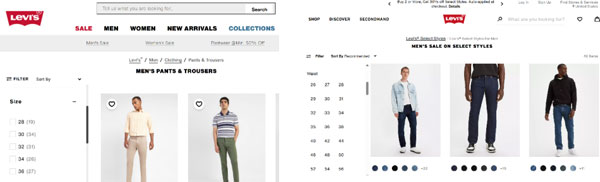
     

    Levi’s India online store and Levi’s US online store


    As I was pre-warned, Levi’s in India offers no odd sizes while they do so in the US. There are different ‘fits’ available, but no odd sizes. Why would they do such a thing? Indian waist sizes are as varied as the Americans. Market size? Well, the upper middle-class that can afford one jeans per year is around 20 million odd, which is close to 8% of the US population. So, what would make Levi’s take this decision, given that they have had Indian bosses for a long time?


    1. Sheer convenience of lesser SKUs? Doesn’t make sense as I can charge you a bit more for the exact size you want. And there are so many ‘fits’ on offer.


    2. Sheer apathy for the Indian customer as we generally accept whatever is handed out to us? This could be the reason as I have personally experienced the same when marketing automobiles. “The Indian customer does not know what he/ she wants, so let’s give what we have. Why re-engineer or tailor-make?”


    3. Sheer lack of activism by the brand-struck customer? And, therefore, being more forgiving towards the ‘phoren’ brands?


    4. The ‘Unnees-Bees’ Syndrome as I call it, of the customer accepting particular drawbacks while other requirements are met. So, I can live with the erring waist size on offer as long as they give me the choice of five fits to choose from.


    The Indian ones should be more sensitive then. Let’s check out what our homegrown brands offer us.
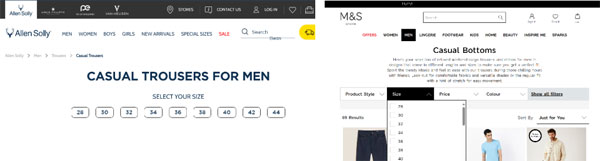
     

    Allen Solly online store and M&S India store


    Louis Philippe, Allen Solly, Indian Terrain… all the same. Only even sizes. While offering choice in fits – classic, regular, slim, super slim, skinny, jogger, carrot and what not. The same applies to shirts only in even sizes, with ‘39’ being the only odd size on offer with the choice of fits. No customisation in the form of collar size and sleeve size. Let the ‘natives’ learn to adjust!


    Talking of natives, M&S metes out the same treatment to their customers back home in Blighty. “Sorry, we destroyed your textile industry to set up Manchester, so as a mark of solidarity, we shall wear your sizes.”


    Does the same apply to footwear? Will my colleague be once again proven right?


    Let’s start with our homegrown favourite Bata.
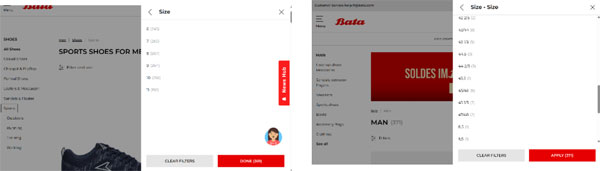
     

    Bata India online store and Bata France online store


    Now the thing with footwear is not about odd or even sizes, but the ½ sizes. An 8.5 or a 9.5 rather than compromising with a 9 or a 10 and swimming in the shoe for life. Bata India offers no ½ sizes while Bata France does. The same questions crop up in my mind. SKUs? Market size? Marketer apathy? Consumer adjustment?


    How do the global brands treat us? No different. Adidas and Skechers play the same game as Indian brands like Bata and Liberty. What a letdown. When I was close to losing all faith in humankind, the Nike India online store came up as the redeemer, offering not just the same product lines but also the same sizes as they do in the US and Europe. So, there is hope!
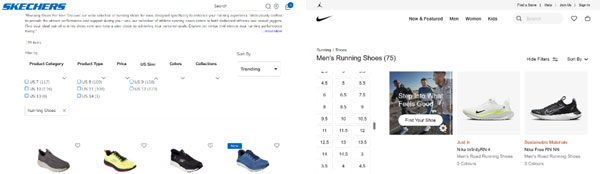
     

    Skechers India online store and Nike India online store


    What I am trying to put across to you is the rude fact that the Indian market, in spite of its size and potential, is still not treated at par with a China or Russia when it comes to most global brands. And it is not just to do with the sizes of apparel or footwear, it is also about the availability of their latest portfolio in the soon-to-be world’s third-largest economy. It is about the larger ‘mindset’ of the brand and the marketer in approaching and addressing the market. It is about the true respect that a brand has for the customer coming alive in its on-ground deployment of product and promise. Any amount of advertising, social media posts and press statements will not add up to the actual demonstration of respect.


    One may say that these are minor issues in the larger landscape of a country and market on the move, but thousands of these issues make up the attitude of an industry addressing the Indian consumer. In the apparel and footwear world, everyone seems to follow the same path while Nike is the exception. Imagine the potential word of mouth when someone is delighted to find his/ her perfect ½ size with one brand while being disappointed with the others. That keeps the cash counters humming. Respect the consumer and you will get it back in multiples. Otherwise you will remain a mere transaction and temporary fad. And, the 20-million strong market today will one day surely double in the next five to seven years.


    The fault does not lie only with the brand marketers and portfolio managers. We, the consumers are equally to blame for adjusting to compromises and not becoming vocal and visible activists for being given what we deserve. A social anthropologist will argue that this is exactly how we have been for eons, whether it be the pantaloon or the politician. So hang on, do I continue my search for a better belt?
     

  • Ogilvy films for Allen Solly

    By Our Staff


    Allen Solly has unveils a new range of denims for women in diverse sizes with a brand new campaign ‘Own Your Shape’. The campaign addresses the growing concerns- “one-size-fits-all”, as women struggle to find the perfect fit denim. With the launch of new campaign ‘Own your Shape’, the brand aims to provide stylish denims for every body type. As part of the campaign, Ogilvy has conceptualised a new film that features three girls of different body types, trying different styles, switching.


    Said Anil S. Kumar, COO, Allen Solly: “At Allen Solly, we care about the right fit for all body types. The need to move beyond ‘One Size Fit for all’ was common during our customer outreach. Fashion is not only about developing the perfect product but also the right fit for each body type and through this ‘Own Your Shape’ campaign, Allen Solly aims to accentuate that beauty comes in all shapes and sizes. He further added, “The brand strongly believe that this campaign will bring positivity among women and encourage the brand to make more such products.”


    Added Mahesh Gharat, CCO, Ogilvy South: “When women compliment other women on their sartorial choices, it conveys a subtle but beautiful appreciation of each other. This is exactly what the film captures between these three wonderful girls. The film captures their unique style and how they have found the right fit in the denim they wear. Through this film, we have depicted the essence of being comfortable in one’s skin and celebrating our body shape no matter what styles we opt for. After all, it’s only when you truly adore your body that the world looks brighter.”


  • Ogilvy & Allen Solly on wearing a mask

    By A Correspondent


    Allen Solly and Ogilvy have come up with a campaign on wearing masks.


    Said Anil S Kumar, COO, Allen Solly: “Driven by the need of the hour, wearing face masks has become a new normal. They are now an unavoidable necessity for the greater good. Our campaign aims to add a fresh and positive perspective to the concept of masks by connecting it to a human characteristic – Smile. With easing lockdowns, people have started venturing out and wearing a mask is the new norm. It becomes highly critical in such times to device messages carefully and creatively. Through our campaign, we are not just highlighting people’s duties & obligations but also empowering their trust in accepting masks as a way to express oneself just the way we do with our smiles. We strongly believe the campaign will add positivity and reinforce the importance of wearing masks to not only keep ourselves safe but put others around us at ease as well.”


    Addded Mahesh Gharat, CCO, Ogilvy South: “Masks are the essentials for the new world. But we don’t want people to feel they are a burden. Designed right, they can be cool, quirky and very very endearing. Our easy-breezy film encourages people to wear a mask with a smile.”


  • Allen Solly celebrates Children’s Day with an emotional twist

    By A Correspondent


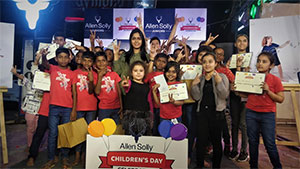
    Allen Solly brought out a creative way to make their junior stores a hub for colourful creativity on the occasion of Children’s Day. At the event, children were paired up with a group of talented kids from local NGOs like CRY, Sparsha Trust, Sarthak Foundation and SOS Children’s Village to participate in a drawing competition at the exclusive Allen Solly Junior store across cities to win exciting prizes.

     

    Commenting on the event, Anil. S. Kumar, COO, Allen Solly said: “Allen Solly Juniors is about fun and vibrancy. Children’s Day is all about celebration and we wanted to connect with the little ones on their special day. Story telling is every child’s favourite past time and hence we made that the core of the celebration. Kids coming together to have fun, doodling and colouring as a team made the event more special.”


  • Allen Solly endorses open work culture through its new campaign

    By A Correspondent


    Allen Solly has announced the launch of its ‘Open Work Culture’ campaign. The new campaign encapsulates the budding work culture that centres around employee-friendliness and freedom of self-expression.  The campaign has been produced by the brand’s creative agency Ogilvy & Mather.


    Commenting on the launch, Anil S Kumar, COO, Allen Solly said: “Allen Solly has always been in the forefront of redefining fashion at work through its unconventional workwear offering. This film is another big step in that direction wherein we bring alive our brand logo ‘The Stag’and through it we celebrate the ‘open work culture’ in today’s workplace”


    Said Mahesh, Chief Creative Officer, Ogilvy & Mather, Bangalore: “In the past, Allen Solly has redefined work wear. Carrying forward the same thought process, we cracked an idea that’ll resonate with the workplace of the future and that’s how #OpenWorkCulture was conceived. Now the challenge was to break the clutter and create a memorable and charming piece of communication. We had an existing property of the Allen Solly Stag. We found a sweet spot when in the new brand narrative, we managed to bring the Stag to life. That’s how the Allen Solly Stag commercial was conceived. Cinematic flair is what made the TVC sticky and unforgettable. And this was just the beginning of the campaign. There’s lots more to come.”


  • Allen Solly appoints Jack in the Box Worldwide as Digital AOR

    By A Correspondent


    Jack in the Box Worldwide, the digital agency brandof The 120 Media Collective, has bagged the digital duties for Allen Solly, making it the second mandate from the Aditya Birla Group after Louis Philippe.


    The mandate includes all digital duties including multi-platform content creation, content marketing, digital campaign creation, media planning and buying, social media, search engine optimization and analytics, search engine marketing, for Allen Solly and its associated sub-brands, Solly Jeans, Solly Sport and Allen Solly Junior.


    Commenting on this development, Sooraj Bhatt, Chief Executive Officer, Allen Solly, said, “Allen Solly’s excited to be partnering with Jack in the Box for our digital mandate after going through an ardent process of shortlisting the best agencies in the digital domain. We chose JITB for their superb editorial content creation abilities, creative supremacy and great credentials. We’re looking forward to doing some great work together and taking Allen Solly to greater heights”.


    Roopak Saluja, Founder & Chief Executive Officer, The 120 Media Collective, said, “There’s no greater validation of the value we add to a client’s business than to be awarded an additional mandate from the same company (we seem to be making a habit of it).  After three years of running all things digital for Louis Philippe, it’s a matter of great pride for Jack in the Box to be given responsibility for Allen Solly, thereby deepening our commitment to Madura Garments and the Aditya Birla Group.”


  • Allen Solly & Talenthouse announce roll-out of innovative contest

    By A Correspondent


    Talenthouse India, SEA’s largest creative crowdsourcing platform, in association with apparel brand Allen Solly has announced a unique filmmaking initiative to launch the brand’s new lightweight and stress-free shirt aptly titled Allen Solly Air. This contest invites aspiring filmmakers to create an impactful and innovative digital ad film for the launch this new offering in the market.


    Entries can be sent in by November 21, 2014 and one stands a chance to be associated with one of the most innovative apparel brands in the country. The ad film needs to highlight the products USP’s and be in sync with Allen Solly’s brand identity and promise. Winners will not only get a chance to showcase their talent and ensuring association with a leading brand like this but also stand an opportunity to win up-to INR 1,50,000. The first four runners-up and top voted will receive INR.10, 000 each.


    Announcing this collaboration with Talenthouse India, Monica Bansal, Digital Marketing Manager, Allen Solly said ‘’Allen Solly as a brand has been synonymous with innovative corporate dressing. We wanted to understand the insights that the young artists have of the brand and what better way than to partner with Talenthouse who has a large base of filmmakers on their platform. We are looking forward to receiving innovative concepts that would widen our imagination and creativity.’’


    Niloufer Dundh

    Commenting on the launch of the contest, Niloufer Dundh, Sales Head, Talenthouse India said, “We at Talenthouse continuously strive to partner with brands that add great value to our artists community. We are sure that our aspiring talent pool will lap up the chance of being associated with a renowned brand like this and showcase their talent to the world. We are optimistic of receiving some very interesting films that the brand would be able to adopt.”


  • Allen Solly’s end-of-season sale app generates 2,194% RoI

    By A Correspondent


    Allen Solly’s recent campaign on Facebook was focused on translating engagement with fans and customer online into footfalls and sales at physical stores. The campaign achieved a revenue target of INR 10 million, and 4 percent of the revenue during the End of Season Sale was from Facebook alone.


    Blogworks conceptualised and created a ‘Scratch Card’ Facebook application, which would allow users to scratch a card virtually and win discounts of 30%, 35% or 40%. They could then take a print of the discount coupon, take it to the store and avail these discounts on their next purchase. The application was available on mobile as well, for Android and iOS platforms. It was promoted through social ads and promoted posts.


    Speaking about their digital marketing initiatives, Sooraj Bhat, Brand Head, Allen Solly said, “The milestone is just an indicator of the dominant position we are looking at vis-a-vis this medium, as we put conversations with consumers at the very core of the Allen Solly brand.” He added, “Consumers see Allen Solly as a friend, and we will increasingly play the role of the fashion wingman, giving them advice and tips on fashion and style.”


    Rajesh Lalwani, CEO, Blogworks, said, “Allen Solly is a rich social programme that we’ve built using our ‘Three I’s’ model – Insights, Intimacy and Income. Not only do we listen to the consumers, we conduct strategic interventions by asking them for feedback, which helps us engage our fans in meaningful conversations and co-creation. We have designed a programme that has helped in generating more footfalls and sales, which we track rigorously.”


  • Allen Solly dons Friday Dressing by O&M

    By A Correspondent


    Allen Solly, apparel brand has been known for having redefined workwear through its ‘Friday Dressing’ concept in 1990s and early 2000s. It created a new category of Work Casuals. The brand’s core USP of Friday Dressing has held it in good stead over the last many years.


    The brand had a very clear challenge in front of it. How to infuse a sense of style and fashion back into Fridays?


    Sooraj Bhat, Brand Head, Allen Solly, said, “While speaking to consumers we realised a desire they had to dress up, dress well on Fridays. But they were not doing so as the code was to be very relaxed on Fridays. Relaxed to the extent of almost not bothering about what was being worn on Fridays. Interestingly though, for these consumers, Friday was the most exciting day of the week (start of the weekend) and hence at least they were most open to experimentation.”


    “Working on the insight that Friday is a day of possibilities, a day when fun and play does a perfect tango with work, a day of celebrations, bonding at work and outside of work, parties and so on, our agency Ogilvy & Mather created a campaign to provide a new meaning to Fridays through how we should Dress-Up and not Dress-Down on the most important day of the week. The new campaign hence is aptly titled ‘Hot Fridays’,” he said.


    The campaign was released nationally in leading dailies on a Friday. The media plan went beyond print and included two initiatives – Tweeple powered launch inBangaloreand unique website launch through 52 Friday Dos. The brand initiated a first-ever Tweeple powered collection launch; a live hoarding where tweets unveiled the collection and unravelled the launch campaign as more and more tweets happened. The idea extended on Allen Solly’s Facebook page, which has over half a million fans, where fans play the Friday Card game with each card in the deck of 365 with 52 representing Fridays. When flipped, the card unveiled a part of the new brand campaign.


    “It was important to tell the young office goer that Friday is the most exciting day of the week at work and that they can’t possibly let go off a Friday, dressed in their coded casuals of jeans andTees. They need to ‘dress up’ and grab all that the action packed Friday offers”, said Simi Sabhaney, President – Ogilvy & Mather Advertising,Bangalore.


    The brand is aggressively growing its retail. It has been opening around 40 stores every year- including this year. “We expect to close this year with over 170 exclusive stores. The last few months have seen several flagship stores come up including in New Delhi and Bangalore. We sense a fresh impetus on the brand – new identity, logo, aggressive investments into brand building, merchandise…they are all coming together’, said Mr Bhat.


  • Brands focussed on men now wooing women customers

    By Amit Bapna


    Aiming iconic beauty brands at men may seem as unimaginable as Philip Morris, of Marlboro Man fame, wooing women consumers. But then Marlboro actually began life as a cigarette for women. By crossing over from one gender to another, marketers today are not looking to do a complete role reversal. Rather they’re just attempting to extend brands to a large untapped market – the other half of the species – without destroying the core proposition.


    Anglo-Dutch consumer products giant Unilever could seemingly be testing one of its most sharply positioned male brands, Axe, amongst women – a limited edition launch for now. Anarchy will be the first fragrance from the Axe brand that will have a female version packaged in a shimmering silver and glossy pink canister with floral and fruity notes – as against the men’s version with fresh and woody strains. With this new avatar, the quintessentially male deo brand that’s built recall largely on the back of its cheeky commercials extends the boldness theme to its brand extension strategy.


    This shift could mark the way forward for marketers in a world in which gender lines are merging.


    Brands across categories – from cars to personal care and from denims to alcohol – are on a gender-flirting mission. For some the affair could turn out to be a one nightstand and for others, it may lead to a happily-ever-after marriage. Michael Maedel, President, JWT Asia Pacific, feels that companies in every sector face a fundamental imperative to grow market share and sales. As lines that have traditionally separated male and female consumers – those of income, attitudes and expenditure – continue to blur, more companies that have created brands targeting one half of the species are starting to address the other half with variants, he adds.


    For instance, Bacardi has launched Bacardi +, a ready-to-drink mixer available in two variants – cola and lemonade – in the United Kingdom, some parts of Europe, China, Thailand, and now India. This marks a clear shift for the brand in reaching out to the male-drinking populace with its 8per cent alcohol content to entice the strong beer drinking segment. In contrast Bacardi’s Breezers that come in a variety of fruit flavors – and are widely consumed by women – have minimal alcohol content.


    Mahesh Madhavan, president and CEO South Asia, Bacardi India explains the logic of the new drink for men: “If you peg anything for men in this market, women will drink it, but the reverse doesn’t happen . Men will not consume a drink positioned for women for sure. It is unfortunate but that is the way it is the world over.”


    According to a JWT global research study, brands across different categories need to do more to reach out to women who are earning more, spending more and marrying later than ever before. Brands that have long focused on men – from banks to cars to property – could do a lot more to leverage this trend.


    Of course when they do, they need to think about how to make their proposition relevant and attractive to women without changing the essence of their core offering.


    Before Axe, there was Allen Solly that had made a sortie into gynic-territory. Allen Solly today is more of a unisex brand although the imagery has been predominantly male. The men’s range was launched in 1993 and the women’s range seven years later. Now, the brand is in the process of a re-branding; the new positioning will also push the gender envelope subtly.


    Says Sooraj Bhat, brand head, Allen Solly. “Our endeavour is to make the Friday Dressing concept, launched in the mid 90s, acceptable and relevant to women as well. After all nearly a fourth of the brand’s share is coming from the women’s market.”


    Conversely, skin care brands globally that were once the domain of women, says Maedel, have been successful in creating mannish lines, from a department store brand like Clarins to a drugstore brand like Nivea. Back home Garnier had been around for over 15 years as a beauty brand for women before it decided to launch a men’s range.


    India is the first market in which the L’Oreal company decided to address the male of the species. Reason: An insight that Indian consumers are less reluctant to use skincare products than in Europe, says Jacques Challes, MD, L’Oreal India. He adds that it was not very risky for Garnier to make the gender-based extension because the values that the brand stands for – efficiency and quality, in a no-nonsense manner – are easily transferable.


    Unilever brand Dove, which is present in categories like body wash, hair care, deos and lotions, has launched a Men+Care range in select markets (excluding India). Says Jennifer Bremner, global brand director, Dove Men+Care: “Our research found that many men were already using women’s skin care products, among them Dove. The range has been specifically created to deliver a range of superior products that give men the care they need without sacrificing effectiveness.” Bremner adds that for now there are no plans to launch in India.


    Over time, the definitions of what are the masculine or feminine dimensions of a society change, depending on the various factors that drive its culture. Explains Sourabh Mishra, chief strategy officer, Saatchi & Saatchi: “In terms of defining a brand’s ‘gender identity’ within that society, what is acceptable at one point in time may not be so at another time.” He cites the example of Levi Strauss that was once all about the tough all-American man exploring the wild spaces in search of his fortune. It is doubtful if it could at that time have stood for the ‘Levi’s Curve ID’ that addresses a range of feminine body shapes. But it is perfectly acceptable today because there has been a shift in culture since then.


    The decision to cross over is not without its dangers. Says Dick Maggiore, President & CEO, Innis Maggiore Group, a leading US-based positioning agency: “The greater the brand’s equity is established with one gender, the greater it should avoid brand androgyny. While a few new customers of the opposite sex could be gained, you would lose many more existing and potential customers while your brand position erodes.” He firmly believes that line extension is almost always a lousy strategy. “The key principle to a positioning strategy is that a brand can only stand for one ‘idea’ in the mind of its prospects and customers.”


    Small wonder then marketers burn plenty of midnight oil before deciding to target a new set of consumers. As Russell Taylor, global brand vice president, Axe, Unilever points out: “Even as a limited edition this is not a decision we took lightly. The one golden rule is: ‘do not break the contract you have with your core target’.”


    Rather than looking at the other sex as a vast untapped market that can set the cash registers ringing, marketers need to figure whether their brands actually meet a need of the new set of consumers. Consider Ranbaxy which recently extended Revital, a daily health supplement, to women. According to Brijesh Kapil, vice president, Ranbaxy Global Consumer Healthcare: “The product was developed to meet the special needs of women, and the product was extensively researched with consumers before launch.”


    In contrast beverage brand Thums Up, whilst claiming to have almost 30 per cent of women consumers, has for some time now been positioned as a ‘macho’ drink in all its imagery and communication. However, a new campaign, in a first of sorts, has a shapely model doing the same stunts as her male counterparts. But we’re still not sure whether that’s a gambit to woo more male drinkers – the model is ‘shapely’, remember – or to invite more women to taste the thunder.


    Source: The Economic Times

    Copyright © 2012, Bennett, Coleman & Co. Ltd. All Rights Reserved