By Avik Chattopadhyay
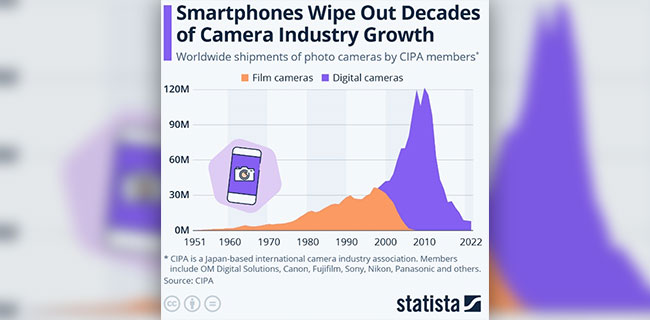
 I came across two very interesting infographics by Statista last week. Though they are different pieces of information, to me they seemed bound by the common thread of a problem that every brand faces in its lifetime – obsolescence.
Brands are scared by this very word. It is a stage in life that no brand wishes to ever experience. Yet, every brand must.
I was discussing the infographic on cameras with a friend and he said, “These Japanese brands have become obsolete. They are nothing today. In just 15 years.” Little knowing, he had posed a crucial question that every brand manager would ask oneself and try the best to answer.
Does a brand become obsolete?
I do not think so, if it is a true brand in the first place. A brand is the promise of an experience, consistently delivered over time, as my guru Wally Olins used to say. Hence, a brand not merely a physical product, method or process. It is the experience that the product or method or process provides. Kodak was not about making cameras. It was about preserving memories. The day it forgot this basic and obsessed with making better cameras, it lost the plot. Just like Canon or Nikon or Panasonic or the hundreds of camera brands that believed their purpose was making a camera.
Those that realised that their purpose was to help capture occasions, share experiences and create memories did not get bogged down by just one product format or process and devised new formats and methods. While many had written off the European camera makers in the 1990s due to the sheer dominance of the Japanese, they are back in business, collaborating with the smartphone makers in engineering their optics. So you have One Plus or Oppo collaborating with Hasselblad. Nokia had collaborated with Zeiss. Xiaomi has collaborated with Leica, which had a previous partnership with Huawei. Amongst the Japanese brands, Sony too realised its brand calling was much bigger than just a camera box, hence happens to be one of the largest optics partner for smartphone and smart device makers.
If Colgate thinks of itself only as a toothpaste and not about dental health and happiness, its days are limited. Similarly if Maruti Suzuki thinks of itself as a maker of personal 4-wheeled vehicles and not as about democratising mobility in India, it will get gobbled up by someone who provides mobility solutions, however large it might be.
A brand never becomes obsolete. A product does. A method does. A process does. And if a name thinks it is only the means and not the end, it surely does become obsolete.
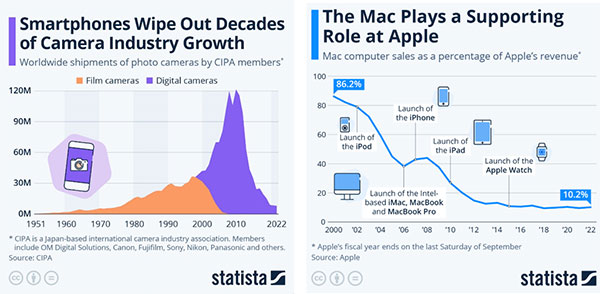
Now, the second infographic says that the Mac is now merely around 10% of Apple’s annual revenues. Which raised the second question in my mind – are brand relevance and obsolescence correlated? Which means, if a brand remains relevant, it cannot become obsolete, and vice versa.
In just 22 years, the share of the Mac in Apple’s revenues has fallen by 8 times. Does that mean that the Mac is losing relevance in Apple’s future scheme of things? Does that imply that the Mac is on the verge of becoming obsolete?
Not at all. The Mac continues to play a critical role in the larger ecosystem that Apple has created. Just that the ecosystem is so damn huge that its financial impact has reduced. However, it continues to do robust numbers, is always a focus at every annual product announcement day and is a critical lifeline for students and creative people. Without the Mac, the ecosystem will be incomplete and other business lines will get adversely impacted. And the fact that Apple keeps regularly upgrading the entire range demonstrates the key role it plays.
So, a lesser share of revenue does never mean waning or lesser relevance of a brand both for the organisation as well as the marketplace. Even though share goes down, profitability can go up. And that critical brand can actually open doors for the organisation into other customer needs and applications. A student buying the first Macbook will certainly be a prime target for the phone, watch and every future solution that Apple comes up with.
Just like the lesser numbers of the Tata Harrier does not imply it has lost its relevance vis-à-vis the Nexon and Punch. The Harrier plays a key role of demonstrating a certain level of engineering, design and performance shoulder to shoulder with a Honda, Hyundai and Kia. Hence, it plays a critical role for the larger Tata brand and its mobility ecosystem.
The next time someone casually comments that a brand has become obsolete or irrelevant, just pause for a moment, give a deep think and then decide whether the statement holds any water, or is it just a temporary phase in the brand’s lifecycle.
Peugeot had started off its brand lifecycle making water mills and steel knives and forks.
So there!